




Abstract
This article explores how Czech amateur participants in reality television programmes interpret their position within production relations. The research is theoretically informed by the notion of value as understood in Critical Marxist theory and the study of extraction of surplus value through capitalizing on unpaid work in reality television production. The principal aim of the research is to circumscribe the narratives produced by the cast members to expound on their provision of their labour for free. Qualitative analysis of semi-structured interviews reveals that participants in reality programmes do not construe their performance on reality television as work, and that the exploitative nature of the reality television production model stays out of their sight.
Amateurs on reality television
The typical production cost of one reality television (RTV) episode in the Czech television market is around 15,000 EUR, whereas one episode of television drama costs approximately 170,000 EUR. 1 Twenty years ago, Mark Andrejević reported that the costs of RTV programmes are a third less expensive than television drama (Andrejević, 2004: 11). The disparity in cost has grown substantially; nowadays in the Czech Republic RTV programmes can be produced at about nine percent of the cost required for television fiction, with its higher production values and featuring professional actors. These figures highlight the vital significance of RTV programmes in reducing the amount of capital re-invested within the television industry and increasing the profits. The striking difference in the cost of producing these programmes is attributed, among other things, to their engagement of amateur participants who sell their persona for ludicrously low compensation (Andrejević, 2011, 2014; Grindstaff, 2011, 2014; Hearn, 2006, 2008, 2010, 2014; Johanssen, 2017; Redden, 2017; Ross, 2014; Wood et al., 2017). We employ the term ‘amateur’ to distinguish reality television participants from professional actors and media personalities. In our usage, ‘amateur’ refers to individuals who lack formal training in performance arts, do not derive their primary income from media work and typically participate in RTV as a one-time or occasional activity.
The RTV programmes’ participants are the prime focus of this article which strives to unpack how the cast members themselves understand their position in the production process. We bring to the forefront that they engage both physically and creatively in the production of shows, while their efforts are not considered to be work and they are deprived of proper wages. 2 This situation is exacerbated in the case of people with low socioeconomic status, suffering from off-screen precarity as well, who are significantly overrepresented as cast members in Czech factual entertainment television. 3 It is not rare that participants in RTV programmes belong among the roughly 600 000 Czech citizens (almost sixpercent of the whole population), whose income is seized by private debt collectors because of unpaid loans . 4 RTV’s producers have even developed the habit of paying (if there is any modest payment) the cast members in cash to circumvent their closely watched bank accounts. 5
The socioeconomic realities of the Czech Republic are shaped by its historical position as one of the Eastern European countries that belonged to the state socialist bloc before 1989. Currently, the Czech Republic holds the lowest proportion of the population at risk of poverty or social exclusion (AROP) in Europe – 11.3 percent in 2024, defined as those living below 60 percent of the median income (Eurostat, Persons at risk of poverty or social exclusion by age and sex,2024). 6 However, the median income itself remains rather low, and it is distributed fairly evenly. Gini coefficient was 2.37 in 2024 (Eurostat, Gini coefficient of equivalised disposable income, 2024). 7 Together, these figures suggest a condition of relative income equality underpinned by generally low earnings – what could be described as a society in which people are generally ‘equally poor’. While extreme poverty is not widespread, sociologist Daniel Prokop estimates that one fifth of the population lives near the poverty threshold (Pokorný, 2024).
In the post-socialist Czech Republic, RTV production and reception have been closely intertwined with the newly acknowledged reality of social inequalities and the society’s enthusiastic embrace of neoliberalism. RTV – particularly life intervention and makeover shows – gradually (after 2000) began to serve as a lens into life at the social margins in the post-1989 period. In a society shaped by 40 years of egalitarianism, representations of poverty and socioeconomic deprivation have evoked – and continue to evoke – a peculiar mix of fascinated contempt and a revolted gaze, often classifying lower-class RTV participants as backward laggards incapable of cutting the cords to the socialist paternalist state and its economy of scarcity (Reifová 2021a; Reifová 2021b).
The main objective of the following research is to fathom how the cast members understand the production model of RTV, their role in the programme making process, and crucially, whether and how they conceptualize themselves as workers. We examine the narratives they assemble to account for the provision of their labour for inadequate, or no, remuneration, with particular attention to how they position their activities within or outside frameworks of labour.
Our interest in participants’ imaginings of labour and perceptions of fairness in working conditions stems from the above-mentioned orthodox implementation of neoliberalism in post-socialist societies (Makovicky, 2016). With these objectives, our research draws on the perspective of cultural studies of media industries (Mayer et al., 2009). In this field, media products are no longer seen as the work of individual creative geniuses, but as the result of production cultures – environments shaped by collaboration, competition, hierarchy and power dynamics that influence how individual talents operate within larger organizational structures (Banks et al., 2016).
‘Labourization’ of media production studies
Labour is generally defined as a productive activity aimed at creating material and non-material goods and services. The transformative effect it has on the external world and the fulfilment of needs, including the basic means of subsistence, are among the attributes most commonly associated with labour. The tradition of critical political economy distinguishes between work, which is timeless productive activity, and labour, the concrete organization of work in class-based societies (Fuchs, 2014: 26). In capitalist society, the main characteristic of labour is the production of marketable commodities – any activity that builds up value suitable for monetization in capitalist markets is considered labour. The notion of labour became instrumental in the analysis of ‘the new spirit of capitalism’ in the last 20 years (Boltanski and Chiapello, 2007). Today, critical scholars find labour in many unexpected places. After the ‘turn to labour’ (Hesmondhalgh, 2017: 30), actions and deeds which used to go unnoticed as playing, socializing with others, or simply living one’s life are reconsidered as work. With concepts such as emotional labour (Hochschild, 1983) and immaterial labour (Lazzarato, 1996) at the forefront, this perspectival shift encouraged critical theory scholars to circumscribe affective labour (Hardt, 1999), aspirational labour (Duffy, 2016), crowdwork and microlabor (Altenried, 2022), invisible work (Kaplan Daniels, 1987), hope labour (Kuehn and Corrigan, 2013), prospecting labour (Fast et al., 2016), spectacular labour (Johanssen, 2017) or speculative labour (Gregg, 2015).
It is the concept of immaterial labour which received attention for its aptitude to pin down the nature of amateurs’ involvement in the production of RTV (Hearn, 2008, 2010, 2014). The autonomist Marxists coined the concept as part of their analysis of the transformation of the ‘contemporary scene of labour and production . . . under the hegemony of immaterial labour’ (Negri and Hardt, 2004: 65). Under the umbrella of the immaterial labour production paradigm, work in post-Fordist society is reinvented as activity necessarily containing cognitive, informational, communicative, social, or emotional investments.
Immaterial labour is ubiquitous in time and space. It has the ‘tendency to blur the distinction between work time and nonwork time’ (Negri and Hardt, 2004: 66), but it also washes away the division between work and the worker. In the regime of immaterial labour, the worker works with her entire personality and subjectivity, and thus she becomes her labour. Modern management techniques, according to Mauricio Lazzarato (1996) ask for nothing less than ‘the worker’s soul’ (p. 134). Immaterial labour makes tight entanglements of work and the worker’s personal traits, needs, affects and anxieties. Work is no longer instrumental activity confined to specific working hours; it becomes articulated with the worker’s self-worth, identity, fulfilment, passion, distraction, or entertainment. Fluidity between work and nonwork life means that ‘immaterial labour involves a series of activities that are not normally recognized as work’ (Lazzarato, 1996: 133). The ultimate logic of this restructuring of work – intermingling it with activities, virtues and needs that do not resemble work – is straightforward. Under these circumstances, the articulation of work and wages is growing looser. The worker’s activities that generate value, but that do not correspond to the traditional idea of work, are easy to exclude from the worker’s pay. Marxist vocabulary refers to the amount of work, which is not factored into wages, as surplus value. Its appropriation by the subject who did not create it is understood to be the determining precondition of the unjust arrangement known as exploitation.
Amateur labour on RTV
Amateur participants’ involvement in RTV corresponds to the definition of immaterial labour in multiple ways. The substance of their immaterial labour is in the complete embroilment of their psychic sensibilities and social life in production of the media content. They work with disclosing their privacy, producing and receiving strained emotions, activating bodily affects and demonstrating positive or, more likely, negative relationships. Andrejević (2004) coined the term ‘productive surveillance’ to describe participants’ provision of access to their private zones, viewing it as one of the resources that the RTV production model acquires at no expense (p. 6). By assuming the role of a giant social peephole, where those ‘behind the wall’ bear the costs, RTV emerged as a visionary precursor, or rather early symptom, of surveillance capitalism (Zuboff, 2019). In Hearn’s (2014) words, life-intervention surveillance shows are predicated upon ‘monetization of being’ (p. 248). The question arises as to what underlies participants’ decisions to commodify discreet facets of their private lives and affective structures? Does it originate from the principles of the genre, the exploitative commercial interests of the producers, or does it indicate a volatile space for the participants’ own agency?
RTV culture tends to be interpreted as a cultural incarnation of the social and economic paradigm of neoliberalism. Televisual texts of RTV programmes were scrutinized for showcasing responsibilized neoliberal subjects (Biressi and Nunn, 2008; Ouellette and Hay, 2008a; Stiernsted and Jakobsson, 2017), who are expected to fend for themselves outside networks of communality and solidarity, through personal discipline and self-management (Ouellette and Hay, 2008b). Text analysis revealed that individualistic entrepreneurialism is portrayed as a normative model of humanity in RTV, where our own selves are viewed as capital intended for value enhancement (McCarthy, 2007). Audience research nevertheless contested the significance of RTV as a form of neoliberal pedagogy (Sender and Sullivan, 2008). In this context, Skeggs and Wood (2011: 94) emphasized the experiential affectivity of RTV programmes rather than their ideological governmentality. The extent of integration into neoliberal contexts spans beyond RTV texts and audiences. The production processes, roles and (self-)positioning of amateur participants also warrant assessment from the perspective of neoliberal adherence. Cast members’ participation in RTV programmes is often depicted as an effort to establish their selves as brands (Arcy, 2015; Duffy and Pooley, 2019; Hearn, 2006, 2008, 2010, 2014; Khamis et al., 2017). Participants’ familiarity and recognizability, stemming from unique and easily discernible attributes (whether scandalous and bizarre gigs), become the brand’s selling points, expected to generate value through subsequent appearances in the symbolic industry. For example, in the Czech adaptations of Pop Idol, the category of unskilled, off-key performers ‘Starship Troopers’ garnered significant attention, propelling some eccentric participants, like Shopaholicadel, into social media phenomena. From this perspective, RTV participants tend to adopt neoliberal solutions in response to an environment of precarious labour, characterized by various forms of ‘flexible accumulation’ (Harvey, 1990). By performing on RTV programmes, they produce their selves in a dual capacity of ‘image commodity’ and ‘image entrepreneurs’ (Hearn, 2010). They co-create an economic system in which the distinction between the commodity and the capitalist implodes in the fuzziness of immaterial labour. Given that the primary fodder of the shows is their selves, which are invested, designed and managed by themselves, they embody the role of ‘entrepreneurs of the self’ (Gordon, 1991, cited in Hearn, 2006). Their selves fulfil a dual role: they act as the capitalists, overseeing transactions and profits, while simultaneously serving as the commodity being exchanged. Simultaneously, their selves also represent ‘temporary celebrities’ (Hearn, 2014), who are perceived as demonstrating how to adopt personalized entrepreneurship for others. According to Hearn (2006), by intertwining image with commodity value, RTV participants construct spectacularized selves. They function as templates for others to mould their identities in alignment with ‘corporate colonization of the real’ (p. 133). Television broadcasting of these templates extends ‘the logic of the branded or promotional self . . . further into the general population’ (p. 143). Duffy and Pooley (2019), in their discussion of social media personalities as contemporary ‘mass idols’, classified this kind of neoliberal modelling as ‘parables for making it in a precarious employment economy’ (p. 26).
A strand of research, anchored in the work and exploitation paradigm, perceives RTV participants as workers subjected to various forms of coercion and manipulation, rather than as entrepreneurs deftly manoeuvring through the attention economy. Wood et al. (2017) addressed this dual focus in literature centred on RTV production: ‘Much of the literature surrounding this figure focuses on it as part of the celebrity economy which invites new forms of self-commodification and performance “labour” – and yet there is curiously very little interrogation of this form of celebrity work as work’ (p. 117). The work-centred inquiry into RTV was initiated by Mark Andrejevič (2004, 2011) who claimed that being watched during one’s daily activities constitutes work and that unpaid or inadequately paid work in RTV amounts to exploitation. According to Alan Wertheimer (1999), RTV participants must be coerced to be considered exploited, a condition not present in the RTV production process. Nonetheless, RTV participants, particularly those from the working class, are likely subjected to coercion by the macrostructures of capitalism in their off-screen lives, with their freedom of choice potentially constricted by severe socioeconomic hardships (Andrejević, 2011: 26).
In their wrap-up of the varied forms of academic neglect and public deprecation directed at the work of ordinary celebrities on RTV, (Wood et al., 2017) argued that a significant portion of this labour resembles traditional, physical and embodied work. When addressing the ways television celebrities are ‘moulded, recycled, and repurposed’ (Wilson, 2014) we must consider the entire mode of production and look beyond the straightforward exploitation in value extraction. Asymmetrical labour relations in the RTV production model contribute to impeding the entrepreneurial upswing of amateur performers. ‘Dispensable celebrities’ occupy the lowest tier of cultural work, experience short shelf lives and are subject to the demands of the show and the market, rather than autonomously running their celebrity micro-corporations (Collins, 2008). Laura Grindstaff stressed that since the outcomes of RTV programmes are strongly premeditated, ‘the agency of participants is more rigidly circumscribed by the dictates of the production process as well as generic expectations for what constitutes a successful performance’. This characterization of RTV participants, which we deploy in our research, starkly contrasts with theories centred on RTV participants’ self-marketing strategies as a systematic method in scaling up their personal corporate-style identities.
The theoretical frameworks of immaterial labour, self-branding and exploitation in RTV production were mainly developed through the analysis of Anglo-American media contexts. However, the global expansion of reality television formats raises critical questions about the universal applicability of these theories. This study contributes to this emerging body of work by examining how the conditions of post-socialist transformation shape participants’ narratives about their involvement in RTV production, potentially challenging assumptions embedded in theories derived from different cultural and economic contexts.
Outline of methodology
In our research we aim at replenishing the existing theories of immaterial amateur labour in RTV production with the emic perspective of the cast members themselves. Our main concern was to collect their own accounts of their physical and psychic involvement in RTV production and identify the narratives they produce when expounding on their roles within the filming process.
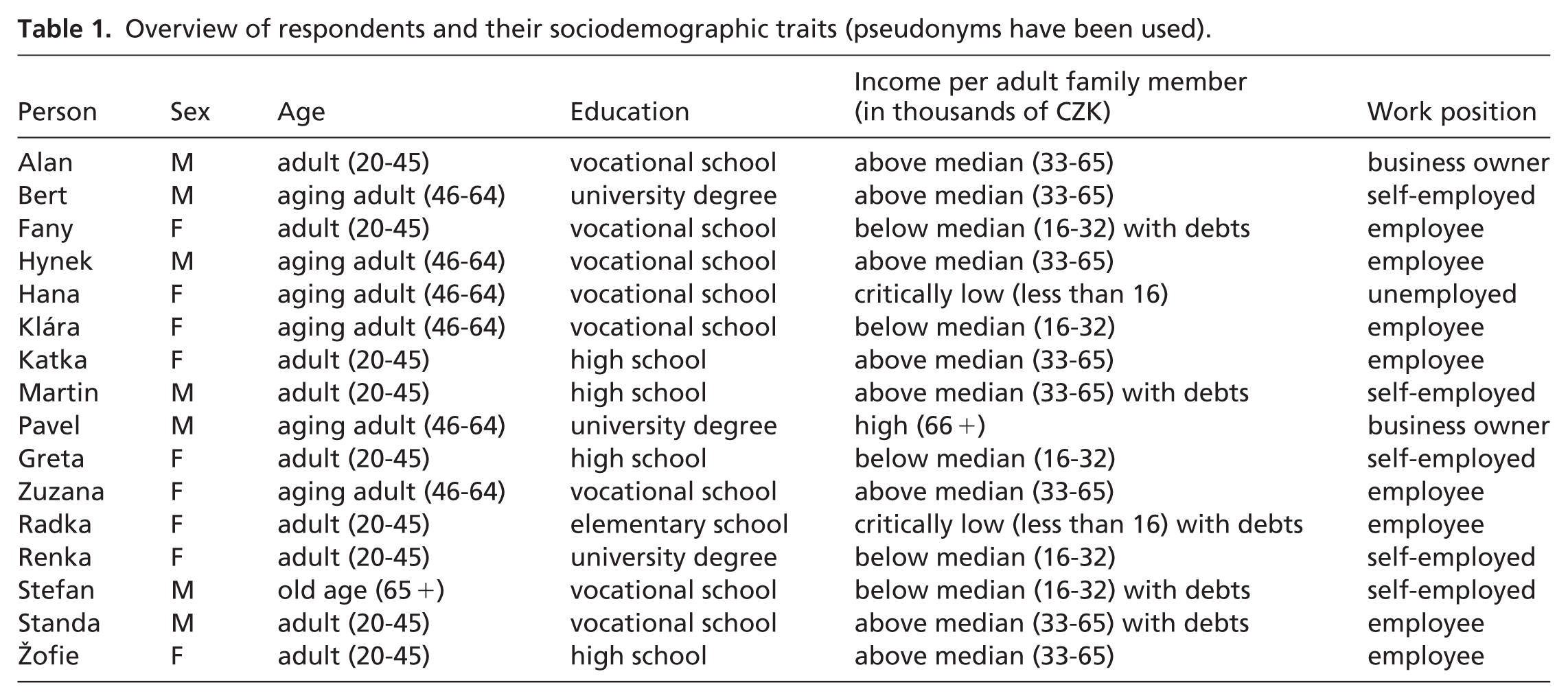
To accomplish this, we conducted 16 semi-structured interviews which took place in September 2021 (See Table 1). The interviewees were recruited with the assistance of TV Prima, a Czech television channel proficient in the production of RTV programmes. Basic demographic and socioeconomic data, including participants’ debt status, were collected through a short questionnaire to serve as a reference for interpreting responses in the analysis section. We remunerated our respondents for their time with funds from our project provided by the Czech Science Foundation.
Overview of respondents and their sociodemographic traits (pseudonyms have been used).
The interviews, taking approximately 2 hours each, followed a list of topics prepared in advance, which helped us to map out the scope of cast members’ work on RTV, motivations to participate, benefits and costs associated with their RTV appearance, how shooting was situated in time and space and what were their relations with other participants and crew members. We encouraged a narrative approach in the responses to collect stories and reasoning instead of just facts.
Our methodological approach places strong emphasis on the protection of respondents’ privacy and anonymity. While ethical issues related to interviewing celebrities (Driessens, 2014) and elites (Lilleker, 2003) have been previously addressed, we deliberately chose not to categorize our participants within these groups. Despite their public visibility – which might otherwise justify a reduced expectation of privacy – our research indicates that these individuals occupy the position of amateurs and outsiders in the circuits of value within the attention economy. Therefore, we applied the same ethical standards as for private individuals. Specifically, we used fictitious pseudonyms and replaced the exact titles of the shows with indeterminate characteristics.
To systematize how cast members interpreted their role as working subjects in RTV production, we coded, categorized and analysed respondents’ narratives using the grounded theory toolkit (Strauss and Corbin, 1990). The interviews were transcribed and coded in NVivo. Open coding was carried out by two coders: inter-coder agreement was calculated with the NVivo Coding Comparison function with the result Kappa = 0.6. Subsequent rounds of coding, when relationships between categories were established and concluding pivotal categories selected, were carried out by one coder.
The analysis was unfolded by moving from the ontological to the phenomenological dimension of the research problem. We began by identifying what the participants highlighted as the most salient aspects of performing in RTV. From there, we distilled the interpretations emerging from the participants’ narratives. Finally, we confronted these interpretations with the critical theory perspective on the capitalization of amateurs’ self-investment in RTV production.
Work displacement
Our respondents largely rejected the notion of their performance on RTV as work. When asked whether he felt like he was doing work during the filming, Stefan responded: ‘Nah, no way. They told us not to look at the camera and we just acted like it wasn’t even there’. Pavel, when asked the same question about his performance on a food-based competition show, reacted: ‘You can’t really call that work. I don’t consider cooking to be work’. Standa’s response to his participation in a social experiment programme, that includes an honorarium, went like: ‘Nah, I just saw it as fun, not work. The fact that someone paid me for it was a bonus’. Fany seconded with the similar words: ‘During the filming, I felt like I belonged there. It didn’t feel like work; it just felt like I was doing something natural’, as well as Radka, who said: ‘Did it feel like I was working on that show? No, no, no, not at all. Definitely not’.
The persistence with which respondents disconnected their participation from the notion of work varied. None of them embraced the narrative of work spontaneously or of their own accord, and 9 out of 16 still rejected the idea that their performance constituted work, even when explicitly prompted. The remaining seven respondents (Bert, Renka, Martin, Hana, Žofie, Hynek, Greta) eventually agreed or partially agreed with the characterization of RTV performance as work after they were presented with this interpretation. For example, Bert identified with a work-based definition of his RTV participation: ‘Yeah, it’s still work. Basically, anything you do with the goal of earning something is work, even if it’s fun’. Hana differentiated between roles in which she impersonated characters other than herself (in the courtroom shows) and those in which she represented herself personally. For her, only the former qualified as work: ‘Well, I guess when I was playing those other people, yeah, when I was doin’ that, I felt more like I was at work, like I had to deliver something’.
Irrespective of the intensity and persistence with which respondents articulated their definitions, the most prominent pattern emerging from our data is their rejection or reluctance to conceptualize their engagement with RTV programmes as work, a phenomenon warranting further examination. In the following subsections, we analyse three key dimensions of this work displacement: how participants describe performing various activities while denying these constitute work (5.1), their significant time investment despite rejecting work frameworks (5.2), and the conditions under which some participants do acknowledge work-like aspects of their involvement (5.3).
Performing activities, but not doing work
To be clear, our respondents described a range of different activities (outlined below) that they engaged in during the shooting. However, they consistently resisted or avoided categorizing these activities as work. In some cases, this dual narrative of acknowledging the performance of activities while denying that they constituted work led to outright contradictions, as seen in the case of Katka. At the beginning of the interview, Katka stated: ‘I was constantly cooking, the kids in that family did not know homemade food. I was doing laundry five times a day. I worked my fingers to the bone there’. When explicitly asked later whether she considered the filming to be work, she responded: ‘It didn’t feel like work to me; it was more like being at some kind of camp’.
The activities detailed by our respondents encompassed a range of tasks that were integral to their performance. Some provided detailed accounts of
On numerous occasions, our interviewees engaged in
Contrary to standard definitions of the RTV genre (Kavka, 2012), the participants did not merely passively disclose their being to the cameras. Instead, they engaged in
Akin to creative practices, the respondents outlined how they perceived the shows from the perspective of I could replace all the food in the fridge before the nutritionists’ inspection, but I did not. The sausage was left there, so were the ice creams. This is a reality show, you know. Some things must be there, otherwise it would not work.
Another recorded instance of a production-adopted perspective was a concern with audience satisfaction and ratings. Zuzana exhibited a profound dedication to the interests of the viewers, for whom she claimed to be working: ‘We’re doing it for the people, you know. So, let those folks enjoy their time in front of the TV’. Spectatorship held significant importance for Standa and Adam as well, although they prioritized responsibility for generating ratings over delivering entertainment to the audiences.
Investing time, but not doing work
The previous section examined the extent of RTV participants’ involvement in the making of the shows, highlighting various activities that were nevertheless not classified as ‘work’ by the cast members themselves. This data configuration is further triangulated with the category of (labour) time. Not only did our respondents engage in diverse activities, but they also invested a considerable amount of time in them, all while excluding this time from the discourse of work. From a Marxist viewpoint, ‘labour time is the measure of value’ (Fuchs, 2014: 46). To understand the role of RTV participants in the production process, their activities must be considered within the dimensions of time.
All but two respondents reported enduring long and exhausting periods of filming. Their tolerance for extended working hours without fixed shifts varied, influenced by the off-screen work cultures to which they had been socialized. Hana, an ordinary countrywoman participating in hybrid RTV shows for financial reasons, described the long working hours as a notably severe condition: You show up at seven in the morning and end up waiting until like five or six in the afternoon. It’s really tough on you, because you just have to sit there on the floor or something. Nobody’s gonna give you even a sip of water.
Renka, an early-career singer aiming for a career in showbusiness, saw it as an inevitable aspect of the industry: ‘There were times I was totally wiped out. They kept filming and it was three in the morning. But at the same time, I was thinking –I signed up for this, they’re just doing their job, after all.’ While Hana viewed the television crew as ‘the Other’, imposing harsh conditions on her, Renka’s profile as a semi-professional artist fostered greater empathy for the organization of television shooting and tolerance for working through the night. Renka, with her background in the music industry, perceived what Ross (2008) terms ‘flexploitation’ in creative work as more normalized than other participants.
Cast members’ time invested in the shooting was not limited to what they did on the film set. It was extended to various preceding and follow-up activities, which represent yet more deeply concealed (and hence unpaid) activities contributing to the show’s commercial power. Prior to filming, participants typically allocated time to enhancing their chances of making a good impression on the TV screen. They cleaned or renovated their apartments (Standa, Žofie, Fany, Katka, Hynek) and attended to their appearances by visiting hairdressers or purchasing new clothes and make-up (Radka, Žofie, Greta, Renka).
While the preliminary activities were primarily physical, respondents’ follow-up efforts were predominantly focused on handling the emotional repercussions, particularly those related to maintaining their reputation and psychic well-being. Emotional strain was inextricably intertwined with the reception of their RTV performances on social networks, primarily with online shaming and disparagement (Reifová, 2021a, 2021b). Eight respondents recounted spending time reading comments on Facebook, which they described as tormenting. Hana became a victim of the blurred line between reality and fiction in the courtroom programmes. She impersonated morally or socially challenged characters of other ordinary people in several episodes of these hybrid programmes. In such shows, ordinary people frequently serve as amateur actors, portraying the lives of other ordinary people in a strategy of low-cost production. Hana became a victim of an online witch hunt because viewers believed she was personally responsible for the shocking events depicted: I was sitting at home and crying. They were nasty to me, writing to me that I kicked out my own children and did not care about them . . . But I have three kids and did not throw out any of them.
Hana shouldered the emotional costs associated with specific RTV programming that relies on blurring the lines between actors and characters, tinkering with non-transparency and encouraging audience gossip culture. In this way, she contributed to the show’s capacity for generating profit. In some instances, online hate was replaced by offensive reactions in the real world, necessitating a significant amount of psychic energies. ‘I had paparazzi waiting by my house after being on two shows, and, I admit it, I reached for the antidepressants. I was simply terrified of going out. I went on sick leave and stayed behind closed curtains’ (Standa).
Equivalence of work: drawing parallels between RTV performance and regular jobs
What underlying dynamics lead respondents to sideline the concept of work when recounting their involvement in RTV shooting?
The respondents who acknowledged that they acted as working subjects, such as Bert, Renka and Martin, simultaneously constructed a specific equation through which they aligned the activities performed during filming with those carried out in their regular jobs. They drew a parallel between their professional work and the substance of their performance on television. Both Bert and Renka have experience in the media professions – Bert was a presenter for a local radio station in his younger years and Renka is a singer recording with smaller labels. Renka adopted the worker’s discourse when describing her participation in the song contest: ‘We were really working, like rehearsing with the band, or when we were doing actual prep work, with the costumes, that was genuinely hard work’. Renka and Bert’s experience in the media industry informs their characterization of RTV gigs as sui generis work. Martin’s perspective was similarly rooted in the alignment between his regular job and his activities on the film set; however, in his case, a different equation emerged. He recognized certain aspects of his RTV performance as legitimate work because he was tasked with performing his usual job – operating an excavator – for the camera in a show about self-employed individuals awash with debts: ‘With that show, it was work. Because there, they actually filmed pretty much all our jobs, you know. Whether I’m sitting in the office, on the excavator, or doing this and that. . .’. Martin appeared in several RTV programmes, but he restricted his definition of work to the instances when he replicated aspects of his regular job in the life-intervention programme.
The findings indicate that what shaped the respondents’ definitions of their roles in the production process was the equivalence – or lack thereof – between the activities in RTV and their own perceptions of work derived from their daily jobs. Many participants did not see themselves as RTV’s working subjects because the television tasks did not match their usual understanding of work. This widespread denial of their activities as work in their RTV experiences is best understood through the lens of immaterial labour theory, as discussed earlier (Lazzarato, 1996; Negri and Hardt, 2004). It likely arises from the lack of a clear connection between the activities performed during filming and any familiar forms of work they have encountered before. Our finding concerning the (lack of) equivalence between work and RTV activities highlights a subtle mechanism that facilitates the ease of RTV exploitation.
Gains and pleasures of participating in RTV
The displacement of work among our respondents was closely linked to their complete avoidance of viewing RTV as an enterprise generating profit for the television industry, particularly through the privatization of surplus value created by the participants. In response to the question ‘How do RTV shows make money?’ 11 participants emphasized the role of ratings in generating profit. Some participants were clearly aware that ratings drive advertising revenues. For example, Hynek noted, ‘Well, if you think about it, how is TV paid for? From ads. They can only charge money for ads if they have some kind of ratings’, and Zuzana remarked, ‘Well, they must get ratings. So that they can get ads and make money from it’. Others, like Radka, perceived ratings as a kind of magical black box, viewing the figures as inherently significant without detailed understanding: ‘They need to have, what’s it called, ratings, so they get a lot of, well, so people watch it, you know’. In any case, all respondents reacting to the above question viewed ratings and advertising as the core economic principle of RTV. Not one participant mentioned that their labour, which was either unfairly compensated or not compensated at all, directly contributed to the accumulation of profit within the industry.
From the viewpoint of our participants, RTV was not primarily significant as a genre funnelling profits into television budgets, but rather as an experience through which they could secure various forms of monetary or non-monetary rewards for themselves. They did not see their participation in RTV as a loss or harm but, on the contrary, as a method of achieving their personal goals. Participants narrated their involvement in the shows as a way of obtaining something they deemed valuable. This focus, on the gains and pleasures derived from their participation, is a crucial element of the hermeneutical framework that underpins their disinterest in viewing their involvement as work, and in recognizing themselves as workers whose efforts are capitalized on beyond their control.
We identified four types of values that participants associated with their appearances on RTV programmes, which combined symbolic pleasures and practical gains.
Financial help
Nine respondents indicated that financial gain (or the potential for it, in the case of winnings) was among the motivations for applying to participate in the RTV programmes and the satisfactions which they brought to them. Five of them cited money as the primary reason for their participation. These five individuals hoped that it could alleviate the socioeconomic hardships they were experiencing. Radka’s family was in debt and living in emergency housing. Standa was financially dependent on his partner. Stefan was unable to afford fodder for his horses, and Hana and Hynek were unemployed with serious health issues. The circumstances of these participants challenge the assumption that RTV participants’ choices to perform are free from coercion and thus should not be considered exploitative (Wertheimer, 1999). Hana provided the following account of her condition prior to participating in RTV: ‘I needed it for the house, for food, for everything. I seriously needed it just to get by because money from the government is way too little’. Money was nonetheless also a motivation for more affluent participants who sought additional contributions for their special projects. Katka’s family income was above the median and her motivation was still primarily financial: ‘We were doing that apartment renovation back then, so we mainly went for it because of the money. We didn’t take out any mortgage, so it was like a financial boost that really helped us out’.
The financial incentive itself was a significant factor for some participants, although the specific amounts they received were less important. Aside from Hana, who complained about exceedingly low payments from the television, there were no comments on the equity of the financial compensation in reflecting the nature of the activities performed or the time spent filming. This perspective can be interpreted as a reduced concern for the processes of exploitation.
The desire to appear on the television screen
A group of six of the participants (Fany, Renka, Standa, Martin, Pavel, Hynek) found the idea of being televised particularly appealing. Their pleasure was manifested in idealistic and pragmatic forms.
The So, it actually gave me what I’ve always wanted – to be on that movie screen, to have that career, to be, you know, famous. So, thanks to that, it kind of really worked out well for me. . . . I don’t do that anymore now.
The
Our ‘screen-pragmatic’ respondents better complied with the category of ‘ordinary celebrity’ as defined by Grindstaff (2014) who attributes to them ‘fleeting and program- or event-specific’ familiarity rather than ‘sustained and intertextual recognition’ (p. 324). Sue Collins (2008) coined the term ‘dispensable celebrity’ to encapsulate this category of temporary starlets, who serve as a backdrop to highlight the excellence of the true A-listers. While Collins’ concept of ‘dispensable celebrity’ captures the temporary nature of many reality television careers, Hugh Curnutt (2011) has argued for the emergence of more ‘durable’ forms of reality celebrity, whereby some participants successfully leverage their initial appearances into sustained media careers. In the style of ordinary and dispensable celebrities, our respondents saw some opportunities to capitalize on their television appearances, but they did not dream of commodifying themselves into full-time stars. Hynek, who participated in the singing contest with his wife, a migrant from Eastern Europe with a background in musical education, saw the show as an opportunity to promote his wife. Nevertheless, he did not envision her in the larger world of showbusiness but rather as a music teacher: ‘I signed her up to show off her singing and teaching skills. Cause when we decided we’d be together, I was like, it’d be such a waste for her to just end up here as a cleaner or something like that, you know?’
Our ‘screen pragmatists’ illustrate, as Grindstaff (2014) noted, that there are variegated types of ordinary celebrity. At one end of this spectrum, some ordinary celebrities possess semi-professional skills and aspirations that align them more closely with traditional entertainment industry practices and glamorized celebrity culture. Renka, a young singer with studio recording experience and plans for a music video, represents this end of the spectrum in our study. At the other end, ordinary celebrity overlaps with cultural forms historically associated with popular spectacle, such as variety entertainment, freak shows, or circuses. These modes of visibility are often grounded in non-elite, locally specific platforms rather than in mainstream stardom or professional aspiration. Martin exemplifies this latter end of the ordinary celebrity continuum. He has been in provincial and low-brow showbiz, singing and playing music at the amusement parks, corporate events and private parties, for years: I go around to weddings, Christmas parties, all these cultural events. . . . So, the offer [to go on RTV] kinda came in handy, you know? We were like, okay, this will be another experience, there’ll be experts and all that stuff.
Self-branding thus encompasses both aspirational, high-profile forms and more modest, community-oriented purposes. Scholars of self-branding, such as Hearn (2014), describe RTV programmes as the assembly-line production of star-struck celebrities whose aspirations propel them into careers within other popular media. MTV’s show The Hills has been cited as a quintessential example of a platform for the construction of personal brands through glossy aesthetics and vibrant, electrifying urban nightlife (Hearn, 2010). However, it is important to note that this is not a universally applicable RTV template. In our study, we found respondents situated on the spectrum of ordinary celebrities who engaged in self-branding in a more subdued, parochial and unpolished manner, devoid of the practices of the spectacle-savvy self-promoters.
Eagerness to become familiar with television’s backstage
While those wishing to see themselves on television valued it as a stage, we also identified others who were captivated by the opportunity to glimpse behind the scenes. For seven cast members (Alan, Bert, Klára, Greta, Pavel, Zuzana, Žofie), the principal motivation for participating in RTV was the desire to get access to the otherwise unattainable television milieu, which they found appealing and extraordinary. Klára said on this topic: ‘I was also very interested in the shooting itself, how it is managed and organised . . .’. Žofie put it in almost identical words: ‘I found everything around shooting very interesting. Backstage was particularly exciting’. The opportunity to witness the show’s production and television work was a source of fascination to them; a moment of encounter with an otherwise distant television aura.
RTV participation as a mission
The final distinct motivation was observed in Hynek and Fany, who viewed their RTV appearance as a mission. By making public appearances on RTV, they aimed to share their stories of life-changing experiences, hoping to enlighten wider audiences. Fany, for instance, was on a religious quest: ‘I found my faith in the Lord and all my life changed. I wanted everyone to see how great God is and what his capacity is to change the people’.
The four motivations embody values, the pursuit of which was of such significance to the participants that it propelled them into participating in RTV: money, self-iconicity, privilege and mission. Shedding light on the desire for these gains and pleasures is essential for theorizing the participants’ notable indifference towards unpaid or inadequately compensated work and reduced concern for exploitation of their labour power within RTV production.
Discussion: who is the arbiter of exploitation?
Our respondents narrated their participation in RTV as an experience rooted in personal autonomy, whereby they set their own goals or pursued their dreams, which they realized through the opportunities afforded by the RTV genre. They largely framed their RTV participation as self-directed, goal-oriented projects, executed under their own supervision and control. Involvement in RTV was predominantly associated with attainment of various forms of pleasures and gains. The majority of respondents did not regard their participation as work, even when prompted, and none were aware that RTV generates profit margins, in part, by capitalizing on surplus value created through low-cost production – one significant element of which being their unpaid or underpaid labour. In simpler terms, they were highly attentive to the values they garnered, while neglecting the value extracted from them.
This self-centred orientation, focused on the gratifications obtained, was aptly encapsulated in Renka’s words: ‘I saw it as me actually wanting something from them. I saw it like, my reward was singing in that broadcast, during prime time, and basically, it gave me what I wanted’. Renka’s self-empowering narrative culminated in her conviction that she outmanoeuvred the RTV production, rather than being outmanoeuvred herself: ‘I let them think they were using me, but in the end, it was actually the other way around’.
Our respondents exhibited very limited interest in the structural conditions of the television industry or the mechanisms of value extraction that underpinned their personal experiences. This neglect of structural frameworks starkly contrasts with the critical scrutiny applied to the RTV genre within the exploitation paradigm, as outlined by scholars such as Andrejević (2004, 2011, 2014) and Wood et al. (2017). This critical school views the RTV genre as reliant on the unrewarded provision of human labour, thereby categorizing it as inherently abusive and exploitative. However, the actual, flesh-and-blood RTV participants in our study did not articulate any sense of exploitation, nor did they perceive themselves as engaging in work. This presents a significant analytical dilemma, one that Andrew Ross (2014) aptly anticipated by arguing that we lack the benchmarks for judging fairness in sectors like RTV, and that we should be cautious about labelling participants as exploited, too quickly. Ross (2014) raised a key question that touches on a central tension in our research: ‘Are they not the arbiters of their own exploitation? To argue otherwise is to come close to charging them with false consciousness’. (p. 36) Marwan M. Kraidy (2011: 209) also justified the gravity of this dilemma, noting ‘a range of possibilities from submission to exploitation through uncompensated labor under surveillance, to a partial and contingent recovery of human agency’. These considerations are vital to our study, as it underscores the complex interplay between corporate exploitation and individual empowerment among RTV participants, which is the principal quandary our work illuminated empirically.
While acknowledging hermeneutical autonomy of RTV participants in navigating the poles of exploitation and agency, it is crucial to return to the key contours of the Czech social contexts within which their decisions to participate in RTV, along with their subsequent narratives, evolved. As was indicated in the opening section, in the post-socialist Czech Republic, the social context is shaped by a particularly stringent form of neoliberalism that has flourished in the countries of the former Soviet bloc since the sociopolitical changes of 1989 (Kideckel, 2002; Makovicky, 2016; Verdery, 1996). In the Czech social milieu, post-1989 neoliberalism has been serving as the radical Other to socialism, ‘something to be escaped, repressed, and destroyed’ (Kennedy, 2002: 13). Post-socialist neoliberalism has been intertwined with a pronounced disidentification from the state socialist era and its pivotal ideological tenets, such as the labour-centred ethos (Ost, 2005). It also fostered scepticism towards social justice, welfare and efforts to address structural inequalities, which were often seen as remnants of the discredited socialist past. The anti-communist discourse of neoliberalism reconstituted it as ‘zombie socialism’, a spectre that never rests and will haunt us again if we do not rigorously sanitize our political and economic programmes and sever ties with the rhetorics and ideologies of the past (Chelcea and Druta, 2016). Within post-socialist neoliberal hegemonies, strongly endorsing the entrepreneurial mind-set, concepts such as the working class, exploitation, or labour union agendas are seen as outdated and politically-tainted ideologies of state socialism, from which all ties must be broken (Jontes and Trdina, 2018; Kideckel, 2002). The apathy exhibited by Czech RTV participants towards unjust work conditions and exploitation must be therefore interpreted against the backdrop of distinctively orthodox neoliberal governmentality that characterizes the post-socialist world.
Footnotes
Acknowledgements
This study was supported by the research scheme Cooperatio at the Faculty of Social Sciences, Charles University, Prague.

Funding
The authors disclosed receipt of the following financial support for the research, authorship, and/or publication of this article: This study was supported by the research scheme Cooperatio at the Faculty of Social Sciences, Charles University Prague.
Declaration of conflicting interests
The authors declared no potential conflicts of interest with respect to the research, authorship and/or publication of this article.
Data availability statement
The data that support the findings of this study are available on request from the corresponding author. The data are not publicly available due to their containing information that could compromise the privacy of research participants.