




Abstract
Building upon scholarly research in the fields of art, cultural studies and transformative politics, this article examines how museums, as cultural infrastructures, function as sites for grounding radical imagination and political prefiguration within housing struggles in Rome. To further critical debates on the relations of art and activism in art institutionalism, this article analyses two case studies: the art museum MAAM (Museo dell’Altro e Dell’Altrove [Museum of the Other and Elsewhere]) and MAd’O (Museo dell’Atto di Ospitalità [Museum of the Act of Hospitality]). In both cases, occupants and artists collaborate on the premise that artistic projects can serve as political tactics that favour various facets of the right-to-housing movement. Drawing on Cornelius Castoriadis’s concept of radical imagination and Davina Cooper’s theory of conceptual prefiguration, the article analyses how these experimental institutions mobilise care, hospitality and cohabitation as normative practices. It argues that reconfiguring the museum as an inhabited and relational infrastructure, MAAM and MAd’O prefigure alternative forms of cohabitation under conditions of housing precarity.
Introduction
Discussing two case studies of Italian contemporary socially engaged and artistic projects in Rome from political, sociological and cultural perspectives, this article argues that these projects operate as instituent practices (Raunig, 2009) that fuse institutional critique with political imagination and prefiguration, mobilising art as a tool within the right-to-housing struggles. Scholar of utopian thought Ruth Levitas argues for a radical shift in the understanding of utopia as rather a ‘means of livelihood, ways of life and structures of feeling’ (Levitas, 2013: 126). For Levitas ‘utopian thought and of reading utopia that engages with the actual institutional structure of the present and the potential institutional structure of the future can help us here, and this demands an understanding of utopia as method rather than as goal’ (Levitas, 2013: 126). Introducing the concept of prefiguration in this landscape, and building on the work of Levitas, British scholar in political theory Davina Cooper (2017) claims there is a performative dimension to prefiguration, as it follows the ‘material practices such purposes are intended to “capture”’. In this context, scholar Chiara De Cesari argues for a tight-knit relationship between artistic practices and prefiguration, enlightened by what she calls ‘anticipatory representation’, describing how art projects and ‘exhibitionary complexes’ (Bennett, 1994) are ‘state-like initiatives instituted by non-state actors who playfully engage with these ambiguities’ (De Cesari, 2021: 156).
Museums today are at risk of elitism, or ‘extreme governmentality’ (Sheikh, 2011), and often fall short of convivial or more collaborative interventions in their surroundings’ social and political fabric. This article examines the art museum as a discursive and cultural infrastructure that politically prefigures cohabitation, advancing research on political imagination and prefiguration within artistic activism and institutionalism (Baravalle, 2018; Gielen, 2014; Raunig, 2009). It builds on scholarship that identifies housing squats as sites where collective subjects are recomposed through the prefiguration of alternative models of urban citizenship (Caciagli, 2019; Grazioli, 2021a; Grazioli and Caciagli, 2018). Based on an interdisciplinary approach to artistic activism, art institutionalism and practice, as well as political philosophy and theory, the article identifies as key the work of the Greek-French philosopher Cornelius Castoriadis and Cooper. A founding principle of Castoriadis’s revolutionary thinking, the author’s radical imagination refers to the human capacity to create new meanings and social institutions that are not predetermined (Castoriadis, 1998). Cooper (2014) claims that conceptual prefiguration critically reimagines norms and structures, thereby opening up new possibilities. The article examines the relationship between the museum – understood as a practice of radical imagination and a conceptual prefiguration – and right-to-housing movements. It questions how artistic projects employ infrastructures that engage with and mobilise the institutional power of the museum to partake in local political actions and influence debates surrounding housing rights in the city of Rome.
The first case study is MAAM – Museo dell’Altro e Dell’Altrove (Museum of the Other and Elsewhere) – and was initiated by artist and anthropologist Giorgio De Finis and anthropologist Fabrizio Boni. It is housed at the multicultural housing squat, Metropoliz, at a large, former private salami factory in the eastern outskirts of the city, squatted by the housing movement, Blocco Proletario Mobile (BPM). The second case study is MAd’O – Museo dell’Atto di Ospitalità (Museum of the Act of Hospitality). It is an art project initiated by Rome-based socially engaged art collective Stalker, housed at the four-story former public building in the central neighbourhood of Esquilino, and squatted by housing movement ACTION, called Spin Time.
The research conducted specifically on these case studies involved a larger survey of scholarly research on social movements in Rome, in particular, the housing movements of ACTION, BPM and ethnographic research in MAAM and MAd’O. For this research, I conducted nine interviews with initiators of MAAM and MAd’O, former members of the housing movement ACTION, scholars who have been researching art and activism in Rome and members of other housing squats, such as Porto Fluviale. 1 Over the course of six months between 2021 and 2022, I visited and attended four events at Spin Time Labs, MAd’O and MAAM, and I visited the collection at MAAM. These experimental projects, working on the edges of legality and legitimacy, transform the museum into political tactics and forms of political prefiguration.
In the following, I ground these cases in the historical and contemporary political landscape of the right-to-housing in Rome. Here, I use the anthropological and ethnographical studies of scholars, to address how the housing squats propose new models of cohabitation, through processes of commoning, education and legitimization.
From deprivation to prefiguration: current perspectives on housing squats in Rome
Housing has become one of the most acute fault lines in contemporary urban life. Across European cities, financial investment in real estate markets coupled with state disinvestment in welfare provision are polarising political facets in local arenas and forcing weaker segments of citizens to use alternative ways of finding shelter. In Rome, these dynamics have been exacerbated by the privatisation of public housing stock initiated in the early 1990s through the Piano Casa reforms. As a result, the gap between available social housing and the number of applicants has continued to widen (Grazioli, 2021b).
These structural conditions intersect with Rome’s position as one of the principal urban entry points for migrants and asylum seekers in Italy. In recent years, succeeding governments have enabled measures that have complicated rather than facilitated family reunification procedures, asylum seeking, citizenship requests and housing. Migration has altered the social composition of housing rights movements, while an increasing number of people are finding alternative means of securing decent housing (Grazioli, 2017).
Despite the lack of support and agency in social housing policies, the right-to-housing movements in Rome navigated diverse levels of engagement with public offices, creating what scholar Alejandro Sehtman calls a ‘self-made housing policy’ (Sehtman, 2018: 467). Furthermore, housing squats in Rome have been theorised as urban commons (Bailey and Marcucci, 2013; Caciagli, 2019; Mattei, 2011), where practices of commoning (De Angelis, 2014; Federici, 2019) create new collective subjects.
Post-2001 was a significant moment for the right-to-housing movements in Rome, when many activists from the squatting scene supported local activist networks. Formerly known as DAC – Diritto alla Casa (Right to Housing), the right-to-housing movement ACTION, took on a pivotal role in Rome’s political landscape by creating new strategies that would tighten relations between the city council offices and the local right-to-housing movements. Forms of picketing would sustain long-term practices, such as the sportelli (helpdesks) (Sehtman, 2018, 469). The latter functioned as informal relocation management offices for those in need of housing who did not fit the requirements or who were homeless due to waiting lists. With these practices, ACTION entered the political arena. Thereafter, ACTION members also campaigned in local elections and obtained seats on the city’s council. This transversality crosses ideological borders around antagonism and has proved to be effective. ACTION and other similar right-to-housing movements, like BPM, created political leverages that sustained informal social housing. Although ACTION and BPM acted in unison, the two movements parted ways after the local elections in 2006 (Sehtman, 2018: 470). The grassroots housing movement, BPM, targeted students and young precarious workers and often found efficacy in less demand from the city council on housing rights and more support to the local housing squats, improving living conditions. In both cases, the cultural realm was also a political arena fostering favourable conditions to leverage more support and protection to the right-to-housing movements.
In recent scholarship, housing squats in Rome have been conceptually framed as an urban commons (Caciagli, 2019; Caciagli and Milan, 2021). Scholars Grazioli and Caciagli claim that ‘they are addressed to those who have the need and willingness to experiment with paradigms of urban reproduction that are radically alternative to the mainstream ones’ (Grazioli and Caciagli, 2018: 707). This article’s starting point is what Grazioli (2021b) claims is a prefiguration of urban citizenship: the richness of many housing squats’ everyday life and activities prefigure an alternative model of urban citizenship based on solidarity and commonality, instead of on the competition for the commodified urban resources along the lines of class, race, ethnicity, and so on.
Moreover, Caciagli (2019: 731) argues that critical analysis of squats as ‘static’ sites of resistance prevents the possibility of reading squatting as resilient, or rather, what she argues are ‘educational sites of resistance’ (Caciagli, 2019: 732) or ‘places in which dispossessed individuals re-construct themselves as a collective subject through social ties enforced by co-habitation within the squat’ (Caciagli, 2019: 743). If housing squats are to be considered as a prefiguration of alternative models of urban citizenship, where collective subjects are recomposed, what role can an artistic project play within this prefigurative infrastructure context?
Rethinking the museum as an instituent practice – an introduction to MAAM and MAd’O
The MAAM and MAd’O cases intervene precisely at the intersection of housing struggles and cultural production. Rather than approaching the museum as a stable apparatus of representation, these projects deploy institutional language as a tactical resource within the urban landscape. These practices are resonant with Benjamin Buchloh’s notion of the aesthetic institution, or rather an acknowledgement that the artistic gestures and material practice of art were ‘always already inscribed within the conventions of language and thereby within institutional power and ideological and economic investment’ (Buchloh, 1990: 136). Marcel Broodthaers, Daniel Buren and Hans Haacke were among the many artists working between the late 1960s and the early 1990s who forged what is known as institutional critique, a strand of artistic practice that addressed the ideological apparatus underlying forms of institutionalisation. For example, Andrea Fraser argues that institutional critique should not claim an inside or an outside of the institution, but rather reflect on ‘what kind of institution we are, what kind of values we institutionalise, what forms of practice we reward, and what kinds of rewards we aspire to’ (Fraser, 2005: 293). Stemming from Fraser’s indications, this article adopts a non-binary approach to the critique of institutions, instead focusing on how the critique of the museum becomes an ‘analytical tool, a method of spatial and political criticism and articulation that can be applied not only to the art world but to disciplinary spaces and institutions in general’ (Sheikh, 2009: 32).
By employing communication strategies commonly used by art institutions, MAAM and MAd’O facilitate political discourses by making their gestures public. This fosters the involvement of the city’s administrative and political actors, such as the city’s government and local political and civic groups. This could be paralleled to what scholar Pascal Gielen refers to as ‘public gestures’, which, on his account, ‘may be rational, theoretical, emotional, or aesthetic, but they can also reside within the artistic event itself’ (Gielen, 2014: 275). He claims that within the ‘democracy of the art world, the only way to convincingly obtain a position for dismeasure (or dissent) is by means of argumentation or by “making public” the singular artistic gesture’ (Gielen, 2014: 275). A recent example is Indonesian collective ruangrupa’s proposal of the ‘lumbung’ as a curatorial methodology for the artistic direction of documenta 15 in 2022. The event poignantly expressed through their unique proposal for showcasing contemporary global art practice the interconnectedness of world-making and alternative systems of governance. However, the 2022 edition of the European art quinquennial was used as a trope by internal political affairs in Germany. The event shed light on national political intricacies, eventually damaging cultural freedom (Moses, 2023). The resulting controversy compromised cultural autonomy and intensified polarisation around contemporary artistic activism and institutional critique (Deml, 2023; Shah, 2022; You, 2022) ruangrupa’s artistic and curatorial gesture, while embedded within the institution as artistic directors, thus exemplifies the tensions of navigating institutional critique from within, exposing the vulnerabilities of cultural infrastructures to external political forces.
Building on the legacy of institutional critique articulated by artists such as Broodthaers, Buren and Haacke, and later theorised by Fraser (2005) and Sheikh (2006, 2011), MAAM and MAd’O operate less as sites of opposition than as instituent practices (Raunig, 2009): experimental, processual institutions that simultaneously inhabit and unsettle dominant cultural infrastructures. Raunig carefully addresses these situated practices by naming the ‘instituent’, which, as he claims, ‘conjoins the advantages of both “generations” of institutional critique’. He views these generations as one being more outspoken, exemplified by Andrea Fraser, and another as more embedded and self-reflexive, such as ruangrupa. Here, both practices exercise ‘forms of parrhesia (or frank, truth-telling)’ and ‘impel a linking of social criticism, institutional critique and self-criticism’ (Raunig, 2009: 11). Raunig (2009) sees this linking as a ‘direct and indirect concatenation with political practices and social movements, but without dispensing with artistic competences and strategies, without dispensing with resources of and effects in the art field’ (p. 11).
Activist and scholar Marco Baravalle questions relations between art and struggle and claims ‘[a] new infrastructure is needed – a new physical, digital, linguistic, and economic infrastructure – in order for art to face the challenge of continuing financialization, rising reactionary politics, and the ongoing transformation of the art world into an event economy’ (Baravalle, 2018: 7). Baravalle argues that creating a new political subjectivity and facilitating new infrastructures is primarily due to the encounter between artists and ‘social movements, grassroots organizations, and radical cooperatives’ (Baravalle, 2018: 8).
Culturally analysing experimental art institutionalism (Spinelli, 2023) as a crucial alternative to ‘business as usual’ in the field of contemporary art, the article argues MAAM and MAd’O are instituent, facilitating new infrastructures that use the museum as a concept and political tool, prefiguring forms of cohabitation. Although they are not formally recognised, they confer legitimacy, enabling the housing squats of Metropoliz and Spin Time to strengthen their solidarity networks and resist eviction, as explained below.
Proposing new models: MAAM – Museo dell’Altro e Dell’Altrove
In 2009, BPM squatted a large salami factory owned by the real estate investment company Salini Impreglio. The premises had been abandoned for several years. The community of occupants comprised families with migrant backgrounds, precarious students and low-income Italian citizens. After a temporary encampment inhabited by Roma communities was evicted from an ample parking space near their premises, members of BPM worked closely with the occupants to integrate both communities into the newly formed housing squat. BPM activists renamed the housing squat Metropoliz, referring to integration practices and to a melting pot of cultures cohabiting (De Finis, 2022; Grazioli, 2021a). To support Metropoliz, De Finis and Boni curated and carried out a long-term socially engaged art project, inviting several artists to co-produce artworks at Metropoliz. The social art project used the notion of outer space, specifically the moon, to explore concepts of identity and antagonism. The result was an exhibition held at Metropoliz in 2013. The art show was accompanied by the production of a documentary titled Space Metropoliz, released in 2014, in which the curators documented the coproduction of the artworks and the relationships among the inhabitants, the project’s idea and the artists. The success of Space Metropoliz initiated a long-term collaboration between artists and inhabitants, resulting in a museum renamed MAAM by De Finis (De Finis, 2022).
As a participant observer, I visited MAAM on several occasions, including an open Saturday event. Located on Rome’s eastern periphery, Metropoliz – home to MAAM – is characterised by industrial buildings and large-scale murals. At the gate, we were greeted by a resident who requested a donation. His white plastic table and solitary chair, positioned to block the entrance, seemed to signal both a threshold and a form of care-driven gatekeeping. While inside the premises, in the background, I could see the ground-floor terraced single houses. I came upon two partially covered courtyards filled with children riding bikes and playing. Street art and installations adorned the walls, blending the aesthetics of urban art with the affective textures of everyday life. The shaded courtyards offered a porous transition between communal living and artistic expression. Facing it, the exhibition hall extended towards the entrance, densely filled with sculptures, paintings and installations. The encounter raised critical questions about the role of museums as spaces not only of display, but of social reproduction, hospitality and everyday life. As scholars Francesca Bragaglia and Karl Krähmer claim, Metropoliz is ‘the result of a mix of endogenous resources, but also a series of dynamics that have led to a concentration of considerable exogenous resources’ (Bragaglia and Krähmer, 2018), with MAAM being one of them. These spatial transformations enact what Cooper (2014, 2017) conceptualises as normative prefiguration: practices that treat hospitality and care as legitimate social forms.
De Finis claims calling MAAM a museum was a political tactic from the start of his engagement with Metropoliz (interview with the author, Rome, 2021). Rather than signalling institutional prestige, the term functioned as a protective legal-symbolic device capable of mobilising public attention, attracting transversal publics and producing leverage against eviction. As he explained, ‘the museum wasn’t about putting beautiful things on display. Not everything was beautiful. But that was precisely the point’ (De Finis, interview with the author, Rome, 2021). MAAM, in his view, was not a space of aesthetic reverence but one of political agency.
When people enter MAAM, it’s not like stepping into a cathedral – you don’t cross yourself and bow to what the curator has placed before you. You are free, as Jacques Rancière would say, as an emancipated spectator. (De Finis, interview with the author, Rome, 2021)
In other words, institutional authority was not to be taken for granted. Visitors were expected to critique, challenge and even reject what they encountered: ‘You entered a museum and were free to say “no” to the institution ... and this is a practice we must learn’ (De Finis, interview with the author, Rome, 2021). For De Finis, this was not only an institutional experiment, but a profoundly political gesture – one that activated what Rancière describes as a space of dissensus, where hierarchies are unsettled, and meaning-making is shared (Rancière, 1999, 2009). In this sense, MAAM operates as a performative disruption of the museum as regime of authority, transforming exhibition into an agonistic civic practice.
As De Finis emphasised throughout our exchange, museums – whether city-run, such as MACRO, or self-instituted, such as MAAM – should be ‘inhabited as social spaces’ (interview with the author, Rome, 2021). I found his refusal to distinguish the two institutional forms particularly striking, as for him, both operated within a continuum of self-managed cultural production. Over time, the presence of MAAM generated transversal forms of institutional recognition. Cultural workers, journalists, artists, scholars and municipal representatives increasingly framed Metropoliz not as an illicit occupation but as a cultural common (Mattei, 2011). In October 2016, then Deputy Mayor and Culture Councillor Luca Bergamo publicly visited MAAM and endorsed its artistic value, marking the first formal gesture of municipal recognition (La Repubblica, 2016).
For De Finis, it is not merely symbolic that Metropoliz hosts an inhabited museum – it has real consequences, protecting the community from eviction and activating a broader political imaginary. MAAM can be understood as an instituent practice in Raunig’s (2009) sense: an experimental institution that neither entirely rejects nor wholly reproduces dominant institutional frameworks. It simultaneously inhabits the museum form and disrupts its normative functions by embedding exhibition within the housing struggle. As such, MAAM materialises Castoriadis’ notion of the radical imaginary as a collective capacity to institute new social meanings beyond inherited institutional forms (Castoriadis, 1998), which generates alternative forms of belonging through shared habitation.
Today, the ties between the inhabited museum and the housing squat are blurred, and it is hard to see when one ends and the other starts. The museum’s operations are sustained through unpaid care work: residents rotate through gatekeeping duties, guide tours. While these practices enact what Caciagli (2019) describes as an ‘educational commons’, they also introduce tensions around labour, visibility and informal commodification (Micu, 2021). These contradictions do not undermine MAAM’s political function; rather, they expose the fragile equilibrium. Nevertheless, MAAM demonstrates how the museum can be reconfigured as a tactical infrastructure, enabling cultural legitimacy and protection. However, MAAM operates primarily through visibility-based legitimacy. MAd’O, by contrast, radicalises this logic further by shifting from visual representation to hospitality as institutional practice, moving from exhibition to relational governance.
Working in context: MAd’O – Museo dell’Atto di Ospitalità
MAd’O is housed in a housing squat taken over by ACTION and renamed Spin Time. Situated at a major urban junction linking Rome’s centre to its eastern periphery, the building stands beside Piazza Maggiore, where the ancient Aurelian walls mark a porous threshold between centre and margin. From the square, via di Porta Labicana extends towards the Colosseum, connecting San Giovanni and Esquilino – districts shaped by overlapping histories of migration and displacement.
Spin Time is an inhabited dormitory-like space in a former public building of the Italian national insurance company INDAP (now INPS) in Esquilino. The building was broken into during the 2013 right-to-housing movement’s massive political action titled Tsunami Tour (Giannoli, 2013). This citywide protest saw several hundred families take over more than ten large empty buildings across several neighbourhoods. The four-story corner brutal architectural-style building, now occupied by ACTION, houses around 400 families, many catholic associations and religious charities that aid women and children in supporting the residents in need (Cacciotti, 2020).
In 2018, Spin Time caught the national media’s attention when the network of religious associations, involved in care for residents’ well-being, intervened and favoured the right hand of Pope Francis, Cardinal Konrad Krajewski, to act against the city council’s order to evict by restoring the building’s power connection. As scholar Chiara Caccioti explains, ‘realities such as Spin Time are trying to “open up” to the territory both as a defensive strategy and to accommodate the different instances present and make the occupied space a resource truly available to citizens’ (Cacciotti, 2021: 153). This event was a result of the ‘defensive strategy’, whereby Spin Time reclaims its political power and legitimacy within the city’s politics.
Within this political ecology, Spin Time Labs emerged as a defensive cultural strategy designed to render the occupation accessible to a wider urban public. The residents and activists of Spin Time mobilised artistic practice as a form of legitimacy, transforming the building’s lower floors into collective cultural infrastructure. Projects occupy the basement, entrance hall and first floor, and the atmosphere evokes a proper Italian autonomous social centre. 2 Most of the cultural programming, workshops and activities occur here, in the entrance hall, auditorium and a large room transformed into a concert hall in the basement, while the housing is on the upper floors. The events range from live concerts and DJ sets to political meetings such as open assemblies, film screenings, theatre shows and art exhibitions. MAd’O was inaugurated in 2019 within this context as a curatorial intervention that radicalised Spin Time’s relational logic by redefining hospitality as a museum practice. The museum emerged through a collaboration between the collective Stalker, political theorist Sébastien Thiéry and residents of Spin Time as part of Thiéry’s research on the recognition of hospitality as intangible cultural heritage.
During ethnographic fieldwork, I engaged with members of MAd’O and participated in events co-organised by Spin Time Labs and ACTION. One key encounter took place in the courtyard of Spin Time, outside a space managed by Scomodo. 3
In this context, Lorenzo Romito – an artist and co-founder of the Stalker/Osservatorio Nomade art collective 4 – described Mad’O as a curatorial intervention within the building’s complex social ecology. The building itself operates as a vertical assembly: the upper floors are inhabited by migrant and Italian families participating in the housing occupation. At the same time, the lower levels serve as cultural and organisational infrastructure. Phrases such as ‘upstairs is inhabited, downstairs organises’ circulate during public assemblies, naming the spatial and symbolic divides between zones of domestic life and those of institutional or activist labour.
The museum emerged in 2019 through a workshop led by Thiéry during his residency at Villa Medici, the French cultural institute in Rome. As part of the PEROU project (Pôle d’Exploration des Ressources Urbaines), 5 Thiéry proposed recognising hospitality as an intangible cultural heritage element for UNESCO World Heritage. Alongside scholar and landscape designer Gilles Clément, he argued for the institutional valorisation of housing occupations, slums and other precarious spaces that offer refuge to migrants and displaced persons.
In collaboration with Stalker, Thiéry identified Spin Time as a prototypical case – a living experiment in radical cohabitation. To activate this recognition, a working group of artists and residents selected 20 photographs out of 80 that captured quotidian acts of hospitality within Spin Time. Stalker and Thiéry organised a performative procession from Villa Medici to the building’s underground levels, whereby the images were used as banners. This action symbolically connected elite cultural heritage with grassroots urban resistance, while inaugurating a new space for communal reflection and curatorial experimentation. As Romito puts it: The building’s underground floor – until then unused – was activated for the first time as a cultural space. That’s where MAd’O took shape: a museum not of objects, but of gestures, responsibilities, and care. (Romito, interview with the author, Rome, 2021)
In follow-up interviews conducted in 2023 with founding members of MAd’O, participants emphasised that the museum was never conceived as a temporary intervention. Rather, it was meant to be an enduring platform that operationalises hospitality through artistic, social and political practices. One member explained, ‘The intention was to create an enduring platform that would activate the concept of hospitality through artistic and political engagement’ (MAd’O collective member, interview with the author, Rome, 2023).
During the COVID-19 lockdown, the group adapted the space for outdoor programming and continued to convene intergenerational workshops and gatherings. They described the museum as a ‘space of hospitality for residents, migrants, activists, and international visitors’, and insisted that ‘MAd’O is not product oriented. This is a space of conviviality and care’ (MAd’O collective member, interview with the author, Rome, 2023). The use of the term ‘museum’ was itself strategic, ‘we chose to call it a museum to shift the meaning of the space – from a nightclub to a place of silence, memory, and relation’ (MAd’O collective member, interview with the author, Rome, 2023). Exhibitions at MAd’O are not structured around finalised objects but serve as occasions for gathering, reflection and recognition.
Romito frames MAd’O not as a conventional museum but as a site of negotiation – bridging affective, political and infrastructural divides through collaborative cultural practice. Drawing on Stalker’s long history of ‘contextual’ engagement with marginalised urban space, Romito emphasises that their methodology does not aim to claim or colonise space. Instead, it aspires to catalyse latent potentials within local ecologies: What we’ve always tried to develop is a contextual practice – a way of working that attempts to connect with a social and urban ecology and act as a catalyst for its potential ... From the start, it was never about occupying or taking possession, but about crossing thresholds: crossing walls, limits, boundaries, in order to uncover the worlds the city hides. (Romito, interview with the author, Rome, 2021)
Romito also refers to this methodology, as an ‘ethic of dignified proximity’ 6 – of being with rather than speaking for (interview with the author, Rome, 2021). This provides the conceptual foundation for Mad’O and exemplifies what Raunig (2009) conceptualises as instituent practice: an institutional form that neither stabilises dominant cultural power nor entirely rejects institutional logic. Instead, MAd’O institutes hospitality itself as a mode of governance-in-common. Through the lens of Cooper’s (2014, 2017) conceptual prefiguration, MAd’O treats hospitality as if it were already a recognised political principle. MAd’O demonstrates how the museum can function as a prefigurative infrastructure. If MAAM politicises the museum through visibility and cultural legitimacy, MAd’O radicalises the museum through continuous relational infrastructure, shifting the horizon of prefiguration from representation to cohabitation.
From radical imagination to Utopianism: the Museum as a radical imagination and prefiguration of permanency
While Castoriadis emphasises the generative power of the radical imagination to institute new social forms, Cooper offers an analytic vocabulary for understanding how such forms take shape through the performative reworking of normative concepts. Taken together, they provide a compelling framework for analysing how the museum – when situated within housing occupations – can function as an infrastructural experiment.
Castoriadis conceptualises radical imagination as the fundamental human and collective capacity to create social meanings and institutions that are not predetermined (Castoriadis, 1997: 321). Castoriadis argues the social is continually re-instituted through the imaginary, or rather an ‘undetermined creation of figures, forms and images that provide the signifying content of what we call reality’ (Castoriadis, 1998: 127). In his writings, creative imagination is a fundamental aspect of society, transcending cultures and time. It is an ontological force that cannot ‘be deduced from function, nor from need. It is the emergence of otherness’ (Castoriadis, 1997: 320). Castoriadis claims that art is a ‘window on chaos’ (Castoriadis and Cooper, 2018), challenging societal values by affirming them through creativity and radical imagination.
Castoriadis finds the public sphere an essential grounding for envisioning the infrastructure of modern governance and radical imagination. Inspired by pre-modern Athenian forms of democracy, he posits three distinct types of public sphere. One of these, the agora, he argues, is where individuals freely dispute and reshape the meanings that organise social life. I argue that, transposed in contemporary culture, the agora works as a framework positioning instituting practices – practices that open spaces to new forms of sociality, governance and political subjectivation. Rather than operating within the logics of cultural consumption, these institutions enact what Castoriadis calls a ‘recreative participation’: a participatory process through which residents, artists and visitors generate new imaginaries of inhabiting and belonging through art and a shared radical imaginary.
Cooper extends debates on imagination by introducing conceptual prefiguration, an approach that reframes normative concepts – such as property, statehood, gender or belonging – as if they were already otherwise (Cooper, 2014). For Cooper, prefiguration is not merely about anticipating a future alternative but about performing concepts differently in the present, thereby unsettling their dominant meanings and opening up their political possibility (Cooper, 2014, 2017). Cooper, a scholar who investigates conceptual thinking and applies an interdisciplinary approach to reconceptualise state, gender and property, sees conceptual prefiguration as a political project. Cooper often claims conceptual prefiguration approaches terms understood and enacted as if they could be otherwise in everyday life and its institutions. For example, Cooper argues prefigurative conceptions of statehood and of ‘activist statehood’ are ‘fostered and embedded within a web of relations’ and, rather than stable, suggest a mode of collective agency, which ‘raises important questions about the relationship between public governance and transformative politics, including the powers rightfully drawn on in the latter’s pursuit’ (Cooper, 2017: 346).
Furthermore, Cooper claims conceptual prefiguration leads to unsettling and to reidentifying practices or terms (Cooper, 2014: 18) and relates to a ‘future openness and uncertainty into how we understand these concepts within the everyday’.
In her writings, Cooper addresses the issues of property and belonging as a category of conceptual prefiguration, arguing that property should be understood as belonging. This critical effort unpacks ‘how social relations are imagined’ (Cooper, 2014: 184), whereby ‘kinds of property to which different relations of belonging give rise’. She argues that it is ‘the agency that property grants those people, entities, and communities that attract and hold the belonging of others’ (Cooper, 2014: 185).
Castoriadis and Cooper elucidate how the engagement of experimental cultural institutions in housing struggles generates prefigurative political effects. These effects do not depend on sustained practices of care or relational labour. In MAAM and MAd’O, the museum becomes a space where inhabitants, artists and activists institute, however provisionally, through shared occupation and redefinition of social norms.
At MAAM, the museum is cared for: the inhabitants of Metropoliz open the museum to the public on Saturdays, they check the entrance, explain why donating is important, take care of the kitchen area and sometimes offer beverages and food (Figure 1). Although these acts of care can be seen as commodification and have created various disputes within the Metropoliz Community (Micu, 2021), the normative practice of taking care of public space within the privacy of the housing shelter prefigures a radical form of cohabitation built on the fusion of public and private space. Today, BPM’s specificity relies on the relation between Metropoliz and MAAM. Over the years, the museum’s presence within the squat has attracted attention from a transversal group of actors, ranging from city councillors to artists, cultural workers and scholars. This transversal interest has overturned the housing squat’s collective agency from precarious to not-so-easy to evict. BPM’s coordination and mediation of the squat challenge the city government’s social housing policies by protecting a multicultural community that is deeply involved with the care of and for art and culture (i.e. inhabitants often give tours and are involved in different aspects of museum work). The result is Bergamo’s public endorsement, thereby enhancing MAAM’s legitimacy.
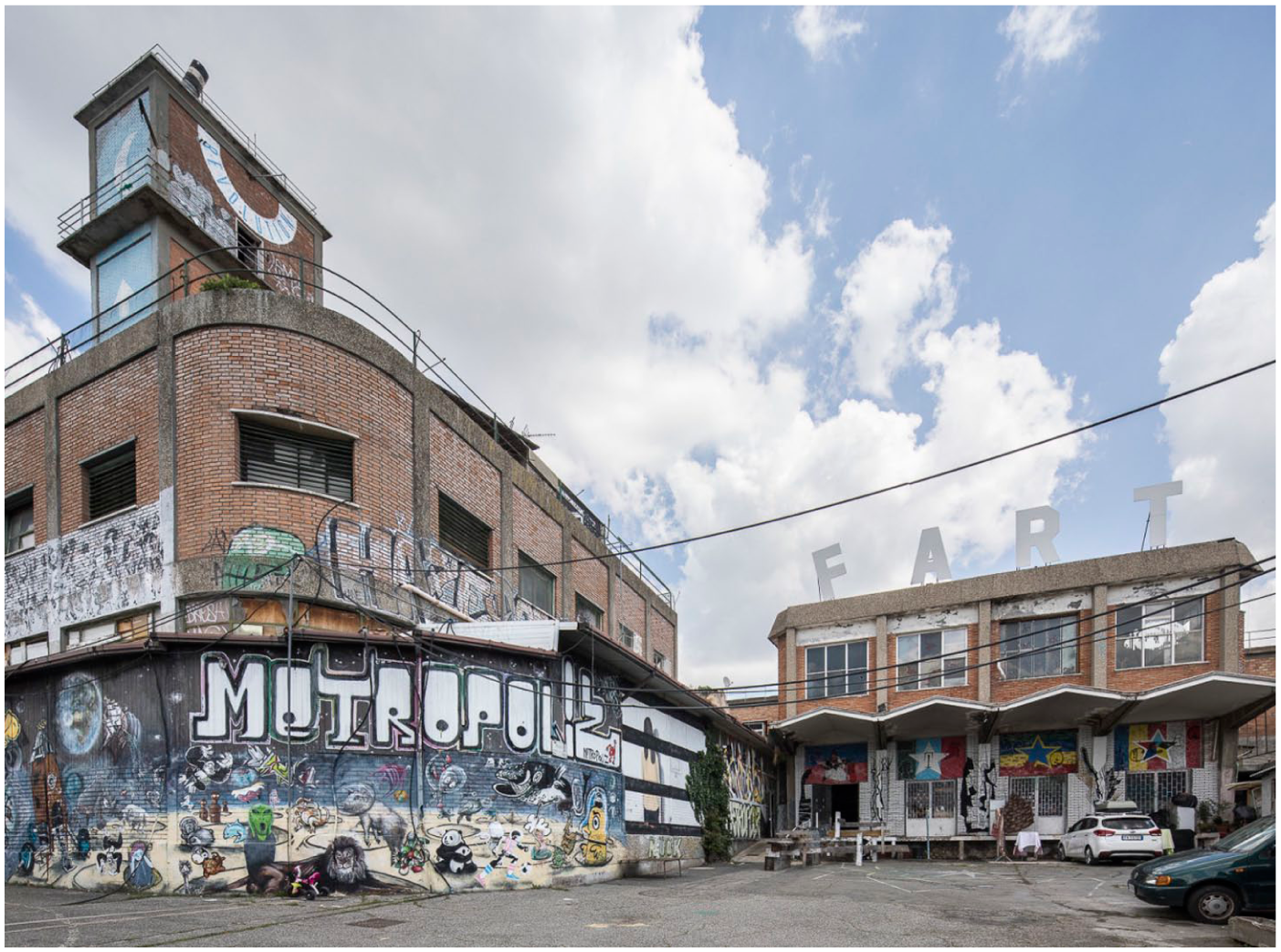
Entrance MAAM, photo by the author.
Although the role of the museum and the extent of the social impact of artistic projects on the inhabitants are questionable, it is reasonable to claim that MAAM, within Metropoliz, is one of the main political tactics used to protect the squat from eviction. Metropoliz’s museum provides generative grounds for conceptualising cohabitation as a halfway point between a public space for art and a private dwelling, thereby producing the inhabited museum (De Finis, 2022). Although the future of the squat is still uncertain, MAAM results in a political act of reclaim and legitimacy embedded within a web of relations among different actors: public officers, private owners, activists, neighbourhood associations and cultural workers. MAAM forces us to rethink ways of living together, functioning both as a political tool and a trope for new ways of living.
The normative practices set forth by MAd’O account for the volatility of artistic practices and their efficacy within the relationality between participants and the actors they address and care for. MAd’O enacts conviviality on the premise that the museum is not a collection of artworks or a static space for showcasing art. However, it is a space of living relationships between artists, activists and community members surrounding Spin Time. Romito’s account illustrates a broader shift in the logic of activist art: from oppositional modes of protest to what may be described as prefigurative infrastructures of care. As he reflects: ‘For us, that’s what art is: not interpretation, but a way of living and building the world together with others’ (MAd’O collective member, interview with the author, Rome, 2023).
MAd’O now functions as an experimental art space where hospitality is practised through creative means. The initiators of MAd’O claim that ‘as the spaces’ hosts, they are also “hosted” by many like-minded creatives and communities, as they often take over the space to use it for their own meetings, events, and gatherings’ (MAd’O collective member, interview with the author, Rome, 2023). Some of these communities are neighbourhood associations, such as the Associazione dei Genitori Di Donato (Parents Association, Di Donato school), or migrant communities from the African continent, Iran or Afghanistan. The type of formats varies and ranges from social dinners to exhibitions, talks and public programming. For example, Afghan Rewind (MAd’O, 2021) is a photographic exhibition on the history of Afghanistan from 2001 to 2021. Centering around the US invasion and occupation of Afghan territories, the exhibition (Figure 2) and public programme stemmed from the awareness-raising campaigns of Afghan communities in Rome against the violence following the US military retreat in August 2021.
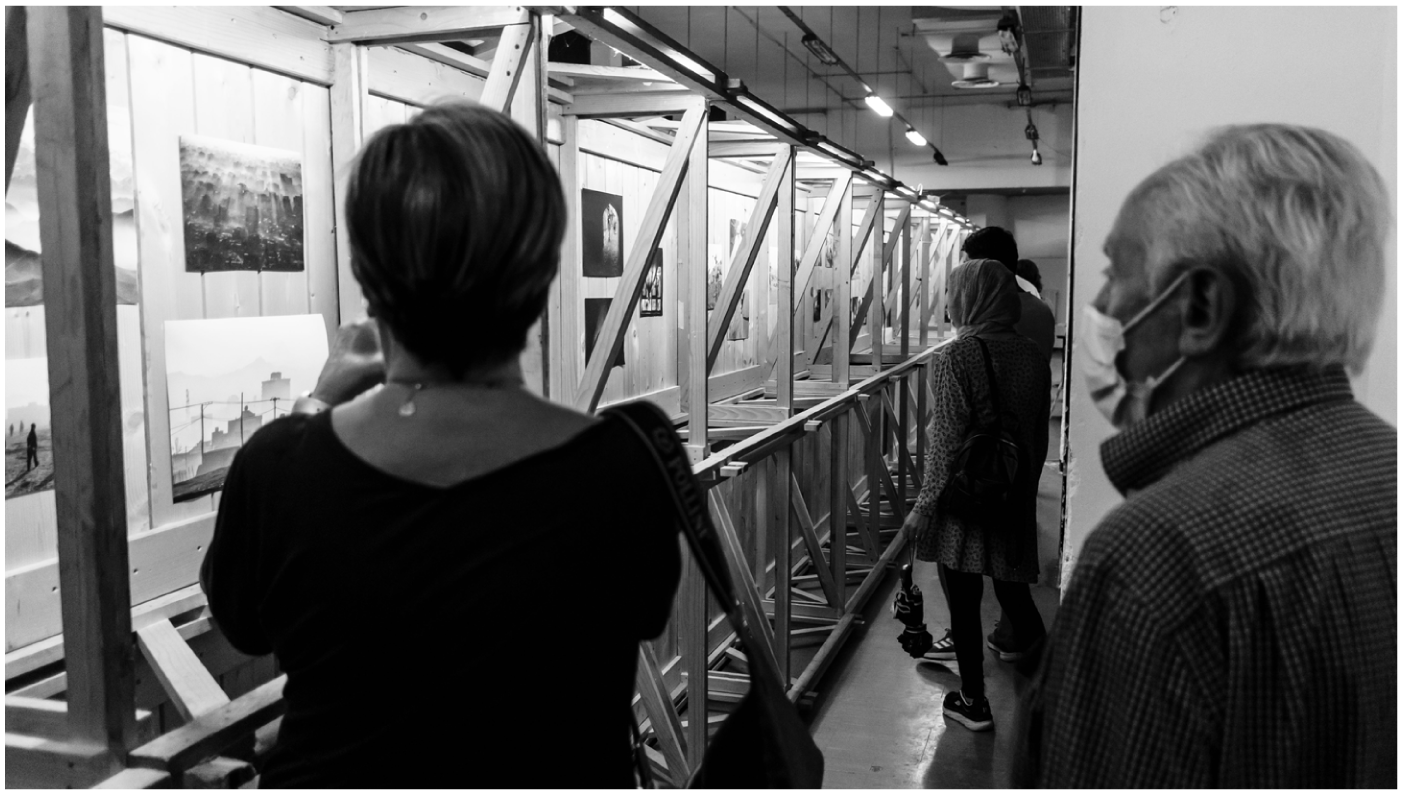
Exhibition installation view, Afghan Rewind, Mad’O, photo by Morteza Khaleghi.
Here, the conceptual prefiguration of museums anticipates convivial forms of cohabitation that also fuse public and private space. MAAM aligns with Castoriadis’ emphasis on radical imagination: the museum is both imagined and enacted through shared labour, spatial transformation and agonistic publics. MAd’O resonates more directly with Cooper’s framework: hospitality is treated as an already-legitimate principle. Through the analysis of how these projects use art as a tool for activism, this article sets forth the argument that the museum as a site for radical imagination and a conceptual prefiguration enhances specific activist tactics that favour the permanency of the housing squats in which MAAM and MAd’O are housed but also imply a more extensive practice of radical imagination and critical reflection on models of cohabitation.
Conclusion
Today, experimental art institutionalism forwards critical debates around contemporary society and how museums as power infrastructures are questioned through ground-breaking practice. Few studies have addressed how the concept of the museum is used as a tool in political disputes, and there is a tight-knit relationship between artistic practices and experimental institutionalism. My research on occupations in Rome revealed the embeddedness of artistic practice and activism in right-to-housing movements. This article investigates how museums are conceptually used, resulting in political processes of radical imagination and conceptual prefiguration. The case studies in Rome further the political and critical debate around art institutionalism. Recent scholarship frames housing squats in Rome as an alternative model of urban citizenship based on solidarity and commonality. These sites are understood as a prefiguration of collective subjectivity and as educational sites of resistance. The text explored the role of artistic projects within this context and their ties to the right-to-housing movement.
The rationale for such unique interdisciplinarity stems from an investigative interest in the political implications of artistic projects within contexts of political dispute. Rather than investigating the forms or aesthetics of individual artists, this inquiry delves into the relational aspects of art making and artistic research, arguing that the potential of these ways of doing relies on the transformative practices the projects can enhance within the political landscapes in which they are embedded. Notions of new infrastructures for art (Baravalle, 2018), political and artistic gestures (Gielen, 2014) and instituent practice (Raunig, 2009) serve to ground the scope of the research. In this context, Castoriadis’ and Cooper’s work contributes to this inquiry, particularly when Castoriadis refers to radical imagination and the recreative participation of the public sphere (Castoriadis, 1997) and when Cooper claims that normative practices that foster conceptual prefiguration (Cooper, 2014) are valuable for analysing the progressive and transformative practices of the everyday.
At MAAM, radical imagination materialises through collective world-making enacted in shared labour, curatorship and spatial transformation. At MAd’O, conceptual prefiguration takes shape through the performance of hospitality as if it were already a legitimate political principle.
Although neither MAAM nor MAd’O has achieved full legal recognition, both have cultivated strategic legitimacy. This condition allows them to operate as politically protected yet legally vulnerable infrastructures. Such legitimacy is sustained not through state recognition alone but through relational entanglements with artists, residents, activists, journalists, schools, neighbourhood organisations and religious institutions. The stabilising effects produced by MAAM and MAd’O remain fragile. Both projects are sustained through unpaid labour, informal governance and volatile political alliances. This tension – between protection and vulnerability – remains a defining condition of experimental art institutionalism under contemporary regimes of urban speculation. Today, Spin Time Labs is at high risk of eviction, and this research confirms that such spaces are vital to citizens’ well-being. This article aims to contribute to greater support for Spin Time Labs’ permanence.
This article contributes to scholarly research in cultural studies, institutional critique and urban politics. It demonstrates how the museum functions not only as a site of representation but also as an infrastructure for alternative governance, care and survival, and how it can be reimagined as an infrastructure enabling radical imagination and conceptual prefiguration to converge in cohabitation. In the cases examined, experimental institutionalism does not merely critique dominant systems of power; it constructs operative alternatives within their interstices. By situating experimental art institutionalism within housing struggles, the article extends scholarship on transformative politics and art institutionalism. It shows how cultural institutions can function as interfaces between informal survival infrastructures and formal political arenas, mediating between illegality, legitimacy and everyday life.
Footnotes

Ethical considerations
Ethical approval for this study was obtained from the Ethics Committee of the Faculty of Humanities (file 2021-FGW_OTHR-13936) prior to the commencement of data collection. The research was conducted in strict adherence to the ethical guidelines of the University of Amsterdam.
Funding
The research for this article was funded by IMAGINART – Imagining Institutions Otherwise: Art, Politics, and State Transformation, research project of ASCA – Amsterdam School of Cultural Analysis at the University of Amsterdam (NWO VIDI, project number VI. Vidi. 195. 178).
Declaration of conflicting interests
The author declared no potential conflicts of interest with respect to the research, authorship, and/or publication of this article.
Data availability statement
Data sharing not applicable to this article as no datasets were generated or analysed during the current study.