




Abstract
This article reflects on the global appeal of brandedness as a central mode of creativity in contemporary capitalism. Drawing on ethnographic fieldwork including focus group interviews and visual data from Mozambique and beyond, it examines how practices of copying, remixing and hybridising logos blur the moral and aesthetic boundaries between authenticity and imitation, originality and repetition. By bringing together informal counterfeit production in the Global South and official brand collaborations in the Global North, I argue that both operate through the same combinational logic of creativity, one that thrives on excess, circulation and the affective power of the logo. Reframing creativity as a collective process, a form of commoning, the article suggests that the symbolic life of brands has escaped corporate ownership to become a shared cultural resource. The hybrid-fake should thus not be understood as an absence of authenticity but as an expression of participation, joy and aesthetic experimentation within a global economy of signs.
In April 2021, I bought a little handbag from a Chinese shop in Maputo, Mozambique, for about five euros. It was a strange hybrid thing: the synthetic leather imprinted with a modified Louis Vuitton floral pattern, the golden bee from Gucci gleaming at the clasp and the famous red-green-red ribbon running down the front (see Figure 1). Why settle for one brand when your handbag can have two? At first, I bought it as a joke, an ironic souvenir of research on Chinese-Mozambican fashion exchanges. But the longer I kept it, the more it seemed to condense everything I was trying to understand about creativity, consumption and desire. That handbag was not just a fake, it was a commentary. It took some of global luxury’s most recognisable signs and let them spill, merge and mutate. It refused to choose between Gucci and Louis Vuitton. In doing so, it hinted at something deeper than fraud: a global fascination with brandedness itself.
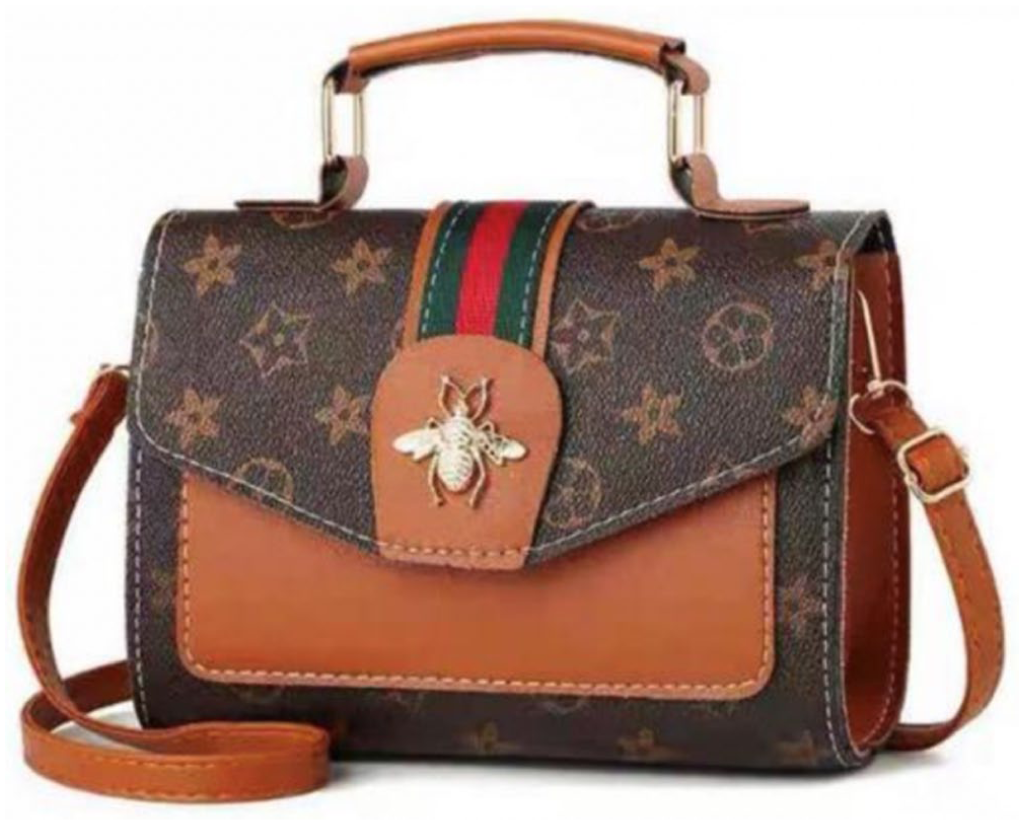
The Chinese-made Louis Vuitton-Gucci handbag.
Cultural theorists have long connected creativity to originality, and authenticity to truth (Boon, 2010; Conklin, 1997; Franklin, 2023; Hendry, 2000; Theodossopoulos, 2013). Brands, by contrast, are often accused of manufacturing desire, of selling us the illusion of authenticity through commercial artifice (Cavanaugh and Shankar, 2014; Moor, 2007; Newell, 2012). Yet in Maputo’s stores and street stalls, I encountered creativity that thrived precisely on imitation and excess. Shop displays overflowed with logo-covered sneakers, LV monograms printed next to Nike swooshes (see Figure 2) and the Louis Vuitton flowers again layered with Chanel’s interlinked Cs on capulanas, traditional Mozambican cotton fabrics (see also, von Pezold, 2022).
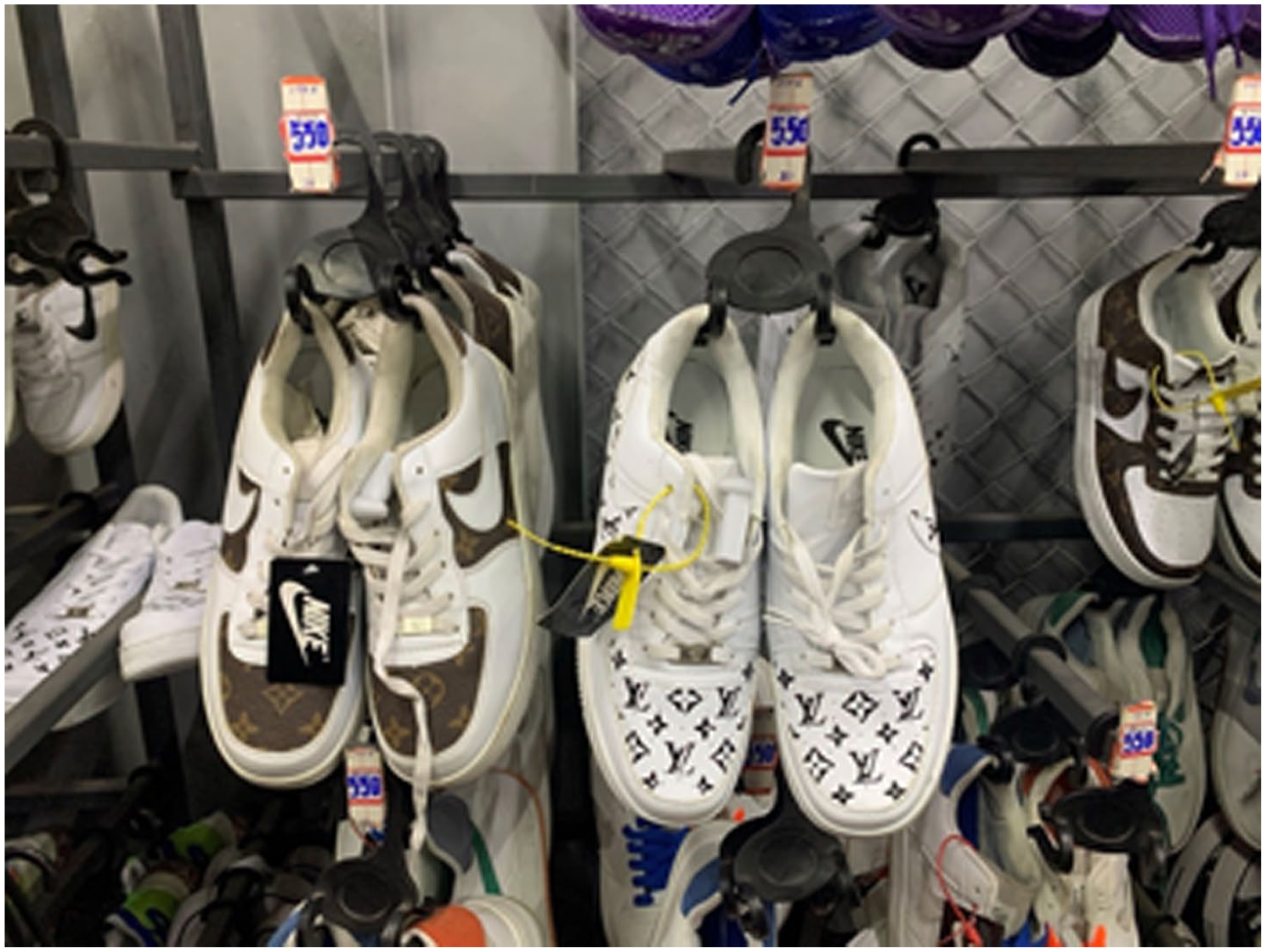
LV-Nike branded sneakers in a Chinese-owned store in Maputo, 2024.
When I asked Mozambican consumers what they thought of these goods, some admitted they preferred the look of famous brands even if they knew the items were fake. Others dismissed the question altogether: ‘If my Gucci is fake, who cares?’ one female focus group participant told me. What became apparent was not deception but joy. These fakes did not try to pass as authentic, they flaunted their hybridity. They turned global luxury into playful, accessible fashion, available for everyone to remix. Mozambican consumers were not duped, they were curators. They chose among the flood of counterfeit goods to assemble outfits that felt modern, stylish or simply fun. ‘I can do a mix’, one middle-aged male interviewee explained. ‘I can have an authentic piece of clothing, authentic pants and a Gucci shirt from downtown [Maputo], for example. So, I create my own style, mixing creativity and fakeness. I combine the useful with the pleasant’.
Such statements resonate with Constantine Nakassis’s (2012) notion of the ‘aesthetics of brandedness’ which are appreciated among Indian youth in Tamil Nadu: garments that look branded without copying any specific brand, mixing fonts, logos and colours into an imagined elite style. The pleasure lies not in owning the real brand but in participating in its aura. The brand becomes pure form, an aesthetic rather than an index of origin. This delight in brandedness unsettles the Western moral economy of creativity. Since the emergence of Romanticism in late 18th century Europe, authenticity has been linked to sincerity and originality, while imitation has been cast as a derivative (Guignon, 2004; Lindholm, 2008). Fashion complicates this. Copying is its very engine (Hilton et al., 2004; Nakassis, 2013). Trends move through repetition and remix. This leads to the ‘piracy paradox’ (Raustiala and Sprigman, 2006), according to which piracy both enables and harms the fashion industry simultaneously. As Mackinney-Valentin and Teilmann-Lock (2014) note, copying in fashion eventually is not the demise of creativity but one of its driving forces.
In the Mozambican fashion market, copying takes on new meanings. Here, counterfeit culture is not just about deception or theft but about participation in a global conversation. As Sasha Newell (2013) argues, the branded object’s power (be it fake or not) lies in its instability: it both conceals and exposes the brand as a performance, a declaration of value that can be endlessly re-enacted. The Chinese-made handbag in Maputo, like many of its cousins in Lagos, Nairobi or Naples, reveals that brands are not stable markers of authenticity (see also, Manning, 2010). They are floating signs, available, recombinable, endlessly generative. This shifting of perspective is crucial. Rather than viewing counterfeits as threats to creativity, we might see them as expressions of combinational creativity, the human tendency to make something new by assembling what already exists (Boon, 2010; Arvidsson and Niessen, 2014; Dewey, 2020). From this angle, a hybrid LV-Gucci bag and a luxury brand collaboration differ less than we might think.
Indeed, what fascinated me most was how the same logic has been adopted by high and street fashion brands themselves. In recent years, the fashion industry has been overtaken by the craze for ‘collabs’. Gucci × Adidas (see Figure 3). Versace × Fendi. Tiffany × Nike. Louis Vuitton × Supreme. Designers and marketers call these partnerships ‘creative synergies’, but in many cases, their products amount to little more than logo layering. A Tiffany-blue swoosh adds little to a Nike sneaker’s material quality or form; it simply multiplies its sign value. When I scroll through social media images of these official co-brands, they remind me of the bag from Maputo: two logos or other trademarks meeting on a single surface, the thrill lying in the novelty and seeming impossibility of the combination. It is legality, not creativity, that sets them apart. One is hailed as innovation, and the other condemned as infringement. Yet both depend on the same aesthetic of recombination, the visual pleasure of over-signification.
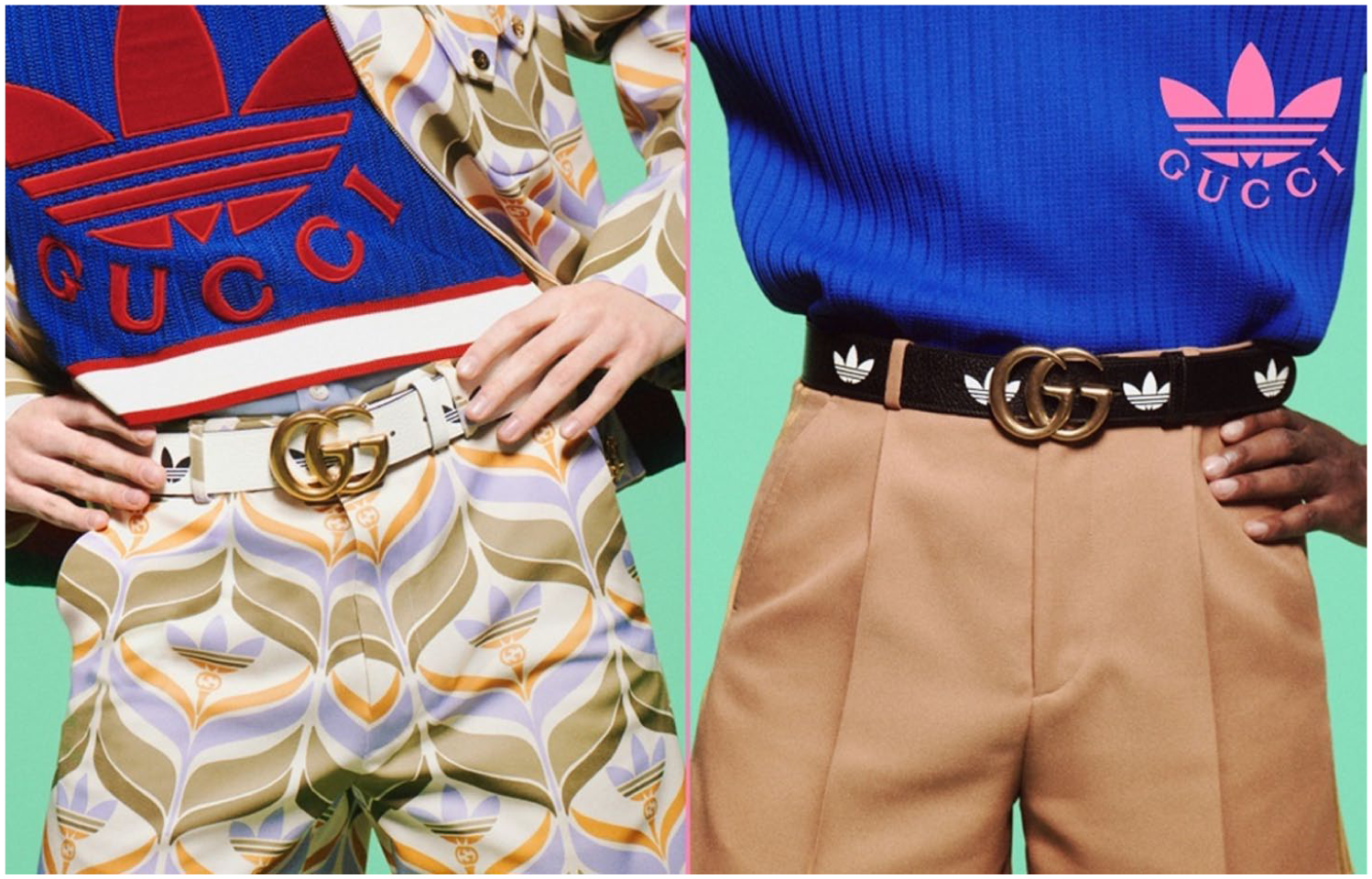
Adidas × Gucci collection, Gucci, 2022.
Luxury houses defend these collaborations as bold experiments in creative fusion. But as any marketing analyst might admit, they are also about risk management and audience reach. By borrowing each other’s cultural capital, brands rejuvenate themselves without the danger of genuine reinvention (Pantanella, 2023). Creativity, in this model, is administrative. More often than not, it happens in the boardroom rather than the atelier. Seen in this light, the legal boundary between collaboration and counterfeiting looks increasingly arbitrary. Both practices rely on the remixing of brand identities. Both generate desire through the multiplication of signs. The LV-Gucci handbag and the Tiffany × Nike sneaker participate in the same visual economy: the joy of the logo unleashed.
To call both forms creative will provoke discomfort, especially within the global hierarchies of design and ownership. Intellectual property law draws a moral boundary between innovation and imitation, protecting some forms of creativity while criminalising others, often at the expense of non-Western practices and industries (Boateng, 2011; Peukert, 2016; Pinheiro-Machado, 2017; Thomas, 2017). But as scholars of copying have shown, the ‘original’ itself is often a legal fiction. Everything builds on what came before (Boon, 2010; Johns, 2010; Röschenthaler, 2020). Jean Baudrillard, for example, has already questioned the very foundation of authenticity in consumer culture and has shown how signs (such as brand names) become simulacra, ‘representations that bear no relationship to reality but construct reality in their own right’ (Hietanen et al., 2019: 30). Likewise, Newell (2012) describes the trademarks of branded commodities as ‘performative labels declaring an underlying value that is ultimately undistinguishable from its counterfeit’ (p. 261).
In this sense, counterfeiting in the Global South exposes the uneven geography of legitimacy. In fashion’s ‘brand heartlands’ such as North America and Western Europe, the right to copy is heavily policed. Outside these zones, copying is often tolerated as economic necessity or cultural adaptation. What is more, the same corporations that prosecute counterfeiters also depend on them: the constant recirculation of logos keeps desire alive (Nakassis, 2013). As one Mozambican clothes and accessories vendor told me, ‘People want to show off even if they are poor. The Chinese know that and offer way cheaper prices than the European original’.
The fashion industry, too, plays with fakery (see also, Mackinney-Valentin & Teilmann-Lock, 2014; Nakassis, 2013). Gucci’s ‘Fake/Not’ collection from 2020, with the word FAKE printed in bright yellow across its monogram bags, is an explicit wink at the counterfeiters it claims to oppose (SCMP Style, 2020; see Figure 4). Here again, the fake becomes aesthetic. The brand stages its own piracy to stay ahead of the imitators. What could be condemned as ‘inauthentic’ in a Maputo market becomes ironic chic in Milan.
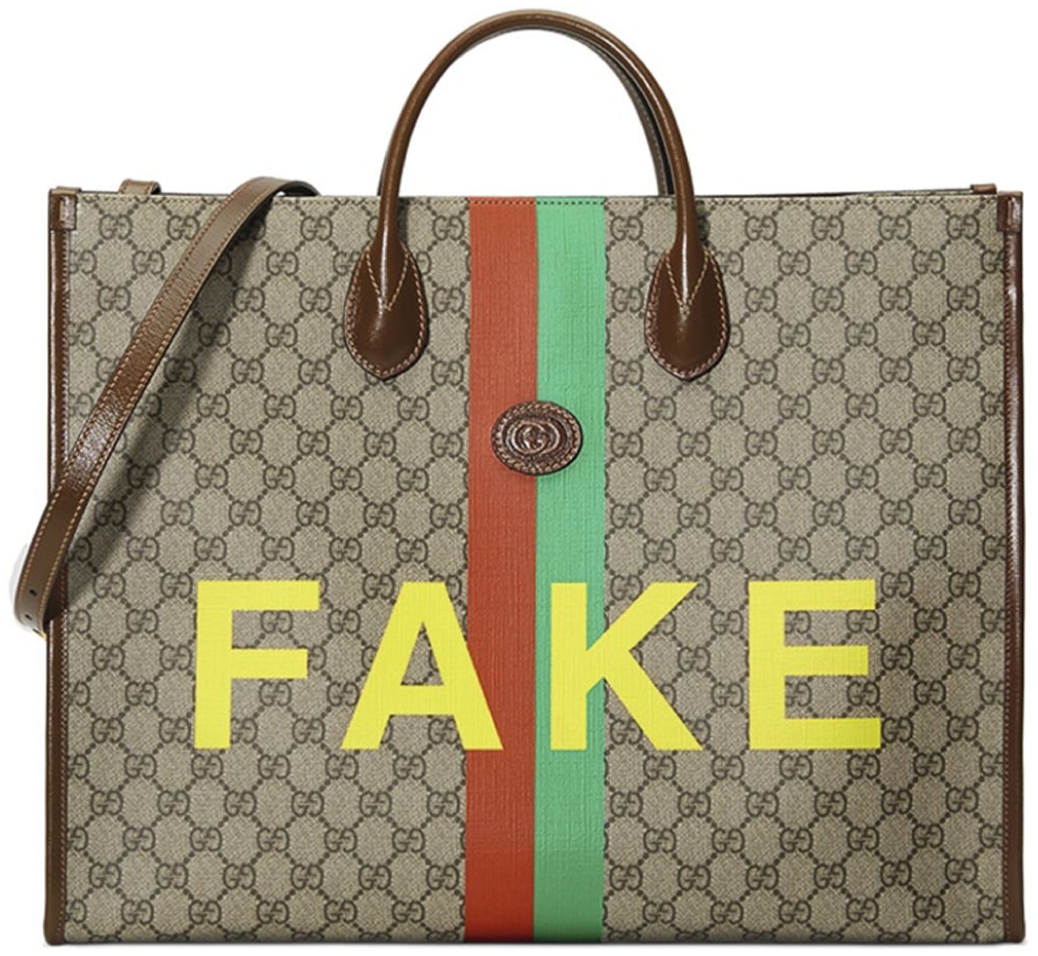
Bag from the Gucci Fake/Not collection, Gucci, 2020.
This special issue, ‘Creativity (un)bound’, invites us to think of creativity not as property but as process, not as restricted but as commoning, something collectively shared. Copying, remixing and hybridising are not violations of creativity but its social forms. They mirror both long-standing forms of collaborative and derivative creativity in China (de Kloet et al., 2019; Keane and Zhao, 2012; Liao, 2020; Tang, 2023) and emerging ideas of open access and crowdsourcing in the Global North (Benkler, 2006; Lessig, 2004; Ruppert-Stroescu and Hawley, 2014): everything we make emerges from the shared materials of the world. In this sense, brandedness itself can be seen as a global commons, a pool of aesthetic resources circulating across regions, classes and legal regimes (see also, Deka, 2018; Deka and Arvidsson, 2022). The brand, once a corporate asset, becomes a collective language. Its forms are endlessly borrowed, transformed and re-signified. In Maputo, Nairobi or Guangzhou, producers and consumers participate in this semiotic commons without asking for permission. Their work is often precarious, sometimes illegal, but undeniably creative.
This perspective unsettles the moral certainty of both anti-piracy campaigns and celebratory discourses of innovation. If creativity is always relational and combinational to some extent, then the line between designer and copier, artist and consumer, North and South begins to blur. The handbag in Maputo and the Tiffany × Nike sneaker do not sit on opposite ends of a hierarchy, they just occupy different positions on the same continuum of creative exchange.
At the heart of this exchange lies affect: joy, desire, aspiration, sometimes irony. The thrill of brandedness is not only about status but about belonging to the spectacle itself. It is the pleasure of participating in an unapologetically consumerist global flow of signs, even momentarily. This affective power is what sustains both luxury fashion and its counterfeits. In my fieldwork in Mozambique, I often heard laughter when people spoke about fakes. The laughter was not cynical, it was self-aware. ‘Everybody wants to be part of it’, one focus group participant said about Chinese fashion. ‘They help the poor guy afford a Chanel [. . .] and feel some sort of some belong or acceptance and what not. So it’s kind of difficult to hate on that’. The fake offered a small victory: an entry into a visual world otherwise reserved for the rich. It turned exclusion into play.
That same playfulness animates young sneaker artists in the Global North, who customise branded shoes into new, unauthorised artworks (see Figure 5). Their creations, which often incorporate the logos of multiple brands, circulate on TikTok and Instagram, where they are celebrated as unique expressions of creativity and style with a hint of postmodern irony rather than punished as infringement. What unites them with their Mozambican counterparts is an unashamed enjoyment of the branded sign, the freedom to take it apart, reassemble it and wear it differently.
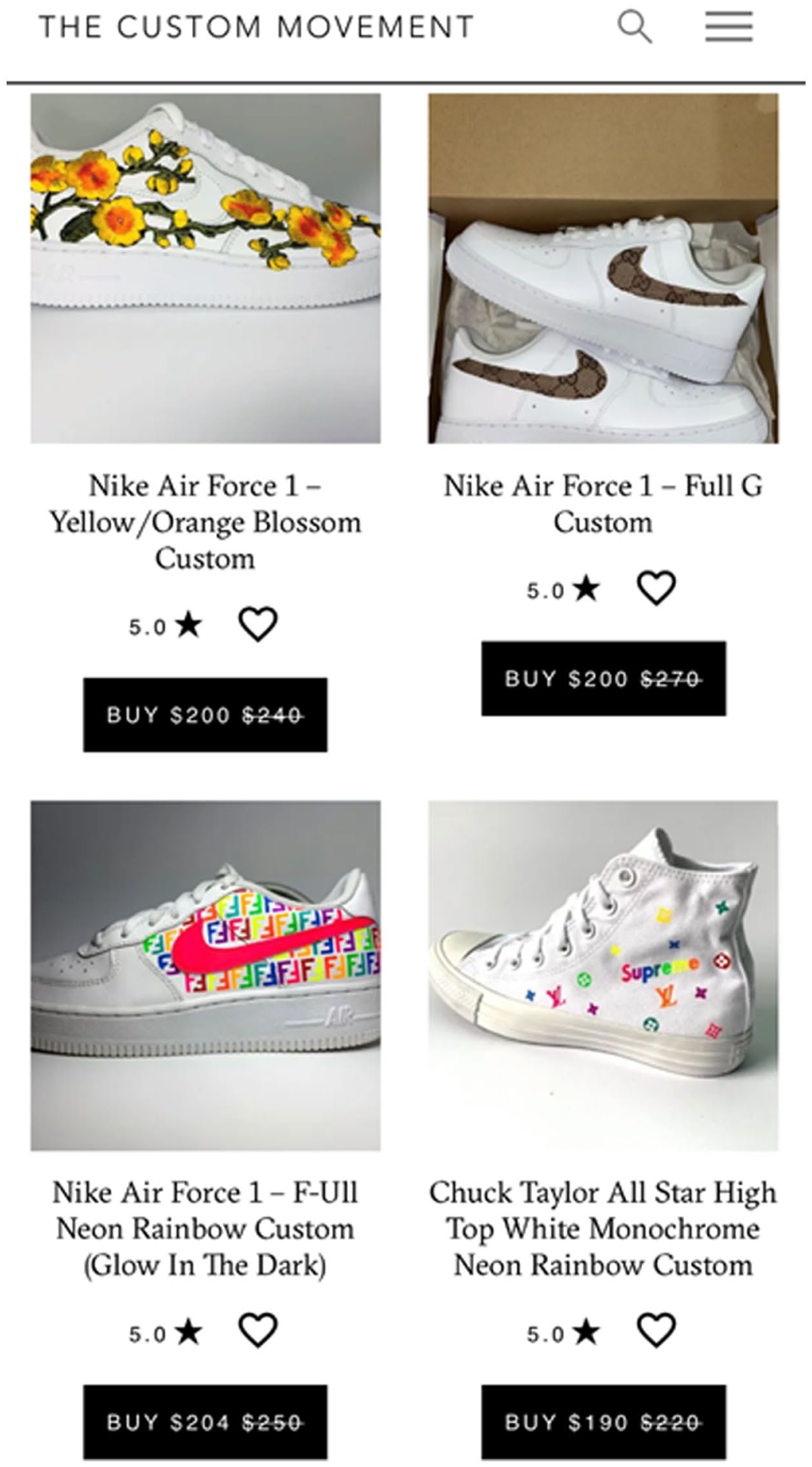
Custom-made hybrid-brand sneakers for sale on the thecustommovement.com website, 2024.
If creativity today is increasingly about remix rather than invention, perhaps the most radical act is not to resist brandedness but to give in to it creatively, to push its excess to the point where ownership no longer matters. In this sense, the hybrid-fake handbag is not an imitation of luxury but a parody of it, a grassroots critique manifested in plastic and stitching. It exposes the absurdity of corporate exclusivity while embracing the sensuous appeal of the logo itself.
This does not mean that all forms of copying are innocent. Counterfeit economies involve exploitation, precarious labour and environmental harm (Lamptey et al., 2024). Yet to reduce them to illegality alone is to neglect their cultural force. They remind us that creativity is not the monopoly of designers or corporations, it is a capacity of ordinary people navigating unequal worlds. In both Maputo’s markets and Paris’s boutiques, creativity builds on recombination. Whether through official collaborations or informal hybridisations, we are witnessing the same movement: a loosening of the importance of authenticity and authorship and an unbinding of the logo from its owner.
The bag I bought in Maputo has started to peel, its fake leather curling at the edges. I keep it on the top shelf of my closet. It reminds me that creativity is never entirely pure, that joy thrives in the mixing of worlds. Every time I look at it, I think of the multitude of people that made and desired similar things: Chinese producers tweaking designs to avoid inspection, Mozambican shoppers pairing fake Gucci shirts with real jeans, fashion executives in Paris dreaming up the next co-brand. All of them, in their own way, participate in what Baudrillard (1984) calls the ‘hyperreality’ of consumer culture, the realm where the sign becomes more powerful than the thing it represents. But rather than disparaging this, perhaps we can learn from it. Logos, once symbols of corporate control, have slipped their leash. They circulate freely, mutating in unpredictable ways.
‘Giving in creatively’ to brandedness, then, is not surrender but reappropriation. It means recognising that creativity today often happens within, not against, the circuits of capital, through small acts of play, parody and pleasure that turn exclusion into commons. In the end, the global desire for brandedness may be less about owning than about belonging, less about authenticity than about participation. The handbag might be fake, but the joy it sparks is real.
Footnotes
Acknowledgements
I would like to thank my colleagues from the China Africa Fashion Power ERC project and especially Tommy Tse for many inspiring discussions on this topic. This paper also benefitted from the valuable feedback received from discussants and audiences at seminars held in Hangzhou and Nairobi. ChatGPT was used for shortening and restructuring in the process of turning a full paper draft I wrote into a shorter Cultural Commons piece.

Funding
The author disclosed receipt of the following financial support for the research, authorship, and/or publication of this article: This work was supported by the European Research Council (grant no. 101044619).
Declaration of conflicting interests
The author declared no potential conflicts of interest with respect to the research, authorship, and/or publication of this article.
Data availability statement
Data sharing not applicable to this article as no datasets were generated or analysed during the current study.