



Abstract
This article examines how art museums participate in shaping a contested regional identity by analysing four contemporary visual art exhibitions staged in the Pearl River Delta between 2017 and 2024, each narrating ‘tales of the south’ within the context of China’s Greater Bay Area initiative. Drawing on Heidegger’s notion of worlding and Bal’s concept of exhibition-ism, and informed by fieldwork, interviews, and document analysis, it explores how these exhibitions collectively articulate the Pearl River Delta’s identity in multiple – and at times contradictory – ways: as peripheral and ‘wild’ within China’s art ecosystem; as a frontier of modernization driven by urbanization, marketization, and globalization; as part of the Global South in solidarity with developing nations; and as an emerging international hub of innovation and technology. In doing so, this study theorizes exhibitions as worlding practices in contemporary art.
Introduction
A revolving barber’s pole installed at the centre of a room wrapped in intensely saturated, multicoloured wallpaper; piles of bricks stacked inside a steel-framed bunk bed; and a group of seemingly live chickens roaming the space – all evoke the street scenes of the 1990s Pearl River Delta (PRD), a moment when urban construction was accelerating, boundaries between city and countryside remained blurred, and novel urban spaces such as hair salons were emerging. This was the mise-en-scène of Canton Express: Art of the PRD, presented at Hong Kong’s M+ museum in 2017, which partially restaged the exhibition first shown at the 2003 Venice Biennale.
Yet a closer look reveals elements specific to M+’s restaging. One wall prominently displayed a ‘Mind Map of PRD Art’, interweaving key artistic events and institutions across Guangdong and Hong Kong with major politico-economic milestones, including the establishment of special economic zones (1980), Deng Xiaoping’s southern tour (1992), the Hong Kong handover (1997), and the Guangdong–Hong Kong–Macao Greater Bay Area (GBA) agreement (2017). Evidently, M+’s iteration was more than a simple reprise. It articulated a new objective: to contribute actively to the formation of a contemporary art ecosystem in the PRD. This ambition was reinforced by the exhibition’s timing – coinciding with the signing of the GBA framework in 2017 – and by M+’s positioning as a core cultural infrastructure within the GBA. The museum’s proximity to Hong Kong West Kowloon Station, a key node in the high-speed rail network linking Hong Kong to Mainland China, further underscores the significance of this spatial and institutional positioning.
Canton Express prompted my broader study of the contemporary art ecosystem of the PRD. Existing scholarship on contemporary Chinese art has largely concentrated on Beijing and Shanghai, leaving regional art worlds comparatively underexamined. To address this gap, I analyse the M+ exhibition alongside three subsequent exhibitions held at He Art Museum (HEM; Foshan), Shenzhen Pingshan Art Museum (PAM), and the Guangdong Museum of Art (GDMoA; Guangzhou). Drawing on Heidegger’s concept of worlding and Mieke Bal’s notion of exhibition-ism, I examine how these four exhibitions – taken together – operate as curatorial and institutional sites through which the historical realities of the PRD are articulated and made meaningful.
Methodologically, the study combines document analysis, field observations, and interviews conducted at the four exhibition venues. I reviewed exhibition materials published on the official websites and WeChat public accounts of each institution. During field visits, I closely examined curatorial statements, wall texts, and exhibition catalogues, and assessed what Alpers (1990) terms the ‘museum effect’: the process through which museums invest ordinary objects with new significance and value. As Alpers argues, curatorial decisions – including exhibition design, spatial arrangement, and display strategies – play a crucial role in shaping viewers’ interpretations of visual, cultural, social, and political meanings.
I conducted formal interviews with the director of the GDMoA and an in-house curator at HEM, alongside informal conversations with two curatorial staff members at Shenzhen PAM, and one curator at M+. The interviews were recorded and transcribed, with notes taken during informal exchanges. By examining how practices of worlding unfold across these four exhibitions, I argue that the institutions seek to cultivate what they frequently describe as a regional art ecosystem – an emic, institutional metaphor used to frame interlinked artistic, curatorial, and infrastructural relations – distinct from, and at times in competition with, the dominant centres of Beijing and Shanghai, echoing their emphasis on southern China’s distinctive ecological imaginary. As the first region deeply shaped by capitalism following China’s reform and opening-up policy, the PRD is worlded as a frontier of global marketization and urbanization, reflecting ambivalent stakeholder attitudes. Through the curatorial foregrounding of intensive labour conditions and postcolonial solidarity with Southeast Asia, these exhibitions world the PRD as affiliated with the Global South. Finally, by privileging technological experimentation and digital media, the exhibitions world the region as an emerging international hub of innovation and technology – selectively adopting, and at times critically inflecting, the GBA’s rebranding agenda. This study thus contributes to contemporary art scholarship by theorizing exhibitions as worlding practices.
Contemporary art worlds and hierarchy
Contemporary art is embedded in processes of cultural globalization. Recent scholarship has recognized that such globalization no longer operates through a single centre–periphery model, but through multiple, shifting centres and peripheries. Harris’s (2017) discussion of the growing prominence of Asian art centres within the contemporary art world exemplifies this recalibration. Yet, despite this apparent pluralization, hierarchies persist. New art centres often achieve visibility through what Velthuis and Curioni (2015: 2) describe as being ‘absorbed’ into existing global hierarchies – for instance, through New York- and London-based galleries opening branches in cities such as Hong Kong, Beijing, and São Paulo, while local galleries in these emerging centres adopt symbolically loaded white-cube formats modelled on New York, Berlin, or London (Velthuis and Curioni, 2015). Museums in peripheral contexts likewise pursue international legitimacy by emulating architectural and institutional models associated with the centre, even as they exhibit predominantly domestic artists – conditions that may ultimately reproduce their peripheral position within the symbolic hierarchy of the global art world (Kharchenkova and Merkus, 2025).
Recent research by Lee et al. (2025), however, introduces the concept of decentering as an alternative dynamic. Rather than relying on integration into established centres, decentering foregrounds circulation and interconnectedness among peripheral regions themselves, potentially circumventing entrenched cultural hierarchies. One factor contributing to this process is the use of regional and identity-based labels – such as ‘Latin American art’ or ‘contemporary Arab representation’ – which function as classificatory frameworks grounded in geography, identity, and, at times, ideology.
Plattner’s (1996) study demonstrates that centre–periphery hierarchies also operate within nation-states. His analysis of a regional art market in the United States shows how the everyday practices of most art-world actors are overshadowed by the symbolically dominant yet demographically minor New York art scene. Drawing on Plattner (1996) and Lee et al. (2025), this article empirically examines a regional art ecosystem in China that is similarly overshadowed by the Beijing and Shanghai art scenes, yet is actively seeking to challenge this hierarchy by mobilizing the label of ‘southern art’ to shape a regional identity.
PRD and its contemporary art
The concept of the PRD as a geographical region is related to the eastward spread of Western learning. In the early 20th century, European geographers conducting fieldwork in Guangdong agreed on the existence of a delta in the Pearl River region. Wu Shangshi finalized this assertion by publishing the Pearl River Delta thesis in 1947 (Mao, 2018). In the 1980s, the reform and opening-up policies of the People’s Republic of China ‘re-inscribed the southern China coast as the PRD: a multicultural Cantonese place whose contemporary economic significance is owed to absorbing the mass production apparatus of Hong Kong’ (Cartier, 2009). The manufacturing industry, exemplified by the ‘made-in-China’ production model, has established the PRD’s global reputation as the ‘world’s factory’ (Zhang et al., 2017).
In 1994, the Guangdong provincial government designated the administrative sphere of the PRD an economic zone including nine municipalities: Guangzhou, Shenzhen, Dongguan, Foshan, Jiangmen, Zhongshan, Zhuhai, and the urban areas of Huizhou and Zhaoqing. After the transfer of sovereignty over Hong Kong and Macao, the two Special Administrative Regions became part of the PRD. In 2017, the Framework Agreement on Deepening Guangdong-Hong Kong-Macao Cooperation in the Development of the GBA was signed by the three relevant government parties in the presence of Xi Jinping. Unlike the PRD, the GBA is an official initiative to create the fourth ‘Bay Area’, after New York, San Francisco, and Tokyo. This transformation encompasses the government’s intention to rebrand the PRD as a ‘vibrant world-class city cluster’ (State Council, 2019: 8).
As Welland (2018) observes, the global rise of Chinese contemporary art coincided with state-led efforts to stage spectacular international events – such as the Beijing Olympics in 2008 and the Shanghai World Expo in 2010 – in order to attract global attention and signal the reconfiguration of a colonial first-world/third-world order. Rather than operating as separate or antagonistic spheres, contemporary art and Chinese state politics articulate a contingent alignment: institutional actors selectively adopt, adapt, and at times resist state framings in pursuit of their own symbolic and professional agendas. Wang Shaoqiang, the director of the GDMoA remarked that ‘the promotion of PRD art now operates within the GBA framework, in line with the central government’s strategic ambition to consolidate the region as a national core’, while a curator involved in M+’s recent exhibition Canton Modern (2025) similarly noted that public museums in the region are encouraged to foreground PRD art. 1 Against this backdrop, this study situates the development of the contemporary art ecosystem in the PRD, examining its emergence in relation to the cultural and symbolic ambitions of the GBA initiative.
Scholarship on contemporary art in the PRD remains limited, reflecting the region’s peripheral position within Chinese contemporary art. By contrast, Wong’s (2014) monograph examines ‘readymade’ art production in Dafen village, Shenzhen, where artisans hand-paint copies of Western masterpieces – such as works by van Gogh – for export, a mass production often associated with the PRD’s reputation as the ‘world’s factory’. A small body of research addresses how leading Guangdong artists and collectives engage themes of rapid urbanization and labour alienation (Fok, 2011; Koppel-Yang, 2004; Lin, 2018). Studies of Hong Kong art have largely centred on contested cultural identity (Clarke, 2001; Vigneron, 2010), while scholarship on Macao artists remains sparse (Júnior, 2004). Other work examines art institutions and events in the PRD, highlighting varied modes of cultural production across national and private museums (De Nigris, 2017; Ho, 2020) and the differentiated roles of government-funded institutions (Cartier, 2008; Ho Chui-fun, 2020). Research on art fairs and cultural tourism further underscores the significance of timing and location (Lan, 2011; Leung, 2018; Zhang and Xie, 2019).
Only a few studies explicitly connect or compare art scenes across the region. Vigneron (2010) situates Cantonese art within China’s longer history as a gateway to the world and advocates cross-regional collaboration through international fairs. At a more localized scale, Lei (2007) analyses a non-profit art space in Macao that fosters exchanges with Zhuhai. Other scholars emphasize divergence rather than integration: Cartier (2009) argues that Hong Kong’s postcolonial identity complicates its incorporation into the PRD, while Wong (2018) contrasts Hong Kong’s micro-aesthetics with Guangdong’s socialist-modernist legacy.
Yet existing research has not addressed the emergent narrative of a ‘southern Chinese art’ centred on the PRD – linking Guangdong, Hong Kong, and Macao – that regional museums have articulated through exhibition-making since 2017. Across this scholarship, moreover, exhibitions appear either as archival evidence of artistic practice or as institutional outcomes, rather than as constitutive agents in the formation of regional contemporaneity. This study addresses both gaps: it empirically examines how the regional art ecosystem intersects with Chinese state politics in rebranding PRD art from low-end manufacturing associations to high-end conceptual practice, and theorizes exhibitions as worlding practices that actively constitute regional contemporaneity in the PRD.
Art-worlding the contemporaneity through exhibition-ism
In The Origin of the Work of Art, Heidegger (2002) redefines ‘origin’ not as a temporal beginning but as an ontological founding: the moment something becomes what it is. Art, he argues, is an origin – ‘a distinctive way in which truth comes into being, becomes, that is, historical’ (p. 49). Against the Aristotelian view of art as derivative, Heidegger sees art as constitutive of truth and human historicity.
For Heidegger, art is ‘the setting-itself-to-work of the truth of beings’ (p. 16). Truth is not correspondence but ‘unconcealment’ (p. 28), emerging through the interplay between earth and world: earth is a mode of being – often material, but not reducible to matter – that resists full disclosure and continually withdraws; world, by contrast, is the realm of intelligibility and meaning opened up by human existence. In great works, the world is configured as a coherent horizon, not imposed but unfolding dynamically: ‘world worlds’ (p. 23). Worlding thus names the process by which humans dwell within, shape, and are shaped by a world through practices such as language, tools, ritual, and art. Among these, art gives truth a historical form through creators, preservers, and ‘the historical existence of a people’ (p. 49).
Heidegger’s notion of worlding has resonated widely. Spivak (1999) shows how imperialist literature worlds the Global South, relegating colonized peoples to the earth without the power to world themselves. In human geography, non-representational theory similarly stresses that worlds are enacted through dwelling, embodiment, and practice (Anderson and Harrison, 2010). In art studies, Welland (2018) applies Heidegger and Spivak to experimental art in Beijing, linking worlding to globalization and gender. In this article, I adapt Heidegger’s concept by introducing the term art-worlding to specify how artistic practices – particularly exhibitions – configure shared horizons of meaning. Rather than analysing individual artworks, I treat exhibitions as enactments through which the PRD’s art-worlding and sense of contemporaneity are constituted.
The notion of ‘contemporary art’ is now well-established, as evidenced by contemporary art museums worldwide. However, scholars continue to debate what constitutes the ‘contemporaneity’ implied by contemporary art and its periodization, which Western conceptions of contemporary art have shifted from post-1945 to the 1960s and, later, post-1989 art. In China, however, contemporary art generally dates from the late 1970s onwards, corresponding to the end of the Cultural Revolution and the onset of economic and social reforms (Bishop, 2013; Wu and Wang, 2010).
Attempts to periodize contemporary art have revealed the limits of such frameworks, which cannot accommodate global diversity. As a result, theorists increasingly treat it as a discursive category. Osborne (2013: 23) calls ‘the contemporary’ an ‘operative fiction’ that distinguishes past from present by recognizing multiple contemporaneities while positioning contemporaneity itself as an ongoing project. Agamben (2009) similarly defines the contemporary through temporal disjunction, an untimeliness that enables critical reflection on one’s own era.
Notably, Bal (2020) proposes the concept of exhibition-ism as a means to explore contemporaneity – exhibition practices offer a critical framework for understanding contemporary art, not as a period marker or stylistic descriptor, but as a literal means to examine ‘what art is and can do’ (p. 19). For Bal, exhibition-ism foregrounds exhibition-making as central to comprehending how contemporary art emerges from and returns to today’s social world.
My fieldwork suggests that curating has become primary rather than secondary to art-making. Applying Heidegger’s notion of art’s origin to this context, the claim that ‘curating is part of the art-making’ (Bal, 2020: 19) must be taken seriously. This study sutures these two theoretical traditions, proposing art-worlding through exhibition-ism as a framework capable of accounting for how institutional and curatorial decisions constitute – rather than merely reflect – regional identities. I apply this framework to four exhibitions staged at major PRD museums between 2017 and 2024.
Case selection
This article examines four visual art exhibitions presented at major art museums in four PRD cities: M+ (Hong Kong), HEM (Foshan), Shenzhen PAM, and GDMoA (Guangzhou). Although numerous exhibitions have emerged in the region following Canton Express – across private museums (e.g. Floating World at Times Museum, Guangzhou, 2025), non-profit art spaces (e.g. PRD Contemporary Art Exhibition: The Old People’s Restaurant and the Sea at Ox Warehouse, Macao, 2024), and commercial galleries (e.g. Four Winds: A Different Perspective on Southern Art at Guangdong Contemporary Art Centre, 2 Guangzhou, 2024) – this study concentrates on these four cases. They are selected because they are hosted by key art museums that either possess or are actively developing institutional collections and because they are large-scale group exhibitions featuring at least 15 artists.
This focus on museums follows Macdonald’s (2003) observation that museums have historically functioned as a dominant apparatus for identity formation – here examined at the level of regional, rather than national, identity. The analysis does not trace the longitudinal institutional development of these museums; instead, it foregrounds the curatorial practices and discursive strategies mobilized in the selected exhibitions, enabling a cross-sectional analysis of four institutions’ distinct yet interrelated approaches to worlding the PRD. Rather than offering a city-by-city account, the study adopts a supra-urban perspective emphasizing how curatorial narratives operate across cities to articulate the PRD as a shared regional formation. Throughout, actors shift fluidly between referring to specific cities – most frequently Shenzhen – and invoking the PRD or ‘southern China’ as a whole. I treat this scalar mobility as analytically significant: evidence that the PRD’s regional coherence is actively negotiated through curatorial practice rather than given in advance, and flag where curatorial claims concern a specific city rather than the region as a whole.
From 23 June to 10 September 2017, M+, a public museum in Hong Kong, presented Canton Express. Curated by Hou Hanru, the exhibition featured fifteen artists and art collectives, all of whom were based in Canton at the time the works were produced. The curatorial statement describes Canton Express as a significant international showcase for PRD art and reflects on the influence of rapid globalization and urbanization in China during the 1990s on the region and its cultural landscape. The 2017 restaging highlighted a ‘unique regional artistic language’ (M+, n.d.). Compared with the three subsequent exhibitions analysed here, Canton Express was a smaller-scale show featuring the ‘physical, mental, and emotional complexities of life in the “factory of the world”’ (M+, n.d.).
From 12 December 2023 to 7 April 2024, the exhibition Tales of the South was presented at HEM. HEM is a non-profit private institution established by the Chinese appliance giant Midea Group at its headquarters in Foshan, Guangdong. According to HEM’s founder, He Jianfeng, a member of the family behind Midea: I hope the museum can contribute to the cultural dimension of the national Guangdong-Hong Kong-Macao Greater Bay Area development plan. (Arch College, 2020)
This commitment to the GBA initiative has seemingly been acknowledged, with the Guangdong government (2020) recognizing HEM as a ‘cultural and artistic landmark of Foshan’. Within this institutional framework, Tales of the South, curated by HEM’s in-house team, was framed as an effort to ‘rearticulate our own local culture’, as a curatorial staff member I interviewed explained. 3 The exhibition brought together twelve modern artists and thirty-three contemporary artists and collectives either from or based in Guangdong and Fujian. According to HEM’s (2025) official materials, it sought to re-examine the shaping of ‘Southern art’ over the past 150 years through shifting contexts, institutional reforms, media transformations, and the fluctuating fortunes of cultural institutions.
From 23 December 2023 to 11 June 2024, Shenzhen PAM presented the exhibition Nomads in the South: Rivers, Tunnels, Dampness and Constellations. 4 PAM was established by the Culture, Radio, Television, Tourism and Sports Bureau of Pingshan District, Shenzhen, and branded itself ‘China’s first district-level contemporary art museum’ (ARTEXB, n.d.). Produced by PAM’s director Liu Xiaodu and independent curator Cui Cancan, the exhibition was described in its curatorial materials as ‘the first time Chinese contemporary art connected the South’. It brought together 101 emerging artists and art institutions from eight provinces – Guangdong, Fujian, Jiangxi, Hunan, Guizhou, Yunnan, Guangxi, and Hainan – and one municipality, Chongqing. Of these participants, twenty-four artists and one institution were based in the PRD.
From 1 May 2024 to 31 October 2024, GDMoA, one of China’s earliest national key public art museums, showcased the exhibition A Constellation of Cities: Contemporary Art and Experiment in Southern China and Beyond. The exhibition was among the first held at the new venue in Guangzhou’s Baietan GBA Art Centre, which opened to the public in 2024. According to the director, Wang Shaoqiang, GDMoA is currently the spatially largest art museum in China. 5 A Constellation of Cities was directed by Wang and curated by Hu Bin, a dean at the Guangzhou Academy of Fine Arts, and Philip Dodd, the former director of the Institute of Contemporary Arts. Featuring works by 119 artists and art collectives, sixty of whom were based in the PRD, the exhibition was described by Hu (n.d.) as seeking to ‘examine the PRD within the context of globalization, or to use the PRD as a lens through which to observe contemporary global art and cultural phenomena’. I begin with the most institutionally distinctive worlding operation: the mobilization of a biological ecosystem metaphor to recast ecological difference as the ground for a southern art identity.
From biological ecosystem to art ecosystem
The curatorial statement for the third section, ‘South of 30 Degrees North Latitude: Nature, Climate and Growth’, in PAM’s exhibition quoted artist Wang Ting extensively: For Southerners, the climate is humid and sultry, leaving an aerosol shadow on the retina and a sticky feeling on the mucous membranes of the nasal cavity and the surface of the skin, a feeling hard to write down, but carried in fleshy memories and perceptions. This sense also becomes the root of our identity. What identifies us is not only the city written on our ID card or the local dialects in the South but the first breath we take after birth and the initial sense on our skin from the outside world as we grow up. (Cui, 2024a)
Wang’s reflection frames Southern identity as grounded in the embodied experience of climate. In my reading, this formulation shifts the basis of regional belonging from administrative or linguistic markers to sensory and ecological conditions. These embodied experiences inform Wang’s series of untitled paintings (2023), which meticulously depict tropical flora with lush dark green leaves and vibrant yellow and pink flowers. Her innovative use of airbrush on canvas distinguishes the works from conventional floral still life, evoking a steamy, humid atmosphere, as though the plants are glimpsed through tropical mist. Similarly, artist Yuan Ye’s archival art project, DAWAN Plant Identification Manual (2022), presents tropical and subtropical plants inhabiting ancient buildings in Shenzhen’s Pingshan district, where PAM is located. Unlike typical botanical archives, Yuan’s work integrates species names, biological characteristics, and functional descriptions into historical context, presenting a ‘plant biography’ of relationships between plants and human activity in the region.
As Lee et al. (2025) show, self-labelling can be a key strategy for art in peripheral regions, enabling, for example, Korean contemporary art to distinguish itself from Chinese and Japanese art within East Asia. Similarly, PAM’s curator Cui (2024a) foregrounded the distinctive biological ecosystems of southern China – subtropical evergreen forests, interlaced mountains, and dense waterways – in contrast to those of the north. In my reading, this framing prepares the ground for Cui to draw a parallel with regional differences in art worlds. A documentary at the entrance featured Cui and artists comparing their local art ecosystems with Beijing and Shanghai, portraying the South as unstructured, autonomous, grounded, and vibrantly peripheral against the professionalized and commercially mature ‘northern cultural hegemony’ (Ho, 2020: 161). By emphasizing what Cui (2024a) termed ‘the South’s distinct cultural positionality and knowledge system’, PAM advanced what I analyse as a ‘margin-resisting-centre’ discourse.
By contrast, HEM and GDMoA rely more heavily on archival display: both institutions draw on archival materials in exhibition-making to world a southern Chinese art ecosystem. A HEM curator explained the museum’s approach to presenting 1980s art history, which involved sourcing materials from the Asia Art Archive (AAA) and conducting further research to corroborate historical accounts, including inviting artists who had lived through these events to contribute to exhibitions. 6
The section ‘Doubts of Identity’ presented the emergence of groups such as 105 Studio, Southern Artists Salon, and Big Tail Elephant in the 1980s as marking, according to its curatorial statement, ‘the rise of contemporary art in the region’. Archival materials – photographs, copies of documents, and sketches pinned to walls – were interwoven with contextual texts and artists’ testimonies. For instance, introducing 105 Studio at the Guangzhou Academy of Fine Arts, the exhibition quoted Li Zhengtian saying, ‘Back then, numerous painting societies existed in Beijing, inspiring us to believe Guangzhou should also establish an academic group to foster diversity and stimulate new ideas. This motivated us to create the studio’. Accompanying the quote were three pages excerpted from a 2007 AAA interview transcript with Li Zhengtian who, in one passage, recalls a debate in the early 1980s between Northern and Southern artists during preparations for a ‘Modern Art Exhibition’: We asked whether this ‘modern’ was a temporal or cultural concept. They replied, naturally, that it was cultural. I argued that, if it is cultural, then that’s problematic, since our art had already advanced beyond modernism into postmodernism. Postmodernism is not merely a late phase of modernism; it embodies many new cultural forms. The ensuing debates became known as the ‘South–North controversy’. Today, this dispute is seldom publicized and rarely discussed.
In my analysis, these wall texts and archival displays transported viewers back to the Chinese art scene in the early 1980s, which was characterized by lively engagement with Western art discourses and the pursuit of contemporaneity. As Gül Durukan and Akmehmet (2021) note, archival practices in contemporary art exhibitions highlight how the eclectic, diverse, and non-canonical nature of contemporary art history encourages institutions to present archive-based exhibitions, thereby revealing lesser-known narratives about artists, artworks, and institutions. I argue that HEM foregrounded Guangzhou artists’ marginalized yet progressive understanding of contemporary art. Specifically, the exhibition detailed the ‘South-North controversy’, demonstrating that, by the mid-1980s, postmodernism had become central in marking the departure from a historically situated modernism (Osborne, 2013: 17), an insight that Li grasped more swiftly than his Northern counterparts. Thus, the exhibition can be read as constructing a counter-narrative by illuminating obscure historical events (Gül Durukan and Akmehmet, 2021).
Similarly, GDMoA opened its exhibition with an archival room, ‘Contemporary Art Overview of GDMoA’, presenting over two decades of records (1997–2023) on clipboards across three walls, with books, catalogues, pamphlets, and video archives displayed on a central table. In an interview, Director Wang explained that the aim was to construct a narrative framework for southern contemporary art – offering both historical perspective and future outlook – and to build a coherent knowledge system rather than isolated exhibitions. This curatorial framing suggests how archival display can be used to assemble a regional art history, as both HEM and GDMoA mobilize the heterogeneous materials of contemporary art history to construct counter-narratives that recover marginalized southern practices, echoing Foster’s (2004) view of the archive as a site of construction rather than excavation. HEM further extended this strategy with a wall-sized chart, ‘Tides of Art Institutions’, mapping museums, galleries, non-profits, and self-organized initiatives across Guangdong and Hong Kong (1994–2023), in dialogue with M+’s ‘Mind Map of PRD Art’.
A frontier of urbanization, globalization, and marketization
Introducing M+’s restaging of Canton Express, curator Pi Li (2017: 6–7) revisited contemporary Chinese art history, underscoring Canton Express’s distinctive position therein: Canton Express featured a new language in art that was developing far from the political centre. The PRD, situated at the frontline of Deng’s reform, was in the midst of rapid globalization and urbanization. Artists there eschewed political and commercial iconography in favour of [a] sceptical, critical attitude toward the society. They instead employed multimedia practices to address the impact of globalization, with its mixture of city landscape, daily life, and the mental and emotional complexities of its residents.
The exhibition featured now-classic works by the Big Tail Elephant Working Group, among China’s earliest site-specific practices critically engaging Guangzhou’s shifting socio-economic and physical landscapes (Lin, 2018). Group member Lin Yilin presented Hotbed, a steel-framed bunk bed with bricks and six television sets showing his earlier brick-based performances. These works used bricks – the building blocks of the urban environment – as the central material. Included was his groundbreaking Safely Manoeuvring Across Lin He Road (1995), in which he moved a brick wall piece by piece across one of Guangzhou’s busiest streets, reflecting on transformations driven by urbanization. Another video documented Drive Shaft (1996), performed in Hong Kong a year before the handover. For 4 days Lin manoeuvred walls inscribed with the names of city offices, parties, and organizations through alleys, roads, and bridges, capturing anxieties about impending political change. Juxtaposing these performances exemplified Lin’s strategy of ‘urban insertion’ (Lin, 2018), a hallmark of Big Tail Elephant’s engagement with urban environments in situ.
In addition, Canton Express included San Yuan Li (2001), a city symphony film by Cao Fei and Ou Ning documenting the transitional space of an urban village in Guangzhou. Liu Heng’s video installation The Abandoned (2002), which featured a video placed in a high-density polyethylene net atop gravel, similarly explored urbanization by highlighting the lifecycle of gravel and, thus, connecting the exploitation of natural resources with the wastefulness characteristic of rapid real estate development. I interpret the exhibition’s presentation of these works as unconcealing the earth (Heidegger, 2002) – the bricks, polyethylene netting, and gravel – and art-worlding the PRD as a vast construction site in which residents were compelled to shift from rural to urban lives.
Canton Express also featured Sample Room (2002) by Zheng Guogu, a work inspired by the global economic networks of Guangdong’s manufacturing industry. Zheng observed that, once local product samples are produced, manufacturers connect with international buyers through Hong Kong to sell goods overseas. Drawing on this global economic cycle, Zheng created a showroom to display locally manufactured kitchenware samples accompanied by email correspondence between himself and Canton Express curator Hou Hanru discussing a Venice Biennale project displayed on wooden slatwall panels. In my reading, Zheng wittily mirrored art production in manufacturing processes, highlighting both as products ‘Made in China’ destined for international consumption. Zheng’s perspective suggests that the contemporaneity of the PRD lies in synthesizing all production activities in global communication and economic flows.
Notably, HEM featured ‘Guangzhou: The First 1990s’ Biennial Art Fair’ (Figure 1) in a section titled ‘Efficiency is Life: Marketization Wave vs Wild Growth’. The curatorial statement for this section noted: In 1992, Deng Xiaoping made a speech during his southern tour, which strengthened the determination to build a market economy. The Cold War was over and China was playing an increasingly important role in the global market. The First 1990s’ Biennial Art Fair in Guangzhou, which Lv Peng presided over in the same year, to a certain extent foreshadowed the market had stepped into the development of contemporary art.
7
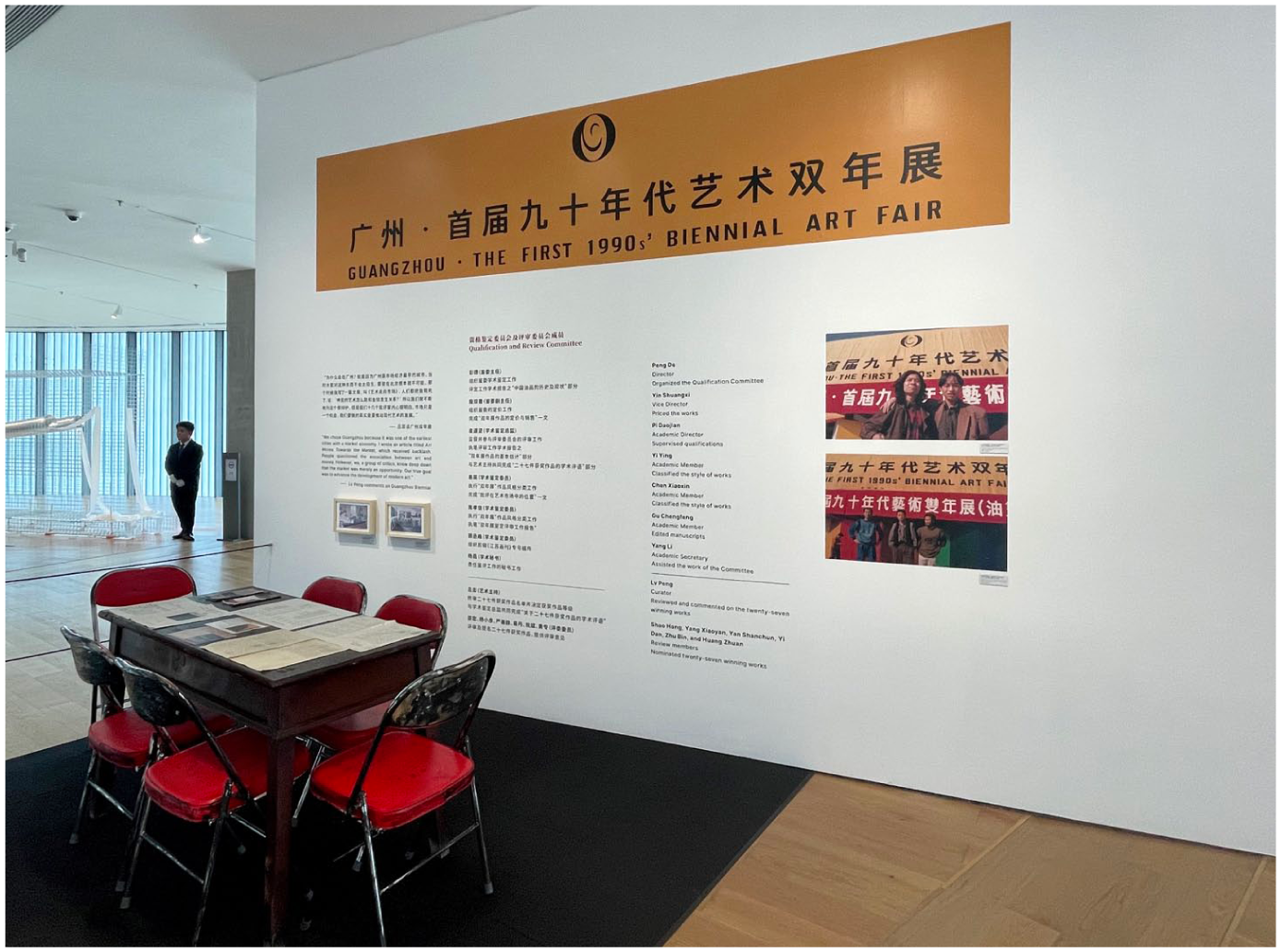
‘Guangzhou: the First 1990s’ Biennial Art Fair’ featured at HEM. Photo by the author.
Although the Guangzhou Biennial, which featured artists from across China rather than merely the PRD, did not ultimately achieve its intended objectives (Lan, 2011), it remains significant for its dual emphasis on establishing both a financial operating system and a system of art evaluation – an ambition that, as Wu and Wang (2010: 289) note, anticipated many art projects in the following decade. I argue that HEM’s reinterpretation foregrounded the Biennial as an initiating moment in the marketization of contemporary Chinese art. The event was presented archivally, listing committee members and quoting organizer Lv Peng saying about the choice of Guangzhou as ‘It was one of the earliest cities with a market economy. [At the time, the locals were familiar with this kind of activity, and it would have been impossible to hold the event in Beijing.]’. 8 Accompanying this quote were photographs documenting preparations for the exhibition, review conferences, and participating artists on-site. Nearby was a table and chairs in a typical 1990s conference arrangement. Several archival documents were displayed on the table, including invitations, business negotiation appointment cards, and jury certifications.
Among these materials was the original handwritten text of an article by Lv Peng titled ‘Market-Oriented Turn: Reflections on the Development of Chinese Art in the 1990s’. Readers today might find the wholehearted embrace of commercialization by one of China’s most influential art critics and scholars surprising, but the following excerpt provides context: The entry of art into the market is, in essence, an entry into order. An art environment without a market is, in fact, a barren wasteland detrimental to artistic development. In such a context, art is constantly at risk of being ‘disfigured’ by crude interventions or impromptu directives issued over the phone. The market offers a mechanism of orderly and lawful operation; under its rules, the production and ‘success’ of artworks are affirmed and safeguarded by various market forces.
The ‘crude interventions or impromptu directives’ here refer to the censorship of cultural production common in China, which often involves authorities demanding revisions that artists and curators experience as unreasonable and non-negotiable. In my reading, this context explains why critics such as Lv advocated marketization as a strategy for safeguarding artistic freedom, a viewpoint less commonly encountered in the contemporary art scenes in other countries. The handwritten format reinforced the sense of cultural censorship as a frequently excluded and, thus, cryptic discourse in China – one that archive-based exhibitions help to surface (Gül Durukan and Akmehmet, 2021). Through this curatorial framing, the PRD was worlded as a frontier of marketization, associated with hopes for artistic freedom and aligned with aspirational visions of global urbanity.
The world’s factory and its links to the Global South
‘As the “world’s factory”, the PRD is renowned for rapid urbanization, driven primarily by Foreign Direct Investment . . . in labour-intensive industries’ (Zhang et al., 2017). The theme of labour permeates the exhibitions examined here. PAM featured Xie Wendi’s glass sculpture In Her Own Body – Zhen (2023), inspired by her amazement at a silk factory in Foshan. There, women workers stood before rows of large silk-reeling machines skilfully teasing fine silk threads from cocoons and then knotting and smoothing them. Each worker managed four to five machines simultaneously, and the constant motion of the workers’ hands appeared from a distance to weave the air. Captivated by this scene, Xie invited a worker named Zhen – a common Cantonese name – to model these motions, which were cast in moulds and then transformed into hollow, blown-glass forms capturing their delicacy (Gu, 2024). Adjacent to Xie’s work was 1980s/Poem by Liu Xianglin, who transformed the poetry of Shenzhen electrician Wang Zheng into illuminated characters in a light box. Wang’s poetry reflected on his experiences as a migrant worker born in the 1980s and compelled to leave his hometown – where there was ‘no land to farm’ 9 – and spend his youth engaged in strenuous labour.
Exhibitions at both HEM and GDMoA featured Hong Kong artist Jaffa Lam’s long-term project Micro Economy, developed in collaboration with former women workers in Hong Kong. Many belonged to the generation central to the city’s manufacturing boom in the 1970s and 1980s, when the garment industry underpinned export trade (Salaff, 1981). After China’s reform and opening-up policies in the late 1970s, however, factories relocated to mainland China to cut costs, causing widespread job losses among these workers. Lam responded by using her artist’s fees to employ former seamstresses to produce soft sculptures from recycled umbrella fabric, repurposing discarded materials, skills, and labour under global capitalism.
In my interpretation, Lam’s project echoes Massey’s (1993: 63) observation that ‘capital’s ability to roam the world further strengthens it in relation to relatively immobile workers’. HEM displayed Lam’s Parachute (2011) (Figure 2), first commissioned by He Xiangning Art Museum in Shenzhen. Lam remarked, ‘I bring the Hong Kong experience here because similar experiences may occur in Shenzhen in the future’. 10 This insight proved prescient: in the past decade the PRD has faced growing competition from Southeast Asian economies offering incentives to attract foreign investment, especially in textiles and garment production (Zhang et al., 2017). The worn umbrella fabric, suspended in mid-air, evokes the precarity and exhaustion of labourers in the ‘world’s factory’.
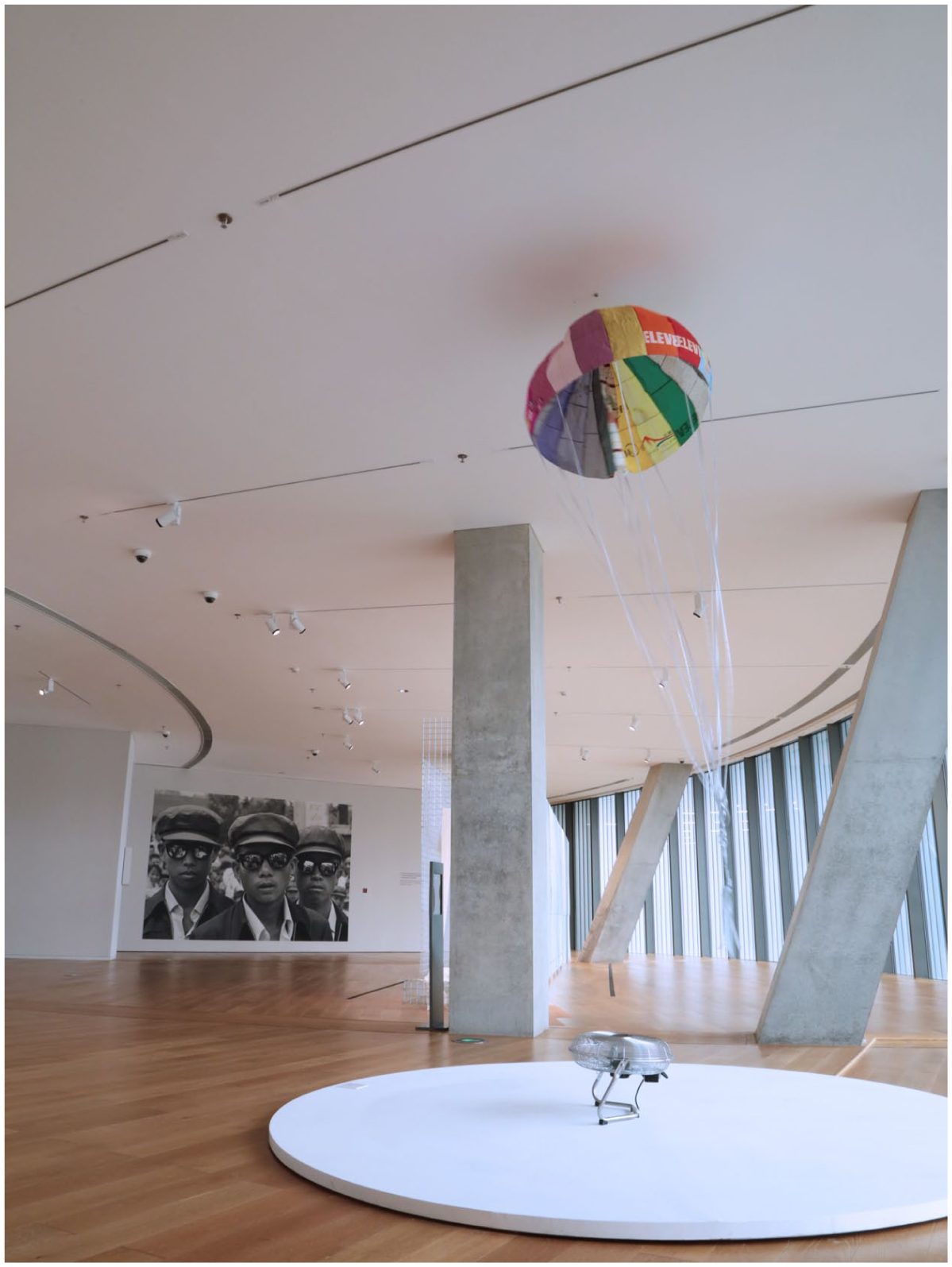
Installation view of Parachute at HEM. Photo courtesy of the artist.
Notably, GDMoA Director Wang described the museum’s ‘southern perspective’ as ‘beginning with the PRD, then expanding to the nation, Southeast Asia, and ultimately the world’. 11 This orientation was reflected in the exhibition’s inclusion of works such as Zheng Peili’s 480 Minutes (2008–2012), a 40-channel video installation assembled from surveillance footage recording eight hours of labour in a Hangzhou garment factory. GDMoA also featured Southeast Asian artists to, as a wall text stated, ‘reflect on the Western definition’. Among these was Entang Wiharso’s Wisdom (2018), whose cartoon-like figures entwined with vegetation, animal skins, and architectural motifs draw on Indonesian and Western folklore and contemporary culture. This imagery can be read as evoking and critiquing visual regimes associated with colonialism – early anthropologists measuring racialized bodies and imperial powers classifying and extracting plant species from colonized territories.
In this way, GDMoA’s exhibition-making worlded the PRD – and, by extension, China – as part of the Global South, foregrounding shared histories of colonialism and imperial domination with Southeast Asian countries as well as common roles in global production chains characterized by cheap labour and resource extraction.
Art-worlding the PRD as an ‘international innovation and technology hub’
Cui (2024b) explained in PAM’s curatorial guide that: When we interviewed Shenzhen artists [in preparation for this exhibition], seven or eight of them addressed technology and AI. So, if we were to identify a defining feature of Shenzhen’s art, perhaps it is technology. However, in my humanistic view, the core issue of Shenzhen should be migrant labour, not technology.
Cui’s remarks illustrate what Welland (2018) identifies as the growing overlap between contemporary art and state politics, rather than their operation as separate or antagonistic spheres. While many Shenzhen artists echoed the official branding of the city as a technological hub by foregrounding technology-based art, Cui sought to recalibrate curatorial attention towards migrant labour. This tension perhaps explains why the section ‘Shenzhen Time’ – which featured exclusively Shenzhen-based artists born after 1985 – simultaneously worlds the city as both the ‘world’s factory’, home to the headquarters of Foxconn, and China’s ‘Silicon Valley’ within the GBA, home to tech giants such as Huawei and Tencent.
Among the most technologically sophisticated works in the section was Zoe Li’s I Tell the Moon My Secret and the Moon Tells Me Yours (2023) (Figure 3), which combines photographs of the moon and soundwaves, a robotic arm, and a video documenting the work process. The years-long project began with Li’s (2025: 37) speculative questions ‘Could moonlight physically etch words into existence?’ and ‘How might one translate the invisible waveforms of speech into visible traces using nothing but lunar glow?’ Li deployed industrial robotic arms outdoors to work in concert with the moon: the robot repeatedly traced the soundwave of a secret she whispered, and only when the moon appeared within the robot’s field of view was the waveform captured in a long exposure. This suggests that, beyond its poetic premise – the moon as a confidante for human secrets – the criticality of Li’s work lies in its resistance to total technological mastery. Thus, the piece underscores the unruliness of natural conditions: only under a bright, unobstructed night sky can the act of communication take place.
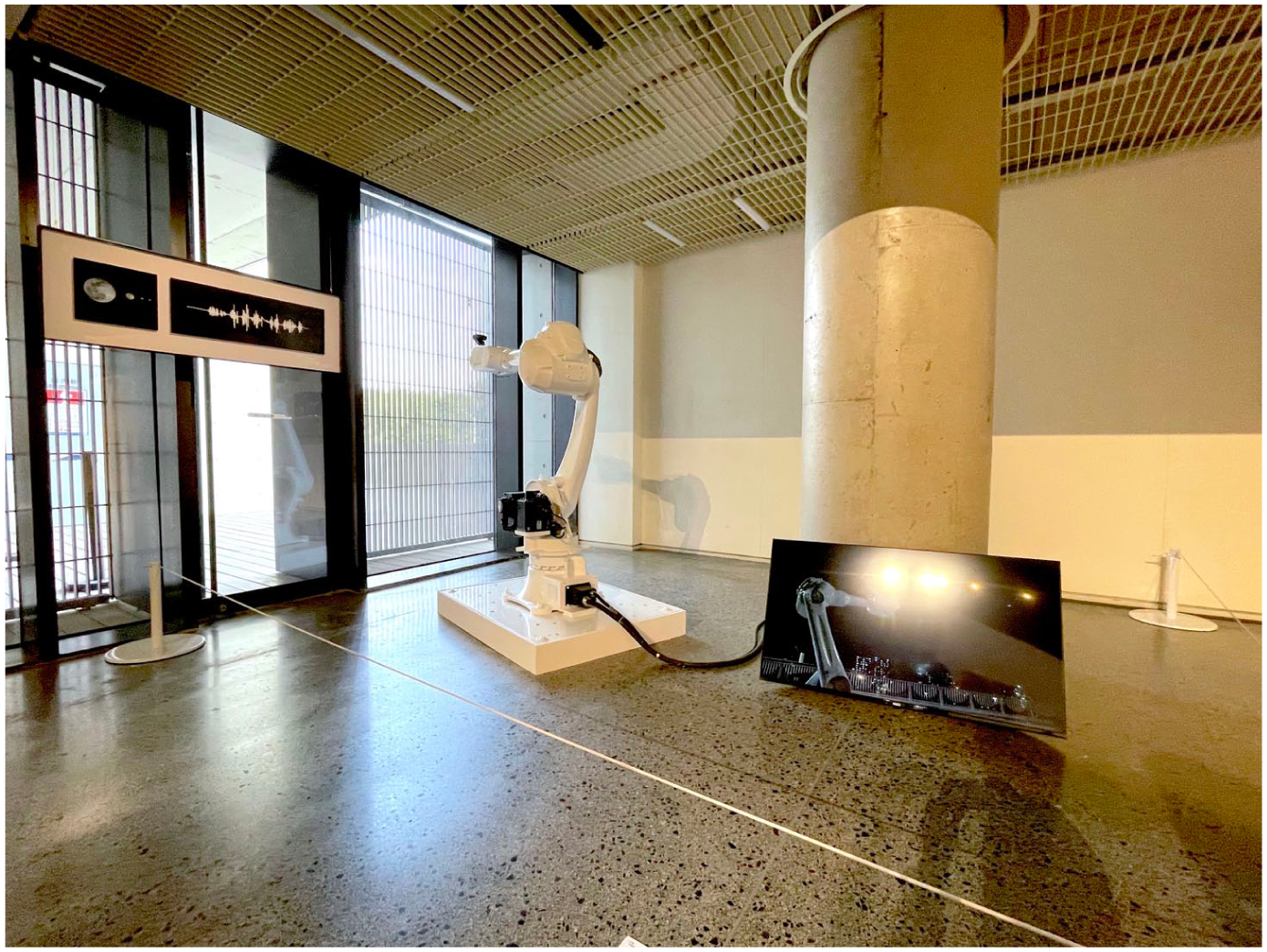
Installation view of I Tell the Moon My Secret and the Moon Tells Me Yours at PAM. Photo by the author.
Across the four exhibitions, digital and technologically mediated artworks were mobilized to frame the PRD as technologically forward-looking, while also offering critiques of technology’s impact on human subjects. For instance, GDMoA showcased Yao Qingmei’s Fencing: Landscape Fight (2021), a three-channel video installation documenting a choreographed duel between two fencers using ‘selfie-swords’. These selfie sticks, topped with smartphone cameras, live-streamed raw footage of the duel, which was mediated by a referee-presenter. As the combat unfolded, the performers gradually blended the specialized vocabularies of fencing and photography. The work thus interrogated the interaction of human bodies with the omnipresent production of self-images.
Indeed, although digital and technology-oriented art has become ubiquitous across global art worlds, actors within the PRD art ecosystem – such as the Shenzhen artists discussed above – seek to position themselves at the forefront of this trend. This ambition was particularly evident in M+’s 2017 restaging of Canton Express. The exhibition catalogue introduced the featured work Can You See? (2003) as the ‘first live-streamed art project in China’ (Can You See? 2017: 29). In this project, artists Xu Tan and Jin Jiangbo established webcasting hubs at the Venice Biennale and a residential complex in Shenzhen and transmitted live footage between the locations. Audiences at both sites were invited to join an online chat group and participate in live debates, thus creating a translocal, interactive viewing experience. Although live-streaming was mainstream by 2017, M+’s curatorial effort recontextualized the project in the early 2000s, highlighting the ‘dynamic circulation of art and technology’ (Can You See? 2017: 29) in the PRD. Rather than claiming technological exceptionalism, this framing historicized the entanglement of art and technology in the region, aligning early experimentation with contemporary GBA narratives of innovation.
Conclusion
This study analyses exhibition-making at four art museums through which the ‘truths’ of the PRD’s contemporaneity – its coming into being and becoming ‘historical’ (Heidegger, 2002: 16) – are articulated. In doing so, it theorizes exhibitions as worlding practices in contemporary art within a long-overlooked regional art ecosystem striving to define itself at a historical juncture when Chinese state policy seeks to recast the PRD’s image from the low-end ‘world’s factory’ to the higher-end vision of the GBA as an ‘international innovation and technology hub’ and global cultural megalopolis.
Accordingly, contemporary art institutions intersect with state agendas to redirect international attention from the PRD’s manufacturing ‘readymade’ culture towards conceptual and experimental practices. Yet this intersection does not simply function as soft propaganda. Across the exhibitions, the worlding of PRD histories also foregrounds critical reflections on technological mastery, labour exploitation, environmental extraction, and the uneven consequences of rapid urbanization and global capitalism. At the same time, certain themes remain muted – notably tensions between regional integration narratives and the distinct historical experiences of Hong Kong and Macao, sensitivities heightened after Hong Kong’s recent political and social unrest. Likewise, parallels with Southeast Asia and other developing regions are framed primarily through postcolonial solidarity, while China’s ambitions for China-centred globalization are treated more cautiously within institutional discourse.
Within these constraints, museums nonetheless demonstrate agency in shaping the identity of contemporary art in the PRD. As a wall text at HEM notes, Cantonese art has cultivated a ‘wild temperament’ distinct from other regions. PRD institutions thus position themselves at the margins of China’s art ecosystem while presenting this peripheral status as organic and generative, mirroring the region’s ecological diversity and its capacity to challenge dominant artistic narratives.
This ambition also extends to collection-building: three of the four museums (PAM being the exception) have assembled substantial holdings of local artists. Both GDMoA and HEM emphasize locally grounded exhibitions. In an interview, the director of GDMoA contrasted this approach with what he described as the exhibition model of the Power Station of Art in Shanghai, a municipal contemporary art museum, characterizing it as frequently importing and directly presenting works by international artists. By contrast, he emphasized GDMoA’s commitment to foregrounding PRD-based artists and regional narratives. 12 While recent research shows that private contemporary art museums in China have become increasingly globalized in their exhibition profiles – among 23 surveyed institutions, 9 are based in Beijing and 9 in Shanghai (Kharchenkova and Merkus, 2025) – the director’s comparison functions less as a general claim about Shanghai than as a relational positioning of GDMoA within the national art hierarchy. In this sense, Shanghai operates as a symbolic centre against which GDMoA worlds itself as regionally grounded.
This study contributes to unpacking contemporary art-worlding enacted through exhibition-making, encompassing institutional positioning, curatorial practices such as selecting themes and artworks, drafting curatorial statements, and interpreting works. These practices have prompted sustained institutional critique that foregrounds the social, political, economic, and historical contexts shaping art. While I have also interviewed visitors to HEM and GDMoA about their experiences and interpretations, reception analysis will be pursued in future research to assess the effects of art-worlding. A further development will examine cultural policies issued by the central government, Guangdong Province, and the nine municipalities following the 2017 GBA framework in order to analyse regional and local cultural governance and its relationship to the geopolitical conditions shaping art-worlding.
Beyond these directions, one broader point emerges: if art, for Heidegger, gives truth a historical form, then these exhibitions render the PRD’s contested present legible as history-in-the-making. They show how regional art ecosystems are not simply found but continually worlded – through curatorial practice, institutional imagination, and the uneven negotiations between state ambition, local aspiration, and global cultural hierarchy.
Footnotes
Acknowledgements
The author is grateful to the two anonymous reviewers for their constructive and insightful feedback, which significantly improved the quality of this article. She also thanks Tang Ying Laam for her assistance in this research project.

Funding
The authors disclosed receipt of the following financial support for the research, authorship, and/or publication of this article: The project was fully supported by a grant from the Research Grants Council of the Hong Kong Special Administrative Region, China (project no. 23604022), as well as the Rising Star Research Grant from Hong Kong Baptist University.
Declaration of conflicting interests
The author declared no potential conflicts of interest with respect to the research, authorship, and/or publication of this article.
Data availability statement
Data sharing not applicable to this article as no datasets were generated or analysed during this study.