




Abstract
A ballerina’s life is generally considered to be hard. She works long hours, for poor pay in a highly disciplined and hierarchical system in which her interests are seldom at the forefront. Pain, eating disorders and exhaustion are considered to be the ‘unavoidable risks’ of the profession. However, when asked, most ballerinas talk with a lot of pride and fulfilment about their profession; they feel empowered and privileged. To social scientists, this poses the question of how to understand the concept of agency in the world of ballet. This article aims to contribute to the discussion using contemporary materiality theories. Dualistic thinking prevails in the world of ballet; the mind is supposed to have total control over the body. The article examines this thinking in relation to daily ballet practice, in particular the ballerina’s use of pointe shoes. The findings shed an unexpected light on agency while illustrating the potential of materiality theories in this research area.
The hardships of a life in ballet are well known. As a dance career will only last for a short time and competition is cruel, especially among ballerinas, the dancer always has to get the most out of it. Hence, all time and energy are invested in training and dancing. Having a normal social life, going out with friends, is considered to be beyond the realms of their daily lives. Experiencing pain, dealing with long-term injuries and exhaustion are considered to be part and parcel of the profession (Aalten, 2001). Living up to a very strict image of the female ballet body, eating disorders are common among ballerinas. Also, traditional ballet pedagogy is described as being hurtful and humiliating to most ballet dancers. ‘They break them down in order to build the kind of dancer they want here’, is the comment of a ballet coach (Wulff, 1998: 65). Furthermore, almost all professional aspects of a dancer’s life, from daily dancing schedules to any kind of career building, are completely determined by others – in the main by choreographers and ballet company directors (Wulff, 1998). These characteristics of ballet life hold true for dancers in professional ballet companies all over the world, and are considered inherent to the profession.
This has resulted in a rather critical approach to ballet culture in the social sciences, especially in Feminist Studies (see for example Adair, 1992; Daly, 1997), but also beyond (see Off Balance: The Real World of Ballet [1983], by journalist Suzanne Gordon). The criticism concerns the way women are portrayed in ballet performances as well as the lack of the dancer’s agency in her everyday life. Actually, even within the ballet world itself, classical dancers are considered to be oppressed by the strong hierarchical and traditional structure (Wulff, 1998: 73).
Recently, however, alternative views on the position of ballet dancers can also be found. In her book Ballet across Borders: Career and Culture in the World of Dancers, Helena Wulff describes how dancers find ways to resist or question the voice of choreographers or coaches in daily life, for example by refusing to dance steps that hurt them or that they do not like, or by changing steps minutes before a performance (Wulff, 1998: 73–4).
Anthropologist Anna Aalten, in her extensive research on the ballet culture, seeks to add the emic point of view to the existing picture. After interviewing many professional female dancers in ballet companies in the Netherlands, Aalten finds that ballerinas obtain much satisfaction from their profession. They persistently state they feel strong, powerful, athletic and elegant as a ballerina. They feel the high ballet standard challenges them, and in fact enables them to excel. While dancing, they get the best out of themselves, resulting in feelings of power, autonomy and physical and emotional freedom (Aalten, 2002: 137, 235–8, 2004: 33).
Aalten’s research reveals a complex interaction between the strict ballet regime on the one hand, and the personal agency of dancers on the other. In a Foucauldian sense, self-fulfilment and identity seem to be the outcome of subordination.
Meanwhile, Aalten and others keep pointing to the major problems concerning the health of ballerinas. The persistent problems with long-term injuries, exhaustion and eating disorders seem to be related to the high standards of choreographers, the strong competition, the short career and the hierarchical structure, combined with the dominant traditional image of the ballerina as a light, almost ethereal creature (Aalten, 2001, 2002, 2004; Wulff, 1998). From this perspective, it does appear the ballerina has a weak social position.
So, from an emic view dancers can be considered active agents who accept the ballet regime in order to achieve a personal goal. From an outsider’s perspective, though, one may wonder to what level a ballerina is used to having self-control and whether her self-image, including her very personal goals, are merely shaped and prescribed by that same ballet regime.
Drawing on contemporary materiality theories, this article aims to further the discussion on agency, heralded by Aalten and others. The tangibility of ballet practice will be taken as a starting point by focusing on one particular object: pointe shoes. Pointe shoes are used for dancing on the tip of the toes and as they balance on them, ballerinas seem to float and become the ultimate expression of grace and ethereal lightness.
Feminist writers often consider the dancer-on-pointe as the ultimate expression of inequality in ballet: whereas male and female dancers still performed similar steps, alongside each other, in the 18th-century pas de deux, the arrival of pointe shoe technique in the 19th century, brought about a different way of partnering: ‘always with the male dancer supporting, guiding and manipulating the female dancer’ (Foster, 1997: 4). The instability of the pointe shoes makes the ballerina a graceful yet fragile creature, literally dependent on male support for her balance (Novack, 1993).
In this article, however, I will consider ballet shoes in quite a different fashion; not as a materialization of gender issues or a specific ballet ideal, but as a direct extension of the ballerina’s body and movements. I will regard the female dancer and her shoes as a unique, intimate and hybrid assemblage, shaping and exchanging each other’s characteristics. I will look at the way girls train with them, the way the shoes are cared for, but also at the means of their production and recent technological innovations.
These practices will then be confronted with the dominant theory of materiality in the world of ballet; one in which the mind is prevailing over and controlling the material world (the body). From this angle we will be able to discern several strong contradictions between ballet ideology and daily ballet practice. As a result, new ideas will be disclosed on the ways agency comes about in the world of ballet and on how it is also challenged.
Research background
Anthropological research on ballet dance traditionally concerns itself with two topics: analysing the meanings of ballet choreographies and the cultural context of ballet dance. The two lines of research are strongly influenced by feminist and gender studies and both consider the body and its movements as a cultural construction (Wulff, 2001). Recently, ethnographic research has also become popular, in which a practice-oriented approach is adopted and the dancers’ tangible bodies have come more to the fore (Aalten, 2001, 2007). The current article can be positioned within the recent ethnographic line of research. However, adopting a ‘materiality-perspective’, it also wants to add something new.
Theoretically, the research is mainly based in the Anglo-Saxon field of Material Culture Studies. In this young interdisciplinary field, scholars from the social sciences, archaeology and history take part in a lively debate on the way people and things have an influence on, and shape each other. Reacting against traditional Cartesian and essentialist theories on material culture, such as technical determinism and structuralism, a non-dualist approach of people and things is promoted, a hybrid perspective on the world in which norms and agency are considered to be (re)produced, but also challenged and changed in the relations between (and merging of) people and things (Dant, 2004; Ingold, 2000; Miller, 2005; Warnier, 2001). Moreover, the dialectics between people and things can bring about normative changes in unexpected, implicit, non-discursive and therefore effective ways (Miller, 2005; Rowlands, 2005), for example when new things or technologies are introduced, accepted or rejected.
In this article, this particular non-dualist stance is used, including the specific focus on material culture, to look at the construction of ballet dancers and ballet culture in an unexpected way. The new angle is also considered an opportunity to let go, temporarily, of the dominant focus on issues of gender and sexuality in ballet research. In the future, however, it could also be very interesting to combine both perspectives. 1
The information on dealing with pointe shoes and ballet culture was partly drawn from the author’s personal experiences, as she was trained as a classical dancer at a professional Dutch ballet academy (dansopleiding Conservatorium Den Haag) from the age of 11 to 14 years. In addition, information was used from the extensive anthropological and ethnographic research of Anna Aalten and Helena Wulff on the lives and experiences of ballet dancers. Additional data on the use of pointe shoes come from the excellent handbook by Barringer and Schlesinger (2004), containing several interviews with ballerinas talking about their shoes, as well as websites and newspaper articles.
What pointe shoes are
Most people never come into contact with pointe shoes. It is important to describe some of their physical properties.
Pointe shoes enable dancers to balance on the tip of their toes, with their feet in a pointed position. In order to achieve this, ballet shoes have a soft leather sole and a hard tip of paper, tissue and hardened glue, with a small flat surface at the front. The shoes are designed for this particular use; they are not well suited for walking, as they are very slippery and stiff.
The visual effects of dancing on pointe shoes are manifold; when lifting one leg in the air both legs look especially elongated; pirouettes can be performed more smoothly and at high speed.

A pair of pointe shoes, Amsterdam 2008
Pointe shoes were first used at the beginning of the 19th century, in the Romantic Age. In the Romantic ballets, the stories concerned supernatural, female, ethereal creatures, such as sylphs, wilis, water nymphs, and later swans, and fairies in a tragic encounter with a mortal, human man. The ballerina represented an almost illusionary female, an emblem of purity, and the pointe shoes were meant to create this illusion, lifting the female dancer off the floor (Barringer and Schlesinger, 2004: 1–7; Terry, 1962: 22–9). Some of these romantic ballets, such as La Sylphide and Giselle, and later neo-classical pieces, such as Swan Lake and Sleeping Beauty, are still very popular today. Learning pointe shoe technique, since then, has become fully intertwined with ballet instruction and theatrical dance pedagogy in general, and has continued to evolve over the decades.
How to work them
Ballet students need to have had a few years of training before they can start with pointe classes. They need to have a strong and straight posture and be able to tighten the muscles in the legs, feet, back and abdomen sufficiently, otherwise injuries will quickly follow. Girls mostly start with the classes at the age of 11, but their ballet teacher decides on whether they are ready for this step (Barringer and Schlesinger, 2004: 20, 138). The purchase of the first pair of pointe shoes is considered a major event, when sometimes even the teacher, family members and video-cameras are present. At that moment, the student enters the adult realm of ballet. One can actually speak of a rite of passage.
The first pointe class often turns out to be vastly disappointing, the slippers feel extremely hard and uncomfortable and they hurt. The feet need to adjust to the tight shoe and become very strong in order to deal with the pressure on the toes. Getting on and off the toes, standing on one leg or performing pirouettes on pointe are true achievements and take years of hard, painful work. Only a few girls are physically able to eventually fully master pointe shoes.
As such, pointe shoes function as a material threshold to the professional world of ballet.
Pointe makes you feel light and graceful. It is a wonderful feeling to be en pointe. I’m 13. I’ve been dancing since I was 3. Ballet is really hard work. All the hard work pays off when you are so strong and you see those beautiful pointe shoes in your dance bag. Pointe makes you feel tall. You feel really delicate on pointe because you have to be able to lift yourself up, and take yourself down carefully again. I love pointe. It’s awesome. Pointe shoes are awesome too because they are hard and they are fun to use.
2
Here, we recognize the voice of the dancers in Aalten’s research. Ballet students seem to consider the difficulty of mastering ballet shoes a challenge, enabling them to excel and triumph.
This feeling of pride is supported by the fact that a dancer on pointe shoes can move with an extraordinary grace, speed and smoothness. In combination with the shoes the ballerina can execute movements that exceed the abilities of the normal human body, escaping its limitations. As such, a ballerina not only represents an ethereal, supernatural entity. In alliance with her pointe shoes she actually has become a uniquely enabled agent.
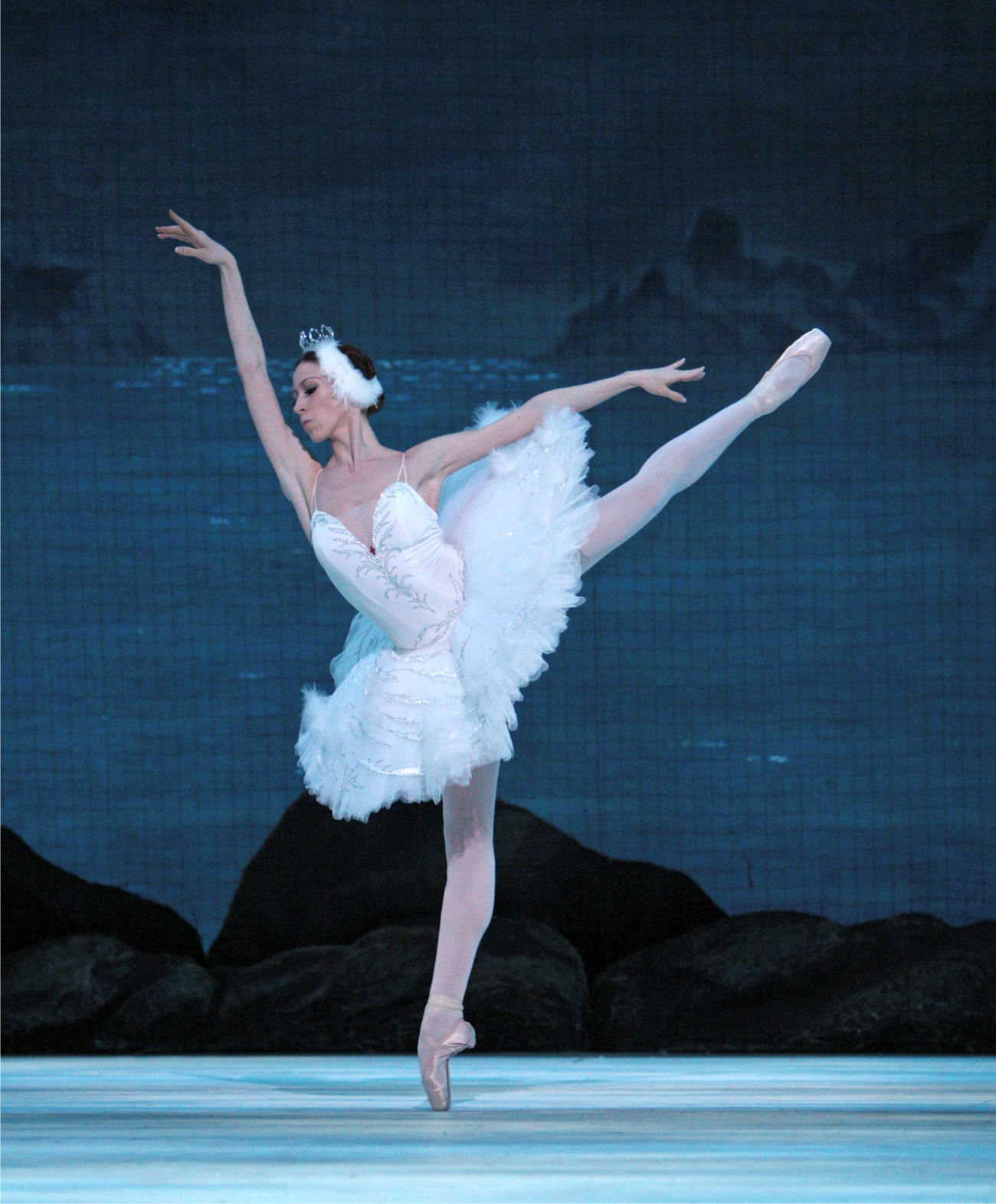
‘When lifting one leg in the air both legs look especially elongated’. ©Lebrecht Music & Arts/Hollandse Hoogte, Kirov (Marijinsky) Ballet, Victoria Tereshkina as Odette in Swan Lake, Royal Opera House, 18 July 2005
Dancer and shoe merging
Before we turn to the question of the ballerina’s agency, I want to go deeper into the intimate relationship that dancers develop with their shoes, adopting a non-dualistic stance.
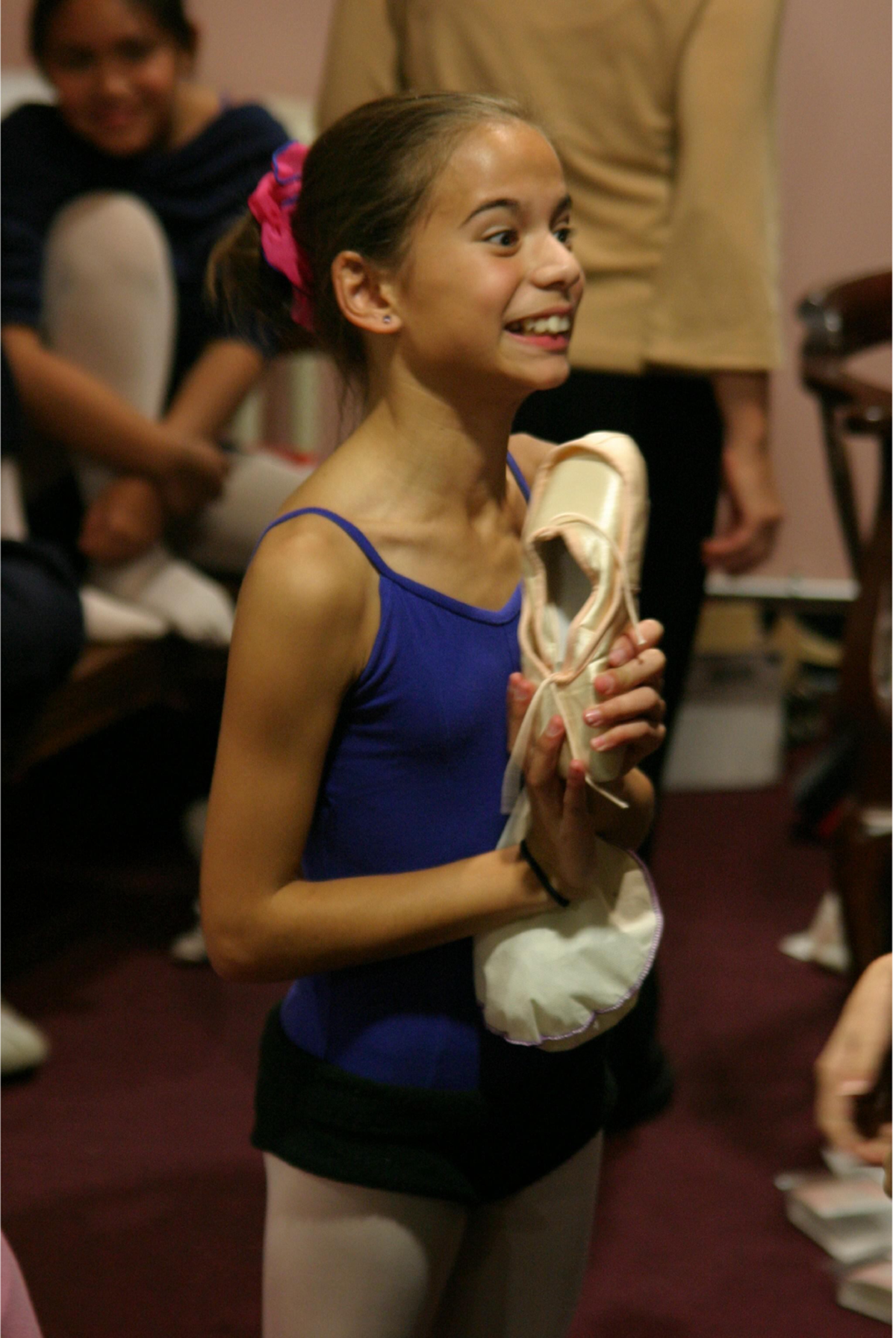
This young ballet student is very excited to buy her first pair of pointe shoes. With special thanks to the Los Angeles Ballet Academy and photographer Ric Wilson
The ultimate goal for a ballerina is to merge with her shoes while dancing. Moving on pointe should look and feel natural. She should be able to anticipate the floor, ‘feel’ it, through her shoes. Like the blind man who perceives the pavement and its obstacles through the tip of his stick (Warnier after Paul Schilder, 2001: 7), the legs of a ballerina end at the outer tip of her pointe shoe.
In recent materiality theory researchers stress the idea that subject and object are intimately connected and that often one cannot isolate the abilities, intentions and goals of the human agent from its alliances with objects. They should be approached as an assembly.
One way to analyse how deeply humans and things are united is to study skills. Anthropologists Tim Dant (2004) and Tim Ingold (2000: 5, 340–9) demonstrate that while learning to use an object, both subject and object change. As we develop our physical abilities in driving a car or sampling wine, new qualities and nuances of car and wine come to the fore. As we become experts, the object becomes more and more complex to us. Together, the object and the subject develop new properties and possibilities of action. Dant and Ingold stress that the source of these new characteristics and actions is not be found in either the person or the thing; we are dealing with a new entity, an assembly or a person-thing.
Similarly, appropriating pointe shoes encompasses a process of mutual change. At the beginning, all students used more or less the same type of pointe shoes. But, as students become more and more acquainted with the shoes, they learn to know their feet in a new fashion; personal needs are discovered as well as developed. There are many types of pointe shoes and, in the course of time, a dancer develops a preference for a certain type of ballet shoe. She ‘works’ and handles them in a unique way – I will elaborate on this later – and will not be able to change to a different type of shoe easily; her posture, leg and feet muscles are adjusted to this particular shoe type. Equally, used shoes can only be worn by that particular dancer. Also, the dancer will not be able to use the first type of shoes she ever danced on. Even though these shoes were essential for building her current abilities, they will be too hard and supportive for her now. Her training and acquired skill have changed her feet and body irreversibly, similar to how a professional sommelier will never be able to experience a wine the same way he could when he took his first sips. The mutual qualities of sommelier and wine, ballerina and shoes, have changed and have become adjusted to each other.
The interdependence of dancer and shoes becomes even more clear when we take a look at the relationship between the ballerina and the cobbler. Ballet shoes are hand-made products and one particular shoe-type is often made by one person. Via the shoes, dancers and cobblers are intimately linked on a daily, physical basis. In a newspaper article, journalist James D. Watts Jr interviews ballerina Jennifer DeWolfe from the Tulsa Ballet. She has been getting her shoes from the same cobbler for the past 11 years and she had noticed something changing as the man aged.
‘When he was younger, he was very consistent in quality,’ she said. ‘But in the last year or so, sometimes I would get one shoe that was absolutely perfect, and out of the same box I’d get a shoe that looked like it was made by an ape.’ (Dewolfe in Watts, 2005)
This statement shows how dependent the ballerina is on the work of the cobbler. She is not in a position to show empathy for the flaws of the cobbler as his work has a direct effect on her functioning. The shoes are an integral part of her moving body and she simply needs the cobbler to provide her with the right limbs.
The same mechanism can be seen when the cobbler wants to retire. Getting used to a different type of shoe takes a lot of time and effort; a dancer needs to readjust her body and her way of training in order to develop a new perfect fit (Barringer and Schlesinger, 2004: 186).
In an article on pointe shoes by Kevin Conley (2002), Merrill Ashley, a former principal at the New York City Ballet told the journalist that when she found out her cobbler was going to retire she took it as a hint it was time for her to do the same.
I can’t get used to another maker. It’s like changing husbands. It’s …’ She paused, before alighting on the right word. ‘It’s you!’ (2002: 70)
Understandably, many dancers will try to prevent this kind of change. Sometimes, as a result, the names of those who make the shoes are deliberately not revealed to the dancers. Ballerina Said Bergman (Tulsa Ballet): It’s understandable, though. When a maker retires, all the dancers who wore his shoes get really angry. If we knew his name, we’d probably track him down and make him go back to work. (in Watts, 2005)
So, in order to deal with such intimate and interdependent relations in a socially acceptable way an artificial barrier is sometimes constructed. It shows to what extend the shoes and dancers are intertwined.
According to Jean Pierre Warnier (2001), such intimate relationships with objects not only have a social impact but can also reach deep into the subject’s psyche. Following Foucault, he stresses that particular techniques of the body are also techniques of the self. This implies that developing a skill in relationship to an object is, especially for young people, a means through which the subject shapes his or her passions and drives.
For example, people experience several emotional thresholds during a learning trajectory with an object. We already noted the excitement students feel when they buy their first pair of shoes. After that, numerous landmark events follow, such as the first performance on pointe, the first auditions and castings, as well as, unfortunately, the first serious injury. In addition, throughout a ballerina’s career, the level of her pointe work will always be decisive for the outcome of selection procedures and thus for her career as a whole. According to Warnier, such critical events are considered constitutive for a subject, for example in the way a pilot’s subjectivity is formed by his or her first flight and the first encounter with a storm, or the way child soldiers are marked by their first acts of violence. Handling the plane or gun personally is an essential part of experiencing and handling the moment and, hence, is deeply associated with these formative events. In addition to that, there is a growing familiarity with the object; handling it becomes more automatic and, thus, natural. These objects, then, become intertwined with one’s notion of self-confidence and self-realization, whether it concerns a gun, a plane or a pair of ballet shoes.
In short, a ballerina can be considered an amalgamation between the person and her tool. The new, composite agent is able to perform and express itself at an extraordinary level, escaping the limitations of the human body, and experiencing pride and fulfilment. Furthermore, the process of learning to dance on pointe changes the dancer irreversibly; the shoes become part of her corporal system and reach into her emotional framework and personal drive. In the next paragraph I will contextualize the relationship between the dancer and her pointe shoes by looking at the dominant outlook on materiality in the world of ballet. This will enable us to then return to the issue of agency with a fresh look.
An ideal of disembodiment
The merging of the ballet dancer and her shoes takes place in a culture that is dominated by a strong Cartesian ideology, in which the subject, or the mind, is not only separated from the object, but triumphs over it. Ballet, as an art form, represents the typical western notion of the mind prevailing over the body (Aalten, 2004: 29). Not only is a ballerina physically expected to have absolute control over her body, as a theatrical figure she epitomizes an ideal of lightness and disembodiment, defying gravity. In this respect, ballet, as an art form, differs greatly from professional sports: both fields aim at transgressing the limits of the normal, human body. But whereas sports celebrate the body and measure its performances, ballet aims at transcending the tangible body, escaping the banal material world, and enchanting the audience.
The western dualistic ideal of the mind controlling the body is dominant in the world of ballet in many ways. It is, for example, a dominant model in ballet training. Ballet students are taught to train with the image of the perfect ballet body in mind. This image is presented in numerous ways: in pictures in ballet books, in ballet videos and also by ballet teachers. The students are trained to transform and mould their own bodies towards that particular mental image (Aalten, 2002: 27, 113–14, 135–6; Foster, 1997). Repetition is an important aspect of this moulding process: ‘Drilling is necessary because the aim is nothing less than creating the body. With repetition, the images used to describe the body and its actions become the body’ (Foster, 1997: 239). Tim Ingold (2000: 340–9) would describe it as a dualistic view of the ‘production process’: the end product is considered the result of imposing a mental image, from outside, onto the material world. In this approach, the body is considered to be an instrument or a tool and absolute control is the aim (Aalten, 2004: 29–31). This perspective is very different from the one we looked at earlier, in which subject and object are considered to be equal parts of the process and influence each other while developing skill.
The ideology of the mind controlling the body, however, is not restricted to ballet classes or performances. In professional ballet academies, students are taught to feel responsible for their physical appearance, outside as well as inside the school. Students are made aware that the cleanliness of their ballet clothes matters, and the state of their hair and nails should be impeccable. Ballerinas who are known for their flawless looks are presented as role models. The idea behind this is that the quality of a dancer is expressed through the control she has over her physical appearance (Hoogsteyns, 2008: 120).
There is no doubt about the effectiveness of the dualistic work ethic. Ballerinas can force their bodies to perform at an extremely high level. As students, they find out that it is possible to transform the body drastically, as long as they put their whole mind to it. Hence, focusing on ‘the ideal image’ enables dancers to transgress their physical limits.
Anna Aalten, however, points to the drawbacks of this method. Dancers do not seem to learn and honour the limitations of their personal bodies when necessary (Aalten, 2002: 136). This is considered a major factor in causing long-term injuries and serious eating disorders. From a materiality-theory point of view one could say that ‘the ideal ballet body’ has more weight and presence, or is more material, in the training method than the actual physical bodies of dancers. The perfect ballet body is actually a ‘disembodied’ body.
Back to the shoes
So what effect does the dualistic ideology have on the everyday shoe-practice? Let us begin with noting that pointe shoes, as artefacts (!), are in fact crucial for enacting the ballet ideal of disembodiment. The shoes literally lift the dancer off the ground and enable her to escape from the limits of the ordinary body. According to Eliza Minden, designer and producer of pointe shoes, the status of ballet as an art has, however, also hindered developments in design and materials of pointe shoes. Whereas the equipment for sportsmen, such as swimsuits or running shoes, is constantly improved with high-tech materials and adjusted to the needs and performances of their users, ballet shoes are still made from the same, traditional materials as they were a hundred years ago. Proud of the strong traditions in ballet culture, the original craft of producing ballet shoes is still highly honoured and the cobblers are considered artists. So, although the level of ballet technique is rising and more is asked from the dancer and her shoes, the production materials have hardly changed (Minden, 1998: 6). What are the consequences of this?
The main problems with the ‘old-fashioned’ pointe shoes, is that the materials wear down quickly and that they demand a lot of care. For most dancers a new pair of shoes is slightly too hard to dance on, so they ‘work’ the shoes to make them softer, by bashing them against the wall, squashing them between door and doorframe or even by biting on them. Every ballerina has her own way of modifying the shoes. The balance, however, is very delicate, and quickly the shoes become too soft to stand on. In order to lengthen their lifespan, Sellac, a type of hardening glue, is often poured into the shoes. Nevertheless, most shoes do not last longer than one or two performances, so the care for those shoes never stops.
Here, a friction can be noticed between the ideology of the art-status of ballet, and the tangible, non-dualistic daily practices dancers are faced with. Whereas the ballerina, in order to dance perfectly light and graceful, needs to be in perfect unity with her shoes, her comfort and safety are not the main parameter behind the production process, but the traditions of the shoe-production and the hierarchies in ballet culture. Of course, shoe companies do try to improve the fit of the shoes (not the materials). These processes of innovation, however, are often directed at satisfying new demands by choreographers, or, in case of custom-made shoes, the needs of prominent soloists. In relation to the average dancer, though, the idea of ballet as a tradition-honouring art form seems to have more materiality, or weight, than her actual needs in order to complete herself as an ‘assembly’.
Minden points out that the main problems with pointe shoes – durability and stiffness – can be solved by using more modern materials. For her brand of shoes she adopted high-tech elastics that make the shoes firm yet flexible, so that they do not have to be broken in. This increases their lifespan three to fivefold. Also, automatic inside padding makes the shoes much more comfortable to wear. Though Minden is not the first to make use of new materials (Barringer and Schlesinger, 2004: 63–5), she was the first to explicitly connect this step to giving the needs of ballerinas a central place in the design of her shoes. The shoes have been on the market since the early 1990s and their popularity is now growing rapidly. They are called revolutionary, as well as controversial in the ballet world.
Material agency in the world of ballet
In his article ‘A materialist approach to materiality’, Michael Rowlands (2005) examines the idea of hierarchies of materiality. Following Marx’s work on materialism, Rowlands examines the idea that self-realization is intertwined with practical activity, with making and doing, constituting both consciousness and materiality (2005: 73). According to this idea, materiality is not an a priori condition. Depending on our active participation (or lack of it, denial of it), we can be more or less material in our being. Hence, hierarchies of materiality are formed through denial or full access to an embodied sense of the self (2005: 80). A crucial measure of self-realization is the understanding that subjects have of this particular context and of their capacity to alter it (2005: 76).
In the world of ballet, the ideal of immateriality seems to be prevailing over the needs and properties of ballet dancers. This is not so strange, when we remember that the main goal of ballet instruction is directed at overcoming the tangible body in many ways. In Rowlands’ terms, however, the immaterial ideal of ballet is not only more substantial than the actual bodies of dancers, but consequently also partly denies the dancer’s agency.
From a materiality perspective, the dancer does not have a full embodied sense of the self. She is actually actively trained to ignore the signals and limits of her physical body. Aalten notes that in order to deal with the problems resulting from this, of eating disorders and long-term injuries, a critical self-awareness of dancers, in particular towards their own bodies, should be promoted. In Rowlands’ terms: the dancer’s personal body should gain some weight, become more substantial. However, Aalten also notices that, in reaction to these suggestions, dancers often reply that they are fully aware of the situation, but that they choose to submit to it. Dancers, then, do not seem to express a sense of capacity to alter their situation in the way Rowlands describes it.
But perhaps, alteration should not be sought after in the verbal discourse but in the non-discursive realm of material culture. Rowlands points out that ‘if self-knowledge can move people to alter their material conditions in a practical way, it then becomes a kind of social and political force’ (2005:76). Although Minden is not a professional dancer herself, she did learn to dance on pointe in her younger years and her sister is a ballerina, as well as many of her female friends. She says she started designing pointe shoes out of personal frustration over the characteristics of the conventional shoes and promotes her product as being ‘designed and invented by a dancer’. In this way, Minden claims the design of her shoes actually results from the embodied experiences and (emerging) self-knowledge of ballerinas.
Adapting the design and materials of pointe shoes to the specific needs of dancers, in terms of enhancing comfort and durability and decreasing pain, Gaynor Minden shoes offer an alternative view of the dancer’s body. Literally incorporating the dancers’ own bodies, and not the ballet ideal, the shoes gives them more weight, more materiality, more substance.
So how were the Minden shoes actually received in the world of ballet? Were they silently adopted? Or rejected? Perhaps not surprisingly, the introduction of Minden shoes led to a lot of controversy in the world of ballet. Kevin Conley, who wrote an article on the subject in the New Yorker, calls it a veritable war. Minden’s claim for reducing injuries, for example, is rejected by Suki Shorer, teacher at the School of American Ballet, who states ‘Ballet isn’t about health. It’s an art form’ (in Conley, 2002: 70). Some opponents call Minden’s footwear ‘cheater shoes’ considering that the shoes in a way do some of the work for the dancer, and make dancing on pointe too easy and comfortable. Others state that they think the shoes are inferior in an aesthetic sense; a trained eye can always see the difference (Conley, 2002: 78; Horseley, 2003). In the beginning, such comments actually seem to have led sales of the shoes to stagnate, but as more and more successful dancers from the younger generations are using them, the popularity of Minden shoes is now rapidly rising.
The fierce reactions show that Minden’s shoes touch a sensitive nerve and that, in a way, they are considered threatening to the ballet culture. Many dancers themselves even agree on the idea that ballet life should be full of hardships and that it shapes who you are as a person and a dancer. The Minden shoes challenge this basic assumption. Their design literally articulates, and gives a voice to, the needs of ballerinas, and aims at enhancing comfort. In this way, the shoes forces every dancer to reflect on their own position and on their possibilities for altering it.
Conclusion
The anthropological discussion on the agency of ballerinas hinges on the image of the ballet culture as both repressing and enabling dancers at the same time. How should we understand the position of dancers in this? Taking materiality as its starting point, the above survey reveals a strong tension between the dualistic, western ideal of disembodiment and the intrinsic non-dualistic, material ballet practice. This provides us with tools to deepen our understanding of the position dancers are in; the distance between the immaterial ideal and daily practice is constantly bridged by the bodies of dancers; their injuries, their constant care for pointe shoes silently fill up the gap. Next to that, the ballet ideal seems to be more material and substantial than the real bodies, practices and needs of dancers. The denial of the materiality of ballet dance does not only appear impractical; more than that, it seems to be dangerously common. From this point of view, dancers lack a crucial sense of agency within ballet culture. However, change is also detected precisely in the realm of the material, embodied in Minden’s shoes.
Footnotes
Funding
This research received no specific grant from any funding agency in the public, commercial or not-for-profit sectors.