




Abstract
In recent debates about the ever-growing prominence of celebrity in society and culture, a number of scholars have started to use the often intermingled terms ‘celebrification’ and ‘celebritization’. This article contributes to these debates first by distinguishing and clearly defining both terms, and especially by presenting a multidimensional conceptual model of celebritization to remedy the current one-sided approaches that obscure its theoretical and empirical complexity. Here ‘celebrification’ captures the transformation of ordinary people and public figures into celebrities, whereas ‘celebritization’ is conceptualized as a meta-process that grasps the changing nature, as well as the societal and cultural embedding of celebrity, which can be observed through its democratization, diversification and migration. It is argued that these manifestations of celebritization are driven by three separate but interacting moulding forces: mediatization, personalization and commodification.
Keywords
Celebrity has become a defining characteristic of our mediatized societies. It is ever-present in news and entertainment media – boosted by formats such as reality TV – in advertising and activism, and it has deeply affected several social fields, especially the political, but also the gastronomic and even the religious fields, for celebrity has become a valued resource to be used in power struggles. Celebrity status, it is argued, gives those who have it discursive power or a voice that cannot be ignored (Marshall, 1997: x), and it is supposed to function as a general token of success (Bell, 2010: 49). Such is the proliferation of celebrity culture that several authors have discussed its importance for social cohesion and identity formation (e.g. Marshall, 2010; Sternheimer, 2011); or, as Ellis Cashmore phrases it: Like it or loathe it, celebrity culture is with us: it surrounds us and even invades us. It shapes our thought and conduct, style, and manner. It affects and is affected by not just hardcore fans but by entire populations. (2006: 6)
Yet we must remain cautious not to fall prey to easy functionalist interpretations of celebrity culture. As Nick Couldry (2004: 124, 128) contends, the social function of celebrity discourse is not a given and must first be empirically corroborated. Not everyone thinks that celebrity culture is important, just as it probably does not enable a general community feeling. Still, he continues, our attention is incessantly drawn to the discourse and performances of celebrities, which makes them at least a recurring reference point for people’s social practices.
In analysing the shift toward the cultural and societal prominence of celebrity, a number of scholars have adopted the term ‘celebritization’ (e.g. Boykoff and Goodman, 2009; Lewis, 2010), although others prefer ‘celebrification’ (e.g. Gamson, 1994; Turner, 2006). Indeed, celebrification and celebritization appear at times to be used almost interchangeably, and it becomes even more confusing when certain authors use one or both concepts for describing yet another process, namely the transformation of individuals into celebrities. For example, while Joshua Gamson (1994: 191) writes about the celebrification of politics as a coup by the entertainment-celebrity model, Graeme Turner (2006: 155) reserves celebrification for the process by which an individual becomes famous, which he later labels celebritization (Turner, 2010a: 13). Offering a clear distinction between and definition of both concepts is therefore a necessary first step to be taken in this article.
Added to this connotative complexity are the disparate and one-dimensional views of celebritization, as each scholar stresses different dimensions, aspects and explanatory factors. In contrast, this article’s main goal is to propose a holistic yet parsimonious conceptualization of celebritization, which will be undertaken in two steps: first, by disentangling the different indicators of celebritization, or its essential manifestations; and, second, by discussing celebritization’s moulding forces and constitutive processes. The combination of these indicators and moulding forces into one multidimensional model enables a more comprehensive and nuanced understanding of celebritization than is currently available in the literature. However, I want to stress that the resulting conceptual model should be conceived not as an endpoint, but, on the contrary, as a starting point for further research that can specify the relations between its concepts and analyse the different articulations of celebritization in various social fields, a few possibilities of which are discussed in the concluding section.
Celebrification and celebritization
This article begins by defining more in detail the concepts of celebrification and celebritization. In line with other ‘-ization concepts’, such as globalization, criminalization and colonization, I propose to reserve celebritization for the societal and cultural changes implied by celebrity. Celebrification, in contrast, comprises the changes at the individual level, or, more precisely, the process by which ordinary people or public figures are transformed into celebrities – e.g. film stars, academostars, celebrity politicians or so-called socialites like Paris Hilton. This transformation is a confirmation of individuality (Braudy, 1986: 7) and consists of the embodiment of a subjectivity that unites ‘the spectacular with the everyday, the special with the ordinary’ (Dyer, 2007 [1979]: 35). Notwithstanding the paradoxical nature of celebrities as both ordinary and extraordinary, they are still distanced from the ordinary. Consequently, the transformation from ordinary person to celebrity can be seen as a media ritual that both confirms this separation and legitimates the ‘myth of the mediated centre’, or the myth that the media are the essential gatekeepers to the imagined society’s centre (Couldry, 2003).
Celebrification also entails commodification: stars and, by extension, 1 celebrities ‘are both labour and the thing that labour produces’ (Dyer, 2004 [1986]: 5). They are manufactured by the celebrity industry and produce and help to sell other commodities. In this sense, the celebrity presents and personifies ‘[t]he two faces of capitalism – that of defaced value and prized commodity value’ (Marshall, 1997: 4).
Celebritization, on the other hand, occurs not at the individual, but at the social fields level. Scholars have discussed celebritization particularly in relation to (electoral) politics (e.g. McKernan, 2011; Turner, 2004), but also (environmental) activism (Boykoff and Goodman, 2009), fashion, literature, academia and medicine have been studied or mentioned as examples (see Gamson, 1994: 186). Importantly, celebritization does not equal increased celebrification, nor does the celebritization of a social field imply the celebrification of all the agents in this field. Similar to other power resources, celebrity is distributed unequally.
Celebritization can best be understood as a long-term structural development or ‘meta-process’ (Hepp, 2012; Krotz, 2007) on a par with globalization, individualization or mediatization. It is a meta-process because it lacks a clear starting or endpoint and is dispersed in space and time, not strictly following a specific direction. Therefore, and crucially, it would be misleading to think of celebritization as simply an increase of celebrity in space and time. First, regarding space, terms like ‘global stars’ and ‘worldwide celebrity’ are not uncommon in the literature (e.g. Choi and Berger, 2010; Kellner, 2009). Underlying these terms is the assumption of a global celebrity culture, or at least the recognition of certain individuals on a global scale. While this might be plausible for a few exceptional figures like Barack Obama (Kellner, 2009), the question remains how far one’s fame needs to stretch in order to speak of ‘global celebrity’. Furthermore, we should not ignore the differences between individualistic and collectivistic cultures, western and non-western societies, and their implications for the value and ways of achieving celebrity status therein. Also, every culture or nation has its own heroes, stars and celebrities. Most of these people’s fame does not reach beyond cultural or national boundaries, which makes celebrity culture essentially a plural and heterogeneous phenomenon. Hence it could best be described as a patchwork of several small and some larger celebrity cultures with differing degrees of overlap.
Second, even though some historical figures have been discussed in terms of fame (e.g. Alexander the Great [by Braudy, 1986] and Lord Byron [by Mole, 2008]), little attention has been paid to the prevalence of celebrity in previous epochs. This relative lack of historical awareness is epitomized by Richard Schickel’s (2000: 23) adage that ‘there was no such thing as celebrity prior to the beginning of the twentieth century’. However, as Elizabeth Barry (2008: 252) summarizes in her introduction to A Cultural History of Celebrity, a special issue of the International Journal of Cultural Studies, celebrity culture has its roots in Romanticism (see also Mole, 2009), in Madame Tussaud’s celebrity wax figures and in public speeches by Victorian scientists. Moreover, the special issue demonstrates that mechanisms behind our modern celebrity culture, like representations in the printed press, have been and continue to be coexistent with traditional ‘engines of fame’ such as being knighted (Barry, 2008: 252).
Summarized, the contextualization of celebritization in space and time clarifies that it should be understood not merely as an absolutely expanding phenomenon (i.e. its quantitative dimension) as several authors also proclaim (e.g. Turner, 2004: 17), but rather as a meta-process that points to certain changes in the nature of celebrity and its societal and cultural embedding (or its qualitative dimension). Several of these changes have already been discussed in the literature; I limit my review here to those that have been explicitly linked with celebritization, which also demonstrates the disparate and often one-sided character of these analyses. Concerning the changing nature of celebrity, celebritization has been defined as the democratization of celebrity, or the idea that there has been a ‘shift of emphasis from achievement-based fame to media-driven renown’ (Cashmore, 2006: 7). According to this radical logic, one no longer needs to achieve something or possess special talent to become famous; appearing in the media and simply being famous is thought to be sufficient (see also Boorstin, 1992 [1961]).
Concerning the societal and cultural embedding of celebrity, several interpretations have been given of celebritization. First, it has been used to denote both the mobility of celebrities within media and entertainment (e.g. combining careers in the movie, music and fashion industries) (Lewis, 2010: 583) and the ‘migration’ of these celebrities into areas traditionally not associated with fame. Common examples are celebrities endorsing or even becoming politicians (e.g. Street, 2004), or celebrities involved in environmental politics, for instance, actor Leonardo DiCaprio (Boykoff and Goodman, 2009).
Second, and related to these last examples, is the fact that some politicians have become celebrities (e.g. McKernan, 2011). This is part of what can be labelled the ‘diversification’ of celebrity, as several social fields produce celebrity personalities. According to Neil Gabler (1998: 156), this diversification of celebrity can be described as ‘an issue of supply and demand’. In his view, the supply of available entertainment and sports celebrities no longer meets the audience’s growing demand for celebrities. Therefore, the media were forced to create or find new supplies by ‘widen[ing] the beam of their spotlight’ (Gabler, 1998: 156). In other words, it is through the mediatization of certain social fields that celebritization can occur.
Third, in contrast to this view, Gamson (1994: 191) suggests that a ‘celebrity logic’ lies behind the diversification of celebrity, although his analysis is focused almost exclusively on politics (see also Rojek, 2001: 186). The overload of mediated information combined with the struggle for attention, he says, predictably results in the colonization of several arenas by celebrity logic. Accordingly, emotionalization and dramatization, which have been categorized as elements of personalization (see below), have become common strategies to capture people’s attention and consequently seduce them to consume and establish attachments with products and brands (including political parties and personas). Paul Hewer and Douglas Brownlie (2009: 482) elaborate on celebritization as commodification by arguing that ‘celebritization describes what happens when the logic of celebrity is exploited as a mode of production in the service of marketing ends’. This suggests that although celebrification and celebritization are very different processes, they share the central importance of commodification and the corporate and public relations industries behind it. Yet, celebritization cannot be reduced to commodification, as will be shown below.
Celebritization: toward a multidimensional model
The above overview of current definitions and tentative explanations of celebritization exposes their rather mechanical or even causal nature (especially in Gabler and Gamson) and the general lack of a holistic understanding of this meta-process. However, if these disparate views of celebritization are combined and logically integrated into one overarching framework, we can gain comprehensive insight into its chief manifestations and moulding forces, which form two clusters in my model (see Figure 1). 2 The first cluster consists of the three main indicators (or articulations) of celebritization: democratization, diversification and migration. The second cluster is formed by the three interrelated moulding forces or engines of celebritization: mediatization, personalization and commodification. In the following paragraphs, this conceptual model is further clarified.
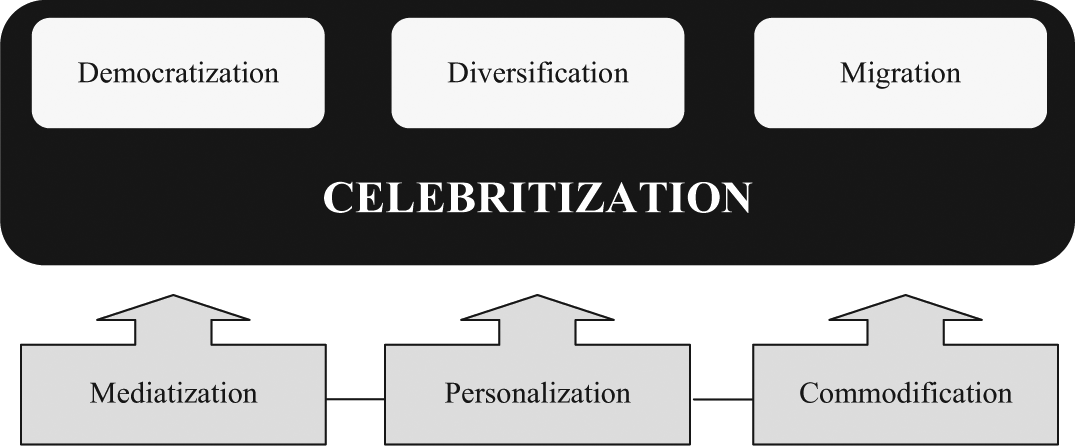
The conceptual model of celebritization.
Indicators of celebritization
The interpretations of celebritization surveyed above indicate that this meta-process can be observed through internal and external dynamics. Internally, the nature of celebrity changes through its democratization; externally, celebrity is produced in other social fields that are traditionally less permeated by celebrity status (diversification), and it advances the mobility within and across certain social fields of people using their celebrity status (migration).
Democratization
Several authors have pointed to the devaluation of meritocracy in celebrity culture as they believe that fame has been increasingly disarticulated first from innate qualities and later from achievement (e.g. Cashmore, 2006; Gamson, 1992; Marshall, 1997). Stated differently, there has been a shift from achieved celebrity to attributed celebrity (Rojek, 2001), which accords with Andy Warhol’s (cited in Draper, 2008: 3) often quoted prediction in 1968 that: ‘In the future, everyone will be world-famous for fifteen minutes.’ Implied in this notion of democratization is the increased access of (ordinary) people to the stairway to stardom.
The role of (new) media technologies and platforms is crucial, with the internet and reality TV often given special mention. Karen Sternheimer (2011: 8), for example, speaks of the decentralization of celebrity production: while previously a small circle of film studios was the dominant decision-maker, today the internet and its social websites and interactive media (e.g. Facebook, YouTube) have created the do-it-yourself (DIY) celebrity. Yet, many of these new-found celebrities are bound to the media industry by contracts that are just as strict as the ‘old’ film industry’s ones (Marshall, 2006: 643). Reality TV, on the other hand, offers its participants a transient glimpse of celebrity culture and has been heralded as a democratizing force because it paves the way for marginalized groups in society to be publicly visible. Nonetheless, these groups are not themselves producing mainstream content (Tyler and Bennett, 2010: 378) and they push unionized and well-paid actors out of the market by offering non- or low-paid services (Collins, 2008).
Indeed, the political economy of reality TV is based on the rapid circulation and constant renewal of its participants, which implies that these celebrities-in-the-making rarely have a serious opportunity to establish a long-lasting (media) career (Turner, 2006). As Sue Collins (2008: 89) aptly expresses: ‘Most of these reality TV vets find that in the sixteenth minute, they are not absorbed into the celebrity system; rather, their celebrity currency runs out and they are channelled back into obscurity.’ Most reality TV participants do not outgrow the ontology of what Chris Rojek (2001: 20–1) has called ‘celetoids,’ or persons who are instantaneously in the spotlight but unable to hold attention and are thus forced to return to anonymity. Some of the examples he gives are one-hit wonders, lottery winners and stalkers.
Given the many arguments that nuance the democratizing role of reality TV and the internet, Graeme Turner (2006: 157) concludes that ‘celebrity still remains a systematically hierarchical and exclusive category, no matter how much it proliferates’. Therefore, he suggests that it is better to replace democratization by ‘demotic turn’, which signals both the striking visibility of ordinary people in the media and the potential role of celebrity in everyday life (Turner, 2006: 153, 2010b). It follows that we should not be dazzled by the seemingly diverse and democratic character of celebrity; rather, we should pay attention to how and by whom it is produced, which obviously bears ideological consequences. ‘In other words, the democratizing claim risks becoming indistinct from neoliberal ideologies of market meritocracy, which use the rhetoric of equality of opportunity to disguise and sustain massive inequality’ (Tyler and Bennett, 2010: 379).
Couldry (2010) supports this view as he explains how (participants in) reality TV programmes and DIY celebrities contribute to the propagation of neoliberal discourse. On the one hand, programmes such as Big Brother or sites such as YouTube serve as an ‘expanded zone of self-display’ (2010: 82) or a platform for self-branding, by means of which individuals are integrated into a profit dynamic and neoliberal logic. The self becomes a monetized commodity that is gradually unpacked and reduced to mere exchange value. On the other hand, these platforms for self-branding reinforce neoliberal culture’s ‘rationale of “self-improvement”’ (2010: 81) and ‘normalize a particular type of individualism, a self-improvement project that does not necessarily rate caring for others as a high priority’ (2010: 80).
In sum, the democratization of celebrity is only relative and must be critically evaluated. While it enables under-represented social and cultural groups to gain media attention, the celebrity and media industries exploit reality TV participants and DIY celebrities in order to increase their profits. These manufactured celetoids are turned into commodities that implicitly support and reinforce both the inequality of the celebrity system and the spread of neoliberal discourse.
Diversification
A second indicator of the societal and cultural embedding of celebrity can be found in its diversification. Celebrity is not the exclusive domain of media, entertainment and sports, but is also apparent in politics (Street, 2004), gastronomy (Hyman, 2008), business (Littler, 2007) and academia (Moran, 1998; Williams, 2006). Interestingly, this raises the question of whether this contradicts the shift from idols of production toward idols of consumption, as Leo Löwenthal (1984: 206–8) once lamented, or rather, as I would propose, if the idols of production have also become idols of consumption. We have seen that authors who explicitly use the term ‘celebritization’ explain this diversification as a mechanism of supply and demand (Gabler, 1998) and as a consequence of the strategy to capture the media’s and people’s attention (Gamson, 1994). Authors who do not use ‘celebritization’ but still address this diversification draw a more complex picture.
Giles (2000: 25) gives a central role to the media in explaining the diversification of celebrity by linking it to the growing number of media outlets. Since there are more TV channels, newspapers and magazines, more people are given a forum; politicians and presenters, but also people not exploiting a specific talent. Furthermore, through narrowcasting, several niches gain prominence, which can lead to the creation of celebrity chefs (e.g. Hyman, 2008), lifestyle gurus (Lewis, 2010) and other celebrities. However, this rather media-centric view offers only a partial explanation and necessitates the inclusion of economic rationales and field-specific dynamics.
According to Charles Kurzman et al. (2007: 360) it is especially a profit dynamic that drives people in different sectors to pursue fame. A certain celebrity status can enable attorneys, CEOs or doctors to demand higher fees and thus earn more money. Therefore, they hire public relations agents to increase their visibility in their particular field but also, if possible, in the media more generally. Indirectly, celebrity status can generate profits through introduction into previously closed networks or invitations to social events where relations with other elites can be established. This increased social capital can subsequently be converted into economic capital, for instance, through participation in private equity funds or other potentially lucrative investment projects.
Celebrity status can be used not only for economic profit, but also as a means to acquire or control power, especially in the political field. In fact, the political and entertainment fields do not differ a great deal with regard to the creation of their public personalities. Whereas a politician must embody the affect of the people, state and party, an entertainment celebrity should capture the audience’s affect (Marshall, 1997: 203). Yet, celebrity status is not as stable as other power resources and needs to be continuously reconfirmed, which can result in politicians being trivialized and reduced to the level of pure entertainment figures (Pels, 2003: 57–9).
In contrast to this absorption of politics by celebrity, the celebrity system does not penetrate as easily into the relatively autonomous academic field, according to Joe Moran (1998: 70). In academia, the construction of celebrities is more controlled by its elites and is more dependent on market rules and internal dynamics. Publishing houses, for instance, are incrementally governed by principles of saleability and marketing, making it more difficult to publish monographs for young and unknown scholars compared with the big names in the field. Still, through procedures such as peer review, the internal dynamics of academia are not completely overcome by market rules (see also Shumway, 1997).
Overall, the diversification of celebrity proves to be a complex process, influenced not only by the media (and mediatization), but also by the market and capitalism, power struggles and internal dynamics. This discussion, and especially the last point about academia, marks an essential point for the study of diversification and celebritization; namely that these are not just (meta-)processes changing society or culture at large, but rather should be analysed and compared in specific social fields. These fields seem to value celebrity status and other (power) resources in different ways, while market rules resort to diverse effects depending on the organization of the field. As a result, celebrities can differ significantly regarding the level of their production, ontology and meaning depending on their field or professional area (Marshall, 1997; Turner, 2004: 17–18).
Migration
The third indicator of celebritization is migration. Migration can be defined as the process through which celebrities use both their relative autonomy as public personality and their celebrity status to develop other professional activities either within their original field or to penetrate other social fields. Migration is thus a twofold process that captures the mobility and convertibility of celebrity.
Migration within a certain field occurs when celebrities diversify their activities in the field in which they have established their celebrity status. According to Lee Barron (2006: 526), this is especially apparent in the media industry, where celebrities increasingly move into alternative careers, as well as in other media. Elizabeth Hurley, for example, became famous as an actress, model and the girlfriend of Hugh Grant, and later moved into film production. This kind of migration can be seen as an answer to the democratization of celebrity, especially to the rapid circulation of celebrity commodities, and thus as an attempt to establish a more lasting career, building on one’s celebrity status before it vanishes (Barron, 2006: 535). Still, in line with one of the central arguments of this article that celebritization is not merely about an increase in space and time, but points to changes and celebrity’s structural embedding, it is worthwhile mentioning here that this internal migration is not a new phenomenon. We can think of Charlie Chaplin, for example, who already in the beginning of the 20th century combined roles in front of the camera as actor and behind it as producer and director. What might have changed is the scale and intensity of this migration, although this has not been examined yet.
Migration across social fields occurs when celebrities are granted or force access into another social field by capitalizing on their celebrity status. In the United States, some movie stars, for instance, have converted their celebrity status into political power by becoming state governors (Arnold Schwarzenegger) or even president (Ronald Reagan) – it has even been argued that also George Washington, as former commander-in-chief of the Continental Army, can be categorized as a celebrity president (Cooley, 2005: 418). Some reasons for external migration other than gaining political power are the pursuit of exposure, a positive image, influence or money. Sometimes enterprises, organizations or campaigns can also profit from the involvement of celebrities, for example, through their increased media exposure or brand likeability (e.g. Erdogan, 1999), although this has potential drawbacks for the kind of message that the organization wants to communicate (see Meyer and Gamson, 1995).
There are also limits for the celebrities themselves regarding migration into other social fields. While entertainment and sports celebrities can make statements about some topics relatively easily, they need more credentials when engaging in activities that require a higher degree of involvement or knowledge. In such cases, it is insufficient to possess a fan base as a power source or some personal link with the subject as a token of legitimacy. As such, migrations are not without risk for celebrities, because it is often not clear to what extent the audience will tolerate them (Marshall, 1997: 107). Clear examples can be found in celebrity diplomacy (Cooper, 2008), in which celebrities such as actress Angelina Jolie and U2 singer Bono have established a certain amount of legitimacy, although their long-term involvement clearly does not replace the need for specific education and training or other credentials to function as official diplomats with political power. Former Spice Girl Geri Halliwell also started a career as UN ambassador, but quickly failed due to a lack of perceived authentic involvement and credibility.
A final point that must be stressed is that these (external) migrations are bidirectional, meaning that it is not only entertainment and sports celebrities who are penetrating into other social fields such as the political, but that such movement is also possible the other way around. We can think of politicians becoming board members of multinationals or sports clubs, professors serving as jury members for book prizes, financial experts who are offered publishing contracts, etc. Although not all of these migrations should be completely reduced to the fact that they are possible because of celebrity status, there is no question that it plays at least a minimal role.
Moulding forces of celebritization
In tracing the different understandings of celebritization, I have identified three (meta-)processes as its moulding forces, namely mediatization, personalization and commodification. It is obviously beyond the scope of this article to discuss these three (meta-)processes in detail, hence the focus is especially on their connection with celebritization and, to a much lesser extent, their possible interrelations.
Mediatization
In many (also negative) accounts of celebrity culture, the media are perceived as among the main culprits for how it has prospered and for its deep entanglement in society and culture. Especially in political analyses, mass media are seen as a major contributor to the creation of celebrity politicians (e.g. Pels, 2003) because they are thought to co-shape the climate and the operational logics by which politicians have to perform. This influence of the media is generally termed ‘mediatization’, which can be broadly defined as a meta-process that ‘does not describe a closed theory of media change but, much more openly, a certain panorama of investigating the interrelation between media communicative change and sociocultural change’ (Hepp, 2012: 8). Media are not confined to particular technologies in this account, but include social practices, media as organizations and as a social institution (see also Krotz, 2009: 23).
In general, mediatization can be considered both a prerequisite and a possible catalyst for celebritization. Since celebrities are essentially media personalities, it can be expected that the social field in which they are produced will be, to some extent, already mediatized. In these mediatized social fields, individuals have a potential advantage when they are media savvy and able to become media personalities or celebrities. Stated differently, the mediatization of a social field might have a positive influence on the creation of media personalities or on the collective and subjective perceived importance of attaining celebrity status. It can be hypothesized then that a greater degree of mediatization of social fields might result in a stronger celebritization.
However, both theoretically and methodologically, the question of how to observe the degree of mediatization (and celebritization), let alone unravel or distinguish between the various stages, is very difficult to answer. Jesper Strömbäck (2008) made an attempt by discerning four phases in the mediatization of politics: To what extent are the media (a) the most important source of information, (b) dependent on political institutions, and to what extent are (c) media content and (d) political actors mainly governed by political or media logic? Although his model was not meant to be unidirectional, three main problems arise. The lower limit of each of the phases is unclear, as well as how to use this model in empirical studies, and if and how it can be applied to social fields other than the political. The same applies, mutatis mutandis, to the checklist developed by Andrea Schrott (2009). Even though it provides a more systematic instrument for the analysis of mediatization, it is very difficult to give a straightforward answer to questions such as ‘Is the actor’s guideline the criteria [sic] of media logic?’ or ‘In which way are unintended consequences of mediatized actions processed?’ (Schrott, 2009: 56). Still, the author recognizes the limits of her instrument by arguing that it needs to be refined and empirically tested on more cases.
What further complicates this picture is the interdependence of mediatization with other processes in the constituency of celebritization. While mediatization is the key to understanding celebritization, it is clearly not its sole engine. As demonstrated above when discussing diversification, the matrix of (meta-)processes and factors influencing the creation and importance of celebrity can differ thoroughly, depending on the social field. It would be misleading, for example, to explain the celebritization of academia, politics or gastronomy by referring only to mediatization, without including internal or profit dynamics and other structural processes. The first meta-process that should be added is personalization.
Personalization
Personalization goes hand in hand with individualization, the meta-process that is prevalent in highly differentiated societies (see Beck and Beck-Gernsheim, 2001) and that can be described as the (increasing) centrality of the disembedded individual over the collective. According to Giles (2000: 12), the individual has been central in historiography, which, to a certain extent, turns the history of western civilization into a history of fame. ‘Celebrity status operates at the very centre of the culture as it resonates with conceptions of individuality that are the ideological ground of Western culture’ (Marshall, 1997: x). This has been reinforced with the rise of neoliberal ideology, which puts the autarkic personality at the forefront. More generally, the news can also be seen to present an individuocentric worldview, operationalized through storytelling techniques and narrative conventions that emphasize the individual over the collective and the personal over the structural, for example, by using spectacular and human-interest stories (Curran, 1996: 141; Harcup and O’Neill, 2001: 276–9).
In contrast to the seemingly consensual understanding of individualization, there is a rich variety of social scientific definitions of personalization, which have been synthesized by Rosa van Santen and Liesbet van Zoonen (2009). Even though their typology is tailored to fit politics, it can be easily transposed to other social fields such as the economic or religious fields. There are seven types of personalization that can be summarized in three clusters: individualization, privatization and emotionalization. Here, individualization implies the scrutinization of politicians’ professional qualities, such as integrity and reliability. Privatization means that the focus shifts from the public to the private lives of politicians, while emotionalization entails a shift from the public to the private persona of politicians.
For some scholars (e.g. Turner, 2004) these shifts from the public to the private are the turning points in becoming a celebrity. However, the dominant public–private binary has recently been revised and expanded with the ‘popular self’, which denotes the (re)presentation of an ordinary, easy-going and pleasing persona without necessarily disclosing private details (see Driessens et al., 2010: 319). Indeed, politicians, lawyers and CEOs often participate in talk shows to develop their popular persona and thereby their celebrity status. Obviously not all politicians, lawyers and CEOs participate in talk shows or disclose their private lives. This implies that one’s personality is also an important aspect of becoming a celebrity, although the social practices of colleagues can create certain expectations and standards that can increase the pressure to participate in the media and celebrity circus (Driessens et al., 2010; Langer, 2010).
In other words, the mediatization of a social field can stimulate its personalization (see also Mazzoleni, 2000: 325), but, of course, mediatization was not the starting point of personalization, which goes back to the earliest stages of politics and goes along with the embodiment of individual and institutional power. As a consequence, it must be re-emphasized that it would be a misconception to put the media at the centre of the explanation of, in this case, the meta-process of personalization. In politics, for example, internal reforms can also dramatically affect the level of personalization, for instance, by shifting the emphasis from the party to the politician through changes in electoral legislation.
Commodification
While personalization results in great(er) prominence of the individual subject and dimensions beyond the public, commodification turns these individual subjects (but also objects, relationships or ideas) into commodities by bestowing economic value on them. As stated in the discussion of celebrification, a commodity can be defined as both the product and the producer of labour. This definition echoes Marxist theory which stresses the social character of commodities: they are bought and sold on the market, for a variable price that is the monetization of the commodity’s exchange value. Hence commodification has been described as ‘endemic to the logic of capitalism’ (Ralph, 2009: 78) and as ‘the seemingly irresistible process in which everything appears subject to the intensity of modern-day capitalism’ (Cashmore and Parker, 2003: 215).
The same applies to celebrities, who are generally perceived as products of capitalism (e.g. Kurzman, et al., 2007; Marshall, 1997). Still, there is disagreement regarding what exactly is commodified in the case of celebrities. According to the narrow view of Kurzman et al. (2007: 353), it is reputation, whereas Cashmore and Parker (2003: 215) argue that it is the ‘human form’. This article follows the latter view, since reputation is only one aspect of the commodification of the individual. The celebrity’s name, image, hair(style), clothing style, to name but a few, are also turned into commodities to be sold and consumed. Indeed, celebrities are essential in creating audiences and markets (Marshall, 1997), which they also do explicitly through endorsements of products and brands.
Important to note is that stars and celebrities are not only products and producers of alienated labour; they also embody and personify the ideology of capitalism (Dyer, 2007 [1979]; Marshall, 1997; Rojek, 2001). As Marshall (1997: x) writes: the celebrity as public individual who participates openly as a marketable commodity serves as a powerful type of legitimation of the political economic model of exchange and value – the basis of capitalism – and extends that model to include the individual.
Notwithstanding this hegemonic function of celebrity, it can also be counter-hegemonic and foster critical consciousness. According to Sean Redmond (2006: 40): ‘[c]elebrity-commodity intertexts leak, they are ideologically porous, and countervalues emerge in their sign systems’. Many derivative celebrity commodities, such as movies, pictures, advertisements, songs or merchandising, can go against the grain, question normative readings, empower citizens and call for action.
Redmond (2006: 40) gives the example of the commercial for Britney Spears’ fragrance Curious, which ‘is for girls to experiment, to try out sexual scenarios and encounters, both with boys and other girls’, and thus is believed to question ‘patriarchy and stereotypical gender norms’. However, two critical remarks must be made here. First, although consumers may have the freedom to purchase potentially counter-hegemonic commodities, producers can be seen to use them to their commercial advantage (Jansson, 2002: 16). Second, and more fundamentally, it is ‘one thing to be transgressive about sexuality, religion, social mores and artistic conventions, but quite another to be transgressive in relation to the institutions and practices of capitalist domination’ (Harvey, 2002: 207).
Discussion and conclusion
Following the inconsistent use of ‘celebrification’ and ‘celebritization’ in the literature, this article started by clearly distinguishing both concepts and putting forward their definition. I have suggested conceptualizing ‘celebrification’ as the transformation of individuals into celebrities and ‘celebritization’ as the meta-process involving changes in the nature of celebrity (or its democratization), and its social and cultural embedding (through its diversification and migration). In contrast with many rather one-sided analyses that trace back celebrity’s social and cultural prominence especially to the success of the (mass) media, I have argued that celebritization should be conceived as a product of mediatization, personalization and commodification. Importantly, this stress on mediatization instead of (mass) media urges us to rethink the role of the media and broaden our focus from the media as technological platforms or content providers and ideological apparatuses to an understanding that pays attention to not only the direct involvement of media industries and their products (magazines, movies, television shows, etc.), but also their indirect role as they actively co-shape our social environment and (non-)media-related social practices, an analytic approach which is promoted by mediatization studies (e.g. Driessens et al., 2010; Lundby, 2009).
Similarly, the theory of celebritization presented here enables us to think more profoundly about celebrity’s influence without having to cast this immediately in terms of linear effects. Instead there could be analysis of how celebrity moulds the cultures we live in or the fields people are active in and what its consequences are, for instance in terms of power relations, expectations, identity formation and self-presentation (online as well). In fact, Turner (2010a: 14) has put this on celebrity studies’ research agenda as one of the most pressing challenges, thereby suggesting we shift attention away from the dominant text-oriented analyses. Subsequent research should also inquire into the exact (inter)relations between the different moulding forces of celebritization on the one hand, and how they co-produce the articulation of celebritization through its different manifestations on the other hand. For instance, it could be hypothesized that democratization has an inverse or counter-dependent relation to commodification, or that the diversification of celebrity in certain social fields is more strongly influenced by mediatization than it is in others. Related is the question how and to what extent the commodified nature of celebrities influences their migration, especially if we think of celebrities involved in (radical) social and political activism (e.g. Collins, 2007).
A good example of how the proposed theory of celebritization can be put to work, can be found, albeit in different terms, in David Shumway’s (1997) intriguing analysis of the creation of academostars (or celebrification) in the field of literary studies (diversification). According to Shumway, the first seeds for the creation of academostars were planted after the Second World War, when criticism became the dominant paradigm in literary studies and, consequently, the personal gained prominence in academia, to such an extent that the discipline split into different camps organized around certain authors (personalization). Yet it was only later, when academics started to combine their intra-field genius – which remains the basic condition and thus inhibits the democratization of academic fame – with extra-field media exposure and careers that their star began to shine (mediatization, migration). The rich proliferation of the lecture circuit and academic conferences and their need for famous keynote speakers – who not only exhibit their ideas, but also their personalities (personalization) – reinforced the status position of several academostars, who soon became targets by university head-hunters for well-paid positions (commodification).
This example also confirms the necessity – mentioned earlier – of analysing and comparing celebritization in different social fields, certainly because much of the available literature on celebritization, mediatization and personalization – especially when it is empirically grounded – is focused on the political field. While this might seem a logical consequence of the significant attention paid to politics by the media, it does not relieve scholars of the need to study these meta-processes in other social fields. Focusing beyond politics and more on social fields such as the financial, judicial, academic or religious, to name but a few, will not only strengthen empirical claims about celebritization, mediatization and other related (meta-)processes, but also enable qualification and advancement of our theoretical models.
Finally, the discussion on the spatial dimensions of celebrity culture suggests the need for more cross-cultural research and case studies from non-western celebrity cultures. How exactly do smaller and more local celebrity cultures differ from the dominant Anglo-American model? What kind of celebrity cultures exist in more collectivistic cultures? Answering these questions may shed light on the validity of our findings in other contexts, and give us better insight into the meta-process of celebritization, into celebrity culture as a status system and its relationship to other status systems.
Footnotes
Funding
This research received no specific grant from any funding agency in the public, commercial or not-for-profit sectors.