




Abstract
The article gives insights into the evolution of the dance club scene in the growing urban region of the Finnish capital of Helsinki in the 1990s. The development of two different club cultures – techno and house – is accounted for. Techno culture was to a large degree made meaningful through the social change towards a computerized information society. Its popularity grew rapidly, but this was followed by a steep decline. In comparison, house culture was legitimized through more subtle strategies and slowly built up its symbolic capital, excluding direct references to a social structural meaning-making. Both styles were eventually to become recognized beyond their young clubbing audiences, and were utilized in significations of other value systems. The study shows the interplay between the symbolics associated with the city’s club venues and historical and social developments, and how actors in the field of club culture reposition themselves over time.
Keywords
This study looks at trajectories in the symbolic value of two forms of dance club culture in Helsinki in the 1990s, at a time when the Finnish capital’s night-time economy grew and evolved. In line with studies of urban night-time economies – a genre of studies that has described a sophisticated creation of demand based on coalitions between media images, youth cultures, pleasure spaces and corporate powers (e.g. Chatterton and Hollands, 2003; Latham, 2003) – we enquire into how principles of worth are construed in media representations of club life. We account for how two dance music scenes diffused distinctive images of their events and discuss how these value assertions may have affected their positions and durability over time.
As we are concerned with claims of cultural and symbolic value, we will lean heavily on Bourdieu’s (1993) essay on the field of French literature, in which he discusses the fields of art and literature as subject to and a materialization of a complex set of social forces and power relations.
Bourdieu did not incorporate the role of the media into his theory of culture (Hesmondhalgh, 2006), even if he does refer to marketing strategies aiming at diversifying products in The Social Structures of the Economy (Bourdieu, 2005: 67). Urban nightscape theory, for its part, offers references to the local media as cooperators in creating demands and profiling venues (e.g. Chatterton and Hollands, 2003). Thornton (1995) suggests that subcultural media plays a specifically important role by disclosing information on events and venues that are often left out of the mainstream news media. Drawing on Bourdieu, Thornton assigns the subcultural media certain roles in the value worlds of club culture: it locates, identifies and interprets new phenomena; it positions music in relation to its traditions; and it assists in matching audiences and music.
This article focuses on the reconstruction of a small-scale nightscape’s symbolic economy. We study the development of music venue genres through branding discourses and value assertions found in pick-up magazines – a genre typical of the 1990s urban subcultural club style-profiling communication. Our study object – the plugs, listings and short reports in pick-up magazines – operates within an image reality that is both fictional and factual, and which constitutes a commodity in itself (Jameson, 1991: 275–7). Our claim here is not that this image reality plays a decisive role in driving cultural change, but rather that it participates in it, responds and reacts to it (Cronin, 2004: 57). Fiske (1995: 132) points out a certain semiotic power in the meaning-making interface between products of the culture industries and experiences of everyday life. Such interfaces are likely to be found in the Helsinki nightlife venue-promotion discourse of the 1990s.
The main concept of the study is symbolic value (e.g. Bourdieu, 1993: 37). It refers to cultural products that are recognized as symbolically valuable, and which contribute to an accumulation of symbolic capital. Bourdieu embraces the idea that the scarcity of a good is important for its market value; he claims that the most symbolic value is given to restricted audience production with the least financial compensation, and, conversely, that the least symbolic value is given to wide-scale production with more commercial relevance (Bourdieu, 1993: 39). Wide-scale production is divided by the audience into production for the bourgeois and for the ‘popular classes’. The former production is claimed to have more symbolic value than the latter. Hollands (2002) recognizes a parallel structure in contemporary nightlife, showing that regulation of audience size is very much a social factor, as it works not only as a sign of whether the production is art- or commerce-oriented, but also as a way of building symbolic capital via construing images of certain audiences. Audience image is an important part of the branding of clubs.
This requires continuous discursive efforts of comparison and identification. Our study shows that not only do actors enjoy different values according to the claimed or actual size and nature of their venues; they also actively construe their worth through legitimizing and branding discourses. We find, for example, that in order for actors to establish a new music club scene, they must, to begin with, justify themselves without gaining recognition from others, but act without concern for the opinion of others to attain their worth (the inspired polity, Boltanski and Thévenot, 2006: 88). They become inspirational vanguards precisely because their worth is independent of others’ appreciation. This polity is the site of permanent tension with fame (the polity of fame, Boltanski and Thévenot, 2006: 98–107). In addition, meanings are produced of and from social experience. Such meanings, therefore, will produce a (striven-for) identity for the people involved (Fiske, 1995; Hirsch, 1991 [1972]). What techniques, then, were used in order to appeal to different Helsinki audiences in the 1990s? Which traits turned out to be the most profitable for symbolic capital production over time?
Background
Due to economic and social transformations in both Finland and its neighbouring countries, the homogeneous welfare state had begun to break down in the early 1990s. After a deep economic depression in the first half of the 1990s Helsinki grew rapidly until 2000 and became one of the fastest growing European cities with respect to population, employment and Gross Value Added (GVA) growth (Laakso and Kostiainen, 2007). Finland began its transformation from a country of emigration to one of immigration; marginal groups became more visible in the public space; nightlife became livelier and started to diversify (Forsander, 2002; Salasuo & Seppälä, 2005; Tani, 2002); and the number of bars, pubs and discos rose (Sillanpää, 2002) with the liberalization of alcohol legislation. It was in these historical circumstances that different subcultures and dance music genres also established their own venues in Helsinki nightlife. The actors in the nightlife economy started to compete in the creation of attractive club scenes. Music styles and subcultural codes legitimized and defined them in the new media genre of city pick-up magazines, which listed and plugged nightclub events.
In earlier studies on club and rave cultures the emphasis has mostly been on consumption. Pini (2001: 54) has observed that within this research there is a tendency to reduce club and rave to one essence, whether it be ‘youth resistance’ (Wilson, 2002), ‘hedonism’ (McRobbie, 1994) or ‘postmodern neo-tribalism’ (Bennett, 1999; Malbon, 1998), and, most recently (Riley et al., 2010), ‘both neo-liberalism and neo-tribalism’. The idea of one ‘late modern youth culture’ has to a large extent been formed in the literature without much consideration of actual local societal contexts. Research on production, for its part, has offered alternative accounts, focusing on the commercial premises of cultural production. Strachan (2007: 246–7) draws a line between Anglo-American media and cultural studies and work by Bourdieu and his followers. The former tends to emphasize large-scale cultural production, sometimes with the outcome of an ‘almost axiomatic conflation between [the] popular music industry and the recording industry’, and the latter small-scale cultural production. Between these groups of approaches – youth cultural consumption as ‘identity’, ‘resistance’, ‘postmodernity’ or ‘neo-tribalism’ on the one hand, and cultural production either understood as larger commercial trends or small-scale art craft on the other – lies work that perceives the production and consumption of popular culture as part of the same phenomenon (e.g. Böse, 2005; Hollands, 2002; Thornton, 1995). This work has explored the constant negotiation (by producers and audiences) between the commercially oriented mainstream and the more Do-It-Yourself type of subcultural production, in a process in which audiences and producers are mutually involved in the creation of symbolic value or, in the language of Thornton (1995), subcultural capital. 1
If the emphasis in earlier club culture studies has been on consumption and production, our own inquiries concern the construction of images used when profiling club venues within the symbolic value field of club cultures. We look at the ways in which the pick-up magazine genre attached cultural worth and significance to the club venues of two different music styles in plugs, puffing articles and listings. Such event images are often aimed at targeting specific audiences and enhancing the position of and demand for the product.
The attraction of a product and its final audience size/characteristics depend largely on how it is placed in the historical field of cultural production. The product is justified and legitimized in relation to other producers both now and in the past. Producers need to portray themselves as distinct in order to claim recognition and build symbolic capital. Newcomers, in general, need to choose a position between avant-garde strategies aimed at breaking traditions and adaptive strategies aimed at becoming part of the established culture (Bourdieu, 1993: 57–9). A new generation of cultural producers might, for instance, create new style mixes or they might ‘ride’ on past traditions. A claim of worth and a claim of a position become important.
Thornton (1995) has shown that the most symbolic value is often placed on clubs and music which have distanced themselves the most from commercially oriented ‘mainstream’ production. In dance music, Thornton argues, there are two major cultural traditions that most music tends to fall into. She refers to them as a black and a white tradition. The former is said to ‘maintain a rhetoric of body and soul’, with ‘a key interest in vocals and, in certain subgenres, “funky” instrumentation’, in the ‘grain of the voice, the thumping and grinding bass’ (Thornton, 1995: 72; see also Böse, 2005: 433–5), while the latter refers to the ‘European style’ of music, which is, at least in the case of early 1990s dance music, ‘about a futuristic celebration and revelation of technology to the extent that it minimizes the human among its sonic signifiers’; described as ‘electronic, progressive, industrial and techno, this music tends towards the instrumental and explores new computer sound possibilities’ (Thornton, 1995: 72–3). Without applying Thornton’s signifiers of ‘black’ and ‘white’, we will show that the differentiation she makes between inviting, softer and perhaps more embracing music styles on the one hand, and a harder rhythm characterized by a more artificial and ‘industrial’ aesthetic on the other, correspond quite well to the dance club event styles portrayed in our material.
To summarize our point of departure: the cultural position of club productions, styles and producers is not self-given but a result of conscious efforts to find an advantageous cultural tradition and position to settle in (Thornton, 1995). Also, regional and local styles within dance music always coexist at different stages within their cycles of rising and declining influence (Straw, 1991). Targeting and construing audiences in journalistic promotional items for club events will thus naturally channel strategies that utilize local, situational and temporal dimensions and adaptations of value claims. The strategies of club venues in Helsinki in the1990s are likely to offer valuable insights into the climate of a growing urban region emerging from a deep economic recession to becoming the IT-vanguard of Nokialand.
Material and proceedings
In an analysis of developments in the fields of cultural production the material needs to cover a relatively long period of time. For our purposes we have chosen to analyse items from Helsinki lifestyle media over the period from 1986 and 2007.
For a reconstruction and analysis of symbolic capital building of club venues in 1990s Helsinki, the choice of the main data source was quite obvious: for many years there was only one established print medium that covered nightlife and club culture in Helsinki, the pick-up magazine CITY. 2 Flyers were also used to inform people about events, but it was not possible to collect these retrospectively and the collection of flyers at our disposal was fragmentary. CITY (founded in 1986, discontinued in 2012) held its position as the most significant source of nightlife information in Helsinki up until the late 1990s. 3 The magazine was very much a part of the city’s promotional culture, constructing desirable and saleable products (commodities, messages or ideas), potential audiences (citizens, clubbers, consumers), and messages about them (see e.g. Davis, 2006: 149–50).
Genre-wise, CITY can be described as a hybrid of what Thornton (1995: 142–6, 151–5) refers to as ‘listings magazines’ and ‘niche/consumer magazines’. Listings magazines primarily list all of the club nights taking place, and thus provide concrete information about club culture. Niche/consumer magazines, in turn, give further meaning to this information, as they ‘categorize social groups, arrange sounds, itemize attire and label everything. They baptize scenes and generate the self-consciousness required to maintain cultural distinctions. Additionally, they give definition to vague cultural formations, pull together and reify the disparate materials which become subcultural homologies’ (1995: 151).
During 1988 CITY was published monthly, but from 1989 onwards it changed to come out fortnightly, so there were over 200 issues between 1988 and 1996. All issues were read through on paper at the Finnish National Archives and all data on club nights were collected. This amounted to 275 (= N) items, 4 each representing one journalistic piece, such as a listing of a club in the event listings section, an advertisement or a report article. From 1996 onwards, selected data from a few other magazines and later CITY issues were collected to cover, but also to confirm, the main events up to 2007. The movements of various actors in the club scenes were then mapped and followed over time. For each item we systematically filled in a form consisting of the following aspects: (1) the main theme of the press item; (2) the venue’s music genre(s); (3) description of the venue and its music style: justifications (why so special, good, new), motives for participating (why does/should the clubber go there) and attached significations (cool, new, avant-garde). We also described briefly the main message of the text and noted names of key actors and sites. This mapping served as a content analysis, and was necessary in order to get a larger picture of the material.
In a subsequent phase, after counting mentions and claims, we evaluated the popularity of the events in the pieces in terms of: frequency of references (how many events and how often referred to), size of crowds (exclusiveness of small-scale venues in comparison to large rave parties, for example). We estimated the relations between the genres based on the overall picture we received from our grouping of the material. Based on a first rough content analysis, we defined the actors and styles of events, and outlined the contours of the club culture from 1988 onwards. Figure 1 portrays the mapping using the signifiers found in the material itself. The positioning on the vertical axis represents our interpretation of the popularity of the music genre venues. 5

A mapping of the emergence and histories of genres in Helsinki club culture in the period 1987–2007. The vertical positioning corresponds to our interpretation of popularity and force of impact.
What might not be immediately evident from Figure 1, but which became clear in the very first readings and counting of the material, was that during the first 10 years most events and actors took a position either within the genre of techno (with the word appearing 309 times in the data, first in 1991), which emerged as the dominant genre of the first decade of club culture, or in the genre of house (with the word appearing 201 times in the data, first in 1988), which emerged as the second main genre, with an oppositional position to techno. Our study will therefore focus on the trajectories of symbolic capital attached to these two genres as expressed in the material under study. Gradually, both as intertwined and parallel processes, many other genres (such as trance) emerged, but they are omitted from this study.
Helsinki club culture from 1988 onwards
Searching for identity: the role of newcomers
A public articulation of the club and rave culture in Helsinki can be dated to 1988, when acid house nights were first listed and written about in the material. In the beginning the events seemingly focus on the restricted audience end of nightlife taking place in a small club venue called Berlin on Wednesdays. In the first coverage of this new phenomenon it stands clear that the genre’s cultural position is still rather unclear: its distinctness is not yet established. Nevertheless, in the first brief pieces on these acid house nights, some obvious efforts are made throughout to assert that these events are a genre for selected minorities as opposed to mainstream nightlife participants.
Regulation of venue sizes and placement of events on less busy nights are ways of regulating symbolic value, and the perceived difficulty of the cultural content per se, such as the style of music, also defines it. Often the familiarity of cultural production, especially its closeness to existing genres, defines it as more approachable to wider audiences, whereas the lack of such cultural positioning makes it less approachable. Cultural position-taking is also achieved through grouping together new and existing genres. In the early material, the position-taking still oscillates between different styles.
Over the years house and techno eventually took cultural positions in ways that more clearly corresponded to two diverse sites and framings. However, in the CITY club listings in 1991 these identities were still not very apparent nor were they clearly differentiated. For example, techno was simply mentioned as being danced to by hip-hoppers, or a genre of techno house as being played. Symbolic worth was claimed mostly in terms of the venues’ particularity and originality. The new club scene was portrayed as a site for newcomers of both producers and audiences.
Challenging the establishment: the story of techno
By 1992 the techno 6 genre was manifested in a series of CITY reports as a revolutionary youth culture. From 1991 onwards, techno events were rapidly given more magazine space in the form of previews, interviews, reports and ads. Over time, the events became more frequent and bigger in size. At the time, techno was applied as sort of an overall label for Finnish club and rave culture as a whole, as well as for all electronic dance music. Other club genres remained in its shadow and settled for small club venues and little publicity. This shift towards a position of a large-scale audience production seemed to be coupled with distinct cultural position-taking: constructing techno in all the magazine’s coverage as a masculine cultural sphere, as well as avant-garde in relation to existing and previous styles. A kind of dual image arose: techno was big, but it was a revolution for a specific group, the ‘selected’ one.
After a while both journalists and the subjects interviewed in the CITY coverage started to give symbolic value to the new techno phenomenon through social meaning-making (Thornton, 1995). This was achieved by associating techno with computerization and, more broadly, with the structural changes taking place in the transition from the industrial economy towards the new, computerized knowledge economy, and with the audiences linked to this change. This affinity with particular audiences, namely young, computer-enthusiastic males, was shown in a survey conducted on participants at a large techno event called Satellite in 1993, and reported in CITY 3/1994. Participants were 71 percent male, typically students, with an education level above the national average for their age. Responding to pre-given options in the survey, they felt that virtual reality, strobe lights, laser lights, smoke machines and computers essentially belonged to techno and rave culture. They also considered techno a new and revolutionary form of music and culture. This identity, which was heavily constructed in CITY reporting from 1992 on can be seen in excerpts from the feature article called ‘Techno Alphabets’. At the time, the popular vocabulary of ‘cyberdiscourses’ and ‘cyber fantasies’ was employed by the CITY journalists (Paasonen, 2005). In addition, the excerpt below shows how wide audiences were sought, reflected by the representation of some DJs as pop stars.
CITY 4/1992 Techno Alphabets (Feature Article) – B Joye Beltram techno guru Binary number system. The bases of digital encoding. – G William Gibson Cyberpunk writer. Neuromancer novel is techno tribes Bible. – E Eliot Ness Finland’s techno guru – R Rave. Location and concept for the youth culture of our times. Words are not enough. Be there or be □
Significantly, the techno events are now claiming an avant-garde cultural position, alleging that they capture the Zeitgeist of a computerized society. The attempts to challenge the previous cultural and nightlife establishment centred around rock music are shown in the next excerpt. It also discloses a rich use of references to high cultural traditions, comparing techno to the music of Bach as well as to Dante. Alluding to such famous historical transgressors in art can also be viewed as a claim to be taken ‘seriously’ in spheres of high-ranked symbolic capital in future assessments of its overall impact and value.
CITY 19/1992 Tekno (Lengthy report on the techno party culture) – Synthesizer replaces electric guitar. Digital MIDI-language replaces notes. Guitar band is replaced by a 20-year-old babyface, programming a computer – ‘Techno’s key word is change, which embraces the global village. Western society as we know it is at the end of its road. It’s being replaced by a new global culture, based on neuro-electronic networks’, sums up Cosmo. – Fast paced and clearly synthesizer-based dance music. On the other hand, nothing new under the sun. Dante was a cyberpunk of his time and Bach’s fugues were techno house.
The techno genre was by this stage framed by wide-audience production and commercial profit, seemingly without a huge loss of symbolic capital. This may have been possible due to the specific cultural position-taking and social meaning-making related to actual social changes at the time, as well as the arrogant avant-garde position-taking and its claims of taking over the field from established producers. With its adoption of strong and explicit social meaning-making and the vocabulary of a technological revolution, techno’s success needs to be connected with the changes in social power structures and the emerging ‘information class’ in Helsinki. The genre was legitimized and positioned as the vanguard of these changes, popularizing specific ways of perceiving new technology and the information society’s development. 7
After a deep economic recession in 1992 new economic growth began in Helsinki, heavily based on ICT (information and communication technologies). The job market changed rapidly and soon there was great demand for ICT specialists, who were offered high wages. These positions mainly attracted young men in engineering and economics, while at the same time significant numbers of older manual workers were being laid off (Kortteinen and Vaattovaara, 2001, 2003). Even though such a structural change was indeed a global phenomenon, in Helsinki it was exceptionally dramatic as the Finnish capital soon was to have a bigger proportion of IT professionals than many of the largest European cities at the time (Kepsu and Vaattovaara, 2008; Musterd and Gritsai, 2010).
The above social meaning-making of techno culture, combined with an avant-garde cultural position-taking and a commercially oriented wide-audience approach, was, however, short-lived, and in the mid 1990s techno began to lose its symbolic capital. It lost its position at the same time as the audience base widened to include large groups with little symbolic value. Techno’s turning point is marked by the material in the following excerpts, in which an experienced clubber complains about the lack of restricted production, and a new truly underground scene emerges and is defined as a reaction to these developments. Structural position-taking as a question of creating an image of who the audiences are (and thus are not!) seems to be one of the most important factors in the devaluation of techno in our material. Commercially profitable wide-audience production is set against the non-profit organization of restricted audiences in the new underground scene, with only the latter being symbolically valuable. After losing momentum concerning its reputed association with major social changes and emergent social groups, techno was subsequently judged according to the more permanent-seeming features of the field of cultural production, where symbolic value is associated with restricted audiences and subtle position-taking as part of the field’s traditions.
CITY 21/1995 Princes of the Night. Club Wannabes. Entreé is their bravado and small talk their trade. (Nightlife report.) Nightlife serves certain crowds, but people like me would like something really underground, because all those mass things were done years ago. In 1990 we were there, celebrating techno, and at the time it wasn’t for big crowds.… These commercial techno youths, who the parties are arranged for, parties with famous names, Westbam, Marusha.… Those parties are drawing crowds from outside the city, which I guess is their idea. Then you have the other end, Kaivohuone and Hesperia and Planet Hollywood [upper and lower market mainstream places], a lot of bars for jerks. CITY 5/1996 Parties Underground. (Nightlife report.) Underground parties are not raves, although the music that is played is based on so-called techno … people who saw how techno became fun for all. Wiser from past mistakes, this crowd wants to keep the party to themselves. Parties are no longer advertised with flyers, but instead, participants are a carefully selected crowd to ensure the right atmosphere … the right music with the right company.… Organizers aren’t making a profit like those people who used to arrange techno parties.
Techno venues had become common and were not that newsworthy any more. This case description indicates that social meaning-making as a base for symbolic value-making only applies to particular times of change, and the newly opened space for experiments and creativity will eventually close up as the developments and changes diffuse into the society at large.
Restricted AND inclusive production: the investment by house
At the same time as techno became the overall label for all electronic dance music and for all dance club and rave culture in Helsinki in the first half of the 1990s, another group of actors emerged with a commitment to softer electronic dance music, eventually categorized under the genre label of house.
8
In the CITY coverage, its producers and audiences, their clubs and DJs, were assigned a significantly more discreet profile in comparison to the techno scene. The descriptions of the events also actively made distinctions between the two genres. The style orientation of house, in its essence, resembled Thornton’s description of a tradition that ‘maintains rhetoric of body and soul’ and the relationship with established producers was more adaptive (Bourdieu, 1993: 57–9) than in the techno scene. The house club culture is often referred to in our material as springing out of a British music scene. Significantly, there was never any clear and strong locally bound social meaning-making expressed in the house scene descriptions, merely a focus on the feeling of the music itself. Few interpretations and definitions were given, and mostly the clubs and styles were described with such adjectives as ‘happy’, ‘danceable’ and ‘soulful’. The descriptions carefully avoided associations with social distinctions. The positioning of the styles as something different from the techno culture is evident: CITY 12/1992 Arena Clubs, Clubs, Clubs! (Nightlife preview section) New Bliss club starting up.… It works on a ‘no names’ principle and according to the organizers the club lives in a post-techno era … the latest club classics from England, from house revival, mellow beat, garage.… Downstairs softer music from acid jazz to ambient. CITY 13/92 Clubs Totally Blissed Out! (Nightlife review section) … The musical line at the Bliss club is not precisely techno, but a lighter and more melodic dance beat…. ‘There’s more to life than a good night out in clubs. But not much’, the organizers modestly announce.
In contrast to the techno scene, no star DJs stood out in the portrayals of the house scene, and often the events were announced by referring to the name of the club rather than mentioning individual DJs. One of the popular house clubs called Smile had apparently been operating for several months before it even started listing events in the CITY listings section, which might have been a cautious choice in line with a strategy of restricting audiences. Going against the cultural trend of emphasizing new technology and computers as factors in dance music, there was, early on, an interest on the part of the house DJs to cooperate with live musicians; at many venues house nights took turns with soul, funk, acid jazz and music styles that were referred to as black music ‘live’ sounds.
The desire to distinguish itself from techno, which at the time had achieved a dominant place in the nightlife, is illustrated in the following correction to a previous club preview. Here again, house is located in a group of genres seen as distinct from techno.
CITY 13/1994 Restaurant guide Heresay Techno is played at Vanha only on Saturdays (Correction to an event listing in a previous issue) In the previous CITY a serious error was made. It was claimed that the summer club Zoo at Vanha offers techno five nights a week. The truth is that Zoo offers house on Wednesdays, soul, funk and Indian rhythms on Thursdays, funk on Fridays and favourite rhythms of guest DJs on Sundays.
Contrary to the destiny of techno, which more or less lost its central position in popular culture during the latter half of the 1990s, house became more or less established as one of the major sounds of popular music. In the late 1990s more commercially oriented house clubs began to emerge, and the genre divided into two main structural fields: the commercially oriented and symbolically less valuable scene on the one hand, and restricted production and a symbolically more highly valuable scene on the other.
Crossing the borders to established cultural genres
Potential spaces that would widen the scope of club culture towards the cultural establishment and/or high culture were being opened for both the Helsinki techno and house club culture scenes. Noticeably, these incidents do not necessarily represent any general trend and such movements often occur when trends fade out. Nevertheless, they point out possibilities as regards strategies in highlighting and repositioning symbolic value and an evolution of the signification attached to popular culture over time. Symbolic capital accumulated within youth club cultures can turn into currency in other symbolic economies. The concept of the ‘space of [the] possible’ (Bourdieu, 1993: 30) describes all the possible directions to which one can move from a specific position in the field, and beyond the initial field.
For techno producers, recognition outside the club and youth culture was reported in CITY 9/1999 when the genre’s symbolic capital had already started to diminish within its subcultural circuits. The report gave an account of the National Museum of Contemporary Art, Ateneum, hosting an event called Ambient City, a non-stop broadcasting radio channel for experimental ‘ambient techno’ music, featuring several DJs and composers, including some from the techno scene. The event was held in cooperation with an independent radio station, Radio City, and a private club and rave organization, PopZoo. Furthermore, long after the collapse of techno’s symbolic value among clubbers and when it was no longer publicized in our material, in 1998, the new Museum for Contemporary Art, Kiasma, hosted an exhibition called ‘Techno Tribes’, displaying flyer art and DJ soundscapes. Thus, the symbolism of techno, originally created in quite subcultural nightclub and rave club milieus, was in this way re-channelled and made meaningful within the infrastructure and genres of the fields of high culture. This may be due to the genre’s position as a carrier of the meanings of certain social and structural developments in society. It had played a role as part of the cultural vanguard, creating discourses and aesthetics about the new technology society. By offering opportunities to identify and acknowledge social change, it took on another worth, which was of interest to broader audiences than young people and techno party-goers (Bourdieu, 1993: 57–9; Eyerman and Jamison, 1998; Jordanova, 1989).
For house producers, we suggest that the space of the possible was opened up through a more subtle long-term position-taking. In the mid 1990s, as the house sound had diffused into popular dance music, the first commercially oriented house clubs emerged and house producers were able to gain economic capital. The sub-field of restricted production of house clubs established its own ways of crossing boundaries between spheres of cultural production. This can be illustrated by two cases. First, DJ Ender, a figure appearing in items on both techno and house club culture, but who had mainly been situated in the restricted production end of house circuits, started to cooperate with young jazz musicians, and later on with classical musicians, in a musical group called Nuspirit Helsinki. 9
The club culture-oriented symbolic capital and the musical expressions connected to club milieus were in this way incorporated in the wider cultural field somewhere between bourgeois wide-audience production, high culture and subculture. Indeed, Nuspirit Helsinki has been well acknowledged in both club culture and the cultural establishment, including making appearances at major cultural festivals. Nevertheless, fame is still achieved through underground knowledge and credibility cultivated in a context of restricted audience production and within youth culture that are portrayed as valuable characteristics in products such as DJ Ender. Nuspirit thus maintained a certain street credibility.
Another example is the duo DJ Lil’Tony and club organizer Tim Uskali. Their story was recounted later on in a CITY article ‘Club Angels of the City.’ (CITY 11/2007), 10 though their symbolic capital among clubbers already seemed to have been rather established by the time of the interview. With their roots in the late 1980s Ibiza party scene as active party-goers, these two producers have been working in Helsinki clubs for nearly two decades, DJing and eventually opening their own dance clubs and bars, and nowadays cafés and restaurants. Their movement towards commercial profit has been slow, but they are described as enjoying a reputation that gives high symbolic value to all the club and bar projects they are involved in. In spite of this success, in the interview they legitimize their action in terms of spheres other than commercial ones, actively claiming the worth of the inspired polity (Boltanski and Thévenot, 2006: 83–90).
Club Angels of the City (Profile article) ‘I still rent my apartment. Good things don’t grow out of thinking money.’ [Uskali says] ‘… Greed for money only works in mainstream nightclubs’, Uskali continues. Social connections made abroad have turned out to be vital for the club business. Rantanen [Lil’Tony] books foreign DJ guests without intermediaries.
Importantly, at the recent clubs founded by these cultural producers with house backgrounds (within the now rather mainstream and commercialized nightclub supply of the city), the musical profile has moved away from a specialization in house and other electronic dance music, towards a mixture of various marginal and ‘indie’ genres, ranging from dancehall jazz, 1980s soul and street hip hop, with the possibility of mixing ultimately any genre, such as 1970s Finnish popular songs, into the whole without loss of symbolic capital. DJ Lil’Tony became one of the owners and a ‘creative director’ of an annual public-sector-subsidized and private-sector-sponsored high-profile urban music festival called Flow, 11 for many years part of the acclaimed Helsinki Festival, and has very much entered the circuits of the cultural establishment.
Long-term investment in restricted audience production within youth popular culture, but still a compliant and soft profile, seemed to open up the space of the possible for the former house producers into the realm of more widely recognized culture.
Conclusions
The ways that claims of particularity and worth were construed in our material differed greatly between the genres of techno and house. Techno progressed very rapidly from small clubs and modest media attention to large venues and widespread publicity, continuing to gain symbolic capital, until, very suddenly, in the mid 1990s, its popularity and symbolic value dropped and it disappeared from the pluggings and the listings in our material. Techno was given significant amounts of media space, and the social and cultural analyses of the phenomenon were extensive, with very clear attempts to connect it to certain broader social phenomena and social groups. House, for its part, constitutes to offer a marked contrast to techno, as it prevailed in small clubs and out of the publicity limelight for a long time; it built its symbolic capital very slowly and, unlike techno, never completely lost it, but seems to have survived and merged into quite mainstream non-distinguished dance/disco nightclubs. In addition, players never made the same sort of attempts to publicly give accounts of what house was about, or who it was for. Its strategy of value claims and legitimation was more subtle than that of techno. We also found that musical substance messages, symbols and codes of both techno and house, eventually crossed over to the realm of high art or the cultural establishment.
In order to illustrate our interpretations of the two genres’ developments in popularity and value claims over time we have drawn up two trajectories of the developments in the original mapping of Figure 1. The two lines in Figure 2, show our reading of the development stories of techno and house on the basis of the representation of the genre’s value claims and popularity in our material. The vertical axis represents our estimation of the level of popularity. As all events have grown in size in Helsinki over time, any relation between genres on the same spot of the horizontal axis represents the researchers’ interpretations of the relational position at that time. The upper line illustrates the club genre of techno, with its rapid increase in popularity and rather abrupt end. The lower line illustrates the development of house, with its slow but stable popularity increase.
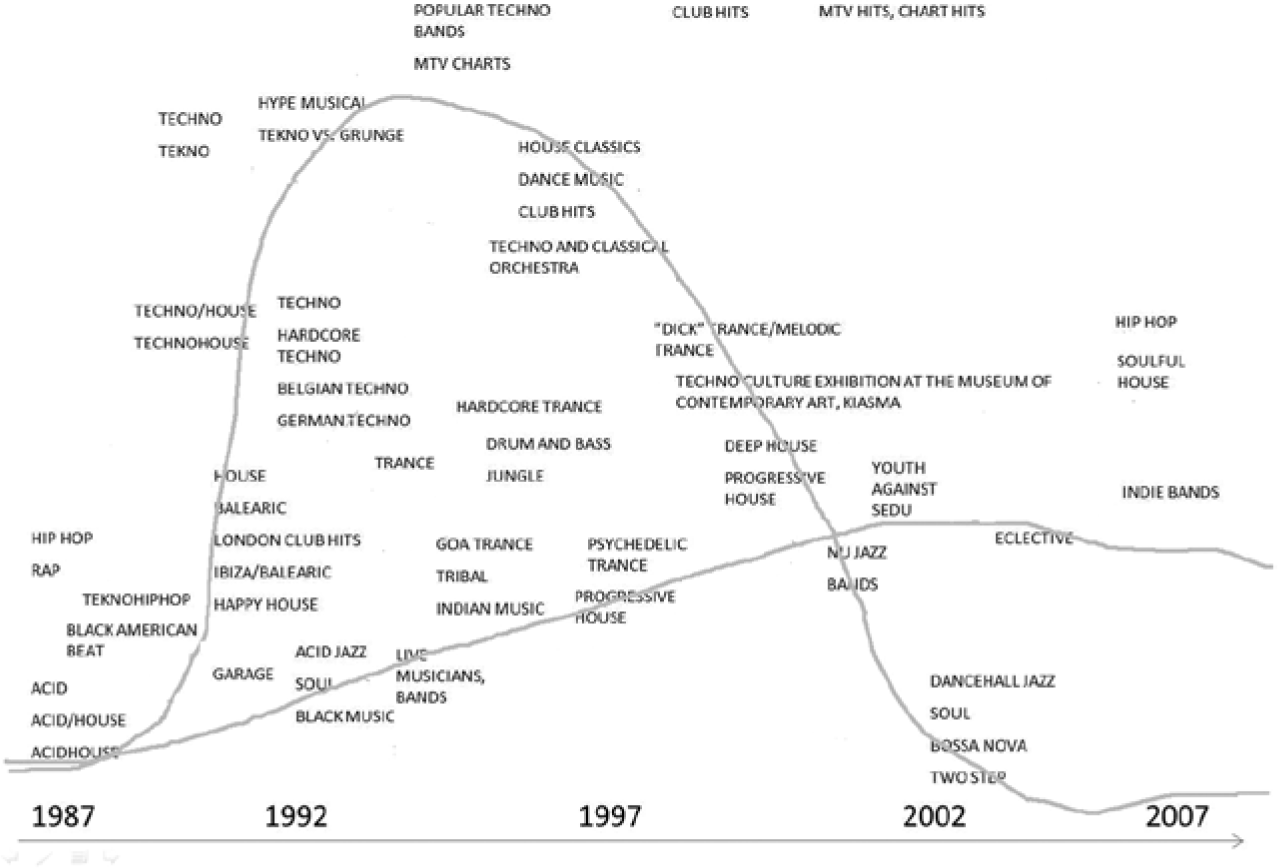
The interpretations of trajectories in popularity of techno and house venues as claimed in our material over time.
Before summarizing our main observations, we must conclude that the study’s most important theoretical and methodological implications must be formulated in some negative conclusions. These concern how to conceptualize symbolic capital through reconstructions of events in historical documentation. In our study we carried out a reconstruction of developments in ahistorical value geography on the basis of a textual analysis. Bourdieusian theory offers an advantageous framework for understanding positions and movements in terms of acclaimed (or interpreted) symbolic capital. Nevertheless, applying the theory to textual representations turned out to be challenging as it lacks an apparatus for grasping claims of worth as textual units, in this case the value assertions under study. We were therefore compelled to formulate interpretations on the basis of a combination of numerical overviews (frequency of words and amount of space given to a topic), content of text and significations of words, and in addition we evaluated what it meant in terms of symbolic position-taking in a historical context. These circumstances led us to conclude that, when it comes to studying the expressions and messages in textual media data, we need to turn to other conceptual tools than those offered by the concept of symbolic capital. More explicitly, we need tools that have the claims of the textual units embedded in their rationale. (What are the claims? What is to be looked for in them?) We suspect that, in order to interpret the assertions of symbolic values using textual material, we need to adapt theories like the justification theory by Boltanski and Thévenot (2006), which presents certain prototypes of justifications in any economy of worth. However, these types of tools for discerning value rationales are intended mostly for analysing arguments and negotiation of decision-making processes, and might not be able to catch dimensions typical of cultural consumption and production, such as identity, emotions and stimulation of senses. Also, the rationales tend to be mixed in the messages we have studied: the club event producers who we saw as empowering their work by relating it to social movements were probably doing this to a large extent to gain concrete commercial advantages.
Despite our choice of a – for our purposes – rather blunt and laborious theoretical tool, we claim that our study offers some unique knowledge of a cultural field in a time and place that have never been studied before.
The first observation that needs to be highlighted is the centrality of ‘technology speak’ and the appeal to savvy young computer males in the history of the Helsinki techno scene. Night-time economies may be in the vanguard of change, functioning as an aestheticization and popularization of particular societal discourses and images. Thus, our analysis showed how the techno genre was later attached to other types of worth in other cultural contexts; an example of this is its display at the Helsinki Museum of Contemporary Art. It became a pastiche or symbol of a Zeitgeist of a specific time as part of a historical sociocultural expression. This could be explained by the genre’s ability to incorporate into itself social meanings of larger significance that were current in Finland at the time of the techno venue boom. Such relationships between social messages and cultural production are very much in line with the work of social movement theorists (Eyerman and Jamison, 1998).
The discourse on house demonstrates another type of value trait. It appears that house producers profiled their events in a more subtle manner, slowly increasing cooperation with established producers and jazz musicians, and later on opening up venues and holding club nights where a number of other genres, even quite dissimilar ones such as indie rock, were played. Being uncommitted to any clear-cut genre lines can also be seen as part of the phenomenon of the cultural omnivore which emerged in the 1990s, with tastes extending from classical to world music and pop (e.g. Erickson, 1991; Peterson, 1992). Nevertheless, in our material we saw how both exclusive and inclusive tactics were taken up by actors of the house scene, but the restriction of audience size, the limitation of publicity and sticking to claims of worth of the independent ‘inspired polity’ (Boltanski and Thevenot, 2006) seemed to contribute to its manifestation over time. Again, in explaining why house producers were able to gain recognition in other (‘higher’) cultural scenes – as they did in the cultural establishment later on – the ability to create spaces for wider tastes and provide more cultural nuances is of significance. An appeal that is detached from social context, and thus more timeless, may be more easily adapted to new trends and therefore more durable over time.
Popularization has been described as a function of the ‘falling rate of distinction’ of objects and goods in a growth society (Baudrillard, 1998: 63). The question that necessarily arises both from the high amount of durable symbolic capital that house’s profile of honour and independence achieved, and techno’s rapid loss of symbolic capital when its audience base had become too wide, is whether the control of publicity and audience size actually controls who the audiences are. It is not possible to make claims in this matter based on the material of the study, but in the light of a growing Finnish night-time economy it would be fruitful to look further into such correlations in the future.
In the summer of 2012, the paper version of the Helsinki-based pick-up magazine CITY was discontinued after serving its urban audiences for 26 years. Although the era of dance venue listings had already ended long before, the end of the magazine’s story may also be seen as an end-point of the symbolically and commercially invested narrative of dance club life construed and disseminated in the print genres of short journalistic portrayals, plugs and flyers. In this article we have pointed out some ways in which this genre actively constructed symbolic value in Helsinki nightlife in the 1990s.
Footnotes
Funding
For the research presented in this article, Paulina Seppälä received funding from the Finnish Foundation for Alcohol Studies and the Finnish Cultural Foundation. Matilda Hellman is funded by the Academy of Finland.