



Abstract
Chinese video websites emerged as early as 2005, when video-sharing websites such as the US-based YouTube were launched and sophisticated P2P streaming software became globally available. There were several hundred private Chinese video websites in their heyday, and most operated without authorisation. By 2012, the number of major private video websites had been drastically reduced to little more than ten, all of which had become large-scale businesses. This study argues that the development of Chinese video websites is a story of struggle and self-invention of identity. These websites have undergone a process of oscillation and transformation between piracy and copyright adherence that has involved grassroots Chinese subtitle groups, state intervention and market competition. There are various levels of competition and collaboration inside private video websites, between private and state-owned video websites and between subtitle groups and video websites. In addition, this study also emphasises fan affection and labour invested by some subtitle groups which ambivalently integrates with and yet transgresses the market strategy of video websites.
In a news spot on China Central Television (CCTV) in 2010, a Chinese journalist asked four guests which media they used to watch films and television. Three of the four interviewees answered ‘the Internet’. The other interviewee chose ‘DVDs and the Internet’ (Zhao HT, 2010). The same news show revealed that the post-1980s and 1990s generations in mainland China are no longer interested in sitting in front of a television or even buying DVDs. Instead, they prefer online viewing on video websites and downloading material from the Internet. The steady growth and improvement of Internet infrastructure in China has nurtured a huge population of young Internet producers and users who consider the Internet a source of more diverse audio-visual programmes than cinema and TV, which are both under tight state control in terms of content and quantity (Barboza, 2010b). The younger generations in China enjoy using the Internet ‘not because it offers a means to rebellion, but because it gives them a wide variety of social and entertainment options’ that can be accessed through downloads and online viewing (Barboza, 2010a). The low cost of Internet videos is another major attraction. While some movies premiere on pay-per-view channels, online viewing is essentially free in China. It has been estimated that around 325 million users watched videos online in the second half of 2011 (Zhang, 2012). The culture of non-legal sharing promoted by Chinese subtitle groups, the boom in IT industries specialising in download management and media players, and the need for global image consumption have greatly influenced the emergence of the online video industry in China. As a result, Internet generations in China, Taiwan and Hong Kong have shaped a new consumption lifestyle of online viewing and downloading that is heavily computer-and web-based and characterised by individualistic autonomy.
Chinese video websites emerged as early as 2005, when video-sharing websites such as the US-based YouTube were launched and sophisticated P2P streaming software became globally available. There were several hundred private Chinese video websites in their heyday, and most operated without authorisation. By 2012, the number of major private video websites had been drastically reduced to little more than 10, all of which had become large-scale businesses (ChinaIrn, 2012). Due to policy regulations and commercial pressure to buy copyrighted audio-visual programmes, only websites strongly supported by the state and venture capital remain. Online video is a money-burning business, and most private video websites have difficulty making a profit because of the high cost of copyright fees and maintaining the technological infrastructure. According to Xinhua (2011), ‘Mainstream income is still based on advertising sales and a small proportion of premium service fees.’ Because China has banned advertising in TV dramas, online video advertising and marketing presents a ‘big opportunity’ that appeals to several hundreds of millions of 3G and smartphone users (Nong, 2012).
Three categories of online video sites exist in China: (1) peer-to-peer (P2P) broadcasting, (2) Web 2.0 video sharing and (3) video-on-demand downloading (Anthony et al., 2008: 2). The majority of Chinese video websites play the role of an online video service supplier of ‘extensive libraries of television programmes and movies’ rather than user-generated content (Nong, 2012). The first type, such as PPS and PPTV, operate like Web TV and offer various programme options. The second type, such as Youku and Tudou, emphasise online file sharing. The third type, such as Xunlei and Very CD, focus on downloads instead of online viewing. Xunlei, which once specialised as a download manager, later developed its own video-on-demand platform. Very CD, which used to be a popular online download database, has transformed itself into an online portal platform that directs online viewers’ clicks to other major video websites, escaping the controversies of piracy as a result. The main categories of audio-visual programmes include TV news, feature films, TV programmes, anime and online games. Many websites also offer discussion platforms for online interaction. They feature domestic and foreign content from Taiwan, Hong Kong, the US, the UK, Japan, Korea and Thailand among other countries.
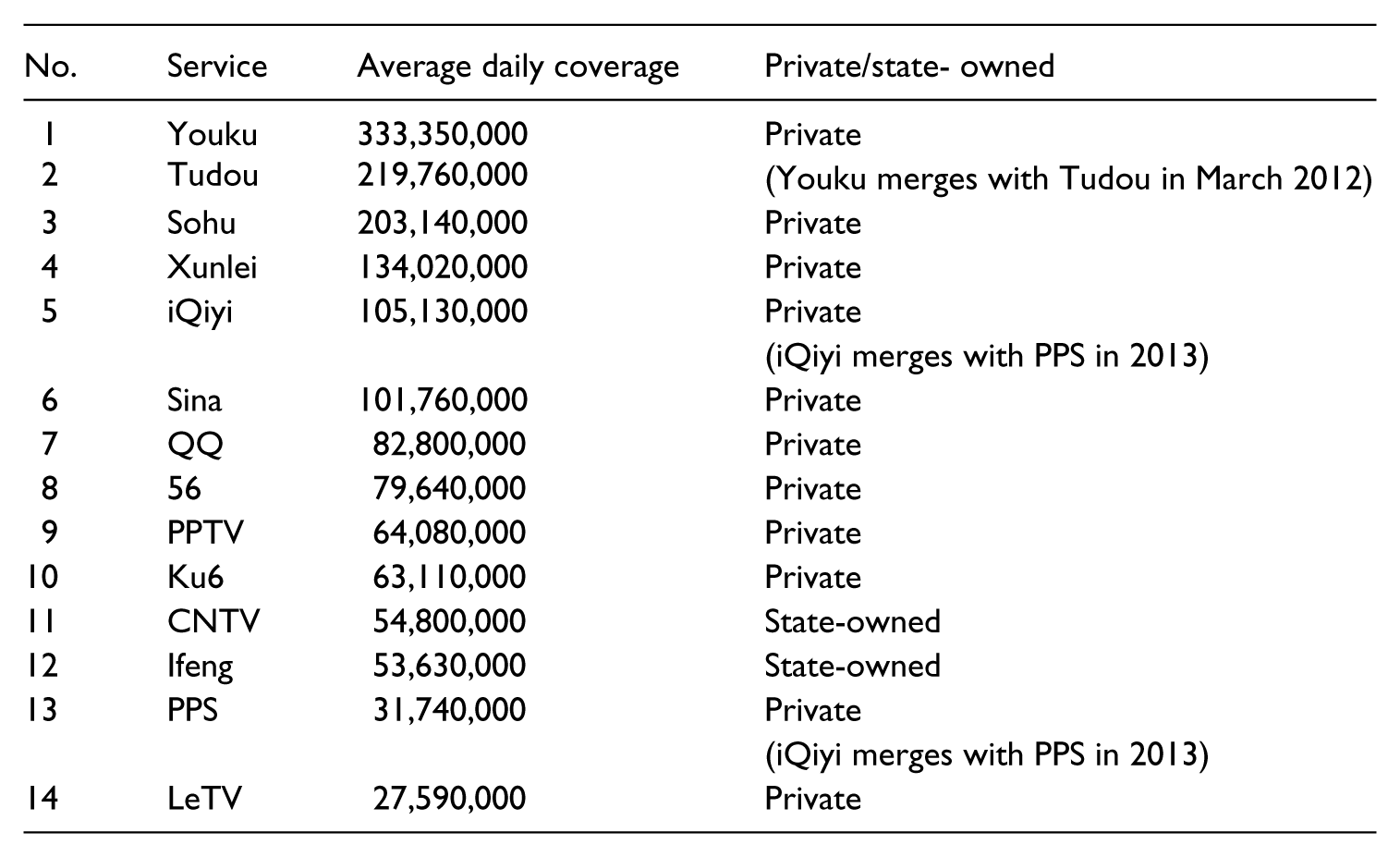
In this study, ‘private’ video websites are specified in contrast to ‘state-owned’ video websites. In late 2009, a state-owned Web TV website, CNTV, took off, emphasising the official legality of the medium. The main subjects of this study are private Chinese video websites, most of which are pioneers and have grown in popularity by accommodating grassroots efforts from Chinese subtitle groups. CNTV operations are analysed, as they relate to the Chinese state’s strategies and practices in participating in video website markets. The website examples and related news discussed in this study are mainly selected from, but not limited to, 14 brand-name video websites that were popular in 2011 (Li, 2011). 1 This study began as early as 2008. Much effort was spent collecting information from online news, blogs and discussion forums and observations from video websites. The online video industry has experienced a lot of unpredictability and change due to fickle state policies and rapid market competition from the IT industry. Thus, the research arguments have undergone revisions and relocations. I hope this study sheds a light that will guide future investigation.
This study argues that the development of Chinese video websites is a story of struggle and the self-invention of identity. These websites have undergone a process of oscillation and transformation between piracy and copyright adherence that has involved grassroots Chinese subtitle groups, state intervention and market competition. The primary stage is defined as 2005–2009, an unruly era in which private video websites were pushing their luck by largely assimilating unauthorised domestic and foreign programmes in collaboration with powerful subtitle groups catering to free file sharing. However, since the state’s curb on forms of online piracy in late 2009 and the launch of CNTV, the situation has shifted. This study investigates how copyright enforcement associated with political control and market forces has resulted in various levels of competition and collaboration within private video websites, between private and state-owned video websites, and between subtitle groups and video websites. The online video industry belongs to the contemporary Chinese capitalist modernity that comprises ‘market adjustment mechanisms’ in combination with ‘state regulation’ (Wang, 2006: 695). In addition, this study also emphasises fan affection and labour invested by some subtitle groups which ambivalently integrates with and yet transgresses the market strategy of video websites.
Grassroots networks with subtitle groups and online unauthorised sharing
This section focuses on the period before the state’s crackdown on unlicensed download forums and video websites in late 2009 and the localised culture of popular information technology related to free computer viewing in China. One market survey of the Chinese online video industry in 2012 noted that ‘five years ago, you had close to 100% of streaming television series online coming from illegal uploads’ (Avcj.com, 2012). A large number of illegal uploads comprised unauthorised foreign-language programmes. Most private video websites were established at a time when altruistic Chinese subtitle groups were widespread and stable on BitTorrent (BT) forums. From their beginnings, private video websites have largely depended on the unauthorised circulation of audio-visual files promoted by subtitle groups. These subtitle groups are organised by ardent fans who actively invest their affection and work into their favourite audio-visual programmes to achieve a sense of accomplishment and communal belonging without financial payment (Hu, 2012).
In general, many subtitle groups distribute their latest Chinese-subbed programmes to video websites. It is easy to find various subtitled versions of a programme on a single website. Some insiders in subtitle groups on online forums have revealed that part of their work schedule includes sending completed files to video websites (Baidu Post Bar, 2012). Some private video websites also reportedly hire employees as fake Internet users to upload non-legal audio-visual content to high-speed servers (Li, 2010). As this information indicates, subtitle groups and private video websites conduct constant exchanges. As the state regulation was comparatively loose at first, the model for private video websites was to explore a new market based on a low-cost investment. Subtitle groups that aim for the high visibility of their translated versions and credit for their work are happy to contribute to video websites because they have the same interest in attracting online audiences. The commercial agenda of Chinese video websites has been based on a context of pirate culture and anarchic impulses. Chinese subtitle groups and online audiences want to transgress national limitations and get in touch with global popular culture.
The craving for more freedom in audio-visual content options through downloads and online viewing is also facilitated by the evolution and popularity of online software and technologies in China. A digital file, whether downloaded or viewed online, is without physical weight. Online viewing via a video website is even easier than downloading. Whereas downloading requires time spent to download the file, online viewing only requires a click. BitTorrent forums, organised by various Chinese subtitle groups, offer a wide range of P2P networks for file sharing, and have fostered a download culture among the viewers of subtitled audio-visual programmes. Most Chinese private video websites include a downloading option in their menu, which means that viewers can choose whether to watch online or download the audio-visual programmes to their PC or smartphones. Unlike YouTube, most Chinese video websites adopt download functions because download culture has been an important part of facilitating daily viewing for active Chinese audiences hooked up to the Internet and searching for free audio-visual programmes. This implies that those video websites maximise flexibility to please Chinese audiences, which in a way encourages unauthorised circulation. Some video websites using P2P technology, such as PPTV and PPS, request that users install free software to activate the online viewing platform, with the intention of forming a bond with their customers and to obtain advertising revenues. This shows that the Chinese online video industry has a technological connection with the part of the software industry that specialises in downloads, media players and streaming video platforms.
International venture capital and state administration
Most well-established and well-surviving privately owned video websites have received strong financial support from both international and domestic venture capital. According to one industry insider, ‘venture capital fueled the boom in China’s video websites’ (China Daily, 2010). In 2006, 11 online video firms received a combined US$52.7m in venture capital funding, an increase of almost 40 percent over 2005 (Taylor, 2007). The prosperity of video websites is associated with the Chinese IT industry’s developments in the area of ‘network technologies’ and influenced by ‘domestic and international political economies’ (Zhao YZ, 2010: 272). Since the early 1990s, Chinese government leaders ‘have openly made known their desire to see the success of the Western venture capital process replicated in China and have taken initiatives and adopted policies over the recent years to achieve this ambition’ (Escapeartist.com, 2007). The Chinese boom has created a global wave and also attracted international venture capitalists searching for market opportunities. The Chinese state is a powerful promoter of global capitalism and marketisation in China. As Wang Hui precisely indicated, China’s ‘market economics and the process of globalisation cannot be implemented other than by state intervention’ (Wang, 2003: 119). However, this development path has a ‘nation-building’ mission, and in China’s historical collective consciousness, national interests have been defined since early modern China as resisting the ‘Western invasion’ (Zhao YZ, 2010: 268–9). Such a contradictory strategy restructures the Chinese online video industry.
On 29 December 2007, China’s State Administration of Radio, Film and Television (SARFT) enacted a statute known as the ‘Administrative Provisions on Internet Audio-Visual Programme Service’ and announced that a government licence for ‘information network audio-visual programmes’ would be required, and that applicants must be either state-owned or state-controlled companies (Sennitt, 2008). Many video websites were funded by foreign venture capital and could not meet this demand. The government subsequently announced that established companies could continue as long as they did not have a bad record, making it difficult for online video newcomers to enter the battlefield by crossing the threshold set up by SARFT. This former regulatory policy revealed the state’s desire to have a strong administrative role in managing the previous chaos. The state’s supervision has reinforced its power in the presence of powerful international venture capital based on the economic dominance of the West.
Since 2008, most major Chinese video websites have been licensed and, as a result, have accepted the state’s new dominant political intervention. In December 2009, the state launched a ruthless attack on select famous BitTorrent forums and video websites, such as leading website ‘BT China’, either shutting them down or downsizing them. These BitTorrent forums were accused of being outlaws either because they lacked a licence or were distributing ‘lewd, obscene, and violent content’ (Xie and Huang, 2010: 429). Only major video websites with rich venture capital investments that could afford to buy copyrighted programmes and state-owned Web TV content are now seen as legitimate players in the game. ‘Anti-piracy’ is seen as an act of the state to deliberately repress small-scale BitTorrent download websites that carry unauthorised programmes and a political act based on the state’s claim to copyright legitimacy. Further, the state’s implicit support of several big commercialised video websites is signalled by its wiping out of unlicensed operations (Wei, 2009).
As the state imposed tight controls, the online video industry developed various strategies in response to the regulation. Some Chinese private video websites have used dodgy means to escape punishment for copyright infringement. For example, applying the ‘safe harbour’ doctrine, video websites have emphasised that they only provide the platform and are unable to sanction the behaviour of avid Internet users who upload unauthorised files for the purpose of sharing (Zhou, 2009). Besides, video websites have variously submitted, collaborated and shown themselves to be savvy players that are aware of the state’s controlling techniques. These major video websites have been keen to establish a public relations office to cope with government demands (Lin, 2008). The dependence of Chinese video websites on the state has eliminated the possibility of establishing a sound system and rule, as the best way for enterprises to survive is not to challenge the authoritative rule but to underline ‘human networks’ (Zhang, 2001). Most major private video websites consolidate their close ties with the state for the sake of its guardian-like protection. For example, one of PPTV’s main investors is the Shanghai government.
Gary Wang, CEO of Tudou, stated that ‘Tudou has taken a soft self-censorship approach, employing more than 100 volunteers to monitor its videos and report anything that may draw unwanted attention from the authorities’ (Griffin, 2007). In July 2012, SARFT ordered that video websites pre-screen all made-for-Internet dramas and micro-films before online publication on video websites. This policy puts pressure on private video websites to exercise further self-management and self-surveillance in terms of content. Chairman of LeTV, Liu Hong made the following statement, ‘Self-censorship is very exciting for us.… [T]he power is given to the video website. It reflects the complete trust that SARFT has in the video websites’ (Bai and Su, 2012). This statement changes the interpretation of the authoritative regulation of content into a positive discourse of self-empowerment and a benevolent act of support. Creating the impression of maintaining harmonious relations with the state is a survival strategy for IT entrepreneurs who do not aggressively resist political authority, but appear to submit to the mode of political control.
The birth of CNTV and path to copyright
A new chapter began shortly after the official crackdown on BitTorrent forums. CNTV was born on 28 December 2009. CNTV is a symbol of national authority in web broadcasting, but in form is a copycat of the established private video websites. CNTV has the advantage of being able to use online journalist media broadcast by CCTV while also imitating and incorporating popular entertainment, such as gaming, sports and podcasts that are part of the appeal of its private counterparts.
According to its homepage, CNTV sees itself as an official web-based TV broadcaster with leadership status, and describes itself as a ‘globalised, multi-linguistic, multi-terminal public webcast service platform’ and an ‘authoritative Internet-based broadcaster in China’ (CNTV, 2010a). As a state-run website, CNTV intends to ‘become the influential online video-based multi-media database’ and ‘China’s biggest copyrighted online video communication institute’ (CNTV, 2010b). CNTV displays the strength of national modernisation in connection with globalisation and expresses techno-nationalism, which is defined as seeking technological prowess and has become one of the highest principles in China’s current nation-building project (Qiu, 2010). CNTV has more than 450,000 hours of TV programmes and can collect more than 1000 hours of TV programmes from other terrestrial TV stations every day without having to pay expensive copyright fees (CNTV, 2010b). State-owned video websites, including terrestrial Web TV, all have their own or cooperative production companies through which they can negotiate for copyright at lower prices and then resell the copyright at higher prices to private video websites (Wu, 2011). By demonstrating an official politically correct ideology in support of copyright, CNTV possesses the capital of copyright, through which it establishes a copyright hierarchy and monopoly. China’s ‘embrace of capitalistic social relations, including the acceptance of a global intellectual property regime which privileges private property ownership’ is incorporated into the state’s national development (Zhao YZ, 2010: 283). However, copyright is an example of the importation of a westernised globalisation and modernisation that is not part of Chinese tradition that privileges collective ownership and socialism (Pang, 2012). The longing to join a global intellectual property regime (IPR) is an act of gaining globally ‘legitimate IPR status’, which makes China ‘compatible with the rest of the “civilized world”’ (Pang, 2012: 98–9).
CNTV took the chance to acquire the exclusive webcast rights for the 2010 FIFA World Cup in South Africa. It declared that, although it would not distribute the live broadcast rights to any other websites, private video websites would be able to purchase the rights to provide video-on-demand services from CNTV. Ma (2010) criticised CNTV for ‘taking advantage of public resources for self-interest’ by taking on the contradictory roles of both ‘contractor’ and ‘distributor’. Here, ‘copyright’ is not primarily concerned with securing the rights of original authors to accumulate capital. Rather, it is a tool for the state to hold broadcasting rights with the capitalist purposes of making profit and competing with private video websites.
Copyright regulation forces have driven private video websites to strategically adapt to a copyright system by buying original programmes and becoming involved in original media content production. In addition to spending a lot of money on top-rated copyrighted domestic TV series targeting the huge Chinese population, major video sites also purchase foreign TV programmes. For example, Tudou is extensively linked with Disney Media Distribution (US), TV Tokyo (Japan) and CtiTV (Taiwan), and imports copyrighted programmes such as American TV series, Japanese animation and Taiwanese variety shows (Focus, 2011). However, video websites often have to pay a high price to acquire copyrighted broadcasting rights. Developing self-made media content is another strategy that saves the cost of acquiring copyrights. For example, Youku’s year-long ‘Beautiful 2012’ campaign produced micro-films for net citizens by cooperating with well-known filmmakers from mainland China, Taiwan, Hong Kong and Korea (Shao, 2012). Tudou’s made-for-Internet drama That Love Welcomes was a co-production with Taiwanese talents such as Creative Executive Su Limei, a director, producer and actor with experience in Taiwanese TV production (Global Times, 2010). The micro-films and Internet TV programmes shown on some video websites open up new spaces for inter-Asian audio-visual production and develop talent pools.
On the path to copyright, vicious market competition has raised copyright prices to an unreasonably high level for several years. Continuous fights have been had over copyright infringement in the online video industry. The copyright battle ‘is an attempt to stem losses at online video websites where companies have spent a lot more than they earned on copyright purchases’ (Chen, 2012). For example, although state-owned CNTV claims to be a video website that only supplements copyrighted programmes, it was sued by LeTV and Xunlei for illegally broadcasting more than 100 of their copyrighted programmes (Qin, 2012). It is curious to see even state-owned CNTV also run the risk of violating its constructed image of copyright authority. It seems that copyright protection has not been considered an internalised mentality in China. Pirate culture is part of Chinese people’s everyday life, but copyright is a policy imposed by the state’s will to win global/western recognition (Pang, 2012). Copyright symbolises the power of exclusion and control in the realm of market competition, and could become a means of attacking rivals and self-preservation. However, coexisting with the competition over copyright legitimacy in the online video industry marks an exercise in collaboration. Although CNTV and LeTV waged copyright disputes, they also had a partnership. LeTV has supplied both content and hardware to CNTV and was granted the licence to sell and operate Internet set-top boxes in China (LeTV Global, 2012). That is, LeTV provides high-tech support to CNTV, and in return CNTV guarantees LeTV legitimacy and advantage in marketing their own equipment nationally.
On 12 March 2012 it was announced that Youku and Tudou would merge into a single company: Youku Tudou Inc. (Barboza, 2012). According to Takada (2012), ‘the two U.S.-listed firms have been bitter rivals, locking horns in courtroom battles over alleged copyright infringement and unfair competitive practices’. Baidu, a technological corporation famous for producing the biggest search engine in China, acquired PPS and is integrated with Baidu’s online video platform, iQiyi in May 2013 (Custerc, 2013). Youku and iQiyi are the main brands in the deal, while Tudou and PPS are expected to keep their own brands. Although ‘China’s online video advertising sector has been showing annual growth rates in excess of 100 per cent over the past years,’ Chinese video websites have been unable to earn profits in the long term due to rapidly accelerating bandwidth and licensing costs (Xia, 2012). The marriage between different online video websites ‘create significant cost synergies when the companies rationalize their overlapping Web capabilities’ and eliminate intense competition over acquiring copyrighted content (Gara, 2012).
The new dynamic partnerships with subtitle groups
The ruthless shutdown of several major BT forums in 2009, the ban on fan-subbed American TV series video website’s due to the pressure from SARFT in 2010 and video websites’ purchases of foreign programmes’ copyrights have not only affected those video websites, but also subtitle groups and the relations between the two sides. Thus, although these connections were underground in the past, the video websites and subtitle groups have experimented with new forms of partnership on copyrighted programmes. Mr Liang, the leader of influential subtitle group YYeTs, revealed that the group provided the Chinese subtitles for the imported authorised American series Lost for Sohu, a private video website that claimed to acquire copyrighted programmes from CBS in the US (Sina.com.cn, 2010). According to Sohu TV’s online monthly journal, CBS’s production mode involves the completion of an episode’s shooting before broadcast each week. As such, there is not enough time for Sohu to produce Chinese subtitles and make a synchronous cast in China (Sohu TV Monthly, 2012). Thus, Sohu admitted that it copied the subtitle groups’ successful model for releasing Chinese-subtitled American TV series by downloading the original version from the Internet. It also reveals that CBS permitting Sohu to localise its production strategy is a means of permitting the status and operation of subtitle groups as long as they operate in the name of copyright. In addition to Sohu, Tudou stated it has also legally imported American TV series for simulcast since 2011 and that it openly cooperates with subtitle groups. According to a staff member at Tudou, ‘the mainland’s subtitle groups have developed a sophisticated system of production’, producing high-quality subtitles at great speed (Luo, 2011).
These examples show how private video websites rely on subtitle groups’ rich work experience to support their copyright operations, which also involves a sense of competition. If Sohu and Tudou cannot show programmes as early as most Chinese subtitle groups, that is, within 24 hours after the original release, they lose their speed advantage over subtitle groups. This is why some Chinese video websites have been eager to incorporate grassroots efforts and competences of Chinese subtitle groups into the formal copyright economy. The state’s copyright regulations have similarly threatened subtitle groups, as they could easily disappear from video websites due to their unauthorised subtitling activities. For some subtitle groups, collaborating with private video websites on copyrighted programmes has become a kind of flexible accumulation for sustaining and widely circulating their cultural production.
TSKS, one of the most famous subtitle groups specialising in Korean TV dramas, is a good example of how subtitle groups became somewhat burdened by the fears of being eliminated and legally unrecognised. In 2010, TSKS announced on its online forum that it had been authorised to produce the Internet versions of SBS’s Chinese-subtitled programmes since July 2011 by showing photos of signed contracts (TSKS Forum, 2010). In fact, Zhijiang Dongyang Tianshi Cultural Broadcasting Company negotiated with SBS to obtain an Internet broadcasting copyright, and then commissioned TSKS to take charge of the Chinese translation and subtitle work due to its efficiency and competence (Wang and Yang, 2010). As Youku ‘gained the holding rights to Zhejiang Dongyang Tianshi Cultural Broadcasting Company via the transaction’ in 2012, it is reasonable to assume that Youku may have direct access to SBS programmes with TSKS-produced Chinese subtitles (China Tech News, 2012). The commercialised imperative of online video companies and overseas copyright providers has prompted local Chinese subtitle groups such as TSKS to enter into a global network with SBS, a Korean TV station with original TV drama productions.
TSKS mentioned that if anyone or any subtitle group wanted to translate SBS programmes, he/she/it could contact TSKS and negotiate a partnership. TSKS’s aggressive act to legitimate their subtitle production invited both warm encouragement and sharp criticism on the online discussion forum. Those who did not agree argued that TSKS was behaving like a monopoly, preventing other subtitle groups from performing translations. TSKS replied that the 2009 crackdown made it insecure and that obtaining online translation copyright was a form of self-protection. TSKS also highlighted its official collaborations with video websites such as LeTV and PPTV, which owned the broadcasting rights to several Korean TV dramas and variety shows made by KBS, MBC and JTBC (TSKS Forum, 2010, 2011a, 2011b). Sohu’s co-production with Korean actors in a Korean-language Internet TV drama also depended on TSKS’s translation. Besides that, TSKS networks well with various fan forums devoted to Korean pop idols based on ‘Baidu Post Bar’, a collection of online forums offered by Baidu. Its strong alliance with Korean TV copyright holders, Chinese video websites and Korean idol fan forums indicate how TSKS intends to establish itself as a ‘brand’ with powers of ‘authenticity’ and ‘quality’ for its professional ability in subtitling production.
A subtitle group’s motivation to self-brand to gain symbolic capital and attract online advertising for the purpose of earning more money to maintain web servers arouses debate among fansubbers on whether it constitutes commercialisation (Meng and Wu, 2013). Over the last few years, collaborations between private video websites and subtitle groups have also drawn attention to whether subtitle groups are becoming commercialised. One insider in a subtitle group indicated that while such a partnership could bring a little money to subtitle groups for subsidising technological infrastructure maintenance, it is not especially meant for people working on subtitles (Liang, 2012). Although video websites offer payment, the payments are quite low given the efforts invested by fansubbers. One subtitle group, Dymy, explained on a forum that its cooperation with video website iQiyi on the Japanese Blast of Tempest anime production was not relevant to commercialisation (Dymy, 2012). Dymy said it did it for free, differing little from its past active distribution of free subtitled versions to various video websites. The only difference arises in whether the subtitled product is a copyrighted or an unauthorised programme. Dymy was positive about this official cooperation, as it meant that Japanese companies and iQiyi showed high respect for its subtitling work. It is Dymy’s hope that it can somehow be formally recognised instead of stigmatised, as the subtitle group’s purpose is purely devotional and it requests no monetary reward.
John Fiske (1992) has called fan culture a ‘shadow cultural economy’ in comparison with official cultures in which elitist tastes prevail. If ‘piracy’ is a denigrating nametag, plugging into a copyright system is a way out of the ‘shadow cultural economy’ for some subtitle groups based on anarchic poaching. Working with the copyright system is intimately related to purifying, maintaining and empowering the achievement and reputation driven by fan affection. Of course, not all of the Chinese subtitle groups are on the track of formal cultural economy. Unlike video websites, subtitle groups do not take both formal and informal tracks merely for commercial reasons. Helping products to gain wider distribution and visibility is certainly a way to exhibit fan affection and satisfy personal/group interests. TSKS’s attempt to monopolise subtitling resources is less about commercialisation and more about the desire to be superior to and quicker than other Korean-language programme subtitle groups through the possession and speed of the releases of Chinese subtitles.
Conclusion
In October 2012, a Taiwanese news report indicated that many Japanese TV dramas had been withdrawn from Chinese video websites due to recent tensions between China and Japan caused by territorial disputes over the Diaoyu (Senkaku) islands (Que, 2012). The ‘Japan’ category on the main page lists of most video websites has since been unavailable, although it remains possible to search for some Japanese programmes that have been covertly preserved. The news report indicated that while SARFT had orally informed the Chinese media to be cautious about broadcasting Japanese-language programmes, no formal regulations were in place. Although the deletion of Japanese programmes from video websites marks a kind of self-censorship caused by both anti-Japan sentiments and political propaganda, it may not necessarily mean the websites are genuinely patriotic. As the majority of Japanese programmes are unauthorised, their removal is a safe means of avoiding unwanted attention from SARFT. However, the fansubbing activities of subtitle groups are not influenced by this anti-Japan complex. In addition to political sensitivities, more and more videos are becoming unavailable to online audiences outside China due to copyright restraints. Many copyright owners have requested online viewing in mainland China only, excluding Hong Kong, Taiwan and other countries (Phoenix Weekly, 2012). Video websites want to avoid having original copyright owners becoming aware that their programmes are on these sites without permission.
As a high-tech interest group with transnational capital investments, the major licensed Chinese video website inevitably goes through ‘political exchange’ including ‘self-censorship’ to win the state’s support and the gradual submission to the copyright order (Wang, 2006: 691). Such political exchange is incorporated into China’s political control mechanism that combines ‘national will and market logic’ (Wang and Xu, 2006). Those big players on the path to copyright are involved in a repetitive cycle of obtaining audio-visual resources, accumulating copyright capital and competing for quick and popular releases. They also have opportunities to collaborate and achieve mutual benefits in terms of platform integration and technological assistance. All of these ambiguous relations are developed due to the intervention of copyright, which concerns ‘ownership, control, access and use’ (Vaidhyanathan, 2003: 11).
Without an ‘authentic’ identity, Chinese video websites have experienced a mobile process of self-reinvention thus far. Their current ‘legal’ identity has been fabricated by licences issued by the state, purchases of copyrighted programmes and self-made Internet audio-visual production. However, such an identity is an empty and unstable one, as its subjectivity is created to react to and cope with the uncertainties and repressions generated by the state’s political control, intense market competition and risky transnational venture capital investments. This is also ironically evidenced in the example that CNTV, the spoiled son of state-owned CCTV that has publicly insisted on a legitimate copyright image, was once accused of stealing copyrighted programmes from LeTV and Xunlei.
In contrast, subtitle groups have a valid basis for the distribution and circulation of subtitle downloads, even though they also cannot be totally free from the state’s supervision. Their core operative value works through the strong ties of fan affection, free sharing and recognition from an online audience. Since the crisis in 2009, subtitle groups have not been confined to merely starting new formal contracts to work with private video websites. As the video websites’ self-discipline in restraining subtitle groups’ unauthorised versions has showcased, subtitle groups look for alternative ways to take advantage of flexible media player software to maximise their effectiveness and reach a wider online audience. In this way, they also form a subtly competitive relationship with video websites promoting online viewing. For instance, YYeTs has connected its BT links of subtitled files to Yzdb.tv, a mysterious website that collects various video sources that link directly to the Baidu Player, which the user must download to facilitate online viewing. According to the examples and discussions in this article, the vague and multiple relations between private video websites and subtitle groups blur the boundaries between legal and non-legal, official and grassroots, and commercial and non-profit. The new complicated patterns of competition and collaboration between Chinese private video websites and subtitle groups are mediated not only by state regulation and market logic, but also by Chinese fansubbers’ affection, which always seeks to create online spaces of uncontained performance and ‘collectively organized pressures of human passions made articulate’ (Streeter, 2011: 2).
Footnotes
Appendix
| No. | Service | Average daily coverage | Private/state- owned |
|---|---|---|---|
| 1 2 | YoukuTudou | 333,350,000219,760,000 | Private |
| (Youku merges with Tudou in March 2012) | |||
| 3 | Sohu | 203,140,000 | Private |
| 4 | Xunlei | 134,020,000 | Private |
| 5 | iQiyi | 105,130,000 | Private |
| (iQiyi merges with PPS in 2013) | |||
| 6 | Sina | 101,760,000 | Private |
| 7 | 82,800,000 | Private | |
| 8 | 56 | 79,640,000 | Private |
| 9 | PPTV | 64,080,000 | Private |
| 10 | Ku6 | 63,110,000 | Private |
| 11 | CNTV | 54,800,000 | State-owned |
| 12 | Ifeng | 53,630,000 | State-owned |
| 13 | PPS | 31,740,000 | Private |
| (iQiyi merges with PPS in 2013) | |||
| 14 | LeTV | 27,590,000 | Private |
Funding
This research, conducted from 1999 to 2011, is funded by the National Social Council in Taiwan (Project number: 98-2410-H-003-062-MY2). This paper is an outcome of an International Workshop, funded and organised by Asia Research Institute (national University of Singapore), ‘Social Media and Cross-border Cultural Transmissions’, 21-22 June 2012.