




Abstract
This article examines how foresight, hindsight and perception are enabled, modified and compromised by competing intellectual traditions and by social and professional exigencies. Focusing on the example of one scholar, Dr Leonhard Adam, and his essay ‘Has Aboriginal art a future?’ this article charts the trajectory of this question from obscurity to celebration. It explores why such a significant question was unable to ignite debate, at a time when there was considerable interest in the role of Aboriginal art in the articulation of national identity. It examines the intellectual and social conditions that framed Adam’s contribution and explores what enabled him, as a relative outsider, to develop such a prescient understanding of the future of Australian Aboriginal art.
Keywords
In 1944 the Australian avant-garde literary magazine Angry Penguins carried two significant essays. The first, and most notorious, was a celebration of the work of the poet ‘Ern Malley’, a fiction invented by two servicemen, James McAuley and Harold Stewart, but taken up in good faith by the magazine’s editor, Max Harris. The second was a provocative essay written by German Jewish refugee Dr Leonhard Adam, titled ‘Has Aboriginal art a future?’ A photograph of Adam formally attired in an academic gown, and images of Australian Aboriginal art and artefacts accompanied the essay: visual evidence of two very different histories of ideas.
For Adam, and the cause he was espousing, the timing could not have been worse. The Ern Malley hoax severely compromised the reputation of Angry Penguins, and the subsequent competing tsunamis of vitriol and support precluded discussion about other contributions. This affair continues to feature in Australian literary debate and scholarship today (Brooks, 2011; Crouch, 2012; Lloyd, 2001). Adam’s article received little attention, although it was mentioned by realist artist Victor O’Connor, in The Communist Review, where he claimed that while the effect of Angry Penguins ‘will be to destroy, not raise Australian standards’ Adam’s essay was an exception, and its ‘serious and scholarly character … is a welcome change from the general atmosphere of the magazine’ (1944: 302–3).
There were good reasons for Adam to publish this essay in a new and experimental magazine. He was unambiguously and provocatively discussing contemporary Aboriginal art as a modern and innovative movement. In doing so he was not addressing the question ‘Has Aboriginal art a future?’ to the anthropologists involved with the study of Aboriginal art, nor to the government administrative officers or missionaries involved in managing the lives of Aboriginal people who produced the art. Instead Adam was talking to Australia’s avant-garde intelligentsia: the artists, writers, collectors, patrons and academics who were the audience of the magazine and the taste-makers in Australia. While Adam’s interests intersected with those involved in the collection, display and discussion of Aboriginal art, including missionaries and church groups, anthropologists and artists, his focus differed from theirs. He reflected, to some extent, the interests of Roger Fry, Roland Penrose, Herbert Reid and others, who produced exhibitions, essays and forums that discussed African and South Pacific art and explored the universal nature of art practice, but his interest was more specific. He considered Aboriginal art to be an identifiable and distinct contemporary art movement and therefore deserving of education, training, scholarship and patronage. He argued that there were benefits, including in health and well-being, that this contemporary art movement would bring to Aboriginal communities. It was an extraordinary vision for the development of the Australian Indigenous art market from someone who had been in Australia for just over three years. That, by 2007, the Aboriginal arts and crafts sector would be described as producing ‘very significant economic, social and cultural benefits [that] … extend to Indigenous individuals and communities, and the wider Australian and international community’ (The Senate, 2007: 3.31 and 3.36), was virtually unimaginable in 1944.
It is only recently that the significance of Adam’s essay and his role in developing the study of Aboriginal art has been acknowledged. In 2001 Howard Morphy identified Adam as one of ‘the first to attribute [Indigenous] works to known individuals’. In 2006 Adam’s essay was included in a significant compilation of critical documents relating to Australian modernism (Stephen et al., 2006), and in 2008 David Jaffe claimed it was a ‘perceptively titled … pioneering essay’. More recently, Benjamin Thomas (2011) described how Adam influenced the continued interest of the National Gallery of Victoria’s director, Daryl Lindsay, in Aboriginal art. The question of why this acknowledgment took more than 60 years to occur informs consideration of broader scholarly, aesthetic and societal responses to ideas of culture and identity in Australia in the 20th century.
Leonhard Adam in Australia
Leonhard Adam arrived in Australia in September 1940. Like many German Jews, he had left for the United Kingdom in 1938, where he was subsequently interned as an ‘enemy alien’. In 1940 he was transported to Australia on the Dunera, and held at the Tatura Internment Camp until he was released in 1942 to work as a researcher at the University of Melbourne. Although not acknowledged by Adam, his 1944 essay reflects his experiences as a German Jew and his own experiences of cultural loss and physical separation. He saw the brutal attacks by the Nazis that expunged cultures and subcultures across Europe. He witnessed the destruction of books he had authored, and experienced his own disempowerment and the fragmentation of his family. His interest in strengthening contemporary cultural identity was not to do with salvaging cultural material or archaic practices, but rather about art production as evidence of the preservation of culture, and as support for an intellectually robust, economically viable and culturally dynamic society. For Adam art enabled Aboriginal culture and identity to claim a place in the academy with all the benefits that thus accrued.
Adam arrived in Australia with an established international reputation as an ethnographer that was consolidated with the publication by Pelican, in 1940, of his book Primitive Art (see Figure 1). Melbourne society embraced him. He gave classes in Mandarin and Anthropology at the University of Melbourne’s Queen’s College, and public lectures to the Anthropological Society of Victoria, the Gallery Society at National Gallery of Victoria, and at the University. He wrote catalogue entries and curated exhibitions (including for the National Gallery and National Museum of Victoria in May 1943 [Adam, 1943], the Velasquez Gallery in 1945 [Velasquez Gallery, 1945], and for the Australian and New Zealand Association for the Advancement of Science meeting in August 1955). He was a member of the Victorian Anthropological Society and Vice-President of the Victorian Aboriginal Group (VAG) from 1943. The private collectors, academics and museum professionals, whom he met through his work at the University of Melbourne and the National Museum of Victoria, informed his consideration of Aboriginal art, as did the missionaries, Church members and well-connected individuals whom he met through friends and family. Many were vocal advocates for Aboriginal rights and worked passionately for the cause of Aboriginal uplift. In 1945, at the invitation of the Australian federal government’s Council for the Encouragement of the Art, Adam wrote the foreword for the Exhibition of Aboriginal Arts and Crafts (Velasquez Gallery, 1945). Bark paintings and associated artefacts from Groote Eylandt that arrived (too late) for the exhibition served as the basis for the University of Melbourne Ethnographic Collection (now known as the Leonhard Adam Collection of International Indigenous Culture).
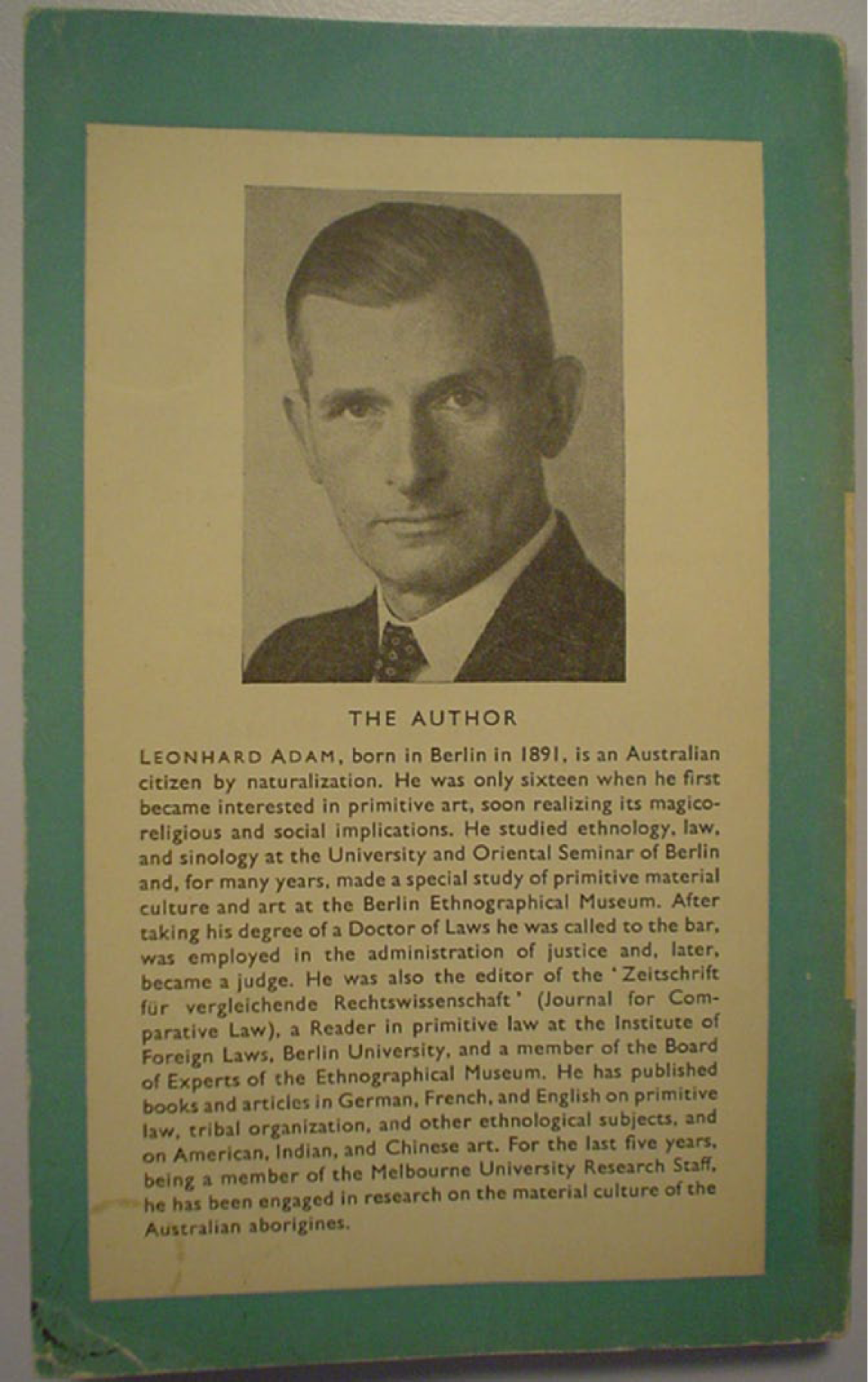
Back cover Leonhard Adam’s Primitive Art (Penguin Books, Harmondsworth, Middlesex, reprinted 1949; reproduced with the permission of Mary-Clare Adam).
Despite Adam’s extensive and influential networks it was not surprising that his essay was ignored. Australia had only recently moved from planning for the annihilation of, to advocating assimilation for its Indigenous people, and the question of the future of Aboriginal people, and complicated questions about their economic and cultural trajectory were problematic to ask and difficult to answer. The study of Aboriginal art was primarily ethnographic. The first Aboriginal works purchased for the National Gallery by Victoria’s Director, Daryl Lindsay, were two realist watercolours on paper by Edwin Pareroultja, acquired in 1946. This was followed by a gift of eight bark drawings from the Department of the Interior in 1952 (personal communication, J. Ryan, 29 and 30 April 2009). Adam argued passionately for Indigenous art to be included in a specially built art gallery or in the National Gallery of Victoria. To the local academic community this position appeared to be the hypothesizing of a European who was both out of time and out of place. Greg Dening, one of Australia’s leading historians who, as a student, assisted Adam with work on the University’s Ethnographic Collection, described Adam as a ‘lonely figure’, ‘always on the edge of the establishment at the University of Melbourne’, suffering from ‘lack of respect for his learning and his world status in scholarship’ (1998: 94, 98).
In Europe, on the other hand, Adam’s work was applauded. His friends and colleagues included some of most significant anthropologists of his day, Franz Boas, R.R. Marrett, Brenda Seligman, Bronislaw Malinoski and Alfred Bühler, and his contribution was acknowledged by them in correspondence now held in Leonhard Adam Archives at the University of Melbourne. Claude Lévi-Strauss cited Adam’s papers, ‘Das Problem der asiatisch-altamerikanischen Kalturbeziehungen mit besonderer Berücksichtigung der Kunst’ and ‘Northwest American Indian Art and Its Early Chinese Parallels’, as important contributions in his book Structural Anthropology (1972: 246, 267). In a review of Südseestudien. Gedenkschrift zur Erinnerung an Felix Speiser (published in 1951), which included contributions by the most significant anthropologists of the day, H.E. Hause cited Adam’s paper on Groote Eylandt bark paintings as ‘a most interesting contribution to a field which is crying for attention’ (1952: 245).
European intellectualism and the question ‘Has Aboriginal art a future?’
In 1944 travel to remote Aboriginal communities was difficult, and contact between collectors in the southern states and producers in northern Australia was mediated by anthropologists and missionaries. Anthropology was influenced by British anthropology and was focused on managing the frontier (Peterson, 1990). Nicholas Thomas (1989: 1) argues that British and French anthropological discourse was ahistorical for ‘complex conceptual and discursive reasons’ that continued to influence anthropological enquiry more broadly. In Germany historians such as Leopold von Ranke (1795–1886), Georg Gottfried Gervinus (1805–71), Johann Gustav Droysen (1808–84) and Ottakar Lorenz (1832–1904) also advanced the view that ‘natural peoples’ had no history, but it was contested in disciplines aligned with anthropology, such as linguistics, ethnography, philosophy and comparative religion, all of which considered that anthropology enquiry required an historical approach (Zimmerman, 2001: 37–44). Adam studied primitive laws and was influenced by the tradition of the Historical School of Jurisprudence, developed by Gustav Hugo (1764–1844) and Friedrich Karl von Savigny (1779–1861), and articulated in Paul Vinogradoff’s (1854–1925) significant Historical Jurisprudence, published in two volumes in the 1920s (Donohue, 2012; Rodes, 2004).
In his essay Adam (1944: 49) relied on an art historical framework when he asserted that: Some people … forget, however that art is not a static, but a dynamic phenomenon, that it is perpetually changing, and that mutual influences from tribe to tribe, and probably from altogether different peoples also, have been at work for centuries. European influence on primitive art, therefore, is only the latest development in a very long chain of historical events.
An influential opponent of ahistorical discourse was Adam’s teacher and mentor Josef Kohler (1849–1919). Kohler argued that evidence of law always indicated the existence of sets of social and historical constructs, and by implication it was therefore impossible to conduct an ahistorical study of law. He asserted that ‘history, relativity, evolution and change, are found in nearly every present day creed of legal philosophy’ including in small Indigenous societies (Elison, 1961: 425). The central tenet in ‘Has Aboriginal art a future?’ reflects Kohler’s influence, as Adam (1944: 49) asserts: art is not an independent phenomenon but an integral part of a specific culture. It is the aesthetic reflection of the spiritual background of the culture to which the artist belongs.
Kohler’s studies of cultural practice informed his arguments on human rights and the development of legal institutions. He considered rights to be both relativist and specific, being context-dependent rather than absolute, and argued that ‘the doctrine of the rights of mankind is a doctrine of definite stages of culture, not a doctrine of permanent law’ (Elison, 1961: 419) and that ‘[a]s the development of the law is partly teleological, partly logical, no one kind of court will be the only right one’ (Kohler, 1914: 242, cited in Elison, 1961: 420). He concluded that acknowledging cultural specificity is, therefore, essential to effective governance.
This is also reflected in Adam’s claims that: The complete abolition of tribal organisations, traditions, ceremonies and the like has long been recognized … as being not only a wrong native policy, but also a great danger to the mental balance of primitive peoples. (1944: 49)
In this Adam extends Kohler’s line of argument, contending that judgements about art require an understanding of cultural context and cultural specificity. Adam further maintained that art production, with people being able to carry out cultural practice on their own land, led to improved education, economic advantage and community well-being.
Material culture: exhibition, consumption and academic enquiry
The role material culture played in the curriculum also differed between Germany and Australia. At the Freiderich-Whilhelm University Adam’s teachers, who were curators at the Berlin Ethnographic Museum, used the collection extensively for teaching. By 1900 this museum was the largest ethnographic museum in the world. Its American Archaeology Department, directed by Adam’s teacher Professor Eduard Seler (1849–1922), became the major centre of South American studies in Europe largely due to the material he collected in his six expeditions to Mexico and Guatemala between 1887 and 1911 (Lally, 2002: 70). Albert Grünwedel, director of the Indian collection, taught Indian and Central Asiatic archaeology (Glenn Penny, 2003: 104; Zimmerman, 2001: 196) using the extraordinary Indian collection of wall-carvings, icons and artefacts collected from sites along the Silk Road by his assistant Albert von le Coq as part of the 1904, 1905 and 1914 Deutsche Turfan expeditions (Kost, 2012: 1–9; von le Coq, 1928: 25).
Adam was aware of how this vast amount of ethnographic material, collected during expeditions and territorial conquests, and filling museums, salerooms and private collections, was shaping European aesthetics and art historical discourse. He was engaged both as a collector and as member of the Board of Experts for the Berlin Ethnographic Museum. He continued his engagement in Australia, attempting to negotiate the sale of two large Benin bronzes for his friend, Berlin collector Gerhard Mertz in 1949. 1
Adam was also aware of how artists collected and studied these objects, discussed them at salons and wrote about them in avant-garde literary journals. In both Europe and in North America masks, shields and three-dimensional sculpture from Africa and the Pacific were displayed in the same galleries, and often in the same shows that exhibited avant-garde art. For example at Die Neue Galeri in Berlin, Picasso’s 1913 exhibition juxtaposed his most recent paintings with examples of African sculpture (Stepan, 2006: 99). Adam was familiar with the prominent galleries and dealers, such as Cassirer Gallery in Berlin, the Carlebach Gallery in New York, and Parisian Charles Ratton, who developed this trade; with the collectors whose taste and patronage often rivalled that of the state institutions; and with the emergent discourse and scholarship. Adam’s friend Baron von der Heydt, who was purported to have one of the largest collections of ‘primitive art’ in the world and who also owned a large number of significant works by Europe’s most avant-garde artists, commissioned some of the greatest scholars in this field to produce books on his collection (see Cohn, 1932; Greissmaier, 1936; von Sydow, 1932). The volumes authored by von Sydow and Cohn were published by Bruno Cassirer, who with his cousin Paul had opened the Cassirer gallery and publishing business in 1895, and who represented the most significant avant-garde artists from Belgium, England, France and Russia.
While the discourse relating to primitive art had emerged from aesthetic (Semper, 2004 [1861, 1863]), philosophical (Worringer, 1953 [1908]) and ethnographic studies (Haddon, 1894, 1895), by the 1930s an art historical perspective was being introduced by scholars such as Franz Boas (1955 [1927]) and Eckart von Sydow (1932). At the University of Ghent Franz Boas’s student, and Adam’s contemporary, Frans Olbrechts (1899–1958), taught a course on primitive art employing an historical discourse and methodology, and identifying individual African sculptors and centres of artistic production. In 1942 he published an essay, ‘The integration of art in the culture of primitive peoples’. Adam corresponded with Olbrecht and his 1944 essay aligns with Olbrecht’s approach, highlighting the work of individual Indigenous artists, examining the position of Aboriginal art within international art history, and arguing for an interdisciplinary approach to art historical and anthropological studies.
In Australia the intellectual landscape was different. Anthropology commenced at the University of Sydney in 1925 as a training program for professionals involved with Australian and Pacific societies (Peterson, 1990: 7–10). There was no department of art history in the country until 1947, when Joseph Burke arrived at the University of Melbourne to take up the newly established Herald Chair of Fine Arts. The large study collections held in institutions in Melbourne (assembled by Baldwin Spencer and Donald Thomson), Sydney (by A.P. Elkin and later Ronald and Catherine Berndt) and Adelaide (by Norman Tindale) were not easily accessed by other teaching programs. Australian anthropologists did not explore the role of Aboriginal art within the international art market, or as a part of western art historical discourse. They did, however, contribute to exhibitions that included Aboriginal art.
Exhibiting Aboriginal art
Charles Barrett and A.S. Kenyon curated the first Aboriginal Art Exhibition in 1929 at the National Museum of Victoria. They included Aboriginal artefacts and bark paintings collected by Baldwin Spencer; works on paper by 19th-century Aboriginal artist Tommy McRae; and a papier-mâché model depicting rock art from the Grampians. The catalogue discussed the links between bark paintings, rock art sites, scarred trees and artefacts, and contained a plea to protect Aboriginal sites ‘as national possessions’ (Barrett, 1929: 12). Although two Aranda men, Stan Loycurrie and Jack Noorywauka, (referred to anonymously in the Preface as ‘two full-blooded natives from the interior of South Australia’) demonstrated tool-making, staged performances and built a mia mia in the exhibition space, the ethnographic emphasis was framed by the paradigm of the ‘dying race’. Adam’s mentor, A.P. Elkin opened this exhibition (Griffiths, 1996: 181–3) and his friend, artist Frances Derham, presented two public lectures on Aboriginal art (Kleinert, 2002).
Over the following decade the interest in Aboriginal art broadened as artists sought to develop an Australian art vernacular. Margaret Preston, who worked with Alfred Kenyon, Robert H. Croll, D.K. Mahony and Charles Barrett on exhibitions, including the 1929 exhibition at the National Museum of Victoria (Griffiths, 1996: 181–3; McLean, 1998), published a series of articles between 1925 and 1941 in which she argued that Aboriginal art provided a legitimate visual grammar for Australian artists (Edwards and Peel, 2005: 103; Preston, 1925: n.p.). A similar interest was reflected in the exhibition of the Aboriginal art and crafts displays at the Arts and Crafts Society of Victoria, where anthropologist Baldwin Spencer had been President between 1915 and 1919, and Frances Derham (1894–1987) Vice-President between 1928 and 1932. Derham used Aboriginal design elements in her design for the cover of the Society’s publication, The Recorder, in March 1929 (Parsons, 1989: 41), and exhibited Aboriginal art from her own collection and lent by anthropologist C.P. Mountford. During a trip to Hermannsburg in May 1938 she took 80 local children to Palm Valley for sketching classes (Holder, 2007). Another member, artist Jessie Traill, visited Central Australia in 1928 and in 1932. She was an active fundraiser for Aboriginal communities (Kirby, 2007). Potters Gladys Reynell, Alan Lowe and Ernest Finlay also incorporated Aboriginal motifs into their designs (Parsons, 1989: 41).
In 1941 Fred McCarthy and staff from the Australia Museum curated Australian Aboriginal Art and Its Applications at the David Jones store in Sydney. This exhibition continued the theme of Australian Indigenous design, juxtaposing Aboriginal cultural material with examples of modern Australian art and craft that included fabrics and ceramics (McCarthy, 1941; Thomas, 2001: 302). Artists represented included Violet Mace, Grace Seccombe, Anne Weinholt and Frances Burke. Mace had visited the Finke River Mission at Hermannsburg in Central Australia in 1934, collecting Aboriginal children’s drawings and a sketchbook by Aboriginal watercolour artist, Albert Namatjira. She owned a work by Kalboori Youngi, the Queensland sculptor mentioned in Adam’s essay (Adam, 1944: 50; Timms, 1995).
The year 1941 was also when the first comprehensive survey of Australian art, Art of Australia 1788–1941 toured North America. Sponsored by the Commonwealth of Australia and under the auspices of the Carnegie Corporation, it opened at the Museum of Modern Art (MOMA) New York and at the National Gallery of Art Washington with Aboriginal art representing around 15 percent of the work on display (Ryan, 2002). Margaret Preston and writer Marjorie Barnard accompanied the exhibition and wrote pieces for the catalogue, the cover of which was comprised exclusively of Aboriginal designs, including drawings of a shield and Wandjina (Preston, 1941). Despite this interest, acquiring works by Aboriginal artists, other than a select few such as Albert Namatjira, was not easy, and the interest shown by artists and anthropologists in Aboriginal art did not stimulate the kind of market activity that had occurred overseas.
It was in this context that in 1943 Adam curated the Primitive Art Exhibition at the National Gallery and National Museum of Victoria. As A.P. Elkin (1943: 376), and ‘J.L.M.’ (1943: 98) wrote in reviews in Oceania and Man respectively, that this was the first exhibition in Australia to contextualize Aboriginal art in a broader international context, a point emphasized by Adam in the catalogue. Daryl Lindsay, Director of the National Gallery wrote in the Foreword. ‘An exhibition of this kind … brings home to us very forcibly that art is a universal language’ (1943: iii).
The market for Aboriginal art
In ‘Has Aboriginal art a future?’ Adam argued that Aboriginal art could be commercially viable, and in Melbourne the main proponents for the commercialization of Aboriginal art and craft were those who supported the Indigenous uplift movement. Prominent in this movement were members of the Victorian Aboriginal Group (VAG), including Adam’s wife Mary and sister-in-law Helen Baillie, and friends Valentine, Molly and Geoff Leeper, and Max Crawford. The VAG arranged exhibitions, sold work on behalf of missions, and discussed how art and craft could sustain the livelihood of individuals and communities. As early as 1931 the VAG determined that ‘a depot shold (sic) be started for the disposal of aboriginal work Arts and Crafts etc … and arrangements made to write to all Government and Mission Stations to find out what goods, if any, were available’. 2
Adam became the VAG’s Vice-President in 1943, distributing the annual report to groups overseas, and co-signing a letter to the Anti-Slavery and Aborigines’ Protection Society in London on 22 March 1946 (Poynter, 2008: 228–9). In his 1944 essay Adam refers to a VAG exhibition held in 1942, which included ‘textiles made by Aboriginal women in European techniques’ (1944: 50)
Members with links to missions in remote Australia brought substantial knowledge about the life of contemporary Aborigines to inform the work of the VAG. They provided regular reports from Aboriginal reserves and missions around the country, including on art and craft production. These provided Adam with information on the types of production taking place, as well as the economic benefits that accrued in communities. For example, the Finke River Mission Station’s annual report for the year ended 30 June 1936 recorded that two men produced ‘67 fancy boomerangs and 106 Pokerpieces, which were all disposed of’ and that women’s ‘fancy work’ produced an income for that year of £98-17s-0d. The report concluded that: ‘Everyone who wished to had a chance to earn a little extra. No difficulty was experienced in disposing of the articles made.’
3
A year later the ‘Report for the year July 1937 to June 1938’ noted that an agent, Mr J. Rice, had been appointed to sell works in Alice Springs and that: ‘Quite a lot were sold to various people in the South and to tourists coming out here’, and that ‘all articles manufactured found a ready sale.’
4
The following year the report for the period July 1939 to June 1940 records the sale of art and craft at the Darwin Country Women’s Association Centenary Exhibition.
5
By mid 1941 the Mission wrote triumphantly that: ‘For the first time the demand exceeded the supply.’
6
By the time Adam published his essay the Mission was reporting that: our locally manufactured goods met with a great demand, which in turn meant additional income to our people. To most of them it meant enjoying a standard of living unknown to them before.
7
The arguments made by the VAG’s Education sub-committee that any Aboriginal education policy ‘should be based … on their own tradition & culture [and] …should be linked up with craft work & should be for self-support’
8
are echoed in Adam’s claim that Aboriginal education should ‘help to preserve the historical and emotional basis of their graphic art’ (1944: 49). Adam was also aware of uplift programs in Africa and North America, and wrote: Aborigines should be given opportunities to either carry on or develop their traditional style … good examples of European art techniques could be used to teach the natives how to find new ways for the aesthetic expression of their own ideals. This has been done, with great success, at the Prince of Wales College, Achimota (Gold Coast) and in the United States where the wall paintings in the recreation room in the Department of the Interior Building in Washington are the works of North American Indians trained by European painters. (1944: 49)
‘Has Aboriginal art a future?’
While Adam’s advocacy intersected that of the anthropologists, uplift groups and artists, it rested on different premises. In his essay Adam argued that Aboriginal art was a movement, defined by particular styles and particular forms and with an aesthetic sensibility that placed it within an art historical discourse, and beyond ethnography. He attempted to provide an evidence-based art historical perspective, reasoning that if Aboriginal art was to have a future then it needed to be considered as an active and creative force with historical antecedents, and not as ethnography, nor as an appropriation into the semiotics of Australian art. He discussed shared artistic concerns resulting from ‘mutual influences from tribe to tribe, and probably from altogether different peoples … [which] also, have been at work for centuries’ (1944: 49). He described Aboriginal Australia as historically dynamic, concluding that ‘European influence on primitive art, therefore, is only the latest development in a very long chain of historical events’ (Adam, 1944: 49). He assessed Aboriginal painting stylistically and comparatively, examining rock art, bark paintings, baskets, textiles, clay sculpture and crayon drawings (1944: 40), and noting regional variations and shifts in styles. He provided international contexts, comparing Australian rock art to that of Europe, Africa and India, identifying ‘[n]aturalistic simplicity and truth to nature’ (1944: 43) as the most identifiable traits of significant prehistoric rock art, while commenting on the ‘technical skill’ and ‘masterly vigour’ of the art from these three continents (1944: 43) and comparing traditional depictions of animals to art from Melanesia and North-West America (1944: 42). He made particular mention of ‘sculptress, Kalboori Youngi, a member of the Pitta Pitta tribe in Central Western Queensland’, celebrating her innovative use of material and her aesthetic sensibility, which he likened to ‘the naivety of early Gothic sculpture’ (1944: 50).
Adam particularly sought to define and defend innovation and agency in Aboriginal art. The illustrations in ‘Has Aboriginal art a future?’ include engraved pearl shells with ‘pseudo-geometric style’ bark paintings showing both traditional ‘“X-ray” representation’ and ‘foreign influences’, basketry indicating ‘accuracy and symmetry of fine workmanship’, painted bark bags and clay figures. They were carefully chosen for their aesthetic appeal, material variance, visual accessibility and their support for an art historical narrative.
The Australian aborigine definitely has good taste. I believe there can be no doubt that, although he ‘reads’ those ideograms as we read some writing, he also has the aesthetic sensation of beautiful lines and fine arrangements of patterns. This opens a wide field for future developments including the utilization of decorative designs for commercial purposes. (1944: 50)
Adam recognized that his position challenged a significant orthodoxy, one that essentialized Indigeneity by privileging ‘uncorrupted’ pre-contact cultural material as authentic, and the use of non-Indigenous materials in Indigenous art as evidence of ‘deterioration and degeneration’ (Adam, 1944: 49). As Ruth Phillips explains: [T]he scholarly apparatus that inscribes the inauthenticity of commoditized wares [is] a central problem in the way that art history has addressed Native art. The authenticity paradigm marginalizes not only the objects but the makers, making of them a ghostly presence in the modern world rather than acknowledging their vigorous interventions in it. (1998: x)
If Aboriginal art was intrinsically innovative, then the introduction of new materials and techniques was empowering rather than problematic, and Adam suggested that ‘good examples of European art techniques could be used to teach the natives how to find new ways for the aesthetic expression of their own ideals’ (1944: 49). He suggested that schools for ‘teaching of weaving and other handicrafts’ were established where rug and carpet making could become ‘an aboriginal industry of some importance’, as could pottery. He emphasized that these media could be the basis for new ways of producing Aboriginal art, talking about this as ‘an industry’ (1944: 50).
This issue of innovation was not just a technical issue but had important economic implications. A market in Aboriginal art could not be developed while collectors privileged pre-contact ‘uncontaminated’ ‘native’ art above contemporary production. Adam argued, therefore, that authenticity was linked to cultural dynamism, not cultural stasis. In the 1949 edition of his book Primitive Art he wrote: One or two anthropologists have suggested that an artefact produced with European tools cannot be regarded as genuine, or, at its best, only as ‘semi-genuine’. This view is, in my opinion, incorrect. The dynamic process of cultural evolution implies, among other factors, influences from outside … There is no reason why the changes wrought by the import of European goods and methods should not be recognized as a formidable case of diffusion of culture. (Adam, 1949: 247)
Promoting Aboriginal art
Adam conceived of a transformative schema in which art, as a central enabler of social and economic change in Indigenous communities, supported cultural practices of continuing relevance to individual communities. He continued to promote this idea for the rest of this life. When art critic Alan McCulloch published an article titled ‘Save art form of aborigines!’ on 4 July 1951, Adam responded that it was ‘very gratifying that an art critic of your standing now openly pronounces a truth which should be realized by all true art lovers’ and offered to show him ‘a few beautiful – though brand new – paintings on bark from Milingimbi’. 9 He ensured that his paper ‘The Bark Paintings of Groote Eylandt’ (1951), published by the Museum fur Völkerkunde in Basle, was sent to the most influential organizations in South Africa, the UK, Europe and North and South America. 10 He carefully seeded collections with Aboriginal bark paintings, including gifting bark paintings from Milingimbi to the American Museum of Natural History in July 1951 and again in 1957. 11 These are the first Aboriginal bark paintings acquired by the Museum of Natural History and pre-date the presentation of a series of works from Yirrkala by the Berndts in 1958. In 1952 Adam sent a Milingimbi work by ‘Daignnanan of Gbaboino people ca. 45 years of age’ to Dr J. Alden Mason at the University of Pennsylvania. By 1953 Adam had dispatched bark paintings to the University of Knoxville in Tennessee, the University of Pennsylvania and Milwaukee Public Museum. 12 Both Boston University and the American Museum of Natural History sought Adam’s assistance to purchase Aboriginal bark paintings. 13
Adam also petitioned the commercial art market to take an interest in Aboriginal bark paintings, including Julius Carlebach at the Carlebach Gallery New York (which was the venue for Roy Lichtenstein’s first one-man show in New York, and traded works of art by European artists such as Kurt Schwitters), 14 and Berlin collector, Dr Gerhard Mertz. 15
Conclusion
Adam’s essay ‘Has Aboriginal art a future?’ aligned issues of identity, agency, social well-being and culture. He argued that the health and economic security of Aboriginal people could be effectively strengthened by support for art practice and education, by the development of an Aboriginal art market, and by positioning Aboriginal art within a scholarly art historical context. He maintained that Indigenous communities, like all societies, were in a state of constant flux, and that a strong culture, evidenced through a community’s creative output, was the key to successful social change. He eschewed the branding of Aboriginal art as homogeneous, noted distinctive variation between regions and artists, and used analogies that were employed within the western canon of art, arguing, for example, that ‘the difference between a rock engraving in the Sydney district and a rock painting in North-west Australia is not smaller than that between works of Giotto and Picasso’ (1944: 43).
Adam’s essay was both optimistic and prescient. In 1944 he wrote: ‘Maybe that one day in the future we can admire mural paintings of Australian animals, hunting-scenes and the like, done by aboriginal artists, on the walls of some suitable building’ (1944: 50). Sixty-two years later the Musée du Quai Branly commissioned works by eight of Australia’s most significant Aboriginal artists, Paddy Bedford, John Marwundjarl, Ningura Napurrula, Lena Nyadbi, Michael Riley, Judy Watson, Tommy Watson, and Gulumbu Yunupingu as part of the design of the building (Australia Council, 2006). In 2013 the museum installed a commission from Gija artist, Lena Nyadbi, covering the roof of the museum and visible from the Eiffel Tower.
Adam passed away in 1960. During his lifetime travel to remote Aboriginal communities was difficult and communications networks, where they existed, were unreliable. During the 1960s collectors, curators and dealers such as Steward Scougall, Karel Kupka, Tony Tuckson, and Jim Davison had begun to collect and trade bark paintings, and mining began to open up northern Australia. It was to be another twenty years, however before the art market considered Aboriginal art a worthy investment.
A decade after the publication of ‘Has Aboriginal art a future?’ Adam wrote: But the populations survive and with them their innate artistic capacity. So long as primitive men passed as savages, and their works as mere curios, no one took these native talents seriously, but the discovery of the aesthetic value of primitive art, as well as its psychological and social functions, could not fail to attract the attention of educationists, missionaries, and colonial administrators. (1954: 210)
Adam believed that the introduction of new techniques and materials would support the development of ‘an aboriginal industry of some importance’, providing ‘economic profit’ (1944: 50) for Aboriginal communities working on their own country. In the 21st century this belief was vindicated by the findings of the Australian government’s Senate Inquiry into the Indigenous Art and Craft Sector, which conservatively valued the Aboriginal art market at between $300million and $500 million (The Senate, 2007: 2.17); by the tens of thousands of collectors who buy Aboriginal art; and, most importantly, by the Aboriginal art centres working to ensure that ‘an aboriginal industry of some importance’ continues to flourish across Australia.
Footnotes
Funding
This research received no specific grant from any funding agency in the public, commercial, or not-for-profit sectors.