




Abstract
Dating shows are experiencing resurgence in contemporary China. This study conducts a critical discourse analysis of If You Are the One, one of the most popular dating shows, to examine what are the ways in which women are represented and how the show is both shaped by and constitutive of the ongoing sociocultural practices in contemporary China. The study concludes with the observation of women’s subordination to the collusion between commercialism and patriarchy and of double manipulations of women in media discourses by forces of both market and state. Facing a state–market complex, feminism has a long way to go in China.
In recent years, a group of dating shows produced by provincial television stations has dominated primetime Chinese television, for instance, If You Are the One, Let’s Date, and Go for Love. If You Are the One (henceforth IYATO), or Fei Cheng Wu Rao, produced by Jiangsu Satellite TV, which literally translates to ‘if you are not sincere, do not disturb’, is the most popular yet controversial one among the many. Dating shows are not new in China. Historically, the provincial Shanxi television station pioneered the production of the first dating show named The TV Matchmaker in China in 1988. In late 1990s, as Chinese television accelerated its transformation from political and educational orientations to an entertainment one, Hunan Satellite TV produced the well-known-for-a-time dating show The Rose in 1998. The show employed the ‘six men vs. six women’ format to realize a televised matchmaking through practices such as self-narration, questions and answers, and love confession (Zhang and Wang, 2010). The recent appearance of shows such as IYATO signals a resurgence of the dating show format. Unlike The Rose which confined discussions to private matters such as personality and hobbies, IYATO mediates larger socioeconomic issues such as pre-marriage property notarization.
Because of its social and cultural relevance, the show grabbed vast audiences when it was aired in January 2010 and has become one of the most watched shows in China. 1 When I traveled back to China, I would invariably join my family in watching the show after dinner. So great is the show’s popularity, it has triggered transmedia discourses in varied media outlets. People critically evaluate the standpoints and performances of every contestant and heatedly debate the on-screen tensions and conflicts. To some extent, the show functions as a cultural forum for the negotiation of contested values and beliefs among diverse social groups (Newcomb and Hirsch, 1983).
Modeled on the global format Take Me Out, IYATO represents a number of unconventional generic features which constitute a break from earlier shows and contribute to its popularity. First, it incorporates a typical component of beauty pageants which explicitly use women’s bodies on a public stage as a forum for public engagements (Banet-Weiser, 1999). Like older dating shows, IYATO displays women visually. However, unlike its historical counterparts, IYATO innovates a ‘24 women vs. 1 man’ technique. The use of a multitude of attractive young women turns out to be a successful, although banal, strategy in pulling in viewers. Second, the show uses devices of voting off (Keane and Moran, 2008: 160) and suspense to make viewers engaged. In the show, female contestants stand behind flashy podiums with numbers. Each episode presents four to five bachelors, which divides the episode into several subunits. In each subunit, the bachelor goes through three intrusive rounds of questioning from both the host and female contestants. In each round, a short video revealing the personal information of the bachelor such as education, occupation, interests, and dating history is shown. Female contestants can vote the bachelor off in any one of the three rounds by turning the light off. If more than two lights remain on after the three rounds, the situation is reversed and the bachelor chooses from the remaining women, or just gives up. The use of voting off and the design of pounding heartbeats and smashing sound effects before and after the voting works to add suspense, build tension, and therefore construct a relatively intense experience for audiences (Keane and Moran, 2008). Third, as a subgenre of reality television, the show embodies a ‘rhetoric of realism’ through its form and content (Dubrofsky, 2006: 41), which naturalizes the construction of conflict and romance to its audience. Compared with earlier shows, the use of short documentary videos about the bachelor in IYATO creates a further sense of realness. Fourth, practices such as the ongoing campaign of recruiting candidates and soliciting audience feedback to candidate profiles online, the transmedia distribution and engagement with audiences, and social debates across varied media platforms constitute an interactive and multimedia spectacle, which permeates, mobilizes, and organizes everyday life (Kellner, 2003) on a much more unprecedented scale. Other characteristics such as flirtatious talk between contestants and the primetime scheduling during the weekend also account for IYATO’s popularity.
Besides these generic features, the ‘unconventional’ representations of women as outspoken and sometimes aggressive professionals who often frankly express their materialistic desires and relentlessly reject bachelors in the show might also appear ‘subversive’ to audiences, and keep them engaged. These images of professional women have not only made the show popular but also engendered discussions on the advent of the feminist moment in China in both academic and popular discourses. For instance, Wang (2010) points out that women are endowed with rights to choose whether or not they want to keep the bachelor in the show. Moreover, the bachelor is gazed at, questioned, and judged by female standards. All these signal the arrival of the feminist era. Zhuang (2011) also argues that the best way for bachelors to survive verbal attacks from women is to show humbleness and submission. As such, the male resistance is dissolved into nothing, and female power is exaggerated to the largest extent under the spotlight. These theoretical observations are simplified in popular discourses as ‘these women all look powerful’, a perception I often heard when I chatted with my family and relatives about the show.
These observations might appear to be politically naïve. However, the unexpected romanticism accompanying the popularity of IYATO should lead us to take its politics seriously: What actually are the ways in which women are represented both on screen and in popular discourses? How is the show both shaped by and constitutive of the ongoing sociocultural practices in contemporary China? In addressing these questions through the show, I hope to complicate the politics of gender by linking them to the wider social development in post-reform China.
Chinese women in the media
The feminist activism and criticism that swept the western world decades ago was intertwined with an increasingly mediated world, saturated with images and representations of women and gender relations in newspapers, magazines, film, TV, and advertising (Gill, 2007). Therefore, mass media became a major focus of feminist critique. Friedan’s The Feminine Mystique (1963) was among the earliest efforts to problematize femininity and stereotyped gender roles in women’s magazines. This liberal feminist intervention was followed by ideological critiques coming out of a long-standing Marxist tradition, which criticized how gendered media representations, especially those in magazines and advertising, worked to produce and reproduce dominant gender ideologies (e.g. McRobbie, 1977; Williamson, 1978; Winship, 1987). This body of research could be seen as pioneering the growing critical and interpretive feminist studies in the 1990s that looked at gendered news narratives and feminist television research which explored gender representations and feminist possibilities in popular television (Valdivia and Projansky, 2006).
However, earlier feminist scholarship on media representations focused on white middle-class heterosexual gender politics and concepts of race, ethnicity, class, and sexuality were largely missing. Contemporary feminist media studies begin to foreground intersectionality in gender politics (Valdivia and Projansky, 2006). Feminist media scholarship today also engages with critiques of postfeminist media culture, which implies that feminism is no longer needed (e.g. Joseph, 2009; Projansky, 2001; Tasker and Negra, 2007). Postfeminist media critiques are deeply connected to contemporary feminist focuses on intersectionality because postfeminist media culture, with a blindness to race, ethnicity, class, and sexuality, often over-represents white middle-class heterosexual women having choices among career, marriage and family as evidence of the success of feminism. It is also feminist sensitivity to a much wider range of social oppression and representational politics structured by hierarchies of race, gender, and ethnicity (Brooks and Hebert, 2006) that drives forward global feminist media studies (e.g. Hegde, 2011; Shome, 2012).
It is within the context of an increasingly global feminist media research and politics that this study gains significance. The Chinese case can speak to every moment of feminist theory and politics formation in western society, yet retains its own complexities and specificities. An unavoidable issue in discussing the feminist history and politics in China is the role of the state in mobilizing and regulating women’s liberation. The Chinese socialist state put gender equality on a parallel track with class struggle and proletarian liberation, believing that the basic road to gender equality was through women’s participation in socialist production (Chen, 2009). Guided by this ideology, the Chinese state constructed exceptionally ‘positive’ images of women through state media, with an emphasis on women’s contribution to socialist production (Eber, 1976; Glasser, 1997). This led to the negation of gender difference, and desexualized and masculinized discourses about women based on revolutionary male norms (Li, 2011). While classic Marxist feminism thinks that gender issues could be solved through class struggles, there is a huge literature that reveals the flaws in this strategy. While women were acknowledged as holding up half the sky in the Mao era, they had to bear the triple burden of economic production, revolutionary work, and housework (Evans, 2002; Li, 2011). Yet women as domestic labor were rarely represented in mass media (Wallis, 2006). State intervention in the family and in the workplace in fact restructures the link between the family and the economy, which is usually considered the key to women’s oppression, and thus plays an indirect role in the oppression of women as perceived by McIntosh in the 1970s (Connell, 1990).
The market reform further complicates feminist politics in China, but the ‘strategic complexity of state action in gender politics’ (McIntosh, 1978, as cited in Connell, 1990: 515) doesn’t disappear. As Wallis (2006) critically points out, Chinese women are prescribed certain (often contradictory) roles – as workers, housewives, and consumers – according to the political economic needs of the Chinese state in the market era, and such roles are frequently articulated in media discourses. However, when we conceive the role of the state in gender politics in the new era, it is difficult to separate the state from the market as the primary goal of the state at this historical moment is to ensure political legitimacy through national and economic development. While images of working women, especially those who are successful, are still constructed to reaffirm the correctness of the state’s economic decisions, women have been simultaneously and increasingly mobilized as consumers both by the state and by the market, as the rapid marketization has been coupled with a drive for private consumption encouraged by the state (Wallis, 2006; see also Ferry, 2003). The promotion of consumption is often fulfilled through gendered consumption practices as constituted by gendered consumerist images and narratives, which partially contributes to the return of a discursive environment that continues to essentialize gender (Wallis, 2006; see also Ferry, 2003). This tendency is exacerbated as the state strategically encourages women to return home as housewives so as to contain labor unrest resulting from unemployment and low wages (Li, 2011; Wallis, 2006). Hence, there is a perceived resurfacing of patriarchal culture since the market reform. Within this context, women are increasingly re-feminized, sexualized, and objectified in mass media (Hooper, 1998; Liu et al., 1997; Luo and Hao, 2007; Wallis, 2006). An urban-centric consumerist media culture is also characterized by blindness to or misrepresentations of women from lower classes such as laid-off women and female migrants (Sun, 2009; Wallis, 2006).
Thornham and Feng (2010) argue that a return to a ‘femininity’ construed upon essentialized gender difference, to a large extent brought about by exposure to a globalized western consumer culture, is in turned legitimized and co-opted by a western-style consumerism which identifies women’s empowerment with consumption. Feminism as an object of desire, as a historical and political space, and as a subject position is lost with the rise of the global capitalism, its media and cultural industries, political complicities, and individualizing strategies. In this sense, the Chinese case could be connected to the western postfeminist popular culture through a shared loss of feminist politics and subject positions.
Compared with their working-class counterparts, middle-class professional women seem to be more readily experiencing this historical process. Urban professional women have reaped significant economic benefits from the market reform. However, potential political action in this group is constantly regulated. Within this context, scholarly and popular thinking that considers dating shows centering on urban middle-class women as political appears intriguing to me. Are sociocultural practices of gender in China significantly transformed in recent years? Have media representations of Chinese women been accordingly renewed and redefined? With these questions, this article attempts to re-examine the representations of Chinese women in media with the example of IYATO.
Methods
This study borrows the analytical framework of critical discourse analysis (henceforth CDA) to analyze IYATO. Developed mainly by European scholars such as Norman Fairclough, Ruth Wodak, Teun van Dijk, and others, CDA has become one of the most influential branches of discourse analysis. It provides both theories and methods ‘for the empirical study of the relations between discourse and social and cultural developments in different social domains’ (Jørgenson and Phillips, 2002: 60). While there is heterogeneity of methodological and theoretical approaches found in this tradition, some principles are shared by most CDA researchers (Wodak and Meyer, 2009). CDA sees discourse as a form of social practice which is both socially conditioned and socially constitutive. Discourse is constitutive in the sense that it contributes to the reproduction or transformation of dominant social ideologies and practices regarding class, race, ethnicity, gender, sexuality, etc. Given the ideological and perhaps material effects of discourses, CDA is interested in demystifying ideologies and the exercise of social power through systematic investigations of discourses (Dijk, 1993; Fairclough, 1992, 1995; Fairclough and Wodak, 1997; Wodak and Meyer, 2009).
Incorporating these tenets, Fairclough (1995) proposes a three-dimensional framework as a methodological guide for CDA in practice, on which this study relies. Fairclough conceives CDA as the analysis of the relationship among text, discourse practice, and sociocultural practice. The text can be the use of spoken language, written language, and other semiotic activities that produce meanings, for instance, visual images (photography, television, film) and nonverbal communication. The text here refers to IYATO. Discourse practice is the process of textual production and consumption, or the ways in which text is produced and consumed. Sociocultural practice is defined as ‘the social and cultural goings-on which the communicative event is part of’ (Fairclough, 1995: 57). This study focuses on current sociocultural practices of gender in China, especially those revolving around the ‘leftover women’ phenomenon I will turn to shortly.
The relationship between discourse and sociocultural practice is mutually influential, with discourse practice mediating the two: the properties of sociocultural practice first shape the nature of discourse practice, through which it shapes the text; it is also through discourse practice that the text contributes to the constitution of the social world. When applying this framework, attention can be paid to different combinations of the three dimensions. This study emphasizes the analysis of the text, and a ‘selective’ (Fairclough, 1995: 62) analysis of the audience and sociocultural practices.
To conduct the textual analysis, I reviewed nearly complete scenes from the show from January 2010 to March 2012 when I began this project. The episodes starting from 20 June 2010 are readily available on the official website of the show. For episodes before that, I watched most of them once for entertainment when I was staying in Shanghai in the first half of 2010. For scholarly purposes of this study, I searched video clips from these episodes online and revisited them in March 2012. Although incomplete, they covered the majority of the textual flow. While reviewing the show, I paid attention to how visual components of the show interact with language in producing meanings (Fairclough, 1995). In particular, I focused on the dialogue between contestants conceived as social interaction, nonverbal cues related to the social interaction, and visual components like settings, props, and costume and make-up of the contestants. Emergent themes regarding the show’s construction of gender were identified during this process.
The discourse of the show was defined as both what was said on and about the show (Hasinoff, 2008). To trace discourses about the show, I analyzed audience commentaries from an online forum dedicated to the show at Baidu Post, one of the largest online communication sites owned by China’s search engine giant Baidu. I also recruited five members of the audience through the forum and interviewed them. The interviewees were all college students and urban professionals.
‘Leftover women’
Critical accounts of media discourses cannot proceed with ‘a naïve text–context dichotomy’ (Hodge and Kress, 1988: 8). Such accounts should at least begin with an examination of the message that molds the production of the text (Hodge and Kress, 1988). In the case of IYATO, the producer Gang Wang said in an interview that the show was largely inspired by the social phenomenon of ‘leftover women’ and ‘leftover men’. 2 Given this connection, it is necessary to explore the ‘leftover women’ phenomenon and associated sociocultural practices of gender which have shaped the discursive features of IYATO.
The sexist buzzword ‘leftover women’ has been frequently used since 2007 in both official lexicons and popular discourses to refer to urban single female professionals in their late 20s or older. Women’s singleness is heterogeneous and culturally specific (Taylor, 2012). In western popular culture, single women are allowed, endorsed, even celebrated, yet simultaneously disavowed, pitied, and scorned in popular culture. Women’s singleness is seen as indicative of the contradictions and tensions that are constitutive of postfeminism (Taylor, 2012). In China, single women, invoked as ‘leftover women’ in public discourses, are often pathologized as a social problem to be solved through marriage. In the news website of the All China Women’s Federation, a mass organization for women affiliated with the Communist Party, there were about 200 editorials containing the term ‘leftover women’ between October 2007 and March 2012. Typical articles included: ‘Why are professional women left over?’ ‘Let experts tell you how to get out of the “leftover women” dilemma.’ ‘Advice: to get married earlier’, etc. Besides, ‘leftover women’ has also become a hot topic for popular journalism, television dramas, entertainment shows, magazines, films, online discussions, etc. Hashtags such as ‘Are you left over?’ frequently populate social networking sites.
Media discourses on ‘leftover women’ permeate everyday life in a highly mediated environment. Real-life and mediated matchmaking practices are booming. Although ‘forced marriage’ and ‘arranged marriage’ have been cast into the dustbin of history, the centuries-old practice of matchmaking is still alive in China, and has taken another lease of life with the birth of the social category ‘leftover women’. In reality, matchmaking activities are organized through a variety of forms, including professionalized agencies, amateur matchmakers, commercial matchmaking fairs and tourism, and voluntarily formed matchmaking gatherings by parents such as that founded in People’s Park in Shanghai, or in Shanghai IKEA stores. Public and commercial spaces are appropriated to hold these activities. This is not all. The most embarrassing moment for single women happens at family gatherings during holidays when relatives one after another ask questions such as ‘Are you dating someone now?’ I myself have experienced this many times.
In a society where the social order is largely built upon a deeply ingrained gender hierarchy, this overall ‘discursive fact’ (Foucault and Rabinow, 2010) can be seen as the expression of a subliminal moral panic toward the increasing liberation of highly educated professional women from the domestic sphere. It also signals a return of family authority. The incitement of discourses by a variety of social institutions including family and media creates a social fear among women that they will become spinsters if they cannot get married before the age of 30, thereby bringing into play the working of power, which effectively regulates single women who choose not to take on domestic responsibility at the expense of their professional pursuits right away. Several of my close Shanghai friends who are single professionals in their late 20s have confessed more than once in our meetings to experiencing this kind of pressure and their anxieties have grown since late 2011.
There are also people (e.g. Fincher, 2011) who argue that the ‘leftover women’ phenomenon is a political project initiated by the state. China’s preference for boys, combined with its one-child policy, has led to selective abortions of female fetuses and resulted in a surplus of bachelors. Within this context, the ‘leftover women’ myth is interpreted as a state intervention to tackle the skewed sex-ratio and maintain social stability. So, ironically, while there are more bachelors in ‘reality’, what circulates in society is another form of ‘knowledge’ (Foucault and Rabinow, 2010).
Either as a conservative sociocultural reaction or as a crafty political project, or perhaps both, repressive discourses on ‘leftover women’ have caused mistaken beliefs among people. In public discourses, the age threshold for defining ‘leftover women’ keeps reducing, from 30 to 27 to 25. However, to get married in China is not cheap. Marriage in China has become a discursive locus where increasingly complicated social and economic relations are played out. In a culture which doesn’t have many expectations toward women, except the fulfillment of reproduction, men are valued more. Chinese parents tend to buy houses for sons instead of daughters. With the one-child policy, urban families who don’t have sons thus invest many economic considerations into daughters’ marriage. Marriage means a chance for upward social mobility. With the real estate boom, it becomes particularly necessary for urban parents to have their daughters marry a man with a house, a car, and a stable and high income. Young women, as disciplined historical subjects who are made aware of their value, are prudent enough to ‘wait for a good price to sell’, both by choice and under compulsion. This self-commodification and neoliberal calculation unconsciously contributes to consolidate male dominance. Women remain single for many reasons, and this is a prominent one.
Chinese single women should be conceived as particular historical subjects in a particular political, economic, social, and cultural setting. Being single as a result of either free choices or careful calculations, women are subjected to dominant conceptions of gender hierarchies and roles. This doesn’t mean the absence of resistance from women. The formation of hegemonic gender ideology is always a negotiated process, with contestation and struggles. However, at this historical moment, dominant social forces seem to have the upper hand in gender politics. So, this article emphasizes the aspects of manipulation and domination in China’s gender culture and situates the analysis of IYATO within this ‘wider frame of the society and the culture’ (Fairclough, 1995: 62) to see how the show is socially constituted by and constitutive of the dominant social relations, practices, and knowledge of gender. In what follows, I discuss three discursive themes identified through the show.
Essentializing gender
First, the show tends to essentialize gender difference. The host of the show, Fei Meng (henceforth Meng), was a news anchor. The producer believed that the show needed a mature and wise male host, and Meng appeared to be an ideal choice as he had years of experience in news reporting. 3 While this belief certainly shows the producer’s bias toward light-hearted popular culture as opposed to serious media forms such as news, its categorization of men and women as different creatures is more relevant to the discussion here. The belief that men are more sophisticated, rational, and capable of better managing the show reifies the popular Mars/Venus thinking of the 1990s, which argues that men and women are from two different planets and thus possess essentially different attributes.
The gender essentialism which the show prescribes also freezes unequal power relations between the two guest commentators of the show: Jia Le (male) and Han Huang (female). Le is the founder of China’s Four-Color Personality Research Center and Huang teaches social psychology in a local Communist Party school in Jiangsu Province. As the tremendous commercial success of the show drew attention from the censor, Huang was added to the show in June 2010 to balance its orientation. In the show, Huang’s role is confined to representing the conservative mother figure more than professional women. Being smiling, caring, demure, and feminine, Huang seems to embody all the desirable traits of a good woman, wife, and mother. Compared with Huang’s comments, which are often mild, innocuous, and sound pleasing to all, Le’s are more aggressive, sharp, and ‘insightful’, to borrow the term used by my interviewees. This constructed passive/active, mild/sharp, nonassertive/aggressive dichotomy speaks to the essentialized assumptions of gender that structure the show. Besides, although both Le and Huang perform the role of guest commentators, Le speaks up more frequently than Huang, with the speech being either initiated by Le himself or invited by Meng. Meng and Le thus enact an old-boy buddy formula throughout the show, which sets hegemonic masculinist standards for the show. For instance, usually when a bachelor shows up, Meng would encourage him by saying that ‘I hope you will be able to take away one of the many pretty women.’ This encouragement suggests a view of women as something ‘there’ to be chosen from. In Meng’s discourse, the matchmaking experience is transformed into a man’s adventure to conquer and possess the female other.
Furthermore, the way in which the bachelor and the women make their entrance is treated differently. The appearance of the women is usually in a beauty pageant mode: they walk to the frontstage from the backstage area. However, the appearance of the bachelor is ritualized: he slowly descends in a lift from above the stage, accompanied by bold and cheerful music. This strategy freezes the mystery of the bachelor within a short time and constructs a ‘manly’ moment (Zhuang, 2011). It works to mark the scarcity of men and thus can be seen as part of the ongoing production and propagation of the knowledge about ‘leftover women’ as opposed to ‘scarce men’.
The male gaze in the harem
In examining The Bachelor in the U.S., Dubrofsky (2006) points out the show’s troublesome racial politics as manifested in the way in which it appropriates a harem structure. The trope of harem, which has been repeatedly employed in orientalist discourses, has been recycled in contemporary popular culture where a phallocentric vision of many women reflects a utopia of sexual omnipotence (Shohat and Stam, 1994). For instance, Busby Berkeley’s big production number, which use a multitude of women to serve as signifiers of male power over infinitely substitutable females, projects a harem-like structure (Shohat and Stam, 1994). Although the studio is not an all-female space, the presence of 1 bachelor with 24 women in a phallocentric configuration (see Figures 1 and 2) 4 in IYATO implicitly embodies the harem structure.

The phallocentric stage setting of the show.
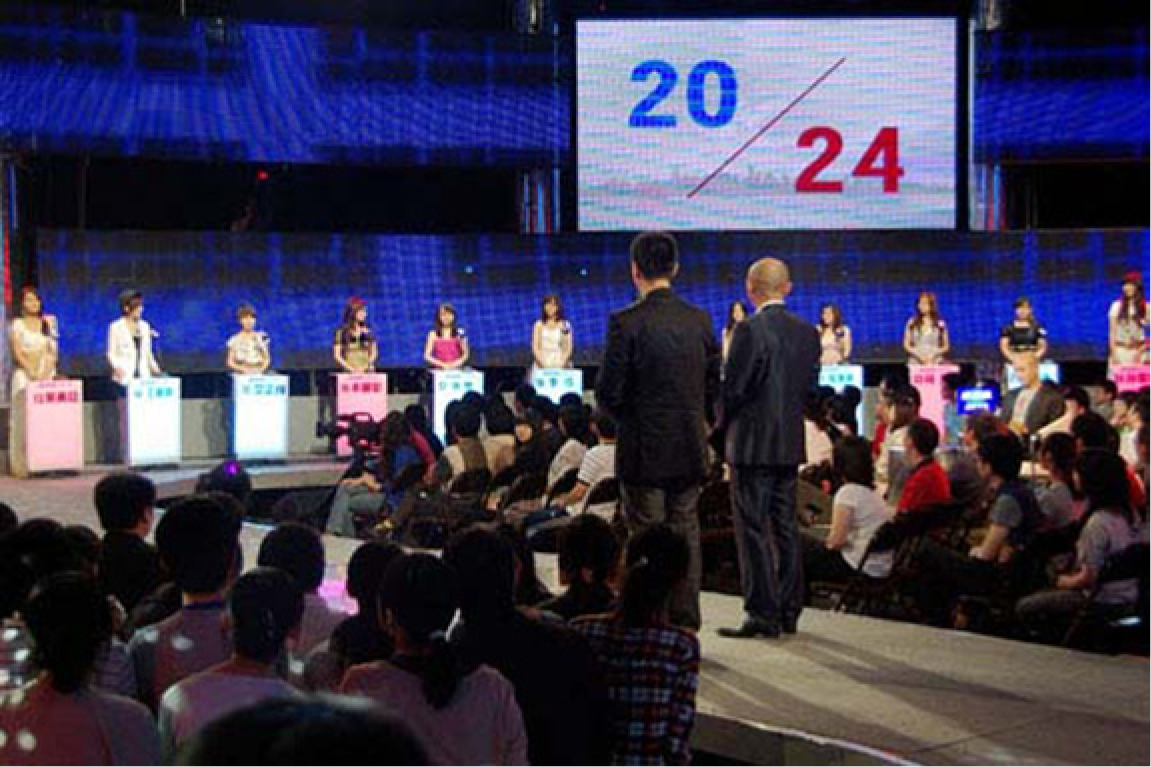
The male host and bachelor stand in the center of the stage, facing female contestants standing on the edge.
While the harem is patriarchal in nature, some accounts have seen it as a privileged site of female interaction and lesbian sexuality (Shohat and Stam, 1994). The visible male presence in IYATO disrupts the potential queer fantasy. Interestingly, some audiences have projected this queer imagination of the harem onto Meng and Le. For instance, one college student I interviewed said: ‘Meng and Le are such good partners. When I discuss the show with my roommates, we all want them to be together!’ This light ‘queering’ of a heteronormative space is presumably a commercial stunt. However, some audiences have indeed found it pleasurable.
Within this harem-like structure, women are being looked at in multiple ways. First, women are gazed by the bachelor in the show. As part of the rules, the bachelor can choose one woman he would like to date most at the very beginning. To do so, he performs an authentic male gaze by looking at all 24 women one by one. Someone might argue that a gender reversal is created at the ‘manly’ moment when the bachelor shows up, in which men becomes the sexual object to be looked at. However, Gill (2007) reminds us that each instance of gazes operates in the context of our collective knowledge about the politics of looking. In a culture where women have been historically subjected to constant scrutiny, no single instance of women looking at men could constitute a kind of reversal in gender relations and nor could this isolated instance possess the authentic quality of examples of men looking at women. In fact, as the bachelor steps out of the lift, the gender relation is quickly restored. Second is the voyeuristic gaze performed by viewers behind the panopticon-like camera (Mulvey, 1988 [1975]). As cameras tend to be heavy, the people who operate them in the media industry are usually males. IYATO is no exception (Zhang, 2011). A panoramic mobile male gaze happens when all women walk onto the set of the show. This gaze also embodies the overarching look of the absent producer. The third gaze is performed by the audience. Gendered viewing relations are not fixed and viewers often take ‘wrong’ gender positions in their viewing experience (Sturken and Cartwright, 2001). For instance, female viewers can identify with the male position in viewing and thus gain male pleasure, or they can consume the male images on display, in this case, the bachelor. Both female and male contestants were heatedly discussed online. However, women were more likely to be subjected to audiences’ scrutiny. Audiences heatedly discussed which woman was more feminine and more beautiful in the online forum I studied. This confirms the traditional formula of gaze and points to a patriarchal unconscious.
In contrast to the pleasure in looking is the pleasure of being looked at. In a patriarchal environment, attractive appearance is usually the most important criterion by which women are assessed. In general, young, beautiful, and slim women are more welcomed by the bachelor throughout the show. It is not difficult to discern that women have tried hard to obtain power and seek men’s approval through the commodification of their appearance (Goldman, 1992). Unlike bachelors, who are usually in casual daily clothes, women in the show all dress up and use traditional signifiers of femininity such as make-up and accessories. There are many photos of the women before and after the makeover (see Figure 3). 5 This is a media spectacle of exaggerated female body curve, thick make-up, and flamboyant color. The commodification of appearance constitutes what Gill (2007) calls self-objectification resulting from an internalization of an external male gaze. That says sexual objectification is not something done to women by men but the freely ‘chosen’ wish of active and often assertive female subjects.
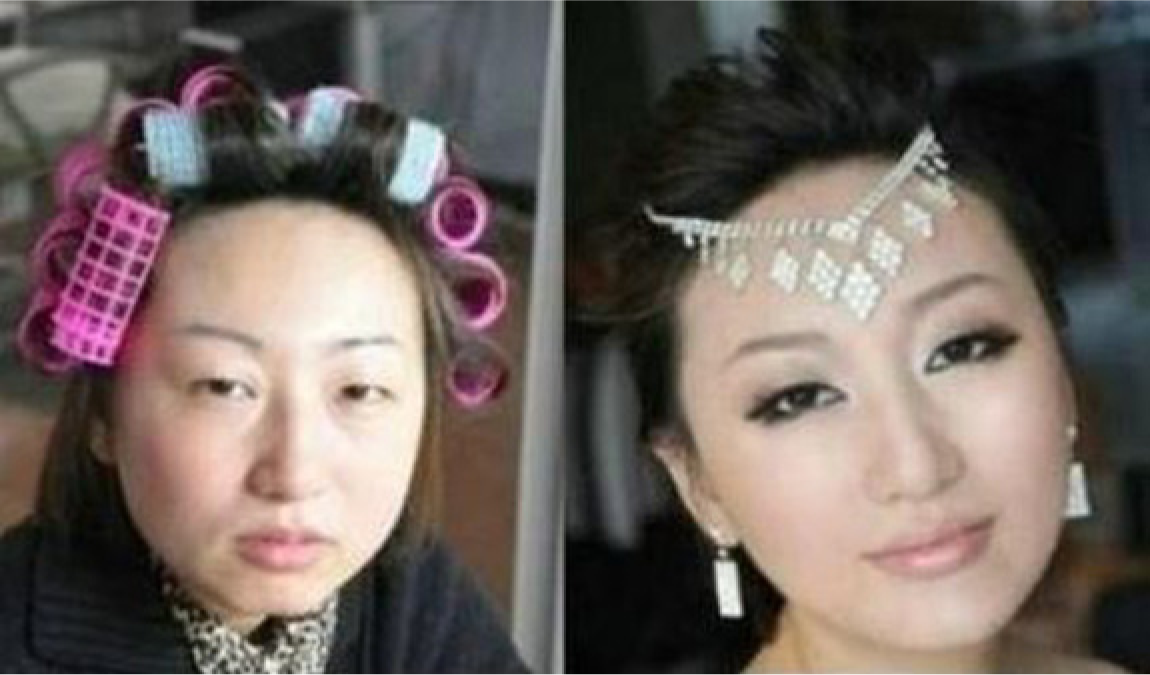
A female contestant before and after the makeover
The new woman?
The show is highly saturated with the middle-class imagination. Women attending the shows are all professionals, small business owners, and petty entrepreneurs. Representations of poor, rural, and minority women are hardly visible. The same goes for the bachelor. While this small group of women may be represented as having benefited from the country’s economic liberalization, further scrutiny reveals that women’s economic independence is an illusion. Most women expect the bachelor to have economic capacities to well afford marriage and family. For instance, the episode on 17 January 2010 features a financially insecure bachelor, Chen Zhao (henceforth Zhao). Being a former fashion magazine designer, he earned about CNY 3000 (USD 500) per month. Zhao quit his job and had been adjusting his life for two months when he went for the show. In that episode, after the first video is shown, a provocative conversation ensues among Zhao, the host Meng, and two women:
Can I say you are jobless now?
Right, I don’t have a job now.
[One woman immediately turns her light off.]
Well, only four lights remain. In our previous episodes, men with annual salaries of over CNY 100,000 were turned down. You dare to come with no job?
This is not an issue, I think.
I think this is an issue. Ying Wang [turns to one of the women], tell him if this is an issue.
I am not saying that you must have a job, but as a man you should have the ability to afford the family in the future. So I am not sure how long he needs to adjust himself. If it is already two months, I think it is a little bit long.
I am now, eh, more like a freelancer. I have no job now, but in fact, I am a freelancer.
Ok, so I think, you know, some westerners also don’t have to work everyday. They might work for several months and earn what can cover their expenses for the whole year. They can use the rest of the time to travel. Isn’t it romantic?
Right, right.
Yuting Wang [turns to another woman], do you accept this lifestyle?
It costs much to travel. If he only earns CNY 3000 per month, as a man, it is too little.
CNY 3000 is just my fixed income.
But it is unstable.
In the conversation, the phrase ‘as a man’ is mentioned twice by the two women. It conjures up an essentialized gender difference and bestows men with more important social expectations and roles both in and outside home. This expectation sometimes develops into money worship. For instance, later, when Zhao asks female contestants ‘Would you like to go for a bike ride with me in the future?’ One contestant named Nuo Ma (henceforth Ma) answers back: ‘I’d rather weep in a BMW.’ Ma might be an extreme case. However, in general, women still expect to seek material support from men. This resonates with the deep-seated conservative notion running through the society that men should support the family, and consolidates the traditional gender division of labor.
Although nowadays the two-earner family is typical in urban China, family wages are still androcentric. In contrast to women’s expectation of an economically capable boyfriend/husband, bachelors care less about women’s jobs and incomes. Instead, they focus more on personality and appearance. According to Wang and Rong’s (2011) content analysis of 344 bachelors’ standards for choosing spouses in 89 episodes in 2010, 53.2% of men have specific requirements of women’s personality and nearly 30% of men have concrete descriptions of the facial and bodily features of their dream women. As for the terms men use in describing their ideal spouses, the most frequent ones are: gentle, considerate, and filial. Only 3.2% of men care about women’s economic capability. Unlike contemporary western femininity that is constructed as a set of bodily characteristics (Gill, 2007), in the Chinese context, the desired femininity is more of a combination of both bodily and non-bodily characteristics such as demureness and family cares.
If the reorganization of economic life is crucial in gender politics, the male-dominated mode of production apparently shatters a feminist imaginary inferred from the ostensibly assertive performance of women. So the irony of the shows lies in that, on the one hand, women appear to be overcritical of bachelors, creating an impression that men have been overpowered by women while, on the other hand, women ask for an economic reliance on men. No wonder one audience member said to me: ‘Chinese feminism is pseudo-feminism; its nature is to reap without sowing.’
Conclusion
Through the analysis, I conclude that women are essentialized, represented as subordinates and dependents who need material support from men, and encouraged to become sexual subjects by internalizing the male gaze. The kind of gender ideologies read off the show are grounded in the social practices and relations of gender revolving around the ‘leftover women’ phenomenon, and also contribute to constitute the deep social structure which systematically favors men in many aspects, including marriage and relationship.
Besides, gender representations in IYATO also need to be understood within the context of an increasingly conservative Chinese media, which is ardently performing its capitalist turn amidst market reform. The Chinese media and culture industry, including the television industry, has been increasingly commercialized. This trend results partly from China’s media reform, in which the authorities have terminated subsidies for stated-owned cultural institutions, thereby forcing them to speed up the pace of commercialization for financial self-reliance. Along with this are the exploding entertainment industry and the booming urban consumer culture. In this context, first, female celebrities and hosts are treated as sex objects to be consumed. There are numerous news items and rumors about female celebrities being mistresses of political officials or sleeping with directors to get a part in movies or television dramas. The practice of consuming women is normalized both in officialdom and the entertainment industries. Social discourses tend to blame women for self-abandonment instead of a system that allows for such exploitation. Second, women become visual signs or tools out of which the entire media, advertising, and entertainment industries make profits. On the one hand, women are explicitly sexualized in mass media to raise ratings, as seen in IYATO. On the other hand, women are entrapped into commercial intrigues by mass media. In the case of IYATO, some people romanticize women’s harsh interrogations of bachelors as a sign of gender reversal, as mentioned earlier. However, this seemingly politically correct empowerment of women actually functions as a commercial strategy by the media to win attention in a society congested with patriarchal discourses and practices. This was proved by Ma when she said in an interview with New York Times that the producer asked women not to spare the dignity of the bachelor (Wong, 2011). The show made CNY 2 billion in advertising revenue in 2011, becoming the most profitable entertainment show in China (‘The advertising revenue of IYATO …’, 2011). This proves that women are the biggest selling point of the show. To reiterate, images of women in the show appear to be progressive, but they are conservative in nature. The worst thing about women’s ostensible aggressiveness and domination as constructed in the show is that it hypes up postfeminist sentiments in a society that argues that feminism has arrived or even that feminism is no longer needed in China. This creates a very unfavorable discursive environment for the feminist project to be practiced in China.
The dual process of commodification of women in the increasingly commercialized media industry operates without difficulties in a patriarchal society. In fact, the two work in a mutually reinforcing way. Female bodies simultaneously endure male gaze and labor for the commercial interests of the television station. This produces women’s subordination to the collusion between commercialism and patriarchy.
Last, we need to think about the role of the state in the case of IYATO and beyond. The tremendous commercial success of IYATO means that it embodies the market logic and aligns with the state capitalist ideology centering on economic development. However, on the other hand, the party-state’s obsession with socialist legacies continues to drive government control of television. When women’s economic demands from men occasionally develop into overtly materialistic pursuits, as seen in the case of Ma, this counters the efforts of the state to uphold socialist morality through media, including entertainment media, and incurs state intervention. The materialist women implicitly play the role of rebels, who need to be policed in the eyes of the censor. In June 2010, the State Administration of Radio, Film, and Television (SARFT) issued two documents to regulate the show. The show was forbidden to hype up unhealthy and incorrect opinions on marriage and relationships such as materialism (‘SARFT regulates dating shows’, 2010). Apparently, the regulation was not motivated to sincerely regulate problematic gender representations for the sake of women. Rather, it aimed to contain Chinese women so as to maintain political and social stability. So here is a double manipulation of women in media by forces of both the market and the state. Facing a state–market complex, feminism has a long way to go in China.
Footnotes
Funding
This research received no specific grant from any funding agency in the public, commercial, or not-for-profit sectors.