



Abstract
The earthquake and tsunami which occurred in the Tohoku region of Japan (northern Japan) on 11 March 2011 have taken the lives of more than 15,000 people. The disaster and the accident in the nuclear reactors in Fukushima have left about 330,000 people homeless. The catastrophe has affected not only Japanese politics, economics, society and people’s mentalities, but also its cultural industries. This article attempts to investigate two contemporary issues tracing the effects of the Great East Japan Earthquake (the Tohoku Disaster) on Japan’s media landscape: its impact on Japanese media production and distribution, particularly of its most transnationally famous forms, manga and anime; and how perceptions of ‘soft power’ have fluctuated in this difficult media moment. The research uses a cultural and industrial studies approach based on discourse analysis, focusing on the period immediately following the Tohoku Disaster in order to map significant shifts and unexpected results and responses from within Japan’s cultural industries to the earthquake, tsunami and Fukushima power plant disasters.
On 11 March 2011, the most powerful earthquake on record in Japan, with a magnitude of 9.0, triggered a massive tsunami affecting the Tohoku region. The tsunami reached up to 10 km inland, causing a meltdown of the Fukushima nuclear reactors. This unprecedented catastrophe saw a surging death toll reach 15,885 and 2,623 people were still the missing as of April 2014 (National Policy Agency, 2014). As rescue teams continue to search along the coast in the three most devastated prefectures of Iwate, Miyagi and Fukushima, it has been reported that 267,419 people are still unable to return home, and are living as evacuees, as of 13 February 2014 (Tasukeai Japan, 2014). As these sources indicate, and as other academic studies have begun to show in relation to news media (Abel, 2011; Rausch, 2012), Japan’s media industries played important roles in how people coped, communicated and made sense of the deeply affecting and tragic events in the north-east of Japan’s main island.
This article expands on existing research, to show how Japan’s popular media industries responded to the 11 March disasters, using approaches from cultural and industrial studies based on discourse analysis (following Hesmondhalgh, 2007; Wasko, 2005). The discourses analysed are mixed, combining data from personal interviews with a wide variety of news and other popular media discourse sources collated in the weeks and months following the devastation. An historical reception studies method is used to analyse these disparate datasets, in order to ‘illuminate the cultural meanings of texts in specific times and social circumstances to specific viewers’ (Staiger, 1993: 161). The aim is to trace identifiable impacts of the disasters on Japan’s media infrastructure and creative output. In doing so, the article takes four clusters of responses as its focal nodes: first, the immediate impact of the disasters on an ongoing argument between the manga industry and government; second, the infrastructural difficulties which the Japanese media industry had to face, and the solutions that were enacted by producers; third, the power manga and anime had to inculcate a sense of normalcy for people in the devastated areas; and, fourth, the function of Japanese media production to give a voice to those who were suffering.
This is important because the place of Japan’s media industries was called into question during and after the triple disaster of 3.11. The Japanese author Kikuchi Kan said, for example, that ‘in a catastrophe which is a matter of life and death, art work is just a luxury’ (quoted in Yaguchi, 2011). 1 As this example shows, the status of art and popular media were thrown into question by creators and commentators when the disasters struck. That is why this article seeks to unpack the Japanese media responses in the aftermath of disaster, examining how popular art forms functioned in relation to a rapidly shifting set of cultural debates and serious social issues.
The impact of the disasters on Japan’s popular media was instantly palpable. In the month after the disaster, the sales of one major publisher dropped 15% in the Tohoku area and across the 23 wards of Tokyo alone (Holmberg, 2011). While perhaps unsurprising, given the difficulty of distribution in the regions, this figure demonstrates the need to consider the impact of regional losses on a set of domestically focused media industries. Further, this domestic orientation is marked by high levels of industrial collaboration. For example, the Japanese manga market is worth about 400 b yen (approx. £3.4 b), and equates to not much less than a quarter of all publishing in Japan. However, because manga’s intertextual reach extends to multi-media intellectual property business (‘contents business’ in Japanese), including films, anime, video games and more, the scale of the ‘manga’ market is actually closer to 3000 b yen (approx. £25 b; Holmberg, 2011). The integration of Japan’s domestic media industries necessitates scrutiny of the broader kinds of impact that the 3.11 earthquake, tsunami and meltdown had on the production and distribution of popular media franchises. The integration of the media industries, along with their local focus, means that disruption to Japan had the potential to bring about a further cultural tsunami within transnational Japanese media distribution.
‘The earthquake happened … [I thought] they deserved it’: disaster and ongoing conflict between Japan’s media industries and Tokyo’s metropolitan government
Following the triple disaster on 11 March 2011, immediate impacts were seen in the media industries. First, a range of manga and anime events were cancelled or postponed due to the disaster (Japanimate, 2011; Hatena Book Mark News, 2011), including one of the biggest anime events in the world, the Tokyo International Anime Fair 2011 (24–7 March 2011, normally held at Tokyo Big Sight) and a breakaway anime fair called the Anime Contents Expo (26–7 March 2011, Makuhari Messe). These cancellations were a blow not just to the domestic markets for manga and anime but also for the international distribution of Japanese media, because these events act as marketplaces for international distribution deals. However, in 2011 these cancellations also intervened in an ongoing dispute between Japan’s media producers and the local government in Tokyo.
The Anime Contents Expo was due to be a new event, set up by manga and anime-related publishers in opposition to the reform of the Tokyo Metropolitan Ordinance Regarding the Healthy Development of Youths (Tōkyō-to Seishōnen no Kenzen na Ikusei ni Kansuru Jōrei) (Anime News Network, 2011). The reformed law was intended to newly regulate the way manga and anime are sold in Tokyo, removing ‘obscene’ publications from spaces like convenience stores, which are heavily used by children. The revisions were shepherded through by the former Governor of Tokyo, Shintarō Ishihara (2011), 2 and were objected to by the Comic Jusshakai (which literally means the Association of 10 Comic Publishing Companies) on the grounds that it restricts the freedom and creativity of manga production and distribution. 3 The Comic Jusshakai involved some of the most powerful manga producers, including the well-known multi-media industry leader Kadokawa Shoten Publishing, as well as major manga publishers like Shūeisha and Shōgakukan. The chain of correspondence between the governor and these publishers after the disaster reveals a serious conflict between the industry and the authorities.
When the Comic Jusshakai decided to cancel the Anime Contents Expo it was over concerns about participants’ safety due to ground liquefaction in the Makuhari area,
4
where the Makuhari Messe convention centre is situated, as well as planned power outages and confusion over transportation. Ishihara’s reaction aroused much controversy. He said:
I wasn’t sure what the major publishers were being paranoid about…. There was the Anime Fair … but, they said, ‘We will not go and will hold [another anime event] at Makuhari.’ Then, the earthquake happened. Both were cancelled. [I thought] they deserved it. (Anime News Network, 2011)
Ishihara’s well-known political conservatism goes some way to explaining these comments, but the schism between media companies and local government was exacerbated by his response to the disaster.
The Anime Contents Expo eventually ran in 2012, and was designed by the Comic Jusshakai to compete with the Tokyo International Anime Fair; it was held just outside Tokyo at the same time as the Tokyo International Anime Fair as a demonstration of the power of the media industries in local culture. In 2012, none of the Comic Jusshakai were represented at the Tokyo International Anime Fair (Tokyo International Anime Fair, 2013), and 2013 saw a further decline in the size and significance of what once was the world’s premiere anime trade fair. The year 2014 marked the cessation of hostilities and the amalgamation of the two events into the newly formed AnimeJapan event, which made heavy use of the catchphrase, ‘Here is everything in anime!’ (AnimeJapan, 2014). This cheerful reunification of the industry, however, masks the continuing split between government and industry, as the Asahi Newspaper reports: ‘The organizers agreed to integrate the two events after the metropolitan government dropped out of the operation’ (Ohara, 2014). In this respect, the 3.11 disasters polarized extant debates, compounding an industry–government schism that has led to the rebranding of an event that had previously been the jewel in Tokyo’s manga and anime culture crown.
For the lack of paper: industrial responses to shortages in the aftermath of the 3.11 disasters
In addition to problems of politics and events, Japan’s publishing industries also immediately suffered from shortages of paper, ink, transportation fuel and confusion around distribution routes following the 3.11 disasters. According to Nihon Seishi Rengōkai (the Japan Paper Association), the factories of Nippon Paper Industries Co. Ltd at Ishinomaki and Iwanuma, and the Hachinohe factory belonging to Mitsubishi Paper Mills Ltd, which produce about 20% of paper for publication and flyers in Japan, were all struck by the catastrophe. For example, the second largest paper company in Japan and the tenth largest in the world, Nippon Paper Industries Co. Ltd, announced that they calculated a special loss of 63 b yen for the first quarter of 2011 (Asahi Newspaper, 12 May 2011).
Although Japanese paper companies tried to maintain paper supplies by increasing paper imports, it was reported at the time that, ‘we can manage one of two months, but there is no prospect [of paper] after that’ (public relations department of Mitsubishi Paper Mills Ltd, in Takashige, 2011a: 11). As a result, storehouses in the Tokyo area did not have adequate stores of paper (see Figure 1). In this circumstance, Shūeisha (one of Japan’s largest publishing houses) postponed the release of eight manga volumes including Naruto and Kochira Katsushika-ku Kameari Kōen Mae Hashutsujo (This is the Police Station in Front of Kameari Park in Katsushika Ward) from 4 April to 21 April. For a lack of paper, Japan’s media industries struggled to maintain normal production in the wake of the 3.11 disasters.
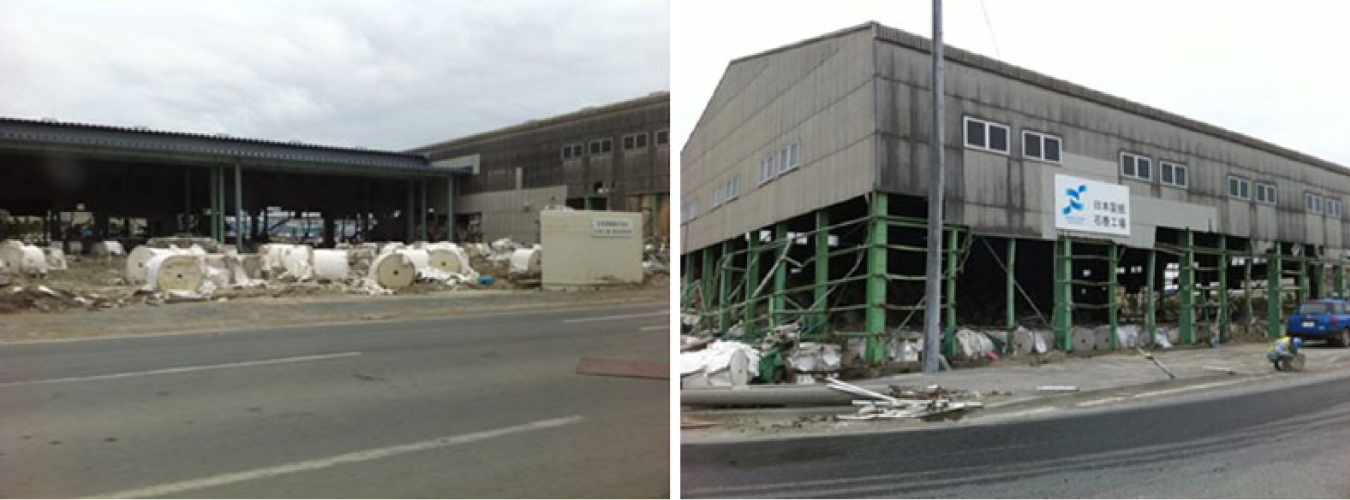
The Ishinomaki factory of Nippon Paper, taken on 6 May 2011. Paper rolls weighing some tons each are littered like toilet rolls. The trains and railways used for paper distribution were also destroyed.
Seemingly as a consequence of these shortages, an important publishing shift took place, as manga magazines started to be released through online distribution. Shūeisha began with two issues of Shōnen Jump, a weekly compendium of serialized popular anime titles, which were supposed to be published in March. Shūeisha distributed Shōnen Jump volume 15 (14 March issue) through the web page Yahoo! Comic for free and had nearly a million hits on the first day. Twenty-one manga, including Naruto, One Piece and Gintama, were then made available through this website until 27 April. These were emergency measures meant to offset delays in delivery to the disaster-stricken areas. Kōdansha’s comic magazines Shōnen Magazine, Young Magazine, Morning and Shōgakukan’s Shōnen Sunday followed suit.
Shūeisha’s editorial staff said, ‘we hope to convey the manga artists’ messages to as many people as possible’ (Internet Watch, 2011). However, there were criticisms that readers in the devastated areas were not benefitting from the free online distribution (Holmberg, 2011). In the devastated areas, hundreds of thousands lost their homes. Without homes, schools or public places, and without infrastructure such as electricity, telephone lines or mobile signals, internet access on computers or mobiles was severely reduced. Consequently, most of the beneficiaries were in areas that were not severely afflicted.
In contrast, and in a related case of online publishing, the free online distribution of Katei no Igaku (Home Medical Science) had direct tangible benefits for the victims of the disaster (Takashige, 2011b: 31). The medical book (5775 yen, or approximately £47) was made available online from the day after the disasters, and was downloaded a million times in the following 13 days. Users made comments like: ‘I am a resident of Ibaraki prefecture [one of the affected prefectures] and many neighbours around here are elderly. The book was useful at the evacuation site’, and, ‘I want to donate money equivalent to the book price for the relief [efforts]’ (Takashige, 2011b: 31). Therefore, while manga distribution online seems to have been intended to maintain the visibility of titles in the face of paper shortages, there were less commercially oriented outcomes of online distribution, not least the kinds of charitable donations and the downloading of free books for practical and specialized purposes outlined above. While the disruptions to production and distribution in publishing may have been relatively short-lived, then, their impact was significant and contains lessons for the industry around the potential for future online publication strategies.
From the healing power of texts to the power-saving movement: Hayao Miyazaki, One Piece and Neon Genesis Evangelion
The disaster also saw the promotion and uses of media changing in a ripple-effect that spread through audio-visual Japanese media production. This section charts examples of texts used for ‘healing’ (iyasu) purposes, and those which might be equated with the iyashi-kei, or ‘healing-type,’ boom that first emerged in the 1990s. Marc Hairston has defined these texts as ‘anything (an artwork, a piece of music, a person, even a scenic view) that creates a sense of peace and spiritual satisfaction’ (2008: 257). As this section demonstrates, notions of ‘healing’ after the 3.11 disasters became closely enmeshed with consumption and industrial production cultures.
In one significant example, the 3.11 disasters coincided with the production of Studio Ghibli’s latest film, From Up On Poppy Hill (Kokuriko-zaka Kara, Goro Miyazaki, released on 16 July 2011 in Japan). As one of Japan’s best-known directors, whose films often feature environmental themes, the studio’s leading figure, Hayao Miyazaki became an important voice in the aftermath of the disaster. Hayao Miyazaki’s comments about his appreciation for the people who had worked towards relief efforts were reported across a range of media outlets, as were his fears for those left homeless by the disaster, and for the loss of a part of Japan to the nuclear meltdown at the Fukushima power plants (Yomiuri online, 2011). For example, Miyazaki stated, ‘Now isn’t the time to make hasty judgments and talk about a theory of civilization self-importantly. I appreciate and am proud of those who have been working in the power plants for us’ (Shimamura and Mibu, 2011). However, within Studio Ghibli, the approach to the production of From Up On Poppy Hill was more pragmatic. Night shifts for computer-related work were put in place to make more efficient use of electricity, so that production would be less affected by the planned blackouts. Consequently, Miyazaki’s empathetic statements need to be understood in relation to Japan’s highly commercialized and profit-oriented anime industry.
In the promotion for From Up On Poppy Hill, Hayao Miyazaki’s two personae (artist and business owner) commingled, his undiminished work ethic combining with displays of his personal response to the traumatic events. During the press conference about the release of From Up On Poppy Hill’s theme song, Miyazaki was filmed shedding tears about the plight of those in the Tohoku region. Miyazaki also claimed that the reason that he told his staff members not to stop production was to make them empathize with the disaster victims (Yomiuri online, 2011; Sada, 2011). In these deft manoeuvres, Miyazaki was able to appeal to a sense of shared national suffering by creating narrative links between the difficulties the disaster caused at his own company, and his own appreciation of the plight of those in the Tohoku area.
Studio Ghibli also demonstrated their business-oriented empathy by screening previews of From Up On Poppy Hill to people in the earthquake and tsunami-hit areas. Elementary school and junior high school students and their parents were invited to Hamanasu Hall in Kesennuma city of Miyagi prefecture on 2 July. The capacity of the hall is 450 people and the preview screening was held twice to respond the desires of local people to see the new Studio Ghibli film. There was a further preview at the Takata elementary school in Rikuzentakata city in Iwate prefecture on 3 July for the students and their parents. Peace Winds Japan (a non-government organization, NGO) worked with Studio Ghibli, and set up an improvised cinema with a big screen and audio system in the Takata school’s gymnasium. In making quick connections with locally focused NGOs, Japanese media companies like Studio Ghibli were able to be responsive to the national mood, and to raise awareness and sympathy for those affected.
Participants were uniformly grateful, generating high levels of good publicity for the studio. For example, participants reported that, ‘it was like a dream that we were able to watch Ghibli’s film before its release’; and also more broadly that, despite being in the disaster area, ‘it was really enjoyable’ (Peace Winds Japan 2011). Additionally, Ue wo Muite Arukō (I Shall Walk Looking Up), used as the theme song of From Up On Poppy Hill, also seems to have chimed with the Tohoku audience members, with one reportedly saying, ‘I was looking down after my town was devastated, but I should look up’ (Peace Winds Japan, 2011). Through such responses to Studio Ghibli’s screenings, the impact of Japan’s media industries in the immediate aftermath of the earthquake, tsunami and nuclear disaster had significance for beginning a discussion about the process of psychological healing for local communities.
Capitalizing on the positive promotion at the previews, Hayao Miyazaki and Studio Ghibli producer Toshio Suzuki went to the preview to greet the audience and give them their autographs (Peace Winds Japan, 2011). Miyazaki commented on From Up On Poppy Hill, ‘I think that the main female character’s wish and the male character’s courage in a difficult situation are needed in our time. I hope that this film encourages people in any way [it can]’ (Yomiuri online, 2011). This anecdote shows both the power of the anime industry and the deeply felt impact that their post-disaster activities had. While Miyazaki’s statements during this time appear sincere and heartfelt, Studio Ghibli once again benefited from its position as one of Japan’s most powerful film producers by keying in to public sentiment during the months following the 3.11 disasters. The studio has a long history of using mildly nationalist sentiments in its advertising campaigns (Studio Ghibli, 2002: 66–8), so the reciprocal benefits involved in promoting From Up on Poppy Hill in the Tohoku region compounded their normal practices, rather than indicating a departure.
Nor were Studio Ghibli alone in their attempts to engage with relief efforts in the months following the disaster. At a bookstore in Sendai city, one of the most afflicted areas, a copy of Shōnen Jump was passed around until it fell apart. The bookstore Shiokawashōten Itsutsubashiten opened on 14 March, three days after the disaster, although other bookstores remained closed. Cut off from distribution, the owner Yūichi Shiokawa was only able to sell his existing stock. Every time customers asked him for new magazines, he kept apologizing for he had none. He recounted how, once, a child even burst into tears when he knew that he could not buy CoroCoro Comic (Takatsu, 2011: 11). This example illustrates how the search for normality in the face of disaster appears to have been centred on people’s ability to resume normal consumerist behaviours (for more on consumerism in Japan, see Tobin, 1992). Thus, the desire to purchase, to own and to consume became a source of potential further trauma in disaster-struck local communities.
The most requested manga, according to Shiokawa, was Shōnen Jump, which contains the popular serial One Piece. An enthusiastic fan drove all the way to the next prefecture, Yamagata, to buy a copy and donated the copy to Shiokawa’s store after reading it. Shiokawa even posted a sign saying, ‘Read Shōnen Jump 19 March issue, no.16!! One copy available here’. Subsequently, more than 100 readers visited to read the only copy; sometimes waiting in a queue, or cycling from over 10 km away. According to Shiokawa, ‘more parents buy children books or picture books now to prevent their children from watching wretched images on TV. Our urgent needs are clothes, food and housing, but the role of books is important’ (Takatsu, 2011: 11). The side effect of the traumatic events, namely the desire of parents to shield their children from the devastation around them, demonstrates how important Japan’s print and audio-visual media industries became, on a local level, in the wake of the disaster.
In another example of unplanned disaster-relief synergy, a collection of the sayings by the characters of One Piece, titled One Piece, Strong Words, Part 1, was published on 9 March 2011, and reprinted twice, selling 330,000 copies the first month (Sasaki, 2011). Based around a group of comi-dramatic pirate characters, One Piece is predominantly an action-genre series, so this non-narrative release was particularly notable and unusual within the franchise’s history. The book offers encouraging phrases quoted directly from the manga; for example, ‘If I don’t fight side by side with these guys with all my strength, I have no right to ride the same ship as them!!! I have no right to laugh with them!!!’; and, ‘May your ship never get lost at sea!!! May you never lose your way to this island even in a storm!!! I will wait for you until the bell tolls!!! May we meet again!!! My friend!!!’ (Holmberg, 2011). Behind the bombast of many of its sayings, the book is collection of phrases that emphasise the need for group solidarity in periods of strife, unexpectedly connecting it with the disaster-relief efforts and public sentiments in the immediate aftermath of the 3.11 disasters.
Like Studio Ghibli shifting their working hours, manga and anime also functioned as a practical force for the energy-saving movement following the disaster. The energy-saving movement came about due to the accident in the nuclear reactors in Fukushima and was promoted through anime. The movement was called Yashima Sakusen (‘Operation Yashima’) and was named after the operation to gather electricity for battles in the anime series Neon Genesis Evangelion (1995–6). This movement was spread via Twitter and mixi (a Japanese social networking system). The name indicates the power of anime concepts to inspire real-world change. The anime-derived name for this movement is claimed to have been an attempt to help the public understand the energy-saving movement’s aims, thereby making it more acceptable (Kasai, 2011: 60; Okuno, 2011: 13).
This is a particularly significant choice of text, because Neon Genesis Evangelion has associations with previous periods of strife in Japan (Malone, 2007). People were being appealed to through reference to this 15-year-old anime series, which was originally broadcast after another set of disasters in Japan: the Great Hanshin Earthquake (January 1995) and the sarin gas attack on the Tokyo subway (March 1995). Therefore Neon Genesis Evangelion provided an echo of tragedies overcome in the past, and was used to inspire new attempts to overcome disaster. It offers evidence not only of the Japanese people’s love for anime, but also that anime was seen by the campaigners as both an inspiration and a comfort, as something so fundamental to Japanese culture that it could be used to motivate people in a time of shock and disaster. This, despite the often elegiac, if not dystopian tone of the anime itself (Napier, 2005: 29). In these ways, then, anime and manga texts became entangled with the events that followed the 3.11 disasters, demonstrating the complexity of their textual resonances, and also the deeply ingrained nature of consumption patterns within contemporary Japanese culture. That manga and anime were used to inspire, relieve and uplift the population following the disaster is a testament to their centrality within Japanese culture.
Disaster and media production: from Naruto to a Venice Golden Lion-winning film
Despite Hayao Miyazaki’s claims to the contrary, the disaster had a range of impacts across the content and distribution of Japanese media texts. Immediately after the calamity, all of Japan’s TV stations broadcast only news related to the disaster all the time. There were no programmes for children and harrowing images in the news are reported to have badly affected children (Azuma, 2011). TV Tokyo was the only station which broadcast anime series for children on the day following the disaster. While there was disagreement about the strategy of broadcasting anime series in such a sobering situation, viewers reportedly said that, ‘it was good that your station did that because my children were kept away from traumatic images’ (personal interview: Azuma, 2011). As implied in the bookstore owner Shiokawa’s comments, harrowing images appeared on TV for some months after the disaster and parents worried about the influence on their children.
However, even TV Tokyo’s alternative broadcasting strategy was significantly different from its normal scheduling and appearance in places. Right after the earthquake and tsunami, TV anime producers at TV Tokyo cut ‘scenes of drowning, tsunami or death, including scenes in which a huge robot destroys the ground, and so on’ (Azuma, 2011). Even high-ranking producers such as Fukashi Azuma were affected during and after the events in Tohoku. He claims to not have had a single day off between the disasters and the end of May, and to have cut scenes from anime, modified sections of scenes featuring materials deemed to be sensitive, and to have changed the anime line-up for his station, which is the only Japanese company to have a specific channel devoted to anime (Azuma, 2011). Modifications were also made to several TV Tokyo anime films – for example, some of the scenes in Naruto’s latest film spin-off, Naruto Shippūden 5: Blood Prison (released on 30 July 2011), were altered (Azuma, 2011).
The disasters’ impact spread not only to anime series, but also to manga production. One of the main publication responses to the 3.11 disasters was Kotobuki Shiriagari’s Anohi kara no Manga (Manga from That Day, published by Enter Brain). Some of the manga from this anthology were first published in the national newspaper Asahi Newspaper, and other short manga stories appeared in the May issue of Comic Beam (12 April). According to manga critic Nobuyuki Minami, Shiriagari’s Anohikara no Manga is the best of the 3.11 Disaster manga:
In his four-frame comics, he draws his real feelings and the serious situation in the affected areas, based on his voluntary work there, and he still keeps a sense of humour. Other story manga [about the disaster] describe a world with hope and despair as an allegory, and they make the readers think about the issues. (Minami, 2011)
Keeping a sense of humour in a serious narrative is the most recognisable characteristic of Shiriagari’s work. The mixture of humour and seriousness in his manga somewhat mitigated the impact of the disaster for the manga’s readers. Shiriagari started drawing stories about the disaster in the four-frame manga Chikyu Boueika no Hitobito (People of the Earth Military Defence) just after the earthquake happened, which were published in Asahi Newspaper from 14 March 2011. Shiriagari explains the reason why he was urged to draw this manga: ‘Even if my idea is wrong, I thought I had to express it now’ (Shiriagari, 2011a). Shiriagari’s sense of immediacy and humorous approach to his serious subject matter demonstrate a survivor style of narrative often missing from the history of Japanese media production (Broderick, 1996: 16).
The four-frame comic strips depict Shiriagari’s experience of voluntary work in Iwate prefecture, and the shocking scenery was depicted without words:
I think I became unbound by pressure. I am timid and am not a volunteer type, but I hesitated to draw without seeing the actual sites. I thought, ‘Am I allowed to write anything really? What do the sufferers feel about my manga?’ But I had to draw. I had a hazy feeling and wondered what I should do. When I actually went there, what I saw with my eyes was not false even though the stay was only for a couple of days. There is one episode without any story but with rubble and rubbish, but it can’t be helped. No idea sprang to mind at all. That was the only idea came to me. (Shiriagari, 2011b)
Shiriagari’s shock and concern are represented through his participant view of the disaster, told through his own experiences of it. The concern to respond in genuine ways reveals how insiders and outsiders were created within Japan around these events. The legitimacy of representation, and the need for accuracy felt by Shiriagari, indicates the high levels of immediacy with which representations were being produced, but also that these representations were seen as far more contentious when produced by those who were not ‘survivors’ themselves.
The effect of pictorial expression, which is one of the advantages of manga, made Shirigari’s four-panel comic strips expressive. Indeed, critics picked up on the importance of both pictorial art forms and notions of legitimacy:
To face harrowing realities beyond our imagination, we need a certain filter. Anohi kara no Manga is proof that manga can function as a filter. The perspective to grasp the disaster as fiction opens up some windows and in such suffocating situations people describe manga with words such as ‘imprudent’ or ‘self-restrained’. You show a possibility for manga which is not just for entertainment. (Interviewer in Shiriagari, 2011b).
Anohi kara no Manga is assessed here as a showcase of the possibility of manga. It is commented upon as taking manga away from its perceived function as entertainment, into new realms more commonly associated with post-9/11 media works (Versluys, 2006).
Shiriagari has, therefore, been framed as one among a number of artists and authors searching for ways to engage with a newly traumatized Japanese society, in his case, through manga art. Again in the interview from Daily Czyo, Shiriagari says:
Although there are many fantastic aspects to manga, they don’t look real if they are not based on realities. I want to step into the real world. When 9/11 happened 10 years ago, there were few manga that dealt with it. Literature and music interlocks with society, but I feel that manga is a bit slow to work together. It’s a shame that manga is behind literature and music because manga has power.… So I believe that manga has to commit to society. (Shiriagari, 2011b)
Here, Shiriagari sets up a new hierarchy of values for manga art, positioning his own works above those that provide escapist pleasures to audiences. What is particularly interesting, however, is the time lag he refers to; the way he claims that manga have been slow to take up social causes and concepts in culture. This attempt to resituate manga art higher within a pantheon of different, fast-moving and responsive media texts demonstrates an anxiety around the status of the medium in post-disaster Japan.
While Shiriagari’s self-reflexive responses were among the most significant, there were also several nuclear-focused stories produced in the months following the disaster. For example, the short story Umibe no Mura (A Seaside Village) describes the world 50 years after the Tohoku Disaster, and Furueru Matchi (A Shaking Town) is about a pregnant woman who has lost her fiancé and is threatened by aftershocks and radiation. Kawakudari Futago no Oyaji (Going Down the River: The Middle-aged Male Twin) provides a manga about the Fukushima nuclear leak, in which nuclear power plants are personified as women, with one of them saying, ‘I know that I’m not a woman you can beat … it’s a hundred years early for human beings to tame me.’ In the same story, there are scenes wherein birds are tweeting things like, ‘I wonder if it’s already melted down’ in a similar manner to the way people Tweeted in the real world. These more serious works, many of which focused on the nuclear aspects of the disasters, contain clearer shadows of previous Japanese media texts relating to the bombings in Nagasaki and Hiroshima (Broderick, 1996: 3–17). What is remarkable and distinctive, however, is the way that contemporary technologies and a lack of trust in government run through many of these texts.
However, manga artists did not all take the same route as Shiriagari’s in attempting to connect with post-disaster Japanese society. Miso Suzuki’s Boku to Nihon ga Furueta Hi (The Day when Japan and I Shook, published by Tokuma Shoten) 5 is worthy of note because he agreed to start the manga on condition that all of the royalties be donated to the relief efforts. This reportage manga describes a ‘life-sized catastrophe’ (Holmberg, 2011). It covers, among other things, Miso’s experience of the disaster in Tokyo and the night his daughter spent being looked after by Disney Sea and Tokyo Disney Land’s customer service department when she was unable to return home. He also investigates Chiba prefecture, where the land subsidence has not yet been corrected and people have to live on in bad conditions, as well as investigating the hazardous effects of radiation at the High Energy Accelerator Research Organization in Tsukuba city (Ibaraki prefecture). Because Suzuki deals with topics such as publishers or paper companies as well as his family’s struggles and his own, he includes interviews with people there, and describes the impacts of the disaster on the production side of the manga industry. This is the distinguishing contribution of this manga among other manga about individuals’ sorrow and struggles.
A final development worth mentioning is the way manga about the disaster are quickly being adapted into live-action films. The Venice Golden Lion winner Himizu (Figure 2) was paid much attention for its ‘anguished portrait of a post-tsunami Japan’ (Ide, 2011), featuring real-life haunting images of Ishinomaki city in Miyagi prefecture. This film was directed by Sion Sono, but Himizu was adapted from Minoru Furuya’s manga of the same name. In this instance, the importance of manga as a source text was played down, however: ‘I had already written the script and was forced to change it. Whether to shoot footage of the area was something I struggled with because many there lost their lives and many have still not been found’ (Sono in Ide, 2011). Sono’s adaptation of this 2001–3 manga updated and changed it to incorporate the 3.11 disasters and to make the story develop a more hopeful ending, claiming he wanted to ‘dispatch a message to encourage us to have hope’ (Sono in Nakayama, 2011). Divorced from its multi-media roots, Himizu’s success as an art film represents the most successful international representation of the disaster to date, discounting the immediate press coverage that travelled the world.
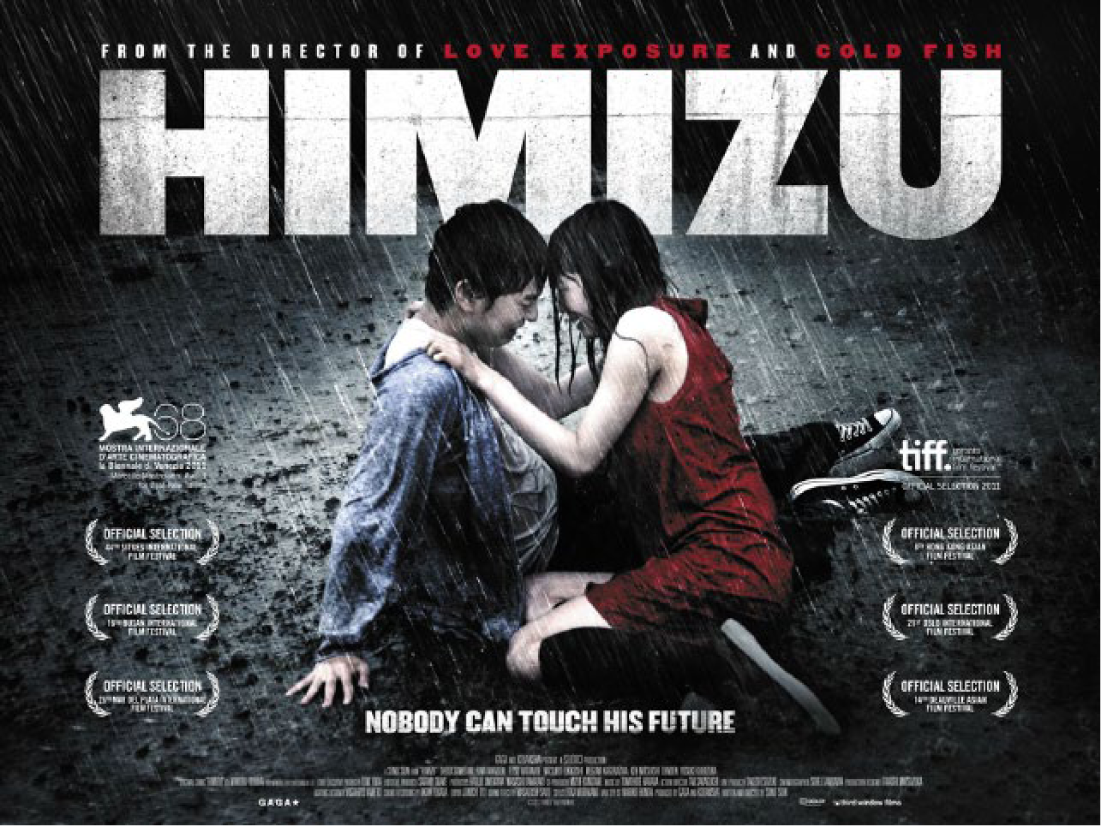
Himizu’s international poster, courtesy of Third Window Films
Himizu is about two 14-year-old school children, Sumida and Keiko, who have both experienced dystopian breakdowns of family, and it describes the never-ending collapse of normality. Symbolically, the abandoned boy Sumida (Shota Sometani) dreams only of becoming ‘ordinary’. Sion makes this point saying, ‘After March 11, Japan has to be considered unstable. I believe our days of normality have ended and we have entered [a stage] where “beyond the norm” appears to be never-ending’ (Sono in Ide, 2011). He claims that such thoughts caused him to rewrite the script and to film in a tsunami-devastated area. ‘It was supposed to be a light romance. When I began to rewrite the script, I was asked not to write an apocalyptic film but I couldn’t stop’ (Sono in Ide, 2011).
Himizu was shot in Ishinomaki in late May 2011. One of the crew members’ families in Ishinomaki helped with the shooting for some hours in among the debris of destroyed houses and washed-up cars. Sono said:
I had to be careful about filming. Many people said that it would better not to shoot there. But I thought drama makers should not refrain from shooting when documentary makers do it there.… I struggled, but I thought I would regret it my whole life if I didn’t go there that time. (Sono in Nakayama, 2011)
Sono’s attempt accords with Shiriagari’s urgent desire to see the actual sites. Both artists seek to give people in the afflicted areas a voice and to help them gain attention from people who are far away from them. Himizu therefore simultaneously functions as a mediator between those who have been suffering from the calamity and the audience who have not experienced it, as well as showing reality through a filter of fiction.
In this sense, Himizu’s transnational function is notable. Many of the foreign press at the Venice International Film Festival saw Himizu as the first film work to deal directly with the disaster after the 2011 earthquake and tsunami, and there were many questions about the shift of consciousness after the disaster. Sono explains his reason for making a film in the face of this devastating reality:
The intention of the manga written 10 years ago is to describe the boredom and emptiness of the ordinary that young people share, but after the disaster, ‘endless out-of-the-ordinary’ experiences have become ordinary. Having made a film in Japan where out-of-the-ordinary is ordinary, Himizu has become totally different from other films I made before. (Sono in Nakayama, 2011)
The turn from ordinary to endless out-of-the-ordinary is key to understanding Himizu, and to representations of post-Fukushima Japan. As Hayao Miyazaki said, he would not now feel able to make fantasy films such as Nausicaa of the Valley of the Wind (Miyazaki quoted in NHK, 2011), and these new kinds of anime, manga and film may see a shift towards exploring the ordinary in the aftermath of this extraordinary disaster.
Conclusions: from disaster to relief?
The 3.11 disasters impacted in multivalent ways on Japan’s media industries. Immediately following the earthquake, tsunami and meltdown, these industries faced significant problems, not least how, where and to whom to distribute texts. Moreover, texts were also notably altered by these events, with manga, anime and live-action film texts working to give voice to those suffering, censoring imagery deemed offensive and also working to provide audiences with fictionalized media representations that moved beyond news coverage. In this calamity, manga, anime and films have also been a source of support for the people in the afflicted areas in some surprising ways: as seen in Shōnen Jump’s free online distribution, the One Piece Strong Words manga series and the Yashima Sakusen power-saving movement taken from Neon Genesis Evangelion.
Perhaps best capturing the mood of the Japanese nation, Hayao Miyazaki’s strong words of encouragement provided a discursive framework readily taken up by a grieving nation:
Our archipelago has suffered from typhoons, earthquakes and tsunami over and over again. Nevertheless, this archipelago is blessed with rich nature. Even though there are great difficulties and sorrow, it is worth making efforts to make it more beautiful.… We don’t need to despair.… I am determined not to take a step backward and not to leave this land.… I am making a new production. It is not easy to work as hard as I wish due to my age. I don’t know if I am able to keep making films as I did before because conditions will change as time passes. Yet, I will fight against adversity. (Miyazaki in Yomiuri online, 2011)
While the road to restoration is still in its infancy, Miyazaki’s statements lay bare the types of emotional response to the 3.11 disasters seen from Japan’s media producers. A deep sense of loss, anxiety and fear commingled in the aftermath of the disaster with industrial innovation, texts designed to aid the healing process and numerous attempts to mitigate loss by bringing Japanese media consumers together in support of those affected. In these ways, Japan’s media industries have shown their best and worst faces in response to this disaster; their overt commercial impulses weighed against the desire to use those impulses to benefit those affected. As a result, the narratives about the impact of the disaster on Japanese media production and distribution have quickly been reframed in accordance with the industries’ efforts to support relief efforts. These relief efforts, as shown in the production of post-disaster manga texts, have also reciprocally benefited a set of industries hard hit by the disaster.
Footnotes
Funding
The authors would like to thank the AHRC for their funding of the ‘Manga Movies: Contemporary Japanese Cinema, Media Franchising and Adaptation’ research project, which made this work possible.