



Abstract
This article examines the online circulation of the slogan ‘Je suis Charlie’ which went viral on social media after the Charlie Hebdo attacks in Paris in January 2015. Building first on recent literature on digital virality, it approaches the slogan’s circulation in terms of the transfer of affective intensities among network connections and with consideration to the function of social media algorithms in bringing about network encounters. Two samples of tweets using the slogan are analysed to highlight the emergence of subjective relations to Charlie from within networked circuits of affect. The declaration ‘Je suis Charlie’ is argued to be a performance of affective citizenship in the name of social cohesion while also constructing ‘affect aliens’.
On 7 January 2015, in the hours after the massacre of nine employees of the French satirical newspaper Charlie Hebdo, a visitor to the office, and two police officers, the slogan ‘Je suis Charlie’ (‘I am Charlie’) became a viral media phenomenon. In one version, the slogan began circulating on Twitter as a wildly popular hashtag. Reports indicate that the hashtag was used in some 235,000 tweets by 5pm of the day of the attacks (AFP, 2015). The hashtag’s frequency is said to have peaked at nearly 6500 tweets per minute the evening after the attacks, and to have been used in more than 5 million tweets worldwide by 9 January (Goldman and Pagliery, 2015). At the same time, the slogan was rapidly circulating on Facebook as a status update and in the graphic logo format of simple white letters printed on a black square, a popular format also shared on Instagram and Twitter. Posters and placards of this image were displayed publicly across Paris – in shop windows, pasted on walls, and held by demonstrators at street rallies. For several weeks, the slogan was ubiquitous; from where I stood, it seemed that everyone wanted to be Charlie.
The day after the attacks, I attended a public rally in the Place de la République in central Paris. It seemed like an important moment to witness, even though I didn’t know how comfortable I felt participating in a movement that appeared to be cohering so rapidly around two statements of identification. The momentum of ‘Je suis Charlie’ had now also produced ‘Nous sommes tous Charlie’ (‘We are all Charlie’). By 6pm, a very large crowd was building in the square, with some people holding placards with these slogans and some flying the French flag. There was a reverential quietness, as if we were waiting for a performance to begin and, after a few minutes, I noticed the Mayor of Paris make her way through the crowd to the centre of the square where a ceremony took place. After some time, the low hum of whispers transformed into song, gathering momentum in the crowd around me. Everyone had begun to sing La Marseillaise, the French national anthem.
I felt immediately uneasy – the one in the crowd not conforming to group behaviour, not sharing the collective mood. Even though I live in France, La Marseillaise is not my national anthem and I don’t know all the words. Besides, I thought to myself, was this a national event? Was a mass expression of patriotism setting the right tone for the commemoration of yesterday’s massacre? Certainly all of the victims were French citizens killed on French soil, but so were the perpetrators, and so what had begun as a rally to mourn the brutal loss of human life had somehow merged with a celebration of Frenchness. Perhaps the Frenchness of the perpetrators was being marked out as deviant, expelled by this display of patriotism. But perhaps also the non-Frenchness of some present at the rally was being marked out as somehow disconnected from the tragedy and from a correct affective relationship to it. I felt like an ‘affect alien’, to use Sara Ahmed’s term. I was not ‘facing the right way’ (Ahmed, 2010: 37).
My experience of this event is by no means universal, but I want to use uneasiness as a way to think about the circulation of ‘Je suis Charlie’ in public space and on social media platforms. Camille Robcis (2015) has helped me to name some of this affective alienation by writing how she too had been ‘troubled by numerous appeals to a form of national authenticity apparently required to comment on these events’. Robcis notes how appeals made by bloggers, commentators, and other social media users expressed in a range of heterogeneous examples a shared perception of hypocrisy and cultural misunderstanding on the part of what were sometimes being called ‘Anglo-Saxons’. She writes: these commentators seem particularly upset by the American or British insinuation that the content of Charlie Hebdo might indeed be read as racist and, consequently, that one may condemn the murders without embracing the identificatory universalism that [French Prime Minister] Valls and others have called for. (Robcis, 2015)
A productive critique of universalism might begin with feelings of alienation or discomfort when called to identify with that universalism, particularly when the call implies a test of citizenship. Whether or not one is French and whether or not one defends the content of Charlie Hebdo, it is clear the slogan ‘Je suis Charlie’ functions as more than a simple statement of universal solidarity. It seems important to ask whether circulation of the slogan also implies identification with a universalist frame of citizenship which contributes to the erasure of some forms of social difference.
Just a few short months after the Charlie Hebdo attacks, the publication of a book by French sociologist Emmanuel Todd (2015) generated a media controversy. Entitled Qui est Charlie? (Who is Charlie?), the book attempts to debunk the myth of universal citizen solidarity with Charlie Hebdo post-attacks. Todd’s demographic analysis leads him to argue that the pro-Charlie demonstrations of 11 January 2015 did not reflect the socioeconomic diversity claimed in much of the celebratory rhetoric of politicians and the media. Rather, Todd argues that statistical exaggeration favoured an ‘over-mobilisation’ of the upper middle classes (Todd, 2015: 20), and that the working class and suburban populations of immigrant descent were effectively sidelined. This imbalance, for Todd, helps to explain why marchers across the country rallied around the French republican ideal of liberté – notably freedom of expression – while égalité was left relatively unheard. Moreover, Todd claims this distortion shows up the ‘mechanisms of ideological and political power’ at the heart of French society, here manifest in a ‘moment of collective hysteria’ (Todd, 2015: 23). Far from a confirmation of unanimous solidarity, ‘Je suis Charlie’ was ‘an emblematic demonstration of false consciousness’ (Todd, 2015: 18; my translations). In an interview, Todd went on to call the mobilisation ‘a pure and simple imposture’ (Lancelin, 2015).
In this article, I propose that it is most productive to examine the circulation of ‘Je suis Charlie’ neither as universal solidarity nor as ideological imposture. Much like a meme, the contagious complexity of the slogan cannot be captured by quantitative measurement of tweet volume and frequency or by ideological critique of false consciousness. Focusing instead on the conditions of the slogan’s social media circulation, I will draw on recent scholarship on digital virality to help consider how things spread in networked assemblages comprised of users, affective encounters, and technical infrastructures. I will first trace the role of affect in the ordinary habitus of digital media use. If acts of tweeting and sharing contribute to viral circulation, voluntarily and otherwise, then theories of affect help to thicken description of what happens when users encounter shareable digital content and each other in networked spaces. It will then be important to pay attention to the invisible function of social media algorithms, which help to bring about encounters and manipulate the value of content; virality is influenced by the politics of software. Two samples of tweets will be analysed in line with this main question: when the slogan ‘Je suis Charlie’ circulated on social media in the hours after the Charlie Hebdo attacks, what else spread with it?
Who is Charlie?
When versions of the slogan ‘Je suis Charlie’ began proliferating on social media in January 2015, they represented attempts by residents of France and others around the world to come to terms with shocking violence perpetrated one ordinary Wednesday morning in Paris. Several cartoonists, who had made a career out of deliberately ruffling the feathers of political and religious groups, had been brutally slain. President Hollande described the attack on Charlie Hebdo as an act of terrorism. The wildfire spread of ‘Je suis Charlie’ was shortly followed by ‘Nous sommes tous Charlie’ (‘We are all Charlie’). Both slogans claimed a defiant collective defence of the cartoonists’ right to freely express themselves in a secular republic, particularly in the face of the religious extremism that was believed to have motivated the killings. Other visual renderings of the slogan and its message of solidarity also became popular, notably a number of cartoons representing the power of pencils over guns. More than just freedom of expression, these messages seemed to become synonymous with a defence of freedom of the press and of the role of visual arts such as cartooning to express and critique political beliefs in a democratic society.
At the same time, the figure of Charlie evoked by these slogans was more selective than universal, also symbolising the assumption of a universalising and unmarked masculinity. The masculinity named aligns closely with the kind of subject position for which the ability to publicly express political beliefs, to launch critique and to satirise reflect a rarely questioned privilege and social legitimacy. And so a slogan that would be claimed as apolitical, precisely because it evoked a universal public able to rise above sectarian violence and censorship, would itself be mired in political debate. For in its declaration of certain hallowed freedoms, ‘Je suis Charlie’ played into the vexed relation between universalism and social differences at the centre of debates about citizenship within the French republican model.
The French state’s universalist model positions all individuals as abstract representatives of the citizenry, publicly equal before the law. In effect, it imposes a single standard of citizenship to which all are required to assimilate. White, male, Christian and heterosexual citizens have historically been favoured, and their social and political centrality has obscured recognition of others, notably women, queers and people of North African descent (Scott, 2005). Feminist and queer activist groups have successfully fought in recent decades for legal measures that to some degree decentralise white heterosexual males as the presumed citizen. French Muslims, however, plus second- and third-generation descendants of North Africans, and other subjects of France’s former colonies, continue to experience forms of social, political and legal marginalisation.
Against this background, widespread identification with Charlie intersected with claims to national authenticity. The French state made this association plain in several examples of officially mandated positions. These include numerous public declarations by Prime Minister Valls, and the display of ‘Je suis Charlie’ or ‘Nous sommes Charlie’ banners on public buildings such as the Paris town hall, and even anecdotally reported cases of ‘Je suis Charlie’ being used coercively in French schools to police young pupils’ adherence to state values. The most internationally visible instance was the marche républicaine on the Sunday after the Charlie Hebdo attacks. The world witnessed President Hollande walking arm-in-arm with several other heads of state to demonstrate their collective alignment with Charlie through solidarity with France. If identification with Charlie was used to measure identification with French citizenship and its universalist framing, then the popularity of the slogan revives important questions about the viability and political legitimacy of occupying positions of gendered, sexualised and racialised otherness in France.
When these debates are transposed into the context of online social media, some of the questions that arise include how online content goes viral, by what mechanisms, and due to what level of user agency. We might also ask in what measure viral slogans are hegemonic and to what extent resistance can emerge. On the one hand the power and effectiveness of the ‘Je suis Charlie’ slogan were precisely in its erasure of difference, in its mass demonstration of individualised solidarity: the individual Charlie is the collective, united in defence against attack upon any one of its members and the values that each embodies. Charlie names a position of solidarity, membership of an affective community. On the other hand, the performative function of mass repetition of the speech act ‘Je suis Charlie’ serves to inaugurate a new subject who seeks recognition within a restricted field of norms. The paradox of this subject is that its singularity emerges only through multiple acts of individuality, none of which is fully autonomous. No single Charlie originates the subject position from which all claim to speak.
The autonomous, rational subject is not the best lens through which to examine the forces that made Charlie go viral. Thinking about other forces at work in collective online dynamics disrupts an easy equation of all uses of the slogan with equivalent acts of solidarity. One important layer to consider will be the performative function of the software behind online declarations. If computer code is ‘the only language that is executable’ in as much as it ‘actually does what it says’ (Galloway, 2004: 244), then perhaps the subject who tweets or shares is partly the executed object of the software used. Before turning to software, I will consider the relation between users and the contagious intensities emerging from the digital assemblages of social media.
Sharing Charlie: virality and affect
I have discussed at length elsewhere (Payne, 2015) how a new language of virality reframes the value of ordinary acts of digital intimacy, such as sharing, liking, friending and tweeting. These everyday acts constitute a habitus, that is, they mediate between individual agency and socioeconomic structures. For Jonathan Sterne (2003: 375), the term ‘media habitus’ names ‘a set of social dispositions, a kind of “generative principle” of spontaneous and creative social action based on one’s position in a field and one’s access to and possession of certain kinds of capital resources’. Given the unresolved duality of agency and structure in which action takes place, the actor is neither wholly active and intentional nor wholly passive and involuntary. Habitus suggests that something other than cognitive intentionality governs our ordinary acts of mediated intimacy, and that they operate beyond the plane of signification. Everyday acts of media use are vectors for the circulation and potential capture of affect.
The language of affect helps to name how media work ‘to discipline, control, contain, manage, or govern human affectivity and its affiliated things “from above,” at the same time that they work to enable particular forms of human action, particular collective expressions or formations of human affect “from below”’ (Grusin, 2010: 79). Circulation of content traces the transmission of affective intensities between and among users in a network assemblage, and so this dynamic emerges as something more than a collective accumulation of individual, cognitively processed acts. Transmission appears to confirm each user’s agency as a discrete subject – to like, to share, to tweet and so on. Yet the technical affordances that structure these acts also undermine the agency behind them and put them to work for political and economic ends. Affective transfers of this kind occur among the various human and non-human actors that comprise the sociotechnical assemblages of networked environments.
Crowds may offer a model of networked environment, and Tony Sampson (2012) is one of a number of authors who have recently applied social theories of the crowd to the dynamics of networked media circulation. In his reading of late nineteenth-century French sociologist Gabriel Tarde’s work on imitation, Sampson critiques how use of the metaphor of virality tends to presume active or passive subject positions. The contagious spread of online memes offers one example of how the language of digital virality struggles to break out of the logic of biological determinism. Instead, Sampson (2012: 14) proposes ‘an ontology of relational encounter’ to think about the intersection of contagious network intensities, built on ‘a process of imitative subjectivation’. Rather than suggesting social media users receive and pass on the contagious feeling associated with a meme or hashtag by imposture or false consciousness, how the user is situated within a complex web of human and non-human actors gives rise to a different state of being. User ontology is characterised by continuous reflexive acts of networked media habitus produced at the intersection of programmed interface features, dynamics of social imitation, and feelings of autonomy. Like individual bodies in a crowd, networked subjectivity emerges from the forces and intensities that converge in and around users as they perform the routine practices of sharing, tweeting, and updating status. The body of the crowd as viral assemblage takes on proportions beyond a mere accumulation of individual intentions and motivations, giving the impression that it has a life of its own.
Declaration of the slogan ‘Je suis Charlie’ announces and inaugurates a new networked subjectivity. The identifying subject is an emergent property of a relational encounter with others whose identification with Charlie has propelled a kind of affective imitation. As it is used here, the language of affect takes us away from a strict focus on the meanings of the slogan and towards questions of its use. It takes us away from who or what Charlie really is and towards what is vectored along with acts of identification, what emerges in moments of encounter such that identification is itself a kind of affective property. The ‘I’ who is Charlie is the combined effect of network intensities and interface relations.
In order to examine the range of affects circulating during the first hours of ‘Je suis Charlie’, I conducted two searches of messages sent on Twitter in and around Paris on 7 January 2015. The first search included tweets featuring the exact phrase ‘Je suis Charlie’, of which Twitter’s search mechanism produced a sample of 143 tweets. The second search included tweets featuring the hashtag #jesuischarlie, of which I sampled the first 500 search results. Twitter was chosen for this analysis because its interface includes an easy search mechanism based on free choice of terms, exact phrases or hashtags, and selected dates and locations. One drawback is that it is not possible to determine how Twitter aggregates search results from chosen terms, either in relation to the real-time chronology of 7 January or the completeness of the archive produced. The search results presented here are an approximation of the live Twitter feed on that date, generated over a year later, and calculated by undisclosed algorithms. Given Twitter’s obscure mechanism, I am unable to determine the percentage of the total tweets represented by my search results.
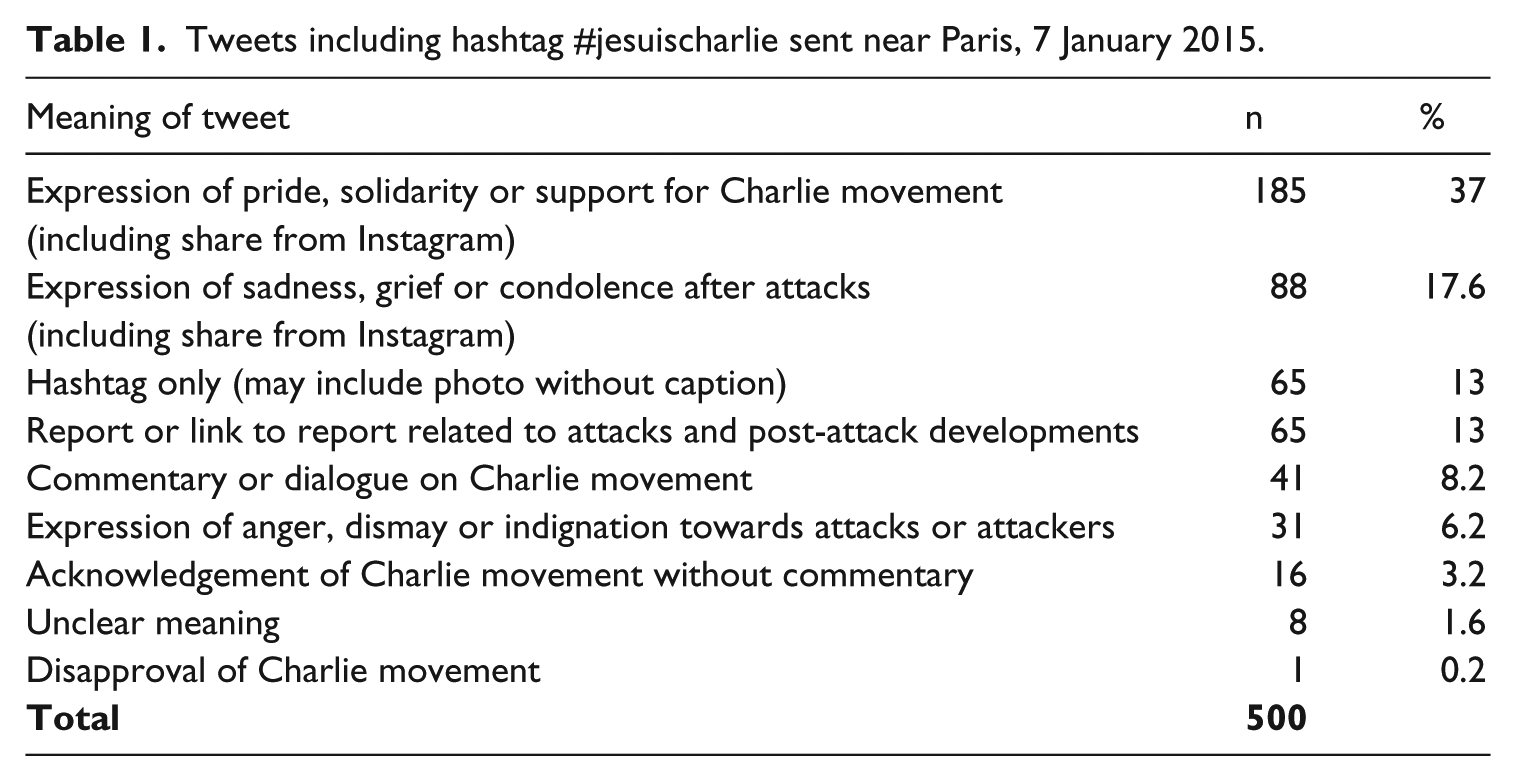
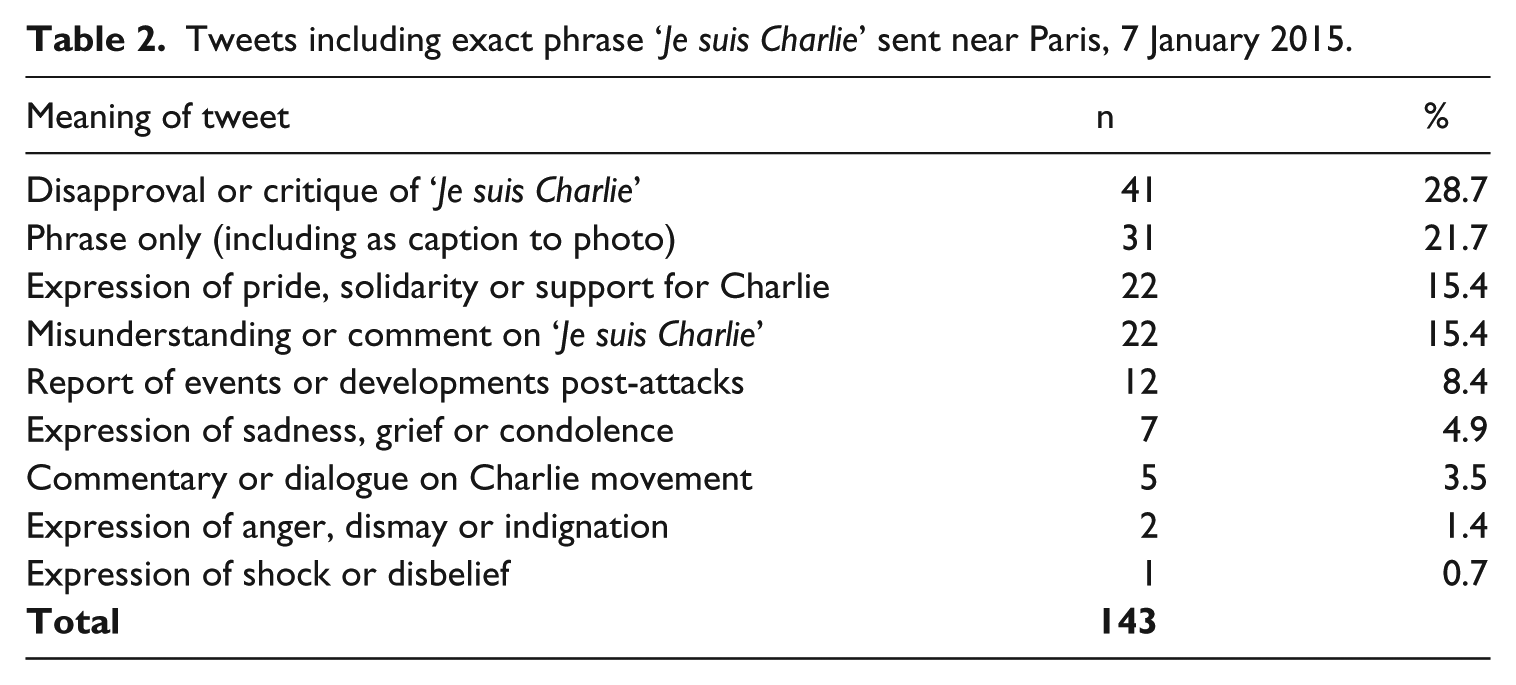
To analyse results of both searches, I placed tweets into categories reflecting my interpretation of the message including, where possible, the affective register conveyed (see Tables 1 and 2). These interpretations were based primarily on phrases accompanying the phrase ‘Je suis Charlie’ or hashtag #jesuischarlie, on emoticons such as smiley or sad faces, and in some cases on attached illustrations or cartoons conveying a clear message. For tweets with photographs attached, including those shared from Instagram, interpretation was based primarily on the phrasing of the tweet as the large majority of photographs were interpreted as simply documenting public gatherings after the attacks. Most tweets in both samples were written in French, with some in English and a very small number in German or Spanish.
Tweets including hashtag #jesuischarlie sent near Paris, 7 January 2015.
Tweets including exact phrase ‘Je suis Charlie’ sent near Paris, 7 January 2015.
The sample of tweets based on the hashtag #jesuischarlie shows the most commonly conveyed affective reactions include either pride, solidarity and support in relation to the Charlie movement (37%) – notably pride to be French and solidarity with the French state and its values – or sadness, grief and condolence expressed towards the victims of the attacks (17.6%). This latter number is relatively low, especially compared to the 13% of tweets merely reporting on post-attack events (such as public gatherings or police updates) without clear affective investment. Another 13% include the hashtag #jesuischarlie, either as the totality of the tweet or to accompany an otherwise uncaptioned photograph. The sample is remarkable for its lack of voices of critique or alienation. Only a single tweet out of 500 expresses clear disapproval of the Charlie solidarity movement; however, a further 11.4% (Commentary … + Acknowledgement …) take the movement or the hashtag itself as an object of discussion without appearing to overtly support or criticise it.
This analysis appears to confirm how the hashtag #jesuischarlie functions as a marker of ‘ambient affiliation’ (Zappavigna 2011). Twitter users deploy hashtags for a dual purpose: ‘They act as both a label for the potential discourse community that they establish and render searchable the coupling that occurs in the tweet’ (Zappavigna, 2011: 801). While the affective investment behind use of the #jesuischarlie hashtag is not explicit in almost 40% of the sample, I interpret the vast majority to include it in order to be positively affiliated with the emergent community it names. Only one tweet rejects this community while seeking affiliation, while a small proportion offers critical commentary. Moreover, the hashtag explicitly indicates connection among Twitter users who might otherwise be dispersed: it is one of the mechanisms of virality. Further analysis of hashtag use in the days, weeks and months after the attacks is needed to show how reasons for affiliation varied, including commercial reasons unrelated to Charlie Hebdo.
The second sample, based on the exact phrase ‘Je suis Charlie’ and not including the hashtag, shows quite a different picture. While approximately 20% of these tweets convey similar reactions of either pride and solidarity or sadness and consolation, more than 28% express outright critique or disapproval of the phrase itself with a further 15% querying its meaning or purpose. In other words, more of these users appear to quote the phrase than to affiliate themselves with its cause. This 43% of tweets deserves attention as these users foreground the affective intensities of network dynamics by signalling and reacting to their own moment of encounter with the contagious slogan. Three trends of critical commentary are evident.
Illustrating the first trend, one user is irritated by and cynical about the Charlie movement: ‘comment ça m’énerve ceux qui mettent “je suis Charlie” et qui n’ont jamais entendu parler du journal Charlie hebdo, tt ça pr follow le mouv’ (‘It really annoys me how people post “Je suis Charlie” and have never heard of the paper Charlie Hebdo, all just to follow the movement’). 1 These feelings are echoed closely by a user who addresses members of ‘the movement’ directly: ‘Vous êtes la a dir je suis Charlie je suis Charlie mais avant tout sa combien connaissait Charlie hebdo’ (‘Here you are saying Je suis Charlie je suis Charlie but before all of this how many of you knew Charlie Hebdo’). Here, other social media users are called out as opportunist and insincere in their engagement with group dynamics, with the claim that some don’t know what the movement is even supporting. Another user labels the opportunists more bluntly: ‘Et y’a les moutons qui te mettent “je suis Charlie” partout’ (‘And here are the sheep posting “Je suis Charlie” everywhere’), followed by a ‘suspicious face’ emoticon. For these critics, Charlie supporters lack sincerity, individuality and knowledge of context.
A second theme of reaction is evident among users who question the purpose and efficacy of the slogan. One user tweets: ‘Pq vous écrivez je suis Charlie enfaire ça va changer qoi’ (‘Why are you writing “je suis Charlie”, I mean what’s it going to change’), followed by two crying emoticons and a wink. Likewise, another tweets: ‘Ils me saoulent les gens sur snap a mettre “je suis Charlie” ça va c’est bon on a capter mais un snap ça fait rien hein! Imbécilesss’ (‘I’m sick of these people on Snap[chat] posting “je suis Charlie” OK we get it, but a snap’s not going to do anything! Idiots’). Both users gesture to the sense that the viral slogan bears little or no relation to the attacks themselves and that social media operate at a distance from reality. Another user seems to suggest that the slogan registers an over-reaction to and over-identification with an isolated event of violence: ‘Ehhh arrêtez de dire je suis Charlie, demain tu vas te réveiller tu vas a l’école personne t’aura rafaler!’ (‘Hey stop saying “je suis Charlie”, tomorrow you’ll wake up, you’ll go to school and no one will have gunned you down’). This user seems to signal that the implied suffering behind messages of solidarity with the victims is misplaced and exaggerated – and perhaps that those expressing it are unlikely ever to be in the position of being gunned down or blown away. In contrast, the ironic possibility that identification with Charlie is exposing oneself to violence is evoked by another user: ‘Mais si jai bien compris les gens dise je suis charlie pour dire ouais venez me tuer moi’ (‘So if I understand right people are saying “je suis Charlie” to mean yeah come and kill me’).
A third common theme emerging from these tweets is what might be called a purposeful affective alienation, manifest in critique or outright disapproval of Charlie Hebdo and contempt for expressions of solidarity with its fallen cartoonists. In this sense these tweets are more political, whether overtly in tone or by implication. One user asks: ‘En disant je suis Charlie vous savez toutes les idées que ça sous entend ? Reflechissez avant de parler’ (‘When you say “je suis Charlie” do you know all the ideas that implies? Think before speaking’). Calling out opportunism and sheep mentality like those users quoted above, here a generalised public is also criticised for unthinkingly supporting (unspecified) opinions which this user sees as politically suspect. Similarly, another user quotes the slogan in order to disavow it: ‘Jamais je mettrais “je suis Charlie”, j’oublie pas les caricatures en plus l’histoire elle est grave chelou’ (‘I would never post “je suis Charlie”, I haven’t forgotten the cartoons, and plus this whole story is totally sketchy’). For them, Charlie cannot be separated from the unforgettable and presumably offensive nature of his cartoons. In addition, something suspicious about the events is implied – possibly a prelude to conspiracy theories which began to circulate about the role of the government in the Charlie Hebdo attack.
More pointed in their critique is the user who addresses a public who should know better than to support Charlie: ‘Vla les hypocrites, comment tu peux dire je suis Charlie alors qu’il a critiquée ta religion, il s’est foutus de ta gueule’ (‘Look at the hypocrites, how can you say “je suis Charlie” when he criticised your religion? He screwed you around’). Because some argue Charlie Hebdo targeted all religions in its satire, this user could be read as addressing anybody with religious faith, and in fact another user takes this very position of generalised offence: ‘Je respect trop les religions pour dire que je suis Charlie’ (‘I have too much respect for religions to say I am Charlie’). It seems likely, though, that the ‘hypocrites’ singled out by the previous user are those French Muslims whose solidarity with Charlie is perceived to be blind to the specific contempt beneath the paper’s brand of humour. A final user spells out this frustration briefly and plainly: ‘Les musulmans qui disent “je suis Charlie” vs êtes srx’ (‘Muslims who say “je suis Charlie”, are you serious?).
A few preliminary conclusions can be drawn from this group of metatextual tweets. First, the affective quality of discourse present in these tweets is more attributable to network dynamics than to individual subjects. The subjectivity of these Twitter users emerges in relation to network dynamics precisely because of the affective and political composition of the exchanges in which they participate. This point is indebted to Sanjay Sharma’s (2013) analysis of ‘Black Twitter’ and associated ‘Blacktags’, the vernacular term for racialised popular hashtags which circulate to construct rather than reflect African American identity online. Blacktags ‘reveal the contagious effects of networked relations in producing emergent racial aggregations, rather than simply representing the behaviour of an intentionally acting group of Black Twitter users’ (Sharma, 2013: 48). Similarly, because the Twitter users I quote all draw attention to the existence of online contagion as the basis of their tweets, it appears to be possible to identify moments of affective transfer – or recognition of affective transfers having taken place – which might not otherwise be legible beyond their real-time flow. Therefore the position of critical distance to ‘Je suis Charlie’ taken by tweets in this sample is confirmation that they too are subject to it, not immune to it. It might be possible to conclude that the network circulation to which they are reacting – with irritation, cynicism, anger, and sometimes humour – is above all an affective contagion which continues to generate versions of itself in each new network encounter.
What are the mechanics of a situation in which social media users may experience a sense of agency and affective authenticity in circulating and reacting to digital content, and doing so habitually, while their very ontological status as users is an emergent property of the shifting dynamics of the digital assemblage? One important clue to this puzzle comes from recent scholarship on software, which aims to demystify our sometimes fetishistic attachment to digital media products by drawing attention to infrastructures that lie beneath them.
Programming Charlie: software and algorithms
To many digital media users, knowledge of the technical functions of software is relatively obscure. We are more likely to focus on the effects of software than on the obscure code that software executes. Wendy Hui Kyong Chun (2013: 2) helps to explain the wide appeal and importance of examining software in epistemological terms:
Its combination of what can be seen and not seen, can be known and not known – its separation of interface from algorithm, of software from hardware – makes it a powerful metaphor for everything we believe is invisible yet generates visible effects, from genetics to the invisible hand of the market, from ideology to culture.
With technical and epistemological questions in mind, it may be helpful to look briefly into the role of software in constructing user experience on social media like Twitter. If the declaration ‘Je suis Charlie’ arises out of contagious network intensities – more a feeling than subject position, spread in circuits of imitation – then the technical affordances of platforms to bring about contagious encounters are vital to circulation dynamics.
The algorithmic construction of the user experience of social networks has by now received considerable attention in both popular press and scholarly discussion. Whether concerned by loss of user agency or barely concealed proprietary relations to advertisers and other corporate partners, different levels of user knowledge of interface manipulations amounts to widespread recognition that how content appears and spreads is anything but organic. Writing about Facebook, Taina Bucher (2012: 1) analyses that network’s News Feed software as a device of governmentality, identifying ‘the specific algorithmic and “protocological” mechanisms of Facebook as a proactive means of enabling, shaping and inducing attention, in conjunction with users’. She identifies algorithms that prioritise the value of some network connections over others so as to determine where in the News Feed to place content from those contacts: how interesting the item will be to the user depends on how the two contacts have already interacted with each other’s content. Algorithmic match-making among users serves the broader purpose of monetising users’ activity through increasingly precise projections of where and when they are likely to pay attention: ‘users do not merely browse the content that they find interesting; the “interesting” content increasingly finds them’ (Bucher, 2012: 12).
Algorithmic reframing of user activity is also practised routinely by Twitter to curate ‘trending’ topics: Trends are determined by an algorithm and, by default, are tailored for you based on who you follow and your location. This algorithm identifies topics that are popular now, rather than topics that have been popular for a while or on a daily basis, to help you discover the hottest emerging topics of discussion on Twitter that matter most to you. (FAQs about trends on Twitter, n.d.)
The striking generality of this language aims to reassure but succeeds in obscuring more than illuminating the process; the algorithm’s legitimacy and benevolence are the focus (Gillespie, 2014). Moreover, these terms of service note that it is possible (and forbidden) for the user to ‘abuse trends’ by purposely attaching unrelated content to trending topics, that is ‘in an attempt to gain attention in search’ or ‘to drive traffic to your profile or website’ (FAQs about trends on Twitter, n.d.). The line between these two relations to trend is fine. One on side, Twitter openly constructs trends with a secretive algorithm and drives traffic to them; on the other, users are imagined to abuse or ‘game’ the same system and are threatened with expulsion from it. Full details of how to calculate trends are so precious that competition must be avoided at all cost.
The use of software to generate encounters is clearly helping Facebook and Twitter to achieve some of their commercial goals, and I have only scratched the surface of the complexity of technical factors involved. Algorithmically arranged relations among users and between users and content serve the greater interest of both companies’ partnerships with advertisers by generating more and more precise data on users and their habits, data which forms the basis for predicting future online behaviour. These techniques can be identified as strategies of control, illustrating the vision of societies of modular and ‘dividual’ control described by Deleuze (1992). The predictive capacities of data collection might be more accurately seen as ‘premediation’: the medial design and containment of certain possible futures, including an affective orientation to them (Grusin, 2010).
But using data analysis to produce opportunities for encounters does not determine what will be exchanged or transferred during those encounters; it only comes closer to helping to explain how rather than why content circulates. Two additional perspectives on software are important to consider as correctives to deterministic assumptions about the function of algorithms. They remind us to examine software and algorithms, like all technological objects, within circuits of use – and, significantly, of power. One fundamental insight concerns the effects of software and the code that programs it. While computer code is performative, in that it produces effects that result from a language of commands, ‘the execution of code is often mired in ambiguity, undecidability and incompleteness’ (Mackenzie and Vurdubakis, 2011: 7). Alternative outcomes that cannot always be controlled also emerge from the conduct of code. These are the ‘vicissitudes of execution’ which Chun (2013: 24) notes may contradict our belief that computer systems function because code simply does what it says it will do. The successful execution of actions performed by coded software produces the illusion of easy retroactive identification of causality and intentionality.
Understanding the effects of code depends on the story we tell of its role in environments where the production and deployment of software intersect unevenly with a range of contested interests – in short, spaces of politics (Crawford, 2015). The software user is constructed in relation to social norms which serve to frame how the story is represented and how the user’s agency can be legible. As Gillespie (2014) adds, the politics of representation are crucial to understanding how software users are called into being as subjects and as publics by algorithmic calculations and evaluations of data (see also Cheney-Lippold, 2011). ‘Algorithms that purport to identify what is hot’, writes Gillespie (2014: 23), ‘engage in a calculated approximation of a public through its participants’ traceable activity’. The calculation constitutes a selective characterisation, not just evaluating but performatively representing publics ‘that would not otherwise exist except that the algorithm called them into existence’ (Gillespie, 2014: 23).
In analysing the story of software, we need to ask not only who is selected to be part of the story, who is not, and why, and not only how their participation is being told. We also need to ask how the story itself invents these characters as its own ‘public’, back to whom the story is told – and sold. Software’s performative function is to call into being its own user or public, including through its role in the transfer of affect (Parikka, 2015). In this sense, social media users identifying with Charlie were called into being by the combined forces of social media algorithms and the affective and political intensities coursing through and around them.
Not being Charlie: affective alienation
The title of Todd’s (2015) book Qui est Charlie? plays on the popular children’s picture book Where’s Wally? which challenges the reader to identify the distinctly dressed Wally in densely packed crowd scenes. Known in the US and Canada as Where’s Waldo?, the book is known in France as Où est Charlie? (Where’s Charlie?). While hundreds of thousands of Charlies identified themselves in widespread locations in the days after the Charlie Hebdo attacks, Todd’s book shifts focus from the where to the who, asking who is represented by this massively identified figure. In a sense, Todd takes up the inverse challenge of the children’s book: whereas Wally or Waldo is scarcely visible in the crowd and yet completely distinct once found, the Charlie sought by Todd is the crowd which conceals its own distinctions. His question, ultimately, is to ask who is not Charlie. Todd’s analysis of the crowd provokes similar questions of the thousands of online actors who all appear to embody the values of Charlie. Among their ranks, small pockets of critique and discomfort emerge.
After the attacks, defenders of Charlie Hebdo’s inflammatory content tended both to invoke a particular French cultural history of satire and to apply to this satirical function a particular version of equal opportunity. The paper’s irreverent satire was said to confirm the existence of a healthy press that is free to engage in debates about political issues of the day. Moreover, some claimed that all social and political groups were targeted equally by the satirists’ pen, not just Muslims. This claim evokes a level playing field of social and political interests, which abstracts differences of ethnicity, religion, gender and sexuality from their concrete realities and asymmetrical relations to power. In this anti-communitarian account of freedom of expression, satirising one group is supposedly the same as satirising all groups; satirising them is satirising us. And yet any analysis of the political function of humour should surely recognise the difference between those laughing and those being laughed at. Mahmood Memdani draws a parallel with popular US radio and television show Amos ’n’ Andy, cancelled in 1966 after years of complaints of racist and stereotypical depiction of African Americans. Just as broadcaster CBS ‘hoped that Black people [would] learn to laugh at themselves’, says Memdani, the publishers of Charlie Hebdo seemed to suggest ‘that the problem with Muslims is that they lack a sense of humor, and that the solution is for Muslims to learn to laugh at themselves’ (in Venkat, 2015).
Memdani reminds us that all representation is political but also that power operates through representation’s relationship to affect. To get the joke of Charlie Hebdo is to share an affective orientation to the objects of its humour. Failing to laugh – or failing to laugh at oneself being laughed at – characterises ‘affective alienation’: a state of being ‘out of line with an affective community’ (Ahmed, 2010: 37). Affective misalignment occurs ‘when we do not experience pleasure from proximity to objects that are already attributed as being good’ (Ahmed, 2010: 37). One of Ahmed’s examples of affect alien, the ‘melancholy migrant’, is clearly designated as the cause of negative affect because of their failure to experience the pleasure of humour correctly. In turn, affective misalignment is taken to signify opposition to the principle of freedom of expression (the freedom to laugh at others) and ultimately critique of the nationality which rallies around such ideals.
Perhaps this explains my affective dislocation from the public rally I attended. Not only were freedom of expression and other kinds of liberté being fundamentally equated with Frenchness, but collective identity was reinforced in the bodily exchange of particular feelings, especially through song. Song provided a common vector for individual affective intensities: a shared communicational form through which it was now possible to convey a common sense of having been affected by the attacks. In this communicational assemblage of bodies feeling together, individual affects merged with the social structure of nationalism to produce a collective practice of affective citizenship.
The concept of affective citizenship helps to describe ‘which intimate emotional relationships between citizens are endorsed and recognised by governments in personal life’, but also ‘how citizens are also encouraged to feel about others and themselves in broader, more public domains’ (Johnson, 2010: 496). Like other measures of citizenship, selected displays of affect reinforce a normative framing of collective identity in conjunction with biological discourses of the human (Fortier, 2010). In this way, affective citizenship can be seen as an extension of biopolitical governance taken up by individual subjects: The ‘affective subject’ becomes ‘affective citizen’ when its membership to the ‘community’ is contingent on personal feelings and acts that extend beyond the individual self as well as beyond the ‘private’ realm of family and kin, but which are also directed towards the community. (Fortier, 2010: 22)
Alongside the communicative vector of La Marseillaise, public declaration of ‘Je suis Charlie’ offers a strong example of the performative practice of affective citizenship. Declaration makes a claim to social cohesion, at the level of bodies and at the level of discursive frames like nationality, but cohesion is tested by the intensity of alien subjects ‘not facing the right way’.
Conclusion
The universalist declaration ‘Je suis Charlie’ risks circulating a mode of citizenship which privileges some affective relations over others, and reinforces as normative particular gendered and ethnic subjects whose entitlement to freedom of expression silences others. As a collective expression of affective citizenship, the slogan helps to orient individuals towards a shared feeling about objects, relations and others naturalised as good or bad. This affective orientation is partly consistent with the French state’s political agenda post-Charlie Hebdo attacks, which has focused on selective acounts of social cohesion and community values, especially in the face of communitarian ‘unease’ (Fortier, 2010). More than a subject position, ‘being Charlie’ can be understood as a feeling or affective orientation, taken up in the manner of good citizenship. How the slogan circulated online illustrates both the ‘stickiness’ of affect (Ahmed, 2010) and its ambivalence.
Like the viral circulation of memes, feeling Charlie was transmitted online not just because of affective contagion or because social media users were swept up in a collective mood or ‘Zeitgeist’, but because those affected users were shaped by a network ontology emerging from the contingence of encounter and the invisible calculations of digital infrastructure. Not feeling Charlie is transmitted through the same mechanisms, and for this reason it is an affective orientation easily lost in the crowd. The challenge for ‘affect aliens’, if we are to take seriously the political urgency of recognising social difference, is to find ways to ‘game the system’ of a network culture where visibility equals searchability.
Footnotes
Funding
This research received no specific grant from any funding agency in the public, commercial, or not-for-profit sectors.