



Abstract
This article reads the notion of mediatization through a current example of architectural practice: the Axel Springer Campus in Berlin. Based on current theories of mediatization, it shows how this architectural project for a media firm finds new ways for architecture itself to function as a medium. It argues that architect Rem Koolhaas developed an architectural design that has the capacity to mediate images and interpretations of the productivity of media practitioners, of the relationship between media firm and urban environment, as well as of more general transformations of media work in the digital age.
The work of journalists is to observe, and to draw conclusions from what they have seen. In this sense, when aiming at understanding their own employers’ strategy, economic well-being, or cultural state of mind, journalists will presumably aim at drawing conclusions from the spatial representation strategies performed by the firms’ corporate headquarters, be it the act of symbolic architectural strength displayed by Renzo Piano’s New York Times Tower in Manhattan (completed in 2007) or the hyper-solid steel structure of The Economist in London by Alison and Peter Smithson (1964). However, few media firms have made architecture a cornerstone of their self-definition processes as consistently as the Berlin-based publishing house Axel Springer. Any journalist working for Springer is confronted with the inherent symbolism of corporate architecture and interior architecture. Spatial representation mechanisms have always been central to the firm’s philosophy.
One example is the famous Axel Springer Journalistenclub on the 19th floor of the corporate headquarters high-rise in Berlin. In the background, visitors see the original panelling of the library of the London newspaper The Times, bought by the young publisher Axel Springer in the 1960s when The Times moved to a new building in London. Axel Springer had always loved London and England (Jürgs, 2001). The country not only represented the kind of journalism he was interested in, but to a significant degree also a kind of tabloid journalism that was tougher and louder than anything common in Germany at that time. Having worked for Springer for some years, I can attest that this fascination is still present within the company today; for the tabloid Bild, one key point of orientation has always been the way in which The Sun does tabloid journalism. For the media entrepreneur Axel Springer, tabloid journalism and his understanding of quality reporting as represented by The Times always went together. If there is, as Deuze (2005) claims, a distinct culture of tabloid journalism, then Springer was interested in transporting this culture into Germany as thoroughly as possible. The combination of entertainment and information Deuze identifies as significant for this culture was something that particularly interested Springer. And he saw its roots in the UK. By buying the interior from The Times, he expressed this interest, and his close emotional connection to England. The library inside the Journalistenclub was an act of symbolic spatial communication aimed at Springer’s own senior journalists and other higher employees (the only ones allowed to use the club), at visitors in the club, but also, by means of the frequent reproduction of the story in his own media, at the general public.
In a more general and more political way, the whole construction of the Berlin high-rise by architects Melchiore Bega, Gino Franzi, Franz Heinrich Sobottka and Gustav Müller, starting in 1961, can be seen as a symbolic political act (Warnke, 2008). Springer purposefully built directly on the border towards East Berlin. Construction started only months before the German Democratic Republic (GDR) commenced building the Berlin Wall. This was an example of architecture becoming a tool for strategic political activism by means of a media company (for an encompassing analysis of the relationship between architecture and the notion of strategy see Gutzmer, 2015: chapter 2).
Apparently, the GDR reacted to this kind of urban structural and visual attack, with the construction of own high-rises along Leipziger Straße. An architectural arms race started. People in East Berlin understood this – and aptly named their high-rises ‘Springerdecker’, a football metaphor which roughly translates as ‘Springer covers’. This arms race even intensified when Springer used the top of his building to broadcast western news to the people in East Berlin (Kruip, 1999). In terms of media theory, one could argue that Springer used architecture as an alternative publishing platform. Not only was the building itself, with gold representing the economic superiority of the West, becoming a message. It also functioned as an alternative way of carrying political messages, circumventing the efforts by the GDR to control political communication within its own regime. Springer, in this way, used the specific and, from an urbanist point of view, rather absurd cultural topography of Berlin to strengthen his own position as an actor in the Cold War (for a encompassing contextualization of this political employment of the city see Warnke, 2008: chapter 1).
For Axel Springer as a person, as well as for his company, architecture has always carried symbolic significance. Hence, it makes sense to turn to Springer when seeking to understand the relationship between architecture and communication. This is what this article will do – with a focus on a more recent architectural development. It will analyse the architectural strategies employed by Axel Springer through a focus on one concrete example of architectural construction currently under way in Berlin: the new ‘Axel Springer Campus’, the latest extension project of the corporate headquarters. By doing so, the article will aim at developing an understanding of the ways in which the relationship between space and the activities of media institutions can be read as a fusion connecting the distinct principles of architecture and medium. This approach builds on works of theorists such as Gieryn (2002: 34), who, through a sociological reading of architecture, made the point that a building can be read simultaneously ‘as the object of human agency and as an agent of its own’. The article thereby extends the engagement of Colomina (1994) with the ways in which architecture today acquires characteristics of media. She argues that ‘modern architecture only becomes modern with its engagement with the media’ (Colomina, 1994: 14). Through this engagement, a building effectively transforms into ‘a mechanism of representation in its own right’ (1994: 13). It is this mechanism that this article will engage with. It aims at developing a deeper understanding of the process of representation by a media company in times of thorough industry crisis and change. Effectively, it suggests that particularly in such change-ridden times, and through processes of architectural representation, processes that by and large can be seen as mechanisms of representation of the corporate self, architecture might even have the potential to be read as a means of creating a sense of a collective identity 1 (see Martin, 2003: 9).
In so doing, this article will read the architectural activities of Springer as an element of ‘mediatization’ as conceptualized prominently for instance by Couldry and Hepp (2013), Hepp (2013) and Hepp et al. (2015), and as critically discussed by Deacon and Stanyer (2014, 2015), among others. The argument will be that, for Springer, architecture becomes a tool for communication. It thereby functions as a medium (very much in the sense developed by Colomina, 1994). And it finds new ways of functioning as a medium. In this sense, it is indeed an example for the cultural meta-process of mediatization, if measured by the key features of mediatization that Couldry and Hepp (2013: 196) propose: on the one hand, a quantitatively ‘increasing temporal, spatial and social spread of mediated communication’; on the other, a qualitatively very specific kind of mediated communication, with its own codes, rules and limitations.
There are, of course, very different levels on which architecture can become a medium in Colomina’s sense of a mechanism of representation (1994: 13). Some of these will be discussed later. Specifically, one can argue that a concrete architectural structure has the capacity to reflect internally and/or to the public the social activities inside a building (and, if an office building is concerned, by extension inside the organization occupying a building; see Martin, 2003: 156–81). It can, furthermore, offer symbolic insights into the relationship its tenants have towards other buildings, or to the city in which it is based. And it can point to ways in which the building in question and the processes it contains carry a certain relevance for general processes of social, cultural or technological change. These processes of architectural mediation will be looked at later. Before doing so, however, I want to discuss in more detail the understanding of architectural mediatization this article employs.
Mediality and mediatization of architectural space
Understanding architecture in the context of mediatization means analysing how concrete buildings foster dynamics that create new levels of meaning, communicative practice and, ultimately, of reflexivity (Deuze, 2012). The academic discourse on the reflexive qualities of architecture has long been interested in media headquarters. Examples include Couldry (2000), Wallace (2012), Ericson and Riegert (2010), and Couldry and McCarthy (2004). In his more general reading of the way in which postwar modernist architecture has become engaged with the creation of the modern company, Martin (2003) analyses the mechanisms through which architecture is engaged with the generation of knowledge of modernist organizations about themselves. Architecture acts as ‘both receiver and transmitter of patterned organizational codes’ (2003: 215).
However, some academic engagements with media houses or capitalist architecture in general have a tendency to take a largely functionalist viewpoint as far as architecture is concerned. At times, they see architecture mainly as a representational power tool (see Sklair, 2006). From that perspective, the media firm is a monolith using architecture to (a) express its own power, and thereby (b) build on it. The inherent complexities and contradictions that architecture conveys are paid little attention. Also, less attention is sometimes paid to the ways in which an architectural structure functions as a means for an organization to develop a more complex sense of itself (in the sense suggested, for instance, by Hatch and Schultz, 2002). It is from this perspective that I hope my reading of the Axel Springer Campus will be a step forward.
Before proceeding with this, however, I want to think through more thoroughly the ways in which this article interprets architecture as an element in the societal process of mediatization. Understanding architecture as a medium not only creates a distinct combination of house and communication. It is also generates a novel connection between subject and world. In a way, the individual human being and the social, cultural and economic environment that positions and determines this individual are brought closer together through an architectural medium.
Architecture and medium are thought together by different strands of media sociology. Authors such as Delitz (2005) or Zierold (2006) define medium mostly as an enabler of a certain exchange, based on signs. Referencing Kittler, Zierold argues that architectural media are characterized by the production, reception and distribution of signs (2006: 15). This definition may be constitutive for practical analyses of the communication value of architecture. However, it is not unproblematic. The question is if, as medium, architecture is really adequately described as distributing signs.
Delitz (2005) approaches the character of architecture as a medium by analysing the ways in which architecture manages to transmit and strengthen social norms. This implies an analysis of the role architecture can play in the emergence of a medially constructed sociality. And it certainly can play this role. Architecture creates sociality. This basic assumption relates to theoretically informed arguments of architectural practitioners. Architects like Peter Eisenman or Bernard Tschumi have long been asking for media-theoretical foundations of architectural modes of social action (Grosz and Eisenman, 2001). Younger architects such as Arno Brandlhuber now follow suit.
But in what way is this kind of social architecture really an element in the mediatization of society? Zierold (2006 23) writes that the media space of architecture constitutes ‘a complex media structure’. This is based on what Zierold calls ‘Formdifferenzen’, which translates as ‘differences of form’ (2006: 23). Light, for example, constructs a form difference. It generates the form difference between light and dark. The perceptible differences of forms and their underlying media structure create the physical basis for the sign structure that constitutes media space. The term ‘sign structures’ refers to different layers of meaning and includes strategies of presentation and representation. In this sense, architecture is transformed into what Lash and Lury (2007: 15) call ‘surfaces of communication, intensities, events’.
However, by quoting cultural sociologists Lash and Lury, the argument of this article is not so much that contemporary architecture is simply taking on a different role in a basically unchanged cultural setting. Rather, what is changing is this setting itself. This is connected to the term ‘sign’. Lash and Lury refer to a modified concept of the sign – in general, but also in particular in communication theory. In their approach, sign-based communication no longer has the potential to transport pre-produced, abstract worldviews consistently on a long-term basis. Rather, the sign itself becomes an object, and it merges with ‘object-ive’ carriers. Following this reading, it appears that the concept of top-down architectural representation is itself becoming problematic. Lash and Lury emphasize that there is a profound cultural transformation, one that has been conceptualized by theorists such as Massumi (2002, 2011) or McQuire (2008): the rational, sign-oriented world of comprehensive intentional communication is challenged by means of physical objects that obtain semi-intentional communicative and thus socially constitutive functions (see also Martin, 2003: 215).
This does not contradict the assumption that there is an increasing importance of architecture for intentional communication. It even seems as if architecture has an increasing role to play in today’s social communication processes. This role can be understood as part of a larger development, in which the relationship between objects and signs is transformed. The object is not the ‘new sign’ that simply takes over the symbolism of other sign systems. Rather, medium and physical object merge into each other in a new way. Media ‘that were formerly representations – become things, and … things that formerly were exclusively material objects become media’ (Lash and Lury, 2007: 36). This means that through its very physicality, architecture is increasingly necessary to produce meaning at all (Lash, 2002: 149). Meaning is where there is architecture. Architecture has the potential to function as a medium – and thus also to become the venue of communicative processes. Signs are no longer possible without tangibility. Communication needs corporeality.
The understanding of architecture as a physical object that obtains medium qualities points to a very specific way in which mediality is constructed. The objects Lash and Lury had in mind, for instance, were primarily rapidly moving objects. Lash in particular is one of the theorists of a culture of flow and movement (see Lash and Urry, 1994). This theoretical approach can be seen as a predecessor of today’s ‘internet of things’, but not so much of a culture of architectural flow. It would be hard to conceptualize architecture per se as a prime driver of a flow-based society or culture. Architecture is primarily stable. And yet it can at the same time be conceived as one enabler of cultural fluidity. It creates Lash and Urry’s spaces of flows. Objects (and information bits) need architectural structures through which to flow. Only through the existence of such structures can the unfolding of a culture based on permanent systems of globalized spatial flows be envisioned. From this perspective, architecture is no longer that which manages the maintenance of boundaries between inner and outer world, but which organizes the various movements between these worlds. From this perspective, architecture is essentially a flow management vehicle. And the capacity of these flows to turn into bits of communication then forms the link between architecture and mediatization. Buildings manage flows, flows can transform into mediated information. Therefore, architecture has relevance when it comes to mediatization – including, but also beyond the communication processes that are the direct outcome of the exertion of corporate power.
Koolhaas: critical architecture and architectural criticism
Before discussing the Axel Springer Campus, I want to reconsider two other architectural projects by Rem Koolhaas and his firm OMA that can be seen as an engagement with, and perhaps also a step away from, the power-related expressive functionalist readings of architecture criticized above: The competition entry for the Universal Headquarters in Los Angeles and the CCTV Tower in Beijing.
Koolhaas’s design proposal for the new corporate headquarters of media conglomerate Universal in Los Angeles in the late 1990s offers a perspective on architecture as an engagement with the complexities of capitalism itself (Gutzmer, 2013). The project was engaged with one particular part of capitalist reality: that of branding. Koolhaas had suggested a concept that tried develop a richer understanding of the notion of branding, engraving the history of the brands involved into the physical shape of the building.
Koolhaas effectively wanted to build the Universal brands. It was in an only half-mocking way that his illustrations used the design of branded bottles by the liquor firm Seagram, just acquired by Universal, as the basis for the suggested structural solutions. The design was an effort on behalf of the architect to unveil the inherent complexities produced by the business-strategic processes of the merger at hand – and their impact on the brands of the new firm. Thereby, rather than indicating that architecture is exclusively a tool for those in power, Koolhaas suggested a design that expresses the contradictions of the merger, and that also points to the ambiguous nature of architecture when it comes to expressing power. This points to the potential of architecture not to be subsumed completely into a power strategy. Particularly when read through the notion of mediatization, architecture can be argued to become a way of making the brands of a company communicate with the outer world, but also with each other. The different brands in this one building are confronted with each other, and with the different symbolic values they have.
Koolhaas’s Universal design is a reflection on the becoming-medium of brands and of brand-driven activities. Koolhaas employed architectural design principles for strategies of cultural criticism (for a discussion of this method see for instance Grau and Goberna, 2015). However, the proposal remained theory; Koolhaas did not win the competition. In terms of the relationship between the conflicting concepts of architecture as medium or as spatial practice, this points to a key difficulty of any deconstructivist approach to architecture. The almost philosophical approach of the Universal project, together with the speculative architectural form suggested, raises the question whether the architect’s intention had ever been to really build, or whether the way in which he understood architecture as medium had not implied a purely theoretical approach right from the start.
The question this points to is whether architecture loses much of its critical capacity once it is more than theory. And sometimes indeed, Koolhaas too is criticized as complicit in corporate or political power. Significant criticism has been directed for instance at his CCTV Tower in Beijing (see Davis and Preiser, 2012). However, from my perspective, it would be too easy to argue that Koolhaas acted as a willing partner in the strategic activities of a repressive regime. Wallenstein (2010), for instance, offers a slightly different perspective. He argues that the building illustrates the existing contradictions of the Chinese political and cultural regime. By focusing on the building’s architectural key idea of the ‘loop’, he claims that the building creates a spatial proximity between regimes of openness and of closure. The public is offered a circular way through the entire building (2010: 168). This public loop, however, is clearly sealed off from other loops – those of the employees, or of the top managers. In this way, the building creates an ‘allegory of openness and closure’ (2010: 177).
Koolhaas in Berlin: media architecture in the digital age
It is, perhaps, no coincidence that Koolhaas’s biggest realized project for a media company so far is set in China, which can be seen as a country still involved in developing an understanding of its own position in mediated capitalist reality. Sun (2014), for instance, elaborates on the inherent contradictions still at play within Chinese society, a society that is at the same time authoritarian, capitalist and thoroughly mediatized. In this sense, in Berlin, Koolhaas has the chance of realizing an architectural media project in a context with a more established, even if certainly crisis-prone, system of media culture. In 2014, his office OMA was announced as the winner of the competition for the new Axel Springer Campus in Berlin, which is essentially an extension to the firm’s existing corporate headquarters.
The project provides the architect with the opportunity to realize at once different levels on which architecture can be understood as a medium: this building has a central relevance because it is built at a time when the media firm Axel Springer itself is going through a time of fundamental change. The company sees itself as the digital hotshot in Germany, and in fact in Europe (its revenue from digital ventures is higher than that from its traditional print business). This self-definition seems to be increasingly accepted by the global media scene (see Clark, 2015). In this context, the building Koolhaas suggested and is currently building mirrors the transformation of the former print giant into a digital media house.
The building design implies an understanding of the complexities the media firm Axel Springer as a company in transition is facing. This understanding goes beyond what conventional corporate storytelling or internal communication would admit. The Koolhaas design seems to be a kind of mediatized self-assurance on behalf of the publishing firm. The building, dedicated specifically to the digital expansion activities within the formerly unequivocal print portfolio, can be interpreted as a kind of self-observation vehicle of a media firm in transition. The fact that in economic terms, Axel Springer is rather successfully digitalizing its portfolio, does not come as a contradiction. Rather, it implies that the firm wants to frame its own new strengths, and understand them better.
Architecturally, Koolhaas has proposed a massive cube that completely occupies the available space north of Berlin’s Zimmerstraße, right behind the old headquarters (see Figures 1 and 2). The overall design is guided by the diagonal atrium bisecting the entire structure (OMA, 2016). The essence of the internal design is a series of terraced floors. Each floor contains a covered part as a traditional work environment, which is then uncovered on the terraces. Together, all the terraces form a kind of ‘valley’ that is supposed to create an informal space with a high degree of mutual visibility at the centre. In this area, workers from the different floors can be expected to be able to observe each other working. Externally, this atrium opens up to the existing Springer buildings. The design’s façade features a large aperture revealing the inner working environment of the 60,000 square metres complex.
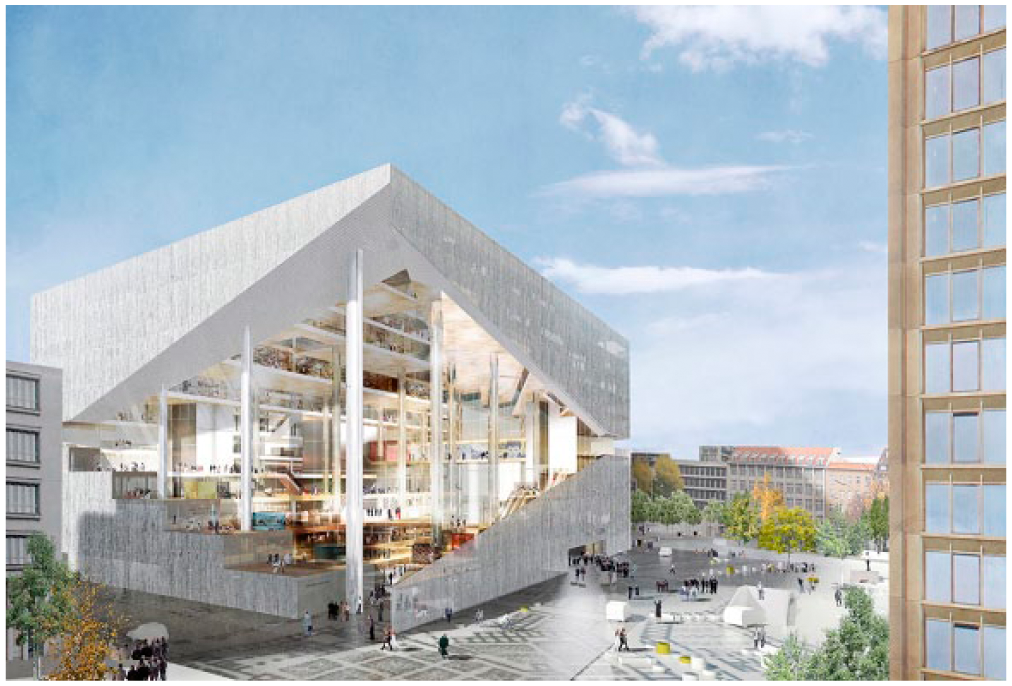
The Axel Springer Campus, as seen from the original building.
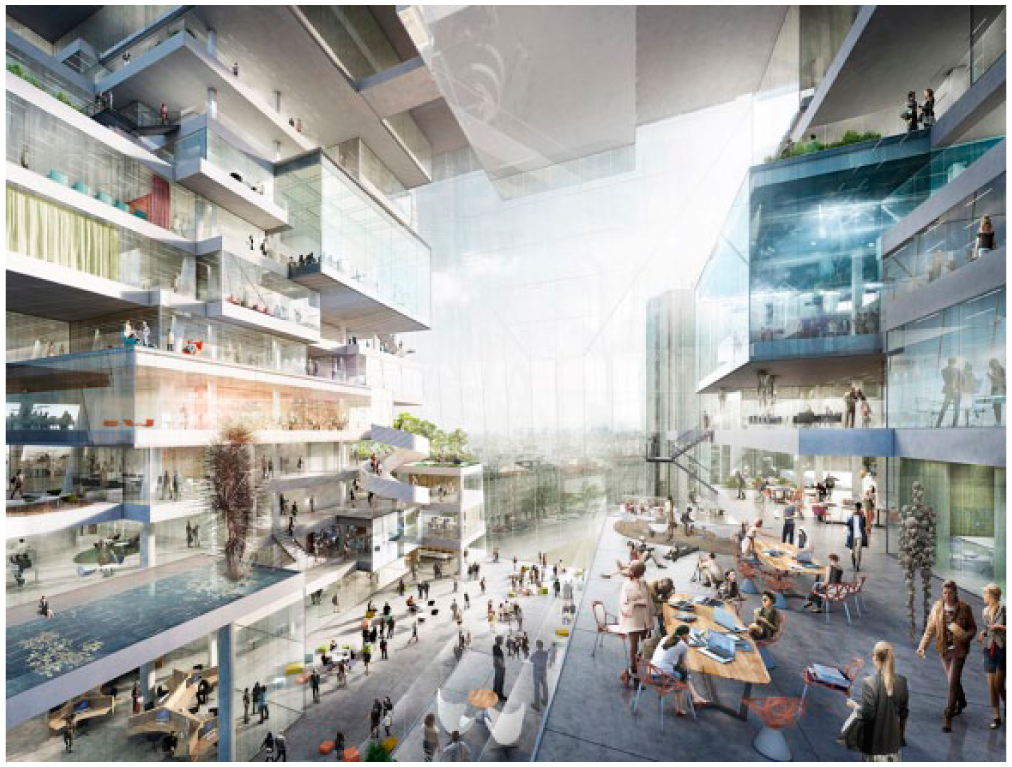
Inside out perspective.
I now want to read the Springer Campus and its architectural specifics with reference to the concept of mediatization. I will propose different levels on which the building can be argued to increase the mediality of social and cultural processes at play in Berlin and around this given industry.
Digital building for digital work processes
The declared main principle of the design was to establish a fluid and integrated working environment. These notions of fluidity and integration contain an element of mediatization. Effectively, the work spaces here become display media. The activity of each employee will be observed by other employees. The employees are assumed to collectively ‘display’ their individual activities. The design creates a set of stages for micro-performances of the digital elite.
Architecture here can be argued to create a heightened degree of understanding of media productivity in the digital age. The architects themselves have formulated this programme. On their website, they write: ‘We therefore propose a building that lavishly broadcasts the work of individuals for shared analysis’ (OMA, 2016). This building wants to broadcast media productivity. And it wants to do so in order to heighten the self-awareness of the company by initiating concrete processes of analysis.
Displaying media productivity to the public
But the design is not only creating internal images of a digital future. It is also generating digital work environments that play a role in the mediation between the company and the public. The architectural design ensures that corporate privacy is a thing of the past. All offices are at least semi-public. The (apparently publicly open) ground floor lobby, a meeting bridge and a rooftop bar are all architectural mediatization vehicles allowing visitors and guests to observe how the company operates.
This points to a novel way of managing the boundary of media firm and outside world. It is a step away from the emphasis media houses used to place on the boundary between themselves and the world outside (Couldry, 2000). Couldry claimed a distinction between media world and outside reality that could be analysed through notions of the profane and the sacred. Ericson (2010) extends this logic in his analysis of the BBC’s Broadcasting House in London. With a reference to Durkheim, he points to an absolute distinction between two worlds. In the Koolhaas building, by contrast, architecture seems to aim at mingling the two worlds.
Mirroring the valley
One interesting aspect of mediatization in the case of a building for a digital media firm is the way in which a building relates the activities of this particular firm to the area that changed the technological environment in which all media firms operate: Silicon Valley. In case of the Axel Springer Campus, this engagement becomes prevalent in one of the key features of the design: the open plan space. The architectural programme aims at establishing both physical and visual relationships centred on the large atrium. The uncovered communal terraces (the ‘stages’ mentioned above) generate what is called by spokespersons and in media reports a digital valley (see Designboom, 2013). Of course, one hears ‘Silicon Valley’ in this. Springer executives were the first German media managers to spend time in the original valley (see Keese, 2014), establishing a kind of Silicon Valley tourism that currently mesmerizes German media firms in the hunt for new digital megatrends. At the centre of the Koolhaas design, Silicon Valley is mirrored in a very physical way, with the proposed architecture forming a three-dimensional canopy enclosing the entire volume. The design replicates the notion of the valley within one concrete building, for any visitor to see.
Reflecting the internal media divide
What is more, the design does not function as a medium only for employees and visitors. The open street between the new building and the existing high-rise, as well as the general capacity to open up the campus, creates the capacity to invite people from the street into the building, thereby connecting inside and outside. Architecturally, the building is able to open up, fusing street and office space. The question is whether Springer will be willing to do so, given that the company has a rich past of clashes with the public. In 1968, for example, left-wing demonstrators attacked the publishing house, which they held responsible for the oppressive German Zeitgeist of that time. In a way, architecture can be argued to pose its own openness as a task for the firm. This design seems to ask: how do you want to engage with the public?
At the same time, however, this juxtaposition of old and new building is not without a potential for conflict. Architecture here creates a visual connection between old and new world. Within this connection, however, the new world seems to foster a sense of architectural unease. There is a clear notion of who is the challenger here (the digital economy), and who is challenged (traditional print journalism). What is on display is a crisis-driven corporate reality: the old media economy, represented by the big newspapers Bild and Die Welt, is observing the digital economy. Presumably, there will be the expectation on the part of the top management of learning processes to occur, with the old media being visually confronted by the ways in which the digital natives on the other side of the road work. However, architecture here does not really foster or enable these learning processes. It only articulates a necessity to do so, by means of effectively functioning as a screen. This building stages media work for other media.
These mutual corporate observation processes are not only a given; rather, they can be read as processes that have representational value as far as the general public is concerned. One can argue that, externally, the publishing house Axel Springer demonstrates by means of architecture that the outlined self-observation processes take place. Normal passers-by are allowed to walk right through the media-economic force fields between old and new media. They see how a relevant player in the European media system is opening up its internal identity process to the public, allowing the latter to observe how the company observes itself. Passers-by are confronted with the media firm’s reflection of its own role within the economy, technological change, and society. Not only does the company not deny that the transformation process it is subject to creates frictions; what is more, it even makes these frictions visible.
Architecture and the city
The term ‘friction’ pertains not just to Axel Springer but also to the city of Berlin. In the past 30 years, the city was subject to huge political and social frictions; the architecture of the building seems to be susceptible to these. In terms of its exterior shape, the building seems to be a compromise between an expression of corporate self-confidence and a sense of respect for the Berlin cityscapes and the rather rigid ways in which the construction of the new Berlin has been managed following German unification. The Koolhaas block towers above the controversial Berlin height limit ‘Traufhöhe’, but remains well below the Springer tower (Haubrich, 2014).
The project plays an important symbolic role for the city of Berlin. Its topological position is charged with historical references, with the campus occupying a central position at the very border between former East and West Berlin. In terms of architectural semantics, the building is an important statement for the city’s collective identity (Loeb and Luescher, 2016). Loeb and Luescher (2016: 178) argue that there has been an erosion of the city’s cultural memory and that contemporary architecture has to deal with that erosion. In this situation, the Koolhaas building, positioned centrally in a historically charged area, arguably plays a role as an urban identity creator. Senate building director Regula Lüscher put it this way (as quoted in Baunetz, 2014):
The design is of high symbolic value, as it integrates the position of the former wall as a diagonal line in the building, at the same time creating an atrium and symbolizing the growing-together of the formerly divided city. Thereby, Springer keeps writing its own architectural history at this particular place.
This quote seems to be indicative of the way in which city politics succumbs to the architectural storytelling strategies of a media firm. Springer writes its own architectural history – and politics accepts that the history of Berlin is written with this.
This approach will certainly draw criticism from left-wing Springer critics. From a public space-oriented point of view, Lüscher’s statement can indeed be seen as problematic – and even more so as Springer does not only accompany the unfolding of its own architectural history here; rather, the company seems to work on a thorough redefinition of its own corporate history in its relation to the Berlin cityscape. As outlined before, in the past, Springer had formulated architectural signals from the West to the East. This was suitable for the company’s role as a key player in the symbolic exchanges during the Cold War. Now, the company builds in the East, sending signals to the West. The perspective has turned through 180 degrees.
In this context, the diagonal line that Lüscher mentioned (and that is key to the Koolhaas design) seems to reinterpret the corporate position altogether, emphasizing new communication directions beyond the logic of dualism that was part of the Cold War. One could argue that Springer wants to be seen as the great healer of historical wounds now, which it certainly had not been before the wall came down.
Mediatization and the architect
Another way in which the Koolhaas design points to broader structures of mediatization beyond the architectural task at hand is unveiled by an analysis of the relationship between the three architectural offices that were part of the competition’s final round. In its final stage, the competition effectively transformed from a relative insider process into a publicly observed battle of different generations of architects, and of different ideas of what an architect is supposed to be today. From the range of star architects that initially competed, two former Koolhaas employees – Bjarke Ingels and Ole Scheeren – were shortlisted, together with their prior boss. This created a sense of a clash of generations, a battle over who is the sovereign to interpret the complex identity processes within this European metropolis in the making. Architecture media attentively covered this battle (Baunetz, 2014; Haubrich, 2014; Designboom, 2013). The online architecture magazine Baunetz (2014) wrote about ‘one of the most exciting architecture thrillers of recent times’. The way in which media such as Baunetz, Designboom, Die Welt or Tagesspiegel covered this battle points to the fact that not only does built architecture have the potential to function as a medium today, but that even the person of the architect can at any point become part of a wider process of mediatization.
Representing digital transformation
Finally, the proposed building cannot only be theorized as ‘medial’ and ‘a medium’. It is also a media-theoretical statement. The Axel Springer Campus is supposed to become a new power centre for the European digital economy. As such, it can be read as a statement about how the news industry will perceive and design its own transition into the digital age. It is no coincidence or mere design trend that the core architectural idea is a huge open space, cutting through the whole building, a space that can be seen from the outside as well as from almost any place in the building. Rather, in this central space, one could argue, the individual’s work on a computer and for a digital medium is entering a new kind of social state. The building recreates the world of online productivity as a social process. Apparently, the company wants its employees to experience a new kind of productive sociality.
In this sense, and parallel to the different layers of meaning outlined so far, the building will create an architecture that actively engages with the ways in which media firms work in the future. What is on display is a world of work inspired by the destruction of boundaries fostered by the digital economy. Digitalization itself seems to develop an ambition to open up here, a desire for transparency. The building allows everybody to see how the digital natives work – because, one could argue, the digital natives want to be seen. Read in this way, the building reflects on the becoming-productive of the digital world, as well as on its tendency for nerdy seclusion. And it does so for all companies, as the digital economy does not limit itself to media firms. The head of the jury, architecture historian Friedrich von Borries, put it in this way (Baunetz, 2014): ‘The competition raised the question of how we want to work in the future. The concept submitted by Rem Koolhaas offered a spectacular answer to this, which opens up a completely new working and communication landscape to its future users.’
This space, however, is far from anti-hierarchical. There is a multitude of layers in which hierarchies might even be constructed within the building in completely new ways. The building’s many height levels and the apparently insinuated capacity for climbing indeed emphasize a sense of subtle hierarchy within the digital realm, even though these hierarchies appear fluid, not represented by locked office doors, but merely by an individual’s position in an endless open space. No one can be sure of his or her hierarchical position in the digital maze. The digital valley constructed by the Axel Springer Campus is a valley of permanent ideas creation, but also of the destruction of certainties that have been overcome. In this sense, this building is not naively harmonious, but rather displays a hyper-competitive spatial challenge for the certainty-seeking journalist profession.
Conclusion
In this article, the extension of the corporate headquarters of media firm Axel Springer has been read with reference to the technological and economic context a firm like Springer finds itself in. The new building by Rem Koolhaas has been theorized as a means of creating a new sense of corporate self-understanding, and perhaps even of identity, in times of significant economic pressure and of rapid technological change. The article has shown how architecture has the capacity to become instrumental in the generation of a heightened capacity for corporate – and at the same time perhaps even urban – self-awareness.
The analysis has been guided by the notion of mediatization. The above-mentioned effects have been attained, the article has shown, by means of processes of mediatized communication, thereby opening up new ways for architecture to develop capacities to function as a medium. Concretely, the building design has been thought through as a way of reflecting the digital work processes taking place at the firm, and of displaying this kind of media productivity to the public. Particular attention has been paid to the notion of the divide between old and new media that can be seen very physically through the relationship between the new campus and Axel Springer’s existing media buildings. The Axel Springer Campus has been read as a mediatized reflection of the global presence of the Silicon Valley and as a way of mediating the role of the company Axel Springer for the city of Berlin. An interpretation has been offered of the very specific role of the individual architect in this process.
Finally, the building design has been read as a display of the general practice of work in the digital age. Arguably, this points to one of the most encompassing media-related functions an office building can have: medially transporting and socially clarifying externally certain features of the world of work in general. If the building were indeed to realize this function, then for once the claim of a new level of transparency, part and parcel of many proclamations around new office buildings, would be more than mere rhetoric.
Footnotes
Funding
The author(s) received no financial support for the research, authorship, and/or publication of this article.