



Abstract
This article explores the cultural labour of social media influencers who market luxury brands on their Instagram profiles. Through an analysis of brand-relevant material posted by six social media ‘influencers’, this article provides insight into the aesthetic of their cultural labour. As context, a brief summary of literature on the concept of brand ambassadorship is offered alongside a discussion of critical scholarship that defines the work of social media influencers as a form of brand value creation. The article argues that there are three types of value creation evident in visuals created by the influencers: as attempts at celebritization, in telling the story of the brand, and as role of models of aspirational consumer-citizenship. It is argued that the visual work undertaken online by social media influencers contributes in significant ways to the production of the value of global brands, and that this should be contextualized within the unique socio-economic aspirations of consumers based in the global south.
Although often regarded by the west as a place that needs to be ‘saved’, ‘aided’ or ‘developed’, more recently Africa is increasingly being recognized as a continent wealthy in consumer aspirations. Recent reports from global consulting firms have claimed that Africa is the ‘new frontier’ for luxury consumer markets (Iqani, 2019). Little research has yet been done on the ways in which luxury items are marketed to African consumers, despite the fact that European economies are benefiting from increasing interest in luxury goods in the global south. It is important to examine how forms of mediation and communication constitute and are constituted by economic processes. This article will draw on, and contribute to, a well-established body of work that aims to understand the operations of marketers and advertisers as an important site of cultural production (Ariztia, 2013; Cronin, 2004; Mazzarella, 2003; Nixon, 2003) by focusing on one aspect of the social media work done by so-called ‘brand ambassadors’ or ‘influencers’. It also contributes to the growing literature on the politics and aesthetics of luxury in Africa (Iqani and Dosekun, 2019) by exploring the visual material produced and shared on Instagram by six leading South African brand influencers.
In the context of the project of ‘de-westernizing’ studies of cultural labour, it is crucial that African case studies are included. South Africa cannot, of course, be taken as representative of the continent. South Africa nevertheless features many of the conditions that are shared by many other countries on the continent: high rates of poverty and unemployment, a large ‘informal’ economy and growing levels of income inequality. When wealth and poverty exist shoulder to shoulder as they do in many African (and indeed global south) contexts, questions about access to economic opportunity, employment and consumer aspirations become central to any research to do with labour. This article approaches the question of how studies of cultural labour can be de-westernized by exploring the kind of brand-work South African social media influencers do. A huge amount of cultural production in service of corporate messaging takes place on social media, in particular on Instagram. In South Africa, a number of high-profile social media influencers and brand ambassadors have active Instagram profiles with followers in the hundreds of thousands. Although ostensibly offering a visual diary of their glamorous lives, the profiles also increasingly serve as platforms for punting brands and commodities. Through a visual analysis of brand-relevant material posted by six carefully selected brand ambassadors and social media influencers, this article provides insight into the aesthetic products of their cultural labour. As context, a summary of literature on brand ambassadorship, including how this work takes place on digital platforms, is offered next.
Who is a brand ambassador and what do they do?
There is a well-established literature on brand management, most of it rooted in marketing and business studies and aiming to provide the industry with advice on how to construct and manage a brand identity (Burmann and Zeplin, 2005; Chernatony, 2010; Kapferer, 2012). Brand management is a sophisticated information- and service-based industry that seeks to further the profit-making aims of various corporate and consumerist entities operating within the neoliberal market. Brand management is the ‘art’ of creating a relationship between the consumer and the brand (Fournier, 1998). While branding is quite obviously concerned with the world of goods and the spending of money, in an economy increasingly driven by information and image, branding is also about communication and mediation. Branding is a strategy of shaping and channelling certain messages in a transmission style, from one to many, so as to gain some kind of perceived competitive edge in the ‘marketplace of ideas’ (Jhally, 2006: 45). The marketing sector is a key employer in the economy of late capitalism, in which flows of information and influence are central (Wood and Foster, 1998). Nowadays the majority of brand ambassadorial work takes place on social media platforms such as Instagram, Facebook and YouTube. As this article explores how social media influencers promote brands through their Instagram profiles, it is worth summarizing the different ways in which individual identities can become strategically harnessed to branding campaigns. A brand ‘ambassador’ is ‘an official or authorized representative of a brand […] that is held out to the public primarily for promotional purposes such as establishing or extending goodwill toward the brand’ (Cohen, 2014: 1). Despite this clear definition, across the brand management literature a variety of applications are evident. There are three main types of brand ambassador noted: celebrities, employees and consumers themselves.
Celebrities as brand ambassadors
Perhaps the most recognizable form of brand ambassadorship is the one that sees a famous person aligning him or herself with a particular brand and in exchange for financial reward, associating their face and reputation with the products. Sponsorship ‘is when a commercial brand hires a celebrity […] to be associated with the brand’ (Kapferer, 2012: 93). This strategy aims to align the values of the brand with those of the celebrity, and usually results in the celebrity appearing in advertising campaigns. Some examples are the French footballer Zenedine Zidane representing Danone (Kapferer, 2012: 93), Bollywood star Shah Rukh Khan representing male beauty cream Fair & Handsome (Shevde, 2008) and David Beckham representing Police sunglasses and Gillette razors (Vincent et al., 2009). Scholarship looking at celebrity brand ambassadorship focuses on how the corporations and celebrities can effectively use one another to develop each brand, how a brand should choose and secure a celebrity endorser (Hollensen and Schimmelpfennig, 2013; Mukherjee, 2009) and ‘how [celebrity] brand ambassadors affect the buying behaviour of the consumers on various online portals’ (Bhat et al., 2016).
Employees as brand ambassadors
Another strand of thought within management literature makes the argument that the most important ambassadors for any brand are the people employed by the corporation. Employees are the prototypical brand ambassadors (Chernatony, 2010: 206), who are expected to help ‘maximise the assets of the company as a brand’ (Chernatony, 2010: 195) when they come into contact with other firms or the public. From this perspective, employees are seen not only as workers who do specific tasks but also ‘storytellers who spread the brand idea’ (Chernatony, 2010: 229). Management literature elaborates on how employees should function as brand ambassadors, for example arguing they should exhibit ‘brand citizenship behaviour’ and ‘brand commitment’ in order to help the brand have a consistent and trustworthy identity (Burmann and Zeplin, 2005: 279). Employees are expected to ‘represent the brand’ and ‘bring it to life for the customer beyond what is possible with media communications, by making it personal’ (Cohen, 2014). It therefore becomes a strategic management task to align ‘employees within the corporation’ (Cohen, 2014) and to make them responsible for ‘the interactive co-creation of meaning and experience that embodies the value propositions of the brand’ (Srivastava and Thomas, 2010: 465).
Customers and consumers as brand influencers
The third conceptualization of the brand ambassador considers consumers themselves as key actors in the creation of brand reputation. A growing subset of management strategists focuses on the power of word-of-mouth marketing through online and offline social networks (Groeger and Buttle, 2014), including how social media can function as a word-of-mouth platforms (Kimmel and Kitchen, 2014) and how social media communications affect consumers’ perceptions of brands (Schivinski and Dabrowski, 2016). This perspective sees citizen-consumers themselves as a key resource in the construction of brand value. Because brands are considered relational, built online and offline by multiple stakeholders (Gyrd-Jones and Kornum, 2013), consumers who actively attach themselves to brands undertake valuable work. For example, in the context of brand ambassadors for place branding (Andersson and Ekman, 2009), citizens themselves are seen as able to fulfil an ambassadorial role such that they can ‘infect’ those with whom they come into contact with positive ideas about a tourist destination. This role is described variously as a ‘brand ambassador’, ‘brand champion’, ‘brand exemplar’ or ‘brand carrier’ (Aronczyk, 2008). Within this array of terms aimed at capturing how ordinary consumers can represent a brand is the idea of the social media influencer. In line with the ‘two-step flow model’, these individuals are considered nodes within social networks who have the ability to influence the opinions and ideas of their circles (Katz, 1957, 2017). These ‘somebodies’ influence ‘traditional target audiences, and help communications professionals establish effective outreach strategies’ (Booth and Matic, 2011). ‘Word of mouth is indeed the real sign of success: customers become active ambassadors because they feel passionate about the brand’ (Kapferer, 2012: 121).
A cutting-edge approach to brand-building sees brand communication taking place through digital influencers (Uzunoğlu and Misci Kip, 2014). This represents a crossover from advertising into public relations (Hutchins and Tindall, 2016). Campaigns organized in this way try to take advantage of the power of word of mouth through ‘influencer outreach’ and ‘brand advocacy’ programmes, in which ‘passionate brand advocates’ quickly ‘distribute positive messages’ to a ‘wide and established network of connections’ (Hutchins and Tindall, 2016: 58). This involves, for example, getting bloggers to participate in events and ‘cover’ them extensively on social media. ‘Influencers’, are ‘bloggers, celebrities or pundits with large followings’ (Hutchins and Tindall, 2016: 59). ‘Influencers’ will often be ‘given products and asked to create social media content around the brand’ (Hutchins and Tindall, 2016: 64). Brands are interested in influencers who have high reach and trust with consumers (Burns, 2016). Celebrities are usually paid for their associations with brands, it is not guaranteed that influencers are. ‘The more high profile the influencer the more likely the arrangement is contractual. Sometimes they are paid to create content, sometimes they do it in return for free entertainment and stuff’ (Hutchins and Tindall, 2016: 66). Increasingly, this kind of online communications work is undertaken voluntarily by individuals hoping to catch the attention of big brands and secure paid brand ambassadorial work. As Brooke Erin Duffy explores, many millennial women go to great lengths to produce free online content that promotes brands in the hope of landing their dream job with those brands – though of course only a small percentage of the hopefuls actually achieve those ends (Duffy, 2017). More often, aspirant social influencers and brand ambassadors end up working for free, for example in creating make-up tutorial videos, though they may spin this experience into a narrative of self-promotion and establishing their own personal brands (Banet-Weiser, 2012).
Critical perspectives on brand value creation by social media influencers
Business studies-oriented scholarship on brand ambassadors provides a vocabulary for observing new kinds of cultural labour emerging in the intersecting spaces of brand management and social media practice. It is insufficient to develop a nuanced understanding of what kinds of work social media influencers and brand ambassadors do, and how that can link into a broader critique of the operations of global consumer culture and neoliberal capitalism. Precisely because brands position themselves as democratic things, ‘a conversation, an ongoing dialogue’ that ‘the people had helped to build themselves simply by participating in the market’ (Frank, 2010: 254), it is important to put them into context by considering the operations of political and economic power. Critical writing on branding situates it as a sophisticated and dynamic force of neoliberal capital, aimed at consolidating commercial and neoliberal power. A significant swathe of critical literature has critiqued the operations of advertising and commercial communication (Ewen, 2008a, 2008b; Goldman, 1996; Haug, 1986; Jhally, 2006; Mattelart, 1991). Although making important contributions, a classic Marxist analysis such as that offered by Mattelart does not allow room for theorizing brands as ‘“cultural resources” that people relate to as significant components of their own identities and overall life world’ (Arvidson, 2005: 5). Brands are not only sets of ideas, images and messages that communicate on behalf of products and corporations, they are also assets that are valuable in and of themselves. This value, labelled by managerial discourse as ‘brand equity’ is produced entirely from consumer attention (Arvidson, 2005: 7). In the post-Fordist age, labour is increasingly alienated from its products while value is increasingly displaced into the aesthetic realm; consider how Nike spends millions more on branding and advertising than on the actual manufacture of its sneakers (Klein, 2009). As capital has been progressively socialized through the integration of consumers’ actions into the articulation of brand value (Arvidson, 2005: 30), new forms of value creation have emerged, in which the cultural, emotional and social labour of individual consumers is central. Brand culture has ‘entailed a fusion of the aesthetic and the economic, of media and reality, of the attention economy and the industrial economy. It has also created the conditions for a real productive autonomy on the part of the inhabitants of this hypermediated world, the networked multitude’ (Arvidson, 2005: 131).
Brand-related labour needs to be understood as simultaneously linked to self-expression and the operations of global capitalist power. For those who use digital media platforms to create content that might promote a corporate brand as well as their own personae, there exists a complex tension between self-empowering action and possible exploitation by economic power structures. Writing about young girls who create YouTube videos, Sarah Benet-Weiser notes: ‘Young women can articulate, craft and broadcast identities on YouTube, but they do so within the commercial context of branding and advertising, and this context can contain and limit young women’ (Banet-Weiser, 2012: 66). This results in a culture in which young people ask less who they are and more how they can sell themselves. Although the modus operandi has changed, arguably global corporations remain interested in dictating to consumers ‘what to dream’ (Ewen, 2008a: 109), only now they give consumers the ‘freedom’ to themselves depict what that dream looks like. Although differing in style and scale, individually produced and shared Instagram photos, like mass-disseminated advertisements, offer ‘very powerful stories that equate happiness and freedom with consumption’ (Jhally, 2006: 103). It does not seem dated in the age of social media to argue that ‘today nearly every moment of human attention is being converted into an occasion for a sales pitch’ (Ewen, 2008a: 14). In other words, the subjectivities and identities that inhabit the increasingly hypermediated world are directly engaged in an economy of production as well as one of consumption. Social media influencers contribute to the creation of the value of brands by engaging in the affective, emotional and communicative labour that gives brands meaning and influence. Although critical perspectives on branding and advertising can be criticized for overdetermining the role of corporate power in producing the perspectives and identities of consumers, it is nevertheless useful to spotlight how new processes of brand communication serve to perform roles quite similar to classic mass communicated advertising campaigns.
The question then arises as to whether the cultural labour undertaken online by aspiring or established social influencers and brand ambassadors is distinctive when enacted by individuals based in the global south. This article considers this by looking at how a select group of South African influencers post about global luxury brands on Instagram.
A critical visual analysis of South African social media influencer brand-images
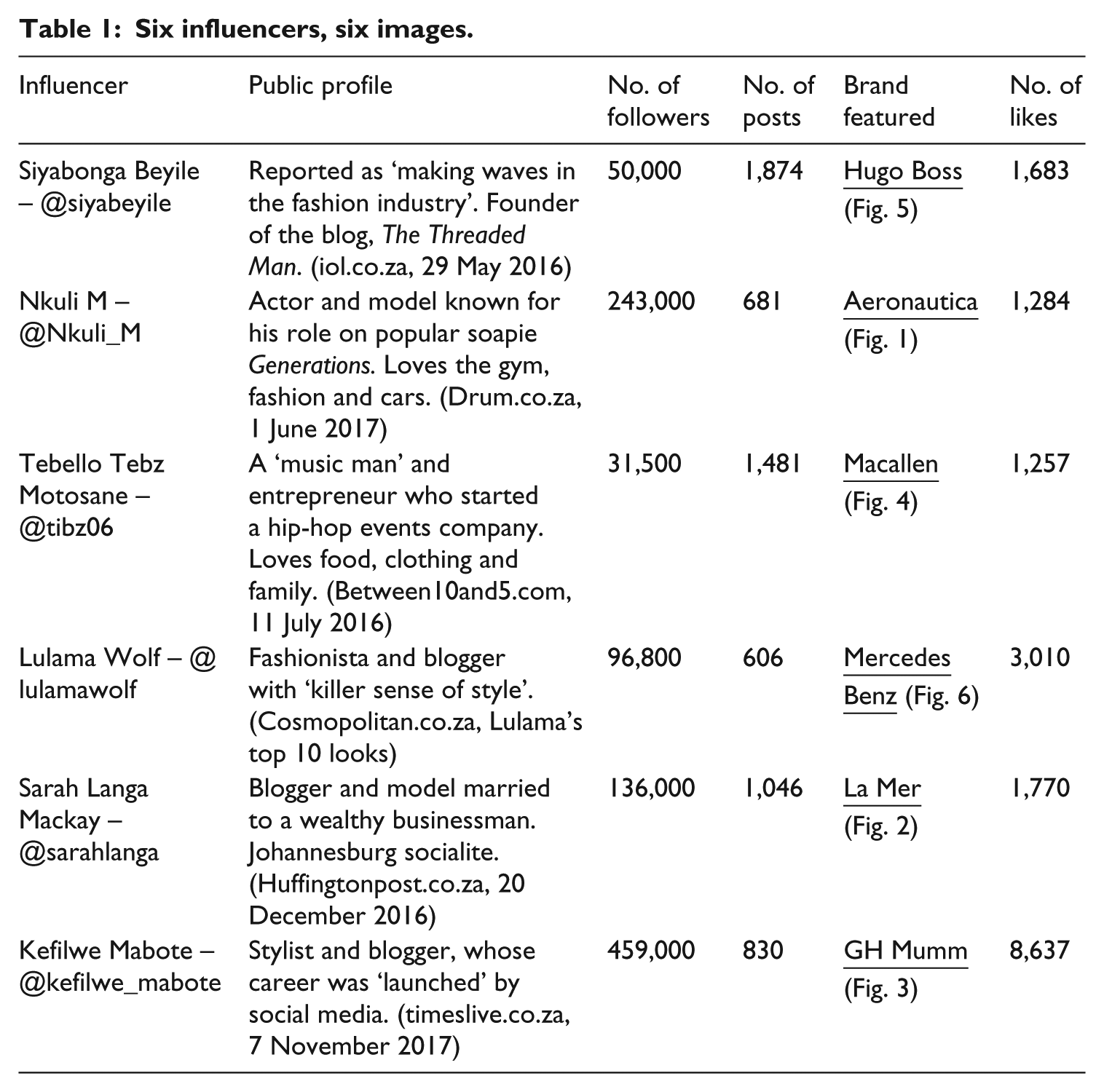
Instagram is established as a key social media platform in which ‘influencers’ are active (Veirman et al., 2017). As one of the most popular image-sharing social media platforms, Instagram occupies a unique niche in terms of its visual approach. Images always ‘converse with people’ (Ewen, 2008a: 13) and have a particular communicative power (Schroeder, 2002, 2008). For the purposes of this study, six key South African social media users (three women and three men) were selected on the basis of the following characteristics: all six influencers straddle a status between celebrity blogger, high-profile fashionista and cultural commentator; each is well known and ‘followed’ in the South African social media space, and actively develops his or her public persona through ongoing digital activity; each Instagram profile has between tens of thousands and hundreds of thousands of followers and a very deliberate and prolific visual presence, as summarized in Table 1. A brief summary of each personality’s public profile, drawn from key media material publicly available, is also included for the benefit of readers not familiar with South African popular culture.
Six influencers, six images.
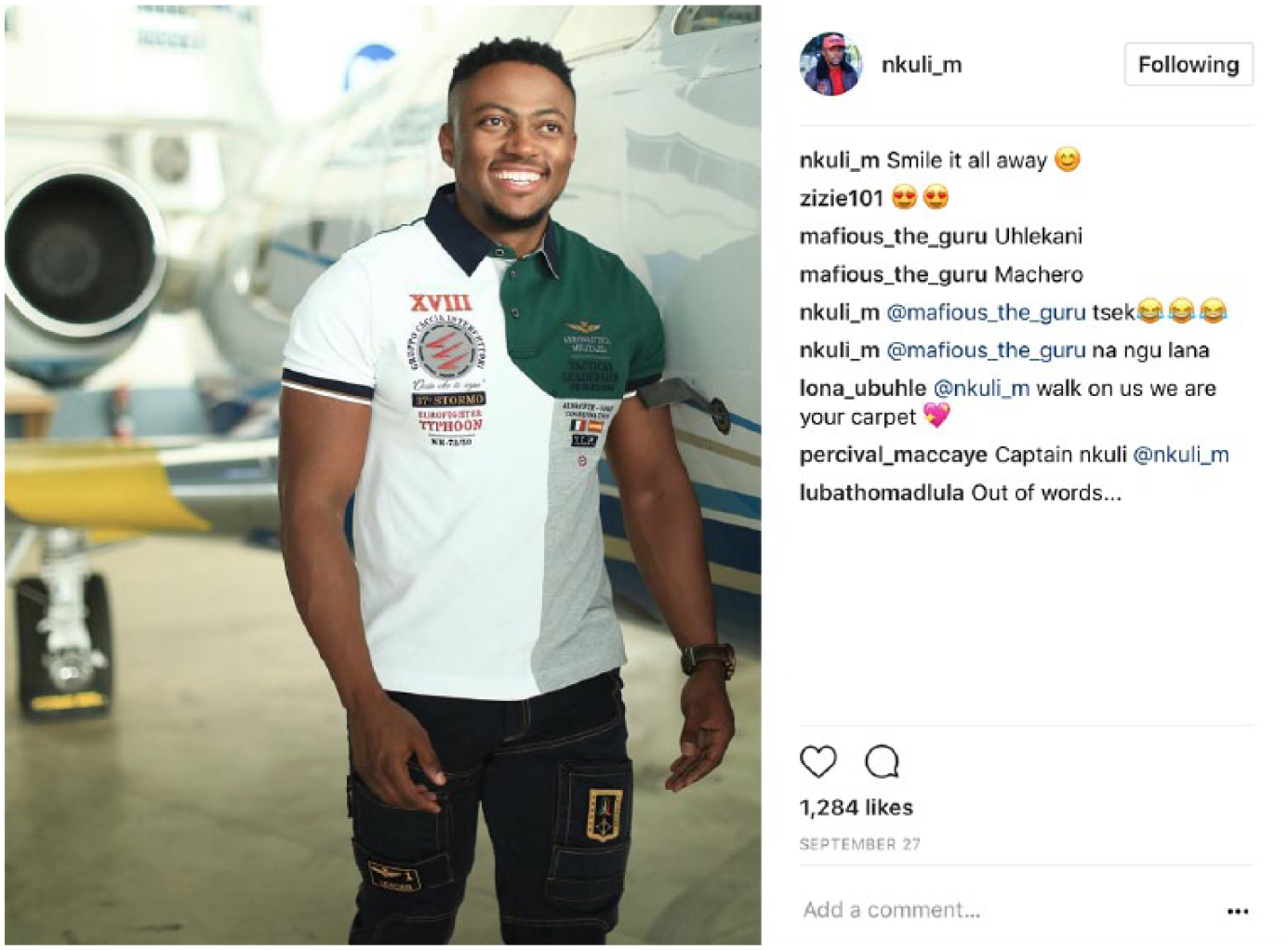
Nkuli M and Aeronautica.
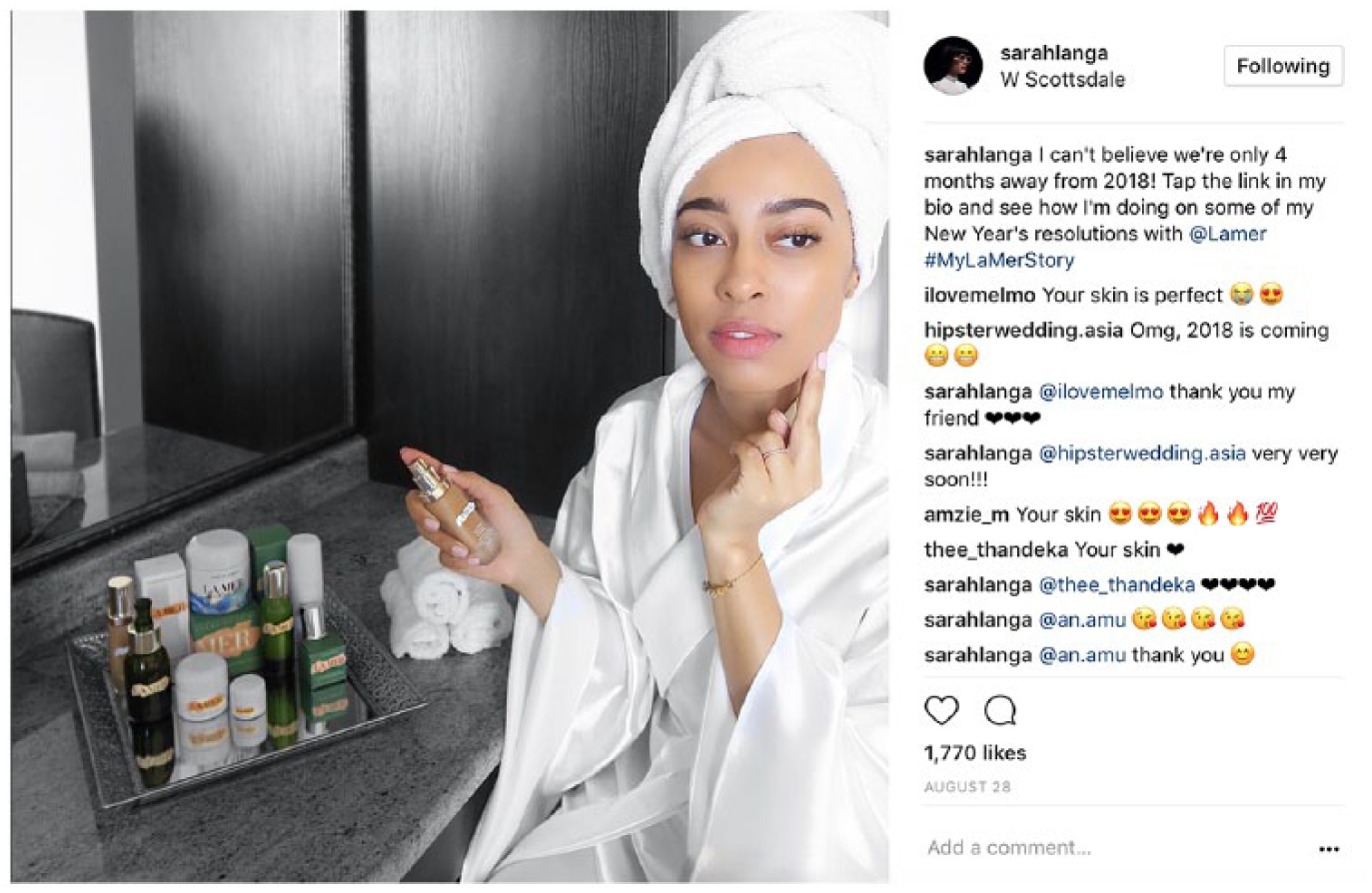
Sarah Langa and La Mer.

Kefilwe Mabote and GH Mumm.
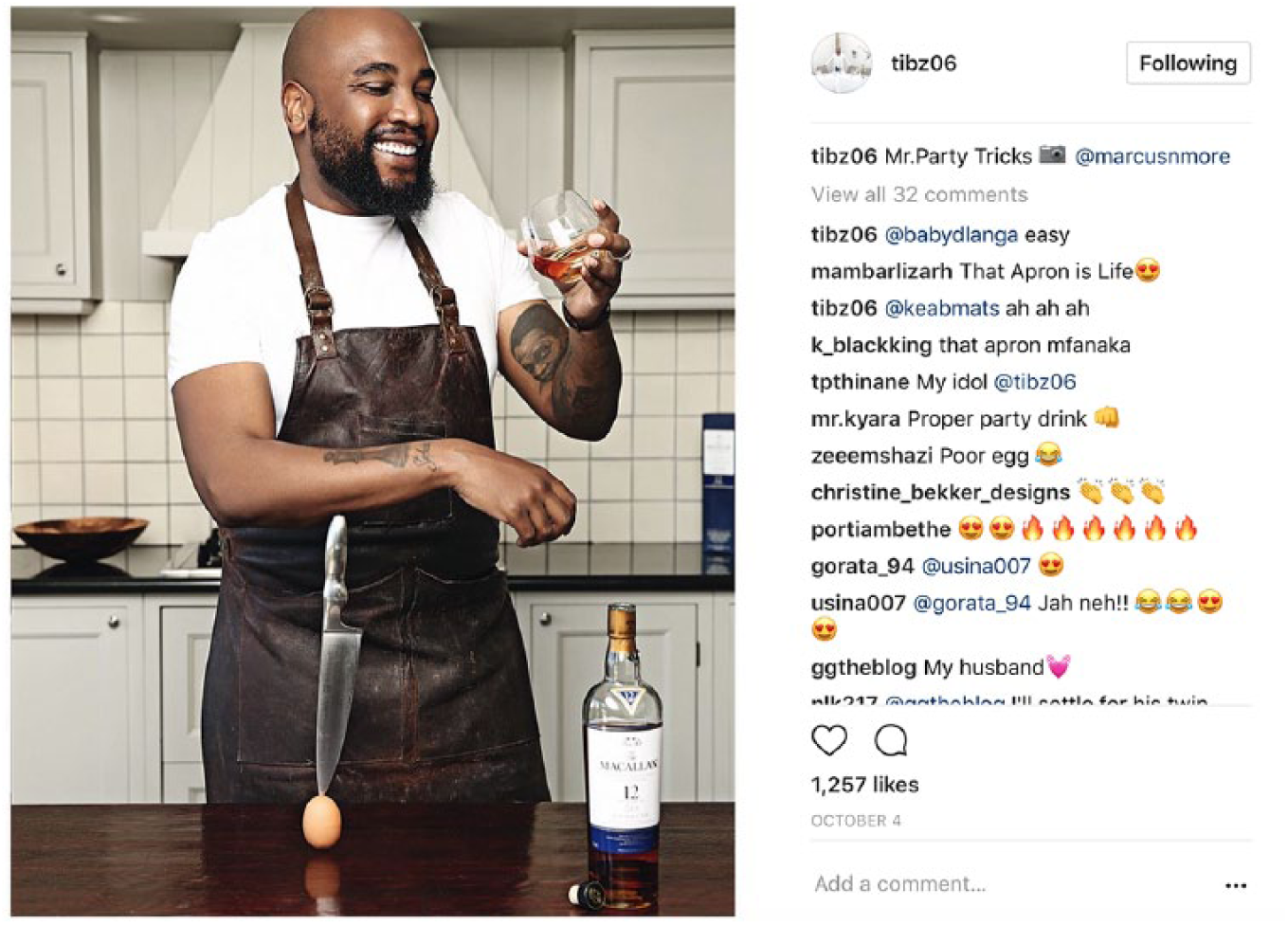
Tibz and Macallen.
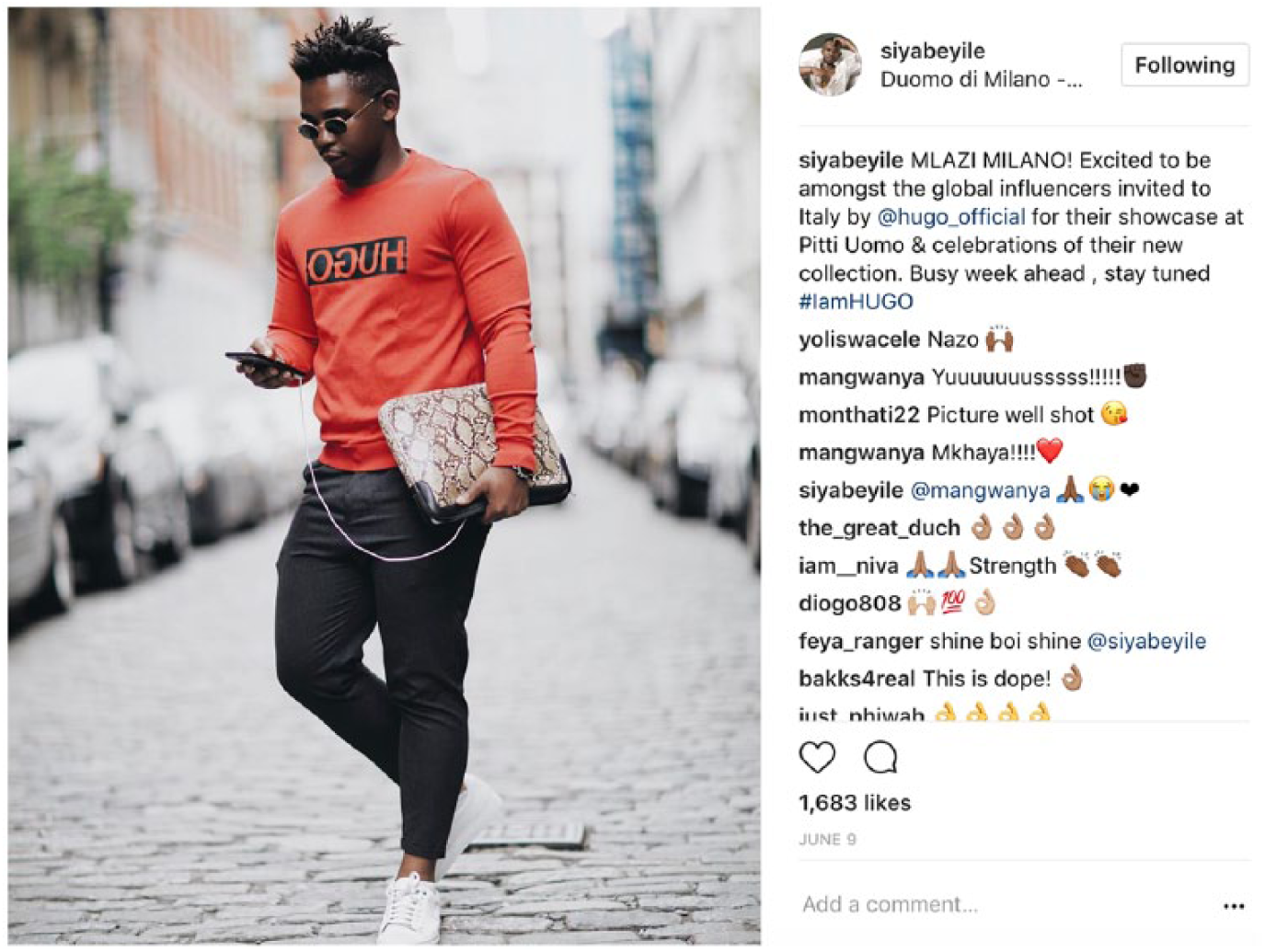
Siya Beyile and Hugo Boss.

Lulama Wolf and Mercedes Benz.
All six influencers regularly align themselves with global brands. One image in which the influencer is shown representing a high-end luxury brand was selected from each profile, and these images were analysed in dialogue with one another in order to develop an argument about the kinds of affective image work being undertaken.
Three levels of cultural labour in brand influencer imagery
All six brand ambassadors are unique, and in their respective profiles cultivate discrete visual narratives about their lives. Each of the brands they present in the respective images is different, ranging from skin care products to whiskey, from champagne to clothing and motorcars. The price points vary, and it is to an extent a matter of subjectivity whether each product can be defined as a luxury. The settings, content and aesthetic register of each image is different. It is impossible to determine from each image alone whether the relationship depicted between the influencer and the brand is formally contracted or an informal, temporary arrangement. What is clear, however, is that for the purposes of each image a relationship is claimed between the brand and its ambassador, and that all of the images show desirable and non-essential consumer products. All the images also function as exercises in the marketing of luxury through social media influencers. As such, it is worthwhile to pay attention to the ways in which the images – and indeed the influencers themselves – work in service of this project. This article posits that the cultural labour evident in the images takes place on three levels. The first encompasses the work done in order to establish credibility as a celebrity. The second involves the work done, as an ‘employee’ to represent the brand values and promote the particular commodity. The third operates on the level of consumer-citizenship and works to promote aspirational narratives and consumer lifestyles in the service of neoliberal capitalism writ large.
Building celebrity: branded individuals
Although all six influencers enjoy a different level of reach and recognition, they are united in their unambiguous aspiration towards achieving full-blown celebrity status and in their performance of celebritydom. Collecting large numbers of followers on Instagram has been theorized as a process of achieving ‘instafame’ (Marwick, 2015). As many of the most-followed Instagram users are already pop stars or celebrities (Marwick, 2015), it follows that those hoping to achieve Instafame will model their own profiles and presences on celebrity self-representation. The most famous celebrities in South Africa have well over a million Instagram followers, for example the reality TV star Bonang Matheba (
Although not technically selfies in that they were snapped by the hand of the person in the image, all of the images chosen for analysis are portraits, which centre the face, body and personality of the influencer, and are contextualized within the meta-self-representation taking place in the Instagram profiles as a whole. Portraits are powerful forms of address which are used strategically in the building of celebrity brands, for example on the cover of consumer magazines (Iqani, 2012). In the digital media age, celebrities have often used social media platforms in order to build a sense of intimacy, showing domestic scenes and glimpses into their private lives, for example Kim Kardashian (McClain, 2013). In contrast, social media influencers seem to devote a great deal more energy to creating a glossy aesthetic that positions them as celebrities with the necessary status to represent high-end brands. From this perspective, significant energy is required to present the self in ways that mesh with the aesthetics of mainstream, commercial media.
The influencers are at once working as models and working on presenting their personal brands in such a way as to align with the brands that they wish to attract and work with. This narrative is extremely individualized. Although all six influencers sometimes picture themselves with others on their Instagram profiles, or picture un-peopled scenes from their lives, there is a strong emphasis on the presentation of the individual self. This meshes very clearly with the individualist (McGuigan, 2010) and self-managing (Rose, 1990) values of neoliberal culture. Although the influencers are not formal employees of the brands in question, they are working to promote themselves as celebrities through their association with those expensive, luxury global brands.
Working the brand: commodity fetishism
Whether or not the influencers are formally employed in order to represent the brand, in the images shared they perform an intimate knowledge of the brand and a close association with it, such that their own personalities are put into service of the brand messaging. Each of the personalities is for the purpose of the image presenting themselves as an employee of the brand, whose job it is to represent its lifestyle and bring to life its values. In line with Aeronautica’s claim to an authentic link with military pilots and the aviation industry, Nkuli M is pictured in a hangar alongside an aircraft, and in line with Macallen’s claim to a ‘peerless spirit’, Tebz is pictured as a maverick foodie alongside his liquid amber sidekick, in accordance with GH Mumm’s claims to bold elite status, Kefilwe looks to the heavens … Notably, in five out of the six images there is a direct visual connection between the influencer’s looks and outfits and the commodities with which they are pictured.
Kefilwe’s white top, pale suit jacket and bright red lipstick mirror the colouring of the Mumm label, offset against the classic green bottle. Lulama’s black outfit and white sneakers invert the white bodywork and black trimmings of the Mercedes. Tebz’ white outfit and leather apron speak to the white bottle label and amber hue of the whiskey. Sarah’s milky satin gown and perfect caramel skin tone are reflected in the white packaging of some of the La Mer bottles as well as the caramel coloured sketch-motif of the La Mer logo. Nkuli offers his own well-muscled torso and shoulders as the clothes-horse for the logo-emblazoned Areronautica clothes. The close visual links between the individual identities and the commodities in their possession suggests a relationship deeper than mere association. It suggests that there is a kind of harmony between the ‘spirit’ of the brand and that of the individuals. Reflecting on Marx’s theory of commodity fetishism, Jhally argues that an ever-present ‘discourse through and about objects […] permeates the spaces of our public and private domains’ to the extent that it becomes ‘the lens through which we come to understand the world that surrounds us’ (Jhally, 2006: 102). This moral orientation is clear in all of the images analysed. It is significant that the commodities are represented not simply as objects but as items that are deeply embedded in the lifestyles of the influencers. Nkuli M could be just about to board that light aircraft, and Tebz is clearly at home cooking while drinking a tumbler of neat whiskey. Siya suggests that wandering the streets of Milan dressed in Hugo Boss while checking his smartphone is a normal part of his work life, Sarah explicitly states that applying the La Mer product is an important part of her daily routine, Lulama shows utter ease as she reclines on the hood of the Benz before the rush of Mercedes Benz Fashion Week kicks in, and Kefilwe exhibits confident delight at finding a magnum of champagne nestling against her on a couch. One way of making sense of this relationship with commodities that is represented is to rely on classic arguments about alienation. While capitalist exploitation empties commodities of meaning, advertising attempts to fill it once again with meaning (Jhally, 2006: 89).
Arguably, this function can be seen to be in operation in the six images selected for analysis. However, instead of the brand itself attempting to do this work, for example through billboards or glossy magazine adverts, it is outsourced to individuals who have shown themselves to be able to tell a story about the brand to their followers. All six influencers are working to inject ‘imaginary and symbolic relations’ (Jhally, 2006: 89) into the objects they picture themselves engaged with. But these messages are so closely aligned to the brand message as to be quite self-evidently directed by the brand even though they pretend to be directed by the influencers. From this perspective, the influencers are working for the brand; their job is to tell a convincingly positive story about it.
Interestingly, many high-end brands go to great pains to include narratives about the expert human labour that goes into their products. For example, in line with approaches of many wine producers (Beverland, 2006), GH Mumm includes exhaustive detail on its website about the vineyards, the growing techniques favoured by their champagne-makers, and the history of associating their products with royalty and haute cuisine. Similarly, Aeronautica tells the story of how the company was first established as a bespoke tailoring service for the Italian military, specializing in creating leather bomber jackets for pilots. This return to the story of labour (from which many mass consumer brands try to distance themselves) is an important component in the representational work of brand ambassadors. This filters into the visual realm. In all of the images analysed the influencers ‘speak’ authoritatively about the brands and their meaning. Lulama effectively captures the idea of dominating open space and mastering the landscape while she ‘owns’ the Benz by reclining on it. Sarah speaks to the efficacy of the La Mer skincare range through the pictured flawlessness of her own skin and her devotion to applying the product. Kefilwe captures the thrilling effervescence of the champagne itself in her expression and bodily posture, which suggests an attitude of fizzily floating up like the famous bubbles. As such, the job of ‘living the brand’ entails adding ‘magic’ into the presentation of the products by associating them closely with their own personalities and lifestyles.
Brand citizens: picturing aspiration
Notably, the brands being represented are global brands. The South African influencers are making claims about their place in the global brand landscape: positioning themselves as worthy of being able to enjoy consuming these brands, and as having an intimate knowledge of what makes them unique. They are not mimicking western aesthetics and values, these influencers are claiming belonging with global consumer culture on an equal footing. The relationship between the global and the local is presented as seamless in the images analysed. There is nothing locally identifiable about the settings of the images suggesting that they were taken in South Africa or are speaking to South African consumers, barring perhaps the landscape shown behind the parked Mercedes Benz in Lulama’s image. A strong message of global belonging is communicated in the images; these I summarize as a form of consumer-citizenship, following Nestor Garcia-Canclini (Canclini, 2001). Siya explicitly claims and celebrates his right to participate in the prestigious menswear fashion event, Pitti Uomo, and similarly the other brand ambassadors occupy the luxury of their respective brands without a hint of discomfort or uncertainty. They are performing a particular narrative of aspiration, in which access to global brands and commodities is considered natural. The celebration of access to the most elite echelons of global consumer culture is echoed in some of the comments on the images. In response to Siya’s pride in being able to state ‘#IamHUGO’, his followers comment with a range of adulatory emojis and statements, perhaps best summed up in @feya_ranger’s ‘shine boi shine’. Similarly, Kefilwe’s ‘joke’ about her strategy to help save water in the face of the terrible drought facing most of the country by drinking champagne, @nkay_n comments ‘role model’. These comments give some insight into what consumption means to black South Africans, and what it means for them to see very visible wealthy black South Africans represented in the media.
As I have written about elsewhere (Iqani, 2016), hopes for a better life are often organized around material markers of success and forms of consumption, both necessities and luxuries. These aspirations take on a particular set of political concerns when they are expressed by those who have been historically excluded and marginalized from national and global economies, as black South Africans were throughout apartheid, formally, and after thanks to its economic legacies. To an extent, the influencers are making a commentary about their individual rights, but also the rights of all those who look up to them, to have access to the elite luxuries of global brands. They are supporting the narrative that suggests that neoliberal consumer culture is democratic, that anyone who works hard enough can have their share of the pie. This narrative remains influential in South Africa, where aspiring black middle-class subjects are often forced to stretch their credit limits in order to have access to middle-class lifestyles (James, 2014) and entrepreneurs in the beauty industry report feeling empowered through making an income selling Avon make-up to other women (Dolan and Scott, 2009). However, they are also making a statement about their own cultural power in having successfully navigated the complex routes to gaining enough influence to be able to receive favours and endorsements from these brands.
All six influencers are attractive, young and comply aesthetically with the norms of global consumer culture. They are not rocking the neoliberal boat but climbing aboard. This does not mean that they are merging their identities and cultures with those of the western brands. Although it may be easy to critique this as merely serving neoliberal power, it is important not to ignore the extent to which many black South Africans aspire to full consumer agency and pleasure. In the hypermediated world, forms of public connection and aspiration are increasingly mediated by ideas of consumption, which sometimes eclipse notions of citizenship and sometimes exist alongside them. Consumers are citizens and vice versa (Canclini, 2001). What cannot be denied is that most people desire more opportunities to participate in the market economy, to drive nice cars, wear designer clothes, drink whiskey and champagne, and apply expensive creams to their faces: this does not mean that they are choosing western values over African values, but that they are claiming the right enjoy those things just as consumers do in the west. In the six images analysed, these aspirations are taken for granted, and their achievement celebrated. From this perspective, the images work to naturalize a particular narrative of success and happiness as something aligned with global brands and expensive lifestyles, while still being proudly South African. This sense of happiness is clearly communicated through the broad smiles of Tebz, Kefilwe and Nkuli, and the pride that their followers communicate through their comments. The message that commodities and brands can contribute to such happiness is an important part of globalized discourses of consumer culture, which need to consistently work to produce those messages in order to retain customers and access new markets.
The production of global brand value through local image work
This article has looked at six images shared by South African social media influencers in order to explore the kinds of cultural labour represented. It has been argued that the kinds of work done operate at the levels of celebrity, employee and citizen, all of which are iterations of brand ambassadors as conceptualized by management consultants. Without doubt, the work done by the ambassadors – on themselves, on the images they feature in, on the social media platforms on which they share them – contribute to building the value of the respective brands. On the one hand, they are material agents deployed to spread key brand messages to new markets (the upwardly mobile consumer in South Africa) and drive home the message that the brands are democratic and accessible to all. Although some commentators might wish to argue that these South African cultural workers are ‘imitating’ or ‘mimicking’ western aesthetics, this perspective is at best short-sighted (and at worst, racist). As Simidele Dosekun argues, black Nigerian women who favour a ‘western’ aesthetic in their personal styling do not see this as copying ‘whiteness’, but as a way of connecting with global, cosmopolitan blackness (Dosekun, 2019). Similarly, the South African influencers who at once celebrate and promote global brands are not trying to be western. They are claiming the fruits of global consumer culture as their own, and claiming their right to occupy the most elite and luxurious consumer identities available. From this perspective, it can be argued that, in the luxury goods marketing sector at least, there is a strong crossover between cultural labour in the global north and global south: the work undertaken by the influencers examined in this article is very much in line with that done by others globally, and in line with the brand identities and values of the products they are promoting. There is a sense of symbiosis as the brands use the influencers to build their reputations, and the influencers use the brands to build theirs, and carry on doing what they love (Duffy, 2017), as Kefilwe Mbote has been quoted as saying in media profiles (timeslive.co.za, 7 November 2017).
On the other hand, the ambassadors can be seen as ideological agents of globalized consumer culture in that they are allowing for their own identities and personalities to serve the bottom line of the large global luxury goods corporations that own the brands. Large global brands also typically exert significant control over how their brand values are communicated, and expect their brand ambassadors to stay true to the scripts designed in global head offices. The brands are western, and have way more economic power than the social media influencers. Because markets in the west are reaching saturation, the companies urgently need to reach new markets, and in order to do so they need to ‘localize’ their brand messaging by associating it with appropriate movers and shakers in the local scene. By finding locally relevant ways of capturing consumer attention, through alliances with influential figures on social media platforms, brands are able to extend their brand equity. As such, the work done by the brand ambassadors, although perhaps difficult to pin down in terms of formal employment contracts and material outputs, nevertheless produces value that is monetized – either through increased sales or through growth in the asset of brand equity – by the corporations that own the luxury brands. Although certainly not symmetrical the flow of value is not one-sided. The social media influencers are also able to build their own brands and reputations through associations with global luxury brands. The more elite the brand with which they are associated, the more likely they are to act as screens for the projections of their followers’ aspirations and consumer desires, the more followers they will get, and the more likely it will be that higher-prestige brands will be willing to engage with them and pay them to create online content. More research is required in order to understand how global brands perceive African markets (though this project has been initiated – see Iqani, 2019), and how global marketing workers interact with local brand ambassadors.
This article has mapped out merely one dimension of the cultural labour of brand ambassadors in South Africa: how their different forms of work can be read off the images that they share, and how in turn visual communication is a central part of the work of brand ambassadorship. As such, this article has a made a contribution to critical literature on branding by presenting the work of brand ambassadorship as a form of labour that produces value, rather than simply as a tool of the brand manager as the business school literature has it. This article has shown how the social media work of South African brand ambassadors fits into the operations of global brand marketing, and arguably is only mildly different from the communications campaigns implemented by the same brands in the west. What is notably distinct, however, is the extent to which the work feeds into aspirational scripts of belonging and citizenship, in ways that speak directly to the history of economic oppression and current reality of huge economic inequality in the country. The aspiration aspect is arguably an important dimension to ongoing research aimed at examining how studies of cultural labour can be de-westernized, as well as research that examines new forms of cultural labour in the global south. Future research should develop this research agenda by exploring in more detail, ethnographically and through interviews, the day-to-day lived experience of those doing this kind of labour, and their insights and experiences into what the work means to them, how it fits into their career trajectories and ambitions, and how they internalize, resist or renegotiate the brand values that they are expected to represent. It will also be necessary for future research to look into how non-influencers’ cultural labour on social media works to build brand value, as well as to explore the different processes through which brands and social media users align to build reach and influence across platforms.
Footnotes
Declaration of conflicting interests
The author(s) declared no potential conflicts of interest with respect to the research, authorship, and/ or publication of this article.
Funding
The author(s) disclosed receipt of the following financial support for the research, authorship, and/or publication of this article: This research received funding from the American Council of Learned Scholars’ African Humanities Programme, as well as a South African National Research Foundation Y-Rated Scholar grant.