




Abstract
This article traces the intersecting and interstitial spaces of political aesthetics in political street art featuring key activists of the Egyptian uprising of 2011–13 as well as the following struggle. We argue that the complex political expressions displayed in the images as recontextualized and embodied afford the images different roles in citizens’ political and social struggles. We develop three modalities of political street art – emplacement, travelling and conversation – that allow different works different roles in the political formation of subjectivity. In order to understand street art’s role in political subjectivity formation, this article applies visual discursive analyses to two expressions of political street art: first, the stencil of a blue bra, referring to sitt al-banat, a woman who was stripped naked in public as she was beaten unconscious by Egyptian military soldiers; second, the mural of then jailed activist Sanaa Seif in the Copenhagen borough of Christiania.
Visual aesthetics play a role in political discourse and public formation, that is, the discursive constructions of publics are visual as well as material and linguistic. The surge in street art in the early days of the Egyptian uprising clearly shows the practice’s political potential (Awad, 2017; Awad and Wagoner, 2017; Gröndahl, 2012; Kraidy, 2016b; Shehab, 2016). This article traces the intersecting and interstitial spaces of political aesthetics in street art featuring two key activists of the Egyptian uprising of 2011–13 and the following struggle. Intersecting and interstitial spaces are created by the complex workings of practices of political street art through which political aspirations are expressed. We argue that diverse visual modalities afford the images different roles in citizens’ political and social struggles. 1 This article investigates the ways in which political street art may contribute to the production and maintenance of a public uprising. We focus on two visual expressions that, for different reasons, have gained fame in media and among street artists and activists, because they enable us to address different roles of street art in political formation of subjectivity. First, we direct our attention to the case of the stencil of a blue bra, which created and repeated a stylized reproduction of a photo and footage of an attack on an anonymous woman by the Egyptian armed forces. The attack resulted in her garment being flung aside exposing her blue bra. The blue bra was stencilled by Bahia Shehab and distributed across Cairo and via social and legacy media. The second case we consider is a less mediatized mural portraying the activist Sanaa Seif in Christiania, Copenhagen. The mural showed the young activist laughing in an intimate image painted by her then-partner, widely acclaimed artist, Ammar Abo Bakr. This was not the first portrait he made of Seif abroad.
We approach the two expressions of street art of the revolution (Hamdy and Karl, 2014) through visual discourse analyses (Rose, 2016). Our identification of discourses draws on previous ethnographic fieldwork (Mollerup, 2015), theoretical arguments and a variety of media productions by street artists, activists and archivists. In the following, we discuss how street art creates political subjectivities. We ground this discussion in the context of the Egyptian uprising. We develop three modalities of political street art that help give rise to, explore and debate political subjectivities and discourses in public space: taking a point of departure in Egyptian street art and their reproductions, we trace their ability to (1) produce political subjectivities through their engagement with the political space in which they arose (emplacement), (2) travel across geography, genres and time (travelling) and (3) develop ongoing dialogue through co-creations on the walls (conversation). Subsequently, we analyse the stencil of the blue bra and the mural of Sanaa Seif employing the three modalities. In conclusion, we reflect on the complexities of visual and social interactions engendered through political street art.
Walls as political sites
Political street art may be understood as a form of citizen media (Baker and Blaagaard, 2016). Certainly, the examples of street art we are focusing on in this article are expressions of dissent or hope for social change that in turn allow the artists or ‘writers’ (Brighenti, 2010) to forge an alliance with or create counter- or subaltern publics (Fraser, 1992; Warner, 2002). As such, street art is here seen as an important revolutionary tool (Awad and Wagoner, 2017: 2), although clearly not all street artists are overtly political in their work (Brighenti, 2010; Cresswell, 1996; Gröndahl, 2012). Indeed, some argue that, rather than explicit acts of resistance and subaltern positioning, street art could be understood as merely forms of transgression in public space (Cresswell, 1996: 23). Cresswell argues that, in contrast to intended resistance, transgressive behaviour is judged by the onlooker and society rather than understood through the aims of the artist. That is, the expressions may be understood in political contexts, recontextualized and used for political purposes, regardless of the artist’s intentions. Necessarily, the political expression of street art enters into a conversation with the surrounding society in which it produces political publics. As such, ‘transgression represents a questioning of boundaries’ (Cresswell, 1996: 39) and boundaries and borders are not abstract notions, but also always embodied and political sites endowed with meanings. It is therefore central to take note of whose boundaries are being transgressed (Cresswell, 1996: 46). Like boundaries and borders, places are constructs of and construct meaning. Political street art is, then, not only transgressing the physical space, which authorities attempt to control, but also transgressing state-sanctioned meaning-making projects.
However, street artists may also choose deliberately to ‘insert themselves into the interstices of the formal spatial structure (roads, doors, walls, subways, and so on) of the city’ (Cresswell, 1996: 47). Political street art is often displayed on outer walls of buildings in the public realm in which it unavoidably interacts with the surrounding society. While walls in urban space may serve a purpose of governing urban people (see also Blaagaard and Roslyng, 2020, for further discussion), street artists use walls and architecture as sets of affordances that unfold and limit the process of expression. In this way, public space always presents a tension between material and discursive meaning-making processes and can never be reduced to either (Cresswell, 1996: 39). By way of this tension, street art produces an interstitial space because the practice defies definition. Brighenti (2010: 316–17) argues that graffiti may be defined as art, but it is always also a crime or a political act of resistance or a merchandisable product. Political street art inhabits all of these diverse qualities simultaneously and none of them completely.
What unifies the practice is its materiality – its insistence on occupying public space, sparking public discourse, creating a new public. W.T.J. Mitchell (2012: 10) points to the word occupy and argues that it signifies a takeover of empty – that is, not privately owned – space. Occupy, or in its Latin version occupatio, ‘is a demand in its own right, a demand for presence, an insistence on being heard’. However, Mitchell asserts, ‘the demand of occupatio is made in the full knowledge that public space is, in fact, pre-occupied by the state and the police, that its pacified and democratic character, apparently open to all, is sustained by the ever-present possibility of violent eviction’ (2012: 10, italics in original). To Mitchell, what remains as a visual site and icon of the revolutionary movements is the empty space – a monument to the revolution that took place or to the state-sponsored violence that eliminated it. The emptiness of the spaces ‘is a register of their historical character . . . where shared political speech and action occur and can just as quickly vanish’ (Mitchell, 2012: 18). Street artists’ practice is based on the materiality of the walls and streets that make up the ‘empty’ spaces. Boundaries are ubiquitous in today’s world, separating ‘us’ from ‘them’, both in terms of imagining others and in terms of material walls dividing land and communities (Awad and Wagoner, 2017: 1). Political street art may counteract boundaries by denying the formal spatial structure of walls the power to define and lay claim to the meaning of spaces (Cresswell, 1996: 47) while maintaining a liquid sense of definition (Brighenti, 2010). This is a form of ‘counter-occupation’ of public space (Mitchell, 2012: 12) that turns graffiti into political expression and a claim to existence. Political street art is therefore seen as citizen-producing media through which street artists ‘become citizens when they engage in practices – perform political or aesthetic acts of citizenship . . . that transform their sense of self and their environment’ (Baker and Blaagaard, 2016: 13, italics in original). Importantly, citizenship is not understood as a legal status in relation to a nation-state. Acts of citizenship are discursive acts that ‘disrupt habitus, create new possibilities, claim rights and impose obligations in emotionally charged tones; pose their claims in enduring and creative expressions’ (Isin and Nielsen, 2008: 10). Street artists become political subjects through transgressing state-sanctioned meaning-making projects independent of where they are expressed.
To many of the theorists of graffiti and public space, street artists and the object of their art are often perceived as interchangeable. Brighenti (2010: 327) writes, ‘[i]t is the writer’s body that makes a territory with his or her own graffiti, and it is in this sense that many writers say that making graffiti is a research one does in the first place on oneself’. However, during the Egyptian uprising, street art regularly portrayed particular people or martyrs. Some stencils – like the blue bra – were inspired by mediated violent acts against a particular body, and became stencilled symbols of the general struggle against this type of violence and oppression. Other work – such as the murals of Sanaa Seif – portray Seif’s political project and activism while she herself was unable to move and advance this project due to imprisonment. It is crucial to understand whether street art merely creates a political space for the artists and the publics they engage or also for the person portrayed. The political street art that grew out of the Egyptian uprising presents a unique opportunity to probe this issue, as street art at this time partook in an intensely contested and ongoing battle for the future of the country, which was fought with and by those portrayed in the artworks.
Egyptian political street art
A noticeable aspect of public spaces in urban Egypt during the uprising was the appearance of street art. Before the uprising, urban spaces in the country were controlled, with a permanent overt and covert police presence in many locations, as well as intense riot police presence on any occasion that authorities deemed potential expressions of dissent (Mollerup, 2015). The few street artists who practised at the time often worked at night and had limited time to create their works of art and dissent. Yet, even while taking precautions, they risked arrest (Jarbou, 2014). Other forms of media were also restricted (Sakr, 2013). When the Egyptian uprising was ongoing – effectively from when mass protests began in January of 2011 and until some time following the removal of Mohamed Morsi as president in 2013 – authorities had limited control over public space. This time presented street artists with very different circumstances in which to work. Though the threat of arrest and confiscation of equipment was still current, time restrictions were no longer a defining condition of their work in the streets. The revolutionary moment gave street artists the audacity and the community support to produce their street art in broad daylight, and enabled different types of creations, using more complex materials and designs, not necessitating swift completion in public. During this period, elaborate, multi-artist creations started to flourish on walls in urban spaces, most notably in Mohammed Mahmoud Street, adjacent to Tahrir Square. The sustained access to the walls was significant to the artwork produced. At times, the swiftness of appearance of new street art itself became the point of political protest. When authorities painted over the walls of Mohammed Mahmoud Street in preparation for the first anniversary of the January uprising, new street art had overlaid the hardly dried paint the following day (Abaza, 2013: 133).
The walls of this street have hosted many famous revolutionary street artworks and has relatedly laid ground for many street demonstrations and battles. Shortly after the authority-sanctioned attack on Ultras Ahlawy football fans during a match in Port Said, in which over 70 people were killed, street artists painted murals of those killed as martyrs (Mollerup, 2015: 33). As they painted, mourning friends and angry protesters gathered around them. Friends of the martyrs would visit the murals and pay their respects to their recently buried friends. Meanwhile, deadly clashes broke out with security forces around the artists and mourners, leaving the artists to switch their attention between the murals and participation in the battle (Morayef, 2012). The artists’ sustained engagement with particular streets was significant for the events that unfolded around them and vice versa. Thus, street art served not only as an ongoing political commentary, at times ridiculing and deconstructing authority, but also as an active engagement with street battles and revolutionary grievances.
After Al-Sisi was inaugurated as president in 2014, authorities increasingly started to regain control over public space: demonstrations and other events that included dissenting bodies in the streets were few, small and quickly broken up by state violence. Many previously graffiti-adorned walls were whitewashed and had yet to regain the characteristic dusty desert-colour of many urban walls in Egypt. Street artists were forced into exile – as in the case of Ganzeer – in order to sustain the authority-imposed silence of the walls (Mallonee, 2014). Another, Hisham Rizq, died under suspicious and uninvestigated circumstances (Abaza, 2015a). With the space of freedom of expression in Egypt closing, many street artists took their practice outside of Egypt, where they can work without the threat of arrest and worse, and where their street art is less likely to be defaced for political reasons. While the location of these creations outside of Egypt does not easily produce interactions with Egyptian publics, they can achieve a presence in Egypt through digital replications and dissemination. In this way, street art and their replications are able to transcend restrictions in movement that dissenting bodies encounter, facilitating new political publics and acts of citizenship directed at Egypt, enacted beyond its borders. We wish to draw attention to the various ways in which street art serves particular political purposes in social struggles.
Three modalities of political street art
On the basis of the discussion above, we develop three modalities of political street art: emplacement, travelling and conversation. We use these modalities as a prism through which we unfold the two cases, the stencil of the blue bra and the mural of Sanaa Seif.
The first modality, emplacement, highlights how some street artworks gain particular resonance due to their occupation of specific walls. This modality emphasizes that urban geography becomes part of the communication and manifestation of street art, and allows a political interaction between the walls occupied by government and the walls claimed by street artists and other protesters. The term draws on anthropological theories of emplacement, which emphasizes relationships between bodies and environments (Howes, 2005; Mollerup, 2020; Pink, 2011) and which draws on Doreen Massey’s notion of place ‘not as points or areas on maps, but as integrations of space and time; as spatio-temporal events’ (Massey, 2005: 130, emphasis in the original). That is, this is a notion of place as constituted by movement and thus transient. Importantly for this modality, the physical and social space impact on the creation and experience of the visual artworks. The engagement with street art, painted in the same streets in which the violence they portray took place, can play an important role in ‘changing media from an object of individual consumption to a tactic for producing new environments and collectivities’ (Mollerup and Gaber, 2015: 2906). Examples of street art which call attention to aspects of this modality are artworks in Mohammed Mahmoud Street (Image 1). Here, street artists were approached by locals, who, through this engagement, heard a different story of the martyrs than the one reported by state-sanctioned media (Elias, 2014: 91). In this way, street art enabled encounters between people while simultaneously serving as an interaction with events taking place around it. This is also highlighted by graffiti of revolutionary chants, which were written on the walls of the streets in which the chants were shouted, thus providing a written record of the street’s aural history.
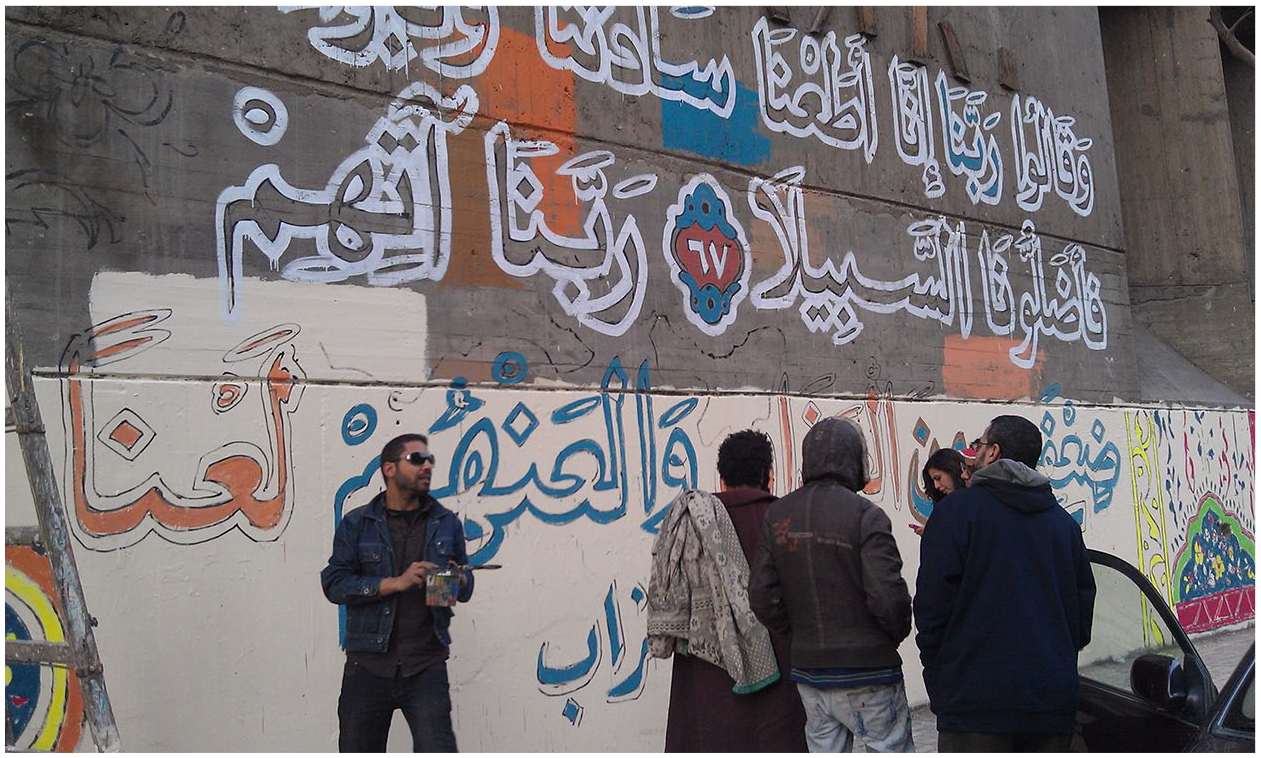
Mohammed Mahmoud Street
The second modality, travelling, highlights the continuous recontextualization of street art through its reproduction in different times, genres and places. The travelling element of street art allows particular events that inspired original artworks to engender symbols, which in turn are applicable to other events or political struggles. In this way, travelling street art enables international relationships between political struggles, thus affording it extensive currency. An example is the Guy Fawkes mask, which originated in Christian in-fighting in 17th-century England. This origin is all but obscured by the use of the mask’s iconography in Vertigo Comics’ graphic novel, in the Hollywood production V for Vendetta and by the anti-capitalist hacker group Anonymous. In this way, the diverse modes of travelling of the Guy Fawkes mask iconography contribute to political struggles of otherwise unrelated publics. Furthermore, travelling may occur as an embodied necessity when street artists are forced into exile or are prevented from working in their local contexts and their work travels with them. Concomitantly, even more complex works may be produced by the same artist with the same motif in various locations. Inviting Egyptian street artists to Europe, as many European cultural institutions did, is not unproblematic, but may hide a Western gaze trying to capitalize on revolutionary expressions. More problematic still, as Mona Abaza asserts (2017: 188–9), is the common coupling of Western interest with glaring ignorance of the Egyptian political context. Nevertheless, it is important to keep in mind that such street art works in multiple ways and can transcend or ignore Western interests and act in relation to local, Egyptian contexts. The travelling modality, then, relates to an international and postcolonial historical contextualization and a critical assessment of the particularities of production of each work.
Finally, the third modality, conversation, highlights ongoing dialogue through co-creations on the walls. Some street artworks continue to unfold by different artists adding to or changing them, thus allowing them to grow, evolve and enter into ever-shifting conversations. Speaking of the occupied West Bank, Julie Peteet (1996: 139) suggests that: ‘One could read the battle of the walls much the way an archaeologist reads stratigraphy – layer by layer – each layer of paint indicating a partial and temporary victory in an ongoing battle.’ Similarly, Awad and Wagoner (2017: 7–8) approach street art as a public dialogue between producers, audience and authorities. It is a dialogue, however, which ‘presupposes change rather than stability, involving the constant negotiation of thoughts and meanings together with the creation of divergent social realities’ (Brighenti, 2010: 8). This third modality is exemplified by the Unlock your passion mural on Mohammed Mahmoud Street by Russian-Syrian artist, Dina Saadi (Larsen, 2015) and the Tank vs Biker artwork by Egyptian street artist Ganzeer in Zamalek, Cairo (Gröndahl, 2012: 24–9; Hamdy and Karl, 2014: 127–30; Shehab, 2016: 165–7). Tank vs Biker was created in May 2011 and began as such: a mural of a tank facing a boy on a bike carrying bread, painted under a bridge in Zamalek. After the events of ‘Maspero’, in which the Egyptian army ran over and killed protesters with armoured personnel carriers (APCs), other street artists replaced the bread boy with protesters holding Guy Fawkes masks so that the tank now appeared to be running over protesters (Image 2). Subsequently, a pro-military group known as the Badr Battalion replaced the Guy Fawkes masks with Egyptian flags and painted over the dying protesters so the work came to be a celebration of the military. This artwork continued to evolve through new additions (Hamdy and Karl 2014: 127).
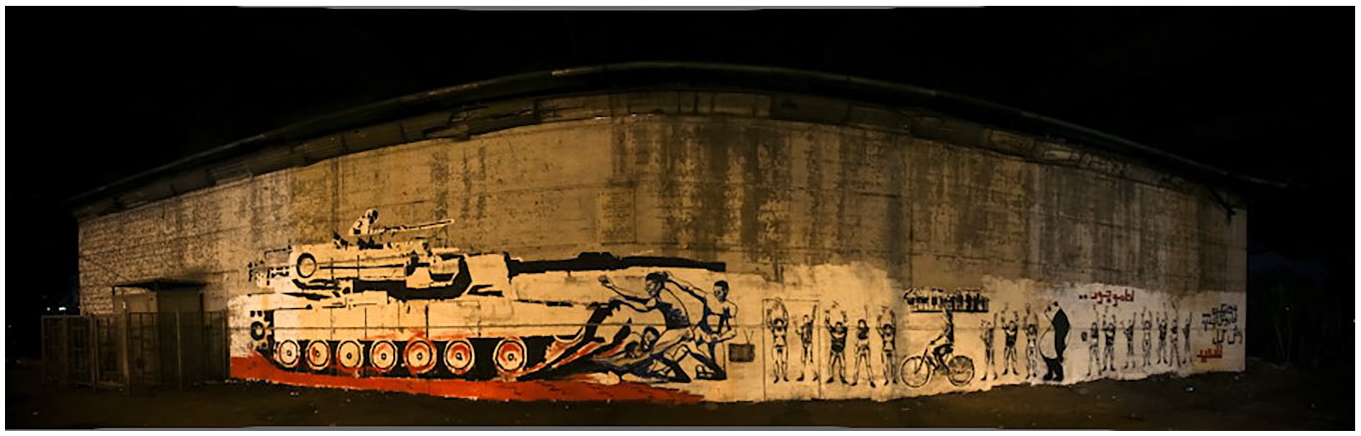
Tank vs Biker
While the ephemeral nature of street art grants that murals such as Tank vs Biker is continuously changed and defaced, not all contributions are welcome. Personal and political relationships within groups of street artists and activists may dictate who and what can be expressed on the walls of the uprising. Unlock your passion was created in 2015 and sponsored by a Scandinavian NGO project entitled Women on Walls (Image 3). Saadi’s mural of a heart with wings and a keyhole sported the message ‘Unlock your passion’ and was painted from a crane rented for the purpose. The mural was met with the harsh reality of the local activists’ anger and put inter-group differences on display, when a response was immediately scrawled across the bottom of the mural stating: ‘we’re locked in a counter revolution. Fuck you and your passion’ (Larsen, 2015). In general, street art may be seen as a practice that creates a counter-public opposing the ruling parties, which in turn are perceived as conservative and stifling the will and freedoms of the people. However, it is not only a practice used by revolutionary activists. The military and the Muslim Brotherhood were also active stencil practitioners and social actors on the walls (Awad, 2017). Thus, while street art itself is a challenge to state control over public space, street art might still propagate state-sanctioned meaning-making projects. The third modality thus emphasizes both the struggle over the topic of the conversation and the right to participate in it, bringing to the fore conversation as a battle of territoriality.
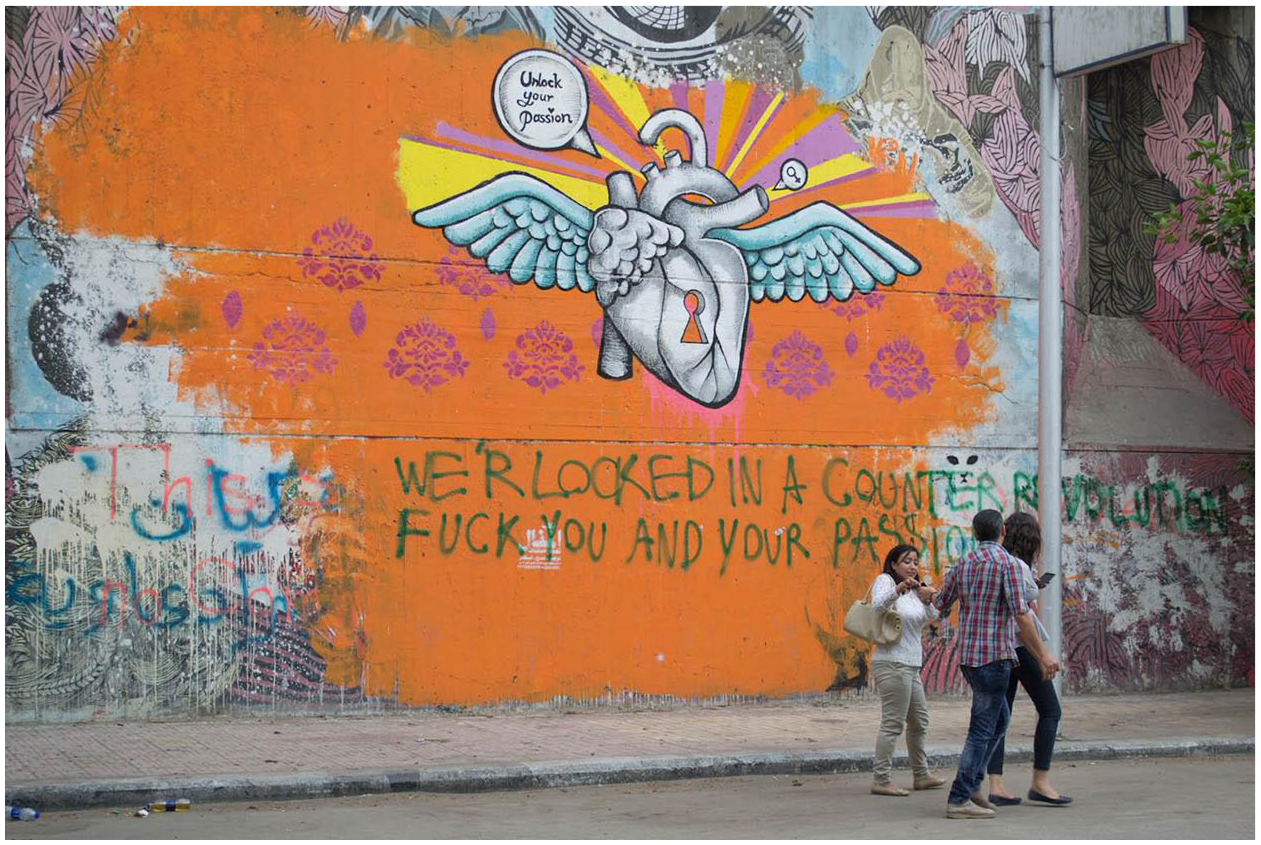
Unlock your passion
Each of these three modalities produces a political aesthetic. The accessibility of the walls also plays into the artworks. While uninterrupted access to the walls may not be necessary, access and ability to occupy particular walls is a prerequisite for street art. Whereas murals clearly require access to the wall for an extended period of time, stencils – although time-consuming in preparation – can be carried out comparatively quickly in public space. Each piece, then, is marked by whether the artists need to be swift due to government-sanctioned patrolling of the space and security threats, or are able to take their time and perform elaborate pieces in the streets. Therefore, importantly, street art is embodied practices of ongoing conversations in public space (Brighenti, 2010: 329). Appropriating public space by producing street art on public walls, the artist ‘opposes the static, monumental politics of the dominant with the mobile, personal tags of the dominated’ (Cresswell, 1996: 47). Thus, street art produces political subjects and counter-publics. In the following, we unfold this argument by analysing the stencil of the blue bra and the mural of Sanaa Seif in Christiania through the three modalities.
The stencil of the blue bra by Bahia Shehab
On 17 December 2011, a young female protester was physically assaulted by the Egyptian army in Cairo’s Tahrir Square during a revolutionary street protest: dragged and stomped on by several soldiers. In the turmoil, the woman’s abaya covering her hair and upper body was pulled over her head revealing a blue brassiere (Image 4). The incident was photographed by Al-Masry Al-Youm photographer Ahmed Almasry and further documented in a short piece of footage, which was uploaded to YouTube and spread virally through social media sites to mainstream media (Hafez, 2014; Kraidy, 2016a; Linssen, 2018). The following day, the image was on the front page of El Tahrir and many carried the newspaper as placards in following demonstrations (Mollerup, 2015). The woman remains anonymous to the general public to this day, 2 but became known in public as sitt al-banat, which translates roughly to ‘the woman among women’ or ‘the lady among girls’ (Kraidy, 2016a: 181) or ‘the most honourable of girls’ (Awad, 2017: 241). In the English language, the woman became known as the Girl/Woman with the Blue Bra or simply Blue Bra Girl (Kraidy, 2016a: 177–81). She was ‘catapulted to global but anonymous fame’ (Kraidy, 2016a: 178) because of the images. This fame was further supported by the production of stencilled work by street artist and visual scholar Bahia Shehab depicting a blue bra. The blue bra stencil was often accompanied by the words ‘No’ in Arabic as well as ‘No to stripping the people’ (Linssen, 2018; Shehab, 2016: 168–9). In the latter case, the shape of the Arabic word for ‘No’ mirrors the neckline of the bra, and below the bra is the mark of a footprint signifying the armed forces’ abuse and spelling out ‘Long live the revolution’ in Arabic (Shehab, 2016: 168) (Image 5). The stencil of the blue bra and the distinct Arabic sign signifying ‘No’ is part of an extensive and continuing art installation by Shehab preceding the uprising, which explored the many meanings and reasons for the word ‘No’: ‘No to Military Rule, No to Emergency Law, No to Postponing Trials . . . No to Stripping the People, No to Blinding Heroes . . .’ (Shehab, 2016: 168). Each ‘No’ related to an incident of violence against Egyptian people. This particular campaign of Shehab’s added the stencil of the blue bra to the words, ‘No to Stripping the People’ because it was inspired by the moment that for many ‘stripped the army of any respect the people had for them’ (Shehab, 2016: 168).
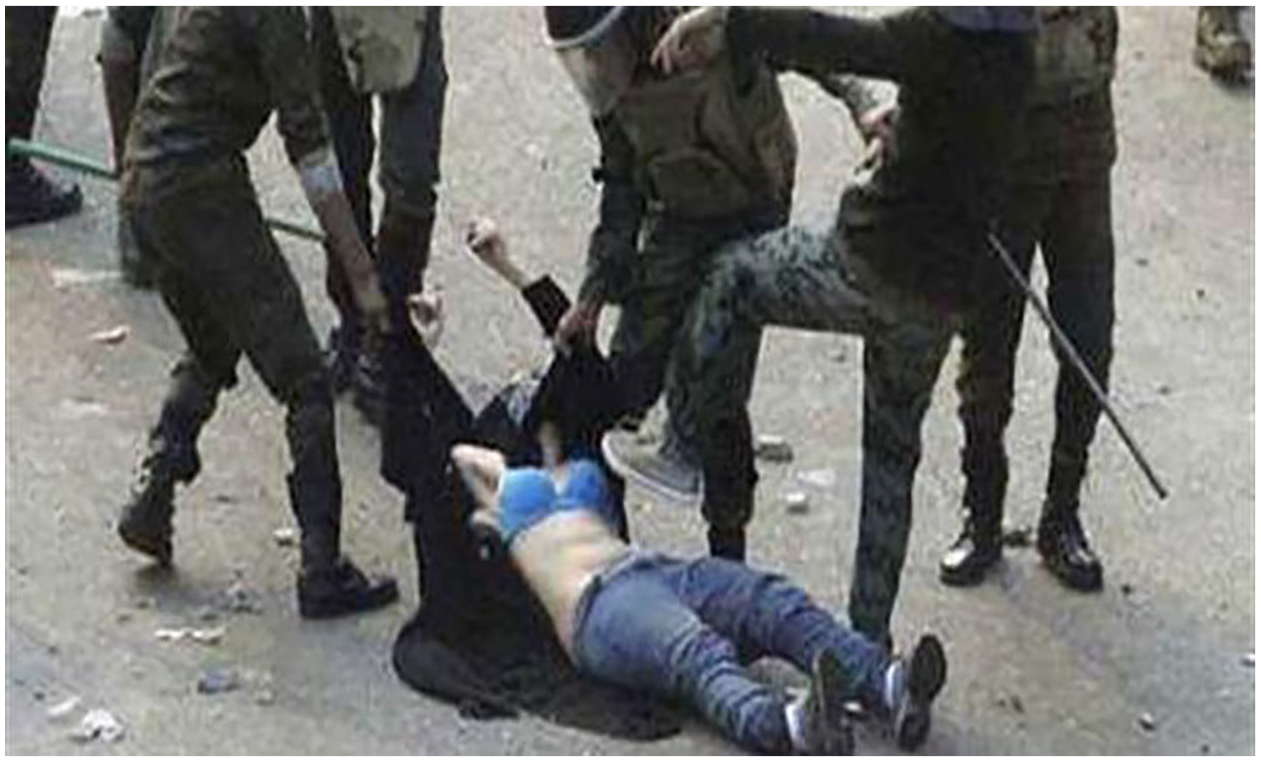
Sitt al-banat

Blue bra stencil
Emplacement
As an individual stencil, the blue bra draws on aspects of all of the three modalities of political expression to different degrees. In terms of emplacement, the stencil was initially produced as a reaction to the attack on sitt al-banat in the streets adjacent to Tahrir Square. This area was significant because the attack and continuous demonstrations and sit-ins took place here, thus allowing the stencil to be part of the ongoing struggles. This particular emplacement further enabled a commentary on events, much like a cartoonist in a newspaper, but through the engagement of passers-by and fellow artists the work became ‘alive’. ‘As we painted the walls, we constantly chatted with each other, and with people on the streets’ (Shehab, 2016: 164). Thus, the stencil and the street artists publicly interacted with the surrounding community. The stencil then became part of a collective production of street art drawing on the attack on the protester of 17 December, which in correlation with other street media initiatives in Egypt at the time, allowed creativity to become a ‘tactic for producing new environments and collectivities’ (Mollerup and Gaber, 2015: 2906).
Travelling
The stencil travelled across walls, crossing borders, boundaries and genres, lending it characteristics relating to the second modality. By virtue of its particular craft and because of social digital media, the stencil was replicable and travelled across digital spheres as well as around the walls of Cairo. Within six months of Shehab’s first stencil ‘someone took a photo of the stencils and the campaign went viral. Three weeks later, it was featured on the third page of one of the leading local newspapers, below the image of Mubarak’ (Shehab, 2016: 169–70). This assured Shehab that the message was heard loud and clear. While the stencil was overwritten or defaced on many walls, the message continued its journey to Beirut (Kraidy, 2016a: 179) and through other media. However, having travelled from the streets to digital screens and the frontpage of El Tahrir and back to the streets, from the outset the image of a blue bra – separate from Shehab’s stencil – received widespread currency on its own terms as a symbol of resistance against violence against women. The blue bra was reproduced by activist and street artist El Teneen in Cairo (Awad, 2017: 240; Gröndahl, 2012: 42). In the rendition by El Teneen, the woman wearing the blue bra resembles a superhero, running towards the viewer with clenched fists and flying cape. Moreover a stencil of the bra and the words ‘What’s next?’ featured on walls in the district of Dokki, Cairo (Gröndahl, 2012: 48–9). In this way, the blue bra travelled as a symbol across genres irrespective of the woman it originally concerned.
Conversation
The stencil at its outset was part of a public conversation, which invited people to comment or just look at or disagree with it, writes Shehab. It was a way of ‘translat[ing] some of the pain and anger, and honour the victims, through visual language’ (Shehab, 2016: 164). Thus, the stencil engaged in public space and discourse, insisting on being heard (Mitchell, 2012: 10) or, in Shehab’s understanding, at least conversed with. In the interest of conversing, Shehab also contributed to Tank vs Biker (Image 2, discussed above) by superimposing the blue bra and the word ‘No’ on the wall, intended as a homage to Ganzeer’s work (Shehab, 2016: 170–1). Thus, the stencil became part of a collective of street art production in Cairo: ‘Every wall we sprayed became a conversation, like an open invitation for people to comment on or just look at what we drew, and contemplate or ignore it altogether’ (Shehab, 2016: 164–5). Even erasure or negative response was seen by Shehab as part of the conversation, telling her ‘I don’t want to read it’ (Shehab, 2016: 164). Especially selective erasure highlights the acknowledgement of the meaning-making power of street art. Awad (2017: 243) argues that ‘Erasing also is as much a symbol as introducing one’, because it changes the original meanings of street art into something new – opposing or amplifying them. Therefore several competing social actors – the military, the Muslim Brotherhood and revolutionary activists – engaged in the conversation on the walls of Cairo (Awad, 2017).
A mural of a laughing Sanaa Seif by Ammar Abo Bakr
In May 2016, Egyptian activist Sanaa Seif was imprisoned on charges of ‘insulting a public official’ as part of the regime’s increasing crackdown on all forms of dissent (Frontline Defenders, n.d.). Shortly after, her then-boyfriend, street artist Ammar Abo Bakr, painted a mural of her laughing on a plywood wall in the free-town, Christiania in Copenhagen, Denmark (Image 6). 3 The mural was painted next to a mural of ancient Egyptian ruler, Tutankhamun. The image was an intimate close-up of Seif, who was laughing forcefully with one hand over her eye as if drying off tears of laughter. The mural bore the accompanying text ‘hahahahaha’ in Arabic. Abo Bakr describes this as being about Seif ‘making fun of the law in Egypt’ (personal communication, 12 July 2019). Upon being summonsed, she had described her court case as a ‘charade’. As of July 2019, the mural was no longer there and the top part of the plywood wall had been taken down. Locals we spoke with did not remember seeing it; nor did they have any idea of who Seif is. The Tutankhamun mural was still there though it had been altered significantly. On an opposing wall, a years-old mural of deceased Danish rapper, Natasja, was intact. ‘No one will touch that, because she is one of our own’, a local explained to us, referring to Natasja’s fight for the existence of Christiania as a free-town.
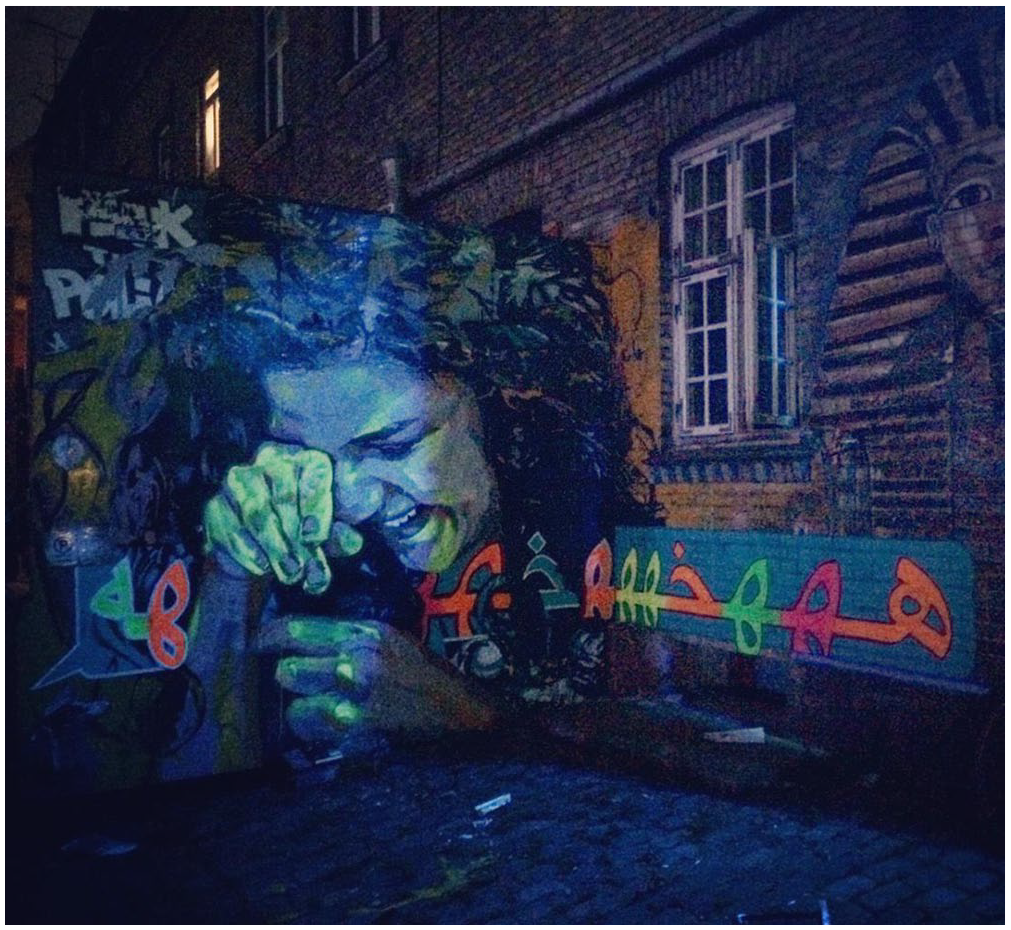
Sanaa Seif mural
Seif comes from a family that has a long history of political activism in Egypt and, like herself, many of her family members have been imprisoned for political reasons. Her incarceration in May 2016 was not her first and Abo Bakr had painted murals of her in Cairo and Rome during her previous imprisonment. These murals were photographed and spread digitally, including by Abo Bakr on his Instagram and Facebook accounts, reaching friends and followers in Egypt. The mural in Rome was used by friends and family of Seif in a campaign to free her and other political prisoners in Egypt. 4 While Abo Bakr’s work and other revolutionary Egyptian street art has been extensively covered in academic literature (see for instance Abaza, 2013, 2015b, Abdelmagid, 2013; Abou-Setta, 2015; Awad and Wagoner, 2017; de Ruiter, 2015; Findlay, 2012; Hamdy, 2015; Kraidy, 2016b; Lennon, 2014; Naguib, 2017; Nicoarea, 2014; Sanders, 2012; Schielke and Winegar, 2012; Sharaf, 2015; Wagoner, 2019; Zakareviciute, 2014), the mural of Seif in Christiania has not received any specific attention.
Emplacement
The mural of Sanaa Seif in Christiania displays qualities from all three modalities mentioned above, yet in very different ways than the stencil of the blue bra. While being placed far from the streets of Egypt, its location in Christiania is not irrelevant or random. Christiania is a place with a history of creative expression and citizen-driven, anti-establishment ways of organizing, and Abo Bakr had a particular wish to do a mural there (personal communication, 12 July 2019). At a time in which access to walls in Egypt was restricted and dangerous, the walls of Christiania served as an extension of the walls of Egypt. They allowed for political expression for and about Egypt even if not emplaced in Egypt. The mural engendered conversation in spite of being - and because it was - placed outside of Egypt and allowed Abo Bakr to engage in acts of citizenship aimed at Egypt at a time when both he and Seif were deterred from doing so in Egypt. This particular emplacement affords Seif and her political project an international presence in spite of her physical body being confined in an Egyptian prison and while the physical walls of Egypt are thoroughly controlled. In this way the mural in Christiania serves to separate the idea of her and her political project from her physical body (see Kraidy, 2016b: 126). When Seif was imprisoned in 2020, 5 Abo Bakr’s murals of Seif (along with drawings and photos) were shared anew on digital platforms, including by himself. At this time, the murals gained durability that was aided by both their emplacement outside of Egypt and its travelling to Egypt and beyond.
The murals Abo Bakr painted of Seif in downtown Cairo, Rome and Copenhagen were all painted while she was imprisoned and thus also served to insist on the injustice of her incarceration. Abo Bakr had previously stated that his reason for painting martyrs was not out of a concern with the martyr, but rather, he ‘put the image of the martyr in the street to disturb the people who murdered him [sic]’ (Mousa, 2014). In the same vein, the murals of Seif could be understood as a way to disturb those who imprisoned Seif, that is, the military regime. Understood in this way, the international emplacement of the murals in Rome and Copenhagen can engender a conversation with and about the diplomatic relations between Egypt and the respective countries, and serves not only to disturb the incarcerators, but also the international backers which normalize and legitimize the Egyptian military regime through diplomatic engagements and trade. 6
Travelling
The likeness of Seif was recontextualized by travelling geographically and in genres. By producing the mural in Copenhagen, Abo Bakr allowed her political project to travel geographically. The preceding mural in Rome further supported this by extending the reach of the travelling and thus her uncontainability. However, the murals outside Cairo were mainly seen by Egyptians through travelling in genre, as digital images of the murals were shared by Abo Bakr and others close to Seif. These digital images did not engage with the most significant places of the revolution – the streets of Egypt – and as such, they did not so much transgress public space in the streets as private space on screens. Seif’s image travelled between analogue and digital genres as well between different expressions within the genre of mural art. Through entering into private revolutionary spaces, the image was able to forge an alliance with a counter- or subaltern public in a very different way than it would, had it been emplaced in the streets of Egypt. In this sense, the dissemination and circulation of the recontextualized reproductions of the murals of Seif and their digital accompaniment while she was imprisoned become even more significant than its emplacement.
Conversation
The mural in Copenhagen significantly engaged in a conversation with the surrounding walls, both through the appropriation of the Tutankhamun mural and through its position across from a local ‘martyr’ of Christiania. In addition, a piece of graffiti in the upper left corner of the wall, saying ‘fuck the police’ was left uncovered by Abo Bakr. In this way, the mural entered into a conversation with local struggles against authorities; a conversation that was continued when posters saying ‘end police violence’ was placed next to the mural, in turn drawing attention to police violence in Egypt as well. The conversation engendered by the mural in Christiania was thus both part of the Egyptian uprising and a general struggle against police violence and abuse of power even if it did not engage directly with the streets of Egypt.
Conclusion
Through visual discursive analyses of two case studies, we have shown how three particular modalities of political street art – emplacement, travelling and conversation – afford the stencil of sitt al-banat and the mural of Sanaa Seif two very different roles in political subjectivity formation. While the mural of Seif serves to further her political project, the stencil of sitt al-banat overwhelmingly refers to her assault rather than to her person or political project. The stencil is put forward into conversations sympathetic to her and, while she might very well take part in or sympathize with this struggle, the stencil is disconnected from her person and political project; it simply does not engage with it. Her vulnerability in the encounter with the armed forces is not captured in the stencilled bra. Even the text in the footprint under the bra points not to her suffering, but to the continued struggle. The detachment from her political subjectivity and attachment to a greater cause allow the stencil to emulate and move with a variety of political discourses on the walls of Cairo and abroad. Indeed, the stencil of a blue bra condenses the details and unknowns of the violent event and its victim to a symbol of a struggle, while she remains silent.
The murals of Seif, in contrast, have an intimate connection with her and her political project, not least due to her own relation with the people who created and shared the murals and images of the mural. Poignantly, Seif’s political project includes a fight for those unjustly incarcerated in Egypt’s prisons and, correspondingly, the campaign by Seif’s family and friends for her release was always accompanied by demands to free all political prisoners in Egypt. A clear dissonance appears between the presentations of the two women: one is a condensation of a political struggle against violence against women into a colourful garment, the other is a deeply intimate and private view into an intensely political subject. If sitt al-banat all but disappears, Seif fills out the frame and then some in the overwhelmingly aesthetical image. The sound of her laughter, the wetness of her tears, the warmth of her skin are all reflected in the mural’s use of colour, texture and words. These expressions of citizen media, then, have a common cause but engage with diverging visual discourses of interaction, enabling different modes of political subjectivity formation.
Visual discursive analyses make apparent the connections between the modalities and the importance of how they interrelate. In the example of Abo Bakr’s travelling mural it is clear that, despite his initial invitation to Copenhagen by government institutions, he is able to produce a mural that, through its digital travels, supports the continued formation of an Egyptian counter-public. In this case, travelling affords a political subjectivity and public formation beyond the Western gaze. However, when sitt-al-banat travels, she changes from being the woman among women to representing the rather more abruptly titled Blue Bra Girl – a simplified sign for the idea of empowerment of women. Thus travelling is not a uniform visual modality, which adds a fixed, political quality to all street art. Like the practice of street art itself, the visual discourses are produced in intersection with the surrounding political and social materialities, in turn producing an interstitial space of multiple possible expressions. It is through these particular relationships that publics and political subjectivities are continually formed.

Seif in Rome
Footnotes
Funding
The author(s) disclosed receipt of the following financial support for the research, authorship, and/or publication of this article: The article is part of a project entitled ‘Images of Conflict, Conflicting Images’, funded by the Velux Foundation [13143] PI Mette Mortensen University of Copenhagen, Denmark.