



Abstract
Group decision making has attracted much scientific interest, but few studies have investigated group decisions that do not get made. Based on the Motivated Information Processing in Groups model, this study analysed the effect of epistemic motivation (low vs. high) and social motivation (proself vs. prosocial) on group decision refusal (the decision to delay choice and refuse all options). In a laboratory experiment, groups had to negotiate diverse preferences and choose one of three options or refuse all. When epistemic motivation was low decisions were made quickly, whereas high epistemic motivation more often led to refusal. This effect was partly mediated by perceived information insufficiency. Social motivation did not affect refusal, but proself motivation led to longer discussions, greater task conflict and more forcing behavior than prosocial motivation. Further, forcing was negatively related to decision refusal, but only when epistemic motivation was low.
Important decisions are usually made in groups: Boards of directors decide about business strategies, national parliaments about million dollar budgets, and international committees on how to handle financial crises. There are good reasons to use groups for these decisions: Groups have a larger pool of knowledge and abilities than individuals, and joint decisions may create greater acceptance. Much research has been done on this topic (for a review, see Kerr & Tindale, 2004), which has led to important insights concerning the role of preferences in group decision making (Davis, 1973), the processing and exchange of information (Greitemeyer & Schulz-Hardt, 2003; Stasser, Taylor, & Hanna, 1989; Stasser & Titus, 1985), and how group decisions are influenced by motivation (De Dreu, Nijstad, & van Knippenberg, 2008; Deutsch, 1949; Janis, 1972).
Although understanding how group decisions are made and how to achieve high quality group decisions is important, another important topic has largely been neglected: The question of whether or not a group actually makes a decision. In many situations, it is possible to postpone, put off, or refuse to make decisions. Whereas a number of studies have examined decision deferral at the individual level (for an overview, see Anderson, 2003), only few studies have addressed this topic at the group level (Kerr & MacCoun, 1985; Nijstad, 2008; Nijstad & Kaps, 2008; White, Hafenbradl, Hoffrage, Reisen, & Woike, 2011). We extend this work by focusing on motivational factors. Indeed, there is empirical support that motivational factors influence the willingness to reach consensus (Steinel, Utz, & Koning, 2010; Toma & Butera, 2009) and the way in which information is processed during group decision making (De Dreu et al., 2008; Stasser & Birchmeier, 2003), making it likely that motivation affects group decision deferral as well.
To investigate the influence of motivation on group decision deferral, we invoke the Motivated Information Processing in Groups (MIP-G) model (De Dreu et al., 2008). The model distinguishes two types of motivation. Epistemic motivation influences the degree to which group members engage in deep and deliberate information search and exchange. Social motivation refers to whether group members are driven by collaborative or competitive goals and can vary from proself (individuals are only interested in their own outcomes) to prosocial (individuals are interested in joint outcomes). The model predicts that the best decisions are made when high epistemic motivation is coupled with prosocial motivation, because then group members deliberately process information to reach high quality decisions that are accepted by most group members. However, when group members initially have divergent preferences we propose that high epistemic motivation may also lead to decision deferral. The reason is, we suggest, that group members who are high on epistemic motivation are unwilling to accept an initially non-preferred option unless they are fully convinced. Groups high in epistemic motivation may therefore delay the decision because they cannot reach agreement about which option is best. We examine this hypothesis, and further propose that the processes leading to decision deferral are different for proself and prosocial groups. Predictions resulting from our reasoning are tested in a laboratory experiment.
Decision refusal in groups
At the individual level, research suggests that decision deferral is more likely when no alternative is clearly superior to other alternatives in the choice set (when there is a decisional conflict; e.g., Anderson, 2003; Dhar, 1997; Luce, 1998; Tversky & Shafir, 1992). For example, when people have to make trade-offs among attributes (e.g., paying more for a better product vs. paying less for a lower quality product) they defer choice more often than when no trade-offs have to be made (Tversky & Shafir, 1992). Similarly, when an alternative is added to the choice set that is similar in attractiveness to another (attractive) alternative people more often defer decisions, whereas they defer less when an inferior option is added (Dhar, 1997).
We focus on one way to defer choice, which Corbin (1980) has called refusal. 1 Refusal occurs when decision makers do not choose among the presently available options but decide to invest more resources to identify further options. Indeed, in many situations, decision makers are confronted with a non-exhaustive set of options. For example, when choosing among job candidates, decision makers generally do not evaluate all possible options, because not all potential candidates will have applied. In these situations it is possible to delay choice and search for new options (e.g., put out a new advertisement to attract more applicants). Decision refusal is not by definition maladaptive: If all given options are inadequate it might be reasonable to look for further alternatives. However, at some point the costs of doing so may well exceed the benefits, and adaptive decision making should keep the costs and benefits of refusal balanced (Nijstad & Kaps, 2008; Tversky & Shafir, 1992). Further, research has shown that decision makers refuse even good options in situations in which there is a decisional conflict (e.g., Dhar, 1997; Tversky & Shafir, 1992).
Only few studies have analysed the antecedents leading to decision deferral in groups. Most relevant are studies on the effects of preference diversity. In a situation in which different group members enter the discussion with different preferences, they have to negotiate which option to choose. If they fail to reach an agreement, indecision may result. For example, Kerr and MacCoun (1985) studied the effect of jury size (3- vs. 6- vs. 12-person groups) and polling method (public show of hands vs. private balloting) on the juries’ verdict. They found that the rate of hung juries (indicating a non-decision) increased with jury size primarily when cases were close, and that public polling exacerbated this effect. Thus, when differences of opinion were likely (with larger juries and closer cases), and when members were less likely to abandon their initial opinion (with public polling), indecision occurred more often. Nijstad and Kaps (2008) examined the effects of diverse preferences more closely. They compared a situation in which members were attracted to different alternatives, a situation in which members had aversions against different alternatives, and a situation in which group members both were attracted to and had aversions against different alternatives. Nijstad and Kaps found that 1) differences in attractions stimulated longer group discussions and more information exchange because members tried to convince one another of their initial opinion and 2) only differences in aversions led to decision refusal, because members were unwilling to accept an alternative that they initially disliked.
Thus, one factor that determines whether groups are able to reach a decision is preference diversity. Because preference diversity implies that some group members must concede to allow a choice, it follows that factors that make giving in less likely (e.g., public polling and aversions) increase the likelihood of non-decisions. In the present study, we were interested in examining the effects of motivational factors on decision refusal in a situation of preference diversity. We base our hypotheses on the Motivated Information Processing in Groups (MIP-G) model (De Dreu et al., 2008).
Motivated information processing in groups
Much work has considered the way information is processed during group decision making (e.g., Greitemeyer & Schulz-Hardt, 2003; Hinsz, Tindale, & Vollrath, 1997; Stasser & Titus, 1985). De Dreu and colleagues (2008) have argued that group level information processing is strongly affected by motivational factors. Their MIP-G model argues that group decision making is primarily driven by two types of motivation. Epistemic motivation is the “willingness to expend effort to achieve a thorough, rich and accurate understanding of … the problem at hand” (De Dreu et al., 2008, p. 23) and can vary from low to high. Social motivation is defined as the “individual preference for outcome distributions between oneself and other group members” (De Dreu et al., 2008, p. 23) and can vary from completely proself (group members are only interested in own outcomes) to completely prosocial (group members are interested in joint outcomes).
Based on dual-process models (e.g. Chaiken & Trope, 1999) and lay epistemic theory (Kruglanski & Webster, 1996), MIP-G assumes that epistemic motivation determines the depth of information search and processing. Under low epistemic motivation groups make judgments based on quick and effortless heuristics, whereas under high epistemic motivation they engage in deep and systematic information processing to conceive a problem in all its complexity. Epistemic motivation is closely related to the sufficiency principle (Chaiken, Liberman, & Eagly, 1989), which suggests that the willingness to systematically process information depends on the actual confidence in a decision (AC) and a sufficiency threshold (ST; i.e., how confident the decision maker needs to be). If the ST is high (e.g., because decisions are important) but the decision maker does not know much about the issue (AC is low), the current state of knowledge is perceived as insufficient. Decision makers will suspend judgment and are highly motivated to deliberately search and process new information. If the ST is low and the decision maker feels confident (AC is high), epistemic needs are satisfied and decision makers resort to heuristic decision strategies.
Epistemic motivation is affected by situational variables. For example, being confronted with preference diversity undermines group members’ confidence (AC) and may therefore raise epistemic motivation (e.g., Schulz-Hardt, Frey, Lüthgens, & Moscovici, 2000). Further, time pressure decreases the ST and concomitant epistemic motivation, because speed of decision making becomes more important than decision accuracy (e.g., De Dreu, 2003). Finally, process accountability (i.e., accountability for the decision making process; Tetlock, 1992) raises the ST and epistemic motivation, because group members engage in pre-emptive self-criticism to be able to defend choice processes to an outside party (Scholten, Van Knippenberg, Nijstad, & De Dreu, 2007).
Regarding social motivation, MIP-G assumes that groups are confronted with a mixture of cooperative and competitive incentives. Group members may not only have the desire to do well as a group and reach high-quality decisions that incorporate the interests of all members (be prosocially motivated), but can also try to come off best, for example by maximizing their power or personal gain with no or negative regard for the outcomes of other members (be proself motivated). Individuals with a prosocial motivation are assumed to process information to foster collective outcomes (such as group harmony, fairness, and high quality decisions), while individuals with a proself motivation are assumed to process information to foster their individual outcomes (such as personal power or gains or letting other members do the hard work). Prosocial vs. proself motivation may be induced by collective vs. individual incentives or instructions to collaborate or compete (De Dreu et al., 2008; Deutsch, 1949). In a situation of preference diversity, prosocially motivated members may be interested in choosing an option that is best for the group, whereas proself motivated members may be interested in prevailing in the discussion and making sure that their preferred alternative becomes the group choice.
Group outcomes are presumed to depend on the combination of these two types of motivation. Under low levels of epistemic motivation, group members are not willing to put in the cognitive effort to reach a high quality decision. This may lead to low effort selfish behavior under proself motivation (e.g., free riding and ignoring others’ input or preferences), or to lazy compromising and effortless concessions under prosocial motivation (e.g., to maintain group harmony without putting in much effort). When epistemic motivation is high, proself orientation may lead to effortful strategies to get one’s way in the discussion (e.g., using deception and making strategic choices), whereas a prosocial orientation has the highest chance to lead to high quality win–win solutions. The MIP-G model has been tested in a number of studies in group decision making and negotiation, confirming the importance of these two types of motivation for group processes and the quality of group decisions (e.g., De Dreu, Beersma, Stroebe & Euwema, 2006; Scholten et al., 2007; Steinel et al., 2010; Toma & Butera, 2009).
Motivation and decision refusal: The present study
Although MIP-G has received good support, the implications for decision refusal have not been examined. The model may, however, also be used to specify the conditions under which groups do not reach a decision, and experimentally testing these predictions was the goal of the present study. We apply the model to predict decision refusal in groups in which group members have divergent preferences. When preferences are diverse, group members must deliberate to reach agreement, and we predict that group processes (mainly in terms of conflict and conflict handling) as well as the prevalence of decision refusal depends on epistemic and social motivation. The conflict handling strategies we focus on are forcing (trying to get one’s way and pushing one’s preferences) and problem solving (trying to find a win–win solution with which everybody agrees).
Our first predictions relate to the effects of epistemic motivation, which we manipulated through two factors that influence the sufficiency threshold (ST) and concomitant epistemic motivation: In the low epistemic motivation condition we induced time pressure (which should lower the ST); in the high epistemic motivation condition we induced process accountability (which should raise the ST). In a situation in which preferences are diverse, actual confidence (AC) in the decision may be relatively low because members’ opinions are not validated through the opinions of others (De Dreu et al., 2008; Schultz-Hardt et al., 2000). In addition, to reach a decision some group members must accept an initially non-preferred alternative. We propose that this is less likely when epistemic motivation is high, because group members are only willing to adopt an initially non-preferred alternative when they are fully convinced that this alternative is the best choice. Under low epistemic motivation (with a lower ST), members need to be less certain and may accept a non-preferred option when they are not fully convinced that it is the best choice (e.g., because it is a quick way to end the discussion). Because groups with high epistemic motivation are less likely to reach agreement on which option is best, we expect decision refusal to be higher with high rather than low levels of epistemic motivation (H1). Furthermore, we suggest that the reason for refusal is the inability of groups to find a superior alternative with which every group member agrees, which may lead to the perception that not enough information is available about the alternatives to make a definitive choice. We therefore expect that the effect of epistemic motivation on decision refusal is mediated by perceived insufficiency of information (H2). Finally, in their effort to achieve a higher level of confidence, groups will use more time for discussion under high as compared to low epistemic motivation (H3a).
The next predictions are about the effects of social motivation. Groups often have prosocial goals (reaching a high quality decision and high agreement), but when group members have different preferences, the proself goal of prevailing in the discussion may become important. We therefore manipulated social motivation through instructing group members to defend their preference during group discussion (in the proself condition) or not (in the prosocial condition). Proself (as compared to prosocial) motivation will make group members reluctant to concede and accept a non-favored alternative. Because group members are less likely to give in, and because giving in is a prerequisite to reaching a decision in a situation with preference diversity, discussions will be longer in the proself than in the prosocial condition (H3b). Similarly, because members are less likely to give in to others, conflict will be higher under proself rather than prosocial motivation (H4). Further, conflict behavior is more likely aimed at getting one’s way in the proself than the prosocial condition, which will associate with forcing as a conflict handling strategy (H5).
For problem solving behavior, in which groups try to reach an agreement that is satisfactory for all parties, we expect an interaction between epistemic and social motivation. As problem solving requires cognitive effort as well as a willingness to consider other parties’ positions, we expect problem solving behavior to be highest in the high epistemic motivation– prosocial condition (H6; cf. De Dreu et al., 2006).
Our final prediction refers to the relations between conflict behavior and decision refusal. In the case of initial preference diversity, one way in which groups could make a choice is when one member resorts to forcing and other members eventually give in. We expect this to happen primarily when epistemic motivation is low. Forcing does not necessarily increase confidence in a decision, and high epistemic motivation will make members reluctant to give in to forcing fellow members because their epistemic needs have not been satisfied (i.e., their AC is still below the ST). However, for members low in epistemic motivation, giving in is one way to end the discussion quickly. Thus, we expect an interaction between forcing and epistemic motivation: Forcing reduces refusal only when epistemic motivation is low (H7).
Method
Design and participants
We used a 2 × 2 factorial experimental design in which epistemic motivation (low vs. high) and social motivation (proself vs. prosocial) were manipulated. Epistemic motivation was manipulated through a combination of time pressure (in the low epistemic motivation condition) and process accountability (in the high epistemic motivation condition). Groups in both the proself as well as the prosocial condition were urged to reach a joint decision, but proself motivation was additionally sparked by an instruction to state and defend initial preferences. Data were obtained from 120 students (32 females, 87 males, one unknown; Age: M = 20.59, SD = 1.98) of the University of Groningen that were randomly assigned to 40 3-person groups (10 groups per condition). They either received course credit or were paid 7 € for their participation. Analyses revealed no effects of gender composition of groups, and gender is further ignored.
Decision task and materials
Groups were instructed to decide among 3 female job candidates that had applied for a teaching position at the Faculty of Economics and Business of the University of Groningen. They were given four decision options: Choose candidate A, B, or C, or choose none of them, which represented the refusal option. Each candidate had finished a master degree in business, making her formally suitable for the position. Further, for each candidate, information was available on 8 attributes, 4 of which were negative and 4 were positive. These attributes were taken from Nijstad and Kaps (2008) and included clarity when explaining, patience, and enthusiasm for teaching. Nijstad and Kaps pre-tested these materials, and developed candidate profiles in which all candidates were perceived to be approximately similar in attractiveness.
Before they started deliberating, group members individually received 3 candidate profiles. These candidate profiles were biased in such a way that group members would have different preferences before the discussion. The full set of information consisted of 24 pieces of information (all 3 candidates were characterized by 8 pieces of information), but these 24 pieces of information were distributed among the group members so that every member only received 12 pieces of information before discussion. The group as a whole always had complete information, but 12 pieces of information were given only to 1 group member, and the other 12 pieces of information were given to only 2 group members.
Preference diversity was created through these biased profiles. Group member 1 only received 4 pieces of positive information about candidate B, 4 pieces of negative information about candidate A and 2 negative and 2 positive pieces of information about candidate C. Consequently, group member 1 should be in favor of candidate B, indifferent to candidate C, and disapprove of candidate A. Likewise, group member 2 received only positive information about candidate C, mixed information about candidate A, and only negative information about candidate B. Group member 3 received only positive information about candidate A, mixed information about candidate B, and only negative information about candidate C. This information distribution created conflicting preferences, but the whole set of information was not clearly in favor of any of the candidates.
We performed a pre-test to examine whether the candidates were perceived to be sufficiently attractive when people received full information. Forty participants received full information about the 3 candidates and were asked to make the same decision as in the main experiment. Of these participants, 17 chose candidate A (43%), 9 candidate B (23%), 4 candidate C (10%), and 10 chose to refuse all (25%). A large majority of participants (75%) thus found at least 1 of the candidates sufficiently attractive.
Procedure
Upon arrival in the laboratory, three participants were guided into a room with 3 small tables in the corners and 1 big table in the center. They were first seated individually at the corner tables to read a general instruction (all instructions were delivered on paper). It told them to imagine that they were a member of a 3-person selection committee that had to fill a vacancy for a teaching position at the Faculty of Economics and Business. After they read a short job description, they were informed that 3 female candidates, who had all graduated in business, had applied. They were instructed to decide, together with 2 other participants, which of the 3 applicants they would hire. However, they also read that it was possible to refuse all options (i.e. hire none of the candidates) and look for further candidates. It was emphasized that they should only choose the refusal option when they were convinced that none of the 3 present candidates was adequate. It was further pointed out that looking for more options is expensive and time consuming.
After reading this instruction, the candidate profiles were handed out. Each participant was advised to study them carefully and it was explained that it was not possible to refer to these profiles during the subsequent group discussion. Moreover, it was noted that the other participants may receive information that is different from their own. Each participant had 8 min to study the candidate profiles. After 8 min, the experimenter collected them and distributed a first questionnaire, on which they indicated which decision option (hire candidate A, B, C, or none of them) they would choose at that moment, and they rated each candidate’s attractiveness. In addition, participants under proself motivation were instructed to write a statement in which they explained why their preferred alternative should be hired (participants under prosocial motivation did not have to do so).
Next, they received a detailed instruction on the following group discussion, in which the independent variables were manipulated. All groups read that they had a maximum of 15 min to make a decision and that they would be videotaped. Groups under low epistemic motivation were additionally put under time pressure. They read that they could win lottery tickets if they used less than 15 min to reach a decision, and with these lottery tickets they could win a 30 Euro bonus (10 Euro per member). It was explained that the less time they needed, the more lottery tickets they could win (increasing their chances to win the bonus). In particular, if they decided within 5 min, they would receive 10 lottery tickets. After 5 min, every additional minute would cost 1 ticket so that after 15 min all tickets were gone. To avoid the impression that they could only receive lottery tickets when they decided in favor of a particular candidate, they were explicitly told that a decision could entail either hiring 1 of the candidates or hire none of them. In the high epistemic motivation condition, time pressure was absent and groups were given 5 lottery tickets regardless of discussion time. However, these participants were made process accountable to increase their epistemic motivation (see Scholten et al., 2007). These groups read that their videotaped discussion would be analysed by a group decision making expert. They were told that the expert may invite some group members to an interview to query them about their role in the decision making process. In the high epistemic motivation condition, group members were advised to therefore pay close attention to their own statements and actions during the decision making process.
Groups in the proself but not in the prosocial condition received the additional instruction that each group member should publicly state and defend his or her preferred choice before the group started discussing. They were told to name their favorite alternative and give a short comment on why they thought it was the best choice. Moreover, they were advised to “sell” their position and defend it in case of criticism. This additional instruction was not given in the prosocial condition, where participants were simply instructed to reach a joint decision.
After all participants finished reading their instructions they were seated at the big table in the center of the room. They were provided with a sheet on which they could indicate the groups’ decision, and were given the signal to start discussing. When a decision was reached (the group chose option A, B, C, or refusal), the group members were separated again to fill in a second (post-discussion) questionnaire. In case a group was not able to choose after 15 min, the experimenter entered the room, announced that time was over and asked them to make a decision within the next minute (all groups did). Afterwards they were debriefed, paid and dismissed.
Dependent variables
Group decision and discussion time
Group choice was coded dichotomously as either decision (coded 0; when a group hired candidate A, B, or C) or refusal (coded 1; when a group hired none of the candidates). Discussion time was measured with a stop watch.
Pre-discussion questionnaire
Before the discussion, each participant was asked to name his or her favorite decision option (hire A, B, C, or none of them) and rated the job suitability for each candidate on 3 7-point scales (1 = completely disagree to 7 = completely agree). These items (e.g. “Candidate A would be a good teacher”) were averaged per candidate to create an index of job suitability (Cronbach’s α = .96, .98 and .98 for candidate A, B, and C, respectively).
Post-discussion questionnaire
All post-discussion questionnaire items used 7-point scales (1 = completely disagree to 7 = completely agree). Two items assessed whether participants perceived the available information as insufficient to make a decision ( “We needed more information to be able to make a good choice” and “We had enough information to base our decision on” (reversed); α =.82). Based on Jehn (1995), task conflict was measured with 3 items (e.g., “During disc
ussion the group members often disagreed”; α = .86). The use of conflict handling strategies was assessed with items from the Dutch Test for Conflict Handling (DUTCH; De Dreu, Evers, Beersma, Kluwer, & Nauta, 2001). Forcing behavior was measured with 4 items, such as “During discussion I tried to impose my opinion on others” (α = .90). Another 4 items (e.g. “During discussion I tried to find a solution that incorporates all group members’ views”) were averaged into a measure of problem solving behavior (α = .78).
Three items checked the manipulation of time pressure (“I wanted my group to reach a decision as soon as possible”; “I wanted to end the discussion as quickly as possible”; “During the discussion I felt time pressure”; α = .86). As a further manipulation check for epistemic motivation the participants answered 7 items (α = .85), all starting with “During the discussion we …” (“tried to weigh all arguments as thoroughly as possible”; “were motivated to obtain an accurate understanding of the situation”; “tried to make decisions thoroughly’; “took the time for a deliberate choice rather than making decisions quickly”; “made decisions based on intuition” (reversed); “tried to quickly and efficiently reach a decision” (reversed); “weighed all the pros and cons thoroughly before making a decision”). A further 5 items constituted the scale for proself motivation (α = .82): “I felt committed to my initial preference”; “I tried to convince my fellow group members of my preference”; “I tried to defend my own preference”; “I clearly indicated my favorite candidate in the beginning of the discussion”; “I tried to talk as much as possible about my favorite candidate.”
Results
Manipulation checks
First it was checked whether we successfully induced pre-discussion preference diversity. A 3 (candidate) × 3 (group member) mixed model ANOVA was conducted on the candidates’ pre-discussion job suitability (with candidate as a within-subject variable). As expected, no main effects but a significant interaction was found, F (4,234) = 429.16, p < .001, η2 = .88, confirming that participants generally liked and disliked those candidates that they should have liked and disliked (see Table 1). In addition, a significant χ2 test confirmed that the large majority (111 out of 120) favored the candidate they should favor, χ2 (6, N= 118) = 187.02, p < .001, Cramér’s V = .89). Seven participants had preferences different from what was expected (of which 1 preferred to refuse all candidates), and 2 participants did not indicate their preferences. Excluding these participants did not change the pattern of results, and they were therefore retained.
Pre-discussion candidate ratings
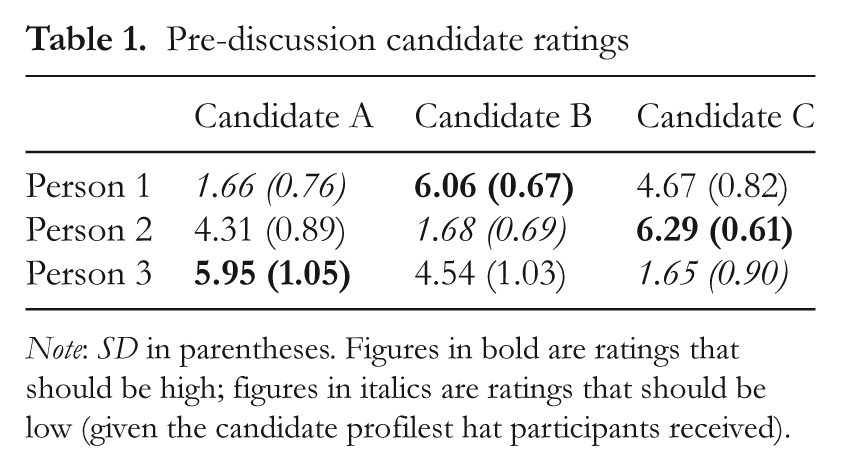
Note: SD in parentheses. Figures in bold are ratings that should be high; figures in italics are ratings that should be low (given the candidate profilest hat participants received).
Questionnaire items were all aggregated to the group level by taking the group mean. The time pressure scale was subjected to a 2 (epistemic motivation) × 2 (social motivation) ANOVA, which resulted only in an effect of epistemic motivation, F (1, 36) = 39.43, p < .001, η2 = .52. Time pressure was perceived to be higher in the low epistemic motivation condition (M= 3.95; SD= 0.89) than in the high epistemic motivation condition (M= 2.29; SD= 0.80). A similar ANOVA on the information processing scale revealed only a main effect of epistemic motivation, F (1, 36) = 5.42, p= .03, η2 = .13, showing that participants in the low epistemic motivation condition perceived that their groups processed information less thoroughly (M= 4.88; SD= 0.44) than those in the high epistemic motivation condition (M= 5.26; SD= 0.58). ANOVA on the manipulation check for prosocial motivation revealed only a main effect for social motivation, F (1, 36) = 15.20, p < .001, η2 = .30. Participants in the proself condition indicated that they had stated and defended their preferred alternative to a greater degree (M= 4.80; SD= 0.60) than those in the prosocial condition (M= 3.95; SD= 0.75). In sum, the induction of heterogeneous preferences and the manipulation of epistemic and social motivation were successful.
Group decision
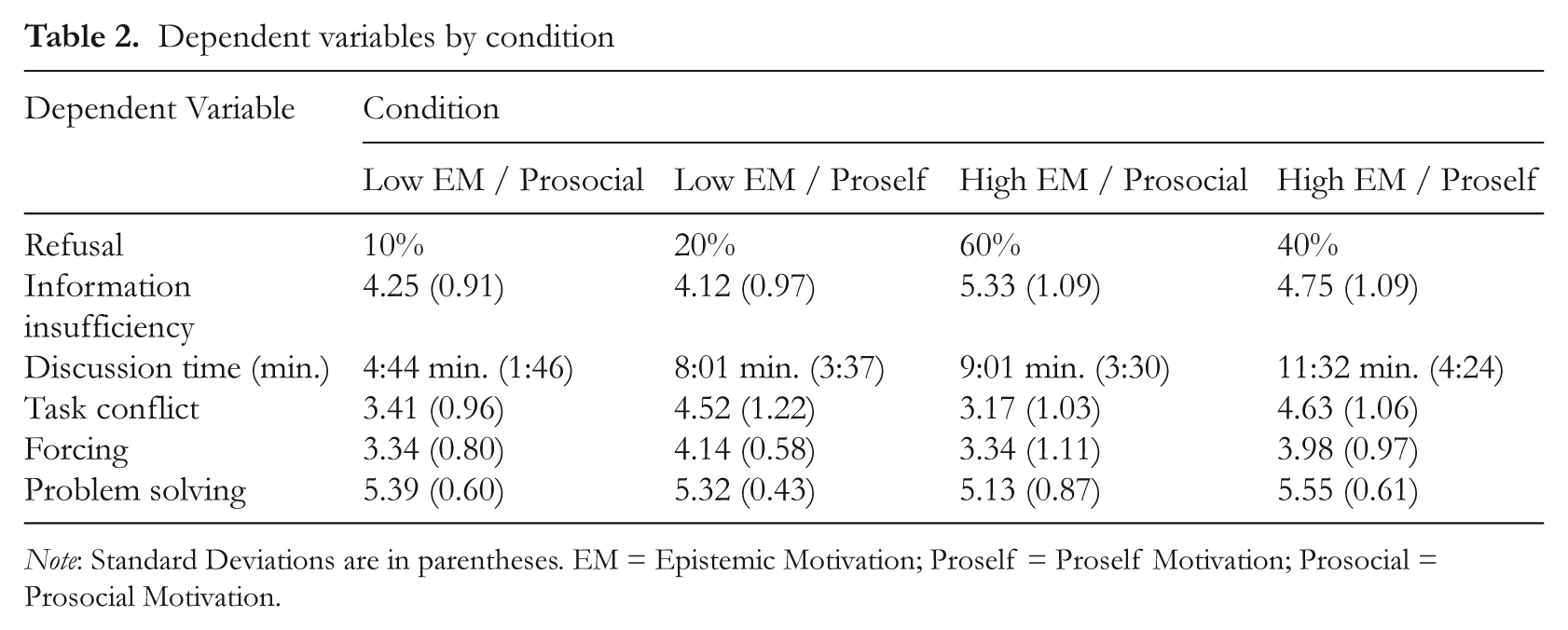
All dependent variables are displayed in Table 2. Group choice was coded dichotomously as either decision (hire candidate A, B, or C) or refusal (hire none of them). It was predicted (H1) that groups would more often choose the refusal option under high rather than low epistemic motivation. Group choice was regressed in a logistic regression on epistemic and social motivation (both dummy coded) as well as their interaction. It yielded a significant effect of epistemic motivation (B = 2.60, SE = 1.24, Wald = 4.43, p = .035) but no effect of social motivation (B = 0.81, SE = 1.32, Wald = 0.38, p = .54) and no interaction (B = 1.62, SE = 1.60, Wald = 1.02, p = .31). Fifteen percent of the groups under low epistemic motivation chose refusal (3 out of 20 groups). This changed notably under high epistemic motivation, where groups chose the refusal option in 50% of the cases (10 out of 20 groups). This confirms Hypothesis 1. 2
Dependent variables by condition
Note: Standard Deviations are in parentheses. EM = Epistemic Motivation; Proself = Proself Motivation; Prosocial = Prosocial Motivation.
Hypothesis 2 predicted that the effect of epistemic motivation on decision refusal would be mediated by perceived information insufficiency. First, we analysed whether epistemic motivation influenced information insufficiency with a 2 × 2 ANOVA. We obtained only a main effect of epistemic motivation, F (1, 36) = 7.13, p = .01, η2 = .17. Information insufficiency was higher under high epistemic motivation (M = 5.04; SD = 1.10) than under low epistemic motivation (M = 4.18; SD = 0.92). Next, group choice was regressed on the information insufficiency scale as well as on epistemic and social motivation and their interaction in a logistic regression. The originally significant effect of epistemic motivation on decision refusal (B = 2.60) was reduced when information insufficiency was controlled for (B = 2.03, SE = 1.30, Wald = 2.46, p = .12), and perceived information sufficiency had a marginally significant effect, B = 0.75, SE = 0.43, Wald = 3.02, p = .08). A bootstrapping analysis (Preacher & Hayes, 2004) indicated that the confidence interval for the indirect effect of epistemic motivation on decision refusal through information insufficiency excluded zero [0.01 – 2.11]. These results are in line with Hypothesis 2.
Group processes
We predicted that discussions would be longer under high than low epistemic motivation (H3a), and longer for proself groups than for prosocial groups (H3b). A 2 × 2 ANOVA yielded a significant main effect of epistemic motivation on discussion time, F (1, 36) = 12.68, p = .001, η2 = .26: Groups under low epistemic motivation needed less time (M = 382 s; SD = 194) than groups in the high epistemic condition (M = 617 s; SD = 245). In addition, a main effect of social motivation, F (1, 36) = 6.98, p = .01, η2 = .16, showed that proself motivation (M = 586 s; SD = 259) led to longer discussions than prosocial motivation (M = 413 s; SD = 209). An interaction was not found, F (1, 36) = .12, p = .73, η2 = .00. Hypotheses 3a and 3b are supported.
Hypothesis 4 predicted that perceptions of conflict would be higher in the proself than the prosocial condition. A 2 × 2 ANOVA confirmed this prediction, and only showed a main effect of social motivation, F (1, 36) = 14.48, p = .001, η2 = .28. Group members under proself motivation perceived more task conflict than group members under prosocial motivation (M = 4.58; SD = 1.11 vs. M = 3.29; SD = 0.98). The effect of epistemic motivation, F (1, 36) = 0.04, p = .85, η2 = .00, and the interaction, F (1, 36) = 0.28, p = .60, η2 = .01, were not significant. Moreover, it was proposed that proself motivated group members would be more likely to engage in forcing behavior than prosocially motivated members (Hypothesis 5). This hypothesis was supported as well: The main effect for social motivation was significant, F (1, 36) = 7.20, p = .01, η2 = .17, and showed that group members under proself motivation scored higher on forcing than those under prosocial motivation (M = 4.06; SD = 0.68 vs. M = 3.34; SD = 0.94). Again, there was no effect of epistemic motivation F (1, 36) = 0.10, p = .76, η2 = .00, and no interaction, F (1, 36) = 0.10, p = .76, η2 = .00.
Hypothesis 6 predicted an interaction: Groups under high epistemic and prosocial motivation will be more likely to engage in problem solving behavior than groups in the other conditions. ANOVA, however, showed no significant effects, not for the predicted interaction, F (1, 36) = 1.42, p = .24, η2 = .04, not for the main effect of epistemic motivation, F (1, 36) = .00, p = .96, η2 = .00, and not for the main effect of social motivation, F (1, 36) = .71, p = .41, η2 = .02. Hypothesis 6 is thus rejected.
Hypothesis 7 predicted that forcing only reduces decision refusal when epistemic motivation is low. Two variables were created, one containing the z-value of the forcing scale and the other representing the interaction between this new forcing variable and epistemic motivation (dummy coded). Group choice was then regressed in a logistic regression on epistemic motivation, forcing and the interaction between forcing and epistemic motivation. The interaction between epistemic motivation and forcing was marginally significant (B = 1.71, SE = 0.99, Wald = 2.97, p = .08). To further investigate this, the effect of forcing on decision refusal was analysed separately under conditions of low and high epistemic motivation. There was no effect of forcing behavior on decision refusal when epistemic motivation was high (B = 0.27, SE = 0.42, Wald = 0.42, p = .52). Forcing was negatively related to refusal when epistemic motivation was low (B = −1.43, SE = 0.77, Wald = 2.60, p = .01). Hypothesis 7 thus received support, although it should be noted that the interaction was significant only at the .10 level.
Discussion
Much research has been done on group decision making, but few studies have examined group decisions that do not get made. Based on the Motivated Information in Groups (MIP-G) model (De Dreu et al., 2008), the present study analysed the influence of epistemic and social motivation on decision refusal. In an experiment, groups with heterogeneous pre-discussion preferences could choose among three job candidates, but could also choose to refuse all options and delay choice.
Although MIP-G argues that high quality group decisions are more likely when epistemic motivation is high rather than low (because members put in cognitive effort to reach the best decision), and when social motivation is prosocial rather than proself (because members are interested in collective outcomes), the model also suggests that high epistemic motivation may lead to indecision. With high epistemic motivation, groups want to be certain that they make the right choice (i.e., they have a high sufficiency threshold; ST). In a situation of preference diversity, this may lead group members to be unwilling to accept an initially non-preferred alternative unless they are fully convinced. This, in turn, may lead to decision refusal when group members are not convinced and groups consequently cannot reach agreement. Groups with low epistemic motivation, in contrast, have a lower ST and members may more easily accept an initially non-preferred alternative, leading to less decision refusal. Consistent with this reasoning, we found that decision refusal was more prevalent in the high than in the low epistemic motivation condition, and that this effect was partly mediated by perceived information insufficiency. We should note, though, that information insufficiency was assessed after the group discussion, so we cannot establish a causal relation between information insufficiency and refusal. It may, for example, be the case that group members used information insufficiency as a (post hoc) way to justify their decision to refuse all options.
Social motivation (manipulated by giving participants in the proself condition the instruction to prevail in the discussion) had no direct impact on decision refusal, but it did affect conflict and conflict behavior. Task conflict was higher in the proself than the prosocial condition, and group members in the proself condition also used forcing behavior more as a conflict handling strategy. Thus, group processes were different under proself than under prosocial behavior, although the outcomes (in terms of refusal) were the same.
We also expected, in line with earlier findings in the context of negotiation (De Dreu et al., 2006), that problem solving would be highest in prosocial groups with high epistemic motivation, because problem solving requires both the willingness to analyse an issue thoroughly and a focus on collective outcomes. However, no effects were observed on the measure of problem solving behavior. One explanation might be that the availability of a refusal option changes normal negotiation patterns. For instance, group members may not feel the need to engage in effortful problem solving behavior if they are not forced to agree on one alternative but have the option delay choice. Adding a refusal option to a choice set may thus reduce problem solving behavior, a possibility that might be studied in further research. Another explanation may be that groups in the prosocial condition were less prosocial than we expected. Although we gave participants in the proself condition clear directions to state and defend your own opinion, we did not explicitly instruct those in the prosocial condition to focus on obtaining high collective outcomes. As a consequence, in the prosocial condition participants may also have been inclined to strive for high individual outcomes (e.g., winning the discussion), with potential negative effects on problem solving behavior.
Finally, we found that conflict handling behavior had different relations with decision refusal depending on epistemic motivation. Forcing is one way to resolve differences of opinion, and indeed we observed that forcing negatively related to decision refusal. However, this only happened when epistemic motivation was low. We would argue that forcing may lead to compliance of group members with the forcing party (reducing refusal), without actually believing that the chosen alternative is necessarily the best one. Under high epistemic motivation, however, such compliance may be unsatisfactory, because group members want to be certain that the best alternative is chosen. Rather than giving in, members with high epistemic motivation may react to forcing with counter-forcing, creating deadlocks that could, in the present conditions, only be solved by resorting to the refusal option. Because high levels of forcing were only found in the proself condition and not in the prosocial condition, it follows that this pattern of forcing and counter-forcing may be most prevalent under proself and high epistemic motivation.
Implications, limitations and future directions
We found that, in situations in which there is no clear best option and no majority in favor of a certain option, higher epistemic motivation makes decision refusal more likely. Our interpretation is that under high epistemic motivation group members are unwilling to accept an initially non-preferred alternative, unless they are fully convinced that this alternative is the best option. There are, however, two alternative interpretations. First, it may be that through effortful information processing groups in the high epistemic motivation condition (but not in the low epistemic motivation condition) realized that all candidates were unattractive, and that they should therefore hire none of them. However, this explanation is at odds with the findings from our pre-test that few people chose refusal when they had full information from the start, suggesting that the candidates were in fact adequate (see Note 2). Second, participants may have realized that none of the candidates was clearly better than the others, which may have led to a decisional conflict and the inability to select one candidate. Further, this may have happened especially in the high epistemic motivation condition. Indeed, evidence at the individual level indicates that decisional conflict may lead to decision deferral (e.g., Tversy & Shafir, 1992), and that this effect is reduced when decision makers are put under time pressure (as in our low epistemic motivation condition; see Dhar & Nowlis, 1999). A counterargument would (again) be that the participants in the pre-test faced the same decisional conflict and they mostly did decide, even though they were not put under time pressure. We thus favor our interpretation that group members under high epistemic motivation are less likely to accept a non-preferred option, because this explanation seems consistent with most of the data.
We manipulated epistemic motivation through a combination of time pressure (in the low epistemic motivation condition) and process accountability (in the high epistemic motivation condition). This strategy was chosen, because both factors raise the sufficiency threshold and concomitant epistemic motivation (e.g., De Dreu, 2003; Scholten et al., 2007). A disadvantage is that we cannot conclude whether it is time pressure or process accountability that drives the effects. Indirect evidence suggests that time pressure may have been more important. In a situation of preference diversity similar to the present experiment, Nijstad and Kaps (2008) found that 47% of groups refused when there was neither process accountability nor time pressure. As this number is quite similar to what we find under process accountability (50%) and different from what we found under time pressure (15%), one may tentatively conclude that time pressure has larger effects than process accountability.
Groups high in epistemic motivation in a situation of preference diversity seem to have lacked the confidence to make a good choice, which may have some important implications. As noted earlier, the sufficiency threshold (ST) is positively related to the perceived importance of a task (Chaiken et al., 1989). Important decisions are thus more likely to lead to a situation in which the actual confidence in a decision (AC) falls below the ST. It thus seems likely that more important decisions more often lead to refusal, especially when cases are close. In fact, common experience suggests that important decisions are often suspended. When there are grave decisions to make and a group wants to conceive the problem in its full complexity, the group may reach a point where it changes its perspective from “Which available alternative is the best?” or “How can we negotiate a decision?” to “Are these alternatives really the best we can get?” High task importance (and thus high epistemic motivation) may account for this change of perspectives that eventually promotes refusal. Thus, although high epistemic motivation is known to be beneficial for high quality decisions (Scholten et al., 2007) this study uncovered a potential downside: Groups are likely to refuse important decisions.
When epistemic motivation is low refusal is less likely. The present experiment found that under time pressure decisions were made in the majority of the cases (85%), and refusal seemed to be no real choice option (although groups could in principle quickly reach the conclusion to refuse). That is, whenever there are time constraints and decisions have to be made quickly decision makers are likely to choose one of the available alternatives instead of delaying or refusing that judgment (also Dhar & Nowlis, 1999). This implies that decisions may be reached even though all available choice options are rather poor. In other words, whereas high epistemic motivation may potentially lead to maladaptive decision delay, low epistemic motivation may be seen as a risk factor for low quality decisions. Perhaps this would be especially likely when some group members resort to forcing and other members lack the epistemic motivation to counter-argue (cf. groupthink, Janis, 1972).
Although this study uncovered some interesting results, it does have some limitations. The first relates to the sample size. With 120 participants in total and only 10 groups in each of the 4 conditions the statistical power of the analyses was low and some effects might have failed to reach conventional levels of significance because of that. In particular, the results regarding the expected interaction of forcing and epistemic motivation on decision refusal could have been stronger with a larger sample size (it was now significant at the .10 level). Moreover, it should be noted that group choice had no real consequences for participants (also see Nijstad, 2008; Nijstad & Kaps, 2008). Although it was emphasized that the decision to refuse all candidates and look for more options is costly and time consuming, participants did not experience real search costs. However, the effects of epistemic motivation on decision refusal cannot be easily accredited to this, because search costs were absent in all conditions. Moreover, the finding that the effect of epistemic motivation was mediated by perceived information insufficiency indicates that most decision makers were honestly trying to find the best possible solution. Nevertheless, it might change the mindset when decision makers have to bear the consequences of their judgments and it is important to investigate this issue in future research.
Finally, it is important to point out that groups will not automatically choose the refusal option when epistemic needs are high. This study used a decision task in which all available choice options were approximately equally attractive, and where group members entered the discussion with diverging preferences. It can be assumed that high epistemic motivation would spark fairly different mechanisms if one alternative was clearly the best as it is for instance in typical hidden profile paradigms (Greitemeyer & Schulz-Hardt, 2003; Stasser & Titus, 1985). There is reason to believe that most prosocial groups would identify and choose the right decision option without any feeling of insufficiency (cf. Scholten et al., 2007). It would be interesting, though, to find out whether this is also true for proself groups. These groups may also end up in never-ending conflicts that can only be solved by resorting to refusal.
Conclusion
In summary, the present study extends our knowledge on group decision refusal by showing that under preference diversity it strongly depends on epistemic motivation whether group decisions are made or not. Even though proself motivation creates more conflict and entails more forcing behavior it does not affect group decision refusal. But when cases are close and epistemic motivation is high, group members tend to perceive the available information as insufficient to make a good judgment. As a consequence, they are likely to resort to refusal. That is, though high epistemic motivation is known to be beneficial for systematic information processing and high quality decisions it may have one potential downside: It makes group members refuse important decisions and become indecisive.