




Abstract
Recent research has demonstrated that group motivation gains due to social indispensability are not restricted to the research laboratory but can be found in existing groups performing meaningful tasks. Our own previous research showed that freestyle swimmers at the 2008 Olympics swam faster in the relay than in the individual competition when swimming at the relay’s later positions. Using aggregated data of freestyle and medley relays from the final heats of the four most recent Olympic Games, we show that high specificity of information on the partners’ performance is a precondition for indispensability effects to occur. As expected, motivation gains in the relay as compared to the individual competition were demonstrated for swimmers at relay positions 2–4, but only in freestyle relays where effort and efficiency of preceding swimmers could be reliably assessed by swimmers. In medley relays, where such feedback is more ambiguous, no motivation gains occurred.
Group work often is not as effective and motivating as people think (e.g., Paulus, Dzindolet, Poletes, & Camacho, 1993). Indeed, previous psychological research primarily investigated motivation losses in teams (i.e., reductions in motivation in group as compared to individual work; see Karau & Williams, 1993, for a review). In recent years, however, the situation is changing with studies showing also higher effort in group versus individual performance settings (i.e., motivation gains in teams; cf. Hertel, Kerr, & Messé, 2000; Kerr & Hertel, 2011; Stroebe, Diehl, & Abakoumkin, 1996; Weber & Hertel, 2007; Williams & Karau, 1991). Such group motivation gains have been documented not only in the laboratory but also in existing teams working on meaningful tasks across longer time intervals (cf. Hüffmeier & Hertel, 2011; Hüffmeier, Krumm, Kanthak, & Hertel, 2012; see also Osborn, Irwin, Skoksberg, & Feltz, 2012). For instance, analyzing data from various sport competitions, two recent studies (Hüffmeier & Hertel, 2011; Hüffmeier et al., 2012) have shown that professional swimmers swim faster in relay than in individual competitions, but only at the relay’s later positions for which their individual contributions were less likely to be compensated by other team members (i.e., the contribution was highly indispensable for the team’s success).
As illustrated by the latter studies, social indispensability can be a central trigger of group motivation gains, which is consistent with existing expectancy theories such as the collective effort model (henceforth CEM, Karau & Williams, 1993, 2001) and others (Hertel et al., 2000; Kerr, 1983). The motivating effect of social indispensability has been demonstrated in controlled laboratory settings across various contexts (e.g., Hertel, Niemeyer, & Clauss, 2008; Kerr et al., 2007; for reviews, see Kerr & Hertel, 2011; Weber & Hertel, 2007), for instance, when individuals are the inferior member in a conjunctive group task (i.e., when the weakest team member determines the group performance, Steiner, 1972; cf. Hertel et al., 2008; Kerr et al., 2007) or when individuals worked at late positions in consecutive group tasks such as sequential public good dilemmas (Au, Chen, & Komorita, 1998) or simulated consecutive group tasks on the Internet (Wittchen, Schlereth, & Hertel, 2007).
In addition to the general motivating effect of social indispensability or high instrumentality of individual effort for the group outcome, initial moderating conditions have been derived theoretically from expectancy models of motivation in groups, such as the CEM (Karau & Williams, 1993, 2001). The CEM assumes that team members’ motivation is a function of three independent processes. The degree to which personal effort is perceived to relate to performance (expectancy), “the degree to which high-quality performance is perceived as instrumental in obtaining an outcome” (instrumentality, Karau & Williams, 1993, p. 685) and the perceived valence of that outcome. The CEM further differentiates between three instrumentality-inherent contingencies: Team members’ motivation is assumed to be maximal if strong relationships are perceived between(a) individual performance and group performance, (b) group performance and group outcomes, and (c) group outcomes and individual outcomes. Consistent with these assumptions, recent research (Hüffmeier et al., 2012) has shown that the contingency between group performance and group outcomes represents a first important moderator of indispensability-based motivation gains: Later relay swimmers swam faster in the relay than in the individual competition only if they had a realistic chance to win a medal (i.e., if they perceived a given relationship of own effort and valued outcomes). Later relay swimmers without a realistic chance to win a medal, in contrast, swam equally fast in both competitions (i.e., they showed neither motivation gains nor losses).
Extending this previous research, the present study tests a second important moderating condition derived from the CEM, that is, the specificity of partner feedback as precondition for the perception of social indispensability. Based on the CEM postulate that team members’ motivation should be maximal if the contingency between individual and group performance is perceived as strong (Karau & Williams, 1993, 2001), we assume that social indispensability only triggers pronounced motivation gains if indispensability is unambiguously and continuously present for the team members.
Initial evidence for the moderating role of feedback on the team partners’ performance is provided by laboratory research (Hertel et al., 2008; Kerr, Messé, Seok, Park, & Sambolec, 2005; Messé, Hertel, Kerr, Lount, & Park, 2002). For instance, continuous feedback about a stronger partner helps inferior group members in conjunctive tasks to recognize that they are actually determining the overall group performance, and that they would let the group down when they do not work as hard as they can. Feedback provided only at the end of a task, in contrast, did not yield such motivation gains (Hertel et al., 2008). In a similar way, Kerr et al. (2005) showed that group members’ motivation gains were significantly decreased when feedback about performance differences between team members was ambiguous.
The moderating effect of partner feedback specificity has, however, not been demonstrated outside of the scientific laboratory when groups have a longer history, work on meaningful tasks, and have more complex interactions. To support the generalizability of the described laboratory results, we report (according to our knowledge) the first documentation of the moderating effect of partner feedback specificity with existing teams performing quite meaningful tasks in the field. In order to operationalize partner feedback specificity, we contrast freestyle and medley relays that differ systematically in the specificity of feedback that the team members receive. In freestyle relays, the feedback about the fellow team members’ effort and performance should be very specific because all swimmers swim the same stroke (i.e., front crawl) and may often practice together on a regular basis. Thus, swimmers of freestyle relays are experienced experts for the swimming stroke of the other relay members, enabling them to assess the performance of earlier swimmers of their relay (expended effort, current speed, etc.) very specifically and reliably. Moreover, the individual swimming times in a freestyle relay are highly comparable among the four swimmers.
In contrast, in medley relays, the feedback about the fellow team members’ effort and performance should be not very specific because the four different swimmers each swim a different stroke (backstroke, breaststroke, butterfly, and freestyle) and are less likely to practice together on a regular basis. Therefore, swimmers of medley relays are usually not experienced experts for the swimming stroke of the other relay members’ swimming strokes, and it is more difficult for them to interpret the specific movements of earlier swimmers of their relay. As a consequence, the decoding of visual information about fellow team members’ levels of expended effort and performance should be less specific for swimmers in a medley relay. Furthermore, the individual swimming times in a medley relay are much less comparable among the four swimmers as compared to freestyle relays. As a consequence, feedback about the fellow team members’ performance in medley relays should be less specific as compared to freestyle relays. Therefore, later swimmers in medley as compared to freestyle relays should be less able to estimate whether their fellow relay members expend their maximum effort and reach their optimal performance. As a consequence, in medley relays perceptions of social indispensability (i.e., I am crucial for the overall team success) should be more ambiguous than in freestyle relays.
Please note that we hypothesize that the specificity of fellow team members’ performance feedback directly affects the CEM’s first contingency inherent in the instrumentality component (i.e., the relationship between individual and group performance; Karau & Williams, 1993, 2001). If information on partners’ performance is clear and unambiguous (i.e., in freestyle relays), the perceived contingency of individual performance and group performance should be strong (given that the other team members are perceived to be highly motivated and efficient, of course). Under these circumstances, team members should perceive their own contribution as highly indispensable in order not to spoil the high effort of their partners. In medley relays, however, the less specific feedback about the fellow team members’ performance should blur the perceived contingency between individual and group performance because individuals are less secure that their fellow team partners perform at their highest level. This insecurity, in turn, should diminish the perceived indispensability of personnel contributions for the team outcome. Therefore, we expect that motivation gains of late starters in medley relays should be significantly smaller compared to motivation gains of late starters in freestyle relays. The expected pattern should lead to a three-way interaction of individual versus group work, position in the relay and relay type, replicating a significant team motivation gain for late starters in the freestyle relays (Hypothesis 1a; cf. Hüffmeier & Hertel, 2011; Hüffmeier et al., 2012) but not in the medley relay (Hypothesis 1b).
Method
Study Design and Participants
The analysis followed a 2 (individual vs. relay competition) × 4 (position: first vs. second vs. third vs. fourth swimmer in the relay) × 2 (relay type: freestyle vs. medley) × 2 (gender: female vs. male) design with the first factor as a within-subject factor. One hundred and fifty-two athletes from 19 countries (71 women and 81 men; mean age at the time of the respective Olympic Games, M = 23.3) were included in the sample. They qualified for the final heats in both the individual and relay freestyle competitions over either 100 m or 200 m or, alternatively, for the individual 100 m competition in anyone swimming stroke and the 100 m medley relay competition at the 1996, 2000, 2004, or 2008 Olympics. 1
The inclusion of data from different Olympic Games resulted in two kinds of swimmers being represented with more than one data set in our sample (i.e., more than one individual and one relay time from Olympic final heats): First, 23 swimmers (15 women and eight men) succeeded in qualifying for the relay competition finals and the respective individual finals in more than one type of competition at the same Olympic Games (i.e., any combination of the 100 m freestyle relay, the 200 m freestyle relay and the medley relay competition). Second, 27 athletes (12 women and 15 men) managed to qualify for an individual and a relay competition final at different Olympic Games (e.g., at the 2000 and 2004 Olympics).
To comply with the required noninterdependence of data in the statistical analyses and to simultaneously avoid a biased sample selection, we chose the following procedure: When a single swimmer featured more than one data set, we determined which of his/her data sets to include in our analysis by using a random generator. The remaining data set/sets of this particular swimmer was/were excluded from further analyses. The final sample thus consisted of 73 swimmers who competed in the final heats of the individual and relay freestyle competitions (37 swimmers in the 100 m competitions and 36 swimmers in the 200 m competitions) and 79 swimmers competing in the final heats of anyone of the 100 m competitions and the medley relay competition. It is important to note that we exclusively compared swimming times of swimmers from both subsamples (i.e., freestyle and medley relays) that swam the same stroke in the individual and relay competition. Therefore, swimming times in individual and relay competitions were comparable except for the different starting procedures in the two competitions. In our data analysis, we statistically controlled for the influence of this factor (see following lines).
Measures
We collected swimming times from the three different types of competition for each swimmer from the website http://www.swimrankings.net/. We focused our analysis on the data from the final heats of these competitions at the 1996, 2000, 2004, or 2008 Olympics to obtain a maximal sample size. Both performance times were corrected for the swimmer’s respective reaction time by subtracting the time the athlete spent on the starting block after the starting signal (also retrieved from the aforementioned web page). These corrections were carried out to control for differences in the starting procedure in individual and relay swim competitions although it is unlikely that differences in the starting procedure fully account for the differences between individual and relay performance (cf. Hüffmeier et al., 2012).
We z-transformed the corrected times separately for each type of competition for both sexes. As there are no Olympic 200 m medley relays, we tested within the freestyle subsample whether the different swimming distances (100 vs. 200 meters) did significantly impact the obtained results. In accordance with previous research (Hüffmeier & Hertel, 2011), the respective analysis showed that swimming distance did neither cause main or interaction effects and we accordingly accumulated the data across this factor.
Statistical Analysis
As weaker swimmers qualify systematically less frequently for individual competitions at the Olympics than stronger swimmers and as these weaker swimmers tend to be systematically positioned at the second and third relay position, unequal cell sizes occurred (see Table 1). However, the applied repeated measures ANOVA analysis can be considered as robust against violations of normality (e.g., Stevens, 2002). We assess the assumptions of homogeneity of covariance using Box’s M-Test (1949), and potential disruptive effects of unequal cell sizes are considered by adjusting the p-value with the Welch test (Welch, 1947).
Reaction-time corrected and standardized (z-transformed) means and standard deviations of swimming times as a function of individual versus relay competition, position in the relay and relay type (N = 152).

Note. Smaller numbers indicate faster swimming times.
Results
The Box’s M-Test was not significant, F(39, 3030, 851) = .59, ns, indicating similarity of the variance–covariance matrices between groups. The 2 (competition) × 4 (position) × 2 (relay type) × 2 (gender) ANOVA on the reaction time corrected and standardized swimming times revealed a significant main effect of the competition factor, F(1, 136) = 5.11, p = .03, η p 2 = .04 (see Table 1, for means and standard deviations), a significant Competition × Relay Type interaction, F(3, 136) = 5.12, p = .03, η p 2 = .04, and, as expected, a significant three-way interaction involving the factors competition, position and relay type, F(3, 136) = 2.78, p ≤ .05, η p 2 = .06 (see Table 1, for means and standard deviations). No other effects were significant, Fs < 1.8.
To decompose the significant three-way interaction, we computed separate two-way interactions for the freestyle and the medley relay samples, respectively. The Box’s M-Test within the freestyle sample was insignificant, F(15, 3550, 421) = .61, ns, indicating similarity of the variance–covariance matrices between groups. The 2 (competition) × 4 (position) × 2 (gender) ANOVA on the reaction time corrected and standardized swimming times within the freestyle sample revealed a significant competition main effect, F(1, 65) = 9.37, p = .003, η p 2 = .13, which indicates an overall faster swimming time in the relay compared to the individual freestyle competition. Importantly, the main effect was qualified by a significant Competition × Position interaction, F(3, 65) = 4.16, p = .009, η p 2 = .16. All other effects were not significant, Fs < 2.2. Consistent with Hypothesis 1a, the advantage of the relay did not emerge before the second position in the relay (see Figure 1). While the a priori contrast between individual and group performance conditions revealed nonsignificant performance losses for the starting swimmers in the relay as compared to individual competitions, t(29) = −0.96,p = .35, the later relay swimmers showed significant performance gains as compared to the individual competition times. Second, third, and last swimmers swam significantly faster in the relay than in the individual competition, t(11) = 2.91, p ≤ .01, t(2) = 6.14, p = .03, and t(27) = 2.23, p = .03, respectively. In contrast to our prediction and in contrast to previous research (Hüffmeier & Hertel, 2011; Hüffmeier et al., 2012), however, performance gains of swimmers at the second and third position (M = .59, SD = .58) were descriptively more pronounced than motivation gains of the last swimmers (M = .33, SD = .69), although this difference was not significant, t(41) = 1.12, ns. We will come back to this differential finding in the Discussion section.
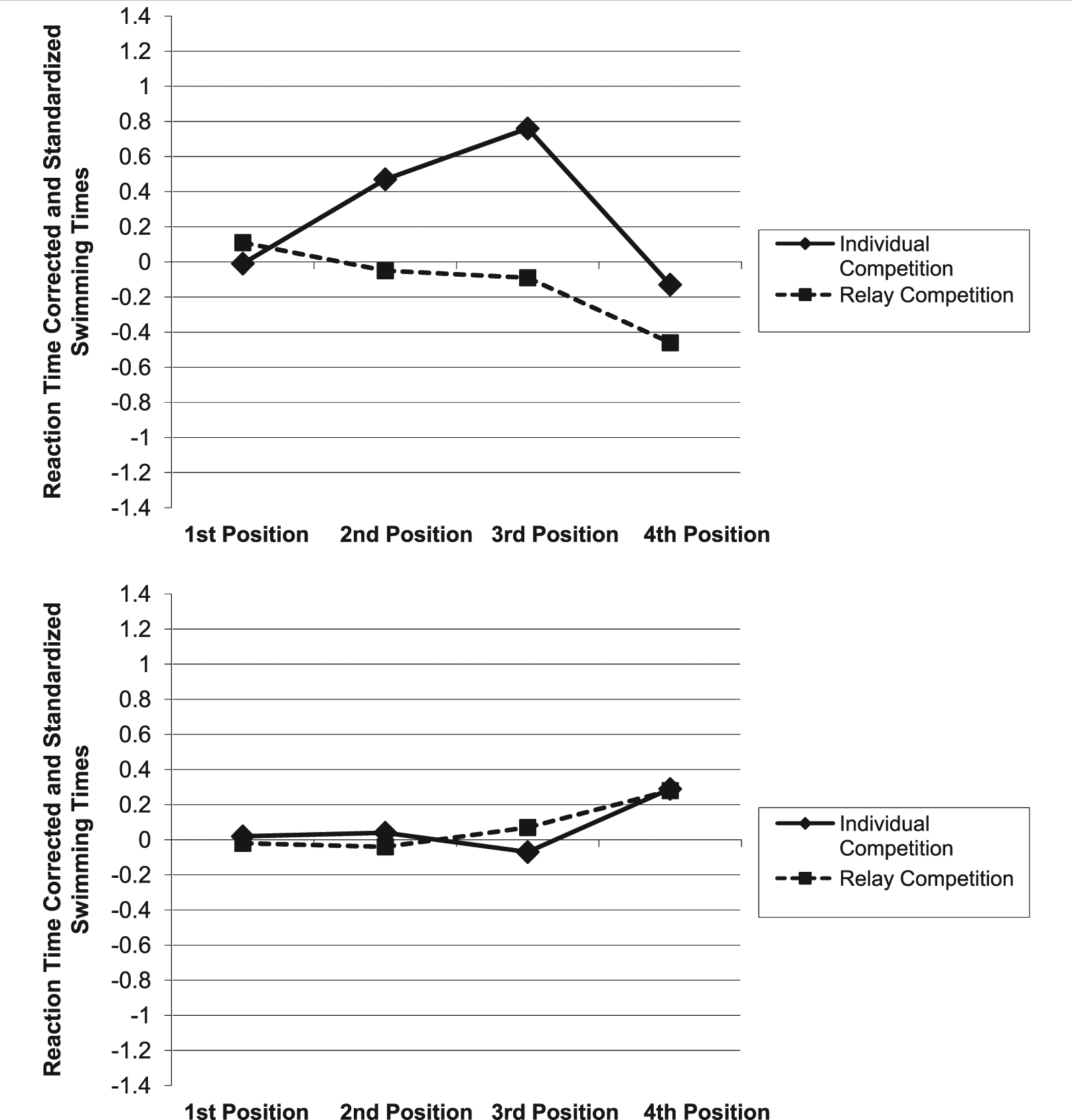
Top panel: Swimming times as a function of individual versus relay competition and position in the relay within the freestyle relay sample. Bottom panel: Swimming times as a function of individual versus relay competition and position in the relay within the medley relay sample.
The Box’s M-Test within the medley sample was insignificant, F(30, 1645, 221) = .74, ns, again indicating similarity of the variance–covariance matrices between groups. The 2 (competition) × 4 (position) × 2 (gender) ANOVA on the reaction time corrected and standardized swimming times within the medley samples revealed a significant competition by gender interaction, F(1, 71) = 3.90, p ≤ .05, η p 2 = .05. At closer inspection, this interaction revealed that male swimmers exhibited slight performance losses (M = −.04, SD = .93; M = .06, SD = .99, for the individual and relay competition, respectively), while women exhibited slight performance gains (M = .12, SD = .89; M = .02, SD = .99, for the individual and relay competition, respectively), however, neither of these effects was significant (i.e., both effects did not differ from 0, ts < 1; see Figure 1, bottom panel). The absence of performance gains in medley relays is thus in line with Hypothesis 1b.
Discussion
In this research, we successfully extended and replicated recent findings on group motivation gains in field settings (cf. Hüffmeier & Hertel, 2011; Hüffmeier et al., 2012) by demonstrating significant group motivation gains for swimmers in the final heats of Olympic freestyle relay competitions starting at the second, third, and fourth position. Please note that additional gains during Olympic competitions are particularly remarkable given that Olympic athletes are already highly motivated in the individual competitions. Moreover, the intergroup competition that is inherent in the Olympics may have already contributed to generally high levels of motivation among the athletes in our sample competing in the individual trials (cf. Erev, Bornstein, & Galili, 1993; Tauer & Harackiewicz, 2004; see Wittchen, van Dick, & Hertel, 2011, for a review and theoretical integration). Consistent with our theoretical rationale, group motivation gains were moderated by the specificity of partner feedback as operationalized by the difference between freestyle and medley relays. When swimmers had highly specific information on their fellow team members’ performance due to the similarity to their own swimming stroke, group motivation gains occurred at later relay positions when individuals’ performance was crucial for the relay team (i.e., less likely to be compensated). However, when swimmers had less specific information on their fellow team members’ performance because these partners swam a different stroke (medley relay), no motivation gains occurred. In addition to these general findings, our theoretical rationale is further strengthened by the fact that in both the freestyle and the medley relays the last swimmers swam the same stroke (i.e., front crawl). Thus, the group motivation gains in the freestyle relays do not seem to be just a consequence of different swimming strokes and related potential for motivation gains.
Instead, this pattern further underlines the importance of feedback specificity as moderating condition. Due to their specialization in one particular swimming stroke, swimmers in medley relays should have had more difficulties in ascertaining their fellow team members’ performance. They may have been less secure whether their team members showed maximal levels of expended effort and whether their achieved performance was actually optimal. Consequentially, they may have perceived their contribution to their team’s success as more dispensable than freestyle swimmers. 2
Among the limitations of the current research is that the sample size is rather small, specifically at the third position of the freestyle relays. At this position, a systematically lower number of swimmers is observable across different studies and data sets (cf. Hüffmeier & Hertel, 2011; Hüffmeier et al., 2012), as only the fourth strongest swimmer of one nation is typically assigned to the third position. At the same time, only two swimmers from one country qualify for the individual competition at the Olympics and weaker swimmers are prevented from even starting in the Olympic individual competitions. However, our results clearly replicate previous findings (cf. Hüffmeier & Hertel, 2011; Hüffmeier et al., 2012). Further replications of the findings for the relay’s third spot would be helpful to further confirm its validity even if the sample size in each of these replications will probably be also rather small.
Another limitation is that we could not provide data on the assumed process that distinguishes freestyle and medley relays. Although our theorizing in this respect is closely derived from both the actually existing differences between the two types of relays and previous theorizing (Karau & Williams, 1993, 2001) and research (Hertel et al., 2008; Kerr et al., 2005; Messé et al., 2002), other factors may also be involved in the absence of motivation gains in medley relays. It may for instance be argued that this absence is due to lower group cohesion (e.g., Everett, Smith, & Williams, 1992) or lower identification with the group (see van Dick, Tissington, & Hertel, 2009, for a recent review on group identification and group motivation and performance). Although these processes may appear plausible at first sight, there are good reasons to assume that they are not the main factors in this research. First, the possibly higher group cohesion and social identification in the freestyle relays did not suffice to elicit motivation gains for the starting swimmers, which suggests that other processes (i.e., social indispensability) may play a more important role. Second, group cohesion in freestyle relays may not have been particularly pronounced as the four freestyle swimmers from one country often compete against each other and fight for scarce and meaningful resources (e.g., tickets for the individual Olympic competition), which does not apply for the medley relay’s swimmers. Third, identification with a group can be equally rooted in both similarities and differences between group members (Postmes, Spears, Lee, & Novak, 2005; Rink & Ellemers, 2007), which suggests that group identification may not have been higher in the freestyle than in the medley relays.
As a final limitation, the findings on the relays’ last swimmers in previous studies and the current study deviate slightly from each other. In previous research, the last swimmers recorded the most substantial performance gains (cf. Hüffmeier & Hertel, 2011), while the gains of the last swimmers did not differ from those of the two predecessors within the relay in the current research. A rather obvious explanation that we already demonstrated in our own previous research (cf. Hüffmeier et al., 2012) is that Olympic finals may already be practically decided for some relays when the last swimmer starts. For instance, final swimmers may either have so much advance (or leeway) that they are no longer important for their teams’ overall outcome because they do no longer influence their relay’s positioning unless they swim unimaginably slow (or quick). If the individual performance is not perceived as highly instrumental for the group outcome, team members’ motivation should decrease (cf. Karau & Williams, 1993; Kerr, 1983).
Our results have several implications for the management of teams in various contexts: Although perceived indispensability for the group seems to be a central process in eliciting high levels of motivation, moderating factors have to be adhered. While previous research has empirically documented effects of the contingency between group performance and group outcomes (Hüffmeier et al., 2012), the current research demonstrates effects of the contingency between individual and group performance. Thus, in addition to maintaining and reinforcing interdependence between group members (e.g., Hertel, Konradt, & Orlikowski, 2004; Pearce & Gregersen, 1991), the provision of contemporaneous feedback of the other team members’ effort, progress, or performance seems to be crucial to maintain high motivation in groups (e.g., Geister, Konradt, & Hertel, 2006). To leverage group motivation gains, managers and group leaders may therefore take specific care to keep the group members informed about their fellow group members’ effort, work, and progress.