




Abstract
Using the Schwartz Value Model as a basis, the meaning of the value item, honor (sense of honor) was explored in eight samples in Finland (N = 1877) and in five comparable samples of 15- to 17-year-old adolescents in Estonia, Finland, Italy, Russia, and Switzerland (N = 1788). In Finland, honor was a self-enhancement value in all age and occupational groups, although its importance varied widely. An identical pattern was found for Estonian adolescents, but for Swiss adolescents honor was both a self-enhancement and a conservation value and for Italian and Russian adolescents, a pure conservation value. Male adolescents had higher regard for honor than female adolescents in Finland, Russia, and Switzerland, but no sex differences were found in Estonia, Italy or in the Finnish adult samples. In all adolescent samples, honor was associated with work-related values (e.g., hard work, conscientiousness).
“Mrs Thatcher saw recapturing the Falklands as a matter of honour—her honour as well as the nation’s honour—which could not be ducked without lasting national shame. … the manner in which she and her forces carried it through was (…) a legitimate source of national pride” (Campbell, 2009, p. 205). This quote illustrates the inseparable unity of honor, shame, and pride. The spectacular rise of Mrs Thatcher’s popularity in Britain after the Falkland war demonstrates the power of honor as a social force. Recent research has focused on honor as a cultural value and compared honor cultures and non-honor cultures with regard to specific behaviors such as violence (e.g., Cohen & Nisbett, 1994), body comportment ( Ijzerman & Cohen, 2011), or the nature of honor-relevant situations and their impact on self and others (Uskul, Cross, Sunbay, Gercek-Swing, & Ataca, 2012). By contrast, there is a lacuna in our knowledge of honor as an individual value, its associations with other values, and meaning variation across cultures. The present study attempts to partly fill this lacuna. We examine honor in Finland and four other European countries.
Honor does not figure in the most frequently used measures of individual (Rokeach, 1973; Schwartz, 1992) or cultural values (Hofstede & Hofstede, 2005; Inglehart, 1997; Inglehart & Walzel, 2005; Schwartz, 2008). None of the cited works list “honor” in their index. We added an item, honor (sense of honor) to the Schwartz (1992) Value Survey (SVS). Our approach to its meaning in this article is simply to look at the pattern of its correlations with the Schwartz values. Thus, our study also contributes to value theory.
Schwartz’s Value Model
Schwartz’s (1992) theory of universal content and structure of values defines values as motivational constructs, cognitive representations of abstract goals which serve to define situations, elicit more specific goals, and guide action. Values are organized into 10 universal types that serve different interests or motivational goals. Values, their contents, and exemplary items in the Schwartz Value Survey are as follows:
Power: Societal prestige and controlling others (social power, authority, wealth).
Achievement: Personal success and competence according to social standards (successful, capable, ambitious).
Hedonism: Pleasure and satisfaction of sensual needs (pleasure, enjoying life).
Stimulation: Excitement, novelty, and challenge in life (daring, varied life, exciting life).
Self-direction: Independent action and thought, making one’s own choices (freedom, creativity, curious).
Universalism: Understanding, tolerance, and protection for the welfare of all people and for nature (broadminded, social justice, equality, protecting environment).
Benevolence: Protecting the welfare of close others in everyday interaction (helpful, honest, forgiving, responsible).
Tradition: Respect, commitment, and acceptance of the customs and ideas that one’s culture or religion imposes on the individual (humble, devout, accepting my portion in life).
Conformity: Restraint of actions, inclinations, and impulses likely to upset or harm others, or violate social expectations or norms (polite, obedient, honoring parent and elders).
Security: Safety, harmony, and stability of society, of relationships and of self (national security, family security, social order, clean).
In Schwartz’s model, the goals and interests that values serve can be either compatible or conflicting with each other. The values form a two-dimensional continuum, organized along a circular structure consisting of two main dimensions, self-transcendence vs. self-enhancement and openness to change vs. conservation. Self-transcendence refers to the motivation to transcend selfish concerns and promote the welfare of others (including the values of benevolence and universalism). Self-enhancement comprises values which motivate people to further their own personal interests even at the expense of others (power and achievement values). Openness to change values refer to the motivation to follow one’s own intellectual and emotional interests (self-direction, stimulation, and hedonism value types), whereas conservation values refer to preferring the status quo and the certainty provided by relationships with close others, institutions, and traditions (tradition, conformity, and security value types).
Values also form an integrated system, which is manifested in a sinusoid pattern of correlations (e.g., empathy shows the highest positive correlation with universalism and the lowest negative with power, and the remaining correlations increase and decrease systematically as one moves along the circle; Myyry & Helkama, 2001). Thus, it is assumed that values and value items have the highest positive correlations with the adjacent values and the lowest negative correlations with the values located on the opposite side of the circle.
The Schwartz research program, then, has successfully identified a set of (relatively) motivationally pure values. In contrast to the presumably culturally relative meaning of honor, the Schwartz values have fairly invariant meaning across different cultures (e.g., Fontaine, Poortinga, Delbeke, & Schwartz, 2008; Spini, 2003). While there is on-going discussion of the degree of cross-cultural meaning equivalence of the items in the SVS (Davidov, 2008; Davidov, Schmidt, Schwartz, 2008; Fischer, 2012; Knoppen & Saris, 2009) we start here from the assumption that the equivalence is sufficient for the comparison of European countries. Naturally, meaning invariance is relative; what counts as sufficient invariance depends on the purpose of the study.
Less attention has been devoted to other, non-universal and presumably motivationally mixed values, for instance those 13 Rokeach value items that were eliminated from the final SVS. Recently Vauclair, Hanke, Fischer, and Fontaine (2011) showed in a meta-analysis that 6 of those value items (cheerful, happiness, inner harmony, loving, mature love, and true friendship) were organized into a new cultural-level value cluster (self-fulfilled connectedness), meaningfully located within the Schwartz cultural level typology of values. However, at the individual level, Rokeach values do not always belong to the integrated value system (Helkama, 1999).
A set of work-related values (e.g., hard work, conscientiousness, frugality) has been used in Finnish studies (e.g., Hirvelä & Helkama, 2011; Myyry & Helkama, 2001). Work-related values presumably vary in meaning as a function of age or nationality. They have usually been located in the domain around achievement, power, security, and conformity values.
Honor as a Cultural Value
In a study which focused on the meaning of honor as a cultural value, Rodriguez Mosquera, Manstead, and Fischer (2002) compared Mediterranean and Northern European notions of honor and found that honor was regarded as a more important cultural value in Spain than in the Netherlands. Achieving more than others, conformity to social norms, having self-respect, and one’s family being noble were considered more important sources of honor in the Netherlands than in Spain, whereas loyalty was more important as a source of honor in Spain. In all, Rodriguez Mosquera et al. (2002) found that the Mediterranean family-centered conception of honor which emphasizes social interdependence was also present in the Netherlands but it was less salient than the achievement and self-direction oriented components of honor.
The findings from the Rodriguez Mosquera et al. (2002) study suggest that in terms of the Schwartz model, honor as an individual value would have an achievement/power component on one hand, as well as a conformity/tradition component. In line with Rodriguez Mosquera et al.’s results, we expect that the achievement component would be more salient in Northern Europe and the conformity/tradition component in Mediterranean Italy.
Which values are regarded as moral values varies from one culture to another, although usually self-transcendence and conservation values qualify as moral but openness to change and self-enhancement values do not (Helkama, 2011; Schwartz, 2007; Sverdlik, Roccas, & Sagiv, 2012). Honor is, almost by definition, a moral value. In Rodriguez Mosquera et al.’s (2002) study of perceived cultural values, honor was strongly related to such prototypical moral (benevolence) values as honesty and helpfulness, both in Spain and in the Netherlands. In honor cultures, honor is a moral value in a particular sense, which is manifested in situations where one is insulted. In honor cultures, but not in dignity cultures, it is one’s moral duty to pay back (Leung & Cohen, 2011).
The present study has a particular focus on the individual and group differences in the importance and meaning of honor in one country, Finland. Although Finland is not an honor culture, honor as a word and as a concept is actively used. The Dictionary of Current Finnish (Nykysuomen sanakirja, 1958) defined it first as “the worth that a person or a group has or believes having in their own minds, or above all in others’ eyes”. The first examples given of the use of the word were “his bourgeois h.; family, national h.” The more recent Basic Dictionary of Finnish (Suomen kielen perussanakirja, 1990) started with the definition “general esteem, reputation”, and gave “family honor” as the first example. Thus, the conformity/tradition component of honor is salient in both dictionaries. As the importance of conservation values increases with age (Verkasalo, Lönnqvist, Lipsanen, & Helkama, 2009), we would expect that honor for younger Finns would be more strongly associated with achievement but for older people with conformity/tradition.
Honor and Emotions
Being insulted leads to anger and shame. Anger functions in the same way in dignity and honor cultures but shame does not. As Rodriguez Mosquera, Fischer, Manstead, and Zaalberg (2008) showed, shame provoked verbal disapproval among honor-oriented participants but withdrawal among non-honor-oriented participants. Shame in individualistic non-honor cultures is different from shame in honor cultures, in which shame is more often elicited by the behavior of other people, less by individual failures (Fischer, Manstead, & Rodriguez Mosquera, 1999).
Individuals feel shame as a response to moral and non-moral failures, typically in situations in which the failure is publicly exposed (Fontaine et al., 2006; Smith, Webster, Parrot, & Eyre, 2002). Shame is most often mixed with guilt, in both individuals’ free narrative accounts of situations in which they felt shame (Silfver, 2007) and moral conflict situations (Myyry & Helkama, 2007; Skoe, Eisenberg, & Cumberland, 2002).
Autobiographical narratives suggest that feelings of shame combined with feelings of guilt are equally likely to lead to reparative behaviors as feelings of guilt alone, but reparative behavior is less frequent in situations where only shame was felt (Silfver, 2007). It is customary to distinguish feelings as states and individual differences in the tendency or disposition to feel a certain feeling. Studies with one of the most widely used measure of dispositional shame and guilt, Tangney’s TOSCA (Tangney & Dearing, 2002), also show that individuals who are prone to feel shame also probably feel guilt. The present study deals with dispositional shame and guilt, as well as dispositional empathy.
In Finnish studies focusing on the relations of individual value priorities to dispositional shame and guilt, shame has been weakly related to achievement in adolescents and to tradition among young adults (Silfver, Helkama, Lönnqvist, & Verkasalo, 2008). By contrast, guilt has shown rather substantial positive relations to universalism, benevolence, conformity, and tradition values, and negative relations to power, hedonism, and stimulation (Silfver et al., 2008). Empathy and perspective-taking tendencies relate positively only to universalism and benevolence, show near-zero correlations with conformity and tradition, and negative correlations with security and power, sometimes also with achievement (Myyry & Helkama, 2001; Myyry, Juujärvi, & Pesso, 2010; Silfver et al., 2008). Drawing on such findings, a functional system approach to morality (Helkama, 2004, 2011) postulated two motivational moral systems. One, based on the moral values of tradition and conformity, is focused on prevention of transgressions, and relates to both shame and guilt. The other, based on the moral values of benevolence and universalism, focuses on promotion of other people’s welfare, and relates mainly to empathy and guilt.
Assuming that the meaning of honor varies cross-culturally, we may extrapolate from these studies the following hypotheses. In cultural contexts where the achievement component of honor is dominant, honor is not a moral value at all. “Losing one’s honor” would refer to public situations in which persons fail to attain the standards of achievement they have set to themselves. They would feel shame (but not guilt). Extending this to the individual importance of honor as a value and tendencies to feel guilt and shame, we could expect that those who have high regard for honor would be prone to feel shame. Given the previous findings on negative correlations between achievement and power with measures of empathy, we would expect the importance of honor to be negatively related to empathy.
By contrast, in contexts where the conformity/tradition component of honor is salient, and honor is a moral value, “loss of honor” would be associated with public disclosure of a moral violation, and the ensuing emotional reaction could be shame as well as guilt. Analogically, the importance of honor would predict both shame and guilt proneness.
Military Honor
Honor has been, historically, central in the military moral codes everywhere (Robinson, 2006). However, in the Anglo-Saxon or Western world, honor does not figure any longer in the textbooks of military sociology or military ethics. For instance, in the Handbook of the Sociology of the Military (Caforio, 2003), there is only one reference to honor, to German military moral code in WWII. The Anglo-Saxon attitude to military honor is expressed in a quote from Robinson (2006, p. 165): “This continued fascination with traditional military honor helped provoke the slaughter of the Second World War”. A textbook on the ethics of the French soldier (Royal, 2008, pp. 61–69) sees the pursuit of honor (or glory) as leading to faulty actions, illustrated by warning examples from Bosnia-Herzegovina and Afghanistan. Military honor does have advocates, such as Olsthoorn (2004, 2011), who stresses the role of honor as a motive for making sacrifices for one’s community.
In Finland, the cohesion of military units and commitment to national defense have been central concerns in military sociology (Harinen, 2011; Pipping, 1947/2008; Salo, 2011), but honor is never mentioned. Notions as group pride or reputation (Salo, 2011) serve as functional equivalents of honor. However, it is in frequent official use. The oath the new officers give includes a promise to follow military honor. The Latin phrase Constantem decorat honor (honor is the reward of a firm person) is the watchword of the Finnish officers’ league. Because honor seems to be a living part of the military tradition, we expect it to be related to tradition and conformity values.
Overview of the Present Study
We attempted to shed light on five issues. First, we asked to what extent the importance and meaning of honor vary in one country, Finland. We examined differences between age groups and compared the military with other groups. A second question was whether the importance of honor would predict dispositional empathy (Davis, 1994), guilt, and shame (Tangney & Dearing, 2002) and third, whether honor, accordingly, could be seen as a moral value. Fourth, we examined cross-national variations in the meaning of honor, by means of samples from five countries, one Mediterranean (Italy), one Eastern European (Russia), one in the middle of Europe (German speaking Switzerland), and two Northern European (Estonia and Finland). Finally, we scrutinized the implications of our findings for the Schwartz (1992) value model in the light of the findings from the two parts of the study. In sum, in combining a within-culture approach and a cross-cultural approach, the present study could scrutinize honor in a more many-sided manner than by relying on one type of approach only.
Part 1: Honor in Finland
To summarize our hypotheses, we expected, first, that honor for young people would be associated with self-enhancement values but for older people with conservation values. Second, we expected that the military, a traditionally honor-oriented profession (Robinson, 2006) would differ from other groups in their conception of honor, by associating it more to tradition values.
With regard to values and emotions, two hypotheses were derived from the literature review above. Given the association of tradition values and shame found in previous studies, we could expect, third, that shame proneness would be associated with the importance of honor. Fourth, if honor is primarily an achievement value or self-enhancement value, we would expect it (a) to be negatively related to tendencies to feel empathy and guilt. But if it is a tradition/conformity value, the expectation would be (b) a positive association with shame as well as guilt proneness.
Method
Eight Finnish samples, as presented in Table 1, were given a 67- item Schwartz Value Survey, with honor (sense of honor) being item #66. In addition to the standard value items, five (in some samples six) work-related value items were added, scattered across different positions in the survey. The items were hard work, conscientiousness, orderliness, punctuality, long-term planning (and frugality). Myyry & Helkama (2001) found that work-related values formed a psychometrically homogeneous type, which was part of the total structure of the Schwartz model, located between achievement and power. Table 1 also details the publication in which other results from this sample have been presented. The participants completed the questionnaires in class in all other samples except the Red Cross volunteers, to whom the questionnaires were sent by mail.
Group descriptives.

The secondary school student sample was given two measures of emotional tendencies. Davis’ (1994) Interpersonal Reactivity Index (IRI) is a self-report measure consisting of four 7-item subscales, two of which are relevant here. Empathic concern measures the tendency to experience feeling of compassion for unfortunate others (items like “I often have tender, concerned feelings, sympathy, and compassion for people less fortunate than me”). Perspective-taking taps the tendency to spontaneously adopt other people’s points of view in everyday life (“I sometimes try to understand my friends better by imagining how things look from their perspective”). Response choices are made by using 5-point scales ranging from 0 (does not describe me well) to 4 (describes me well). The Cronbach alpha for empathic concern was .76 and for perspective-taking .72. Tangney and Dearing’s (2002) Test of Self-Conscious Affect (TOSCA-A) for adolescents was used to measure proneness for guilt and shame. TOSCA consists of scenarios describing interpersonal situations, e.g., unintentionally harming a friend, or failures in achievement situations at school. Each scenario is followed by four responses, involving descriptions of guilt, shame, and defensive reactions (externalization and detachment). For instance, “You make a mistake at school and find out that a classmate is blamed for the error” is followed by (a) I would think “The teacher does not like the classmate” (externalization); (b) I would think “Life is not fair” (detachment); (c) I would keep quiet and avoid the classmate; (d) I would be unhappy and eager to correct the situation”. Respondents rate on a 5-point scale their likelihood of reacting in the manner indicated. The Cronbach alphas were .71 for guilt and .77 for shame.
Results
Table 1 illustrates that the importance of honor varied a great deal. As expected, military cadets regarded honor as a far more important value than did university students of the same age. The mean importance of honor for military cadets was 4.93. Its rank was 16/67. The corresponding figures for university students were 2.86 and 50/67. However, contrary to expectations, honor did not correlate with tradition or conformity even in the cadet sample or in the oldest sample. To test the first hypothesis related to age, we calculated the correlations for honor and the other values separately for the group of the participants over 50, but no significant positive correlations were found for conformity, tradition, or security values and the pattern was almost identical with the one presented in Table 2. Thus, the results did not support hypotheses predicting that among older people and the military, honor would be linked to conservation values. No gender differences in the importance of honor were found in any of the samples. Table 2 illustrates that the highest positive correlation of honor is with achievement, followed by power. The highest negative correlations of honor were with universalism and benevolence. A look at the range of correlations shows that correlations of honor with achievement were fairly uniform across all samples, within a relatively narrow range. Universalism and benevolence displayed the highest negative mean correlation with honor, but there was more variation in their correlations. In fact, for universalism and security, the range of correlations was the largest one. All of the correlations of universalism with honor were negative. Security was the only value for which both negative and positive significant correlations were found. The negative correlations were found in military contexts, among military cadets and reserve officer conscripts. The pattern of mean correlations closely follows the sinusoidal form postulated by Schwartz (1992). The work-related values were, judged by the magnitudes of correlations, located between power and security, which is close to the pattern found by Myyry and Helkama (2001).
Correlations of honor with the Schwartz values and work-related values in eight Finnish samples: Means and ranges (absolute range and minimum to maximum).
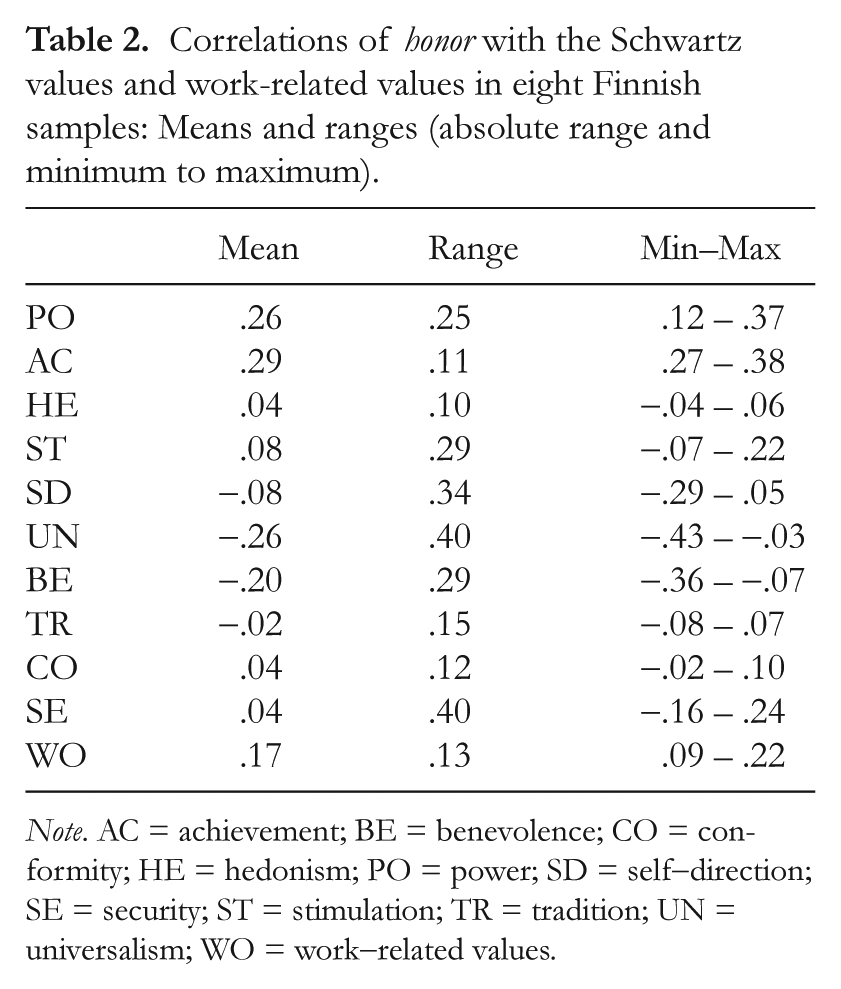
Note. AC = achievement; BE = benevolence; CO = conformity; HE = hedonism; PO = power; SD = self-direction; SE = security; ST = stimulation; TR = tradition; UN = universalism; WO = work-related values.
The importance of honor was related negatively (p < .05) to all measures of moral emotionality in the adolescent sample (empathic concern (r = −.19), perspective taking (r = −.18), and guilt (r = −.24), with the exception of shame (r = .09, ns). To test the hypothesis on the relations of honor and shame, with guilt and empathy partialled out, regression analyses were conducted, with honor as outcome and emotions as predictors. No significant associations were found.
Discussion
These findings unambiguously suggest that honor is a self-enhancement value in present-day Finland, as it is most strongly related to achievement and power. Also, its negative associations with measures of empathy, perspective-taking, and guilt are consistent with our alternative fourth hypothesis (b) as well as with the previous findings that show that self-enhancement values relate negatively to these variables (Helkama, 2011; Silfver et al., 2008). Even if honor as a cultural value, defined in the dictionaries and included in standard military oaths, does have a tradition/conformity component in Finland, this component did not emerge at the level of individual value priorities. For older and younger people alike, as well as for the military, honor was an achievement value, in spite of the large variation in its importance in different samples. Interestingly, though, the importance of honor was higher in hierarchical contexts, among military cadets and reserve officer conscripts. In sum, the importance of honor varied but its meaning was the same in different groups in Finland.
The uniformity of the pattern of correlations across different samples was somewhat surprising. What was particularly noteworthy was the narrow range of correlations of honor with achievement, which showed the strongest average association with honor. It seems justified, then, to claim that honor in Finland is primarily an achievement (and clearly also a self-enhancement) value. The finding that the correlations of honor with all values, except security, were either positive or negative, also testifies the uniform, shared nature of the Finnish conception of honor. The finding that honor tended to be negatively associated with security in military contexts but positively in other contexts seems somewhat counterintuitive—one would expect that the military context would activate both honor and security values alike (national security is one of security items).
Contrary to expectation, we did not find any relations between dispositional shame and honor in the sample where we could examine it. A possible reason for this could be that the measure of shame proneness used in the present study taps the kind of shame that is associated more with withdrawal and self-defensive motivations than with self- and social improvement tendencies, as Gausel and Leach (2011) point out in their review of relevant research. Gausel and Leach cite research showing that shame about achievement failure motivates self-improvement. Since honor is essentially an achievement value, then use of alternative measures of shame could disclose an association with honor. Alternatively, it is possible that the association of honor and shame only occurs in particular situations and does not manifest itself at the level of dispositions, measured in this study.
The pattern of mean correlations of honor with other values in Finland, displayed in Table 2, indicates that this pattern is, with one exception (hedonism and stimulation), consistent with the sinusoidal pattern. This finding suggests that honor as a value could be seen as part of the total structure defined by Schwartz’s (1992) model. Whether the Schwartz model is able to handle the relationships of honor with other values equally well in other countries is the question to which we turn next. To what extent are the findings from Finland unique to that country? Are they perhaps more broadly representative of the Northern European conception of honor?
Part 2: Honor Among Estonian, Finnish, Italian, Russian and Swiss Adolescents
The choice of the five target countries for this study 1 could be justified as follows, drawing on previous studies of honor in Spain and the Netherlands (Fischer et al., 1999; Rodriguez Mosquera, Manstead, & Fischer, 2000; Rodgriguez Mosquera et al., 2002, 2008), current dominant value typologies (Hofstede & Hofstede, 2005; Schwartz, 2008) as well as historical traditions. Russia is unambiguously a collectivistic, hierarchical country, high on collectivism, power distance, hierarchy, and embeddedness, although achievement values are important among the younger generation (Stefanenko, 2003). Finland belongs to the same Northern European cluster of individualistic and egalitarian countries as the Netherlands. Italy—and Spain—are Mediterranean countries which could be expected to share similar cultures of honor, in spite of their current high scoring on individualism and autonomy. Compared to Finland (and the Netherlands), Italy (like Spain) is higher on power distance. Thus, we could expect that the collectivist component of honor would dominate in Russia and Italy but the individualistic achievement component would be salient in Finland.
From the viewpoint of value research, Estonia is of particular interest. A rapid transition has been taking place there within the past 20 years (e.g., Tulviste, Mizera, & De Geer, 2012). It belonged to the communist camp from 1944 until 1990, and Bardi and Schwartz (1996; Schwartz & Bardi, 1997) identified traces of communist influence in the value structures and priorities of Estonians in samples from the 1980s. In post-communist Estonia there has been a strong political and cultural movement from Eastern Europe toward Northern Europe, Sweden and Finland in particular, expressed e.g., in the book title Return to the Western world (Lauristin & Vihalemm, 1997). While Schwartz (2008) locates Estonia among high embeddedness countries, on the Hofstede & Hofstede (2005) individualism dimension Estonia, Finland, Italy, and Switzerland are close to each other on the individualist end, and Russia is located in the collectivist end. Therefore, with regard to the meaning of honor, we expect that Estonia follows the pattern of Northern, Protestant Europe (to which Estonia historically belongs) but would not be astonished to find traces of its collectivist past, either.
Switzerland, on the other hand, is one of the old and stable democracies, and its German-speaking (largely Protestant) section is low on power distance and high on individualism (Hofstede & Hofstede, 2005), which leads us to expect that for the Swiss, honor would be an achievement value.
A comparison of Estonian, Finnish, German, Italian, and Russian dictionaries suggested that honor is defined in a fairly similar way in each language. Italian was the only dictionary to mention female sexual purity. (The German dictionary also mentioned it but indicated that this use is obsolete.)
Method
An attempt was made to obtain samples that would be as comparable as possible to one another. Similar secondary high schools leading to university were selected in each country. The five samples (Table 1; see also Lönnqvist, Verkasalo, Helkama, et al., 2009) consisted of 15- to 17-year-old students from Tallinn, Estonia; Helsinki, Finland; Padua, Italy; Moscow, Russia; and Berne, from German speaking Switzerland. The same version of the SVS was used as described above. The existing “official” versions of the SVS in each language were used. The additional values (work-related values and honor) were translated from the English and equivalence of meaning was established through back-translation. In Switzerland, the number of items was 66 (persistence was omitted), and in Italy, 62 (in addition, God’s grace, salvation, privacy, and self-indulgence were omitted). Honor (sense of honor) was rendered as follows: Estonian: au (autunne), Finnish: kunnia (kunniantunto), Italian: onore (senso dell’onore), Russian: tshest’, (tshuvstvo tshesti), German: Ehre (Ehrengefühl).
Results
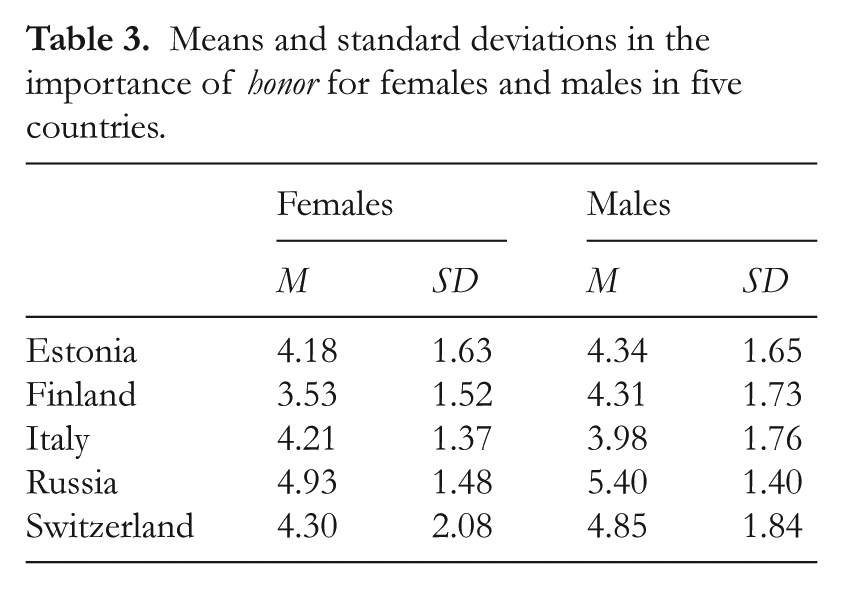
Table 3 illustrates the means for honor for girls and boys in the five samples. It indicates that adolescent boys in Finland (t (529) = 5.37, p < .001), Russia (t (296) = 2.79, p < .005) and Switzerland (t (527) = 3.23, p < .005) attached more importance to honor than did adolescents girls, whereas no gender differences were found in Estonia or Italy.
Means and standard deviations in the importance of honor for females and males in five countries.
The correlations of honor with other values are presented in Table 4. The pattern for Finnish adolescents is highly similar to the pattern shown in Table 2, with the exception that power shows the highest correlation instead of achievement. In the Estonian sample, correlations are, by and large, similar to those in the Finnish sample, only somewhat lower. The Swiss sample resembles the Finnish and Estonian samples in that self-enhancement values correlate with honor. However, conservation values also correlate with honor among Swiss adolescents, and conformity shows the highest correlation. A third type of pattern is seen in the Italian and Russian samples, in which self-enhancement values do not correlate with honor at all (or show weak negative correlations) whereas conformity is the value which is most strongly associated with honor. In the Russian sample, even benevolence is clearly related to honor. Table 4 also indicates that the correlations of honor with power values (positive) in Estonia, Finland, and Switzerland are significantly different from those in Italy and Russia. Analogously, the correlations of honor with conformity in Italy and Switzerland differ significantly from those for Estonia and Finland. The figures showing results of multidimensional scaling confirm these findings. Work-related values seem to be moderately related to honor in every sample.
Correlations of honor with the Schwartz values and work-related values in five countries.
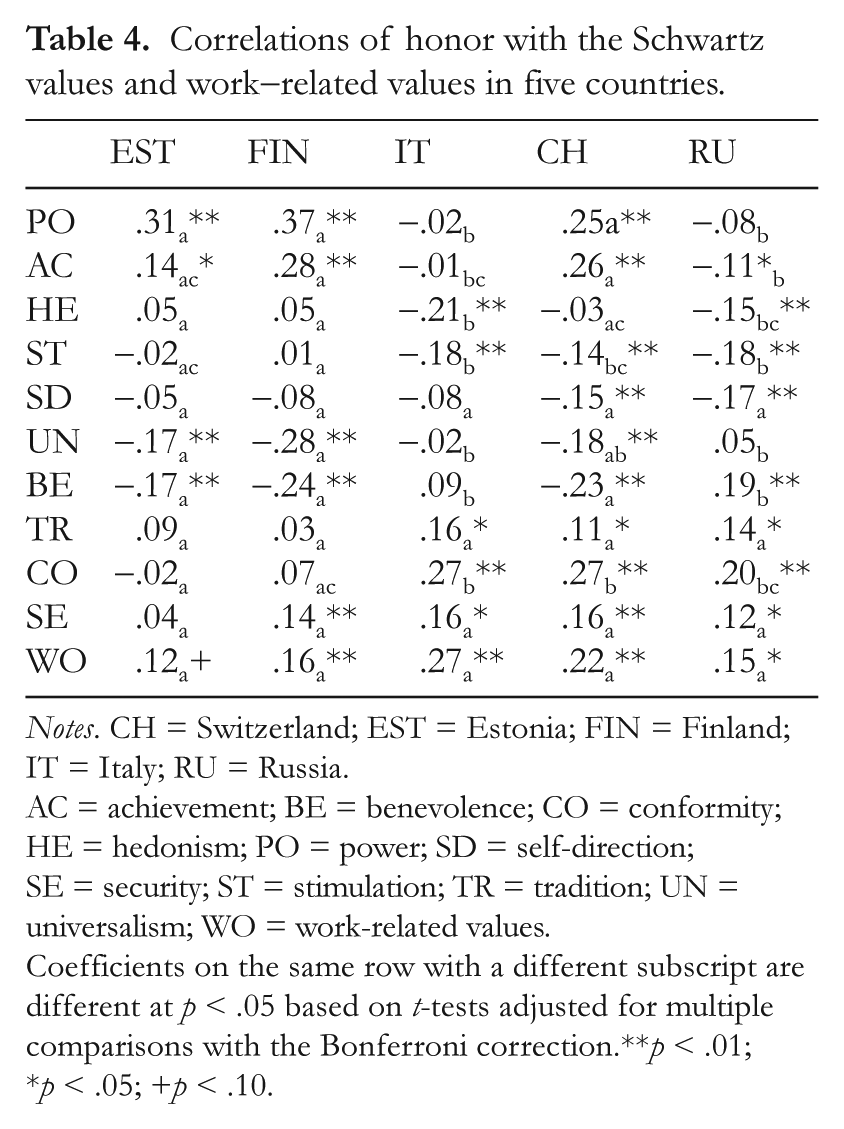
Notes. CH = Switzerland; EST = Estonia; FIN = Finland; IT = Italy; RU = Russia.
AC = achievement; BE = benevolence; CO = conformity; HE = hedonism; PO = power; SD = self-direction; SE = security; ST = stimulation; TR = tradition; UN = universalism; WO = work-related values.
Coefficients on the same row with a different subscript are different at p < .05 based on t-tests adjusted for multiple comparisons with the Bonferroni correction.**p < .01; *p < .05; +p < .10.
Schwartz’s model of the integrated value system implies that the correlations of values with other variables should follow the sinusoid curve. We tested the hypothesis that honor in each country would be part of the integrated system by correlating the predicted with the observed order of correlations between honor and the Schwartz values (excluding work-related values). The Spearman correlations were .96 for Estonia, 1.00 for Finland, .99 for Italy, .98 for Russia, and .96 for Switzerland (all p < .01).
Discussion
The results from the five countries are consistent with the notion of honor’s two components, achievement/power and conformity/tradition component (Rodriguez Mosquera et al., 2002). In Finland and Estonia, the achievement/power component is dominant. This finding locates Estonia in the Northern European value cluster. By contrast, Italian adolescents show the expected Mediterranean pattern that seems similar to the Rodriguez Mosquera et al. (2002) findings from Spain (to the extent that they can be compared). Even the lack of gender difference replicates the findings from Spain. For Russian adolescents, the conformity/tradition component is also dominant, and for them, honor is more important than for the other samples. In Italy and Russia, honor showed negative correlations with hedonism and stimulation, significantly different from the near-zero correlations in Estonia and Finland. A third pattern was found in Switzerland, where honor was associated almost equally strongly with self-enhancement and conformity values, and correlated negatively with universalism and benevolence, in line with Estonia and Finland. As a matter fact, this third pattern is consistent with the dictionary definitions of honor, as well as findings on the cultural meaning of honor in Spain and the Netherlands (Rodriguez Mosquera et al., 2002).

Estonia.
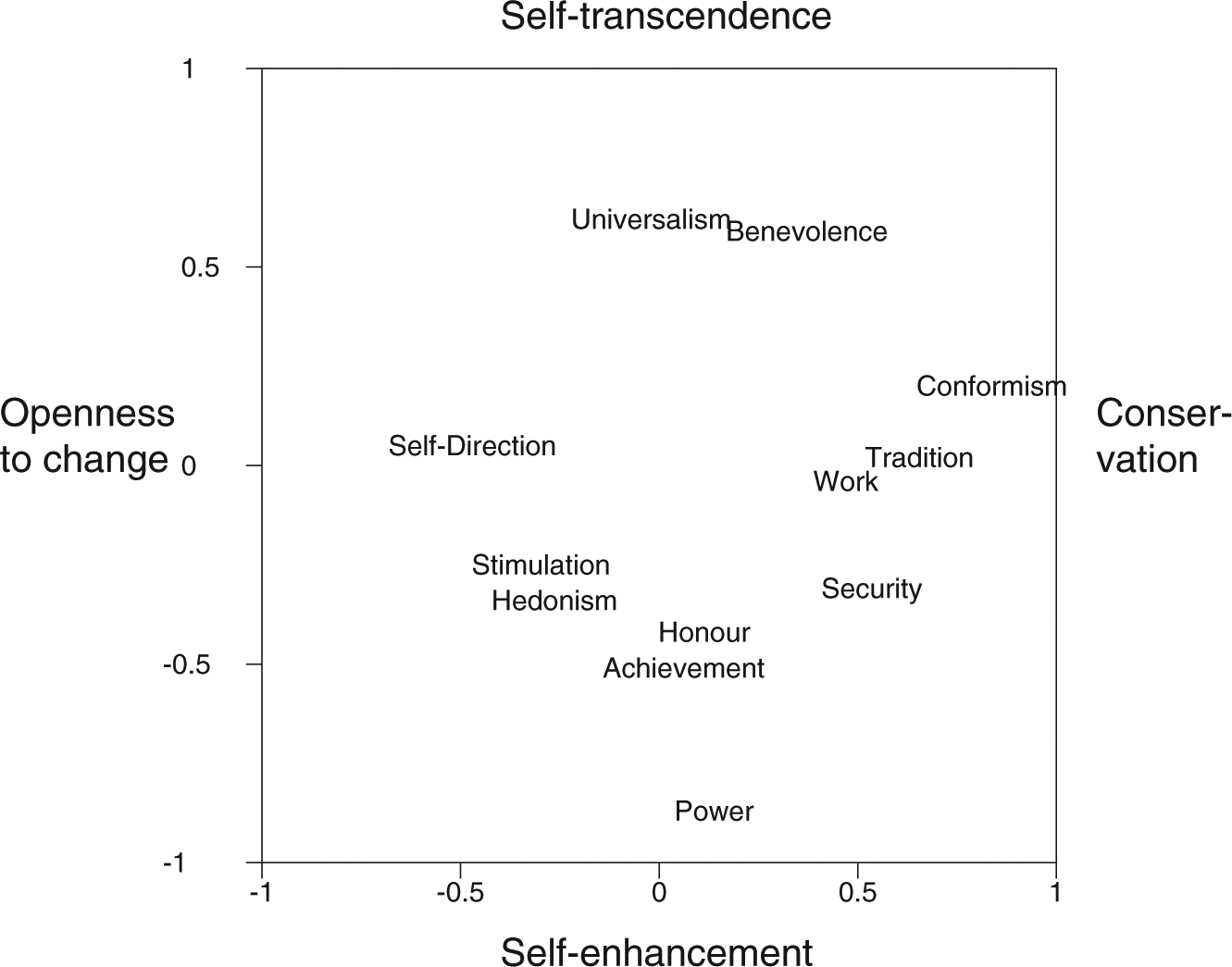
Italy.
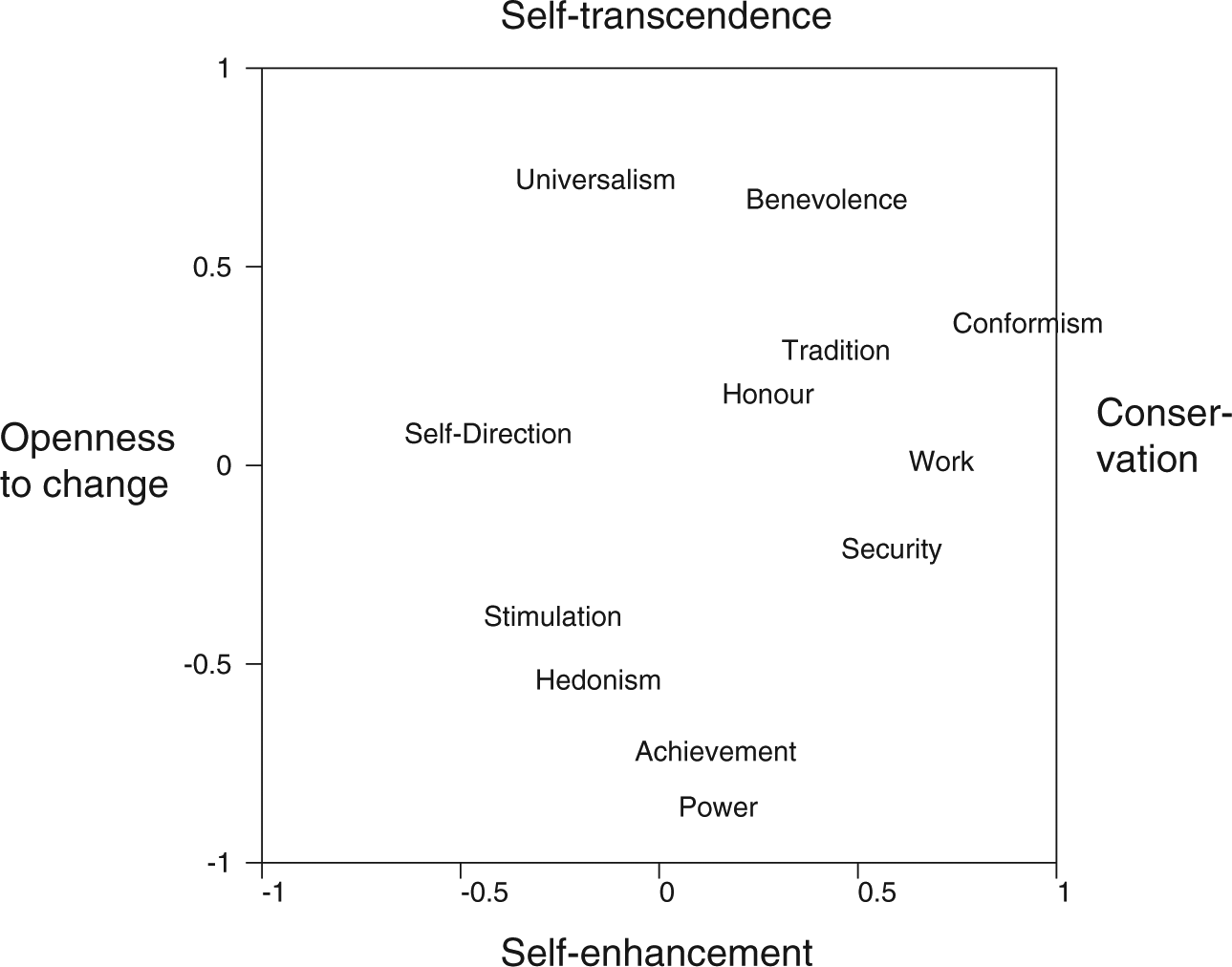
Switzerland.
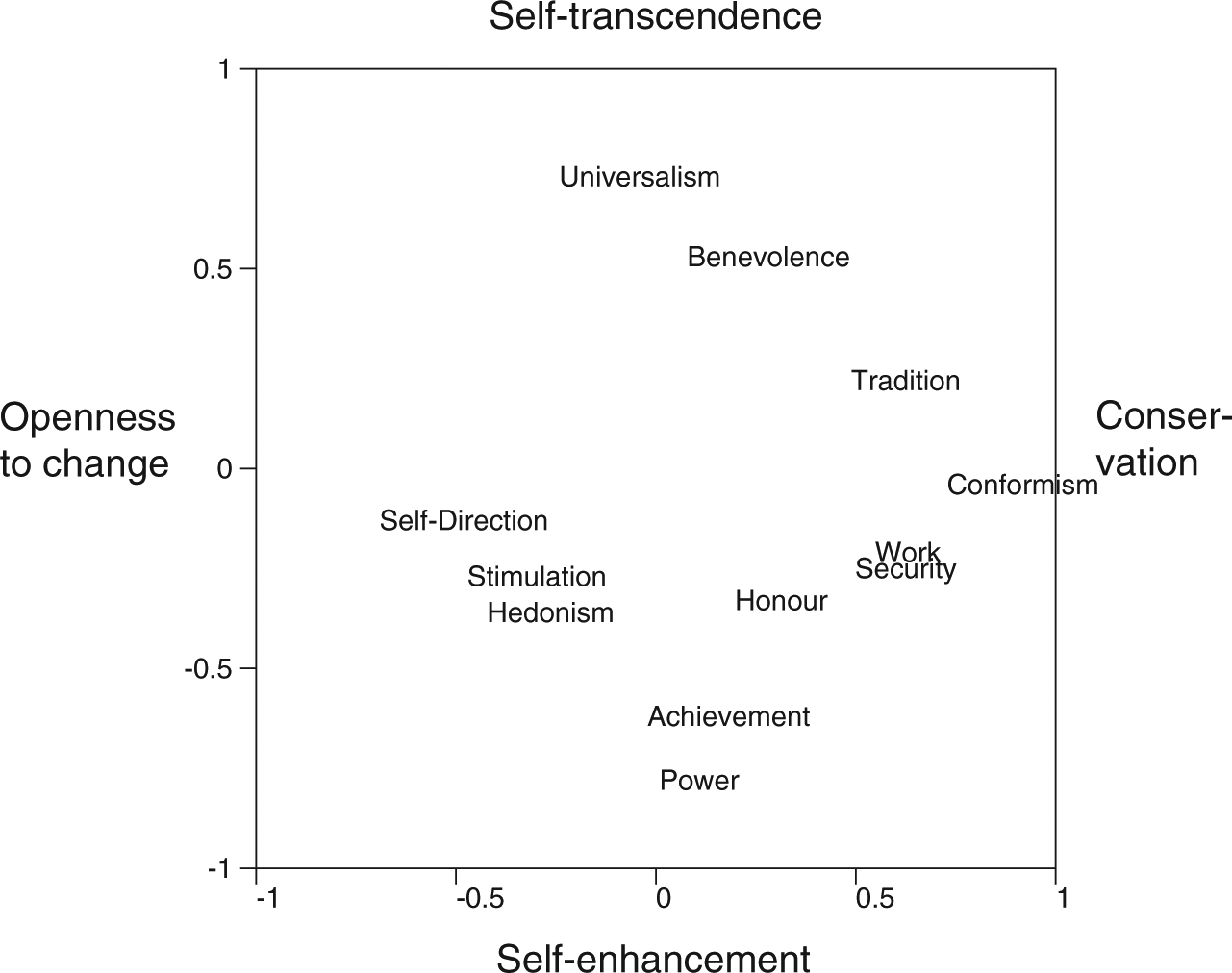
Russia.
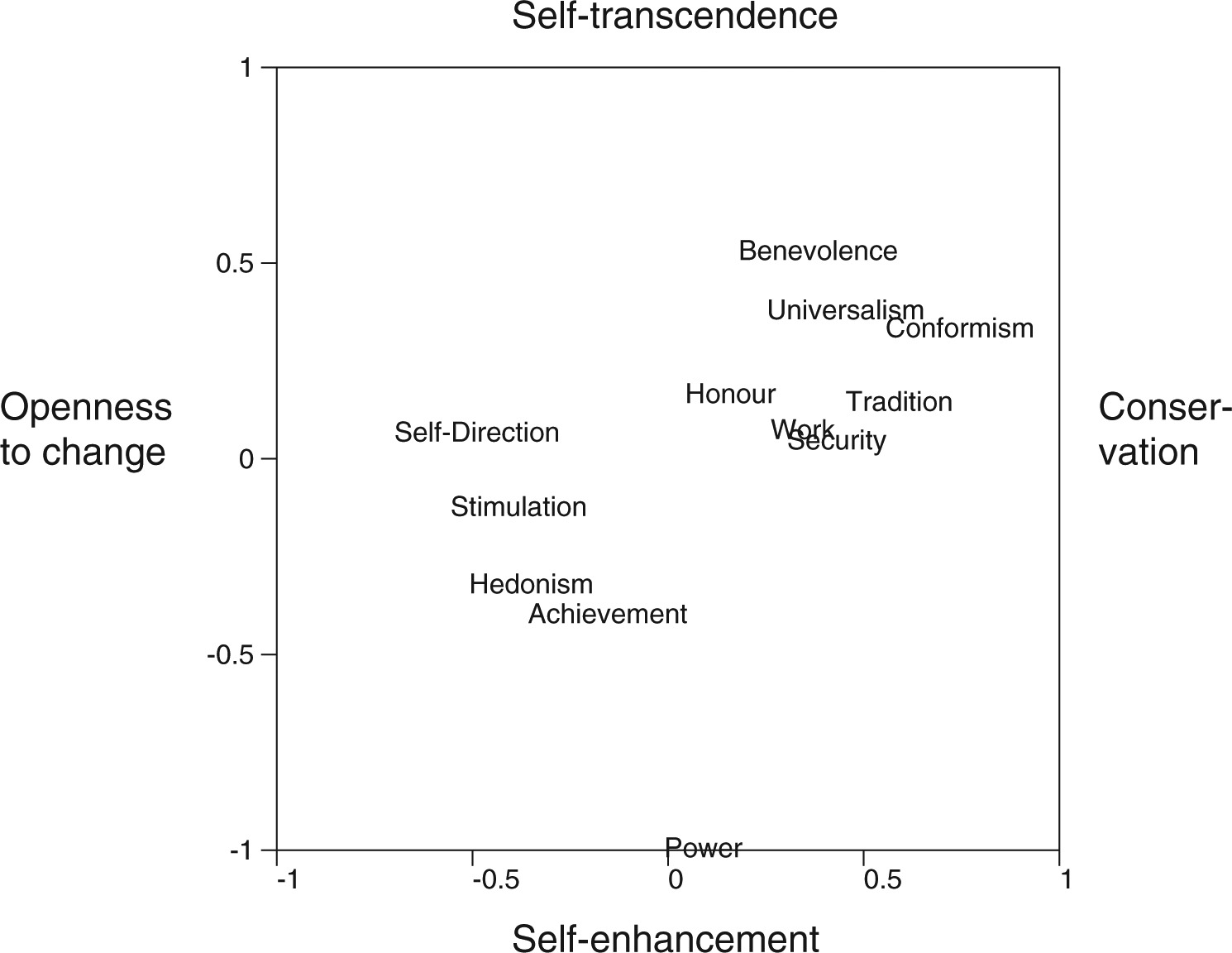
In spite of the striking differences in the patterns, they conform, in all five countries, almost perfectly, with one or two deviations, to the sinusoidal form implied by Schwartz’s notion of a systemic nature of values. This means that Schwartz’s model helps us to understand not only the main motivational goal(s) that honor serves in each country, but it also neatly organizes the varying motivational distances of honor from the other values. For instance, in Estonia, Finland, and Switzerland, pursuing honor is motivationally opposite to self-transcendence values, universalism and benevolence, but in Italy it is neutral (neither compatible nor incompatible with them), whereas in Russia it is compatible with self-transcendence, as shown by the significant correlation with benevolence. It is noteworthy that honor may have a broad motivational profile, as in Switzerland, where it is positively linked to as many as four values, or a narrow one, exemplified by Estonia (pure self-enhancement value). But the motivational contrasts and compatibilities are in each case consistent with the circumplex model. That work-related values showed positive correlations with honor in all samples could perhaps be explained by their sharing with honor the same two aspects, achievement and conformity.
If universalism, benevolence, and conformity/tradition are seen as moral values (Helkama, 2011; Vauclair, 2009), then the present data suggest, first, that honor is most prominently a moral value in Russia, where it was associated not only with conformity but also with benevolence, a prototypical moral value (Helkama, 1999). This stands in clear contrast to findings from Estonia, Finland, and Switzerland, where honor was negatively related to benevolence. Second, in Italy, honor is also a moral value but with a more narrow range, as it relates to conformity and tradition only. In Switzerland, honor is partly a moral value, but also has a self-enhancement component. By contrast, in Estonia and Finland it is not a moral value at all. It is noteworthy that honor did not correlate positively with universalism in any of the countries, which highlights its nature as an ingroup value.
With regard to honor, then, Estonia and Finland share the same Northern European individualist pattern and differ clearly from Russia, where honor turned out to be a conservation value. In Finnish the word for ambitious, a prototypical achievement value, is related to honor (kunnia), kunnianhimoinen. Also in Estonian, the same is true, because ambitious is auahne. Both words mean literally “avid for honor.” However, this does not explain the salience of the achievement component of honor in those two countries, because in Russian and German, the words for ambition, tshestolyubiya and Ehrgeiz, respectively, also derive from honor. Italian is the only language of the five in which ambition (ambizione) is not related to honor.
General Discussion
The research reported in this paper addressed five issues. First, we examined contextual variations in the meaning and importance of honor in Finland. We found, expectedly, that honor as a value was more important in military contexts (for military cadets and reserve officer conscripts) than for other groups. The importance of honor seems to vary with the hierarchical nature of the social context where the data were collected. In the most hierarchical context, cadets in the military academy, honor ranked within the top quarter of the value hierarchy, whereas in the least hierarchical context, social science and psychology departments at the university, it was near the bottom of hierarchy. With regard to honor’s meaning, defined in terms of its relations to other values, we found somewhat surprisingly that irrespective of age or profession, honor was most strongly associated with Schwartz’s (1992) self-enhancement values. Thus, for Finns, young and old, military and non-military, honor is something to be individually achieved, parallel to ambition, wealth, and authority.
Second, we examined honor and emotion in Finland by looking at the relationship between honor and emotion proneness. In line with the finding that honor is a self-enhancement value, we found that people who attach importance to it tend to describe themselves as not prone to feel empathy or guilt; contrary to our prediction, we did not find any association of honor with shame proneness, possibly due to the method used to assess shame.
Our third and main focus was the relationship of honor with other values, both the standard Schwartz core values, and work-related values as well. For cross-cultural comparison, we selected, besides Finland, Estonia, Italy, Russia, and Switzerland. Based on previous research (Rodriguez Mosquera et al., 2002), we distinguished the self-enhancement and conservation components of honor. Relying on the existing typologies of cultural values (Hofstede and Schwartz) we derived the hypothesis that the conservation component of honor would be dominant in Italy and Russia. We already knew that self-enhancement component was salient in Finland. We were not able to derive clear hypotheses regarding the meaning of honor in Estonia and Switzerland.
The data for Italy and Russia clearly supported the hypothesis. In those countries the conservation values, conformity, security, and tradition, related positively to honor, whereas two openness to change values, hedonism, and stimulation, related to it negatively. Thus, in these countries honor serves to maintain stability and continuity. In Russia, this is manifested most clearly, as honor was, in addition, negatively associated with self-direction (an openness to change value) and positively related to benevolence. Even if the similarity of Italy and Russia was expected, it should be noted that according to both the Hofstede and the Schwartz value typologies these two countries are rather different. Italy is an individualist, relatively egalitarian culture, Russia a collectivist, hierarchical culture. The nature of honor as a collective value derives in Italy from the Mediterranean tradition that seems to be alive even in Northern Italy (Padua) where the Italian data were collected.
A second pattern was found for Finland and Estonia, where the self-enhancement component was dominant. In Estonia, only the self-enhancement values, achievement and power, showed significant positive correlations with honor, but in Finland honor also correlated with security.
A third pattern, the combination of honor’s both components, individual self-enhancement and collective conformity/tradition, was observed in Switzerland. In all, our findings do not lend themselves to any clear-cut explanation in terms of current value typologies. Perhaps the differences between countries reflect local traditions that are not captured by existing typologies.
The fourth issue addressed in this paper was honor as a possible moral value and its associations with moral emotions. Current research suggests that self-transcendence and conservation values can be more or less universally regarded as moral values (Helkama, 2011; Schwartz, 2007; Sverdlik, Roccas, & Sagiv, 2012; Vauclair, 2009). From that viewpoint, our results suggest that in Italy and Russia honor is a moral value, in Russia even more strongly, given its association with benevolence. By contrast, honor in Estonia and Finland does not qualify as a moral value at all, given its positive association with self-enhancement values, which are nowhere regarded as moral, and negative association with self-transcendence values, which are everywhere regarded as moral. The Swiss honor, in turn, appears “half-moral, half non-moral”, a mixture of conservation and self-enhancement values.
We had data on the relations of honor to moral emotions only from Finland. The present findings were consistent with previous research in that Finnish honor, as a non-moral, self-enhancement value, was negatively associated with guilt proneness, empathy, and social perspective-taking (e.g., Myyry & Helkama, 2001; Silfver et al., 2008). However, the implications of the theoretical framework developed in the introduction could be spelled out here, in the light of our findings from other countries. We would expect the personal importance of honor to predict dispositional guilt and shame in Russia and Italy, where honor was a moral, conservation value. We expect the association of honor with guilt proneness to be stronger in Russia than in Italy, because of the moderate benevolence component that honor possessed in Russia. The benevolence component present in Russian honor would also lead to the prediction that in Russia but not in Italy, honor would be associated with perspective-taking and empathic concern. Since Swiss honor turned out to be a mixture of self-enhancement and conservation, the predictions would be ambiguous, perhaps “a positive but weak” association.
Shame is the moral emotion conceptually most closely related to honor. Dispositional shame, measured by the TOSCA, has displayed weak and inconsistent associations with values in previous research. While the relations of other moral emotions to the Schwartz values have followed the sinusoid form, those of shame have not (Silfver et al., 2008), which suggests that shame proneness is more involuntary than guilt. Whether this is attributable to the particular measure used here, lacking items that tap self-improvement reactions to threats to one’s self-image or social image (loss of honor), or a more basic property of shame, remains to be seen in future studies.
Fifth, our data speak to the theory of values. We drew on Schwartz’s value model to compare the meaning of honor in the five countries, according to the suggestion by Schwartz and Sagiv (1995). Few studies seem to have followed their suggestion that the Schwartz model could be used to identify culture-specific meanings of values. To our knowledge, ours is one of the first. We found three (or even four or five: Russian and Italian difference on benevolence; Finnish and Estonian difference on security) separate meaning patterns. In Estonia and Italy, honor turned out to be a motivationally pure value, in the sense of being related only to self-enhancement and conservation values, respectively. It was motivationally mixed to some extent in Finland and Russia, and showed a fairly strong motivational heterogeneity in Switzerland. But remarkably, all patterns were compatible with Schwartz’s notion of a motivational continuum and thus indirectly corroborated his theory. Also the finding that work-related values, which are motivationally mixed in an analogous way, were associated with honor in all five countries, is significant. Our findings illustrate the dual nature of honor as something that individuals want to gain and something they attempt not to lose. In terms of the regulatory focus theory (Higgins, 1998), honor could be seen from a promotion focus (Estonia, Finland) or a prevention focus (Italy, Russia), or both (Switzerland). The present results fit in with the observations (Leikas, Lönnqvist, Verkasalo, & Lindeman, 2009) that promotion focus is associated with achievement values and prevention focus with conformity values.
One limitation of the present study—in addition to the one-item measure of honor—is its focus on variation in personal importance. Essentially, we found out that those who had high regard for honor in Estonia and Finland, tended also to have high regard for achievement and power, whereas in Italy and Russia, they had high regard for conformity. This way of examining the meaning of honor necessarily leaves the stable, invariable components of honor out of consideration. Dictionaries in all five European countries suggest that honor is something associated with your family or that you may lose your honor by being dishonest. These components of meaning are stable across countries. As our cross-cultural data were obtained from adolescents only, future studies could test the generalizability of the present findings and the validity of the hypotheses we put forward.
Footnotes
Acknowledgements
We would like to thank Inga Jasinskaja-Lahti, Sointu Leikas, Patricia Rodriguez Mosquera, and two anonymous reviewers for their comments on our work, and Shandi Petersen for her help in preparing the final manuscript.
Funding
This work was supported by the Finnish Academy (grant number 210618).