




Abstract
We investigate the phenomenon of complementary stereotyping of ethnic minorities in Poland and its relationship to system justification. Using results from a nationally representative survey we test the hypothesis that complementary stereotypes—according to which ethnic minorities are seen as possessing distinctive, offsetting strengths and weaknesses—would be associated with system justification among Polish majority citizens. For four minorities, results indicated that stereotyping them as (a) low in morality but high in competence or (b) high in morality but low in competence predicted greater system justification. These results suggest that even in a context that is low in support for the status quo, complementary stereotyping of ethnic minorities is linked to system justification processes. For the three minority groups that were lowest in social status, complementary stereotyping was unrelated to system justification. It appears that negative attitude towards these groups can be expressed openly, regardless of one’s degree of system justification.
Ideas about the characteristics of subordinates emerge out of the political demands imposed by the need to justify and clothe the rude facts of expropriation.
The American sociologist Mary Jackman (1994) has suggested that the ways in which advantaged groups construe stereotypes of disadvantaged groups play a crucial role in the maintenance of the support for the social order. Such stereotypes need not be explicitly negative. On the contrary, they frequently include favorable components. Historical examples include widespread cultural assumptions that women are pretty and pure yet dependent and vulnerable (Glick & Fiske, 2001) and Jewish or Armenian victims of genocide are talented even though they might ultimately lack in humanity (Glick, 2002).
With the decline of outright hostility and contempt toward women and minorities, seemingly “ambivalent” forms of stereotyping and prejudice might have filled the ideological void (see also Dixon, Levine, Reicher, & Durrheim, 2012; Glick & Fiske, 2001; Jost & Kay, 2005). There is reason to believe that complex, yet ostensibly favorable (or at least mixed) stereotypes of social groups are construed to contribute to the legitimacy of the existing social order in a manner that mimics the role of traditional prejudices. In this paper we in investigate whether complementary stereotyping of ethnic minorities can serve system-justifying purposes in Poland—a country with generally low overt support for the status quo (Cichocka & Jost, 2014). We first review psychological research on complementary stereotyping and then discuss the context for our research.
The System-Justifying Function of Complementary Stereotypes
Social psychologists have consistently identified two dimensions that are fundamental to social perception (e.g., Eagly & Mladinic, 1994; Fiske, Cuddy, Glick, & Xu, 2002; Kay & Jost, 2003; Wojciszke, 2005). The first is the extent to which people are seen as friendly, approachable, and moral; this dimension is typically described in terms of warmth or communion. The second refers to judgments of competence and agency. These two dimensions figure prominently in judgments of individuals and social groups (Cuddy, Fiske, & Glick, 2007; de Lemus & Bukowski, 2013; Judd, James-Hawkins, Yzerbyt, & Kashima, 2005; Rosenberg, Nelson, & Vivekananthan, 1968; Wojciszke, 2005), including ethnic minority groups (e.g., Fiske et al., 2002; Phalet & Poppe, 1997).
Judgments of warmth and competence are sometimes positively correlated, as in the case of “halo effects” (Rosenberg et al., 1968; Yzerbyt, Kervyn, & Judd, 2008). However, research has also identified a “compensation effect,” which may be defined as the “tendency to differentiate two social targets in a comparative context on the two fundamental dimensions by contrasting them in a compensatory direction” (Kervyn, Yzerbyt, Judd, & Nunes, 2009, p. 829; see also Kay & Jost, 2003; Kervyn, Yzerbyt, Demoulin, & Judd, 2008; Yzerbyt et al., 2008). Such a pattern is clearly evident in cases of “complementary stereotyping”, whereby “advantaged and disadvantaged group members are seen as possessing distinctive, offsetting strengths and weaknesses” (Kay & Jost, 2003, p. 825). For instance, members of high-status groups might be regarded as highly ambitious, skillful, and hard-working but at the same time as cold, unfriendly, and dishonest (a constellation sometimes referred to as “envious stereotypes”; see Cuddy et al., 2007; Fiske et al., 2002). These are contrasted with stereotypes in which members of low-status groups are regarded as high in warmth but low in competence (often called “paternalistic stereotypes”; Cuddy et al., 2007; Fiske et al., 2002).
These observations suggest that stereotypes of social groups are probably not simply veridical perceptions of personal attributes. One tradition of theorizing in social psychology, which may be traced to Allport (1954), holds that stereotypes serve as rationalizations of the social groups’ relative positions in society (e.g., Eagly & Steffen, 1984; Hoffman & Hurst, 1990; Jost & Banaji, 1994). The idea is that individuals are motivated to develop and disseminate stereotypes that satisfy their desire to explain and justify existing forms of social relations. Complementary stereotypes in particular encourage the assumption that every group in society is receiving a fair share of costs and benefits, so that the social system as a whole benefits from an “illusion of equality” (e.g., Bem & Bem, 1970; Jost & Kay, 2005). In this way, complementary stereotyping helps people to satisfy their system justification motive, defined as the striving to perceive the societal status quo as fair, legitimate, and desirable, even in the presence of countervailing information or interests (Jost & van der Toorn, 2012; Kay et al., 2007).
Studies carried out by Jost, Kivetz, Rubini, Guermandi, and Mosso (2005) demonstrated that complementary stereotyping is indeed associated with heightened system justification tendencies. In Italy, for instance, the perception that the socio-economic status difference between Northerners (higher status) and Southerners (lower status) was large in magnitude was accompanied by complementary stereotypic differentiation. Specifically, perceiving greater inequality was linked to stereotyping Northerners as more competent than Southerners and Southerners as more communal than Northerners. These stereotypes, in turn, predicted ideological support for the current social system (see also Oldmeadow & Fiske, 2007). A similar pattern of results was observed in England, where status differences between Northerners and Southerners are reversed. Finally, an experiment conducted in Israel demonstrated that activating the system justification motive directly by exposing participants to criticism of the social system increased complementary stereotyping of higher status Ashkenazi and lower status Sephardic Jews (see also Kay, Jost, & Young, 2005).
Additional evidence linking complementary stereotypes to system justification processes comes from experiments in which research participants either are or are not exposed to complementary stereotypes (or stereotype exemplars) and are subsequently asked (ostensibly as part of a different experiment) for their opinions about the fairness and legitimacy of the overarching social system. These experiments reveal that participants do indeed score higher on scales developed to measure system justification tendencies following exposure to “benevolent” sexism and stereotypes of women as less agentic but more communal than men (Jost & Kay, 2005), as well as compensatory stereotypes of poor people as happier and more honest than rich people (Kay & Jost, 2003; see also Kay, Czapliński, & Jost, 2009).
Whereas earlier studies focused primarily on the system-justifying function of complementary stereotypes with respect to groups that are roughly equal in size (e.g., Northerners vs. Southerners), de Oliveira and Dambrun (2007) examined whether complementary stereotyping of ethnic minorities also served a system-justifying function for members of an ethnic majority group. These authors did not observe a relationship between complementary stereotypes of ethnic minorities and endorsement of system-justifying beliefs in France. However, they did not appear to test for statistical interactions between stereotypical judgments concerning warmth (or morality) and competence, focusing instead on the interaction between general positivity and negativity (i.e., attitudinal ambivalence). Thus, the relationship between complementary stereotypes as applied to ethnic minorities and system justification tendencies has not been satisfactorily addressed in prior research.
Ethnic Relations in Poland
We sought to determine whether complementary stereotypes of ethnic minorities would be associated with system justification tendencies in Poland. Before World War II, Poland included large populations of Ukrainians, Jews, Belarusians, Germans, and Lithuanians—as well as smaller populations of other ethnic minority groups, such as Armenians, Czechs, and Romani (Gypsies). Many of these groups suffered discrimination, prejudice, and a form of coercive assimilation referred to as “Polonization” (Snyder, 2003). For instance, Lithuanian and Ukrainian schools were closed down, and their national organizations were outlawed. Leaders of the Ukrainian national movement were imprisoned and tortured in the notorious camp of Bereza Kartuska. Jews, too, suffered greatly from numerus clausus and numerus nullus laws, which limited their access to education and job markets. Following the atrocities of World War II, Poland became an ethnically homogeneous country (Gwiazda, 1994). In the most recent nationwide census only 3.65% of Polish citizens declared an ethnicity that was other than “Polish” (Central Statistical Office, 2012). The Jewish population in Poland today is less than 10,000 (Bilewicz & Wójcik, 2010). There are, however, approximately 126,000 ethnic Germans; 49,000 Ukrainians; 46,000 Belarusians; 16,000 Romani; and 13,000 Russians currently living in Poland. The only sizeable “new minority” group in Poland is that of Vietnamese immigrants, who number approximately 25,000 (Wysieńska, 2010). Thus, Poland provides a context in which a very sizeable Polish ethnic majority coexists with small and diverse ethnic minorities, thereby creating a large power asymmetry (cf. Clark & Maass, 1990).
Ethnic minorities in Poland clearly differ in terms of size and status. Although the civilian status and legal rights of ethnic minorities in Poland are protected by the Constitution of the Republic of Poland (“Konstytucja Rzeczypospolitej,” 1997) and the Bill on Ethnic and National Minorities 17/141 (2005), Polish ethnic traditions and religious culture dominate state celebrations and educational institutions (Nijakowski, 2006). Acts of vandalism frequently target minorities’ cultural heritage sites, such as monuments and cemeteries. At the same time, severe forms of persecution, such as the anti-Romani pogrom in Mława, are relatively rare (Winiewski & Bilewicz, 2014). This suggests that in contemporary Poland the ethnic majority’s dominance over minority groups generally takes relatively indirect forms, such as complementary stereotyping, rather than blatant forms of outright hostility and prejudice.
Thus, in Poland, complementary stereotypes of ethnic groups might contribute to system justification. Demonstrating such an effect would contribute to understanding system-justifying processes in an understudied context, namely the post-Communist context. In comparison with traditional capitalist democracies in the West, citizens of Central and Eastern Europe tend to express much greater disappointment with the political system (Kluegel, Mason, & Wegener, 1995; Wojciszke, 2007). For this reason, it has been suggested that system justification theory is simply inapplicable to the post-Communist context (Wojciszke, 2007). Research on system-justifying processes in post-Communist countries remains scarce, although there are a few studies (Jaśko & Kossowska, 2013; Jost, Blount, Pfeffer, & Hunyady, 2003; Kay et al., 2009; van der Toorn, Berkics, & Jost, 2010). A recent review of the literature by Cichocka and Jost (2014) concluded that, despite mean-level differences, system justification seems to possess similar social psychological antecedents and consequences in post-Communist and Capitalist societies.
For example, Kay et al. (2009) demonstrated in the Polish context that compensatory perceptions of wealth predicted system justification among left-wing (but not right-wing) participants (Kay et al., 2009). Importantly, however, this study focused on system justification following exposure to complementary stereotypes of the rich and poor, rather than active bolstering of the social system through stereotyping processes. Recent work conducted in Poland demonstrates clear delegitimization of economic inequality combined with moderate legitimization of social status inequality (Baryła, Wojciszke, & Cichocka, 2014). Our research examines whether complementary stereotyping of ethnic minorities is associated with system justification in a manner that parallels complementary stereotyping of the rich and poor.
Overview of the Study
We hypothesized that complementary stereotyping of ethnic minorities would predict system justification tendencies among majority members in Poland—a country that is generally weaker in ideological support for the status quo (Cichocka & Jost, 2014; Wojciszke, 2005). We sought to determine whether system-justifying processes would be observed with respect to the legitimation of ethnic relations in a context that harbors lower mean levels of system justification. More specifically, we considered the possibility that the justification of the Polish sociopolitical system would be associated with complementary stereotyping of ethnic groups—that is, judgments of high morality and low competence or judgments of low morality and high competence. Specifically, we expected that higher system justification scores would be predicted by the interaction of stereotypical ascriptions of morality and competence to ethnic minorities.
To this end, we analyzed survey data based on a nationally representative sample of Polish adults. This enabled us to revisit the idea, which was called into question by de Oliveira and Dambrun (2007), that complementary stereotyping of ethnic minorities would be associated with greater system justification among ethnic majority groups. It also allowed us to determine whether previous findings concerning the link between system justification and complementary stereotypes of ethnic groups would be replicated in a different political and cultural context, namely Poland—where explicit support for the system remains relatively low (Cichocka & Jost, 2014).
Method
Participants and Procedure
We analyzed data from a domestic survey involving a nationwide, statistically representative sample of the Polish adult population. The sample consisted of 979 respondents (534 women) between the ages of 18 and 89 (Mage = 48.22, SD = 18.03). The study, which was conducted by the Public Opinion Research Centre (CBOS, one of the leading polling firms in Poland), followed the address-based sampling (ABS) method. Participants took part in computer-assisted face-to-face interviews that were conducted in May and June of 2009. 1 Indeed, final sample demographic characteristics closely matched those of the 2011 Polish Census (Central Statistical Office, 2012) in all important respects. Because we were interested in stereotypes of ethnic minorities shared by ethnic majority Poles, the analyses reported here exclude the very few participants who reported their nationalities as Ukrainian or Polish-Ukrainian (n = 2), or Belarusian (n = 4). Thus, the final sample included 973 participants.
Measures
Stereotypes of minorities
We measured stereotypes of the seven most relevant ethnic minority groups in contemporary Poland: Belarusians, Germans, Romani, 2 Jews, Russians, Ukrainians, and Vietnamese (CBOS, 2005). Stereotypes about morality and competence were assessed with items adopted from Cuddy et al. (2009). Participants were informed that the survey pertained to perceptions of ethnic minorities living in Poland. Specifically, the instructions noted: “In the next part of the survey we will ask you about various national and ethnic groups that currently live in Poland.” To measure competence we used one item “Do people like you consider [name of ethnic minority group] competent?” Morality was assessed with an analogous item asking whether each of the minorities was considered “moral.” 3 Respondents provided answers using a 7-point scale ranging from 1 (Definitely not) to 7 (Definitely yes). Scores for each group are summarized in Table 1.
Mean levels and standard deviations of stereotyping with respect to morality and competence for each minority group.
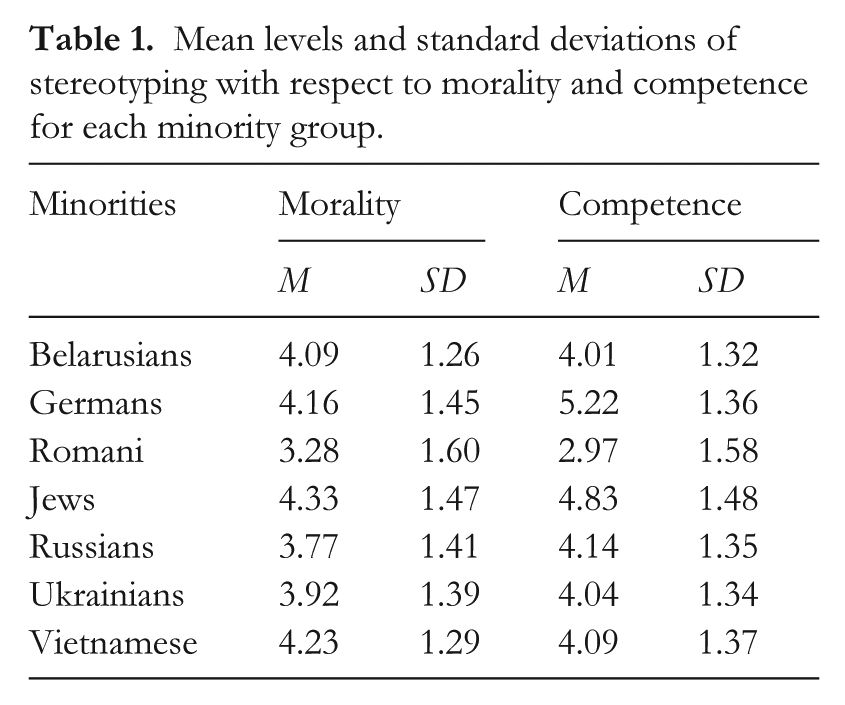
System justification
System justification was measured with three items taken from the Kay and Jost (2003) scale and adapted to the Polish context: (a) “The Polish political system operates as it should”; (b) “In general, our society is fair”; and (c) “In Poland, everyone has a fair shot at wealth and happiness.” Participants indicated their strength of agreement/disagreement with each statement on a scale ranging from 1 (Definitely disagree) to 5 (Definitely agree). Responses from the three items were averaged to form a system justification index (M = 2.05; SD = 0.92, α = .77).
Adjustment variables
All regression analyses adjusted for age, gender, education, and socioeconomic status. Education was measured in terms of years of completed education (M = 11.73, SD = 3.52). Socioeconomic status was measured in terms of subjective perceptions of participants’ own financial situations, ranging from 1 (Bad) to 5 (Good; M = 3.12, SD = 1.06).
Results
Correlational Analyses
In the first step of data analysis we computed zero-order correlations among continuous variables. Ascriptions of morality for all seven groups were positively and significantly intercorrelated, all rs > .37, all ps < .001. Most ascriptions of competence for the seven groups were positively and significantly intercorrelated, all rs > .12, all ps < .001 (except for competence ascribed to Germans and Romani, which were uncorrelated, r[733] = −.01, p = .82). For each of the target groups, ascriptions of morality and competence were correlated with one another, all rs > .34, all ps < .001. System justification was negatively associated with the ascription of morality to Jews, r(735) = −.09, p = .02. System justification was positively correlated with ascriptions of competence to the Romani, r(735) = .15, p < .001 and Vietnamese, r(574) = .10, p = .02. No other correlations between system justification and trait ascriptions were statistically significant (all ps > .057).
Analytic Strategy
To investigate stereotypes of ethnic minority groups, with the use of the PROCESS tool (Hayes, 2013) we conducted a series of hierarchical multiple regression analyses for each of the seven minorities. We analyzed the effects of stereotypes involving morality and competence as well as their interaction as predictor variables, and system justification as the outcome variable. Demographics (age, gender, education, and socioeconomic status) were included as covariates. 4 All continuous predictors were mean-centered prior to the analyses. Gender was dummy coded (0 = male, 1 = female).
We hypothesized a pattern of interaction whereby greater ascriptions of one trait accompanied by lesser ascriptions of the other trait would predict system justification scores. 5 For all significant interactions, we computed simple slopes to examine the effects of morality on system justification for high (+1 SD) and low (−1 SD) values of competence as well as the effects of competence on system justification for high (+1 SD) and low (−1 SD) values of morality (Hayes, 2013). The results are organized according to stereotypes about competence (from highest to lowest).
German Minority
For Germans, the main effects of morality, B = 0.03, SE = 0.03, p = .29, and competence, B = −0.03, SE = 0.03, p = .21, were nonsignificant; however, we observed a significant two-way interaction of the two stereotypical judgments, B = −0.03, SE = 0.01, p = .04; whole model F(7, 721) = 3.30, p = .002, R2 = .03. Simple slope analyses revealed that the effect of morality on system justification was significant and positive for low competence, B = 0.07, SE = 0.03, p = .04, but it was nonsignificant for high competence, B = −0.01, SE = 0.03, p = .69. The effect of competence on system justification was nonsignificant for low morality, B = 0.01, SE = 0.03, p = .80, but it was negative and significant for high morality, B = −0.08, SE = 0.04, p = .04 (see Figure 1).

Interaction effect of ascriptions of morality and competence to the German minority on system justification. Slopes are plotted at the 10th and 90th percentiles.
Jewish Minority
For Jews, the main effects of morality, B = −0.05, SE = 0.03, p = .09, and competence, B = −0.02, SE = 0.03, p = .40, were nonsignificant; however, we observed a significant two-way interaction of the two stereotypical judgments, B = −0.03, SE = 0.01, p = .04; whole model F(7, 653) = 3.53, p = .001, R2 = .04. Simple slope analyses revealed that the effect of morality on system justification was nonsignificant for low competence, B = −0.001, SE = 0.03, p = .87, but negative and significant for high competence, B = −0.09, SE = 0.04, p = .01. The effect of competence on system justification was nonsignificant for low morality, B = 0.02 SE = 0.03, p = .64 and negative and marginally significant for high morality, B = −0.06, SE = 0.04, p = .09 (see Figure 2).
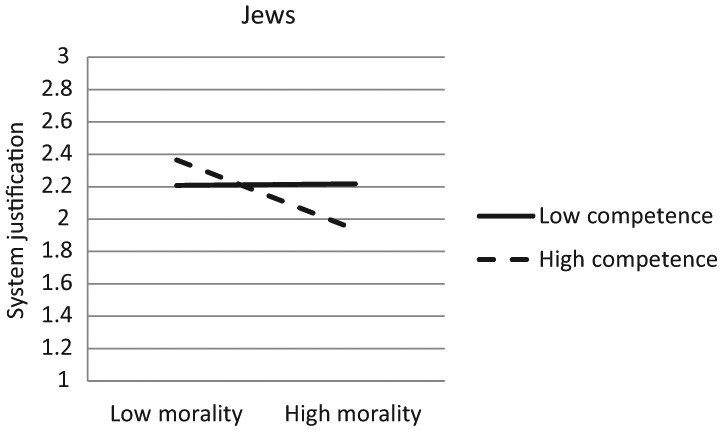
Interaction effect of ascriptions of morality and competence to the Jewish minority on system justification. Slopes are plotted at the 10th and 90th percentile.
Russian Minority
For Russians, the main effects of morality, B = 0.02, SE = 0.03, p = .40, and competence, B = 0.04, SE = 0.03, p = .20, were nonsignificant; however, we observed a significant two-way interaction of the two stereotypical judgments, B = −0.04, SE = 0.02, p = .01; whole model F(7, 658) = 3.36, p = .001, R2 = .03. Simple slope analyses revealed that the effect of morality on system justification was positive and significant for low competence, B = 0.07, SE = 0.04, p = .04 and negative but not significant for high competence, B = −0.03, SE = 0.03, p = .46. The effect of competence on system justification was positive and significant for low morality, B = 0.09, SE = 0.04, p = .01 and negative and nonsignificant for high morality, B = −0.01, SE = 0.04, p = .70 (see Figure 3).
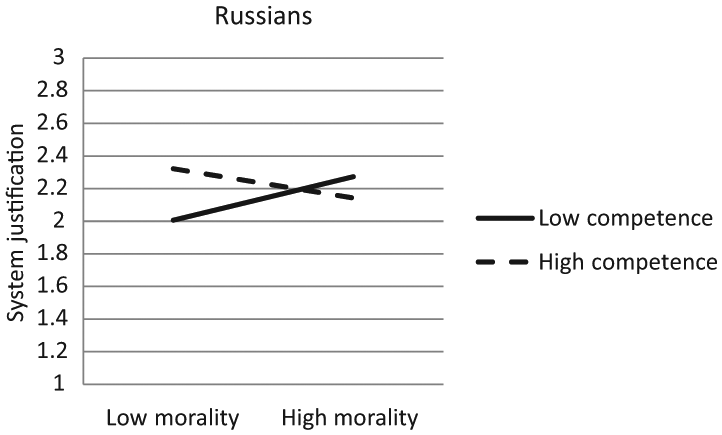
Interaction effect of ascriptions of morality and competence to the Russian minority on system justification. Slopes are plotted at the 10th and 90th percentile.
Vietnamese Minority
For Vietnamese, the main effects of morality, B = −0.02, SE = 0.04, p = .69, and competence, B = 0.07, SE = 0.04, p = .054, were nonsignificant, but we again obtained a significant two-way interaction of the two stereotypical judgments, B = −0.04, SE = 0.02, p = .032; whole model F(7, 481) = 2.68, p = .01, R2 = .04. Simple slope analyses revealed that the effect of morality on system justification was positive but nonsignificant for low competence, B = 0.04, SE = 0.04, p = .47 and negative but nonsignificant for high competence, B = −0.07, SE = 0.04, p = .10. The effect of competence on system justification was positive and significant for low morality, B = 0.12, SE = 0.04, p = .01, but nonsignificant for high morality, B = 0.02, SE = 0.04, p = .63 (see Figure 4).
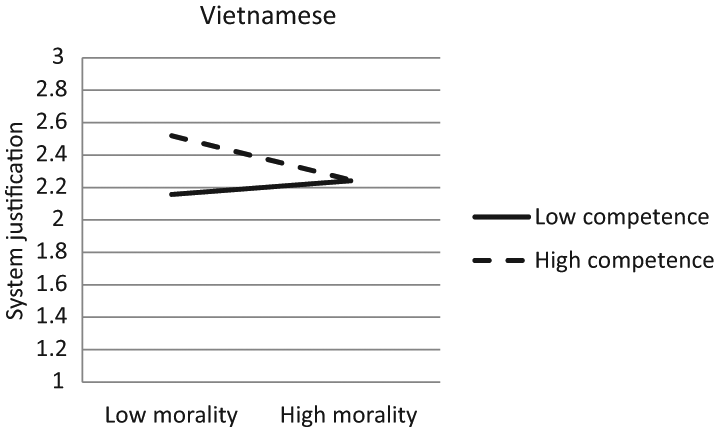
Interaction effect of ascriptions of morality and competence to the Vietnamese minority on system justification. Slopes are plotted at the 10th and 90th percentile.
Ukrainian Minority
Neither the main effects of ascriptions of morality, B = 0.02, SE = 0.03, p = .56, or competence, B = 0.02, SE = 0.03, p = .49, to Ukrainians, nor their interaction, B = −0.03, SE = 0.02, p = .13, were significant predictors of system justification; whole model F(7, 613) = 2.87, p = .01, R2 = .03.
Belarusian Minority
Neither the main effects of ascriptions of morality, B = 0.04, SE = 0.04, p = .34, or competence, B = 0.001, SE = 0.04, p = .98, to Belarusians, nor their interaction, B = 0.02, SE = 0.02, p = .38, were significant predictors of system justification; whole model F(7, 549) = 1.83, p = .08, R2 = .02.
Romani Minority
For Romani, the main effect of morality was not significant, B = −0.01, SE = 0.03, p = .74, but we did observe a significant main effect of competence, B = 0.11, SE = 0.03, p < .001, so that stereotyping Romani as more competent was associated with greater system justification. The two-way interaction of the two stereotypical judgments was marginally significant, B = −0.02, SE = 0.01, p = .07; whole model F(7, 647) = 5.11, p < .001, R2 = .05.
Discussion
In a nationally representative sample of Polish adults we observed that complementary stereotypes of ethnic minorities were indeed associated with system justification. Overall, the pattern of relationships between complementary stereotypes and system justification suggested that Polish citizens who judged ethnic minorities as immoral showed increased system justification when these judgments were accompanied by stereotypes of greater competence. Likewise, citizens who judged ethnic minorities as incompetent showed increased system justification when these judgments were accompanied by stereotypes of greater morality. We observed interaction effects involving stereotypes about morality and competence on system justification for four out of seven target groups analyzed in our study (namely Germans, Jews, Russians, and Vietnamese). These effects were present even after adjusting for demographic variables, such as gender, age, socioeconomic status, and education.
Our findings are in line with the theoretical proposition that complementary (or “ambivalent”) social stereotypes serve the ideological function of legitimizing the societal status quo (e.g., Glick & Fiske, 2001; Jackman, 1994; Jost & Kay, 2005; Kay & Jost, 2003; Kay et al., 2007). Polish citizens who compensated for weaknesses pertaining to one dimension of social judgment (e.g., competence) by ascribing strengths pertaining to the other dimension (e.g., morality) scored higher on system justification. Presumably, such compensatory stereotypes help to sustain the belief that we live in a “fair and balanced” social system (Kay & Jost, 2003; see also Bem & Bem, 1970; Lerner, 1980). Conversely, system-justifying beliefs may foster the occurrence of complementary stereotyping. The present study did not enable us to isolate causal mechanisms, so we must regard both directions of causality as plausible.
The results of our survey corroborate previous demonstrations that endorsing (or being reminded of) complementary stereotypes with respect to gender, wealth, or geographical regions is associated with increased system justification (Jost & Kay, 2005; Jost et al., 2005; Kay et al., 2007). We have seen that complementary stereotypical judgments about ethnic minorities made by members of a dominant majority group are similarly associated with system justification. We only noted one main effect of stereotypical ascriptions of competence on system justification (for Romani) and no main effects of stereotypical ascriptions of morality. This suggests that in order to capture compensatory processes in group judgments (and their relationship to system justification) it is important to consider stereotypes about competence and morality together rather than separately. Consistent with Jackman’s (1994) analysis, system justification motivation may be better served by the belief that positive and negative characteristics are equally distributed across social groups—rather than simply holding hostile or prejudicial attitudes towards minorities in general. As Cisłak and Wójcik (2011) observed, system justification is sometimes associated with positive attitudes towards ethnic minorities in Poland. We have demonstrated that this relationship is moderated by negative attitudes on other (complementary) dimensions of social perception.
We observed subtle differences in the relations between complementary stereotype endorsement and system justification for the various target groups. With respect to Jews and Vietnamese, stereotypes of high competence but low morality were positively associated with system justification. We note that Jews and Vietnamese in Poland are perceived as relatively high in status when it comes to ethnic minorities (Winiewski, 2009). Therefore, it is in line with the stereotype content model (Fiske et al., 2002; Glick, 2002) that for these two groups the combination of high competence and low morality (referred to as “envious stereotypes”) would be especially useful for system-justifying purposes (cf. Winiewski & Bilewicz, 2014). With respect to Russians, higher system justification scores were associated with both forms of complementary stereotyping, although they were highest for the combination of high competence and low morality. Germans were ascribed greater competence than the other minority groups in Poland, and a different pattern emerged for this group: system justification scores were highest among participants who combined stereotypes of high morality and low competence (what Fiske et al., 2002, refer to as “paternalistic stereotypes”).
Finally, when it came to Belarusians, Ukrainians, and Romani complementary stereotypes did not significantly predict system justification. Ukrainians and Belarusians constitute two of the largest immigrant groups entering Poland in recent years (Europejska Sieć Migracyjna, 2013). Surveys suggest that Polish citizens perceive Ukrainian and Belarusian waves of immigration as detrimental to Polish society (Wenzel, 2004). Romani remain one of the most socially excluded ethnic groups in Poland. In general, stereotypes of Romani, which tend to stress thievery and free-riding, are clearly negative with respect to dimensions of morality and competence (Winiewski, 2010). There is also evidence that Romani are least protected by “political correctness” norms and are the most frequent target of hate speech in Poland (Bilewicz, Marchlewska, Soral, & Winiewski, 2014). It is possible that unambiguously negative stereotypes of these three minority groups can be openly expressed, regardless of one’s degree of system justification.
Despite differences in the patterns of stereotypes across groups, what emerges is a relatively clear connection between complementary stereotyping in general and system-justifying processes. At the same time, the results for a few groups (especially Germans) were somewhat surprising, and we certainly do not presume that there is a fixed relationship between stereotypes and system justification. Rather, patterns of complementary stereotyping are likely to change depending on the current state of intergroup affairs as well as media coverage pertaining to various groups. As Jackman (1994) pointed out, “the perceptual distortions . . . that are manifested in the intergroup beliefs of dominant groups” are “likely to have a chameleon quality, with various ideas and modes of attribution flourishing or fading, dependent upon the demands of the relationship at any given time and the broad moral themes that have contemporary currency” (p. 309). The role of specific situational factors in governing the nature of the relationship between complementary stereotyping and legitimation of the societal status quo awaits future research.
The results of this study, in any case, can help to shed light on system justification processes in Poland. The present study, which focused on the system-justifying function of compensatory stereotyping of ethnic minorities (see also Jost et al., 2005), provides additional evidence that hypotheses derived from system justification theory are applicable to the post-communist context (Cichocka & Jost, 2014). More broadly, it would appear that the theory possesses at least some relevance to societies that are considered outside the boundaries of Western, educated, industrialized, rich, and democratic (“WEIRD”) contexts (see Henrich, Heine, & Norenzayan, 2010). Indeed, the possibility exists that when support for the system is especially low (as is presently the case in Central and Eastern Europe), system justification tendencies may manifest themselves in fairly subtle and indirect forms, such as the legitimation of the system of ethnic relations through complementary stereotyping.
Footnotes
Acknowledgements
The authors would like to thank Marta Marchlewska for her assistance in manuscript preparation as well as the editor and three anonymous reviewers for making extremely constructive suggestions for revision.
Funding
This work was supported by the Polish National Science Center (NCN) Sonata Grant DEC-2012/05/D/HS6/03431.