




Abstract
A growing body of work suggests that group-based dissimilarity limits the influence of empathy on helping across group boundaries. The present research examines under which conditions empathy becomes “dis-inhibited” as a motivator of out-group helping. We propose that, when intergroup dissimilarity is high, empathy’s influence on helping critically depends upon the out-group target’s perceived benevolence, i.e. sociability and trustworthiness. Study 1 (N = 123) and 2 (N = 176) manipulated an out-group target’s intercultural dissimilarity and his or her individual features. Results confirmed that when dissimilarity was high, the target’s sociability (Study 1) and benevolence (Study 2) had a facilitative effect on the empathy-helping intentions relationship. When dissimilarity was low, in contrast, empathy predicted helping intentions independent of the target’s individual features. Study 3 (N = 178) manipulated trustworthiness and sociability orthogonally and confirmed the primary role of the out-group target’s trustworthiness over the target’s sociability in dis-inhibiting the empathy-helping relationship among participants with a conservative political orientation.
Dyadic helping across group boundaries can be conceived, at one and the same time, as an interpersonal as well as an intergroup phenomenon. This is so, because it involves characteristics of the interpersonal relationship between the helper and the recipient of help as well as features of the intergroup context in which this relationship is embedded. In this article we examine the interactive effects of perceived intercultural dissimilarities (a group-level factor) and an out-group member’s perceived individual characteristics (an interpersonal factor) on the role that empathy plays as a motivator of cross-group helping.
Numerous studies in social, personality, and developmental psychology have documented the role of empathy—an other-oriented emotional reaction including sympathy, compassion, concern, and the like—for helping the person for whom empathy is felt (for reviews see Batson, 1991; Davis, 1994). However, there also exists empirical evidence that there are boundary conditions on the effectiveness of empathy. One such factor—which lies at the heart of the present article—is the in-group/out-group relationship between a potential helper and the person in need (e.g., Davis & Maitner, 2010; Saucier, Miller, & Doucet, 2005; Stürmer & Snyder, 2010). First, people may experience less or little empathy for a dissimilar other, specifically in intergroup contexts marked by animosity and conflict, in which the out-group is devalued or even de-humanized (e.g., Čehajić, Brown, & Gonzales, 2009; Cikara, Bruneau, & Saxe, 2011; Gutsell & Inzlicht, 2010). Second, even if people experience empathy for an out-group member—for instance, as a spontaneous reaction to the severity of the other’s need—a variety of processes may undermine the influence of this emotional impulse on their decision to help. In our theoretical account for this phenomenon—on which we also base the present analysis—we (together with our colleagues) have proposed that this is so because perceived group-based self–other dissimilarity (including intergroup dissimilarity) often functions as a warning signal (the other is of a “different kind”), which is likely to evoke negative interaction expectations (Mallett, Wilson, & Gilbert, 2008; Pearson et al., 2008) and negative intergroup emotions (Pryor, Reeder, Yeadon, & Hesson-McInnis, 2004; Stephan & Stephan, 1985). As a result, when people contemplate offering help to an out-group member, especially a member of a dissimilar out-group, they may often experience conflicting motivational tendencies due to the concurrent presence of factors prompting help (e.g., empathic impulses, social norms) and factors prompting nonhelp (e.g., feelings of intergroup threat, negative interaction expectancies). Accordingly, they may be generally more hesitant to let themselves be guided by their feelings of empathy and base their decision to help on more systematic and controlled processes instead (e.g., Pryor et al., 2004; Siem, Lotz-Schmitt, & Stürmer, 2014). In line with these assumptions a program of studies employing different research methodologies (field research and controlled experimentation) and focusing on different intergroup contexts (artificial groups and natural groups), different samples of research participants (community volunteers and students, Westerners and Muslims), and different forms of helping situations (volunteering and spontaneous helping) demonstrate that as perceived group-based self–other dissimilarity (including perceived intergroup dissimilarity) between a potential helper and a helpee increases, empathy becomes less important (or even irrelevant) as a motivator for helping or helping intentions (Siem & Stürmer, 2012a, 2012b; Stürmer, Snyder, Kropp, & Siem, 2006; Stürmer, Snyder, & Omoto, 2005). It is particularly noteworthy, at this point, that research participants in the critical low and high group-based dissimilarity conditions did not differ in their dispositions to feel empathy nor did they differ in their reports of empathy for the specific target. There was thus a similar potential for empathy to become effective as a motivator of helping. Still, in line with the reasoning outline earlier, this potential was translated into helping intentions or actual helping only when the helper categorized the target as of the “same kind” whereas, when the target was categorized as of a “different kind,” empathy was irrelevant for the decision to help.
The upshot of the foregoing analysis is that perceived group-based self–other dissimilarity inhibits the effectiveness of empathy as a motivator of out-group helping. Nevertheless, even though the Stürmer et al. findings (Siem & Stürmer, 2012a, 2012b; Stürmer et al., 2006; Stürmer et al., 2005) are consistent with findings by other researchers (Penner & Finkelstein, 1998) and conceptually related work on helping nonkin (Maner & Gailliot, 2007) or strangers (Schlenker & Britt, 2001), there also exists other research that paints a more optimistic picture. Batson and colleagues, for instance, have shown that taking the perspective of an out-group member can in fact increase feelings of empathy for that individual, which, in turn increases helping of the out-group as a whole (Batson, Chang, Orr, & Rowland, 2002; Batson et al., 1997). Likewise, Levy and colleagues demonstrated that to the extent that perceivers adopt the perspective of an out-group member they feel more empathy and have a stronger desire to help even members of stigmatized groups such as the homeless or people with AIDS (Levy, Freitas, & Salovey, 2002). In fact, a main strategy of countless social and humanitarian campaigns precisely consists in eliciting feelings of empathy towards members of stigmatized or underprivileged out-groups in order to mobilize cross-group solidarity, support, and helping. It thus seems that, at least under some specific conditions, empathy is dis-inhibited as a significant motivator of helping out-group members.
The research by Batson, Levy, and others suggests that active interventions such as, for instance, perspective-taking instructions may dis-inhibit the effectiveness of empathy. In the present research we focus on another relevant set of factors that resides more immediately in the interpersonal relationship between a potential helper and the out-group member in need. Specifically, we propose that the influence of empathy on helping decisions critically depends upon the out-group member’s perceived benevolence, that is, a perceiver’s judgements of the out-group member’s trustworthiness and sociability (e.g., Brambilla & Leach, 2014; Fiske, Cuddy, Glick, & Xu, 2002; Leach, Ellemers, & Barreto, 2007; Rosenberg, Nelson, & Vivekananthan, 1968). While “[S]ociability pertains to being benevolent to people in ways that facilitate affectionate relations with them (e.g., friendliness, likeability, kindness),” trustworthiness (also referred to as morality) “refers to being benevolent to people in ways that facilitate correct and principled relations with them (e.g., honesty, trustworthiness, sincerity)” (Brambilla & Leach, 2014, p. 398; see also Leach et al., 2007).
Our theoretical perspective suggests (a) that, when people contemplate offering help to an out-group member they often experience conflicting motivational tendencies due to the concurrent presence of factors prompting help and factors prompting nonhelp, and (b) that one way of how people deal with this conflict is by taking a closer look at the target’s individual attributes, especially at those indicating the target’s benevolence (Siem et al., 2014; Siem & Stürmer, 2012a; Stürmer et al., 2005; see also Dovidio et al., 1997). The present work extends this line of reasoning by elaborating whether and to what extent detecting individual attributes of an out-group member indicating his or her benevolence facilitates empathy as a motivator of out-group helping. Following the reasoning outlined earlier perceptions of group-based self–other dissimilarity undermine the influence of empathic feelings on decisions pro helping through evoking negative interaction expectations and feelings. Discovering personal characteristics of an out-group member that signal his or her benevolence should dispel negative interaction expectancies and negative feelings, however (see Siem et al., 2014). As a result, an out-group member’s perceived benevolence should also make an effect of empathy on helping decisions more likely.
Overview of the Present Research
The main objective of the research presented here was to explore whether or not individual attributes of an out-group member that signal his or her benevolence would function as a dis-inhibitor of the effect of empathy on helping. We tested this mechanism in three studies. Studies 1 and 2 manipulated an out-group target’s perceived intercultural dissimilarity and his or her individual features as two independent variables. Our hypotheses state that when perceived intercultural dissimilarity is high, features pertaining to an out-group member’s perceived benevolence should have a significant facilitative effect on the empathy–helping intentions relationship. When intercultural dissimilarity is low, however, empathy should predict helping intentions relatively independent of the out-group target’s perceived features. Technically speaking, then, the main prediction that we tested in Studies 1 and 2 was a three-way interaction between an out-group target’s perceived intercultural dissimilarity, his or her benevolence-related perceived features, and a perceiver’s feelings of empathy. Specifically, the target’s benevolence-related perceived features should significantly moderate the relationship between empathy and helping intentions when intercultural dissimilarity between the perceiver and the target is high but not when intercultural dissimilarity is low. As indicated before, the literature distinguished between two related though distinct aspects of an out-group member’s perceived benevolence, namely his or her perceived sociability and his or her perceived trustworthiness (e.g., Brambilla & Leach, 2014). The main aim of Study 3 was thus to investigate the relative influence of the trustworthiness component and the sociability component of benevolence on the effect of empathy on helping an out-group member. For this purpose, we manipulated the out-group target’s perceived trustworthiness and sociability in an orthogonal design.
Study 1
We had the opportunity to conduct a provisional test of the assumed three-way interaction between an out-group target’s perceived intercultural dissimilarity, his or her benevolence-related perceived features, and a perceiver’s feelings of empathy in the context of a laboratory experiment on cross-group helping that manipulated an out-group member’s perceived intercultural dissimilarity (low vs. high) and his or her perceived attractiveness (low vs. high) as two two-level between-subject variables (Lotz-Schmitt & Stürmer, 2013). A main purpose of this experiment was to explore the effects of these variables on participants’ interest to seek stereotype-confirming (or disconfirming) information about the target when contemplating about helping. Still, the experiment also included items tapping on the target’s perceived benevolence, especially his or her perceived sociability, as well as participants’ feelings of empathy towards the target and their helping intentions. This allowed us to subject our interaction hypothesis to provisional empirical testing.
Method
Participants
Our sample consisted of 123 female psychology undergraduates. All participants were of German cultural background and were students of the FernUniversität in Hagen. The FernUniversität is Germany’s only public distance teaching university and has a majority of nontraditional students. In line with the general student population at the university, our sample included a wide range of age groups, Mage = 32.04 years, SD = 10.36 years. The majority of respondents were part-time students who worked professionally in various fields. Participants earned credit toward a course requirement for their participation.
Design and procedure
Participants were randomly assigned to the conditions of a 2 (intercultural dissimilarity: low vs. high) x 2 (attractiveness: low vs. high) between-subjects design. The experiment was computer-based and took place in our research lab. The study was introduced to participants as one concerned with the effects of computer-mediated communication on subsequent face-to-face counseling. Upon arrival at the laboratory, participants were seated in individual cubicles with computers. All relevant instructions were presented via the computer. Participants were told that they would be assigned a client of an immigrant service organization seated in a neighbouring room. Participants learned that they would first be provided the opportunity to get acquainted with this client via e-mail. Subsequently, they would meet their client in person to continue their conversation face-to-face. Although participants were carefully instructed about how to use the e-mail program, they did not actually communicate with another person. All client-related information participants received was actually fictitious.
In a first phase of the experiment, participants in all conditions worked through a “personality questionnaire” that included questions regarding participants’ gender, age, and their cultural background. In a next phase, to lend further authenticity to the cover story, participants created a “personal user profile” that included ratings of their physical appearance and personal interests. Participants learned that their profile would be sent to their client with whom they were matched on a random basis.
Attractiveness manipulation
Several minutes after having sent their own profile, participants received their partner’s profile. To hold age and gender constant, all participants read that their client was female and that she was 2 years older than they were. To manipulate target’s perceived attractiveness, in the low attractiveness condition the profile included the information that their partner was nonathletic, average looking, reserved, and not very outgoing. In the high attractiveness condition, on the other hand, the profile included the information that their partner was athletic, good looking, open-minded, and outgoing. Participants were asked to visualize the physical appearance of their partner for a minute. All participants then completed the first part of an “impression formation questionnaire” which contained various adjectives referring to the client’s perceived individual characteristics (including items tapping on her perceived sociability).
Intercultural dissimilarity manipulation
Next, to manipulate intercultural dissimilarity, participants received a message allegedly sent from their partner indicating her cultural background. Specifically, depending on the experimental condition, the partner introduced herself either as an immigrant from Sweden (low intercultural dissimilarity) or from Nigeria (high intercultural dissimilarity): “Hi, I am Sanura (Mette) from Nigeria (Sweden). Sorry, my writing in German is not so good, I mainly write in English at work, but reading and speaking in German is no problem.” 1
The client’s predicament
Next, all participants were informed that their partner had been asked to send a description of the personal problem she wanted to talk about. After about 60 s participants received an email allegedly sent from their partner. The content of the message was identical in all experimental conditions. The partner’s message read:
Huh, what is on my mind right now… I live in Germany for about a year, work for a big company, have to stay for another year. Why I signed up for this study? Because I feel terribly homesick, too much work, no time to get to know other people. At home no one understands what’s the matter, but everything is really bad. Feel really sick and stressed out.
Participants then completed as series of measures relating to the original purpose of this experiment (e.g., measures tapping on their interest to seek stereotype-confirming or disconfirming information). Subsequently, participants completed a second part of the “impression formation questionnaire” that included, amongst others, measures of empathy and helping intentions. They were then fully debriefed, paid (€5.00), and thanked.
Measures
In the following, only the measures that are relevant for the present analyses will be described. For each participant, composite scores for the theoretically relevant measures were created by averaging across the corresponding items.
Client’s perceived sociability
On the first part of the “impression formation questionnaire”, participants rated various adjectives referring to their impression of their client. Three adjectives tapped the client’s perceived sociability, namely friendly, agreeable, and warm (Cronbach’s α = .84). Participants rated each adjective on separate 5-point scales ranging from 1 (rather not true) to 5 (rather true).
Empathy
The second part of the “impression formation questionnaire” included four items tapping feelings of empathy for the client. Specifically, participants indicated whether they experienced feelings of sympathy, concern, compassion, and care for their client (Cronbach’s α = .71). Participants rated each item on separate 5-point scales ranging from 1 (rather not true) to 5 (rather true).
Helping intentions
In a final part of the questionnaire, we measured participants’ helping intentions. First, participants responded to the following two items: “How great would your willingness be to help this client with a personal problem?” and “How great would your willingness be to sit down together with your client and talk about his or her problems?” Ratings for these items were made on 5-point scales ranging from 1 (rather low) to 5 (rather high). In addition, for each activity participants also indicated how much time they would be willing to spend on the activity when they had 2 hours to do so. The ratings for these additional items were made on 5-point rating scales ranging from 0 minutes to 120 minutes (30-minute intervals). To create an overall helping intentions measure we averaged across the four ratings (Cronbach’s α = .78).
Results
Preliminary analyses
We conducted a series of 2 (intercultural dissimilarity: low vs. high) x 2 (attractiveness: low vs. high) ANOVAs to check for potential effects of the experimental manipulations on levels of target’s perceived sociability, empathy, and helping intentions. These analyses yielded one significant effect. Participants in the high attractiveness condition reported higher levels of perceived sociability than participants in the low attractiveness condition, M(high attractiveness) = 4.12 versus M(low attractiveness) = 3.67, F(1, 119) = 10.96, p = .001, η²p = .08. The remaining effects were all nonsignificant, Fs ⩽ 0.67, ps ⩾ .414.
Main analyses
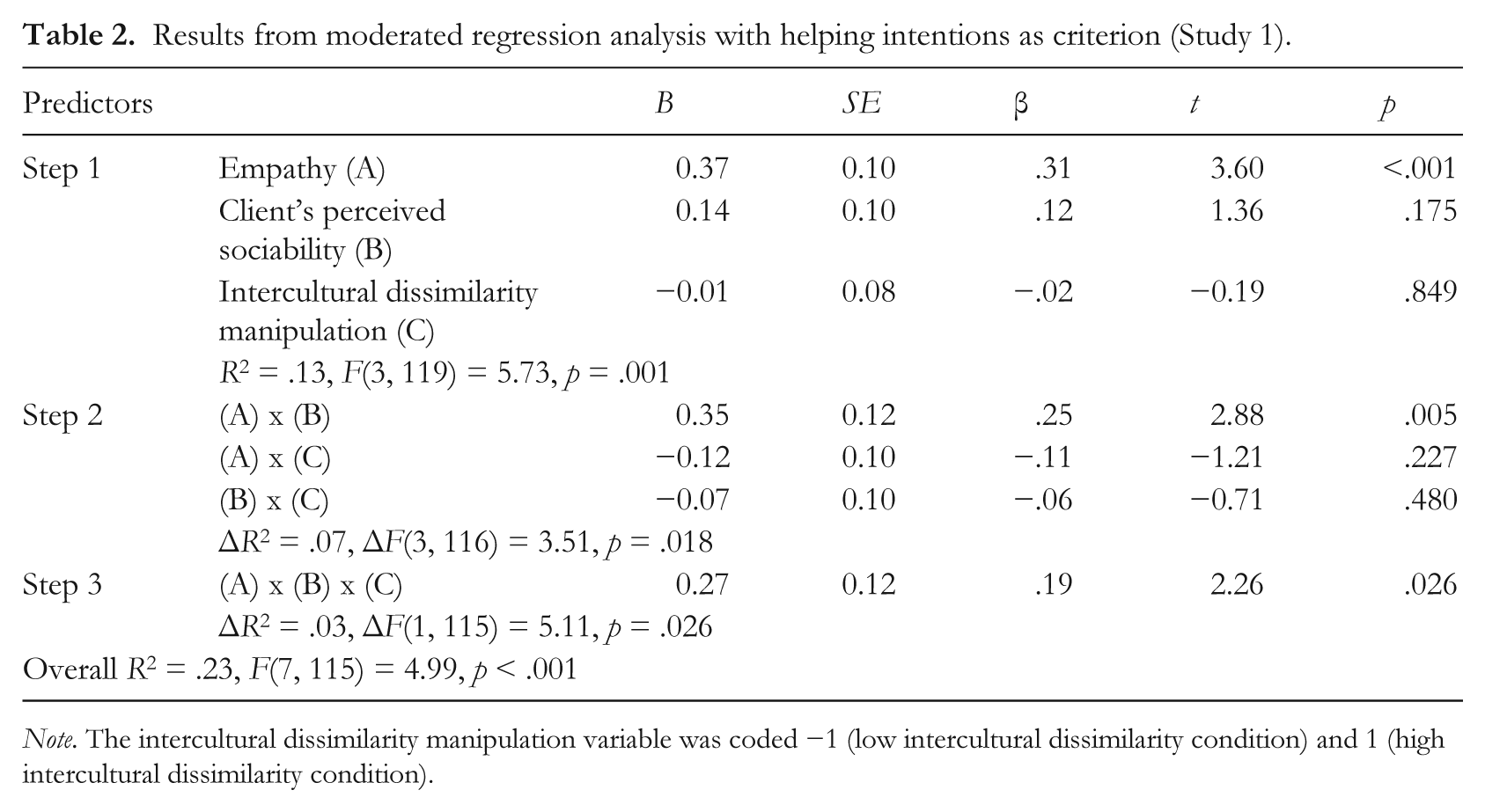
Table 1 presents intercorrelations, means, and standard deviations for all theoretically relevant variables. To test our interaction hypothesis we performed a hierarchical moderated regression analysis in which helping intentions were regressed on empathy, the measure of target’s perceived sociability and the experimental manipulation of intercultural dissimilarity (coded −1 for the low intercultural dissimilarity and 1 for the high intercultural dissimilarity condition) in a first step, with the corresponding two-way and three-way interaction terms added in two subsequent steps (see Aiken & West, 1991). Please note that because this experiment did not include a direct manipulation of target’s perceived benevolence we used our measure of participants’ perceptions of the client’s sociability rather than the attractiveness manipulation as a moderator in this analysis. 2 As can be seen in Table 2, when entered in a first step in the regression equation, empathy was a significant predictor, β = .31, t(119) = 3.60, p < .001. Entering the two-way interactions in a second step yielded a significant Empathy x Sociability interaction, β = .25, t(116) = 2.88, p = .005. Further, and supporting our predictions, when entered in a third step, the Empathy x Dissimilarity x Sociability interaction term received a significant and positive regression weight and added significantly to the criterion’s prediction, β = .19, t(115) = 2.26, p = .026, ΔR2 = .03, ΔF(1, 115) = 5.11, p = .026. Simple slope analyses to decompose this interaction provided further support for our hypothesis (see Figure 1). Specifically, and indicating a significant dis-inhibiting effect of sociability perceptions, among participants in the high intercultural dissimilarity condition (Nigerian client), empathy did not predict helping intentions when the client’s perceived sociability was low, β = −.20, t(115) = −1.13, p = .261, but it did significantly predict helping intentions when the client’s perceived sociability was high, β = .59, t(115) = 3.81, p < .001, for the difference of the two slopes, t(115) = 3.69, p < .001. Among participants in the low intercultural dissimilarity condition (Swedish client), on the other hand, but also as predicted, empathy did predict helping intentions independent of the client’s perceived sociability, for participants perceiving low levels of sociability, β = .37, t(115) = 2.41, p = .018, for participants perceiving high levels of sociability, β = .44, t(115) = 2.52, p = .013, for the difference of the two slopes, t(115) = 0.31, p = .760.
Intercorrelations, means, and standard deviations for all theoretically relevant variables (Study 1).

Note. The intercultural dissimilarity manipulation variable was coded −1 (low intercultural dissimilarity condition) and 1 (high intercultural dissimilarity condition).
p < .10. **p < .05. **p < .01 (two-tailed).
Results from moderated regression analysis with helping intentions as criterion (Study 1).
Note. The intercultural dissimilarity manipulation variable was coded −1 (low intercultural dissimilarity condition) and 1 (high intercultural dissimilarity condition).
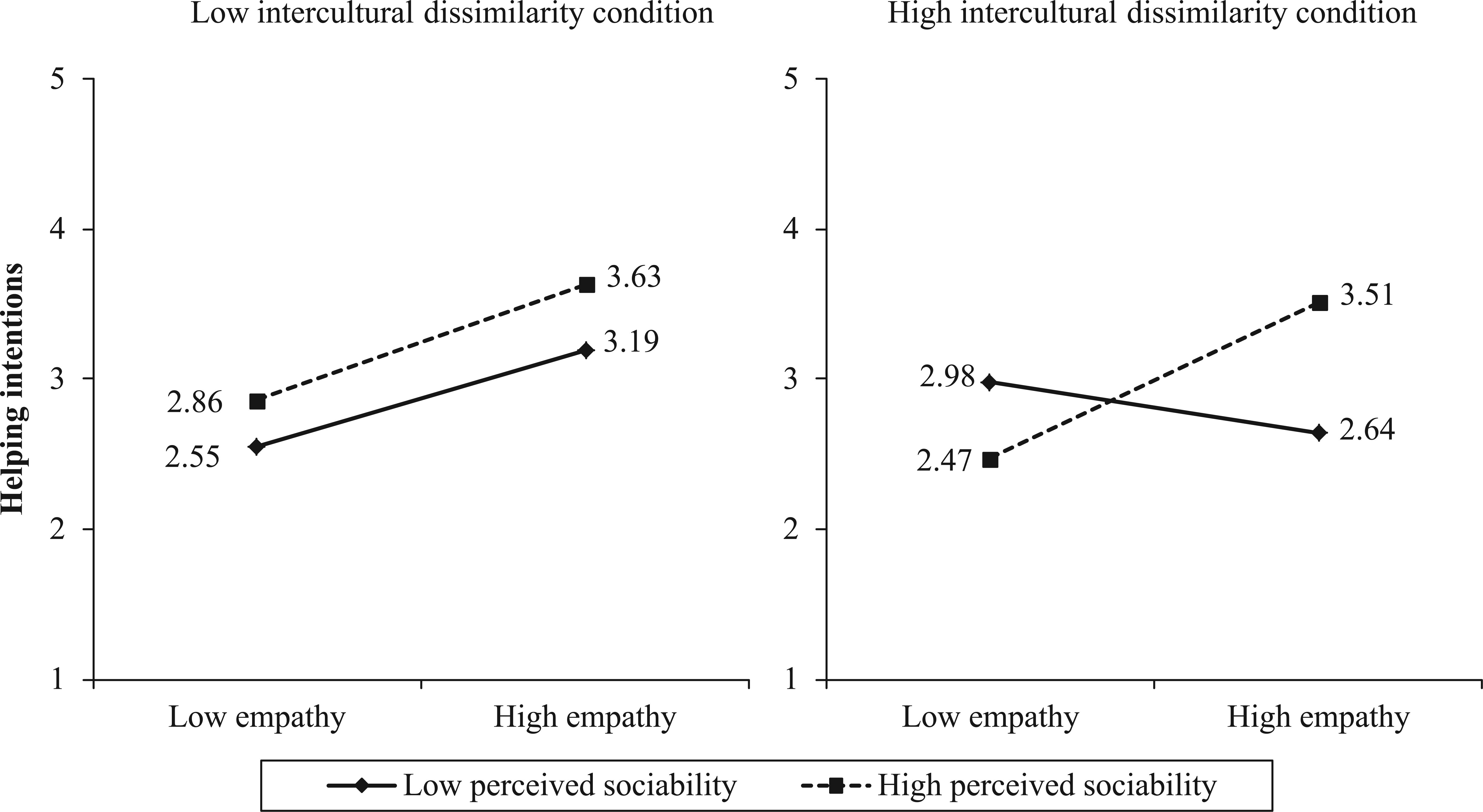
Helping intentions as a function of the intercultural dissimilarity manipulation (coded −1 for the low intercultural dissimilarity condition and 1 for the high intercultural dissimilarity condition), the client’s perceived sociability, and empathy (graphed at 1 SD above and below the means of the client’s perceived sociability and empathy; Study 1).
Discussion
The findings of this first study generally supported our main predictions. In line with the predicted three-way interaction, a moderated regression analysis confirmed that when intercultural dissimilarity was high, an out-group member’s perceived sociability had a significant facilitative effect on the empathy–helping intentions relationship. When intercultural dissimilarity was low, however, empathy predicted helping intentions independent of the out-group target’s perceived sociability. However, this experiment was not specifically designed to test our hypothesis, and it therefore has obvious drawbacks. First, our study did not include a direct manipulation of the target’s perceived benevolence. Therefore, we cannot rule out that factors above and beyond benevolence perceptions contributed to the observed interaction effect (e.g., positive characteristics that people often associate with attractiveness, such as intelligence or competence; e.g., Eagly, Ashmore, Makhijani, & Longo, 1991). Second, the study did only include items tapping on the sociability component of the target’s perceived benevolence, but it did not include items tapping on the trustworthiness component. Research on social perception suggests that, as a natural state of affairs, perceptions of a target’s trustworthiness and perceptions of his or her sociability are often intertwined and highly intercorrelated (e.g., Kervyn, Fiske, & Yzerbyt, 2015; see also Leach et al., 2007). Still, as the present study did not include a measure of the target’s perceived trustworthiness our results do not allow for direct conclusions concerning the role of trustworthiness perceptions in the empathy–helping intentions relationship. We were therefore motivated to subject our interaction hypothesis to further empirical testing.
Study 2
The main aim of our second study was to replicate the Empathy x Dissimilarity x Benevolence effect in a similar context of cross-cultural helping but by using a direct manipulation of target’s perceived benevolence. For this purpose, similar to Study 1, German research participants were provided with information about a (fictitious) immigrant client allegedly seeking counselling on a one-on-one basis. Half of them were presented with a Canadian client (low intercultural dissimilarity condition), the other half with a Nigerian client (high intercultural dissimilarity condition). To systematically tap both sources of benevolence perceptions, our experimental manipulation included information about the client’s sociability as well as his or her trustworthiness. Participants either received information indicating that objective test information revealed that their client scored low on sociability and trustworthiness (low benevolence condition) or that he or she scored high on both of these dimensions (high benevolence condition). Our main prediction was that among participants assigned to a Nigerian client the benevolence manipulation would counteract the inhibiting impact of dissimilarity perceptions and thus increase the influence of empathy on helping intentions. Among participants assigned to a Canadian client, on the other hand, the link between research participants’ feelings of empathy and helping intentions should be relatively independent of our experimental manipulation of the client’s benevolence.
To address potential limitations of Study 1, and to further strengthen the interpretation of our findings, we incorporated the following features into the design and the conduct of our study. First, we improved our measurement of client’s perceived benevolence through including a similar number of items tapping on the sociability and the trustworthiness component of this construct in our measure. This would allow for a more differentiated test of the assumed dis-inhibiting effect of benevolence on the empathy–helping intentions relationship. Second, in Study 2 we administered the manipulation of the client’s benevolence after participants learned about the client’s cultural background. In doing so, we ensured that participants’ responses to their client’s perceived cultural background could not be affected by their perceptions of the client’s individual characteristics, as might possibly have been the case in Study 1. Thus, in Study 2, we could be reasonably confident that the client’s perceived benevolence actually released the effect of empathy on helping intentions. Third, and finally, we also tested two potential alternative interpretations of our findings. The conceptual ambiguity of the attractiveness manipulation in Study 1 raised the possibility that the observed interaction effect was not specific to the target’s perceived benevolence but resulted from a potential confound with other positively evaluated individual characteristics, such as, for instance, the target’s perceived competence (which is often positively related to perceived benevolence in person judgment; e.g., Rosenberg et al., 1968). To test this potential alternative we added a measure tapping participants’ perceptions of their client’s competence to our study, and we used this measure as an alternative moderator in our hypotheses test. The second alternative that we tested was of a more subtle nature. Discovering personal characteristics of an out-group member signalling benevolence may lead to modifications of an initial stereotype-based impression of that person (Fiske, Lin, & Neuberg, 1999; Fiske & Neuberg, 1990). Thus, instead of perceiving the person as a “typical” out-group member, he or she is seen as a member of a specific (and less threatening) subgroup (Brewer, Dull, & Lui, 1981; Eckes, 1994) or as an unusual or atypical out-group member (Manis, Nelson, & Shedler, 1988); in short, as less prototypical. As a result of these processes, empathy-based helping may become more likely. It is important to note at this point that by contrast to our original prediction this alternative explanation assumes that the empathy-disinhibition effect does not simply occur because the out-group member is perceived as benevolent, but because the out-group member is perceived less as an out-group member. To test this alternative, we included a measure of client’s perceived prototypicality in Study 2 and explored its moderating potential.
Method
Participants
One hundred seventy-six German undergraduate psychology students of the Fern-Universität in Hagen participated in this online experiment which was presented in the department’s password-protected virtual laboratory. In line with the general student population at the university, the sample included a wide range of age groups (Mage = 34.07 years, SD = 9.41 years; 127 women and 49 men). The majority of respondents were part-time students, who worked professionally in various fields. Participants earned credit toward a course requirement for their participation. Following Reips’s (2002) recommendations for online experimentation, we only included participants in the sample whose data recordings indicated that they had consistently (i.e., without interruptions) participated in the experiment. This criterion led to the exclusion of 11 participants.
Design and procedure
Participants were randomly assigned to one of four experimental conditions in a 2 (intercultural dissimilarity: low vs. high) x 2 (target’s benevolence: low vs. high) between-subjects design. The study was introduced to participants as part of the development of a training program for community-based volunteer organizations offering nonprofessional one-on-one counselling for immigrants. Participants were told that for the present study they would take on the role of a volunteer cross-cultural counsellor. They would then receive information about a real immigrant client who had allegedly contacted the volunteer organization. As in Study 1, all client-related information participants received was actually fictitious.
After reading the introduction to the study, participants were presented a scanned copy of a (bogus) “precounseling screening form” containing personal background information about their client. The form was allegedly completed manually by a (fictitious) staff member of the volunteer organization’s counselling hotline and signed. The screening form consisted of two separate pages that were presented in a sequential order. The form’s first page contained the intercultural dissimilarity manipulation and some information about the client’s predicament, individual background, and language proficiency in German. The second page contained the manipulation of the target’s benevolence. In a next step, all participants completed a questionnaire including measures of impressions of their client’s benevolence and their willingness to provide future support to their client outside the setting of the study. Finally, participants were debriefed and thanked.
Intercultural dissimilarity manipulation
Information about the client’s cultural background was presented on the first page of the screening form. In the low intercultural dissimilarity condition, the form stated that the client was an immigrant from a culturally similar country (Canada); in the high intercultural dissimilarity condition the form stated that the client was from a culturally dissimilar country (Nigeria).
Benevolence manipulation
The second page of the screening form included ratings of the client’s personality characteristics allegedly completed by staff members of the immigration service organizations to indicate their first impression of the client. Two ratings referred to the client’s sociability (agreeableness and pleasantness), another two referred to his or her trustworthiness (trustworthiness and reliability). Participants randomly assigned to the high benevolence condition received a version of the form in which the staff member’s ratings were always on the positive pole of the corresponding scales. Participants randomly assigned to the low benevolence condition received a version of the form in which the staff member’s ratings were always on the negative pole of the corresponding scales. In addition, in both conditions, a handwritten comment by the staff member stated that his or her personal impression would converge with the results of a standardized personality questionnaire that the client had completed before.
The client’s predicament
Staff member’s notes on the screening form further indicated that clients had called the hotline due to suffering from mental problems including feelings of loneliness, homesickness, sadness, and social insecurity. With the exception of the information about the client’s home country, screening form versions contained the same information about the clients. Clients were depicted as individuals who lived by themselves, who had come to Germany about ten months ago for professional reasons, who felt strong ties to the cultural values of their home culture, and who had functional spoken proficiency in German. To keep the gender relationship between participants and clients constant, screening forms always indicated that the client was of the same gender as the participant.
Measures
For each participant, composite scores for the theoretically relevant measures were created by averaging across the corresponding items.
Perceived intercultural dissimilarity
To check the effectiveness of our intercultural dissimilarity manipulation, participants rated four items tapping the perceived cultural dissimilarity between Germany and the immigrant client’s country of origin with regard to values, lifestyle, living standard, and leisure activities. The ratings were made on 7-point scales ranging from 1 (very dissimilar) to 7 (very similar). The items were recoded such that higher scores indicate higher perceived intercultural dissimilarity (Cronbach’s α = .92).
Client’s perceived benevolence
To measure the client’s perceived benevolence participants rated three adjectives tapping perceived sociability (pleasant, agreeable, humorous) and another three adjectives tapping perceived trustworthiness (trustworthy, reliable, authentic). Participants rated each adjective on separate 7-point scales ranging from 1 (not at all true) to 7 (very true). A principal components analysis on the six items extracted one factor with an eigenvalue exceeding 1 that accounted for 72.38% of the total common variance. All six items had loadings of .75 or greater on this factor. Given the perceptual overlap between the sociability and the trustworthiness measure in our sample, we focused on the overall six-item benevolence measure in our analysis (Cronbach’s α = .92). Still, in order to explore potential differential effects of the trustworthiness and sociability components on the empathy–helping relationship, we reran our analyses using either the sociability component (Cronbach’s α = .90) or the trustworthiness component (Cronbach’s α = .88) as the critical moderator variable.
Client’s perceived competence
In addition, participants rated three items (competent, skilled, independent) tapping on the client’s perceived competence (Cronbach’s α = .88). All ratings were made on 7-point scales ranging from 1 (not true) to 7 (very true).
Empathy
To measure feelings of empathy participants were asked to indicate how much sympathy, concern, care, compassion, and warmth they felt for their client. Participants rated each item on 7-point scales ranging from 1 (not at all) to 7 (very much; Cronbach’s α = .82).
Helping intentions
We then measured participants’ helping intentions. First, participants responded to the following two items: “How great would your willingness be to help this client with a personal problem?” and “How great would your willingness be to sit down together with your client and talk about his or her problems?” Ratings for these items were made on 7-point scales ranging from 1 (very low) to 7 (very high). In addition, for each activity participants indicated how much time they would be willing to spend on the activity when they had 2 hours to do so. The ratings for these additional items were made on 5-point rating scales ranging from 0 minutes to 120 minutes (30-minute intervals). To create an overall helping intentions measure we z-standardized the two willingness and the two time ratings. We then calculated for each participant an overall intentions score by averaging across the four standardized ratings (Cronbach’s α = .85).
Client’s perceived prototypicality
In a final part of the questionnaire, we included the following three items tapping on how prototypical participants felt their client was for his or her cultural group: “He/she seems to be a typical representative of his/her cultural group,” “He/she seems to be rather similar to other members of his/her cultural group,” and “Maintaining the traditions, norms, and values of his/her cultural group seems to be very important to him/her.” Participants rated each item on 7-point scales ranging from 1 (not true at all) to 7 (completely true; Cronbach’s α = .80).
Results
Preliminary analyses
Manipulation checks
A 2 (intercultural dissimilarity: low vs. high) x 2 (benevolence: low vs. high) ANOVA on perceived intercultural dissimilarity revealed a significant main effect for the intercultural dissimilarity manipulation, F(1, 172) = 414.09, p < .001, η²p = .71. As intended, participants in the high intercultural dissimilarity condition perceived the client’s cultural background as more dissimilar to the German culture than participants in the low intercultural dissimilarity condition, M(high dissimilarity) = 5.57 versus M(low dissimilarity) = 2.61, the remaining effects were all nonsignificant, Fs ⩽ 0.37, ps ⩾ .546.
A 2 x 2 ANOVA on target’s perceived bene-volence yielded a significant main effect of bene-volence, F(1, 172) = 130.70, p < .001, η²p = .43, a significant main effect of intercultural dissimilarity, F(1, 172) = 4.83, p = .029, η²p = .03, and a significant interaction effect, F(1, 172) = 4.72, p = .031, η²p = .03. The benevolence manipulation had a strong effect on perceived benevolence in the high intercultural dissimilarity condition, M(high benevolence) = 5.21 versus M(low benevolence) = 3.22, F(1, 172) = 92.55, p < .001, η²p = .35, and a weaker, but still significant effect in the low intercultural dissimilarity condition M(high benevolence) = 5.21 versus M(low benevolence) = 3.86, F(1, 172) = 42.87, p < .001, η²p = .20. Taken together, then, the benevolence manipulation had the expected effect on target’s perceived benevolence even though this effect was more pronounced when client’s cultural dissimilarity was high.
These result patterns were paralleled by two 2 x 2 ANOVAs on the two separate measures of the target’s perceived trustworthiness and the target’s perceived sociability. Specifically, a 2 x 2 ANOVA on trustworthiness yielded a significant main effect of benevolence, F(1, 172) = 76.34, p < .001, η²p = .31, a significant main effect of intercultural dissimilarity, F(1, 172) = 5.70, p = .018, η²p = .03, and a significant interaction effect, F(1, 172) = 5.25, p = .023, η²p = .03, indicating that the benevolence manipulation had a strong effect on perceived trustworthiness in the high intercultural dissimilarity condition, M(high benevolence) = 5.06 versus M(low benevolence) = 3.31, F(1, 172) = 60.82, p < .001, η²p = .26, and a weaker, but still significant effect in the low intercultural dissimilarity condition M(high benevolence) = 5.08 versus M(low benevolence) = 4.05, F(1, 172) = 20.77, p < .001, η²p = .11. A 2 x 2 ANOVA on sociability replicated the strong main effect of benevolence, F(1, 172) = 142.53, p < .001, η²p = .45, indicating that participants in the high bene-volence condition perceived the target as more sociable than participants in the low benevolence condition, M(high benevolence) = 5.35 versus M(low benevolence) = 3.39. The main effect of intercultural dissimilarity and the interaction effect only approached levels of statistical significance, F(1, 172)s ⩽ 2.75, ps ⩾ .099.
Empathy
A 2 x 2 ANOVA on participants’ reports of empathy yielded a significant interaction effect, F(1, 172) = 4.70, p = .031, η²p = .03. Client’s benevolence had a facilitative effect on empathy in the high intercultural dissimilarity condition, M(low benevolence) = 3.89 versus M(high benevolence) = 4.50, F(1, 172) = 6.52, p = .012, η²p = .04, but it did not affect empathy in the low intercultural dissimilarity condition, M(low benevolence) = 4.14, M(high benevolence) = 4.02, F(1, 172) = 0.26,p = .608.
Helping intentions
A 2 x 2 ANOVA on helping intentions revealed that participants in the high benevolence condition also tended to display stronger helping intentions than participants in the low benevolence condition, M(high bene-volence) = 0.11 versus M(low benevolence) = −0.11, F(1, 172) = 3.27, p = .073, η²p = .02. The remaining effects in this analysis were all nonsignificant, Fs ⩽ 2.08, ps ⩾ .151.
Main analyses
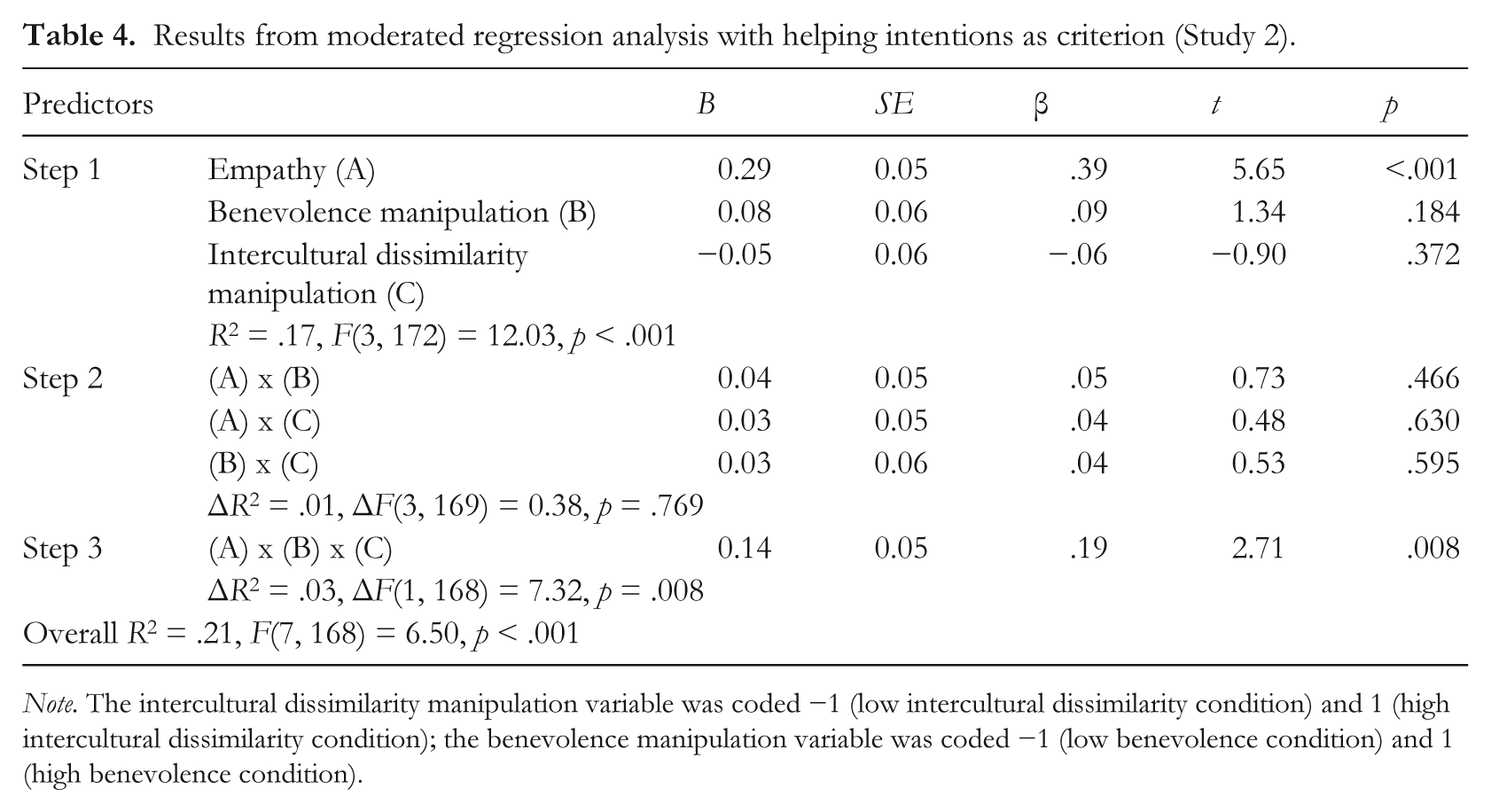
Table 3 presents intercorrelations, means, and standard deviations for all theoretically relevant variables. To test the predicted Empathy x Dissimilarity x Benevolence interaction effect, we conducted a moderated regression analysis in which helping intentions were regressed on feelings of empathy, the benevolence manipulation (coded −1 for low benevolence and 1 for high benevolence), and the intercultural dissimilarity manipulation (coded −1 for low intercultural dissimilarity and 1 for high intercultural dissimilarity) in a first step, with the corresponding two-way and three-way interaction terms added in two subsequent steps. As can be seen in Table 4, when entered in a first step in the regression equation, empathy was a significant and positive predictor, β = .39, t(172) = 5.65, p < .001. Further, and replicating the Empathy x Dissimilarity x Benevolence effect of Study 1, when entered in a third step, the three-way interaction term received a significant and positive regression weight and added significantly to the criterion’s prediction, β = .19, t(168) = 2.71, p = .008, ΔR2 = .03, ΔF(1, 168) = 7.32, p = .008. Simple slope analyses to decompose this interaction provided further support for our hypothesis (see Figure 2). In line with our predictions, among participants in the high intercultural dissimilarity condition, empathy did not predict helping intentions when the client’s perceived benevolence was low, β = .18, t(168) = 1.24, p = .218, but it did significantly predict helping intentions when the client’s perceived benevolence was high, β = .73, t(168) = 4.52, p < .001, for the difference of the two slopes, t(168) = 2.54, p = .012. Among participants in the low intercultural dissimilarity condition, on the other hand, but also as predicted, empathy did predict helping intentions relatively independent of whether the client’s perceived benevolence was low, β = .47, t(168) = 3.58, p < .001, or whether perceived benevolence was high, β = .26, t(168) = 1.99, p = .049, for the difference of the two slopes, t(168) = −1.19, p = .237.
Intercorrelations, means, and standard deviations for all theoretically relevant variables (Study 2).

Note. The helping intentions measure was z-standardized.
p < .10. *p < .05. **p < .01 (two-tailed).
Results from moderated regression analysis with helping intentions as criterion (Study 2).
Note. The intercultural dissimilarity manipulation variable was coded −1 (low intercultural dissimilarity condition) and 1 (high intercultural dissimilarity condition); the benevolence manipulation variable was coded −1 (low benevolence condition) and 1 (high benevolence condition).
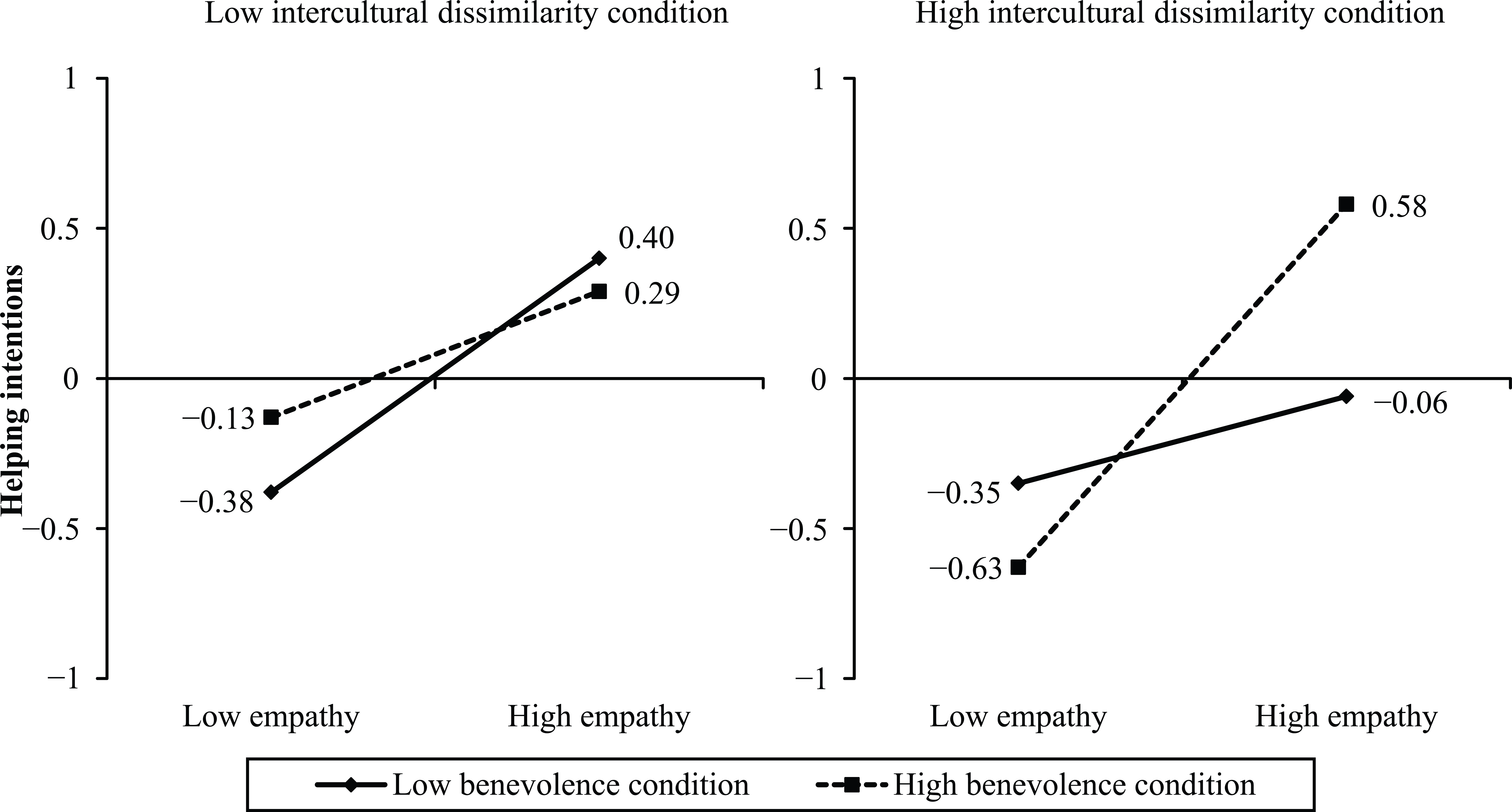
Helping intentions (z-standardized) as a function of the intercultural dissimilarity manipulation (coded −1 for the low intercultural dissimilarity condition and 1 for the high intercultural dissimilarity condition), the benevolence manipulation (coded −1 for the low benevolence condition and 1 for the high benevolence condition), and empathy (graphed at 1 SD above and below the mean of empathy; Study 2).
Strengthening our confidence in the validity of our findings, additional analyses in which we used the manipulation check for client’s benevolence (i.e., the 7-point continuous measure of perceived benevolence) rather than the experimental manipulation as the critical moderator variable replicated these findings; for the critical Empathy x Dissimilarity x Benevolence interaction term, β = .16, t(168) = 2.11, p = .036. Moreover, and further corroborating our perspective, separate moderation analyses in which we used either the sociability composite or the trustworthiness composite instead of the overall benevolence scale as a moderator replicated the moderation findings obtained in the analysis with the overall benevolence scale. Specifically, the Empathy x Dissimilarity x Trustworthiness interaction received a significant regression weight, β = .17, t(168) = 2.32, p = .022, and the Empathy x Dissimilarity x Sociability interaction a somewhat weaker, but still marginally significant, regression weight, β = .13, t(168) = 1.86, p = .065.
Additional analyses: The moderating potential of perceived competence and perceived prototypicality
In a first set of additional analyses we explored whether the predicted dis-inhibiting effect of individual attributes is specific to the target’s perceived benevolence or whether similar effects might be observed for the target’s perceived competence. A 2 x 2 ANOVA on target’s perceived competence yielded two significant main effects, F(1, 172)s ⩾ 14.83, ps < .001, η²p ⩾ .08, for the interaction, F(1, 172) = 0.12, p = .735. Participants in the low intercultural dissimilarity condition perceived their client as more competent, M(low dissimilarity) = 4.63, than participants in the high intercultural dissimilarity condition, M(high dissimilarity) = 3.94, and participants in the high benevolence condition perceived their client as more competent, M(high benevolence) = 4.65, than participants in the low benevolence condition, M(low benevolence) = 3.92. Importantly, however, even though the benevolence manipulation had affected participants’ perceptions of their client’s competence, this variable did not function as an alternative moderator. Specifically, using the client’s perceived competence instead of the client’s perceived benevolence as a moderator in a moderated regression analysis clearly failed to produce a significant Empathy x Dissimilarity x Competence interaction, β = .07, t(168) = 0.90, p = .368.
We also explored whether the dis-inhibiting effect of the target’s benevolence was due to altered prototypicality perceptions in the critical high intercultural dissimilarity conditions (i.e., Nigerian client). A 2 x 2 ANOVA on target’s perceived prototypicality yielded no significant effects, F(1, 172)s ⩽ 2.44, ps ⩾ .120. Moreover, a moderated regression analysis in which we replaced the client’s perceived benevolence by the client’s perceived prototypicality as a moderator did not produce a significant Empathy x Dissimilarity x Prototypicality interaction, β = −.04, t(168) = −0.59, p = .558.
In sum, these findings corroborate the unique role of benevolence perceptions in facilitating the effect of empathy in out-group helping. Client’s perceived competence or his or her perceived prototypicality, on the other hand, can be ruled out as contributors to the moderation effect.
Discussion
The results of Study 2, in which we manipulated a fictitious client’s perceived benevolence after participants learned about his or her cultural background, generally replicated the findings of Study 1. As in Study 1, hierarchical moderated regression analyses provided support for our interaction hypothesis. Among participants assigned to a Nigerian client, empathy did not predict helping intentions when the client’s perceived benevolence was low but it was a significant predictor of helping intentions when client’s perceived benevolence was high. Conversely, among participants assigned to a Canadian client, empathy did influence helping intentions relatively independent of our experimental manipulation of the client’s benevolence.
The second study also contributed substantially to a further conceptual “purification” of the obtained effects. First, strengthening the validity of our conclusions, we replicated the findings from Study 1 using either the experimental manipulation or the manipulation check of perceived benevolence as the critical moderator variables. Second, the Study 2 results also allow us to rule out that factors above and beyond benevolence perceptions accounted for the dis-inhibiting effect of the benevolence manipulation on the empathy–helping intentions link under conditions of high intercultural dissimilarity. Specifically, we were able to show that, in line with our theoretical perspective, the dis-inhibiting effect was specific to the target’s perceived benevolence and could not be observed for the target’s perceived competence, another positively evaluated individual characteristic that plays a major role in person and group perception (e.g., Fiske et al., 2002; Rosenberg et al., 1968). This finding is in line with research on impression formation showing that benevolence judgements typically carry more weight in person perception than competence judgements (e.g., Abele & Bruckmüller, 2011; Wojciszke, 2005). Moreover, our findings suggest that it is the benevolence information itself that drives the dis-inhibiting effect, and not a benevolence-induced alteration of target’s social categorization. Neither did our benevolence manipulation affect the perception of the target’s perceived prototypicality, nor did the measure of target’s perceived prototypicality function as a moderator of the empathy–helping intentions relationships.
Even though the data of Study 2 generally support our predictions they are not without limitations. Perhaps most importantly, although in the low intercultural dissimilarity condition (Canadian client) empathy was a consistent and significant positive predictor of helping intentions, unlike in Study 1 the strength of these relationships did not significantly differ from the strength of the corresponding (nonsignificant) relationship in the high intercultural dissimilarity/low benevolence condition, for the difference between slopes, |t(168)s| ⩽ −1.51, ps ⩾ .134. A viable explanation for this finding could be that participants assigned to a Canadian client perceived their client generally less needy (a perception that was possibly further increased when they learned that their client was sociable and trustworthy). As a consequence, they might have put less weight on their feelings of empathy when contemplating about helping. It is important to note, however, that this finding does not contradict our predictions. What we deem crucial for our perspective, and what is supported by our data, is that when the client came from a culturally dissimilar country perceived benevolence significantly increased the empathy–helping intentions relationship. When the client came from a culturally similar country, by contrast, client’s perceived benevolence did not affect the empathy–helping intentions relationship.
Study 3
Our analyses of Study 2 in which we used either the sociability or the trustworthiness component of the overall benevolence measure as the critical moderator variable suggest that both sources of an out-group member’s perceived benevolence may have parallel (rather than differing) effects on the empathy–helping intentions relationship. Still, since both variables were highly intercorrelated in this study, our conclusions with regard to this issue are limited. In fact, there is an increasing body of research suggesting that, even though in many social contexts both aspects of person perceptions may be naturally confounded, perceptions of trustworthiness may outperform perceptions of sociability in the impression that people form of strangers, including out-group members (for an overview, see Brambilla & Leach, 2014). One explanation for this is that individual attributes signalling trustworthiness are more informative with regard to the essential question of whether or not the other person poses an opportunity or a threat to the self. Therefore such information may play a more crucial role in inferring his or her intentions than sociability (e.g., Brambilla, Hewstone, & Colucci, 2013; Brambilla & Leach, 2014; Brambilla, Sacchi, Pagliaro, & Ellemers, 2013; Brambilla, Sacchi, Rusconi, Cherubini, & Yzerbyt, 2012). Of particular relevance for the present research on cross-group helping, recent research could also demonstrate that the perceived trustworthiness of out-group members plays a primary role in people’s willingness to engage in prosocial actions towards the out-group (Brambilla, Hewstone, et al., 2013; López-Rodríguez & Zagefka, 2015). An integration of these theoretical and empirical arguments into our perspective on the role of the target’s individual attributes in cross-group helping (Siem et al., 2014; Stürmer & Snyder, 2010; Stürmer et al., 2005, especially pp. 533–534) would thus suggest a primacy of the trustworthiness over the sociability component of an out-group member’s perceived benevolence in facilitating the role of empathy in helping out-group members, especially members of out-groups perceived as highly dissimilar to the in-group. To investigate this assumption, Study 3 experimentally disentangled participants’ often naturally confounded perceptions of the target’s trustworthiness and sociability by manipulating trustworthiness (low vs. high) and sociability (low vs. high) as two two-level between-subject variables in an orthogonal design. Because Study 1 and Study 2 confirmed that the predicted moderation effect is contingent upon perceptions of high group-based dissimilarity, in our third study all participants were presented with a target from a culturally highly dissimilar country, Nigeria. To demonstrate a primacy of trustworthiness perceptions over sociability perceptions our experimental manipulations should produce an Empathy x Trustworthiness interaction effect such that the influence of empathy on helping intentions should be stronger in the high trustworthiness condition than in the low trustworthiness condition. The sociability manipulation, in contrast, should affect the strength of the empathy–helping relationship to a lesser extent.
At the time when we conducted our study (January 28 to March 16, 2015) the political climate in Germany with regard to immigration issues was tense. Since October 2014 there have been weekly protests all over the country organized by a political organization named “Patriotic Europeans against the Islamisation of the West” (“Pegida”). Pegida assembled supporters from the conservative political spectrum who articulated their dissatisfaction with contemporary immigration and asylum policies. This led to fierce opposition from liberal citizens and counter-demonstrations. The salient conflict between conservative and liberal forces in Germany created a unique opportunity to also investigate our perspective from a different angle. Politically conservative individuals tend to perceive immigrants as more threatening than politically liberal individuals (for an overview, see Esses, Jackson, Dovidio, & Hodson, 2005). Further, political conservatives seem to be generally more prone to experiencing exploitation fears than liberals (as indicated by, for instance, higher levels of risk aversion; for an overview, see Jost, Glaser, Kruglanski, & Sulloway, 2003). For conservatives, a Nigerian target’s perceived trustworthiness should thus be highly relevant to overcome these emotional and cognitive barriers that prevent them from empathy-based helping. It seems thus reasonable to assume that the predicted relative primacy of trustworthiness perceptions over sociability perceptions in influencing the empathy–helping relationship should be stronger among conservatives than among liberals. We therefore included a measure of participants’ political orientation into our research design and used this measure as an additional moderator of the predicted relationship patterns.
Method
Participants
One hundred seventy-eight German undergraduate psychology students of the Fern-Universität in Hagen participated in our online experiment (Mage = 33.54 years, SD = 10.25 years; 123 women and 55 men). Participants earned credit toward a course requirement for their participation. Following Reips’s (2002) recommendations for online experimentation, we only included participants in the sample whose data recordings indicated that they had consistently (i.e., without interruptions) participated in the experiment. This criterion led to the exclusion of 10 participants.
Design and procedure
Participants were randomly assigned to one of four experimental conditions in a 2 (target’s sociability: low vs. high) x 2 (target’s trustworthiness: low vs. high) between-subjects design. Following the procedure of Study 2, the second page of a (bogus) “precounseling screening form” included ratings of the client’s personality characteristics allegedly completed by staff members of the immigration service organizations to indicate their first impression of the client. Two ratings referred to the client’s sociability (agreeableness and pleasantness), another two referred to his or her trustworthiness (trustworthiness and reliability). In addition, a handwritten comment by the staff member stated that his or her personal impression would converge with the results of a standardized personality questionnaire that the client had completed before.
Sociability manipulation
Participants randomly assigned to the high sociability condition received a version of the form in which the staff member’s ratings were always on the positive pole of the scales measuring the client’s agreeableness and pleasantness. Participants randomly assigned to the low sociability condition received a version of the form in which the staff member’s ratings were always on the negative pole of the corresponding scales.
Trustworthiness manipulation
Participants randomly assigned to the high trustworthiness condition received a version of the form in which the staff member’s ratings were always on the positive pole of the scales measuring the client’s trustworthiness and reliability. Participants randomly assigned to the low trustworthiness condition received a version of the form in which the staff member’s ratings were always on the negative pole of the corresponding scales.
Measures
Measures were collected with identical items and on identical scales as in Study 2: Client’s perceived sociability (Cronbach’s α = .90), client’s perceived trustworthiness (Cronbach’s α = .95), empathy (Cronbach’s α = .83), and helping intentions (z-standardized, Cronbach’s α = .86). A principal components analysis with oblimin rotation on the three sociability and the three trustworthiness items confirmed that our manipulation successfully disentangled perceptions of trustworthiness and sociability. Specifically, the analysis yielded two factors with eigenvalues exceeding 1 that accounted for 87.71% of the total common variance. The three sociability items had loadings of .91 or greater on the first factor and of .17 or smaller on the second factor. The three trustworthiness items had loadings of .94 or greater on the second factor and of .16 or smaller on the first factor. We felt thus justified to use the separate measures of the sociability and the trustworthiness component of benevolence (instead of an overall benevolence measure) in our analyses. Participants’ political orientation was measured at the end of the questionnaire by using a single item asking them to indicate their political orientation on a 10-point scale from 1 = left to 10 = right. This item is frequently used as an indicator of people’s political orientation in research in the social and political sciences (e.g., Jost, 2006; Knight, 1999; Roth & Mazziotta, 2015; ZA & ZUMA, 2014).
Results
Preliminary analyses
Political orientation
A 2 (target’s sociability: low vs. high) x 2 ANOVA (target’s trustworthiness: low vs. high) on the political orientation item showed neither significant main effects nor a significant interaction, all three F(1, 174)s ⩽ 0.06, ps ⩾ .813, suggesting that conservatives and liberals were randomly assigned across conditions. As can be seen in Table 5, and in line with our anticipations, participants’ political orientation was significantly and negatively correlated to their perceptions of the target’s trustworthiness, r(176) = −.18, p = .015, their feelings of empathy, r(176) = −.24, p = .001, and their helping intentions, r(176) = −.31, p < .001, however. We therefore used this variable as a covariate in the following analyses. The reported means are thus always the adjusted means.
Intercorrelations, means, and standard deviations for all theoretically relevant variables (Study 3).

Note. The helping intentions measure was z-standardized.
*p < .05. **p < .01 (two-tailed).
Manipulation checks
A 2 (target’s sociability: low vs. high) x 2 (target’s trustworthiness: low vs. high) ANCOVA on the target’s perceived sociability with political orientation as a covariate revealed a significant main effect for the sociability manipulation, F(1, 173) = 297.30, p < .001, η²p = .63. As intended, participants in the high sociability condition perceived the client to be more sociable than participants in the low sociability condition, Madj(high sociability) = 5.60 versus Madj(low sociability) = 3.18. The main effect of the trustworthiness manipulation and the Sociability x Trustworthiness interaction effect were nonsignificant, F(1, 173)s ⩽ 2.68, ps ⩾ .103. The covariate, political orientation, had a significant effect, F(1, 173) = 7.11, p = .008, η²p = .04.
An analogous 2 x 2 ANCOVA on the target’s perceived trustworthiness further supported the effectiveness of our experimental manipulations. As intended, and as indicated by a significant main effect of the trustworthiness manipulation, F(1, 173) = 265.55, p < .001, η²p = .61, participants in the high trustworthiness condition perceived the client to be more trustworthy than participants in the low trustworthiness condition, Madj(high trustworthiness) = 5.54 versus Madj(low trustworthiness) = 3.10. The main effect of the sociability manipulation and the Sociability x Trustworthiness interaction effect were nonsignificant, F(1, 173)s ⩽ 2.08, ps ⩾ .151. The covariate, political orientation, had a significant effect, F(1, 173) = 13.34, p < .001, η²p = .07.
Empathy
A 2 x 2 ANOVA on participants’ reports of empathy yielded significant main effects of the trustworthiness manipulation, F(1, 173) = 5.40, p = .021, η²p = .03, indicating that participants in the high trustworthiness conditions reported higher levels of empathy than participants in the low trustworthiness conditions, Madj(high trustworthiness) = 4.69 versus Madj(low trustworthiness) = 4.34. The main effect of the sociability manipulation and the Sociability x Trustworthiness interaction effect were nonsignificant, F(1, 173)s ⩽ 2.42, ps ⩾ .122. The covariate, political orientation, had a significant effect, F(1, 173) = 10.94, p = .001, η²p = .06.
Helping intentions
A 2 x 2 ANOVA on helping intentions showed a parallel main effect of the trustworthiness manipulation, F(1, 173) = 4.35, p = .038, η²p = .03, indicating that participants in the high trustworthiness conditions reported higher levels of helping intentions than participants in the low trustworthiness conditions, Madj(high trustworthiness) = 0.13 versus Madj(low trustworthiness) = −0.12. The main effect of the sociability manipulation and the Sociability x Trustworthiness interaction effect were nonsignificant, F(1, 173)s ⩽ 2.42, ps ⩾ .122. The covariate, political orientation, had a significant effect, F(1, 173) = 18.63, p < .001, η²p = .10. Although not predicted a priori, finding that the trustworthiness but not the sociability manipulation increased both empathy and helping intentions fits well with previous research suggesting a relative primacy of trustworthiness over sociability information in cross-group interactions (e.g., Brambilla & Leach, 2014).
Main analyses
Table 5 presents intercorrelations, means, and standard deviations for all theoretically relevant variables. To test our prediction about the relative primacy of the target’s trustworthiness over the target’s sociability in dis-inhibiting the empathy–helping relationship we conducted a moderated regression analysis in which helping intentions were regressed on feelings of empathy, the trustworthiness manipulation (coded −1 for low trustworthiness and 1 for high trustworthiness), the sociability manipulation (coded −1 for low sociability and 1 for high sociability), and participants’ political orientation in a first step, with the corresponding two-way, three-way, and four-way interaction terms added in three subsequent steps. Our theoretical perspective suggests that the target’s perceived trustworthiness has a stronger effect on the empathy–helping intentions relationship than the target’s perceived sociability, and this is especially so among participants with a conservative political orientation. Therefore, the predictive values of the Empathy x Trustworthiness x Political Orientation and the Empathy x Sociability x Political Orientation interaction terms added in the third step were critical for our hypotheses. As can be seen in Table 6, the Empathy x Trustworthiness x Political Orientation interaction term received a significant regression weight, β = .23, t(163) = 3.20, p = .002. Inspections of the simple slopes to decompose the interaction confirmed that among participants with a conservative political orientation, empathy was only significantly related to helping intentions when the target’s perceived trustworthiness was high, β = .67, t(163) = 4.80, p < .001, and not when the target’s perceived trustworthiness was low, β = .18, t(163) = 1.36, p = .176, for the difference of the two slopes, t(163) = 2.55, p = .012. Among participants with a liberal political orientation, empathy was positively related to helping intentions in both the low trustworthiness condition, β = .67, t(163) = 4.73, p < .001, and the high trustworthiness conditions, β = .34, t(163) = 2.99, p = .003, and the effect of the trustworthiness manipulation on the strengths of the empathy–helping intentions relationship was only marginally significant, t(163) = −1.81, p = .072.
Results from moderated regression analysis with helping intentions as criterion (Study 3).

Note. The trustworthiness manipulation variable was coded −1 (low trustworthiness condition) and 1 (high trustworthiness condition); the sociability manipulation variable was coded −1 (low sociability condition) and 1 (high sociability condition).
The Empathy x Sociability x Political Orientation interaction, in contrast, was nonsignificant, β = .05, t(163) = 0.63, p = .530. Inspections of the simple slopes revealed that among participants with a conservative political orientation, empathy was significantly and positively related to helping intentions in both sociability conditions, both βs ⩾ .35, t(163)s ⩾ 2.69, ps ⩽ .008. Importantly, and in line with our predictions, the strength of this relationship did not significantly differ between the sociability conditions, t(163) = −0.75, p = .456. Among participants with a liberal political orientation, a similar pattern emerged: In both sociability conditions empathy had a positive effect on helping intentions, both βs ⩾ .35, t(163)s ⩾ 2.90, ps ⩽ .004, and the strength of this effect was only marginally affected by the sociability manipulation, t(163) = −1.71, p = .089. In sum, then, these findings supportour assumption that among participants with a conservative political orientation, the target’s perceived trustworthiness has a stronger effect on the empathy–helping intentions relationship than the target’s perceived sociability. Among participants with a liberal political orientation, in contrast, the empathy–helping intentions relationship seemed to be relatively unaffected by both the trustworthiness and the sociability manipulation.
Inspections of the simple slopes for the four cells resulting from our experimental design among conservative participants and among liberal participants further strengthened our assumptions. Specifically, among conservative participants, empathy was not significantly related to helping intentions when trustworthiness was low, and this in the low sociability condition, β = .25, t(162) = 1.45, p = .149, as well as in the high sociability condition, β = .11, t(162) = 0.57, p = .572, for the difference of the two slopes, t(162) = −0.09, p = .928. When trustworthiness was high, however, empathy significantly affected participants’ helping intentions, and this again in the low sociability condition, β = .78, t(162) = 3.33, p = .001, as well as in the high sociability condition, β = .61, t(162) = 3.54, p = .001, for the difference of the two slopes, t(162) = 0.75, p = .456 (see Figure 3; to reduce the complexity of the presentation, results are graphed at 1 SD above the mean of political orientation, i.e., only for rather conservative participants). Among liberal participants, in contrast, there was no evidence that the relationship between empathy and helping intentions was stronger in the high compared to the low trustworthiness conditions: Empathy was at least marginally significantly related to participants helping intentions in all four cells of our experimental design, all βs ⩾ .23, t(162)s ⩾ 1.69, ps ⩽ .094.
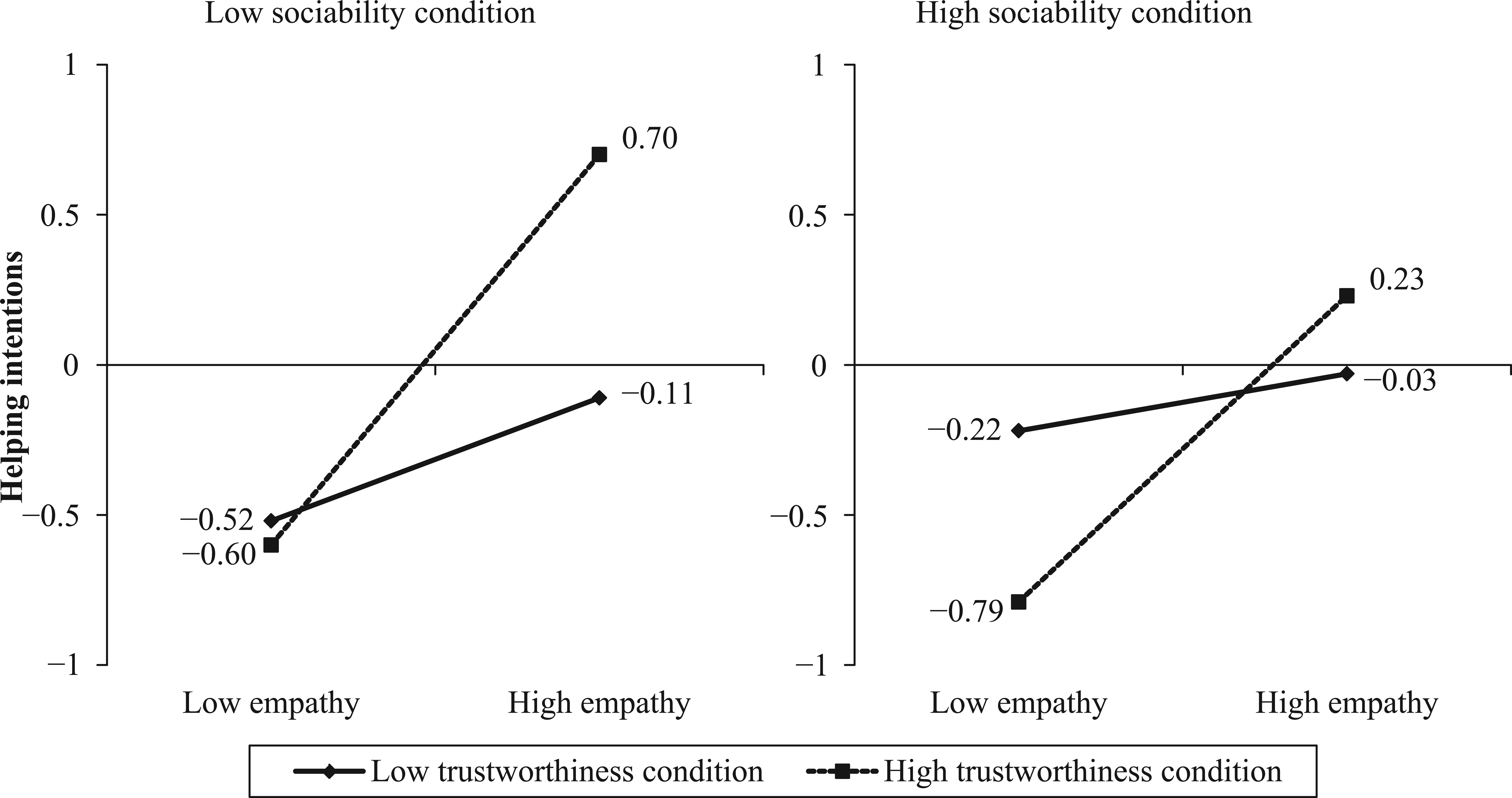
Helping intentions (z-standardized) as a function of the trustworthiness manipulation (coded −1 for the low trustworthiness condition and 1 for the high trustworthiness condition), the sociability manipulation (coded −1 for the low sociability condition and 1 for the high sociability condition), and empathy (graphed at 1 SD above and below the mean of empathy; Study 3). Please note that to reduce the complexity of the presentation, results are graphed at 1 SD above the mean of political orientation.
Discussion
The main aim of Study 3 was to compare the relative contributions of the trustworthiness and sociability aspects of an out-group target’s perceived benevolence in facilitating the positive effect of empathy on helping. We derived our predictions from an integration of our work on the role of the target’s personal attributes in cross-group helping (Siem et al., 2014; Stürmer & Snyder, 2010; Stürmer et al., 2005) with recent research suggesting a primacy of trustworthiness information over sociability information in cross-group interactions (e.g., Brambilla & Leach, 2014). Support for this assumption comes from three different sources: First, and in line with findings by Brambilla, Hewstone, et al. (2013), univariate ANOVAs revealed that the trustworthiness but not the sociability manipulation increased mean levels of both empathy and helping intentions. Second, and confirming our specific interaction hypothesis, hierarchical moderated regression analyses confirmed that the perceived trustworthiness of a Nigerian target had a stronger influence on the effect of German participants’ empathic feelings on their helping intentions than the perceived sociability of the target. In fact, by contrast to target’s perceived trustworthiness, target’s perceived sociability was ineffective as a significant moderator of the empathy–helping intentions relationship. This finding is particularly interesting as it tentatively suggests that, at least under certain conditions, relative to information about an out-group target’s trustworthiness, information about an out-group target’s sociability is less important, if not unimportant, for dis-inhibiting the empathy–helping relationship. At first glance, this result might seem to be at odds with our findings from Studies 1 and 2 where we found that the target’s sociability did affect the empathy–helping intentions relationship. With regard to this issue, it should be taken into account, however, that other than in Study 3, we did not experimentally disentangle participants’ trustworthiness and sociability perceptions in Studies 1 and 2. We can thus not determine whether the observed moderation effects in Studies 1 and 2 were brought about by the target’s perceived sociability, the target’s perceived trustworthiness, or both (in fact, perceived trustworthiness and sociability were highly correlated in Study 2; see also Kervyn et al., 2015). The only study that allows unambiguous conclusions in this respect is Study 3. Therefore, our interpretation that trustworthiness perceptions are more important than sociability perceptions for disinhibiting the empathy–helping relationships seems justified, at least in the present context.
Third, our analyses also provided support for the assumed role of research participants’ political orientation in contributing to the predicted moderation effect. At the time when we conducted our study, the political climate in Germany with regard to immigration issues was tense. As anticipated, our moderated regression analysis revealed that in the context of a salient conflict between conservatives and liberals the Trustworthiness x Empathy moderation effect pattern was only found among the subsample of conservative participants (i.e., individuals who tend to associate immigrants more with threat and potential exploitation than liberals; e.g., Esses et al., 2005; Jost et al., 2003). Among liberal participants, on the other hand, empathy was positively related to participants’ helping intentions in all four cells of our experimental design. Apparently, at a time in which immigration is depicted as a threat, for our conservative research participants the Nigerian target’s perceived benevolence, especially his or her trustworthiness, was particularly relevant to overcome their apprehensions and fears that prevented them from letting themselves be guided by empathic impulses to help. Among liberal participants, one the other hand, stereotype-based negative feelings and expectations towards the target were presumably less pronounced or, perhaps, even actively rejected. Therefore, specific information about the target’s perceived trustworthiness was less relevant to dis-inhibit the empathy–helping intention relationship. At a conceptual level, our finding on the role of participants’ political orientation (i.e., a personal factor) in moderating the influence of the target’s bene-volence on the empathy–helping relationship provides an interesting complement to our results of Studies 1 and 2 which focused on the moderating role of intercultural dissimilarities (i.e., a situational factor).
General Discussion
A growing body of work suggests that group-based dissimilarity serves as a boundary condition on the effectiveness of empathy. The main objective of the present research has been to examine under which conditions empathy becomes “dis-inhibited” as a motivator of out-group helping in a cross-cultural context. We proposed that, when intercultural dissimilarity between a potential helper and an out-group member in need is high, empathy’s influence on helping critically depends on the out-group target’s perceived benevolence, that is, on his or her perceived sociability and trustworthiness. Specifically, we assume that individual attributes signalling that the out-group member is highly benevolent should dis-inhibit the role of empathy as a motivator of helping. Study 1 in which we manipulated an out-group target’s intercultural dissimilarity and his or her attractiveness in the context of a laboratory experiment on cross-cultural helping provided initial evidence for our assumptions. Study 2 replicated and further extended these results in a web-based scenario experiment in which we directly manipulated the out-group target’s perceived benevolence. Finally, Study 3 in which we experimentally disentangled participants’ often confounded perceptions of the target’s perceived trustworthiness and sociability critically extended our perspective by demonstrating a relative primacy of trustworthiness information over sociability information in dis-inhibiting the empathy–helping intentions relationship in cross-group helping. Our experiments employed three different manipulations of the out-group target’s benevolence-related features: Study 1 manipulated the target’s perceived attractiveness as a benevolence-related variable via self-reported information; Study 2 manipulated perceived benevolence more directly via providing “objective” information about the target’s sociability and trustworthiness which were both either low or high, thus closely reflecting the natural state of affairs (e.g., Kervyn et al., 2015). In Study 3, sociability and trustworthiness were manipulated in an orthogonal design in order to artificially disentangle the often naturally confounded perception of the two benevolence components. Further, we confirmed our predictions in samples of sociodemographically highly diverse research participants (even though the variety of factors associated with sociodemographic diversity should make detecting interaction effects more difficult; e.g., Berkowitz & Donnerstein, 1982; Highhouse & Gillespie, 2009). Being able to observe the expected results pattern using differing manipulations and sociodemographic diverse samples speaks strongly and persuasively for the validity and generalizability of the proposed dis-inhibiting role of the target’s perceived benevolence, especially his or her trustworthiness, in the empathy–out-group helping relationship.
The present research has also the potential, we believe, to contribute to a further conceptual integration of research on the role of empathy in intergroup relations (for reviews see Davis & Maitner, 2010; Stephan & Finlay, 1999). Our (and our colleagues’) research—and conceptually related work by other researchers (Maner & Gailliot, 2007; Penner & Finkelstein, 1998; Schlenker & Britt, 2001)—suggest that as in-group/out-group distinctions are salient, empathy-based helping is typically restricted to “us” (or people like us), whereas empathy-motivated helping across group boundaries to “them” is less likely (Siem & Stürmer, 2012a, 2012b; Stürmer et al., 2006; Stürmer et al., 2005). Other researchers, however, have questioned the role of in-group/out-group distinctions in the empathy–helping relationships and claimed a “generality of the empathy–helping relationship” across group boundaries (Batson et al., 1997, p. 495; also Batson et al., 2002; Levy et al., 2002). The present experiments suggest that people do, in fact, help out-group members due to their feelings of empathy. Still, by contrast to helping in-group members, this relationship seems much more contingent upon the presence of facilitating or dis-inhibiting conditions. One important group-level factor in this context concerns the degree of perceived intercultural dissimilarity: People are more likely to consider empathic feelings in their decision to help an out-group member as the perceived dissimilarity between the in-group and the out-group (and relatedly perceived self–other dissimilarity) decreases (Siem & Stürmer, 2012a, 2012b). As indicated by the present research an important interpersonal factor that interacts with the effects of dissimilarity perceptions concerns the out-group member’s perceived benevolence: People may also act upon their feelings of empathy towards members of dissimilar out-groups, but they only do so as they perceive the out-group member as benevolent, especially as trustworthy. It is telling that most work demonstrating a “generality of the empathy–helping relationship” has, in fact, investigated helping either under conditions in which intergroup dissimilarity between the helper’s and the target’s group was low (e.g., helping a student from another university; Batson et al., 1997) and/or the out-group target was depicted as a rather sympathetic (benevolent) individual (e.g., Batson et al., 2002; Levy et al., 2002; see Davis & Maitner, 2010, for a similar observation). From this perspective, rather than assuming generality, or nongenerality, of the empathy–helping relationship across group boundaries, future conclusions should carefully delineate which factors characterizing the helper, the recipient or the helper–recipient relationship might inhibit or dis-inhibit the effectiveness of empathy.
Our findings on the role of the target’s perceived benevolence also point to another important in-group/out-group difference in the role of empathy—the selectivity of empathy as a motivator of helping. When group-based self–other similarity between a potential helper and a person in need is high (i.e., the person in need is an in-group member or member of similar out-group) empathy strengthens helping intentions independent of the target’s individual characteristics. In such contexts, empathy-based helping can be deemed “all-inclusive” because all group members in need may benefit equally from a helper’s empathic reactions. When group-based self–other dissimilarity between a potential helper and a person in need is high, however (i.e., the person in need is a member of dissimilar out-group), then empathy-based helping seems rather selective. Specifically, our findings suggest that the out-group member’s perceived benevolence is a critical selection criterion such that people only follow their feelings of empathy and help when the out-group members possess individual attributes signaling their benevolence, especially their trustworthiness. As a result, out-group members who do not possess such attributes have a considerably lower chance to benefit from empathic responses to their plight. At a more general level, the selectivity of empathy-based out-group helping falls clearly in line with evolutionary perspectives on human altruism. According to this perspective, altruism requires mutual trust and the certainty that one’s contribution to the other’s welfare will not be exploited (which is, in fact, one of the key reasons why, from a biological perspective, altruism takes place within relatively stable and secure social relationships, such as the ones provided by family, friends, or in-groups; see, for instance, Axelrod, 1984). Contact with members of culturally foreign groups typically takes place under conditions of heightened uncertainty, however (e.g., Matsumoto, 2010; Pearson et al., 2008; Rohmann, Piontkowski, & van Randenborgh, 2008; Stephan & Stephan, 2000). With this in mind, one might speculate, in fact, that cues indicating perceived intergroup similarity and cues indicating perceived benevolence, especially trustworthiness, both reduce exploitation fears which, in turn, facilitates empathy-based responding. Further research along the lines of investigation presented here may thus not only contribute to a deeper understanding of the role of empathy in cross-group helping. It may also lead to uncovering more general insights on how empathic responding in modern life is still unconsciously modulated by functional requirements of our evolutionary past.
Footnotes
Declaration of Conflicting Interests
The author(s) declared no potential conflicts of interest with respect to the research, authorship, and/or publication of this article.
Funding
The author(s) disclosed receipt of the following financial support for the research, authorship, and/or publication of this article: This research was made possible by a grant to Stefan Stürmer from the Deutsche Forschungsgemeinschaft (STU 250/3-2).