



Abstract
Members of dehumanized groups are somehow accepted in a variety of menial roles. Three studies verified when and why people might approach members of animalistically and mechanistically dehumanized groups. In Studies 1 and 2, participants showed a greater intention to interact with (Study 1) and attributed higher ratings of success (Study 2) to members of an animalistically dehumanized group in a social context. On the contrary, participants expected that members of a mechanistically dehumanized group would be more successful and were preferred to interact with in a professional context. In Study 3, the psychological process underlying these preferences was investigated. Interestingly, results showed that the objectification of dehumanized group members led participants to interact with them. Taken together these studies show that people approach dehumanized others not because they are liked, but because they are objectified.
Keywords
The rise of human migrations has led to an increasingly multicultural society in which individuals of different nationalities, ethnicities, and social, economic or religious backgrounds share the same physical environment. Interactions between members of different groups, however, are not always easy. The literature on intergroup relations mentions a multitude of biases and prejudice that hinder normal relationships between individuals belonging to different groups (Yzerbyt & Demoulin, 2010). In this regard, the literature has recently investigated processes of dehumanization between groups (Haslam, 2006; Leyens et al., 2000) that encompass the tendency of individuals to reserve full humanness to characterize the groups they belong to, attributing less human qualities to members of the outgroup (see Bain, Vaes, & Leyens, 2014; Haslam & Loughnan, 2014; Leyens, Demoulin, Vaes, Gaunt, & Paladino, 2007; Vaes, Leyens, Paladino, & Pires-Miranda, 2012, for recent reviews).
Dehumanization definitely reduces the possibilities for intergroup interactions (e.g., Vaes, Paladino, Castelli, Leyens, & Giovanazzi, 2003), but does not exclude that we sometimes actively search for or engage with members of dehumanized outgroups. Immigrants, for example, are often victims of dehumanization (Esses, Veenvliet, Hodson, & Mihic, 2008; Vaes & Paladino, 2010), but are highly accepted in diverse menial roles, as mining or cleaning work. Much like the entertainment of exotic animals, we can appreciate foreign music and dance. Sometimes we actively search for people that are perceived as robot-like to perform boring and highly repetitive jobs. The present work aims to understand the dynamics of these types of interactions integrating the work on dehumanization, objectification, and intergroup interactions.
How to Dehumanize the Outgroup?
Recent attempts to understand processes of dehumanization started from the studies conducted by Leyens et al. (2000), who developed infrahumanization theory. Their research focused on emotions and differentiated between secondary emotions (e.g., love) that are a uniquely human characteristic and primary emotions (e.g., pain) that are shared by humans and animals (Demoulin et al., 2004; Rodriguez-Torres et al., 2005). In these studies, participants attributed more secondary emotions to the ingroup than to the outgroup (Leyens et al., 2001) suggesting that people imbue the ingroup with more uniquely human characteristics compared to the outgroup.
More recent approaches emphasized the multidimensional nature of processes of dehumanization. According to the model developed by Haslam (2006), people can be denied two types of attributes: uniquely human attributes (i.e., civility, refinement, moral sensibility, rationality), which are believed to distinguish humans from animals; and characteristics considered typical of human nature (i.e., emotional responsiveness, cognitive openness, depth), which distinguish humans from machines or other objects. The methodology used by Haslam to study animalistic and mechanistic dehumanization generally involved asking participants to attribute human uniqueness (HU) and human nature (HN) traits to various groups (e.g., Bain, Park, Kwok, & Haslam, 2009). Outgroups that are attributed fewer HU traits are perceived as animal-like and seen as immature and irrational. Conversely, members of outgroups that are denied HN traits, seeing them as rigid and inert, are likened to automata (Haslam, 2006).
Research has focused almost exclusively on the negative consequences of denying HU and/or HN (e.g., Bastian, Laham, Wilson, Haslam, & Koval, 2011). In the present research, instead, we focus on the effects of both forms of dehumanization on social perception and the motivation to maintain intergroup contact with dehumanized groups along with the underlying psychological mechanisms that may explain this motivation.
Context, Dehumanization, and Intergroup Interactions
Contact between groups does not take place in a social vacuum (Tajfel, 1972). Instead, the intergroup context and its norms model our expectations, goals, and determine our behavior. What is seen as appropriate and efficient in one context may be seen negatively in another. In the present study we focus on two contexts or spheres to study the relationships with members of dehumanized groups: the social context, where relations prevail, and professional contexts, where interactions revolve around the performance and outcomes on certain tasks. We focused on these two contexts for two reasons. First, because of the parallels that can be drawn between this distinction and the basic dimensions of social cognition: warmth and competence (Fiske, Cuddy, & Glick, 2007). If these two dimensions can encompass our characterization of people in general, they might also be relevant for a large variety of human activities, especially when most of the activities of our daily life are framed around social and professional experiences. Second, because both contexts are expected to change our willingness to interact with dehumanized outgroups that are denied a specific sense of humanness (Haslam, 2006): human uniqueness or human nature.
Although both warmth and competence are important qualities to be successful in most tasks, quite often one might prevail over the other. Social contexts have different norms and require different behaviors compared to those that are desirable in professional contexts. In the former, traits such as warmth, flexibility, or spontaneity are more desirable, because such traits ensure the smoothness and pleasantness of the relationship. In the latter, instead, the most appropriate traits are related to rationality, agency, and cooperation because they ensure a good performance on professional tasks. Knowing that HU involves dimensions like rationality, maturity, and agency, while HN includes traits like warmth, emotional responsiveness, and depth, one can expect that comparatively members of outgroups that lack HU will be seen as more inapt in a professional rather than in a social context, while the reverse might be expected for people that are described lacking HN. These differences allow us to formulate the hypothesis that people will show a relative preference to interact with members of outgroups that are subjected to animalistic dehumanization in social contexts compared to professional contexts whereas the reverse will be true for mechanistically dehumanized outgroups.
As stated before, both contexts (social vs. professional) chosen to test our hypothesis, can be associated with perceived competence and warmth. Therefore, we decided to measure the perception of each dehumanized group in terms of both warmth and competence for two reasons. First, to analyze to what extent warmth and competence are attributed to dehumanized groups. Second, to control the weight of the attribution of each dimension in the preference to interact with animalistically and mechanistically dehumanized groups in each context.
Objectification and Dehumanization
Dehumanization extends beyond mere prejudice or antipathy (Vaes et al., 2012). Liked outgroups can be dehumanized (e.g., Vaes & Paladino, 2010) making it not unthinkable that people could wish to have contact with members of dehumanized groups depending on the type of dehumanization and the interaction context. If this is true, the question that arises is why. In the present research, we propose that the objectification of members of dehumanized groups might play a central role in explaining these preferences.
Objectification is a multifaceted concept and Nussbaum (1999) identified some aspects that might be involved when we treat or perceive people as objects. These aspects—among others—include instrumentality (the person is seen as useful), the denial of autonomy (the person is perceived as lacking agency), the denial of subjectivity (the person is treated as his/her feelings must not be taken into consideration), and fungibility (the person is perceived as interchangeable with similar others). Previous work (e.g., Gruenfeld, Inesi, Magee, & Galinsky, 2008) has differentiated objectification from processes of dehumanization stating that the former is marked by approach tendencies whereas the latter leads to avoidance behavior. These authors reasoned that the objectified is approached and even liked as far as he or she possesses goal relevant attributes.
It is important to note that other research has drawn clear conceptual similarities, especially between mechanistic forms of dehumanization and objectification (Goldenberg, 2013; Haslam, 2014). Mechanistic dehumanization implies the denial of human nature characteristics, and as a result, likens people with inanimate objects much like processes of objectification do. Still, we claim that important differences remain. While processes of dehumanization often imply the denial of a person’s autonomy and subjectivity in line with objectification processes, it not necessarily encompasses perceiving that person as instrumental. As a result, objectification has been related with approach tendencies, while the dehumanized are mostly avoided. Secondly, there seem to be important differences in the emotions that are typically associated with both processes. Mechanistic dehumanization has been linked with disregard and indifference to others, and animalistic dehumanization is associated with contempt and disgust (Haslam, 2006). Objectification, instead, has been related with a willingness for interaction, and therefore, does not necessarily trigger negative emotions. Finally, both forms of dehumanization have shown to be unrelated or even negatively correlated with each other (Haslam, 2006), in contrast, objectification can encompass both forms of dehumanization. Women are often objectified and when they are, they elicit dehumanized perceptions in terms of animalistic (Vaes, Paladino, & Puvia, 2011) and mechanistic dehumanization (Heflick & Goldenberg, 2009). Interestingly, Vaes et al. (2011) showed that men objectified and dehumanized women the more they found them sexually attractive, suggesting that when both objectification and dehumanization processes co-occur they can lead to approach tendencies.
In line with the latter research (Vaes et al., 2011), the present research aims to show that we can approach those who we dehumanize to the extent that we consider them as useful, interchangeable objects that we can easily control (i.e., lack autonomy and subjectivity). Said differently, even though people usually prefer to interact with members of their fully human ingroup, in a variety of situations they might also be prone to interact with members of dehumanized outgroups. In this research we investigate when and why we engage in such behavior.
Overview and Predictions
In a set of three studies we tested the differences between individuals’ intention to interact with animalistically and mechanistically dehumanized groups in different contexts. In Study 1, we tested the hypothesis that participants show a greater intention to interact with an animalistically dehumanized group in social (vs. professional) contexts, while they prefer to interact with the mechanistically dehumanized group in professional (vs. social) contexts (Hypothesis 1). In addition, the perceived competence and warmth of these dehumanized groups was measured allowing us to verify whether Hypothesis 1 holds when controlling for warmth and competence judgments.
In order to show that the preferences to interact with specific dehumanized groups reflect a judgment of objectification, in Study 2 we tested the hypothesis that the animalistically dehumanized group will be perceived as being more successful in the social (vs. professional) sphere while the mechanistically dehumanized group will be perceived as being more successful in the professional (vs. social) sphere (Hypothesis 2).
Finally, in Study 3 we verified whether objectification is one of the psychological processes that explains the preference to interact with members of groups subjected to animalistic or mechanistic dehumanization. Therefore, we tested two separate mediational models in order to show that people want to interact with members of animalistically dehumanized groups in the social sphere and with members of mechanistically dehumanized groups in a professional context to the extent that these targets are objectified in these interaction contexts (Hypothesis 3). It is important to highlight that we expect objectification to play a role independently of the likeability of the dehumanized group members.
Study 1
This study had three main objectives: (a) to study participants’ intention to interact with members of each dehumanized group in social and professional spheres; (b) to analyze their perception in terms of warmth and competence; and (c) verify whether the higher preference for the animalistically dehumanized group in the social rather than in a professional context and for the mechanistically dehumanized group in the professional rather than in the social context was independent of warmth and competence judgments.
In order to examine these issues, participants were confronted with a fictitious group, allowing us to control important group characteristics that are impossible to control in research with real groups (e.g., differences in status, power, number, etc.).
Method
Design
The study consisted of a 3 x 2 mixed-model design with Group Type (animalistically dehumanized vs. mechanistically dehumanized vs. human) as the between-participants factor and Interaction Context (social vs. professional) as the within-participants variable.
Participants
The sample was composed of 149 (82.6% women) students of a large university in the south of Spain, who obtained course credit in exchange for their participation. Their mean age was 19.29 years (SD = 4.25).
Measure and procedure
Data were gathered collectively in a large university auditorium. Participants were randomly assigned to one of three different conditions. After reporting sociodemographic information, participants were presented with a human, animalistically, or mechanistically dehumanized group description. These descriptions (see Appendix 1) were validated by Martínez, Rodríguez-Bailón, Moya, and Vaes (2015). Participants were instructed to read the group description attentively and respond to the following dependent variables:
Social and professional interaction
Willingness to interact was assessed including seven items that referred to either social or professional forms of interaction on a 7-point Likert response scale (1= not at all; 7 = a lot). A factor analysis on these seven items revealed that participants’ responses were clustered around two different factors: “social contact” which included three items (e.g., “To what extent would you like to spend an evening with the members of this group?”; α = .88), and “professional contact,” which included four items (e.g., “To what extent would you like to work with the members of this group?”; α = .92).
Perceived warmth and competence
Participants were asked to indicate to what extent they considered that the members of each group could be described with five traits, using a 7-point Likert response scale (1 = not at all; 7 = a lot). These scales included three warmth traits (i.e., warm, affectionate, and tender; α = .92) and two traits related to competence (competent and intelligent; α = .84).
Finally, participants completed a three-item measure to verify the perceived humanity of the groups (“To what extent do you consider that this group can be described as animal-/machine-/human-like?”). Each question was rated on a 5-point Likert response scale. Participants were also asked to rate the valence attributed to them (“What is your impression of this group?”; 1 = negative; 5 = positive). After completing the questionnaire, participants were debriefed and thanked for their participation.
Results
Manipulation check
In order to verify whether the dehumanized outgroups were perceived as our manipulation intended, a mixed ANOVA with Perceived Humanity (animal-, machine-, or human-like) as a within-participant factor, and Group Type (animalistically dehumanized vs. mechanistically dehumanized vs. human) as a between-participant factor was conducted. A main effect of Perceived Humanity, F(2, 288) = 80.70, p < .001, ηp2 = .35 and the expected interaction between Perceived Humanity and Group Type emerged, F(4, 288) = 28.17, p < .001, ηp2 = .28. Contrast analyses revealed that, as expected, the human group was perceived as the most human of the three groups (Manimalistically dehumanized = 3.72; Mmechanistically dehumanized = 3.54; Mhuman = 4.47). Comparisons between the human group and the other two groups were significant (ps < .001), while no difference in humanity was found between both dehumanized groups (p > .05). Moreover, the animalistically dehumanized group was perceived as being more animal-like (M = 3.20) than the mechanistically dehumanized (M = 2.29) and the human group (M = 1.45, all ps < .001). Finally, the mechanistically dehumanized group was perceived as being more machine-like (M = 3.40) than the animalistically dehumanized group (M = 2.07) and the human group (M = 2.84, all ps < .05).
An analysis of the valence attributed to the three groups revealed a significant Group Type main effect, F(2, 144) = 93.45, p < .001, ηp2 = .56. As expected, the analyses showed that the human group was perceived more positively (M = 4.47) than the animalistically (M = 2.52) and the mechanistically dehumanized groups (M = 2.54; all ps < .05). Importantly, no differences were found in the valence of both dehumanized groups (p > .05).
Social and professional contact
To verify participants’ willingness to interact with dehumanized others, a 3 (Group Type: animalistically dehumanized vs. mechanistically dehumanized vs. human) x 2 (Interaction Context: social vs. professional) repeated measures ANOVA in which only the first factor was manipulated between-participants was run. First, the analysis revealed a Group Type main effect, F(2, 145) = 143.11, p < .001, ηp2 = .664, showing that overall people preferred to interact with members of the human group (M = 5.42) compared to both the animalistically (M = 2.48) and mechanistically (M = 2.69) dehumanized groups. Additionally, we obtained a main effect of the Interaction Context, F(1, 145) = 6.02, p < .05, ηp2 = .04, showing that participants reported a greater willingness to interact in a professional (M = 3.65) than in a social context (M = 3.41).
Importantly, the expected interaction between Group Type and Interaction Context was also significant, F(2, 145) = 9.76, p < .001, ηp2 =.11. Results showed that participants were more willing to interact with members of the mechanistically dehumanized group in the professional compared to the social context. Instead, the social rather than the professional sphere was the preferred interaction context for members of the animalistically dehumanized group (see Table 1). These within-group contrasts confirm Hypothesis 1.
Mean willingness to interact with the different groups as a function of the type of context (Study 1).
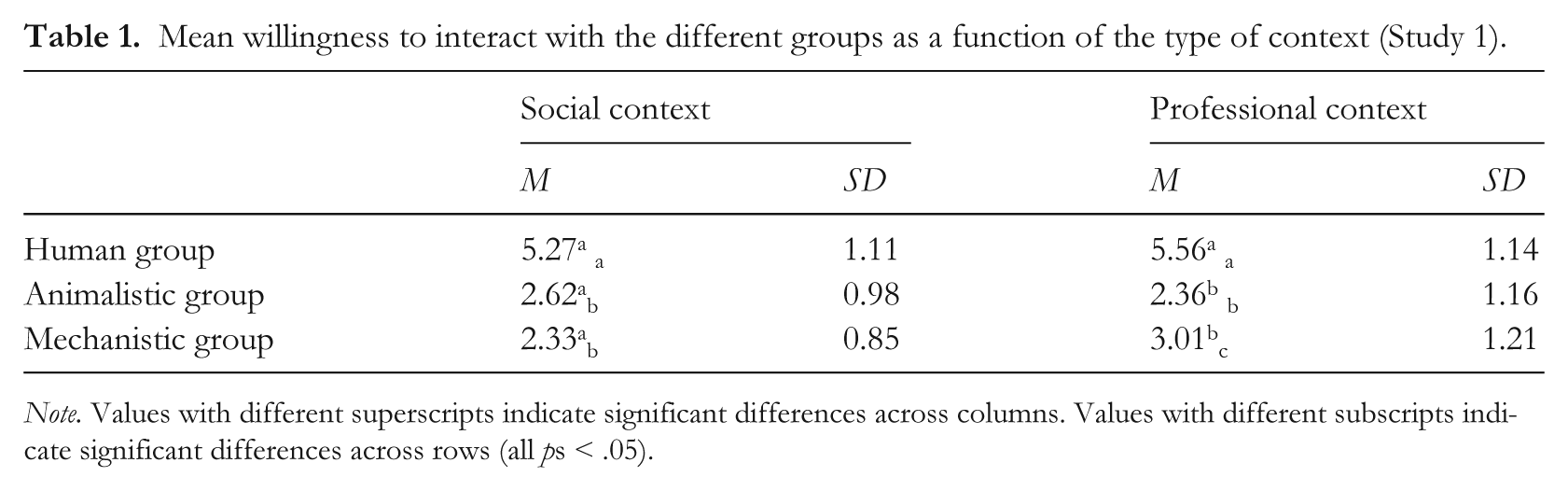
Note. Values with different superscripts indicate significant differences across columns. Values with different subscripts indicate significant differences across rows (all ps < .05).
Perceived competence and warmth
To verify the perceived competence and warmth of the various groups, a 3 (Group Type: animalistic vs. mechanistic vs. human) x 2 (Type of Trait: warmth vs. competence) repeated measures ANOVA in which the first variable was manipulated between-participants was conducted. This analysis showed a main effect of the Type of Group F(1, 144) = 174.26, p < .001, ηp2 = .70, showing that participants attributed higher scores of both judgments, warmth and competence, to the human (M = 5.53) than to the mechanistically (M = 3.36) and the animalistically (M = 2.97) dehumanized groups. Moreover the main effect of Type of Trait was significant F(1, 144) = 174.01, p < .001, ηp2 = .54, as the groups were generally attributed higher competence (M = 4.69) than warmth (M = 3.24). Finally, the expected interaction between Type of Trait and Group Type was significant, F(2, 144) = 70.03, p < .001, ηp2 = .49.
In order to to examine to what extent warmth and competence are attributed to dehumanized groups, within-group contrasts were conducted comparing perceived competence and warmth. Results showed that the mechanistically dehumanized group was perceived more competent than warm, while no significant differences were found between warmth and competence in the animalistically dehumanized group (see Table 2). In addition, a comparison with the midpoint of the scale showed that the animalistically dehumanized group was attributed low warmth, t(44) = −3.07, p < .001, and low competence t(44) = −3.58, p < .001. The warmth attributed to the mechanistically dehumanized group was lower than the midpoint of the scale, t(53) = −12.44,p < .001, whereas the competence attributed to this group was higher than the midpoint, t(52) =10.27, p < .001. Finally, the human group was attributed both high warmth, t(48) = 10.87, p < .001, and competence, t(48) = 24.69, p < .001.
Perceived competence and warmth of the groups (Study 1).
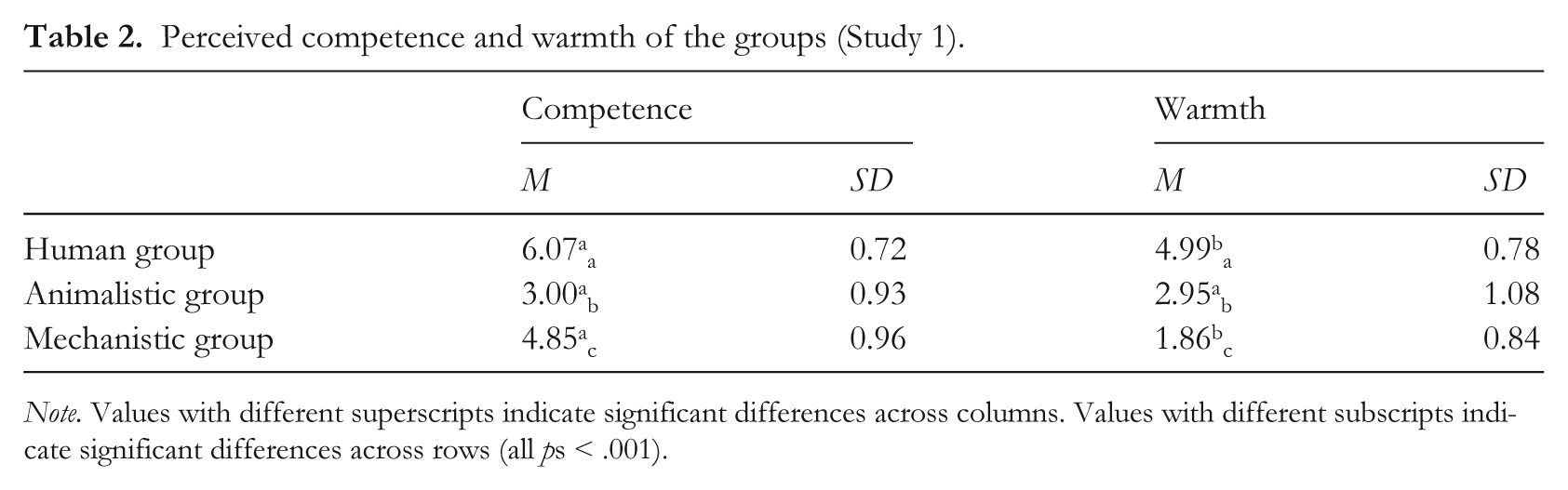
Note. Values with different superscripts indicate significant differences across columns. Values with different subscripts indicate significant differences across rows (all ps < .001).
Finally, it was important to test whether people preferred to interact with an animal-like outgroup in the social sphere and with a machine-like outgroup in the professional sphere independently of how warm and competent the group was perceived. Given that both our main dependent variable and the control variable (warmth and competence) varied within-subjects, we used a method developed by Judd, Kenny, and McClelland (2001). This procedure allows researchers to analyze covariance patterns in within-participant designs. This way, we tested the following regression equation in the animalistic and mechanistic group conditions separately: YD = d0+d1XS + d2XD. YD refers to the difference in the intention to interact in a professional or a social sphere; d0 estimates the mean treatment effect in terms of differences in the intention to interact with the dehumanized group in the professional compared to the social context (provided that XS is centered); XS consists of the sum of the competence and warmth scores (centered), and XD the difference between the competence and warmth scores. According to Judd et al. (2001), if the intercept remains significant regardless of whether XD is a significant predictor or not, we can conclude that participants preferred to interact with members of a dehumanized group in one of the interaction contexts independently of warmth and competence judgments.
Results showed that in the animalistic condition, the difference between competence and warmth was a marginally significant predictor (b = .20, SE = 0.11, p = .06) indicating that these judgments explain a part of the variance in participants’ willingness to interact in social versus professional contexts. Importantly, the intercept remained significant (b = −.30, SE = 0.13, p < .05) indicating that participants prefer to interact in social rather than in professional contexts with members of an animalistically dehumanized group regardless of the way they perceived these targets in terms of warmth and competence.
An identical regression analysis in the mechanistically dehumanized group revealed that the difference between competence and warmth judgments was a significant predictor of participants’ willingness to interact in a professional compared to a social context (b = .33, SE = 0.11, p < .05). However, the intercept did not remain significant in this case (b = −.28, SE = 0.36, p > .05) showing that differences in warmth and competence accounted for participants’ willingness to interact with members of a mechanistically dehumanized outgroup in a professional versus a social context.
Discussion
Results of Study 1 suggest that the animalistic and mechanistic dehumanization of groups have different consequences for people’s willingness to interact with members of these groups. First, as we expected, we observed that participants showed a greater preference to interact with the human group in both the social and professional sphere. Furthermore, results confirmed the hypothesis that the animalistically dehumanized group was preferred in a social (vs. professional) context, while the mechanistically dehumanized group was preferred in a professional (vs. social) context.
Moreover, the manipulation of the humanness of the groups changed their perception in terms of warmth and competence. The human group was seen as equally and highly competent and warm, the mechanistically dehumanized group was perceived as more competent than warm, and the animalistically dehumanized group was judged low on both dimensions. This finding is important for at least two reasons. First, it provides empirical evidence that the overlap between the two senses of humanness and the two basic dimensions of social cognition, warmth and competence, is not perfect (see also Haslam, Loughnan, Kashima, & Bain, 2008). In addition, it seems that the intentions to interact with the animalistically dehumanized group were not fully explained by differences in the perception of warmth and competence of the group. However, the differences in perceived competence and warmth seemed to account for participants’ intentions to interact with the mechanistically dehumanized group. So, while warmth and competence on the one hand and the senses of humanness on the other are clearly related, their overlap is far from perfect and the former difference cannot fully account for the observed effects on the latter variable.
Study 2
People interact with dehumanized groups when they are seen as successful objects possessing attributes relevant for context-specific goals. That is the central process that will be tested in Study 2. Specifically, we expected that the perceived success of the animalistically dehumanized group would be higher in social compared to professional contexts, while that of the mechanistically dehumanized group would be more pronounced in professional rather than in social contexts.
Denying mechanistically dehumanized groups’ curiosity and flexibility makes them appear more rigid. Furthermore, they are perceived as lacking emotions and cognitive openness (Haslam, 2006). Animalistically dehumanized group members, instead, are perceived as irrational, immature, and carried away by their impulses and instincts. Therefore, the denial of HN traits to the members of mechanistically dehumanized groups might provoke that they are seen as more successful than animalistically dehumanized groups in the professional sphere.
The opposite pattern of results was expected in the social sphere. Members of mechanistically dehumanized groups who lack emotionality, warmth, and depth were expected to be seen as less successful in this context compared to animalistically dehumanized group members. Their lack of HU makes that they are perceived as relatively more spontaneous and uninhibited, characteristics that are suitable in various social situations (e.g., to have a good time).
Method
Design
In this study we used a 3 x 2 mixed-model design with Group Type (animalistically dehumanized vs. mechanistically dehumanized vs. human) as the between-participants factor and Type of Success (social vs. professional) as the within-participants factor.
Participants
Eighty students (78.8% women) of a large university in the south of Spain participated in exchange for course credit in the current study. Their mean age was 18.75 years (SD = 3.73).
Measure and procedure
Data was collected in a single session in a university classroom. Participants were provided with a similar questionnaire as the one used in the previous study. Both the manipulation and the manipulation check were identical to Study 1, but now only a measure of perceived success was inserted as the main dependent variable.
Perceived success of dehumanized groups
The perceived success of each group in the different contexts was measured with a 20-item scale with some items related to the social context (e.g., “Members of this group are usually successful in social situations”) and others related to the professional context (e.g., “Members of this group usually realize their professional goals”).
Participants were asked to indicate their level of agreement or disagreement with each of the statements on a 7-point Likert scale (1 = completely disagree; 7 = completely agree). A factor analysis on these 20 items revealed that participants’ responses were clustered around two different factors. Therefore, the 12 items regarding professional success (α = .94) and the eight items that reflected social success (α = .95) were averaged in two separate indices.
Results
Manipulation check
In order to verify the success of the manipulation, a repeated measures ANOVA with Perceived Humanity (animal-, machine-, and human-like) as a within- and Group Type as a between-participant variable was conducted. The Perceived Humanity main effect was significant, F(2, 154) = 9.18, p < .001; ηp2 = .10, but qualified by a significant Perceived Humanity x Group Type interaction, F(4, 154) = 19.93, p < .001; ηp2 = .34. Contrast analyses revealed that the human group was perceived as more human than both dehumanized groups (Manimalistic = 3.41; Mmechanistic = 2.50; Mhuman = 3.96; all ps < .001). At the same time, the mechanized group was perceived as less human than the animalized one (p < .05). The animalistically dehumanized group was perceived as being more animal-like than the mechanistically dehumanized and the human group, (Manimalistic = 3.38; Mmechanistic = 2.23; Mhuman = 1.84; all ps < .001). Finally, the mechanistically dehumanized group was perceived as being more machine-like than the animalistically dehumanized and the human group (Manimalistic = 1.79; Mmechanistic = 3.77; Mhuman = 2.72; all ps < .01).
Also the valence attributed to the group descriptions was analyzed showing a Group Type main effect, F(2, 57) = 57.92, p < .01. The human group was perceived more positively than both dehumanized groups (Manimalistic = 2.41; Mmechanistic = 2.27; Mhuman = 4.44; all ps < .001), while the means of both dehumanized groups did not differ, t(53) = 0.68; p > .05.
Perceived success in different contexts
In order to verify the perceived success of the various groups, a repeated measures ANOVA with Group Type (animalistically dehumanized, mechanistically dehumanized, and human) as a between-participant factor and Type of Success (social vs. professional) as a within-participant variable was conducted. Results yielded a significant effect of Group Type, F(2, 77) = 71.35, p < .001; ηp2 = .65, showing that the human group was perceived as more successful (M = 5.55) than the animalistically (M = 3.40) and the mechanistically (M = 3.35) dehumanized groups. Furthermore, Type of Success was shown to make a significant difference, F(1, 77) = 16.66, p < .001; ηp2 = .17, indicating that participants gave higher scores to professional (M = 4.73) compared to social success (M = 3.78). More importantly, the interaction between Group Type and Type of Success was significant, F(2, 77) = 30.77, p < .001; ηp2 = .44. As shown in Table 3, participants predicted greater professional success for the mechanistically than the animalistically dehumanized group and more social success for the animalistically than the mechanistically dehumanized group. The human group was perceived as the group with the highest success both in the social and the professional spheres (all ps < .001).
Perceived success as a function of context (social/professional) and group type (Study 2).
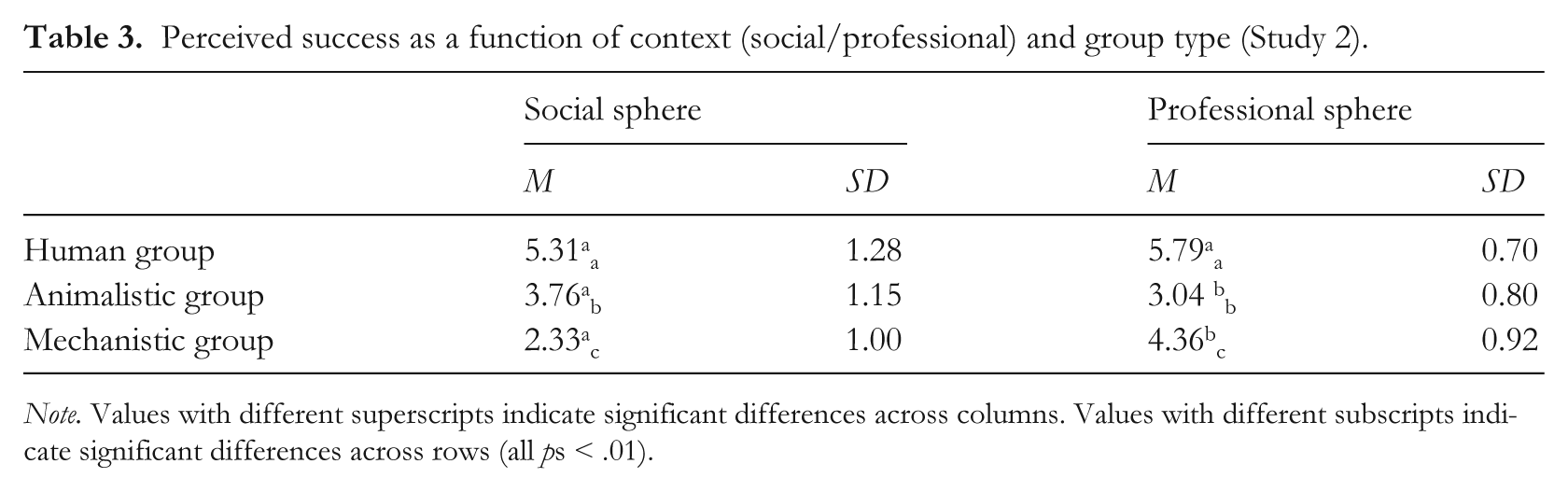
Note. Values with different superscripts indicate significant differences across columns. Values with different subscripts indicate significant differences across rows (all ps < .01).
Additionally, a set of paired sample t tests was conducted within each group. As expected, the animalistically dehumanized group was seen as more successful in social compared to professional situations, t(28) = 3.52, p < .001, while the opposite pattern was found for the mechanistically dehumanized group, t(25) = 8.20, p < .001. Finally, no significant differences were found between social and professional success in the human group, t(24) = 1.57, p < .12 (see Table 3).
Discussion
Unsurprisingly, the results of Study 2 showed that participants perceived the human group both in the social and the professional sphere as the most successful group. However, when we focused on the dehumanized groups, results showed that the denial of HU traits to members of the animalistically dehumanized group made them to be considered more successful in social compared to professional contexts, while the lack of HN traits of the mechanistically dehumanized group made them to receive higher scores in the professional than in the social context. Taken together with the results of Study 1, Study 2 suggests that participants could be motivated to interact with dehumanized groups in the same context in which they are seen as most successful. This link was tested more directly in Study 3. In our opinion, to perceive a group as successful in a specific domain could be related with the perception of its members as objects. Objects are successful when they are useful and fulfill a specific purpose, when they can be easily controlled because of their lack of autonomy and subjectivity, and when they are interchangeable making them easily recognizable. Applied to people we propose that the objectification of dehumanized groups, perceiving them as useful, easily controllable (i.e., lacking autonomy and subjectivity), and fungible, is the psychological process that explains why people prefer to interact with dehumanized groups in certain contexts.
Study 3
The aim of this study was to explore whether people indeed approach dehumanized targets only in the fields in which they are objectified. According to Hypothesis 3, individuals will only show an intention to interact with animalistically and mechanistically dehumanized groups in a social or professional context, respectively, when members of such groups are objectified. To test this hypothesis, four scenarios were selected from a pilot study. Two scenarios referred to social situations whereas the other two described professional situations. Both social and both professional situations had to require an equal amount of social and competence skills, but in only one of them it was expected that members of dehumanized groups would be approached.
Pilot Study: Selection of Scenarios
Eighteen undergraduate Italian students, different from the participants in the main study, were asked to evaluate 44 different situations. Specifically, they had to rate the extent to which each of the scenarios required warmth and competence skills. On the basis of their ratings, we selected two pair of scenarios which did not differ on warmth or competence (see Table 4, all ps > .05). The resulting social scenarios were dancing in a disco and celebrating a birthday party. The selected professional scenarios were: working on a schedule and writing a poem.
Warmth and competence judgments of the four scenarios (Study 3).
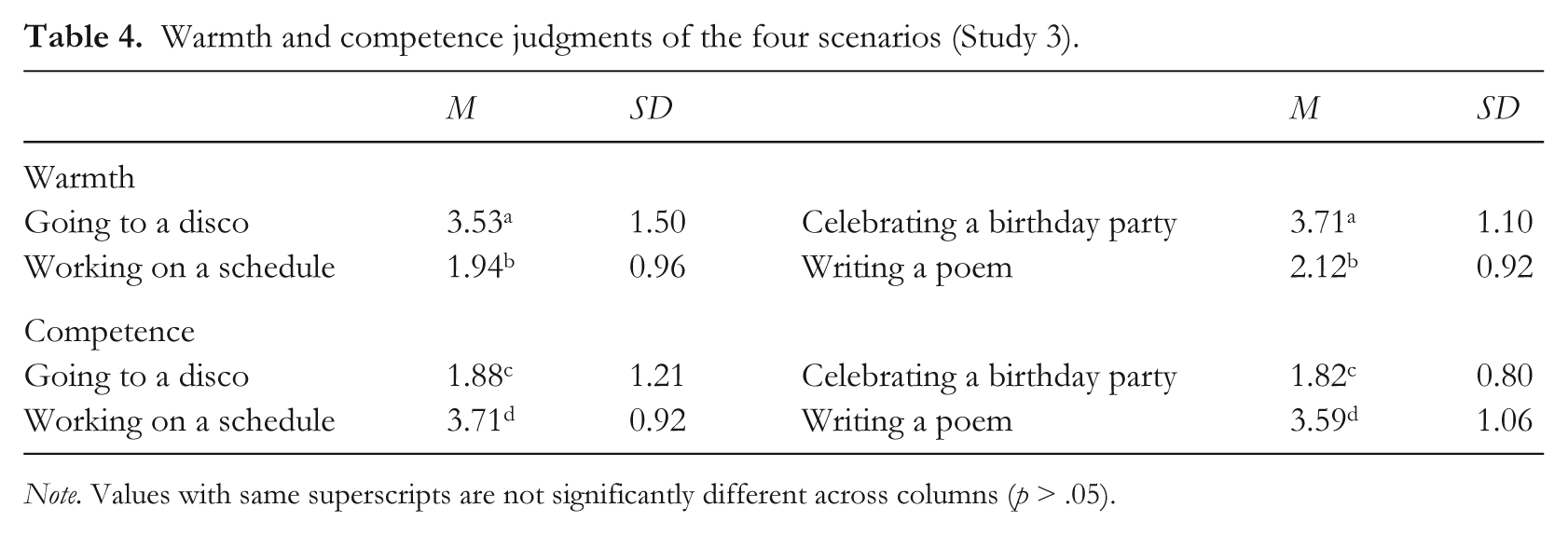
Note. Values with same superscripts are not significantly different across columns (p > .05).
As one might expect, the professional scenarios were perceived as requiring more competence-related skills (M = 3.64) than the social scenarios, M =1.85, t(16) = 4.94, p < .001, while the social scenarios were perceived as requiring more warmth skills (M = 3.61) than the professional scenarios (M =1.85), t(16) = 5.35, p < .001.
Main Study
In order to test the mediational role of objectification on interaction preferences with the dehumanized groups, we selected from the pilot study the two pairs of scenarios (two social and two professional) that did not differ on warmth or competence. Animalistic dehumanization leads individuals to be perceived as coarse, instinctive, immature, irrational, and uncivilized, that is, lacking HU traits. Therefore, we expected such individuals not to be chosen to celebrate a birthday party. They are not likely to contribute to a peaceful atmosphere and might even ruin the party. By contrast, dancing in a disco was expected to be a social situation with few rules, where lack of inhibition and spontaneity might be more appreciated. Therefore, animalistically dehumanized people could contribute to have a great time.
In the two professional scenarios, we expected participants to prefer to interact with members of the mechanistically dehumanized group in the scenario “working on a schedule” but not in the scenario “writing a poem.” Given that mechanistically dehumanized individuals are described as superficial and rigid (lacking HN traits), they were expected to be helpful candidates to produce an efficient and structured schedule that can optimize time. However, the mechanistically dehumanized group was not expected to be useful in the scenario “writing a poem,” as its members were not considered to have HN traits, that is, the emotional responsiveness and cognitive openness needed to create it.
This specific procedure allowed us to further disentangle humanness from warmth and competence judgments. We compared contexts that were equalized in the warmth and competence required to interact successfully with others (see pilot study), but in which dehumanized group members will only be approached when they are objectified.
Method
Design
The study used a 3 x 4 mixed-model design with Group Type (animalistically dehumanized vs. mechanistically dehumanized vs. human) as the between-participants factor and Type of Scenario (disco vs. birthday vs. poem vs. schedule) as the within-participants factor.
Participants
Sixty-eight students of a large university in the north of Italy agreed to participate voluntarily in this study (79.4% women). Their mean age was 21.4 years (SD = 2.51). Participants were approached and asked to participate at different sites of the campus.
Materials and procedure
Participants were asked to read the description of one fictitious group reading either the description of the animalistically dehumanized, mechanistically dehumanized, or human group. Afterwards, participants were presented with the four pretested scenarios and asked about the likeability of the group (depending on the experimental condition) in each scenario. Three likeability items were presented for each scenario (e.g., “I would like to meet a person of this group in the described situation”) and answered on a 7-point Likert scale ranging from 1 = not at all to 7 = totally. Scores on the three items for each situation were averaged. The reliability of the likeability scale for each situation was satisfactory: “dancing in a disco” (α = .92), “celebrating a birthday party” (α = .92), “working on a schedule” (α = .91), and “writing a poem” (α = .90). Participants were then asked to complete the objectification measure created for this purpose that included seven items based on the concept of objectification proposed by Nussbaum (1999) and the objectification scale developed by Gruenfeld et al. (2008). Specifically, the items reflected the following dimensions: instrumentality (e.g., “If you had to choose one of the following situations—going to a disco, celebrating a birthday party, working on a schedule, or writing a poem—in which a member of the group presented might be useful to reach your goals in the given situation, which one would you choose?”); denial of autonomy (“…in which a member of the group presented cannot act in an autonomous and independent way…”), fungibility (“…in which any member of the group presented may be helpful in achieving your aim”), and denial of subjectivity (“…in which situation would you care less about the feelings of a member of the group…”). For each of the seven items, participants were asked to choose one of the four scenarios (going to a disco, celebrating a birthday party, working on a schedule, or writing a poem). Scores on the seven items were summed together to form an objectification scale for each scenario. The scores in each situation ranged from 0 to 7. Finally, the measure of the intention to interact with members of the group was rated on a forced-choice scale by asking: “If you had to choose one of the following situations—going to a disco, celebrating a birthday party, working on a schedule, or writing a poem—in which situation would you like to interact with a member of the presented group?”
Results
Objectification as a mediator
The mediational role of objectification in explaining people’s willingness to interact with dehumanized group members was tested conducting two separate mediational analyses for the two types of scenarios (social vs. professional). First of all, Tables 5 and 6 suggest that only in one of the social scenarios (disco) participants preferred to interact with a member of the animalistic group and only in one of the professional scenarios (working on a schedule) they preferred to work with a member of the mechanistic group.
Intention to interact with the dehumanized group in social scenarios (Study 3).
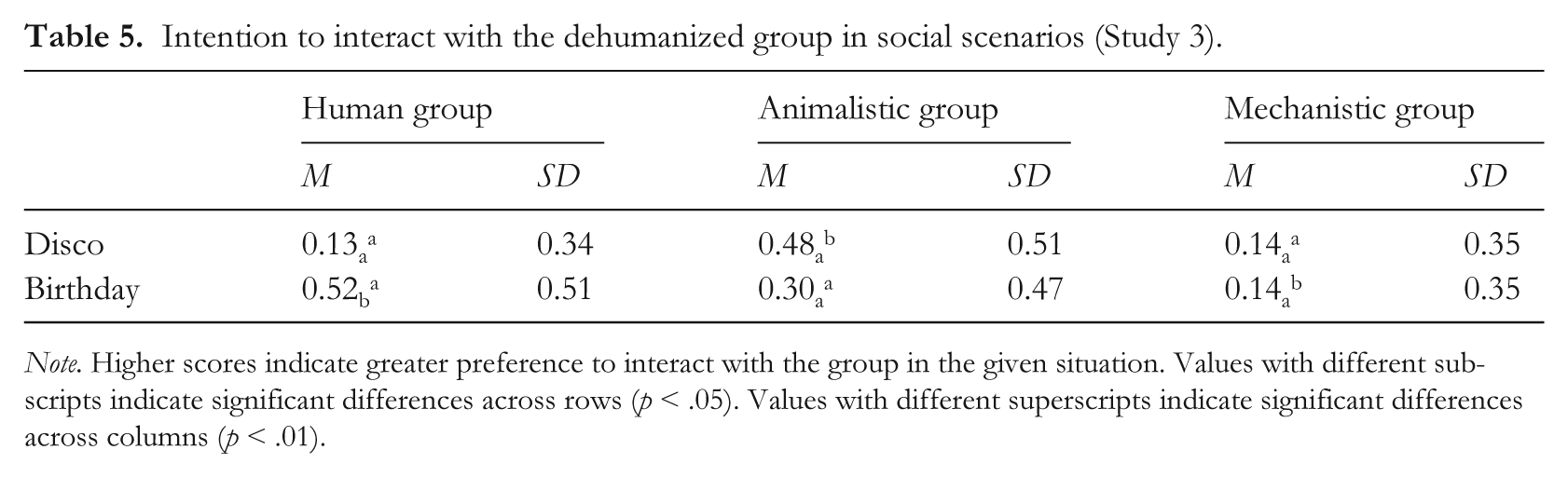
Note. Higher scores indicate greater preference to interact with the group in the given situation. Values with different subscripts indicate significant differences across rows (p < .05). Values with different superscripts indicate significant differences across columns (p < .01).
Intention to interact with the dehumanized groups in professional scenarios (Study 3).
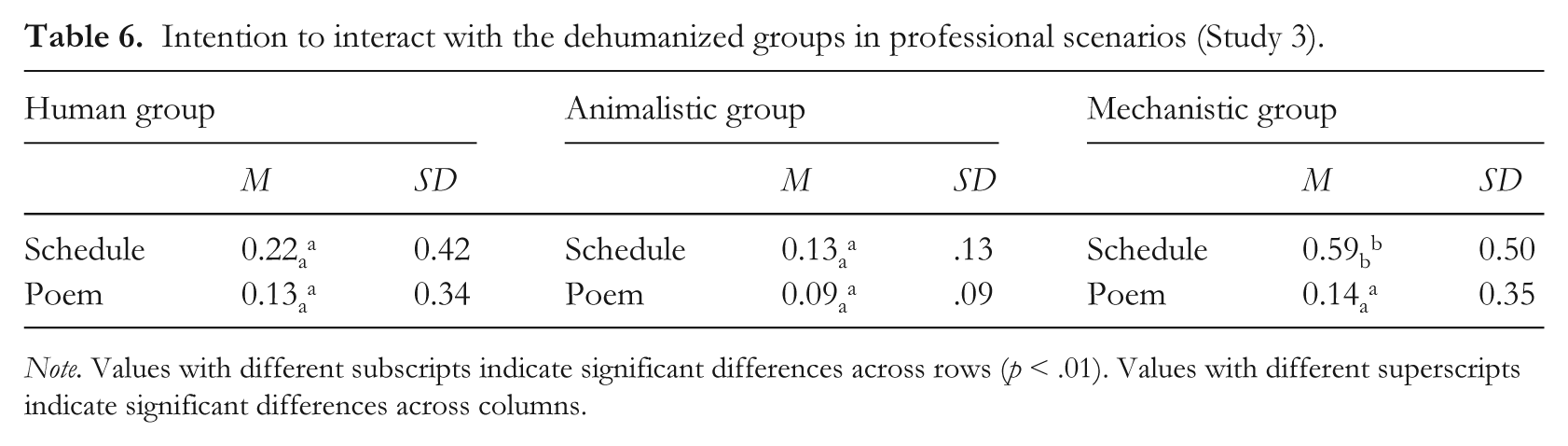
Note. Values with different subscripts indicate significant differences across rows (p < .01). Values with different superscripts indicate significant differences across columns.
Social scenarios
We argued that the willingness to interact with members of an animalistically dehumanized group is restricted to social scenarios in which members of such groups are objectified (Hypothesis 3). In order to test this hypothesis, we used Model 4 (with 10,000 iterations) of the PROCESS tool described by Hayes (2013). Following Hayes and Preacher (2014), we created two dummy variables inserting our Dummy 1: animalistically dehumanized group (contrast-coded as animalistic = 1, mechanistic = 0, human = 0) as IV and the Dummy 2: mechanistically dehumanized group (contrast-coded as mechanistic = 1, animalistic = 0, human = 0) as a covariate. The scores in the objectification scale were included as a mediator variable. In addition, we controlled for the likeability of the group (see Table 7). As expected, the indirect effect of participants’ willingness to interact with members of the animalistically dehumanized group in the disco scenario through the objectification of its group members was significant. The 95% confidence interval did not include zero [1.008, 4.457].
Mediational analysis of objectification in explaining people’s preference to interact with animalistically dehumanized group members in the disco scenario (social context; Study 3).
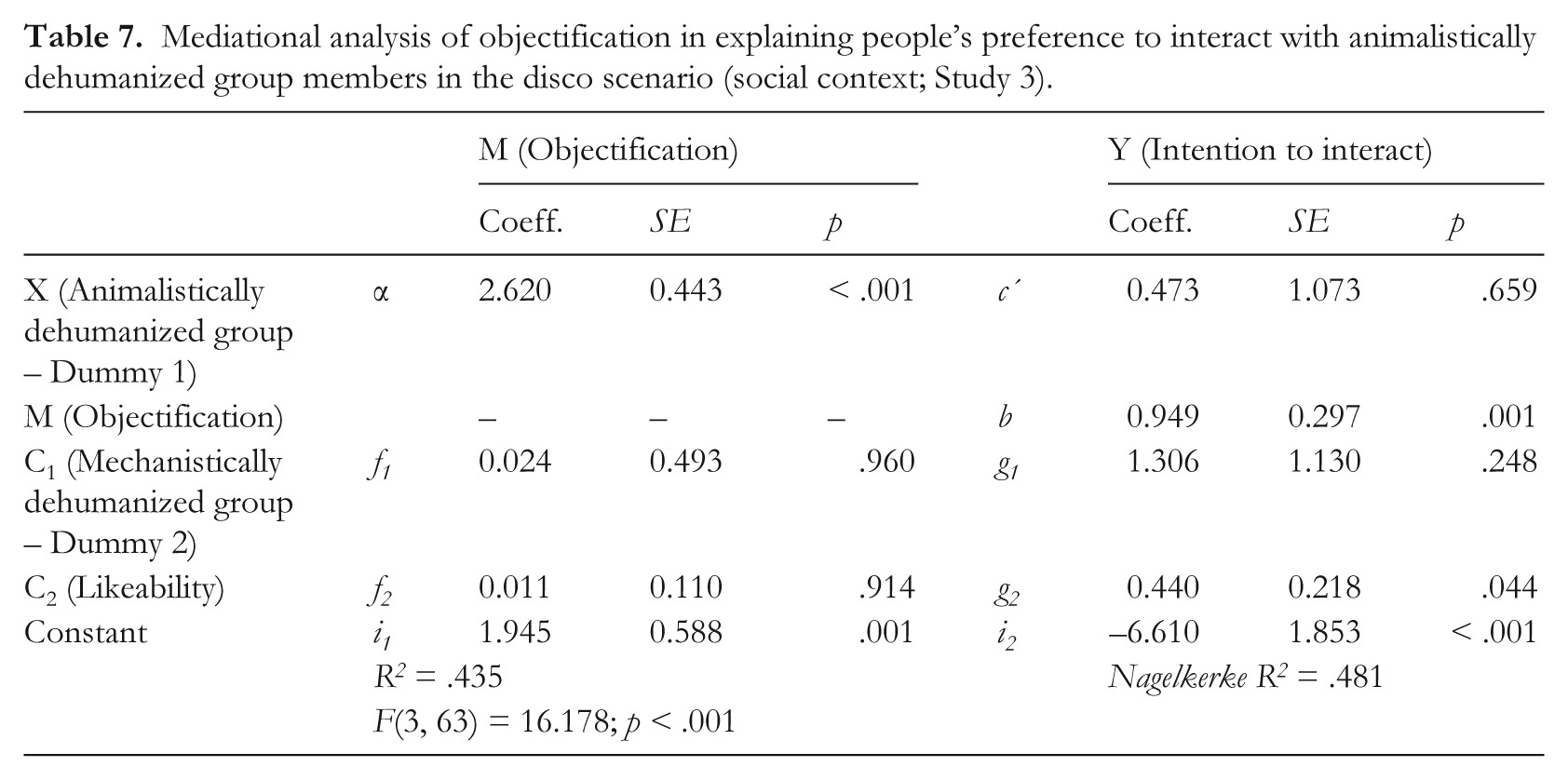
Moreover, animalistic dehumanization did not predict the intention to interact with the group in the birthday party scenario via the objectification of the group in this context [−0.950, 0.842] for 95% and [−0.736, 0.656] for the 90% confidence interval.
Professional scenarios
Similar mediational analyses using Model 4 (with 10,000 iterations) of the PROCESS tool were conducted to explore the mediational role of objectification in explaining the preference to interact with mechanistically dehumanized group members in those professional scenarios in which they are seen as objects. In this case, the Dummy 1 was the mechanistically dehumanized group (contrast-coded as mechanistic = 1, animalistic = 0, human = 0), and Dummy 2: animalistically dehumanized group (animalistic = 1, mechanistic = 0, human = 0) was inserted as a covariate. We also controlled for the likeability of the group. Results showed that in the schedule scenario, objectification marginally mediated the preference to interact with a mechanistically dehumanized outgroup. Indeed, the 95% confidence interval for the indirect effect included zero [−0.082, 2.829], but the 90% confidence interval did not [0.113, 2.406]. Results are presented in Table 8.
Mediational analysis of objectification in the relationship between the mechanistically dehumanized group and the intention to interact with it in the professional context (schedule scenario; Study 3).
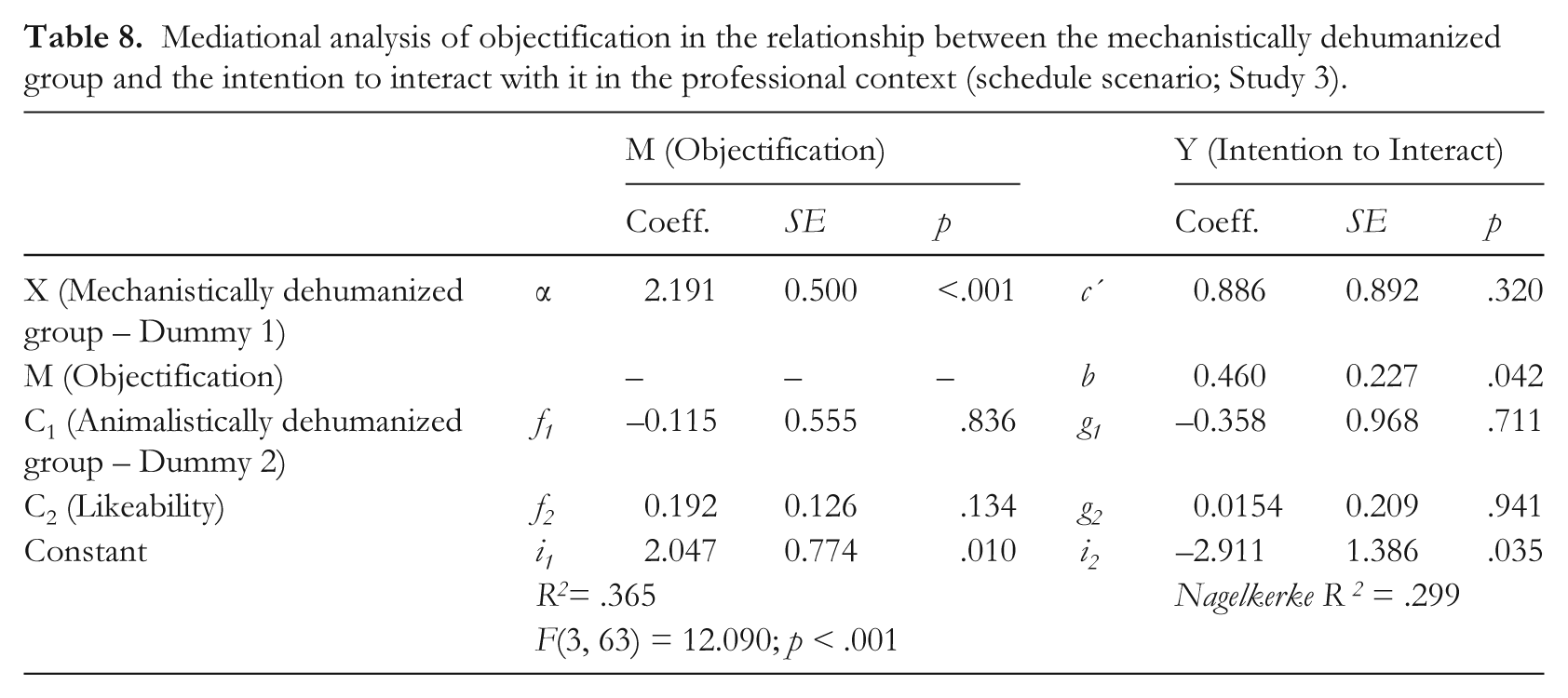
Note that mechanistic dehumanization did not predict the intention to interact with the group in the poem scenario via the objectification of the group in this context since zero was included both in a 95% [−1.352, 0.590] and 90% [−1.089, .443] confidence intervals.
Discussion
As in Study 1, the present findings supported the idea that interacting with animalistically dehumanized group members was preferred in the social sphere, while members of the mechanistically dehumanized group were preferred in the professional sphere. However, qualifying the results of Study 1, this preference did not apply to all social or professional contexts. Animalistically dehumanized group members were only preferred in social situations in which they were also objectified, that is seen as useful, interchangeable, and easy to control in the specific situation (i.e., dancing in a disco, but not celebrating a birthday party). Similar findings were obtained for the mechanistically dehumanized group. Participants preferred to interact with members of this group only in those professional situations in which they were seen as useful, interchangeable, and lacking feelings and autonomy, but not when the members of this group were not objectified (i.e., writing a poem).
We would like to underline that objectification explained people’s willingness to interact with dehumanized groups over and above their likeability. This result suggests that people prefer to interact with members of dehumanized groups not because they like them, but because they are “convenient” in the given situation. One does not need to consider their feelings, they can be easily controlled because of their lack of autonomy, they are interchangeable and thus easy to recognize and given their characteristics they are useful in that specific situation. This result extends Gruenfeld et al. (2008) framework who emphasized that objectification leads to approach behavior because the objectified is liked the more he or she has goal relevant attributes. According to these authors, this was also the reason why objectification and dehumanization processes differ from one another. The present findings together with previous research (Vaes et al., 2011) show that both processes can be related. When we approach dehumanized groups we might do so the more we objectify them regardless of whether we like them or not.
Still, in the professional situation, objectification was only a marginal mediator. This result might suggest that in professional situations objectification is not the only variable that explains why people interact with mechanistically dehumanized groups, and future research should address whether other variables could be involved in explaining this specific relationship.
General Discussion
Results of this research demonstrate that animalistic and mechanistic dehumanization are two different forms of dehumanization with contrasting consequences on the interactions that people seek with dehumanized individuals. In Study 1, people’s intention to have contact with both dehumanized groups in two different contexts—social and professional—was analyzed. Unsurprisingly, results showed that participants preferred the human group both for social (e.g., going for a walk) and professional activities (e.g., working together). The main finding of this research, however, is that participants did show a relative interest to interact with the animalistically dehumanized group in social situations and with the mechanistically dehumanized group in professional situations. This result suggests that, although dehumanization of groups is understood as a form of prejudice (Castano & Giner-Sorolla, 2006), members of dehumanized groups may still be approached in certain situations. The social and professional contexts can be associated with key dimensions of social perception such as perceived warmth or competence. Because of this possible confound, warmth and competence judgments were gathered in Study 1. Results indicated that even though warmth and competence judgments are related with the attribution of the two senses of humanness, these judgments could not fully account for the observed effects on intergroup closeness to dehumanized outgroups in social and professional contexts.
The aim of Study 2 was to investigate the reasons that may lead individuals to wish to interact with dehumanized groups in certain contexts. We considered that the intention to interact with the animalistically dehumanized group in the social sphere and with the mechanistically dehumanized group in the professional sphere may be due to the perception that their members are successful in such contexts.
If people report a preference to interact with members of dehumanized groups in those contexts in which they are seen as most successful, suggests that these preferences reflect a functional, more than an affectionate or personal relation. Is it possible that people are interested in having contact with dehumanized groups the more they perceive them as “convenient” or “easy to use”? Such considerations are similar to the ones people make when they interact with objects, meaning that processes of objectification might underlie people’s preferences to interact with dehumanized outgroup members. Results of Study 3 demonstrated that people only report a higher intention to interact with members of dehumanized groups when they were objectified. An animalistically dehumanized group, for example, does not seem to be preferred in all social situations but only in those in which they are seen as useful and controllable objects. Therefore, in the social situation of going to a disco, in which people just want to have a good time, participants reported a high intention to have contact with members of the animalistically dehumanized group. However, in another more intimate social situation such as a birthday party, animalistically dehumanized individuals were not welcome (their lack of HU traits like civility and reasonableness may ruin the party). Similarly, participants only expressed the intention to interact with the mechanistically dehumanized group in a professional situation in which its members were objectified. Specifically, when the goal was to work on a schedule with the aim to plan tasks efficiently, participants tended to report a greater intention to interact with the mechanistically dehumanized group. By contrast, participants expressed less desire to interact with the mechanistically dehumanized group in another professional situation—writing a poem—(a situation that requires the same perceived competence and warmth than the “work on a schedule” situation). In this case, it is likely that participants did not objectify this group because its lack of HN traits reduces their functionality in the given situation. In short, people seem to be interested to interact with members of dehumanized groups only when they are seen as functional and convenient much like we regulate our interactions with objects. Moreover, these results were obtained controlling for intergroup liking showing that regardless of their likability it was their perceived usefulness that made people prefer to interact with members of dehumanized groups.
Additionally, the results of Study 3 could be interpreted as evidence for the fact that the two humanness dimensions are not reducible to warmth and competence judgments (Haslam et al., 2008). If this was the case, the animalistically and the mechanistically dehumanized groups should be preferred in both social and professional scenarios respectively since both scenarios in the social and professional spheres were pretested to require the same amount of warmth and competence. However, participants only reported a greater intention to interact with members of these dehumanized groups when the groups were objectified.
The present research was able to make progress in the study on the consequences of dehumanization. Importantly, it compared the different possible consequences of animalistic and mechanistic dehumanization and provided evidence that objectification underlies people’s preference to interact with dehumanized group members in certain contexts. Still, it is important to consider the limitations of the presented research. One concerns the manipulation of humanity creating fictitious groups. While this approach was useful to control several group variables (status, history, and existing stereotypes), it also separated the described groups from reality. To make our findings more applicable to the study of inequality and gain further insight on the condition under which intergroup contact might occur, we consider it is necessary to combine experimental and correlational studies that use different procedures for a more comprehensive understanding of the problem.
In line with this argument and given the possible inconsistency of the present findings with the literature on dehumanization which showed that members of both animalized and mechanized groups are usually not approached, we would like to stress the importance to replicate the present findings in future studies in other social or professional contexts. Furthermore, it would be interesting to analyze other important variables related with the dehumanization process, as for instance, the emotions elicited by the animalistically and mechanistically dehumanized groups. According to Haslam (2006) animalistic and mechanistic dehumanization elicit negative emotions (disgust and indifference respectively). However, we suggest that people might report more positive emotions toward dehumanized groups when they are objectified. Future research might explore the role of emotions on the relationship between dehumanization and objectification. In addition, future research should also examine other contexts in which people might want to interact with dehumanized groups focusing on other areas of human conduct in which interactions with dehumanized group members is likely to occur (e.g. immigration, national and international conflicts, etc.).
Footnotes
Appendix 1
Descriptions used in the manipulation of humanity. Versions in Spanish (Studies 1 and 2) and Italian (Study 3) available under request.
The animalized group was described with low HU traits. Specifically, participants read the following “Members of this group often act instinctively. They are not very rational and they do not control themselves well. They are not defined by features such as civility and cultural awareness. They seem coarse and insensitive because they lack refinement. Child-like qualities or lack of maturity are their central defining traits.”
The mechanized group description was created using low HN characteristics: “Members of this group often act in an individualistic way. They are passive and very similar to each other, so they are easily interchangeable and fungible. Their manner is generally cold, and they are close-minded. Generally speaking, there are few things that affect them. They are not good at recognizing the emotions of the out-group and are quite rigid and superficial.”
Finally, the human group was described with characteristics that were both high in HU and HN: “Members of this group often act very maturely. They could be defined as rational, educated, and civilized. Their open minds make them flexible. Moreover, they are sociable and do not have many problems understanding others’ emotions. They are not superficial, so their character may be characterized as deep.”
Funding
The author(s) disclosed receipt of the following financial support for the research, authorship, and/or publication of this article: This research was supported by Grants No. PSI2013 45678-P and No.PSI2014-59659-R, from the Spanish Ministry of Economy and Competitiveness (Ministerio de Economía y competitividad) and by a grant from the F.P.D.I program of the Regional Government (A.D.2008, Junta de Andalucía) to the first author. This paper is based on the first author’s dissertation.