



Abstract
This study tests whether entertainment portrayals of international medical graduate physicians may influence attitudes toward such physicians among television viewers. Given the growing importance of international physicians in U.S. health care delivery, such effects would have the potential to impact significant numbers of patient–physician interactions. From a theoretical and methodological standpoint, this examination extends existing work on entertainment portrayals of often-stigmatized minorities and its impact on minorities for whom stereotypes may be in some respects favorable. An experiment manipulating positive versus negative portrayals of the communicative and professional competence of an Asian Indian female physician on the program ER found that exposure had no effect on conventional, deliberative measures of attitude toward such physicians. However, use of attitude-accessibility measurement suggested that viewers (to the extent that they identified with the narrative character, an Asian Indian physician) who saw the negative portrayal were slower to respond that they liked other Asian Indian female physicians who were presented in photos in a judgment task afterwards—in other words, the negative portrayal inhibited an approach response to other similar physicians. An implication of this finding is that such television portrayals may have the potential to influence affective responses to medical providers from the same demographic as the character portrayed, in ways viewers are likely to be unaware of. Such responses may well influence patient expectations and interactions with such physicians.
Keywords
Narrative influence on audience perceptions of minorities and stigmatized populations has been a subject of increasing research interest (Chung & Slater, 2013; Chung, Slater, & Comello, 2011; Mastro & Tropp, 2004; Ortiz & Harwood, 2007; Schiappa, Gregg, & Hewes, 2005). The issue of attitudes toward minorities has particular importance for health care delivery, as a large and increasing number of U.S. physicians are international. According to the American Medical Association (AMA, 2010) almost 30% of all practicing physicians in the United States are considered international physicians—physicians who have earned their undergraduate medical degree from a country outside the US or Canada (AMA, 2010). Of these, almost 25% of international physicians are from two major countries in South Asia: India and Pakistan (AMA, 2010). Thus, the chances of coming across an international physician of South Asian origin when one visits a doctor in the US are relatively high. As Quick (2009) and Street (2003) note, medical interactions are in all likelihood influenced by various environmental factors, of which entertainment programming is one.
Although, over one fourth of all physician populations practicing medicine in the US are considered international, the portrayals of these physicians on television are fairly scarce (Jain & Slater, 2013). Thus, the limited portrayals that exist have the potential for an outsize influence (Mastro, 2003) on patient perceptions of such physicians and, as a result, on the patient–provider encounter. Therefore, it is important, as a first step in assessing such impact, to first determine whether such portrayals are in fact likely to influence attitudes toward international physicians.
From a theoretical perspective, the question of narrative entertainment influence on attitudes toward minorities is intriguing. It may be that audience members seek to compensate in socially desirable ways for the effects of the programs in responses to attitudinal measures, in which case responses may be better discerned using nondeliberative measures. These indirect measures capture attitudes in an automatic manner without a participant’s awareness as opposed to explicit measures that tap into a person’s acknowledged deliberative attitudes (Eno & Ewoldsen, 2010; Fazio & Olson, 2003; Greenwald & Banaji, 1995). Given the motivation and opportunity, as is the case when deliberative measures of attitude assessment are used, participants are likely to inhibit and censor their true feelings regarding a racial group (Devine, 1989; Fazio & Towles-Schwen, 1999). Such a pattern is likely to be found when measuring attitudinal responses toward the so-called “model minorities,” groups for whom stereotypes are generally considered positive, such as Asians in the US (Lin, Kwan, Kwan, Cheung, & Fiske, 2005; Ramasubramaniam & Oliver, 2007).
The present research, therefore, seeks to advance theoretical understanding of entertainment narrative influences by examining the impact of positive versus negative portrayals of minorities (in this case, Asian Indian physicians) using both deliberative and nondeliberative attitude measures. Moreover, we do so by incorporating examination of narrative identification (a form of involvement with the narrative character that includes sharing both cognitive and affective perspectives of the character; Cohen, 2001) and transportation (a form of cognitive engagement with the narrative that blurs the boundaries between the narrative and the real world; Green & Brock, 2000, 2002) as potential moderators of this influence. The theoretical framework guiding this research, along with narrative transportation and identification, is parasocial contact hypothesis (Schiappa et al., 2005) and motivation and opportunity as determinants of behavior (MODE) model (Fazio, 1990, 2001; Fazio & Olson, 2003). Next, we review existing research on media representations of Asians in the US. In addition, we also present the previous research on media and stereotypes with specific focus on the studies utilizing implicit measures to understand such issues.
(Asian) Stereotypes in Media and Medical Entertainment Programming
Media portrayals are fraught with stereotypical depictions of minority groups (Arendt, 2010; Dixon & Williams, 2014; Ramasubramaniam & Oliver, 2007). For example, research conducted in Europe found that frequency of reading a newspaper that overrepresented foreigners as criminals led to more negative implicit attitudes toward this group of individuals (Arendt, 2010). Yet another study found that participants were quicker to respond to the terms associated with the jezebel stereotype (that suggests African American women as hypersexual and promiscuous) after watching African American interviewees portraying the jezebel stereotype in a video (Brown Givens & Monahan, 2005). Additional research examining the influence of messages in video games and television programming on people’s racial attitudes suggest: participants are quicker to identify weapons after watching a video game featuring Black characters (Burgess, Dill, Stermer, Burgess, & Brown, 2011); neither Latino nor African American characters are portrayed in professional and higher status roles (Mastro & Behm-Morawitz, 2005; Seggar & Wheeler, 1973); and gender portrayals on television are imbalanced with women less frequently being depicted as working outside the home (Signorielli & Bacue, 1999; Signorielli & Kahlenberg, 2001). In medically focused entertainment programs males dominate the narratives (Hether & Murphy, 2010) and television portrayals cast women in stereotypical roles of nurses rather than doctors (Calvert & Huston, 1987; Signorielli & Bacue, 1999). A recent content analysis found that although the number of women as doctors on television was representative of the total number of female physicians in the US, most female physicians on these programs were not shown as active caregivers (defined as engaging in interactions with patients). This suggests that although women are shown as physicians, inclusion of these women was presumably often for the extension of heterosexual romantic narrative plotlines (Jain & Slater, 2013).
These biased media depictions are not limited to negative stereotypic portrayals, however. Previous research provides strong evidence that media depictions of Asians in the US further “model minority” stereotypes. Zhang (2010) studied the extent to which people internalize and accept mediated stereotypes about Asian Americans and found that message recipient’s social reality perceptions regarding the out-group were reflective of media portrayals. Previous research suggests that people attribute model minority stereotype to Asians such that this group is perceived to be more likely to be financially, professionally and academically successful; technology savvy; and socially inept (Paek & Shah, 2003; Taylor, Landreth, & Bang, 2005; Taylor & Stern, 1997; Zhang, 2010). Another study that examined Asian American portrayals in advertising in news magazines found that in accordance with hardworking stereotypes associated with this minority group, advertisements portrayed Asian Americans in a workplace setting as compared to other minority groups (Paek & Shah, 2003). Furthermore, this group is more likely to be featured in publications geared toward readers interested in popular business and science/technology as compared to general interest and women’s magazines (Taylor et al., 2005; Taylor & Stern, 1997).
Another study found that these popular culture portrayals, based on the tenets of cultivation (Gerbner & Gross, 1976) and media dependency theory (Ball-Rokeach & DeFleur, 1976), may influence the social reality beliefs of any given message recipient in regards to model minority groups (Zhang, 2010). Such stereotypes can lead to undesirable media effects among members within ethnic groups including: mental health issues (Thompson & Kiang, 2010); problems in interpersonal relationships (Son & Shelton, 2011); and perceptions by others of this group as a realistic threat toward limited resources (Maddux, Galinsky, Cuddy, & Polifroni, 2008). As a result, we feel this topic demands greater academic attention.
Though much research has focused on the portrayals of minority groups and women in entertainment programming, the research examining portrayals of international physicians, most of whom also belong to ethnic minority groups, on television is relatively rare. Nielsen Media Research reports medical entertainment programming (fictional programs with physicians, hospitals, patients, and health-related issues as the main focus of the show) is one of the most popular genres of entertainment television (“2006–07 Prime Time Wraps,” 2007). Previous research suggests an influence of exposure to medical entertainment programming on viewers’ social reality perceptions regarding health policies (Turow & Gans, 2002); healthcare providers (Chory-Assad & Tamborini, 2003; Gerbner & Gross, 1976; Quick, 2009); healthcare system, health information, and preventive behaviors (Hether, Huang, Beck, Murphy, & Valente, 2008; Rideout, 2008). A recent content analysis of medical entertainment programs (Jain & Slater, 2013) found international physicians were substantially underrepresented, increasing the likelihood that those few international physicians portrayed on these programs might have an outsize influence on patient perceptions of providers and thus on their relationships with them (Mastro, 2003).
We know from prior research that limited or negative portrayals of out-groups may influence message recipients’ social reality perceptions and can lead to stereotyping of and prejudice toward minorities such as African Americans and Latinos (Dixon & Linz, 2000; Mastro, 2003; Ramasubramaniam, 2011). Conversely, positive portrayals may reduce social distance desired from out-group members, such as gay men (Schiappa et al., 2005). Indeed a recent extension of parasocial interaction has been in the area of intergroup contact, one of the two theoretical frameworks that inform the present research.
Parasocial Contact Theory
Engaging in parasocial interaction with the out-group character on a television show influenced the message recipient’s attitude toward the out-group in a positive direction and reduced prejudice toward the portrayed out-group in general (Schiappa et al., 2005). This phenomenon termed parasocial contact hypothesis (Schiappa et al., 2005) notes that intergroup contact on television could influence attitudes due to changes in category-attribute beliefs regarding the portrayed out-group. The effects become more pronounced in the event of limited out-group contact. In their experiments, the researchers found that exposure to gay and transvestite group members led to decrease in prejudice toward this group over time. Furthermore, this body of research suggests that viewers’ reactions toward out-groups, as a result of engaging in parasocial interaction with the out-group character, parallel actual intergroup contact situations.
Bandura’s (1986) social cognitive theory, used extensively to explain both intended and unintended effects of entertainment programs, could provide an explanation as to why parasocial contact may influence attitudes toward out-groups (Joyce & Harwood, 2012; Mazziotta, Mummendey, & Wright, 2011; Slater & Jain, 2011). Mediated portrayals involving out-group members offer an opportunity for message recipients to engage in “vicarious contact” by helping them learn how to engage in out-group interaction, and enhance their self-efficacy (Joyce & Harwood, 2012; Mazziotta et al., 2011). This may lead to an alteration of beliefs associated with the portrayed out-group prompting an overall positive affect (Schiappa et al., 2005).
Because physicians of South Asian ethnicity would most likely be considered belonging to an out-group for most individuals in the US, and high-quality intergroup contact situations may be limited, mediated contact may provide an avenue for learning regarding this minority group. However, because of the social desirability biases associated with model minorities, many of whom work as physicians in the US, implicit measures, briefly reviewed in the next section, may be better suited to understand people’s attitudes regarding this group.
Implicit and Nondeliberative Attitude Measures and MODE Model
Measures that capture automatically activated attitudes in an unobtrusive, indirect manner are referred to as implicit measures (Goodall, 2011). When attitudes are measured using implicit and explicit attitude measures, they are mostly correlated, barring socially sensitive topics such as racial issues (Eno & Ewoldsen, 2010; Olson & Fazio, 2003). This divergence can be explained in terms of the MODE model (Ewoldsen, Rhodes, & Fazio, 2014; Fazio, 1990, 2001).
MODE model defines attitude as a link between the object and its evaluation. According to this model each individual’s attitude toward an attitude object exists on a continuum where one end of the continuum represents no attitude (or very weak attitude) and the other end represents extremely strong associations between the attitude object and its evaluations, rendering the latter association automatic. Depending upon their levels of motivation and opportunity (Olson & Fazio, 2003), individuals can either make spontaneous, automatic judgments or deliberative, more thought out, effortful considerations regarding the attitude object. Motivation can influence the judgments when people have some desire for accuracy, fear of invalidity, need to belong, and need to feel positively toward the self (Olson & Fazio, 2003). Opportunity to make the judgment involves time and cognitive resources such as self-regulation, among other things (Olson & Fazio, 2003). An individual will choose deliberative processing over spontaneous one to make judgments when both the motivation and opportunity to do so are present. If either (or both) are lacking, then spontaneous judgments are made.
A myriad of reasons, including the desire to appear egalitarian, contributes to a lack of (or a weak) correlation with respect to people’s racial attitudes on implicit and explicit measures (Eno & Ewoldsen, 2010; Ewoldsen, Ellithorpe, & Fazio, 2012; Olson & Fazio, 2003). When people are asked about a sensitive topic they might have concerns or motivation not to appear prejudiced (Dunton & Fazio, 1997; Olson & Fazio, 2003). Given the opportunity (as is the case with the most explicit measures) the expressed attitudes might not reflect the real attitudes which implicit attitude measures might be more apt at capturing. Indeed, Ewoldsen et al. (2012) found that heavy viewers of television expressed more favorable attitudes toward African Americans, as measured explicitly, but elicited more negative affect when assessed with nondeliberative implicit measures. Given the present research examines attitudes toward a social group that enjoys the reputation of being a high-status minority in the US, relative to other minority groups (Ramasubramaniam & Oliver, 2007; Thompson & Kiang, 2010), the opportunities to respond in a manner consistent with societal perceptions abound. Therefore, to understand the impact of mediated portrayals, this study employs both deliberative and nondeliberative measures to test the influence of media exposure and the role of narrative process of transportation and identification on a message recipient’s intergroup attitudes.
One type of nondeliberative measure, used in the current research, helps in measuring the strength between the attitude object and its evaluations, also known as attitude accessibility. Accessible attitudes are spontaneous or automatic and are easily retrieved on presentation of a prime (Fazio, 1993; Fazio, Sanbonmatsu, Powell, & Kardes, 1986; Fazio & Williams, 1986; Roskos-Ewoldsen, 1997). Accessible attitudes can determine behavior when presented with a prime (Roskos-Ewoldsen, 1997) and appropriate context (Slater, 2002) and hence attitude accessibility is especially relevant for health-related behavior change (Shen, Monahan, Rhodes, & Roskos-Ewoldsen, 2009; Slater, 2006; Roskos-Ewoldsen, Yu, & Rhodes, 2004), voting behavior (Fazio & Williams, 1986), and media effects research (Nabi & Krcmar, 2004; Roskos-Ewoldsen, Roskos-Ewoldsen, & Carpentier, 2002).
Prior research notes two primary influencers of accessibility: Frequency and recency of the prime (Roskos-Ewoldsen et al., 2002). Based on this notion, Shrum (1996, 2009) proposed that among heavy viewers of television, certain attitudes and exemplars become chronically accessible due to repeated exposure to the prime, and influence the message recipient’s future behavior accordingly. We argue that other processes that a message recipient can engage in, namely transportation in the narrative and identification with a protagonist, explained next, can also influence attitude accessibility.
Identification With the Protagonist and Narrative Transportation: Implications for Portrayals of Out-Group Members
Narrative identification is a form of involvement with the narrative character and includes sharing both cognitive and affective perspectives of the character (Cohen, 2001). Identification with a narrative character is generally expected, in the context of research on persuasive narratives, to increase the impact of that portrayal. For example, a recent study of exposure to Sex and the City indicated that identification with a narrative character increased audience self-efficacy, reduced counterarguing, and motivated story-consistent health-related behavior (Moyer-Gusé, Chung, & Jain, 2011). Recent research suggests that affect-inducing entertainment programs, especially those in narrative format, may influence social attraction and intergroup attitudes (Chung & Slater, 2013; Chung et al., 2011; Oliver, Dillard, Bae, & Tamul, 2012). For example, Chung and Slater’s (2013) research compared how perspective taking differed among message recipients as a function of stigma and the subsequent influence on intergroup attitudes. Their research suggests that message recipients are more likely to take the perspective of a less stigmatized character which in turn was associated with higher social acceptance of the out-group, albeit, more so for the less than for the highly stigmatized out-group. Similarly, Oliver et al. (2012) found a positive influence of information presented in narrative (compared to nonnarrative) format on affect and intergroup attitudes. This effect of identification could be of value in research on intergroup attitudes.
However, research on effects of narrative identification has not been, as far as we are aware, extended to positive versus negative portrayals of out-group members for whom stereotypes are typically at least as much positive as negative. In other words, our understanding of the process of identification, when an out-group character is regarded generally positive off screen but is portrayed negatively on-screen, is relatively limited. The current research fills this gap by examining people’s reactions to the groups that are generally perceived to possess desirable characteristics in the U.S. society.
To the extent that an audience member is cognitively and emotionally engaged with the behavior of the minority protagonist, we would expect that a favorable portrayal is likely to increase positive evaluations of similar out-group members, as the evaluations are being engaged in with relatively greater intensity. Conversely, a negative portrayal can be expected to result in more negative evaluations to the extent to which this cognitive and emotional engagement is taking place. In other words,
H1: The positive portrayal will tend to increase (a) positive attitudes and (b) accessibility of positive evaluations of social group members similar to the protagonist as a function of the extent to which viewers report identification with the character portrayed.
Transportation or absorption in a narrative is a cognitively engaging activity that blurs the boundaries between the narrative and the real world (Green & Brock, 2000, 2002). Because transportation requires a message recipient’s complete focus on the narrative, one of the consequences of transportation is persuasion in line with the narrative (Green & Brock, 2002). Although much attention has been devoted to understanding the influence of narrative transportation on a message recipient’s attitudes and beliefs in general, research to understand the influence of transportation specifically on a message recipient’s intergroup attitudes is still in its infancy (Chung & Slater, 2013; Chung et al., 2011). Identification focuses on increased cognitive and affective involvement with a character or characters (Cohen, 2001), and transportation focuses on such responses to the narrative as a whole (Green & Brock, 2000, 2002). Despite this more global focus, we might expect similar moderating effects due to transportation.
During transportation all the mental processes are focused on the narrative and counterarguing is suppressed (Slater, Buller, Waters, Archibeque, & LeBlanc, 2003; Slater & Rouner, 2002), so the content of the narrative might be more likely to influence the message recipient’s “real-world beliefs” about out-group members, whether in a positive or negative direction, to the extent the message recipient gets transported in the narrative (Green & Brock, 2000). Furthermore, transportation provides the message recipients with opportunities to experience the narrative world without being physically present in that world (Green & Brock, 2000). This vicarious “direct” experience with the narrative world could then result in stronger association between the object and its evaluations, since past research has demonstrated that attitudes formed through direct experience are stronger, more stable, and more quickly accessible than other forms of experience (Fazio & Zanna, 1981). It may be that to the degree a viewer is transported, the mediated experience may be more like a direct experience in its effects. In other words, levels of transportation may influence the effect of the stimulus on out-group attitudes. Therefore it is proposed that:
H2: The positive portrayal will tend to increase (a) positive attitudes and (b) accessibility of positive evaluations of social group members similar to the protagonist, as a function of the extent to which viewers report transportation in the narrative.
Method
Design and Participants
Participants were randomly assigned to one of the three conditions (portrayal valence: positive, negative, control), and were recruited from the students enrolled in different communication classes in a large Midwestern university, N = 223. The subjects were almost equally distributed across the three experimental conditions (positive = 73, negative = 77, control = 73) after random assignment. Participants on an average were 20.50 years old (SD = 2.92), 56% (n = 124) were females, and almost 59% were Caucasian (n = 132). Almost 13% (n = 28) of the sample consisted of participants who reported their race as Asian Americans or Asian Indians.
Manipulation
The video for the study was created by editing an episode of the show ER featuring an Asian Indian female physician as one of the primary doctors on that episode of the show. The video for each condition was about 11–12 minutes long.
In the positively valenced portrayal condition the physician, Dr. Neela Rasgotra, was shown as a caring, competent, and empathetic physician. In this version, Dr. Rasgotra’s patient was an adolescent girl who came to the ER after she suffered an injury caused in a minor brawl with her foster brother. The patient told the physician that she was scared because she could be transferred to a new foster home over this incident, even though she was very happy in her current foster home. The participants exposed to this condition saw Dr. Rasgotra effectively advocate for the girl with the social worker so that the patient was not uprooted from her current foster home.
In the negatively valenced portrayal condition the same physician, Dr. Rasgotra, was shown to be raising concerns among hospital attending physicians regarding her inability to competently communicate with her patients, to the point that it was a focus of discussion at a formal meeting. She was also shown as a callous physician and an incompetent communicator who committed a serious error in communicating the death of an adolescent patient to the wrong family and did not know how to handle the delivery of bad news.
The control condition was an episode of ER in which Dr. Rasgotra only appeared fleetingly in the background.
Measures
Media use variables
To understand each participant’s previous experience with the television show ER, frequency of exposure (M = 2.31, SD = 1.80) and familiarity (M = 3.04, SD = 1.78) with the show were each measured with a single item. Response options ranged from 1 (never watched/not familiar at all) to 7 (watched all the time/very familiar). A single yes/no item was included to measure participant’s previous exposure to the episode of the show used in the experimental manipulation. Out of 223 participants, 77% reported no prior exposure to the episode.
Transportation
Green and Brock’s (2000) Transportation Scale was used to measure this variable (α = .76; M = 4.22, SD = .96). One of the items “The events in the show have changed my life” was not included due to the inapplicability of the item to this audience. Sample items included, “I was mentally involved in the story while watching” and “I wanted to learn how the story ended” (1 = strongly disagree, 7 = strongly agree).
Identification
Identification with the protagonist (α = .89; M = 4.17, SD = 1.12) was measured using a 10-item Identification Scale (Cohen, 2001). The response categories for the items were measured on a 7-point scale ranging from 1 (strongly disagree) to 7 (strongly agree). Sample items included “I tend to understand the reasons why Neela did what she did” and “While viewing the show, I could feel the emotions Neela portrayed.”
Quality of intergroup contact
This variable was measured using six items on a 7-point Semantic Differential Scale by asking the quality of the contact (α = .91; M = 4.78, SD = 1.28) participants experienced while interacting with individuals of Asian Indian ethnicity (Mastro, Behm-Morawitz, & Ortiz, 2007). A sample item is “In general, how pleasant has your contact with Asian Indians been?” and participants were asked to indicate their rating on a scale of 1 (unpleasant) to 7 (pleasant). A higher number indicates more positive contact.
Out-group attitudes
To measure attitudes towards Asian Indian physicians (six items; α = .90; M = 6.83, SD = 1.72) participants were asked to respond to statements such as feelings of negativity, warmth, contempt, suspicion, friendliness, and admiration on a 7-point Semantic Differential Scale. A higher number reflects a more positive attitude (Wright, Aron, McLaughlin-Volpe, & Ropp, 1997).
A manipulation check performed by measuring the participants’ perceptions of competence of the main character, Dr. Neela Rasgotra, on a 7-point scale (1 = completely incompetent to 7 = completely competent) indicated that the manipulation was effective, F(2, 220) = 15.25, p < .001. People assigned to the positively valenced condition perceived Dr. Rasgotra to be significantly more competent (M = 8.05, SD = 2.31) than those assigned to the negatively valenced (M = 6.12, SD = 2.39) or control condition (M = 6.85, SD = 2.30). Another item that served as a manipulation check asked participants to assess the ethnicity of the protagonist. Of all the participants, 80% correctly identified the Asian Indian ethnicity of the main character and this result was distributed evenly across three conditions.
Attitude accessibility
The reaction-time task for measuring accessibility of a participant’s attitudes toward Asian Indian female physicians was adapted from a previous study (Rhodes & Ewoldsen, 2009; Rhodes, Roskos-Ewoldsen, Edison, & Bradford, 2008). Participants were shown female physicians of about the same age and attractiveness (based on pretest results) in the form of still photos, after a series of training tasks that required them to categorize pictures and words according to their preference (as like/dislike). Three of these pictures were of Asian Indian physicians (pretests indicated that 82%, 76%, and 57% of respondents recognized them as Asian Indian); the other pictures (Caucasians among other racial groups) were included to mask the intention of the measure. Participants were asked whether they liked/disliked the physician and the response time of the respondent was recorded in milliseconds. The underlying logic of the measure is that respondents might deliberatively discount the portrayal in their evaluation of similar social group members, but the impact on attitude accessibility—being slower to express liking or faster to express dislike to these similar social group members—would not be readily controlled in this way. Participants were told that they should be fast and maintain their speed but should not be so that they make inaccurate judgments. After running a reliability analysis, responses to two of the Asian Indian physician photos were combined to create an index of valenced attitude accessibility (α = .81; M = 0.99, SD = 1.18); the third (the one with the lowest percentage of correct recognition as Asian Indian) was dropped as its inclusion decreased index reliability. 1
General Data Analysis Strategy and Reaction-Time Data
All the hypotheses were tested using PROCESS macro, Model 1 (Hayes, 2013), which provides confidence intervals using a bootstrap method to assess significance. All the reported analyses that were run using the macro employed 5,000 bootstrap resamples. Process calculates output at a 95% confidence interval. If the confidence intervals do not cross zero, that provides a test for the support of hypothesis. Regression coefficients reported are unstandardized. The control condition featured the protagonist but she remained primarily in the background, did not engage in meaningful on-screen interaction, and was not shown as an active physician. Therefore measures that assessed the participant’s involvement with the protagonist such as identification do not yield meaningful information for participants in the control condition. Therefore, analyses that involved assessment of the message recipient’s involvement with the protagonist were run after excluding the data from the participants in the control condition. If the interaction effect is significant, that suggests that the predictor variable is working differently for participants in the positively and negatively valenced conditions. In other words, participants assigned to positively, compared to negatively, valenced condition will tend to associate more positive evaluations to social group members similar to the protagonist as a function of the extent to which they report identification with the portrayed character or transportation in the narrative.
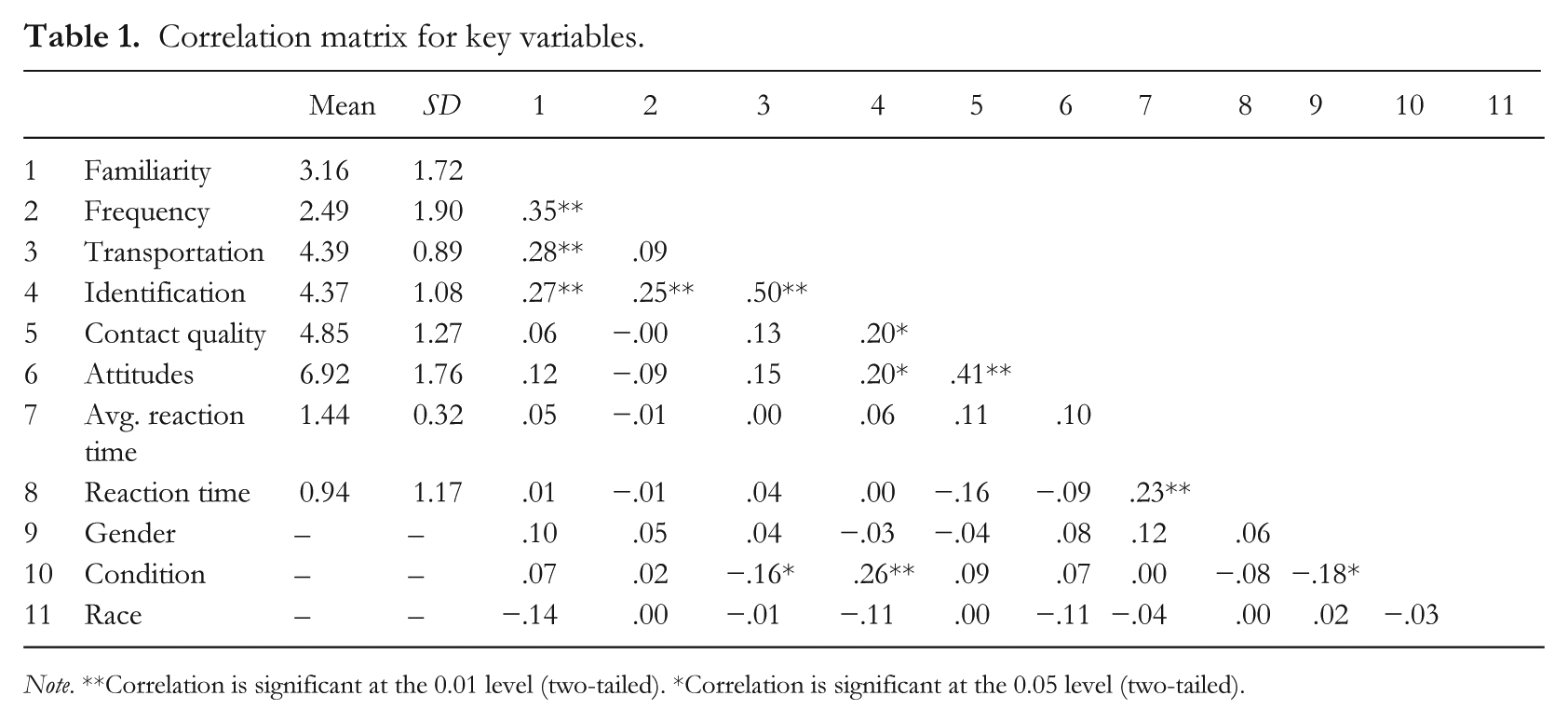
Condition was dummy coded after removing the data from the participants in the control condition (positive condition = 1, negative = 0). Quality of intergroup contact with South Asians, gender (dummy coded; women = 1, men = 0), and participant race (dummy coded; Asian or Asian Indians = 1, else = 0) were added as controls. For information related to correlation and descriptives for key variables, please see Table 1.
Correlation matrix for key variables.
Note. **Correlation is significant at the 0.01 level (two-tailed). *Correlation is significant at the 0.05 level (two-tailed).
Reaction-time data was subjected to reciprocal transformation (Rhodes & Ewoldsen, 2009; Rhodes et al., 2008; Roskos-Ewoldsen & Fazio, 1992) and was multiplied by 1 for positive (e.g., “like”) responses and by −1 for negative (e.g., “dislike”) ones. As a result, higher positive scores indicated faster responses to liking, and lower negative scores indicated faster responses to disliking; therefore, the higher the score, the more accessible the positive evaluation. Then, these data were examined for outliers. Responses over or under three standard deviations from the mean were deleted, consistent with standard practice for analyzing reaction times (Rhodes & Ewoldsen, 2009; Rhodes et al., 2008; Roskos-Ewoldsen & Fazio, 1992). Transformed reaction times on test items included in the attitude-accessibility task were averaged and included as a covariate to adjust for individual response time differences.
Results
A one-way analysis of variance (ANOVA) indicated no difference between the conditions in the participants’ level of familiarity with the show ER, F(2, 220) = 1.32, p = .27. There were no differences found in participants’ frequency of watching the protagonist Dr. Neela Rasgotra on the other episodes of the show ER, F(2, 220) = 2.28, p = .10. No differences were found in terms of the quality of contact with Asian Indians across conditions, F(2, 192) = 1.13, p = .33.
Hypothesis 1a proposed identification into the narrative as a moderator of the effect of the predictor variable, valence of the portrayal, on the outcome variable attitude towards South Asian physicians, R2 = 0.20, F(6, 128) = 5.39, p < .001. Identification did not moderate the effect of condition on attitudes after controlling for gender, race, and quality of contact, b = 1.00 (SE = 0.28), t(128) = 0.36, p = .72, 95% CI [−0.45, 0.65]. There was, however, a significant effect of quality of prior contact, b = 0.55 (SE = 0.11), t(128) = 4.89, p < .001, 95% CI [0.33, 0.78] such that the better the perceived quality, the more positive were the attitudes towards the out-group.
Hypothesis 1b tested the aforementioned relationship using nondeliberative measures. In addition to the controls stated before, participant’s average speed on reaction-time tasks was also controlled for in the analysis. Outcome variable was attitude accessibility towards Asian Indian female physicians. The model was significant, R2 = 0.11, F(7, 127) = 2.27, p = .03. Identification moderated the effect of condition on participant’s attitude accessibility after adding relevant controls, b = 0.41 (SE = 0.20), t(127) = 2.01, p = .05, 95% CI [0.01, 0.81]. There was a significant effect of condition, b = −2.00 (SE = 0.92), t(127) = −2.15, p = .03, 95% CI [−3.81, −0.16], quality of contact b = −0.19 (SE = 0.08), t(127) = −2.30, p = .02, 95% CI [−0.35, −0.03], and average speed b = 0.73 (SE = 0.32), t(127) = 2.29, p = .02, 95% CI [0.10, 1.36]. If the quality of contact was perceived to be positive, participants were more quickly able to access positive evaluations towards the out-group as indicated by the time taken to access the evaluation.
The significant interaction in H1b was explored in PROCESS macro with Johnson-Neyman’s method. The macro calculates the effect of focal predictor variables at different levels of moderator variable and also provides the corresponding significance levels at 95% confidence intervals (Hayes, 2013). At values of identification between 1.90 and 3.43 (suggesting low to moderate levels of identification) the effect of valenced portrayal was significant. The pattern of the interaction suggests that at lower to moderate levels of identification with the Asian Indian doctor character, people in the negative condition were quicker to access their positive evaluations of other South Asian female physicians, but, with the increasing levels of identification, the participant’s favorable attitude became less easily accessible as indicated by the longer time taken on the reaction-time task. Furthermore, after rising to .84 (at identification levels of 4.96) the probability value started to drop again albeit not enough to be statistically significant (see Table 2).
Conditional effect of valence on attitude accessibility at values of identification.

Note. *p < .05.
Hypothesis 2a proposed transportation into the narrative as a moderator of the predictor variable, valence of the portrayal, on the outcome variable attitude towards South Asian physicians, R2 = 0.20, F(6, 128) = 5.33, p < .001. This hypothesis was not supported as transportation did not moderate the effect of condition on attitudes towards Asian Indian physicians after controlling for gender, race, and quality of contact, b = 0.13 (SE = 0.34), t(128) = 0.38, p = .70, 95% CI [−0.54, 0.80]. The only variable that had a significant influence on attitudes was quality of prior contact b = 0.55 (SE = 0.11), t(128) = 4.80, p < .001, 95% CI [0.32, 0.78] indicating that more positive contact leads to a more positive attitude, overall.
Hypothesis 2b proposed transportation as a moderator of the predictor variable, valence of the portrayal, on the outcome variable, attitude accessibility towards Asian Indian female physicians. In addition to gender, race, and quality of contact, average speed was also added as a control. This hypothesis was not supported, R2 = 0.09, F(7, 127) = 1.73, p = .11. Transportation into the narrative did not moderate the effect of condition on participant’s attitude accessibility after including relevant controls, b = 0.20 (SE = 0.25), t(127) = 0.80, p = .43, 95% CI [−0.30, 0.70]. Quality of contact, b = −0.20 (SE = 0.09), t(127) = −2.30, p = .02, 95% CI [−0.37, −0.03], and average speed, b = 0.83 (SE = 0.32), t(127) = 2.58, p = .01, 95% CI [0.19, 1.47], were the only statistically significant predictors of the outcome variable.
Discussion
In this research, we used 11- to 12-minute-long experimentally manipulated stimulus from the show ER that varied with respect to valence of the main character who belonged to a minority group. Outcome measures were both deliberative and nondeliberative measures of attitudes toward minority group Asian Indian physicians. The findings of the study reveal that neither media exposure nor narrative engagement variables have any influence on message recipients’ attitudes, as measured through deliberative measures. However, findings utilizing nondeliberative measures indicated that after exposure to the negative portrayal of the female Asian Indian physician on ER, positive attitudes toward other Asian Indian female physicians although more easily accessible initially, started to become less accessible with the progress of the narrative, to the extent to which the viewer identified with the portrayed Asian Indian physician. This finding appears consistent with previous research examining the valence of out-group portrayals in media and subsequent influence on a message recipient’s attitudes toward the portrayed out-group (Joyce & Hardwood, 2012; Mastro & Tukachinsky, 2011). Implicit measures used in this study provided an opportunity to capture each participant’s true feelings toward the group considered “model minority” that may have resulted in socially desirable responses when measured through explicit deliberative measures. This finding is consistent with Fazio’s MODE model; deliberative attitudes permit the opportunity to correct evaluations to be consistent with more socially desirable responses, or responses with which the participant may be more personally comfortable (Fazio & Olson, 2003; Nosek, Greenwald, & Banaji, 2007). The nondeliberative attitude-accessibility measure, like other implicit measures, may help capture subtle approach/avoid responses of which the viewer may not be aware, but that may influence behaviors towards members of the social group portrayed.
The results of this study are provocative in several regards. Conventional deliberative outcome measures suggest that a positive versus a negative portrayal of an Asian Indian physician had no bearing on attitudes toward such physicians, regardless of how much viewers were transported or identified with the physician portrayed. However, nondeliberative attitude-accessibility measures indicated otherwise; participants who viewed negatively valenced portrayals, although quicker in accessing positive evaluations initially, started to take longer as the narrative progressed, as a function of the extent to which they identified with the protagonist.
We interpret these findings as suggesting that a positive versus negative portrayal of a “model minority” physician may influence overall positive or negative, respectively, responses to actual physicians from that minority group in ways that may not be consciously available to the viewer. These results in our study hold only to the extent that viewers were emotionally and cognitively engaged with the character portrayed—that is, to the extent they identified with the character. This contingent condition makes sense particularly given the context of the experiment: Students participating in an experiment for extra credit are often not very motivated to attend to experimental stimuli. Those students who identified with the character presumably were much more engaged with the program content and the positive or negative outcomes of the character’s behavior. In the social world, such programs are typically watched by fans of the program on a fairly regular basis and who tend to be emotionally involved with the characters portrayed. A consistently positive or negative portrayal would therefore be likely to generate a chronically accessible attitudinal response (see Shrum, 2009)—regarding, in this case, Asian Indian physicians—among regular viewers which would have the potential to influence patient behavior with real-life Asian Indian physicians.
Given an increasing number of physicians practicing medicine in the US belong to various minority groups, it is imperative to examine the effect of mediated portrayals of such minority groups on people’s attitudes as those could guide subsequent behaviors (Jain, 2014; Jain & Krieger, 2011). For instance, patients who may be construing their judgments of this group as a consequence of exposure to mediated images, when coming in contact with a minority physician may assume the physician’s communication skills to be incompetent which can then translate to the patient’s own reservations regarding medical interaction (e.g., limited disclosure of information and lack of compliance, among other things). Alternatively, based on predictions by parasocial contact hypothesis (Schiappa et al., 2005), exposure to media portrayals of out-groups may reduce perceived social distance and may make the message recipient more comfortable in an actual interaction situation with a member of this out-group. In terms of medical interaction, this may mean forming a more trusting relationship with the healthcare provider which then may lead to other positive health outcomes (Jain, 2014; Jain & Krieger, 2011).
Quality of contact with other Asian Indians was another consistent and significant predictor of both deliberative and nondeliberative attitudes toward Asian Indian physicians in the current study. Those with positive contact with the out-group indicated more positive attitudes toward the attitude object, Asian Indian physicians, and were quicker to indicate their liking toward them. This is in line with other research that indicates the perceived quality of contact with the on-screen out-group may influence nonmediated intergroup interaction with individuals from the portrayed out-group (Ortiz & Harwood, 2007). Thus, if viewers of medical programs form a positive relationship with an out-group health provider character on television, they may be better able to communicate with physicians from this group in real-life situations.
The question also arises why transportation did not have the same moderating effect as identification. Our best guess is that transportation measures concern response to the show as a whole and not responses mobilized by the portrayal of one specific character, which is better assessed through identification, and more relevant to attitudes toward physicians of the same ethnic background.
The question may arise regarding whether such nondeliberative attitude measure differences in fact have any implications for behavior, an assumption of our previous comments. In this regard, we would like to note results of experiments in which implicitly measured racial attitudes were predictive of nonverbal behaviors such as, how much eye contact someone is willing to make with a minority person (Dovidio, Kawakami, & Gaertner, 2002; Dovidio, Kawakami, Johnson, Johnson, & Howard, 1997). The parallel with the present situation, and possible influence of attitude accessibility on willingness to share information comfortably with an Asian Indian physician, seems apparent. Moreover, other implications of attitude accessibility—such as increasing the intention–behavior relationship—have also been evidenced in the literature (Fazio, 1996), which may hold value in a healthcare context where physicians are often trying to persuade individuals to take positive actions toward a health behavior (e.g., healthy eating and exercise).
Limitations and Future Research
Participants were university students and the majority of them reported having had some contact with Asian Indians. On average, participants reported interacting with people of Asian Indian ethnicity once every 2 weeks (M = 4.7, SD = 2.78). Therefore the sample was familiar with the out-group Asian Indians and had relatively positive preexisting attitudes toward this group (M = 6.83, SD = 1.72). Therefore the effects of manipulation, if any, were perhaps further weakened due to the study sample. The results may be different if the study is replicated with a different population that has relatively lower levels of intergroup contact, resulting in greater dependence on information from the media (Ball-Rokeach & DeFleur, 1976).
Moreover, we did not enquire about each participant’s nationality. Being a foreign immigrant could have influenced a participant’s judgment of the narrative character who herself was an immigrant with a foreign accent. Therefore, future research in this area should include such questions to ascertain participant’s immigration status; given national diversity the study may be more plausible in a university setting.
This research was conducted with the assumption that participants would categorize the protagonist as an ethnic minority physician for whom fairly positive evaluations were held. It could be that the participants used gender, and not ethnicity, for categorizing stimuli; if so, that would explain the weak effects found in the study. Therefore, future research in the area will benefit from conducting pretest, especially if multiple categorizations are a possibility for attitude object.
Likewise, of course, students are not representative of the population as a whole and different findings for the general population cannot be excluded as a possibility. Another limitation of the study is the use of a single protagonist and a single episode of the show ER. Therefore a different stimulus, protagonist, or sample might generate different results. Finally, this is a single-exposure experiment, in which exposure is imposed by the experimenter. In the social world, a more typical scenario for television viewing is repeated exposure to the portrayal of a character in an ongoing program, in which viewers have self-selected on the basis of their emotional and cognitive involvement with the program. In our view, this limitation represents a conservative bias, as in this experimental context exposure is more modest (a single program) and involvement with the program on the part of most participants (who were participating in order to receive extra credit) less than what would be found for regular, “real-world” viewers of the program.
Future research should also test the extent of attitude generalization across other demographic dimensions. In this study, the protagonist was a female physician of Asian Indian ethnicity and the attitude objects used in the reaction-time task were matched in gender and ethnicity to the message character. It would be useful to replicate the study using a male physician of Asian Indian ethnicity as the target object to see if effects are sex-specific or generalize across sexes. A similar question may be asked across ages—both the physician portrayed and the physicians whose photos were used in the outcome measure were relatively young.
On a positive note, the findings of this study indicate that media portrayals do have an effect at a level that is beyond conscious volition of an individual. This finding holds immense potential for harnessing positive power of mediated portrayals featuring minorities. Indeed, “vicarious contact” is shown to influence attitudes toward the portrayed out-group (Mazziotta et al., 2011; Ortiz & Harwood, 2007). Furthermore, Joyce and Harwood (2012) in an experimental investigation found an influence of valence of portrayal on out-group attitudes such that positive valence led to more favorable attitudes toward the out-group. Notably, the negative portrayals did not influence attitudes negatively as predicted by the researchers. These findings are promising as they suggest that these portrayals could be used to design interventions to reduce prejudice and stereotyping, and enhance positive attitudes toward minority groups.
Substantive Implications
Almost one fourth of the currently practicing physicians in the US are considered international medical graduates (IMGs) and most of them are involved in providing direct care to patients (AMA, 2010). If viewers are more or less ready to like such physicians as a result of viewing mediated portrayals, it could support or inhibit establishing a cordial relationship between such physicians and their patients, an important element in a productive clinical encounter (Street, Gordon, & Haidet, 2007). These portrayals could be especially problematic for the message recipients in rural areas or inner cities where the levels of personal intercultural contact with Asian Indians may be low but the levels of professional intercultural contact with the out-group may be high (Jain, 2014; Jain & Krieger, 2011). For example, IMG physicians usually constitute a higher percentage of physicians in rural, underserved areas as compared to U.S. medical graduates (Baer, Ricketts, Konrad, & Mick, 1998). However, as the findings of this and other related research suggest, media could be used as a vehicle for establishing intergroup contact, which may provide an avenue for learning about cross-group interactions, and might influence efficacy beliefs regarding engaging in such interactions (Mazziotta et al., 2011). This has tremendous potential for patient training interventions, as previous research suggests that patients do not always communicate well with their physicians (Cegala, 2003; Cegala, Street, & Clinch, 2007). The lack of communication may be more pronounced when physicians also belong to an ethnic/racial out-group (Jain, 2014; Jain & Krieger, 2011). However, mediated narratives featuring out-group physicians could address this issue by mitigating stereotypes, influencing intergroup attitudes in a positive direction, and by enhancing efficacy beliefs to engage in cross-cultural interactions. Furthermore, medical education could also utilize such narratives to train medical students to interact with diverse patient populations in the US without any preconceived biases. In other words, the findings of the study are encouraging in that there could be ample practical implications of using media-based interventions for promoting positive intergroup attitudes and subsequently, medical interaction.
Even though the participants reported high levels of prior contact with the out-group, and only experienced the narrative exposure once, the valenced portrayals did appear to activate the attitude automatically to the extent that viewers identified with the protagonist. In the area of patient–provider communication, the favorable (or unfavorable) accessible attitude might influence the interaction and subsequent health behavior positively or negatively. More generally, and more provocatively, these results suggest that media exposure to exemplars of minorities—even minorities generally viewed favorably—may influence accessibility of positive or negative attitudes about them, even in the absence of effects on deliberative measures. This pattern suggests, disturbingly, that such entertainment programs effects may be below the threshold of conscious awareness for viewers.
Footnotes
Funding
The author(s) received no financial support for the research, authorship, and/or publication of this article.