




Abstract
Employees who violate significant organizational norms are organizational deviants engaged in organizational deviance. Yet, few acts of organizational deviance involve all members of an organization; in many cases, many people are uninvolved. The current research examined the responses of the nondeviant actors. Several literatures led us to predict that organizational deviance would cause nondeviants to experience cognitive dissonance, especially its vicarious form, and redouble their own work effort in response. Yet, we also predicted that low levels of identification with the deviant actors would weaken this effect. Three studies with multiple samples and methods supported these predictions, showing that nondeviants experience deviants’ dissonance and increase their own work effort, but only when more rather than less identified with deviants. In addition to extending and connecting theories of deviance and dissonance, these findings suggest that organizational deviance may have unexpected benefits for groups and organizations.
It is now common knowledge that assistant coach Jerry Sandusky molested numerous children during his tenure with Penn State University. In addition to harming the children, Sandusky’s behavior damaged the university and ended several colleagues’ careers. A look at the recent news reveals that very different people, engaged in a wide range of deviant behaviors, have also imposed serious consequences on their colleagues: The CEO of Yahoo! padded his résumé; a group of Harvard undergraduates cheated on an exam; and the director of Countrywide Financial was charged with insider trading. In each case, the organization and its uninvolved employees suffered. These are just a few, extreme examples of a common event—organizational deviance (Berry, Ones, & Sackett, 2007)—in which some people bear responsibility (“deviants”), while others do not (“nondeviants”).
For the deviant parties themselves, the consequences are clear: cognitive dissonance, reputational damage, and reprisal. Accordingly, the deviant parties’ responses (e.g., apology or denial; Kim, Ferrin, Cooper, & Dirks, 2004) have received substantial research attention. For the nondeviants, however, the consequences are less clear, with prior research providing less guidance about their postdeviance responses. Although nondeviant parties can derogate the deviant parties (Marques, Abrams, Páez, & Hogg, 2001; Marques, Abrams, & Serôdio, 2001; Pinto, Marques, Levine, & Abrams, 2010), little is known about how the nondeviant parties approach their own jobs, postdeviance. Since organizational deviance is common, and since few cases would seem to involve everyone in an organization, understanding the responses of the nondeviant actors remains critical.
The current research focused on a particular behavioral reaction of great importance to groups and organizations: the exertion of effort. Drawing from research on organizational failure (e.g., Goodman et al., 2011), identity (e.g., Dutton & Dukerich, 1991; Elsbach & Kramer, 1996), group identification (Brewer & Gardner, 1996; Hogg & Abrams, 1988), intragroup deviance (Marques, Abrams, Páez, et al., 2001; Marques, Abrams, & Serôdio, 2001; Pinto et al., 2010), and cognitive dissonance (e.g., Monin, Norton, Cooper, & Hogg, 2004; Norton, Monin, Cooper, & Hogg, 2003; Steele, 1988), we predicted that the consequences of deviance would lead the nondeviants to work harder. As initial, anecdotal evidence, consider the comments of a Penn State football player about the Sandusky scandal:
What matters to us is how we fought through it. For us, that’s all we’ll ever think about. We’ll get together when we’re old guys and we’re not going to talk about the sanctions and how bad that was, we’re going to talk about how we fought through it and how we went out there and kicked people’s butts. (defensive tackle Jordan Hill)
Our first goal was to test whether the nondeviant actors do work harder after witnessing organizational deviance, positing that effort represents one important response to deviance (likely among others).
In addition, we sought to build theory about why that might happen. Starting from the well-documented finding that people identify with their groups (Hogg & Abrams, 1988), we proposed that deviance would call the nondeviants’ identities and positive self-concepts into question. As a result, they would experience cognitive dissonance, an internal inconsistency between their positive self-concept and the negative implications of the deviance (Steele, 1988). Furthermore, since the deviance originated in other people’s behavior, we primarily expected this dissonance to take a vicarious form (Monin et al., 2004; Norton et al., 2003). Building on the literature’s subtle suggestion that working harder offers one way of coping with (Brockner, Davy, & Carter, 1985) and/or distracting oneself from identity threat and related dissonance (Zanna & Aziza, 1976), we expected the nondeviants to work harder, offering what we hoped would be the first direct evidence of a link between dissonance and effort.
Because individuals naturally identify with their groups, large or small (Hogg & Abrams, 1988), many organizational actors should react to deviance with dissonance and the desire to work harder. At the same time, it is apparent that some members of real groups and organizations show little identification (Doosje, Ellemers, & Spears, 1995). Whether they are simply “punching the clock” at work or deriving their identity from somewhere else, individuals with weak identification should not feel particularly threatened by their organizational colleagues’ deviance. Thus, they should experience less dissonance and a lesser desire to work harder. We tested this proposition by varying the level of group identification, predicting that low identification would weaken the relationship between deviance and effort.
In addition to documenting an ironic benefit of organizational deviance, these results could extend and connect theories of deviance and dissonance. We believe that this research would be the first, for example, to theorize and document how organizational deviance affects nondeviants’ approach to their own jobs. With respect to dissonance, we propose that individuals who identify with a group feel dissonant after their group identity is threatened, which they resolve by exerting more effort. This proposition raises the possibility that identification and effort may work in a compensatory fashion—and that this compensatory process may extend to vicarious dissonance. Figure 1 depicts the relationships in the current research.
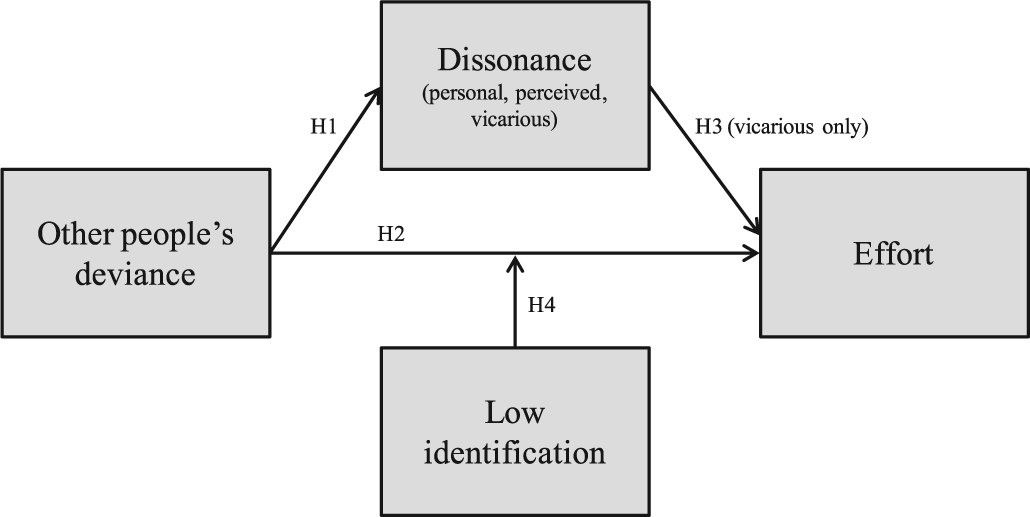
Relationships in the current research.
Research Domain
We first define the domain of the current research. Organizational deviance, also called “counterproductive workplace behavior,” occurs when organizational members misbehave and/or fail to meet minimum requirements (Dalal, 2005). It involves the voluntary violation of significant organizational norms (Bennett & Robinson, 1995) and includes an array of behaviors that target and threaten the organization itself, its members, or both (Bennett & Robinson, 2000). Here, we specifically investigate deviant behaviors that target both organizations and individuals (Bennett & Robinson, 2000), as well as two subtypes from the organizational failure literature: competence and integrity (Kim et al., 2004). 1
Although deviance varies in severity (Bennett & Robinson, 1995), our focus is deviance of moderate severity—that is, neither trivial nor severe enough to threaten the organization’s existence. This kind of deviance occurs often in many kinds of organizations (Bennett & Robinson, 2000). Finally, our prediction that organizational deviance prompts effort exertion as a means of dissonance reduction does not discount the possibility that people have other strategies for reducing dissonance (Elliot & Devine, 1994). Finding themselves identified with a deviant organization, for example, they could quit. Thus, we acknowledge that increased effort is likely just one of several ways through which individuals resolve dissonance.
Organizational Deviance and Individual Threat
Organizational deviants suffer relatively clear consequences, both internal and external. Assuming they chose the actions that precipitated the deviance, they often experience internal inconsistency between their positive self-concept and the negative implications of the deviance. In other words, they suffer cognitive dissonance (Bazerman, Beekun, & Schoorman, 1982; Gunia, Sivanathan, & Galinsky, 2009; Sivanathan, Molden, Galinsky, & Ku, 2008; Staw, 1976). At the same time, external consequences for deviants arise from the reactions of perceivers, who call their actions and identity into question or even impose punishments (Ohbuchi, Kameda, & Agarie, 1989).
Less clear are the impact on and responses of the nondeviants. At first blush, their nonresponsibility suggests that the threat is less direct, and the need for responding less acute. At a minimum, they should suffer fewer external sanctions, as their own actions did not precipitate the problem. Several lines of research, however, suggest that the nondeviants may still suffer internal identity threat.
Macro-organizational behavior research on organizational failures, for example, indicates that deviance often threatens an organization’s overall identity (Goodman et al., 2011), conflicting with what is central, distinctive, and enduring about the organization (Albert & Whetten, 1985). Because employees often derive a portion of their own personal identity from their organization’s identity (Elsbach & Kramer, 1996), and because others reinforce this self-identification by identifying them with the organization (Dutton & Dukerich, 1991), threats to an organization’s identity can create personal identity threats for its members, both involved and uninvolved (Dutton, Dukerich, & Harquail, 1994).
Personal identity threat can then precipitate reparative behaviors, even amongst those uninvolved in deviance. Thus, when the New York Port Authority’s initial responses to homelessness conflicted with the organization’s identity, its employees felt personal identity threat, which led even the uninvolved to participate in the development of novel solutions (Dutton & Dukerich, 1991). Similarly, layoffs threatened the identity of layoff survivors, who often committed additional effort to the work task (Brockner, Tyler, & Cooper-Schneider, 1992). Despite their lack of causal connections to the deviance then, nondeviants may still feel and act upon identity threat as a result of their connection to the organization.
Psychological research complements these findings by suggesting that nondeviants may also feel threatened as a result of group identification processes. Specifically, this research suggests that deviance could threaten the portion of the nondeviants’ identities that comes from their group memberships, that is, their collective identities (e.g., Brewer & Gardner, 1996). In general, collective identities arise because people define themselves by their groups and obtain a portion of their self-worth from their groups’ positive attributes (Brewer & Gardner, 1996; Hogg & Abrams, 1988; Turner, Hogg, Oakes, Reicher, & Wetherell, 1987). An important implication is that they tend to see ingroup members as highly similar to themselves (Tajfel, 1982). Accordingly, ingroup members’ deviance should be troubling, as it casts a negative light on similar others and valued groups. In other words, a group member’s deviance could directly threaten the nondeviants by threatening their collective identity, and thus their overall self-concept.
Research on the “black sheep effect” supports this logic, suggesting that deviant group members personally threaten the collective identities of nondeviant group members (Marques, Abrams, Páez, et al., 2001; Marques, Abrams, & Serôdio, 2001). Because it is important for group members to maintain a positive group identity, nondeviants negatively evaluate deviants (Marques, Yzerbyt, & Leyens, 1988). The current research is consistent with this prior research but extends it in several important ways. First, the black sheep literature focuses on the reactions of nondeviants towards deviants (i.e., derogation), whereas we specifically examine the job-related behaviors of the nondeviants. Second, our results suggest that nondeviants’ reactions may not stop with derogation, but rather may extend to a range of group- and organization-relevant behaviors. Finally, by default, the majority of studies on the black sheep effect have focused on the negative role of deviants (cf. Reese, Steffens, & Jonas, 2013). However, we call attention to the fact that deviants may sometimes actually play a positive role in organizations by prompting the nondeviants to work harder. In sum, our work complements the black sheep literature by showing that deviants may ironically benefit their groups and organizations via the nondeviants’ job-related behaviors.
Since membership in the same organization amounts to membership in the same group (e.g., Dutton et al., 1994), and since organizational colleagues may also share numerous subgroup attributes (e.g., department, team), organizations create conditions in which other people’s deviance is likely to threaten the identities of the nondeviant parties. Based on all of the aforementioned research, organizational deviance may thus create personal identity threat for the nondeviants.
The Responses of the Nondeviant
Because people are generally motivated to see themselves in a positive light (Zuckerman, 1979), identity threat creates a variety of problems for nondeviants. Acknowledging the many possible implications of identity threat (e.g., guilt or shame, Bohns & Flynn, 2013; identity change, Guendelman, Cheryan, & Monin, 2011), we draw from two lines of research suggesting that identity threat creates cognitive dissonance. Self-affirmation theory contends that identity threats represent a major cause of dissonance, as events that call the positivity of a person’s identity into question sit uncomfortably with the presumed positivity of their global self-concept (Steele, 1988). Choosing to write a counterattitudinal essay, for example, is something that a competent and responsible person would seem unlikely to do (Steele & Liu, 1983). Thus, individual identity threats create personal dissonance.
Second, recent research interest in a variety of vicarious processes (e.g., Goldstein & Cialdini, 2007; Gunia et al., 2009) has shown that people can experience vicarious dissonance: “a type of vicarious discomfort resulting from imagining oneself in the [dissonant party’s] position” (Norton et al., 2003, p. 47). Thus, after seeing an ingroup member take a dissonance-inducing action (e.g., choosing to write a counterattitudinal essay), people indicate that they would experience dissonance if they were in that person’s position. Whereas personal dissonance involves real, direct identity threat, vicarious dissonance involves imagined, indirect identity threat. Critically, however, the vicarious party does experience this indirect threat personally, whereas they would be unlikely to experience personal threat from perceived dissonance (an estimate of how much dissonance the ingroup member is experiencing; Norton et al., 2003). Although the actions of ingroup members can prompt all three forms of dissonance (personal, vicarious, and perceived), Norton and colleagues suggested these actions have the strongest effects on vicarious dissonance. 2 Having witnessed an ingroup member engage in a dissonance-inducing action (these authors argue) people are less likely to feel the ingroup member’s exact emotional sentiment (personal dissonance) or have a detached reaction (perceived dissonance) than to experience sympathetic and congruent emotions (vicarious dissonance).
The previous logic suggests that organizational deviance can create a host of threats to the nondeviants’ identities. Combining the idea that organizational deviance creates identity threat with the self-affirmation and vicarious views of dissonance suggests that organizational deviance may create both personal and vicarious dissonance, as well as the perception that the deviant actors themselves are feeling dissonant. To test these predictions, we examine the dissonance that arises after organizational deviance, versus a control condition in which no deviance occurred:
Hypothesis 1: Organizational deviance will create personal, vicarious, and perceived dissonance for nondeviant individuals.
Our second goal was to examine a consequence of dissonance for the nondeviants’ job-related behaviors. Individuals show surprising flexibility in resolving their dissonance, altering a wide variety of thoughts, attitudes, and/or behaviors to reduce inconsistencies (Aronson & Mills, 1959; Festinger & Carlsmith, 1959; Festinger, Riecken, & Schachter, 1956). Initial and subtle precedents for the idea that increased effort serves as one route to dissonance reduction come from the self-affirmation and vicarious dissonance literatures. In addition to suggesting that dissonance arises from threats to the self-concept, self-affirmation theory contends that the self-concept encompasses a wide range of positive attributes, so people can reduce dissonance by affirming or demonstrating virtually any of their positive attributes (Steele, 1988). After writing a counterattitudinal essay, for example, people can resolve their dissonance by taking steps to affirm their political values (Steele & Liu, 1983); after making a poor financial decision, they can reduce their own dissonance-driven escalation by documenting their creativity (Sivanathan et al., 2008). In sum, when people experience dissonance, self-affirmation theory indicates that “they can do almost anything to make it right” (Cooper, 2007, p. 92).
Because exerting effort is one important way that people affirm their identity as productive members of an organization (e.g., Brockner et al., 1985; Brockner et al., 1992), effort would seem to offer one critical way of reducing deviance-induced dissonance. Indirect evidence comes from Brockner and colleagues’ research on layoff survivors, which suggested that survivors often exert more effort after than before a layoff (Brockner et al., 1992). Additionally, survivors exert more effort than people who do not witness a layoff, especially when low in self-esteem (Brockner et al., 1985). Though originally interpreted using equity theory (Adams, 1965) rather than dissonance theory, these results are also consistent with dissonance: For survivors, layoffs likely tarnish the organization’s identity and/or the organizational identities of their laid-off colleagues (Brockner et al., 1985). The previous logic suggests that they should thus experience some level of direct or indirect identity threat. Additionally, the self-affirmation view of dissonance suggests that survivors with low self-esteem should experience this threat most acutely, as they have the fewest psychological resources available to buffer themselves (Steele, Spencer, & Lynch, 1993). In sum, although many of these findings were not motivated within a dissonance framework, they are consistent with the idea that dissonance-inducing events can prompt individuals to work harder. We believe our studies are among the first to explore this link directly.
If individuals themselves work harder after an identity-threatening event, vicarious dissonance theory suggests that they may also do so after an ingroup member acts in an identity-threatening fashion. Cooper (2007, p. 134) summarizes the general situation well:
In vicarious dissonance . . . it is the group member who caused a potentially aversive event to occur. Because of your relationship with the actor, you feel as though you did it. You know, of course, that you are not really the person who brought about the event and, if asked, you know the difference. Still, it feels as though you were partially responsible for it, as you and the actor are fused together by a common social identity. You then take whatever steps you can take to make the action not as bad as it seems.
Supporting the idea that vicarious effort exertion represents one possible step, research on vicarious escalation of commitment demonstrates that decision-makers who are identified with a failed decision-maker experience more of that person’s dissonance and commit more effort and resources to their original course of action, spending 59% more time on the other decision-maker’s already-failing auction (Gunia et al., 2009).
Collectively, these lines of research suggest that expending additional effort may represent one way that people can resolve vicarious dissonance. Although the nondeviants in the current context could also spend their effort doubling down on the original deviance, this would seem to represent a difficult path to dissonance reduction. Given an easier way to resolve dissonance, people often take it (Cooper, 2007). Expending effort on their own work task, and thereby affirming their own self-worth, seems to offer a simpler path to dissonance reduction. In addition, expending effort on the work task might distract people from their dissonance, and thus reduce it (Zanna & Aziza, 1976). 3 For these reasons, we predicted that people would work harder after organizational deviance than after the absence of deviance:
Hypothesis 2: Organizational deviance will prompt effort exertion from nondeviant individuals.
Although an ingroup member’s actions can prompt all three forms of dissonance (personal, vicarious, and perceived), Norton et al. (2003) predicted and showed that these actions have the most direct implications for vicarious dissonance, and that vicarious dissonance has the most direct effects on subsequent behavior. For example, although their participants experienced all three forms of dissonance after observing an ingroup member’s counterattitudinal speech, only vicarious dissonance varied in accordance with the dissonance-inducing features of the situation (i.e., choice, consequences, and identification). Furthermore, only vicarious dissonance related to the amount of reparative, dissonance-reducing behavior (attitude change) that participants undertook. For the current research, this suggests that vicarious dissonance may mediate the relationship between the dissonance-inducing event (other people’s deviance) and the reparative behavior (own effort):
Hypothesis 3: Of the three forms of dissonance, only vicarious dissonance will mediate the effect of other people’s deviance on individuals’ own effort.
We have argued that a key source of the nondeviants’ increased effort is their identification with the group to which they and the deviant party both belong. Yet, this also suggests that low levels of identification at the outset may render increased effort less important. In other words, low identification may moderate the proposed relationship between other people’s deviance and the nondeviants’ effort, weakening this relationship for nondeviant parties who had low identification before the deviance occurred. Indirect support comes from psychological studies suggesting that, for example, people are less engaged in the happiness (Howard & Gengler, 2001), less troubled by the difficulties (Miller, 1987), and less enthralled with the successes (Cialdini et al., 1976) of those with whom they identify only weakly. Less-identified group members are also less engaged with group goals (Woltin & Sassenberg, 2015) and experience lesser feelings of guilt following a group’s negative actions (Doosje, Branscombe, Spears, & Manstead, 1998, 2006). Finally, people experience a lesser need to vicariously escalate when less identified with the person who failed (Gunia et al., 2009).
To test the prediction that low identification would weaken the deviance–effort relationship (see Figure 1), we varied the strength of people’s group identity, portraying the deviant actor as either an ingroup or an outgroup member using a minimal group paradigm (Tajfel, 1982; Tajfel, Billig, Bundy, & Flament, 1971). In addition to testing the moderation prediction, this was a “moderation-of-process” approach for testing dissonance as the underlying mechanism (Spencer, Zanna, & Fong, 2005). For psychological processes like dissonance that are easy to manipulate but hard to measure (Zanna & Cooper, 1974), Spencer and his colleagues have recommended demonstrating the process by manipulating a moderator instead of measuring a mediator, assuming that theory supports the operation of the moderator. The research on psychological connection described before (e.g., Gunia et al., 2009; Norton et al., 2003) supports identification as a moderator, suggesting that the amount of dissonance people feel on behalf of someone else depends on how much they identify with that person. Thus, the current research manipulated group identification, predicting that low identification would significantly reduce the nondeviants’ desire to exert effort. If so, this would lend evidence to dissonance as the mechanism, even without measuring it (Spencer et al., 2005):
Hypothesis 4: Low levels of identification with the deviant actor’s group will moderate the nondeviants’ increased effort.
The Current Research
Three studies using multiple samples and methods tested these hypotheses. Study 1 sought initial evidence in a naturalistic context for the basic premise that the deviance of an ingroup member prompts nondeviants to work harder (Hypothesis 2). MBA students learned that a real project group member had or had not performed poorly on a real group assignment, after which they could exert effort helping their actual professor. Study 2 sought to document Hypotheses 1–3 (see Figure 1): A national sample of adults learned that employees in another part of their organization had or had not engaged in racial bias and then responded to a set of validated dissonance and effort measures. Study 3 tested whether low levels of identification would weaken the relationship between deviance and effort (Hypothesis 4) by involving an adult sample in a two-party trivia task with an ingroup or outgroup member who cheated; participants could then exert effort in a separate task. Overall, the results supported all four hypotheses, indicating that other people’s deviance creates all three forms of dissonance and prompts effort exertion as a result of vicarious dissonance, but only when nondeviants identify relatively strongly with the group to which both they and the deviant belong. In other words, the deviance–effort relationship in Figure 1 primarily holds under conditions of high identification, as predicted.
Throughout the current research, we faced the challenge that dissonance is notoriously hard to measure (Elliot & Devine, 1994). Since the earliest days of dissonance research (Festinger, 1957), the presence of dissonance has often been inferred rather than demonstrated directly (Bem, 1972). In response, more recent dissonance research has turned to measuring dissonance via self-report measures of “dissonance discomfort” (Elliot & Devine, 1994; Matz & Wood, 2005), recording the experience of dissonance-related emotions (e.g., how “uncomfortable” or “uneasy” people feel). Dissonance discomfort has shown convergence with experiences of dissonance, but divergence from nondissonance processes like self-perception, arousal, and negative emotions in general (Elliot & Devine, 1994; Matz & Wood, 2005). Thus, it represents a reliable measure of dissonance.
Study 1
In Study 1, MBA students who were members of a real project group imagined that their group received negative or neutral feedback from their actual professor on a real assignment that they had been assigned to complete. The feedback indicated that one of their real group members had or had not made a poor contribution to the assignment. Thus, they were nondeviants reacting to the deviance of an actual group member. As a robustness check of Hypothesis 2, the poor contribution was described in one of two qualitatively different ways: as a matter of competence or integrity (Kim et al., 2004). Participants then completed a separate task that was unrelated to the assignment: helping their actual professor prepare some materials for a future class. The amount of assistance that they provided measured their effort.
Methods
Participants and design
Participants were 58 MBA students (40 men, 1 unreported; average age = 27.8, SD = 2.1) enrolled in an introductory leadership class at a Midwest U.S. business school. The study manipulated a single factor of deviance: competence, integrity, none. Competence and integrity forms of deviance were included to span a range of possible deviance types and determine whether different forms have varying effects. On one hand, integrity has been characterized as more severe (Kim et al., 2004) and could thus elicit more effort; on the other, competence issues can be quite severe in the work domain (Gunia, 2014) and could thus elicit comparable effort. The no-deviance condition was a control. Participants were randomly assigned to one of the three conditions.
Procedure
After the sixth of 10 classes, participants received an email from their professor, asking them to complete a survey. After clicking the survey link, participants were first asked to type the initials of each of the other real members of their “leadership paper group,” an actual, established group that had been tasked with completing a leadership paper together. Participants were asked to imagine that everyone in the group had agreed to write a separate section of the assignment; they were further instructed that the real group member whose initials they had typed first wrote the introduction. Shortly after everyone completed their individual sections and the group submitted the paper, participants were told that their actual professor emailed the entire group with feedback (see Appendix A for the email’s content). In the two deviance conditions, the email indicated that he was “highly disappointed” by the introduction (a section the participant had explicitly not written), either because it lacked depth (competence) or resembled a Wikipedia page (integrity). In the control condition, he was “somewhat interested” by the introduction, which was described as average. Thus, the email did or did not describe deviance that called participants’ group identity into question, but it emphasized that the deviance or nondeviance was attributable to the behavior of another group member, not themselves.
To measure effort, participants next learned that they would complete an entirely separate task that did not relate to this paper (or their grade). Specifically, their actual professor (about whom they were just thinking) was: “preparing an exercise involving anagrams for a future class and needs some help with it.” Participants were presented with a list of matching words and phrases that were not yet matched. Helping (i.e., correctly matching) was described as optional; they could refuse or stop whenever they wished. Participants first indicated whether they wanted to solve the anagrams (yes or no). If no, they skipped to the next stage. If yes, they spent as long as they liked matching real words or phrases (e.g., “Omaha, Nebraska”) with one of 12 nonsensical phrases (e.g., “Aaron bakes ham”). If they completed all 12 items (one set), they proceeded to a second set, and then a third. The number of anagrams that they solved, and the number that they solved correctly (both coded as 0 if they had chosen not to complete any anagrams), served as interrelated measures of effort. Finally, participants answered some basic demographic questions.
Results and Discussion
Table 1 lists the primary correlations. Hypothesis 2 predicted that people would exert more effort after learning of deviance than nondeviance. Since all but seven people agreed to complete the anagrams, there was no effect of condition on willingness to complete the task, F(2, 55) = 0.10, p = ns. On average, people solved 11.78 anagrams (SD = 6.83), most correctly (M = 11.31; SD = 6.55). However, participants in the two deviance conditions solved more anagrams (M = 13.22, SD = 6.91) than did participants in the control condition, M = 9.41, SD = 6.12; F(1, 56) = 4.52, p = .04. They also solved more anagrams correctly, M = 12.78 versus 8.91; SD = 6.50 versus 6.03; F(1, 56) = 5.10, p = .03. Both effects remained significant when the people who chose not to solve any anagrams were excluded (ps = .01 and .007); competence/integrity had no effect on either result (ps = .68 and .64) and did not interact with a binary deviance/no deviance variable. These results support Hypothesis 2 and suggest that deviance involving both competence and integrity have similar effects on the nondeviants’ effort.
Study 1 correlations.

^p < .10. *p < .05. **p < .01. ***p < .001.
This study showed that MBA students worked harder on behalf of a real professor after being informed that a real group member had been deviant (vs. nondeviant) on a real group assignment, calling their group identity into question. After both competence and integrity forms of deviance, individuals with work experience, considering a real project group, group member, and assignment, worked harder than they did after nondeviance. The lack of a competence/integrity effect is noteworthy, as it suggests that the effect of other people’s deviance on effort may extend to a range of deviance situations. Nevertheless, this study had several limitations: in particular, since people exerted effort on behalf of the person who highlighted the deviance (their professor), their additional effort could have represented an attempt to repair the dyadic relationship with the disappointed professor rather than an attempt to cope with dissonance. Our next study sought to remedy this limitation and test Hypotheses 1–3.
Study 2
In this study, a national sample of adults learned that colleagues in one of their organization’s other offices had or had not demonstrated racial bias during a hiring decision; participants then completed validated measures of dissonance (Elliot & Devine, 1994) and effort (Fehr, Kirchler, Weichbold, & Gachter, 1998). To distinguish dissonance from affect and compare it with complementary yet alternative mechanisms, participants also answered questions about their positive affect and self-esteem. Since racial bias is targeted toward individuals rather than the organization itself (Bennett & Robinson, 1995), this study also expanded the range of deviance in the current research.
Methods
Participants and design
Participants were 81 Amazon MTurk participants from the United States (49 men; average age = 34.16, SD = 10.69) who had agreed to participate in this study for $.75. Compared to an undergraduate sample, the MTurk sample is more diverse and representative of society, and at least as reliable (e.g., Buhrmester, Kwang, & Gosling, 2011). Participants were randomly assigned to a deviance or nondeviance condition.
Procedure
Participants learned that they had received two job offers; both for HR analyst positions in Chicago. After reading short descriptions of the companies (Actinium and Berkelium corporations, denoted “A/B” in what follows; see Appendix B for the descriptions and manipulations), they chose which offer to accept and were hired into that organization’s Chicago office. The remainder of the instructions referred to the chosen organization by name. Participants were then asked to imagine they had worked at A/B for 3 years, devoting almost their entire life to the job, which left little time for friends, family, or hobbies. One day, they read a newspaper article about their company. In the deviance condition, the article indicated that HR analysts in the company’s Minneapolis office were accused of severe racial bias in the hiring process. In the nondeviance condition, parallel language indicated that the HR analysts used a typical hiring process.
Dependent Measures
Dissonance
Participants completed the three-item Personal Dissonance Discomfort Scale developed and validated by Elliot and Devine (1994), indicating how “uncomfortable,” “uneasy,” and “bothered” they felt (1= not at all to 7 = very much so); responses loaded into a personal dissonance scale (α = .97). Paralleling Norton et al. (2003), participants also answered the same three questions about how “the analysts in the Minneapolis office” felt (perceived dissonance; α = .97), and how they would feel if they “were an analyst in the Minneapolis office” (vicarious dissonance; α = .98).
Positive affect
To mask the study’s focus and distinguish dissonance discomfort from other forms of affect, two positive emotions (happy and good) were intermingled with each set of dissonance questions on the same 7-point scale. They were compiled into three positive affect scales (personal α = .94; perceived α = .96; vicarious α = .93).
Self-esteem
Participants answered an adaptation of the validated Single-Item Self-Esteem Scale (Robins, Hendin, & Trzesniewski, 2001), indicating whether “I have high self-esteem right now” (1 = not very true to 5 = very true).
Effort
Participants then learned that they had arrived at work at A/B and were tasked with hiring the strongest possible candidate for a management position, a decision unrelated to events in Minneapolis and which (unlike Study 1) would have no impact on the entity that highlighted the deviance (the newspaper):
You have 20 resumes for this position on your desk. Someone else pre-sorted them so that the most qualified candidates are on top. Since: 1) you are fairly sure that most of these candidates are not qualified, 2) you have a lot to do today, and 3) it takes about 10 minutes to review each resume, you need to decide how many of these resumes to review. You can review anywhere between 5 and all 20 resumes.
The number that they chose from a dropdown box served as a measure of their effort; past research has demonstrated that such tasks proxy for the amount of effort that people actually exert (Brockner et al., 1985; Fehr et al., 1998). Finally, participants were asked: “At the end of the day, would you like to review any more resumes to ensure that you made the best choice?” (11-point scale: no; yes, 1 resume; yes, 2 resumes; . . . yes, 10 resumes).
Manipulation checks
Participants indicated whether the newspaper article was about “my company” or “another company” and whether it was negative or positive (1 = negative to 7 = positive).
Results
Six participants incorrectly indicated that the deviance occurred in a different company and were dropped, leaving a final sample of 75. Participants in the deviance condition (M = 1.11, SD = 0.45) indicated that the article was more negative than participants in the nondeviance condition (M = 3.41, SD = 1.36; t(73) = 9.86, p < .001), supporting the manipulation. Table 2 lists the correlations among the primary variables.
Study 2 correlations.

^p < .10. *p < .05. **p < .01. ***p < .001.
Hypothesis 1, suggesting that deviance would generate more dissonance than nondeviance, was supported. Participants in the deviance condition reported more personal (M = 5.11, SD = 1.62), perceived (M = 5.88, SD = 1.52), and vicarious (M = 5.91, SD = 1.59) dissonance than did participants in the nondeviance condition (Ms = 3.60, 3.79, 3.59; SDs = 1.75, 1.80, 1.97; ts(73) = 3.86, 5.44, 5.63; ps < .001). In addition, participants in the deviance condition reported less personal (M = 1.51, SD = 0.79), perceived (M = 1.53, SD = 0.95), and vicarious (M = 1.30, SD = 0.60) positive affect than did participants in the nondeviance condition (Ms = 3.16, 3.22, 3.30; SDs = 1.35, 1.52, 1.65; ts(73) = 6.46, 5.79, 7.00, ps < .001). Deviance condition had no effect on self-esteem, however; deviance: M = 3.39, SD = 1.00; nondeviance: M = 3.32, SD = 1.00; t(73) = 0.30, p = .76.
Hypothesis 2 suggested that deviance would also prompt effort exertion. In support, participants in the deviance condition reviewed more résumés (M = 10.68, SD = 5.54) than did participants in the nondeviance condition, M = 8.27, SD = 3.94; t(73) = 2.17, p = .03. Condition had no effect on how many additional résumés people wanted to review, however, suggesting that the initial effort exertion compensated for the deviance, t(73) = 1.01, p = .32.
Hypothesis 3 suggested that only vicarious dissonance would mediate the relationship between deviance and effort exertion (résumés reviewed). Both deviance condition and vicarious dissonance (β = .35, p = .002) predicted résumés reviewed. When both were included in a single regression, however, vicarious dissonance remained significant (β = .31, p = .02), while deviance condition did not (β = .08, p = .56). A bootstrap test with 5,000 iterations (Preacher & Hayes, 2004) yielded a confidence interval that did not include zero (.09 to 3.57), supporting mediation (see Figure 2). Although the pattern of relationships was similar for the personal and perceived dissonance scales as well as the positive affect scales (see Table 2), the relationships were weaker, and bootstrap tests produced confidence intervals that did include zero (personal dissonance: −.22 to 1.87; perceived dissonance: −.76 to 2.51; personal positive: −1.93 to .98; perceived positive: −1.49 to 1.76; vicarious positive: −1.98 to 1.26). Thus, only vicarious dissonance mediated the critical relationship, supporting Hypothesis 3.

Study 2 mediation.
Discussion
This study replicated Study 1 and supported Hypotheses 1–2, indicating that other people’s deviance elicits personal, perceived, and vicarious dissonance as well as effort exertion from the nondeviant parties. Supporting Hypothesis 3, it also showed that only vicarious dissonance mediates the relationship between deviance and effort. Neither of the other two dissonance scales nor any of the positive affect scales mediated this relationship. This finding, consistent with Norton et al. (2003), suggests that people who witness colleagues’ deviance vicariously simulate its effects on the deviant parties in their own minds, and this aversive image leads them to work harder. In drawing this conclusion, it is also notable that other people’s deviance had no effect on individuals’ own self-esteem, further suggesting that the primary effects operate vicariously. These effects surfaced even though the nondeviants’ additional effort would have no direct effect on the entity that highlighted the deviance, helping to compensate for a limitation of Study 1. Our next and final study explored the effects of low group identification.
Study 3
Study 3 explored whether low identification would moderate effort exertion by weakening the relationship between other people’s deviance and the nondeviants’ effort. This tested Hypothesis 4 and, as noted, also represented a moderation-of-process approach for testing dissonance as the underlying mechanism (Spencer et al., 2005). Participants in this study worked on a group task with someone who did or did not share an attribute (i.e., avatar color). This very subtle manipulation of identification was based upon the well-established minimal group paradigm in which a subtle and seemingly random similarity is sufficient to elicit high or low levels of group identification with other people (e.g., Shteynberg & Galinsky, 2011; Tajfel et al., 1971). Additionally, we viewed the subtle manipulation as offering a particularly conservative test of the hypotheses.
During the task, participants’ partner independently chose to cheat (which could be viewed as dishonesty intended to benefit participants; e.g., Gino & Pierce, 2009), and the computer system automatically disqualified the team. The study then allowed participants to exert effort in an unrelated task by transcribing some “field notes” for the experimenter (based on Brockner et al., 1985); the amount of time that they spent transcribing served as the primary measure of their effort. Finally, as a separate test of Hypothesis 4, participants were asked to complete a validated test of cognitive effort: the Cognitive Reflection Task (CRT; Frederick, 2005). Overall, we predicted that participants who were more highly identified with the cheater would spend more time transcribing and get more answers correct on the CRT than would participants who were less identified.
Methods
Participants and design
Participants were 78 native English-speaking adults (24 men; average age = 42.7, SD = 15.6) who were members of a survey pool assembled by a Midwest U.S. business school (not MTurk). (The native English restriction was important given the language proficiency demanded by both of the dependent variables.) These participants had agreed to participate in online studies in exchange for opportunities to win Amazon gift cards. They participated remotely, via computer. Participants were randomly assigned to a high (same avatar color) or low (different avatar color) identification condition.
Procedure
After clicking a link to participate in an online experiment in which multiple people were participating at the same time, participants were told to wait while additional people joined. After 22 seconds, the computer refreshed and indicated that the experiment was about to begin. Five avatars, identical except for their color, appeared on the screen; participants were instructed to choose an avatar as their online identity (Shteynberg & Galinsky, 2011). After choosing an avatar, participants learned that they (Participant 17) and a randomly selected partner (Participant 31) would complete the first task together. In actuality, the partner did not exist. The computer refreshed, showing their own avatar and their ostensible partner’s avatar, which were either the same color (high identification) or a different color (low identification). Prior research has demonstrated that manipulating identification in this minimal manner creates a strong sense of group identity for those in the high identification condition (Shteynberg & Galinsky, 2011). To reiterate this manipulation, the words “You: Participant 17” and “Your Partner: Participant 31” appeared in the relevant colors at the top of subsequent screens.
The next screen informed participants that they and their partner would work together to solve 10 trivia questions, all of which were solvable (Moore, 2003; Moore & Small, 2007). For each correct answer, both they and their partner would earn an additional entry into the gift card raffle. To complete the task, one of the two parties would act as the “respondent” and the other as the “adviser.” The respondent would answer the questions, and the adviser would provide assistance; the adviser could communicate with the respondent but not vice versa. Neither party was permitted to open additional Internet windows during the task; since respondents could not communicate with advisers, however, they could not influence advisers’ Internet behavior. After clicking the continue button, participants saw a screen indicating that they had been randomly selected to act as the respondent.
Participants then saw the first trivia question (“What is the capital of the United States?”). Six seconds later, a message from their partner, the adviser, appeared on their screen: “hey how r u?? wow thats easy…” and then “dc!” The next three questions were similarly easy, and the partner’s statements similar in tone (see Appendix C). The fifth question, however, was harder: “In what film did actress Mae West say the line, ‘When I’m good, I’m very good, but when I’m bad I’m better’?” The partner said: “whoa man thats a tough one, hang on a sec while i look it up,” and then, after 10 seconds, “ok its ‘I’m No Angel.’” Among the remaining five questions, four were easy. During the one other relatively difficult question (#9), the partner again seemed to check the Internet (see Appendix C). After completing the quiz, all participants received feedback saying: “Our online monitoring system detected that the [adviser] opened a new internet window during the following questions: [5 9]. Therefore, you and your partner have been disqualified from receiving any additional entries in the lottery.” Thus, the feedback made it clear that the deviance was attributable to the adviser’s behavior, over which participants (i.e., respondents) had no control.
Dependent Measures
Effort: Typing time
Participants then proceeded to the second stage of the experiment, which was described as a separate, individual task. They learned that the experimenter had conducted a series of field interviews, typing them up as the interviewee spoke. His rapid typing produced many spelling and grammatical errors, however, so the experimenter was requesting participants’ help in transcribing the field notes accurately. Participants saw an image file of the notes and were asked to transcribe as much and as long as they wished (other participants would continue where they stopped). In such a task, effort could be operationalized in several ways. Under the assumption that 5 minutes of typing at a speed of 200 words per minute and 10 minutes of typing at 100 words per minute involve equivalent amounts of effort, we operationalized effort as the amount of time participants spent typing, controlling for their typing speed (see following lines). As the typing time variable showed a strong right-skew (skewness statistic = 3.58), it was log-transformed for analysis.
Effort: Cognitive reflection
As a separate measure of effort, participants were also asked to complete the CRT, three logic questions that seem easy but actually require substantial cognitive effort to answer correctly (Frederick, 2005; see Appendix C).
Typing speed, manipulation check, and demographics
Finally, participants completed a measure of typing speed that required them to type a standard passage as quickly as possible, then were asked to recall their partner’s avatar color and their own. Finally, they answered some basic demographic questions.
Results
All participants correctly indicated that their avatar color did or did not match their partner’s avatar color, suggesting that they perceived the identification manipulation. Participant gender had no effects on the dependent variables; in this age-diverse sample, however, age was correlated with the logged typing time variable (r = .32, p = .004) and was thus included as a covariate (along with typing speed) in the analysis of typing time. Age and typing speed were neither relevant to nor correlated with the CRT results, so they were not included in that analysis.
Hypothesis 4, predicting that low identification strength would weaken the tendency of the nondeviants to work harder after deviance, was supported by the typing time measure of effort: An ANCOVA on the logged typing time variable, with typing speed and age as covariates, indicated that participants in the high identification condition spent more logged-time typing (M = 2.28, SD = 0.53) than participants in the low identification condition, M = 2.05, SD = 0.52; F(1, 74) = 5.15, p = .03. Although typing speed did not (and was not expected to) vary across the two conditions, highly identified participants spent about 6 minutes typing, whereas less identified participants only spent about 3 minutes and 20 seconds typing.
Hypothesis 4 was also supported by the CRT results. An ANOVA on the number of CRT items answered correctly indicated that participants in the high identification condition got 1.29 out of three items right (SD = 1.29), whereas participants in the low identification condition got .75 items right, SD = 1.03; F(1, 76) = 4.17, p = .045. Thus, participants who were highly identified with a deviant actor engaged in additional effort exertion, both physical (typing) and cognitive (reflection).
Discussion
This study again demonstrated that nondeviant parties work harder after witnessing deviance. Yet, it documented that this effect is reduced for dissimilar colleagues, with whom the nondeviant parties only weakly identify, since they come from a different group (Shteynberg & Galinsky, 2011). The fact that these effects emerged across two separate measures of effort, one physical and one cognitive, lends generalizability to the findings. These results, in tandem with the previous studies, suggest that other people’s organizational deviance creates dissonance and a strong imperative to work harder, creating an ironic benefit of otherwise unfortunate deviance. The imperative only arises, however, when the nondeviant party highly identifies with the group to which both they and the deviant party belong.
General Discussion
Organizational deviance occurs with unfortunate frequency. Research is beginning to unpack its effects and the subsequent actions of the involved individuals (e.g., Bennett & Robinson, 2000). The current research focused on the nondeviant, uninvolved actors, showing that their vicarious dissonance prompts effort, an ironic benefit of an otherwise negative event. These effects are less pronounced, however, for people who identify only weakly with the group to which both they and the deviants belong. We believe that these results hold some important theoretical and practical implications.
Theoretical Implications
Past research on postdeviant behavior has tended to focus on the deviant actors—those who bear responsibility. This emphasis makes sense, as their direct role prompts a direct impact. Nevertheless, the current research suggests that the effects of deviance go beyond the deviants; they extend to those who are only connected to the deviance via membership in the same groups. It seems that psychological, as well as causal links can connect people to deviance and shape their subsequent behavior.
This suggests that theory about the impact of deviance could cast a wider net by including anyone with a psychological connection to the deviance or deviant. In this view, people’s postdeviance behavior might depend on the nature of their connection. People with a causal connection should experience substantive consequences, engaging in behavior intended to manage those consequences (e.g., by offering a social account; Scott & Lyman, 1968). People with a psychological connection, however, may experience psychological consequences like those in our research, which result in behaviors that reduce their dissonance and reaffirm their identity.
Additionally, past research on postdeviance behavior has often focused on the negative consequences of deviance: for example, blaming others (Jackall, 1988) or derogating the deviants (Marques et al., 1988). Consistent with a groundswell of interest in positive psychology (Seligman & Csikszentmihalyi, 2000), however, research is beginning to recognize that deviance and failure can also have positive effects. Edmondson and Lei (2014), for example, summarized recent research showing that teams that fail can cultivate psychological safety by responding effectively. Our research follows in the same vein but is the first (to our knowledge) to document a positive effect of deviance—via the nondeviants’ job-related behaviors. Since most organizational actors are presumably uninvolved in any particular act of deviance, and since increased effort is probably one of many possible behavioral options, the current research opens up new opportunities for investigating the potentially positive effects of deviance.
Along similar lines, the current findings contribute to the long-standing debate on the benefits and costs of ingroup identification. Recent game theoretic research has reasserted the long-standing idea that identification is more helpful than harmful, in this case by arguing that “ingroup love” dominates “outgroup hate” (e.g., Halevy, Bornstein, & Sagiv, 2008; Halevy, Weisel, & Bornstein, 2012). This argument is also consistent with research on the black sheep effect (e.g., Abrams, De Moura, Hutchison, & Viki, 2005; Marques, Abrams, & Serôdio, 2001). Our research supports a positive view of identification, highlighting a previously unrecognized benefit of identification for both groups and group members: Groups with high levels of identification among their members may show productive responses to their own members’ deviance. In particular, after a group member’s deviance, their nondeviant group members may work harder than the nondeviant members of weakly identified groups or the members of nondeviant groups. Not only should this increased effort benefit the group; it should benefit the members and their standing within the group. Deviance, then, may actually help to improve group performance, but only when the group members are highly identified.
Additionally, the current research extends theories of cognitive dissonance in some novel ways. First, we drew from prior research to argue that many people naturally identify with their groups and organizations (Dutton et al., 1994; Hogg & Abrams, 1988). Yet, we also recognized that many members of real organizations show low levels of identification. By showing that highly identified group members experience vicarious dissonance and exert additional effort after deviance, whereas less identified group members show a lesser need to do so, our results suggest that identification and effort may operate in a compensatory fashion. Specifically, the results suggest that organizational actors may compensate for dissonance-eliciting forms of identification by working harder. If so, then the dual mechanisms of effort and identification may contribute to a self-regulatory system that allows people to control their dissonance across many situations. Research that directly investigates this compensatory hypothesis could be particularly fruitful.
Finally, the current research extends vicarious dissonance theory in several ways. First and most obviously, it suggests that an omnipresent set of situations—acts of organizational deviance—can cue vicarious dissonance. If so, then vicarious dissonance may represent a feature of everyday organizational life, and its antecedents and consequences would seem to warrant additional attention in organizational research. Second, the current research suggests that the compensatory relationship between effort and identification may extend to vicarious dissonance. Consistent with Norton et al.’s (2003) observation that vicarious dissonance has some of the same antecedents as personal dissonance, this idea nevertheless raises some interesting implications. For example, if highly identified individuals can resolve their vicarious dissonance by working harder, would people who have worked hard to join an organization but have not yet identified resolve it by identifying more deeply with the organization? If so, then an organization’s new employees might show the highest levels of resilience after deviance. Finally, Norton et al. (2003) raised the intriguing possibility that vicarious dissonance may be particularly common in collectivistic cultures. If so, we would raise the further possibility that the employees of East Asian versus Western organizations might work harder after an act of deviance, giving the former a better shot at recovery.
Practical Implications
Although the current research documents a positive effect of deviance, it would be patently unwise to encourage organizational deviance. Deviance often harms organizations and their members, and organizational actors should typically do whatever they can to avoid it. Nevertheless, deviance does happen with unfortunate frequency, and organizational leaders need to know how to respond. It appears that the most common response is to blame a few “bad apples,” as opposed to the organization and its underlying conditions (Jackall, 1988). Yet, the current research raises the interesting possibility that leaders may instead want to highlight the similarities between the deviants and the nondeviants. Doing so, while uncomfortable, would seem more likely to prompt the vicarious dissonance processes that encourage effort exertion and allow the nondeviant actors to recover. Beyond these benefits, downplaying the “bad apples” story should better accord with years of research showing that the real problem often lies with the “bad barrels” of the organization (Tenbrunsel & Smith-Crowe, 2009). Future research that tackles these issues could be particularly informative.
Limitations, Future Directions, and Conclusion
This research has some necessary limitations that could stimulate future work. First, we drew from scenario and experimental studies, with all of the attendant benefits and limitations. Thus, we were able to obtain control unattainable in the field, particularly in the midst of troublesome organizational deviance. For the same reason, however, our studies could not capture all of the realism and nuance that attend actual organizational deviance. Research that extends our findings into real organizational settings, across a variety of deviance situations, could be fruitful. Additionally, several of our studies had some specific limitations: In Study 1, participants’ effort exertion may have been intended to repair the relationship with the person who identified the deviance, in addition to repairing their own dissonance. Although this was not the case in Study 2, it does remain a weakness of Study 1. Additionally, Study 3 relied on an established manipulation of group identification and showed that participants correctly perceived their own and their group member’s avatar color, but it contained no direct manipulation check of participants’ identification level. Although this was driven by our assumption that highly identified participants would derogate and/or de-identify rather than identify with their group member post hoc, making it difficult to include a post hoc manipulation check, it remains a weakness of Study 3.
A final limitation relates to the rather precise scope of our research: moderately severe deviance involving a handful of individuals, and a particular response by the nondeviants. Although our own organizational experience (and ample research) indicates that these kinds of events happen often in organizations, and that groups and organizations place great importance on the effort of their employees, future research that releases some of these boundary conditions is nevertheless welcome. Future research could, for example, investigate the effects of trivial or severe deviance on the nondeviants’ effort. Or it could investigate deviance involving a large proportion of an organization’s employees, exploring the conditions that determine whether any given individual feels deviant versus nondeviant. These are just two of many important research questions; documenting precisely when, why, and how deviance threatens the full range of organizational actors is and will remain a priority.
Awaiting future research, however, we believe that the current research offers a series of potent conclusions: The effects of organizational deviance extend far beyond the deviants. Nondeviant actors appear to experience dissonance as a result of their group identification. This dissonance leads them to work harder, which may ultimately allow them to move forward. It is only when they weakly identify with the deviants that they can short-circuit the imperative to exert more effort. Since many members of many organizations identify with their organizations and group members, yet remain removed from their colleagues’ deviance, the silver lining of organizational deviance may be the efforts of the uninvolved.
Footnotes
Appendix A: Study 1
Appendix B: Study 2
Appendix C: Study 3
Funding
The author(s) received no financial support for the research, authorship, and/or publication of this article.