




Abstract
Whether racism is perceived in ambiguous situations may depend on individual differences in perceivers’ beliefs about the prevalence of racial prejudice and discrimination, trivialization of targets’ concerns, and vigilance and confidence in recognizing instances of racial prejudice. In Studies 1 and 2, we develop a psychometrically sound measure of these beliefs, the Propensity to Make Attributions to Prejudice Scale (PMAPS), and provide evidence that the PMAPS is related to individual differences in the justification and suppression of prejudice. Studies 3 and 5 provide evidence that the PMAPS predicts attributions to prejudice in a variety of situations. Theoretically consistent racial and gender differences in the PMAPS were found in a large sample (Study 4). Together, these data provide evidence supporting the reliability and validity of the PMAPS and provide insights about the role that beliefs and expectations play in third-party observers’ judgments about expressions of prejudice.
Contemporary social norms that condemn overt expressions of prejudice toward lower status racial groups may have contributed to a reduction in blatant expressions of racism (Crandall & Eshleman, 2003; Dovidio, 2001). Consequently, expressions of racial prejudice are often subtle, ambiguous, or justified in ways that decrease the likelihood individuals will be perceived as racist (Crandall & Eshleman, 2003; Dovidio & Gaertner, 2000; Katz & Hass, 1988; McConahay, 1986; Pearson, Dovidio, & Gaertner, 2009; Saucier & Miller, 2003; Saucier, Miller, & Doucet, 2005; Sue et al., 2007). Such ambiguity leaves room for uncertainty and bias in perceiving prejudice.
In short, contemporary expressions of prejudice are often constructed in ways that are difficult for others to perceive. Given the ambiguity surrounding expressions of prejudice, judgments about whether prejudice has been expressed are influenced by a variety of factors related to the situation and the perceiver. The primary focus of prior research has been on the situational factors (Inman, Huerta, & Oh, 1998; Major, Kaiser, & McCoy, 2003; Major, Quinton, & Schmader, 2003; Wang, Stroebe, & Dovidio, 2012) and individual differences (Pinel, 1999) affecting targets’ attributions to prejudice. A relatively smaller amount of research has examined the role of situational factors affecting third-party observers’ attributions to prejudice (Inman & Baron, 1996; Marti, Bobier, & Baron, 2000; Swim, Scott, Sechrist, Campbell, & Stangor, 2003). However, we know of no research that has examined individual differences in third-party observers’ general tendency to make attributions to prejudice and how this tendency can be characterized, measured, and, importantly, how this tendency might affect situational attributions to prejudice. Consistent with the evidence that higher expectations to be treated stereotypically are related to tendencies of targets to attribute prejudice as an explanation for ambiguously discriminatory behaviors (Brown & Pinel, 2003; Kaiser, Vick, & Major, 2006; Pinel, 2002; Pinel & Paulin, 2005; Pinel, Warner, & Chua, 2005; Wang et al., 2012), we propose that differences in bystanders’ beliefs that others behave prejudicially toward stigmatized individuals will similarly predict observers’ tendencies to make attributions to prejudice.
A fundamental assertion of attribution theory (Kelly & Michela, 1980) and research on stigma consciousness (Pinel, 1999) is that beliefs and expectations affect the attributions people make. Thus, possible sources of individual variation in the tendency to make attributions to prejudice may be observers’ beliefs about expressions of prejudice. Consistent with signal detection theory approaches to understanding appraisals of prejudice (Barrett & Swim, 1998), we propose prior beliefs and expectations will influence individuals’ sensitivity for prejudice cues and response biases in attributions to prejudice. For example, observers who believe prejudice is pervasive and are more vigilant in attending to potential signals of prejudice may have response biases that increase the likelihood they will interpret others’ behaviors as expressions of prejudice. Conversely, observers who think prejudice is uncommon, and are less vigilant, may have response biases that decrease the likelihood they will make attributions to prejudice.
The Propensity to Make Attributions to Prejudice
To test the proposition that individuals’ prior beliefs and expectations related to expressions of racial prejudice will predict their situational attributions to prejudice, we developed a measure of individual differences in third-party observers’ tendencies to make (or not make) attributions to prejudice: the Propensity to Make Attributions to Prejudice Scale (PMAPS). In contrast to existing measures of targets’ expectations to be treated stereotypically (e.g., Pinel, 1999), we designed an instrument that could be also used to measure the attributional tendencies of majority group members. Furthermore, in developing the PMAPS, we sought to expand upon existing measures of expectations for prejudicial treatment to include additional, theoretically relevant constructs. Specifically, we measured several aspects that we believed to underlie observers’ tendencies to make attributions to prejudice: (a) pervasiveness, or beliefs about the prevalence of racial prejudice; (b) vigilance in spotting instances of prejudice; and (c) trivialization of targets’ claims and concerns about being treated prejudicially. We reasoned these beliefs would characterize individuals’ tendencies to make attributions to prejudice, such that variability in these beliefs would predict variability in observers’ situational attributions to prejudice.
Beliefs About the Pervasiveness of Prejudice
Individuals may have different beliefs about the pervasiveness of racial prejudice (i.e., that racial prejudices are common or uncommon). These beliefs may be especially important when expressions of prejudice are subtle (e.g., Sue et al., 2007), or when alternative race-neutral explanations are available to the perceiver. Such ambiguity may invite the kind of top-down processing described by theories of confirmation bias (Nickerson, 1998) and biased assimilation (Lord, Ross, & Lepper, 1979). Individuals who think prejudice is uncommon or rare may be less likely to consider prejudice as a possible explanation. Conversely, individuals who believe racial prejudice is more widespread may be more likely to perceive prejudice (Barrett & Swim, 1998) because prejudice may be more cognitively available as an explanation (Marti et al., 2000).
Vigilance and Cognitive Accessibility
Individuals who are more vigilant for environmental cues that may indicate racial prejudice may be more likely to see prejudice in their social world (Inzlicht, Kaiser, & Major, 2008). For chronic targets of prejudice, vigilance for cues that they have been subjected to prejudice or discrimination may be adaptive (Major & Sawyer, 2009; Wang et al., 2012) in that attributing one’s negative outcomes to the prejudice of others can protect self-esteem. Although the motivations for vigilance may differ for observers who are not chronic targets of prejudice, higher levels of vigilance are thought to result in a greater sensitivity to signs of prejudice (Barrett & Swim, 1998). Additionally, third-party observers who are primed to be more vigilant in identifying cues for prejudice are more likely to make attributions to prejudice (Marti et al., 2000) suggesting the more (or less) cognitively accessible prejudice is as an explanation for behavior, the more (or less) likely it is that individuals will perceive prejudice.
Trivialization of Targets’ Concerns
The belief that racial minorities too often unfairly claim that they are the targets of prejudice and discrimination (e.g., McConahay, 1986) may lead to a lower tendency to make attributions to prejudice. Members of the racial majority may be motivated to trivialize the impact of prejudice as a way of justifying negative or ambivalent attitudes toward racial minorities (Crandall & Eshleman, 2003; Katz & Hass, 1988; McConahay, 1986), or to legitimize their higher social standing (Jost, Banaji, & Nosek, 2004; Pratto, Sidanius, Stallworth, & Malle, 1994) by denying that racial discrimination occurs. Indeed, trivialization is often expressed in the form of denying that expressions of prejudice are such, for example, by claiming that racist or sexist humor is “just a joke” (Ford, Boxer, Armstrong, & Edel, 2008; Hodson, Rush, & MacInnis, 2010).
Overview of the Present Studies
Our goal in the present set of studies was to generate and empirically validate a composite, and perhaps multidimensional, measure that would characterize tendencies to make (or not make) attributions to prejudice. Therefore, in the first phase of our research, we developed items to measure individuals’ beliefs about the pervasiveness of racial prejudice, trivialization of targets’ concerns about being treated prejudicially, and vigilance in spotting prejudice. In Study 1, we used exploratory factor analysis to identify a reliable set of items measuring these dimensions and tested hypotheses about how the PMAPS fit within a broader nomological network of established individual differences. In Study 2, we further examined the factor structure of the PMAPS through confirmatory factor analysis and assessed whether the PMAPS was a relatively stable and enduring individual difference.
In the second phase of our research, we assessed whether the PMAPS predicted observers’ attributions to prejudice across various situations. Research suggests that motivations and beliefs tend to have stronger effects in situations of higher ambiguity, or when discriminatory behaviors are more subtle (e.g., Kaiser & Major, 2006; Major et al., 2003; Operario & Fiske, 2001; Pinel, 1999), which is often the case when prejudice is expressed. Alternatively, the tendency to make attributions to prejudice may not be constrained by the level of ambiguity. We tested these hypotheses in Study 3a where we manipulated situational ambiguity and assessed whether the PMAPS more strongly predicted attributions to prejudice in more ambiguous situations. And in Study 3b, we assessed whether the PMAPS predicted attributions to prejudice above and beyond modern racism (McConahay, 1986) to assess the uniqueness of the PMAPS in comparison to a related construct. In Study 4, we assessed demographic differences (e.g., sex, race) in the distributions of PMAPS scores in a large sample. Lastly, in Study 5, we examined evidence for the ecological validity of the PMAPS by assessing whether our measure predicted attributions of racism in a recent, nationally salient event.
Study 1: Scale Construction and Evaluation
We designed Study 1 with two objectives: (a) identify a reliable set of items measuring the tendency to make (or not make) attributions to prejudice, and (b) evaluate the nomological network between our new measure and established psychological constructs related to the justification and suppression of racial prejudice. To address our first objective, we created statements to reflect the three hypothesized dimensions of the tendency to make attributions to prejudice and subjected these items to exploratory factor analysis to assess the dimensionality and reliability of our measure.
Our second objective in Study 1 was to evaluate evidence of the construct validity of our newly developed measure by assessing whether the PMAPS is predictably related to established psychological constructs. Therefore, we selected several measures of related constructs and tested predictions about their correlations with the PMAPS (see Table 1). Several theories and empirical findings informed our predictions about how these constructs would be related to tendencies to make attributions to prejudice. First, an important characteristic of contemporary forms of prejudice is the denial that prejudice exists (Dovidio, 2001; McConahay, 1986). Thus, we hypothesized individuals who are more likely to hold prejudices toward racial minorities should be lower in the tendency to make attributions to prejudice. To test this prediction, we assessed correlations between the PMAPS and several measures of individual differences that are considered to justify (Crandall & Eshleman, 2003) expressions of racial prejudice. We included measures of social dominance orientation, modern racism, and right-wing authoritarianism because of their strong associations with prejudicial attitudes (e.g., Crandall & Eshleman, 2003; Duckitt & Sibley, 2007; McFarland, 2010). Second, we hypothesized the PMAPS would be positively correlated with individual differences related to the suppression of prejudice. Thus, we included measures of empathetic concern, perspective taking, internal motivations to suppress prejudice, and egalitarian values that are negatively associated with prejudicial attitudes (Crandall & Eshleman, 2003). We also hypothesized that the PMAPS would be positively correlated with the tendency to make complex attributions because attributional complexity has been shown to be related to higher complexity in thinking about racial issues and to predict detection of subtle racism (Reid & Foels, 2010). Lastly, we assessed whether the PMAPS was independent of socially desirable responding and need for cognition, which we argue are theoretically distinct constructs.
Convergent and discriminant measures and predicted relationships with the PMAPS (Study 1).
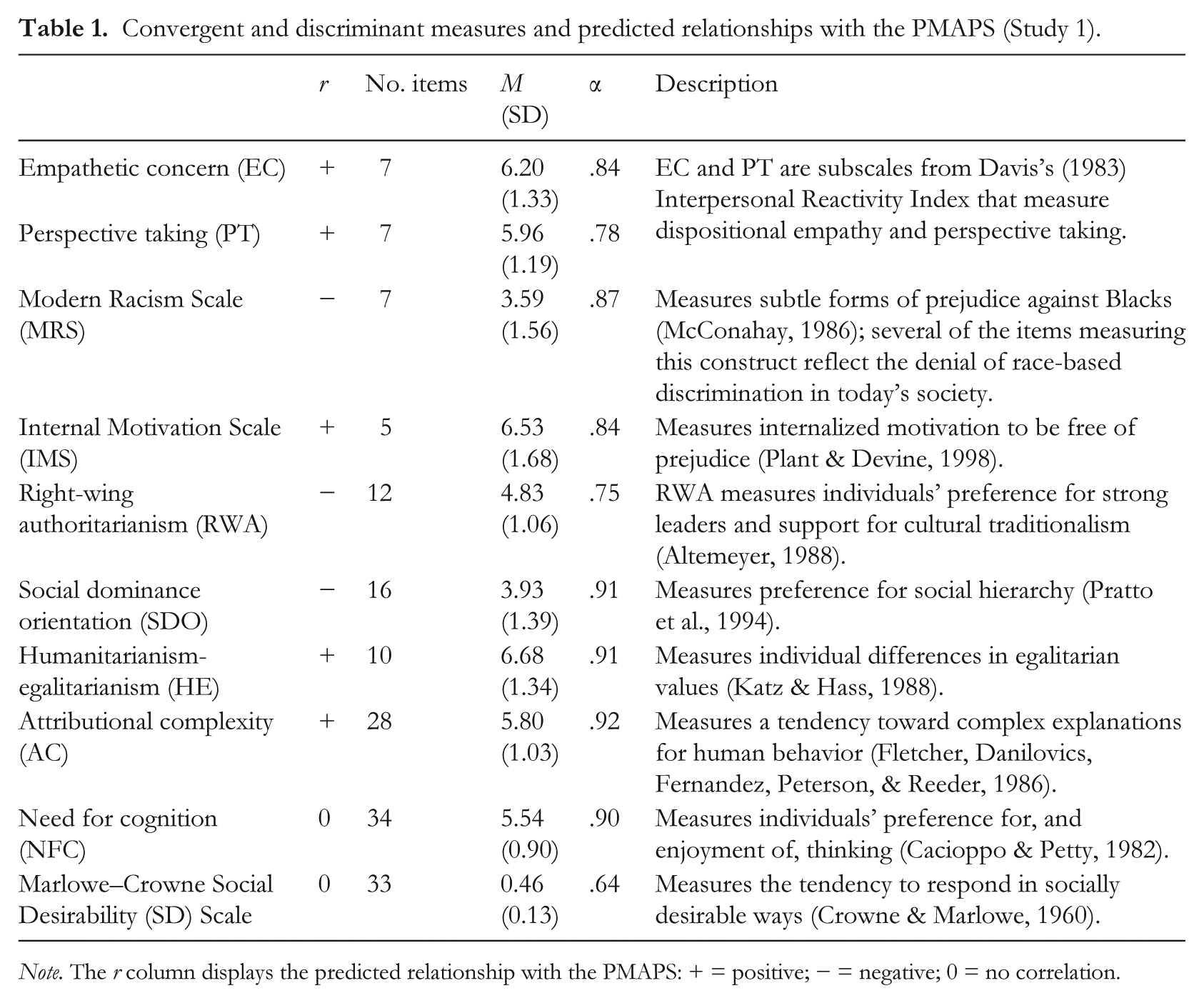
Note. The r column displays the predicted relationship with the PMAPS: + = positive; − = negative; 0 = no correlation.
Method
Item creation
We began by creating an initial set of statements reflecting beliefs about the prevalence and pervasiveness of prejudice and discrimination (e.g., “You’ll see lots of racism if you look for it”), trivialization of targets’ concerns (e.g., “Racial minorities are too sensitive about stereotypes”), and vigilance (e.g., “I am on the lookout for instances of prejudice or discrimination”), as well as additional items we assumed would be related to tendencies to make attributions to prejudice. The set of items was reviewed and expanded by several graduate student colleagues specializing in the psychology of prejudice and discrimination. The resulting item pool contained 31 items.
Participants
Participants were 225 college undergraduates (122 men, 103 women, ages 18 to 28, M = 19.40, SD = 1.56) enrolled in introductory psychology courses at Kansas State University. The majority of participants identified as White/Caucasian (79%).
Procedure
All materials were administered online. Participants responded to all of the original 31 items created for the PMAPS, which were presented in random order. Participants next completed each of the measures used to test the construct validity of the PMAPS described in Table 1. For all items, participants responded on a 9-point scale (1 = strongly disagree, 9 = strongly agree).
Results and Discussion
Exploratory factor analysis
All 31 PMAPS items were entered into a principal components analysis (PCA) with varimax rotation. 1 Six factors with eigenvalues greater than 1 were extracted by the PCA. However, inspection of the inflection point on the scree plot suggested only four factors be retained. Additionally, a parallel analysis (Hayton, Allen, & Scarpello, 2004) suggested four factors be retained based on eigenvalues exceeding chance. Therefore, only the first four factors were interpreted. Table 2 displays the factor loadings for each item.
PMAPS item selection: Principal component analysis factor loadings (Study 1).
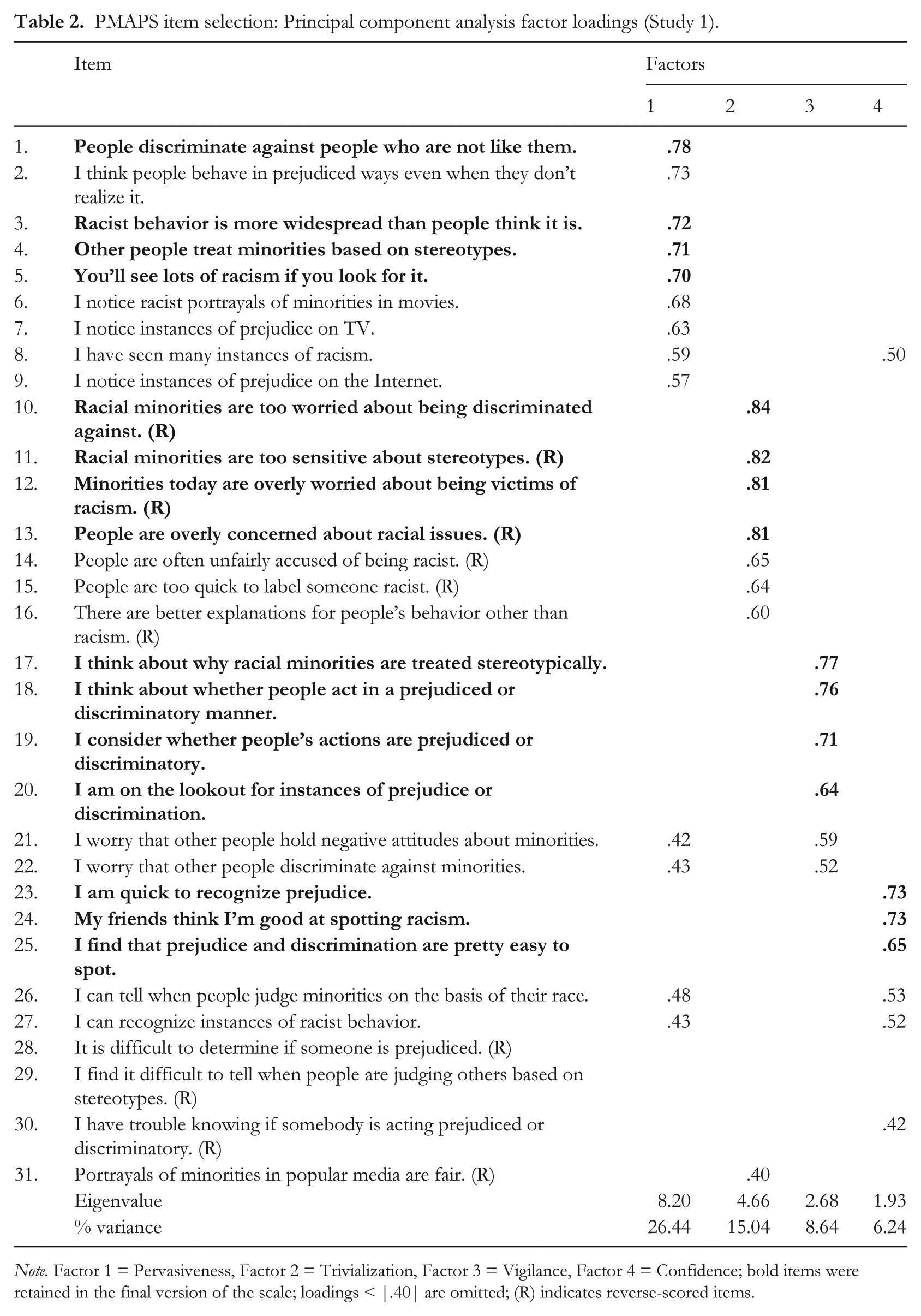
Note. Factor 1 = Pervasiveness, Factor 2 = Trivialization, Factor 3 = Vigilance, Factor 4 = Confidence; bold items were retained in the final version of the scale; loadings < |.40| are omitted; (R) indicates reverse-scored items.
Item selection and reliability
Scale reduction best practices were followed (see Stanton, Sinar, Balzer, & Smith, 2002; Worthington & Whittaker, 2006) to make decisions about item retention. We chose to retain items based on loadings > |.50|, clean factor loadings (i.e., cross-loadings < |.40|), and examination of the interpretability/face validity of the items’ content. The first factor consisted of items related to beliefs about the pervasiveness of racial prejudice (Pervasiveness subscale, four items retained, α = .79). The second factor contained items assessing trivialization of targets’ concerns about racism (Trivialization subscale, four items retained, α = .89). The third factor contained items related to vigilance in recognizing expressions of prejudice (Vigilance subscale, four items retained, α = .80). The fourth factor contained items that appeared to reflect individuals’ confidence in recognizing expressions of prejudice (Confidence subscale, three items retained, α = .75). Finally, the overall PMAPS composite containing all 15 of the retained items (after reverse-scoring the items in the trivialization dimension) achieved a good level of reliability (α = .83). Table 3 displays the descriptive statistics for each of the subscales and the composite.
PMAPS descriptive statistics (Study 1).

Note. The Trivialization subscale is reverse scored when included in the composite PMAPS variable, but not when reported individually.
Evidence of construct validity
Table 4 demonstrates that all of our predicted relationships between the PMAPS and the constructs hypothesized to be negatively correlated with the PMAPS were supported. Specifically, higher PMAPS levels were related to lower levels of modern racism, social dominance orientation, and right-wing authoritarianism. Thus, the PMAPS was found to be negatively related to attitudes and beliefs that serve to justify prejudice (Crandall & Eshleman, 2003), and these findings are consistent with prior research findings regarding whether or not the targets of prejudice make attributions to prejudice and discrimination is related to their system-justifying ideologies (Kaiser, 2006; Kaiser & Major, 2006; Kaiser et al., 2006; Major, Kaiser, O’Brien, & McCoy, 2007; Major, Quinton, & McCoy, 2002).
Evidence of construct validity: Convergent and discriminant bivariate correlations with the PMAPS (Study 1).
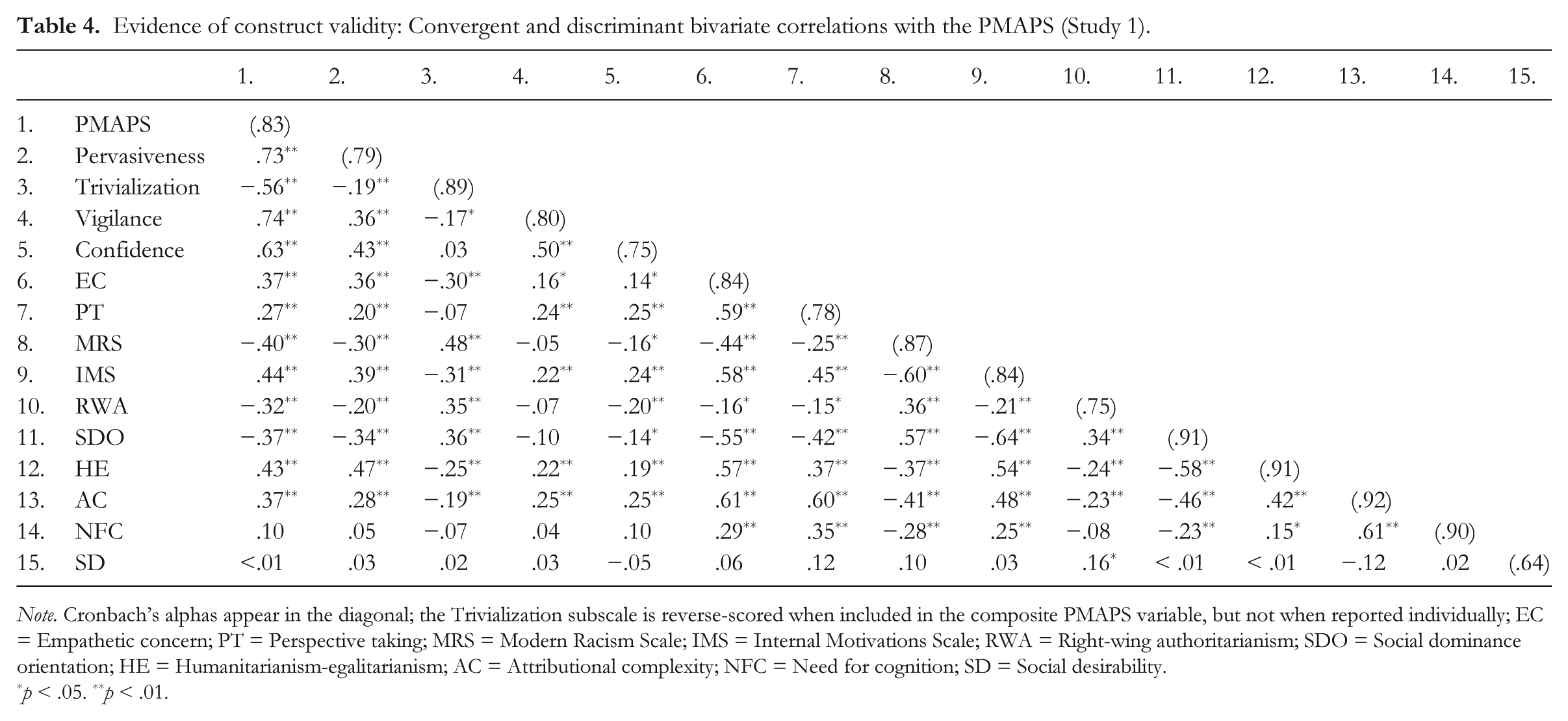
Note. Cronbach’s alphas appear in the diagonal; the Trivialization subscale is reverse-scored when included in the composite PMAPS variable, but not when reported individually; EC = Empathetic concern; PT = Perspective taking; MRS = Modern Racism Scale; IMS = Internal Motivations Scale; RWA = Right-wing authoritarianism; SDO = Social dominance orientation; HE = Humanitarianism-egalitarianism; AC = Attributional complexity; NFC = Need for cognition; SD = Social desirability.
p < .05. **p < .01.
Additionally, the tendency to make attributions to prejudice was positively related to individual differences related to the suppression of prejudice (Crandall & Eshleman, 2003). Specifically, the PMAPS was found to positively correlate with measures of empathy and perspective taking, support for humanitarian and egalitarian beliefs, and internal motivations to suppress prejudice. Additionally, the PMAPS was significantly related to higher attributional complexity, which has been shown to be related to the identification of subtle racism (Reid & Foels, 2010). Together, this is compelling evidence that the tendency to make attributions to prejudice is positively related to a variety of attitudes and beliefs that prejudice should be suppressed.
Evidence of the discriminant validity of the PMAPS was also found. Table 4 shows the PMAPS was unrelated to socially desirable responding and need for cognition, suggesting the PMAPS is not measuring a tendency to provide socially acceptable responses, nor a general preference for deliberative thinking. Thus, overall, the convergent and discriminant validity of the PMAPS was supported.
Conclusions
Study 1 was conducted to develop a measure of the propensity to make attributions to prejudice. Evidence from the exploratory factor analysis confirms that individual differences in beliefs about the prevalence and pervasiveness of expressions of racial prejudice, trivialization of targets’ concerns, vigilance in attending to signs of prejudice, and confidence in recognizing expressions of prejudice can be reliably measured. Furthermore, these beliefs and expectations related to expressions of racial prejudice and discrimination were predictably related to constructs believed to underlie the justification and suppression of prejudice (Crandall & Eshleman, 2003). Furthermore, none of these constructs were found to be redundant with the PMAPS (as would be indicated by much stronger correlations), and the PMAPS did not correlate with theoretically distinct constructs such as social desirability or need for cognition. These results support the construct validity of the PMAPS. Given this predictable and meaningful nomological network of individual differences related to the PMAPS, these results provide compelling evidence that the PMAPS is measuring a theoretically relevant set of beliefs that may predict observers’ situational attributions to prejudice.
Study 2: Confirmatory Factor Analyses and Test–Retest Reliability
In Study 2, we conducted a confirmatory factor analysis (CFA) to confirm the dimensionality of the PMAPS and to further assess its reliability by testing whether the four factors identified in Study 1 combine to form a higher order construct. Additionally, we assessed the test–retest reliability of the PMAPS.
Method
Participants
Participants were 748 college undergraduates enrolled in introductory psychology courses at Kansas State University (253 men, 494 women, ages 18 to 31, M = 18.75, SD = 1.20). The majority of participants identified as White/Caucasian (84%).
Procedure
All materials were administered online. All participants completed the PMAPS (the 15 items retained from Study 1) at Time 1. Items were presented in random order. Participants responded to the items on a 9-point scale (1 = strongly disagree, 9 = strongly agree). A subset of 106 participants (46 men and 60 women, ages 18 to 31, M = 18.89, SD = 1.72) completed the PMAPS items a second time (Time 2) approximately two months after Time 1.
Results and Discussion
Confirmatory factor analyses
To examine the fit of the four-factor solution, we conducted a CFA of the 15 retained PMAPS items using the Time 1 data from all 748 participants. Our hypothesized model consisted of the four latent variables representing the four subscales and the PMAPS as a second-order construct. Results of the goodness-of-fit indices suggested the four-factor model adequately fit the data, χ2(86) = 257.26, p < .001; χ2/df = 2.99; standardized root mean square residual (SRMR) = .05; goodness-of-fit index (GFI) = .96; adjusted GFI (AGFI) = .94; comparative fit index (CFI) = .96; root-mean-square error of approximation (RMSEA) = .05, 90% CI [0.04, 0.06]. Additionally, the four-factor model fit the data better than a single-factor model, χ2(86) = 2033.66, p < .001; χ2/df = 22.60; SRMR = .15; GFI = .69; AGFI = .59; CFI = .53; RMSEA = .17, 90% CI [0.16, 0.18]. These data provide evidence that the PMAPS can be treated as a higher order construct comprised of four related dimensions.
Test–retest correlations
We found moderate to moderately strong correlations between the Time 1 and Time 2 composite PMAPS scores (r = .68, p < .001; MTime 1 = 5.34, SDTime 1 = 1.02; MTime 2 = 5.50, SDTime 2 = 0.91), the Pervasiveness subscale scores (r = .54, p < .001; MTime 1 = 5.99, SDTime 1 = 1.48; MTime 2 = 6.30, SDTime 2 = 1.30), the Trivialization subscale scores (r = .59, p < .001; MTime 1 = 4.92, SDTime 1 = 1.87; MTime 2 = 5.02, SDTime 2 = 1.74), the Vigilance subscale scores (r = .59, p < .001; MTime 1 = 5.19, SDTime 1 = 1.39; MTime 2 = 5.19, SDTime 2 = 1.39), and the Confidence subscale scores (r = .52, p < .001; MTime 1 = 5.31, SDTime 1 = 1.52; MTime 2 = 5.51, SDTime 2 = 1.38). These correlations suggest that beliefs about the prevalence of racism, trivialization of targets’ concerns, and vigilance and confidence in recognizing instances of racial prejudice are moderately stable over time.
Study 3: Predicting Situational Attributions to Prejudice
After establishing the psychometric properties of the PMAPS in Studies 1 and 2, we next assessed the predictive and incremental validity of the PMAPS in Study 3. Research on targets’ attributions suggest that individual differences in expectations to be treated prejudicially have stronger effects on targets’ attributions to prejudice in situations that are relatively ambiguous with regard to the reasons behind an actor’s behavior (e.g., Johnson, Simmons, Trawalter, & Ferguson, 2003; Major et al., 2003; Wang et al., 2012). Therefore, we hypothesized individual differences in the propensity to make attributions to prejudice would be more strongly related to observers’ situational judgments when expressions of prejudice are relatively ambiguous. However, an alternative hypothesis is that observers’ tendencies to make attributions to prejudice, or to deny prejudice as an explanation for others’ behaviors, may be strong enough to influence attributions regardless of the level of situational ambiguity. To test these hypotheses, in Study 3a we manipulated cues for prejudice in different scenarios involving White actors behaving antisocially toward racial minority targets.
In Study 3b we assessed the incremental validity of the PMAPS. Modern racism is characterized by beliefs that prejudice toward Blacks is no longer a societal problem and that Blacks unfairly claim discrimination in order to gain social advantages (McConahay, 1986). This construct is similar to the trivialization dimension of the PMAPS (and the Modern Racism Scale [MRS] and the trivialization scales were found to be correlated in Study 1). Therefore, it was important to test whether tendencies to make attributions to prejudice, as measured by the PMAPS, contributed to the explanation of unique variance in attributions to prejudice above and beyond the MRS. One reason we predicted the PMAPS would explain attributions to prejudice above and beyond the MRS is that the MRS contains more of an evaluative belief that Blacks unfairly claim discrimination to gain social advantages, whereas the PMAPS more specifically assesses beliefs about the pervasiveness of prejudice.
Study 3a Method
Participants
Participants were 284 (63% male, 36% female, 0.7% transgendered, age 18 to 72, M = 32.49, SD = 10.92) American residents who were recruited online through Amazon Mechanical Turk (MTurk) and were compensated $0.05 for their participation. Participants self-identified as White/Caucasian (75%), African American (11%), Hispanic (5%), Asian (5%), Pacific Islander (0.4%), or other (3%).
Procedure
Data were collected online. Participants first completed the 15-item PMAPS measured on a 9-point scale (1 = strongly disagree, 9 = strongly agree); α = .88, M = 5.80, SD = 1.15. Eight short scenarios involving a White actor and an ethnic minority target (e.g., Black, Latino, Arab) were presented next (see Appendix A). Participants rated the extent to which they believed the behavior in each scenario was the result of racial prejudice on a 9-point scale (1 = definitely not prejudice, 9 = definitely prejudice). Participants were randomly assigned to one of three conditions. In the nonprejudice cue condition, participants were presented with eight different scenarios that suggested the reason for the actor’s behavior toward the target was due to some factor other than race (e.g., “A White teacher fails a Black student for cheating”). In the ambiguous prejudice cue condition, the scenarios did not include any explicit cues as to the cause of the actor’s behavior (e.g., “A White high school principal cuts the Mexican-American Studies program from the school curriculum”). In the clear prejudice cue condition, the scenarios described a relatively blatant expression of racial prejudice (e.g., “A White individual intentionally gives an Arab individual incorrect directions”). We averaged the prejudice rating across the eight scenarios (nonprejudice cue scenarios α = .90, ambiguous prejudice cue scenarios α = .81, clear prejudice cue scenarios α = .89).
Study 3a Results and Discussion
We entered the average prejudice rating as the criterion variable in a regression analysis to test whether the composite PMAPS score would interact with the amount of situational ambiguity in predicting attributions to prejudice. The dummy-coded variables carrying the main effect of condition were entered in Step 1, the PMAPS was entered in Step 2, and the two-way interactions between the two dummy-coded condition variables and the PMAPS were entered in Step 3; total model R2 = .74, F(5, 278) = 161.95, p < .001. As expected, there was a strong main effect of level of ambiguity on attributions to prejudice, R2 = .71, F(2, 281) = 340.87, p < .001, such that the ratings of prejudice were lowest in the nonprejudice cue condition (M = 2.76, SD = 1.56), higher in the ambiguous prejudice cue condition (M = 6.33, SD = 1.23), and highest in the clear prejudice cue condition (M = 7.88, SD = 1.35). There was also an effect for the PMAPS above and beyond the condition main effect, ΔR2 = .03, F(1, 280) = 37.50, p < .001, such that higher levels of the PMAPS predicted higher prejudice ratings (b = 0.41, 95% CI [0.28, 0.54]). The interaction terms in the model provided no evidence of a differential effect of the PMAPS between conditions, ΔR2 = .002, F(2, 278) = 0.83, p = .25. Simple slopes analyses revealed that the PMAPS predicted attributions to prejudice in all three experimental conditions: nonprejudice cue b = 0.29, 95% CI [0.06, 0.52]; ambiguous prejudice cue b = 0.50, 95% CI [0.26, 0.73]; clear prejudice cue b = 0.44, 95% CI [0.22, 0.66].
Additional analyses including race (a dummy-coded variable indicating whether the participant identified as White/Caucasian or not) and gender as covariates did not significantly change the results of the previously reported regression model. Neither race nor gender were found to predict attributions to prejudice when accounting for the level of ambiguity, the PMAPS, and their interactions, nor did race or gender interact with the conditions or the PMAPS. Although caution should be taken when interpreting these results due to the fact that 75% of our sample identified as White, these findings at least suggest that perceptions of prejudice across levels of ambiguity might be better understood by accounting for individuals’ tendencies to make attribution to prejudice than by individuals’ racial or gender identities (see Study 4 for race and gender differences in the PMAPS).
As an additional exploratory analysis, we calculated zero-order correlations for each of the four PMAPS subscales in predicting attributions to prejudice in each of the three conditions (see Table 5). All four of the PMAPS subscales were found to be significantly correlated with attributions to prejudice in the ambiguous prejudice and clear prejudice cue conditions. These results suggest the PMAPS subscales represent important constructs for predicting attributions to prejudice when situational information is ambiguous and when situational information more clearly indicates prejudice. A less clear pattern of results emerged in the nonprejudice cue condition where pervasiveness and vigilance predicted attributions to prejudice, but trivialization and confidence did not. Future research is needed to see if these patterns replicate and to examine the situations in which the different dimensions of PMAPS are more or less relevant for understanding attributions to prejudice.
PMAPS subscales predicting attributions to prejudice at different levels of ambiguity (Study 3a).

Note. Zero-order correlations are presented; the Trivialization subscale is not reverse-scored.
p < .05. **p < .01.
Study 3b Method
Participants
Participants (N = 298) were recruited on Amazon MTurk (73% White; 39% male, 60% female, and 0.7% who identified as “other”; age 18 to 73, M = 37.02, SD = 12.89).
Procedure
Participants completed the PMAPS (α = .87, M = 5.52, SD = 1.27) and the MRS (α = .90, M = 3.63, SD = 1.90). Similar to Study 3a, participants were randomly assigned to one of three conditions (nonprejudice cue, ambiguous prejudice cue, or clear prejudice cue) in which they read three scenarios (see Appendix B). To address the limitation of Study 3a that different scenarios were used for each of the three conditions, in the present study, we created scenarios that were similar across conditions and only varied the cues for prejudice. Additionally, all scenarios depicted a Black target. We chose to include only Black targets because the MRS may have greater validity in predicting perceptions of racism toward Blacks. Participants rated the extent to which they believed the behavior in each scenario was the result of racial prejudice on a 9-point scale (1 = definitely not prejudice, 9 = definitely prejudice). We averaged the prejudice ratings across the three scenarios in each condition (nonprejudice cue scenarios α = .73, ambiguous prejudice cue scenarios α = .70, clear prejudice cue scenarios α = .68). All materials were presented in a randomized order.
Study 3b Results and Discussion
One limitation of Study 3a is that different scenarios were used in each of the three conditions that manipulated levels of ambiguity. Although this limitation was addressed in the present study, we again found the PMAPS did not interact with the different cues for prejudice (ps > .51) and that the PMAPS predicted attributions to prejudice in all three conditions: nonprejudice cue b = 0.46, 95% CI [0.23, 0.70]; ambiguous prejudice cue b = 0.42, 95% CI [0.20, 0.65]; clear prejudice cue b = 0.35, 95% CI [0.10, 0.60]. However, in Study 3b, we were primarily interested in whether the PMAPS predicted variance in attributions to prejudice above and beyond the MRS. Therefore, we conducted a hierarchical regression of prejudice ratings collapsed across conditions. We entered the MRS in Step 1 and the PMAPS in Step 2. In Step 1, the MRS accounted for 5% of the variance in attributions to prejudice, b = −0.31, 95% CI [−0.47, −0.15], p < .001. In Step 2, the PMAPS, b = 0.45, 95% CI [0.14, 0.76], p = .005, predicted an additional 3% of variance, F(1, 295) = 7.95, p = .005, above and beyond the MRS. Furthermore, the regression coefficient for the MRS was reduced to nonsignificance, b = −0.12, 95% CI [−0.33, 0.09], p =.255, with the PMAPS in the model in Step 2. Study 3b therefore provides evidence of the incremental validity of the PMAPS.
Study 3 Conclusions
The results of Studies 3a and 3b support the predictive and incremental validity of the PMAPS. Although these data do not support the hypothesis that a tendency to make attributions to prejudice more strongly predicts attributions to prejudice in ambiguous situations, they do suggest that the tendency to make attributions to prejudice influences attributions across the levels of situational ambiguity that we sampled in the current study. More specifically, the PMAPS predicted attributions to prejudice in ambiguous situations, but also in situations where race-neutral reasons for the actors’ behaviors were available as well as in situations where prejudice was expressed more blatantly. That the PMAPS predicted attributions to prejudice in the nonprejudice cue condition suggests individuals with a stronger tendency to make attributions to prejudice may discount alternative attributions, or that individuals who have a weaker tendency to make attributions to prejudice may more readily accept nonprejudiced explanations. Similarly, even when prejudice is more blatantly expressed, individuals with relatively lower tendencies to make attributions to prejudice may discount or deny prejudice as an explanation. Overall, these results provide evidence supporting the validity of the PMAPS in predicting attributions to prejudice when expressions of prejudice are ambiguous, more blatant, and when informational cues suggest race-neutral explanations, and that the PMAPS predicts attributions to prejudice above and beyond the MRS.
Study 4: Race and Gender
Having collected data from a large number of participants over the course of the current research, we were interested in how the distribution of individual differences in the tendency to make attributions to prejudice, as measured by the PMAPS, might be different or similar between different demographic groups (i.e., gender, ethnicity). Prior research has found that, as observers, Blacks are more likely to make attributions to prejudice than Whites (e.g., Inman & Baron, 1996; Levin, Sinclair, Veniegas, & Taylor, 2002), possibly because racial prejudice as an explanation for behavior is more cognitively accessible to members of groups who are traditionally the targets of racial prejudice and discrimination (Marti et al., 2000). We believed these findings might be due, in part, to between-group differences in the tendency to make attributions to racial prejudice. As such, we expected to find significantly higher mean PMAPS scores for racial minorities than for Whites. Additionally, compared to White men, White women tend to be less likely to endorse ideologies (e.g., social dominance orientation) that serve to justify expressions of prejudice (Sidanius & Pratto, 1999; Whitley, 1999), possibly because women in a sexist society may have more understanding of stigma and experiences with prejudice than men. Research also supports the conclusion that White women are more likely to make attributions to racial prejudice than are White men (e.g., Inman & Baron, 1996). Therefore, we also expected to find higher levels of mean PMAPS scores for White women than for White men.
In regard to racial minority gender differences, Sidanius and Veniegas (2000) argue that racism is more likely to be experienced by men than by women because the social dominance motives underlying racial discrimination lead to more male-on-male expressions of prejudice in a patriarchal society. However, others have found either no gender differences in Blacks’ and Latinos’ expectations for being the target of racial discrimination (Levin et al., 2002), or marginally higher reported experiences of racial discrimination by Black female than by Black male college students (Swim, Hyers, Cohen, Fitzgerald, & Bylsma, 2003). Therefore, we treated the question of gender differences in racial minority groups in the tendency to make attributions to prejudice as an open question with competing hypotheses. A finding of higher mean PMAPS levels in racial minority men than in racial minority women would support the prediction based on the subordinate male target hypothesis that minority men will have a higher tendency to make attributions to racial prejudice than will minority women. Alternatively, according to the double-jeopardy hypothesis, minority women’s experience of both racial and gender discrimination may combine to increase their tendency to make attributions to prejudice compared to their male counterparts. Thus, a finding of higher mean PMAPS levels in racial minority women than in racial minority men would support this competing prediction.
Method
Participants
For the current study, we combined the samples from Studies 1 through 3 (as well as Study 5) with additional participants from several other student samples. In total, the combined sample resulted in 3,821 participants. Participants who did not report their sex (139 participants) or who did not report their ethnicity (45 participants), were removed from this sample. Additionally, participants self-identifying as Native American (22), Pacific Islander (2), or other (87) were removed from the sample because of small sample sizes. The resulting sample consisted of 1,117 male and 1,919 female Whites/Caucasians, 101 male and 139 female Blacks/African Americans, 63 male and 91 female Latinos/Latinas/Hispanics, and 58 male and 63 female Asians. The modal age for the final sample was 18 years old (M = 20.03, SD = 4.93).
Results and Discussion
Table 6 displays the means and standard deviations for each demographic group, as well as the effect sizes (Cohen’s d) for the differences between groups. As expected, White women scored higher on the PMAPS than did White men, and the effect size for this difference was relatively small. Also as expected, White men scored lower on the PMAPS than did Black men, Hispanic men, and Asian men, and these effect sizes ranged from small to medium–large. No evidence was found for the double-jeopardy hypothesis that minority women would have a higher tendency to make attributions to prejudice than would minority men. Rather, the data supported the subordinate male target hypothesis that minority men would be more likely to make attributions to prejudice than would minority women, although the observed PMAPS effect sizes comparing men and women within each minority group were small.
Standardized effect sizes for racial and sex differences in the PMAPS (Study 4).

Note. Values are the standardized differences (Cohen’s d) between groups. Positive values indicate the group in the row has a higher mean than the group in the column, and negative values indicate the group in the row has a lower mean than the group in the column.
p < .10. *p < .05. **p < .01.
Figure 1 displays box-and-whisker plots for each demographic group. The considerable overlap in the distributions of PMAPS scores suggests that the tendency to make attributions to prejudice varies considerably within demographic groups and that there is a large amount of overlap in the distributions across groups. Although purely descriptive, these overlapping distributions across demographic groups, as well as the relatively small effect sizes for the differences between many of the groups, suggest the tendency to make attributions to prejudice is more of an individual difference than a disposition that can be categorically attributed to any one social group (see Hyde, 2005, for a related argument about gender differences and similarities). Thus, in addition to demographic characteristics such as sex and ethnicity, it is important to consider individual differences in the tendency to make attributions to prejudice when making predictions about perceptions of expressions of prejudice.
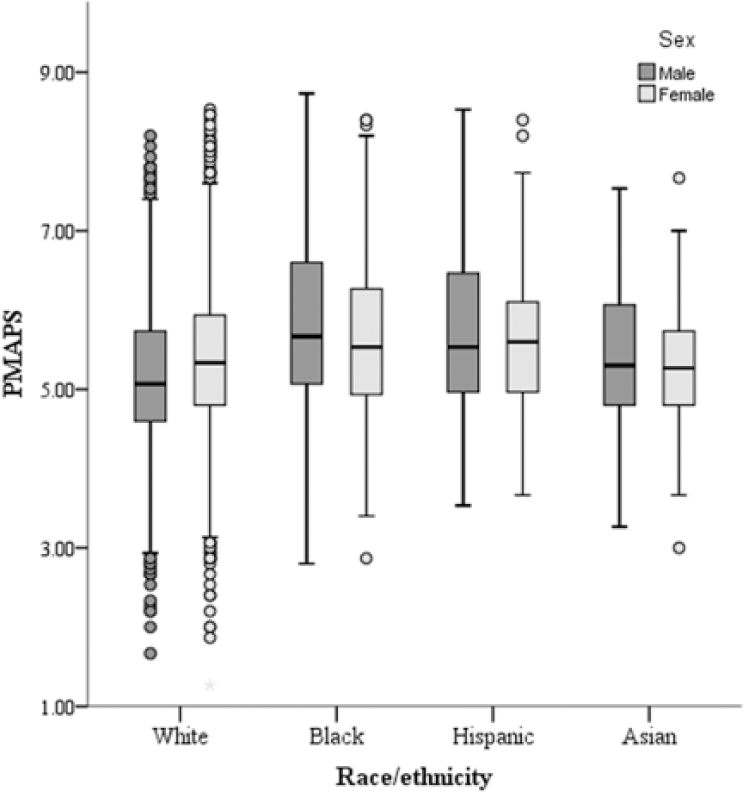
Box plots of the distribution of PMAPS scores by race and sex.
Study 5: Ecological Validity
To assess the ecological validity of the PMAPS as a measure of the tendency to make attributions to prejudice, we used the PMAPS to predict attributions to prejudice about the events that occurred in Ferguson, Missouri in August 2014. On August 9, 2014, a White police officer, Darren Wilson, shot and killed an 18-year-old Black man, Michael Brown. Media reports of the events surrounding the shooting provided conflicting evidence about whether the shooting was justified, or whether the shooting was motivated by racial prejudice (“What Happened in Ferguson?,” 2014). For example, media outlets reported that several witnesses claimed that just prior to the shooting, Michael Brown raised both hands in surrender, while other witnesses claimed Michael Brown charged the police officer. Additionally, the officer claimed Michael Brown had assaulted him earlier and attempted to take possession of his firearm. Protests followed and were met by what many criticized as an overly militarized response by the police. Such reports arguably created ambiguity as to whether or not Darren Wilson’s actions, and the police response to the protesters, were racially motivated. We predicted that, in the context of this ambiguity, the PMAPS would be related to attributions to prejudice.
Method
Participants
Participants were 164 students (49 men and 115 women), mostly White/Caucasian (91%), ages 18 to 35 (M = 18.90, SD = 2.01), who were enrolled in an introductory psychology course at Kansas State University.
Procedure
Participants first completed the PMAPS (α = .84) at the beginning of the semester (September 2014). Zero to 29 days (M = 8.32, SD = 9.38) later, participants completed the following measures in a separate study administered online. To measure attributions to prejudice in the events surrounding the Michael Brown shooting, we wrote 11 items (e.g., “The police officer who shot Michael Brown is a racist”; “The shooting of Michael Brown was justified given the circumstances” (reverse scored); “The police response to the protesters in Ferguson, Missouri was racist”) to which participants responded on a 9-point scale (1 = strongly disagree, 9 = strongly agree) scale. We averaged responses across these items to create a composite attributions to prejudice score (α = .90).
Results and Discussion
The PMAPS predicted attributions to prejudice in the events surrounding the shooting death of Michael Brown, composite PMAPS (with trivialization reverse scored, M = 5.28, SD = 1.02) r = .41, p < .001; pervasiveness (M = 5.79, SD = 1.38) r = .31, p < .001; trivialization (not reverse scored, M = 4.79, SD = 1.68) r = −.40, p < .001; vigilance (M = 4.94, SD = 1.53) r = .20, p = .009; confidence (M = 5.15, SD = 1.39) r = .14, p = .072, such that higher levels of the propensity to make attributions to prejudice were associated with higher levels of attributions to prejudice. Furthermore, neither participant sex nor whether the participant identified as White showed evidence of moderating the relationship between the PMAPS and attributions to prejudice or to predict attributions to prejudice controlling for levels of PMAPS (although we advise caution in interpreting the effects of racial identification given that the number of non-Whites in our sample was small).
In Studies 3a and 3b, we used vignettes to describe expressions of prejudice involving varying degrees of ambiguity. Although this methodology provided a degree of experimental control, the hypothetical nature of these vignettes limits the generalizability of our findings that the PMAPS predicts attributions to prejudice. We addressed this limitation in the current study by using the PMAPS to predict attributions to prejudice in a real-world event. While we do not know in this case whether attributions to prejudice were “correct” or accurate, the finding that the PMAPS predicted a substantial amount of variance in attributions to prejudice provides evidence supporting the ecological validity of the PMAPS.
General Discussion
In the current studies, we found consistent evidence that beliefs and expectations about expressions of racial prejudice combine to characterize a general tendency to make attributions to prejudice, and that variability in this general tendency predicts third-party observers’ attributions to prejudice in a variety of situations. We first developed a measure of individual differences in the tendency to make attributions to racial prejudice, the Propensity to Make Attributions to Prejudice Scale (PMAPS). In Studies 1 and 2, we established that the PMAPS demonstrates good psychometric properties (e.g., reliability, temporal stability) and that the PMAPS was predictably associated with individual differences related to the justification and suppression of expressions of racial prejudice (Crandall & Eshleman, 2003). In addition to demonstrating the construct validity of the PMAPS, these patterns of relationships suggest individuals who are less likely to justify, and more likely to suppress, expressions of prejudice are more likely to perceive others’ potentially prejudicial behaviors as expressions of prejudice. Further, evidence for the validity of the PMAPS was demonstrated in Studies 3 and 5, where we found the PMAPS predicted observers’ attributions to prejudice in various situations, both hypothetical (Study 3) and real (Study 5). The results of Study 3a also suggest each of the four PMAPS subscales (Pervasiveness, Trivialization, Vigilance, and Confidence) are important constructs for predicting attributions to prejudice when situational information is ambiguous or when informational cues are clearer in indicating that prejudice has been expressed. Additionally, the results of Study 3b demonstrated the PMAPS predicted attributions to prejudice above and beyond the related construct of modern racism.
Additionally, we provided evidence that the tendency to make attributions to prejudice is an individual difference that varies across racial and gender groups (Study 4). Although there were predictable differences in the mean levels of PMAPS scores between groups, there was also significant overlap across groups. Though caution should be taken when generalizing these findings to more heterogeneous, nonstudent populations, this considerable overlap in distributions suggests the tendency to make attributions to racial prejudice is not categorically associated with any particular social group. In combination, the data from these five studies provide converging evidence supporting the conclusion that the PMAPS is a reliable and valid measure of individual differences in the tendency to make attributions to racial prejudice.
We should note that the results of Studies 3a and 3b did not support the hypothesis about the moderating effects of informational cues on the tendency to make attributions to prejudice. Rather, the findings from Studies 3a and 3b support the conclusion that the tendency to make attributions to prejudice may influence attributions across a wide range of situations and not only when expressions of racial prejudice are relatively ambiguous. This finding could mean that individuals with a higher tendency to make attributions to prejudice may be more likely to discount race-neutral explanations when such information is available, to perceive prejudice in ambiguous situations, and to see more blatant forms of racism as expressions of prejudice. Conversely, individuals lower in the tendency to make attributions to prejudice may be less likely to perceive prejudice in ambiguous situations and may have more readily accepted the race-neutral explanations in our nonprejudice cue condition. Importantly, individuals lower in the tendency to make attributions to prejudice may underemphasize the role of racial prejudice, not only when prejudice is ambiguously expressed, but also when observing behaviors that are more blatantly racist. Such denial of racism (e.g., McConahay, 1986) may have motivational underpinnings in system justification (Jost et al., 2004; Major et al., 2007) or cognitive underpinnings such as a relative lack of knowledge about historical discrimination (Nelson, Adams, & Salter, 2013). While the etiology of tendencies to make attributions to prejudice deserves attention in future research (in which we hope the PMAPS will be of use), the current studies provide compelling evidence that the PMAPS predicts attributions to prejudice across a range of potential expressions of prejudice.
Limitations
The current research is not without limitations. The student samples used in Studies 1, 2, 4, and 5 may limit the generalizability of our findings. Additionally, in Studies 3a and 3b, the PMAPS was measured in the same study that the stimuli and the measures of attributions to prejudice were presented. This may have created a demand characteristic where individuals simply tried to be consistent with their responses on the PMAPS and the dependent measures. This was not a limitation of Study 5, however, where participants completed the PMAPS in an ostensibly unrelated study several days or weeks before providing their attributions about Ferguson, Missouri. Finding that the PMAPS predicted attributions to prejudice when individuals were not immediately primed with the PMAPS increases our confidence that the PMAPS is a valid measure of the tendency to make attributions to prejudice.
One important question that follows from our findings that the PMAPS was correlated with a set of individual differences that more broadly define justifications for expressions of prejudice (Crandall & Eshleman, 2003) and system-justifying beliefs (Jost et al., 2004) is whether tendencies to make attributions to prejudice are a consequence of these ideological beliefs and motivations. Our goal in the present research was to create and empirically validate the PMAPS; however, we suspect the tendencies measured by the PMAPS are a consequence of different political and ideological beliefs, and therefore the PMAPS may represent a more proximal set of attitudes that allow researchers to predict attributions to prejudice. The correlations between system-justifying beliefs and the PMAPS in Study 1 support, but do not directly test, the causal links between these different beliefs. Future research could examine the conditions and motivations that affect tendencies to make (or not make) attributions to prejudice.
Future Directions
Future research should further examine how individual differences in attributions to prejudice operate at the cognitive level from the theoretical perspective of signal detection theory (SDT). As we suggested in our introduction, the PMAPS may be measuring individual differences in the sensitivity for cues of prejudice or response biases in favor of making or not making attributions to prejudice (for applications of SDT to attributions to prejudice, see Barrett & Swim, 1998). Future research could use SDT paradigms to systematically manipulate positive cues for prejudice (i.e., the signal) in combination with information supporting alternative attributions or that attenuate the signal in other ways (i.e., informational noise). Such research may provide information about how tendencies of observers to make attributions to prejudice relate to being able to tell the difference between prejudiced and nonprejudiced behavior (i.e., sensitivity), and/or how these tendencies relate to evidence thresholds for deciding whether something is racist or not (i.e., bias).
We found that tendencies to make attributions to prejudice predicted attributions at various levels of evidence for prejudice. However, the present data do not directly address the accuracy of individuals’ attributions to prejudice. Future research may explore the boundary conditions of the effects of the PMAPS because this may help to decipher whether different levels on the PMAPS reflect response biases or sensitivity. For example, if individuals who have very low tendencies to make attributions to prejudice are more likely to deny that prejudice was expressed even when the evidence overwhelmingly suggests that prejudice was indeed expressed, then it would suggest that lower levels of the PMAPS reflect a response bias to not make attributions to prejudice. Additionally, more work needs to be done to examine the relative roles the different dimensions of PMAPS play in predicting sensitivity and bias. For example, pervasiveness and vigilance may be more important for predicting sensitivity, while trivialization is more important for predicting bias. Such research will help to further illuminate the psychological processes at work in making attributions to prejudice.
It would also be interesting to explore the factors that increase or decrease the tendency to make attributions to prejudice overall, as well as factors that may differentially influence the dimensions of PMAPS. Presumably, the differences we observed between racial minorities and Whites, as well as within each racial and gender group, could be explained by differences in personal experiences of being the targets of racial prejudice (Sidanius & Veniegas, 2000), or by the different levels of knowledge about historical instances of racial discrimination (Nelson et al., 2013). Future research might examine whether experiencing, witnessing, or learning about instances of racial discrimination and expressions of prejudice lead to greater tendencies to make attributions to prejudice. Additionally, research on how different experiences, motivations, and beliefs work to attenuate the tendency to make attributions to prejudice will increase our understanding of the different psychological processes that lead to postracialist beliefs and the denial of racism.
Conclusion
Our research contributes to the literature on the psychological factors involved in attributions to prejudice by demonstrating that individuals differ in their tendencies to make attributions to racial prejudice, and that these tendencies predict attributions to prejudice in various situations. Additionally, we extended the research examining targets’ attributions to prejudice by examining the attributions made by third-party observers. A better understanding of how beliefs and expectations about expressions of racial prejudice may influence observers’ attributions to prejudice has both theoretical and applied implications. In conclusion, our measure of the propensity to make attributions to prejudice has the potential to contribute to our understanding about how individual differences and social contexts operate through motivational and cognitive mechanisms to facilitate or hinder the recognition of subtle expressions of prejudice. An understanding of attributions to prejudice made by observers, especially by members of dominant groups, has important societal implications in that bystanders’ judgments are often relied on when dealing with instances of prejudice and discrimination (e.g., workplace and legal settings). In a contemporary society in which prejudice emerges often under the cover of ambiguity, understanding the processes that underlie perceptions of prejudice is essential in understanding and improving intergroup relations.
Footnotes
Appendix A. Scenarios Used in Study 3a
Appendix B. Scenarios Used in Study 3b
Acknowledgements
The authors would like to thank Jericho Hockett, Jessica McManus, and Russell Webster for their contributions in helping to write and evaluate items for the PMAPS, and to Jericho Hockett for helping to develop scenarios for Study 3. The authors would also like to thank Satoris Culbertson and Gary Brase for their comments and advice on this program of research.
Funding
The author(s) received no financial support for the research, authorship, and/or publication of this article.