




Abstract
We examined how the perception that separatist groups threaten the majority’s moral identity impacts the latter group’s support for reconciliation in separatist conflict. Two studies were conducted in Indonesia, where separatist conflict is rife. Javanese students (representing the nonseparatist majority) responded surveys regarding separatist conflicts in Aceh (Study 1, N = 679) or West Papua (Study 2, N = 500). As expected, perceived threat to the majority’s moral identity increased this particular group’s reconciliatory attitudes (Study 1), emotions, and behaviours (Study 2), through increased compensatory needs for social acceptance and restoration of moral image. These findings underline the importance of moral identity dynamics in separatist conflict. Moreover, they reveal that the majority, despite its dominant position, can experience morality threat from separatist groups which can foster positive attitudes towards the reconciliation process.
Separatist conflict is among the most violent types of intergroup conflict. Recent tensions in eastern Ukraine illustrate the often aggressive nature of separatist conflict, causing enormous human and material costs since it erupted in 2014 (Kirby, 2015). At the root of this conflict is a clash between people in eastern and southern Ukraine who aspire to have closer ties with Russia, and pro-European Union people in western Ukraine (Kuzio, 2015). Yet, despite the pressing need for insights that can ultimately help reduce separatist conflict, surprisingly few social psychological researchers have made separatism the focal point of their investigations. The few studies dedicated to this topic focused predominantly on the perspective of the separatist group (e.g., Sani, 2005). For example, Sani’s (Sani, 2005; Sani & Pugliese, 2008) research on schisms revealed that the intentions of a subgroup to separate from its superordinate group are rooted in the perception that existing norms and values of the superordinate group have undermined those of the subgroup. However, to our knowledge, researchers have largely ignored the perspective of the majority or parent nation (but see van Leeuwen & Mashuri, 2013). Given that separatist conflict involves (at least) two parties (i.e., the separatist group and the nonseparatist parent nation), we argue that more insight is needed into the parent nation’s cognitive, affective, and behavioural responses to separatism. Our ultimate aim is to shed more light on factors that promote de-escalation of separatist conflict among members of the parent nation. We present two surveys in this paper that were conducted in the Republic of Indonesia, where ethnic groups in Aceh and West Papua are actively striving for independence.
In this paper, separatist conflict is considered the result of conflicting interests of a separatist group and a nonseparatist parent nation (from here on referred to as “the majority group”). The latter includes both the ethnic majority group and other nonseparatist ethnic minority groups. The former refers to an ethnic minority group that is actively seeking to increase its autonomy by severing ties with the majority group. We sought to demonstrate that the conflict that ensues from separatist actions can heighten morality threat among the majority, which in turn activates compensatory needs for social acceptance and restoration of moral image. Together, these needs affect the majority’s willingness to reconcile its conflict with the separatist group.
Although morality threat is the focus of the current research, it is of course not the only form of threat that plays a role in separatist conflict. Indeed, separatism frequently involves a dispute over economic and power resources (Kingsbury & Laoutides, 2015). Economic and political grievances can be violent drivers of armed conflicts in general (Collier & Hoeffler, 2004) and separatist conflict in particular (Horowitz, 1981). In the current paper, we focused on morality threat rather than economic or power threat because the former, more than the latter, holds the potential for conflict reconciliation. As will be explained in the following, morality threat can elicit specific needs among a perpetrator group (in this case, the majority) that are at odds with conflictual intergroup relations. Consequently, we argue that morality threat can promote majority support for the amelioration of separatism conflict and for reconciliation.
Morality Threat and Compensatory Needs
Morality has to do with what people count as right and wrong and is considered the most pivotal dimension of social identity (Ellemers, Pagliaro, & Barreto, 2013). Morality matters because it is more predictive of positive group evaluations such as group pride than other dimensions of social identity, which include competence and sociability (Leach, Ellemers, & Barreto, 2007). People accordingly experience judgments about the immorality of their group (i.e., dishonest, insincere, and untrustworthy) as an aversive threat to their group’s moral identity (Brambilla, Sacchi, Pagliaro, & Ellemers, 2013). Morality threat is a specific form of symbolic or identity threat (Ellemers, Spears, & Doosje, 2002; Stephan & Stephan, 2000), which refers to the feeling that important values and beliefs of the ingroup are jeopardized by another group. Morality threat in particular involves the concern over wrongdoings committed by the ingroup against another group which damage the ingroup’s reputation as good and moral (Cottrell & Neuberg, 2005; Ellemers et al., 2002).
We reasoned that morality threat could be a potent issue in separatist conflict. Separatist conflict typically involves transgressions by both parties, resulting in mixed and alternating roles of victim and perpetrator for both the separatist group and the majority (Tan, 2000). However, due to its more powerful position, the majority is more often accused of inflicting harm upon the separatist group (Harbom & Wallensteen, 2007). This power asymmetry makes it hard for the majority to deny its role as a perpetrator (Rouhana, 2004). Following the needs-based model of reconciliation (NBMR; Shnabel & Nadler, 2008), we argue that taking a role as a perpetrator in separatist conflict the majority suffers a threat to their identity as a moral actor. Indeed, Shnabel and Nadler (2008) found that perpetrators expressed a strong concern about how others viewed them as being immoral.
Prior research has revealed that people’s reactions to ingroup immorality are highly ambivalent. Confronted with their group’s wrongdoings, people sometimes engage in a host of defensive reactions, for example, by dehumanizing the victims (Castano & Ginner-Sorolla, 2006) or emphasizing ingroup victimization (Bar-Tal, 2000). However, wrongdoings sometimes also motivate people to self-criticize their own group such that they trigger a sense of collective guilt and shame (see Leach, Bilali, & Pagliaro, 2015, for a review). This suggests the existence of one or more moderating variables that determine whether ingroup wrongdoings trigger defensive or restoring reactions.
We argue that national identification is one such moderating variable. Verkuyten’s (2009) “group identity lens” model posits that national identification is an important part of social identity which makes people highly sensitive to anything that could harm their group. Stronger national identification hence instigates greater threat perceptions. Confirming this idea, Verkuyten (2009) found that the more the Dutch as a majority group identified with their nation, they perceived ethnic minorities as threatening their national norms and values. Moreover, van Leeuwen, van Dijk, and Kaynak (2013) found that high-identifying group members were more strongly affected by threats to their moral identity than low-identifying group members. We therefore expected that the majority’s national identification would positively predict the degree to which remembering their past harm doings against the separatist group triggers morality threat (Hypothesis 1a).
In separatist conflict, the majority typically exercises stronger economic and political power, which affords it a higher status than the separatist group. This power and status asymmetry gives the majority a more dominant position compared to the separatist groups (Harbom & Wallensteen, 2007). According to intergroup threat theory (ITT; Stephan, Ybarra, & Rios, 2016), the dominant group is concerned about the possibility that nondominant groups will attempt to challenge the legitimacy of existing power relations. This concern renders the dominant group particularly sensitive to claims depicting them as immoral. After all, being cast as immoral would undermine the legitimacy of their privileged position (Saguy, Chernyak-Hai, Andrighetto, & Bryson, 2013). Perceived dominance hence appears to be a positive predictor of perceived morality threat. We thus predicted that the majority’s perceived dominance would be positively related to the perceived threat to the moral image of the majority over the transgressions this group committed against the separatist group (Hypothesis 1b).
The NBMR suggests that wrongdoings lead perpetrators to become more concerned with two compensatory needs: social acceptance and restoration of moral image. Social acceptance reflects perpetrators’ motivation to seek empathy and understanding of the circumstances that force them to act against moral standards, as well as to form social bonds with the victims through friendships or cooperation (Shnabel & Nadler, 2008). Empirically supporting this notion, prior studies (Shnabel & Nadler, 2008; Shnabel, Nadler, Ullrich, Dovidio, & Carmi, 2009) found that the perpetrators’ need for social acceptance was stronger than their need for empowerment, which is typically expressed by the victims.
Restoration of moral image describes perpetrators’ motivation to act in a way that could regain their sense of being perceived as moral actors and “rehumanize” them (Shnabel & Nadler, 2008). Intergroup helping research provides evidence for the existence of the need for restoration of the ingroup’s moral image. For example, van Leeuwen and Täuber (2012) found that when the ingroup was viewed as unfriendly, individualistic, and cold by another group, group members became more helpful to the latter group in an attempt to refute such negative characterizations. People are often concerned about how their group is viewed by other groups, and the belief that the ingroup is viewed in a negative light triggers attempts to create a more favourable impression (Vorauer, 2006). Moreover, research has shown that dominant groups are particularly motivated to be liked and seen as moral, as opposed to subordinate groups which are more motivated to be respected and seen as competent (Bergsieker, Shelton, & Richeson, 2010). Dominant groups, by virtue of their powerful and high-status position, are already assigned traits reflecting their competence. However, exactly because of their powerful position, they are also often criticized for being biased and unfair (Vorauer, Main, & O’Connell, 1998), which makes them sensitive to appearing moral.
In the current context, social acceptance refers to the majority’s need to be accepted by the separatist group, and restoration of moral image involves the majority’s need to persuade the separatist group to relinquish their negative perception of the majority. The NBMR posits that morality threat which is typically experienced by the perpetrating group heightens compensatory needs for social acceptance and restoration of moral image. Building on this argument, we accordingly expected that morality threat would positively predict compensatory needs (Hypothesis 2a). Combining this hypothesis with Hypothesis 1a stating that national identification is an antecedent of morality threat, we further predicted that the effect of national identification on compensatory needs would be mediated by morality threat (Hypothesis 2b).
Reconciliatory Attitudes
Bar-Tal and Bennink (2004) explained that reconciliatory attitudes, which include outgroup trust, positive outgroup attitudes, positive outgroup stereotypes, and consideration for the other party’s needs and interests in conflicts, are an important precursor of reconciliation. According to the common ingroup identity model (CIIM; Dovidio, Gaertner, & Saguy, 2009), an inclusive identity encompassing both ingroup and outgroup contributes to the ingroup’s positive attitudes towards the outgroup. Research demonstrated that such common identity perceptions indeed facilitated reconciliatory tendencies (Harth & Shnabel, 2015), and that national identity promoted reconciliatory attitudes such as trust and perspective-taking (Andrighetto, Mari, Volpato, & Behluli, 2012). We therefore predicted that national identification would increase reconciliatory attitudes towards the separatist group (Hypothesis 3a).
However, several factors can obstruct reconciliatory attitudes. Relative group prototypicality stemming from perceived group dominance increases the dominant group’s tendency to see the subordinate group as nonnormative for the shared superordinate group (Wenzel, Mummendey, & Waldzus, 2007). The perception of the separatist group as a deviant group within the nation is likely to attenuate the majority’s trust in the separatist group, as well as its positive attitudes and general consideration for the interests of the separatist group. We therefore predicted that perceived dominance would decrease reconciliatory attitudes towards the separatist group (Hypothesis 3b).
The NBMR (Shnabel & Nadler, 2008) also suggests that the dominant group’s compensatory needs emanating from morality threat increase their reconciliatory attitudes towards the nondominant group. Indeed, Shnabel et al. (2009) observed that dominant groups demonstrated more willingness to reconcile with a conflictive outgroup when they received a message of social acceptance from this group. We therefore predicted that compensatory needs would be positively related to reconciliatory attitudes (Hypothesis 4a), and that the effect of morality threat on reconciliatory attitudes would be mediated by compensatory needs (Hypothesis 4b).
The Current Studies: Separatism in Indonesia
The Acehnese and the West Papuans are two separatist ethnic groups in Indonesia. Aceh joined Indonesia in 1945 when the country officially declared its independence. West Papua is officially part of Indonesia since 1969 under the Act of Free Choice sponsored by the United Nation of Indonesia. However, some Acehnese and West Papuans have been struggling for separation, claiming social and economic injustice between their region and other parts of Indonesia (Kingsbury & Aveling, 2003).
We investigated how Javanese participants responded surveys regarding separatist conflicts in Aceh (Study 1) and West Papua (Study 2). The Javanese in Indonesia are the dominant ethnic group in terms of group size, politics, and economy (Suryadinata, Arifin, & Ananta, 2003), and are the most prototypical for the majority group. Across the two studies, we examined morality threat experienced by members of the Javanese majority, and how this threat ultimately affected support for reconciliation with the separatist society. The focus of Study 1 was on how morality threat of a separatist conflict in Aceh impacted the Javanese’s reconciliatory attitudes towards the separatist society. In Study 2, we additionally investigated the Javanese’s reconciliatory emotions and behaviours towards the separatist society.
Study 1
The goal of Study 1 was to examine how the majority’s experience of separatism affects their reconciliatory attitudes towards the separatist group, as outlined in Hypotheses 1a to 4b. The backdrop for this study was Aceh, the northernmost province in Indonesia.
Method
Participants and Design
Participants were 679 Javanese undergraduate students from the University of Brawijaya (306), the State University of Malang (95), the Islamic State University of Pekalongan (169), and the Islamic State University of Sunan Ampel (106; three did not specify their university affiliation; 444 were female, and 22 did not indicate their gender; Mage = 19.40, SDage = 1.32). This study was a correlational survey, and participants took part on a voluntary basis.
Procedure and Measures
This study was administered in a classroom where research assistants handed participants a paper questionnaire. Participants were asked to indicate their agreement with a series of statements using 5-point answering scales (1 = not at all, 5 = very much). At the beginning of the study, informed consent was obtained from all participants. The questionnaire commenced with a measure of national identification, which was assessed with four items adapted from Sindic and Reicher (2009; e.g., “Being an Indonesian is very important for me”; α = .83). Perceived status difference was assessed with three items based on Fiske, Cuddy, Glick, and Xu (2002; e.g., “The Javanese are more well-educated than the Acehnese”; α = .84). Perceived power difference was assessed with three items created by the authors (e.g., “In Indonesia, the Javanese are more powerful than the Acehnese”; α = .86). Perceived dominance was created by combining status difference and power difference in the analysis as a latent construct.
Morality threat was assessed by four items developed by the authors (e.g., “I fear that harm doings of the Indonesian military against the Acehnese impair the public image of the Indonesians as cordial, friendly, and helpful people”; α = .86). Compensatory needs were also assessed as a latent construct by measuring two constructs that were derived from Shnabel and Nadler (2008): social acceptance (four items, created by the authors; e.g., “It is important for me that the Acehnese are willing to open their door for other Indonesians to make friends with them”; α = .89) and restoration of moral image (four items, created by the authors; e.g., “It is important for me that the Acehnese view the other Indonesians as fair and just”; α = .88). Positive outgroup attitudes, positive outgroup stereotyping, and outgroup trust were then assessed and combined into the latent construct of reconciliatory attitudes. Positive outgroup attitudes were assessed by four items (e.g., “I feel positive about the people of Aceh”; α = .80). Positive outgroup stereotyping was assessed by asking participants to rate the extent to which a list of four traits applied to the Acehnese (i.e., “generous,” “faithful,” “religious,” “good-natured”; α = .76). Both of these constructs were developed by the authors. Outgroup trust was assessed by three items adapted from Tam, Hewstone, Kenworthy, and Cairns (2009; e.g., “I believe the Acehnese are sincere when they say they want peace on the issue of the separatist conflict”; α = .57). 1
At the end of the study, participants were asked to indicate their age, gender, ethnicity, religion, university department, and university affiliation. Upon finishing, participants were debriefed and thanked. 2
Results
Preliminary Analyses
Data in this study were analysed by means of a structural equation modelling (SEM) using Mplus 7.4 (Muthén & Muthén, 1998–2015). Of the 679 participants, 42 (6.19%) did not complete one or more items in the questionnaire. We used MLR estimator to examine the goodness of fits of the structural model, which does not require the assumption of multivariate normality and is suitable for data with missing values (Muthén & Muthén, 1998–2015).
We used item parcelling to create indicators in our structural models (Little, Cunningham, Shahar, & Widaman, 2002) because we were interested in the relations among latent constructs. Following Little et al. (2002), the dimensionality of the factor structure of each construct was initially checked on the basis of exploratory factor analyses using oblique rotation. If the construct was unidimensional, we used an item-balancing algorithm. If the construct was multidimensional, parcelling was created by means of a domain-representative technique (Kishton & Widaman, 1994).
Hypotheses Testing
The goodness of fit of the hypothesized structural model was assessed with root mean square error of approximation (RMSEA), comparative fit index (CFI), and Tucker–Lewis index (TLI). RMSEA values lower than .08 and CFI and TLI values higher than .90 indicate good fits to the data (Hu & Bentler, 1999).
The initial model as represented in Figure 1 fitted the data well (RMSEA = .058; 90% CI [0.047, 0.070], CFI = .97, TLI = .96). However, the modification indices revealed that adding a direct path from national identification to compensatory needs reduced the chi-square by 51.782. The chi-square of this revised model (χ2 = 67.774, df = 36) was significantly lower than that of the hypothesized model (χ2 =121.590, df = 37), ∆χ2 (1) = 40.307, p < .001. 3 The revised model also had better fits to the data (RMSEA = .036, 90% CI [0.023, 0.049], CFI = .99, TLI = .98) than the hypothesized model. We therefore tested the hypotheses using the revised model, which is depicted in Figure 2.

The hypothesized model in Study 1. Numbers in the model are standardized path coefficients.
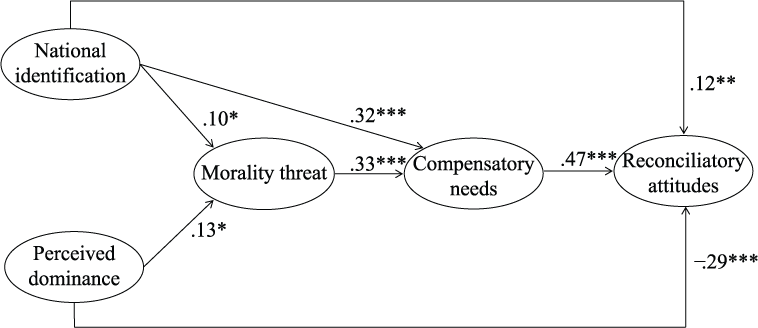
The revised model in Study 1. Numbers in the model are standardized path coefficients.
As shown in Figure 2, national identification increased morality threat, in line with Hypoth-esis 1a (β = .10, SE = 0.05, p = .040, 95% CI [0.005, 0.201]), and so did perceived dominance (β = .13, SE = 0.06, p = .038, 95% CI [0.007, 0.255]), supporting Hypothesis 1b. Confirming Hypothesis 2a, morality threat positively predicted compensatory needs (β = .33, SE = 0.04, p < .001, 95% CI [0.249, 0.419]). The additional direct path from national identification to compensatory needs was also significant (β = .32, SE = 0.04, p < .001, 95% CI [0.240, 0.398]). The indirect effect of national identification on compensatory needs via morality threat was significant, as predicted in Hypothesis 2b (indirect effect: β = .03, SE = 0.02, p = .042, 95% CI [0.001, 0.067]). Confirming Hypothesis 3a, national identification increased reconciliatory attitudes (β = .12, SE = 0.04, p = .005, 95% CI [0.037, 0.203), whereas perceived dominance significantly decreased reconciliatory attitudes (β = −.29, SE = 0.05, p < .001, 95% CI [−0.376, −0.195]), supporting Hypothesis 3b. Compensatory needs increased reconciliatory attitudes (β = .47, SE = 0.05, p < .001, 95% CI [0.372, 0.559]), in line with Hypothesis 4a. Finally, confirming Hypothesis 4b which focused on the mediating role of compensatory needs, morality threat enhanced reconciliatory attitudes via compensatory needs (indirect effect: β = .16, SE = 0.03, p < .001, 95% CI [0.099, 0.212]).
Alternative Models
To examine the plausibility of the revised model, two nonnested alternative models were proposed. The Akaike information criterion (AIC) was used for comparison of nonnested models. Two models are significantly different if the ∆ AIC amounts to 4 or greater where a smaller AIC indicates better fits to the data (Burnham & Anderson, 2004). 4
Alternative Model 1
The group identity reaction model (see Verkuyten, 2009) suggests that threat perceptions lead people to identify strongly with their group and in turn, group identification affects these people’s attitudinal, emotional, and behavioural reactions to the threatening groups. Moreover, the sociofunctional threat-based approach to prejudice (Cottrell & Neuberg, 2005) describes that morality threat which stems from perpetrators’ perception of distress suffered by victims directly elicits reconciliatory attitudes, emotions, and behaviours. Based on these theories, we specified Alternative Model 1 in which morality threat preceded national identification, and morality threat directly predicted reconciliatory attitudes (see Figure 4 in the supplementary materials). However, we reasoned that this alternative model would be inferior to the revised model. This is because the NBMR, as suggested by Shnabel and Nadler (2008), posits that the impact of morality threat on reconciliatory attitudes should be fully instead of partially mediated by compensatory needs. As a result, adding a direct path from morality threat to reconciliatory attitudes is theoretically unnecessary. In support, the AIC (14175.768) of this rival model were significantly higher than those of the revised model (AIC = 14169.583; ∆AIC = 6.185), indicating that the original (revised model) fitted the data better than the Alternative Model 1. Indeed, as shown in Figure 4 in the supplementary materials, the direct path from morality threat to reconciliatory attitudes was not significant.
Alternative Model 2
The group identity moderator model (Verkuyten, 2009) posits that social identification and intergroup threat interact to affect people’s attitudinal, emotional, and behavioural reactions to threatening groups. Moreover, research by Doosje, Branscombe, Spears, and Manstead (1998) found the more people identified with their group the more they reacted defensively (i.e., felt less guilty) to their group’s mistreatment of another group. This observation, as argued by Shnabel et al. (2009), implies that high-identifying members of the perpetrating group would be less likely to experience needs for social acceptance and restoration of moral image compared to low identifiers, which in turn suppresses their reconciliatory attitudes. We accordingly specified Alternative Model 2 in which national identification and morality threat, as well as national identification and compensatory needs, interact to predict reconciliatory attitudes (see Figure 5 in the supplementary materials). However, we expected this second alternative model to fit the data more poorly than the original revised model. This is because Shnabel and Nadler (2008) reasoned that within the NBMR, compensatory needs for social acceptance and restoration of moral image are a potent factor to boost reconciliatory attitudes towards the victim group, regardless of the level of the perpetrating group’s social identification. Shnabel et al. (2009) found that identification with the perpetrating group did not moderate the extent to which fulfilment of this particular group’s need for social acceptance increased its willingness to reconcile with the victim group. The AIC difference between this alternative model (14171.121) and the original revised model (14169.583) did not reach significance (∆AIC = 1.534). These results imply that the original revised model and the Alternative Model 2 fitted the data equally well. 5
Discussion
The original hypothesized model in Study 1 was revised by including a direct path from national identification to compensatory needs for social acceptance and restoration of moral image. This suggestion makes theoretical sense as the NBMR posits that the primary goal of compensatory needs is to restore the perpetrating group’s public moral image (Nadler & Shnabel, 2008). There is ample empirical evidence to attest to the fact that the more people identify with their group, the more they support actions that can enhance the positive image of their own group (Branscombe, Ellemers, Spears, & Doosje, 1999; Ellemers et al., 2002). The current finding is in line with this notion: in an attempt to protect the ingroup’s moral image, which is threatened by previous wrongdoings committed against the separatist group, high-identifying majority members demonstrated higher levels of compensatory needs for social acceptance and restoration of moral image compared to low-identifying majority members.
All of the hypotheses regarding the unique relationships within the model in Study 1 were confirmed. However, Study 1 bears two potential limitations that deserve discussing. First, the fit of the second alternative model was comparable to that of the original revised model. In this alternative model, reconciliatory attitudes were additionally predicted by the interaction of national identification and morality threat, as well as by the interaction of national identification and compensatory needs. The results revealed that the paths from the two interaction terms to reconciliatory attitudes were not significant. This suggests that the second alternative model is empirically inferior to the original revised model, despite the fact that both fitted the data equally well. A follow-up study is nonetheless necessary, in order to test the consistency of these findings.
The second limitation is that Study 1 focused exclusively on how separatism threat relates to reconciliatory attitudes. But reconciliatory attitudes are just a precursor of reconciliatory behaviours. In other words, reconciliation requires reconciliatory behaviours, which may evolve from both reconciliatory attitudes and reconciliatory emotions (Malloy, 2008; Stephan, 2008).
Study 2
Study 2 was designed as a second test as well as an extension of the model as developed in Study 1. By investigating Javanese participants’ responses to separatism in West Papua, as opposed to Aceh, we could not only replicate the findings of the first study but also investigate its generalizability to another separatism conflict involving a culturally different separatist group and a different level of conflict intensity. In this eastern region of Indonesia, separatist tendencies are current and stronger than those in Aceh, where they are more dormant. Study 2 also aimed to validate the notion that reconciliation is a multidimensional construct, covering not only reconciliatory attitudes but also reconciliatory emotions and behaviours, and reconciliatory attitudes and emotions are a precursor of reconciliatory behaviours.
Reconciliatory Emotions and Behaviours
Reconciliatory emotions refer to the transformation of conflictive emotions such as revenge and anger, which are pervasively felt by group members against their adversaries in intergroup conflicts, into other emotions such as guilt and shame (Bar-Tal & Bennink, 2004). Reconciliatory behaviours denote certain actions of the perpetrating group such as willingness to apologize and making reparations (Stephan, 2008). Reconciliatory emotions and attitudes are necessary precursors of reconciliatory behaviours (Malloy, 2008; Stephan, 2008). Indeed, collective guilt and shame have been found to predict support for making reparations to victimized minority groups (Allpress, Barlow, Brown, & Louis, 2010; van Leeuwen et al., 2013).
We generated a number of additional hypotheses for Study 2. Prior studies found that group identification positively predicted collective guilt (Doosje, Branscombe, Spears, & Manstead, 2006) and shame (Johns, Schmader, & Lickel, 2005) when the ingroup was accountable for historical transgressions. Drawing on these findings, we predicted that national identification would be positively related to reconciliatory emotions (Hypothesis 5).
We also expected that reconciliatory attitudes and emotions, separately, would predict reconciliatory behaviours (Hypothesis 6). The NBMR posits that morality threat experienced by a powerful group triggers compensatory needs, which ultimately heighten reconciliatory emotions of collective guilt and shame, as well as reconciliatory behaviours towards the powerless group. Our next hypotheses therefore were that compensatory needs would predict the majority’s reconciliatory emotions (Hypothesis 7a) and reconciliatory behaviours (Hypothesis 7b), and that compensatory needs would mediate the effect of morality threat on reconciliatory emotions (Hypothesis 7c) and reconciliatory behaviours (Hypothesis 7d). Moreover, we expected that the effect of morality threat on reconciliatory behaviours would be mediated by reconciliatory emotions (Hypothesis 7e).
Kessler et al. (2010) found that Germans’ sense of dominance fostered negative emotions such as anger, irritation, and annoyance vis-à-vis nondominant groups. These findings show that perceived dominance boosts conflictive emotions, but they do not clarify how dominance affects reconciliatory emotions. We predicted that the direct effect of the majority’s perceived dominance on reconciliatory emotions would be mediated by morality threat (Hypothesis 8).
Method
Participants and Design
Five hundred participants took part in this study in exchange for a small fee. They were Javanese undergraduate students from four universities in Java, Indonesia (University of Brawijaya [241], State University of Malang [30], State University of Sebelas Maret [80], and Islamic State University of Pekalongan [149]; 374 were female; Mage = 19.79, SDage = 1.08). The design of Study 2 was a correlational survey, identical to Study 1.
Procedure
The procedure and materials were the same as in the first study, with the following exceptions. First, the terms Aceh or Acehnese were replaced with Papua or Papuans. Second, we included measures of reconciliatory emotions and reconciliatory behaviours.
The questionnaire included measures of national identification (α = .86), status difference (α = .85), power difference (α = .89), morality threat (α = .89), social acceptance (α = .91), restoration of moral image (α = .87), positive outgroup attitudes (α = .84), positive outgroup stereotypes (α = .84), and outgroup trust (α = .66). Status difference and power difference were combined into a latent construct of perceived dominance. Social acceptance and restoration of moral image were combined into a latent construct of compensatory needs. Positive outgroup attitudes, positive outgroup stereotypes, and outgroup trust were combined into a latent construct of reconciliatory attitudes. 6
Reconciliatory emotions consisted of two scales: Collective guilt and collective shame. We assessed collective guilt with four items adapted from Wohl and Branscombe (2005; e.g., “I feel guilty about the awful things the Indonesian military did to the Papuans”; α = .93). Collective shame was assessed by five items adapted from Brown and Cehajic (2008; e.g., “It makes me feel ashamed when I see an international report on the treatment on Papuans by the Indonesian military”; α = .86). Reconciliatory behaviours consisted of three scales: Willingness to apologize, willingness to cooperate, and support for affirmative action. We assessed willingness to apologize with four items adapted from McGarty et al. (2005; e.g., “I would like to apologize to Papuans about the wrongdoings committed by the Indonesian government against them in the past”; α = .88). Willingness to cooperate was measured with four items adapted from Scott, Bishop, and Chen (2003; e.g., “I am willing to cooperate with the Papuans”; α = .88). Support for affirmative action was assessed by six items adapted from Swim and Miller (1999; e.g., “A certain quota of Papuans, even if not all of them are fully qualified, should be admitted to colleges and universities in Indonesia”; α = .68).
Finally, participants were paid, thanked, and debriefed after filling out some demographic information including age, gender, ethnicity, religion, university department, and university affiliation.
Results
The data in Study 2 did not have any missing values. To test the goodness of fit of the hypothesized structural model, we therefore used the MLM estimator that is suitable for data with no missing values and that does not assume multivariate normality (cf. Muthén & Muthén, 1998–2015). Using the same item-parcelling techniques as in Study 1, Figure 3 presents the hypothesized full model. This model overall had very good fits to the data (RMSEA = .036, 90% CI [0.026, 0.046], CFI = .99, TLI = .98).
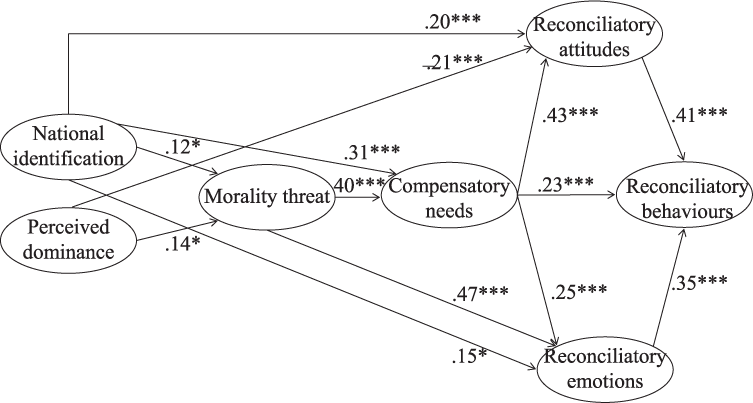
The hypothesized model in Study 2. Numbers in the model are standardized path coefficients.
As shown in Figure 3, national identification was a positive predictor of morality threat (β = .12, SE = 0.05, p = .014, 95% CI [0.025, 0.223]), as was perceived dominance (β = .14, SE = 0.06, p = .012, 95% CI [0.031, 0.245]). Morality threat gave rise to compensatory needs (β = .40, SE = 0.05, p < .001, 95% CI [0.307, 0.496]), and the additional path from national identification to compensatory needs was also significant (β = .31, SE = 0.05, p < .001, 95% CI [0.209, 0.419]). National identification in turn indirectly increased compensatory needs via morality threat (indirect effect: β = .05, SE = 0.02, p = .015, 95% CI [0.009, 0.090]). National identification increased reconciliatory attitudes (β = .20, SE = 0.05, p < .001, 95% CI [0.093, 0.305]), whereas perceived dominance decreased reconciliatory attitudes (β = −.21, SE = 0.04, p < .001, 95% CI [−0.293, −0.133]). Compensatory needs increased reconciliatory attitudes (β = .43, SE = 0.07, p < .001, 95% CI [0.293, 0.572]), and they mediated the effect of morality threat on reconciliatory attitudes (indirect effect: β = .17, SE = 0.03, p < .001, 95% CI [0.116, 0.232]). These findings are in full support of hypotheses 1a through 4b and replicate the results from Study 1.
In line with Hypothesis 5, national identification increased reconciliatory emotions (β = .15 SE = 0.06, p = .013, 95% CI [0.030, 0.263]). In support of Hypothesis 6, both reconciliatory attitudes and reconciliatory emotions increased reconciliatory behaviours—for the effect of reconciliatory attitudes (β = .41, SE = 0.05, p < .001, 95% CI [0.316, 0.500]); for the effect of reconciliatory emotions (β = .35 SE = 0.05, p < .001, 95% CI [0.259, 0.441]).
Compensatory needs positively predicted either reconciliatory emotions (β = .25, SE = 0.07, p = .001, 95% CI [0.108, 0.392]) and reconciliatory behaviours (β = .23, SE = 0.05, p < .001, 95% CI [0.121, 0.331]), and they also mediated the effect of morality threat on reconciliatory emotions (indirect effect: β = .10, SE = 0.03 p < .001, 95% CI [0.047, 0.153]) and reconciliatory behaviours (indirect effect: β = .09, SE = 0.02 p < .001, 95% CI [0.046, 0.135]). These findings were in support of Hypotheses 7a, 7b, 7c, and 7d, respectively. As predicted in Hypothesis 7e, reconciliatory emotions mediated the effect of morality threat on reconciliatory behaviours (indirect effect: β = .16, SE = 0.03, p < .001, 95% CI [0.106, 0.223]). The effect of perceived dominance on reconciliatory emotions was mediated by morality threat (indirect effect: β = .07, SE = 0.03, p = .010, 95% CI [0.016, 0.114]), corroborating Hypothesis 8. These findings confirmed all hypotheses in Study 2.
Alternative Models
Alternative Model 1
The first alternative model is a combination of group identity reaction where morality threat affects national identification and the sociofunctional threat-based approach to prejudice where this threat also affects reconciliatory attitudes and behaviours. The AIC of this alternative model (12720.730) did not significantly differ from the AIC of the hypothesized model (12720.222; ∆AIC = .508). However, as shown in Figure 7 in the supplementary materials, the path from morality threat to reconciliatory attitudes was not significant, consistent with the finding in Study 1. The path from morality threat to reconciliatory behaviours was also not significant. Thus, even though the alternative model fitted the data equally well as the hypothesized model, for reasons of parsimony the hypothesized model should be considered superior.
Alternative Model 2
The second alternative model is the group identity moderator model in which national identification moderates the effect of morality threat on reconciliatory attitudes, emotions, and behaviours. This model specification was combined with the interaction of national identification and compensatory needs in predicting each of the three reconciliation domains. The AIC (12725.680) of this alternative model was significantly greater than the AIC (12720.222; ∆AIC = 5.458) of the hypothesized model. Indeed, as shown in Figure 8 in the supplementary materials, neither the interaction of national identification and morality threat nor that of national identification and compensatory needs significantly predicted reconciliatory attitudes, emotions, and behaviours. These findings show that the hypothesized model fitted the data better than the second alternative model.
Discussion
The findings in Study 2 replicated those from Study 1. They also supported our additional hypotheses in which we predicted that reconciliatory attitudes and reconciliatory emotions are precursors of reconciliatory behaviours. The outcomes of reconciliation are mutual cooperation and willingness of a perpetrator group to apologize for their wrongdoings against a victimized group (Bar-Tal & Bennink, 2004). To achieve this outcome, however, parties in dispute during a process of reconciliation require maintaining positive attitudes and mutual trust, as well as positive emotions such as guilt and empathy. Previous research often operationalized reconciliation as specific behaviours such as support for reparative actions (Allpress et al., 2010), commitment to apology (McGarty et al., 2005), or a general behaviour of willingness to reconcile (Shnabel & Nadler, 2008). This study, therefore, was the first to differentiate between reconciliatory attitudes, emotions, and behaviour.
General Discussion
Despite the global prevalence of separatist conflict, there is a surprising shortage of research into the psychological mechanisms that drive this particular form of conflict, and even more so of research into the majority’s responses to separatist tendencies (but see van Leeuwen & Mashuri, 2013). The aim of the current research was to fill this void, by looking at variables that predict majority members’ attitudes and emotions towards reconciliation with a separatist group, as well as their reconciliatory behaviours. Supporting our main predictions, morality threat promoted reconciliatory attitudes, emotions, and behaviours by activating compensatory needs for social acceptance and restoration of moral image.
The finding that morality threat fostered compensatory needs, which ultimately resulted in stronger reconciliatory attitudes (Study 1 and Study 2), emotions and behaviours (Study 2), highlights the pivotal role of morality in separatist conflict. Morality threat is typically conceptualized as group members’ own perception of their group (e.g., Brambilla et al., 2013; Does, Derks, Ellemers, & Scheepers, 2012). However, in the current research, we studied morality threat as a form of metastereotype, referring to negative characterizations or evaluations that ingroup members believe others hold about the ingroup (Vorauer et al., 1998). Crucially, they may not agree with these characterizations, but are still concerned about the ingroup’s public image. Hopkins et al. (2007; see also van Leeuwen & Täuber, 2012) argued that negative metastereotypes activate group reputation concerns. Within the context of the current research, the majority’s belief that others consider their group’s behaviour as immoral, regardless of their own judgements of the morality of their group’s actions, resulted in stronger needs to restore their group’s moral image through reconciliation. This distinction between perceived and metastereotypic morality threat is important because it opens up avenues for interventions that could contribute to the resolution of separatist conflicts, as we will explain further in this section.
We distinguished between three levels of reconciliation: reconciliatory attitudes, emotions, and behaviours. The needs-based model of reconciliation posits that the key determinant of reconciliation for a perpetrator group is the willingness of this group to apologize for their wrongdoings against the minority as a victim (Shnabel & Nadler, 2008). Whether reconciliatory behaviours will ensue, according to the model, directly depends upon the willingness of the victimized group to acknowledge the importance of the perpetrator’s compensatory needs of social acceptance and restoration of moral image. However, these compensatory needs predicted reconciliatory behaviours via reconciliatory attitudes and emotions. This has two implications. First, it suggests that the NBMR would benefit from incorporating reconciliatory attitudes and emotions as antecedents of reconciliatory behaviours. Second, the findings support the NBMR by demonstrating that the majority can be an actor of positive social change (see Shnabel & Ullrich, 2013, for a review). Reconciliatory attitudes from the majority’s side imply that this group is willing to share their privileged power and economic resources with the separatist group, for example through affirmative action. Such attitudes are noteworthy because they counter the majority’s concern over defending the status quo they enjoy (Iyer & Leach, 2010). In short, the observation that the majority can be an agent of peace provides hope for the resolution of separatist conflict.
Finally, we found that national identification fostered reconciliatory attitudes. This finding is in line with the common ingroup identity model (CIIM; Dovidio et al., 2009), and extends the model to the context of separatist conflict. The CIIM reasons that a superordinate identity that encompasses both the majority and the separatist group contributes to the first group’s solidarity (see Stewart et al., 2016) towards the latter group. Consequently, the majority might feel implicated by the disadvantages of the separatist group (Subašić, Schmitt, & Reynolds, 2011). Reconciliatory attitudes then arise even though the majority group is aware that the separatist group is challenging the integrity of a united nation, a status quo the majority group is defending.
Limitations and Suggestions for Future Research
Aside from resonating reputation management concerns, morality threat in our research aligns with research on morality criticism and collective guilt and shame, in the sense that ingroup members acknowledge that their wrongdoings against another group are illegitimate (Leach et al., 2015). Morality threat in this regard induces ingroup-directed emotions such as guilt and shame, which ultimately increase support for reconciliation with the victimized group. Indeed, Harth, Kessler, and Leach (2008) found that ingroup members experienced guilt when they believed their ingroup had illegitimately imposed injustice on another group. However, Leach et al. (2015) pointed out that morality threat can also elicit moral disengagement, which hinders reconciliation by fostering dehumanization of the victimized group. The perceived legitimacy of wrongdoings may be a crucial factor in determining the extent to which morality threat gives rise to feelings of collective guilt which promote reconciliation, or to moral disengagement which obstructs reconciliation. This notion could be investigated in future research.
Roccas, Klar, and Liviatan (2006) differentiated between two facets of group identification: attachment and glorification. The first connotes the degree of both cognitive and emotional attachments to the in-group, whereas the second has to do with the beliefs in the superiority of and deference to group norms and symbols. Roccas et al. (2006) argued that glorification triggers defensive reactions to ingroup historical wrongdoings, whereas attachment is more likely to elicit acknowledgment of the wrongdoings. In support, their research showed that attachment was positively associated with feelings of collective guilt over ingroup wrongdoings, whereas glorification was negatively related to collective guilt. Moreover, Leidner, Castano, Zaiser, and Giner-Sorolla (2010) found that glorification, but not attachment, increased people’s resistance to making reparations to the victims of the ingroup’s mistreatment. As the current research assessed group identification in terms of national attachment, future studies could include measures of national glorification to examine the separate effect of both forms of identification on reconciliatory emotions, attitudes, and behaviours.
The focus of the current research was on morality threat as an identity motive that moulds the extent to which the majority is willing to reconcile its conflict with a separatist group. However, as put forward in the introduction, separatist conflict is not exclusively rooted in identity or psychological motives, but also in political and economic motives. For example, separatism within a country can be a threat involving territory loss (Hjerm & Schnabel, 2010) or threaten domestic security (Clarke, 2007). Separatism can also threaten the national economy, especially if the separatist group is rich in natural resources from which the majority readily profits (van Leeuwen & Mashuri, 2013). Future research could investigate these various forms of political and economic threat, and their influence on reconciliatory attitudes. This could provide useful information for composing a comprehensive model of both peaceful and violent responses to separatist conflict, which simultaneously integrates identity and realistic motives. This comprehensive model could subsequently help policy makers to develop policies and intervention programs to tackle hurdles in the peace-making process and promote support for reconciliation among members of the majority.
Practical Implications
In conflict, both parties have a tendency to view themselves as victims. However, viewing the ingroup as a victim can trigger moral credentialing or moral licensing, which boosts feelings of moral superiority and reduces the likelihood of future moral behaviours (Monin & Jordan, 2009). In contrast, viewing the ingroup as perpetrator implies an increased awareness of the ingroup’s wrongdoings, which can activate a sense of moral debt (Sullivan, Landau, Branscombe, & Rothschild, 2012). We thus propose that an intervention that aims to change the majority’s view of its own role in the conflict from that of victim to that of perpetrator is a potentially powerful tool to increase reconciliatory attitudes and behaviours.
One way to change ingroup perceptions from victim to perpetrator is by focusing group members on their group’s moral image as seen by outsiders. Morality threat, after all, is a potent trigger for reconciliation. The challenge of such an intervention is that it requires groups to be susceptible to other groups’ perception of the ingroup. Conflict tends to elicit a focus on the own group’s interests (Pratto & Glasford, 2008), at the expense of attention to other parties not involved in the conflict. It is therefore important to redirect the majority’s attention from an inward focus to an outward focus. One possible way of achieving this is by increasing the majority group’s awareness that separatist conflict is not a merely domestic issue, but a human rights issue involving the international community. They should be made aware that the international community is closely monitoring their actions, and passing judgement when these actions are perceived as unjust or violating human rights. Through continuous awareness of international attention, groups engaged in separatist conflict may find it more difficult to withdraw to a “victim” mindframe and, instead, are forced to consider the morality and legality of their actions vis-à-vis the other group.
Footnotes
Funding
The first author was awarded the Netherlands Fellowship Programmes (NFP; Grant number CF8784/2013) which supported this research.
Notes
References
Supplementary Material
Please find the following supplemental material available below.
For Open Access articles published under a Creative Commons License, all supplemental material carries the same license as the article it is associated with.
For non-Open Access articles published, all supplemental material carries a non-exclusive license, and permission requests for re-use of supplemental material or any part of supplemental material shall be sent directly to the copyright owner as specified in the copyright notice associated with the article.
