




Abstract
Political action is one of the main methods of social change. Previous research has shown that readiness to participate in such actions is determined by an evaluation of the current situation. The question arises as to how stable beliefs influence such evaluations. In this study we have analyzed the link between such beliefs and readiness to participate in political actions. We assumed that just and dangerous world beliefs are factors that influence readiness to participate in political actions. However, these factors’ influence is mediated by political efficacy. Respondents from Russia (N = 440) and Ukraine (N = 249) participated in our study. Structural equation modeling partly confirmed the hypotheses. It has shown that the more people believe in a just world and the less they believe in a dangerous world, the higher their internal and external political efficacy is. Political efficacy, in turn, predicts readiness to participate in various forms of political action. Internal political efficacy is positively linked to normative political collective actions, while external political efficacy is negatively linked to nonnormative collective actions. However, the extent of these patterns is dependent on cultural context.
Political action aimed at changing the existing sociopolitical situation is one of the main methods of social change. Such activity may take various forms. Researchers usually point out that such action may take either personal or collective forms (Klandermans, 1984; van Stekelenburg & Klandermans, 2010). In recent years, scholars have been paying special attention to various forms of political collective actions, from signing petitions to engaging in armed skirmishes.
When researching political collective action one of the main questions that need to be addressed is what conditions contribute to the emergence of such behavior? For most of the second half of the 20th century researchers concentrated on the three factors that are thought to influence political action: social identity, political efficacy, and justice evaluation. In the last decades a number of models were proposed which aim to bring these factors together. Chief among them is van Zomeren’s dual-path model, which postulates that while social identity is a prerequisite for collective action, there are two paths which lead to action. The rational path is based on efficacy, while the emotional path is based on a feeling of injustice that leads to group-based anger (van Zomeren, Leach, & Spears, 2012; van Zomeren, Postmes, & Spears, 2008). When explaining the inception of these mechanisms, researchers often consider how people perceive their current situation. Particularly, group-based anger is seen as a result of external attribution of social injustice, while collective efficacy is seen as a result of perceived instrumental social support.
However, few researchers take into account that such factors as efficacy and the feeling of injustice depend on the way a person perceives and interprets information, which is determined by certain individual and relatively stable factors. Among such factors are social worldviews. Previous research has shown that social beliefs affect readiness to engage in political actions (e.g., Moore, 2008; Stroebe, 2013). However, those studies do not provide insight into how social worldviews are linked to the key variables that influence political collective actions. The goal of this study is to examine the link between social worldviews, political efficacy, and readiness to participate in various forms of political behavior.
Social Worldviews and Political Efficacy
Social worldviews are conceptualized as beliefs about what people are like, how they behave towards each other, and how they should be responded to and treated. Over the last 50 years, researchers have distinguished a number of social worldviews that represent a person’s belief in a “good” or “bad” world.
One notable example of a belief in a “good” world is just world belief (JWB) introduced by M. Lerner (Lerner, 1980). He postulated that most people believe that the world is just, and events and outcomes are logical and predictable. In such a world people get what they deserve and deserve what they get. Studies show that JWB has a positive influence on one’s life. It creates confidence in one’s ability to overcome difficulties (Dalbert, 1998), and also increases trust in others (Dalbert & Filke, 2007; Dittmar & Dickinson, 1993; Furnham, 1995; Lipkus & Bissonnette, 1996; Otto & Dalbert, 2005; Zuckerman & Gerbasi, 1977).
Another notable example, in this case of a belief in a “bad” world is dangerous world belief (DWB) introduced by J. Duckitt (Duckitt, 2001, 2006; Duckitt, Wagner, du Plessis, & Birum, 2002). It was described as a perception of the world as an unstable, dangerous, and threatening place where decent people are threatened by bad people. A person who believes in a dangerous world is constantly expecting an attack. As a result, such people are unsure of their ability to cope with life and don’t trust other people. The only exception is a political leader who commands uncritical and unreciprocated obedience from a person that believes in a dangerous world (Crowson, 2009; Jugert & Duckitt, 2009; Perry & Sibley, 2010; Perry, Sibley, & Duckitt, 2013; Sibley, Wilson, & Duckitt, 2007; Sibley, Wilson, & Robertson, 2007; van Hiel, Cornelis, & Roets, 2007; Weber & Federico, 2007).
A person who believes in a just world is likely to believe that their actions have an effect on the quality of their life. They also tend to be more trustful of others and eager to cooperate and are more likely to expect the world to react to their actions. A person who believes in a dangerous world has less faith in the effectiveness of their actions, is unlikely to cooperate, and wouldn’t expect the world to be responsive. Thus, JWB and DWB may influence efficacy.
Efficacy was described by A. Bandura (Bandura, 1977, 1997) as a person’s evaluation of their ability to perform at desired levels and reach desired outcomes. In his opinion, self-efficacy is one of the key factors that influence the actions of someone who has encountered hurdles on the path of achieving a goal (Bandura, 1977, 1997). Bandura made the distinction between general and specific self-efficacy. In the context of collective action researchers usually examine a particular type of specific self-efficacy—political efficacy, which can be defined as a feeling that an individual political action has or can have an impact on a political process (Campbell, Gurin, & Miller, 1954).
Political efficacy is conceptualized as having several dimensions. Most researchers distinguish between internal and external efficacy. Internal efficacy can be defined as an individual’s confidence in their or their in-group’s abilities to understand politics and to act politically. It is divided into personal (Caprara, Vecchione, Capanna, & Mebane, 2009; Morrell, 2005; Schulz, 2005) and collective (Klandermans, 1984; van Stekelenburg & Klandermans, 2010) efficacy. Personal political efficacy is a person’s evaluation of their ability to influence political processes. Collective political efficacy is a person’s assessment of the influence of their in-group. Internal political efficacy is taken into account in the majority of modern studies dedicated to political behavior.
At the same time external efficacy is rarely examined in psychological studies. It constitutes an individual’s belief in the responsiveness of the political system (Craig, Niemi, & Silver, 1990; Madsen, 1987; Schulz, 2005). People with a high level of external political efficacy believe that people in charge of their country are interested in providing transparency, equal political rights, freedom of speech, and are responsive to citizen’s requests.
We propose that the two different types of world beliefs are linked to political efficacy. Namely, since just world belief suggests confidence in one’s abilities, we can assume that it increases internal personal efficacy (Hypothesis 1a). Since it also increases one’s trust in other people, we can assume that JWB increases collective internal efficacy (Hypothesis 1b). Finally, if a person believes the world to be just, it is likely they would consider the government to be just and responsive. Therefore, we can assume that JWB leads to higher external efficacy (Hypothesis 1c). Dangerous world belief, on the other hand, entails a feeling of powerlessness and lacking control. Therefore, it can be assumed that DWB lowers personal internal efficacy (Hypothesis 1d). Since DWB also means that a person has trouble trusting others, we can assume that it lowers collective efficacy (Hypothesis 1e). Finally, a person that believes in a dangerous world likely sees the government as restrictive and unresponsive. Therefore, dangerous world belief leads to a lower external efficacy (Hypothesis 1f).
Political Efficacy and Political Behavior
The next point of interest is how political efficacy impact a person’s willingness to engage in particular forms of political behavior. Most researchers distinguish between various forms of political behavior, often based on the principle of whether they are normative or nonnormative. (Cameron & Nickerson, 2009; Tausch et al., 2011) For the purposes of this study we distinguish between five forms of political behavior, which compose a spectrum of normative and nonnormative options. Forms of behavior that conform to a society’s norms and laws—for example, voting, signing of collective petitions, and authorized street protests (organized with the fulfillment of legal requirements of either notifying the government or getting legal consent, if applicable)—are considered normative. On the other hand, illegal, uncommon, or immoral forms of behavior like unauthorized street protests (organized in violation of applicable laws and procedures) and violent protests are categorized as nonnormative. The most normative institutionalized form is voting, while the most nonnormative and noninstitutionalized form is violent street action. This classification has been used in a number of studies (Becker & Tausch, 2015; Reichert, 2016).
In general, most studies examine the link between internal political efficacy and people’s willingness to engage in various types of political activity, ranging from voting to street protests (Blackwood & Louis, 2012; Cakal, Hewstone, Schwär, & Heath, 2011; Cohen-Chen, Halperin, Porat, & Bar-Tal, 2014; Finkel, Muller, & Opp, 1989; Mannarini, Roccato, Fedi, & Rovere, 2009; Mummendey, Kessler, Klink, & Mielke, 1999; Rees & Bamberg, 2014; Tausch & Becker, 2013; van Zomeren, Leach, & Spears, 2010; van Zomeren, Postmes, & Spears, 2012; van Zomeren, Saguy, & Schellhaas, 2012; Zimmerman, 1989). The general consensus is that the higher people’s internal efficacy, the more willing they are to take part in such actions.
However, recent studies have shown that the relationship between internal political efficacy and collective action is not as clear-cut as it was previously thought to be. Namely, Tausch et al. (2011) point out that both normative and nonnormative forms of political action are likely to be influenced by efficacy in different ways. They argue that political efficacy positively affects normative forms of political action, with higher efficacy meaning higher readiness to engage in normative political behavior (Becker & Tausch, 2015; Tausch et al., 2011). Thus, we hypothesize that internal political efficacy, both personal and collective, is primarily linked to normative forms of political behavior such as voting, signing collective petitions, and engaging in authorized protests (Hypotheses 2a and 2b).
At the same time efficacy might have a negative influence on readiness to engage in violent collective action, meaning that people with low efficacy are more likely to commit violent political acts (Becker & Tausch, 2015; Tausch et al., 2011). We can assume that this role is primarily fulfilled by external efficacy. People who feel that the government is unwilling to take their opinion into account, have less trust in political leaders (Balch, 1974) and show less support of the political system (Iyengar, 1980). As a result, they are more inclined to disobey the rules of the system and to commit acts aimed at its destruction. Due to these considerations, we suppose that external political efficacy is more likely to be negatively linked to nonnormative forms such as engaging in unauthorized street protest and violent street actions (Hypothesis 2c). All research hypotheses are summarized in Figure 1.

Research hypotheses.
However, it should be noted that we also suggest that whether a form of political behavior is considered to be normative or nonnormative is largely dependent on a particular political culture and context at the time of research, which means that the categorization of forms may vary greatly between countries. As a rule, studies of different forms of collective action and factors that influence them are conducted in the European Union, while there is an extremely small pool of such studies in post-Soviet countries. In our study we decided to focus on the cases of Russia and Ukraine.
Social Context of the Study
Russia and Ukraine are a curious case of two countries having a long shared history, yet retaining separate national and cultural identities. This rift became all the more apparent in the last 25 years, as Russia and Ukraine underwent vastly different political processes.
In post-Soviet Russia, political actions such as mass protests proved to be relatively rare and ineffective. While there are indeed examples of mass political protests and actions (protests against the welfare reform of 2005, the postelection protests of 2011–2012), these two cases resulted in the protesters’ failure to sufficiently alter the sociopolitical situation in the country. Since 2012 the opposition made numerous attempts to organize large political demonstrations for various declared causes (demonstrations against the war in Ukraine, demonstration to protest the murder of Boris Nemtsov), all of which ultimately failed to attract a sufficient number of supporters and make a lasting impact. Subsequently, by 2015 Russians have come to exhibit an extremely low level of readiness to participate in mass protests. Recent polls by the NGO Levada-Center show that only 13% of Russians are ready to take part in mass protests against the decrease of quality of life (Levada-Center, 2015b), and only 10% are willing to participate in mass protests with any kind of political demands (Levada-Center, 2015a).
Meanwhile, post-Soviet Ukraine has not only had a large number of examples of mass protests, but also numerous instances when such actions had a lasting impact. Since the beginning of the 21st century, Ukraine has effectively gone through two revolutions. The so-called “Orange Revolution” of 2004 brought opposition leader V. Yushenko to power despite formal election results. A decade later, mass protests in Kiev led to the ousting of President V. Yanukovich and the establishment of a new government. As a result, Ukrainians exhibit a greater readiness to participate in mass protests. Polls conducted by the Ukrainian Centre for Economic and Political Studies (Razumkov Centre) in January 2015 show that 43% of respondents are ready to participate in protests. By July 2015 that figure dropped to 18%, which was the lowest mark since May 2013 (Razumkov Centre, 2015).
Study
Participants
Respondents from Russia and Ukraine took part in the present research. The Russian sample consisted of 440 Russian residents (76.40% men and 23.60% women), aged 23 to 77 years old (M = 38.99; SD = 11.62) and the Ukrainian sample of 249 Ukrainian residents (59.80% men and 40.20% women), aged 23 to 65 years old (M = 35.55; SD = 10.76). The data were collected with an electronic web-based questionnaire during December 2015. The online survey guaranteed respondents’ anonymity. The online version of the questionnaire was created on the website https://docs.google.com/ and distributed through social media (Facebook, Vkontakte). The participants took part in the study on a voluntary basis.
Method
Participants filled out online questionnaires measuring worldviews, political efficacy, and readiness to participate in political action. Two versions of the questionnaire were created—one for the Russian and one for the Ukrainian sample. Russians answered questions about the Russian government while Ukrainians answered questions about the Ukrainian government.
All the surveys were in Russian. This decision was made due to several reasons. Studies show that while a decreasing number of Ukrainians call Russian their “native” tongue, over 80% of the population can speak Russian and even prefer it for certain types of communication (Gradirovski & Esipova, 2008), meaning a lack of a real language barrier. Secondly, the survey was spread through social media pages and groups where Russians and Ukrainians discussed politics in Russian. Thirdly, the fact that all surveys were conducted using the same language removed the risk of translational errors and the need for methodological validation.
Just world belief
Belief in a just world was assessed with a scale developed by C. Dalbert (Belief in a Just World Scale; Dalbert, 1998). The Russian-language version of the scale (Nartova-Bochaver, Hohlova, & Podlipnyak, 2013) includes 13 direct statements: seven of them form the personal JWB scale (e.g. “I believe that I usually get what I deserve”) and six statements form the general JWB scale (e.g. “I believe that the world in general is just”). In this particular research only the general JWB scale was used. Participants were asked to indicate how much they agreed or disagreed with the statements using a 6-point response scale (1 = completely disagree, 6 = completely agree; for the Russian sample: α = .79, for the Ukrainian sample: α = .80).
Dangerous world belief
Belief in a dangerous world was measured by a scale developed by J. Duckitt (Dangerous World Beliefs Scale; Duckitt et al., 2002). The Russian-language version of the scale (Gulevich, Anikeenok, & Bezmenova, 2014) includes 10 items (five direct and five reverse coded): “There are many dangerous people in our society who will attack someone for no reason at all,” “The social world we live in is basically a safe, stable, and secure place in which most people are fundamentally good” (reverse coded). Participants were asked to indicate how much they agreed or disagreed with these statements using a 5-point response scale (1 = completely disagree, 5 = completely agree; for the Russian and Ukraine samples: α = .83).
Political efficacy
Political efficacy was assessed with a scale developed by I. Sarieva (Perceived Political Efficacy Scale; 2016). The scale derives from 12 direct statements which are combined into three subscales: Internal Personal Political Efficacy (e.g., “I can influence the making of new laws and political decisions”), Internal Collective Political Efficacy (e.g., “Together Russian citizens can influence the making of new laws and political decisions”), and External Political Efficacy (e.g., “People in charge of Russia are interested in creating equal opportunities for all political actors”). Participants were asked to indicate how much they agreed or disagreed with the statements using a 5-point response scale (1 = completely disagree, 5 = completely agree). Principal components analysis yielded three components with eigenvalues greater than 1 that accounted for 75.20% (for Russia) and 84.52% (for Ukraine) of the variance. Loadings, after varimax rotation showed that personal political efficacy loaded primarily on the first component (28.22%, α = .80 for Russia and 30.49%, α = .87 for Ukraine); collective political efficacy loaded on the second component (27.47%, α = .92 for Russia and 29.45%, α = .88 for Ukraine); and external political efficacy loaded on the third factor (19.50%, α = .89 for Russia and 22.59%, α = .84 for Ukraine).
Readiness to participate in political behavior
Participants were asked to indicate how much they were ready to take part in five forms of political action (voting, authorized street protests, unauthorized street protests, signing of collective petitions, and violent protests) using a 5-point response scale (1 =not quite ready, 5 = ready).
Results
Results derived from the Russian and the Ukrainian samples were analyzed separately. At the first stage we calculated descriptive statistics and employed one-sample and two-sample t test to compare the two samples. At the second stage we performed structural equation modelling (SEM) and compared the Russian and the Ukrainian models.
Descriptive Statistics and Sample Comparison
Descriptive statistics and intercorrelations were calculated using SPSS 17.0 for the main variables (see Tables 1 and 2).
Descriptive statistics and intercorrelations for research variables (Russia).

Note. DWB = dangerous world belief; JWB = just world belief; IPPE = internal personal political efficacy; ICPE = internal collective political efficacy; EPE = external political efficacy; SCP = signing collective petition; ACA = authorized collective actions; UCA = unauthorized collective actions; VCA = violent collective actions.
p ⩽ .001. **p ⩽ .01. *p ⩽ .05.
Descriptive statistics and intercorrelations for research variables (Ukraine).
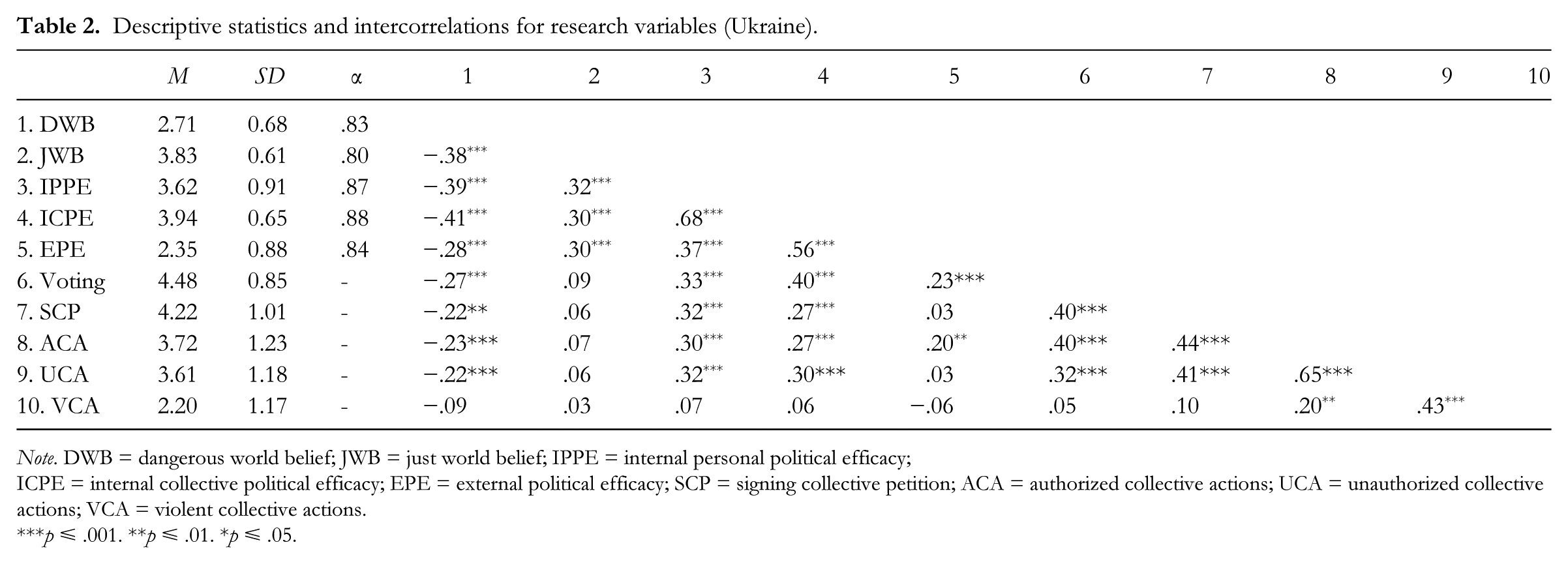
Note. DWB = dangerous world belief; JWB = just world belief; IPPE = internal personal political efficacy; ICPE = internal collective political efficacy; EPE = external political efficacy; SCP = signing collective petition; ACA = authorized collective actions; UCA = unauthorized collective actions; VCA = violent collective actions.
p ⩽ .001. **p ⩽ .01. *p ⩽ .05.
Social beliefs
Firstly, we compared the means and significant differences for the main variables for the Russian and the Ukrainian samples. Onе-sample t test showed that Russian participants indicated an average level of DWB, t(439) = −1.21, p = .083, and an average level of JWB, t(439) = 1.26, p = .112. Participants from Ukraine indicated a low level of DWB, t(248) = −6.60, p < .001, and high level of JWB, t(248) = 8.46, p < .001.
Secondly, upon comparing the two samples, the t test showed significant difference between DWB and JWB. We concluded that Ukrainians have a higher JWB, Ukrainian sample: M = 3.83, SD = 0.61; Russian sample: M = 3.55, SD = 0.81; t(687) = 4.80, p < .001; while Russians have a higher DWB, Ukrainian sample: M = 2.71, SD = 0.68; Russian sample: M = 2.96, SD = 0.73; t(687) = −4.32, p < .001.
Political efficacy
Political efficacy showed different results for the Ukrainian and Russian samples. Russians exhibited a low level of personal, t(439) = −21.19, p < .001; collective, t(439) = −5.17, p < .001; and external political efficacy, t(439) = −45.12, p < .001. Ukrainians showed a low level of external political efficacy, t(248) = −10.15, p < .001, but high level of personal, t(248) = 10.70, p < .001, and collective efficacy, t(248) = 22.89, p < .001.
Upon comparing the two samples, the t test showed significant difference for all types of political efficacy. Ukrainians exhibited a higher level of all three types of political efficacy: internal personal, Ukrainian sample: M = 3.62, SD = 0.91; Russian sample: M = 2.04, SD = 0.95; t(687) = 21.25, p < .001; internal collective, Ukrainian sample: M = 3.94, SD = 0.65; Russian sample: M = 2.67, SD = 1.26; t(687) = 14.63, p < .001; and external, Ukrainian sample: M = 2.35, SD = 0.88; Russian sample M = 1.44, SD = 0.73; t(687) = 14.51, p < .001.
Political collective actions
Initially we planned on comparing readiness to engage in normative and nonnormative forms of behavior in general. However, we discovered using exploratory factor analysis that the five forms of political behavior formed different factors for the Russian and the Ukrainian samples. Two factors were formed for both samples, but the factors’ content was different. For the Russian sample one factor was loaded with voting behavior (65%) and signing petitions (74%), while engaging in authorized (64%), unauthorized (91%), and violent (76%) street actions formed another one. For the Ukrainian sample voting (54%), signing petitions (73%), authorized (73%), and unauthorized (75%) street protests formed one factor, while violent street protests (80%) formed another. Due to this consideration we analyzed all types of political behavior separately.
In general, Russians showed a high level of readiness to vote, t(439) = 10.30, p < .001; sign collective petitions, t(439) = 11.05, p < .001; and engage in authorized street protests, t(439) = 8.20, p < .001; an average level of readiness to engage in unauthorized street protests, t(439) = −1.29, p = .199; and a low level of readiness to engage in violent protests, t(439) = −12.40, p < .001. At the same time, Ukrainians indicated a high level of readiness to vote, t(248) = 27.58, p < .001; sign collective petitions, t(248) = 19.01, p < .001; engage in authorized street protests, t(248) = 9.32, p < .001; engage in unauthorized street protests, t(248) = 8.21, p < .001; and a low level of readiness to engage in violent protests, t(248) = −10.71, p < .001.
Ukrainians indicated a higher level of readiness to vote, Ukrainian sample: M = 4.49, SD = 0.85; Russian sample: M = 3.70, SD = 1.43; t(687) = 7.93, p < .001; sign collective petitions, Ukrainian sample: M = 4.23, SD = 1.02; Russian sample: M = 3.70, SD = 1.34; t(687) = 5.37, p < .001; and engage in unauthorized street protests, Ukrainian sample: M = 3.62, SD = 1.19; Russian sample: M = 2.92, SD = 1.33; t(687) = 6.88, p < .001. At the same time, upon comparing the two samples we discovered that there is no significant difference in readiness to engage in violent street protest and authorized street protest.
Model Description and Comparison
To test our hypotheses, we used structural equation modeling (SEM) in Mplus (Version 7.11). The proposed model was tested. The model included 10 variables. The worldviews served as independent variables; the three types of political efficacy served as potential mediators. Readiness to engage in five forms of political actions consecutively served as dependent variables.
SEM results are shown in Figure 2 for the Russian sample and Figure 3 for the Ukrainian sample. Only significant links are presented in the figures. For the Ukrainian sample the model had perfect fit indexes, χ2 = 6.41, df = 10, p = .779; CFI = 1.00; RMSEA = 0.00, 96% CI [0.00, 0.05]; SRMR = 0.02, and for the Russian sample it had good fit indexes, χ2 = 16.55, df = 10, p = .085; CFI = 0.99; RMSEA = 0.04, 68% CI [0.00, 0.07]; SRMR = .0.02. Direct links between social worldviews and readiness to political action were insignificant and their inclusion didn’t improve model fit.

Tested model (Russian sample).

Tested model (Ukrainian sample).
In line with our hypotheses, the results have shown that worldviews were related to personal internal, collective internal, and external political efficacy. Both in the Russian and the Ukrainian samples JWB increased political efficacy, while DWB decreased it. These findings fully confirm Hypotheses 1а–1f.
Political efficacy, in turn, predicted readiness to engage in political behavior. In general, internal personal and collective efficacy better predicted readiness to engage in normative forms of behavior, while external efficacy predicted readiness to engage in nonnormative behavior. Namely, in both the Russian and the Ukrainian samples internal efficacy increased readiness to vote and sign petitions, while external efficacy affected readiness to participate in violent protests. However, there were also cultural differences.
Notably, in the Russian sample participation in authorized street protests was predicted by both internal and external efficacy. Internal efficacy increased readiness to engage in the protests, while external efficacy decreased it. At the same time, in the Ukrainian sample only internal efficacy had a link to authorized street protests. Higher internal efficacy led to higher readiness.
Readiness to engage in unauthorized street protests showed a different picture. For Russians, only external efficacy negatively predicted readiness to participate in such actions. At the same time, for Ukrainians readiness to engage in unauthorized protests was affected by both internal and external efficacy. Internal efficacy had a positive link to readiness to participate in such actions, while external efficacy had a negative link. These results once again partly confirm Hypotheses 2a, 2b, and 2c.
The comparison of the Russian and the Ukrainian models was conducted using the chi-square test and the Wald test. The chi-square test showed difference between the two samples (see Table 3), but using the Wald test on every path has shown that most links are universal. There are, however, three exceptions.
Model parameters.

Firstly, there is a difference in the link between dangerous world belief and internal personal political efficacy (W = 5.06, p < .05). There is a stronger negative effect in the Ukrainian sample.
Secondly, there is significant difference in the path between external political efficacy and authorized street protest (W = 20.09, p < .05). External political efficacy is negatively linked to authorized street protest in the Russian sample, but it has no significant connection in the Ukrainian sample.
Thirdly, there is significant difference in how the three types of political efficacy influence unauthorized street protest. In the Ukrainian sample readiness to participate in unauthorized street protests is influenced by all three types of efficacy. In the Russian sample only external political efficacy affects this factor; for internal personal: W = 3.84, p < .05; for internal collective: W = 3.92, p < .05; for external: W = 7.78, p < .05.
Discussion
In this study we have examined the link between worldviews, political efficacy, and readiness to participate in political action. We suggested that worldviews, representing belief in a “good” (just world belief) or “bad” world (dangerous world belief), may act as filters that affect political efficacy which includes a person’s belief in their own ability to influence political processes (internal political efficacy), their in-group’s ability (internal group efficacy), and also their expectations regarding the political system’s response (external efficacy). Political self-efficacy, in turn, might influence readiness to participate in different forms of normative and nonnormative political actions—from voting to violent street protests. However, we expected this link to have cultural specificity which is connected with the sociopolitical environment of societies. To investigate cross-cultural differences, we conducted the study in two countries with different sociopolitical environments—Russia and Ukraine.
Our results indicate that there are two universal patterns that are present across both the Russian and the Ukrainian samples. Firstly, both in Russia and Ukraine JWB positively predicts political self-efficacy, while DWB negatively predicts political self-efficacy. This is likely due to the fact that JWB and DWB are linked to a perceived predictability of the world as well as the ability to affect various outcomes. People who strongly believe in a dangerous world—but weakly in a just world—admit that a person is unable to predict the future or influence it through their actions, which results in low efficacy. Thus, JWB and DWB act as stable filters that constantly affect the way a person receives and interprets information and, as such, have a profound impact on further political decision-making.
Secondly, it can be said that in both samples high internal efficacy is generally better at predicting willingness to engage in normative forms of behavior. In particular, in both Russia and Ukraine readiness to vote and sign a petition is positively connected with internal political efficacy. At the same time, low external efficacy has a more pronounced influence on nonnormative forms of political behavior. More accurately, the role of external efficacy increases as we move towards the nonnormative side of the political behavior spectrum. In both Russia and Ukraine readiness to engage in violent protests is exclusively—and negatively—linked to external efficacy. This is likely due to the fact that low external efficacy represents a lack of trust in the government and lack of confidence that normative actions would get a response. As such, the most violent forms are chosen which cannot be ignored by the authorities and don’t fit into the established political system.
These results contribute to our understanding of the genesis of political action. Firstly, the findings pinpoint the role of relatively stable views and beliefs of the people that participate in such action. Previous studies have shown that there are three main variables which influence political action participation—political identification, political efficacy, and negative emotion toward an outgroup/political authority (Duckitt & Sibley, 2010). Most scholars view these variables as a product of a person’s evaluation of their current situation. However, a number of studies conducted over the last 20 years indicate that readiness to participate in political action is determined by relatively stable ideological dimensions. In particular, it has been noted that a person’s attitude towards protesters and readiness to participate in various forms of political action are negatively linked to right-wing authoritarianism (RWA; Duncan, 1999; Peterson, Smirles, & Wentworth, 1997, 1998) and social dominance orientation (SDO; Moore, 2008). This is due to the fact that RWA and SDO lessen a person’s identification with protest movements, as well as collective efficacy and anger toward political authority (Cameron & Nickerson, 2009; Green & Auer, 2013; Saeri, Iyer, & Louis, 2015).
In our study we have expanded on this idea. The results indicate that there is a link between readiness to engage in political action and social beliefs. There are two possible explanations for these results. On the one hand, we can assume that this occurs due to the link between social beliefs and ideological dimensions. According to Duckitt’s dual model, dangerous world belief (DWB) predicts RWA. As a result, the negative link between DWB and political self-efficacy could be explained by the corresponding level of RWA. Russian respondents’ stronger belief in a dangerous world (as compared to that in Ukrainian respondents) leads to a higher level of right-wing authoritarianism and, subsequently, lower self-efficacy and readiness to engage in political action. On the other hand, we can assume that the effects of just world belief and dangerous world belief on political self-efficacy are mediated by a different mechanism—the level of interpersonal trust. A lower level of trust diminishes a person’s belief in themselves and others and, subsequently, diminishes political efficacy. To confirm these possible explanations further research is needed.
The results of our study also show that there are culture-specific aspects of the link between political efficacy and readiness to participate in various forms of political action. While the basic principles of how internal and external efficacy affects readiness to engage in normative or nonnormative action remain the same, the definition of what actually constitutes a normative action or nonnormative action seems to be specific for each nation. For example, Russians mainly take into account the chance of punishment from the authorities (even authorized protests in Russia carry a risk of arrests and fines) and the amount of effort needed to participate. In contrast, Ukrainians are mainly concerned with whether a form of behavior entails violence and make a clear distinction between peaceful (voting, petitions, authorized and unauthorized nonviolent protests) and violent (violent protests) actions. In particular, in the Russian sample internal efficacy only predicts a single form of street action—authorized street protests. External efficacy, on the other hand, predicts all three types—authorized, unauthorized, and violent. Presumably that means that for Russian respondents authorized street protests represent the border between rational forms of political action that allow citizens to influence the political situation from within the system (voting, petitions) and the forms aimed at fighting the system (unauthorized and violent protests).
At the same time, in the Ukrainian sample internal efficacy predicts readiness to engage in both authorized and unauthorized street actions, while external efficacy predicts only unauthorized nonviolent and violent protests. Presumably, this means that unauthorized protests serve as the border between working within the system and against it.
It should be noted that we acknowledge a number of limitations to our research. Firstly, the fact that the survey was conducted only in Russian could be seen as a limitation since it impacts the representativeness of the Ukrainian sample for a number of reasons. It could push away respondents that have a negative attitude towards the Russian government. Thus, further research should use surveys in both languages.
Secondly, the fact that the survey was conducted exclusively online might be considered another limitation since it reduces exposure to certain demographics. Thus, it seems advisable to use also pen-and-paper surveys in further research.
Thirdly, in our study we only considered the rational path of collective action that is based on political efficacy, while most studies also consider the emotional path. It would be interesting to examine how emotions fit in our proposed model. Thus, in future studies it is plausible to consider the links between external efficacy and group anger.
Footnotes
Funding
This research received no specific grant from any funding agency in the public, commercial, or not-for-profit sectors.