




Abstract
We identify public opinion polls from other countries as an important form of indirect exposure to outgroups, and an important source of intergroup metaperceptions, outgroup perceptions, and support for group-level behavior towards outgroups. Three experiments demonstrate a two-step process through which such exposure affects support for ingroup behaviors that facilitate peaceful or violent intergroup relations. When indirectly exposed to national outgroups, Americans inferred intergroup metaperceptions (Step 1), which, in turn, shaped outgroup perceptions (Step 2). This effect and its underlying process occurred in relation to both fictitious (Experiment 2) and real outgroups (Iran, Experiment 1; Germany, Saudi Arabia, Experiment 3), as well as those similar (Germany) and dissimilar (Saudi Arabia) to the ingroup (Experiment 3). Further, this effect occurred beyond ingroup perceptions (Experiments 1–3), perceived intergroup threat (Experiments 2–3), and intergroup similarity (Experiment 3). Contributions to the literatures on cross-group contact, intergroup perceptions and attitudes, and image theory are discussed.
Keywords
Research has investigated how people think their own group is viewed by other groups, and how these intergroup metaperceptions affect experiences of, and behavior in, direct contact with members of other groups (Frey & Tropp, 2006; Plant & Devine, 2003; Shelton & Richeson, 2005; Shelton, Richeson, & Salvatore, 2005; Stephan, 2014; Vorauer, 2006; Vorauer, Main, & O’Connell, 1998; Vorauer & Turpie, 2004), as well as how intergroup metaperceptions affect how people want their group to behave towards other groups (Kteily, Hodson, & Bruneau, 2016). 1 Yet, in today’s globalized world, with the media creating ample opportunity for indirect contact (Bandura, 2001; Schiappa, Gregg, & Hewes, 2005), cross-group contact most often occurs indirectly rather than directly (see also Ortiz & Harwood, 2007). One form of media that indirectly exposes people to outgroups and their views on the ingroup involves reports of public opinion polls with data relevant to ingroup–outgroup relations (e.g., Americans seeing a poll of Iranians’ positions on Iranian policies relevant for U.S. interests). Although such media reports do not necessarily reflect the outgroup’s perception of the ingroup, people may draw on it to predict how the outgroup sees the ingroup. In other words, outgroup public opinion polls may generate, or change, preexisting intergroup metaperceptions. These should have downstream consequences on outgroup perceptions and intergroup attitudes—especially since in indirect exposure (rather than direct contact), people often lack first-hand experiences to inform their intergroup attitudes.
From Indirect Exposure to Outgroups to Support for Ingroup Behavior: A Two-Step Process
The media have been recognized as one of the most important, frequent, and prevalent sources of information people use to form or shape intergroup attitudes (Bandura, 2001; Schiappa et al., 2005) and intentions for intergroup behavior (Mazziotta, Mummendey, & Wright, 2011; Ortiz & Harwood, 2007). The key reason, in our view, is that media consumption exposes the consumer indirectly to outgroups and, psychologically, creates indirect intergroup experience—a major predictor of perceptions of the outgroup and behavior towards it (Christ et al., 2010; Crisp & Turner, 2009; Turner, Hewstone, Voci, & Vonofakou, 2008; Wright, Aron, McLaughlin-Volpe, & Ropp, 1997), as well as intergroup metaperceptions (Goómez & Huici, 2008; Wout, Murphy, & Steele, 2010). Synthesizing knowledge from the literatures on intergroup attitudes and behavior, group perceptions, and intergroup contact, we argue that media reports of outgroup public opinion regarding outgroup preferences towards policies relevant to the ingroup will affect intergroup attitudes and behavior (e.g., people’s support for aggressive or peaceful ingroup behavior towards the outgroup). This hypothesis is also in line with research on international image theory, showing that when people perceive an outgroup to endorse policies that are threatening or aggressive to the ingroup, they are more supportive of the ingroup’s use of force against the outgroup (Herrmann & Keller, 2004; Koopman, Snyder, & Jervis, 1990).
We further argue that the effect of indirect exposure to outgroups on intergroup attitudes and behavior occurs through changes in intergroup metaperceptions and outgroup perceptions. In line with this hypothesis, research has shown that intergroup metaperceptions and outgroup perceptions affect intergroup attitudes and behavior in tandem, by interacting with one another (Kamans, Gordijn, Oldenhuis, & Otten, 2009) or by one (metaperceptions) leading to the other (outgroup perceptions; Kteily et al., 2016). Yet, it is unclear how exactly outgroup perceptions and intergroup metaperceptions work in tandem to affect intergroup attitudes and behavior. That is, do they work in parallel, as the findings by Kamans et al. suggest, or in a certain sequence, as the findings by Kteily et al. suggest? We argue that the process hypothesized before occurs in two sequential steps in a specific order, from intergroup metaperceptions (Step 1) to outgroup perceptions (Step 2; see Figure 1).

Theoretical model of two-step process of effect of indirect exposure to outgroups on support for ingroup behavior towards the outgroup.
The Sequential Link From Intergroup Metaperceptions to Outgroup Perceptions
Our argument for a sequential two-step process where intergroup metaperceptions precede outgroup perceptions is rooted in research on the consequences of intergroup metaperceptions and social inclusion and rejection, and in research on international image theory. First, research on metaperceptions and social inclusion and rejection suggests that metaperceptions should lead to changes in outgroup perceptions. Negative metaperceptions reduce trust toward and intentions to interact with outgroup members (Méndez, Gómez, & Tropp, 2007; Tropp, Stout, Boatswain, Wright, & Pettigrew, 2006), trust in particular being a reflection of outgroup perceptions. Expectations of rejection from outgroup members—likely reflecting negative metaperceptions—can increase negative views of the outgroup (Barlow, Louis, & Hewstone, 2009), while expectations of inclusion by outgroup members—likely reflecting positive metaperceptions—encourage more positive relations with members of that outgroup (Tropp & Bianchi, 2006).
Second, according to international image theory, the action potential of intergroup metaperceptions is rooted in underlying beliefs about the outgroup and its motives, while the action potential of outgroup perceptions is rooted in underlying beliefs about the power differential and the structural relations between ingroup and outgroup (Boulding, 1959; Cottam, 1977). These latter beliefs aggregate to images of the outgroup as an “enemy” or “ally,” which define—and thus precede—the functional relations between the ingroup and the outgroup, which, in turn, determine outgroup perceptions (Alexander, Brewer, & Herrmann, 1999). In other words, outgroup perceptions should be closer to intergroup attitudes and behavior than intergroup metaperceptions. Outgroup images have been shown to predict outgroup-directed emotions as well as policy support (Bilali, 2010).
The research briefly reviewed in the previous lines thus lends support to our hypothesis that intergroup metaperceptions precede outgroup perceptions in carrying the effect of indirect exposure to outgroups on intergroup attitudes and behavior. Further, they support our contention, implied in this hypothesis, that intergroup metaperceptions have consequences for intergroup attitudes and behavior.
While people may also project how they see the outgroup onto how the outgroup views the ingroup (i.e., outgroup perceptions influencing intergroup metaperceptions), such projection is more likely for specific beliefs or stereotypes than for the more broad-based perceptions (e.g., negative/positive; see Yzerbyt, Judd, & Muller, 2009) relevant to the present context. Yet, per se outgroup perceptions may precede metaperceptions under specific circumstances where people are motivated to use negative metaperceptions as post hoc justification/rationalization of outgroup-directed hostility or negativity (e.g., “I hate them because they hate us”). Thus, although the relationship between intergroup metaperceptions and outgroup perceptions can likely go in both directions, metaperceptions preceding outgroup perceptions is more plausible and likely more frequent.
Similarly, a process whereby intergroup metaperceptions and outgroup perceptions operate in parallel is unlikely. While outgroup perceptions should directly affect support for ingroup behavior toward the outgroup, intergroup metaperceptions should only do so indirectly, but not directly. The reason is, as mentioned earlier, that people’s metaperceptions have less action potential than outgroup perceptions.
Overview of Studies
Experiment 1 tested our hypotheses in a realistic context, making use of a national outgroup with whom the US has had tense relations for over three decades (Iran) at the time of data collection. Experiment 2 provided a conceptual replication and tested whether the two-step process would generalize to situations where people hold no preexisting attitudes of the outgroup, making use of a fictional outgroup. Ruling out the possibility that perceived threat could account for the indirect effects of indirect exposure to outgroups on intergroup attitudes and behavior, Experiment 2 also controlled for perceived intergroup threat. Exposing participants to one of two countries that varied in terms of perceived similarity to the US (Germany and Saudi Arabia), Experiment 3 tested whether the effects depended upon the specified outgroup. Additionally, Experiment 3 controlled for both perceived intergroup threat and ingroup–outgroup similarity. Since people vary in how positively or negatively they view their ingroup, and such ingroup perceptions can influence both intergroup metaperceptions and outgroup perceptions, all experiments controlled for participants’ perceptions of the ingroup.
Experiment 1
Method
Participants
Of 319 adults recruited through Amazon’s Mechanical Turk (MTurk), 13 were excluded because they were not born in the US or did not speak English as their first language, 15 because they did not spend sufficient time on the study, and 32 for failing a manipulation check. This left 259 participants for final analyses (ages 18–74, M = 38.83, SD = 13.87; 116 males). This exclusion of 19% of the sample was within normal range (3–31%) for online studies (Chandler, Mueller, & Paolacci, 2014) and the use of carefully selected exclusion criteria have been deemed crucial to ensure sufficient data quality (e.g., Curran, 2016).
Procedure
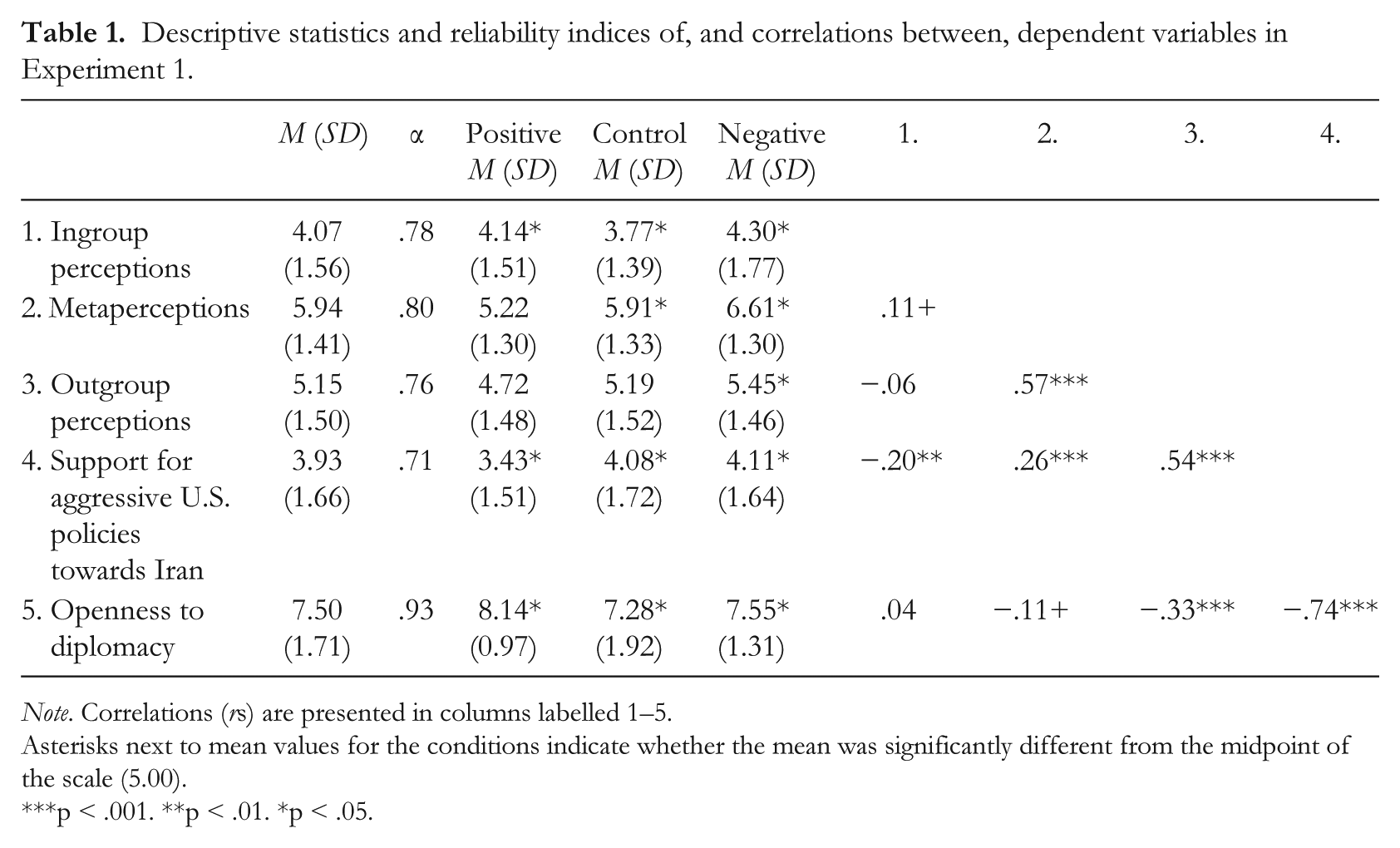
We randomly assigned participants to one of three conditions. In two of these, participants read a report on a fictitious but allegedly real Gallup poll showing that a majority of the Iranian public favored policies that were either positive or negative toward the US (positive and negative indirect exposure conditions, respectively). Importantly, the report did not give direct information about Iranians’ opinions of Americans. It simply stated that Iranians support policies described as “peaceful” or “aggressive” towards the US, such as supporting (or opposing) their government in opening up Iranian waterways for American use, and allowing (or not) international inspections of Iranian nuclear facilities. Participants in the control condition did not read any report. All participants then responded to the following measures, all of which were unidimensional, as intended, and assessed on visual analog scales (1 = strongly disagree, 9 = strongly agree), unless noted otherwise. Descriptive statistics and reliability indices are reported in Table 1.
Descriptive statistics and reliability indices of, and correlations between, dependent variables in Experiment 1.
Note. Correlations (rs) are presented in columns labelled 1–5.
Asterisks next to mean values for the conditions indicate whether the mean was significantly different from the midpoint of the scale (5.00).
p < .001. **p < .01. *p < .05.
Manipulation checks
Following the manipulation, participants in the negative and positive indirect exposure conditions responded to questions about facts mentioned in the report they had just read (i.e., whether the majority of Iranians wanted their government to “close off waterways that the US depends on,” “prohibit international inspections of the Iranian nuclear facilities,” “adopt aggressive policies towards the US,” and “adopt peaceful policies towards the US”). Participants answered these questions on a 9-point scale (1 = not true at all, 9 = absolutely true).
Metaperceptions
Five items measured participants’ expectations of how Iranians view Americans, adapted from previous research on image theory (Alexander et al., 1999; Alexander, Brewer, & Livingston, 2005; Bilali, 2010) and group sentience (Leidner, Castano, & Ginges, 2013; e.g., “Iranian people. . .” “think that Americans cannot be trusted,” “think that power in the hands of Americans is a dangerous thing,” “think that American leaders are weak,” and “think the typical American has compassion for the suffering of others” [reverse-coded]).
Outgroup perceptions
Five items assessed participants’ perceptions of outgroup members (Iranians), paralleling the metaperception items (e.g., “I think that Iranians. . .” “cannot be trusted”).
Ingroup perceptions
Five items assessed participants’ perceptions of Americans, paralleling the outgroup perception items (e.g., “I think that Americans. . .” “cannot be trusted”).
Support for aggressive U.S. policies toward Iran
Participants indicated their support for, or opposition to, plans of the US to “enter direct negotiations with Iran” (reversed), “impose further sanctions on Iran,” and “use military force against Iran,” on 9-point scales (1 = strongly oppose, 9 = strongly support).
Openness to diplomacy initiated by Iran
Participants responded to an imaginary scenario in which the Iranian government invited the US for direct negotiations, indicating their support for, or opposition to, plans of the US to “accept the invitation and agree to enter the negotiations” or “decline the invitation and stay out of the negotiations” (reversed), on 9-point scales (1 = strongly oppose, 9 = strongly support). The data points of three participants were excluded on this outcome based on univariate outlier analysis (Tabachnick & Fidell, 2007). 2
Results
Thirty-two participants whose scores were above or below the midpoint of the scale in the direction contrary to the report on the manipulation check were excluded from further analyses. Zero-order correlations of all dependent variables (DVs) are displayed in Table 1; while support for aggressive U.S. policies towards Iran and openness to diplomacy initiated by Iran were strongly correlated, confirmatory factor analyses modeling the items of these two variables as two separate factors, χ2(4) = 35.87, p < .001, or one common factor, χ2(5) = 325.50, p < .001, indicated that the two-factor model was significantly better than the one-factor model, χ2diff (1) = 289.62, p < .001. All DVs were subjected to a one-way analysis of variance (ANOVA) with condition as three-level independent variable (control vs. negative indirect exposure vs. positive indirect exposure). Differences in the within-group degrees of freedom reflect varying numbers of univariate outliers and/or missing values on different variables. For cell means and standard deviations, and tests of whether means differed from the scale midpoint, see Table 1.
Metaperceptions
All conditions differed significantly, F(2, 256) = 22.42, p < .001, ηρ2 = .149. Participants in the positive indirect exposure condition expressed the least negative metaperceptions, participants in the negative indirect exposure condition expressed the most negative metaperceptions, with control participants falling in between, ts(256) > 3.40, ps < .001.
Outgroup perceptions
Participants’ perceptions of Iranians differed significantly across conditions, F(2, 256) = 4.72, p = .010, ηρ2 = .036. Participants in the positive indirect exposure condition expressed significantly less negative perceptions than control participants, t(255) = 2.01, p = .045, and participants in the negative indirect exposure condition, t(255) = 3.05, p = .003. Participants in the control and negative indirect exposure conditions did not differ significantly, t(255) = 1.18, p = .238.
Ingroup perceptions
Participants’ perceptions of Americans differed marginally across conditions, F(2, 256) = 2.80, p = .063, ηρ2 = .021. Participants expressed significantly more negative perceptions of Americans in the negative indirect exposure condition compared to control, t(256) = 2.30, p = .022. The other two contrasts were not significant, ts(256) < 1.60, ps > .130. 3
Support for aggressive U.S. policies toward Iran
Participants’ support for aggressive policies differed significantly across conditions, F(2, 256) = 4.28, p = .015, ηρ2 = .032. Participants in the positive indirect exposure condition expressed significantly less support than control participants, t(256) = −2.55, p = .011, and participants in the negative indirect exposure condition, t(256) = −2.62, p = .009. Participants in the control and negative indirect exposure conditions did not differ significantly, t(256) = 0.15, p = .880.
Openness to diplomacy initiated by Iran
Openness differed significantly across conditions, F(2, 252) = 6.80, p = .001, ηρ2 = .031. Participants were significantly more open to diplomacy in the positive indirect exposure condition compared to control, t(252) = 3.66, p < .001, and the negative indirect exposure condition, t(252) = −2.45, p = .015. The negative indirect exposure condition and control did not differ significantly, t(252) = 1.20, p = .231.
Mediational analyses
To test our core hypothesis that outgroup public opinion affects support for foreign policy through a two-step process of metaperceptions (Step 1) and outgroup perceptions (Step 2), we conducted a sequential mediation analysis with metaperceptions and outgroup perceptions as Step 1 and Step 2 mediators, respectively, ingroup perceptions as covariate, and support for aggressive policies and openness to diplomacy initiated by Iran as the respective DVs, using 5,000 bootstrapping samples (Hayes, 2013, Model 6). Two dummy variables represented the positive indirect exposure and negative indirect exposure conditions (values of 1 and 0 for participants in the positive indirect exposure condition, 0 and 1 for participants in the negative indirect exposure condition, and 0 and 0 for participants in the control condition). As the effects found by the ANOVAs were mostly driven by the positive indirect exposure condition, the dummy representing the positive indirect exposure condition served as the independent variable in all analyses, with the dummy representing the negative indirect exposure condition as a covariate. As the covariate of ingroup perceptions was itself affected by condition, its interactions with the dummy variables that affected it (i.e., negative indirect exposure) had also to be entered as covariates in the model for statistical reasons (see Yzerbyt, Muller, & Judd, 2004). Indirect effects are presented controlling for all other covariates in the model but were also significant when not controlling for these covariates. Alternative models were inferior or not consistent across DVs (see online supplementary materials). Estimates of direct effects are presented in Figure 2 for both outcomes, support for aggressive foreign policies and openness to diplomacy.

Positive indirect exposure, intergroup metaperceptions, and outgroup perceptions predicting support for aggressive foreign policies and openness to diplomacy in sequence in Experiment 1.
Support for aggressive foreign policies
The sequential indirect effect of the positive indirect exposure condition on support for aggressive foreign policies via metaperceptions and outgroup perceptions was significant, b = −.63, SE = 0.30, 95% CI [−1.27, −0.11] (see Figure 2). The positive indirect exposure condition did not directly affect outgroup perceptions, nor did metaperceptions directly predict support for aggressive foreign policies.
Openness to diplomacy initiated by the outgroup
The sequential indirect effect via metaperceptions and outgroup perceptions was significant, b = .56, SE = 0.27, 95% CI [0.10, 1.19] (see Figure 2). The direct effect of metaperceptions on openness to diplomacy was only marginal.
Discussion
Experiment 1 provided initial evidence that indirect exposure to an outgroup affects people’s support for ingroup behavior toward the outgroup by changing their intergroup metaperceptions and outgroup perceptions. Importantly, this joint indirect effect of intergroup metaperceptions and outgroup perceptions occurred in sequential fashion, with intergroup metaperceptions affecting outgroup perceptions (rather than vice versa or in parallel). Further, the effects were driven by positive (rather than negative) indirect exposure. The relative lack of effects in the negative condition compared to control may have been due to preconceived notions of Iran as antagonistic to the US rendering the control indistinguishable from the negative condition—an issue we addressed in Experiment 2.
A possible alternative explanation for our effect of indirect outgroup exposure on support for ingroup behavior is that, rather than being driven by metaperceptions and outgroup perceptions, it may actually have been driven by perceived intergroup threat. Learning that Iranians support policies that are peaceful towards the US may have decreased perceived threat from Iran (Stephan, Ybarra, & Morrison, 2009), which could have led to less negative attributions in general (Kramer, 2004). In other words, our effect and its underlying mechanism may be reducible to decreased perceptions of outgroup threat; thus, in Experiment 2, we sought to replicate the effects observed in Experiment 1 while controlling for the potential role of perceived intergroup threat.
Experiment 2
Experiment 2 used the fictional country of “Kionda” as target outgroup, ruling out any preconceived notions participants could have about real outgroups as a confounding factor. Further, Experiment 2 also tested whether the indirect effects through metaperceptions and outgroup perceptions found in Experiment 1 are reducible to, or go beyond, perceived intergroup threat. To do so, we measured perceived intergroup threat for use as a covariate in the process models.
Method
Participants
Of 307 MTurkers, 19 were excluded because they were not born in the US or English was not their first language. Based on univariate outlier analysis (Tabachnick & Fidell, 2007), an additional five were excluded for taking significantly more or less time to complete the study than average. Another 34 participants were excluded for failing the manipulation check, leaving 249 U.S.-born participants for analysis (ages 18–78, M = 38.79, SD = 13.32; 93 males).
Procedure
The manipulation was identical to Experiment 1, except using the fictitious country Kionda instead of Iran as the national outgroup. Participants were introduced to Kionda as a country with “tenuous” relations with the United States, the Kiondan government being accused of supporting groups involved with political violence against the United States. Kiondan public opinion was described as supporting either “peaceful” or “coercive” policies towards the US, strengthening or resisting diplomatic relations with the US, and either stopping or continuing support for groups accused of political violence against the United States.
Measures
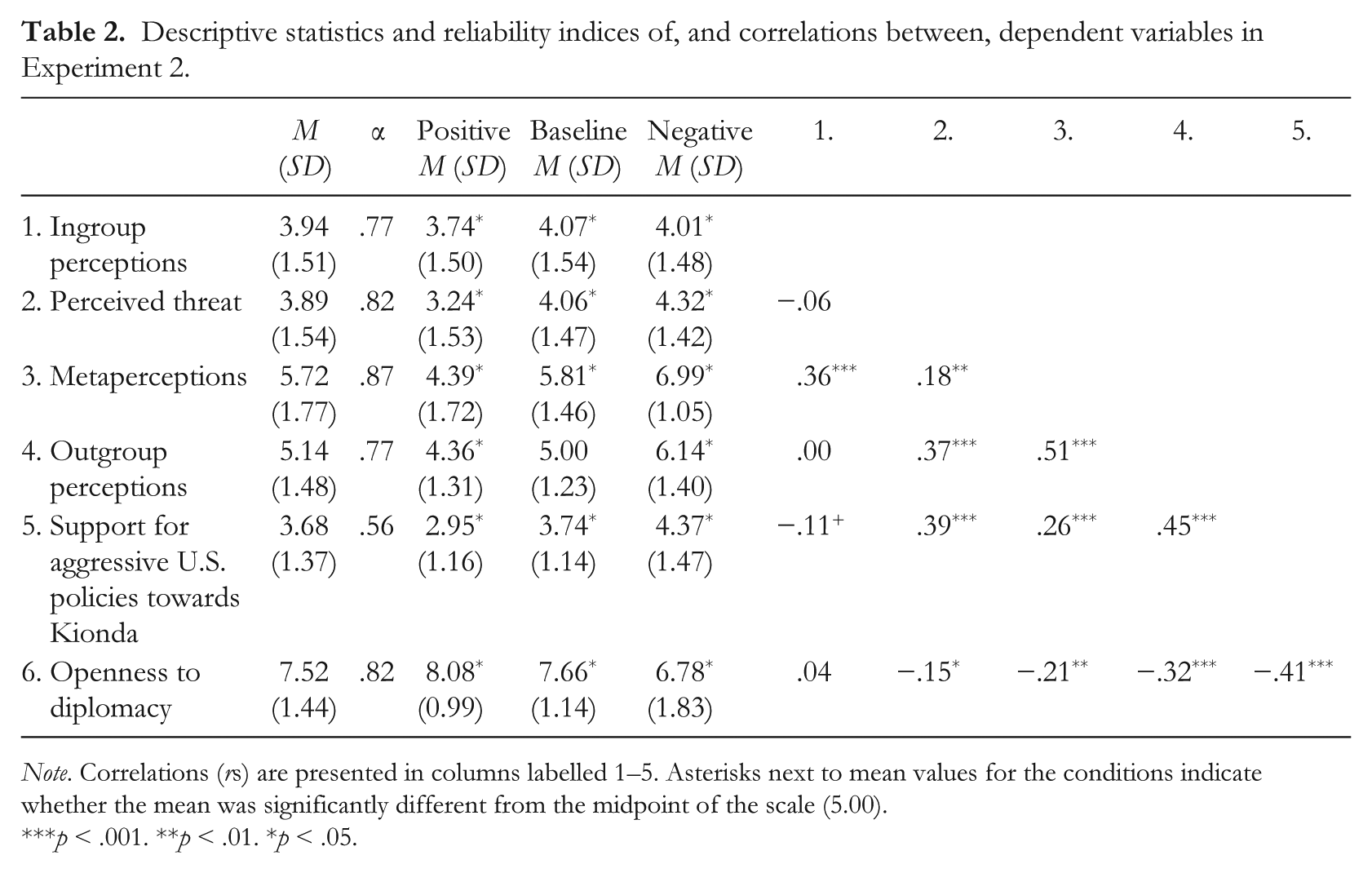
As in Experiment 1, all measures used visual analogue scales from 1 to 9, unless noted otherwise. Descriptive statistics and reliability indices are reported in Table 2. All measures from Study 1 were identical with two exceptions: (1) the measures of metaperceptions, outgroup perceptions, and ingroup perceptions used four items (rather than five items as in Study 1), and (2) all measures used “Kiondans” or “Kionda” as the outgroup (rather than Iran in Study 1). Perceived intergroup threat was measured with four items adapted from prior research (Stephan et al., 2002; e.g., “Kionda poses a threat to American culture,” “Kionda’s military development poses a threat to U.S. interests”; 1 = strongly disagree, 9 = strongly agree).
Descriptive statistics and reliability indices of, and correlations between, dependent variables in Experiment 2.
Note. Correlations (rs) are presented in columns labelled 1–5. Asterisks next to mean values for the conditions indicate whether the mean was significantly different from the midpoint of the scale (5.00).
p < .001. **p < .01. *p < .05.
Results
We followed the same data analytical strategy as in Experiment 1. Based on univariate outlier analyses of the manipulation checks, 34 participants in the positive and negative indirect exposure conditions were excluded from further analysis. Zero-order correlations are displayed in Table 2; while again support for aggressive U.S. policies and openness to diplomacy were strongly correlated, confirmatory factor analyses modeling the items of these two variables as two separate factors, χ2(4) = 49.49, p < .001 or one common factor, χ2(5) = 176.71, p < .001, again indicated that the two-factor model was significantly better than the one-factor model, χ2diff (1) = 127.22, p < .001.
Metaperceptions
Participants reported significantly different metaperceptions of Kiondans across conditions, F(2, 246) = 63.27, p < .001, ηρ2 = .340. Participants in the positive indirect exposure condition reported significantly less negative metaperceptions than participants in the control condition, t(246) = −6.46, p < .001, and participants in the negative indirect exposure condition, t(246) = −11.22, p < .001. Participants in the negative indirect exposure condition reported significantly more negative metaperceptions than participants in the control condition, t(246) = 5.30, p < .001.
Outgroup Perceptions
Participants differed significantly across conditions in their perceptions of Kiondans, F(2, 246) = 36.47, p < .001, ηρ2 = .229. Participants in the positive indirect exposure condition reported significantly less negative perceptions of Kiondans than participants in the control condition, t(246) = −3.16, p = .001, and participants in the negative indirect exposure condition, t(240) = −8.43, p < .001. Participants in the negative indirect exposure condition reported significantly more negative perceptions of Kiondans than participants in the baseline, t(240) = 5.65, p < .001.
Ingroup Perceptions
Participants did not differ significantly across conditions in their perceptions of Americans, F(2, 246) = 1.15, p = .318, ηρ2 = .009. 4
Perceived Intergroup Threat
Participants significantly differed across conditions in perceived intergroup threat, F(2, 246) = 11.60, p < .001, ηρ2 = .086. Participants in the positive indirect exposure condition perceived significantly less threat than control participants, t(246) = −3.68, p < .001, and participants in the negative indirect exposure condition, t(246) = −4.56, p < .001. Participants in the negative indirect exposure condition did not differ from control, t(246) = −1.11, p = .267.
Support for Aggressive U.S. Policies
Participants differed significantly across conditions in support for aggressive policies, F(2, 246) = 24.96, p < .001, ηρ2 = .169. Participants in the positive indirect exposure condition expressed significantly less support than control participants, t(246) = −4.12, p < .001, and participants in the negative indirect exposure condition, t(246) = −7.04, p < .001. Participants in the negative indirect exposure condition expressed significantly more support than baseline participants, t(246) = 3.26, p = .001.
Openness to Diplomacy
Participants differed significantly across conditions in openness towards diplomacy, F(2, 246) = 18.88, p < .001, ηρ2 = .133. Participants in the positive indirect exposure condition (M = 8.08, SD = 0.99) expressed significantly higher levels of openness than control participants, t(246) = 2.05, p = .041, and participants in the negative indirect exposure condition, t(246) = 6.02, p < .001. Participants in the negative indirect exposure condition expressed significantly less openness than control participants, t(246) = 4.24, p < .001.
Mediational Analyses
The same sequential mediation model and alternative models (see online supplementary materials) as in Experiment 1 were tested. Dummy variables representing the positive and negative indirect exposure condition, respectively, were coded as in Experiment 1. As the effects found by the ANOVAs in Experiment 2 were equally driven by both the positive and the negative indirect exposure conditions, we tested the sequential indirect effect of them with either one as the independent variable (and the respective other dummy as a covariate). Ingroup perceptions and perceived intergroup threat served as additional covariates, along with interactions between the positive indirect exposure condition and perceived intergroup threat (since this condition affected threat). As such, we were able to test whether (a) the effect of indirect exposure to outgroups that support ingroup-favorable policies on support for ingroup behavior, and (b) the effect of indirect exposure to outgroups that support ingroup-unfavorable policies on support for ingroup behavior, occurred through the same pathways of intergroup metaperceptions and outgroup perceptions, but in opposite directions. Further, we were able to test whether this process unfolds even when controlling for perceived intergroup threat and ingroup perceptions. Estimates of direct effects with positive indirect exposure as the independent variable are presented in Figure 3a for both outcomes. Estimates of direct effects with negative indirect exposure as the IV are presented in Figure 3b for both outcomes.
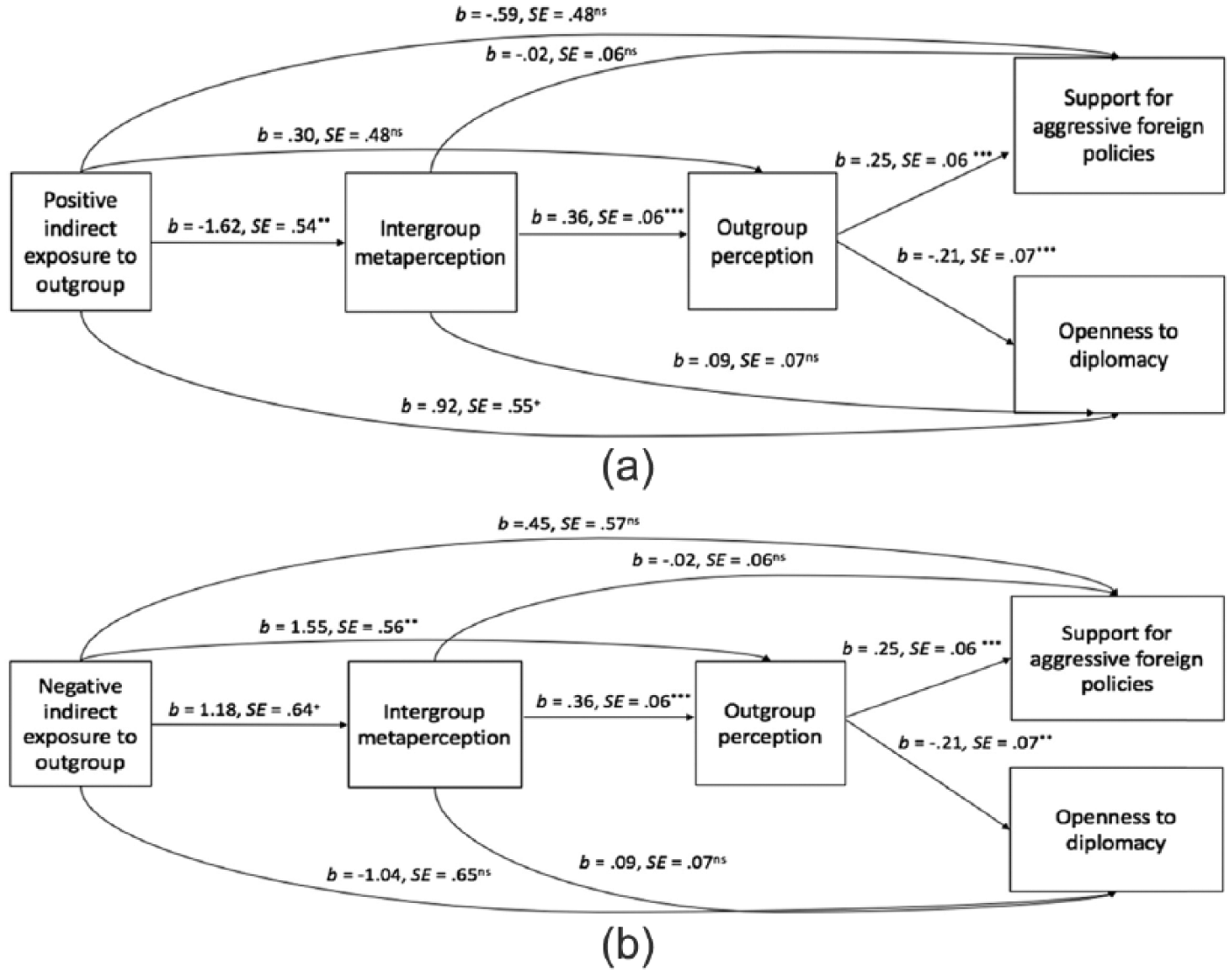
3a. Positive indirect exposure, intergroup metaperceptions, and outgroup perceptions predicting support for aggressive foreign policies and openness to diplomacy in sequence in Experiment 2.
The sequential indirect effect of the positive indirect exposure dummy via metaperceptions and outgroup perceptions was significant for support for aggressive policies, b = −.14, SE = 0.06, 95% CI [−0.32, −0.05], and openness to diplomacy, b = .12, SE = 0.07, 95% CI [0.03, 0.32], and so was the sequential indirect effect of the negative indirect exposure dummy (for support for aggressive policies: b = .11, SE = 0.04, 95% CI [0.05, 0.21]; for openness to diplomacy: b = −.09, SE = 0.04, 95% CI [−0.21, −0.02]). These indirect effects were significant with and without entering the covariates in the model. Further, metaperceptions did not directly predict support for aggressive policies, nor openness to diplomacy.
Discussion
Experiment 2 conceptually replicated Experiment 1 and extended it in two important ways. First, it found a difference of both the positive indirect exposure and the negative indirect exposure conditions from control, showing that the effect of indirect exposure to an outgroup on support for ingroup behavior toward the outgroup occurs via the same sequential process whether or not the exposure is positive or negative in nature. However, as predicted it occurs in opposite directions. Second, Experiment 2 showed that this process occurs over and above the effects of perceived intergroup threat. Again, the sequential indirect effect via metaperceptions and outgroup perceptions was the only robust explanation for the effect of indirect exposure to an outgroup on support for ingroup behavior toward the outgroup.
Using a fictional outgroup was particularly important for demonstrating experimental effects independent of preconceived notions of the outgroup. However, in the context of international relations, using a fictional outgroup may necessarily create other concerns. First, imagining a country they have never heard of may have made it difficult for participants to form attitudes towards it, which may explain the low reliability of the support for aggressive foreign policies measure. Second, by virtue of not having heard of the country before, participants likely saw “Kionda” as neither overly negative nor overly positive vis-à-vis the ingroup. Thus, both Experiment 1 and Experiment 2 indirectly exposed participants to national outgroups that were either seen as negative from the start, and/or less than positive. Neither experiment exposed participants to outgroups that were seen positively from the start. Further, neither experiment exposed participants to outgroups seen as culturally or politically similar to the ingroup. Since Americans may support cooperative relations with national (out)groups perceived as culturally similar (e.g., democratic societies) more so than national (out)groups perceived as dissimilar (e.g., nondemocractic societies; see Herrmann & Keller, 2004; Roccas & Schwartz, 1993), it is possible that effects observed in Experiments 1–2 were dependent upon perceiving the outgroup country as culturally or politically dissimilar. Thus, Experiment 3 tested whether the effects of indirect exposure to outgroups would generalize to outgroups that are seen as similar to the ingroup.
Experiment 3
Expanding on Experiments 1–2, Experiment 3 randomly varied whether participants received indirect exposure to an outgroup they would likely view as similar to their ingroup (Germany) or one they would likely view as dissimilar to their ingroup (Saudi Arabia).
Method
Participants
Of 602 MTurk participants, 25 were excluded because they were not born in the US or English was not their first language. An additional 11 had to be excluded because they wished to withdraw their data after participation. Another 47 were excluded because according to outlier analyses (Tabachnick & Fidell, 2007), they took significantly less or more time to complete the study than average, indicating they likely did not pay sufficient attention or were interrupted during the study. This left 519 participants for analyses (ages = 18–79, M = 35.70, SD = 12.89; 193 males).
Procedure
Experiment 3 used a similar design as Experiments 1 and 2, crossing the indirect exposure to an outgroup with type of outgroup as a second factor, resulting in a 3 (positive indirect exposure vs. control vs. negative indirect exposure) x 2 (similar vs. dissimilar national outgroup) design. Participants either read information about public opinion in Germany as supporting policies to “strengthen” or “sever” ties with the US, including to increase or reduce military and intelligence cooperation with the US (similar outgroup positive indirect exposure condition and similar outgroup negative indirect exposure condition, respectively), or the same information about public opinion in Saudi Arabia (dissimilar positive indirect exposure condition and dissimilar negative indirect exposure condition, respectively). Whereas Germany is a Western European and democratic country that participants were expected to view as rather similar to the US, Saudi Arabia is an Arab, Islamic monarchy that participants were expected to view as rather dissimilar from the United States. Manipulation checks were used as in previous studies, but presented as “true/false” questions.
Measures
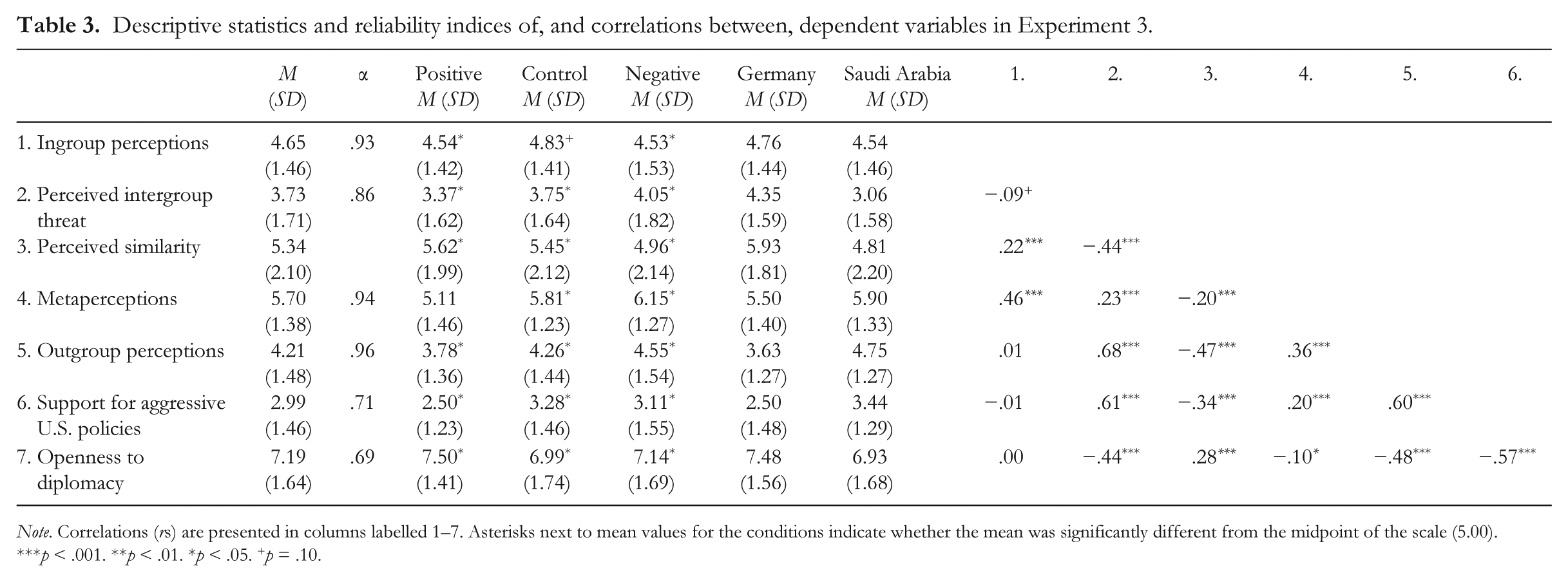
As in Experiments 1–2, unless otherwise noted, all measures used visual analogue scales ranging from 1 to 9. Descriptive statistics and reliability indices are reported in Table 3. Experiment 3 used the same items as Experiments 1–2 for the measures of metaperceptions, outgroup perceptions, ingroup perceptions, perceived intergroup threat, support for aggressive foreign policies, and openness to diplomacy initiated by outgroup. However, Experiment 3 added items to the measures of metaperceptions, outgroup perceptions, and ingroup perceptions (see Appendix). In addition, the order in which metaperceptions and outgroup perceptions were presented was randomized, so as to avoid order effects that could influence the results of sequential mediation analyses. Also, one item assessed perceived similarity of the outgroup to the ingroup, on a 9-point scale (1 = not similar at all, 9 = very similar).
Descriptive statistics and reliability indices of, and correlations between, dependent variables in Experiment 3.
Note. Correlations (rs) are presented in columns labelled 1–7. Asterisks next to mean values for the conditions indicate whether the mean was significantly different from the midpoint of the scale (5.00).
p < .001. **p < .01. *p < .05. +p = .10.
Results
Thirty-five participants were excluded from further analysis for failing the manipulation checks. Analyses were the same as in Experiments 1–2, except that type of outgroup (Germany or Saudi Arabia) was added as a second factor in the analyses, including both its main effect and its interaction with indirect exposure. When referring to “the interaction” in reporting results of general linear models (GLMs), we are referring to the interaction between exposure and type of outgroup. Zero-correlations are presented in Table 3; while support for aggressive U.S. policies and openness to diplomacy were strongly correlated, confirmatory factor analyses modeling the items of these two variables as two separate factors, χ2 (4) = 61.29, p < .001, or one common factor, χ2 (5) = 437.80, p < .001, again indicated that the two-factor model was significantly better than the one-factor model, χ2diff (1) = 376.51, p < .001.
Perceived Similarity
As expected, participants’ perceived ingroup–outgroup similarity differed significantly by type of outgroup, across levels of indirect exposure, F(1, 478) = 34.72, p < .001, ηρ2 = .068. Germans were perceived as more similar to the US than Saudis. The main effect of indirect exposure was also significant, F(1, 478) = 4.20, p = .012, ηρ2 = .017. Participants in the negative indirect exposure condition perceived the outgroup as less similar than control participants, t(478) = −2.12, p = .035, and participants in the positive indirect exposure condition, t(478) = −2.79, p = .006. Participants in the control and positive indirect exposure conditions did not differ significantly in their perceptions of intergroup similarity, t(478) = 0.82, p = .415. The interaction of indirect exposure and type of outgroup was not significant, F(2, 478) = 1.15, p = .319, ηρ2 = .005.
Metaperceptions
Participants’ metaperceptions differed significantly between indirect exposure conditions, across types of outgroup, F(2, 478) = 24.60, p < .001, ηρ2 = .093. Participants in the positive indirect exposure condition expressed significantly less negative metaperceptions than control participants, t(478) = −4.89, p < .001, and participants in the negative indirect exposure condition, t(478) = 6.86, p < .001. Participants in the negative indirect exposure condition expressed significantly more negative metaperceptions than control participants, t(478) = 2.30, p = .022. Participants also reported significantly more negative metaperceptions of Saudis than of Germans across levels of indirect exposure, F(1, 478) = 9.90, p = .002, ηρ2 = .020. The interaction was not significant, F(2, 478) = 1.02, p = .363, ηρ2 = .004.
Outgroup Perceptions
Participants’ outgroup perceptions differed significantly between indirect exposure conditions, across types of outgroup, F(2, 478) = 11.98, p < .001, ηρ2 = .048. Participants in the positive indirect exposure conditions expressed significantly less negative outgroup perceptions than control participants, t(478) = −3.34, p = .001, and participants in the negative indirect exposure conditions, t(478) = 4.81, p < .001. Participants in the negative indirect exposure conditions expressed marginally more negative outgroup perceptions than control participants, t(478) = 1.70, p = .090. Participants also expressed more negative perceptions of Saudis than of Germans across levels of indirect exposure, F(2, 478) = 82.43, p < .001, ηρ2 = .147. The interaction was not significant, F(2, 478) = 0.33, p = .718.
Ingroup Perceptions
Differences between indirect exposure conditions, across types of outgroup, trended towards significance, F(2, 478) = 2.31, p = .101, ηρ2 = .009. Participants expressed marginally less negative perceptions of Americans in the positive indirect exposure conditions compared to control, t(478) = −1.73, p = .084. Participants also expressed marginally less negative perceptions of Americans in the negative indirect exposure condition compared to control, t(478) = −1.91, p = .057. Participants in the negative and positive indirect exposure conditions did not differ, t(478) = −0.15, p = .880. There was also a trend for participants to express less negative ingroup perceptions when asked questions about Saudis rather than Germans (M = 4.76, SD = 1.44), F(1, 478) = 2.58, p = .109, ηρ2 = .005. The interaction was not significant, F(2, 478) = 1.82, p = .163, ηρ2 = .008. 5
Perceived Intergroup Threat
Participants’ perceptions of threat significantly differed between indirect exposure conditions across types of outgroup, F(2, 478) = 6.59, p = .002, ηρ2 = .027. Participants expressed significantly less threat in the positive indirect exposure conditions compared to control, t(478) = −2.27, p = .024, and in the negative indirect exposure conditions, t(478) = −3.61, p < .001. There was a trend for participants to express more threat in the negative indirect exposure conditions compared to control, t(478) = 1.52, p = .130. Participants also perceived more threat when questions were in reference to Saudis rather than Germans across levels of indirect exposure, F(1, 478) = 78.77, p < .001, ηρ2 = .142. The interaction was not significant, F(2, 478) = 0.20, p = .815, ηρ2 = .001.
Support for Aggressive Foreign Policies
Participants’ support for aggressive foreign policies significantly differed between indirect exposure conditions across types of outgroup, F(2, 478) = 14.82, p < .001, ηρ2 = .058. Participants expressed significantly less support in the positive indirect exposure conditions compared to control, t(478) = −5.31, p < .001, and participants in the negative indirect exposure conditions, t(478) = 3.83, p < .001. Participants in the negative indirect exposure conditions did not differ significantly from participants in the control condition, t(478) = −1.32, p = .186. Participants also expressed significantly more support for aggressive policies toward Saudi Arabia than toward Germany across levels of indirect exposure, F(1, 478) = 57.11, p < .001, ηρ2 = .107. The interaction was not significant, F(2, 478) = 1.22, p = .295, ηρ2 = .005.
Openness to Diplomacy
Participants’ openness to diplomacy significantly differed between indirect exposure conditions and across types of outgroup, F(2, 478) = 4.41, p = .013, ηρ2 = .018. Participants in the positive indirect exposure conditions reported significantly more openness than control participants, t(478) = 2.94, p = .003, and marginally more so than participants in the negative indirect exposure conditions, t(476) = −1.90, p = .058. Participants in the negative indirect exposure conditions did not differ significantly from control participants, t(478) = 1.42, p = .157. Participants also reported more openness when an invitation for negotiations was extended by Germany rather than by Saudi Arabia across levels of indirect exposure, F(1, 476) = 11.93, p < .001, ηρ2 = .028. There was no significant interaction, F(2, 478) = −0.21, p = .810, ηρ2 = .001.
Mediation Analyses
The negative and positive indirect exposure dummies were constructed as in Experiment 2. The type of outgroup independent variable was also represented by a dummy variable, coded −0.5 for participants in the Germany conditions and 0.5 for participants in the Saudi Arabia conditions. As in Experiment 2, ingroup perceptions and threat were used as covariates. In addition, perceived similarity was entered as an additional covariate to test whether the hypothesized sequential process goes beyond perceived similarity. Again, for any covariates significantly affected by the manipulated IVs, their interactions with the respective dummies were entered as additional covariate terms into the model (e.g., Threat x Positive Indirect Exposure Dummy, Perceived Similarity x Positive and Negative Indirect Exposure Dummies). Unless noted otherwise, all significant indirect effects in what follows were consistent when not including the covariates in the model. As in Experiment 1, the ANOVAs found no significant differences between negative indirect exposure and control in terms of the two outcome variables (i.e., support for aggressive policies and openness to diplomacy), and therefore the indirect effects analyses focused on positive but not negative indirect exposure. Estimates of direct effects for both outcomes are presented in Figure 4. The hypothesized sequential indirect effect via metaperceptions and outgroup perceptions was significant for both support for aggressive foreign policies, b = −.02, SE = 0.02, 95% CI [−0.07, −0.001], and for openness to diplomacy, b = .03, SE = 0.02, 95% CI [0.001, 0.09]. Metaperceptions did not directly predict support for aggressive foreign policies, but they did so for openness to diplomacy.
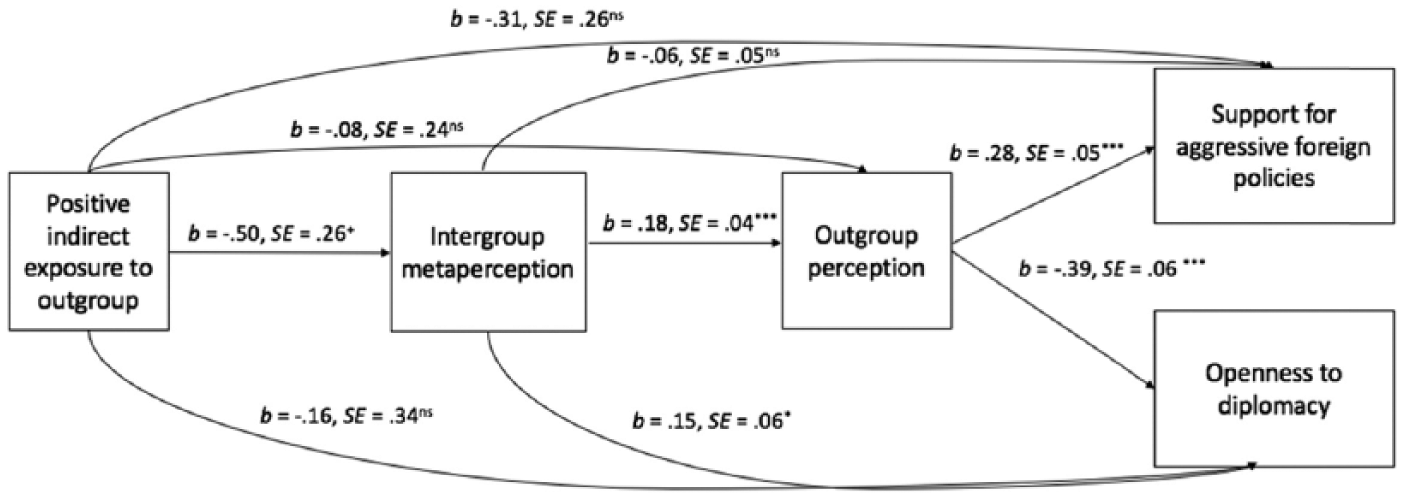
Positive indirect exposure, intergroup metaperceptions, and outgroup perceptions predicting support for aggressive foreign policies and openness to diplomacy in sequence in Experiment 3.
Discussion
Experiment 3 replicated findings from Experiments 1–2 in regard to positive indirect exposure, showing that positive indirect exposure to an outgroup affected intergroup metaperceptions, which affected negative perceptions towards that outgroup, ultimately affecting support for ingroup behavior toward the outgroup. As in Experiment 2, this sequential process was consistent while controlling for perceived intergroup threat and participants’ perceptions of their own ingroup. Participants were generally more negative towards the dissimilar outgroup (Saudi Arabia) than the similar outgroup (Germany). Importantly, however, the effects of indirect exposure were not dependent upon the similarity of the outgroup; they remained significant when controlling for perceived similarity. Additionally, the presence of significant main effects of indirect exposure with a simultaneous absence of significant interactions with type of outgroup indicated that the effects of indirect exposure to outgroups generally occur for both outgroups seen as similar to the ingroup and outgroups seen as dissimilar from the ingroup.
Validation Study of Target Outgroups
To validate our choice of the target outgroups used in Experiments 1 and 3, we conducted a survey of Americans’ perceptions of 23 national outgroups (including the ones used in Experiments 1 and 3) in terms of perceived threat, friendliness, similarity, and the extent to which they trust Americans (i.e., intergroup metaperceptions regarding trust). Participants were presented with four questions assessing each of the four dimensions on 1–9 scales. For each question, participants rated all 23 outgroups. Of 104 participants recruited through MTurk, six were excluded for indicating that English was not their first language or that they were not born in the US, leaving 98 participants (ages 18–75, M = 36.00, SD = 13.21, 47 males). Iran was generally viewed most negatively in terms of the four dimensions, Saudi Arabia significantly less negatively, and Germany least negatively (also significantly so; for detailed results see Table 4), supporting our choice of these outgroups for the respective purposes of Experiments 1 and 3.
Ratings of 20 outgroup countries.

Note. Asterisks next to the means for Iran indicate when the difference from the mean for Saudi Arabia was significant (p < .05); asterisks next to the means for Saudi Arabia indicate when the mean was significantly different from the mean for Germany. The contrasts between means for Iran and Germany were always significant.
Statistical Power
Post hoc power analyses using the G*Power program (Erdfelder, Faul, & Buchner, 1996; Faul, Erdfelder, Lang, & Buchner, 2007), with alpha = .05, respective Ns of 259 (Experiment 1), 249 (Experiment 2), and 484 (Experiment 3), and Cohen’s fs based on the smallest effect in each study, revealed that on the basis of the average effect size, the statistical power to detect the effects was 0.54 in Experiment 1, .99 in Experiment 2, and .76 in Experiment 3. In all three studies, the power was greater than the average in the field of psychology (0.35; Bakker, van Dijk, & Wicherts, 2012; Marszalek, Barber, Kohlhart, & Holmes, 2011), and within the range of the average power of 0.65 in studies published in Journal of Personality and Social Psychology, Personality and Social Psychology Bulletin, and Journal of Experimental Social Psychology (Fraley & Vazire, 2014). Most importantly, we did obtain significant, a priori hypothesized effects.
General Discussion
Three experiments investigated how indirect exposure to an outgroup affects how people want their ingroup to behave towards that outgroup. Based on past research on cross-group contact and metaperceptions, we predicted that people would use indirect exposure to an outgroup to inform their views of how outgroup members see the ingroup (intergroup metaperceptions), which would influence how they view the outgroup (outgroup perceptions), which would ultimately determine their support for ingroup behavior toward the outgroup. This hypothesized sequential indirect effect model was the only one consistently supported by the data across all three experiments.
This research illuminates how effects on intergroup attitudes and behavior are transmitted. In doing so, it also explains the exact process of previously found joint effects of intergroup metaperceptions and outgroup perceptions on support for intergroup attitudes and behavior (Kamans et al., 2009; Kteily et al., 2016). Further, the present research contributes to and links the literatures on intergroup metaperception and outgroup perceptions, demonstrating how one relates to and influences the other. Similarly, it adds to international image theory, suggesting that people may not only form images of outgroups, but also what could be called “metaimages.” Last but not least, our focus on indirect exposure to outgroups adds to the emerging literature on indirect forms of intergroup contact (e.g., Mazziotta et al., 2011) by showing that indirect exposure to outgroups can change perceptions of those outgroups by first changing intergroup metaperceptions and subsequently outgroup perceptions, and that by changing these two sets of perceptions in sequence, indirect exposure can affect support for ingroup behaviors towards the outgroup. Expanding the indirect contact literature, our research shows that indirect exposure and metaperceptions do not merely have consequences for one’s individual behavior (e.g., Méndez et al., 2007; Vorauer & Turpie, 2004), but also for one’s behavior as a group member.
While we found robust and converging evidence for the effects and process hypothesized here, there should also be important boundary conditions and moderating factors. First, it was striking that only in the case of the fictional outgroup (Experiment 2), the negative indirect exposure had similarly strong effects as the positive indirect exposure. Given that effects of negative indirect exposure were more similar to control (see Experiment 1), it may be that positive information carries more weight than negative information when thinking about real outgroups that tend to be perceived as having negative relations with the ingroup.
An important moderating factor of our two-step process might be the relation of the individual to his or her ingroup, be it ingroup identification, ingroup ties, or identity fusion. The closer that one feels to the ingroup, the greater the importance one will place on viewing the group positively, and the stronger one will likely react to information conflicting with that positive view (Roccas, Sagiv, Schwartz, Halevy, & Eidelson, 2008; Swann, Jetten, Gómez, Whitehouse, & Bastian, 2012). For people who feel strongly connected to the ingroup, seeking out positive views of the ingroup could be a form of self- or collective verification (e.g., Gomez, Seyle, Huici, & Swann, 2009). Instead, people who feel less close to the ingroup may be less likely to infer that an outgroup’s support for policies reflects that outgroup’s perception of the ingroup (intergroup metaperceptions), because such information would be less self-relevant. With less motivation to view the ingroup positively, it seems plausible that they would be less likely to view an outgroup positively or negatively in response to their perception that the outgroup views the ingroup positively or negatively. Since there are many ways to conceptualize the relationship between an individual and the ingroup (e.g., Roccas et al., 2008; Swann et al., 2012) and multiple modes of social identification that have distinct consequences for perceptions (Roccas et al., 2008), identifying how these factors differentially moderate the impact of indirect exposure would be a critical step for future research.
In addition to contributing to various theories and literatures, our findings also have important implications for understanding how to improve intergroup relations. The ecological validity of our manipulation materials (i.e., manipulating indirect exposure to outgroups by presenting reports of outgroup public opinion) points to the viability of foreign public opinion to positively influence the foreign policy of one’s own country, and ultimately, international relations. Exposing Americans to public opinion in foreign countries where people often are more favorable toward the American people than toward the U.S. government (e.g., Tessler, 2003) could conceivably alter Americans’ support for U.S. foreign policy depending on its perceived impact on the people versus the governments of other countries; for instance, Americans might become less inclined to support U.S. policies that would harm people in other countries (e.g., certain forms of targeted economic boycotts), while becoming more inclined to support policies that would promote nonviolent resolution of international tensions. Although we did not test directly how indirect exposure to the views of citizens and governments from national outgroups might differentially inform Americans’ support for foreign policy, both our theoretical model and empirical findings suggest that such distinctions would be worthwhile to pursue in future work, as they may illuminate strategies to promote greater support for nonviolent and peaceful foreign policies among U.S. citizens.
Footnotes
Appendix
Metaperceptions for Experiment 3:
Following the sentence “[German/Saudi] people. . .” metaperceptions were assessed with items including,
think that Americans have peaceful intentions.
think that Americans don’t consider the needs of others.
think most Americans are working for peaceful international relations.
think the US will work with other countries to achieve mutual goals.
think Americans are arrogant and conceive of themselves as better than others.
think the United States tries to exploit other countries for their resources.
think the United States uses its power to prevent others from getting ahead.
think that Americans cannot be trusted because they know how to trick others.
think that Americans have no hostile intentions toward other countries.
think that Americans’ objectives are self-centered and harmful to others.
think that power in the hands of Americans is a dangerous thing.
think that America takes whatever it wants from other nations.
think Americans enjoy getting their way even if it spoils things for others.
think that Americans are quite naïve.
think that most Americans want to have things better for the group, but that Americans lack discipline and are not likely to work very hard.
think that American leaders are weak.
think Americans don’t care when others suffer.
think the typical American has compassion for the suffering of others.
Funding
This material is based upon work supported by the National Science Foundation Graduate Research Fellowship Program awarded to the first author under Grant No. 1451512. Any opinions, findings, and conclusions or recommendations expressed in this material are those of the author(s) and do not necessarily reflect the views of the National Science Foundation.
Notes
References
Supplementary Material
Please find the following supplemental material available below.
For Open Access articles published under a Creative Commons License, all supplemental material carries the same license as the article it is associated with.
For non-Open Access articles published, all supplemental material carries a non-exclusive license, and permission requests for re-use of supplemental material or any part of supplemental material shall be sent directly to the copyright owner as specified in the copyright notice associated with the article.
