




Abstract
Western citizens perceive human behaviour as a significant cause of climate change and increasingly adopt proenvironmental behaviours. However, such positively connoted behaviours can either increase (consistency) or decrease (compensation) the probability that one acts in a similar way in the future. Drawing from social influence and social identity literatures, we propose that numerical support for proenvironmental values (majority vs. minority) moderates the effect of past behaviour on intention to adopt proenvironmental behaviour. Across three studies (N = 500), past behaviour, either measured (Study 1) or manipulated (Studies 2 and 3) interacted with numerical support, manipulated (Studies 1 and 2) or measured (Study 3), to predict proenvironmental intention and behaviour. Results showed that majority support results in balancing dynamics, whereas minority support results in a consistency effect. These findings highlight the importance of the normative context for proenvironmental behaviour adoption and offer leads for developing behaviour change strategies.
Keywords
In all likelihood, environmental issues—most notably the ever-growing plastic pollution (e.g., Eriksen et al., 2014) and the increasing levels of carbon dioxide linked to climate change (e.g., National Oceanic and Atmospheric Administration, 2017)—will be one of the main challenges our world will face during the next coming decades. In Western societies at least, people are globally aware of and convinced by the prominence of those issues. For instance, opinion polls show that no less than 95% of Europeans believe in the importance of protecting the environment and 85% of them believe they can personally play a role in protecting the environment (European Commission, 2014). Moreover, a majority of citizens feel concerned about climate change, see it as an important possible risk, and wish to act against it (Lorenzoni & Pidgeon, 2006). However, when asked about their personal behaviour, only 72% of the respondents declared recycling waste, 52% cutting down energy, and 37% cutting down water consumption. Regarding CO2 emission, only 35% reported choosing more environmentally friendly ways of travelling and 20% using their car less (other behaviours were adopted by even smaller numbers; European Commission, 2014). Thus, there seems to be a gap between attitude and behaviour regarding citizens’ proenvironmental behaviour.
In the present research we propose that this attitude–behaviour gap can be understood as a social influence process, where two antagonist mechanisms are determined by the perceived numerical (majority vs. minority) support for ecology. First, we assume that nowadays—at least in Western countries—a proenvironmental norm exists and motivates people to endorse proenvironmental attitudes, and that people’s positive attitudes towards the environment lead them to engage in at least a few environmental behaviours (i.e., initial conformity to environmental norms). However, we reason that these same initial proenvironmental behaviours can influence future behaviour in two opposing directions. On the one hand, they can lead to further consistent behaviour for motives of need for consonance (Festinger, 1957) or commitment (e.g., Kiesler, 1971). On the other hand, it can lead people to “slack off”—resulting in seemingly inconsistent behaviour—because of a self-licensing phenomenon (see Merritt, Effron, & Monin, 2010). Second, we argue the perception that either the majority or minority of one’s group supports environmentalism (i.e., numerical support) influences people’s interpretation of their own past behaviour and, therefore, plays a pivotal role in moderating the (consistent vs. inconsistent) link between past and future behaviour.
Consistency and Balancing
Past research has showed that people need a certain level of consistency in their beliefs and actions (Aronson, 1969; Festinger, 1957) and tend to act consistently with their past deeds, provided that they have incorporated them in their self-concept (e.g., Bem, 1967; Reed, Aquino, & Levy, 2007; Thøgersen, 2004; Whitmarsh & O’Neill, 2010). Moreover, the more a person acts in a given direction, the more likely they are to pursue this direction in the future, even if this appears to be ill-advised (e.g., Joule, 1991; Kiesler, 1971; Schaumberg & Wiltermuth, 2014; Staw, 1976). Accordingly, past behaviour can increase the likelihood of performing consistent behaviour in the future.
However, past behaviour can also result in a reduction of consistent behaviour. Indeed, people may use positive past behaviours as moral credentials allowing them to fulfil their identity-related goals and subsequently relax their efforts towards pursuing these goals (i.e., a moral self-licensing effect; see Merritt et al., 2010, for a review). A recent meta-analysis of 91 studies found the licensing effect to be reliable even if small to medium in terms of effect size (Blanken, van de Ven, & Zeelenberg, 2015). Of particular relevance for the present research, self-licensing effects have been found in a variety of contexts including sustainable behaviour (Longoni, Gollwitzer, & Oettingen, 2014; Schultz, Nolan, Cialdini, Goldstein, & Griskevicius, 2007; Schumann & Klein, 2015; Tiefenbeck, Staake, Roth, & Sachs, 2013): people increased energy consumption, reduced participation in proenvironmental action, and recycled less in a handiwork task after having, respectively, been told that they consumed less energy or less water than their neighbours, been given the opportunity of signing a proenvironmental petition online, or been able to select green products in an online shopping task. As a corollary, reminding them of negative past behaviour can motivate people to make up for it and increase further efforts, a similar balancing effect to which we refer here as “compensation” (e.g., Longoni et al., 2014; Toner, Gan, & Leary, 2014). 1
Literature has identified a few moderators for the consistent/inconsistent effect of past behaviour on future behaviour. For example, Conway and Peetz (2012) investigated the effects of abstraction level and suggested that a more abstract level of conceptualisation (i.e., focus on temporally distant conduct) would lead to consistency, while a more concrete level (focus on relatively recent conduct) would lead to balancing. Joosten, van Dijke, van Hiel, and De Cremer (2014) studied reputation concerns and cognitive load and found consistency effects to occur when cognitive resources are available (i.e., a proactive approach to reputation building), whereas compensation occurs when cognitive resources are depleted (i.e., a reactive approach). Finally, Susewind and Hoelzl (2014) proposed the moderating role of self-regulation: paying attention to one’s commitment towards a goal leads to consistency, while paying attention to one’s progress towards this goal leads to balancing.
In the present research we aim to investigate another potential moderator of the link between past and future behaviour, namely, numerical support—the proportion of a relevant ingroup that is perceived to support a given goal or value. More specifically, we argue that a majority support would make people focus on the avoidance of normative deviance (i.e., compliance) and result in balancing dynamics, whereas a minority support would make people focus on goal advancement and result in a consistency effect.
Majority and Minority Support
One of the most influential theories regarding majority and minority influence—conversion theory (Moscovici, 1980)—can help establishing predictions about behavioural balancing versus consistency effects. According to Moscovici’s theory, social majorities (i.e., social norms) influence throughout a comparison process that instigates a focus on individual-norm discrepancies and motivates people to avoid deviance (see Butera, Falomir-Pichastor, Mugny, & Quiamzade, 2017; Martin & Hewstone, 2008; Wood, Lundgren, Ouellette, Busceme, & Blackstone, 1994, for reviews). Indeed, individuals tend to align their position with that of ingroup majorities either because these are usually perceived as more correct and competent (Cialdini, 1984; Levine & Russo, 1987; Nemeth, 1986) or to fulfil identity concerns (Asch, 1956; David & Turner, 1996; Deutsch & Gerard, 1955; Festinger, 1950; Kelman, 1958; Tajfel & Turner, 1986). As a consequence, majorities have been found to influence people on outcomes as trivial as public responses to a visual perception task (Asch, 1956) or as specific as daily personal energy consumption (Nolan, Schultz, Cialdini, Goldstein, & Griskevicius, 2008), to name a few. In a similar vein, literature illustrates how people increase their efforts when they learn they are doing worse than a descriptive majority (i.e., they try to compensate for their perceived deviance; Longoni et al., 2014; Schultz et al., 2007; Toner et al., 2014; but see Verkooijen, Stok, & Mollen, 2015). However, according to Moscovici (1980), once people’s normativity is ensured, they may no longer feel the need to pursue their efforts any further, which would result in weaker attitudes (i.e., mere or superficial conformity to majority positions). This social management of the conflict (Mugny & Pérez, 1991) is accompanied by a poor cognitive integration of the majority position (i.e., sociocognitive paralysis; Sanchez-Mazas, Pérez, Navarro, Mugny, & Jovanovic, 1993) and hinders its assimilation. Hence, some consider that it is difficult to obtain a real integration of a majority position, which would appear only under certain conditions, for example, when the content is important for the individual (Martin & Hewstone, 2008).
Conversely, according to Moscovici’s theory (1980), social minorities influence people’s attitudes and behaviours through a validation process that elicits closer attention to, and deeper elaboration of, the minority views. Hence, people do not feel pressured to conform to minority positions, and would only endorse them as the result of a true influence process. Moreover, past research suggests that agreement with the minority group position may increase people’s motivation to adopt the group goals as personal goals. In comparison with majority groups, members of minority groups are, overall, more cohesive, participative, and committed in defending the group’s positions (Gerard, 1985; Mullen, 1991; Simon, Hastedt, & Aufderheide, 1997; also see Levine & Moreland, 2006), notably because minorities are perceived as representing the self better than majorities (Abrams, 1994). Moreover, individuals are more likely to attribute their attitudes and behaviours to personal factors when they are supported by few versus a great number of people (Kelley, 1973), which may result in a greater internalisation of minority positions. People also prefer belonging to minority groups, notably because smaller groups better satisfy the conflicting needs for belonging and for uniqueness (Brewer, 1991; Codol, 1975; Leonardelli, Pickett, & Brewer, 2010; Snyder & Fromkin, 1980). As a consequence, minorities elicit higher ingroup identification and satisfaction than majority groups (Leonardelli & Brewer, 2001).
In sum, past research suggests that people may engage to a lesser extent in further consistent behaviour when a majority (as compared to a minority) supports their previous attitudes and behaviours. This reasoning is supported by empirical evidence showing that attitudes changed via majority influence are less predictive of related behavioural intention than attitudes changed via minority influence (Martin, Martin, Smith, & Hewstone, 2007). Moreover, Falomir-Pichastor, Mugny, Quiamzade, and Gabarrot (2008) showed that agreement with majority views evokes feelings of quiescence and relaxation, whereas agreement with minority positions evokes feelings of cheerfulness (see Higgins, 1997; Shah & Higgins, 2001). These results suggest that individuals interpret their past behaviour as a function of the numerical support for it, and will engage to a lesser extent in consistent behaviour when they already fit normative prescriptions.
Conversely, people might feel more threatened when their past behaviour does not fit the normative prescriptions of a majority (vs. a minority) and, consequently, try harder to make up for their lack of effort. Accordingly, Falomir-Pichastor et al. (2008) showed that disagreement with majority views elicits feelings of agitation (whereas disagreement with minority views elicits feelings of dejection and sadness). Consequently and according to classic normative influence literature, majorities may, at first, exert more influence than minorities.
Hypotheses and Overview of Studies
The present research aimed to investigate whether numerical support for proenvironmental values actually moderates the link between past and future behaviour, thus shedding light on the prevailing environmental attitude–behaviour gap described before. We reasoned that majority support would draw people’s attention to reflect on whether their past behaviour satisfies the majority norm. Then, when one’s past behaviour reflects a lack of normativity, one would try and actively make up for it by adopting more congruent behaviours (compensation). However, once past behaviour sufficiently validates their belief of attaining normativity, the individual would feel justified in slacking off and adopting less congruent behaviours (self-licensing). Contrariwise, minority support would energise people and lead them to act consistently with their past deeds. Accordingly, we predicted a Past Behaviour × Numerical Support interaction effect on future behaviour.
More specifically, our main hypothesis is that people will be more motivated to show consistent/inconsistent behaviour when a minority/majority supports their past behaviour (H1). In addition, we predict that people with initially lower proenvironmental behaviours will be more motivated to compensate when proenvironmental behaviours are supported by a majority (rather than a minority) of people (H2), whereas those with initially higher proenvironmental behaviours will be less motivated to pursue their efforts when proenvironmental behaviours are supported by a majority (rather than a minority) of people (H3).
We present three studies that test these hypotheses. Numerical support was either manipulated (Studies 1 and 2) or measured (Study 3) in terms of the proportion of a relevant ingroup that supports the environmental values. Past behaviour was also measured (Study 1) or manipulated either in a subtle (Study 2) or explicit fashion (Study 3). The main dependent variable was participants’ commitment to proenvironmental actions as assessed through attitude towards a collective action (Study 1), behavioural intention (Studies 2 and 3), and actual behaviour (Study 3). All research materials can be obtained upon request from the first author.
Study 1
In the first study, we investigated the interactive impact of (measured) past behaviour and (manipulated) numerical support for environmental values on participants’ attitude towards a green collective action. Moreover, we included a control condition with no information regarding numerical support. We expected numerical support to moderate the link between past behaviour and positive attitude towards future green collective action. Because, by default, past behaviour should positively predict attitude towards collective action, we did not expect minority and control conditions to differ from one another. However, we expected the link between past behaviour and attitude to be reduced in the majority condition as compared to the two other conditions.
Method
Participants and procedure
American participants were recruited through Amazon’s MTurk platform and accepted to enter a “study on the perception of environmental issues.” From the initial 214 participants, four failed to answer an instructional attention check (i.e., a question for which it is specifically requested to tick a given answer; see Oppenheimer, Meyvis, & Davidenko, 2009) and were excluded from further analyses. The final sample included 210 participants (71 males and 139 females, 21–74 years of age, M = 34.5, SD = 11.0). Participants were randomly assigned to one experimental condition (majority vs. minority support vs. control condition; N = 69, 71, and 70, respectively), and were debriefed and remunerated at the end of the survey. Lacking information about the expected effect size, we adopted a rule of thumb of at least 70 participants per experimental condition to ensure sufficient power.
Independent variables
Numerical support manipulation
Participants were first asked to read a 400-word text on environmental issues. The content of the text was inspired by a proenvironmental blog article. The numerical support manipulation consisted in a prelude informing that a representative sample of U.S. citizens had been surveyed following the publication of this press article. Depending on the experimental condition (minority vs. majority support), it was said that,
18% [82%] of the individuals declared supporting the content of the text without hesitation, and committed to make more individual efforts in order to reduce their own consumption. Thus, only a minority [a large majority] of the inhabitants supports unconditionally proenvironmental values.
Participants in the control condition read the text without any prelude.
Self-reported daily life behaviours
Participants then reported to what extent they adopted green and nongreen behaviours in their daily life by completing the 50-item General Environmental Behaviours Scale (GEB; Kaiser & Wilson, 2004). The GEB measures a variety of environmental behaviours, some relatively easy to adopt (e.g., “I collect and recycle used paper”), others requiring more effort (e.g., “I contribute financially to environmental organisations). Thirty-six items are measured on a 5-point scale (1 = never, 5 = always) and 14 with a binary response (1 = yes, 2 = no). A “nonapplicable” answer is available for all items. Following Kaiser and Wilson’s (2004) recommendations and using ACER Quest (Adams & Khoo, 1996), we applied a Rasch-type model on the data, so that individuals’ environmental score would take into account their overall performance level as well as the difficulty of each specific (endorsed and nonendorsed) behaviour. The composite score was found reliable (separation reliability coefficient r = .80, min. = −2.45, max. = 2.49; M = −0.43, SD = 0.82; a higher score represents greener habits).
Dependent measure: Attitude towards green collective action
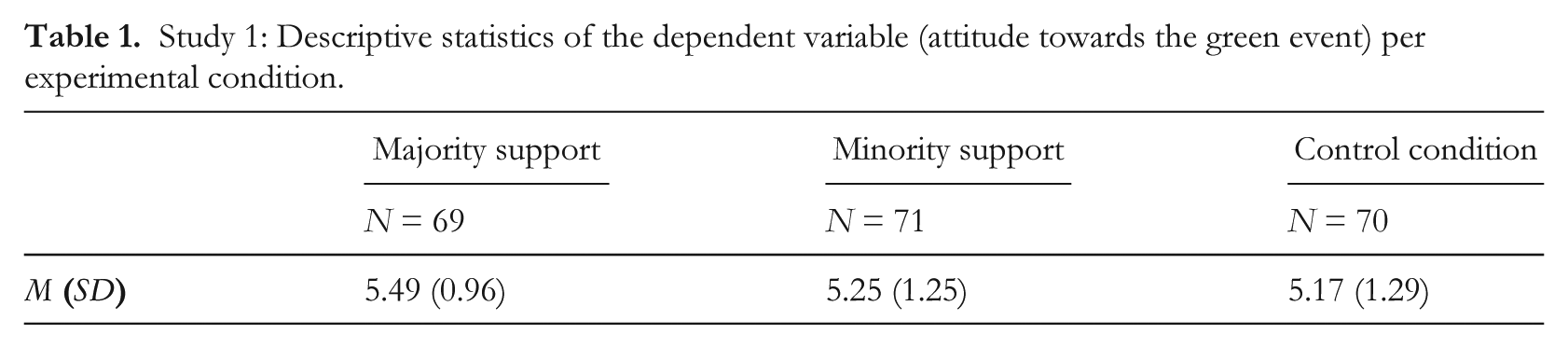
Participants were then introduced to the concept of “Green Christmas.” A short text described the weight of Christmas celebrations’ eco-footprint (e.g., “$75 billion spent on Christmas gifts, 1.9 billion cards sent, and 20.8 million Christmas trees cut in the US alone”) and that many different small actions could help reduce the impact on the environment and “help celebrate the season while caring for the earth.” Four items assessed participants’ attitude towards the proenvironmental collective action (e.g., “This event will raise awareness of resource consumption issues”; 7-point scale: 1 = strongly disagree, 7 = strongly agree). 2 An exploratory factorial analysis showed that responses to all items loaded on a single factor (explaining 70% of the variance); they were thus aggregated (α = .85, M = 5.28, SD = 1.18; means per condition are reported in Table 1).
Study 1: Descriptive statistics of the dependent variable (attitude towards the green event) per experimental condition.
Results
Attitude towards the collective action was regressed on numerical support coded according to the hypothesis (minority and control condition = −1, majority = 2), its orthogonal contrast (minority = −1, control = +1, majority = 0), self-reported green behaviour (standardised), and all appropriate interactions. Overall model: F(5, 204) = 9.09, p < .001, R2 adj = .16. The analysis revealed a main effect of self-reported behaviour, b = .45, 95% CI [0.30, 0.60], t(204) = 5.97, p < .001, η2p = .15; the more participants reported green behaviour, the more positive their attitude towards the Green Christmas action was.
More interestingly, the interaction between past behaviour and the contrast of interest was also significant, b = −.15, 95% CI [−0.26, −0.05], t(204) = −2.96, p = .003, η2p = .04 (see Figure 1). No other effects were significant, t(204) < 1.14, ps > .26. Slope analyses showed that self-reported green behaviour predicted attitude towards the collective action in both the minority, b = .53, 95% CI [0.25, 0.80], t(204) = 3.79, p < .001, and the control conditions, b = .67, 95% CI [0.42, 0.93], t(204) = 5.21, p < .001, but this link disappeared in the majority support condition, b = .14, 95% CI [−0.10, 0.38], t(204) = 1.13, p = .26. Amongst people with less green habits (−1 SD), attitude was more positive in the majority than in the minority and control conditions, b = .22, 95% CI [0.07, 0.36], t(204) = 2.92, p = .004. However, contrary to our third hypothesis, attitude was not less positive in the majority condition amongst people with greener habits (self-reported behaviour +1 SD) as compared to the minority and control conditions, b = −.10, 95% CI [−0.24, 0.05], t(204) = −1.29, p = .20.
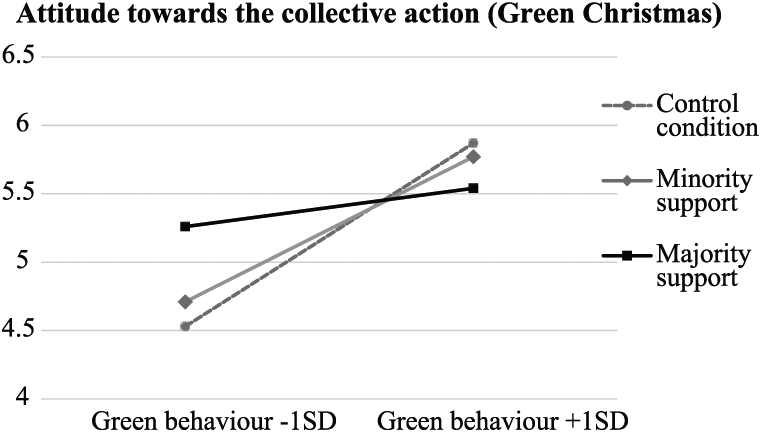
Attitude towards the collective action (a “Green Christmas”) as a function of self-reported green behaviour and social support (majority vs. minority support vs. control condition with no information) in Study 1.
Discussion
This study provided evidence that numerical support moderated the relation between past behaviour and engagement in future action, represented here by positive attitude towards a proenvironmental collective action. In both the minority and control conditions, past behaviour positively predicted attitude. This link, however, disappeared in the majority condition. Most interestingly, simple effects showed that majority support elicited a compensation effect amongst participants reporting less green behaviour (as compared to the minority and control conditions)—a compensation that can be understood as an effort to make up for an initial lack of normative conduct.
Despite providing empirical support to our main hypothesis, the present study still had two limitations to overcome. First, majority support did not lead participants reporting greener behaviour to a less positive attitude (i.e., self-licensing), which is inconsistent with our third hypothesis. Participants were likely uncertain about the level of green behaviour they should adopt in order to satisfy the normative expectation, and defined their own personal threshold. As a consequence, they persevered in this goal instead of self-licensing. A pilot study with a similar population provided additional evidence for this interpretation: amongst participants with higher green past behaviour who believed that a majority supported environmentalism, those who considered that they “already did a lot” and “did enough” reported a less positive attitude towards the event than those who considered they “could do more” and “did not do enough.” Details of this pilot study are reported in the supplementary material.
The second limitation is that this study’s main dependent variable consisted in the sole evaluation of a proposed collective action, which reflects participants’ general attitude towards green action rather than personal commitment (or intention to commit) to it. To compensate for these limitations, in further studies we moved towards more direct operationalisations of past behaviour and assessed personal behavioural intention (Studies 2 and 3) and actual behaviour (Study 3).
Study 2
In the second study we draw from attitude inference literature (Salancik & Conway, 1975) to manipulate participants’ subjective feeling of doing well or less well regarding the environment (i.e., acquisition of moral credentials vs. not). We investigate participants’ willingness to participate in a collective action as a function of numerical support and past behaviour. We expected numerical support to moderate the effects of participants’ subjective feeling about their past proenvironmental behaviour on their intention to engage in future green actions. Specifically, we expected a higher willingness to participate in the majority (vs. minority) condition amongst participants who were led to believe they were doing poorly (i.e., no moral credentials; H2). Conversely, we expected lower willingness to participate in the majority (vs. minority) condition amongst participants who were led to believe they were doing well (i.e., obtainment of moral credentials; H3). Regarding numerical support, Study 2 included a manipulation check, which was lacking in Study 1.
Method
Participants and procedure
Students from a Swiss university were contacted by email and accepted to participate in an online “survey on the environment and environmental behaviour.” Sample size was determined based on the size effect of the first study to ensure power = .80 (G*Power3; Faul, Erdfelder, Lang, & Buchner, 2007). One hundred sixty-five participants (129 female and 36 male of 17–62 years of age, M = 24.3, SD = 6.50) completed the study. The study adopted a 2 (numerical support: majority vs. minority) × 2 (moral credentials: with vs. without) design, and participants were randomly assigned to one experimental condition. Number of participants per condition ranged from 36 to 44 (variations are due to the software’s random assignment procedure).
Independent variables
Numerical support manipulation
The same manipulation as in Study 1 was used. Participants first read a 400-word newspaper-like text describing the situation of energy overconsumption in the local area, with an introductory note specifying that either 12% or 88% of the population supported proenvironmental values. After reading the text, participants were asked to assess the degree of adherence to environmental values in the general population. Specifically, participants indicated whether those values, according to them, were supported by a minority or a majority (7-point scale: 1 = a minority, 7 = a majority; M = 3.82, SD = 1.58), and then indicated a specific percentage from 0% to 100% (M = 45.7, SD = 23.0).
Moral credentials
The moral credentials manipulation draws from early work on attitude inference (Salancik & Conway, 1975). Participants answered 12 questions about their daily life green behaviour; frequency adverbs were introduced in those questions and varied depending on experimental condition. In the moral credentials condition, the adverb “sometimes” was coupled with the positive items (i.e., green behaviour) and the adverb “very often” to the negative items (i.e., nongreen behaviour), so participants would more easily report greener habits and infer a more environmentally friendly self-image (e.g., “At home, I sometimes recycle paper,” “I very often omit to turn off the light when I leave a room”). The adverbs were switched in the no-credentials condition in order to make it harder for participants to infer a positive self-image (e.g., “At home, I very often recycle paper,” “I sometimes omit to turn off the light when I leave a room”; 7 point-scale: 1 = not at all like me; 7 = very much like me). Mean answer of those 12 questions was higher in the credentials (M = 5.55, SD = 0.73) than in the no-credentials condition (M = 5.28, SD = 0.74), F(1, 161) = 4.95, p = .027, η2p = .03, indicating that the manipulation was successful.
Dependent measure: Willingness to participate in a proenvironmental event
Participants then read about a proenvironmental event —the “Zero Power Day”—supposedly organised by a local association. The aim of this event was that participating individuals achieved near-zero energy consumption for 24 hours (i.e., do not use artificial light, computer, phone, TV, radio, electric, gas, or microwave ovens, etc., with the exception of home fridge and freezer which were allowed to remain plugged), in an effort to increase awareness of and reduce energy consumption. Inspired by collective action literature (Zaal, van Laar, Ståhl, Ellemers, & Derks, 2012), four items measured willingness to participate in the event (e.g., “To what extent would you take part in this event?”; 7-point scale: 1 = not at all, 7 = very much; α = .85, M = 3.91, SD = 1.67).
Results
Check of the numerical support manipulation
Numerical support (−1 = minority, 1 = majority), moral credentials (−1 = without, 1 = with), and their interaction were entered as predictors with the two checks of the numerical support manipulation as dependent variables. Only the main effect of numerical support was significant: participants perceived that proenvironmental values were supported by a minority rather than a majority in the minority condition (M = 3.54, SD = 1.55) as compared to the majority condition (M = 4.08, SD = 1.57), b = .28, 95% CI [0.03, 0.52], t(161) = 2.25, p = .026, η2p = .03. Additionally, they estimated proenvironmental values to be supported by a smaller percentage of the population in the minority (M = 40.8, SD = 21.2) than in the majority condition (M = 50.4, SD = 23.7), b = .49, 95% CI [0.14, 0.84], t(161) = 2.75, p = .007, η2p = .05.
Intention to participate in collective action
Willingness to participate in the proenvironmental event was regressed on numerical support (−1 = minority, 1 = majority), moral credentials (−1 = without, 1 = with), and their interaction. Overall model: F(3, 161) = 2.91, p = .04, R2 adj = .03. None of the main effects were significant, ts(161) < 0.72, ps > .48. However, the expected Support × Credentials interaction was significant, b = −.37 [−0.63, −0.12], t(161) = −2.90, p = .004, η2p = .05 (see Figure 2). As expected, decomposition revealed a simple effect of credentials in the minority condition, b = .46, 95% CI [0.10, 0.83], t(161) = 2.50, p = .014, so that willingness was higher in the credentials (M = 4.41, SD = 1.63) than in the no-credentials condition (M = 3.48, SD = 1.77). In the majority condition, this simple effect was not significant, b = −.28, 95% CI [−0.63, 0.07], t(161) = −1.58, p = .12. Additionally, the simple effect of support in the credentials condition was significant, b = −.39, 95% CI [−0.75, −0.02], t(161) = −2.09, p = .038, so that willingness was higher when a minority supported proenvironmental values (M = 4.41, SD = 1.63) than when a majority did (M = 3.64, SD = 1.64). The simple effect of support was also significant in the no-credentials condition but the pattern was reversed, b = .36, 95% CI [0.01, 0.71], t(161) = 2.00, p = .047, so that willingness was higher when there was support from a majority (M = 4.20, SD = 1.51) than a minority (M = 3.48, SD = 1.77).

Willingness to participate in the proenvironmental event as a function of social support (majority vs. minority) and moral credentials (presence vs. absence) in Study 2. Error bars represent standard errors of the mean (SEM).
Discussion
Again, in this second study and consistent with our first hypothesis, we found numerical support to moderate the link between past behaviour and future behavioural intention while using another operationalisation of past behaviour, as well as a dependent variable closer to personal behaviour. Specifically, as predicted by our second hypothesis, participants who were led to believe that their behaviour was rather insufficient were more willing to compensate when they believed that a majority (vs. minority) supported environmental values, presumably because noncompliance with a value is more threatening when this value constitutes a majority norm. Conversely and consistent with our third hypothesis, participants who were led to believe that their behaviour was sufficient, maintained their efforts only when they believed that a minority supported those values, whereas majority support elicited self-licensing.
Thus, this study was able not only to overcome the limitations of the first study but also to extend previous findings in several ways. A compensation effect appeared amongst participants who were led to believe their proenvironmental behaviour was not sufficient, in the majority condition as compared to the minority condition. Moreover, the reversed and expected self-licensing effect was found amongst participants who believed their proenvironmental behaviour was sufficient, in the majority support condition only. We conducted a third study in order to provide more consistent evidence in support of our hypothesis whilst using different operationalisations of the variables.
Study 3
In this study we measured rather than manipulated numerical support for proenvironmental values and used a bogus feedback paradigm in which participants were informed that their past behaviour already fulfilled, or not, a prescriptive proenvironmental norm based on the recommendations of a fictitious national office (e.g., Longoni et al., 2014; Toner et al., 2014). Support was assessed relative to a significant ingroup, namely the students from the participants’ university. Finally, this study included both a behavioural intention and an actual behaviour measure. Indeed, behavioural intention is only predictive of actual behaviour to a certain extent (see Sheppard, Hartwick, & Warshaw, 1988) and it was important to replicate our findings on a direct behaviour measure. Consistently with our hypotheses and previous findings, we expected numerical support to moderate the link between past behaviour and participants’ commitment to future green behaviour. Negative feedback would increase proenvironmental intention and behaviour amongst participants who believe there is a majority (vs. minority) support for environmental values. Positive feedback, conversely, would decrease intention and behaviour amongst participants who believe in a majority (vs. minority) support.
Methods
Participants and procedure
One hundred and forty students from a Swiss university were contacted by email and accepted to enter an online study “on the perception of environmental issues.” Initial sample size was determined based on the two previous studies’ effect sizes to ensure power = .80. Four participants indicated in a comment section at the end of the study that they did not believe their feedback to be accurate but rather randomly distributed. Additionally, 11 participants were unable to recall the feedback given to them in the manipulation check (six in the negative and five in the positive feedback condition). These participants were excluded, leaving a sample of 125 participants (86 female and 39 male, age ranging from 18 to 67, M = 24.94, SD = 8.03). The study adopted a 2 (feedback: negative vs. positive) × (estimated numerical support: continuous) design and participants were randomly assigned to one of two experimental conditions (negative feedback: N = 54; positive feedback: N = 71; variation in the number of participants is due to the software’s random assignment procedure).
Independent variables
Estimated numerical support
Participants indicated the percentage of students from their university who, according to them, was “supporting the environmental values and the principle of energy saving.” University students were chosen as the comparison target as we assumed they were a meaningful ingroup for our participants. Answers ranged from 10% to 100% (M = 55.20, SD = 19.66).
Feedback
Participants answered the same 12 items assessing green behaviour as in Study 2 (with the difference that no frequency adverbs were introduced), then received bogus feedback allegedly based on their answers. The feedback defined the participant’s position relative to an official environmental standard, namely the recommendation of the—fictitious—Office of Sustainable Development. Depending on experimental condition (negative vs. positive feedback), participants were told that they were “below [above] the standard recommended by the Office of Sustainable Development, which means you engage in less [more] proenvironmental behaviours than would be expected from you.” At the end of the survey, participants were asked to recall the feedback given to them (the 11 participants who failed to do so were excluded from analyses).
Dependent measures
Engagement in a proenvironmental event
As in Study 2, participants read about a proenvironmental event, the “Zero Power Day,” and indicated their willingness to participate in the event (four items; 7-point scale: 1 = not at all, 7 = very much; α = .85, M = 4.08, SD = 1.68; means per condition are reported in Table 2).
Study 3: Descriptive statistics of the dependent variables per experimental condition.

Note. DV = dependent variable.
Petition signing
In order to assess behaviour more directly, at the very end of the study participants were given the opportunity to sign three petitions related to environmental issues that were circulating in Switzerland at the time and concerned three different topics: decreasing the importation of fruits and vegetables from abroad, banning the use of genetically modified organisms in the country, and putting pressure on the government to implement a fair climate policy. To control for an effect of the topic, we created a dichotomous score separating participants that signed one petition or more (coded 1) from participants that did not sign any petition (coded 0). Two participants left the study just before answering these questions, leaving a sample of 123 for this variable. Overall, 72% of participants signed at least one petition.
Results
Engagement in a proenvironmental event
Feedback (−1 = negative, 1 = positive), estimated numerical support (centred), and their interaction were entered as predictors in a regression model with engagement in the proenvironmental event as the dependent variable. Overall model: F(3, 121) = 1.45, p = .23, R2adjusted = .01. The analysis yielded no significant results. The expected Feedback × Support interaction failed to reach significance, b = −.11, 95% CI [−0.26, 0.04], t(121) = −1.42, p = .16, η2p = .02, although the slope pattern was consistent with what was expected (see Figure 3); negative feedback: b = −.01, 95% CI [−0.23, 0.20], t(121) = −0.12, p = .91; positive feedback: b = −.23, 95% CI [−0.46, −0.01], t(121) = −2.08, p = .04.
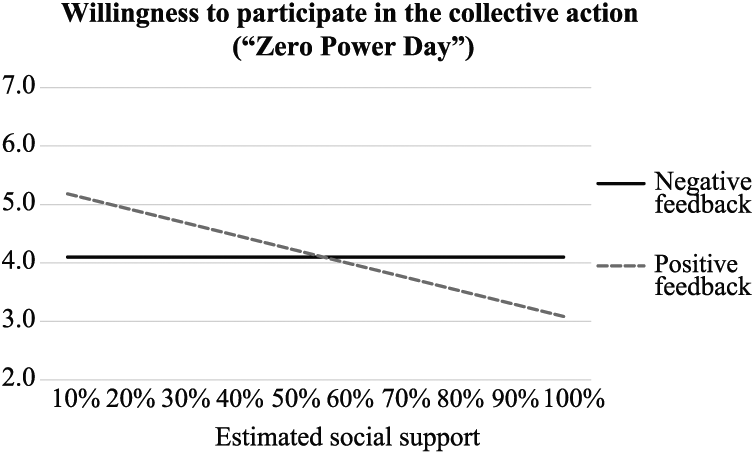
Willingness to participate in the proenvironmental event as a function of estimated support for proenvironmental values and feedback (positive vs. negative) in Study 3.
Petition signing
A binary logistic regression was conducted on petition signing (0 = no petition signed, 1 = at least one petition signed) with feedback (−1 = negative, 1 = positive), estimated numerical support (centred), and their interaction as predictors; and revealed the expected Feedback × Support interaction to be significant, Wald’s χ2(1) = 4.70, p = .03 (see Table 3). Congruent with our hypothesis, the probability to sign at least one petition increased with numerical support for ecology in the negative feedback condition, but decreased in the positive feedback condition (see Figure 4).
Binary logistic regression of feedback and social support on petition signing in Study 3.
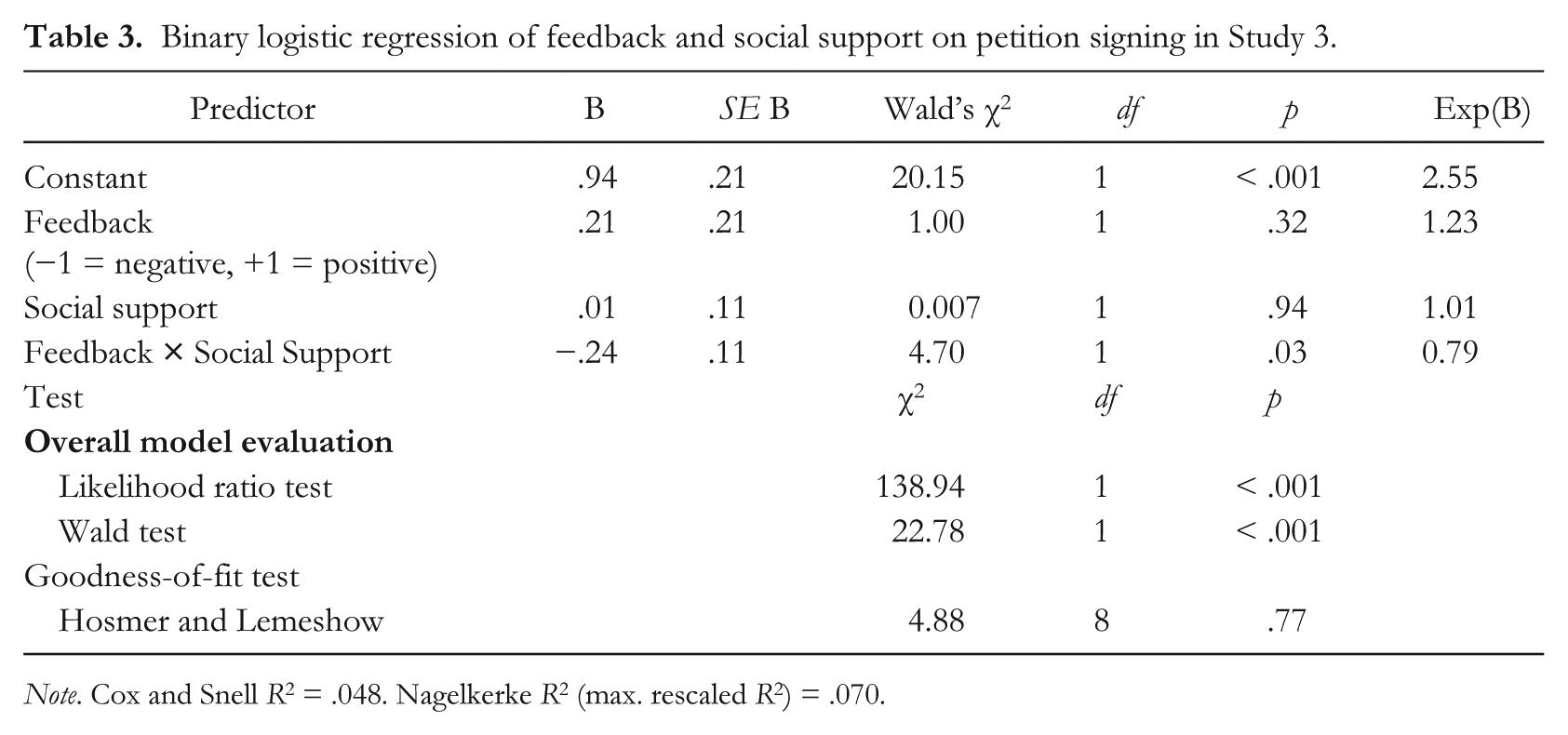
Note. Cox and Snell R2 = .048. Nagelkerke R2 (max. rescaled R2) = .070.
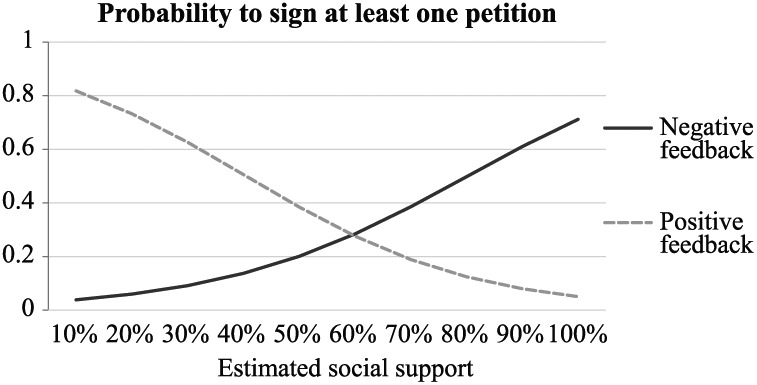
Probability to sign at least one petition as a function of estimated support for proenvironmental values and feedback (positive vs. negative) in Study 3.
Discussion
In this study we replicated the results of Study 2 using a behavioural measure, that is, signing three petitions in favour of the environment. However, the expected interaction failed to reach significance on the behavioural intention measure (p = .16), although the slope pattern was consistent with what was expected. It is worth noting that recent developments in statistics in psychology have warned about the restrictive threshold of the p-value, and simulations have shown that p-value can vary considerably from study to study (the so-called “dance of the CIs,” see Cumming, 2014). Lack of significance of this measure could be attributed to probabilistic misfortune. We conducted a small-scale meta-analysis on our data in order to strengthen our conclusions.
Small-Scale Meta-Analysis
To help reach a conclusion about the interactive effect of numerical support and green habits (measured or sanctioned by feedback), we conducted a small-scale meta-analysis on the findings of the three studies. Given its common use in meta-analyses, we chose Cohen’s d as the effect size indicator and computed it for the Numerical Support × Green Habits interaction for each study (although Cohen’s d initially qualifies differences in a pairwise comparison, it can easily be obtained by transformation from another effect size indicator; see Cohen, 1988; Rosenthal, 1994). Studies were weighted according to their sample size. Using R metafor package (Viechtbauer, 2010), we ran a random-effect Hunter and Schmidt’s model on the data and obtained an average Cohen’s d = .42, 95% CI [0.24, 0.59], SE = 0.09, z = 4.70, p < .001 (see Table 4). Studies were found homogenous, Q(3) = 1.45, p = .69, I2 = 0%. In conclusion, despite the fact that 1 finding out of 4 did not reach significance, one can have confidence in the reliability of the medium-size Numerical Support × Past Behaviour interaction effect.
Small-scale meta-analysis on the results of the three studies. Cohen’s d was chosen as the common effect size indicator. Studies are weighted according to sample size.
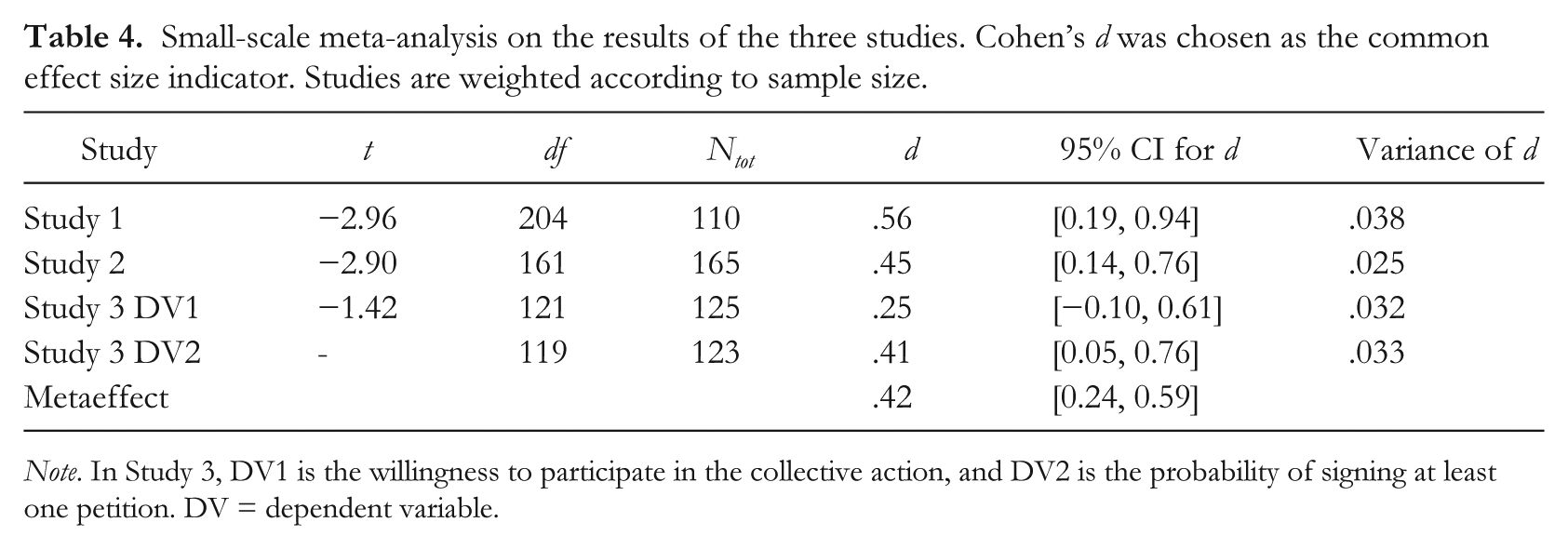
Note. In Study 3, DV1 is the willingness to participate in the collective action, and DV2 is the probability of signing at least one petition. DV = dependent variable.
General Discussion
The Present Research
Past behaviours have been found to lead to either behavioural consistency or inconsistency, the latter being referred to as “balancing.” In the present paper, we drew from social influence and social identity literatures to propose that majority versus minority numerical support would moderate the inconsistent/consistent behaviour effect. In accordance with conversion theory (Moscovici, 1980), we hypothesised that people would be more motivated to show consistent behaviour when a minority, rather than a majority, support their past behaviour. Whereas minority support would energise people and lead them to act consistently with their past deeds, majority support would elicit a focus on whether one’s past behaviour satisfies the majority norm (i.e., comparison process). If past behaviour is considered sufficient, one would feel less agitated and thus allowed to reduce efforts to adopt proenvironmental behaviours (i.e., self-licensing). If past behaviour, however, reflects a lack of normativity, one would actively try and make up for it by adopting more normative behaviours (i.e., compensation). Accordingly, we anticipated that past behaviour would predict more congruent future behaviour (i.e., consistency effect) when proenvironmental values are supported by a minority rather than a majority of people.
In three studies we investigated the interactive impact of proenvironmental past behaviour and numerical support for environmental values on proenvironmental behavioural intention and behaviour. Across the studies, we either measured or manipulated both independent variables, which altogether strengthens our findings. Notably, by manipulating participants’ understanding of their past behaviour through an attitude inference paradigm (Study 2) and a bogus feedback manipulation (Study 3), we ruled out an alternative explanation of the results by a priori differences in participants’ adoption of green behaviour (Study 1). We were also able to replicate the consistency/balancing effect on attitude, behavioural intention, and behaviour measures. Consistent with our hypothesis, numerical support moderated the link between past behaviour and future intention/behaviour. Although the predicted interaction effect failed to reach significance on 1 out of 4 dependent measures, the pattern of findings was consistent across the three studies and a small-scale meta-analysis ensured its reliability. Specifically, minority support led to patterns of behavioural consistency as past behaviour positively predicted proenvironmental actions. Majority support, on the other hand, led to dynamics of balancing: insufficient past behaviour increased motivation to engage in further conduct (i.e., compensation), while sufficient past behaviour decreased it (i.e., self-licensing).
Theoretical Implications and Future Research
Moderating the in/consistency effects
The present research may be of relevance for different research domains. For instance, past research suggests that focus on commitment versus progress towards a goal moderates the inconsistency/consistency effect (Susewind & Hoelzl, 2014). Accordingly, the moderating effect of majority/minority support observed here may echo a similar dynamic: majority support makes participants focus on their degree of compliance with the normative position—which can equate to a progress focus—while minority support makes participants focus on their commitment to the proenvironmental goal. It should be noted, however, that in Susewind and Hoelzl’s study, participants reflected upon their personal goals, and not the goals of a given group relative to a descriptive, numerical norm. Future studies should compare types of (personal vs. normative) goals and their effect on behavioural inconsistency/consistency. Moreover, they should investigate whether the focus on commitment versus progress towards the goal would mediate the effect of a minority versus majority focus.
The role of initial attitude
Another issue that would deserve greater attention in future research concerns the moderating role of initial attitude. Indeed, a great deal of research has studied social influence through the lens of the source of influence with which the individual initially disagrees (Butera et al., 2017; Martin & Hewstone, 2008). A contrario, we used here the notion of numerical support (i.e., the number of persons who support the individual’s position). Indeed, research on self-licensing and the rebound effect of positive feedback tends to focus on individuals who agree with the principle being studied (e.g., Longoni et al., 2014). From our perspective, and provided that the importance of environmental values is widely endorsed by the general population (European Commission, 2014), we assumed that all participants would support these values to a certain extent. However, as we did not measure their initial attitude towards environmental issues, this remains an assumption. Future studies would need to take into account participants’ initial position (see Blanton & Christie, 2003; Göckeritz et al., 2010). If inconsistent/consistent behavioural patterns are indeed related to support for individuals’ prior attitudes or behaviours, we would expect to replicate our findings only amongst individuals with a greener initial attitude. Contrarily, if these patterns are related to social influence, findings would be replicated regardless of initial attitude.
Regulatory focus and deviance regulation theory
The present findings may also be of relevance regarding both, regulatory focus theory (RFT; Higgins, 1997) and deviance regulation theory (DRT; Blanton & Christie, 2003). RFT defines two independent motivational systems: a prevention focus related to “ought” (obligations and duties) and a promotion focus related to ideals (hopes and aspirations). DRT also assumes a dual motivational system that differentiates desired and required behaviours (i.e., obligations) from desired but not required behaviours (i.e., ideals). DRT predicts that individuals try to maintain a positive self-image by avoiding undesirable ways of deviating from social norms and by choosing desirable ways of deviating from social norms. As such, predictions from DRT seem consistent with the theoretical framework of the present research (see also Blanton, Stuart, & van den Eijnden, 2001).
On the one hand, people would be more likely to adopt green behaviour when this behaviour is normative, and deviance is framed negatively. This prediction is consistent with Moscovici’s (1980) understanding of majority influence, as well as the assumption that people would focus on avoiding deviance from normative positions (i.e., majority support condition). On the other hand, people would also be more likely to adopt green behaviour when this behaviour is not normative and deviance is framed positively (i.e., minority support condition). Thus, this prediction is consistent with Hypothesis 1, according to which proenvironmental behaviour has a positive connotation, which increases people’s motivation to act accordingly, specifically when this behaviour is not normative. However, the consistency effect observed in the minority conditions should disappear when green behaviour is no longer positively connoted. Further research is needed in order to examine in more depth this issue.
What makes an active minority active?
Finally, the present findings may also be of relevance for minority influence research. All in all, the present findings are consistent with Moscovici’s (1980) theory of social influence, which states that majorities are more likely to elicit superficial conformity to norms, whilst minorities enable a deeper integration of the position and more “real” influence. Interestingly, minority influence literature has insisted that minorities must stay active in order to gain influence (e.g., Mugny, 1982) but has rarely explicitly stated what this means for minority members. In consonance with others (Levine & Moreland, 2006), the present findings support the idea that belonging to a minority has an energising effect on its members, pushing them to stay involved and militating to promote the minority’s goals and values, which in turn results in what observers would call an “active minority” (see also Morrison & Wheeler, 2010, for a description of the relationship between minority status and self-concept clarity). Additionally, it also makes sense to think that such an increased commitment to minority positions will strengthen the attitude–behaviour link and, therefore, help people resist future counterattitudinal persuasive attempts (Martin, Hewstone, & Martin, 2008).
Conclusion: The Paradox of Successful Minorities
We would like to conclude on a historical note and highlight that the environmentalist movement started back in the 1970s as a minority (by nongovernmental associations such as Greenpeace and Friends of the Earth) but then gradually gained visibility (e.g., first Earth Day in 1970, first UNO international conference on the issue in 1972). Quickly both, nations (e.g., Earth Summit in 1992, ratification of the Kyoto Protocol in 1997) and individuals (Berger & Corbin, 1992) grew an ecological conscience until, eventually, environmentalism established itself as a (new) majoritarian and normative value (World Values Survey Association, 2010–2014). The 2015 UNO’s proposition of 17 sustainable development goals, of which seven are directly related to environmentalism, illustrates this transition to a majority support. In this sense, environmentalism depicts a remarkable example of an active minority that managed to impose its position and induce—to some extent—societal change (i.e., an innovation process; Moscovici, 1985). However, adequate behaviour remains insufficient despite a wide acknowledgement of the importance of the issue, resulting in the attitude–behaviour gap described at the beginning of this paper. Thus, the case of environmentalism illustrates the paradox of a successful minority that managed to impose its position so well that it finally emerged as the new social norm but lost its potential of “real” influence in the process of becoming a majority. The current difficulties in implementing efficient actions against climate change as well as other environmental issues illustrate this struggle.
This raises concerns about the possibility of long-term success of any movement aimed at eliciting societal change. It should be noted, however, that the objective numerical support matters less than the subjective feeling of being part of a majority or minority group of people acting for the environment. Thus, to avoid mere compliance effects, any societal movement should keep acting as if it were a minority. This logic raises an intriguing question regarding climate change specifically: could it be that the “argument of consensus” (i.e., arguing that everyone agrees on the matter and that an overwhelming number of scientists identifies human behaviour as a major cause of climate change; Cook et al., 2016), massively relayed by the media, actually produces a paradoxical effect and hinders personal efforts in fighting the issue? In an interview about environmentalism, Moscovici (2000) highlighted that “the environmental movement should regard itself as a minority” if it wants to remain active and influential. The present findings support this view and suggest that, paradoxically, having people believe they are only few to care for the environment might be the best way to get them not “go green” but to “stay green.”
Footnotes
Acknowledgements
We are grateful to Oliver Arnold for his help in conducting the Rash analyses, to Fabio Mason for his help in collecting data, to Gabriel Mugny for his valuable comments on a previous version of the manuscript, and to Cynthia Lee for a precious proofreading of the manuscript.
Funding
The author(s) received no financial support for the research, authorship, and/or publication of this article.
Notes
References
Supplementary Material
Please find the following supplemental material available below.
For Open Access articles published under a Creative Commons License, all supplemental material carries the same license as the article it is associated with.
For non-Open Access articles published, all supplemental material carries a non-exclusive license, and permission requests for re-use of supplemental material or any part of supplemental material shall be sent directly to the copyright owner as specified in the copyright notice associated with the article.
