




Abstract
Scientists are in near-universal agreement that human activity is a primary cause of climate change. Yet, despite this scientific consensus, the American public remains divided when it comes to beliefs about human-induced climate change. We investigate the role of partisan group identity and the politicization of science in undermining the impact of a scientific consensus message about human-induced climate change. We do so with a survey experiment administered on a nationally representative sample, finding that partisan identity—and especially politicization—can stunt the effect of a scientific consensus statement about climate change. We conclude with a discussion about how scientists, as a group, might work with partisans to more effectively communicate scientific information.
How does the American public arrive at its beliefs about human-induced climate change? This question is of obvious importance given the contested nature of climate change and the potential societal implications. One source of information on climate change is personal experience (e.g., Druckman, 2015a). Yet perhaps of greater relevance is information that people obtain indirectly from two key groups: scientists and political party elites. These two groups differ in their perspectives. Scientists, as a group, nearly universally agree (i.e., there is a consensus) that human activity is a primary cause of climate change (e.g., Cook et al., 2013; Cook et al., 2016; International Panel on Climate Change, 2013; Rosenberg, Vedlitz, Cowman, & Zahran, 2010). 1 In contrast, American political elites are divided, with Democrats largely accepting the scientific consensus that human activity is a primary cause of climate change, while many Republicans remain skeptical (Bolsen, Druckman, & Cook, 2015; Lavelle, 2017).
When it comes to the American public, it seems as if partisan group identity reigns supreme, especially among those who are knowledgeable: as partisans gain more information, they polarize such that Democrats strongly believe in human-induced climate change and Republicans do not (Bolsen et al., 2015; Hamilton, 2011; Kahan, 2016). Can scientists, as a group, intercede in these processes and exert influence on the public’s beliefs via a consensus statement? Does politicizing the science—by which we mean introducing its inherent uncertainty and political application—nullify the effect of communicating that a scientific consensus exists? If so, are there ways to counteract the politicization of science? Finally, are there effects of communicating the scientific consensus about climate change on support for climate mitigation policies?
Partisan Group Identity and Politicization
To address the questions just raised, we use a nationally representative survey experiment. In the experiment, we explore whether a consensus message about human-induced climate change affects beliefs and opinions. As we will explain, we expect it will, contingent on partisan group identity and knowledge. Specifically, the aforementioned polarization among knowledgeable Democrats and Republicans reflects differential partisan reactions to consensus messages: while Democrats accept the message, knowledgeable Republicans reject it, leading to the partisan divide. We also study whether politicizing the consensus message (i.e., stating that politics colors scientific work and advocates selectively use evidence) nullifies its effect. In so doing, we address concerns that politicizing climate science undermines the impact of the consensus by causing people to be uncertain about which science can be believed (e.g., Dietz, 2013, p. 14085).
We additionally build on recent work showing that the impact of “inauthentic” information (i.e., in our case, a politicization claim) can be minimized. This occurs when people are warned in advance of an impending threat and to disregard any “deceptive” (e.g., politicized) arguments (Cook, Lewandowsky, & Ecker, 2017; van der Linden, Leiserowitz, Rosenthal, & Maibach, 2017), or sometimes when they are told after the fact to do so (Bolsen & Druckman, 2015). To see if these approaches can counteract politicization, our experiment includes conditions to not only look at the impact of a consensus message—alone or in the presence of a politicization claim—but also to explore whether providing a warning or correction aimed to counteract politicization can effectively resuscitate the consensus message’s effect.
To preview, we find partisan group identity can, at least for high-knowledge Republicans, limit the ultimate impact of a scientific consensus statement. Even so, the more daunting challenge seems to come from politicization, which undermines the impact of a scientific consensus statement for nearly all partisans. Moreover, we find that efforts to counteract the politicization effect fail. While this leads to a pessimistic portrait of the impact of scientific consensus messages, we discuss, in the conclusion, ways in which scientists might be able to effectively communicate.
Experimental Design and Procedure
We conducted an experiment embedded in a nationally representative survey in the United States (implemented over the Internet) with a total of 1,329 participants. 2 Data were collected during July 2014. We randomly assigned participants to one of five experimental conditions, echoing the scenarios discussed before: a control condition, a consensus information condition, a politicization condition, a warning condition, and a correction condition.
Participants in the control condition began by reading a brief introduction, which stated, “We are now going to ask your opinion about human-induced climate change. Climate change refers to a long-term change in the Earth’s climate due to an increase in the average atmospheric temperature.” These participants then immediately answered our main outcome measures. We asked them whether “most scientists are in agreement or divided on the statement that human activities are causing climate change” (coded 1 if there was a perception of scientific consensus, and 0 otherwise). Additionally, we measured belief in human-induced climate change with the question, “To what extent do you think climate change is human-induced as opposed to a result of Earth’s natural changes?” (responses were provided on a 7-point fully labeled scale; 1 = entirely Earth’s natural changes, 7 = entirely human-induced). 3 Finally, we measured opposition or support for a set of three climate change polices including: (a) whether government should decrease or increase investments in ways to reduce impacts from climate change; (b) the importance of planning for ways to reduce climate change’s impacts; and (c) opposition or support for laws aimed to cut emissions of greenhouse gases; (responses to each question were recorded on a 7-point scale; 1 = strongly oppose, 7 = strongly support). We created a single-scaled measure from these three items tapping policy beliefs (α = .91) such that higher scores indicate greater support for climate mitigation policy action.
These variables allow us to partially test van der Linden, Leiserowitz, Feinberg, and Maibach’s (2015) gateway belief model which posits consensus messages affect perceived scientific consensus, which then shapes belief in human-induced climate change, which finally influences support for climate mitigation policies (also see van der Linden, Leiserowitz, & Maibach, 2016). While the nature of our study does not allow for a direct test of mediation (see Bullock & Ha, 2011), we can offer suggestive evidence regarding the model’s causal predictions. 4
To address the question of how a scientific consensus statement about human-induced climate change affects partisans, we randomly assigned some respondents to a consensus condition. They read the following statement immediately after the aforementioned introduction (that was also provided to control group respondents): A recent report, Climate Change Impacts in the United States, produced by 300 expert scientists and reviewed by the National Academy of Sciences as well as agencies with representatives from oil companies, puts much of the uncertainty to rest by stating that climate change “is primarily due to human activities.”
The gateway model suggests such a statement will increase perceptions of scientific consensus, belief in human-induced climate change, and ultimately support for climate mitigation policy. Other work suggests these effects could be contingent on partisan group identity and political knowledge, due to motivated reasoning.
In the case of motivated reasoning, partisans hold prior views that may mimic the aforementioned party elite’s views such that Republicans are less likely to believe in human-induced climate change than Democrats (e.g., Bolsen et al., 2015; Hamilton, 2011). Partisans then interpret new information (e.g., a scientific consensus statement about human-induced climate change) in line with their prior belief, regardless of its “objective” accuracy. Thus, Republicans may counterargue and reject the consensus statement that is contrary to their prior beliefs. Democrats, on the other hand, may accept the belief-consistent information and shift their opinions even further in the direction of the scientific consensus (see, e.g., Bolsen, Druckman, & Cook, 2014a; Lavine, Johnston, & Steenbergen, 2012; Leeper & Slothuus, 2015; for more general discussion of partisanship and climate change beliefs, see Schuldt, Konrath, & Schwarz, 2011; Schuldt, Roh, & Schwarz, 2015).
Motivated reasoning occurs most often among individuals with high amounts of knowledge. Those individuals tend to hold prior opinions that echo elite views (Lenz, 2012), and tend to have the motivation and ability to engage in effortful and defensive cognitive processes, including counterarguing against information that is incongruent with existing beliefs (Taber & Lodge, 2006). In terms of consensus-messaging effects, we expect the largest group identity hurdle to come from high-knowledge Republicans who may reject the consensus statement (Kahan, 2015; also see Cook & Lewandowsky, 2016; Deryugina & Shurchkov, 2016).
To address the question of whether a politicization claim can undermine the impact of the scientific group’s consensus message, we randomly assigned some respondents to a politicization condition. Studies of support for several emergent energy technologies show that politicizing science (i.e., emphasizing its inherent uncertainty and political motives in its application) can vitiate the impact of consensus messages since people become uncertain about whether science can be trusted (Bolsen & Druckman, 2015; Bolsen, Druckman, & Cook, 2014b). To test whether this occurs when it comes to human-induced climate change (also see van der Linden et al., 2017), we included an experimental condition where respondents read the following passage immediately after the aforementioned introduction: As you have likely heard, the role that humans’ actions play in driving climate change has been a point of debate. Politics nearly always color scientific work with advocates selectively using evidence (e.g., that supports their policy positions). This leads some to say there is too much uncertainty over the role that humans play in this process—politics make it difficult to assess whether climate change reflects human activities or the Earth’s natural changes. This may be true even for a recent report. That debated report, Climate Change Impacts in the United States, produced by 300 expert scientists and reviewed by the National Academy of Sciences as well as agencies with representatives from oil companies, “claimed” to put much of the uncertainty to rest by stating that climate change “is primarily due to human activities.”
This operationalization follows Bolsen and Druckman’s (2015) characterization of politicization occurring “when an actor emphasizes the inherent uncertainty of science to cast doubt on the existence of scientific consensus” (p. 746, original emphasis). As the authors note and as our treatment suggests, this is typically done in pursuit of a particular political agenda. 5
We randomly assigned participants to one of two additional experimental conditions to test whether there are approaches to combat the potentially nullifying effect of politicization. As mentioned, we investigate two approaches studied in related work on misinformation and “successful de-biasing” (Lewandowsky, Ecker, Seifert, Schwarz, & Cook, 2012). That work suggests that offering a warning in advance of the misinformation—or in our case, the politicization claim—can counteract its effect. Specifically, when a warning is preemptively issued, which tells people they will encounter a politicization claim that is false, it may “inoculate” people from the effect of politicization encountered later and resuscitate the scientific consensus effect (Bolsen & Druckman, 2015; Cook et al., 2017; van der Linden et al., 2017). The other possible approach is to offer a correction that follows the politicized statement, telling people to dismiss the inauthentic information they previously encountered (see, e.g., Cobb, Nyhan, & Reifler, 2013; Nyhan & Reifler, 2010). In this case, the hope is that people will dismiss the politicization claim, increase their trust in the consensus scientific information, and update their opinion accordingly.
6
We operationalized both approaches in line with Bolsen and Druckman’s (2015) study of the effects of warnings and corrections on counteracting politicized science with respect to emergent energy technologies; each condition added: Some say that it is difficult to assess the role of human actions in climate change since people only point to evidence that supports their positions (e.g., their policy positions). Yet, despite what some claim, there is virtually no uncertainty when it comes to the assessment of human-induced climate change; a recent comprehensive report, endorsed by a wide range of individuals and organizations, makes clear that a consensus of scientists believes that human activities play a fundamental role.
The idea is that a warning or correction might restore the impact of the consensus information regarding human-induced climate change. In sum, respondents were randomly assigned to one of five experimental conditions with the following flow of information: (a) control; (b) consensus information only; (c) politicization claim + consensus information; (d) warning + politicization claim + consensus information; and (e) politicization claim + consensus information + correction. All groups then answered the aforementioned outcome variables (i.e., perception of a scientific consensus, belief in human-induced climate change, and policy belief items).
The survey also included items to measure partisan identity and knowledge. We measured party identification with a standard 7-point response scale, with higher values moving toward “strong Republican” (i.e., labels were: strong Democrat, weak Democrat, lean Democrat, independent, lean Republican, weak Republican, strong Republican). We measured knowledge by counting the number of correct answers to 11 factual questions about politics, science, and energy. We included a mix of general political knowledge and domain-specific questions because it will identify individuals who are more likely to attend to their party’s positions (e.g., politically knowledgeable individuals are more likely to be aware of elites’ positions in general), and who are generally motivated to process information in line with the aforementioned motivated reasoning account (e.g., those knowledgeable about science and energy will be motivated to protect their existing beliefs in this domain). Our use of objective knowledge measures enhances their validity since people often overreport self-reported knowledge due to social desirability bias; it also is a fairly common practice when it comes to public opinion studies (e.g., Delli Carpini & Keeter, 1996). We included additional items measuring demographic and political characteristics; question wording for these measures appear in the supplementary Appendix (available at the journal’s website), as does a demographic profile of our sample.
We expect, as explained, that the impact of the consensus information will be contingent on partisan knowledge subgroups (i.e., high-knowledge Republicans may not be affected by the consensus information, possibly moving in the opposite direction). We distinguish Democrats and Republicans based on our partisanship measure, treating leaners as partisans (see Druckman, Peterson, & Slothuus, 2013; Levendusky, 2010). 7 For knowledge, we created low- and high-knowledge subgroups by taking a median split on the 11-point (politics, science, and energy) knowledge scale (for discussion of median splits, see Iacobucci, Posavac, Kardes, Schneider, & Popovich, 2015a; Iacobucci, Posavac, Kardes, Schneider, & Popovich, 2015b). 8 We then created four subgroups: low-knowledge Democrats (n = 213), low-knowledge Republicans (n = 173), high-knowledge Democrats (n = 286), and high-knowledge Republicans (n = 264). 9
Results
We present the results in five tables—one for all groups merged and then separately for each distinct subgroup. Each table includes five models, consistent with van der Linden et al.’s (2015) gateway model, to test whether the conditions affect (a) perceptions of consensus, (b) belief in human-induced climate change, (c) belief in human-induced climate change through a process (suggestively) mediated by perception of a scientific consensus, (d) policy beliefs, and (e) policy beliefs through a process (suggestively) mediated by a belief in human-induced climate change. 10
Table 1 shows the consensus statement increased perception of a scientific consensus among all partisans (p < .01, Model 1). While the consensus statement had no effect on belief in human-induced climate change among all partisans (Model 2), perception of a scientific consensus on human-induced climate change is positively associated with a belief in human-induced climate change (Model 3). This suggests potential indirect effects of the scientific consensus statement on belief in human-induced climate change since that statement affected perception of a consensus in Model 1, which is associated with an increased belief in human-induced climate change in Model 3. 11 The consensus condition had no effect on policy support (Model 4) but, again, there are potential indirect effects. The consensus statement affects perceptions of consensus, which is positively associated with belief in human-induced climate change, which in turn, is positively associated with support for climate mitigation policy (Model 5). This coheres with the gateway model’s prediction of a consensus statement exerting indirect effects on policy support mediated by its impact on belief in human-induced climate change. A consensus message affects perceptions of consensus and ultimately can influence belief in human-induced climate change and support for climate mitigation policy.
Message effects on all respondents.

Note. Coefficients are from a logit model for the perceptions of consensus model and from ordinary least squares for the other models. Standard errors are in parentheses.
p ≤ .01. **p ≤ .05. *p ≤ .10, for two-tailed tests.
We also found that the politicization claim undermined the scientific consensus message’s effect. When politicized, the consensus message does not have a significant positive effect on perception of a scientific consensus among all partisans (Table 1, Model 1). While perception of a scientific consensus is a significant predictor of belief in human-induced change, and the latter affects policy beliefs, these effects are not from the experimental stimuli but rather reflect the importance of these “fundamental” beliefs on this issue. In short, politicizing science eliminates the positive impact of a consensus message. Moreover, offering a preemptive warning or post hoc correction meant to counteract politicization is not effective at resuscitating the scientific consensus message’s effect.
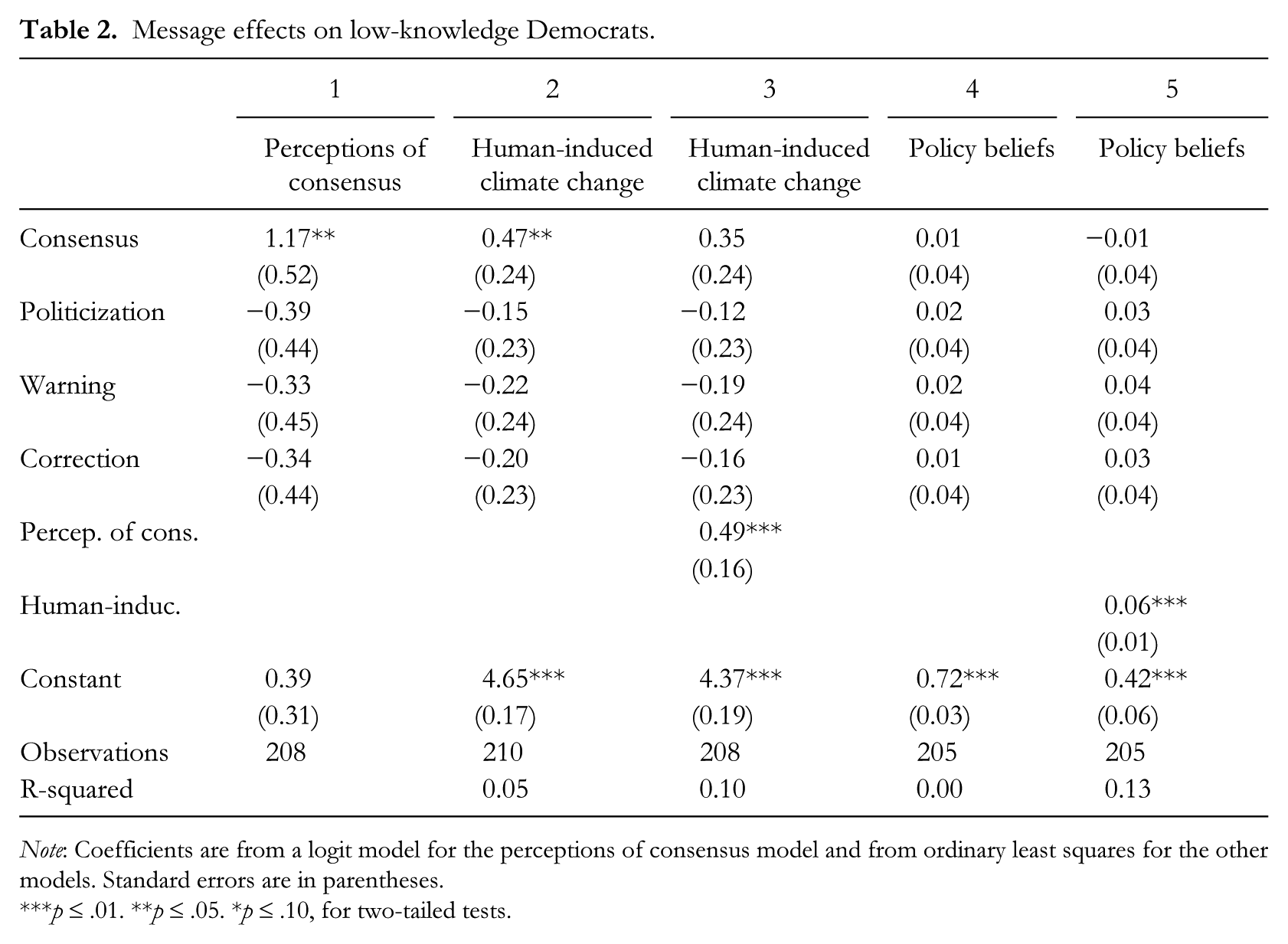
When we turn to the analyses of the experimental conditions on partisan knowledge subgroups, the results for both low-knowledge Democrats (Table 2) and low-knowledge Republicans (Table 3) look similar to the findings in our merged models in Table 1. The consensus message increased perception of a scientific consensus regarding human-induced climate change for both groups (p < .05). Moreover, the consensus statement increased belief in human-induced climate change for both low-knowledge Democrats (p > .05) and low-knowledge Republicans (p < .10). This latter effect appears to be mediated entirely through perceptions of a scientific consensus, as shown in Model 3, where the main effect of the consensus condition became insignificant once the perception of consensus measure was included as an independent variable. The experimental conditions had no effect on support for climate mitigation policy (Model 4). Yet, we again see potential indirect effects on policy support through the impact of the consensus message on belief in human-induced climate change. The consensus statement affected views of consensus (Model 1) which is positively associated with a belief in human-induced climate change (Model 3), which in turn is positively associated with support for climate mitigation policy (Model 5).
Message effects on low-knowledge Democrats.
Note: Coefficients are from a logit model for the perceptions of consensus model and from ordinary least squares for the other models. Standard errors are in parentheses.
p ≤ .01. **p ≤ .05. *p ≤ .10, for two-tailed tests.
Message effects on low-knowledge Republicans.

Note. Coefficients are from a logit model for the perceptions of consensus model and from ordinary least squares for the other models. Standard errors are in parentheses.
p ≤ .01. **p ≤ .05. *p ≤ .10, for two-tailed tests.
We also found that the politicization treatment eliminates the consensus message’s effect on perceptions of consensus for low-knowledge Democrats but not for low-knowledge Republicans (Tables 2 and 3, Model 1). Politicization also eliminates the consensus message’s effect on belief in human-induced climate change for both subgroups. Further, warnings and corrections had no resuscitative impact. This is stark for low-knowledge Democrats: the scientific consensus message’s effect vanished entirely in the presence of politicization. For low-knowledge Republicans (Table 3), politicization did not stunt the impact of communicating scientific consensus on perception of a consensus, as noted (Model 1); however, its negative influence on belief in human-induced climate change (Model 3) countered the indirect consensus message effect that carried over via perceptions of consensus. Warnings and corrections also failed to resuscitate the scientific consensus effect for either subgroup, and thus for all low-knowledge partisans, politicization undermined the consensus message’s effect.
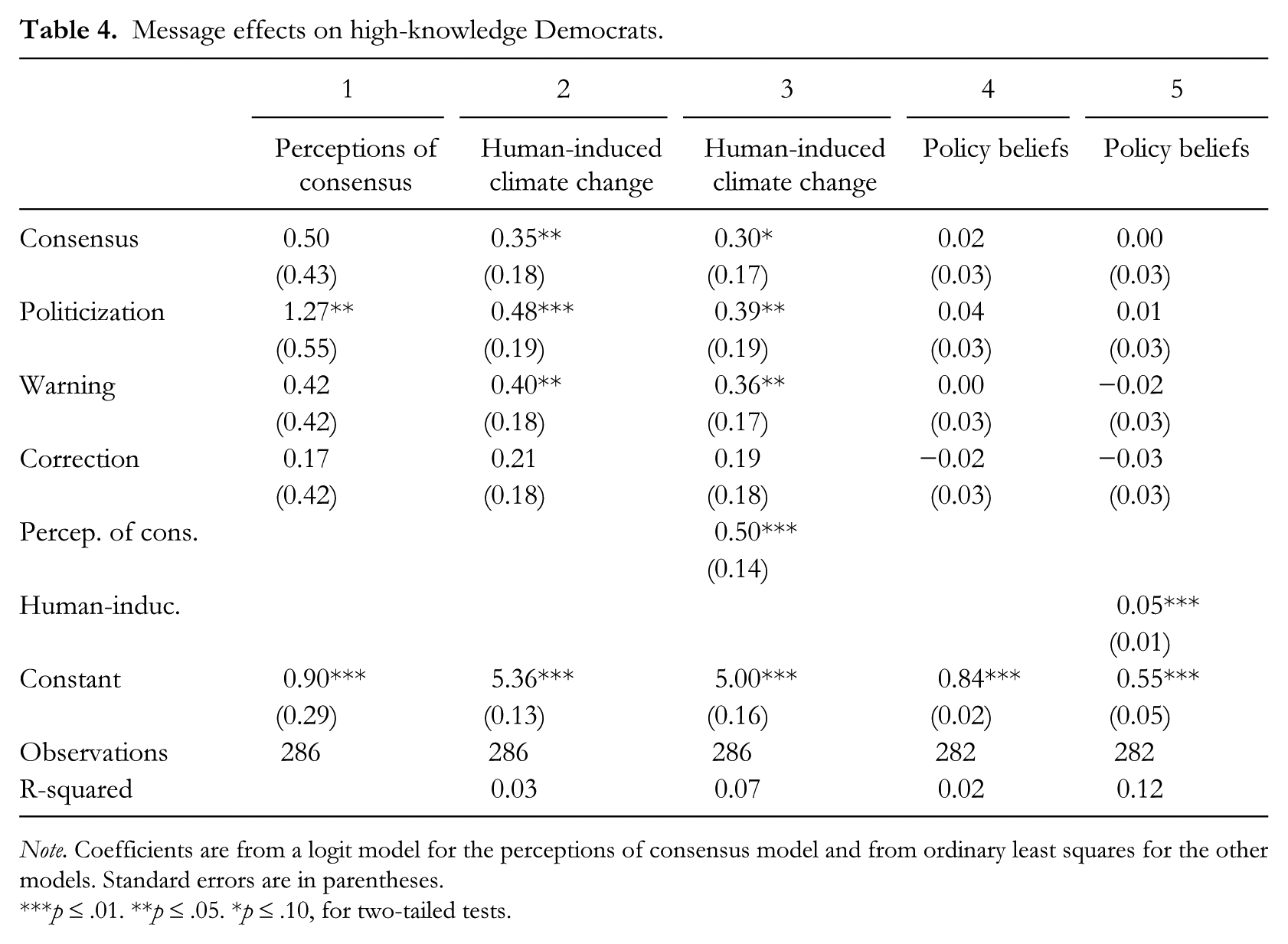
Table 4 presents the results for high-knowledge Democrats. We found that the consensus information had no effect on perceptions of consensus among this more knowledgeable subgroup (Model 1). This may reflect that the bulk of high-knowledge Democrats already held this belief and so there was not a lot room for movement (i.e., 71% of high-knowledge Democrats in the control condition held this belief). That said, the politicization claim significantly increased perception of a scientific consensus on climate change among high-knowledge Democrats (p < .05), and it is not entirely clear why. (It could reflect counterarguments generated in response to the politicization claim.)
Message effects on high-knowledge Democrats.
Note. Coefficients are from a logit model for the perceptions of consensus model and from ordinary least squares for the other models. Standard errors are in parentheses.
p ≤ .01. **p ≤ .05. *p ≤ .10, for two-tailed tests.
We further found the consensus message significantly increased belief in human-induced climate change among high-knowledge Democrats (p < .01) and the politicization claim did not eliminate its effect (Table 4, Model 2). We surmise, although we have no direct evidence, that this reflects motivated reasoning processes (e.g., the generation of counterarguments against the politicization claim) among these knowledgeable partisans who previously believed in human-induced climate change.
The gateway model’s mediational predictions also are supported with one interesting caveat. The impact of the consensus message on belief in human-induced climate change exerts an independent impact even after controlling for perception of a scientific consensus on human-induced climate change (Table 4, Model 3). This suggests that high-knowledge Democrats become more supportive for reasons beyond recognizing the existence of a scientific consensus: they may be motivated to think through other considerations such as the policy implications of their belief (Campbell & Kay, 2014) and the social implications of reaffirming their partisan identity (Kahan, 2015). In sum, the consensus message affects belief in human-induced climate change for high-knowledge Democrats, and its effect on policy beliefs appears to be at least partially mediated through its impact on belief in human-induced climate change (Table 4, Model 5). And for this subgroup, politicization does not undermine the scientific consensus message’s effect (the correction condition is the exception).
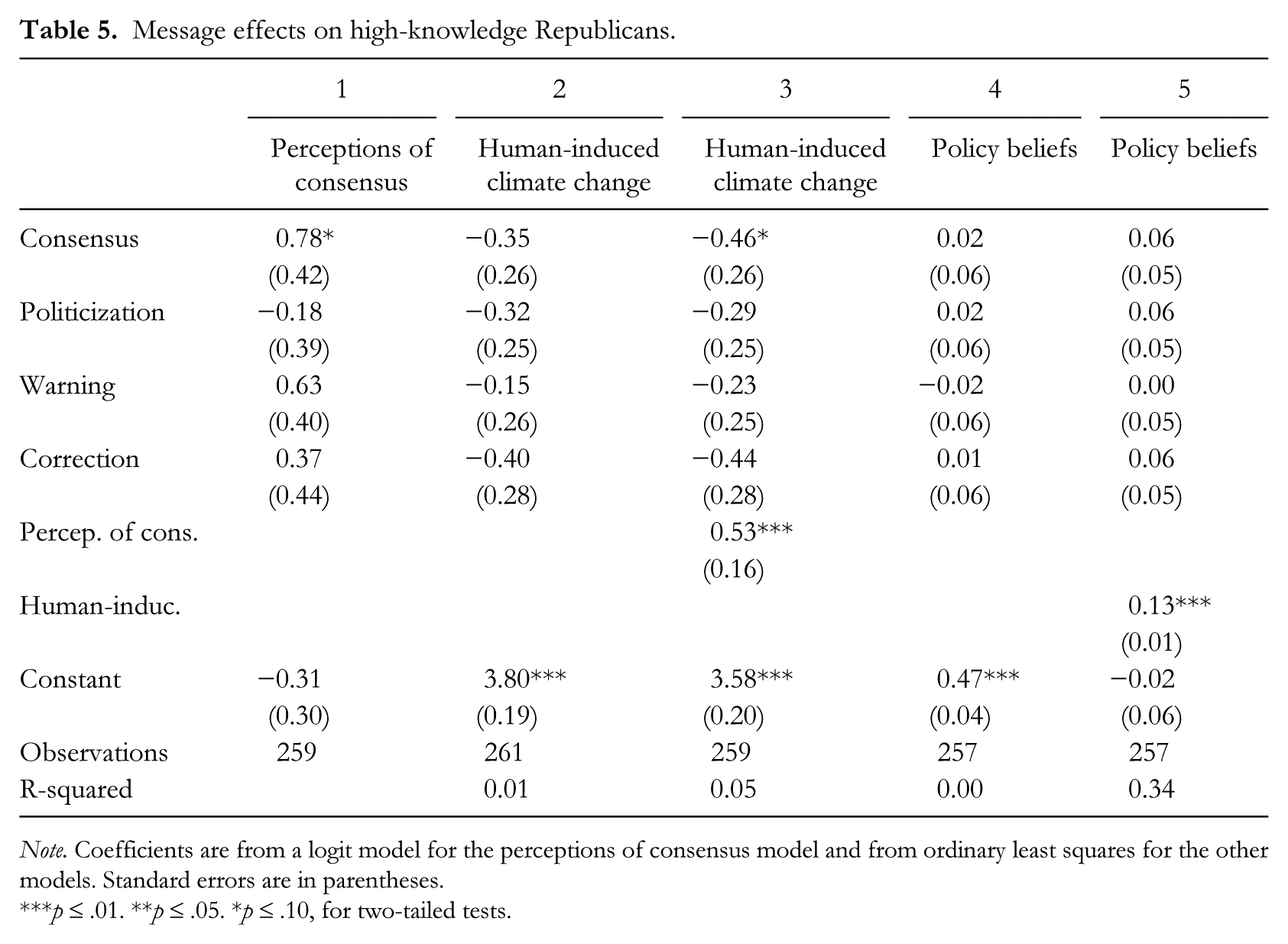
Table 5 shows that high-knowledge Republicans reacted differently to exposure to the scientific consensus message. As in other subgroups, the consensus message significantly increased this subgroup’s perception of a scientific consensus (p < .10, Model 1). That belief is a significant predictor of belief in human-induced climate change (p < .01, Model 3), which positively predicts support for climate mitigation policy (p < .01, Model 5; also see Lewandowsky, Gignac, & Vaughan, 2013; van der Linden, 2016; van der Linden et al., 2015). Yet, the significant negative effect of the consensus message in Model 3 (p < .05) counteracts the positive effect of the perception of a scientific consensus (p < .01) on belief in human-induced climate change. It shows that high-knowledge Republicans may incorporate alternative considerations. These might stem from an aversion to policy solutions that often follow from accepting that humans are a primary cause of climate change (e.g., restrictions on personal freedom, new taxes, etc.) or from a desire to affirm their partisan group identity. This counteracts any indirect effect of consensus messaging on the belief that climate change is primarily human-induced and on support for climate mitigation policies. 12 We also found that politicization eliminates the scientific consensus message’s effect on high-knowledge Republicans, and that warnings and corrections failed to resuscitate its impact among this subgroup.
Message effects on high-knowledge Republicans.
Note. Coefficients are from a logit model for the perceptions of consensus model and from ordinary least squares for the other models. Standard errors are in parentheses.
p ≤ .01. **p ≤ .05. *p ≤ .10, for two-tailed tests.
To summarize:
A scientific consensus statement leads all partisan subgroups, with the exception of high-knowledge Democrats, to increase their perception of the existence of a scientific consensus regarding human-induced climate change.
A scientific consensus statement increases belief in human-induced climate change for all partisan subgroups (with the exception of high-knowledge Republicans), which in turn is associated with increased support for climate mitigation policies. This coheres with van der Linden et al.’s (2015) gateway belief model and suggests that even if consensus messages do not directly affect policy views, they can have indirect effects.
However, there are two major caveats:
High-knowledge Republicans reject the consensus statement’s direct application to human-induced climate change, thereby undermining, or at least vitiating, its indirect impact on policy support.
With the exception of high-knowledge Democrats, politicizing climate science eliminates the effect of the consensus statement on beliefs about human-induced climate change. Moreover, efforts to counteract politicization fail.
In short, partisan group identity can, at least for some, limit the impact of scientific consensus messaging, but perhaps the more daunting challenge comes from politicization.
Conclusion
Our results clarify what, to this point, have been mixed findings on the impact of consensus climate change messaging (cf. Cook & Lewandowsky, 2016; Deryugina & Shurchkov, 2016; van der Linden, 2016; van der Linden et al., 2015). Consistent with van der Linden et al.’s (2015) gateway model, we found that consensus messaging can have a positive effect among all partisan subgroups, at least on some outcome measures (e.g., perceptions of the existence of a scientific consensus). We also found no effect among high-knowledge Republicans exposed to the consensus message on belief in human-induced climate change, consistent with a cultural cognition/motivated reasoning account of opinion formation (e.g., Kahan, 2016). The bottom line is studying the impact of such messaging requires careful attention to which outcome variables are being studied (e.g., perceptions of a consensus, belief in human-induced climate change, policy support) and to specific subgroup differences in partisanship and knowledge. Future work should also attend, more carefully than we were able given our design (Bullock & Ha, 2011), to specific causal relationships between variables in the gateway belief model—our work is only suggestive of causal pathways.
We also found that politicization statements constitute a threat to scientific consensus-messaging efforts, and in many ways, may be a more challenging hurdle to overcome than intergroup partisan differences on climate change. That said, we take some comfort in that, in contrast to our results here, other studies have shown warnings (and sometimes corrections) can counter politicized statements or misinformation (Bolsen & Druckman, 2015; van der Linden et al., 2017). It is likely that the warning and correction treatments we employed were simply insufficient to counteract politicization. In particular, in contrast to other recent work, our warning did not incorporate a detailed refutation of the politicization claim (Cook et al., 2017; van der Linden et al., 2017). This may have rendered the warning too weak to effectively inoculate against the (potentially stronger) politicization argument. More work is needed on effective messaging approaches, and credible source cues for different audiences, as a way to improve the efficacy of science communication efforts (Druckman, 2015b; Druckman & Lupia, 2017).
Finally, our results have implications for intergroup relations. We began by noting that citizens might choose to form beliefs about climate change by obtaining information from scientists or partisan elites. Scientists, as a group, do not often arrive at a consensus as clear as the one about human-induced climate change; yet, the public remains divided. Part of this stems from the fact that partisan identities are deeply held and can trump the collective wisdom and perceived expertise of scientists. But it also comes from the ostensible ease with which politicizing statements can undermine consensus-messaging effects. While our study did not attribute the politicization statement to a partisan source, such messages do indeed often originate from political figures, and more work on this is needed.
Scientists, for good reason, typically avoid taking clear partisan stances, as neutrality is a key to credibility. Even so, there may be benefits from scientists, in communicating what they know about human-induced climate change, working more closely with partisans of different stripes (e.g., Republicans). They can clarify what science shows and does not show: differentiating the existence of knowledge about the impact of human activity on climate change from the implications of the scientific consensus for different policy approaches. It is this latter topic on which science has less to say—and the conflation of scientific knowledge with policy advocacy may underlie Republicans’ aversion to trusting scientific messages about climate change (see Campbell & Kay, 2014; also see Hennes, Ruisch, Feygina, Monteiro, & Jost, 2016). Indeed, our results on high-knowledge Republicans suggest that the consensus statement generates more considerations than simply realizing there is a consensus. The hope is that clearer communication of what scientists know and do not know, and acknowledgment and respect for group differences and values, will help lessen the impact of politicization. This could help build trust in science and empower scientists’ collective wisdom.
Supplemental Material
On-Line_Appendix_for_Do_Partisanship_and_Politicization_Undermine_the_Impact_of_a_Scientific_Consensus_Message_about_Climate_Change – Supplemental material for Do partisanship and politicization undermine the impact of a scientific consensus message about climate change?
Supplemental material, On-Line_Appendix_for_Do_Partisanship_and_Politicization_Undermine_the_Impact_of_a_Scientific_Consensus_Message_about_Climate_Change for Do partisanship and politicization undermine the impact of a scientific consensus message about climate change? by Toby Bolsen and James N. Druckman in Group Processes & Intergroup Relations
Footnotes
Acknowledgements
We thank John Cook, Clau Dermont, Samuel Gubitz, Erin Hennes, Adam Howat, Dan Kahan, Adam Levine, Jacob Rothschild, Sander van der Linden, the journal’s special issue editors, and seminar participants at Northwestern University and the University of Pennsylvania for insightful advice. Data used in this paper as well as additional (e.g., robustness) analyses are available at the second author’s website ( ).
).
Funding
The author(s) received no financial support for the research, authorship, and/or publication of this article.
Notes
References
Supplementary Material
Please find the following supplemental material available below.
For Open Access articles published under a Creative Commons License, all supplemental material carries the same license as the article it is associated with.
For non-Open Access articles published, all supplemental material carries a non-exclusive license, and permission requests for re-use of supplemental material or any part of supplemental material shall be sent directly to the copyright owner as specified in the copyright notice associated with the article.
