




Abstract
Past research has ascertained the benefits of involuntary, “forced” exposure to positive imagined contact. This research explored determinants and consequences of actively chosen imagined contact in a setting of entrenched intergroup conflict. In Study 1, when given an unvalenced visualisation scenario enabling participants to steer the visualisation in any direction they wanted, Turkish Cypriots visualised an intergroup interaction nondistinguishable in quality to that of those assigned to a positive scenario. In Study 2, when asked to actively choose between visualising a positive or a negative intergroup interaction, Turkish Cypriots disproportionally preferred positive over negative contact. The chosen visualisation reflected mood and valenced confirmation biases and resulted in virtuous (vs. vicious) effects on group-level outcomes. These findings shed a first light on the psychological underpinnings of volitional intergroup imagery and indicate that intergroup imagery is a safe way of engaging with the outgroup even in contexts of entrenched conflict.
Keywords
Involuntary or “forced” exposure to positive imagined contact has proved a beneficial intervention strategy for intergroup relations (Lemmer & Wagner, 2015; Miles & Crisp, 2014); this research investigates whether individuals actively choose positive imagined contact in naturalistic settings ridden with intergroup conflict.
Most interventions using intergroup imagery have been carefully crafted by exposing individuals to positive imagined contact towards prejudice reduction. However, when allowed to create and engage in their own simulated contact scenarios, individuals might not actively choose to visualise positive contact experiences. They might rely on their current mood or own personal past experiences of contact and be inclined to visualise a negative contact scenario instead. This might be especially true in contexts characterised by a long history of entrenched intergroup conflict; hence the recent emphasis on assessing contact interventions on a macrolevel, where societal conflict is involved (Lemmer & Wagner, 2015). Salomon (2006), for instance, differentiated between experiences of intergroup contact in regions with a recent history of intractable conflict, such as the Middle East, and experiences in regions without serious conflict, like many places in Europe and North America. Intergroup contact in conflict areas is expected to be bounded by an atmosphere of hostility (Salomon, 2004); this might hold even when the actual conflict has ended, like in Cyprus, because it had encompassed everyday life for such a long period of time (e.g., Bar-Tal, 2007; MacGinty, 2010). Broadly, the presence of ongoing intergroup tensions or even violence can create a social climate where instigating positive contact or achieving positive effects from contact is particularly challenging (Lemmer & Wagner, 2015; McGarry & O’Leary, 1995). Hence, for intergroup contact interventions to be successfully deployed in real life settings, we must ensure that these interventions are applicable outside of stringent laboratory instructions.
Studies on involuntary or assigned positive imagined contact thus may be not be suitable to inform us of the conditions and processes that are naturally at work in realistic social settings and thus may return an overly optimistic outlook for the potential for positive change through mental visualisation, especially in contexts afflicted by a history of conflict. Such criticism has been brought to the imagined contact research before (e.g., Bigler & Hughes, 2010; Brown, 2010).
Research on freely chosen intergroup contact, on the other hand, has the potential to take us a step closer to an understanding of how people spontaneously engage in intergroup imagery in naturalistic settings and, in so doing, it can shed a light on the ways in which imagined contact may contribute to creating its own intergroup “realities” in real settings, by lessening intergroup friction or potentially exacerbating such tensions. This knowledge will in turn allow researchers to create interventions that will work outside of stringent laboratory conditions.
Over two studies we endeavoured to initiate an investigation of freely chosen imagined contact. We investigated a setting of enduring conflict—that of the intergroup relations between Turkish and Greek Cypriots—so that assessing voluntary contact choices in this context, we would ascertain the intrinsic perils and risks (or safety and potentials) of unmonitored, unstructured imagined contact and uncover the mechanisms involved.
Documented Effects of Valenced and Unvalenced Involuntary Imagined Contact
Involuntary exposure to imagined intergroup contact, defined as “the mental simulation of a social interaction with a member or members of an outgroup category” (Crisp & Turner, 2009, p. 234), has shown to have positive effects on several outcome measures, including positive intergroup attitudes (Husnu & Crisp, 2010a; Turner, Crisp, & Lambert, 2007), positive projection to the outgroup (Stathi & Crisp, 2008), outgroup trust (Pagotto, Visintin, De Iorio, & Voci, 2012; Vezzali, Capozza, Stathi, & Giovannini, 2012), outgroup variability (Turner et al., 2007), self-efficacy concerning future contact (Stathi, Crisp, & Hogg, 2011), intentions to engage in future outgroup contact (Husnu & Crisp, 2010a, 2010b), and reduced negative outgroup stereotypes (Brambilla, Ravenna, & Hewstone, 2012; Cameron, Rutland, Turner, Holman-Nicolas, & Powell, 2011; Stathi, Tsantila, & Crisp, 2012). Positive effects of imagined contact can include more subtle forms of bias, such as implicit prejudice (Turner & Crisp, 2010; Vezzali, Capozza, Giovannini, & Stathi, 2012) and subtle, nonverbal behaviours (Birtel & Crisp, 2012; Turner & West, 2012).
Studies of imagined contact typically instruct participants to imagine a positively valenced interaction. This reflects a recognition that quality of contact is a particularly important factor in shaping intergroup relations (e.g., Eller & Abrams, 2004; Stathi & Crisp, 2008; Voci & Hewstone, 2003) and that, while mere contact is capable of reducing prejudice, it is most effective under optimal positive conditions (Pettigrew & Tropp, 2006). This has been argued to apply also to imagined contact. Crisp and Turner (2009), for instance, recognise that specifying a positive interaction may be important to guard against a possible negative tone, which might emerge if participants are given no direction or left to their own mental simulations. This point is important, as it suggests that freedom in mental imagery might encourage individuals to rely upon negative stereotypes as a basis for the imagined interaction.
Empirical studies comparing involuntary positive imagined contact with involuntary unvalenced imagined contact (or the so-called “neutral” imagined contact) seem to corroborate this argument. For example, Stathi and Crisp (2008) found that those individuals who had been asked to imagine a positive contact interaction reported more positive self–outgroup projections than those who had imagined a valence unspecified scenario. In a similar vein, West, Holmes, and Hewstone (2011) did not find the standard beneficial effects of involuntary imagined contact in a condition of involuntary unvalenced contact with an individual with schizophrenia (see Studies 1 and 2); these beneficial effects were found only when the visualisation task was modified to require explicitly positive and pleasant imagined contact scenarios (Studies 3 and 4). Yet, Miles and Crisp’s (2014) meta-analysis of imagined contact studies’ design characteristics found no appreciable difference in effects between involuntary positive imagined contact (52 studies) and involuntary “neutral” imagined contact (14 studies; N = 948 and 3,908, respectively). Miles and Crisp advanced the possibility of a “mere imagined exposure” effect whereby thinking about any type of imagined interaction is beneficial.
Miles and Crisp (2014), however, also raised the possibility that individuals may naturally lean towards imagining a positive interaction even when they are not explicitly asked to imagine a pleasant one; hence, negative stereotypes might colour the content of unvalenced imagined scenarios only in the most intractable settings of intergroup conflicts. The present research collected data from conflict-ridden Cyprus to go at the core of this conjecture and first put it to direct empirical test.
The “Cyprus Problem,” as it involves today the Greek Cypriot majority and the Turkish Cypriot minority, arose from ethno-national differences which led to intergroup violence between the two communities (Hadjipavlou, 2007). The result was a ceasefire line that left the Turkish Cypriot minority in the northern one third of the island and the Greek Cypriot majority in the south. Today, a UN mediation effort continues with UN soldiers remaining along the “Green Line.” Nicosia is still widely recognised as the last divided capital in the world.
The Cyprus context is therefore an exemplar conflict-ridden context where to investigate the choices that individuals make when given the chance to exert some control over their intergroup imagery—of breaking away from the reality of intergroup friction and animosity they are daily immersed in or to reificate it by replicating its qualities and pernicious effects.
To test these ideas, in Study 1, we contrasted an unvalenced imagined contact condition against both positive and negative involuntary imagined contact to check whether unvalenced imagined contact is positive or negative in conflict-ridden societies and thus produces positive or negative outcomes. In Study 2, we furthered this investigation using a novel paradigm of actively chosen imagined contact and explored whether individuals in these contexts prefer positive or negative imagined contact when both are equally available. In addition to studying the psychological consequences of volitional imagined contact, in Study 2 we also explored its psychological determinants—in terms of mood regulation and expectancy confirmation.
Study 1
Past research on involuntary intergroup imagery has contrasted unvalenced imagined contact with positive imagined contact. To ascertain whether individuals from a conflict-stricken society would visualise a positive or a negative imagined contact scenario when given the chance to freely choose its qualities, we compared the qualities and the effects of an “unvalenced” imagined contact scenario with those generated in conditions in which we instructed individuals to visualise an explicitly positive and an explicitly negative imagined contact scenario. We centred this study’s design around the “unvalenced” condition because it does not specify any valence for the intergroup interaction. While this condition is similar to the standard neutral condition of past imagined contact studies, we opted to call it unvalenced to stress that participants were genuinely unrestricted and thus free to go in either the positive or negative direction.
We expected Turkish Cypriots not explicitly directed to visualise positive imagined contact to actively and freely lean towards visualising negative imagined contact scenarios and, as a result, to display a spiralling of negative emotions, cognitions, and behaviours. Hence, we hypothesised that the unvalenced imagined contact scenario would align in qualities and effects more with the negative imagined contact condition than with the positive imagined contact scenario. We also included a no-contact control scenario of an outdoor scene as a control condition.
Method
Participants and Design
One hundred and eighty-two participants from the Turkish Cypriot community (115 female, 62 male, and five gender unspecified; M = 30.11 years, SD = 11.80) volunteered for a study on “social issues in Cyprus.” To check the respondents’ experience of the 1974 war, participants were asked whether they had had direct involvement (i.e., personal experience), or indirect involvement (i.e., experience of a relative or close other) in the 1974 war, including whether they had been displaced and lost someone close as a result of the war. There was strong support for a high impact of the conflict on the recruited respondents: Over 89% of the overall sample reported at least some direct or indirect involvement in the conflict. Specifically, 14.8% reported direct involvement (as a soldier, prisoner of war, etc.) and 74.7% indirect involvement (father kidnapped, neighbouring village bombed, etc.); 13.7% reported personal displacement from their own homes and 60.9% indirect experience of displacement (e.g., parental displacement); 30.2% reported losing a family member and 13.2% reported losing a friend or close other as a result of the war.
Participants were randomly assigned to an unvalenced, negative, no-contact control, or a positive imagined contact condition (n = 47, 49, 44, and 42, respectively) and then completed a paper questionnaire in a research laboratory.
Procedure and Materials
Previsualisation attitude measure
Prior to the imagined contact manipulation participants completed an evaluation task or “feeling thermometer” (Esses, Haddock, & Zanna, 1993) to express their attitudes towards Greek Cypriots. The thermometer ranged from 0o (extremely cold/negative) to 100o (extremely warm/positive) labelled in 10o increments.
Imagined contact task
To ensure that valence appraisals associated with completing the attitude measures did not interfere with the imagined contact manipulation, all participants then engaged in a filler task (30-second visualisation and open-ended description of an outdoor scene). At this point, three groups received the experimental manipulation of unvalenced contact, negative imagined contact, or positive imagined contact. Participants took a minute to imagine (unvalenced/negative and unenjoyable/positive and enjoyable) contact with a Greek Cypriot stranger and then wrote a detailed description of the exchange (Turner et al., 2007); in the unvalenced condition, participants were simply asked to imagine contact with a Greek Cypriot stranger, no specification was made with regard to the valence of the scenario. The control condition was a no-contact outdoor scenario in which participants were asked:
I would like you to take a minute to imagine you are walking in the outdoors. Try to imagine aspects of the scene about you (e.g., is it a beach, a forest, are there trees, hills, what’s on the horizon). (Turner et al., 2007)
Contact valence checks
Next, participants expressed their feelings during the visualisation exercise (Islam & Hewstone, 1993; seven items, e.g., enjoyable, relaxed [1 = not at all, 7 = very much]) on a reliable Perceived Contact Valence Index (α = .85).
Outcome measures
To test postvisualisation attitude change, while reducing practice effects and demand characteristics associated with repeated measurement, this time participants rated how they felt toward Greek Cypriots in general on bipolar scale items: cold–warm, positive–negative, friendly–hostile, suspicious–trusting, respectful–contempt, admiration–disgust; anchored from 1 to 7 (Wright, Aron, McLaughlin-Volpe, & Ropp, 1997). An index of attitude improvement was obtained by subtracting the previsualisation scores from the postvisualisation scores (α = .88), upon reverse scoring where appropriate and having metrically equated the measures using Z-scores, so that a positive value indicated pre–post visualisation increased liking of the outgroup and a negative value indicated decreased liking.
Results and Discussion
Checks of Involuntary and Unvalenced Contact Valence
One-way ANOVA on the Perceived Contact Valence Index detected a robust difference between conditions, F(3, 178) = 21.45, p < .001, η2 = .27. Participants who had been asked to visualise a negative intergroup exchange rated the experience more negatively (M = 3.39, SD = 1.23) than those who had been asked to visualise a positive exchange (M = 5.18, SD = 1.69), an unvalenced exchange (M = 4.95, SD = 1.46), or no-contact (M = 5.58, SD = 1.26). Hence, negative involuntary imagined contact scenarios were more unpleasant than all other types of imagery; the negative and positive conditions were therefore significantly separate from each other as well as the other conditions (see Table 1).
Dependent measures as a function of imagined contact conditions in Study 1.
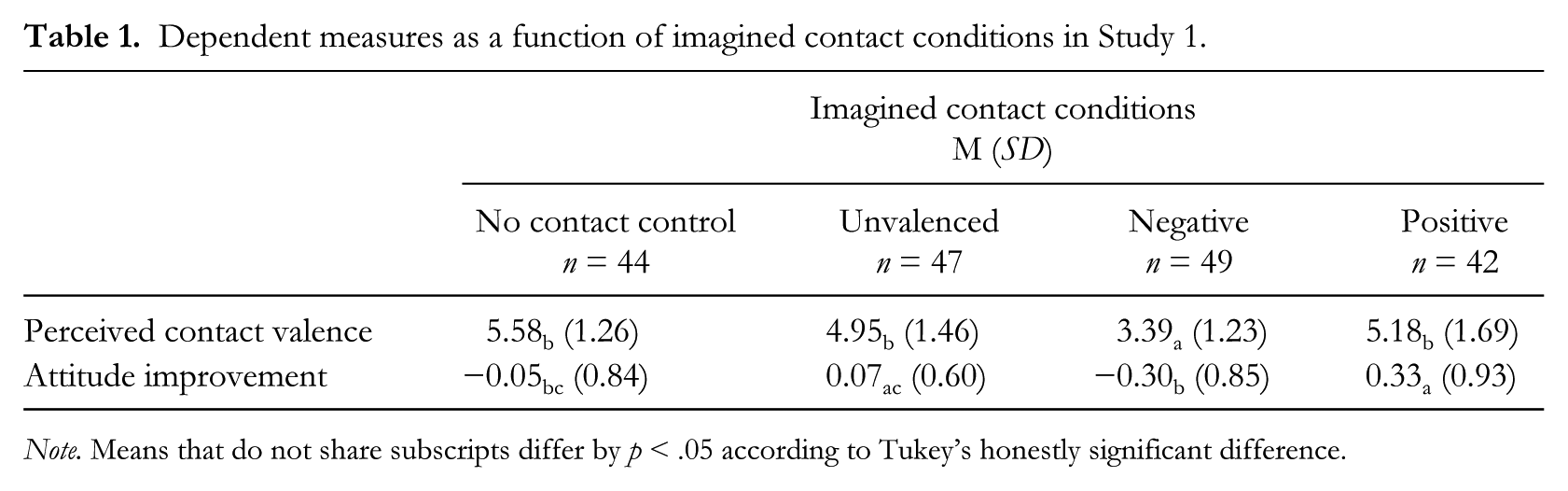
Note. Means that do not share subscripts differ by p < .05 according to Tukey’s honestly significant difference.
Critically, against expectations, the unvalenced contact condition was not significantly different from the positive involuntary contact condition: When participants were left to their own devices and let free to visualise any intergroup exchange they wanted, they generally visualised a positive exchange. This is a promising finding for the application of imagined contact to natural settings of conflict such as Cyprus, as it suggests that imagined contact interventions can contribute to peaceful intergroup relations even when the visualisation is less structured, controlled, and prescriptive.
Involuntary and Unvalenced Imagined Contact on Outgroup Attitude Improvement
A one-way ANOVA was performed on the Attitude Improvement Index to assess the effects of condition on group-level evaluations; it found a significant effect, F(3, 169) = 4.62, p = .004, η2 = .08. A Tukey post hoc revealed that involuntary positive imagined contact (M = 0.33, SD = 0.93) differed from the involuntary negative imagined (M = −0.30, SD = 0.85, p < .001) and no-contact control conditions (M = −0.05, SD = 0.84, p = .04). More importantly, unvalenced contact (M = 0.07, SD = 0.60) differed from the involuntary negative contact condition (p = .03), but was not different from the involuntary positive imagined contact condition.
These results suggest that the impact of the unvalenced imagined contact experience on outgroup attitudes was not statistically distinguishable from that of the involuntary positive contact condition, thus emphasising the potential similarity between these visualisation experiences for the individuals. The unvalenced condition might therefore be a relatively “safe” intergroup imagery to use, even in conflict-ridden contexts such as Cyprus.
One sample t tests were used to examine for each experimental condition whether pre/postvisualisation changes in outgroup attitudes were significantly different from the value of no change (a “zero” value). In the positive imagined contact condition, attitudes were significantly more positive toward Greek Cypriots postvisualisation, t(40) = 2.26, p = .03; in the negative imagined contact condition, outgroup attitudes were significantly worse, t(48) = −2.48, p = .017; hence, involuntary positive imagined contact resulted in improved attitudes toward Greek Cypriots, whereas involuntary negative imagined contact resulted in worsened attitudes towards the outgroup.
More importantly for the research questions at stake, in both the unvalenced and no-contact control conditions, the attitude index was not different from zero (both ts < 1). This means that, even in a conflict-ridden context such as Cyprus, individuals let free to visualise the kind of intergroup exchange of their liking (i.e., unvalenced condition) essentially chose to visualise a positive contact experience which, ultimately, if not benign, had at least nondetrimental effects on their intergroup attitudes. In order to assess the motivational drives responsible for these preferences for positive imagined contact and to isolate their downstream consequences for intergroup relations, we conducted a second study that used a brand new paradigm asking participants to actively choose between different valenced intergroup imageries.
Study 2
Having obtained evidence in Study 1 that participants from a conflict-ridden society in the unvalenced imagined contact condition oriented themselves towards intergroup imageries characteristic of participants in the positive imagined contact condition, in Study 2 we endeavoured to investigate freely chosen imagined contact further by exploring the relative prevalence of positive versus negative imagery choices, their determinants, and consequences for group-level outcomes. To this end, participants were given the opportunity to choose between engaging in a positive or a negative imagined contact scenario. We tested two potential reasons why individuals might choose to visualise positive imagined contact over negative imagined contact: mood regulation and expectancy confirmation.
Mood Regulation
Individuals make strategic attempts at managing their affective experiences. Strategic management of mood has an impact on a variety of behaviours, including entertainment choices (Zillmann, 1988), recall (Parrott & Sabini, 1990), thought suppression (Wenzlaff, Wegner, & Roper, 1988), attention given to persuasive messages (Petty, Gleicher, & Baker, 1991; Smith & Shaffer, 1991), effort put into decision-making (Isen & Means, 1983), and helping behaviour (Cialdini & Fultz, 1990; Schaller & Cialdini, 1990).
Mood and affect have also been found to play a role in intergroup bias. Wilder and Simon (2001) found evidence suggesting that a person’s mood influences the likelihood of engaging in bias against the outgroup. For instance, Forgas and Moylan (1991) conducted an experiment in which participants viewed films that provoked either a positive, negative, or neutral mood. As part of an unrelated experiment, participants were then asked to view drawings of heterosexual dyads in which the persons were members of the same race or were mixed. Participants in a pleasant mood rated the stimulus person more positively and did not differentiate between same-race or mixed-race pairs in terms of competency or likeability. Those in the unpleasant mood condition, however, rated the mixed-race pairs as less competent and likeable. Similarly, Esses and Zanna (1995) studied the effect of induced positive and negative mood on ethnic stereotypes. Over four studies they demonstrated that mood strongly influenced the interpretation of ethnic stereotypes, such that individuals in a negative mood were more likely to attribute negative stereotypes to certain ethnic groups (for reviews of mood effects in intergroup relations, see work by Dasgupta, DeSteno, Williams, & Hunsinger, 2009; DeSteno, Dasgupta, Bartlett, & Cajdric, 2004).
Two distinguishable lines of research can be identified to help explain the effects of mood on group processes. One refers to mood management, the notion that individuals strive for positive affective states and attempt to avoid negative ones (Petty & Wegener, 1991). A strategy used to manage affective experiences has been referred to as the “hedonic contingency hypothesis” by Wegener and Petty (1994). This is the notion that behaviours that result in more positive (and/or less negative) feelings are rewarded, whereas behaviours that result in more negative (and/or less positive) feelings are punished. From this reasoning, mood management strategies should direct individuals towards positive- rather than negative-inducing mood activities. In order to test this hypothesis, Wegener and Petty (1994) presented participants in different mood states with the choice of watching videotapes or reading articles that varied in their expected mood-altering properties. In three studies they found evidence that participants in happy moods were more likely to strategically choose activities on the base of hedonic consequences compared to those in a sad or neutral mood. Similarly, in their review of evidence on the hypothesis that “bad is stronger than good” Baumeister, Bratslavsky, Finkenauer, and Vohs (2001) suggested that people are motivated by hedonic reasons, that is, to avoid negative emotions and obtain positive ones. For instance, Baumeister, Heatherton, and Tice (1994) noted that people use many techniques for escaping and terminating bad moods.
The second line of research suggests a mood congruence influence of mood on social judgements and behaviours (Bower, 1991; Forgas, 1995, 1998). This is the idea that individual judgements are biased in the direction of one’s current mood. For example, positive mood has been found to result in better recall of happy memories (Bower, 1991), increased liking of others (Forgas, 1995), more lenient attributions and judgements (Clore, Schwarz, & Conway, 1994; Forgas, 1994; Sedikides, 1995), as well as more cooperative and confident behaviours (Forgas, 1998).
Mood management and mood congruence effects might be implicated in patterns of volitional intergroup imagery. A potential explanation for participants’ preference in visualising a positive imagined contact in Study 1 might be mood regulation: Individuals’ choice to visualise positive contact might reflect strategic attempts at regulating their mood positively—that is, at enhancing positive moods and reducing negative ones. In other words, strategic choice of scenario valence might be contingent upon participant mood and, in turn, choosing to visualise positive contact might significantly improve (vs. depress) existing moods and colour group-level processes in mood-congruent fashions.
Expectancy Confirmation and Violation
Expectancy confirmation or evaluative fit is predicted by both cognitive accounts of schema congruency and the social identity perspective. This mechanism could also underpin imagined contact choices.
Schema defence
The central roles of social categorisation and social identity in intergroup relations are widely acknowledged (see Brewer, 2001). The most basic features associated with these processes are the categorisation of people into ingroups and outgroups, which forms the psychological basis for prejudice and stereotyping.
Social categorisation of people into ingroup (vs. outgroup) has a number of influences on the cognition, affect, and behaviour of individuals toward their group members such as in reward allocation (Tajfel, Billig, Bundy, & Flament, 1971), positive evaluation (Otten & Moskowitz, 2000), processing the ingroup as more heterogeneous (Boldry, Gaertner, & Quinn, 2007), and retaining schema-consistent information (Park & Rothbart, 1982). Positive behaviours are attributed to internal, stable characteristics of the ingroup, whereas negative behaviours are ascribed to the personal characteristics of the outgroup (Hewstone, 1990). Undesirable outgroup behaviour is processed and encoded more abstractly to presume intentionality than identical ingroup behaviour (Maass, Salvi, Arcuri, & Semin, 1989). Such cognitive biases help to perpetuate social stereotypes, even in the face of contradicting evidence. Evaluative fit effects should be more polarised in contexts where valenced expectations are more polarised (Deegan, Hehman, Gaertner, & Dovidio, 2015) and individuals might be more motivated to regulate their emotions under uncertain environmental conditions (Osman, 2010).
It is therefore not surprising that expectancy violations instigate arduous emotional regulation and stress management (Mendes, Blascovich, Hunter, Lickel, & Jost, 2007; Olson, Roese, & Zanna, 1996). Challenging social stereotypes has been linked to physiological threat (Mendes et al., 2007), cognitive load (Macrae, Milne, & Bodenhausen, 1994), and feelings of disfluency (Rubin, Paolini, & Crisp, 2010).
According to cognitive and social identity accounts, participants in the current study might strive to maintain their knowledge structures about the world unchanged, this includes their valenced knowledge structures about outgroups. They might therefore be inclined to choose to visualise contact scenarios that fit their stereotypical representation of Greek Cypriots as positive or negative depending on their preexisting experience with this outgroup.
We hypothesised that participants would choose positive (vs. negative) imagined contact scenarios in order to either (a) regulate their mood, and/or (b) confirm their preexisting expectations about the outgroup. In order to tease out these underpinnings and psychological consequences of actively chosen valenced imagined contact, we devised the following procedure.
Method
Participants and Design
Two hundred and six participants from the Turkish Cypriot community (107 female, 98 male, and one gender unspecified; M = 34.76 years, SD = 13.94) volunteered for a study on “social issues in Cyprus” and completed the battery of questions in a research laboratory.
Similarly to Study 1, we assessed the impact of the conflict on the recruited respondents: Over 85% of the overall sample reported at least some direct or indirect involvement in the conflict. More specifically, 11.7% reported direct involvement and 73.8% indirect involvement; 7.3% reported personal displacement from their own homes and 66.5% indirect experience of displacement; 31.6% reported losing a family member and 18.9% reported losing a friend or close other as a result of the war.
Procedure and Materials
Pre- and postvisualisation measures
Prior to the visualisation task participants completed the PANAS (Positive and Negative Affect Schedule) developed by Watson, Clark, and Tellegen (1988). Participants were informed that the scale consists of words that describe different feelings and emotions and were asked to indicate the extent to which they felt each emotion in that current moment. Factor analysis indicated a two-factor solution which accounted for 44.91% of the variance. Factor loadings after varimax rotation showed that positive affect items loaded strongly on the first factor (10 items, loadings from .31 to .74; α = .84) and negative affect items loaded on the second factor (10 items, loadings from .51 to .81; α = .88). Having completed the imagery task (see the following lines), participants once again completed the PANAS. Indices of positive affect (α = .89) and negative affect (α = .90) were computed exactly the same as in the preimagery measure. A difference score was also computed from pre- and post-PANAS scores to assess if participants’ positive and negative moods had altered as a result of engaging in the intergroup imagery. Higher scores indicated improved moods after imagery—that is, increases in positive/decreases in negative mood, respectively.
Participants next completed a set of reliable past contact measures adapted to the Cypriot context. They first focused on direct contact experiences: Participants indicated the quantity of positive and negative past contact with the outgroup (Barlow et al., 2012; three items each; e.g., “In everyday life, how frequently do you have positive/negative interactions with Greek Cypriots?’ [1 = never/not at all, 7 = very frequently/a lot]; alphas .97 and .96), as well as overall past contact quality on 7-point bipolar scales (Islam & Hewstone, 1993; five items; e.g., superficial–deep, unpleasant–pleasant [1–7]; α = .71). Storytelling about the outgroup followed; we measured negative and positive family stories (Cameron, Rutland, Brown, & Douch, 2006; two items each; e.g., “Do/did any of your family members tell you negative and upsetting stories/pleasant stories of solidarity about Greek Cypriots that occurred during the war?” [0 = none/never, 1 = 1, 2 = 2–5, 3 = 5–10, 4 = over 10/very often]; alphas .91, and .70). Finally, we measured direct and indirect cross-group friendship (Paolini et al., 2014; two and three items, respectively; e.g., “How many Greek Cypriot people are you friends with?” and “How many of your very best Turkish Cypriot friends have friends who are Greek Cypriot?” [0 = 0, 8 = more than 50]; α = .80 and α = .86, respectively, after items’ standardisation). To ensure completing the contact measures did not interfere with the target imagined contact task, participants next completed the same filler task from Study 1, which included visualising an outdoor scene.
Choice of imagined contact
At this point, participants were asked to choose between one of two intergroup contact scenarios: A positive and enjoyable or negative and unenjoyable interaction with a Greek Cypriot stranger, by ticking one of two decision option boxes labelled as “positive” and “negative.”
To check that participants shared our assumption that individuals choosing to visualise positive imagined contact would expect to feel positively and individuals choosing to visualise negative imagined contact would expect to feel negatively as a result, we also asked them to state in an open-ended question format how they expected to feel as a result of imagining the chosen scenario. Next, participants wrote, in as much detail as they wanted, the scenario they imagined.
Contact valence checks
After the freely chosen intergroup imagery task, participants completed a number of process variables aimed at investigating the downstream consequences of actively chosen contact, including the contact valence checks from Study 1 (Islam & Hewstone, 1993; α = .90).
Postimagery outcome measures
Processing fluency was assessed as a marker of schema congruency (i.e., the greater the congruency, the greater the fluency). Participants rated how easy or difficult it was to imagine the interaction with a Greek Cypriot (1 = not at all easy, 7 = very easy; three items; α = .88). Higher scores indicated easier processing fluency (in line with one’s expectations). To measure positive action tendencies towards the outgroup, participants indicated the extent to which they “felt a desire to seek contact with Greek Cypriots” (five items; α = .84) and to measure negative action tendencies, they answered “How often have you felt a desire to hurt Greek Cypriots physically, e.g., to attack, to strike out, and so on?” (Mackie, Devos, & Smith, 2000; three items, however, one was removed due to lowered reliability; α = .85). To measure outgroup evaluations we used the same outgroup attitude measure as in Study 1 whereby participants rated how they feel toward Greek Cypriots (anchored from 1 to 7; α = .82; Wright et al., 1997). Lastly, outgroup trust was assessed (e.g., “I can trust people I know from the Greek Cypriot community not to hurt people from my community”; adapted from Tam, Hewstone, Kenworthy, & Cairns, 2009; eight items [1 = strongly disagree, 7 = strongly agree]; α = .86). Finally, participants were thanked and debriefed.
Results and Discussion
In line with Study 1’s results for unvalenced contact, the positive scenario was actively chosen twice as often as the negative scenario (131 vs. 71 times, respectively), χ²(1, N = 202) = 17.82, p < .001, once again providing evidence for participants’ natural preference for visualising a positive imagined contact scenario, even in a conflict-ridden society.
Significant main effects were obtained on all dependent measures as a function of imagined contact scenario chosen. For processing fluency F(1, 199) = 44.89, p < .001, η2 = .18, those who chose a positive imagined contact scenario reported higher processing fluency (M = 5.01, SD = 1.67) than those who chose a negative scenario (M = 3.27, SD = 1.90, p < .001); positive action tendencies F(1, 200) = 42.04, p < .001, η2 = .17, those who chose a positive imagined contact scenario reported more positive action tendencies toward the outgroup (M = 3.72, SD = 0.12) than those who chose a negative scenario (M = 2.45, SD = 0.16, p < .001); action tendencies against the outgroup F(1, 199) = 17.52, p < .001, η2 = .08, those who chose a negative imagined contact scenario reported more negative action tendencies toward the outgroup (M = 1.98, SD = 0.13) than those who chose a positive scenario (M = 1.31, SD = 0.10, p < .001); trust F(1, 199) = 53.55, p < .001, η2 = .21, those who chose a positive imagined contact scenario reported more trust toward the outgroup (M = 3.59, SD = 0.11) than those who chose a negative scenario (M = 2.82, SD = 0.14, p < .001); and outgroup evaluations F(1, 200) = 50.64, p < .001, η2 = .20, those who chose a positive imagined contact scenario reported more positive outgroup evaluations (M = 4.23, SD = 0.10) compared to those who chose a negative scenario (M = 3.03, SD = 0.14, p < .001).
Checks of Chosen Contact Valence
Similar to Study 1, we assessed whether a difference existed on perceived contact valence as a function of scenario chosen. A one-way ANOVA showed a robust difference between the two scenarios, F(1, 199) = 146.32, p < .001, η2 = .43. Participants who chose to engage in a positive scenario rated the experience more positively (M = 5.60, SD = 1.14) than those who visualised a negative scenario (M = 3.27, SD = 1.57). A one-sample t test determined that contact valence was significantly higher than the scale midpoint (the value of 3.5) among those who chose a positive scenario, t(129) = 21.10, p < .001, but not statistically different among those who chose a negative scenario, t(70) = −1.23, p > .05. Hence, those who chose a negative scenario, in fact generated an intergroup visualisation that was neutrally toned.
In order to understand which mechanisms were responsible for participants’ preferences to visualise positive (vs. negative) contact (when not instructed to do so), we tested the mood regulation and expectancy confirmation routes. In all analyses reported in what follows, chosen scenario was coded with 0 = chosen negative and 1 = chosen positive imagined contact.
Mood regulation motives and effects
We checked that our participants shared our assumptions about the mood-altering effects of imagery choice (Wegener & Petty, 1994). An independent rater blind to the aim of the study and chosen contact assessed participants’ responses to the open-ended question that asked how they would feel as a result of choosing a positive versus negative scenario to imagine. The rater was asked to code for reported feelings of “positivity” versus “negativity.” Out of the total participants, a little over 62% provided data for this item (N = 128). Out of the 79 participants who chose to imagine a positive scenario, 76 reported that they expected to feel “positive/good/happy” as a result of the chosen imagined scenario, three reported that they would feel “unhappy” despite choosing the positive scenario. Out of the 49 participants choosing the negative intergroup scenario, all respondents stated they would feel “unhappy/uneasy/discomforted” as a result of the scenario. These checks suggest that the majority of participants understood that choosing to go with a positive/negative scenario would have consequences for their subsequent (happy/sad) mood.
To test whether prechoice mood predicted scenario chosen we ran a point-biserial correlation test and found that positive mood (positive affect on PANAS) was marginally predictive of a positive visualisation (r = .13, p = .06), whereas negative mood (negative affect on PANAS) was not predictive of scenario chosen (r = −.03, p > .05).
To check whether the visualisation resulted in changes in positive and negative mood, we conducted a paired samples t test comparing pre- and postvisualisation mood. Those participants who chose the positive imagined contact scenario reported a decreased negative mood postimagery (M = 1.37, SD = 0.59) compared to preimagery (M =1.48, SD = 0.65), t(130) = 2.42, p = .017; no difference was found in their reported positive mood, t(129) = −0.84, p > .05. As for those choosing the negative imagined contact scenario, there was a significant increase in negative mood postimagery (M = 1.97, SD = 0.85), compared to preimagery mood (M = 1.52, SD = 0.60), t(70) = −5.37, p < .001, and a marginal decrease in positive mood postimagery (M = 2.49, SD = 0.96) versus preimagery (M = 2.63, SD = 0.81), t(70) = 1.79, p = .077. Hence, choosing positive imagery reduced negative mood, and choosing negative imagery reinforced negative mood and reduced positive mood.
To assess how changes in mood resulting from actively chosen imagined contact influenced outcome measures, we used the change measure for pre- and postimagery positive and negative mood. We found that increased positive mood was associated with positive action tendency toward the outgroup (r = .16, p = .018), and decreased negative mood was also associated with an increase in positive action tendencies (r = .33, p < .001), as well as outgroup trust (r = .30, p < .001) and positive outgroup evaluations (r = .28, p < .001).
Mediational analyses
We ran bootstrapping analysis to test for mediation, using the SPSS PROCESS macro developed by Hayes (2013). Increased positive mood was not implicated in any of the chosen contact–outcome effects; instead, a significant mediation was obtained for decreased negative mood. The bootstrapping analysis found that the scenario chosen was predictive of positive action tendencies, b = −1.28, t = −6.48, p < .001. Scenario chosen also predicted decreased negative mood (b = 0.56, t = 6.54, p < .001), which then predicted positive action tendencies (b = −0.43, t = −2.71, p = .007). Decreased negative mood was found to be a significant mediator of the chosen contact–positive action tendency link, 95% CI [−0.46, −0.07]. The model was significant, F (1, 199) = 25.34, p < .001, explaining approx. 20% of the variance.
Hence, we found evidence that positive moods guided the choice of positive intergroup imageries. The valence of the freely chosen imagery subsequently influenced participants’ mood (particularly negative mood), which in turn was consequential at the group level: Decreased negative mood explained the relationship between choosing and engaging in a positive contact scenario and more positive action tendencies toward the outgroup.
Schema defence motives and evaluative fit effects
We hypothesised that participants might be seeking experiences that confirm their preexisting valenced expectations—that is, seeking evaluative fit. The reason for such a motive would be a schema defensive motive to maintain one’s schematic worldviews. To check this, we first inspected zero-order correlations to see if individuals’ contact history predicted the valence (positive vs. negative) of the scenario chosen, coded as 0 = chosen negative contact and 1 = chosen positive contact. It was found that the more positive prior direct contact (r = .32, p < .001), the higher quality of past direct contact (r = .35, p < .001), and the larger the number of cross-group friendships (r = .25, p < .001), the more likely these participants chose to visualise a positive (vs. negative) interaction scenario; conversely, the less positive prior contact, the lower the quality of contact, and the fewer cross-group friendships, the more likely participants chose to visualise a negative interaction scenario. Evaluative fit effects were not observed for prior negative contact (r = .05, p > .05), positive (r = .004, p > .05) and negative family storytelling (r = −.008, p > .05), or extended contact (r = .11, p > .05).
Overall, evaluative fit effects were prevalent: Individuals with a history of positive generic and intimate contact with the outgroup sought and engaged in positive imagined contact, and those with a less positive history sought and engaged in negative imagined contact. Further mediation analyses were conducted to differentiate between qualitatively different underpinnings of these effects.
Mediational analyses
We tested chain mediation pathways to see whether (a) scenario chosen mediated the relationship between prior contact and processing fluency, and (b) processing fluency mediated the relationship between scenario chosen and postimagery outcome measures (i.e. positive vs. negative action tendencies, trust, and positive outgroup evaluations).
In Step 1, bootstrapping analysis found that prior positive contact predicted (positive) scenario chosen (b = −0.10, t = −4.80, p < .001) and processing fluency (b = 0.36, t = 4.30, p < .001). Choosing a positive scenario, in turn, predicted higher processing fluency (b = −1.53, t = −5.64, p < .001). Scenario chosen was found to be a significant mediator, 95% CI [−2.07, −0.99]. The model was significant, F(1, 199) = 25.76, p < .001, explaining approximately 21% of the variance.
In Step 2, scenario chosen predicted positive action tendency (b = 1.08, t = 4.97, p < .001), trust (b = 1.05, t = 5.44, p < .001), positive outgroup evaluations (b = 0.92, t = 5.04, p < .001), and the mediator processing fluency (b = 1.74, t = 6.70, p < .001). Processing fluency in turn predicted positive action tendency (b = 0.12, t = 2.26, p = .03), trust (b = 0.15, t = 3.13, p = .002), and positive outgroup evaluations (b = 0.16, t = 3.64, p < .01). Processing fluency was found to be a significant mediator for all three dependent measures. 1
These chain mediation analyses suggest that those with positive prior contact experiences chose a positive contact scenario to imagine, which was high in processing fluency (a marker of fit or schema congruency); this had a positive influence on postimagery group-level outcome variables. This pattern is suggestive of a schema defence motive, whereby individuals with positive outgroup schemas choose category consistent scenarios, and thus process these more fluently.
General Discussion
The aim of the research was to investigate the determinants and consequences of freely chosen positive imagined contact in contexts characterised by a history of entrenched intergroup conflict, as an ecologically valid process potentially taking place outside controlled and structured intervention settings.
We expected Turkish Cypriots seriously affected by the conflict-ridden past of their society to naturally lean towards visualising a negative, rather than a positive, intergroup interaction with a Greek Cypriot. Instead, when given an unvalenced scenario which enabled them to steer the visualisation in any direction they chose (Study 1) or when asked to actively choose between visualising a positive or a negative intergroup interaction (Study 2), we found that these individuals chose to visualise an intergroup interaction that was not statistically distinguishable in quality to that by those explicitly instructed to visualise positive imagined contact (Study 1) and disproportionally preferred positive over negative intergroup imagery (Study 2). In Study 2, we tested potential motivational underpinnings that could account for such findings and found exciting novel (although still preliminary) evidence that overt preference for positive (vs. negative) intergroup imagery might reflect both (a) mood regulation, and (b) an attempt to confirm preexisting valenced expectations about the outgroup and contact with the outgroup.
With regard to mood regulation, similar to previous findings (Baumeister et al., 2001; Wegener & Petty, 1994), our participants shared our assumptions about the mood-altering effects of imagery choice, and natural variations in their general mood preimagery affected their decisions about what imagery to choose and engage in. Those in a happy (vs. less happy) mood at the beginning of our investigation were more likely to actively choose to imagine the positive (vs. negative) scenario, in line with a process of mood management. Changed mood from volitional intergroup imagery was in turn found to have mood-congruent consequences on group-level processes: Actively choosing to imagine a positive intergroup scenario led to a reduction in negative mood, which in turn had a positive downstream effect for the outgroup by leading to more positive action tendencies. Such findings demonstrate the importance of mood and mood regulation in volitional intergroup imagery, and potentially through this route, in intergroup relations. Future research which employs direct manipulations of mood and frustrates (vs. meets) individuals’ needs to maintain positive affective states will be well placed to distinguish between more active and passive ways in which mood impacts on the experience of intergroup imagery.
With regard to expectancy congruency, we found clear and extensive evidence of evaluative fit effects that are central to the posits of social identity and categorisation theories, as well as many cognitive theories advancing the operation of schema defence motives (Mendes et al., 2007; Olson et al., 1996): Individuals with a history of positive direct contact with the outgroup chose to engage in a contact scenario of similar valence (i.e., positive); similarly, those with a history of less positive contact chose to engage in negative imagined contact. In other words, individuals’ past history of contact shaped their choices of imagined contact in such a way that their preexisting valenced expectations about contact with the outgroup would be ultimately confirmed. Furthermore, consistent with an expectancy confirmation hypothesis, we found that freely chosen positive, and not negative, imagined contact was rated by the participants as being higher in processing fluency. Processing fluency, in turn, significantly mediated the relationship between chosen imagined contact and group-level positive action tendencies, outgroup attitudes, and outgroup trust.
While revealing and thought provoking, it is important to note some limitations of our fresh efforts in this novel line of research. Due to the lack of experimental manipulation, the correlational data prevent us from drawing firm causal inferences. Hence, in Study 2 we can only say that choosing a certain scenario came with (vs. caused) certain group-level responses. Additionally, because our design did not include conditions in which individuals could express their contact choice without engaging in the visualisation or alternatively had no choice (i.e., a standard imagined contact condition), Study 2 data do not allow us to establish to what extent the effects we observed on group-level variables (and imagery variables) are driven by the individuals choosing a certain visualisation and/or them actually engaging in it and generating certain intergroup contents, or a mixture of the two. Future research on freely chosen intergroup imagery should incorporate these additional controls in their designs and isolate the “pure” impact of individuals’ volition away from imagery contents. A diary study in which participants can write down their thoughts about imagery or real experiences of actively sought interactions with an outgroup member could be a potential method of testing these assumptions outside of the laboratory.
At the broadest level, our findings indicate that imagined contact is a safe way of engaging with the outgroup even in a conflict-ridden context such as Cyprus. Contrary to this technique’s critics (e.g., Bigler & Hughes, 2010; Brown, 2010) and our own initial predictions, our results demonstrate that even when imagined contact takes place with less than optimally structured instructions or under less than optimally monitored conditions (i.e., away from intervention settings), it will not necessarily have detrimental effects for intergroup relations and it will not necessarily sustain intergroup animosity. At least in one context characterised by a long history of intergroup animosity, most people naturally chose to visualise positive and not negative contact, in the act of regulating their mood and confirming their preexisting (relatively positive) expectations about contact with the outgroup. It will be of importance for future research to ascertain the generalisability of these findings in other conflict-ridden societies as well as peaceful settings.
By turning our attention to imagined contact in contexts that are relatively nonprescriptive and undermonitored (i.e., unvalenced imagined contact, choosing between scenario options), we believe our research opens up exciting new spaces where to investigate entirely new research questions that cannot be easily tested with standard imagined contact paradigms or with traditional intergroup contact designs.
We think that our work sheds original first lights on the motivational bases of freely chosen or volitional intergroup imagery and its downstream consequences for intergroup affect, cognitions, and behaviours. Imagined contact potentially allows individuals to take their experiences with the outgroup wherever they wish. Yet, specific motivational drives obviously constrained such freedom: Our data indicate that people’s past contact will naturally encourage them to explore with their imagery relatively well-trodden contact experiences (i.e., evaluative fit), but still in ways that sustain general positive moods and preexisting group expectations.
The most immediate next question for us is whether these motivational processes we captured here possibly extend their reach in similar ways beyond freely chosen intergroup imagery to other forms of contact with the outgroup. For example, to contexts in which people actively choose or not to engage vicariously with the outgroup by selecting from alternative media and social media options (see e.g., Joyce & Harwood, 2012; or, for initial data on freely chosen intergroup music, see Harwood & Paolini, 2017), or by actively approaching or avoiding outgroup members in ordinary settings of face-to-face contact. Similarly, it will be beneficial to explore how people engage in imagined contact under natural conditions, for instance, by using a diary method to keep track of natural instantiations of mental visualisations in ecological settings. The data reported in this article tell us that these concurrent motivations most likely result in intergroup imagery that confirms past histories with the outgroup and, thus, perpetuates virtuous or vicious intergroup dynamics that are already in motion. If people’s motives for schema-consistent intergroup information that is both engaging and mood-regulating equally impacts other forms of volitional intergroup contact, then there is only room for small and incremental (positive as well as negative) changes in one’s transactions with the outgroup.
Some ancillary findings make us, however, relatively optimistic. In measuring individuals’ (preimagery) prior history of contact with the outgroup, we found that, contrary to widespread assumptions for conflict-ridden societies in the intergroup relations literature (Bar-Tal, 2007; MacGinty, 2010; Salomon, 2004), Turkish Cypriot individuals from the general community who had been significantly affected by the conflict, reported their past direct contact with outgroup members to be more positive than negative in nature. This pattern of greater prevalence of positive (vs. negative) contact is consistent with data from several relatively peaceful intergroup settings (Barlow et al., 2012; Bekhuis, Ruiter, & Coenders, 2013; Dhont & van Hiel, 2009; Graf, Paolini, & Rubin, 2014; Pettigrew, 2008). For example, Graf et al. recently reported that positive face-to-face cross-border contact was significantly more prevalent than negative face-to-face contact in five Central European countries (Austria, the Czech Republic, Germany, Poland, and Slovakia). Our findings extend our understanding of the ecology of direct or face-to-face intergroup contact from peaceful contexts to those of postconflict nature. This additional contribution of the present work is however not merely descriptive, because in this work it is anchored to psychological and motivational processes that make it the psychological springboard for specific and psychologically real intergroup futures. To the extent to which individuals actively choose to enter situations in which they have greater (vs. less) potential to express their personality, expectations, and worldviews (Carnahan & McFarland, 2007; Emmons, Diener, & Larsen, 1986), the growing evidence for greater prevalence of positive (vs. negative) contact coupled with individuals’ motivation to actively perpetuate their lived contact experiences in future interactions with the outgroup make us optimistic that positive intergroup contact—imagined and not imagined—might ultimately prevail over negative intergroup contact.
Footnotes
Funding
The authors disclosed receipt of the following financial support for the research, authorship, and/or publication of this article: This research was supported by grants from the Australian Research Council awarded to the second author (DP0770704, DP150102210).