



Abstract
The current study examined whether Black people’s racial ideology, experiences of racism, and their interaction predict their acceptance of Black-White Multiracial people. Black racial ideologies represent an aspect of Black people’s racial identity that addresses their perspectives on how people within the Black community should behave. Participants (N = 325) were administered a series of measures. Latent class analysis revealed three classes of Black racial identity: undifferentiated (average ideologies), integrationist (high assimilationist, humanist, and oppressed minority), and nationalist (high nationalist). The nationalist group was most likely to endorse rejecting Multiracial people as members of the Black community and also to endorse forcing a Black identity onto Multiracial people, whereas the integrationist group was least likely to make such endorsements. For participants in the nationalist (but not integrationist or undifferentiated) cluster, personal experiences of racism were related to endorsement of forcing a Black identity onto a Multiracial person. Findings suggest that Multiracial people might achieve the most identity affirmation and sense of community among Black people holding integrationist views.
Currently, approximately 7.4% of people of African descent in the United States identify as Multiracial (U.S. Census Bureau, 2011). Thus, whether Multiracial people of African descent comprise members of the Black community has significant implications for the size and composition of this community and for resources allocated to this group (Rockquemore & Laszloffy, 2003). The National Association for the Advancement of Colored People (NAACP) actively dissented from Multiracial people having the option to identify as Multiracial on the 2010 U.S. Census (Rockquemore & Laszloffy, 2003). They indicated that Multiracial individuals with Black ancestry should identify as Black so that the political power of the Black community could be maintained (Rockquemore & Laszloffy, 2003). More generally, however, there is in-group variation in the extent to which Black people, themselves, consider Multiracial people of African descent to be members of their racial group (Franco & Holmes, 2016). Black people’s perception of whether Black-White Multiracial people belong in the Black community has implications for U.S. policies regarding racial designations (see Rockquemore & Laszloffy, 2003), influences whether Black-White Multiracial people identify as Black (Rockquemore & Brunsma, 2002), affects racial coalitions between Black and Multiracial people of African descent (Rockquemore & Laszloffy, 2003), and also has unique and substantial effects on Black-White Multiracial people’s racial identity and emotional health (Franco & Franco, 2015). Considering the importance of the question of whether Black people accept Multiracial people into the community, at this point, it is important to determine factors that might predict whether Black people accept Multiracial people and a Multiracial identity. Of interest for the current study is whether Black people’s racial ideologies and experiences of personal racism may predict the degree to which they accept Black-White Multiracial people (i.e., individuals of Black and White racial ancestry who identify as Multiracial) within their racial community.
Defining Multiracial
Though the term “Biracial” has been used in research reviewed in this paper, the term “Multiracial” is becoming favored in the field and is more commonly utilized in recent publications (Kenney et al., 2015; Root & Kelley, 2003), and thus is used in the current study, except when specifying previous measures and items that utilize the former term. One reason the term Multiracial is endorsed is because it has been embraced by the larger Multiracial movement and was coined by a scholar of Multiracial identity (Hall, 1980), rather than being a term imposed onto individuals of multiple race ancestry by outside forces (see http://www.mavinfoundation.org/index.html and https://www.projectrace.com/). For the present study, “Multiracial” describes people who are of Black-White ancestry and who identify as Multiracial. It may be important to examine Black people’s response to this subgroup because their White ancestry may make them the most threatening of Black racial mixes for the Black population, due to their potential access to social advantages gained through their White ancestry (Harris & Khanna, 2010; Khanna, 2010). They also comprise the largest subset of Multiracial people of African descent (U.S. Census Bureau, 2011).
Defining Acceptance of Multiracial People
Black people’s acceptance of Black-White Multiracial people is composed of two components: rejection of Multiracial people from the Black community and forced Black identity (Franco & Holmes, 2016). The former scale indicates endorsing rejection of Multiracial people’s group membership in the Black community, whereas the latter indicates endorsing rejection of a Multiracial identity in favor of imposing a Black one. The two subscales have a moderate correlation (r = .30), indicating that they have some overlap but are also distinct constructs (Franco & Holmes, 2016). An example is provided to clarify how these two subscales are unique: a Black individual who does not see Black-White Multiracial people as part of the Black community and considers them to have a distinct identity with unique experiences would be high on rejection of Multiracial people but low on forced Black identity.
It is also important to clarify differences and intersections between endorsing forcing a Black identity onto a Multiracial person and categorizing them as Black, since much of the literature on Black people’s perceptions of Multiracial people has focused on how Black people categorize Multiracial people (e.g., Gaither, Pauker, Slepian, & Sommers, 2016; Ho, Kteily, & Chen, 2017). Categorization is conceptually different from forced Black identity because categorization is descriptive (describes views on what someone is), whereas forced Black identity is prescriptive (describes what someone should be; Heilman, 2012; Roberts, Gelman, & Ho, 2017). Psychological theories, such as system justification and status quo maintenance (Eidelman & Crandall, 2012, 2014; Tworek & Cimpian, 2016), demonstrate a connection between the two. In other words, given documented persistent conflations of what “is” and what “ought to be” (Eidelman & Crandall, 2014; Tworek & Cimpian, 2016), when people categorize Multiracial people as Black, they may also be more likely to think they should identify as Black. Furthermore, it follows that in order for a Black person to endorse forcing a Multiracial person to identify as Black, they must identify the Multiracial person as Black; hypodescent ascriptions—or the categorization of Multiracial people based on their most subordinate racial group (Ho et al., 2017)—may be a necessary prerequisite to forced Black identity. Thus, given the limited research on prescriptive identity ascriptions, we rely on corollaries of Black people’s hypodescent categorizations to inform our hypotheses predicting forced Black identity.
Black Racial Identity and Acceptance of Multiracial People
Historically, Black people have considered Multiracial people members of the Black community and there is research to suggest that this continues to be true (Khanna, 2010; Rockquemore & Brunsma, 2001). Specifically, as a byproduct of the one-drop rule, which specified that anyone with a drop of Black blood is Black (Rockquemore & Brunsma, 2001, 2004), Black people acknowledge Multiracial people as part of their racial community and report acceptance of their Multiracial identity (Chen & Ratliff, 2015; Franco & Holmes, 2016); however, recent research indicates variability in the degree to which Multiracial people are viewed as part of the Black community (Franco & Holmes, 2016; Ho et al., 2017).
One factor that may influence acceptance of Multiracial people into the Black community is Black people’s racial identity (Shelton & Sellers, 2000; Stryker & Burke, 2000; Thompson, 1995). Racial identity is defined as the qualitative meaning that one applies to being a member of a racial group (Sellers, Smith, Rowley, & Chavous, 1998). Through developing a racial identity, one develops a personal understanding of what it means to be Black, which can then be applied to others (Thompson, 1995). Social identity theory posits that when people develop an identity, one way that they may elevate their own group’s status is through designating group boundaries and subsequently denigrating out-group members (Tajfel, 1982). To do so, an individual may go through a process of categorization in which the self is categorized as part of an in-group in which others are either included or excluded (McLeod, 2008; Tajfel & Turner, 2001).
Sellers et al. (1998) operationalize Black racial identity through their multidimensional model of Black identity (MIBI), which includes subdomains related to racial centrality, regard, and ideology. The ideology component of racial identity is appropriate for the current study because it addresses individual perceptions about Black people as a racial group. Specifically, the ideology dimension acknowledges identity as being a group-level construct that includes perceptions of one’s entire racial community. Thus, ideology is hypothesized to have relevance to who is and who is not considered a member of the community.
Sellers et al. (1998) reported four ideologies—assimilationist, humanist, oppressed minority, and nationalist ideologies. Individuals high on assimilationist ideology believe in emphasizing the commonalities between African Americans and other races and contend that Blacks should conform to the standards set by mainstream society. A humanist ideology emphasizes commonalities among all humans. Individuals with this ideology do not classify people in terms of race or other characteristics and view everyone as part of the human race. Oppressed minority ideology emphasizes the commonalities of experiences between African Americans and other oppressed groups. Those endorsing oppressed minority perspectives are likely to view coalition building with other oppressed groups as the most appropriate strategy for social change. The nationalist ideology emphasizes the uniqueness of the Black experience and asserts that African Americans should be in control of their own destinies, with little input from other groups: Black people should develop institutions, relationships, and activities that are specific for Blacks.
We examine Black people’s racial identity by incorporating the four racial ideologies into racial identity classes. Racial identity classes are useful because they reflect the multifaceted nature of racial identity (e.g., Sellers, Rowley, Chavous, Shelton, & Smith, 1997). A number of studies have begun to examine latent profiles of racial identity, in which racial identity subgroups are composed based on groupings of multiple indexes of racial identity variables (e.g., Banks & Kohn-Wood, 2007; Richardson et al., 2014; Seaton, 2009). Latent class analysis also provides more accurate descriptions of racial identity in that different ideologies tend to occur in tandem, rather than in isolation (Banks & Kohn-Wood, 2007; Richardson et al., 2014; Seaton, 2009).
In line with previous studies using class analysis with the MIBI (e.g., Banks & Kohn-Wood, 2007), it is hypothesized that at least one class will display integrationist views, represented by downplaying of racial difference with Whites (e.g., relatively high assimilationist and humanist, low nationalist), and another class will demonstrate nationalist views, represented by awareness and attention to race (e.g., relatively high nationalist and low assimilationist and humanist). An integrationist class is in line with research that finds that correlations between assimilationist and humanist ideologies have been found to exceed .5, suggesting these two ideologies occur alongside one another (Banks & Kohn-Wood, 2007). A separate nationalist class is supported by findings that illustrate inverse relationships between nationalist and assimilationist ideologies (e.g., Sellers et al., 1997); also, given that these two ideologies are conceptual opposites, it is unlikely that high rates of both ideologies would be found within the same class. Next, we discuss research that informs the degree to which individuals in each class accept Multiracial people.
Integrationist
An integrationist class is hypothesized to be characterized by views that Black people can assimilate into the mainstream culture and form connections with Whites (i.e., relatively high assimilationist and humanist, low nationalist). Individuals with this class of ideologies may be accepting of Multiracial people because their racial background along with their racial identity may be perceived as evidence of Black integration into the mainstream culture. Individuals with characteristics of an integrationist class (e.g., high assimilationist or humanist) have been found to inhabit more diverse social networks (i.e., high assimilationist; Sellers et al., 1998), and also to display less of a preference for dating within the race (i.e., high humanist; Lalonde, Jones, & Stroink, 2008). They display less bias against White people and lesser expectations that White people will discriminate against them (i.e., high humanist; Lecci & Johnson, 2008). In sum, integrationist individuals may be less weary and more accepting of people with racial differences. Whereas affiliation with Whiteness has been found to activate suspiciousness and distancing for some Black people towards Black-White Multiracial people (Leverette, 2009; Thornton, 2009), given integrationists’ openness and affiliation with White people, this may not be the case for them. Thus, individuals in the integrationist class are hypothesized to be more accepting of Black-White Multiracial people as members of the Black community. Also, given that counter to nationalist individuals, integrationist individuals do not emphasize similarities in race as being important for connection, affiliation, and solidarity (Lalonde et al., 2008; Lecci & Johnson, 2008; Sellers et al., 1998), they may be less likely to force a Black identity onto Black-White Multiracial people.
Nationalist
The hypothesized nationalist class (i.e., relatively high nationalist and low assimilationist and humanist) is expected to be characterized by Black separatism—emphasizing the distinctiveness of the Black experience and the importance of Black people controlling their own institutions and dissociating from people from other races (Sellers et al., 1998). Black nationalists are more likely to maintain distance from White people (Lalonde et al., 2008; Sellers et al., 1998), as they expect to experience discrimination (Lecci & Johnson, 2008). Nationalists have a clear preference for dating within their race and oppose interracial dating (Lalonde et al., 2008), and they may view racial mixing as the source of the breakdown of the Black family and community (Lalonde et al., 2008; Smith & Moore, 2000). Indeed, Multiracial people’s White heritage may raise concerns for nationalist individuals who are vigilant to White oppression and who exhibit higher anti-White attitudes (Lecci & Johnson, 2008) and increased worry over discrimination from Whites (Lecci & Johnson, 2008). Thus, they may perceive Multiracial people and identity as evidence of aligning with the oppressor (Lalonde et al., 2008; Smith & Moore, 2000). In support of this, one study found that high nationalists had more negative views of a Multiracial person because they were not perceived as sharing concerns and experiences with the Black community (Sullivan & Arbuthnot, 2009).
There is some research documenting Black people’s negative reactions to a Multiracial identity. Some Black people perceive it as a social obligation for people with Black ancestry to identify as Black in order to secure increased attention and resources for the community (Thornton, 2009). They may regard Multiracial people who do not identify as Black as denying their ancestry and being racially disillusioned (Rockquemore, Brunsma, & Delgado, 2009; Thornton, 2009). Those who identify as Multiracial are seen as diminishing Black clout and inhibiting Black solidarity (Rockquemore & Brunsma, 2004). Identifying as Multiracial may be perceived as an elitist move that aligns with notions of White supremacy (Thornton, 2009); namely, the majority group is attempting to divide and conquer minority communities, and Multiracial identity is a manifestation of this attempt (Leverette, 2009; Thornton, 2009). Although these opinions have been framed as general attitudes among the Black community, they may be unlikely to be espoused by integrationist individuals, for whom race is not as divisive a marker for connection and affiliation (Sellers et al., 1998), but may be more likely among nationalists, given that a focus on Black separation from other racial communities, suspicion towards Whiteness, and loyalty to the Black community—separate from all other races—is characteristic of this class of identities (Lecci & Johnson, 2008; Sellers et al., 1998). Overall, individuals in a nationalist class may see Multiracial individuals as out-group members and perceive them as disconnected from the Black community. Individuals in a nationalist class may be less likely to accept Multiracial people as members of their community, and more likely to force a Black identity onto Multiracial people.
Racism
In addition to racial identity, one factor that might be linked to Black people’s views on acceptance of Multiracial people into the Black community is Black people’s own experiences of racism. Stigma-based solidarity theory indicates that when racial minority groups experience discrimination, they feel closeness and similarity with other stigmatized racial groups (Craig & Richeson, 2016). In support of this, across five studies, Craig and Richeson (2012) found that experiences of racial discrimination for monoracial minority group members were related to feelings of closeness and similarity with other monoracial minority groups. Tenets of stigma-based solidarity theory indicate that when Black people experience racial discrimination, they will feel closer and similar to Multiracial people of African descent, as a comparably stigmatized group (Craig & Richeson, 2012, 2016). Closeness and similarity contribute to accepting individuals within one’s in-group (Craig & Richeson, 2016; Johnson & Kaiser, 2013; Kteily, Cotterill, Sidanius, Sheehy-Skeffington, & Bergh, 2014). Thus, racism will likely contribute to Black people accepting Multiracial people as members of the Black community.
Furthermore, feelings of closeness in light of shared susceptibility to racial discrimination can extend to assumptions of shared identity. For instance, when Black people experienced social exclusion, they were more likely to categorize a racially ambiguous face as Black (Gaither et al., 2016). Another study (Ho et al., 2017) found that Black people’s perceived discrimination against them predicted their perceptions of “linked fate” with Multiracial people (i.e., what happens to Biracial people will affect Black people), which subsequently predicted their likelihood of perceiving Multiracial people as Black. In sum, threats such as discrimination have been proposed as generating inclusiveness toward Multiracial people among Black people because threats make salient how Multiracial people are similarly racially stigmatized (Ho et al., 2017), or because threat motivates Black people to expand their community to increase group-based power (Gaither et al., 2016). This inclusiveness manifests as applying hypodescent categorizations—categorizing Multiracial people as Black to symbolize that they belong in the Black community (Ho et al., 2017). Although hypodescent characterization is a disparate outcome from forced Black identity, because of systematic biases that conflate what is (e.g., hypodescent means a Multiracial person is Black) with what ought to be (e.g., Multiracial people should identify as Black), it is likely that when hypodescent characterization occurs, forced Black identity may be more likely to occur as well (Eidelman & Crandall, 2012, 2014). Thus, Black people’s experiences of discrimination are hypothesized to be linked to increased likelihood of endorsing forcing a Black identity onto Multiracial people.
The stigma-based solidarity model also propounds that person-based factors may influence the likelihood of experiences of stigma provoking solidarity (Craig & Richeson, 2016). One such person-based characteristic may be racial identity. Lending support to this point, one study found that Latinos who reported close relationships with White people expressed less solidarity with Black people, even when they were primed with the shared racial disadvantages experienced by each group (Glasford & Calcagno, 2012). Experiences of racism likely foster commonalities and inclusiveness with other minority group members because of a shared identity as disadvantaged and an awareness of inequity (Craig & Richeson, 2016). Contrastingly, close relationships with White people fosters less awareness of inequity or of subjective disadvantage (Dixon et al., 2010; Rodriguez & Gurin, 1990), even when individuals are primed to perceive racial disadvantage (Glasford & Calcagno, 2012). To the extent that “closeness with Whites” can act as a proxy for an integrationist class (views commonly defined as alignment with the mainstream culture), it may be that for Black people who express integrationist ideologies, racism may not relate to racial group boundary formation—acceptance of Multiracial people—although this relationship may still exist among individuals in a nationalist class.
The Current Study
The current study examines whether Black people’s racial identity class influences their acceptance of Black-White Multiracial people and also how ideology classes may influence the relationship between experiences of racism and acceptance of Multiracial people.
The hypotheses are as follows:
At least two classes will arise based on racial ideologies—an integrationist and a nationalist class.
Compared to the nationalist class, the integrationist class will be more likely to endorse accepting Multiracial people into the Black community and less likely to endorse forcing a Black identity on them.
Experiences of racism will relate to increased endorsement of acceptance of Multiracial people and endorsement of forcing a Black identity on them. 3a. This relationship will be moderated by racial identity class, such that relationships between experiences of racism and acceptance of Multiracial people will be apparent for those in a nationalist class but not for those in an integrationist class.
Method
Participants
Participants included 325 Black adults (227 women, 96 men, two other), ranging in age from 17 to 73 years old, with a mean age of 24.44 (SD = 10.23). Approximately 46% of participants reported their family income as greater than $80,000 per year; 31.4% earned between $40,000 and $79,000; and 22.8% averaged a family income below $40,000. On a spectrum ranging from 1 (completely heterosexual) to 5 (completely gay), most (76.3%) reported being “completely heterosexual”; a few (1.8 %) reported being “completely gay”; and the remainder (23.7%) rated themselves as somewhere between the poles. Approximately 19.7% of the sample reported “completed high school” as their highest level of education; 40.3% finished some college; 5.5% finished an associate’s degree; 17.8% finished a bachelor’s degree; and 15.7% reported a graduate degree.
Procedure and Recruitment
After obtaining IRB approval from a mid-Atlantic university, Black participants were recruited via online Black communities, such as those found within Facebook, as well as through a mid-Atlantic university registrar, to complete an online study. Advertisements indicated that the study assessed “Black people’s perceptions of Black-White Multiracial people.” Participants accessed Qualtrics, an online survey platform, where they were presented with informed consent material, followed by the scales listed in what follows, with items presented in random order. Additional scales were administered that were used for a separate study that provided evidence of the psychometric validity of the Acceptance of Biracial People Scale (Franco & Holmes, 2016).
Measures
Means, standard deviations, ranges, and alpha rates for all measures are listed in Table 1.
Correlations among scales, reliabilities, means, standard deviations, and observed ranges of variables (N = 325).
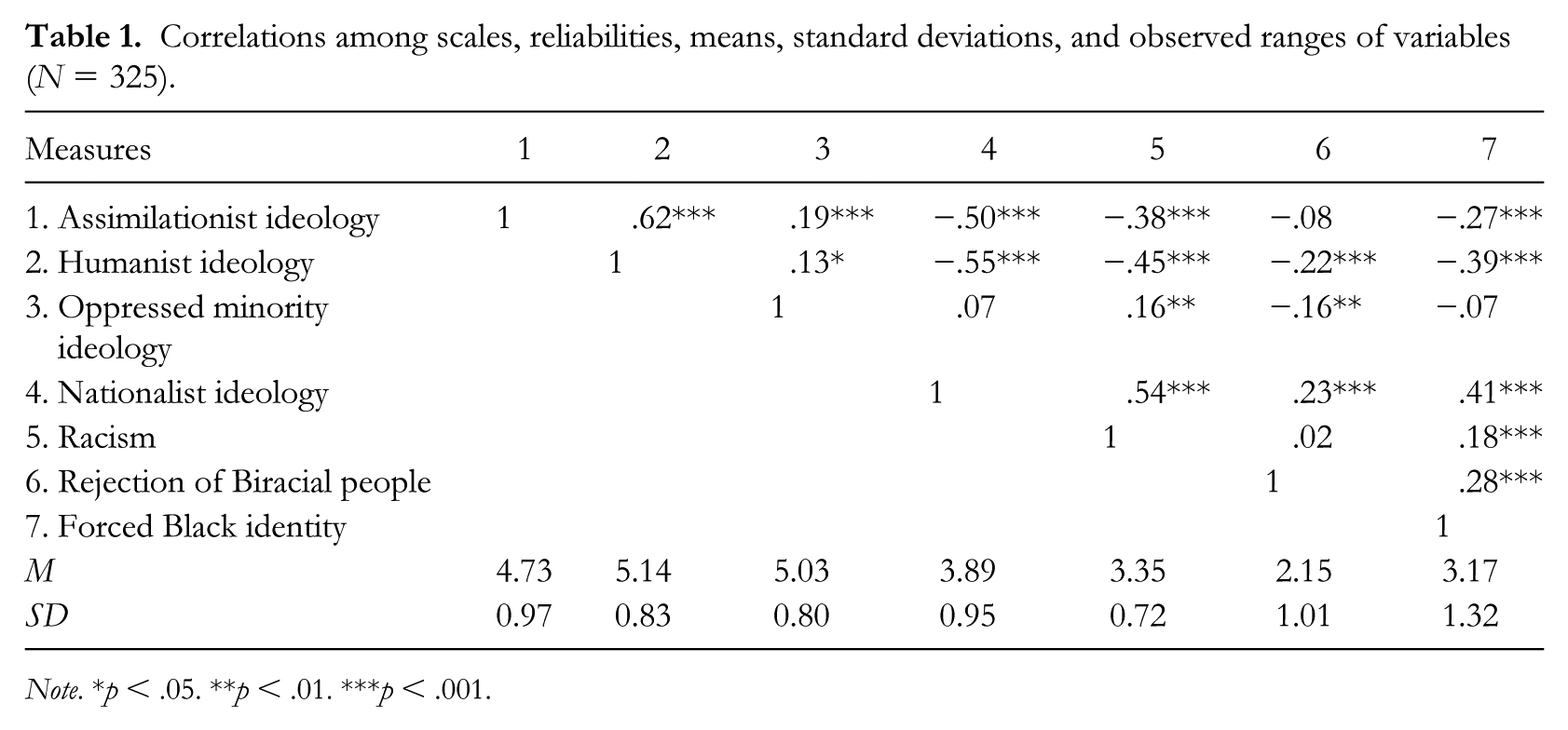
Note. *p < .05. **p < .01. ***p < .001.
Racial identity
To assess racial identity, the ideologies subscales of the Multidimensional Inventory of Black Identity were used (Sellers et al., 1997). For each statement, respondents endorse the extent to which they agree using a 7-point Likert-type scale (1 = strongly disagree, 7 = strongly agree), with higher scores indicating higher levels of each construct. To score the scale, relevant items are reverse-scored, and averages are calculated for each subscale.
Ideologies
Racial ideology is comprised of four subscales, which measure an individual’s philosophy as to how African Americans should behave. It measures assimilationist ideology (nine items; e.g., “Blacks should strive to integrate all institutions which are segregated”; current sample α = .74); humanist ideology (nine items; e.g., “Being an individual is more important than identifying oneself as Black”; α = .69); oppressed minority ideology (nine items; e.g., “The same forces which have led to the oppression of Blacks have also led to the oppression of other groups”; α = .67); and nationalist ideology (nine items; e.g., “Black people must organize themselves into a separate Black political force”; α = .79). The measure is well established and has been used across a number of Black samples (e.g., Banks & Kohn-Wood, 2007; Richardson et al., 2014; Seaton, 2009; Sellers et al., 1997).
Racism
Racism was assessed using the Racism and Life Experiences Scale-Revised (RaLES; Harrell, 1997). This nine-item measure condenses 10 scales assessing experiences of and responses to racism. Content areas assess stress caused by racism, personal experiences of racism, and the impact of racism on one’s family and friends. An example item is “During the past year, how much have you personally experienced racism, racial discrimination, or racial prejudice?” (1 = not at all, 5 = a lot). The scale has been used extensively with Black samples with evidence of adequate reliability (e.g., Carter & Reynolds, 2011; Smith-Bynum, Lambert, English, & Ialongo, 2014; current sample α = .87). Higher scores indicate more experiences of racism.
Acceptance of Multiracial people
The 10-item Biracial Group Membership Scale assessed the degree to which Black people consider Black-White Multiracial people members of the Black community (Franco & Holmes, 2016). The measure was created and normed on a Black sample (Franco & Holmes, 2016). The instructions indicate that “Biracial” is defined as someone with a Black and a White parent who identifies as Biracial. The first factor, entitled “rejection of Multiracial people” assessed rejection of Multiracial people as members of the Black community (e.g., “Biracial people do not count as real Black people”; current sample α = .78). The second factor, entitled “forced Black identity” assessed the degree to which participants think that Multiracial people should identify as Black (e.g., “A Biracial person who identifies as anything but Black is in denial”; α = .82). Items were measured on a 7-point Likert scale (1 = strongly disagree, 7 = strongly agree). Higher scores indicate greater endorsement of rejection of Multiracial people and of forcing a Black identity, respectively.
Results
First, a post hoc sensitivity power analysis was conducted in G*Power, which indicated that the current sample size (N = 325) allowed for 80% power to detect effects as small as 0.02. G*Power uses Cohen’s f2 for MANOVA effect sizes. Effect sizes are reported in this study using multivariate eta-squared (η2). Therefore, f2 was transformed into η2 according to Cohen (1988), and this transformation yielded the same result (η2 = .02).
In latent class analysis, latent subgroups are constructed based on groupings of indicator variables (Muthén & Muthén, 2013). Latent class analysis was implemented using Mplus to examine clustering in scores on racial ideology variables (Muthén & Muthén, 2013). A number of indexes were used to assess model fit. First, the Bayesian information criterion (BIC) indicates goodness of fit, with lower values indicating better fit to the data. We favored a bootstrap likelihood ratio test (BLRT) over the likelihood ratio chi square statistic (L2) in assessing fit because of issues with the latter when there is a large number of indicators or categories (Langeheine, Pannekoek, & van de Pol, 1996). A nonsignificant BLRT indicates that the model is a better fit than other models. We also considered power analysis recommendations suggesting that each class contain at least 20 participants. Last, we used the Lo–Mendell–Rubin (LMR) test. If this test is significant, it indicates that the class solution provides better fit than that of the models with fewer classes (Lo, Mendell, & Rubin, 2001). We completed one-, two-, three-, four-, and five-class models involving the ideology variables. We present results of the class analysis in Table 2.
Model fit statistics for latent class analysis with ideology variables.
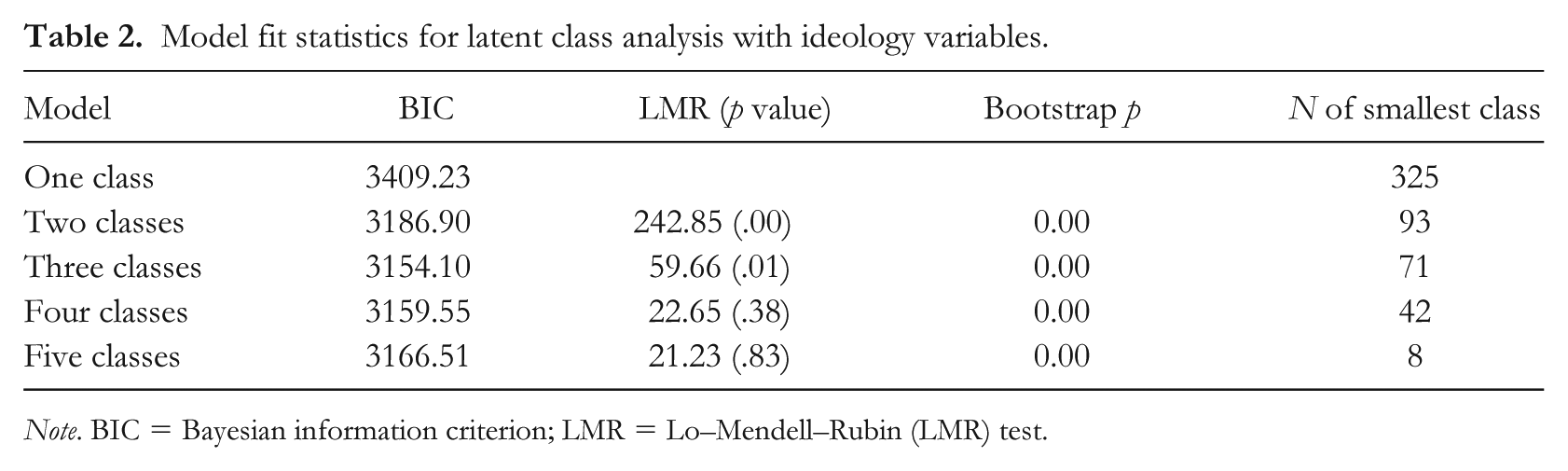
Note. BIC = Bayesian information criterion; LMR = Lo–Mendell–Rubin (LMR) test.
BIC values began to level off at three classes and exhibited a negligible decrease between three and four classes. The nonsignificance of the LMR indicated that the four-class solution provided no better fit than the three-class solution. BLRT remained significant across all number of classes. Masyn (2013) indicated that, in some cases, the BLRT may continue to be significant, even as the maximum number of classes is reached. In comparing power across models, the five-class model did not have enough participants per class to be viable, whereas all other models had at least 20 participants per class. Based on these criteria, the three-class solution was chosen as the best fitting solution, in consideration of its power, BIC value, and significance value for the LMR test.
Means of ideology variables across classes with the three-class solution are presented in Table 3 and Figure 1. We followed up our analyses with MANOVAs to examine whether racial identity ideologies were significantly different across classes. We report these results in Table 3. MANOVAS indicated significant differences across ideology cluster groups in regard to all ideologies: assimilationist, F(2, 322) = 256.33, p < .001; humanist, F(2, 322) = 386.19, p < .001; oppressed minority, F(2, 322) = 8.79, p < .001; and nationalist, F(2, 322) = 127.06, p < .001.
Mean and standard deviations of ideologies across classes.
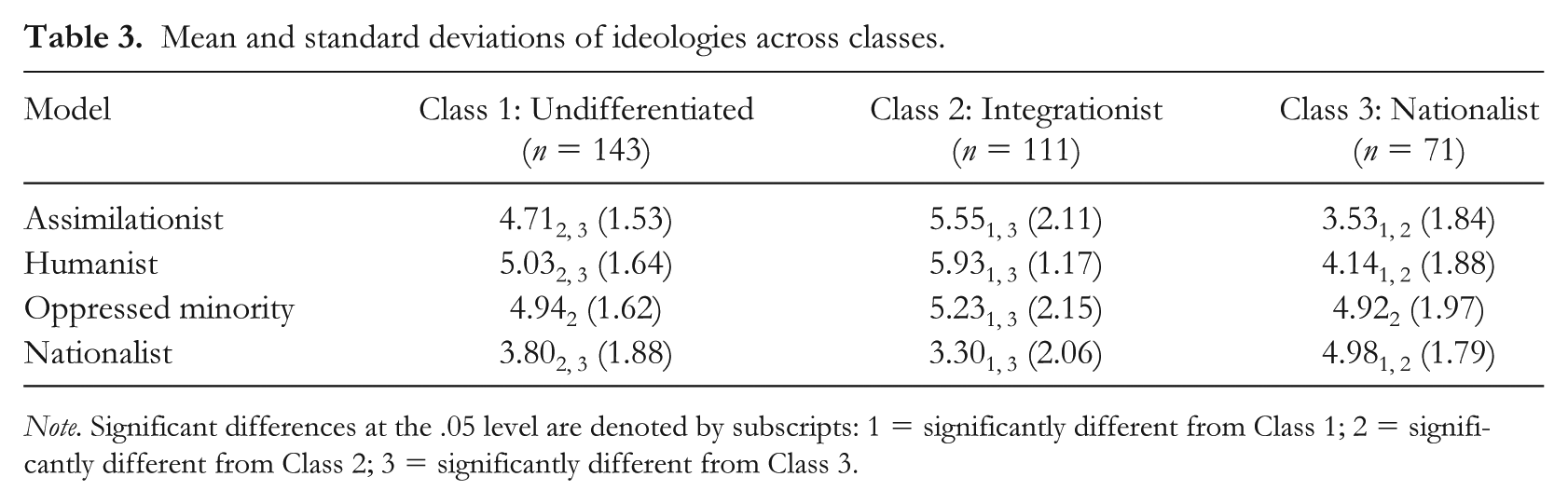
Note. Significant differences at the .05 level are denoted by subscripts: 1 = significantly different from Class 1; 2 = significantly different from Class 2; 3 = significantly different from Class 3.
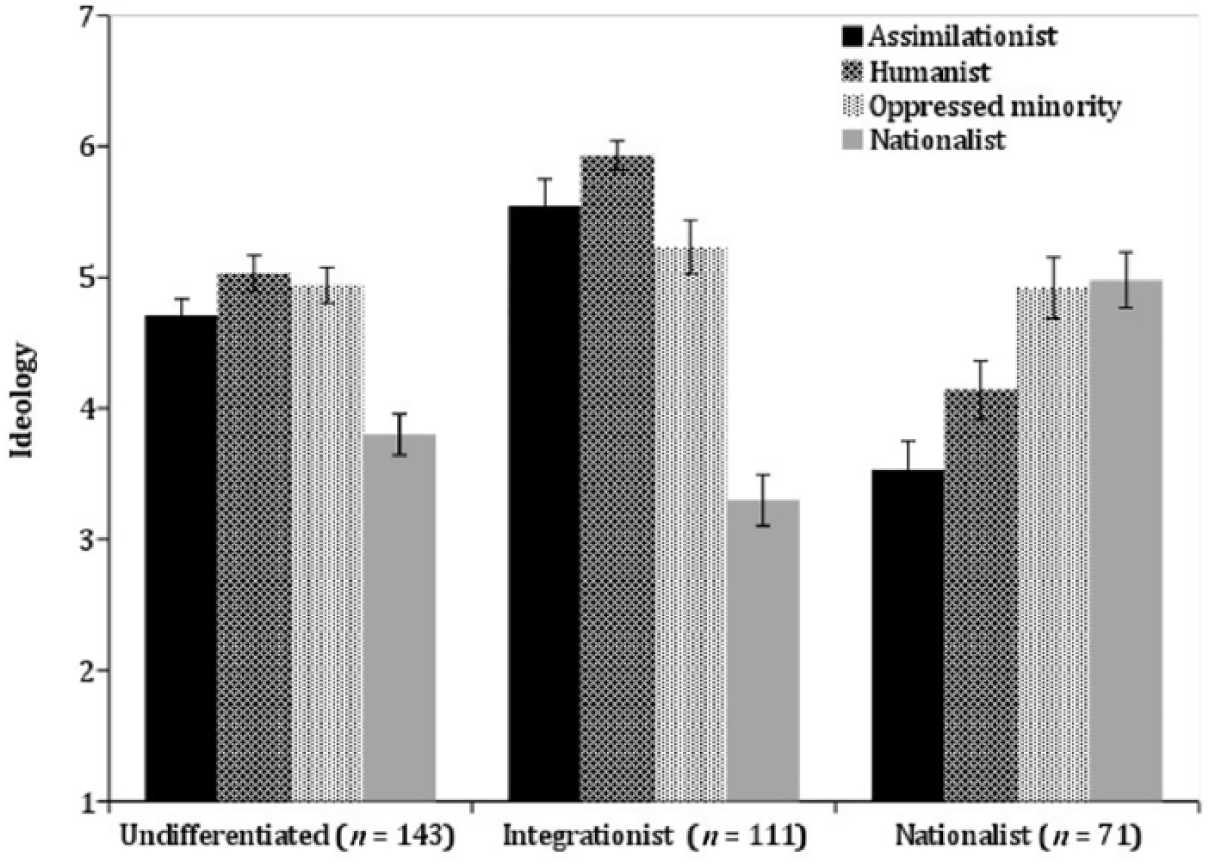
Mean ideology values for each class.
The largest cluster (n = 143) was labeled “undifferentiated” and possessed ideology means that generally differed significantly from but fell between those of the other two clusters. This cluster was labeled “undifferentiated” because individuals in this cluster, compared to those in other clusters, were not the highest or lowest on any particular ideology. They had no distinctive characteristics regarding their levels of endorsed ideologies. The second cluster (n = 111) was labeled “integrationist” because participants comprising the cluster scored significantly higher on assimilationist, humanist, and oppressed minority ideologies than the two other classes. Participants in this cluster likely demonstrate feelings of similarity both towards White people and other minority groups. The third cluster (n = 71) was labeled “nationalist” because participants’ level of nationalist ideology was higher than that of participants of all other clusters. Thus, in line with hypotheses, there was one class that displayed higher assimilationist/humanist ideologies (integrationist class) and another that displayed higher nationalist ideology (nationalist class).
We then conducted a MANOVA to investigate whether classes differed in their levels of rejection of Multiracial people and forced Black identity. The MANOVA indicated significant differences in the Rejection From Black Community subscale across classes, F(2, 322) = 4.30, p = .014, with a small to medium effect size, η2 = .03 (Miles & Shevlin, 2001). Post hoc least significant difference (LSD) tests indicated that the integrationist group (M = 1.96, SD = 0.89) was less likely (p = .004) to endorse rejecting Multiracial people as members of the Black community than the nationalist group (M = 2.41, SD = 1.27). There was a marginal difference (p = .09) between the undifferentiated (M = 2.41, SD = 1.27) and nationalist groups, which indicated that the latter group was somewhat more likely to endorse rejecting Multiracial people as members of the Black community.
The MANOVA indicated significant differences in the Forced Black Identity subscale across classes, F(2, 322) = 24.94, p < .001, with a medium to large effect size, η2 = .13. For the Forced Black Identity subscale, there were significant differences between all classes. The integrationist group (M = 2.69, SD = 1.21) was least likely to force a Black identity onto Multiracial people compared to the undifferentiated (M = 3.31, SD = 1.93; p = .005) and finally the nationalist (M = 4.00, SD = 1.25; p < .001) groups. This pattern of results indicates that the nationalist group was most likely to force a Black identity onto Multiracial people. The undifferentiated group scored between the nationalist and integrationist class in their likelihood of forcing a Black identity onto Multiracial people.
Racism
Counter to hypotheses, correlations indicated nonsignificant relationships between Black people’s experiences of racism and their likelihood of rejecting Multiracial people from the Black community, r(325) = .02, p = .75. However, in line with our hypotheses, Black people’s experience of racism was related to an increased likelihood of forcing a Black identity onto a Multiracial person, r(323) = .18, p < .001 (see Table 1).
The 2.16.3 PROCESS Hayes’s macro was used to conduct all moderation analyses (Hayes, 2013). Racism was centered prior to analyses. The moderation term was entered as a multicategorical variable comprised of the three classes, with the undifferentiated cluster coded as a reference group and the remaining clusters dummy-coded for comparison. The simple slopes of the regression of Acceptance of Multiracial People subscales on racism were calculated at each class value.
Rejection of Multiracial people
The overall model with racism and the interaction term was marginally significant, R2 = .03, F(5, 319) = 2.24, p = .05, and racism was not a significant predictor of rejection of Multiracial people, B = −.21, SE = 0.13, 95% CI [−0.47, 0.05], p = .12. There was no significant interaction between experiences of racism and racial ideology on predicting endorsement of rejection of Multiracial people, ΔR2 = .00, F(5, 319) = 0.40, p = .67.
Forced Black identity
The overall model was significant, R2 = .15, F(5, 319) = 11.24, p < .001, but racism was not a significant predictor of forced Black identity, B = −.17, SE = 0.16, 95% CI [−0.49, 0.15], p = .30. There was a marginally significant interaction between experiences of racism and racial ideology on forced Black identity, ΔR2 = .02, F(5, 319) = 11.24, p = .05. There was a significant difference in relationships between racism and forced Black identity between the nationalist cluster and the undifferentiated and integrationist clusters. For the nationalist class, there was a positive relationship between experiences of racism and forced Black identity, B = .63, SE = 0.29, 95% CI [0.06, 1.20], p = .03, whereas for the undifferentiated, B = −.17, SE = 0.16, 95% CI [−0.49, 0.15], p = .30, and integrationist, B = −.06, SE = 0.18, 95% CI [−0.41, 0.28], p = .73, clusters, the relationship between racism and forced Black identity was nonsignificant.
Discussion
The current study sought to investigate whether Black people’s racial identity predicts their endorsement of acceptance of Black-White Multiracial people. Typologies of Black people’s racial identity were constructed based on groupings of multiple indexes of racial identity variables; these included “undifferentiated” (average ideologies—no distinctive highest or lowest score on dimensions of ideologies compared to each of the other clusters), “integrationist” (high assimilationist, humanist, and oppressed minority), and “nationalist” (high nationalist) classes. Findings generally aligned with hypotheses in that the integrationist cluster was most likely to endorse accepting Multiracial people—to accept them into the Black community and also to accept their Multiracial identity and not force a Black identity onto them. In contrast, the nationalist cluster was least likely to endorse acceptance of Multiracial-identified people as members of the Black community and also most likely to force a Black identity onto them. The undifferentiated cluster scored between the nationalist and integrationist groups in their likelihood of accepting Multiracial people and forcing a Black identity on them.
Results indicate that monoracial Black people may have diverse opinions as to whether Multiracial people belong with the Black community. Specifically, nationalist individuals may endorse excluding Multiracial people, whereas integrationists may endorse welcoming them. With Multiracial-identified people comprising the fastest growing racial group in the US (Farley, 2001), these diverse opinions as to whether Multiracial people are part of the Black community may influence the trajectory of the Black community in regard to its scope and political power.
Findings regarding Black people’s racial identity and acceptance of Multiracial people have several implications for Multiracial people. Many Black-White Multiracial people consider themselves Black (Wright, Olyedemi, & Gaines, 2014), and accordingly, rejection by Black people affects Multiracial people’s racial identity and feelings of belonging in a different way than rejection from other racial groups (Franco & Franco, 2015). Findings indicate that Black people who espouse a constellation of views that indicate openness to the mainstream and connection with other people of color, along with the recognition of a common humanity that extends beyond race, may be most accepting and affirming of Multiracial people and their identity. In contrast, Black nationalists may be more likely to espouse rejection and invalidation of the racial identity of Black-White Multiracial people who identify as such. However, generally across classes, there were low rates of endorsement of rejection of Multiracial people as members of the Black community—indicating that Multiracial people may be more likely to be accepted than rejected among Black people of diverse racial identities. Of course, these findings should be framed by the demographics of the sample—wealthy, educated, and mostly female—and also by the demographics of the target (Black-White Multiracial). Findings may be less generalizable to Black people who do not possess these demographic characteristics, or else to Multiracial targets of African descent who are not of Black and White heritage.
Whereas it may be difficult for Multiracial people to gauge a Black person’s racial identity in order to assess whether they might experience rejection, it may generally be important for Multiracial people to understand that Black people’s racial identity may affect whether they reject them. This awareness would allow the Multiracial person to attribute rejection they face to characteristics of the rejecter, rather than to flaws within themselves. Given the negative consequences of Black rejection for the emotional well-being and racial identity of Multiracial people (Franco & Franco, 2015), this understanding may mitigate the established harmful psychological, interpersonal, or identity-related effects of invalidation (Franco & O’Brien, 2018).
Our study lends only partial support to stigma-based solidarity theory. Namely, experiences of stigma (racism) did not create more feelings of similarity between Black and Multiracial people, as demonstrated by nonsignificant relationships between experiences of racism and endorsement of accepting Multiracial people into the Black community (Craig & Richeson, 2012, 2016). Relationships between racism and connectedness to other minority groups have been demonstrated in experimental studies (e.g., Craig & Richeson, 2012; Ho et al., 2017), but may be more difficult to detect in correlational studies. Experimental studies employ immediate primes manipulating discrimination, whereas the measure of racism in the current study asks about racism experienced in the past year. Thus, relationships between racism and similarity may have been diluted with the passage of time since the racism was experienced. Thus, experimental studies are encouraged that would allow for the immediate assessment of the effects of a racism prime on Black people’s acceptance of Multiracial people. Given that racial identity is relatively stable, but also may be subject to situational factors such as salience and context (Ho et al., 2017; Sellers et al., 1998), experimental studies might also clarify direction and causality through priming a certain racial identity type and examining accompanying variations in acceptance of Multiracial people.
In contrast, our results did indicate that experiences of racism were related to endorsement of forcing a Black identity onto Multiracial people. Forcing a Black identity may be a medium through which Black people increase the number of people within their racial group, allowing for increased political power and clout, and a larger magnitude of collective action (Dawson, 1994; Sanchez, 2008). Considering that experiences of racism may generate an increased need for collective action, forced Black identity may be one dimension through which Black people magnify their collective power. This finding is true for individuals espousing a nationalist ideology.
But why might nationalists respond to racism by espousing forcing a Black identity onto Multiracial people, whereas those with other classes of ideologies might not? Each ideology expresses a unique orientation to racial progress in light of racial oppression (Sellers et al., 1997). For integrationists, racial progress is achieved by assimilation into the mainstream culture, whereas for nationalists, racial progress is achieved through Black racial solidarity and separatism. Black nationalists forcing a Black identity onto Multiracial people may be one way through which they aim to achieve such solidarity. Furthermore, the experience of racism may heighten the urgency of the need for racial solidarity among nationalists.
In sum, the current study indicates that Black people’s racial identity may be an important determinant of their endorsement of acceptance of Multiracial people into the Black community. Whereas historically the Multiracial communities and Black communities were considered part of one Black community (Rockquemore & Brunsma, 2001; Rockquemore et al., 2009), this study emphasizes that Black people’s racial identity, and experiences of racism, may be important factors to consider when assessing Black people’s perceptions of whether Multiracial people remain a part of the Black community, as well as their receptivity to a Multiracial identity. With the rapid growth of the Multiracial population, the current study sheds light on evolving racial group boundaries in an increasingly diverse society.
Footnotes
Funding
The authors received no financial support for the research, authorship, and/or publication of this article.