



Abstract
Increasing economic inequality adversely affects groups with low socioeconomic status (low-SES). However, many people are opposed to wealth redistribution policies. In this context, we examined whether dehumanization of low-SES groups has a role in this opposition. In the first study (N = 303), opposition to wealth redistribution was related to denying human uniqueness (e.g., intelligence and rationality) and having negative attitudes toward low-SES groups, more than denying human nature (e.g., emotionality and capacity to suffer) to low-SES groups. Mediation analyses indicated that this effect occurred via blaming low-SES groups for their plight, after controlling for participants’ SES and negative attitudes towards low-SES groups. In the second study (N = 220), manipulating the human uniqueness of a fictitious low-SES group affected support for wealth redistribution measures through blame. These results indicate that animalizing low-SES groups reduces support for wealth redistribution via blaming low-SES groups for their situation.
Increasing income inequality affects the well-being of many people around the world (Buttrick & Oishi, 2017; Wilkinson & Pickett, 2017). However, there is widespread opposition to policies designed to redistribute wealth and thus reduce the negative impact of income inequality (Ashok, Kuziemko, & Washington, 2015). The main objective of the present work is to analyze some ways in which people resist redistribution policies. Specifically, we focus on how dehumanization of low-SES groups (Loughnan, Haslam, Sutton, & Spencer, 2014; Sainz, Martínez, Moya, & Rodríguez-Bailón, 2018) may influence the rejection of wealth redistribution policies through causal internal attributions of poverty (Bullock, Williams, & Limbert, 2003).
Opposition to Redistribution Policies
Previous studies have analyzed how different factors contribute to the legitimization and maintenance of the unequal status quo (Moya & Fiske, 2017; Willis, Rodríguez-Bailón, López-Rodríguez, & García-Sánchez, 2015). Thus, wealth redistribution preferences seem to be shaped by a multitude of variables, such as the socioeconomic status of the perceiver (e.g., Brown-Iannuzzi, Lundberg, Kay, & Payne, 2015), their personal political preferences (e.g., Jaime-Castillo & Sáez-Lozano, 2014; Rodríguez-Bailón et al., 2017), structural variables such as social inequality (e.g., Heiserman & Simpson, 2017; Sands, 2017), and various combinations of these factors (e.g., Dawtry, Sutton, & Sibley, 2015).
An important factor that contributes to the rejection of wealth redistribution is people’s understanding of the causes of poverty. Poverty is a complex and multifactorial phenomenon that is sometimes misrepresented as a simple consequence of low-SES groups’ inadequate decision-making (e.g., not saving money, being lazy). This causal misrepresentation is accompanied by a denial of the role of contextual or cultural factors (e.g., low wages, poor education, the loss of social values among the poor) that, in fact influence the economic situation of these groups (Tagler & Cozzarelli, 2013). This serves to justify income inequality by placing the responsibility for low-SES groups’ situation on them rather than on social and economic systems. Moreover, blaming low-SES groups for their disadvantaged situation promotes economic inequality by motivating people to oppose wealth redistribution (Bullock et al., 2003). In this study, we propose that the dehumanization of low-SES groups fuels this process.
Dehumanization of Low-SES Groups
Dehumanizing groups has been deemed a pervasive process that serves to legitimize different types of inequality (for reviews, see Haslam & Loughnan, 2014; Haslam & Stratemeyer, 2016; Vaes, Leyens, Paladino, & Miranda, 2012). One of the main contributions to the study of dehumanization is Haslam’s (2006) dual model of humanity. According to this author, two related dimensions of humanity exist. The first is human nature (HN), which involves a sense of emotionality or interpersonal warmth that is denied to objects or machines. The denial of this dimension leads to the perception of others as machine-like (mechanistic dehumanization), without the ability to experience suffering or other emotional states. The second dimension is human uniqueness (HU), which refers to intelligence, agency, and self-control, and serves to differentiate humans from other animals. Groups lacking this dimension are dehumanized in an animalistic way and are therefore considered to be “inferior” or “less evolved” animals. The denial of this dimension is a process that contributes to creating and sustaining hierarchical differences among groups (Haslam & Loughnan, 2014).
Even though these dimensions of humanity (HU and HN) are related to each other, previous studies have found that the denial of each dimension has distinct outcomes. For example, denying HN traits to patients helps doctors to cope with burnout (Vaes & Muratore, 2013) and to perform painful yet beneficial procedures on patients (Haque & Waytz, 2012). In contrast, the denial of HU involves lowered perceptions of traits such as rationality and civility. It is also associated with blatant forms of dehumanization, including seeing racial/ethnic minorities as being closer to apes than to Homo sapiens on an evolutionary continuum (Kteily, Bruneau, Waytz, & Cotterill, 2015). The denial of HU has been associated with a tendency to reduce helping behaviors (Andrighetto, Baldissarri, Lattanzio, Loughnan, & Volpato, 2014) or with the perception that individuals are less capable of improving themselves (e.g., Viki, Fullerton, Raggett, Tait, & Wiltshire, 2012). It has also been associated with a higher tendency to exclude groups in certain contexts (Martínez, Rodríguez-Bailón, Moya, & Vaes, 2015), among other possible negative consequences for those who are animalized (for a review, see Haslam & Loughnan, 2014).
Early research focused on analyzing the role of dehumanization in the maintenance of racial, ethnic, or gender inequalities. More recent research has begun to examine the relation between dehumanization and social class. This research revealed that a widespread tendency exists to consider low-SES people to be animal-like (Sainz et al., 2018) and thus to deny them HU traits. For example, Loughnan et al. (2014) showed that low-SES groups, such as those called “chavs” in the UK and “White trash” in the US, were regarded as less uniquely human and more animal-like.
These findings indicate that the denial of humanity may be an important feature that shapes the perception of low-SES groups and, more generally, reactions to economic inequality. Based on previous evidence showing how variables such as hierarchy-maintenance orientation shape perceptions of the income gap (Kteily, Sheehy-Skeffington, & Ho, 2017), we propose that the dehumanization of low-SES groups may also bias the interpretation of factors that cause poverty, leading people to reject wealth redistribution policies. We also propose that the two dimensions of humanity may have distinct effects. Each dimension of humanity may allow people to come to terms with the existence of inequality and poverty in their society. On the one hand, the denial of HN implies that a group has a limited capacity to suffer, so observers feel less distressed and guilty about their situation (Zebel, Zimmermann, Viki, & Doosje, 2008). This could lower the tendency to help and, as a consequence, maintain income inequality. On the other hand, one of the functions of the denial of HU is to create vertical or hierarchical differentiation between groups, where others are placed below one’s own or group position (Haslam & Loughnan, 2014). Moreover, previous studies have also found that people are less likely to help groups they consider to be animal-like (e.g., Andrighetto et al., 2014). Thus, it is plausible, though not yet established, that the denial of HU to low-SES groups might also contribute to decreased support for redistribution (thus promoting inequality). Furthermore, the psychological mechanisms that might be responsible for the link between attribution of humanity and attitudes towards redistribution policies have also not been identified.
Overview of the Present Research
Extant research indicates that low-SES groups are frequently dehumanized and that this might contribute to the justification and maintenance of economic inequalities, just as dehumanization serves to maintain racial and other intergroup hierarchies (for a review, see Vaes et al., 2012). Thus, there are grounds to believe that mechanistic dehumanization (denial of HN) of low-SES groups might contribute to economic inequality by triggering the minimization of these groups’ suffering. However, research has showed that these groups tend to be the subject of animalistic dehumanization (denial of HU). Therefore, we consider that this dimension may have a key role above and beyond that of HN.
Little attention has been paid to how the denial of HU may shape attitudes and responses to poverty and economic inequality. In this article, we propose that dehumanization of low-SES groups (Loughnan et al., 2014) may play a key role in causal attributions of poverty and wealth redistribution policies. The animalistic dehumanization of low-SES groups implies that these groups are perceived as irrational and impulsive, without control over their behavior. This animalization may lead to a process where people blame low-SES groups for their situation, ascribing it to internal causes (e.g., making wrong decisions) rather than to external factors (e.g., economic recession). Further, causal attributions of poverty have an important proximal influence on attitudes toward wealth redistribution (Tagler & Cozzarelli, 2013). We therefore propose that they mediate the relation between denial of HU and reduced support for wealth redistribution. In sum, we propose that (de)humanizing (denying or attributing HU traits) low-SES groups biases causal attributions of poverty, in turn affecting attitudes towards wealth redistribution.
We conducted two studies to address the unexplored relation between the denial of humanity to low-SES groups and attitudes towards wealth redistribution policies. The first study was correlational and examined the relationships among both dimensions of humanity (HU and HN), causal attributions of poverty, and attitudes towards wealth redistribution. The second study was experimental and was aimed at examining the causal influence of HU traits denial on attitudes toward wealth redistribution. Both studies examined whether the link between dehumanization and wealth redistribution preferences might be mediated by the blaming of low-SES groups for their situation. Data and materials for these studies can be found online (osf.io/eakq6).
Study 1
The main goal of this study was to explore the relation between dehumanization of low-SES groups and inequality-related variables, such as causal attributions of poverty and attitudes towards wealth redistribution policies. We expected that denial of humanity would be associated with greater blame placed on low-SES groups (more internal than external attributions) for their disadvantaged situation (Hypothesis 1), and with lower support for wealth redistribution policies (Hypothesis 2). Specifically, we analyzed whether one dimension of humanity (HU) was associated with the other variables to a higher extent than the other dimension of humanity (HN). Finally, we also conducted a mediational analysis using an index of causal attributions (internal attributions minus external attributions) of poverty as the mediator in the relation between attribution of HU and wealth redistribution policies (Hypothesis 3). To analyze the unique role of humanity (HU traits) above and beyond negative attitudes about poverty, we adjusted for negative attitudes towards low-SES groups.
Method
Participants and procedure
Participants were recruited through Amazon’s Mechanical Turk (MTurk). They were compensated for their participation in a study ostensibly about income distribution and economy-related attitudes. Sample size was calculated using G*Power for a small correlation (r = .20, α = .05, 80% Power, minimum 193 participants; Faul, Erdfelder, Buchner, & Lang, 2009). The final sample was composed of 303 U.S. participants (140 women, 161 men, 2 other; Mage = 36.78, SD = 13.05). Once participants agreed to participate in the study (which received the approval of the University of Kent’s Ethics Committee), they were presented with the following measures.
Dehumanization measures
We included two different measures of dehumanization. Participants completed an eight-item scale developed by Bastian, Jetten, and Radke (2012), which included four items related to HU (e.g., “People from lower classes lack self-restraint, like animals” [reverse-coded]; α = .76), and four items related to HN (e.g., “People from lower classes are superficial, they have no depth” [reverse-coded]; α = .74). Responses were given on a 7-point scale (1 = not at all, 7 = very much so). In addition, we used the Ascent of Man Scale developed by Kteily et al. (2015). Participants were presented with three sliders, one for each target class, in a random order to test how “evolved” they considered the average member of low-, middle-, and upper SES groups to be. Responses ranged from 0 (least evolved) to 100 (most evolved). A low-SES humanity score was calculated by subtracting upper/middle-SES ratings from low-SES ratings (higher scores indicate that low-SES groups are more evolved), following the procedure of Kteily et al. (2015).
Causal attributions of poverty
To assess causal attributions of poverty for low-SES groups, we used the scale developed by Cozzarelli, Wilkinson, and Tagler (2001). Participants rated 18 possible causes of poverty. Answers were given on a 5-point scale (1 = not at all important as a cause of their poverty, 5 = extremely important as a cause of their poverty). The original structure of the measure distinguished among internal (e.g., “lack of effort and laziness by the poor”; α = .88), external (e.g., “prejudice and discrimination in hiring”; α = .86), and cultural/structural (e.g., “being born into poverty”; α = .55) causes of poverty. However, as the authors of the scale pointed out, the cultural dimension is empirically less consistent in factor analyses, and sometimes reflects a mix of internal and external attributions. Since we were interested in comparing internal and external causal attributions of poverty, we conducted a two-factorial analysis including the cultural items of the scale. The results confirmed one factor including mainly external attributions (α = .89) and a second factor including mainly internal attributions (α = .87). Items related to cultural attributions were distributed between both factors. 1 Finally, to have a measure that reflected the process of blaming the members of low-SES groups for their situation, we created a blame index (Internal − External Attributions = Blaming the Poor). Higher scores indicate more blaming of low-SES groups for their plight.
Wealth redistribution attitudes
We used four items (e.g., “The government should redistribute wealth by heavily taxing the rich”; α = .86) adapted from Dawtry et al. (2015), and five items (e.g., “There is a need to flatten the hierarchy in this society”; α = .89) adapted from Kteily et al. (2017) to measure wealth redistribution attitudes. Responses to both measures were given on a 7-point scale (1 = strongly disagree, 7 = strongly agree). An exploratory factor analysis (varimax rotation, principal components extraction) showed that only one factor explained 66.42% of the variance. Therefore, we decided to merge both scales into a single scale (α = .94).
Negative attitudes toward low-SES groups
We measured attitudes toward low-SES groups using a six-item (α = .89) scale with positive (e.g., “I generally like low-SES groups”) and negative items (e.g., “I don’t like low-SES groups very much”) adapted from Cozzarelli et al. (2001). Responses for both measures were given on a 5-point scale (1 = strongly disagree, 5 = strongly agree).
Participants’ SES and demographics
Participants reported their subjective SES on the 10-step Subjective Socioeconomic Status Scale (Adler, Epel, Castellazzo, & Ickovics, 2000). They also provided objective indicators of SES, such as their annual pretax income range (7-point scale; 1 = below $15,000, 7 = above $65,000) and education level (7-point scale; 1 = less than high school degree, 7 = doctoral degree). As done in previous research (Kraus & Keltner, 2009), we standardized these objective indicators to create a measure of objective SES (r = .16, p = .005). Finally, participants reported their demographic information (gender, age), after which they were thanked and debriefed.
Results
Attributions of humanity traits to low-SES groups
Results from Bastian et al. (2012) showed that low-SES groups were attributed more HN (M = 5.26, SD = 1.04) than HU traits (M = 4.62, SD = 1.09), t(302) = −14.83, p < .001, Hedges’ gav = .60. Regarding the Ascent of Man Scale, the results revealed differences between low-SES (M = 80.54, SD = 22.60) and both middle-SES (M = 85.04, SD = 17.58), t(302) = −5.44, p < .001, Hedges’ gav = .22, and upper SES groups (M = 86.00, SD = 18.70), t(302) = −4.26, p < .001, Hedges’ gav = .26. No differences were found between middle- and upper SES groups, t(302) = −1.07, p = .284. Thus, we decided to create the index of the Ascent of Man Scale by subtracting the low-SES groups rating from the upper/middle-SES groups rating.
Regression analysis
We calculated simultaneous multiple regressions using the humanity measures along with the attitudes towards low-SES groups measure as predictors of the income redistribution attitudes variables (see Table 1). To simplify the analysis, we created a composite index of the measure of HU and the Ascent of Man Scale (r = .40, p < .001) by following a similar procedure to the one used by Kteily and Bruneau (2017). This procedure consists of merging, after standardizing, the measures that relate to the human–animal dimension (i.e., HU and the Ascent of Man Scale). Results indicated that the attributed level of HU–Ascent of Man Scale score (index) negatively predicted the blame index and, at the same time, positively predicted support for wealth redistribution policies. Thus, the more participants considered low-SES groups as not fully human (i.e., animal-like), the more they blamed them for their disadvantaged situation, and the more they opposed the redistribution of resources. These results support Hypotheses 1 and 2. Moreover, analyses comparing variables’ ability to predict outcomes were conducted following the procedure suggested by Paternoster, Brame, Mazerolle, and Piquero (1998). As expected, results showed that compared to HN, the HU–Ascent of Man Scale index better predicted most of the variables included in the study (see Table 2).
Simultaneous multiple regression analysis of dehumanization (HU–Ascent of Man Scale, HN) and attitudes on the inequality engagement variables (attributions about poverty and preferences for redistribution attitudes) included on Study 1.
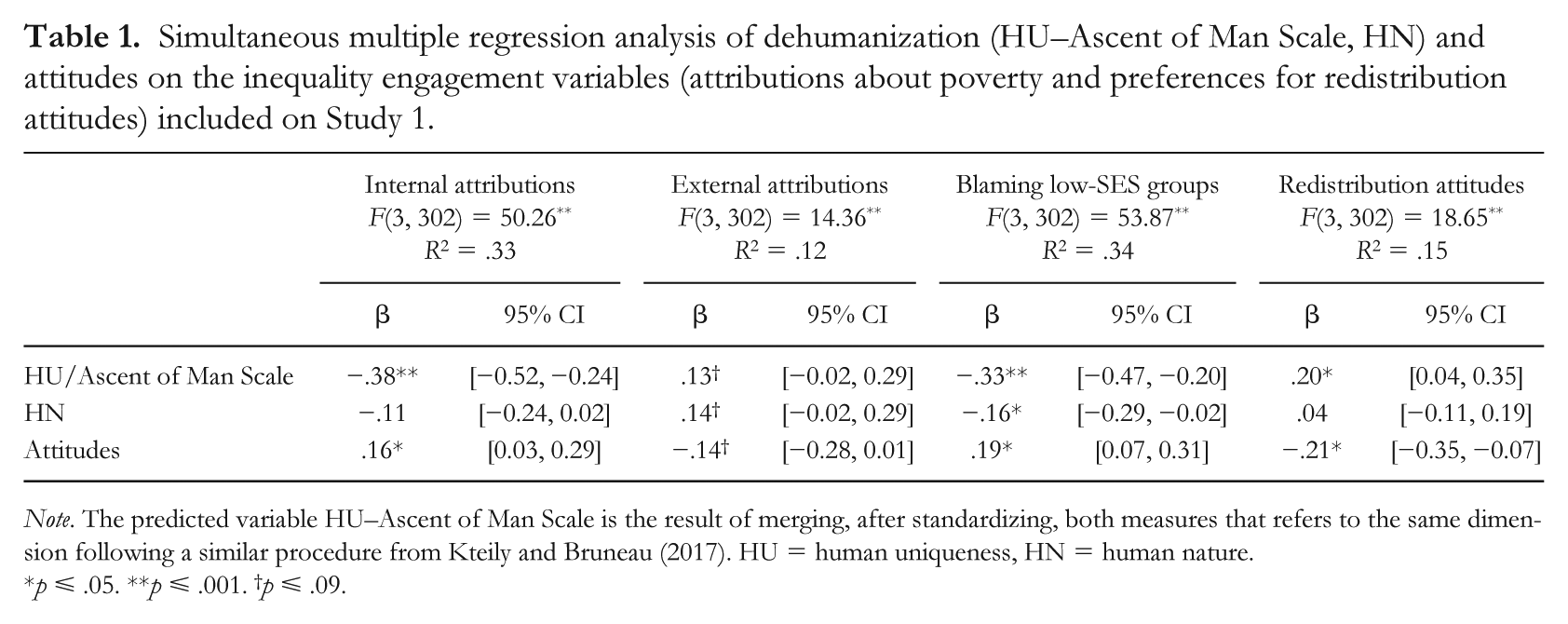
Note. The predicted variable HU–Ascent of Man Scale is the result of merging, after standardizing, both measures that refers to the same dimension following a similar procedure from Kteily and Bruneau (2017). HU = human uniqueness, HN = human nature.
p ⩽ .05. **p ⩽ .001. †p ⩽ .09.
Comparison of the capability of prediction (beta scores) among the variables included in Study 1.
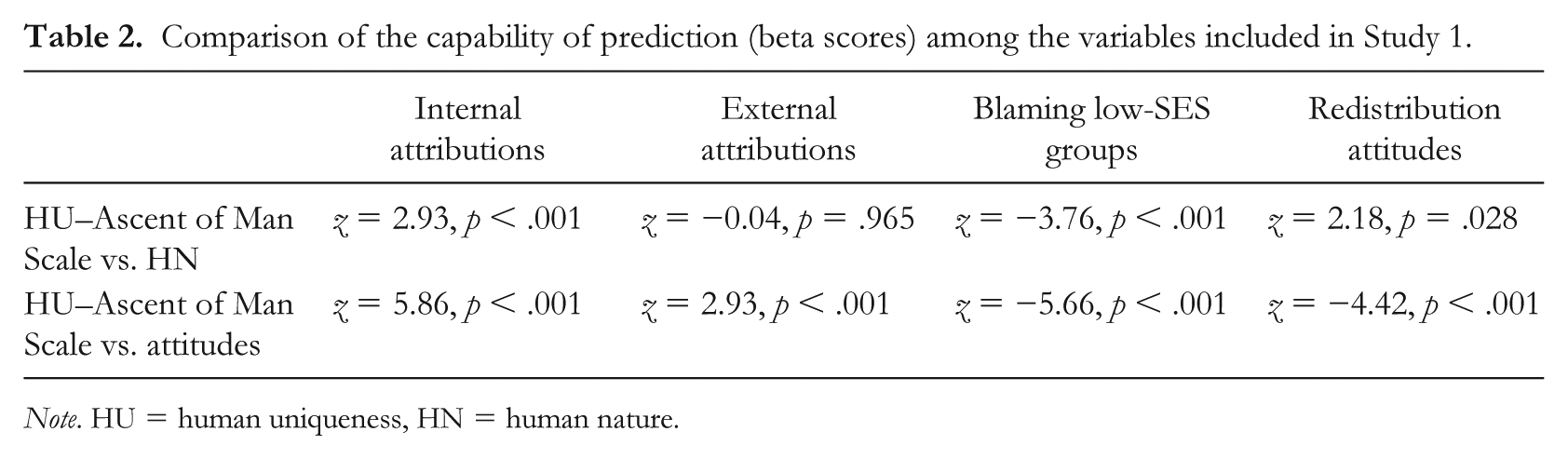
Note. HU = human uniqueness, HN = human nature.
Mediation analysis
After the regression analysis, we conducted a mediation analysis (PROCESS Model 4, bootstrapping 10,000 samples, 95% CI; Hayes, 2013). This was done to explore the possible mediation of blaming low-SES groups in the relation between the index of HU–Ascent of Man Scale and wealth redistribution policies (see Figure 1). Based on the regression results, we included the HU–Ascent of Man Scale index as the predictor of attitudes about redistribution policies. The results revealed a significant indirect effect of blaming low-SES groups (IE = .41, SE = 0.04, 95% CI [0.33, 0.51]) on the relation between the HU–Ascent of Man Scale index and attitudes toward redistribution policies. Additionally, we calculated the same mediational analysis including HN, negative attitudes towards low-SES groups, and participants’ SES (objective and subjective) as covariates (see Table 3). The results, after controlling for these variables, revealed that the indirect effect remains significant (IE = .23, SE = 0.05, 95% CI [0.13, 0.33]): the effect of the HU–Ascent of Man Scale index prevails above and beyond the effect of HN (HN effect = .04, SE = 0.07, 95% CI [−0.11, 0.18]), negative attitudes toward low-SES groups (Attitudes effect = −.19, SE = 0.08, 95% CI [−0.34, −0.06]), and participants’ subjective (SSS effect = −.14, SE = 0.06, 95% CI [−0.26, −0.01]) and objective status (OSC effect = −.04, SE = 0.06, 95% CI [−0.16, 0.09]). In summary, these results support Hypothesis 3, indicating that a relation exists between the attribution of human traits (as measured by the HU–Ascent of Man Scale index) and the rejection of wealth redistribution policies, mediated by the blaming of low-SES groups.

Mediational analysis of the role of blaming low-SES groups in the relation between dehumanization (measured in Study 1, manipulated in Study 2) and attitudes towards wealth redistribution policies, controlling for attitudes towards low-SES groups (Study 1), HN (Studies 1 and 2), and participants’ SES (Studies 1 and 2).
Mediational analysis of the role of blaming low-SES groups in the relation between dehumanization (measured in Study 1, manipulated in Study 2) and attitudes towards redistribution policies, controlling for attitudes towards low-SES groups (Study 1), HN (Studies 1 and 2), and participants’ SES (Studies 1 and 2).
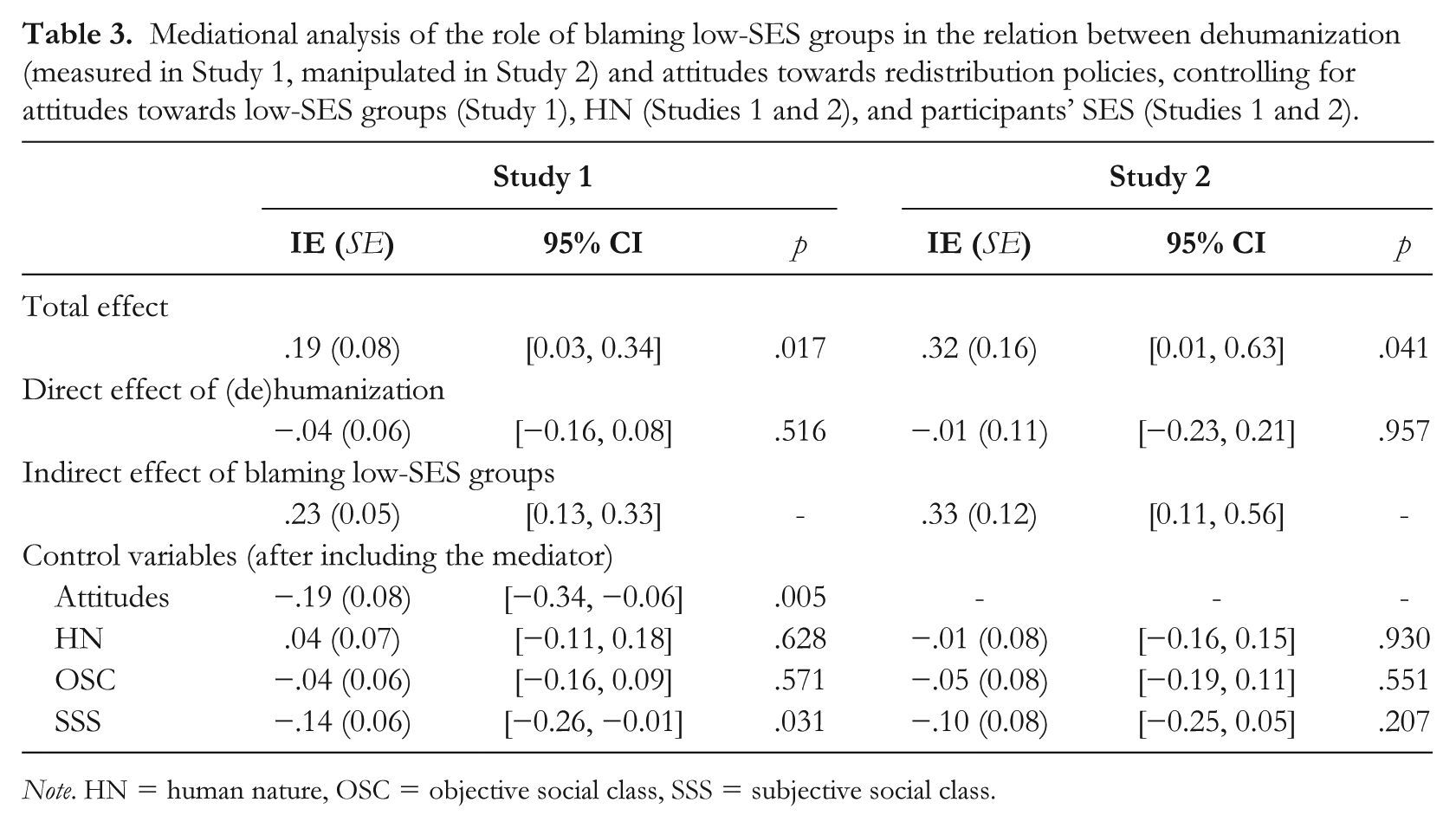
Note. HN = human nature, OSC = objective social class, SSS = subjective social class.
Discussion
This study analyzed the relation between dehumanization of low-SES groups and attitudes toward economic redistribution variables, such as causal attributions of poverty (placing blame on low-SES groups for their situation) and wealth redistribution policies. The results indicate that the less that people attribute humanity to low-SES groups, the more they blame these groups for their poverty, and the less they support wealth redistribution policies. However, the dimensions of humanity (HU, HN) seem to have a different influence on the predicted variables. The results show that differences between humans and animals captured by the HU–Ascent of Man Scale index were a better predictor of the variables than those captured by the HN dimension. Therefore, it seems that considering individuals from low-SES groups as scoring lower in the human–animal dimension (HU–Ascent of Man Scale index) is associated with rejection of redistributive policies via blaming low-SES groups for their poverty more than through the perception that low-SES groups are incapable of suffering because of their poverty (i.e., denial of HN). Moreover, the influence of the HU–Ascent of Man Scale index on attitudes towards wealth redistribution policies via the attribution of blame to low-SES groups seems to prevail. This was the case even when controlling for individual variables such as SES or attitudes towards low-SES groups, which remained significant in the mediation model. Therefore, it seems that the attribution of animal traits to low-SES groups is the factor that triggers the rejection of redistribution policies via blaming the groups for their plights. Based on this preliminary result, we conducted a second study to focus on how the attribution or the denial of HU to low-SES groups influenced attitudes towards wealth redistribution through blaming those groups for their situation.
Study 2
In this study, we manipulated the HU ascribed to low-SES groups to determine whether it exerts a causal influence on support for redistribution policies via placing the blame on low-SES groups for their plights. We decided to manipulate the attribution of humanity in terms of HU rather than HN given that in Study 1, participants were more inclined to deny these traits (see also Loughnan et al., 2014) and that the denial of these traits was more strongly related to blame and redistribution attitudes. We expected differences between the humanized (high HU) and the animalized (low HU) low-SES groups. Specifically, we hypothesized that there would be higher attributions of poverty to internal causes for the low-HU group in comparison with the high-HU group (Hypothesis 1). Additionally, we predicted higher attributions of poverty to external causes when participants were presented with a high-HU group in comparison with a low-HU group (Hypothesis 2). In short, we considered that participants would blame the poor for their plights more when they were animalized. We also expected that participants presented with a low-HU group would show less positive attitudes toward wealth redistribution compared with participants who were asked to imagine a group described as having high-HU traits (Hypothesis 3). Finally, we anticipated mediation of the blame index in the relation between the humanity manipulation and support for redistribution policies, after controlling for participants’ SES and the group’s ascribed HN (Hypothesis 4). All hypotheses were preregistered and can be found online (osf.io/7gwmp).
Method
Participants and procedure
The sample size was calculated using G*Power analysis (Faul et al., 2009) for an independent t test (two independent groups) based on the partial correlation between HU and wealth redistribution, controlling for HN from Study 1 (effect size d = .38, α = .05, 80% Power). The results revealed that a minimum of 220 participants was required. We recruited slightly more participants to ensure that we would reach the minimum required number. The final sample was composed of 257 U.S. participants (140 men, 115 women, 2 other; Mage = 36.62, SD = 11.67). They were recruited through Prolific Academic services and were compensated for their participation in the study. Participants were asked to take part in a study ostensibly about group relations and economy-related attitudes (which received approval from the Ethics Committee of the University of Granada). Once they provided their consent to participate, participants were presented with the following measures.
Humanity manipulation
Participants were required to read a fictitious scientific article published in a well-known scientific journal about “the personality of groups.” A short abstract of the article described the socioeconomic details and the personality traits of a group supposedly living in Spain. In two conditions participants were told that the described group was considered as having a low SES (few resources, lower level of education, and jobs that are not highly valued). Once participants read this information, they were presented with the manipulation of HU (low vs. high adscription of HU traits) following the same procedure and materials as those used by Martínez et al. (2015). In one condition, the group was described as being irrational, lacking culture, and behaving in a childlike manner (low-HU condition). In the other condition, the group was described as being rational, having culture, and behaving in a mature way (high-HU condition). 2 Participants answered manipulation checks about the SES of the group (“What is the socioeconomic status of the group?”; 1 = low SES, 3 = upper SES); its ascribed HU traits (“To what extent do you think the group lacks culture, is irrational, childlike, coarse, immoral [civil, rational, mature, refined, and moral; reversed-coded]?”; 1 = not at all, 7 = completely; α = .93); and its ascribed HN traits (“To what extent do you think the group is emotional, warm, open minded, active, and has depth?”; 1 = not at all, 7 = completely).
Attributions about poverty and redistribution attitudes
We used the same measure of causal attributions of poverty as in Study 1. 1 As preregistered, we calculated the blame index: internal causal attributions (eight items, α = .88) minus external causal attributions (10 items, α = .88). Regarding wealth redistribution preferences, we shortened and adapted the scale used in Study 1. In this study, we used four items measuring preferences for wealth redistribution (e.g., “Economic support should be given to the low socioeconomic status group described before”; 1 = strongly disagree, 7 = strongly agree; α = .90). Finally, participants reported their SES and demographic information (gender, age), and were thanked and debriefed.
Results
Manipulation checks
The results confirmed the effectiveness of the manipulation. Participants reported a lower attribution of HU traits to the group described in the low-HU condition (M = 2.15, SD = 1.30) than to the group in the high-HU condition (M = 5.87, SD = 1.40), t(255) = −22.07, p < .001, Hedges’ g = 2.74. Additionally, no differences were found regarding SES of the low-HU (M = 1.14, SD = 0.88) compared to the high-HU group (M = 1.02, SD = 0.15), t(255) = 1.42, p = .716, as both were described as having low-SES.
Causal attributions and redistribution attitudes for low- and high-HU groups
Results regarding causal attributions of poverty showed a higher attribution of internal causes to the group lacking HU (M = 3.05, SD = 0.85) in comparison with the high-HU group (M = 2.46, SD = 0.94), t(255) = 5.26, p
Mediational analysis
We conducted a mediational analysis (PROCESS Model 4, bootstrapping 10,000 samples, 95% CI; Hayes, 2013) of the role of the blame index in the relation between (de)humanization (low/high HU) and wealth redistribution attitudes, to verify Hypothesis 4 (see Figure 1). The results showed a significant indirect effect of attribution of blame on the relation between dehumanization and attitudes towards wealth redistribution (IE = .40, SE = 0.09, 95% CI [0.23, 0.59]). Additionally, we conducted a mediational analysis controlling for participants’ SES and the adjusted residual of HN. Due to the correlation between HU and HN, we calculated the residual of HN (after regressing the observed HN on the manipulation check of HU) to use it as a covariate in the mediational analysis (see Table 3). This allowed us to calculate the effect of HN independent from HU and then to control for this specific effect (Paternoster et al., 1998). The results revealed that the indirect effect remained significant (IE of the blame index = .33, SE = 0.12, 95% CI [0.11, 0.56]), after controlling for subjective and objective status (SSS effect = −.10, SE = 0.08, 95% CI [−0.25, 0.05], p = .207; OSC effect = −.05, SE = 0.08, 95% CI [−0.19, 0.11], p = .551) and the residual of HN (HN effect = −.01, SE = 0.08, 95% CI [−0.16, 0.15], p = .930).
Discussion
In this second study, we analyzed how dehumanizing low-SES groups, through the denial of HU traits, results in the justification of income inequality. The results confirmed that attributing human traits (HU) to low-SES groups reduced the attribution of internal causes and increased the attribution of external causes of poverty to them, compared with the denial of human traits. This suggests that low-SES groups are blamed for their economic struggles when they are dehumanized. Additionally, the results showed that dehumanization (vs. humanization) of these groups also led to lower support for wealth redistribution measures; this, in the end, favoures social inequality. Finally, the results indicate that blaming of low-SES groups is the mechanism that mediates the relation between dehumanization and attitudes towards wealth redistribution, even when controlling for participants’ SES or HN traits. We conclude that dehumanizing low-SES groups impacts how people perceive and legitimate economic inequality.
General Discussion
The present research extends previous findings regarding the association between SES and dehumanization (Loughnan et al., 2014; Sainz et al., 2018) by exploring the role of dehumanization of low-SES groups in the justification of income inequality. The results from these two studies indicate that animalistic dehumanization of low-SES groups led participants to attribute the economic struggles of those groups to their own wrongdoings or failures. This, in turn, led participants to consider social policies, such as welfare or income redistribution, as useless efforts, without any impact on the eradication of poverty. In short, dehumanization contributes to justifying poverty rates and decreases people’s tendency to help those who have less in our society, which helps to perpetuate the status quo.
Although the consequences of dehumanization have been clearly established in the literature, its relation with SES has been underexplored. The denial of humanity traits to some groups of people contributes to justifying and legitimizing socioeconomic differences. This seems to be due to the fact that dehumanization acts as a barrier that blinds people to evidence of how the socioeconomic system perpetuates unequal access to resources, goods, and services. These results highlight how dehumanization is an important factor in the study of attitudes about inequality and wealth redistribution due to its effect on people’s perceptions about the living conditions of low-SES groups. From this perspective, the dehumanized perception of these groups will trigger rejection of social policies related to welfare or wealth redistribution. This is because the problem is perceived to be caused by those who suffer from it. Additionally, based on previous evidence (e.g., Bastian, Laham, Wilson, Haslam, & Koval, 2011), we know that individuals who are considered animal-like are deemed to be unable to change their behaviors (and blamed for that) due to their primitive nature. Therefore, dehumanizing low-SES groups contributes to the perception that poverty is a stable and permanent state that cannot be solved by improving the socioeconomic conditions of poor families. Having in mind these results, future studies could analyze if a dehumanized perception of poverty might be a process that feeds itself, in line with previous findings on dehumanization (e.g., mutual reinforcement of dehumanization and violence; Kteily, Hodson, & Bruneau, 2016) and on perceptions of economic inequality (e.g., vicious circle of economic inequality; García-Sánchez, van der Toorn, Rodríguez-Bailón, & Willis, 2018). It might be possible that the more that people dehumanize low-SES groups, the less they will help them (i.e., maintaining the status quo), which could lead people to blame or dehumanize those groups even more for not overcoming their difficulties (i.e., confirmatory bias).
So far, we know that a higher attribution of internal rather than external causes of poverty leads to a process of blaming low-SES groups for their economic situation. However, there are some limitations in these studies in terms of the measure of causal attributions of poverty. First, the results indicate that the reliability of one factor was low (Cozzarelli et al., 2001). The low reliability of the cultural factor did not affect our main goal of comparing internal and external causal attributions of poverty. However, future research should implement preliminary studies to confirm the factorial structures of the scales before conducting the main studies. Second, in our studies we did not take into consideration other possible categorizations of causes of poverty. Future studies should address this limitation by analyzing whether and how different types of internal causal attributions of poverty may change the pattern of results found in the current studies. Previous studies established different categories of attributions of poverty based on control capability (e.g., Weiner, Osborne, & Rudolph, 2011) and the differentiation between internal and controllable (e.g., wasting their money) and internal and uncontrollable (e.g., having a low IQ) causes of poverty. This controllability seems to be a key issue in the ascription of humanity to a target (Testé, 2017). Therefore, we could hypothesize that the ascription of more internal and controllable causes of poverty would lead to even lower support for wealth redistribution policies in comparison with internal yet uncontrollable causes of poverty. This prediction is in line with a previous study by Bastian et al. (2011) showing that after committing an immoral action (i.e., internal), animalized individuals are not punished given that they are considered to be unable to control themselves (i.e., uncontrollable); instead, participants seemed to exhibit a paternalistic attitude toward such individuals.
Along with these findings, other studies have also highlighted other negative consequences of dehumanization (e.g., Bastian & Haslam, 2011). In addition to lay theories about internal causal attributions of poverty, previous studies have found that living in economic scarcity has a negative impact on people’s cognitive resources (Shah, Mullainathan, & Shafir, 2012), which in turn influences their decision-making in terms of economic issues. Taken together, these findings indicate that poverty is often a misunderstood issue: factors that are considered to be internally caused might in fact be the outcome of living in a deprived situation (uncontrollable); highlighting that low-SES groups are not entirely to blame for their disadvantaged situation.
Additionally, the present results seem to point out that people tend to actively dehumanize and negatively depict the poor to justify income inequality. We know that in some contexts, dehumanization can be an independent process that do not necessarily imply a negative perception of a person or group. However, in other contexts, dehumanization might be used as an active, valence-driven process (i.e., with a negativity component) to justify our behaviour towards others (Haslam & Loughnan, 2014). Future studies could investigate how dehumanization can vary in its level of negativity (e.g., level of negative attitudes) as a function of the social purpose the process might have in different contexts. For instance, it is possible that dehumanization motivated by an active desire to denigrate others might have an increased level of negativity (i.e., dehumanization by commission) compared with a passive form of dehumanization (i.e., dehumanization by omission; Waytz & Schroeder, 2014). This differentiation might be incorporated into the well-known distinctions of dehumanization based on type (animal vs. object), explicitness (explicit vs. subtle), and grade (blatant vs. subtle) previously established in the literature (see Haslam, 2014). Moreover, future studies could also implement manipulations of humanity that are not based on the ascription of traits but rather based on pictorial forms of dehumanization, such the Ascent of Man Scale (Kteily et al., 2015). This might help to provide a more independent manipulation of humanity from the other measures. Additionally, the inclusion of real instead of fictitious groups would also strengthen the conclusions of these studies.
Future studies could also analyze how wealth inequality in each society moderates the dehumanization of low-SES groups. Previous studies have identified how levels of inequality influence attitudes about wealth redistribution (Heiserman & Simpson, 2017). We expect that societies with higher levels of inequality would be more likely dehumanize the groups at the very bottom of their socioeconomic structures, whereas societies with lower levels of inequality would be less likely to dehumanize these groups given that the SES differences between groups would be less salient (Wilkinson & Pickett, 2010). Additionally, our results indicate that participants’ SES did not play a clear role in the present outcomes. However, other related variables such as identification with other SES groups could moderate our results; future studies could address this issue.
Finally, researchers should aim at understanding how poverty is perceived, with the goal of reversing the dehumanized perception of low-SES groups. However, efforts should also be made to understand how wealthy and high-SES groups are perceived. The concentration of wealth in the hands of a few people is an important issue to the same extent that poverty is. Therefore, more research is needed to understand how the mechanistic dehumanization of high-SES groups, previously identified by Sainz et al. (2018), influences types of causal attributions of wealth and people’s attitudes towards wealth redistribution.
In conclusion, dehumanizing low-SES groups seems to be a pervasive process that not only contributes to legitimizing the unequal distribution of wealth, but also constitutes a barrier to interclass relations that perpetuates the suffering of those who have less in our societies. These results highlight how the attribution of human traits would contribute to a more equal society.
Supplemental Material
Suplemental_material – Supplemental material for Less human, more to blame: Animalizing poor people increases blame and decreases support for wealth redistribution
Supplemental material, Suplemental_material for Less human, more to blame: Animalizing poor people increases blame and decreases support for wealth redistribution by Mario Sainz, Rocío Martínez, Robbie M. Sutton, Rosa Rodríguez-Bailón and Miguel Moya in Group Processes & Intergroup Relations
Footnotes
Funding
The author(s) disclosed receipt of the following financial support for the research, authorship, and/or publication of this article: This research has been conducted in the framework of projects PSI2017-83966-R and PSI2016-78839-P, funded by the Spanish Ministry of Economy, Industry and Competitiveness.

Supplemental material
Supplemental material for this article is available online.
Notes
References
Supplementary Material
Please find the following supplemental material available below.
For Open Access articles published under a Creative Commons License, all supplemental material carries the same license as the article it is associated with.
For non-Open Access articles published, all supplemental material carries a non-exclusive license, and permission requests for re-use of supplemental material or any part of supplemental material shall be sent directly to the copyright owner as specified in the copyright notice associated with the article.
