




Abstract
Three studies investigated the effect of intergroup contact and social identification on social change among three advantaged groups in Cyprus, Romania, and Israel. In Study 1 (n = 340, Turkish Cypriots), intergroup contact with disadvantaged immigrant Turks positively predicted endorsement of their social change motivations directly, and via intergroup trust and perspective-taking indirectly. In Study 2 (n = 200, Romanians), contact with the ethnic minority Hungarians positively predicted endorsement of their social change motivations via intergroup trust, perspective-taking, and intergroup anxiety, while ingroup identification negatively predicted endorsement of Hungarian ethnic minority’s collective action tendencies via perspective-taking and anxiety. In Study 3 (n = 240, Israeli Jews), intergroup contact positively predicted, while ingroup identification negatively predicted, endorsement of disadvantaged Israeli Palestinian citizens’ social change motivations via perspective-taking, anxiety, and trust. Across three studies, results show that intergroup contact led the advantaged groups to attitudinally support social change motivations of the disadvantaged outgroups through increased trust, perspective-taking, and reduced anxiety, whereas ingroup identification weakened their intention to support social change motivations via perspective-taking and intergroup anxiety in Study 2, and via intergroup trust, perspective-taking, and intergroup anxiety in Study 3.
Keywords
Introduction
Most research on social change shows that disadvantaged individuals engage in social change attempts to redress incidental or structural inequalities—for example, imbalance in terms of social, economic, or political power (Haferkamp & Smelser, 1992)—when they perceive that they are disadvantaged on the basis of their membership to their group, when they are angry about this disadvantage, and when they perceive themselves to be capable of redressing this disadvantage collectively (van Zomeren, Postmes, & Spears, 2008). Research has also shown that, among the members of disadvantaged groups, positive interactions with members of advantaged groups can mitigate these processes by improving attitudes toward the advantaged group and decreasing intentions to engage in collective action, a process known as the sedative effect of contact (Çakal, Hewstone, Güler, & Heath, 2016; Çakal, Hewstone, Schwar, & Heath, 2011; Dixon, Tropp, Durrheim, & Tredoux, 2010; Saguy, Tausch, Dovidio, & Pratto, 2009). However, much less is known about the psychological conditions that promote or hinder support for social change benefitting the disadvantaged among members of advantaged groups.
This is surprising, as changing the structures that create and perpetuate disadvantages also depends on how much the advantaged group is prepared to defend the status quo or how willing it is to support the social change attempts by the disadvantaged outgroup (Pettigrew, 2010). Psychological mechanisms such as positive interactions, which are known to hinder social change attempts among disadvantaged groups, might actually energize social change among advantaged groups. Here, we focus on vertical interactions—intergroup contact between advantaged and disadvantaged groups—and investigate the potential effects of such contact (Allport, 1954; Pettigrew, 1998) on endorsement of social change motivations of the disadvantaged among the advantaged groups.
Emerging research shows that intergroup contact between disadvantaged groups as well as contact between advantaged and disadvantaged groups might have positive effects on social change. In fact, as an effective prejudice reduction strategy, contact has the potential to instigate processes that might encourage social change motivations in several ways. First, contact may enhance social change via fostering solidarity and empowerment, horizontally, between disadvantaged groups (Çakal, Eller, Sirlopú, & Perez, 2016; Dixon et al., 2017), or vertically, between advantaged and disadvantaged groups (Reimer et al., 2017; Selvanathan, Techakesari, Tropp, & Barlow, 2018). Second, contact can also encourage members of the advantaged group to be more inclusive of the disadvantaged group and to adopt a more critical approach to the ingroup’s code of conduct toward the disadvantaged outgroup (Pettigrew, 1998; Verkuyten, Thijs, & Bekhuis, 2010). Thus, by adopting a more inclusive and less critical approach toward the disadvantaged outgroup, members of the advantaged group might come to acknowledge the plight of the disadvantaged group and recognize the unfairness of the situation.
Although crucial for social change, recognition of the illegitimacy of this type of situation and endorsement of the disadvantaged group’s right to challenge it may not always translate into direct action—petitions, marches, or protests—to support the rights of the disadvantaged outgroup. In some contexts, for instance where intergroup division is more pronounced and intergroup relations are conflictual—for example Jews and Palestinians in Israel, or Romanians and Hungarians in Romania—members of the advantaged group may refrain from engaging in collective action in favour of the disadvantaged outgroup, but they might still be motivated to support the disadvantaged group’s rights via alternative ways, such as attitudinal support for policies benefitting the disadvantaged (Dixon, Durrheim, et al., 2010), donating money and time for the advancement of the disadvantaged outgroup’s rights (Fingerhut, 2011), or supporting the disadvantaged group’s collective action.
Finally, contact can also indirectly energize social change efforts among the advantaged via its sedative effect, by reducing collective action intentions aimed at maintaining the status quo among advantaged group members directly (Çakal et al., 2011, Study 2), or indirectly by reducing perceptions of ingroup efficacy (Çakal et al., 2011, Study 2) and perceived threats from the outgroup (Çakal, Hewstone, Güler, & Heath, 2016, Study 1).
In the present research, we turn our gaze on intergroup trust, perspective-taking, and intergroup anxiety as potential affective processes (Swart, Hewstone, Christ, & Voci, 2011) through which intergroup contact (a) might lead to an endorsement of the disadvantaged group’s right to challenge illegitimate and unfair conditions, (b) might exert its sedative effect on ingroup collective action intentions among the advantaged group.
In the following lines, we first provide a research outline on how contact and identification with the ingroup influence trust, perspective-taking, and anxiety in intergroup encounters. We then integrate this research with work on social change by proposing that, among members of advantaged groups, trust and perspective-taking can increase willingness to endorse disadvantaged groups’ attempts to challenge the illegitimate status quo while effectively decreasing willingness to engage in ingroup-serving collective action. We also argue that anxiety might be simultaneously associated with decreased willingness to endorse social change efforts in favour of disadvantaged outgroups and stronger motivations to engage in collective action in favour of the advantaged ingroup. We expect the very same mechanism, social identity, that induces endorsement of social change attempts of the disadvantaged to have a negative effect on social change motivations among the advantaged group. In particular, we surmise that identification with the advantaged ingroup could decrease attitudinal support for the disadvantaged outgroup’s social change attempts and increase motivations to engage in collective action for the advantaged ingroup via decreased trust and perspective-taking, and via increased anxiety.
Intergroup Trust, Perspective-Taking, and Intergroup Anxiety
Meta-analytic research by Pettigrew and Tropp (2008) shows that one possible mechanism through which contact improves intergroup attitudes is via affective processes—by increasing trust and perspective-taking, and decreasing intergroup anxiety. In the present research, we operationalize intergroup trust as expectations that outgroup members will cooperate with ingroup members and will not take advantage of them (Lewicki, McAllister, & Bies, 1998), and perspective-taking as cognitively oriented emphatic concern aimed at understanding others’ thoughts and viewing the world from others’ viewpoints (Davis, 2004; Galinsky, Ku, & Wang, 2005). Last, we define intergroup anxiety as apprehension experienced in anticipation of, or during, interaction with members of the outgroup (Stephan, 2014; Stephan & Stephan, 1985).
Intergroup Trust
Trust is an iterative process that builds upon prior successful interactions and has the capacity to promote a positive approach and reconciliatory acts toward the outgroup (Tam, Hewstone, Kenworthy, & Cairns, 2009). Because trust creates an anticipation of others’ benevolent intentions when groups are involved in a conflict, it holds great promise for reconciliation and compromise in times of turmoil. Conflicts make group identities more salient, and salient identities are associated with ingroup favouritism, increased perception of threats, and (dis)trust (Brown, 2000; Brown, Cehajic, & Castano, 2008). Once established, trust can motivate individuals to work together toward common goals with members of the rival group (Kramer & Carnevale, 2001; Tam et al., 2009) and renounce their privileges toward this cooperation (Tanis & Postmes, 2005). Because building trust relies on positive interactions and is negatively influenced by salient group identities, trust could plausibly mediate the effects of intergroup contact and ingroup identification on ingroup collective action intentions and endorsement of the disadvantaged outgroup’s social change motivations. On the one hand, positive contact could predict increased intergroup trust, and trust in turn could predict more support for social change benefitting the disadvantaged outgroup. On the other hand, trusting that members of the disadvantaged group will not exploit the ingroup’s vulnerabilities during the process could also reduce the advantaged group’s willingness to engage in collective action to maintain their group’s privileged position.
Despite this previous evidence on the positive role of intergroup trust in conflictual settings (Balliet & van Lange, 2013), only one study has explored the positive effect of intergroup trust on support for social change. Brylka, Mähönen, Schellhaas, and Jasinskaja-Lahti (2015) investigated the relationship between perceived cultural discordance between advantaged Finns and disadvantaged Russians in Finland on the cultural rights of the disadvantaged group and collective action via intergroup trust and anxiety. Among the advantaged Finns, cultural discordance was associated with decreased intergroup trust, which, in turn, predicted less support for collective action by the Russian disadvantaged group.
As interesting as this finding might be, it does not show (a) how intergroup trust emerges, (b) whether group boundaries play any role in determining the levels of intergroup trust, and (c) how intergroup trust influences advantaged group members’ willingness to engage in ingroup collective action aimed at maintaining the status quo.
Perspective-Taking
Similar to its effects on trust, intergroup contact also has a positive effect on perspective-taking (Aberson & Haag, 2007; Pettigrew & Tropp, 2008), while a stronger identification with the ingroup reduces people’s tendency to see the world from another group’s perspective (Tarrant, Calitri, & Weston, 2012). Active consideration of outgroup members’ experience of the intergroup environment—perspective-taking—improves intergroup relations in more than one way (Batson, 2011; Todd & Simpson, 2017). First, taking the perspective of the outgroup positively changes our evaluations of them across a variety of intergroup settings (Batson, Chang, Orr, & Rowland, 2002; Shih, Wang, Trahan Bucher, & Stotzer, 2009; Vescio, Sechrist, & Paolucci, 2003). Second, the more we take the perspective of the outgroup, the more ready we are to recognize our discrimination against them (Todd, Bodenhausen, & Galinsky, 2012) and the less ingroup favouritism we display (Galinsky & Moskowitz, 2000)—a key dimension of opposition to social change benefitting the disadvantaged outgroup (Leach, Iyer, & Pedersen, 2007; Lowery, Unzueta, Knowles, & Goff, 2006; O’Brien, Garcia, Crandall, & Kordys, 2010). Third, taking the perspective of the disadvantaged outgroup motivates members of the advantaged group to adopt approach-oriented action tendencies toward them (Todd, Hanko, Galinsky, & Mussweiler, 2011).
As previous research suggests, perspective-taking could predict collective action on behalf of the disadvantaged outgroup (Mallett, Huntsinger, Sinclair, & Swim, 2008) and mediate the effects of positive intergroup contact on collective action oriented toward improving the conditions for the disadvantaged outgroup (Fingerhut, 2011; Selvanathan et al., 2018). In the present research, we contend that the effect of perspective-taking is not limited to garnering attitudinal support for disadvantaged groups’ social change attempts, and argue that perspective-taking can also energize social change by demotivating advantaged group members from taking action to protect their privileges.
Thus, we expect perspective-taking to influence social change attempts by increasing support for social change benefitting the outgroup and by decreasing willingness to engage in collective action aimed at improving or maintaining the advantaged ingroup’s position and the status quo.
Intergroup Anxiety
Much like intergroup trust and perspective-taking, intergroup anxiety, too, is influenced by a positive intergroup environment and ingroup identification. Contact is associated with reduced intergroup anxiety (Islam & Hewstone, 1993), while stronger identification with the ingroup positively correlates with increased intergroup anxiety (Stephan, 2014). In turn, intergroup anxiety is positively associated with negative attitudes and negative stereotypes of the outgroup (Eller, Abrams, & Zimmermann, 2011; Islam & Hewstone, 1993; Renfro, Duran, Stephan, & Clason, 2006; Swart et al., 2011; van Zomeren, Fischer, & Spears, 2007), negative emotions toward the outgroup (Binder et al., 2009; Butz & Plant, 2006), and negative behavioural intentions toward the outgroup (van Zomeren et al., 2007). Finally, experiencing intergroup anxiety is also negatively associated with positive action tendencies toward outgroups (Costello & Hodson, 2011; Martinez, 2000).
Some research suggests that intergroup anxiety might be associated with decreased support for disadvantaged outgroups’ political rights (Sengupta & Sibley, 2013), and might mediate the effect of intergroup disagreement about the cultural rights of the disadvantaged on willingness to engage in solidarity-based collective action in favour of the disadvantaged outgroup (Brylka et al., 2015). Based on these findings, we hypothesize that the negative effects of intergroup anxiety could also stall social change via another route, that is, by increasing willingness to engage in collective action to maintain the status quo among the advantaged.
In sum, we argue that all three affective processes—trust, perspective-taking, and anxiety—could energize or stall social change attempts among advantaged groups via a dual pathway, by mediating the positive effects of intergroup contact and the negative effects of ingroup identification on attitudinal support for social change attempts and ingroup collective action intentions among members of advantaged groups. We tested this dual pathway model among three advantaged groups: economically and socially advantaged Turkish Cypriots in Cyprus, majority Romanians in Romania, and Israeli Jews in Israel.
Overview of Present Research Context and Hypotheses
In our first study, we focused on Turkish Cypriots who have had nonviolent conflictual relations with Turkish immigrants, also known as settlers, who first arrived in the island after the war in 1974. Although exact numbers and demographics of Turkish immigrants are hard to obtain due to an unofficial veil of secrecy imposed by Turkish Cypriot officials (Loizides, 2011), the last official census conducted in Northern Cyprus (2011) calculates the overall population to be 290,000, of which 35% are individuals from Turkey. A great majority of immigrants have low levels of education and socioeconomic status and are largely excluded from the political structures and grossly underrepresented in parliament (Hatay, 2007).
Both communities have Turkish origins and thus are ethnically similar; however, they are divided along cultural, social, and political fault lines, and group boundaries are salient (Psaltis, Çakal, Kuşçu, & Loizides, in press). Recent research shows that almost 50% of Turkish Cypriots now consider themselves as Cypriots and perceive their “Cypriotness” as being threatened by the Turks, both at the group and state levels (Çakal, 2012; Navaro-Yashin, 2006).
In our second study, we explored the same processes among Romanians in Transylvania, a region in Romania which is home to a large ethnic minority, Hungarians. Romania’s last census (2011) revealed that 1,227,623 people, or 6.1% of the total population, are Hungarians, making them the largest ethnic minority in Romania. Despite Hungarians making up a small percentage of the total population, there are some Romanian counties in the region of Transylvania, such as Harghita and Covasna, where Hungarians represent more than 70% of the total population. Although this intergroup context can be best described as nonviolent but conflictual, the two communities have been involved in violent interethnic clashes as late as 1991 (Culic, Horvath, & Marius-Magyari, 1998; Lipcsey, Gherman, & Severin, 2006).
Our third study was conducted in Israel, which is home to a sizeable ethnic minority, Palestinians. The intergroup context is often of an antagonistic and suspicious nature. According to official figures, Palestinians constitute 21% of the overall Israeli population (approaching 9 million; Central Bureau of Statistics, 2016), but they are severely disadvantaged in all domains of public and private rights (Hesketh, Bishara, Rosenberg, & Zaher, 2011). The existing power and status discrepancies facilitate increased conflict-supporting beliefs and contribute to mutual stereotyping, enhanced distrust, suspicion, and skepticism in the intentions and motivation of each group’s behaviour (Hameiri & Nadler, 2017).
Hypotheses
We conducted our studies in various intergroup contexts, each with a different degree of conflict. Our aim was to build on existing research on the positive effects of intergroup contact on affective mediators—intergroup trust, perspective-taking, and intergroup anxiety—and to expand this research to provide novel insights into psychological processes that contribute to social change.
More specifically, we hypothesized that:
H1: More contact with the disadvantaged outgroup will be associated with more endorsement of its social change motivations via increased intergroup trust and perspective-taking, and decreased intergroup anxiety.
H2: Stronger ingroup identification will be associated with less endorsement of the disadvantaged outgroup’s social change motivations via decreased intergroup trust and perspective-taking, and increased intergroup anxiety.
H3: More contact with the disadvantaged outgroup will be associated with less support for collective action in favour of the advantaged ingroup via increased intergroup trust and perspective-taking, and decreased intergroup anxiety.
H4: Stronger ingroup identification will be associated with more support for collective action in favour of the advantaged ingroup via decreased intergroup trust and perspective-taking, and increased intergroup anxiety.
We tested these hypotheses in the three studies we report in what follows. Across all three studies, we employed the same base questionnaire, which was translated to and back-translated from Turkish, Romanian, and Hebrew by qualified translators, for equivalence. Whenever possible, we used the same items to build our models, except in Study 2 in which we had to measure support for outgroup collective action with two items only, to improve the reliability of our measure.
Study 1
Method
Participants
We recruited 336 (143 female; Mage = 37.55, SD = 11.12) adult participants online who self-identified as Turkish Cypriots. The first author contacted the participants via social media and invited them to participate in a survey on current political issues in Northern Cyprus. After consenting, participants were emailed the link to the survey. Any information that might identify the participants was removed before analysis.
Measures
We measured all variables by multi-item 7-point Likert-type scales in which higher values (1 = strongly disagree, 7 = strongly agree) indicate higher levels of the respective variable.
We measured intergroup contact with three items (α = .90): “How often do you interact with your Turkish friends?”; “How often do you participate in the special days (birthdays, funerals, and other similar occasions) of your Turkish friends/their family?”; “How often do your Turkish friends participate in your/your family’s special days (birthdays, funerals, and other similar occasions)?” Hence, our contact measure was a combination of quantitative (frequency of interactions) and qualitative (friendship) aspects that should be most effective for reducing prejudice and improving intergroup relations.
Ingroup identification as Turkish Cypriot was measured by three items (α = .81) adapted from Luhtanen and Crocker (1992): “Being Turkish Cypriot is an important part of my identity,” “I am very happy to be a Turkish Cypriot,” “I am very proud to be a Turkish Cypriot.”
Intergroup trust was measured by three items (α = .71) derived from Brown et al. (2008) and from Tam et al. (2009): “Most members of the Turkish immigrant community in Cyprus can be trusted,” “Despite everything, I trust Turkish immigrants,” “Turkish Cypriots can trust Turkish immigrants in Cyprus.”
Perspective-taking was measured by three items (α = .84) adapted from Batson et al. (1997): “I can see things from the point of view of Turkish immigrants,” “I don’t waste my time listening to the arguments of Turkish immigrants” (reverse-coded), and “On most issues, I am able to grasp the perspective of Turkish immigrants.”
Intergroup anxiety was measured by three items (α = .79; Stephan & Stephan, 1985). Participants reported how likely they were to feel “apprehensive, uncertain, careful” when interacting with members of the Turkish immigrant outgroup.
Collective action for the Turkish Cypriot ingroup was measured by three items (α = .94) adapted from Smith, Cronin, and Kessler (2008): “I would vote for a candidate who would improve the current situation of Turkish Cypriots in Northern Cyprus,” “I would be willing to become a member of an organization that supports Turkish Cypriot rights in Northern Cyprus,” “I would be willing to sign a petition to improve the current situation of Turkish Cypriots in Northern Cyprus.”
We adapted the same three items (α = .83) to measure endorsement of the outgroup’s social change attempts: “Turkish immigrants are right to vote for a candidate who would improve the current situation of Turkish immigrants in Cyprus,” “Turkish immigrants are right to become members of organizations that support Turkish immigrants’ rights in Cyprus,” “Turkish immigrants are right to sign a petition to improve the current situation of Turkish immigrants in Cyprus.”
Results and Discussion
Model construction
We used a structural equation modelling approach to test our model using Mplus 8 (Muthén & Muthén, 2008a, 2008b). We first ran a confirmatory factor analysis to check the construct validity of our scales. As we expected, our observed variables had good loadings onto their respective latent variables (above .50; Kline, 2011). Our model demonstrated an excellent fit to the data (χ2 = 190.06, p = .088, df = 165, CFI = .99, RMSEA = .021, SRMR = .031; good fit is indicated by nonsignificant chi-square value; .06 or lower for RMSEA; .95 or higher for CFI; and .08 or lower for SRMR; see Bentler, 2007; Hu & Bentler, 1999).
Hypothesis testing
Descriptive statistics and zero-order correlations between our latent variables in the model are reported in Table 1.
Descriptive statistics and correlations between the latent variables in the model (Study 1, Cyprus).
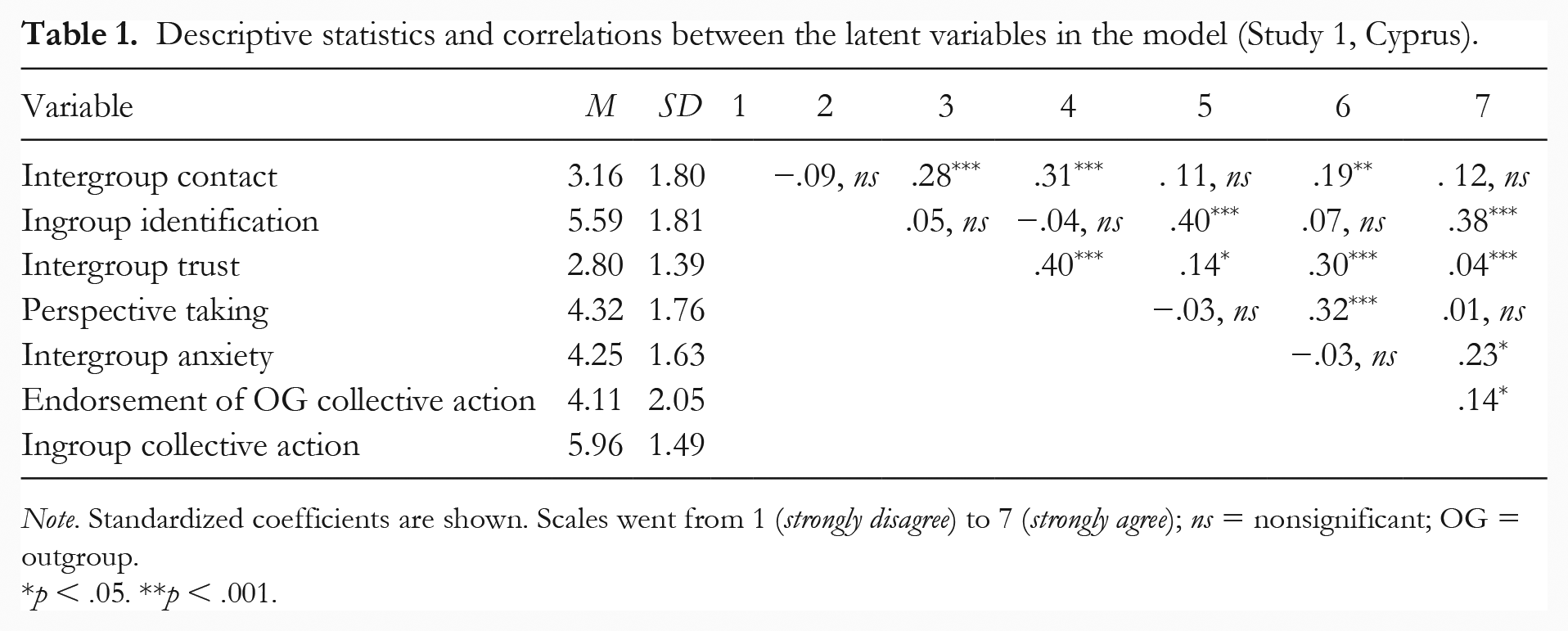
Note. Standardized coefficients are shown. Scales went from 1 (strongly disagree) to 7 (strongly agree); ns = nonsignificant; OG = outgroup.
p < .05. **p < .001.
Our model (Figure 1) explained 23% and 17% of the variance in endorsement of social change attempts by the Turkish outgroup and in Turkish Cypriot ingroup collective action, respectively. In addition, the model accounted for 32% of the variance in intergroup trust, 8% of the variance in perspective-taking, and 25% of the variance in intergroup anxiety.
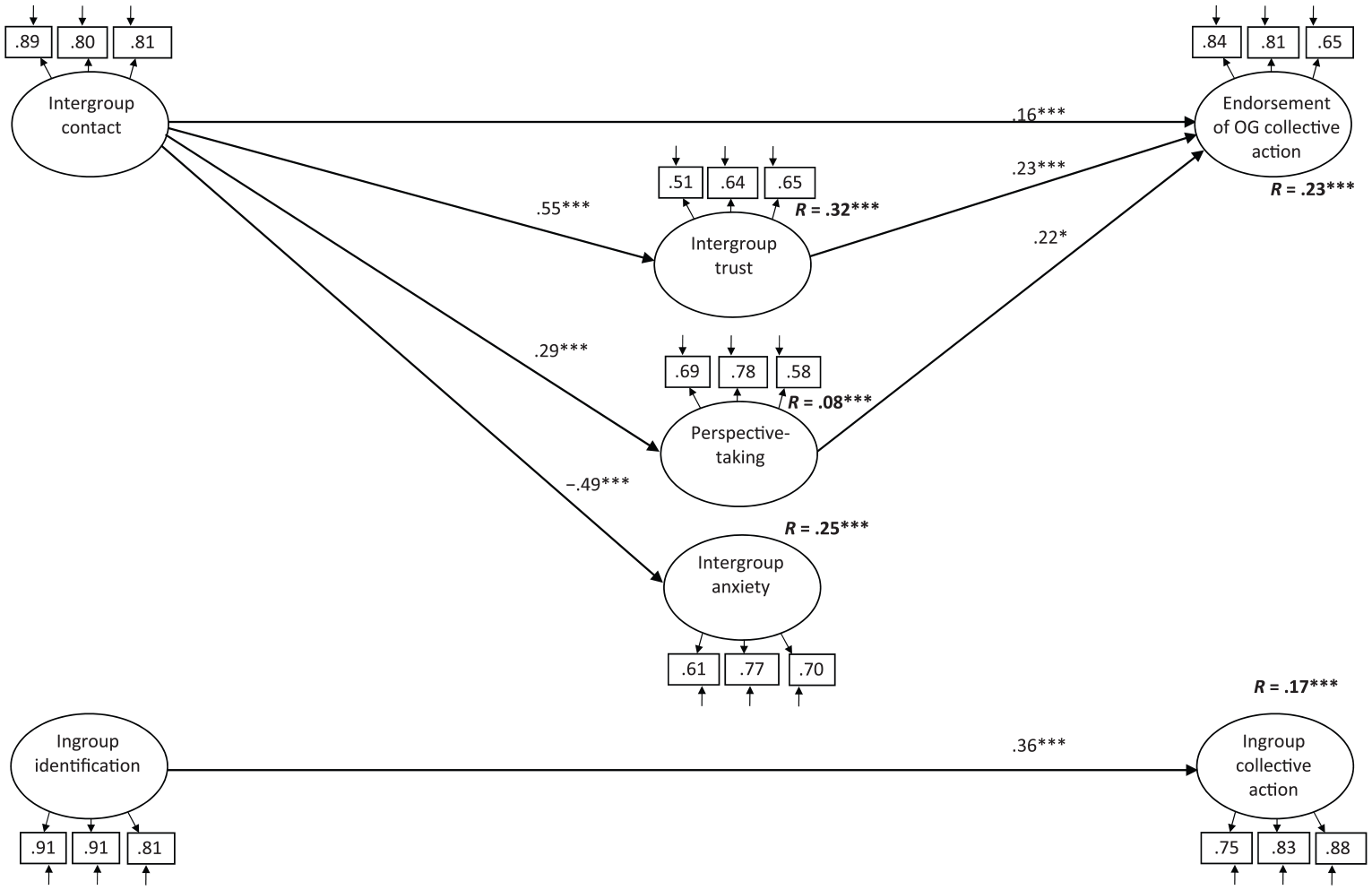
Model showing contact and ingroup identification predicting support for disadvantaged outgroup collective action and ingroup collective action among Turkish Cypriots (N = 336; Study 1).
Contact positively predicted endorsement of the Turkish outgroup’s collective action directly (β = .16, p < .05), and indirectly via intergroup trust (point estimate [PE] = .12, 95% CI [0.006, 0.255]) and perspective-taking (PE = .07, 99% CI [0.016, 0.144]). Contrary to our expectations, ingroup identification as Turkish Cypriot was positively associated (β = .36, p < .001) with intentions to engage in collective action for the Turkish Cypriot ingroup only. These results provided only partial support for our hypotheses. 1
Discussion
Results partially supported the positive effects of contact on social change directly, and indirectly via increased intergroup trust and perspective-taking. To the extent that Turkish Cypriots had more contact with disadvantaged Turkish immigrants, they trusted the outgroup more and they took the perspective of the Turkish immigrants more. In turn, both intergroup trust and perspective-taking were associated with stronger endorsement of the social change attempts of the disadvantaged Turkish outgroup. We found a direct positive association between ingroup identification as Turkish Cypriot and collective action tendencies in favour of the ingroup, but there was no evidence of the negative indirect effects of ingroup identification on social change via trust, perspective-taking, or anxiety. This evidence shows that contact increases attitudinal support for social change benefitting the disadvantaged outgroup by increasing trust and perspective-taking, and it is not related to ingroup collective action, at least among Turkish Cypriots. We sought to replicate these findings in a more conflictual setting, in the context of Romanian–Hungarian intergroup relations in Romania.
Study 2
Method
Participants
One hundred and ninety-seven (125 female; Mage = 20.75, SD = 3.92) participants studying at a university in Transylvania, Romania were recruited on a voluntary basis by a Romanian research assistant to participate in a survey on political issues in Transylvania. After agreeing, all participants completed a paper-and-pencil questionnaire.
Measures
We used the same items as in Study 1 to measure our variables but had to adjust the scale measuring endorsement of outgroup’s social change motivations. The reliability value for the initial three-item scale was below the accepted threshold (α = .53), so we dropped the item “Hungarians are right to vote for a candidate who would improve the current situation of Hungarians in Transylvania, Romania” and used the remaining two items (r = .78, p < .001). All the other measures demonstrated good to excellent reliability (intergroup contact: α = .81; ingroup identification as Romanian: α = .89; intergroup trust: α = .86; perspective-taking: α = .79; anxiety: α = .82; collective action for the Romanian ingroup: α = .77).
Results and Discussion
Model construction
As in Study 1, we tested our model via a structural equation modelling approach in Mplus (Muthén & Muthén, 2008a, 2008b), which showed that our items loaded onto their respective latent variables satisfactorily (above .50), with an excellent model fit (χ2 = 170.73, p = .052, df = 146, CFI = .99, RMSEA = .023, SRMR = .041).
Hypothesis testing
We report the descriptive statistics and zero-order correlations between our variables in the model in Table 2. Means of all our variables except intergroup contact and perspective-taking were above the scale midpoint (4), and all our variables correlated in the expected direction except for intergroup trust and ingroup-oriented collective action. Given its small magnitude, it is highly likely that this is a spurious association.
Descriptive statistics and correlations between the latent variables in the model (Study 2, Romania).

Note. Standardized coefficients are shown. Scales went from 1 (strongly disagree) to 7 (strongly agree); ns = nonsignificant; OG = outgroup.
p < .05. **p < .001.
Our model (Figure 2) explained 32% of the variance in endorsement of social change attempts of the disadvantaged Hungarian outgroup, 17% of the variance in Romanian ingroup collective action, 17% of the variance in intergroup trust, 24% of the variance in perspective-taking, and 14% of the variance in intergroup anxiety.

Model showing contact and ingroup identification predicting support for disadvantaged outgroup collective action and ingroup collective action among Romanians (N = 197; Study 2).
Unlike in Study 1, intergroup contact was not directly associated with endorsement of the disadvantaged Hungarian outgroup’s social change motivations. It only had an indirect positive effect on endorsement of social change attempts via increased intergroup trust (PE = .11, 99% CI [0.001, 0.276]), increased perspective-taking (PE = .12, 99% CI [0.005, 0.249]), and reduced anxiety (PE = .08, 95% CI [0.006, 0.185]), whereas ingroup identification had a negative indirect effect on endorsement of outgroup’s social change attempts (PE = −.07, 95% CI [−0.179, −.007]) via intergroup anxiety. 2
Discussion
Overall, results supported the positive effects of contact on social change via both positive and negative affective mediators. To the extent that Romanians had more contact with the disadvantaged Hungarian outgroup, they reported increased levels of intergroup trust and perspective-taking and decreased intergroup anxiety. In turn, intergroup trust and perspective-taking were positively, while intergroup anxiety was negatively, associated with endorsement of outgroup collective action. Contrary to Study 1, however, we found evidence in favour of the positive link between ingroup identification and intergroup anxiety, which, in turn, was associated with less endorsement of the disadvantaged outgroup’s social change attempts. In the absence of more conclusive evidence, we can only speculate that the effect of ingroup identification on endorsement of outgroup’s social change attempts might be due to the conflictual nature of the intergroup relations between the two groups. We sought to address these issues and replicate our findings in a relatively more conflictual intergroup context in Israel.
Study 3
Method
Participants
We recruited 240 (137 female; Mage = 23.29, SD = 5.67) participants on a voluntary basis at a public university in Israel. All participants were approached by a Jewish research assistant and were invited to participate in a survey on attitudes toward Palestinian citizens of Israel. After consenting, participants were told that the survey measured attitudes toward Palestinians’ willingness to engage in activities aimed at improving their positions in the Israeli society.
Measures
We used the same items and scales to measure our variables as in the previous two studies (contact: α = .92; ingroup identification as Jew: α = .89; perspective-taking: α = .81; anxiety: α = .77; intergroup trust: α = .80; collective action for the Jewish ingroup: α = .79; and endorsement of the Palestinian outgroup’s social change attempts: α = .72).
Results and Discussion
Model construction
As in Studies 1 and 2, we used structural equation modelling, and results showed that our model fit the data well (χ2 = 201.76, p = .024, df = 164, CFI = .98, RMSEA = .031, SRMR = .039), with good factor loadings.
Hypothesis testing
We report the descriptive statistics and zero order correlations in Table 3. Unlike Studies 1 and 2, intergroup contact had little variance, showing that the amount of contact is considerably low.
Descriptive statistics and correlations between the latent variables in the model (Study 3, Israel).
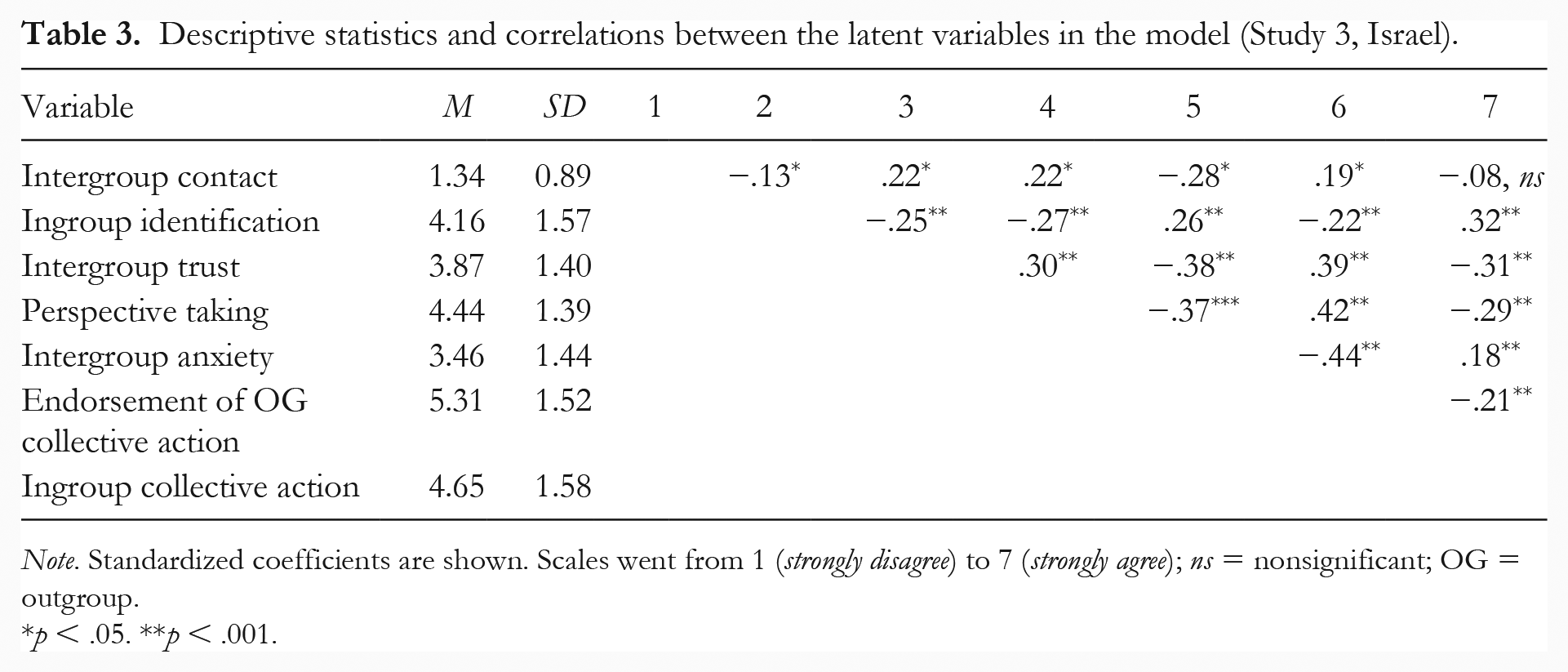
Note. Standardized coefficients are shown. Scales went from 1 (strongly disagree) to 7 (strongly agree); ns = nonsignificant; OG = outgroup.
p < .05. **p < .001.
Our model (see Figure 3) explained 42% of the variance in endorsement of outgroup social change attempts, 22% of the variance in ingroup collective action, 14% of the variance in intergroup trust, 15% of the variance in perspective-taking, and 17 % of the variance in intergroup anxiety.

Model showing contact and ingroup identification predicting support for disadvantaged outgroup’s collective action and ingroup collective action among Israeli Jews (N = 240; Study 3).
Intergroup contact had a positive effect on endorsement of outgroup social change attempts via trust (PE = .06, 99% CI [0.004, 0.186]), perspective-taking (PE = .07, 99% CI [0.013, 0.152]), and intergroup anxiety (PE = .07, 95% CI [0.007, 0.177]). Ingroup identification, on the other hand, was negatively associated with endorsement of outgroup social change attempts via trust (PE = −.11, 99% CI [−0.233, −0.010]), perspective-taking (PE = −.07, 95% CI [−0.171, −0.009]), and anxiety (PE = −.05, 95% CI [−0.136, −0.007]). 3
Discussion
The findings are mostly in line with those from Studies 1 and 2. We replicated the positive effects of contact on attitudinal support for social change motivations of the disadvantaged outgroup via trust, perspective-taking, and anxiety—more contact with the disadvantaged Palestinian outgroup was associated with stronger endorsement of outgroup social change attempts via increased trust, perspective-taking, and decreased intergroup anxiety. Contrary to the earlier findings though, we found a much stronger negative effect of ingroup identification with the Jewish ingroup on social change benefitting the disadvantaged outgroup. The more our participants identified with the Jewish ingroup, the less trust and perspective-taking and the more anxiety they experienced. In fact, results from this study provided the fullest support for the positive effects of contact and negative effects of ingroup identification on social change among the advantaged groups.
General Discussion
Positive contact improves outgroup attitudes and decreases prejudice by increasing intergroup trust (Tam et al., 2009), perspective-taking (Aberson & Mcvean, 2008), and by decreasing intergroup anxiety (Aberson & Haag, 2007; Islam & Hewstone, 1993; Pettigrew & Tropp, 2008), but it can also demotivate disadvantaged group members to engage in collective action (Dixon, Levine, Reicher, & Durrheim, 2012). We investigated the positive effects of contact, via positive and negative affective mediators, on endorsement of social change motivations of the disadvantaged outgroup and ingroup collective action among the advantaged. As hypothesized, more intergroup contact increased individuals’ willingness to endorse outgroup social change attempts, but it did not decrease group members’ willingness to engage in collective action to maintain their advantaged ingroup’s position.
These findings build on existing research on the positive effects of contact on prejudice reduction (Brown & Hewstone, 2005) and provide novel evidence in favour of the energizing effects of contact on social change (Reimer et al., 2017; Selvanathan et al., 2018). First, we show that intergroup contact’s effects on endorsement of disadvantaged groups’ right to engage in action to challenge the status quo are consistently positive in three intergroup contexts. Across three studies, contact with the disadvantaged group was associated with stronger endorsement of the disadvantaged outgroup’ social change attempts both directly (Study 1) and indirectly via trust, perspective-taking, and intergroup anxiety (Studies 1, 2, and 3). Pettigrew (2010) argues that intergroup contact could diminish advantaged groups’ willingness to maintain the structural inequalities against disadvantaged groups on one hand, and it could motivate advantaged group members to recognize the legitimacy of the disadvantaged group’s collective action. Our results provide evidence in favour of the latter.
Second, we show that the role of intergroup contact in motivating advantaged group members to endorse social change attempts among the disadvantaged is not limited to increasing positive affect (Selvanathan et al., 2018). As our findings show, contact also motivates advantaged group members to support social change by decreasing intergroup anxiety.
Third, the results also show that so-called negative effects of contact on collective action (Çakal et al., 2011) do not apply, at least in our data, to advantaged groups. Contact was not associated, directly or indirectly, with decreased willingness to engage in collective action to maintain the status quo. This finding in particular sheds an important light on the intricacies of how contact and collective action relate to each other. The consistent set of findings on the positive effects of intergroup contact on attitudinal support for social motivations of the disadvantaged, and the null effect of contact on ingroup collective action among the advantaged implies that the association between contact and social change is more complex than it was previously suggested by research on the sedative effects of contact (Çakal et al., 2011) on social change. Future research could explore the mechanisms that could motivate advantaged group members to support outgroup collective action while demotivating them from ingroup-serving collective action. Research using direct measures of processes such as collective action by the advantaged group to challenge the status quo in favour of the disadvantaged would be particularly welcome.
Fourth, we replicate and extend previous research by showing that effects of intergroup anxiety on social change are not limited to engaging in solidarity-based collective action to support the disadvantaged outgroup (Brylka et al., 2015). As findings from the third study show, intergroup anxiety could influence social change in alternative ways. Contact with the disadvantaged outgroup might have the positive effect of acknowledging the disadvantaged outgroup’s right to engage in collective action, via reduced anxiety (Studies 2 and 3). Ingroup identification could motivate advantaged group members not to acknowledge the disadvantaged outgroup’s collective action intentions, again, via increased anxiety (Studies 2 and 3) in a violent conflict situation. These findings open up new avenues for research on how contact influences collective action motivations.
Fifth, an interesting finding that emerged from Study 3 is the significant negative correlation between ingroup identification and intergroup contact. Research shows that the effects of contact are stronger and more salient in high-threat and high-conflict contexts (Kokkonen, Esaiasson, & Gilljam, 2016). Earlier research also showed that, through contact, individuals might realize that ingroup norms, customs, and values have no absolute supremacy over the outgroup’s belief systems, and this might lead people to relatively distance themselves from the ingroup, a process labelled as “deprovincialization” (Çakal et al., 2011; Pettigrew, 1998). Thus, in the absence of more robust data, we can only speculate that contact with Palestinians in the high-conflict context of Israel leads to a partial distancing from the Jewish ingroup, as reflected by the negative association between ingroup identification and intergroup contact.
Finally, we also replicate and extend existing research on the predictive power of social identification on collective action intentions (van Zomeren et al., 2008). A qualitative evaluation of the cumulative results from the three studies shows the impact of social identification on social change via different routes. Across three studies, identification with the advantaged ingroup was negatively associated with endorsement of the outgroup’s social change motivations indirectly via increased intergroup anxiety (Studies 2 and 3) and decreased intergroup trust and perspective-taking (Study 3). As for ingroup-oriented collective action, in Study 1, in a relatively nonviolent conflict intergroup context, ingroup identification was directly associated with ingroup-oriented collective action intentions. In Studies 2 and 3, however, stronger identification with the advantaged ingroup was positively associated with ingroup collective action both directly (Studies 2 and 3) and indirectly via anxiety (Study 2), and via trust, perspective-taking, and anxiety (Study 3). Findings from Study 3 suggest that ingroup identification might also motivate collective action via an outgroup-oriented process, such as increased intergroup anxiety or decreased intergroup trust and perspective-taking. Although preliminary, these findings call for future research to investigate the alternative roles that ingroup identification might have in social change. Stronger identification with one’s ingroup might predict decreased support for collective action by the disadvantaged outgroup. Alternatively, it might also predict reactionary collective action to maintain the status quo.
We acknowledge that there are several discrepancies between the findings we report here (Study 1) and previous research. First, inconsistent with earlier research, intergroup anxiety did not mediate the effects of contact and ingroup identification on our outgroup variables in Study 1. Based on findings from Çakal, Hewstone, Güler, and Heath (2016)—which showed that intergroup contact negatively predicted perceived threat, which, in turn, was positively associated with increased willingness to engage in ingroup collective action—it can be hypothesized that intergroup anxiety as a dimension of threat would predict collective action tendencies. We attribute this inconsistency to several differences between our set of studies and Çakal, Hewstone, Güler, and Heath’s (2016). For instance, we did not measure the specific dimensions of threat vis-à-vis intergroup anxiety. Second, our first study was conducted in a relatively nonviolent context. This would mean that anxiety as a perception of threat is not relevant to motivations to engage in collective action. Research shows that in relatively nonviolent, low-threat contexts, individuals have comparatively positive attitudes toward members of the outgroup, and it is difficult for them to become less threatened (Hodson, 2011; Kokkonen et al., 2016). Similarly, conflict-ridden and violent contexts could make the ingroup identity more salient (Schmid & Muldoon, 2015), and a more salient identity could negatively predict support for outgroup collective action and increase willingness to engage in ingroup-serving collective action. An evaluation of the three contexts—a nonviolent one, Cyprus; one with low/past violence, Romania; and a violent one, Israel—shows that, as the level and proximity of the violence increases, intergroup anxiety becomes more relevant to support for outgroup’s social change attempts and ingroup collective action. The increasingly negative association between ingroup identification and trust and perspective-taking on one hand, and the positive association between identification and anxiety in Studies 2 and 3, further corroborate this point.
Although promising, the findings we report should be interpreted with caution. We acknowledge that our measures are less than ideal in terms of measuring direct support for the disadvantaged outgroup’s collective action, and this is reflected in the evidence we provide for our hypotheses. We are aware that agreeing with the measures of attitudinal support for the disadvantaged’s collective action may not amount to actual support for social change. In fact, endorsing the outgroup’s right to challenge the status quo might not even lead to acknowledging the structural disadvantages that the outgroup faces or trigger genuine motivation to change these inequalities on behalf of the disadvantaged group. However, we also think that social change is a multifaceted process that can take many forms and may unfold at a different pace in different contexts (de la Sablonnière, 2017). In conflictual settings, such as the contexts where we conducted our research, social change may be slow paced, and it might be unrealistic to expect advantaged group members to openly support outgroup collective action due to the intensity and recency of the conflict. Thus, we remain firm in our belief that it is still important to understand the processes that lead to attitudinal change, hoping that this change would trigger more direct action.
In a similar vein, we focused on intimate contact with friends and not on the number of friends one might have. Although this might appear less than ideal, meta-analytic research shows that the time spent with outgroup friends has a significantly stronger effect on positive outgroup attitudes than the cumulative effect of number of outgroup friends, proportion of outgroup friends in the friendship circle, closeness, and inclusion of other in the self might have on intergroup attitudes (Davies, Tropp, Aron, Pettigrew, & Wright, 2011). Previous research shows that intimate contact (Herek & Capitanio, 1996), during which parties disclose private details, is more influential than ordinary contact, that is, unstructured and occasional interactions with members of the outgroup in daily life. All in all, although it might be difficult to determine whether the observed effects of contact are due to the intimacy of friendship with a single or with many friends, we argue that they are still reliable. Future research in similar contexts could focus on both the level of intimacy and the quantity of intimate friends to tease apart the effects these two dimensions might have on outgroup attitudes and to provide a more detailed account of these processes.
All our studies are based on cross-sectional data. To address this issue, we tested alternative models and compared our findings to results from previous experimental and longitudinal research. Yet, claims of causality between our variables require further confirmation.
We employed student data in Studies 2 and 3. Past research has shown that findings from studies using students as research participants show variability and therefore may not be reliable (Peterson & Merunka, 2014). It might be the case that our findings are limited by students’ experiences that reflect the current political climate in the respective campuses. However, both studies were conducted in contexts with a history of conflict with occasional concentration of the outgroup (see the comparatively lower levels of contact in these studies). Moreover, given the level of conflict in these contexts, recruitment of adults from the general population is difficult. We operationalized our outcome variables as attitudes and intentions. Conducting research on collective action in conflictual settings is perceived as suspicious and even inflammatory. Given that we focused on contested issues, questions on political attitudes and mobilization including behavioural measures would very likely have had consequences both for the participants and the researchers (Cohen & Arieli, 2011; Goodhand, 2000).
Substantial amount of research on reasoned behaviour and planned action (Ajzen, 1991; Ajzen & Fishbein, 1980) shows that attitudes and intentions are two strong antecedents of behaviour. Attitudes predict intentions, which in turn predict actual behaviour. In other words, individuals form intentions to engage in behaviour on the basis of their attitudes toward that behaviour. The more positive attitudes they have, the stronger their intentions. Intentions are expressed motivations to perform a particular behaviour. In fact, in a meta-analysis of 96 datasets (N = 22,594), attitudes and intentions emerged as the strongest antecedents of behaviour even after controlling for past behaviour and perceived behavioural control (Albarracin, Johnson, Fishbein, & Mullerleile, 2001). Given the conflictual and politically sensitive nature of the intergroup relations across all three contexts, attitudes and intentions provide an optimal approximation of the actual behaviour without incitement. This, we believe, provides additional confidence in our findings.
Conclusion
Research on how intergroup contact influences social change has predominantly focused on the sedative effects of intergroup contact among disadvantaged groups. As our findings suggest, however, contact effects do not operate as a single-group, single-direction process. Social psychological research needs to move away from this narrow approach towards a more inclusive research agenda. Research exploring how and when intergroup contact motivates advantaged groups to engage in collective action on behalf of disadvantaged outgroups—outgroup-oriented collective action—would be particularly welcome. Similarly, researchers should move beyond the conventional Western student samples toward more conflict-ridden contexts and nonstudent samples. This would broaden our understanding of social change in terms of contextual and individual-level variables.
