




Abstract
In real-world intergroup conflict, not all in-group members are equally threatened by the out-group. Yet, the impact of intragroup payoff asymmetry on the inclination to mutually cooperate during intergroup conflict and therefore to protect against out-group attacks, i.e., the “conflict-cooperation effect,” has not been investigated so far. In Study 1, we replicate previous research by using a novel experimental game paradigm, showing increased intragroup cooperation in the presence (vs. absence) of out-group threat under intragroup payoff symmetry. In Study 2, we find a conflict-cooperation effect among group members who are threatened (victims) as well as among group members who are not threatened (helpers) by the out-group. Intragroup cohesiveness, i.e., perceived closeness among in-group members, mediates the conflict-cooperation effect, particularly among selfishly-oriented individuals. Our results support the notion that intergroup conflict may have favored the evolutionary adaption of intragroup cooperation even when the in-group members were asymmetrically threatened by intergroup conflict.
Human intergroup conflict is a widespread phenomenon with large-scale detrimental consequences. Every year, about 100,000 people die in violent intergroup conflict worldwide (UCDP, 2017). Moreover, threats from intergroup violence lead to mass migration, with about 1.3 million people seeking refuge in 2015 alone (UNHCR, 2016).
Despite its detrimental consequences on the collective level, intergroup conflict can also foster positive relations within groups by increasing intragroup trust and cooperation (e.g., Bauer et al., 2016; Benard & Doan, 2011). We will refer to this increased inclination toward intragroup cooperation during intergroup conflict as the conflict-cooperation effect. 1 The conflict-cooperation effect is well supported by field research across different cultures and various conflict situations. For instance, case studies on the civil war in Sierra Leone showed high levels of cooperation in communities who were targeted by rebels (Bauer et al., 2016). In addition, the effect has been demonstrated in controlled lab experiments (Baron, 2001; Bornstein & Ben-Yossef, 1994; Probst et al., 1999).
Previous experimental research on the conflict-cooperation effect assumed symmetry/homogeneity among the members within the conflicting groups (Baron, 2001; Bornstein & Ben-Yossef, 1994; Probst et al., 1999). That is, the in-group members were modeled to face the same costs and benefits in intergroup conflict. In reality, however, intergroup conflict often involves asymmetries between in-group members, particularly regarding the degree to which group members are affected by the intergroup conflict (e.g., Plümper & Neumayer, 2006). For instance, people who live close to the conflict border are more likely to be in danger than people who live in areas more distant from the actual conflict (Keegan, 2011). In a similar vein, in-group members who have more private resources can ensure their safety better than people with fewer resources. However, there is little experimental research on how such asymmetries affect in-group members’ willingness to cooperate in the face of intergroup conflict. In this article, we will address this gap in the literature by investigating the impact of in-group members’ asymmetric payoffs on the conflict-cooperation effect, and we explore whether group members whose payoffs are (vs. are not) affected by intergroup conflict differ in their inclination to cooperate with their in-group members.
The conflict-cooperation effect
Intergroup conflict induces a threat to the members of the conflicting groups. Such (joint) threats are likely to enhance the perceived level of positive interdependence among in-group members (Kelley & Thibaut, 1978; Rusbult & Van Lange, 2003). Similarly, it has been suggested that intergroup conflict increases cohesion and social identification among group members (Benard & Doan, 2011; Bornstein, 2003; Bornstein & Ben-Yossef, 1994; Campbell, 1965). As a consequence, group members might assign more value to the in-group’s interest, which in turn decreases individual free-riding and increases intragroup cooperation (Halevy et al., 2012; Kelley et al., 2003; Rusbult et al., 2004; Van Lange & Rusbult, 2012; for a similar line of reasoning, see Bornstein, 2003).
There are few studies that provide a direct test of the conflict-cooperation effect by comparing the level of intragroup cooperation in the presence vs. absence of an intergroup conflict/threat. Most prominently, Bornstein and Ben-Yossef (1994) found an increase of contributions to a public good that served the in-group’s interest in the presence of an intergroup conflict compared to a no-conflict setting with the same monetary incentives. Moreover, participants indicated that they were less concerned about their own earnings and more concerned about the in-group’s earnings, both significantly correlated with intragroup cooperation. This is in line with the notion that intergroup conflict makes in-group members feel more similar, which increases the chance that they think cooperation is in their own interest, even when it is not from a selfish-rational perspective (Baron, 1997, 2001).
Another study by Probst et al. (1999) showed that the conflict-cooperation effect might be affected by people’s cultural values. One key finding is that “vertical individualists”, i.e., individuals who view people as independent and autonomous, consider inequality to be part of life, and value competition (Shavitt et al., 2006; Singelis et al., 1995), predominately cooperate in an intergroup conflict setting compared to a no-conflict setting. The authors explained this difference by the competition element in the conflict setting, which motivates vertical individualists to cooperate (i.e., in-group cooperation was necessary to compete with the out-group). This suggests that there might be interindividual differences, e.g., regarding social preferences, in how people react to intergroup conflict.
Moreover, Weisel and Zultan (2016) showed that intergroup inequalities (i.e., attacking group vs. victim group) and the way the game is framed (i.e., manipulating the perceived target of threat: individual vs. group) could also affect the conflict-cooperation effect. For instance, members of a victim group, who defend the group against an attacking out-group, cooperated more when the perceived target of threat was framed in terms of the group (i.e., the actions and payoffs in the game were shown at the group level) rather than of the individual (i.e., the actions and payoffs in the game were shown at the individual level). Moreover, it was also found that interindividual differences matter. In detail, prosocials (i.e., people who value equality and/or social welfare) cooperated more during conflict (compared to no-conflict) when the perceived target of threat was framed in terms of the group.
Altogether, these findings support the existence of the conflict-cooperation effect under experimentally controlled conditions. Moreover, they suggest that social preferences, i.e., the degree to which people consider their own welfare relative to another person’s welfare, could moderate the conflict-cooperation effect. Social preferences are often operationalized in psychological research via individuals’ Social Value Orientation, which has been shown to be an important predictor of prosocial behavior (SVO; Murphy et al., 2011; for a meta-analysis on SVO and prosociality, see Balliet et al., 2009). However, regarding the relationship between SVO and engagement in intergroup conflict, previous research showed mixed findings (De Dreu et al., 2014; Thielmann & Böhm, 2016). Some studies suggest that prosocials are more inclined to engage in intergroup conflict (Aaldering et al., 2013; Abbink et al., 2012). Others suggest that prosocials not only value the welfare of their own group but also the welfare of people in general and should, therefore, be less inclined to engage in intergroup conflict (Aaldering & Böhm, 2020; McClintock, 1972; Thielmann & Böhm, 2016; Van Lange, 1999). Therefore, it is an exploratory aim of our research to investigate how interindividual differences in individuals’ SVO relate to the conflict-cohesion effect, under both payoff symmetry and asymmetry.
Intragroup asymmetry and cooperation
In real-world intragroup interactions, asymmetry may have various forms, such as inequality in power, opportunities, resources, and many more. Intragroup inequality may affect cooperation behavior within groups. For example, a greater level of income inequality in developing countries has been shown to be negatively associated with cooperative behavior (for a meta-analysis, see Rosenbaum et al., 2016).
To better understand the causal effects of intragroup asymmetry on intragroup cooperation, previous research has conducted controlled laboratory experiments using various economic games (e.g., Public Good Game, Prisoner’s Dilemma Game, Common-Pool Resource Dilemma; Dawes, 1980; Kollock, 1998). What these games have in common is that people need to decide whether they want to cooperate or to defect. Mutual cooperation leads to the highest collective outcome, but defection leads to the highest individual outcome. If all players mutually defect, however, this leads to the lowest collective outcome, and all players would be better off by mutually cooperating. There are several ways of inducing asymmetries between players in such games. These include: differences in fixed payments for participating in the experiment (e.g., Anderson et al., 2008), differences in the starting amount players receive within the game (i.e., endowment asymmetry; e.g., Cherry et al., 2005), as well as differences in players’ costs and benefits of cooperation (e.g., Tan, 2008). Overall, these experiments show that asymmetry can significantly affect players’ willingness to cooperate (for reviews, see Ledyard, 1995; Van Lange et al., 2013). For instance, regarding the effect of endowment asymmetry, some studies indicate that it negatively affects overall cooperation (Aquino et al., 1992; Cherry et al., 2005; Ostrom et al., 1994; Van Dijk et al., 2002), whereas others show that it does not affect cooperation or even fosters it (Buckley & Croson, 2006; Chan et al., 1996, 1999). Regarding the effect of asymmetry in the cost of cooperation, it has been shown that this can negatively affect overall cooperation compared to a symmetrical setting with the same average individual costs of cooperation (Tan, 2008). In sum, intragroup asymmetry may considerably affect individuals’ proneness to engage in intragroup cooperation. Although several studies conclude that the effect on intragroup cooperation is negative, this may depend on the exact context in which the effect of asymmetry is investigated and how it is operationalized.
Although it is well established that (i) intergroup conflict fosters intragroup cooperation and (ii) intragroup asymmetry can significantly affect intragroup cooperation, less is known about the interplay of these factors. Despite its prominence in real-world settings, to our knowledge, there is no experimental research that has investigated the effects of intragroup asymmetry in the presence vs. absence of intergroup conflict. Quasi-experimental and field research indicates that people who are directly affected by violence during conflict tend to be more cooperative/prosocial than people who are not directly affected (e.g., Bauer et al., 2014; Bellows & Miguel, 2009; Stage & Uwera, 2018; Voors et al., 2012). This is in line with the assumption that group members who are directly attacked usually benefit more from cooperating with their in-group members (i.e., winning the conflict will be a greater relief for those who are more affected). It also corresponds with research on public good games, which shows that people tend to cooperate more when having more to gain by doing so (e.g., Böhm & Rockenbach, 2013; Fisher et al., 1995; Isaac & Walker, 1988; Marwell & Ames, 1979).
Yet, there is also research on helping behavior showing that people are willing to help similar others with whom they share a (probabilistic) common threat, even when they themselves are not affected (Batson et al., 1979). Moreover, there are numerous real-life examples of situations in which those who are not directly affected themselves by the conflict provide help. For example, there was a significant increase in helping behavior (e.g., blood donations) after the terrorist attacks of September 11, 2001 (Becker & Galloro, 2001; Glynn et al., 2003).
To summarize, there is some research indirectly suggesting that the conflict-cooperation effect might be hampered under intragroup asymmetry regarding the out-group threat, whereas other research suggests that intergroup conflict increases intragroup cooperation even when in-group members are affected differently in intergroup conflict. We devise a novel economic game paradigm to provide a direct test of these predictions.
The present research
Previous studies on the conflict-cooperation effect utilized complex multiplayer game paradigms (N-person games), in which they contrasted two experimental settings: two groups either interacted independently of each other (no-conflict condition) vs. the payoffs of both groups were negatively interdependent (conflict condition; e.g., Bornstein & Ben-Yossef, 1994). Here we devise a novel and more simple experimental game paradigm to ease the manipulation of symmetric vs. asymmetric payoffs in intergroup conflict.
In its basic form, the paradigm consists of two games to model the no-conflict vs. conflict setting: the no-conflict setting is implemented by using a two-player Prisoner’s Dilemma Game (PDG; Poundstone, 1993); the conflict setting is implemented using a modified three-player version of the PDG, called the Enemy Game (EG).
In the PDG (see Figure 1A), two players need to decide independently of each other whether they want to cooperate (X) or to defect (Y). If both players cooperate, they maximize the social welfare (highest joint outcome; i.e., “reward” for cooperation R); if both players defect, they minimize social welfare (lowest joint outcome; i.e., “punishment” for not cooperating P); if one player cooperates and the other defects, the cooperator receives the lowest possible personal outcome (i.e., “sucker’s payoff” S) and the defector receives the highest possible personal outcome (i.e., “temptation” to not cooperate T). This results in the following relationship of payoffs: T > R > P > S. Accordingly, each player is better off by defecting, irrespective of how the other player decides, whereas mutual cooperation maximizes the joint outcome.
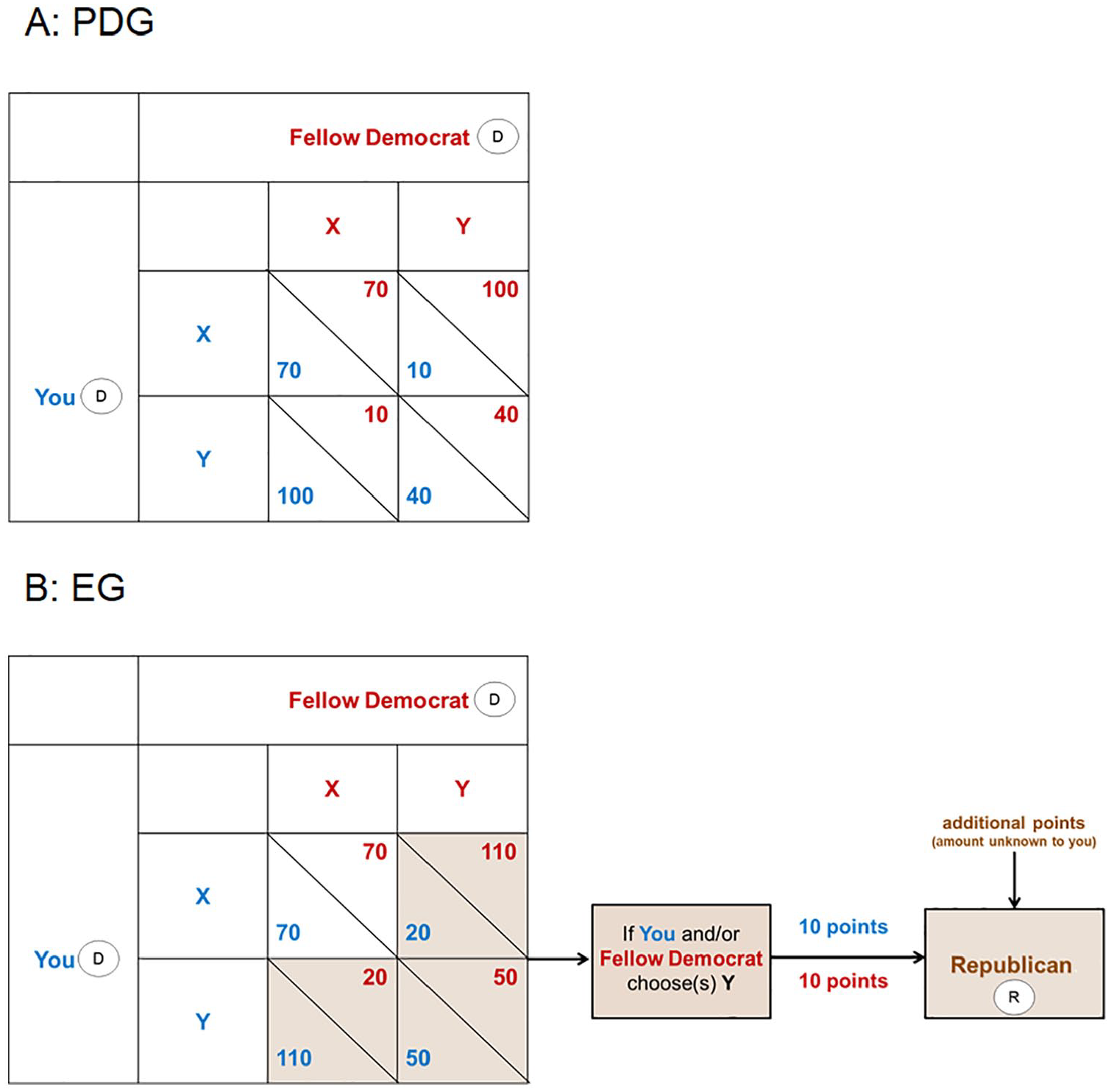
Prisoner’s Dilemma Game (PDG; panel A) and Enemy Game (EG; panel B) as implemented in Study 1 (group identity salience condition).
To model conflict, there is a third player in the EG (i.e., “the enemy”; see Figure 1B). The enemy will always take some of the payoff from each of the two players if they fail to mutually cooperate. Importantly, considering the influence of the enemy, both games have the same payoff matrix. More specifically, if we subtract the payoff that the enemy gets in the EG when the other players are not mutually cooperating, the payoffs for cooperating and defecting in the PDG and EG are equivalent (i.e., cooperator’s gain (R–P), greed (T–R), and fear (P–S); for a detailed explanation of the different motivations in the PDG, see Ahn et al., 2001). Hence, from a game-theoretical perspective, both games yield equal incentives, i.e., mutual defection is the unique Nash equilibrium (Nash, 1951). As such, a comparison of the behavior in the PDG vs. EG yields a motivational conflict-cooperation effect in the presence of equal monetary incentives. Further, to prevent inequality concerns about the enemy, an additional payoff is given to the enemy (with the exact amount unknown to the other players) that is irrespective of the other players’ strategy. Note that the behavior of the enemy is fixed. This is done to eliminate uncertainty about the enemy’s behavior.
The aim of Study 1 was to replicate the conflict-cooperation effect using this novel game paradigm. In Study 2, we introduced intragroup asymmetry to investigate its impact on the conflict-cooperation effect.
Study 1
We conducted an online experiment to validate our game paradigm, aiming to replicate the standard conflict-cooperation effect under intragroup payoff symmetry. We varied whether participants played the PDG or the EG (see Figure 1). The k-index of both games was 0.33
Additionally, we adopted another experimental factor, where we varied whether players were referred to by their personal identity or by their group identity based on a natural group membership. The purpose of this additional factor was to test whether intergroup conflict is necessary to elicit the conflict-cooperation effect (group identity salience) or whether the game structure itself is (partly) responsible for the increased cooperation in the face of a common threat (personal identity salience). In the personal identity salience condition, the players were referred to as “You,”, “Player 2,” and the enemy as “Player 3” (for an example, see the instructions of Study 1 in the Supplementary Materials). In the group identity salience condition, partner players shared the same self-indicated political orientation (either both Democrats or both Republicans (see Figure 1), and the enemy was a member of the opposing (out-)group.
Hypotheses
In line with previous research on the conflict-cooperation effect (Baron, 1997, 2001; Bornstein & Ben-Yossef, 1994; Probst et al., 1999), we expected that intragroup cooperation increases in the face of intergroup conflict (i.e., cooperation (EG) > cooperation (PDG)) when group identity is salient (Hypothesis 1). The personal identity salience condition serves as a control condition to explore whether conflict also increases cooperation in the absence of a salient group identity.
As shown in previous research, interindividual differences matter in intergroup conflict (De Dreu, 2010; Probst et al., 1999; Thielmann & Böhm, 2016; Weisel & Zultan, 2016). Therefore, we assessed interindividual differences in social preferences, operationalized via individuals’ Social Value Orientation (SVO; Murphy et al., 2011). Based on meta-analytical evidence (Balliet et al., 2009), we expected that SVO would lead to overall more cooperation (Hypothesis 2). We also aimed to explore a potential interaction between SVO and the conflict-cooperation effect.
In addition, we measured the perceived cohesiveness between the interacting partners. As such, we explored the potential mediating role of perceived cohesiveness for the conflict-cooperation effect.
Materials and methods
Participants and design
An a priori power analysis advised 379 participants for sufficient test power (1 – β = .80, given α = .05) to detect a small-sized effect (OR = 1.68) in a binary logistic regression. Since we use a two-factorial between-subjects design, we multiplied this number by two. We recruited N = 768 (360 females) participants via the online crowdsourcing platform Prolific Academic. 2 The age of the participants ranged from 18 to 73 years (Mdn = 29). The study was administered with the online survey software Unipark (Questback GmbH, 2016). We adopted a 2 (game: PDG vs. EG) × 2 (identity salience: group vs. personal) between-subjects design.
Measures
Social Value Orientation (SVO)
To assess participants’ social preferences, we used the SVO slider measure (Murphy et al., 2011). Here, participants need to choose between 9 predefined point distributions that allocate points between themselves and a random other participant. The options differ in the amount they provide to the other participant, maximizing equality and/or efficiency of distributions. Participants were informed that one of six decisions would be randomly selected to become payoff-relevant (given they were later selected for the bonus payment). This could either be one of their own decisions (as a sender) or one of the decisions of another participant to whom they were randomly matched (as a receiver). They could earn between 15 and 100 points.
Based on participants’ responses to six items with varying allocation vectors, a continuous variable (i.e., the SVO angle) can be calculated that ranges from –16.26° to 61.39° (a higher value indicating a greater level of prosociality). It is also possible to categorize individuals as “prosocial” (22.45° to 61.39°; i.e., participants who value both their own and others’ welfare or even value others’ welfare more than their own) or as “proself” (–16.26° to 22.45°; i.e., participants who mainly value their own welfare and neglect or even devalue others’ welfare). The mean SVO angle was M = 26.21°, SD = 14.31° (505 prosocials and 263 proselfs). Note that we use the continuous SVO angle for all the analyses; the dichotomous categorization is only used for the descriptive statistics.
Perceived cohesiveness
We measured cohesiveness by asking participants how much they agreed with the following three statements: “I feel close to player 2.”, “You and player 2 are opponents.” (reversed recoded), “You and player 2 are allies.”; 7-point Likert-type scale (not at all; to a very large degree). In the identity salience condition, the wording of the items was adjusted according to participants’ political orientation. The internal consistency of the measure was sufficient (Cronbach’s α = .73).
Procedure
Participants were given an overview of the study and were informed that they would receive a fixed payment of £1/1.30, 3 with a 25% chance of receiving an additional bonus payment (max. £2) based on their decisions and the accumulated payoff during the study (i.e., SVO slider measure and the economic game; conversion rate: 1 point = £0.01). In addition, they were informed that they would be excluded from the study and all the payments if they should fail to correctly answer the instructional manipulation checks (IMC; Oppenheimer et al., 2009; see Supplementary Materials). After that, all participants provided informed consent. In the group identity salience condition, participants were also asked to state their political affiliation (i.e., Democrat, Republican, no/other political affiliation). In the case that they indicated “no/other political orientation,” they were excluded from the study. Next, all participants completed the Social Value Orientation (SVO) slider measure. Following this, the first IMC item was administered, which was followed by the PDG or the EG, including several comprehension questions to make sure they correctly understood the game structure (see Supplementary Materials for instructions and comprehension questions). Participants then completed the perceived cohesiveness measures and some behavioral motivation measures (see Supplementary Materials), followed by another IMC item and demographics.
Results
Table 1 displays the mean level of cooperation by experimental condition and SVO. The logistic regression in Model 1 (Table 2) predicts cooperation by game (PDG vs. EG), identity salience (group vs. personal identity salience), and the respective interaction term. We found a main effect of identity salience, indicating that a salient group identity leads to more cooperation with the in-group member compared to cooperation with a neutral player under salient personal identity. We also found a significant interaction effect of game and group identity. Cooperation was larger in the EG than in the PDG, but only when the group identity was salient. Hence, supporting Hypothesis 1, we provide evidence for a conflict-cooperation effect. In the personal identity condition, a mutual threat from another person did not increase cooperation, despite the same payoff structure and incentives.
Proportion of cooperators by experimental condition and SVO in Study 1.

Note. Standard deviations are shown in parentheses.
Regression models predicting cooperation in Study 1.
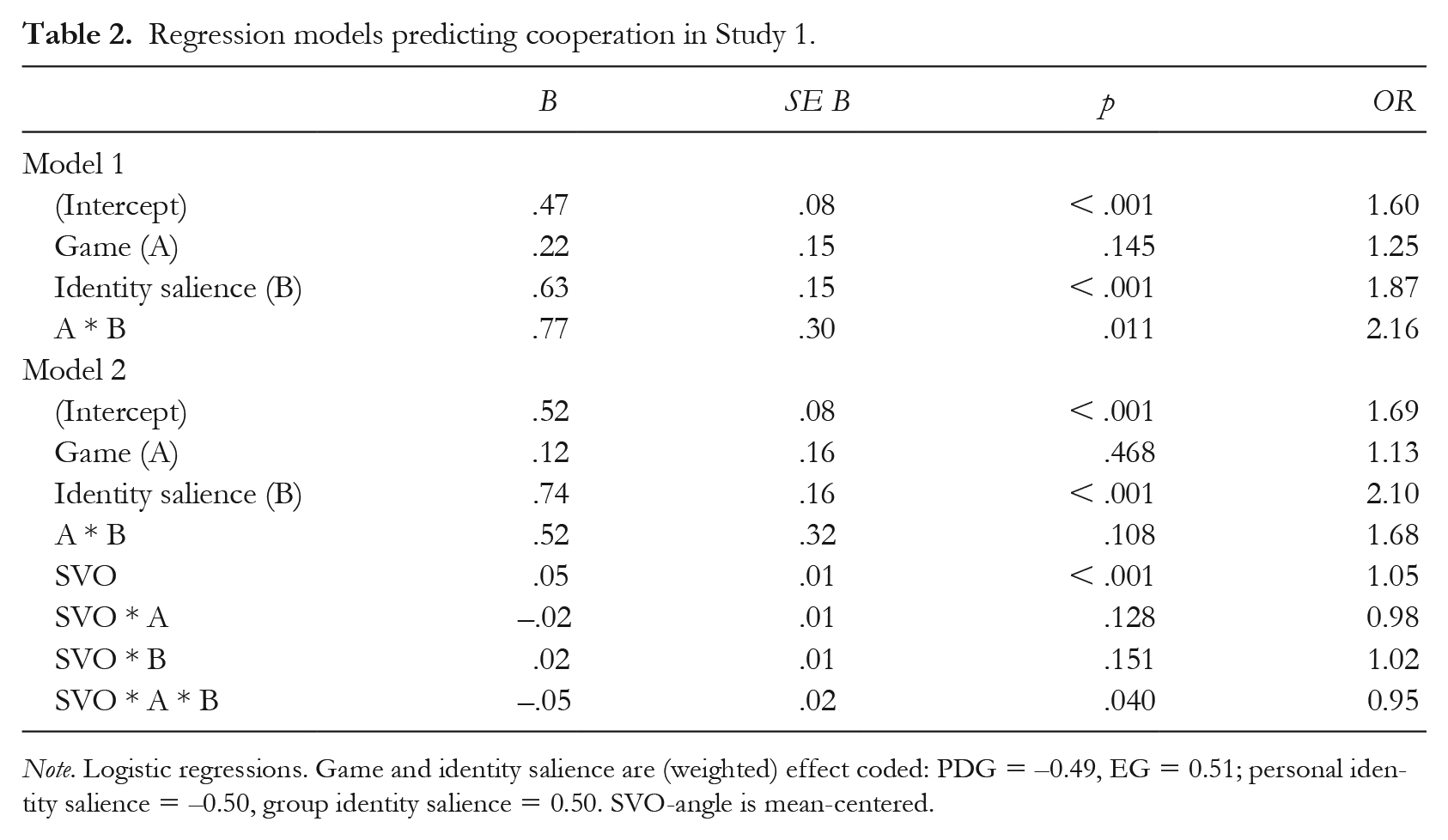
Note. Logistic regressions. Game and identity salience are (weighted) effect coded: PDG = –0.49, EG = 0.51; personal identity salience = –0.50, group identity salience = 0.50. SVO-angle is mean-centered.
In Model 2, SVO (mean-centered) and its interaction terms with the other factors are added as predictors (including the three-way interaction). Supporting Hypothesis 2, there was a significant main effect of SVO, indicating that a higher level of prosociality increased cooperation. Moreover, we found a significant three-way interaction between game, identity salience, and SVO. As evident from the mean cooperation rates presented in Table 1, prosocials were more cooperative under a salient group identity (irrespective of the game they played) compared to a salient personal identity. In contrast, proselfs only increased their cooperation when the group identity was salient and when they faced a conflicting threat from the out-group.
Mediation analyses
To test whether perceived cohesiveness potentially mediates the conflict-cooperation effect observed in the group identity salience condition, we performed a mediation analysis on this subset of the data. Indeed, we find a significant indirect effect of game on cooperation through cohesiveness, B = 0.36, SE = 0.12, 95% CI = [0.14, 0.63] (see Hayes, 2013). 4 We find no direct effect of game (controlling for cohesiveness): B = 0.36, SE = 0.25, 95% CI = [–0.13, 0.84], indicating that the conflict-cooperation effect mainly operated through increased perceived cohesiveness.
Additionally, we performed a moderated mediation analysis for the group identity salience condition to test whether increased levels of perceived cohesiveness also account for the higher level of cooperation among proselfs in the face of an out-group threat. We found weak evidence that the indirect effect of game on cooperation through cohesiveness was moderated by SVO (index of moderated mediation): B = –0.01, SE = 0.01, 95% CI = [–0.03, 0.00], 90% CI = [–0.03, < –0.01] (see Hayes, 2015). To examine the direct and indirect effects separately for prosocials and proselfs, we used –1 SD and +1 SD of the mean SVO angle as conditional values. We found a significant indirect effect for the participants with relatively low SVO values, B = 0.41, SE = 0.16, 95% CI = [0.12, 0.76] and a significant direct effect of game, B = 0.71, SE = 0.34, 95% CI = [0.04, 1.38], indicating that the conflict-cooperation effect among proselfs was partially mediated by increased levels of perceived cohesiveness. For participants with relatively high SVO values, there was no significant mediation by cohesiveness, B = 0.06, SE = 0.12, 95% CI = [–0.18, 0.31], and no direct effect of game, B = –0.23, SE = 0.39, 95% CI = [–1.00, 0.54].
Discussion
In line with previous research (Baron, 2001; Bornstein & Ben-Yossef, 1994; Probst et al., 1999) and supporting Hypothesis 1, we found a conflict-cooperation effect if group identity was salient. Given that we did not find the effect in the personal identity salience condition, we can exclude the possibility that the game structure itself, i.e., the perceived threat from a third party, is sufficient to elicit the conflict-cooperation effect. In fact, it appears that cooperation only increases when in-group members face a common threat from an out-group member.
We also found a main effect of identity salience, indicating that a salient group identity leads to more cooperation with an in-group member compared to cooperation with another individual under personal identity salience (e.g., Brewer & Kramer, 1986; Kramer & Brewer, 1984). Participants higher in prosociality (prosocials) were more likely to increase cooperation in interaction with in-group members. This may also explain why they did not further increase cooperation in the face of an intergroup conflict, i.e., a ceiling effect. Importantly, however, individuals with little concern for others’ welfare (proselfs) increased their cooperation considerably when facing a threat from an out-group member. Additionally, we found that increased levels of perceived cohesiveness with the interaction partner (partially) account for the conflict-cooperation effect.
Overall, Study 1 supports the appropriateness of our novel economic game paradigm to detect the conflict-cooperation effect. We conducted another study to answer our main research questions, i.e., whether the conflict-cooperation effect also applies when there is payoff asymmetry between in-group members. To increase the sensitivity of our dependent variable (and therefore the test power), we used a repeated measurement of cooperation (see also Bornstein & Ben-Yossef, 1994).
Study 2
The aim of Study 2 was to investigate the impact of in-group members’ asymmetric payoffs on the conflict-cooperation effect and to explore whether those group members whose payoffs are (vs. are not) affected by intergroup conflict differ in their cooperation behavior. To model asymmetry, we utilized our novel economic game paradigm: the out-group player (“enemy”) only attacks one of the two in-group players. In detail, we created two asymmetrical roles of the EG: in the victim version (EG-V; Figure 2B), the participant but not his/her in-group member is attacked by the out-group member. In the helper version (EG-H; Figure 2D), the participant’s in-group member is attacked by the out-group member but the participant is not. Note that when the interaction partners do not mutually cooperate, only the victim but not the helper will lose some payoff to the out-group member. Figures 2A (PDG-V) and 2C (PDG-H) show the corresponding control conditions using the PDG, which have an identical payoff matrix, i.e., asymmetrical PDGs in which the victim has a greater incentive to cooperate than the helper. Yet, in all four game versions, mutual defection (i.e., not cooperating) is the unique Nash equilibrium. Moreover, we had two additional control conditions with symmetric versions of the PDG (PDG-S) and of the EG (EG-S) to replicate the conflict-cooperation effect under intragroup symmetry as found in Study 1.

Prisoner’s Dilemma Game Victim (PDG-V; panel A), Enemy Game Victim (EG-V; panel B), Prisoner’s Dilemma Game Helper (PD-H; panel C), and Enemy Game Helper (EG-H; panel D) of Study 2.
Study 1 showed the conflict-cooperation effect only when group identity was salient. Because (i) we did not find a conflict-cooperation effect in the personal identity salience condition, (ii) we also do not expect to find such an effect under payoff asymmetry (i.e., we do not expect asymmetry to increase the willingness to cooperate), and (iii) given that our main focus is on intergroup conflict, we decided to not include this condition in Study 2. In this study, we used political orientations in Germany, that is, opponents of the right-wing political party NPD (National Democratic Party of Germany) as the two in-group members, and a supporter of the NPD as the threatening out-group member (in the EG only). 5
In Study 1, we used a dichotomous dependent variable (i.e., cooperation vs. defection) for the statistical analysis. In this study, we increased the sensitivity of our dependent variable by letting participants play each of the games five times, which also makes it possible to calculate the proportion of cooperative choices in each of the experimental conditions as a continuous dependent variable. For instance, if a participant cooperated three times and defected two times in one of the games, this would result in a proportion of cooperative choices of 0.6 (for a similar approach, see Bornstein & Ben-Yossef, 1994).
Hypotheses
We expected to replicate the conflict-cooperation effect and to find a main effect of game under intragroup symmetry (PDG-S vs. EG-S; Hypothesis 1).
Although asymmetry might negatively impact cooperation, facing an out-group member who might take resources from the in-group could still have a cohesive effect and facilitate cooperation (e.g., Batson et al., 1979; Glynn et al., 2003) compared to a situation without such an (asymmetric) threat. Hence, we expected a main effect of game, i.e., more cooperation in the asymmetric EG with an out-group threat compared to the asymmetric PDG without an out-group threat (Hypothesis 2).
We also investigated whether the role in the game (victim vs. helper) affects cooperation behavior. As argued above, individuals who have more “to lose” from not cooperating (victims) might be particularly motivated to cooperate. Accordingly, we expected that victims would cooperate more than helpers (Hypothesis 3).
Finally, as in Study 1, we expected a main effect of SVO on cooperation (Hypothesis 4). The interplay of SVO and the other experimental factors was again subject to exploratory investigations. Moreover, since cohesiveness was an important mediator in Study 1, we again assessed it to test its role as a potential mediating variable. An alternative explanation for the conflict-cooperation effect could be that participants simply tried to prevent a disliked out-group member from getting points. To get more insight into the potential role of this motivation, we assessed it as an additional behavioral motivation.
Materials and methods
Participants and design
An a priori power analysis advised 109 participants for sufficient test power (1 – β = .80, given α = .05) to detect a small-sized effect (f = 0.10) in a repeated-measures analysis of variance. However, we eventually decided to deviate from this analysis plan by testing our hypotheses in a mixed-effects logistic regression framework (Bates et al., 2014). This analysis is superior because it allows using the individual cooperation decisions as a dependent variable, and to account for the interrelated error terms of intraindividual decisions by adding participant as a random effect (see the Supplementary Materials for a simulation-based power analysis suggesting sufficient test power for detecting small to medium effects). We conducted a laboratory experiment with five experimental sessions of 24 participants each, resulting in N = 120 participants (52 females). Participants were recruited at a large university with the online recruitment software ORSEE (Greiner, 2015). The age of the participants ranged from 19 to 45 years (Mdn = 24.5).
We adopted a 2 (game: PDG vs. EG) × 2 (symmetry: symmetric vs. asymmetric) × 2 (role: victim vs. helper; nested within the asymmetric games) within-subjects design. Due to the within-subjects manipulation, each participant played six different games with five rounds in each game, hence, 30 decisions overall.
Measures
We had the same measures as in Study 1, i.e., SVO, perceived cohesiveness, and behavioral motivations. As an additional measure of behavioral motivation, participants stated their level of (dis)agreement that “preventing that NPD-supporter will take points” motivated their decision (in EG condition only); 7-point Likert-type scale (not at all; to a very large degree). Furthermore, each time that a participant indicated whether they wanted to cooperate or defect, we also assessed the strength of the behavioral intention (not incentivized): “Please indicate the strength of your preference regarding the options X and Y”; 8-point Likert-type scale (strong preference for option X; strong preference for option Y). 6
The mean SVO angle was 26.35° (SD = 14.69) ranging from –7.82° to 61.39° (74 prosocials and 46 proselfs). The three items of the cohesiveness measure showed sufficient levels of internal consistency in all the games: PDG-S (Cronbach’s α = .73), PDG-V (α = .77), PDG-H (α = .69), EG-S (α = .79), EG-V (α = .77), and EG-H (α = .77), where S indicates the symmetric games, V indicates the victim in asymmetric games, and H indicates the helper in asymmetric games. There were two additional measures, described below.
Group identification
As a validity check, we assessed how many participants identified with being an NPD-opponent (none of the participants stated that they were an NPD-supporter) by asking them to indicate how much they agreed with the following four statements: “I identify with the other NPD-opponents.”, “I see myself as an NPD-opponent.”, “I am happy to be an NPD-opponent.”, and “I feel a strong connection with the other NPD-opponents.”; 7-point Likert-type scale (not at all; to a very large degree). The internal consistency of the scale was good (Cronbach’s α = .82); there was an average group identification above the mid-point of the scale (M = 5.01, SD = 1.26; t(119) =13.16, p < .001). Hence, the group identity manipulation was considered effective.
Attitude toward the out-group members
As a validity check, we also measured the attitude that participants had toward the out-group (for all participants: NPD-supporters) by asking them to indicate how much they agreed with the following statement: “What is your general attitude toward NPD-supporters?”; 7-point Likert-type scale (very negative; very positive). We found a strongly negative attitude toward the out-group (M = 1.78, SD = 0.99), which differed significantly from the midpoint of the scale, t(119) = –19.06, p < .001. This is in line with the notion that people hold negative attitudes toward the out-group in real-life intergroup conflict (e.g., Parker & Janoff-Bulman, 2013; Weisel & Böhm, 2015).
Procedure
After arrival at the laboratory, participants were asked to draw an index card, which assigned them to one of 24 private computer cubicles. The whole experiment (including instructions) was computerized using the experimental software z-Tree (Fischbacher, 2007). The SVO slider measure was assessed first (as in Study 1, participants could earn between 15 and 100 points; 1 point = €0.01). Participants were then asked to indicate whether they identified with the group of NPD-supporters or NPD-opponents (everyone indicated that they were an NPD-opponent) and stated their group identification as well as their attitude toward the out-group (i.e., NPD-supporters). Next, the instructions and test questions for each experimental condition were presented in the following fixed order: PDG-S, PDG-V, PDG-H, EG-S, EG-V, EG-H. After that, participants indicated their perceived cohesiveness and their behavioral motivations, separately for each game in the same fixed order as the instructions and test questions. Next, they played each game for five rounds (30 rounds overall). The order of these 30 games was randomly generated for each participant separately. Furthermore, to prevent direct reciprocity concerns, stranger matching was used, i.e., for each of the 30 games, players were randomly matched. Participants were informed that three of the six games were payoff-relevant and the other games were hypothetical. It was unknown to the participants which of these games were payoff-relevant. In fact, only the PDG games were payoff-relevant. Participants were also informed that they could earn between €2 and €15.50. Finally, they needed to indicate their demographics and were presented with their aggregated earning, which was paid out privately. Participants earned on average €10.60 (including €2 show-up fee) for the 75-minute experiment (including payment).
Results
Table 3 shows the mean level of the proportion of cooperative choices by experimental condition and SVO.
Mean level of the proportion of cooperative choices by experimental condition and SVO in Study 2.
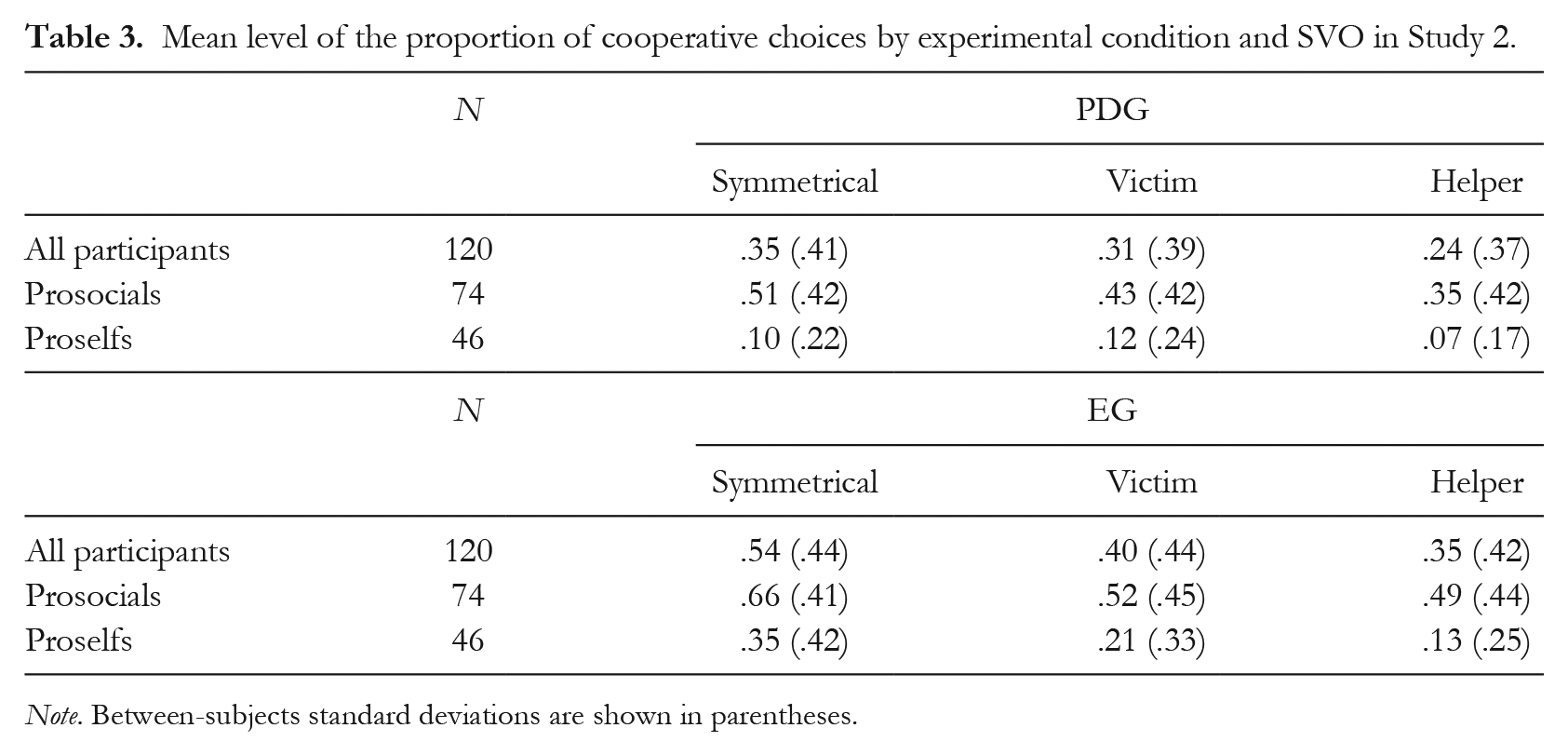
Note. Between-subjects standard deviations are shown in parentheses.
Symmetric games
Supporting Hypothesis 1 and replicating the result of Study 1, we found a main effect of game in the symmetrical games in Model 1A (for the full mixed-effects logistic regressions with statistical values, see Table 4). Again, cooperation was higher in the EG-S than in the PDG-S. Including SVO in Model 2A, SVO became a significant predictor as well. Supporting Hypothesis 4, a higher level of prosociality increased cooperation. As in Study 1, we found a significant interaction of SVO and game, indicating that the conflict-cooperation effect was stronger for proselfs.
Mixed-effects logistic regression models predicting cooperation in Study 2.

Note. Mixed-effects logistic regressions. Models 1A and 2A refer to the symmetrical conditions. Models 1B and 2B refer to the asymmetrical conditions. Game and role are (weighted) effect coded: PDG = –.50, EG = .50 and helper = –.50, victim = .50. SVO-angle is mean-centered. Rounds and subjects were treated as random intercept factors. Observations in Model 1A and 2A [rounds/subjects] = 1200/120 and observations in Model 1B and Model 2B [rounds/subjects] = 2400/120.
Asymmetric games
The mixed-effects logistic regression in Model 1B (Table 4) predicts cooperation by game (PDG vs. EG) and role (victim vs. helper) in the asymmetric games, i.e., PDG-V, PDG-H, EG-V, and EG-H. In support of Hypothesis 2, we found a main effect of game, indicating that intergroup conflict increased overall cooperation even under intragroup asymmetry, irrespective of role. Moreover, supporting Hypothesis 3, we also found a main effect of role, indicating that victims were more likely to cooperate than helpers, irrespective of game. In Model 2B, we included SVO and its interactions with the other factors. Providing further support for Hypothesis 4, there was a main effect of SVO, indicating that prosocials were overall more likely to cooperate than proselfs. Unlike in the symmetric games, we found no interaction of SVO and game in the asymmetric games.
Mediation analyses
To our knowledge, there are no established methods to investigate mediation in a mixed-effects design with a dichotomous dependent variable. Therefore, we used the proportion of cooperative choices across the five rounds for each of the experimental conditions as a continuous dependent variable.
To test whether perceived cohesiveness mediates the conflict-cooperation effect in the symmetrical conditions, we performed a mediation analysis for repeated-measures designs (Montoya & Hayes, 2017). We found a significant total effect, B = –0.19, SE < 0.01, 95% CI = [–0.20, –0.18], an indirect effect of game on cooperation through cohesiveness, B = –0.07, SE = 0.03, 95% CI = [–0.11, –0.02], 7 and a significant direct effect, B = –0.12, SE = 0.04, 95% CI = [–0.20, –0.05], indicating that the effect was partially mediated by cohesiveness.
Given that we found a significant interaction effect between game and SVO in the symmetrical condition, we performed a separate analysis for prosocials and proselfs. 8 For prosocials, we found a significant total effect, B = –0.15, SE < .01, 95% CI = [–0.16, –0.15], no indirect effect of game on cooperation through cohesiveness, B = –0.05, SE = 0.03, 95% CI = [–0.12, 0.02], and a significant direct effect, B = –0.11, SE = 0.05, 95% CI = [–0.20, –0.01], indicating that there was no mediation effect of cohesiveness. For proselfs, we found a significant total effect, B = –0.25, SE = 0.01, 95% CI = [–0.26, –0.23], an indirect effect of game on cooperation through cohesiveness, B = –0.08, SE = 0.03, 95% CI = [–0.16, –0.02], and a significant direct effect, B = –0.16, SE = 0.06, 95% CI = [–0.28, –0.05], indicating that the effect was partially mediated by cohesiveness.
In a second step, we tested whether cohesiveness also mediates the conflict-cooperation effect under payoff asymmetry. We performed a mediation analysis on the aggregated asymmetrical conditions (i.e., PDG-V and PDG-H vs. EG-V and EG-H). We found a significant total effect, B = –0.10, SE < 0.01, 95% CI = [–0.11, –0.10], a marginally significant indirect effect of game on cooperation through cohesiveness, B = –0.03, SE = 0.02, 95% CI = [–0.06, 0.00], 90% CI = [–0.06, < –0.01], and a significant direct effect, B = –0.08, SE = 0.03, 95% CI = [–0.13, –0.02], indicating that the effect was to some degree mediated by cohesiveness.
As mentioned before, an alternative explanation for the conflict-cooperation effect could be that the participants wanted to prevent a disliked enemy from taking points (i.e., mutual cooperation is the only way to prevent the enemy from taking points). To get more insight into whether this motivation played a role, we performed a mixed-effects logistic regression for each EG separately (i.e., EG-S, EG-V, and EG-H), using SVO, cohesiveness, and the motivation to prevent the enemy from taking points as predictors (see Table S3 in the Supplementary Materials). 9 For each model, we found a significant effect of SVO and cohesiveness on cooperation but no effect for the motivation to prevent the enemy from taking points, indicating that cooperation in the EG was mainly driven by SVO and cohesiveness.
Discussion
Replicating the results of Study 1 in a controlled laboratory setting, we found further evidence for the conflict-cooperation effect under intragroup symmetry. More importantly, we also found the conflict-cooperation effect under asymmetric payoffs for the in-group members. Although participants showed higher levels of cooperation when they were directly affected by the intergroup conflict (victims) than when they were not (helpers), even helpers increased their willingness to cooperate compared to a situation in which intergroup conflict was absent.
Overall, participants increased their cooperation under intergroup conflict. Increased levels of cohesiveness mediated the conflict-cooperation effect in both the symmetric and asymmetric games (although only marginally significant in the asymmetric games), supporting the idea that an out-group threat/attack – irrespective of which in-group member is affected by it – has a “bonding” effect. Regarding SVO, prosocials again cooperated on a higher level than proselfs did. Furthermore, we found that proselfs showed a stronger conflict-cooperation effect than prosocials, but only under symmetrical threat. As in Study 1, we only found a significant mediation effect of cohesiveness for proselfs in the symmetrical condition. This indicates that particularly individuals with a rather selfish orientation increased their cooperative behavior through increased bonding under symmetrical threat.
Finally, we did not find a significant effect of the motivation to prevent the enemy from taking points on cooperation (controlling for SVO and cohesiveness). This corresponds with the main effect of role we found (i.e., victims cooperated more than helpers; see Model 1B, Table 4). That is, if the primary motivation to cooperate was to prevent the enemy from getting points, it should not matter from whom the enemy gets the points, which would result in no difference between victims and helpers. However, future research could also tease these motivations apart in a more experimental manner by devising a condition in which the enemy is given points (in case of the players’ unilateral or mutual defection) without subtracting any points from the players. As such, increased cooperation could only be attributed to the motivation to prevent the enemy from receiving points but not to increased cohesion due to an out-group threat.
General discussion
Previous experimental and field research has provided compelling evidence for increased levels of intragroup cooperation in the presence (vs. absence) of intergroup conflict, i.e., the conflict-cooperation effect (Baron, 2001; Bauer et al., 2016; Benard & Doan, 2011; Bornstein & Ben-Yossef, 1994; Probst et al., 1999). Prior research has assumed symmetry in in-group members’ potential costs and benefits associated with the conflict’s outcome. To our knowledge, we are the first to investigate the conflict-cooperation effect in a more realistic setting with asymmetric conflict consequences for the in-group members.
Utilizing a novel experimental game paradigm, we replicate the well-documented conflict-cooperation effect. The effect only emerged when group members had a salient group identity, whereas an outside threat was insufficient to increase cooperation among individuals who did not share a common group identity. This suggests that a common threat may not necessarily increase cooperation, but that there needs to be some commonality among the victims in order to successfully increase cooperation (see also Batson et al., 1979). More importantly, we show that the conflict-cooperation effect persists under intragroup payoff asymmetry. Although group members who had more “to gain” from mutual cooperation were more cooperative (in line with the behavioral incentives), this effect was independent of the presence (vs. absence) of intergroup conflict. In fact, even individuals who had nothing to lose from the attacking out-group member increased their cooperation to potentially prevent a loss for their in-group member who was under attack.
Our results are interesting for the question of how traits favoring intragroup cooperation may have evolved under intergroup conflict. Evolutionary models of social preferences in intergroup conflict (e.g., Choi & Bowles, 2007) often require a high level of out-group threat for all in-group members to favor the selection of group-bounded altruism. Our results indicate that even in the absence of a symmetrical threat, overall intragroup cooperation increases. A possible explanation for this behavior is that in-groups may repeatedly face out-group threats, with varying chances of being the actual target of a single attack (e.g., depending on the exact geographical region where an attack occurs). As a consequence, reciprocity among in-group members (e.g., Yamagishi & Kiyonari, 2000) could be a possible mechanism leading to increased intragroup cooperation under intergroup conflict even in the absence of a symmetrical threat at a single conflict event. In other words, in-group members should be more likely to provide help to victims if the helper and victim roles might potentially change in the future. At the psychological level, reciprocity concerns may operate via positive attitudes toward and perceptions of the in-group members in the face of intergroup conflict (Romano et al., 2017; Yamagishi et al., 1999). Our studies were not designed to test this potential mechanism. However, we found that perceived cohesiveness mediated the conflict-cooperation effect, which may be interpreted as indirect support for the role of reciprocity concerns.
In line with previous research, we find that SVO was positively related to cooperative behavior (for a review, see Balliet et al., 2009). Previous research showed mixed results regarding the role of social preferences in conflict engagement (De Dreu et al., 2014; Thielmann & Böhm, 2016). In the current studies, we found that proselfs had a stronger inclination to increase intragroup cooperation under symmetrical threat than prosocials did (still, proselfs cooperation levels never exceeded that of prosocials). However, we did not find such an effect in the asymmetric games, indicating that the influence of SVO on the conflict-cooperation effect – as the mixed results of previous research also suggest – may vary with context. Nevertheless, it is remarkable that even rather selfish individuals were willing to increase their cooperative behavior toward an in-group member in order to protect that member against an out-group attack. This supports the idea that under some circumstances even proselfs’ individualistic tendencies can be counteracted (e.g., De Cremer & Van Vugt, 1999). Future research could investigate what makes a conflict situation “strong enough” to completely eliminate differences in intragroup cooperative behavior between prosocially- and selfishly-oriented individuals.
Limitations and outlook
The out-group “enemy” had a passive role in our game paradigm. That is, the situation was fixed in the sense that it was certain that the enemy would attack. It might be more realistic to give the enemy an active role in which they may choose to either attack or not. Future research might therefore adopt more dynamic game paradigms, such as the Intergroup Prisoner’s Dilemma (IPD; Bornstein & Ben-Yossef, 1994), the Intergroup Prisoner’s Dilemma–Maximizing Differences (IPD-MD; Halevy et al., 2008) or the Intergroup Parochial and Universal Cooperation game (IPUC; Aaldering & Böhm, 2020), which all model a conflict between (at least) two groups of players. Yet, the identification of an appropriate control condition might be challenging in these games. In any case, assessing in-group members’ beliefs about the likelihood of an out-group attack becomes crucial in these games. For instance, schema-based distrust (Wildschut et al., 2003) might lead to an (unrealistic) overestimation of the likelihood of an out-group attack (see also Rusch & Böhm, 2019).
For Study 2, we adopted a within-subjects design with five rounds per game to increase statistical power. Although we utilized a stranger-matching protocol and randomized games on an individual level to minimize consistency effects and concerns for reciprocity, nevertheless, a within-subjects design has some inherent limitations. For instance, the fact that participants took both the role of helper and victim could have induced emphatic concerns toward a victim when they themselves were helpers, minimizing possible behavioral differences. Additionally, we cannot exclude concerns for indirect reciprocity.
Furthermore, in this article we kept the threat level constant (i.e., 10 points). An interesting question for future research would be how the degree of threat affects the conflict-cooperation effect. Does it, for instance, increase linearly with the threat level or is the mere presence of an out-group threat sufficient to increase intragroup cooperation? Related to this, the degree of threat asymmetry might also affect the conflict-cooperation effect. Indeed, the conflict-cooperation effect was smaller under asymmetry compared to symmetry. Future research should therefore investigate the interplay of both the degrees of out-group threat and intragroup asymmetry to better understand their effects on the conflict-cooperation effect.
Our studies modeled intergroup conflict using a Prisoner’s Dilemma Game. Although the PDG appears to be an appropriate model of real-world conflict (Halevy & Katz, 2013), the paradigm could be easily adapted to model other types of conflict structure. In detail, by changing the numeric parameters in the game matrix, one can easily increase the roles of “greed” or “fear,” given that this better aligns to the conflict structure of interest. For example, the Chicken Game, in which the parameters are set such that T > R > S > P, eliminates the role of fear (hence, only greed can motivate defection), whereas in the Assurance Game, with R > T > P > S, greed does not motivate defection, but fear does (e.g., Oskamp, 1971; Skyrms, 2001).
We have argued that reciprocity concerns between in-group members may explain helpers’ increased willingness to cooperate even when they were not the targets of the out-group attack. To directly test this hypothesis, one could manipulate the “shadow of the future” with probabilistic role assignment (i.e., helper vs. victim). This could be implemented by repeated game play (Pedro Dal, 2005). We would predict an accelerating conflict-cooperation effect in repeated interactions (i.e., during repeated conflict it becomes even more important to stick together), particularly for proselfs, who have been shown to be more affected by reciprocity concerns than prosocials, who are more cooperative irrespective of reciprocity (e.g., Van Lange et al., 2011).
Conclusion
In real-world intergroup conflict, people are often affected differently. As a theoretical contribution, we show that in such asymmetric situations, the conflict-cooperation effect still persists and even group members who have nothing to lose increase their cooperation with threatened in-group members. As a methodological contribution, our novel economic game paradigm may be used in further research to better understand the structural and psychological processes underlying the conflict-cooperation effect.
Supplemental Material
Supplement_revised – Supplemental material for The conflict-cooperation effect persists under intragroup payoff asymmetry
Supplemental material, Supplement_revised for The conflict-cooperation effect persists under intragroup payoff asymmetry by Maik M. P. Theelen and Robert Böhm in Group Processes & Intergroup Relations
Footnotes

Funding
The author(s) disclosed receipt of the following financial support for the research, authorship and/or publication of this article: Financial support from the Excellence Initiative (ZUK II) of the German Research Foundation (DFG) is appreciated.
Supplemental material
Supplemental material for this article is available online.
Notes
References
Supplementary Material
Please find the following supplemental material available below.
For Open Access articles published under a Creative Commons License, all supplemental material carries the same license as the article it is associated with.
For non-Open Access articles published, all supplemental material carries a non-exclusive license, and permission requests for re-use of supplemental material or any part of supplemental material shall be sent directly to the copyright owner as specified in the copyright notice associated with the article.
