




Abstract
A growing body of research has shown that naturalized citizens’ attitudes towards immigration worsen following citizenship acquisition. Accordingly, these socially mobile individuals tend to distance themselves from their former immigrant ingroup. The present contribution explains such self–group distancing coping strategy in terms of an “ironic” procedural fairness effect. Study 1 (N = 566), a survey conducted among naturalized Swiss citizens, showed that fairness perceptions with respect to the naturalization process were indeed associated with stronger anti-immigration attitudes, and that this relationship was mediated by identification with the host nation. Next, two experiments were conducted to demonstrate the causality of the hypothesized mediation model. In Study 2 (Experiment 1; N = 248), fairness of the admission procedure (accurate vs. inaccurate) increased identification with a desirable group. In Study 3 (Experiment 2; N = 141), administration of a national identity prime evoked stronger anti-immigration attitudes. Taken together, our findings highlight a somewhat “dark side” of procedural fairness.
Keywords
It is time to stop the invasion! . . . Why should [the children of] foreigners become Italian just like that? It’s not right.
That the cited quote stems from an adherent of the Italian far-right, anti-immigrant party Lega Nord, should not come as a surprise for anyone knowledgeable of European politics. Striking, however, is the fact that these words were uttered by a naturalized Nigerian politician. Senator Toni Iwobi, who acquired the Italian nationality in the 1970s, has ever since become one of Italy’s strongest advocates of stricter immigration policies. For example, Senator Iwobi’s campaign catchphrase was “Stop Invasion!”; he has ruled against the current procedure for Italy-born children of immigrants to obtain Italian citizenship; and he repeatedly defended fellow party members who made racist remarks towards immigrants (AFP, 2018).
Despite being anecdotal evidence, the opening quote illustrates a quite peculiar social phenomenon: naturalized citizens (i.e., immigrant minority members who accomplished a process of individual upward mobility through citizenship acquisition) may develop a strong preference for stricter immigration policies (e.g., Kolbe & Crepaz, 2016; Politi, Chipeaux et al., 2020; Sarrasin et al., 2018; Strijbis & Polavieja, 2018). By advocating stricter immigration policies, which may entail detrimental consequences for other newcomers, these citizens implicitly seem to convey a more negative stance towards other immigrants. Innovatively, the present contribution aims to understand which underlying mechanisms lead these mobile individuals (i.e., naturalized citizens) to turn against their former ingroup (i.e., the immigrant minority group). In three studies, we show that such derogatory attitudes develop during the process of individual upward mobility itself, and that they are shaped by the perceived fairness of the naturalization procedure. More specifically, we argue that fair procedures during this process foster identification with the host society among those who obtain citizenship, which in turn can spur anti-immigration (policy) attitudes. As such, the present research illustrates that procedural fairness perceptions may ironically bring about rather contradictory effects for intergroup relations in the context of citizenship acquisition: Whereas fair procedures have the potential to foster identification with the host country and relations with host national citizens, they may unfortunately also incentivize naturalized citizens to turn against the former immigrant ingroup, thereby exacerbating the relationship between naturalized and “new” minority groups.
The Individual Upward Mobility Hypothesis
Over the last decade, researchers have developed a growing interest in how intragenerational upward social mobility—that is, the achievement of a higher status position in society during one’s lifetime—affects the psychology of those who move up the social ladder (e.g., Houle, 2011). Albeit undoubtedly beneficial for the individual, such vertical mobility has been associated with rather negative consequences for intergroup relations. In fact, a vast body of research has shown that upward mobility is associated with self–group distancing effects, that is, behavior through which mobile individuals distance themselves from their former lower status peers (e.g., Ellemers, 2001; Ellemers et al., 2004). For example, research on the “queen bee” phenomenon has demonstrated that successful professional women can become the fiercest advocates of the status quo in a company’s hierarchy, thereby hindering female subordinates’ rise on the corporate ladder (Derks, Ellemers, et al., 2011; Derks, van Laar, et al., 2011; Ellemers et al., 2004).
In a similar vein, Kolbe and Crepaz (2016) recently documented another side effect of upward mobility among naturalized citizens. 1 Specifically, these scholars observed some sort of “incorporation effect,” namely that, following the naturalization procedure, new-found citizens were more likely to hold unfavorable attitudes towards immigration than their “nonnaturalized” immigrant counterparts (Kolbe & Crepaz, 2016; see also Just & Anderson, 2015). Intriguing at first glance, such a negative orientation among naturalized citizens should not come as a complete surprise, knowing that distancing among upward mobile individuals is especially likely to occur when the former ingroup is perceived to be the target of negative bias (Derks, van Laar, et al., 2011). Because immigrants often report experiences of stigma and prejudice (e.g., Jones et al., 2019; Khanlou et al., 2008; Valenta, 2009; Vang & Chang, 2019), naturalized citizens may thus be motivated even more to distance themselves from the stigmatized immigrant group once they are granted full citizenship of the host nation.
The incorporation effect itself appears to be robust and consistent across countries (Just & Anderson, 2015; Kolbe & Crepaz, 2016; Sarrasin et al., 2018; Strijbis & Polavieja, 2018). However, little is known about the determinants of these derogatory attitudes towards other immigrants. The few scholars who have attempted to explain why exactly obtaining the host country nationality acts as an identity “turning point” from which naturalized citizens display more negative views on immigration, claimed that the increased bonds with the national majority group following the naturalization process explain why naturalized citizens show derogatory attitudes towards the immigrant minority group (Kolbe & Crepaz, 2016; Kulich et al., 2015). For instance, Politi, Chipeaux et al. (2020) recently showed that willingness to belong to the national majority group relates to increased orientation towards host culture adoption, which in turn fosters anti-immigration attitudes among recently naturalized citizens. However, it should be noted that the accomplishment of naturalization represents the endpoint in a long, often cumbersome migration trajectory of mobile individuals, and it can reasonably be assumed that experiences along the way also play a role in shaping the observed distancing attitudes of naturalized citizens. On the basis of this premise, we argued that specific elements of the naturalization procedure in itself may engender the self–group distancing phenomenon. More specifically, we theorized that the perceived procedural fairness of the naturalization process fosters identification with the host country, which in turn explains anti-immigration sentiments among naturalized citizens.
Procedural Fairness as an Explanatory Process Variable
Procedural fairness refers to the perceived justice of the processes implemented by a decision-maker in order to arrive at an outcome for a given decision (Thibaut & Walker, 1975). According to the relational model of Tyler and Lind (1992), fair procedures convey a message of legitimacy of the decision-maker, which in turn increases identification with the group represented by the decision-making authority (De Cremer & van Knippenberg, 2002; Lind & Tyler, 1988). Given that institutions such as naturalization offices are often perceived to be representative of society as a whole (Turner, 2009), and that their actions constitute an important “socialization experience” (Helms, 1990), fair procedures implemented by decision-making authorities should increase naturalized citizens’ identification with the host nation even more (Valcke, Van Hiel, van Roey, et al., 2020). Importantly, the perceived fairness of naturalization procedures should foster host national identification over and beyond personal experiences of fair treatment or discrimination from naturalization officials—personal experiences which depend on a number of factors that overstep the perceived fairness of the procedure itself (Bies, 2005).
However, such increased identification with one’s new country of residence among naturalized citizens may negatively impact their attitudes towards their former immigrant ingroup. At least two theoretical frameworks support this prediction. First, literature on social groups suggests that peripheral group members are more likely to display outgroup derogation (Ellemers & Jetten, 2013; Noel et al., 1995). The latter hypothesis may especially hold for naturalized citizens, whose status as peripheral group members is most salient. Second, social identity theory (Tajfel & Turner, 1979) posits that social identification with a group leads to both ingroup favoritism and outgroup derogation. And indeed, upward mobility has been associated with increased identification with the new (higher) status group on the one hand, and with less concern for and more prejudice towards the former (lower) status group on the other (Chipeaux et al., 2017; Kulich et al., 2015). In a similar vein, recent studies have demonstrated that identification with the host nation and negative attitudes towards immigrants may coincide (Adam-Troian et al., 2019; Wagner et al., 2012), particularly when increased host national identification is paired with the normative pressure to assimilate and give up one’s previous markers of identity (Jasinskaja-Lahti et al., 2019; Politi, Roblain et al., 2020). In light of these empirical findings and the theoretical frameworks discussed before, it thus seems reasonable to assume that increased host national identification among naturalized citizens following fair naturalization procedures is associated with anti-immigration attitudes.
The Present Studies
To summarize, the present contribution aimed to explore perceptions of fairness of the naturalization procedure as an explanatory mechanism of the previously documented relationship between citizenship acquisition and anti-immigration attitudes (Just & Anderson, 2015; Kolbe & Crepaz, 2016; Kulich et al., 2015; Politi, Chipeaux et al., 2020; Sarrasin et al., 2018; Strijbis & Polavieja, 2018). Taken together, the reviewed theoretical frameworks point towards an “ironic” effect of procedural fairness. On the one hand, a fair naturalization procedure yields the beneficial societal outcome of increased identification with the group into which one is granted access, that is, the host nation. On the other hand, such heightened host national identification comes with a price, namely more negative attitudes towards immigration.
We formulated four main research hypotheses. First, we predicted that the perceived fairness of a procedure through which one achieves higher status in society (i.e., the naturalization process) would be positively associated with host national identification among naturalized citizens (Hypothesis 1). We further hypothesized that enhanced host national identification would be associated with anti-immigration attitudes (Hypothesis 2). Third, we envisaged that procedural fairness with respect to the naturalization process would be associated with anti-immigration attitudes (Hypothesis 3). Last, we theorized that the former relationship between procedural fairness and anti-immigration attitudes would be mediated by host national identification (Hypothesis 4). Figure 1 presents a schematic overview of the hypothesized mediation model.
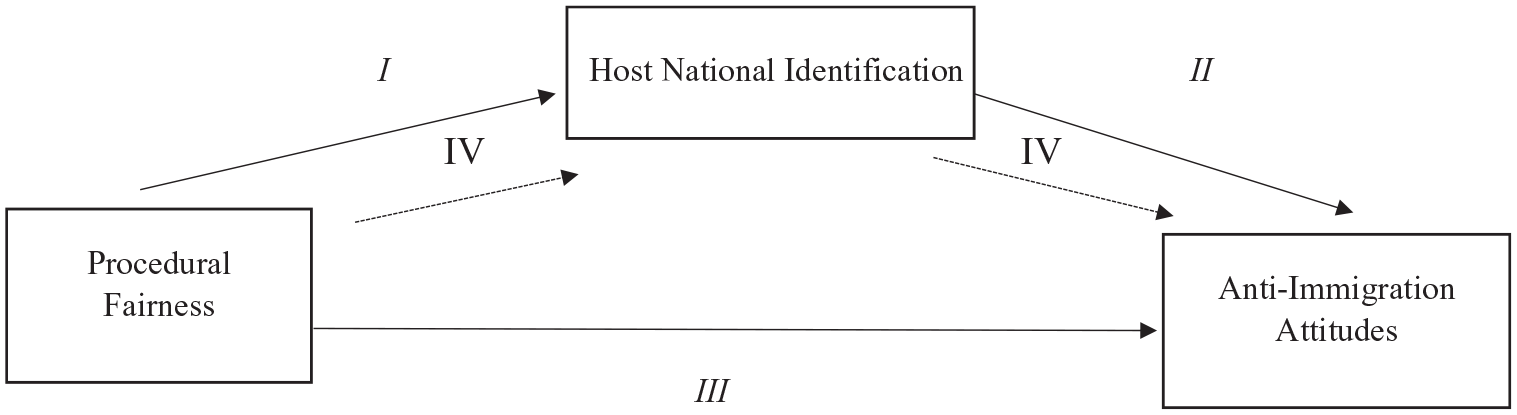
Schematic overview of the hypothesized relationship between procedural fairness of the naturalization procedure, host national identification, and anti-immigration attitudes.
To test our hypotheses, three studies were conducted. In Study 1 (N = 566), we tested the full mediation model (test of Hypotheses 1–4) in a sample of recently naturalized citizens in Switzerland. Furthermore, Studies 2 and 3 were additional lab experiments which we conducted to study the underlying psychological processes, and to assess causality and directionality in our theoretical model, following Spencer et al.’s (2005) methodology. In Study 2 (N = 248), we manipulated the fairness of a procedure implemented to grant access to a higher status group and measured participants’ identification with this group (additional test of Hypothesis 1). In Study 3 (N = 141), we subsequently manipulated host national identification and measured participants’ anti-immigration attitudes (additional test of Hypothesis 2).
Study 1
Method
Participants
We relied on a sample of recently naturalized immigrants in Switzerland. These data were gathered in the context of a larger project regarding citizenship acquisition and naturalization motives. Given the strict Swiss naturalization regime (requiring minimally 12 years of residence in Switzerland, an integration and linguistic examination, etc.), we thus performed a rigid test of our fair process hypothesis (for an overview of the naturalization procedure in Switzerland, see Helbling, 2008). Our sample consisted of 566 recently naturalized citizens (264 males; age: M = 41.87, SD = 13.16, range: 12–77). On average, our participants had moved to Switzerland at a mean age of 19 (SD = 13.79) and had been living in the country for 22 years (SD = 11.02). All of them received our questionnaire during the ceremony marking the end of the naturalization process. This way, we ensured that the interval between naturalization and time of testing was homogenous across participants. A sensitivity analysis using the powerMediation package (Qiu, 2018) in R revealed that, given our sample size and a power of .80, the minimum detectable slope for our mediator (national identification) was β = .17.
In line with official statistics (State Secretariat for Migration, 2019), more than 2/3 of our sample (383 or 67.7%) originated from countries belonging to the European Union. The remainder were either born in a Western, non-EU country (38 or 7%), Africa (61 or 11%), Asia (34 or 6%), South America (18 or 3%), North America (9 or 1.5%), or Australia (2 or .003%). Our participants were employed in various economic areas, ranging from low- (e.g., cleaner, receptionist, driver) to high-wage jobs (e.g., architect, lawyer, banker, engineer). Only seven participants reported to be unemployed (1%). The majority of our sample consisted of newcomers with either university education (244 or 43.1%) or professional education (133 or 22.7%); the others reported high school education (65 or 11.5%), obligatory education (57 or 10.1%), and secondary education (52 or 9.2%). In terms of financial status, 32.8% of our participants reported low household incomes (< 6,200 Swiss francs [CHF]); 36.8% a medium income (6,200–12,200 CHF); and 26% revealed a high income (> 12,200 CHF). Finally, political ideology was assessed on a scale ranging from 1 (utter left-wing) to 11 (utter right-wing); on average, participants rated themselves as 6.13 on this measure (SD = 2.22).
Measures
All items were scored on 5-point Likert scales (1 = totally disagree, 5 = totally agree). Questionnaires were administered in French.
Procedural fairness
We measured procedural fairness with six items, which were based on the criteria put forth by Leventhal (1980) and Tyler (1989). Example items included “The criteria of the naturalization procedure are correct and impartial” (referring to the “bias suppression” criterion) and “The implemented procedure was effective in distinguishing good from bad candidates” (referring to the “accuracy” criterion). The scale’s reliability was sufficient (α = .61; M = 3.90, SD = 0.58).
Host national identification
Feelings of identification with the Swiss society were assessed with eight items, adapted from Leach et al. (2008). These referred to different components of identification such as solidarity with other Swiss citizens (e.g., “I feel solidarity with other Swiss citizens”), satisfaction (e.g., “I am happy to be Swiss”), and centrality (e.g., “Being Swiss is an important part of who I am”). The internal consistency of this measure was high (α = .88; M = 4.27, SD = 0.55).
Anti-immigration attitudes
We measured the extent to which our participants favored stricter migration policies with three items, which we adapted from the 2014 European Social Survey migration module (see also Politi, Chipeaux et al., 2020). Example items are “Should Switzerland go through a period of economic recession, it is imperative that the number of newcomers is limited” and “Switzerland should employ stricter measures to expel immigrants whose residence permits in Switzerland have expired.” This scale’s reliability was sufficient (α = .68; M = 3.37, SD = 0.76).
Data Analysis and Results
Table 1 displays the correlations between our study’s variables.
Correlations among Study 1 variables
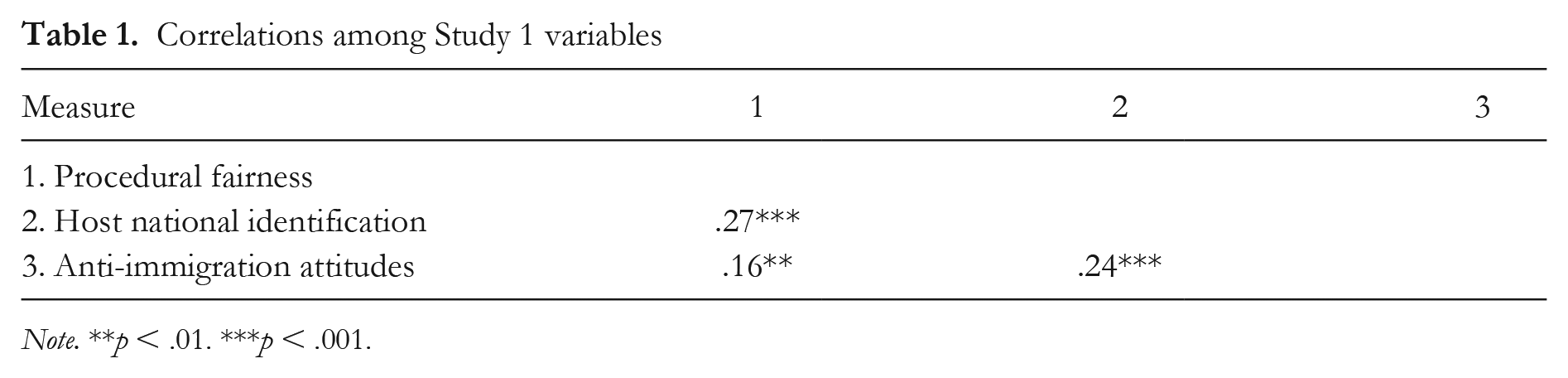
Note. **p < .01. ***p < .001.
We tested for mediation using the lavaan package (Rosseel, 2012) in R (R Core Team, 2017). Standard bootstrapping options (10,000 resamples; α = .05) were implemented, and in each analysis, we controlled for age, gender, education level, household income, political ideology, and origin (EU/non-EU). First of all, results of our analyses revealed that procedural fairness was indeed positively associated with host national identification (b = 0.23, SE = 0.05, p < .001, 95% CI [0.14, 0.32]; test of Hypothesis 1). Second, the path from host national identification to anti-immigration attitudes was also statistically significant (b = 0.29, SE = 0.08, p < .001, 95% CI [0.14, 0.44]; test of Hypothesis 2). Third, we observed that procedural fairness and anti-immigration attitudes were also positively related (although not significantly; b = 0.10, SE = 0.07, p = .137, 95% CI [−0.03, 0.24]; Hypothesis 3). Most importantly, and in line with Hypothesis 4, our results revealed that the relationship between procedural fairness and anti-immigration attitudes was indeed mediated by host national identification (b = 0.07, SE = 0.02, p = .003, 95% CI [0.02, 0.11]).2,3 Figure 2 provides an overview of the unstandardized total, direct, and indirect effects.
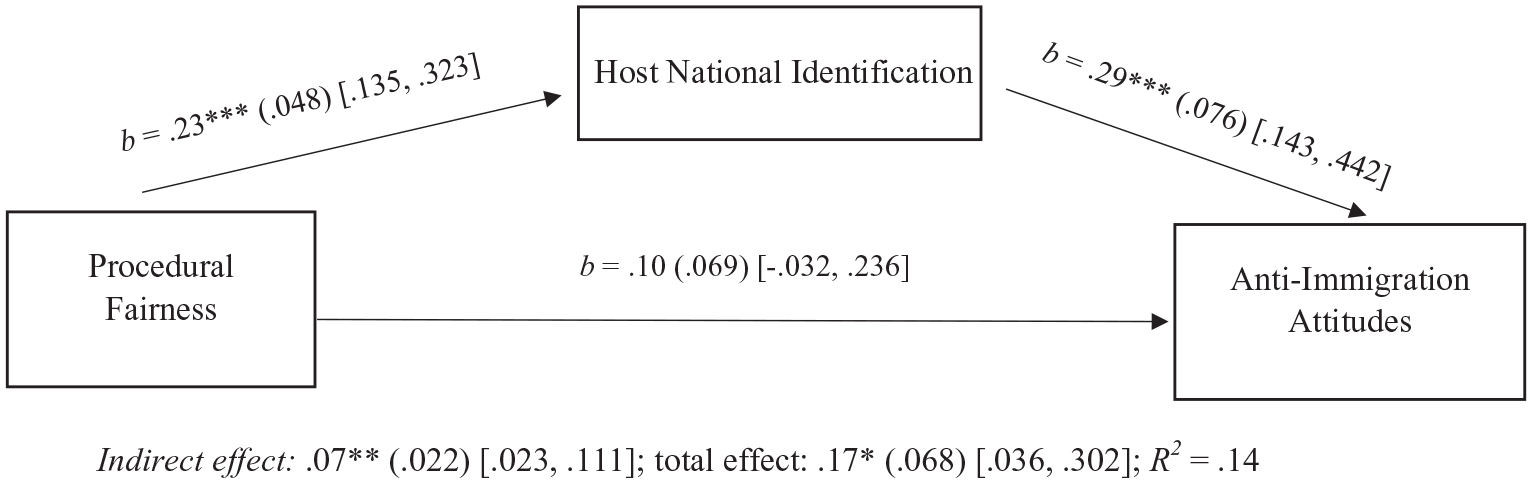
Schematic overview of results of the mediation analysis (Study 1) with procedural fairness as predictor, host national identification as mediator, and anti-immigration attitudes as dependent variable.
Discussion
Study 1 yielded two noteworthy results. First, we were able to pick up on the hypothesized ironic fair process effect: participants—naturalized citizens—who perceived the naturalization procedure as more fair and impartial were also more likely to endorse more restrictive views on immigration. Second and most importantly, we observed that this effect was mediated by increased host national identification. As such, our results help explain why naturalized citizens distance themselves from their former immigrant ingroup: fair naturalization procedures spawn identification with the group (the host nation) represented by the authority (the naturalization offices); and this increased host national identification, in turn, predicted naturalized citizens’ anti-immigration attitudes. Hence, our Study 1 results seem to support the proposition that heightened identification with the host nation, as a result of fairness perceptions, may entail side effects such as more negative attitudes towards immigration.
Taken together, Study 1 thus identified the psychological processes at play in the observed ironic fair process effect. However, due to the cross-sectional nature of our data, we remained inconclusive about the directionality of effects in our theoretical model. It is important to acknowledge that all previous research documenting the incorporation effect has relied on cross-sectional samples (and thus correlational evidence), and that none of these studies has attempted to experimentally replicate the underlying psychological process chain associated with this phenomenon. Although procedural fairness seems to precede rather than follow group identification and belongingness (De Cremer et al., 2008; Tyler, 1989; Tyler & Lind, 1992; Valcke, Van Hiel, Onraet, & Dierckx, 2020; Valcke, Van Hiel, van Roey, et al., 2020), we cannot exclude the possibility that highly identified, naturalized citizens are more likely to glorify their naturalization experience in retrospect. As such, we conducted two additional experiments. In Study 2, an adapted version of the minimal group paradigm (Gaertner & Insko, 2000), participants acquired membership of a higher status group by means of a fair/unfair procedure. Subsequently, we measured commitment to this group. Then, in Study 3, citizens with an immigration background were primed with either the host national identity or a control, and we measured how these primes affected their attitudes towards immigration.
Study 2
Method
Participants
We recruited 308 participants through the online crowdsourcing platform Prolific Academic (ProA; Palan & Schitter, 2018), including only those Prolific workers who were E.U. citizens and fluent in English. All participants were paid £0.50 for their cooperation. We were forced to exclude 60 participants because they either came close to guessing the true hypothesis of the study (N = 34), or because they failed to complete the questionnaire in its entirety (N = 26). As a consequence, our final sample size was N = 248 (148 males; age: M = 29.50, SD = 10.59, range: 18–68), yielding β = .97 to detect a medium effect size d = 0.25.
Procedure
All questionnaires were administered in English. Participants were invited to complete a short cognitive test, of which they were told that it was developed to measure mathematical–spatial abilities. Actually, our “test” was fake, and adapted from Roets et al. (2019). It contained three matrices which were loosely based on the Raven Progressive Matrices (Raven, Styles, & Raven, 1998), and two mathematical exercises which asked participants to pick two out of 12 numbers “summing up to 10 exactly.” Crucially for our experimental manipulation, we informed our participants that their performance would be rated in terms of accuracy and speed, rendering participants clueless about their true performance (which was a prerequisite to ensure the credibility of the feedback provided afterwards; Roets et al., 2019). Following a brief description of the task, we explained to participants that their performance would also be compared to a “representative sample of 1,000 participants,” and that previous research had shown that the “best performers” in this sample had all obtained an average score of 8/10 or higher. Most importantly, we informed participants that their feedback would not only consist of their personal score, it would additionally convey information about whether or not they also belonged to the group of best performers. Mimicking the naturalization process, belonging to the group of best performers also entailed a number of material—besides psychological—benefits. Indeed, best performers were granted access to a (fictitious) restricted database, they were granted an additional bonus of 0.50£ and possibly selected for future remunerated activities.
After participants had completed the test (which lasted about 10 minutes on average), we introduced the fairness manipulation. This was based on van den Bos (2001) and De Cremer (2004), who manipulated procedural justice by exposing their participants to an accurate versus inaccurate procedure. Accuracy is considered one of the main procedural justice criteria (Leventhal, 1980), and its influence on fairness judgments is well established (van den Bos & Miedema, 2000; van den Bos et al., 1997). More importantly, given that all participants in Study 1 were finally granted host national citizenship and that the items included in the questionnaire probed into the perceived accuracy of the naturalization procedure to filter out the “bad” candidates and retain the “good” ones, manipulating accuracy in Study 2 seemed the most reasonable choice. Accordingly, participants in the fair condition read that their score was 8.68, that it was calculated as the average score on each of the five exercises, and that they had thus earned their place in the group of “high potential.” Conversely, participants in the unfair condition were informed that an error had occurred during the processing of their scores and that their data had been lost; but, nevertheless, that the system had allowed them to enter the group of “high potential,” which entitled them to collect the bonus afterwards. In this way, both groups were assigned to the desirable “high potential” group, yet only one group accomplished this by means of a fair and accurate procedure. 4 Following the manipulation, participants completed two manipulation checks and our dependent measure, were debriefed about the true hypothesis of our study, and thanked for their cooperation.
Measures
All items were rated on 5-point Likert scales.
Manipulation checks (MCs)
We included two items to verify whether our manipulation of procedural fairness had been successful: “I was accurately informed about my personal score once the test was finished” (MC 1) and “The procedure of the assignment to the group of high potential was accurate” (MC 2). These items correlated strongly (r = .62).
Group identification
Four items were used to measure this variable. They were based on Leach et al.’s (2008) measure (e.g., “I think that participants who belong to the group of high potential have a lot to be proud of” and “I am glad to belong to the high potential group”). The internal consistency of this scale was high (α = .86).
Data Analysis and Results
Table 2 displays the correlations between our study’s variables.
Means, standard deviations, and correlations among Study 2 variables
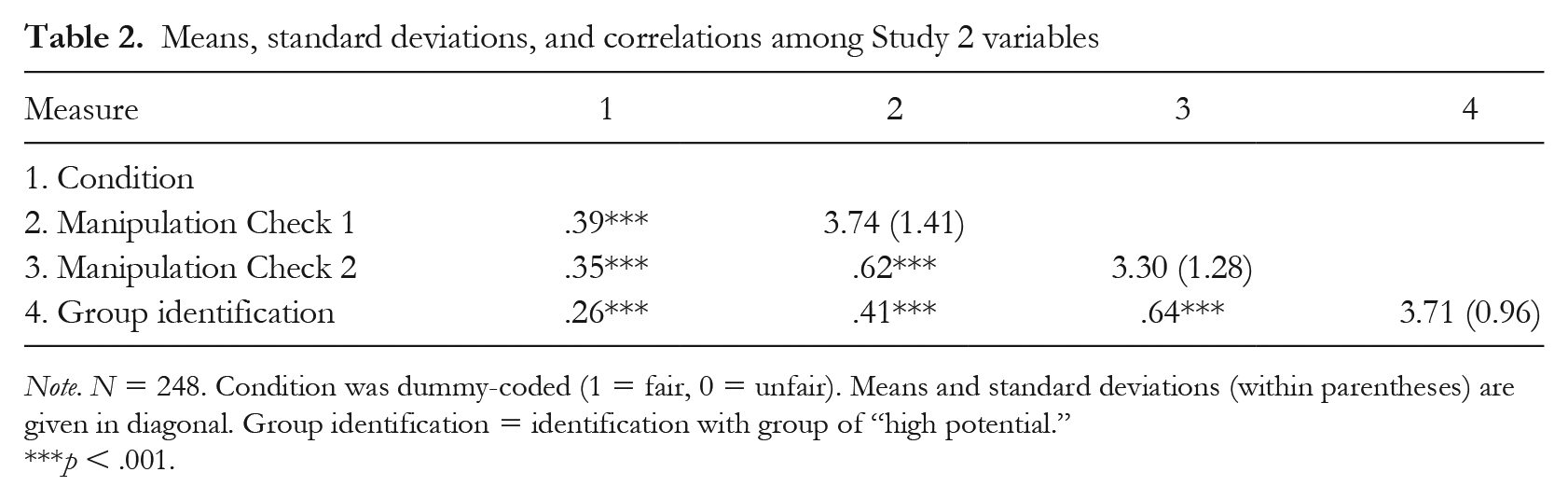
Note. N = 248. Condition was dummy-coded (1 = fair, 0 = unfair). Means and standard deviations (within parentheses) are given in diagonal. Group identification = identification with group of “high potential.”
p < .001.
Manipulation checks
We conducted a multivariate analysis of variance (MANOVA) with condition (two levels: fair vs. unfair) as between-subjects factor on both manipulation checks, to assess the success of our procedural manipulation. Indeed, we found a significant effect of condition, F(2, 245) = 25.17, p < .001, η2 = .17; participants in the fair condition reported stronger agreement with both items (MMC 1 = 4.27, SDMC 1 = 1.00; MMC 2 = 3.73, SDMC 2 = 1.05) than those in the unfair condition (MMC 1 = 3.18, SDMC 1 = 1.56; MMC 2 = 2.83, SDMC 2 = 1.33; dMC 1 = 0.83; dMC 2 = 0.75). As such, we concluded that our manipulation had been successful.
Main analysis
First, we checked whether identification scores were influenced by participants’ characteristics such as education level, age, and income. Given that none of these covariates were significantly related to group identification, age: r = .04, education level: r = −.02, both ps > .247; gender: F(1, 246) = 3.28, p = .071, we dropped them from further analyses. To verify the effects of our accuracy manipulation, we conducted a univariate ANOVA with condition as between-subjects factor and group identification as dependent variable. The results of this analysis are graphically depicted in Figure 3. Consistent with Hypothesis 1, results revealed a significant effect of condition, F(1, 246) = 17.41, p < .001, η2 = .06, such that participants in the fair condition (M = 3.94, SD = 0.82) reported stronger identification with the “high potential” group than those in the unfair condition (M = 3.45, SD = 1.01; d = 0.53).
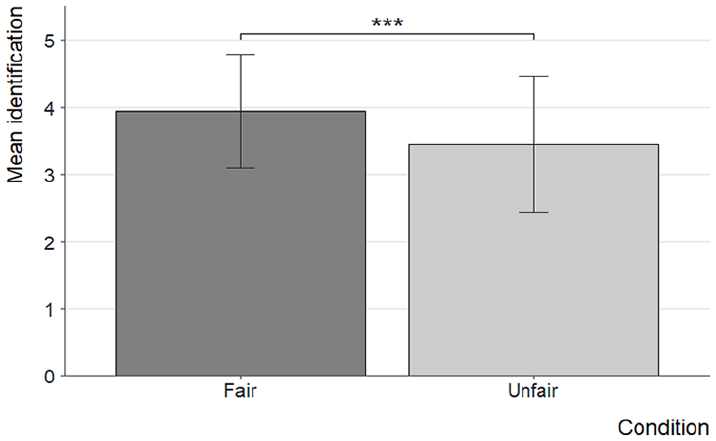
Mean ratings of identification with the desirable group per condition: Study 2.
Discussion
The results of Study 2 supported Hypothesis 1. In line with our results based on cross-sectional data from Study 1, we found that individuals who acquired membership of a desirable, high-status group by means of a fair procedure, subsequently identified more strongly with this group than those who had experienced a procedurally unfair admission process. As such, our findings corroborate other research showing that procedural fairness exerts an influence on group identification (De Cremer et al., 2008; Tyler, 1989; Tyler & Lind, 1992; Valcke, van Hiel, van Roey, et al., 2020). Importantly, just like all naturalization applicants were granted host national citizenship in Study 1, all participants in Study 2 were admitted to the desirable group of “high potential.” As such, the increase in identification with this group cannot be ascribed to the sheer outcome of upward mobility (or the “distributive” fairness of the decision procedure; Folger, 1977). Once more, this suggests that the incorporation effect (Kolbe & Crepaz, 2016) is driven more by characteristics of the naturalization process itself than by its consequences.
Having established that institutional fairness can facilitate identification with an attractive social group, we moved on and tested whether experimentally manipulating identification with a higher status group increases support for stricter immigration policies. In Study 2, the higher status group was artificially created, and hence the social group to which our participants belonged in real life was irrelevant. Conversely, in Study 3, we narrowed our scope to identification effects in a more naturalistic setting. More specifically, we primed identification with an existing social group (i.e., the UK society) and studied how this affected participants’ attitudes towards immigration. To mimic the intergroup setting of Study 1, we recruited British citizens with an immigration background. As such, we studied how identification with the host nation affects anti-immigration attitudes.
Study 3
Method
Participants
A hundred and seventy-five British citizens with an immigration background (69 males) were recruited through ProA (Palan & Schitter, 2018), of which 155 fully completed the experiment. Another 14 participants were excluded because they failed our attention check. As such, we obtained a final sample of 141 participants (58 males; age: M = 30.90, SD = 10.28, range: 18–63; ethnic background: 57 Asians, 82 Blacks, two “other”; 27.7% first, 41.8% second, and 30.5% third generation), resulting in .83 power to detect an effect size d = 0.25. All participants were paid £0.50 for their participation.
Procedure
All questionnaires were administered in English. To conceal the true aim of our study, participants were led to believe that we were collecting data for a project involving language use in online media. Specifically, we informed them that we were studying the effects of the grammar and vocabulary used in online media on comprehension of its content. The experiment consisted of two parts. First, participants completed a comprehension test about an online news article. Following Li and Brewer (2004), this bogus news story contained either a national identity prime (i.e., it described “four reasons why it is great to be British”; host national identification condition) or a neutral prime (“four reasons why it is great to go cycling”; control). In the second part, participants were presented triplets of sentences, and we instructed them to rate these in terms of grammar (1 = rather incorrect, 11 = rather correct), vocabulary (1 = poor, 11 = adequate), and content (1 = completely disagree, 11 = completely agree). To avoid suspicion, they were told that “language comprehension depends in part on experience with grammar and vocabulary,” and that their evaluations of the sentences would thus serve as an additional validation of their performance on the comprehension test. Importantly, in between neutral filler items, we implemented one triplet of items assessing participants’ attitudes towards immigration, which served as our dependent variable (see following lines). Once more, we refer the reader to the supplemental materials for an exhaustive overview of the full procedure, design, and stimuli.
Measures
Identification with the host nation and identification with own ethnic group
To ensure that differences between experimental conditions were not merely due to preexisting identity dissimilarities, we added one item assessing participants’ level of identification with the UK society (i.e., “How committed do you feel towards the UK?”), and one item quantifying their attachment to their own ethnic group (“How committed do you feel towards your ethnic group?”). Both items were rated on 5-point Likert scales, and administered prior to the experimental manipulation.
Anti-immigration attitudes
Three items were used to measure this variable: “Citizenship must be precious, not handed out like candy in a parade,” “We don’t ride along and throw out citizenship like you do with m&m’s or Tootsie Rolls in a parade,” and “If we ever want migration to work, a strict, thorough integration procedure is the key solution” (scored on 12-point Likert scales.). All three items expressed strict views on immigration policies. However, given that participants were also told to rate them in terms of vocabulary, we worded them in an expressive way. We reasoned that this would keep our participants from becoming suspicious and guessing the true hypothesis of our study. The average score of the extent to which participants agreed with the content of these items was calculated and used as indicator of their anti-immigration attitudes. The mean of this scale was 6.98 (SD = 2.39), and its internal consistency was adequate (α = .71).
Data Analysis and Results
Table 3 displays the correlations between our study’s variables.
Means, standard deviations, and correlations among Study 3 variables

Note. N = 141. Condition was dummy-coded (1 = identification prime, 0 = control). Means and standard deviations (within parentheses) are given in diagonal. Ethnic identification = identification with own ethnic group. UK identification = identification with the host nation.
p < .05. **p < .01. ***p < .001.
Covariates
We started off by examining whether both groups were homogeneous in terms of national and ethnic identity prior to the experimental manipulation. Results of a MANOVA with condition as factor revealed that this was indeed the case, F(2, 138) = 0.32, p = .726, η2 = .01; national identification: Midentification = 3.76, SD = 0.98, Mcontrol = 3.89, SD = 1.04, d = 0.13, F(1, 139) = 0.54, p = .464, η2 = .01; identification with own ethnic group: F(1, 139) = 0.00, p = .938, η2 = .00; Midentification = 4.08, SD = 0.97, Mcontrol = 4.07, SD = 1.01, d = 0.01. Similarly, no significant relationship was found between immigration attitudes and gender, F(1, 139) = 0.02, p = .897, η2 = .00; immigration attitudes and age, r = −.01, p = .956; and, most importantly, between immigration attitudes and immigration history: factor with three levels: first, second, and third generation, F(2, 138) = 0.52, p = .594, η2 = .01. As such, we dropped these covariates from further analysis.
Given that attention to the prime was crucial, and that text comprehension might be regarded as a proxy for participants’ attentiveness, we additionally assessed whether both groups’ composite text comprehension scores were comparable. Results revealed a significant effect of condition, F(1, 139) = 31.86, p < .001, η2 = .18, such that participants in the identity prime group (M = 3.53, SD = 0.57) obtained significantly lower scores than those in the cycling prime condition (M = 4.08, SD = 0.60; d = 0.93). Furthermore, a significant relationship was found between participants’ education level and their attitudes towards immigration (r = .18, p = .031). Hence, we retained both variables and entered them as covariates in the subsequent analysis.
Main analysis
To assess the effects of our identification prime, we conducted a univariate ANOVA with condition as factor, and anti-immigration attitudes as dependent variable. The results of this analysis are graphically depicted in Figure 4. In line with Hypothesis 2, we found a significant main effect of condition, F(1, 137) = 8.07, p = .005, η2 = .06, such that participants in the identification condition (M = 7.55, SD = 2.23) displayed stronger agreement with statements expressing anti-immigration attitudes (M = 6.41, SD = 2.42; d = 0.48). Neither the effect of text comprehension nor that of education level reached significance (both Fs < 3.16, both ps > .077). Furthermore, participants’ immigration history did not moderate the observed relationship between condition and anti-immigration attitudes, F(2, 139) = 0.50, p = .608, η2 = .01.
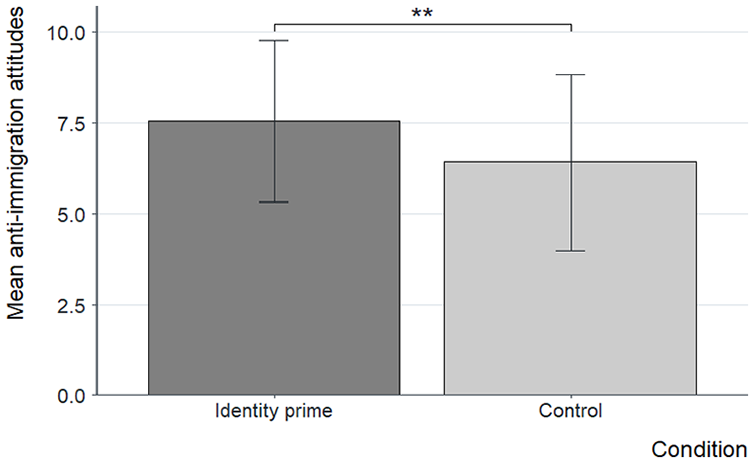
Mean agreement ratings with statements expressing anti-immigration attitudes per condition: Study 3.
Discussion
The results of Study 3 were in line with Hypothesis 2: Exposure to a host national identity prime elicited stronger anti-immigration attitudes. That is, compared to a condition with a neutral prime, exposed participants more strongly agreed with the content of statements expressing anti-immigration attitudes. Let it be noted also that our sample consisted entirely of British citizens with an immigration background, who themselves are linked to the target group given their (ancestral) history of migration. As such, Study 3 provided converging evidence for the Study 1 finding that a process of individual mobility among immigrants is associated with derogatory attitudes towards their former peers, because of stronger identification with the host national group. Furthermore, this derogatory behavior emerged independently of participants’ immigration history, indicating that these effects are not limited to first-generation immigrants but encompass multiple immigrant cohorts.
General Discussion
The aim of the present paper was to study the role of procedural fairness in shaping anti-immigration attitudes among citizens with an immigration background who acquired resident nationality. In Study 1, it was found that fairness perceptions among naturalized citizens with respect to the Swiss naturalization procedure were related to anti-immigration attitudes, and that this relationship was (partially) explained by increased identification with the host nation. Furthermore, Studies 2 and 3 provided additional experimental evidence for the psychological mechanism underlying this ironic fair process effect. To mimic the naturalization procedure in a laboratory setting, in Study 2, participants competed for a place in a desirable, high-status group. Those who succeeded by means of an accurate, fair procedure were more likely to commit to the group and identify with fellow group members than those who were granted group membership on the basis of an inaccurate, unfair procedure (Tyler & Lind, 1992). In Study 3, we confronted British citizens with immigration background with a prime referring to their host national identity. Compared to a control condition, participants in the experimental group were subsequently more likely to show stronger anti-immigration attitudes (Verkuyten, 2001).
The present research contributes to the ongoing debate about immigration in at least four ways. First of all, our results may help to explain the previously documented relationship between citizenship acquisition and negative attitudes towards the former immigrant ingroup (Just & Anderson, 2015; Kolbe & Crepaz, 2016; Politi, Chipeaux et al., 2020; Sarrasin et al., 2018; Strijbis & Polavieja, 2018). Some scholars interpreted this finding in terms of anticipation of the mobility experience. For example, Chipeaux et al. (2017) showed that the mere prospect of upward mobility evoked similar harmful attitudes among mobile individuals towards their nonmobile former compatriots. Others interpreted this finding in terms of consequences of the mobility experience. Indeed, naturalization paves the path for ameliorated contact with majority members, which can result in adoption of their views on immigration (Kulich et al., 2015). Moreover, citizenship acquisition entails a fragile marginal status within the national majority ingroup, which can in part be “concealed” by compensatory behavior such as derogation of others with an even more precarious societal position (Noel et al., 1995; Pinto et al., 2010). Our results add to this body of evidence the notion that the mediating mechanism may also occur during the mobility experience itself. Specifically, they demonstrate that the extent to which mobile citizens develop anti-immigration attitudes depends on how procedurally fair they perceive the naturalization process to be. To the best of our knowledge, our study is the first ever to reveal such a relationship. As such, the present results deepen our understanding of the so-called incorporation effect (Kolbe & Crepaz, 2016). To the extent that the naturalization process satisfies fairness criteria (Leventhal, 1980), the incorporation effect may well be understood as a consequence of procedural fairness.
Second, on a broader level, our results also contribute to the growing upward social mobility literature (Derks, Ellemers, et al., 2011; Ellemers, 2001; Ellemers et al., 2004), because they identify the perceived fairness of a procedure facilitating social mobility as a key social factor for the distancing behavior of those who climb up the status hierarchy. The observation that characteristics of the mobility-granting process are involved in the distancing behavior of stigmatized, socially mobile individuals has important implications. Namely, in each case reported in the literature, a procedure marking the transition from the lower to the higher status group precedes the reported distancing. For example, upwardly mobile women in the workplace often need to apply and demonstrate their professional skills before they are granted a promotion. It thus seems reasonable to assume that fairness perceptions with respect to such procedures may (to a certain extent) play a role in the self–group distancing behavior displayed by these socially mobile individuals as well. Hence, an interesting angle for future research would be to investigate whether distancing attitudes such as “queen bee” behavior covary with fairness perceptions related to the mobility-granting process.
Third, our results also shed light on the mediating social-psychological processes involved in upward mobility. Whereas most scholars do not contradict the observation that mobile individuals appear as motivated as high-status group members to renounce former lower status group members, the psychological mechanisms they ascribe to this phenomenon have been more contested (for contrasting explanations, see e.g., Chipeaux et al., 2017; Kulich et al., 2015). Our results suggest that enhanced engagement with one’s newly acquired group membership may well be an important intermediary psychological process. For example, in Study 1, it was found, consistent with Kulich et al. (2015), that heightened identification with the host national group explained the relationship between fairness perceptions and naturalized Swiss citizens’ anti-immigration attitudes. This finding also corroborates the work of Huo et al. (1996) and Valcke, van Hiel, van Roey, et al. (2020), linking procedural fairness emanating from a superordinate source (in our study: the naturalization offices) to identification with the group represented by this superordinate authority (the host nation). As such, the present results extend the upward mobility literature with the observation that identification with a higher status group can be a precursor, if not a necessary precondition, of mobile individuals’ derogatory attitudes towards their former ingroup. Of course, our findings also beg the question of what will happen with those immigrants who are denied citizenship of the host nation but who feel that they have been treated fairly during the course of the naturalization process nonetheless. According to procedural justice theory, the effects of receiving such an unfortunate decision may not be as devastating as expected provided that the immigration offices adhere to procedural fairness principles. After all, there is overwhelming evidence that fair procedures can mitigate the negative consequences of unfavorable outcomes (cf. Brockner, 2002; Brockner & Wiesenfeld, 1996; McFarlin & Sweeney, 1992; van den Bos, 2005). As such, it can reasonably be expected that fairly treated immigrants who were denied citizenship would display an enhanced willingness to accept the outcome of the naturalization process, and also higher subjective well-being (Valcke, Van Hiel , van Roey et al., 2020) than their unfairly treated counterparts. With respect to anti-immigration policy attitudes, the story seems somewhat different, however. Although we do not a priori rule out the possibility that the ironic fair process effect may also apply to nonmobile immigrants, intuitively the idea makes little sense. Essentially, naturalized citizens’ new-found social identities appear to be the driving force behind this effect, yet identification with a social group seems gratuitous when one is denied access to the group concerned. Thus, if the latter assumption holds, the observed effect of procedural fairness would be subject to moderation by outcome favorability, that is, the perceived fairness of the naturalization procedure would still be associated with national identification and anti-immigration attitudes, but only among those who receive a favorable outcome. On the other hand, it should be acknowledged that identity dynamics are complex and not necessarily linear, and acculturation research also shows that immigrants can develop attachment and identification with the receiving country at very early stages of their migration trajectory (e.g., Maehler et al., 2019). Hence, we also cannot rule out the possibility that fair procedures at the later stage of naturalization may boost these early feelings of national identification. Of course, such conclusions are tentative and need to be verified empirically. As such, we encourage other scholars to study fairness perceptions and identity dynamics among both nonmobile and mobile immigrants.
The last and most important theoretical contribution of the present study is that it highlights what can be described as a somewhat “dark side” of procedural fairness. The overwhelming majority of fairness research has focused almost exclusively on its positive aspects, highlighting the beneficial effects of fair procedures for social groups, such as enhanced group cohesion (Vermunt & Steensma, 2016), group identification (Tyler & Blader, 2003), and positive relations between individual group members (Cornelis et al., 2006). The present results, however, point to a more nuanced picture, highlighting rather mixed consequences of procedural fairness for intergroup relations. Although increased identification because of fairness is likely to foster social relationships between resettled citizens and host country residents, at the same time, these identification processes are likely to negatively impact the relations among minority groups, that is, between naturalized citizens and their former immigrant ingroup. As such, procedural fairness brings about important gains but also losses for intergroup harmony, and our results thus align with existing literature suggesting limits or complications to the effects of fair procedures (e.g., Leung et al., 2007). Moreover, our results also mirror research documenting ironic or paradoxical effects of positive intergroup contact (Çakal et al., 2011; Politi, Giroud et al., 2020; Saguy et al., 2009). Although contact has been praised for reducing intergroup prejudice, there is also ample evidence that, for minority members, it can ironically lead to obliviousness or indifference to one’s own disadvantaged position in society (e.g., Dixon et al., 2010), and curbed support for collective action (e.g., Tausch et al., 2015). Analogous to this strand of literature, the present ironic results testify to simultaneous positive and disadvantageous consequences of fair treatment of ethnic minority groups.
Limitations and Directions for Future Research
The current set of studies also suffers from some potential limitations. First of all, although Study 2 demonstrated the causal effect of fairness of an admission procedure, we did not test for the reverse path. Hence, we cannot exclude the possibility that high national identifiers are also more likely to perceive societal institutions to be fair and unbiased. Future studies should thus rely on longitudinal designs that allow the study of the reciprocal, possibly reinforcing paths between procedural fairness and identification.
Second, the outcome measures in both Studies 1 and 3 were described in terms of different legal statuses (i.e., newcomers, undocumented immigrants, naturalization applicants, etc.) instead of specific ethnic and cultural groups. This lack of specification makes it likely that participants thought of the target (“immigrants”) as a general category, rather than belonging to the same social group as themselves. Nevertheless, it is safe to say that “the immigrant population” in its entirety can be considered an existing social group, with both legal and sociological meaning (Hall et al., 2010). Moreover, social identity research has already shown that group boundaries are defined flexibly and at different levels of abstraction (Tajfel & Turner, 1979), such that group membership can be based on permeable group characteristics such as similar experiences or comparable backgrounds (Davison et al., 2000). These features of social identities increase our confidence in the assumption that the Study 1 participants had considered other (new) immigrants as social peers—at least at a certain point in time. Relatedly, it can be argued that a negative orientation towards immigration in general does not exclude a more moderate stance towards immigrants belonging to one’s own ethnic group. We do not contest such possibilities, and thus encourage other scholars to distinguish between attitudes towards same versus different ethnic group migrants in future research. In a similar vein, we acknowledge that even the latter group encompasses a broad variety of ethnic and cultural constellations, and anti-immigration policy attitudes may covary with the targeted social group. For example, in Europe, prejudice against Muslims is more prevalent than prejudice against other immigrant groups (Strabac & Listhaug, 2008), and hence anti-immigration attitudes could be inflated when referring to Muslim minorities. Future research specifying the target group could distinguish attitudes towards particular groups of immigrants, such as E.U. and non-E.U. citizens, or Muslims and non-Muslims, in order to further explore the boundaries and conditions of self–group distancing in the context of naturalization.
Last, it should be noted that the Study 3 manipulation used the umbrella terms “UK,” “British Isles,” and “Britain,” rather than referring to a specific country (i.e., England, Northern Ireland, Scotland, or Wales). It can therefore be argued that the prime story did not touch upon feelings of national identity in the strictest sense. Nonetheless, it should be noted that the sole objective of Study 3 was to examine the effects of priming an existing social group on anti-immigration attitudes. Furthermore, all the Study 3 participants were residing in England, which is an integral part of the UK. In other words, our participants were all affiliated with the UK as well, through their residency bond with England, and the UK should have constituted a meaningful (supra)national host nation to them. Moreover, by only recruiting English national citizens, we reduced the likelihood that characteristics of participants’ country of residence could have distorted our main results. That being said, future research could allow for a more stringent test of our hypothesis, by exploring whether a similar link exists between identification with England and preference for stricter immigration policies among English nationalized citizens.
Concluding Remarks
In sum, the current study contributes to the thriving debate in Western societies about immigration and cultural diversity, as it identifies experiences with societal institutions as a key antecedent of naturalized citizens’ anti-immigration attitudes. Importantly, in the present research, we only focused on aspects of procedural fairness concerning the accuracy, equity, and rightfulness of the naturalization process, rather than personal experiences of fair treatment or discrimination from decision-making authorities. Whereas the link between negative personal experiences and disidentification with the host nation has been largely evidenced (i.e., rejection–disidentification model; Jasinskaja-Lahti et al., 2018; Jasinskaja-Lahti et al., 2009), little was known thus far about the effects of evaluations of procedures per se, and the effects of identification with the host nation on outgroup derogation. By reaching a finer grained understanding of how group dynamics impact intergroup relations, the present research sheds light on the utterances of Toni Iwobi (2018) cited at the beginning of this article.
Footnotes
Appendix
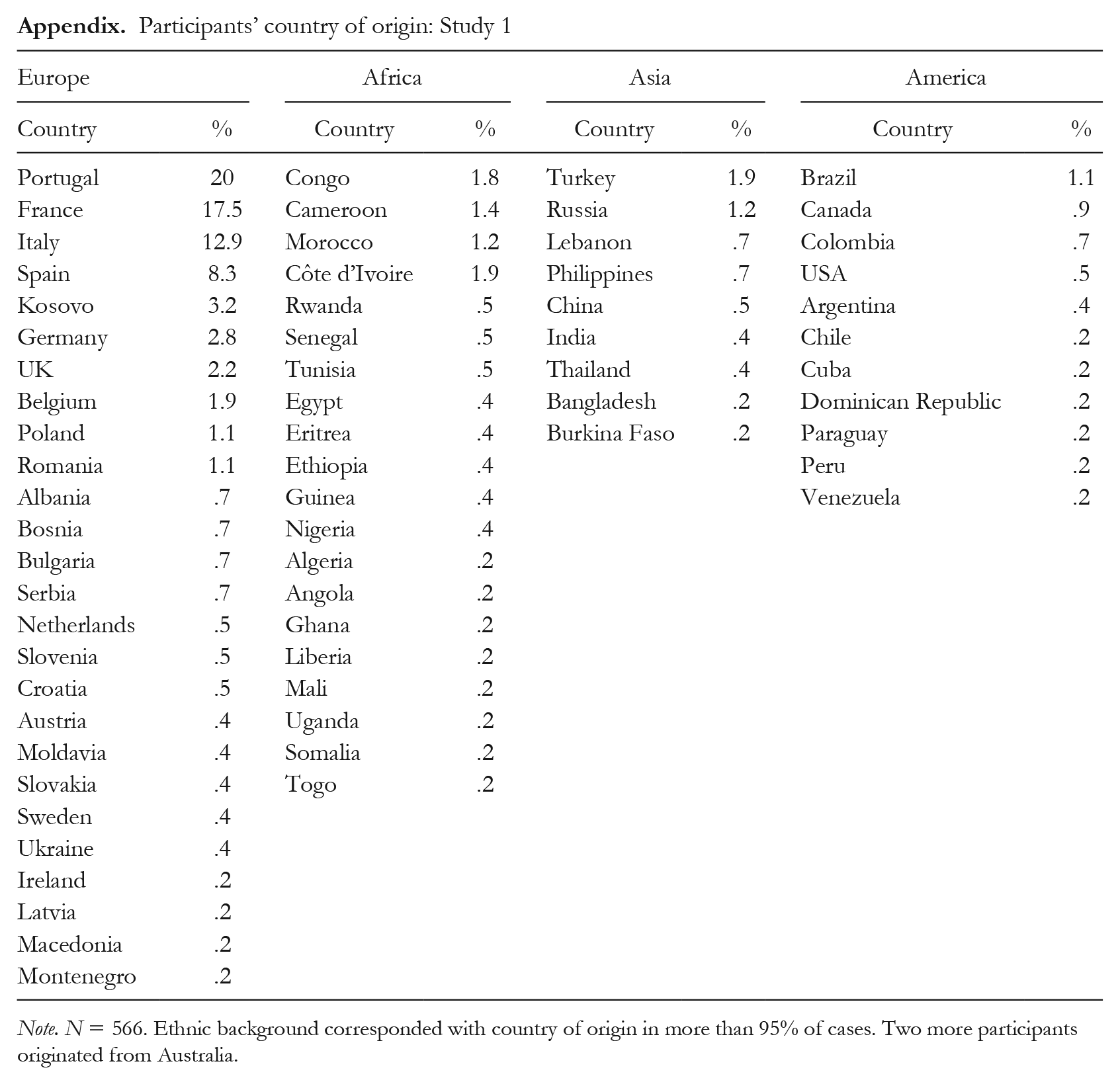
Participants’ country of origin: Study 1
| Europe |
Africa |
Asia |
America |
||||
|---|---|---|---|---|---|---|---|
| Country | % | Country | % | Country | % | Country | % |
| Portugal | 20 | Congo | 1.8 | Turkey | 1.9 | Brazil | 1.1 |
| France | 17.5 | Cameroon | 1.4 | Russia | 1.2 | Canada | .9 |
| Italy | 12.9 | Morocco | 1.2 | Lebanon | .7 | Colombia | .7 |
| Spain | 8.3 | Côte d’Ivoire | 1.9 | Philippines | .7 | USA | .5 |
| Kosovo | 3.2 | Rwanda | .5 | China | .5 | Argentina | .4 |
| Germany | 2.8 | Senegal | .5 | India | .4 | Chile | .2 |
| UK | 2.2 | Tunisia | .5 | Thailand | .4 | Cuba | .2 |
| Belgium | 1.9 | Egypt | .4 | Bangladesh | .2 | Dominican Republic | .2 |
| Poland | 1.1 | Eritrea | .4 | Burkina Faso | .2 | Paraguay | .2 |
| Romania | 1.1 | Ethiopia | .4 | Peru | .2 | ||
| Albania | .7 | Guinea | .4 | Venezuela | .2 | ||
| Bosnia | .7 | Nigeria | .4 | ||||
| Bulgaria | .7 | Algeria | .2 | ||||
| Serbia | .7 | Angola | .2 | ||||
| Netherlands | .5 | Ghana | .2 | ||||
| Slovenia | .5 | Liberia | .2 | ||||
| Croatia | .5 | Mali | .2 | ||||
| Austria | .4 | Uganda | .2 | ||||
| Moldavia | .4 | Somalia | .2 | ||||
| Slovakia | .4 | Togo | .2 | ||||
| Sweden | .4 | ||||||
| Ukraine | .4 | ||||||
| Ireland | .2 | ||||||
| Latvia | .2 | ||||||
| Macedonia | .2 | ||||||
| Montenegro | .2 | ||||||
Note. N = 566. Ethnic background corresponded with country of origin in more than 95% of cases. Two more participants originated from Australia.
Author’s note
Emanuele Politi is now affiliated with Katholieke Universiteit Leuven.
Funding
The author(s) disclosed receipt of the following financial support for the research, authorship, and/or publication of this article: This work was supported by the Special Research Fund of Ghent University (Grant No. BOF16/GOA/007).
