



Abstract
The COVID-19 pandemic necessitates adherence to scientifically supported prevention strategies, such as social distancing. Although most Americans support social distancing, a subset of conservatives reject the scientific consensus on this matter. We explored why some conservatives reject social distancing, focusing on how trust in science contributes to ideological differences in social distancing intentions. In two studies, we replicated recent research demonstrating that conservatives report lower support for social distancing compared to liberals. However, in Study 1 we found support for a moderating role of trust in science, such that conservatives reported stronger intentions to socially distance when they had high trust in science. In Study 2, we enhanced trust in messaging about social distancing – and in turn, social distancing intentions among conservatives – by having the messages come from a Republican (vs. unidentified) government official. These studies provide insight into how we can increase adherence to public health recommendations regarding COVID-19.
The COVID-19 pandemic has spread rapidly across the globe, infecting over 5 million and taking the lives of nearly 500,000 in less than half a year. During this time, the medical and scientific communities have provided critical insights about the SARS-CoV-2 virus and the actions people can take to protect themselves and others. In addition to washing one’s hands with soap and water, perhaps the most widely recommended strategy is practicing social distancing to avoid spreading the virus (Center for Disease Control and Prevention; CDC, 2020). By asking people to avoid close interactions with others and stay home, experts have hoped to “flatten the curve” and prevent hospitals from being overwhelmed by large numbers of patients who need urgent intensive care (Roberts, 2020). This strategy has so far been effective (Matrajt & Leung, 2020; McGrail et al., 2020).
The majority of Americans have been acting in accordance with these social distancing recommendations (Saad, 2020), including both political liberals and conservatives (Shepard, 2020). However, there has been pushback by a subset of conservatives. Conservative-led protests against social distancing and stay-at-home orders have been occurring across the country (Seipel, 2020), and conservatives self-report lower endorsement of social distancing measures (Cheng, 2020; Kushner Gadarian et al., 2020; Rothgerber et al., 2020) and mask-wearing (Cheng, 2020).
Despite being in the minority, those who do not engage in social distancing can infect many others and contribute to the spread of the virus (Zhang et al., 2020). Indeed, a single person with COVID-19 infects about 2–3 others (Callaway et al., 2020; Kupferschmidt, 2020), and it is now believed that a majority of secondary transmissions might be caused by “superspreading events”, where a single infected individual can cause dozens of new infections (Aschwanden, 2020; Endo et al., 2020). It is therefore critical to understand the psychology that prevents support for social distancing and to explore ways to increase support by targeting this psychology. Here, we present two studies examining the role that trust in science (Study 1) and, relatedly, trust in the messages people receive about the science of social distancing (Study 2), play in conservative support for social distancing.
Ideological Divide in the United States
Ideological polarization – the divergence of attitudes and beliefs away from the center and towards conservative and liberal extremes – is a pressing issue in the United States (Dimock et al., 2014; Doherty et al., 2017; Levendusky, 2009; Neal, 2020). From opinions about immigration, race, and homosexuality, to attitudes toward social security and government, Americans are less likely than in the past to hold a mix of conservative and liberal views (Kiley, 2017). The ideological divide falls along partisan lines (with Republicans tending to be more conservative and Democrats more liberal) and increases affective polarization – animosity towards members of the opposing political party (Bougher, 2017; Rogowski & Sutherland, 2016). In recent years, this divide has been further amplified by social media and news outlets (Iyengar & Massey, 2019), which assist in spreading divisive moral and emotional political content (Brady et al., 2019; Brady et al., 2017). Given growing gaps in ideology, both Democrats and Republicans increasingly dislike, distrust, and seek to segregate themselves from one another (Iyengar et al., 2019).
Ideology and Trust in Science
One ideological divide that is especially relevant to the COVID-19 pandemic is trust in science. Conservatives report lower trust in science than liberals on general trust in science measures (Nadelson et al., 2014), as well as lower trust in science regarding certain issues, such as climate change (van der Linden, 2015a, 2015b) and evolution (Nisbet et al., 2015). Recent work has shown that this ideological divide extends to the context of COVID-19, with lower trust in science mediating the link between conservative ideology and lower compliance with prevention guidelines during the pandemic (Plohl & Musil, 2020). Trust in these science-based recommendations has been under particular threat due to the prevalence of misinformation that intensifies skepticism among those who already mistrust science (Pennycook et al., 2020; Stanley et al., 2020). Further, social distancing itself has become politicized, with people perceiving the practice as being supported, or even invented, by liberals (Coppins, 2020).
However, there is evidence that conservatives have similar – sometimes even higher – trust in science than liberals on certain issues, such as the relative safety of fracking and nuclear power (Nisbet et al., 2015). In addition, it is often important to consider the role played by other variables when examining the association between political ideology and trust in science. For example, higher levels of education and greater science literacy widen the gap between liberals and conservatives in their trust in and beliefs about various science topics (e.g., stem cell research, evolution, vaccines, climate change), possibly due to greater confidence in one’s knowledge or ability to defend those views (Drummond & Fischhoff, 2017; Hamilton, 2011; Hamilton et al., 2015). Hornsey and colleagues (2018) have shown that the link between political ideology and skepticism about climate change is stronger in the US than in several dozen other nations. Rutjens and van der Lee (2020) have demonstrated that skepticism about science in the Netherlands comes from diverse sources, with conservatism playing an important role for some scientific topics (e.g., climate change), but other variables – like spirituality and conspiratorial thinking – playing a more important role for others (e.g., vaccination, genetic modification). These findings suggest that conservative ideology is not inherently incompatible with trusting science (Hornsey et al., 2018; Nisbet et al., 2015; Vraga et al., 2018; Washburn & Skitka, 2018) and that there is likely ample variance within conservatives in their tendency to trust the science around COVID-19.
Compatible with this view, conservative mistrust in the science of COVID-19 (and consequently, less compliance with public health recommendations) might have less of an ideological basis and more of a basis in the information conservatives have received about COVID-19 from their political leaders and conservative media. Supporting this possibility, geo-tracking data show that counties that support Trump and consume more conservative news sources tend to engage in less social distancing, even with stay-at-home orders in effect (Gollwitzer et al., 2020). Similarly, exposure to right-wing media decreases compliance with preventative behaviors such as hand-washing and staying home (Ponizovskiy et al., 2020), as does lower consumption of liberal media (Samore et al., 2020). Although not experimental, this emerging work suggests that lower rates of social distancing among conservatives might be driven, at least in part, by exposure to sources that breed mistrust in the science around COVID-19. If so, enhancing conservatives’ trust in information about COVID-19 could be one pathway to increasing social distancing.
The Current Research
In the current research, we examined how dispositional trust in science (Study 1) and trust in science-based messages about COVID-19 (Study 2) relate to conservatives’ intentions to engage in social distancing. Because low trust in science appears to dampen compliance with social distancing recommendations, but conservatives vary in the degree to which they trust science, we reasoned that conservatives who have higher trust in the science would show greater support for social distancing. Specifically, we hypothesized a moderating role of trust in science such that high levels of trust in science would reduce the gap between conservatives and liberals in their support for social distancing. To test this hypothesis, we used a correlational design in Study 1 to examine whether conservatives with higher (vs. lower) levels of general trust in science report stronger intentions to comply with social distancing recommendations.
However, in the current moment it is not enough to document why some conservatives may support social distancing recommendations and why others may not. We must also look for ways of actively increasing trust in science for COVID-19 recommendations to promote greater adherence to social distancing recommendations. We reasoned that one way of enhancing trust in the science around prevention guidelines and therefore support for social distancing among conservatives was to focus on who was sharing the scientific information. Our proposed method uses the lens of social identity theory (Tajfel & Billic, 1974; Tajfel & Turner, 1979; Turner et al., 1994), which argues that people derive esteem from the groups to which they belong and are consequently motivated to protect their groups and their groups’ ideals. In the case of political ideology, people identify as conservative or liberal and are then motivated to protect these ideologies and derogate those who do not share their views (Ashokkumar et al., 2019; Harel et al., 2020; Van Bavel & Pereira, 2018).
From this perspective, we can expect that the ideology of the communicator impacts whether their science-based message is judged as valid and trustworthy. This reasoning has been supported in recent work demonstrating that people are more likely to trust scientists who appear to belong to their own political group (Vraga et al., 2018). Further, research on reactive devaluation revealed the power of putative authorship of messages communicated in conflict contexts, demonstrating that people devalue peace proposals that are presumed to have been devised by their political opponents (even when they were actually authored by their own group; Maoz et al., 2002). In a similar way, political messages are more effective at convincing those who hold the opposing political position when they are reframed to appeal to the moral values of that group (Feinberg & Willer, 2015). In Study 2, we tested a version of these communicator and framing effects by experimentally varying the ideology of the person sharing the messages in support of social distancing. We leveraged the contextualized nature of ideological differences in trust in science, attempting to increase conservative trust in the science behind social distancing recommendations by presenting them as less “liberal”. Specifically, we examined whether conservatives judge science-based social distancing recommendations to be more trustworthy when they come from a conservative political leader.
For both Studies 1 and 2, we report all measures, manipulations, and exclusions, and no data collection took place after any stage of data analysis. All data and materials are available at osf.io/ukp7b. Code can be accessed by contacting the corresponding author.
Study 1
We conducted Study 1 on April 14, 2020, when there were approximately 30,000 total COVID-19 deaths in the US. We measured political ideology, trust in science, and social distancing intentions, and tested whether trust in science moderated the relationship between political ideology and social distancing intentions, such that conservatives with higher trust in science would show higher levels of social distancing intentions. 1
Method
Participants
We recruited 500 participants from Prolific Academic, an online survey site shown to be suitable for social science research (Palan & Schitter, 2018). As was preregistered, we excluded those who failed the attention check (n = 10), who searched the internet during the study (n = 13), and who chose to withdraw their data (n = 6). This left a sample of 473 (272 female, 191 male, 9 non-binary/other, 1 unspecified; Mage = 32.98, SD = 12.45). Using prescreen options offered in Prolific, we screened the sample to include approximately equal numbers of conservatives (n = 235) and liberals (n = 238). A sensitivity analysis conducted in G*Power (Faul et al., 2007) showed that this study was powered to detect small–medium effects (Cohen’s f = 0.13; power = .80; α = .05).
Materials and Procedure
Participants first completed a number of measures as part of another investigation (see “Additional Measures” below). They then completed a measure of social distancing intentions, followed by a measure of their general trust in science, their political ideology, and demographics. We present these measures below in the order of our hypothesized model.
Political Ideology
Participants indicated their political ideology on two items (“When it comes to economic policy, do you usually consider yourself a liberal, moderate, or conservative?”; “When it comes to social policy, do you usually consider yourself a liberal, moderate, or conservative?”; Wetherell et al., 2013). Participants responded on a scale of 1 (strong liberal) to 7 (strong conservative). These were highly correlated (r = .87) and were averaged to create a composite, with higher scores representing more conservative ideology.
Trust in Science
Participants completed a 21-item measure of trust in science (Nadelson et al., 2014), indicating their responses on a scale of 1 (strongly disagree) to 5 (strongly agree). Sample items included, “We can trust science to find the answers that explain the natural world” and “We cannot trust scientists because they are biased in their perspectives”. This scale was internally consistent (α = .94) and averaged to create a composite, with higher scores reflecting greater trust in science.
Social Distancing Intentions
To assess compliance with social distancing recommendations, participants rated the following questions on a scale of 0 to 100: “How much do you support the recent push for ‘social distancing’ or people trying to avoid interacting closely with others to prevent the spread of the virus?”; “Please indicate the extent to which you will practice social distancing during the next month”. These questions were highly correlated (r = .74) and averaged to compute a score of social distancing intentions. Although self-reported, recent work revealed that self-report measures of social distancing closely align with actual social distancing behavior verified by GPS tracking (Gollwitzer et al., 2020).
Demographics
Participants completed a number of measures assessing their demographic characteristics (e.g., age, gender, education).
Additional Measures
We included a number of additional measures as part of another investigation. These included the General Intellectual Humility scale (Leary et al., 2017), the Cognitive Reflection Test (Pennycook & Rand, 2020), and a number of items in response to fake news headlines (e.g., perceived accuracy of the headline; likelihood of fact-checking the article; likelihood of sharing the article). Please refer to the preregistration for the full materials.
Results
Associations with Political Ideology
We first tested whether political ideology predicted social distancing intentions and trust in science in separate regressions. There was a significant association between political ideology and social distancing intentions, such that more conservative participants had lower intentions to practice social distancing (B = −2.77, SE = 0.41, t = −6.76, p < .001). Consistent with prior work showing ideological differences in trust in science (Nadelson et al., 2014), more conservative participants also reported lower trust in science (B = −0.18, SE = 0.01, t = −13.84, p < .001). Both of these associations remained significant (ps < .001) when controlling for education and religiosity.
Moderation by Trust in Science
We next tested whether trust in science moderated the relationship between political ideology and social distancing intentions. We mean-centered political ideology and trust in science and included these predictors and their interaction term in a linear regression model predicting social distancing intentions. As depicted in Figure 1, this analysis revealed a significant interaction (B = 1.51, t = 2.53, p = .012; see Table 1 for full test statistics). High and low levels of trust in science were operationalized as one standard deviation above or below the mean, as were “conservatives” (+1SD) and “liberals” (–1SD). At lower levels of trust in science, conservatives reported lower social distancing intentions than liberals (B = −1.99, SE = 0.64, t = −3.12, p = .002, 95% CI = [−3.24, −.73]). However, at higher levels of trust in science, conservatives and liberals did not differ in their social distancing intentions (B = 0.01, SE = 0.57, t = 0.03, p = .979, CI = [−1.10, 1.13]). Examining this interaction differently, higher levels of trust in science predicted greater social distancing intentions for both conservatives (B = 13.00, SE = 1.61, t = 8.05, p < .001, CI = [9.83, 16.17]) and liberals (B = 6.85, SE = 2.14, t = 3.20, p = .002, CI = [2.64, 11.06]), but this association was stronger among conservatives (see Figure 1). Controlling for education and religiosity did not diminish this interaction (p = .011; see Model 2 in Figure 1).

Social distancing intentions as a function of political ideology and trust in science, Study 1.
Test statistics for moderation model showing social distancing intentions as a function of political ideology and trust in science, Study 1

Note. Coefficients are unstandardized.
Discussion
In Study 1, we replicated previous work demonstrating ideological differences in social distancing behavior (e.g., Gollwitzer et al., 2020) and trust in science (e.g., Nadelson et al., 2014). We also found preliminary support for trust in science moderating ideological differences in social distancing intentions, such that conservatives who reported higher general trust in science indicated social distancing intentions that were as high as those indicated by liberals. These findings suggest that trust in the science around COVID-19 might play a critical role in social distancing behavior, particularly for conservatives. However, this study was limited by its correlational and exploratory nature. We therefore conducted a preregistered experimental follow-up study to address these limitations.
Study 2
In Study 2, we sought to increase conservatives’ trust in science-based recommendations about social distancing, and, in turn, boost their intentions to social distance. Although conservatives and liberals are unlikely to listen to or trust those with the opposing ideology, both camps are likely to listen to and trust those who share their ideology (Iyengar et al., 2019; Van Bavel & Periera, 2018; Vraga et al., 2018). We therefore reasoned that conservatives would be more likely to trust and heed science-based recommendations about social distancing when those recommendations were delivered by someone who was conservative.
To test this hypothesis, we presented participants with tweets about social distancing written by a government official who was either unidentified or one who was identified as a conservative Republican governor. We predicted that conservatives would trust and follow the recommendations of the Republican governor more than they would trust and follow the recommendations of the unidentified government official.
In a recent study examining the persuasiveness of various messages about COVID-19, participants were not persuaded by a short message describing orders given by Trump to adhere to social distancing (Pink et al., 2020). Notably, the messages we used in Study 2 differ from the message used by Pink and colleagues in meaningful ways. First, our messages were communicated first-hand from the conservative governor via a series of tweets, which likely increased the perception that those views belonged to him. Second, we presented tweets from a conservative governor who has shown consistent support for the science around COVID-19. This differs dramatically from President Trump, whose fluctuating support of social distancing likely undermined the genuineness of the message about his orders to stay at home (Wolfe & Dale, 2020).
In addition to testing support for social distancing, because this study was launched during a time when protests against social distancing had been occurring in many states, we explored whether our manipulation could weaken support for these protests among conservatives. Study 2 was preregistered and conducted on May 8, 2020 (approximately 77,000 total COVID-19 deaths in the US).
Method
Participants
An a priori power analysis conducted in G*Power determined that a sample of 351 participants was needed to detect a small–medium effect (Cohen’s f = 0.15; power = .80; α = .05). We therefore recruited 400 participants from Prolific Academic to account for potential exclusions. As preregistered, we excluded those who failed the first (n = 39), or the second (n = 3) attention check, and those who chose to withdraw their data (n = 3). This left a sample of 357 respondents (174 female, 178 male, 5 non-binary/other; Mage = 34.49, SD = 12.86) with approximately equal numbers of conservatives (n = 185) and liberals (n = 172).
Tweeter Ideology Manipulation
Participants were informed that they would be reading tweets written about COVID-19 social distancing. In the conservative tweeter condition, participants read four tweets written by Mike DeWine, 2 the Republican governor of Ohio, all of which endorsed social distancing and referred to science-based information to support this endorsement. Participants were explicitly informed that Governor DeWine was Republican as part of the introduction, “The following tweets regarding COVID-19 (the new coronavirus) were recently posted by Republican Governor Mike DeWine of Ohio. In the tweets, the governor uses science and data to support the call for social distancing”. Participants in the control condition read the same four tweets but with all references to DeWine and Ohio removed (See Figure 2). Participants were introduced to the control tweets with the wording, “The following tweets regarding COVID-19 (the new coronavirus) were recently posted by an American government official. In the tweets, this official uses science and data to support the call for social distancing”.
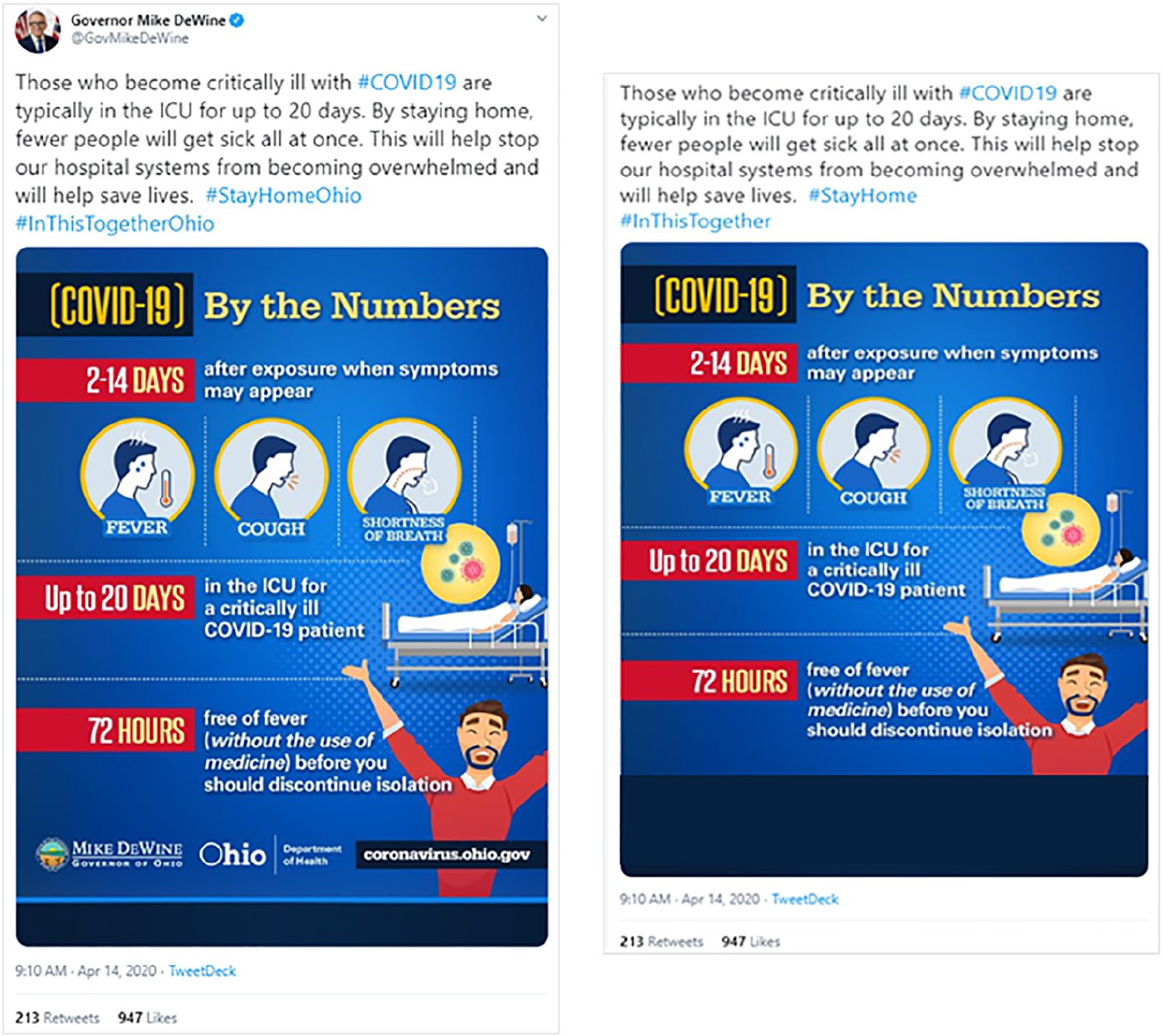
Example tweet from conservative governor condition (left panel) and control condition (right panel), Study 2.
Measures
Manipulation Check
As a manipulation check, we assessed perceptions of the tweeter’s political ideology, “How would you rate the political orientation of the person who wrote the tweets presented earlier in this study?” from 1 (strong liberal) to 7 (strong conservative).
Trust and Perceived Accuracy of Tweets
To assess the proposed mediator of trust, participants rated, “How much do you trust the information expressed in the tweets?” from 1 (not at all) to 7 (extremely). Participants also responded to an adaptation of Pennycook and Rand’s (2020) single-item measure of perceived accuracy, rating, “To the best of your knowledge, how accurate are the claims in the tweets you just read?” from 1 (not at all accurate) to 7 (very accurate).
Social Distancing Intentions
Participants then completed the same two social distancing questions from Study 1 (r = .77).
Support for Protests Against Social Distancing
As an exploratory measure we assessed support for protests against social distancing, asking “In a number of places across the United States, there have been protests against Social Distancing and Stay-at-Home orders. Protestors have been pushing for the immediate reopening of the economy. Please indicate the extent to which you are for or against these protests in the questions below” (0 = “I am not in support of these protests” to 100 = “I am in full support of these protests”) and “Please indicate the extent to which you would be willing to engage in one of these protests” (0 = “I would never engage in one of these protests” to 100 = “I would definitely engage in one of these protests”). These two items were positively correlated (r = .60) and averaged to create a score of support for protests against social distancing.
Political Ideology and Demographics
As in Study 1, we assessed political ideology using the two items from Wetherell and colleagues (2013; r = .82). Last, we measured the same demographic variables as in Study 1.
Additional Measures
We also assessed general concern about COVID-19 with two items taken from Pennycook et al. (2020), and general trust in science and intellectual humility with the same scales used in Study 1, αs = .95 and .86, respectively. 3 Finally, to ensure that results were not affected by residents of Ohio, we assessed whether participants were current residents of Ohio (measured on a binary yes/no scale). Controlling for this variable did not change our findings and we did not include it in final models.
Manipulation Check: Perceived Political Ideology of Tweeter
As expected, participants perceived Governor DeWine as significantly more conservative (M = 4.89, SD = 1.29) than the author of the control tweets (M = 3.32, SD = 1.45), t(355) = −10.66, p < .001. Within condition, Governor DeWine was perceived as significantly more conservative than the midpoint (4), t(158) = 8.73, p < .001, whereas the control government official was perceived as significantly more liberal than the midpoint, t(197) = −6.56, p < .001.
Effect of Tweeter Ideology Manipulation on Social Distancing Intentions
Next, we tested whether the manipulation affected participants’ social distancing intentions. We built a linear regression model with social distancing intentions regressed on participants’ political ideology (mean centered), tweeter ideology condition (0 = control, 1 = conservative governor), and the interaction term. In this model, conservative participants had lower social distancing intentions (B = −4.66, SE = 0.68, t = −6.90, p < .001), replicating our finding from Study 1. There was also a significant main effect of tweeter ideology condition (B = 5.20, SE = 2.01, t = 2.59, p = .010), such that those in the conservative governor condition had higher social distancing intentions (See Table 2 for full test statistics).
Test statistics for moderation model showing social distancing intentions as a function of political ideology and tweeter ideology condition, Study 2.

Note. Unstandardized coefficients are reported; model R2 = .15.
In line with our hypothesis, the interaction between political ideology and tweeter ideology condition on social distancing intentions was also significant, B = 2.30, SE = 1.02, t = 2.26, p = .024 (see Figure 3). Simple effects showed that conservatives (+1SD) reported lower social distancing intentions than liberals (–1SD) in the control condition, B = −4.66, SE = 0.68, t = −6.90, p < .001, CI = [−5.99, −3.33], but this difference between conservatives and liberals was smaller (albeit still significant) in the conservative governor condition, B = −2.36, SE = 0.76, t = −3.10, p = .002, CI = [−3.86, −0.86]. Examining this interaction differently, there was a significant effect of tweeter ideology condition on social distancing intentions for conservatives, such that conservatives in the conservative governor condition reported greater social distancing intentions than conservatives in the control condition, B = 9.74, SE = 2.83, t = 3.44, p < .001, CI = [4.18, 15.31]. However, there was no effect of tweeter ideology condition for liberals, B = 0.63, SE = 2.86, t = 0.22, p = .827, CI = [−5.00, 6.25].

Social distancing intentions as a function of political ideology and tweeter ideology condition, Study 2.
Effect of Tweeter Ideology Manipulation on Trust and Accuracy
We next tested the effect of the tweeter ideology condition on perceived accuracy of the tweets, entering tweeter ideology condition, political orientation, and their interaction term into a linear regression. In this case, there was no effect of condition on perceptions of accuracy, but liberals were more likely to perceive the tweets as accurate than conservatives (B = −0.10, SE = 0.04, t = −2.51, p = .013), replicating prior research (Gollwitzer et al., 2020).
However, tweeter condition significantly affected trust in the tweeted information, with participants reporting more trust in the conservative governor’s tweets than in the control tweets (B = 0.57, SE = 0.14, t = 4.07, p < .001). No interaction with political ideology emerged, (B = 0.03, SE = 0.07. t = 0.42, p = .678), suggesting that the conservative governor condition led to higher ratings of trust among both conservatives and liberals. This is possibly due to the tweets appearing more official and less uncertain, with an identified and possibly familiar governor, as might be predicted by mere exposure effects (see Harmon-Jones & Allen, 2001). Trust in tweets also acted as a significant predictor of social distancing intentions (B = 8.30, SE = 0.66, t = 12.52, p < .001).
Mediation Through Perceived Tweeter Ideology and Trust in Tweets
We next tested whether our manipulation of the tweeter’s ideology impacted social distancing intentions by increasing trust in the tweets. To ensure that the indirect effect through trust was due to conservatives seeing DeWine’s tweets as more ideologically aligned with their own (rather than just more official compared to the control condition), we tested an exploratory moderated serial mediation model whereby condition affected perceptions of the governor’s ideology, which then predicted trust, and in turn, social distancing intentions among conservatives but not liberals. Specifically, we reasoned that governor condition would cause all participants to perceive the governor as more conservative, and that these perceptions would increase conservatives’ trust in the information presented in the tweets, which would then boost conservatives’ social distancing intentions.
We tested this using model 92 in PROCESS version 3.4 (Hayes, 2017). Tweeter ideology condition was the predictor (X), perceived tweeter ideology (M1) and trust in the tweeted information (M2) were the serial mediators, social distancing was the outcome (Y), and political ideology (W) was a tested as a moderator of all paths. As expected, the indirect effect from condition to perceived ideology, to trust, and ultimately, to social distancing intentions, was significant for conservatives (indirect effect = 4.33, SE = 1.48, CI = [1.74, 7.54]) but not for liberals (indirect effect = −62, SE = 0.49, CI = [−1.74, .20]).
As seen in Figure 4, the association between perceptions of the tweeter’s ideology and trust in the tweeted information was moderated by participants’ political ideology (p < .001), such that seeing the governor as more conservative predicted increased trust among conservatives (effect = 0.36, SE = .07, CI = [0.22, 0.49]) but not liberals (effect = −0.10, SE = 0.08, CI = [−0.26, 0.05]). In addition, the path between trust and social distancing intentions was moderated by political ideology (p < .001), such that conservatives reported higher social distancing intentions when they trusted the tweets more (effect = 9.65, SE = 0.81, CI = [8.05, 11.26]), whereas this link was weaker for liberals (effect = 3.39, SE = 0.97, CI = [1.48, 5.30]). 4

Moderated mediation of tweeter ideology condition on social distancing intentions through perceived tweeter ideology and trust in tweeted information, Study 2.
Support for Protests Against Social Distancing
Although there was a significant effect of political ideology on this exploratory measure (B = 6.95, SE = 0.75, t = 9.30, p < .001), neither the effect of tweeter ideology condition nor the interaction with political ideology were significant (ps > .360). However, we tested the same moderated serial mediation model as we tested for social distancing intentions. As seen in Figure 5, this model yielded a significant indirect effect that was conditional on participants’ political ideology, such that the indirect effect from tweeter condition to support for protests through perceived tweeter ideology and then trust in the tweeted information was significant for conservatives (indirect effect = −3.50, SE = 1.20, CI = [−6.07, −1.45]) but not for liberals (indirect effect = 0.46, SE = 0.40, CI = [−0.14, 1.39]).

Moderated mediation of tweeter ideology condition on support for protests through perceived tweeter ideology and trust in tweeted information, Study 2. *** p < .001; ** p < .01; * p < .05; †p < .10.
Again, we found that the association between perceptions of the tweeter’s ideology and trust in the tweeted information was moderated by participants’ political ideology (p < .001), such that seeing the governor as more conservative predicted increased trust among conservatives (effect = 0.36, SE = 0.07, CI = [0.23, 0.50]) but not liberals (effect = −0.10, SE = 0.08, CI = [−0.26, 0.06]). The path between trust in the tweeted information and support for protests was also moderated by participants’ political ideology (p = .001), such that conservatives reported lower support for protests when they reported increased trust in the tweets (effect = −7.64, SE = 1.02, CI = [−9.64, −5.63]), whereas this link was significant but weaker for liberals (effect = −2.52, SE = 1.22, CI = [−4.92, −0.12]).
Discussion
Study 2 extended the findings from Study 1 by providing experimental evidence that enhancing trust in specific communication regarding the science of social distancing increased conservatives’ social distancing intentions. Conservatives who read tweets providing science-based recommendations to socially distance reported stronger intentions to socially distance when those tweets were authored by a conservative governor. This effect was mediated by their perceptions of the tweeter’s ideology and trust in the information provided in the tweets, highlighting the important role played by trusting the science behind prevention guidelines. A similar moderated mediation pattern was found for support for anti-social distancing protests, suggesting that low trust might have been a motivating factor behind the conservative-led protests occurring in over half of the states.
General Discussion
Curtailing the spread of COVID-19 depends on widespread compliance with social distancing recommendations, but compliance tends to be lower among conservatives than liberals (Gollwitzer et al., 2020). Our research examined one contributor to this phenomenon and a method for closing the gap in compliance. In Study 1, conservatives with high trust in science reported complying with social distancing recommendations to the same extent as liberals. In Study 2, increasing conservatives’ trust in science-based recommendations about social distancing by having a conservative deliver the recommendations boosted conservatives’ intentions to social distance.
This research helps us understand the psychology behind social distancing intentions in several ways. Aligned with prior research, we found that, although intentions to socially distance were relatively high among both liberals and conservatives, conservatives tended to have lower intentions to socially distance than liberals. This research is thus part of a growing body of evidence identifying a consistent ideological gap in social distancing (Gollwitzer et al., 2020; Plohl & Musil, 2020; Rosenfeld, 2020; Rothgerber et al., 2020); evidence that is critical to understanding factors that might contribute to further spread of the virus. For example, reduced compliance with social distancing recommendations in strongly pro-Trump counties was associated with a 27% higher growth rate in COVID-19 infections in those counties, revealing the importance of increasing conservatives’ social distancing behavior (Gollwitzer et al., 2020). However, despite ideological differences in social distancing, conservatism itself is not incompatible with engaging in preventative measures during a public health crisis. Indeed, social conservatism has been found to be associated with taking more COVID-19 preventative measures (due to stronger pathogen avoidance), but only among Democrats (Samore et al., 2020). Among Republicans, the association between social conservatism and preventative action is suppressed by other factors, such as lower trust in scientists and less consumption of liberal media. This suggests that enhancing trust in the science around COVID-19 and increasing exposure to sources that support preventative measures can foster use of these measures.
In support of this, we found that those who reported greater trust in science were more likely to endorse social distancing guidelines. Notably, we found this association for both conservatives and liberals, suggesting that trust in science supports intentions to social distance regardless of ideology. This finding suggests that interventions aimed at increasing trust in science – both generally and in the context of specific issues – might have far-reaching benefits, not only for those with a conservative ideology.
In addition, we found that one way to increase conservatives’ trust in messages regarding the science of social distancing, and thereby reduce the ideological intentions gap in social distancing, was to have a conservative explicitly endorse social distancing recommendations. Indeed, conservatives who read tweets by a conservative governor reported social distancing intentions that were 13% higher than those reported by conservatives in the control condition. This finding adds to emerging research demonstrating that theory-based interventions (e.g., inducing empathy) show promise for increasing social distancing (Lunn et al., 2020; Pfattheicher et al., 2020).
The current studies had several limitations, and the prospect of addressing these limitations offers interesting directions for future research. One limitation is that we did not manipulate trust in science directly, but rather manipulated the ideology of the communicator as a way to increase conservatives’ trust. Doing so provided high levels of external validity, as we used real tweets by a conservative governor – messages that the people of Ohio (and others) were actually exposed to. Moreover, the mediation model we tested offers support for the importance of trust in driving the increase in social distancing intentions. However, the possibility remains that the conservative governor condition increased social distancing intentions via other psychological mechanisms. Future work could test other methods for increasing trust in science to provide more experimental evidence for the importance of this moderator. Several strategies for increasing trust in the science concerning climate change have already been tested. For example, van der Linden and colleagues (2017) found support for inoculating the public against climate change misinformation by preventing weaker forms of common arguments, and Howe and colleagues (2019) found that acknowledging uncertainty when predicting the effects of climate change increases trust in these scientific predictions. Future work should explore how these other approaches compare to the approach we used here, and possibly develop a broader picture of effective strategies for increasing trust in science across a variety of contexts.
A second limitation is that we assessed self-reported intentions to socially distance and therefore do not know whether participants’ reports of their intentions manifested in their actual behaviors. Assessing intentions aligns with other research on social distancing (Pfattheicher et al., 2020; Plohl & Musil, 2020; Rothgerber et al., 2020), and has the benefit of being highly feasible and efficient. Further, in a recent analysis that used over 17 million smartphone GPS coordinates, self-reports of social distancing were highly correlated with behavioral social distancing assessed by GPS tracking (Gollwitzer et al., 2020). However, future research could build upon ours by complementing assessments of behavioral intentions with assessments of actual behavior.
Despite these limitations, the current findings have several important practical implications. These findings reveal the important role that political leaders play in fostering compliance with science-based messages. Leaders expressing their support for and trust in science can encourage their constituents to do the same. This is critically important in the current moment, when following scientific recommendations can reduce the spread of COVID-19 and consequently save countless lives. Our findings point to the likelihood that conservatives’ lower compliance with social distancing recommendation stems from the messages they have received from their leaders, and highlight the need for public health messaging to transcend the current political divide in order to promote behavior that is in the best interest of the larger population.
The current findings also point to the powerful effects of how scientific messages are framed. Previous studies have found that framing messages as ideologically concordant can make them more persuasive (Feinberg & Willer, 2015). In a similar way, we found that messages that are communicated by someone who shares your ideology can make them more persuasive. However, because many conservative leaders are unlikely to offer science-based recommendations to socially distance and engage in other preventative measures, it would be useful to explore ways that the medical and scientific communities can frame messages to increase trust in science among conservatives. For example, recent research has found that both conservatives and liberals are more persuaded by messages that describe reciprocity to healthcare workers, use expert scientific advice, appeal to empathy, focus on victims of the virus, make other-focused appeals, and focus on the threat to the public (Jordan et al., 2020; Luttrell & Petty, 2020; Pink et al., 2020).
The current moment calls for increased and immediate adherence to scientific recommendations aimed at reducing the spread of COVID-19. In one of the clearest demonstrations of the costs of political polarization in the United States, the pandemic is revealing the deadly risks associated with the political divide (Van Bavel, 2020). In these studies, we provided insight into a factor that can help close this divide, demonstrating that increasing conservatives’ trust in the science behind prevention strategies might be key to promoting public health and safety in response to COVID-19.
