




Abstract
The rise of far-right movements calls for greater understanding of how the public responds to such movements. In the context of the United States, we examined the role of normative beliefs about the Alt-Right in shaping public reactions toward the movement (three studies, total N = 1,379). Specifically, we examined how perceived prevalence (high descriptive norms) and acceptability (high injunctive norms) of the Alt-Right are linked to public attitudes toward that movement. We found limited evidence of a threat response—that is, perceived prevalence of the Alt-Right did not consistently predict more negative reactions toward it, such as fearing its potential harm to society. There was, however, more consistent evidence of a normalization response—that is, perceived acceptability of the Alt-Right predicted more positive reactions toward it, such as showing leniency toward their activities. These findings underscore the importance of far-right movements in possibly shaping normative standards in society, and how such norms are linked to public attitudes.
Keywords
I wouldn’t want to go back to the old White nationalism when no one was listening to us . . . I want to be in a place where our ideas are entering the mainstream.
In recent years, there has been a notable growth in far-right movements across established liberal democracies. In the United States (U.S.), the Alt-Right, or alternative-right, has emerged as a new political movement that includes a variety of far-right, White nationalist groups that believe White identity is under attack and needs to be protected (Hartzell, 2018). The Alt-Right has its roots in a long tradition of White supremacist groups in the U.S. since the 19th century. It is also ideologically linked to far-right identitarian movements that originated in France and later spread throughout Europe in the aftermath of World War II to defend the rights of Europeans to territories claimed to belong to them (Atkinson, 2018). The ideology of the Alt-Right is characterized by advocating for a culturally and ethnically homogenous society for White people, while at the same time opposing multiculturalism and egalitarianism (Main, 2018). Alt-righters have largely mobilized online, attracting mostly anonymous supporters, and have no formal organization or clear membership criteria (Berger, 2018; De Koster & Houtman, 2008; Hartzell, 2018).
Commentators have noted that after the election of Donald Trump as U.S. president in 2016 (who served as president until 2021), members of the Alt-Right had become emboldened and legitimized to act, with hopes of affecting the political agenda (Berger, 2018; Posner, 2016). The “Unite the Right” rally in Charlottesville, Virginia in August 2017 was one of the largest rallies organized by White nationalists in recent decades, further bringing the Alt-Right to the public eye (Daniels, 2018; Heim, 2017). As noted in the opening quote by Richard Spencer, who is credited with first coining the term “Alt-Right” in 2008, the movement has appeared to become more mainstream in recent years. Between 2014 and 2016, the Alt-Right gained prominence as an alternative to neoconservative ideology in mainstream U.S. politics, including the Republican Party, which was viewed as inadequate in pushing for the interests of White people (Daniels, 2018; Main, 2018). After Trump lost reelection in 2020 to Joe Biden, many Trump supporters, including White nationalists who were part of the Alt-Right, stormed the U.S. Capitol building in an attempt to overturn the outcome of the election (Barry et al., 2021; S. Smith, 2021). While the Alt-Right has received increased public attention in recent years, there is limited understanding of societal attitudes around the movement.
Understanding public responses to the Alt-Right is important because it allows us to assess the potential societal consequences of far-right mobilization and take seriously the possibility that fringe movements can influence mainstream politics. Like most social movements (Benford & Hunt, 1992; Giugni, 1998; Tarrow, 2011), when Alt-Righters gather in public spaces during collective action, their visibility is at least in part intended to evoke a response from the public. We propose that the Alt-Right’s public presence may have important normative consequences. It is possible that the Alt-Right is viewed as becoming increasingly prevalent in society (i.e., high descriptive norm), in terms of becoming more active and attracting more members. At the same time, the Alt-Right may also be viewed as becoming more accepted by the American public (i.e., high injunctive norm), in terms of having more people respecting their views and supporting their right to express them.
Since perceptions of prevalence and acceptability of the Alt-Right signal different normative standards, these perceptions may have divergent downstream links to public attitudes toward the movement. On the one hand, greater prevalence of the far-right suggests that such fringe movements are gaining power and should be stopped—which is a threat response. On the other hand, greater acceptability of the far-right suggests that fringe movements are a common or ordinary part of society and should be tolerated—which is a normalization response. We therefore predicted that greater beliefs in the prevalence of the Alt-Right (i.e., high descriptive norm) will be linked to more negative public reactions toward the movement, whereas greater beliefs in the acceptability of the Alt-Right (i.e., high injunctive norm) will be linked to more positive public reactions toward it. Taken together, the present research aimed to examine whether and how perceived norms around the Alt-Right movement are linked to people’s personal attitudes toward the Alt-Right.
Social Norms
Social attitudes and behaviors are often guided by social norms. What constitutes social norms? Cialdini et al. (1990) argued that norms are far from unitary constructs (see also Cialdini, 2003; Cialdini et al., 1991; Jacobson et al., 2011). Social norms reflect two components: perceptions of what others typically do (descriptive norms) and perceptions of what others should do (injunctive norms). Descriptive norms influence people’s behaviors because they inform them about what others are doing. By conveying what is typical or prevalent in a particular society, descriptive norms can encourage conformity. Injunctive norms, on the other hand, include a value judgement and influence people’s attitudes by creating social pressure to act in a certain way. In line with these ideas, prior research has shown that both descriptive and injunctive norms can jointly and interactively influence social attitudes and behaviors (e.g., Schultz et al., 2007; J. R. Smith & Louis, 2008; J. R. Smith et al., 2012).
Descriptive Norms
Descriptive norms typically encourage behaviors in line with the norm—that is, people tend to adopt the behaviors that others are presumably engaging in frequently or habitually (for a review, see McDonald & Crandall, 2015). In particular, people tend to be highly compliant with the norms of the groups to which they belong (i.e., their ingroups; J. R. Smith & Louis, 2008; White et al., 2009). However, when a threatening group to which they do not belong (i.e., an outgroup) appears to be gaining power and becoming a more integral part of society, reflecting a high descriptive norm, people may reject that group (Hornsey et al., 2003). In particular, Louis et al. (2010) found that among opponents of a conservative social movement in Australia, perceiving that the social climate was becoming more conservative predicted increased willingness to speak out and actively resist the change.
In the case of the Alt-Right, it is an ultra-conservative and explicitly racist group that is largely incongruent with mainstream American values of egalitarianism (De Koster & Houtman, 2008; Simi & Futrell, 2015). The movement also goes against mainstream norms to be (or at least, appear) nonracist and nonprejudiced, in a society with norms of egalitarianism (Crandall et al., 2002). Specifically, White people tend have an aversion to being labelled as “racist” (Bonilla-Silva, 2006), have concerns about confirming the “White racist” stereotype (Goff et al., 2008), and have both intrinsic and extrinsic motivations to respond without prejudice during interpersonal interactions with racial minorities (Plant & Devine, 1998). The norm to be nonprejudiced is so strong that Trump supporters do not see themselves as racist even though they explicitly support policies that perpetuate racial injustice and inequality (Lopez, 2019; Scott, 2019). Thus, egalitarianism is broadly valued in American society. For these reasons, perceiving the Alt-Right—an explicitly racist and antiegalitarian group—as becoming a more prominent feature of American society may elicit public mobilization against them. Thus, we hypothesized that perceived prevalence of the Alt-Right (high descriptive norm) would be related to more negative public reactions toward the movement—in line with a threat response.
Injunctive Norms
Ample research has shown that people’s attitudes towards social groups are shaped by injunctive norms—what people believe to be acceptable in present-day society. The literatures on social norms and prejudice have shown that asking people whether it is socially acceptable to be biased against a group (an injunctive norm) is a strong predictor of whether people personally express bias against that group. This is because perceived norms about whether prejudice is socially acceptable shape people’s views about the attitudes they should hold. Expression of prejudice is highly correlated with whether prejudice towards those groups is socially sanctioned (Blanchard et al., 1994; Crandall et al., 2002). For example, classic work by Blanchard et al. (1994) showed that exposure to someone who condemned racism led people to adopt stronger antiracist attitudes themselves (see also Masser & Phillips, 2003). This work explains how the injunctive norm of being nonprejudiced influences people’s personal attitudes. By extension, people are likely to express tolerance towards groups that others in society also appear to tolerate.
Prior research has also found that after a once-marginalized far-right political party won the elections in France, people were less willing to express their views against that party when they perceived that others in their social environment were supportive of the party (Portelinha & Elcheroth, 2016). Related research on desensitization has shown that encountering hate speech promotes less sensitivity to it, which in turn increases prejudice towards the targets of hate speech (Soral et al., 2018). It is possible that this is in part because repeated exposure to hate speech makes it seem normal and acceptable in society (see Soral et al., 2020). By extension, we hypothesized that greater perceptions that the Alt-Right is tolerated by American society (high injunctive norm) would be related to more positive public reactions toward the movement—in line with a normalization response.
Public Reactions to the Alt-Right
Pro-Alt-Right Reactions
We assessed attitudes toward the Alt-Right in various ways. Pro-Alt-Right reactions were not about explicit support for it per se (in terms of showing support or willingness to become a member of the movement), but about showing leniency to the Alt-Right’s mobilization efforts and being sympathetic to their ideology. Pro-Alt-Right reactions tapped into tolerance of their activities and ideas, but not necessarily explicit support for, or willingness to join, the movement. To use the words of Horton (1996, p. 26) in how tolerance is described, we conceptualized pro-Alt-Right attitudes as being about the “deliberate decision to refrain from prohibiting, hindering, or otherwise coercively interfering with conduct of which one disapproves.” Our conceptualization therefore mirrors recent work on tolerance of racism, which captures the phenomenon whereby people may not personally express racist beliefs but are nonetheless lenient when it comes to racism: they are likely to go along with racist acts and show less concern about the consequences of racism (Hunt et al., 2021). One way to show tolerance and leniency towards the Alt-Right is by believing that their speech qualifies as free speech, no matter how inflammatory it may seem (Uyehara, 2018). A prominent argument for allowing inciting or hateful language is that it falls within people’s right to free speech—a hallmark of democratic societies. However, people can use free speech to defend racist actions (White II & Crandall, 2017). For example, when a Ku Klux Klan rally was framed as a free speech issue rather than a disruption of public order, people showed more tolerance of the rally (Nelson et al., 1997), suggesting that conceiving of the Alt Right’s speech as free speech means that people may be more tolerant of the movement’s protest activities.
Beyond tolerating the Alt-Right’s mobilization, another measure of pro-Alt-Right reactions is by “giving in” to their ideological beliefs, in particular, being sympathetic towards the idea that White people face discrimination and prejudice. Evidence suggests that White Americans are becoming increasingly concerned about threats to their dominant position within the social hierarchy (Newkirk, 2017). When racial minorities are perceived as making social and economic progress, it is associated with perceptions of anti-White bias (Wilkins & Kaiser, 2014), that is, believing that White people are now victims of racial bias. This perception of “reverse racism” is in line with core beliefs of the Alt-Right: the movement’s adherents tend to show high levels of concern over discrimination against White people (Forscher & Kteily, 2020) and argue for the protection of White people’s rights and privileges (Hartzell, 2018). Taken together, our conceptualization of pro-Alt-Right reactions includes support for Alt-Right speech as free speech, tolerance of Alt-Right protest activities, and perceptions of anti-White bias.
Anti-Alt-Right Reactions
Negative attitudes in response to the Alt-Right were also not about directly opposing or restricting the movement, but about fearing the possible harm that they can inflict on society, especially on minority and low-status groups frequently targeted by them. In fact, a prominent argument amongst antiracist protesters that mobilized against Alt-Right rallies was that the movement’s speech should qualify as hate speech (Gottbrath, 2018; Zine, 2018). Prior work has shown that priming values of equality promoted stronger beliefs in the harm of hate speech (Cowan et al., 2002), suggesting that concerns about that kind of speech are linked to the goal of promoting social equality because it helps prevent minority and low-status groups from being unfairly targeted. In addition to concerns about hate speech, emotional reactivity in response to the Alt-Right is also an indicator of negative attitudes toward the movement. This insight is important because exposure to hate speech can promote desensitization, whereby people become less emotionally responsive to hate speech, for example, by being less offended by overtly prejudiced remarks (Leets, 2001; Soral et al., 2018) or disparaging humor (Ford & Ferguson, 2004).
As mentioned earlier, people may feel threatened by the Alt-Right because they represent values that are inconsistent or incompatible with the value of the ingroup—in this case, American values of equality, diversity, and inclusivity. Threat also includes practical concerns about the safety and well-being of fellow ingroup members. Extensive research has shown that people are motivated to reject groups that are perceived as a threat to the ingroup (for a review, see Riek et al., 2006). Further, anti-Alt-Right reactions involve showing increased support for prominority policies that aim to protect groups that are targeted by that movement. In response to racist behaviors among ingroup members, people tend to distance themselves from their ingroup and instead show support for affected outgroups (Berndsen & Gausel, 2015). When advantaged group members become concerned over the treatment of disadvantaged groups, they show increased support for prominority policies (Iyer et al., 2007; Leach et al., 2006). This suggests that people are willing to counter-mobilize to defend the rights of vulnerable minorities, which is in line with work on solidarity-based collective action and allyship (Droogendyk et al., 2016; Thomas et al., 2009). Taken together, our conceptualization of anti-Alt-Right reactions encompassed perceived harm of Alt-Right speech, emotional reactivity, threat from the Alt-Right, and support for prominority policies.
Overview of the Present Research
To summarize, the goal of the present research was to examine whether normative beliefs about the prevalence (i.e., descriptive norms) and acceptability (i.e., injunctive norms) of the Alt-Right were linked to people’s personal attitudes toward the movement (i.e., pro- and anti-Alt-Right reactions). We examined this question across three online survey studies conducted with convenience samples of the U.S. public. Study 1 was a correlational study which examined whether and how normative beliefs about the Alt-Right’s prevalence and acceptability in society were linked to personal attitudes towards the movement. Study 2 manipulated perceived norms—both perceived prevalence and acceptability of the Alt-Right—to test if they are distinguishable constructs, and to examine their effects on personal attitudes toward the movement. Study 3 manipulated perceived norms around acceptability of the Alt-Right and included a control (baseline) condition to assess the direction of effects on personal attitudes toward the movement, while keeping constant people’s perceived norms around the prevalence of the Alt-Right. All survey material, data, and analysis code are available on the Open Science Framework (https://osf.io/pt32u/).
Study 1
Using a correlational design, Study 1 explored whether and how normative beliefs about the Alt-Right (i.e., perceived prevalence and acceptability of the movement) are linked to personal attitudes towards the movement (i.e., pro- and anti-Alt-Right reactions).
Participants and Procedure
A total of 308 American participants were recruited from Amazon Mechanical Turk to complete a survey advertised as “Opinions on Current Social Issues.” We deleted six entries with duplicate IP addresses and MTurk IDs, leaving 302 participants for analysis. Participants’ age ranged from 20 to 71 years (M = 39.66, SD = 12.33; three did not specify their age). There were 180 female participants, 121 were male, and one did not report this information. In terms of race, most participants identified as White (95.68%; n = 288), and in terms of ethnicity, most were non-Hispanic (96.68%; n = 291). There were four participants who identified as Native American, three as Asian, three as Black/African American, two as Native Hawaiian/Pacific Islander, one as mixed race, and one did not report race. No participants reported being a member of the Alt-Right.
Measures
Perceived prevalence
Perceived prevalence of the Alt-Right (descriptive norms; α = .92; five items) was measured by asking participants about their opinion on the current situation in the United States regarding the Alt-Right. For example, participants responded to the stem “The Alt-Right in the U.S. is . . .” on a 9-point scale with various anchors (e.g., 1= not prevalent at all, 9 = very prevalent; 1 = not common at all, 9 = very common).
Perceived acceptability
Perceived acceptability of the Alt-Right (injunctive norms; α = .98; five items) was measured by asking participants to indicate their perceptions of how other Americans feel about the Alt-Right. For example, participants responded to the stem “I believe that most Americans find the Alt-Right . . .” on a 9-point scale with various anchors (e.g., 1 = unacceptable, 9 = acceptable; 1 = intolerable, 9 = tolerable).
Reactions toward the Alt-Right
All items were measured on visual analogue scales (1 = strongly disagree, 9 = strongly agree), unless noted otherwise.
Pro-Alt-Right reactions
Participants indicated the extent to which they thought Alt-Right speech should be protected as free speech (α = .96; six items), using items adapted from Cowan et al. (2002; e.g., “I think that the ideas and beliefs the Alt-Right has expressed in public are about free exchange of ideas, and must be allowed in a free society”).
Participants rated the extent to which they thought the Alt-Right should be allowed to promote their ideas in the public sphere (tolerance of the Alt-Right; α = .92; three items), using items adapted from Skitka et al. (2004; e.g., “hold public rallies, demonstrations, or protests”) on a 9-point scale (1 = no, absolutely not, 9 = yes, absolutely).
Participants rated to what extent they perceived anti-White bias (α = .92; four items), using items adapted from Wilkins and Kaiser (2014; e.g., “Prejudice and discrimination against White people are on the rise”).
Anti-Alt-Right reactions
Participants indicated the extent to which they thought the speech of the Alt-Right can cause harm (α = .94; six items), using items adapted from Cowan et al. (2002; e.g., “I think that the ideas and beliefs the Alt-Right has expressed in public can violate the civil rights of groups that are targeted by it”).
Participants were asked to report the extent to which they felt various negative emotions when thinking about the Alt-Right (emotional reactivity; α = .96; nine items: e.g., disturbed, upset, irritated), on a 9-point scale (1 = not at all, 9 = very much).
Participants rated the extent to which they felt threatened by the Alt-Right (α = .93; five items), using items adapted from Brambilla et al. (2013; e.g., “The Alt Right represents values that are not compatible with American values”).
Participants rated the extent to which they supported or opposed various efforts to improve the situation of racial and ethnic minorities in the U.S. (α = .92; six items; e.g., “Providing more funding for cultural centers and organizations dedicated to minorities”), on a 9-point scale (1 = strongly oppose, 9 = strongly support).
Demographics
Participants were asked to report their age (in years), gender, racial identity, ethnicity (whether they were Hispanic), and political conservatism (α = .93; three items; 1 = very liberal, 9 = very conservative): “In general, I am . . .”; “Regarding economic issues (e.g., taxes, minimum wage), I am . . .”; and “Regarding social issues (e.g., multiculturalism, immigration), I am . . .”
Results
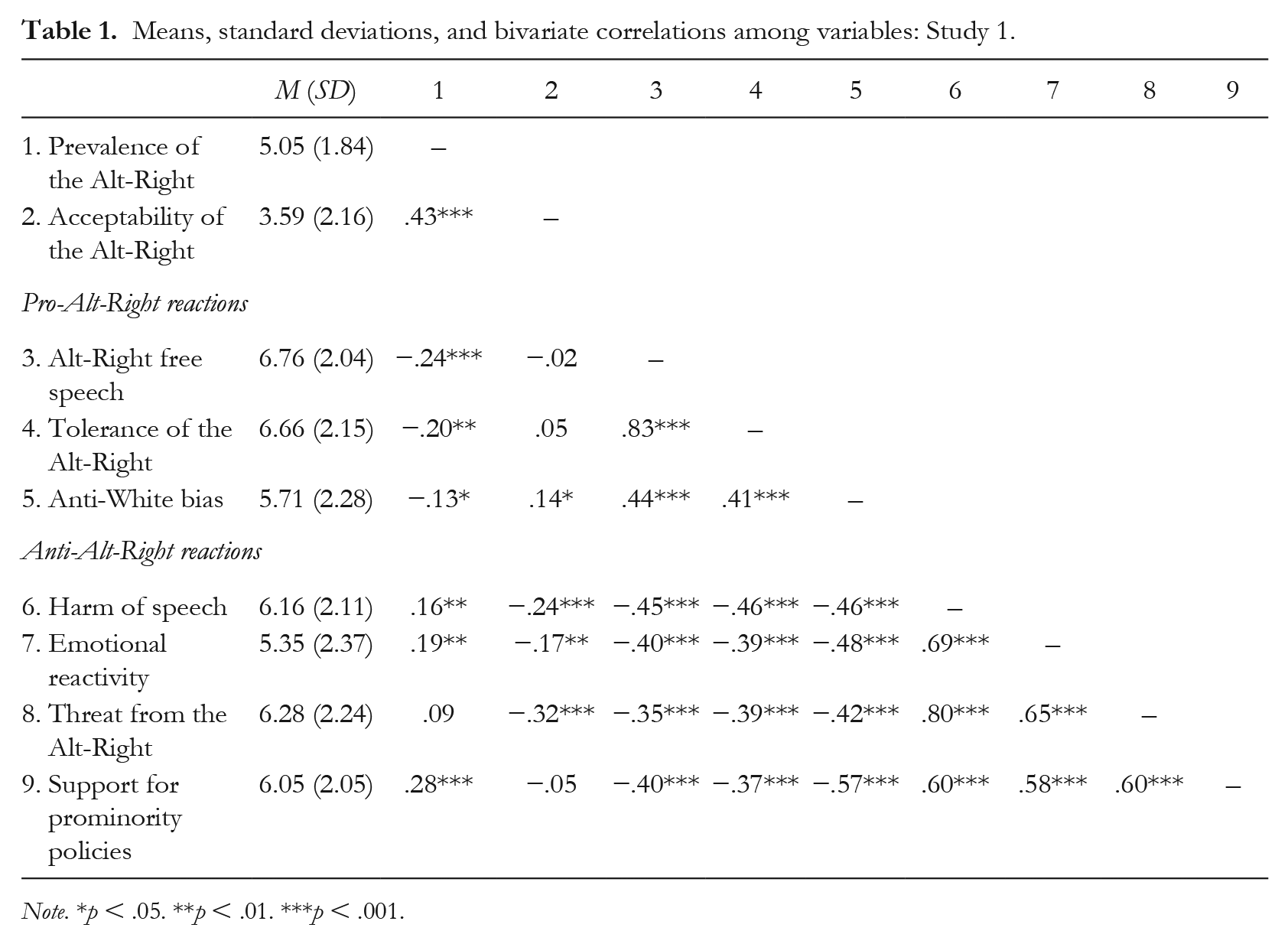
Means, standard deviations, and bivariate correlations between the variables are displayed in Table 1. We used the PROC CALIS procedure in SAS 9.4 to conduct confirmatory factor analysis (CFA) and path analysis.
Means, standard deviations, and bivariate correlations among variables: Study 1.
Note. *p < .05. **p < .01. ***p < .001.
Capturing reactions toward the Alt-Right: CFA
We conducted a two-factor CFA for the reaction measures, whereby the composite measures of (a) perceptions of Alt-Right speech as free speech, tolerance of the Alt-Right, and perceptions of anti-White bias loaded onto the first latent factor (i.e., pro-Alt-Right reactions), and (2) perceptions of harm of Alt-Right speech, emotional reactivity, threat from the Alt-Right, and support for prominority policies loaded onto a second latent factor (i.e., anti-Alt-Right reactions). The errors of the measures within each latent factor were freely estimated. The correlation between the two latent factors was also freely estimated. The model fit was acceptable, χ2(4) = 15.36, p = .004, SRMR = .02, RMSEA = .10, NFI = .99, CFI = .99. All the unstandardized parameter estimates were significant at p < .001, and b ranged from 0.93 to 1.40. Thus, we created composite measures of pro-Alt-Right (α = .79) and anti-Alt-Right (α = .88) reactions. The two resulting reaction variables were negatively correlated (r = −.59, p < .001).
How perceived norms relate to reactions toward the Alt-Right: Path analysis
We conducted a path analysis with perceived prevalence and acceptability entered as exogeneous variables, and pro- and anti-Alt-Right reactions entered as endogenous variables. We modelled perceived prevalence and acceptability of the Alt-Right as simultaneous predictors of pro-Alt-Right and anti-Alt-Right reactions. Since fully saturated models have, by definition, perfect fit, we focused on the direction and significance of the pathways. We allowed the error terms of perceived prevalence and acceptability of the Alt-Right (b = 1.70, SE = 0.25, t = 6.80, p < .001) and the error terms of pro- and anti-Alt-Right reactions to correlate freely (b = −1.64, SE = 0.20, t = −8.37, p < .001), reflecting their theoretical conceptualization as two parts of the same broader construct. The direction and significance of the pathways were as hypothesized (see Figure 1). Greater perceived prevalence of the Alt-Right was linked to lesser pro-Alt-Right reactions (b = −0.31, SE = 0.06, p < .001) and more anti-Alt-Right reactions (b = 0.38, SE = 0.06, p < .001). Greater perceived acceptability of the Alt-Right was linked to more pro-Alt-Right reactions (b = 0.17, SE = 0.05, p < .001) and lesser anti-Alt-Right reactions (b = −0.34, SE = 0.05, p < .001). When we conducted these analyses in general linear models and included demographic variables as covariates (i.e., race, ethnicity, age, political conservatism), the pattern of findings remained the same.

Path model for Study 1.
Discussion
Study 1 found that perceived prevalence and acceptability of the Alt-Right had divergent links to public responses to the movement. Specifically, perceived prevalence of the Alt-Right was linked to more negative reactions toward the Alt-Right, in terms of showing greater concern over the harm that the movement can inflict on society. By contrast, perceived acceptability of the Alt-Right was linked to more positive reactions toward the movement, in terms of showing greater leniency towards their activities.
As a follow-up to Study 1, the goal of Study 2 was to manipulate perceived norms. By doing so, we aimed to examine whether perceived prevalence and acceptability (descriptive and injunctive norms) of the Alt-Right can be disentangled (i.e., manipulated separately) and have divergent links to personal attitudes. First, we sought to replicate the divergent correlational patterns obtained in Study 1 between normative beliefs about the Alt-Right and personal reactions to the movement. Second, we hypothesized causal main effects based on condition. Specifically, we expected lesser pro- and more anti-Alt-Right reactions when there was high perceived prevalence of the movement (i.e., high descriptive norms)—showing a threat effect of the Alt-Right. By contrast, there should be more pro- and lesser anti-Alt-Right reactions when there is high perceived acceptability of the movement (i.e., high injunctive norms)—showing a normalization effect of the Alt-Right. It was also possible that there would be an interaction between perceived prevalence and acceptability of the Alt-Right, whereby the effect of prevalence beliefs on Alt-Right attitudes would depend on whether acceptability beliefs were low or high, but we did not make clear hypotheses about the pattern of possible interaction effects.
Study 2
Method
Participants
A total of 540 valid participants from Amazon Mechanical Turk completed online surveys (age in years: M = 40.30, SD = 12.50, range = 18–80; gender: 328 participants were female, 208 were male, four were nonbinary/third gender). In terms of race, most participants identified as White American (98%, n = 532); three as Black/African American, two as Asian American, two as mixed race, and one as Native American. Overall, 10 participants identified as ethnically Hispanic. Although we initially recruited 809 participants, there were 269 invalid participants, who were excluded for various reasons that were determined a priori (see preregistration at https://aspredicted.org/n5h3a.pdf). Specifically, we excluded 17 entries with duplicate IP addresses and four entries with duplicate MTurk IDs, 101 participants who provided incoherent or wrong open-ended summaries immediately following the manipulation (e.g., copy-pasted the survey instructions, provided answers unrelated to the prompt), 90 participants who failed our inclusion criteria (i.e., 14 were not U.S. citizens, 76 reported identifying with the Alt-Right), and 57 participants that failed at least one manipulation check question. 1
Procedure
We used a 2 (prevalence/descriptive norm: high or low) x 2 (acceptability/injunctive norm: high or low) design. Participants were randomly assigned to one of four conditions (high prevalence, high acceptability: 138; high prevalence, low acceptability: 144; low prevalence, high acceptability: 131; low prevalence, low acceptability: 127). Participants were presented with fictitious but ostensibly real Gallup polling information about the Alt-Right, consisting of two charts (with accompanying texts): one indicative of prevalence of the Alt-Right and one indicative of acceptability of the Alt-Right. To manipulate perceived prevalence of the Alt-Right (descriptive norm), participants were told that Gallup had tracked the number of active organizations that aim to defend White identity, which is a central ideology of the Alt-Right. Participants were randomly assigned to view a line graph of the number of groups endorsing Alt-Right ideology from 1999 to 2017, as either increasing or decreasing over time. In the high prevalence condition, the number of groups increased from 342 to 1,042, whereas in the low prevalence condition, the number of groups decreased from 1,042 to 342.
To manipulate perceived acceptability of the Alt-Right (injunctive norm), participants were told that Gallup had recently conducted a nationally representative survey of Americans, and that the data were representative of the American society on key demographics (e.g., gender, age, race, education, political ideology, geographic location). Participants were randomly assigned to view a bar chart about the extent to which Americans thought the Alt-Right should (or should not) be tolerated, regardless of whether they personally supported or opposed the views of the movement. In the high acceptability condition, the bar chart showed that 68% thought the Alt-Right should be tolerated, 20% thought the Alt-Right should not be tolerated, and 12% reported to not know. In the low acceptability condition, the bar chart showed that 20% thought the Alt-Right should be tolerated, 68% thought the Alt-Right should not be tolerated, and 12% reported to not know. After being presented with the descriptive and injunctive norm manipulation, participants were asked to summarize the polling information that they read, and later proceeded to answer a series of questions about their attitudes towards the Alt-Right.
Measures
Participants responded to the same items used to measure pro- and anti-Alt-Right reactions from Study 1: Alt-Right speech as free speech (α = .97; six items), tolerance of the Alt-Right (α = .93; three items), perceptions of anti-White bias (α = .90; four items), perceived harm of Alt-Right speech (α = .95; six items), emotional reactivity (α = .96; nine items), perceived threat from Alt-Right (α = .94; four items), and support for prominority policies (α = .92; six items). As a manipulation check, at the end of the survey, participants responded to the same items used in Study 1 to measure perceived prevalence (α = .92; five items) and acceptability (α = .96; five items) of the Alt Right. Participants also responded to a series of demographic questions also asked in Study 1 (age, gender, racial identity, ethnicity, political conservatism; α = .93) as well as several additional questions for our inclusion criteria: citizenship status, place of birth, identification with the Alt-Right (“Do you identify with the Alt-Right?”; yes/no), first language.
Results
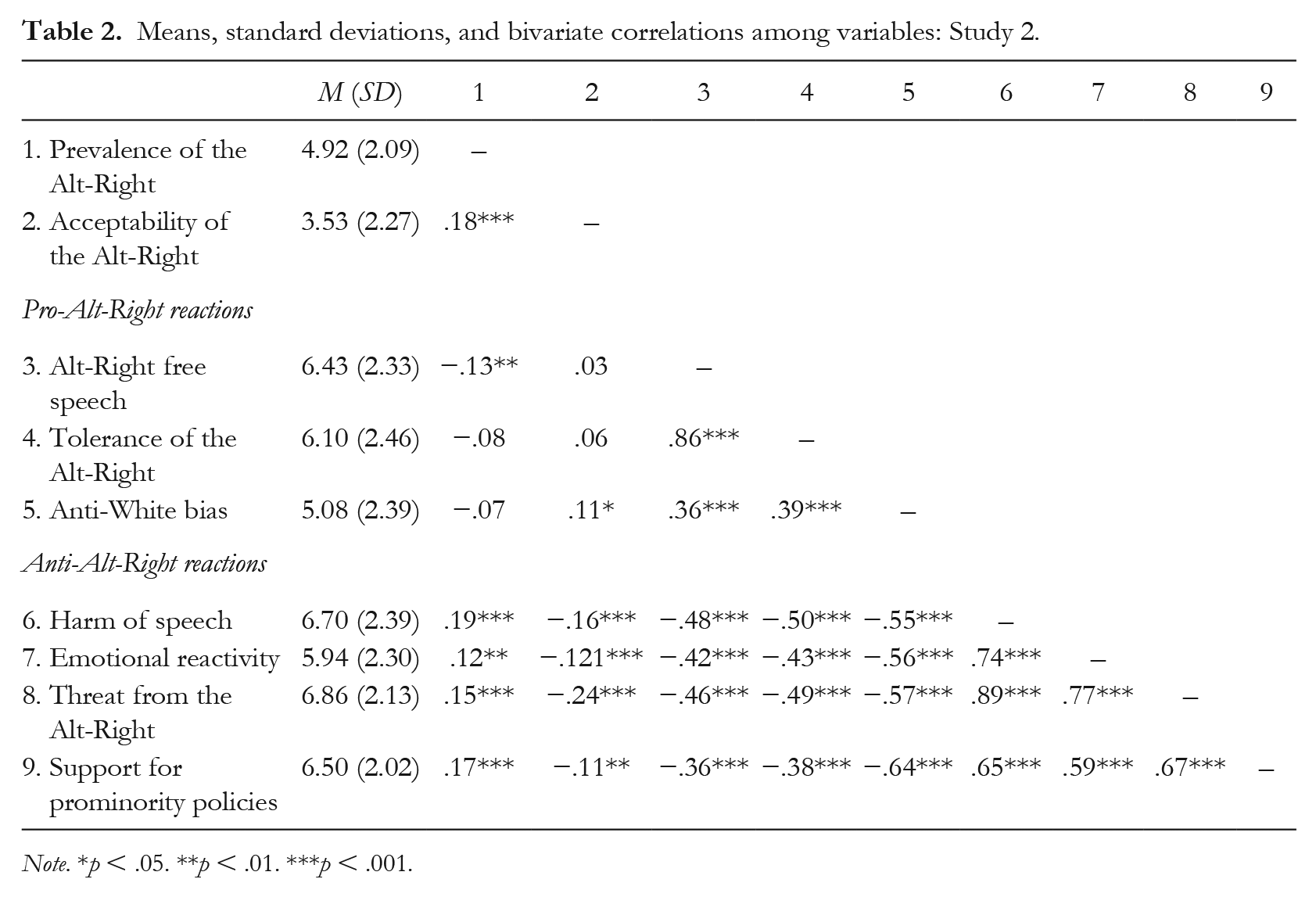
Means, standard deviations, and bivariate correlations between variables are displayed in Table 2. All effects of condition/manipulation were examined with a two-way analysis of variance (ANOVA) using the PROC GLM procedure in SAS 9.4. We controlled for key demographic variables in all analyses (i.e., race, ethnicity, age, political conservatism).
Means, standard deviations, and bivariate correlations among variables: Study 2.
Note. *p < .05. **p < .01. ***p < .001.
Manipulation check
There was a significant main effect of the prevalence manipulation on perceived prevalence of the Alt-Right, F(9, 530) = 431.16, p < .001, ηp2 = .45. Specifically, participants in the high-prevalence condition reported more perceived prevalence of the Alt-Right (M = 5.21) compared to participants in the low-prevalence condition (M = 2.46). This suggests that the prevalence manipulation worked as expected. By contrast, there was no significant main effect of the acceptability manipulation on perceived prevalence of the Alt-Right, F(9, 530) = 0.85, p = .356.
There was also a significant main effect of the acceptability manipulation on perceived acceptability of the Alt-Right, F(9, 530) = 475.26, p < .001, ηp2 = .47. Specifically, participants in the high-acceptability condition reported more perceived acceptability of the Alt-Right (M = 5.43) compared to participants in the low-acceptability condition (M = 2.37). This suggests that the acceptability manipulation worked as expected. However, unexpectedly, there was also a small significant main effect of the prevalence manipulation on perceived acceptability of the Alt-Right, F(9, 530) = 8.13, p = .005, ηp2 = .02. Specifically, participants in the high-prevalence condition reported more perceived acceptability of the Alt-Right (M = 4.10) compared to participants in the low-prevalence condition (M = 3.70).
Capturing reactions toward the Alt-Right: CFA
As in Study 1, we conducted a two-factor CFA for the reaction measures, whereby the composite measures of (a) perceptions of Alt-Right speech as free speech, tolerance of the Alt-Right, and perceptions of anti-White bias loaded onto the first latent factor (pro-Alt-Right reactions), and (b) perceived harm of Alt-Right speech, emotional reactivity, perceived threat from the Alt-Right, and support for prominority policies loaded onto a second latent factor (anti-Alt-Right reactions). The errors of the measures within each latent factor were freely estimated. The correlation between the two latent factors was also freely estimated. The model fit was acceptable, χ2(4) = 32.28, p < .001, SRMR = .03, RMSEA = .11, NFI = .99, CFI = .99. All unstandardized parameter estimates were significant at p < .001, and b ranged from .97 to 1.47. As noted in the preregistration, we therefore created composite measures of pro-Alt-Right reactions (α = .77) and anti-Alt-Right reactions (α = .91) to use as our key dependent variables. The two resulting reaction variables were negatively correlated (r = −.66, p < .001).
How perceived norms affect reactions toward the Alt-Right
Contrary to predictions, there was no significant interaction between the prevalence and acceptability conditions on pro-Alt-Right reactions, F(10, 529) = 0.09, p = .768, nor was there a significant main effect of prevalence, F(10, 529) = 2.55, p = .111. However, the predicted main effect of acceptability was significant, F(10, 529) = 5.32, p = .022, ηp2 = .01. Specifically, participants in the high-acceptability condition reported more pro-Alt-Right reactions (M = 6.48) compared to participants in the low-acceptability condition (M = 6.14).
Contrary to predictions, there was no significant interaction between the prevalence and acceptability conditions on anti-Alt-Right reactions, F(10, 529) = 0.00, p = .986, nor were there any significant main effects of prevalence, F(10, 529) = 0.23, p = .633, or acceptability, F(10, 529) = 2.69, p = .101, on anti-Alt-Right reactions.
How perceived norms relate to reactions toward the Alt-Right: Path analysis
Mirroring analyses from Study 1 and as noted in the preregistration, we conducted a path analysis with the measured variables of perceived prevalence and acceptability of the Alt-Right entered as exogeneous variables, and pro-Alt-Right and anti-Alt-Right reactions entered as endogenous variables. Since here we wanted to focus on divergent patterns of correlations between the norms and Alt-Right reactions, participants were collapsed across conditions. As in Study 1, we allowed the error terms of perceived prevalence and acceptability of the Alt-Right (b = 0.85, SE = 0.21, t = 4.11, p < .001) and pro- and anti-Alt-Right reactions to correlate (b = −2.34, SE = 0.18, t = −12.69, p < .001), reflecting their theoretical conceptualization of two parts of the same (respective) broader construct. Since we modelled prevalence and acceptability of the Alt-Right as simultaneous predictors of pro-Alt-Right and anti-Alt-Right reactions, this was a fully saturated path model, which, by definition, has perfect model fit indices. Our focus was therefore on the direction and significance of the pathways, which were as hypothesized (see Figure 2). Greater perceived prevalence of the Alt-Right was linked to lesser pro-Alt-Right attitudes (b = −0.12, SE = 0.04, t = −2.96, p = .003) and to more anti-Alt-Right attitudes (b = 0.20, SE = 0.04, t = 5.33, p < .001). Greater perceived acceptability of the Alt-Right was linked to more pro-Alt-Right attitudes (b = 0.09, SE = 0.04, t = 2.36, p = .018) and lesser anti-Alt-Right attitudes (b = −0.21, SE = 0.04, t = 5.87, p < .001).
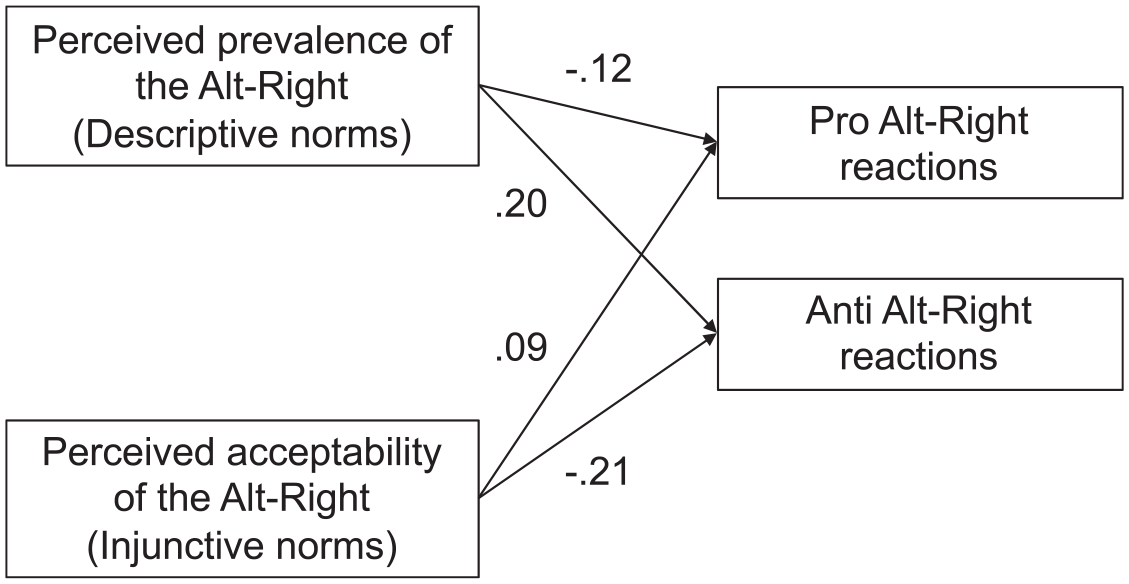
Path model for Study 2.
Discussion
Study 2 replicated the correlational patterns found in Study 1. Specifically, perceived prevalence of the Alt-Right was linked to more negative Alt-Right reactions, whereas perceived acceptability of the Alt-Right was linked to more positive Alt-Right reactions. Study 2 also showed that it was possible to manipulate perceived prevalence and acceptability (i.e., descriptive and injunctive norms) of the Alt-Right separately; believing that the Alt-Right was becoming more prevalent over time was distinct from believing that the Alt-Right was accepted by others in society. This finding is important because in Study 1, we found that perceived prevalence and acceptability had a strong positive correlation, which had left open the possibility that their divergent links to reactions to the Alt-Right could not be separated. Study 2 provided evidence that despite being strongly correlated, prevalence and acceptability perceptions of the Alt-Right were clearly distinguishable, nevertheless.
In terms of the causal effects of both normative beliefs on personal attitudes toward the Alt-Right, we found a small main effect of the injunctive norm manipulation, but not an effect of the descriptive norm manipulation. Specifically, leading people to believe in the acceptability of the Alt-Right (high injunctive norm) promoted slightly more normalizing outcomes in terms of greater pro-Alt-Right reactions (but not anti-Alt-Right reactions). This suggests that anti-Alt-Right attitudes may be relatively stable and difficult to change.
However, leading people to believe in the prevalence of the Alt-Right (high descriptive norm) did not influence personal attitudes toward the movement in terms of either pro- or anti-Alt-Right reactions. Thus, it seems that there is slightly more evidence for a normalization (vs. threat) effect of the Alt-Right. In light of the divergent correlational patterns between prevalence/acceptability of the Alt-Right and Alt-Right reactions, this finding points to the possibility that when we pit prevalence and acceptability of the Alt-Right against each other, perceived acceptability might be the stronger predictor of public reactions toward the movement.
One limitation of the design of Study 2 was that we did not include a control condition to assess participants’ normative beliefs about the Alt-Right at baseline. It was therefore unclear whether greater perceived acceptability of the Alt-Right increased pro-Alt-Right attitudes, or lower perceived acceptability of the Alt-Right reduced pro-Alt-Right attitudes, or both. To test the direction of effects and hone in on the effect of perceived acceptability of the Alt-Right, Study 3 manipulated this variable (high vs. low injunctive norm), and included a control condition to measure baseline perceptions. Here, we expected that evoking high perceived acceptability of the Alt-Right (vs. low and baseline levels) would be linked to more pro-Alt-Right attitudes and less anti-Alt-Right attitudes. Descriptive norms were kept constant (i.e., not experimentally manipulated).
Study 3
Participants
Based on the effect size obtained in Study 2(f = .17; the means and standard deviations of high vs. low injunctive norm condition on pro-Alt-Right attitudes), we conducted an a priori power analysis for a fixed effect, omnibus, one-way ANOVA for three groups, with an alpha level of .05. The total sample size required to achieve a power of .95 was 540, with 180 participants per condition. Knowing that we would need to exclude participants for various reasons (see preregistration at https://aspredicted.org/wt6fk.pdf), 2 we oversampled by recruiting 809 participants. Of those, 71 participants indicated they would like to withdraw their responses upon knowing the purpose of the survey (which was summarized in the debriefing form), and 62 provided incoherent or wrong responses to the open-ended question following the manipulation (e.g., provided answers unrelated to the prompt, shared personal opinions instead of summarizing the polling information), and were therefore excluded. Of the 676 participants that remained, we excluded eight who were not U.S. citizens, 39 who were not born in the U.S., 78 who identified with the Alt-Right, 13 who failed the manipulation check question, and 17 who were multivariate outliers. Thus, 537 valid participants remained for analyses, which was close to our goal of recruiting 540 participants. In terms of race, there were 416 participants who identified as White, 65 as Black, 28 as Asian, 13 as mixed race, seven as another race that was not listed, five as Native American/Alaskan Native, and three as Native Hawaiian/Pacific Islander. In terms of ethnicity, 43 participants (8%) were Hispanic. Overall, 151 participants (28.12%) were racial minority members. As for gender, 297 participants were female, 237 were male, two were nonbinary or third gender, and one did not specify. The average age was 38.35 years (SD = 12.42), ranging between 18 and 81 years.
Procedure
Participants were randomly assigned to one of three experimental conditions: high acceptability of the Alt-Right, low acceptability of the Alt-Right, or control. Participants in the high- and low-acceptability conditions were presented with the same Gallup polling information used to manipulate perceived acceptability of the Alt-Right in Study 2. Participants in the control condition saw no Gallup polling information and proceeded directly to the measures. There were 217 participants in the control condition, 153 in the high-acceptability condition, and 167 in the low-acceptability condition. The number of participants retained in the control condition was somewhat higher than those in the experimental conditions, possibly because participants in the control condition had fewer possibilities to be excluded since they were not required to respond to any manipulation check questions.
Measures
Participants responded to the same items used to measure pro- and anti-Alt-Right reactions in Studies 1 and 2: Alt-Right speech as free speech (α = .97; six items), tolerance of Alt-Right (α = .91; three items), perceptions of anti-White bias (α = .89; four items), perceived harm of Alt-Right speech (α = .94; six items), emotional reactivity (α = .96; nine items), perceived threat from the Alt-Right (α = .92; five items), and support for prominority policies (α = .91; six items). As a manipulation check, at the end of the survey, participants responded to the same items used to measure perceived prevalence (α = .94; five items) and acceptability (α = .97; five items) of the Alt-Right in Studies 1 and 2. Participants also responded to the same demographic questions asked in Study 2 (age, gender, racial identity, ethnicity, political conservatism; α = .92).
Results
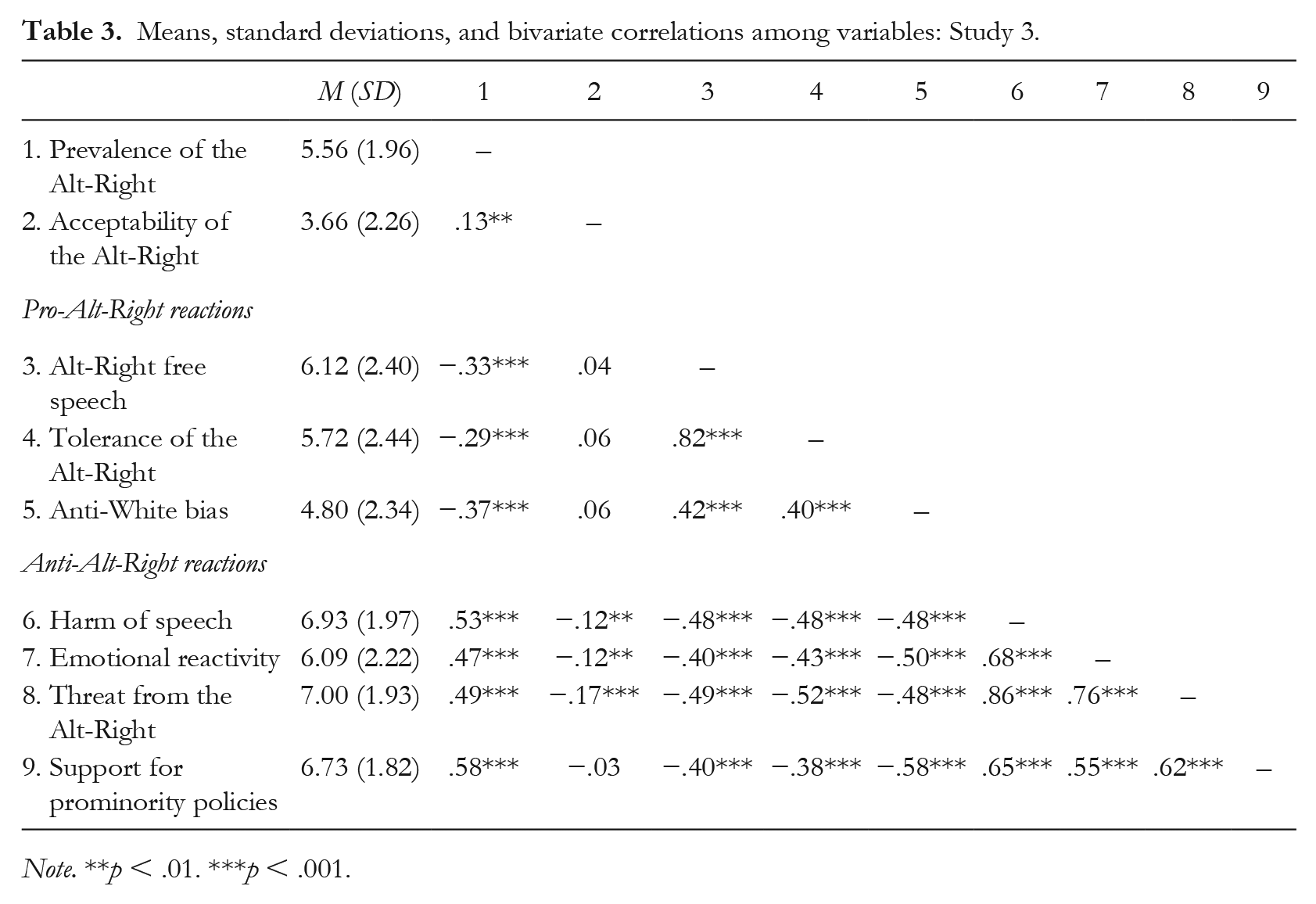
Means, standard deviations, and bivariate correlations between variables are displayed in Table 3. All effects of condition/manipulation were examined with general linear modelling using the PROC GLM procedure in SAS 9.4. We controlled for key demographic variables in all analyses (i.e., age, race, ethnicity, political conservatism).
Means, standard deviations, and bivariate correlations among variables: Study 3.
Note. **p < .01. ***p < .001.
Manipulation check
As hypothesized, there was a significant main effect of condition on perceived acceptability of the Alt-Right, F(11, 525) = 160.25, p < .001, ηp2 = .38. Specifically, participants in the high-acceptability condition reported more perceived acceptability of the Alt-Right (M = 5.63) compared to participants in the low-acceptability condition (M = 2.58), t = 17.73, p < .001. Participants in the high-acceptability condition (M = 5.63) also reported more perceived acceptability of the Alt-Right compared to the control condition (M = 3.36), t = 11.89, p < .001. Further, participants in the low-acceptability condition reported less perceived acceptability of the Alt-Right (M = 2.05) compared to the control condition (M = 3.36), t = −7.01, p < .001. This suggests that the manipulations worked as intended.
Unexpectedly, there was also a main effect of condition on perceived prevalence of the Alt-Right, F(11, 525) = 3.18, p = .043, ηp2 = .01. In particular, participants in the high-acceptability condition reported more perceived prevalence of the Alt-Right (M = 5.76) compared to participants in the low-acceptability condition (M = 5.31), t = 2.28, p = .022. Further, participants in the low-acceptability condition reported less perceived prevalence of the Alt-Right (M = 5.31) compared to the control condition (M = 5.69), t = −2.09, p = .037. This suggests that the manipulation also somewhat shifted perceptions of prevalence of the Alt-Right.
Capturing reactions toward the Alt-Right: CFA
As in Study 2, we conducted a two-factor CFA for the reaction measures. The model fit was acceptable, χ2(4) = 43.03, p < .001, SRMR = .03, RMSEA = .13, NFI = .98, CFI = .98. All parameter estimates were significant at p < .001, and the unstandardized parameter estimates (b) ranged from 0.97 to 1.21. Thus, we created composite measures of pro-Alt-Right reactions (α = .79) and anti-Alt-Right reactions (α = .89). The two resulting reaction variables were negatively correlated (r = −.64, p < .001).
How perceived acceptability (ie., injunctive norms) shapes reactions toward the Alt-Right
There was a significant omnibus effect of condition on pro-Alt-Right reactions, F(11, 525) = 3.01, p = .050, ηp2 = .01. In line with hypotheses, participants in the high-acceptability condition reported higher levels of pro-Alt-Right reactions (M = 5.07) compared to the control (M = 4.63), t = 2.38, p = .018. However, contrary to hypotheses, participants in the high- (M = 5.07) and low-acceptability (M = 4.91) conditions did not significantly differ from each other (t = 0.81, p = .416). Participants in the low-acceptability condition (M = 4.91) also did not significantly differ from the control (M = 4.63), t = 1.56, p = .12.
There was no significant omnibus effect of the manipulation on anti-Alt-Right reactions, F(11, 525) = 0.32, p = .727. Contrary to hypotheses, participants in the high-acceptability (M = 6.96), low-acceptability (M = 7.05), and control (M = 7.08) conditions did not significantly differ from one another on anti-Alt-Right reactions.
How perceived norms relate to reactions toward the Alt-Right: Path analysis
Mirroring analyses from Studies 1 and 2 and as noted in the preregistration, we conducted a path analysis with perceived prevalence and acceptability of the Alt-Right (i.e., the measured variables) entered as exogenous variables, while pro-Alt-Right and anti-Alt-Right reactions were entered as endogenous variables. Participants were collapsed across conditions. 3 Since we wanted to focus on divergent patterns of correlations between prevalence and acceptability of the Alt-Right and pro- and anti-Alt-Right reactions, respectively, we modelled a fully saturated model such that prevalence and acceptability of the Alt-Right were predictors of pro-Alt-Right and anti-Alt-Right reactions. Since fully saturated models have perfect fit by definition, our analysis focused on the direction and significance of each pathway. As in Studies 1 and 2, we allowed the error terms of perceived prevalence and acceptability of the Alt-Right (b = 0.57, SE = 0.19, t = 2.98, p = .003) and pro- and anti-Alt-Right reactions to correlate (b = −1.33, SE = 0.12, t = −10.95, p < .001), reflecting their theoretical conceptualization as two parts of the same broader construct. The direction and significance of all paths were as hypothesized (see Figure 3). Greater perceived prevalence of the Alt-Right was linked to less pro-Alt-Right attitudes (b = −0.42, SE = 0.04, t = −10.27, p < .001) and to more anti-Alt-Right attitudes (b = 0.55, SE = 0.03, t = 18.14, p < .001). Greater perceived acceptability of the Alt-Right was linked to more pro-Alt-Right attitudes (b = 0.10, SE = 0.04, t = 2.90, p = .004) and less anti-Alt-Right attitudes (b = −0.16, SE = 0.03, t = −6.04, p < .001).

Path model for Study 3.
Discussion
Study 3 replicated the correlational patterns found in Studies 1 and 2. Specifically, we found that perceived prevalence of the Alt-Right was linked to more negative Alt-Right reactions, whereas perceived acceptability of the Alt-Right was linked to more positive Alt-Right reactions. Study 3 also examined the causal effects of perceived acceptability (injunctive norm) on personal attitudes toward the Alt-Right, while keeping perceived prevalence (descriptive norm) constant. Similar to Study 2, the causal effects observed in Study 3 were modest; there was a small difference in pro-Alt-Right reactions, but no difference in anti-Alt-Right reactions. This suggests that anti-Alt-Right reactions may not be susceptible to change based on changing norms—regardless of high or low acceptability of the Alt-Right, people showed similarly high levels of anti-Alt-Right reactions.
Building on Study 2, there was initial evidence of the direction of effects by showing that perception of high acceptability shifted pro-Alt-Right attitudes relative to baseline, rather than low acceptability driving the effect. However, inconsistent with Study 2, Study 3 did not find a significant difference between high and low acceptability of the Alt-Right on personal attitudes toward the movement. Instead, Study 3 found a difference between the high-acceptability condition and the control. It is unclear why this was the case, but it is possible that the low-acceptability and the baseline conditions were similar. 4 This would suggest that if perceived acceptability of the Alt-Right drops below a certain level, people’s reactions toward the movement may reach a state of plateau. Despite this inconsistency, Study 3 largely corroborated findings from Study 2 by showing that leading people to believe in the acceptability of the Alt-Right (high injunctive norm) promoted slightly more normalizing outcomes in terms of greater pro-Alt-Right reactions.
General Discussion
How does the public react to the Alt-Right? We tested whether increased prevalence of the Alt-Right (descriptive norm) would promote more negative reactions towards it, reflecting a threat response; and whether increased acceptability of the Alt-Right (injunctive norm) would promote more positive reactions toward the movement, reflecting a normalization response. Three studies showed correlational evidence that perceiving greater prevalence (high descriptive norm) of the Alt-Right was linked to more negative reactions to the movement; by contrast, perceiving greater acceptability (high injunctive norm) of the Alt-Right was linked to more positive reactions to the movement. However, experimental evidence (Studies 2 and 3) indicated that there was limited causal evidence for a threat response and more consistent evidence for a normalization response. In particular, it was found that leading people to believe in the perceived acceptability of the Alt-Right (i.e., injunctive norm) led to slightly more positive attitudes toward it. However, leading people to believe in greater prevalence of the Alt-Right (i.e., descriptive norm) did not influence their personal attitudes.
Taken together, these findings provide initial evidence that the rise of far-right movements may be linked to public attitudes through the way they influence perceived norms. In particular, the increasing normative acceptability of the movement may have the potentially insidious effect of signaling that society should be tolerant of the Alt-Right, which relates to personal attitudes supportive of the movement (i.e., a normalization effect of the Alt-Right). It is important to note, however, that there was only a modest effect of perceived acceptability of the Alt-Right on personal attitudes toward it.
Theoretical and Applied Implications
Our findings contribute to the literature on the effects of social norms on public attitudes. Although a large body of research has demonstrated the power of social norms in a range of domains (for reviews, see McDonald & Crandall, 2015; Tankard & Paluck, 2016), limited work has investigated the role of perceived norms in relation to marginalized groups that gain prominence in society. Although prior research has shown that descriptive and injunctive norms can have interactive effects (e.g., McDonald et al., 2013; J. R. Smith & Louis, 2008), this work has not examined whether and how descriptive and injunctive norms might have divergent outcomes on social attitudes. Extending our understanding of social norms to the context of social movements, the present research contributes to this literature by demonstrating that when assessing norms around a fringe group that has little popular support from the public, perceived prevalence and acceptability of the group (i.e., descriptive and injunctive norms) may signal different normative standards that subsequently guide broader social attitudes in divergent ways. Additionally, by experimentally manipulating perceived norms in relation to the Alt-Right, Studies 2 and 3 showed that, consistent with prior work on social norms (Cialdini et al., 1990, 1991), perceived prevalence and acceptability of the Alt-Right were malleable and distinguishable despite being strongly correlated. Further, consistent with the idea that social movements organize public rallies to elicit a response from the public (e.g., Benford & Hunt, 1992; Tarrow, 2011), our findings suggest that one of the outcomes of social movements might be the promotion of cultural shifts by changing the normative standards in society. It is therefore important to interrogate the ways in which the Alt-Right is portrayed in the media, since media exposure is one of the key ways in which social norms are transmitted and maintained.
In terms of applied implications, our findings suggest that greater perceived acceptability of the Alt-Right in the public sphere can have some consequences for people’s personally held beliefs and attitudes. It is worth noting that the attitudinal outcomes we assessed were somewhat indirect and subtle, rather than explicit support for the movement. Specifically, we measured pro-Alt-Right attitudes in terms of people’s proclivity to tolerate the Alt-Right and endorse its ideology, such as the belief that White people face discrimination due to their race. Thus, it is not the case that perceived acceptability of the Alt-Right was related to the public becoming more overtly supportive of the movement, for instance, by becoming members of the Alt-Right themselves. Our findings instead suggest that the normalizing outcomes of perceived norms in relation to the Alt-Right may be insidious in that people can become relatively more tolerant and sympathetic towards the movement and their beliefs while still maintaining that they are not explicitly supportive of the movement.
Limitations and Future Research Directions
Although the divergent relationships between normative beliefs and personal attitudes were consistent across all three studies, the causal effects of norms on personal attitudes were small and, at times, nonsignificant. It is possible that leading people to believe in the perceived prevalence or acceptability (descriptive and injunctive norms) of the Alt-Right also altered other perceptions that were not accounted for in our studies. For example, reflecting on a White supremacist group like the Alt-Right might have promoted negative self-conscious emotions among White Americans, such as ingroup shame and guilt (Brown et al., 2008), or concerns about appearing prejudiced (Plant & Devine, 1998), which may have contributed to noise within the data.
In addition, we should consider the reverse causal direction. This is especially important given the modest causal effects of norms that we observed in Studies 2 and 3. In particular, it is possible that personal reactions toward the Alt-Right may influence people’s normative beliefs about the movement. Related literature on the false consensus effect has shown that people who harbor high levels of prejudice tend to overestimate the extent to which others agree with their views (Pedersen et al., 2008; Strube & Rahimi, 2006). This might be because people are motivated to justify socially undesirable attitudes by believing that their views are shared by a silent majority. According to this line of reasoning, people who have pro-Alt-Right attitudes may be motivated to perceive greater acceptability of the movement (i.e., injunctive norms). Findings from exploratory analyses using data from Studies 2 and 3 were consistent with this idea; participants who identified with the Alt-Right (vs. those who did not) reported higher levels of perceived acceptability of the movement. Future research should therefore examine how personal attitudes toward the Alt-Right may influence perceived norms in relation to the movement.
Since the present research focused exclusively on the Alt-Right, which is an ultra-conservative, White nationalistic group, it remains an open question whether the findings will extend to other fringe movements. It is also worth investigating whether similar processes are at play for far-left groups such as the so-called Antifa (antifascist) movement, which has risen in prominence by mobilizing against the Alt-Right and other White supremacist movements (Klein, 2019). We might expect that perceiving greater public acceptance of the Antifa movement would be linked to more support for it and its goals at a personal level. Further, it is also important to consider how movement and counter-movement dynamics might influence perceived norms around the groups protesting. It is possible that when far-right fringe movements receive backlash and face suppression, the public may be more likely to support the protection of far-right protesters’ right to free speech and freedom of assembly, which might serve to boost a normalization response.
Finally, although our findings were obtained after controlling for political conservatism, it is important to note that, in general, our sample was skewed liberal and most participants were more likely to be Democrats than Republicans. It has been found that self-identified Republicans tend to report moderate levels of support for a White nationalist movement compared to self-identified Democrats who tend to oppose the movement (Simpson et al., 2018). Therefore, it is likely that had we used a more politically diverse sample, we may have found an interaction between the effects of norms and political ideology such that the normalization effect (i.e., perceived acceptability promoting more pro-Alt-Right attitudes) may have been stronger amongst political conservatives than liberals. By contrast, the threat effect (i.e., perceived prevalence promoting more anti-Alt-Right attitudes) may be most pronounced amongst, or exclusive to, liberals (rather than conservatives). These questions await further empirical testing.
Concluding Remarks
The rising prominence of the Alt-Right in the public eye can have important implications for broader public attitudes. As the Alt-Right has become increasingly featured in the mass media and discussed by political leaders, it holds the potential to shape perceived norms around the movement in terms of promoting the perceived prevalence and acceptability of the Alt-Right (descriptive and injunctive norms). The present research examined if these normative beliefs may have divergent links to public attitudes. There was limited evidence for the link between perceived prevalence of the Alt-Right and more negative reactions toward the movement—a threat response. There was more consistent evidence for a link between perceived acceptance of the Alt-Right and more positive reactions toward the movement—a normalization response. Thus, as far-right groups that were once hidden from the public sphere become a more prominent feature of mainstream society, it is important to consider whether and how the normalization of these groups’ messages aligns with shifts in normative standards and, consequently, in public attitudes.
