



Abstract
Two experiments (N = 449; 246 men, 198 women) examined how political identity moderates appreciation of disparagement humor that violates different moral foundations described in moral foundations theory. In Experiment 1, liberals evaluated memes violating the individualizing moral foundations as more offensive and less funny than conservatives, whereas conservatives rated memes violating the binding moral foundations as more offensive and less funny than liberals. Moreover, conservatives judged the memes across all experimental conditions more favorably than liberals because they more strongly endorse cavalier humor beliefs. Experiment 2 examined the mediating role of perceived personal moral violations. Specifically, liberals evaluate humor violating the individualizing foundations as more offensive than conservatives because they see it as a greater personal moral violation. Similarly, conservatives judged humor violating the binding foundations as more offensive compared to liberals because they see it as a greater personal moral violation.
Keywords
In early 2019, a pub in Australia posted on social media an irreverent picture of Jesus holding a beer and smoking a cigarette. The picture included the caption, “Jesus got hammered for his sins, you can too.” The post sparked a barrage of negative comments from morally outraged citizens claiming the post was “disgusting” and “disrespectful” (Foster, 2019). One person wrote, “any place that needs to mock someone’s faith to sell their business is a disgrace. Absolutely disgusting. Shame on you.” In response, the pub removed the post and issued an apology stating that the picture was never meant to offend anyone.
The protests of disgust and anger over this picture and the pub owners’ surprise at this negative response highlight an important disconnect in the way people perceive disparagement humor. In the present research we propose that this disconnect is rooted in fundamental views of morality that separate political liberals from conservatives. The present research extends previous studies on morality and humor appreciation by showing that liberals and conservatives evaluate disparagement humor differently because they construct their moral worldviews on different foundation concerns and because of their general orientation toward humor.
Morality and Political Identity: Moral Foundations Theory
Anthropologists (e.g., Shweder et al., 1997) and psychologists (e.g., Gilligan, 1982; Kohlberg, 1969) identified a number of culturally widespread ethics, virtues and concerns underlying conceptions of morality. Building on this research, moral foundations theory (MFT; Graham et al., 2009; Haidt & Graham, 2007; Haidt et al., 2009; Haidt & Joseph, 2004) proposes that five foundations or psychological systems of values and practices universally underlie moral intuition, reasoning, judgment and discourse: Harm/care, Fairness/reciprocity, Ingroup/loyalty, Authority/respect, and Purity/sanctity. 1
The Harm/care foundation motivates compassion and concern for the wellbeing of others. The Fairness/reciprocity foundation underlies concerns for equitable treatment of others, motivating social equality and justice. The Ingroup/loyalty foundation encompasses concerns for responsibilities one has to social groups, motivating ingroup allegiance. The Authority/respect foundation underlies a need for social order, motivating deference for tradition and sanctioned authorities. The Purity/sanctity foundation relates to respect for both physical and metaphysical sacredness, motivating the pursuit of chastity and self-control as well as reverence for divinity (see Graham et al., 2009 and Haidt et al., 2009 for reviews).
MFT further suggests that the Harm/care and Fairness/reciprocity foundations represent “individualizing foundations” because they establish the individual as the focal point of morality, cultivating a general concern for the individual’s rights, welfare and protection. In contrast, the remaining three foundations represent “binding foundations” because they refer to allegiances and obligations as the focal points of morality (Graham, et al., 2009; Haidt et al., 2009).
A central argument of MFT that has received considerable support (e.g., Graham et al., 2009; Haidt & Graham, 2007; Haidt et al., 2009) is that liberals and conservatives differentially stress the five moral foundations in constructing their moral worldviews. Because concerns for individuals’ rights and welfare underlie traditional progressive ideology, liberals tend to build their views of morality disproportionately on the individualizing Harm/care and Fairness/reciprocity foundations. In contrast, conservatives allot similar weight to both the individualizing and binding foundations, demonstrating a commitment to individual liberties as well as a respect for the authority of institutions, such as religion and government, that establish social order. Consequently, liberals place comparatively more value on the individualizing foundations and less value on the binding foundations than do conservatives (Graham et al., 2009).
Humor Appreciation
Historically, research on humor appreciation has considered only positive affective responses to humor material, namely amusement or funniness (Martin & Ford, 2018). However, in a series of factor analyses, Ruch and colleagues demonstrated that humor appreciation comprises two orthogonal evaluative dimensions: a positive dimension characterized as perceived funniness of the stimulus and a negative dimension of aversiveness, described as the extent to which one reacts critically to humor material, finding it offensive, inappropriate, obnoxious, etc. (e.g., Carretero-Dios et al., 2009; Ruch & Hehl, 1998). Maximum humor appreciation reflects high funniness and low aversiveness whereas minimal appreciation reflects low funniness and high aversiveness (Ruch, 1992, 2008; Ruch & Hehl, 1998).
The funniness and aversiveness dimensions negatively correlate but only weakly (e.g., Ruch & Hehl, 1986); they represent conceptually distinct reactions to humor material. Thus, it is possible for a person to find something funny and offensive at the same time. For instance, someone could find a racist or sexist joke very funny, because of its structure or clever punchline, and also highly offensive because of its underlying content. In the present research, then, we conceptualize humor appreciation in terms of both a positive evaluative dimension represented by funniness and a negative evaluative dimension represented by offensiveness.
Moral Foundations of Humor Appreciation
McGraw and Warren’s benign violation theory (BVT; McGraw et al., 2012; McGraw & Warren, 2010; Warren & McGraw, 2015) provides a link between people’s views of morality and humor appreciation. BVT describes the necessary conditions for people to perceive something as funny. First, they must perceive an event as a violation: something that seems threatening, immoral, or wrong in relation to an established norm (e.g., cultural, social, linguistic, etc.) in the immediate context (Veatch, 1998; Warren & McGraw, 2015). Second, they must also perceive the event to be benign: harmless, inconsequential or acceptable (Warren & McGraw, 2015). So, people find humor in situations in which they simultaneously perceive a threat of some kind as harmless or inconsequential, that is, as a “benign violation.” Accordingly, researchers operationalize benign violation in terms of the severity of a threat – the more severe, the less benign (Kruschke & Vollmer, 2014; Lawless et al., 2020; McGraw et al., 2012).
Relevant to the present research, McGraw and Warren (2010, Exp. 4) showed that people view moral violations as benign and thus funny insofar as they are not committed to the violated moral norm. McGraw and Warren asked self-identified churchgoers and non-churchgoers to read alleged news coverage of a church that raffled a Hummer as part of a promotion to recruit new members, thus violating norms of sanctity from the MFT framework. They found that non-churchgoers rated the story as funnier than churchgoers, presumably because they placed less significance on sanctity norms and thus viewed the story as a more benign violation. Thus, people see a joke as funny and not offensive to the extent that it represents for them a benign violation. However, people should find it offensive and not funny if they judge the disparagement and resulting threat to be so severe that they cannot also see it as benign.
Building on this research, Kruschke and Vollmer (2014) had participants complete Graham et al.’s (2011) Moral Foundations Questionnaire, assessing the degree to which participants endorse the virtues and concerns of the five moral foundations. Participants then read jokes that violated one of the five foundations. Consistent with BVT, they found that participants perceived jokes as more offensive and less funny to the extent they were committed to the moral foundations violated by the jokes.
Also linking humor and morality, Koszałkowska and Wróbel (2019) contended that disparagement humor can be classified according to the moral foundation(s) it violates. For instance, sexist, racist, and anti-gay humor target historically disadvantaged groups, thus violating the individualizing moral foundations. Accordingly, the more one personally endorses the individualizing moral foundations, the less they see humor disparaging these groups as benign, inconsequential violations. In contrast, people judged jokes mocking sacred religious symbols and figures as offensive insofar as they value the binding moral foundations. The more one personally endorses the binding moral foundations, the less they see humor disparaging religious figures and symbols as benign or inconsequential (Koszałkowska & Wróbel, 2019).
In sum, people appreciate disparagement humor less insofar as it violates a moral standard they personally endorse. Thus, because liberals and conservatives emphasize individualizing and binding foundations in constructing their moral worldviews, we propose that they differentially appreciate humor that violates the individualizing and binding foundations.
Political Identity and Cavalier Humor Beliefs
Research guided by benign violation theory demonstrates the degree to which humor violates a personally valued moral norm is an important determinant of humor appreciation. Another important determinant of humor appreciation is people’s general propensity to view humor as benign. Some people, those who strongly endorse “cavalier humor beliefs,” view any humor, no matter the content, with a playful, non-serious, non-critical mindset. That is, they view anything intended to be humorous, regardless of content, as benign or inconsequential. They implicitly endorse a position that anything said or performed for the sake of humor should be regarded with permissive lightheartedness (Hodson & MacInnis, 2016; Hodson & Prusaczyk, 2021; Hodson et al., 2010). Those higher in cavalier humor beliefs, then, should view most jokes, regardless of content, as funnier and less offensive compared to those lower in cavalier humor beliefs (Hodson & Prusaczyk, 2021).
Although not directly tested, research suggests that conservatives more strongly endorse cavalier humor beliefs than liberals. Cavalier humor beliefs positively relate to “social dominance orientation” (Hodson et al., 2010), a correlate of political conservativism (e.g., Pratto et al., 1994). Thus, conservatives might generally appreciate humor material more than liberals because they have a more cavalier orientation toward humor. Thus, we explored whether cavalier humor beliefs play a mediating role in the relationship between political identity and appreciation of humor in general.
The Present Research: Hypotheses and Overview
According to MFT (e.g., Graham et al., 2009) liberals and conservatives construct their views of morality on different foundation concepts and concerns; liberals are more concerned with the individualizing foundations and less with the binding foundations than conservatives. Also, people do not appreciate disparagement humor insofar as it violates valued moral foundations (Koszałkowska & Wróbel, 2019; Kruschke & Vollmer, 2014). Therefore, we hypothesized that liberals judge disparagement humor violating the individualizing foundations more negatively than do conservatives. In contrast, conservatives judge disparagement humor violating the binding foundations more negatively compared to liberals.
We conducted two experiments to test our hypotheses using Amazon’s Mechanical Turk, an online site managed by Amazon.com that provides a platform for people to take studies researchers post to the site. Previous research demonstrates that Mechanical Turk is as reliable as in-person lab-based data collection (Buhrmester et al., 2011; Casler et al., 2013). Furthermore, Mechanical Turk’s participant base is typically more diverse and representative of the US population than college sample pools (McCredie & Morey, 2019; Miller et al., 2017). Online studies can also foster anonymity, inspiring greater honesty in responses due to a lower effect of social desirability (Kreuter et al., 2008).
Experiment 1 tested our hypotheses by measuring evaluations of either a meme that violated the individualizing foundations, a meme that violated the binding foundations or a meme that did not violate any moral foundation. Also, Experiment 1 examined whether conservatives endorse cavalier humor beliefs more than liberals and therefore evaluate humor, in general, more positively. Experiment 2 assessed whether violation of personal moral standards mediates the effect of political identity on evaluations of humor that violates individualizing or binding foundations.
Experiment 1
Method
Participants and Design
We recruited 325 participants residing in the United States through Mechanical Turk and paid them 35¢ for their participation. We excluded 18 cases for taking more than three standard deviations above the mean time to complete the study or for suspicion of being a bot (i.e., using two repeating keystrokes to complete all dependent measures). Our sample, then, consisted of 307 people (178 men, 127 women and two transgender). Participants’ ages ranged from 20 to 71 years (M = 35.32, SD = 10.68, Mdn = 33.00). There were 239 Caucasians (77.9%), one American Indian (0.3%), 27 African Americans (8.8%), 20 Asians (6.5%), 13 Hispanic/Latinos (4.2%), and seven mixed ethnicity individuals (2.3%). We randomly assigned participants to one of three conditions with the meme manipulation (immigrant-disparaging, religion-disparaging, neutral) serving as a between-subjects variable.
Procedure
Upon accessing the study through Mechanical Turk, participants completed a consent form and then read a brief introduction stating, “We’re studying news stories and public opinion. Please read the headline and examine the image and caption below. Afterward, we will ask your opinion about the image and caption.”
Meme manipulation
Participants read the following headline, “Bar apologizes, removes controversial poster mocking illegal immigrants (immigrant-disparaging meme condition)/Jesus (religion-disparaging meme condition)/Floridians (neutral meme condition) after backlash on social media.” In the immigrant-disparaging meme condition a picture of Rodney Dangerfield accompanied the headline with the caption, “What’s the difference between ET and an illegal immigrant? ET learned English and wanted to go home.” We intended this meme to violate the Fairness/reciprocity moral foundation with its underlying concerns for equity and justice.
In the religion-disparaging meme condition the meme the Australian pub posted of Jesus holding a beer and a cigarette accompanied the headline with the caption, “Jesus got hammered for his sins, you can too.” We expected this meme to violate the Sanctity/purity foundation.
In the neutral meme condition, a meme of a couple sitting on a beach during a storm appeared under the headline with the caption, “Floridians be like ‘It’s only a Category 1 hurricane.’” We included this meme as a “no moral violation” control condition.
Dependent measures
After viewing the headline and meme, participants responded to the following three statements: “I was offended by the poster,” “I resent the poster,” and “The poster was funny.” Participants responded to each statement on a six-point scale from 1 (strongly disagree) to 6 (strongly agree). We averaged responses to the first two items to represent an aggregate measure of offensiveness (Cronbach’s α = .94, r = .89, p < .01). The third item served as a single-item measure of funniness.
Participants then completed a manipulation check by responding to two statements assessing the degree to which the meme they viewed violated the Fairness/reciprocity foundation (i.e., “This poster makes fun of a group that experiences social injustice,” and “This poster makes fun of a group that experiences discrimination.”) and two statements assessing the degree to which it violated the Sanctity/purity foundation (i.e., “This poster makes fun of something of religious significance,” and “This poster makes fun of something that some people consider sacred.”). Participants responded to each statement on a six-point scale ranging from 1 (strongly disagree) to 6 (strongly agree). Cronbach’s alpha was .94 (r = .88, p < .001) for the two Fairness/reciprocity items and .92 (r = .82, p < .001) for the two Sanctity/purity items.
Next, participants completed a measure of Cavalier Humor Beliefs (Hodson et al., 2010). Participants indicated their agreement with six statements (e.g., “Sometimes people need to relax and realize that a joke is just a joke”, “Society needs to lighten up about jokes and humor generally”) on a seven-point scale ranging from 1 (strongly disagree) to 7 (strongly agree). Lastly, participants reported their political affiliation on a seven-point scale ranging from 1 (very liberal) to 7 (very conservative) and indicated their age, gender, and race/ethnicity.
Results
Manipulation Check
We subjected the “Fairness/reciprocity ratings” and the “Sanctity/purity ratings” to separate one-way ANOVAs with the meme condition (immigrant-disparaging, religion-disparaging, neutral) serving as the between-subjects factor. There was a significant effect of meme for both the Fairness/reciprocity ratings, F(2, 304) = 68.68, p < .001, ηp2 = .311 and for the Sanctity/purity ratings, F(2, 304) = 128.20, p < .001, ηp2 = .458.
Tukey’s honestly significant difference post hoc tests revealed significant differences between each of the three condition means: the immigrant-disparaging meme violated the Fairness/reciprocity foundation most (M = 4.51, SD = 1.43) followed by the religion-disparaging meme (M = 3.34, SD = 1.73) and finally the neutral meme (M = 2.07, SD = 1.35). Similarly, the religion-disparaging meme violated the Sanctity/purity foundation most (M = 4.94, SD = 1.22) followed by the immigrant-disparaging meme (M = 2.74, SD = 1.54) and lastly the neutral meme (M = 2.03, SD = 1.31). Overall, it appears that the immigrant- and religion-disparaging memes violated the intended moral foundations.
Descriptive Statistics
Table 1 presents descriptive statistics for political identity, cavalier humor beliefs, offensiveness ratings and funniness ratings of the memes in each of the experimental conditions. A one-way analysis of variance (ANOVA) revealed no significant differences in political identity across conditions, F(2, 304) = 1.07, p = .35. There was, however, a significant difference between conditions in cavalier humor beliefs, F(2, 304) = 7.17, p < .01. A Tukey’s honestly significant difference post hoc test showed that participants in the neutral meme condition endorsed cavalier humor beliefs more (M = 5.16, SD =1.17) than participants in the immigrant-disparaging meme condition (M = 4.48, SD = 1.30). The mean cavalier humor beliefs score for participants in the religion-disparaging meme condition (M = 4.80, SD =1.38) was not significantly different from the other two condition means.
Descriptive statistics and correlations among study variables.

Note. **significance at <.05.
As can be seen in Table 1, we also found that conservatives did, indeed, endorse more cavalier humor beliefs than liberals; political identity correlated positively with cavalier humor beliefs (r = .24, p < .01). Consistent with this finding, funniness ratings of the memes also correlated positively with political identity (r = .18, p < .01) indicating that, across the three conditions, conservatives judged the memes as funnier than did liberals.
Overview of Hypothesis Tests
From our hypothesis we predicted that liberals would judge the immigrant-disparaging meme as more offensive and less funny than would conservatives, whereas conservatives would judge the religion-disparaging meme as more offensive and less funny than would liberals. We tested our hypothesis by conducting regression analyses separately on the offensiveness ratings and the funniness ratings of the memes in each of the three experimental conditions. Preliminary analyses did not reveal significant gender effects and so we collapsed analyses across gender.
We followed Jaccard et al.’s (1990) recommendations to represent the three meme conditions in two effect-coded variables. For the first variable we coded the immigrant-disparaging meme as “1” and the other two as “−1.” For the second we coded the religion-disparaging meme as “1” and the other two as “−1.” The neutral meme was assigned “−1” for both variables. We then computed interaction terms by multiplying standardized political identity scores by each effect-coded variable.
In a hierarchical regression analysis (Jaccard et., 1990) we regressed the dependent measures (offensiveness, funniness) onto political identity and the two effect-coded variables in Step 1 and then added the interaction terms in Step 2. A significant R2change for the full model in Step 2 indicated a significant political identity × meme interaction effect.
Offensiveness Ratings
The main effects-only model of Step 1 was significant, R2 = .15, F(3, 303) = 17.85, p < .001. The full model represented in Step 2 also was significant, R2change = .06, F(2, 301) = 10.34, p < .001, indicating a significant political identity × meme interaction effect. Figure 1 illustrates this interaction effect, plotting the predicted mean offensiveness ratings as a function of meme condition at 1 SD above and 1 SD below the mean standardized political identity score.

Regression lines predicting anticipated offensiveness ratings as a function of the type of moral foundation joke condition and standardized self-identified political identity.
We conducted simple slope analyses regressing offensiveness ratings onto political identity in each of the meme conditions. As expected, there was a significant negative relationship between political identity and offensiveness ratings of the immigrant-disparaging meme, β = −.23, t = −2.26, p = .026, SE = 0.17, CI95 =[−0.72, –0.05] and a significant positive relationship for the religion-disparaging meme, β = .36, t = 3.72, p < .001, SE = 0.19, CI95 = [0.32, 1.06]. The relationship between political identity and offensiveness ratings for the neutral meme was not significant, β = .09, t = 0.98, p = .33, SE = 0.14, CI95 =[−0.14, 0.42]. Supporting our hypothesis, liberals rated the immigrant-disparaging meme as more offensive than did conservatives; conservatives rated the religion-disparaging meme as more offensive.
Funniness Ratings
The main effects-only model of Step 1 was significant, R2 = .10, F(3, 303) = 10.97, p < .001. The full model represented in Step 2 also was significant, R2change = .12, F(2, 301) = 22.74, p < .001, indicating that the political identity × meme interaction effect was significant. Figure 2 plots the predicted mean funniness ratings as a function of meme condition at 1 SD above and 1 SD below the mean standardized political identity score.
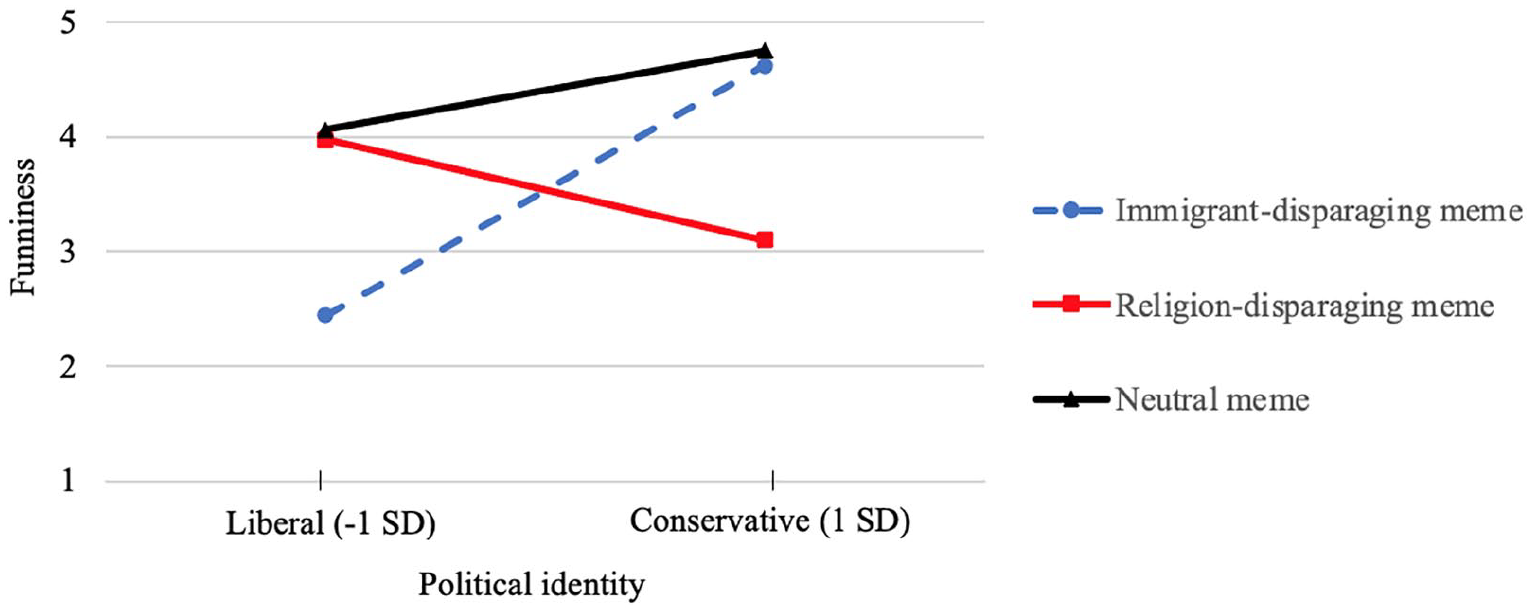
Regression lines predicting anticipated funniness ratings as a function of the type of moral foundation joke condition and standardized self-identified political identity.
Supporting our hypothesis, simple slope analyses revealed a significant positive relationship between political identity and funniness ratings for the immigrant-disparaging meme, β = .61, t = 7.52, p < .001, SE = 0.15, CI95 = [0.80, 1.38] and a significant negative relationship for the religion-disparaging meme, β = −.24, t = −2.39, p = .019, SE = 0.18, CI95 =[−0.80, –0.08]. Finally, there was a significant positive relationship between political identity and funniness ratings for the neutral meme, β = .22, t = 2.38, p < .019, SE = 0.15, CI95 = [0.06, 0.63]. Liberals rated the immigrant-disparaging meme as less funny than did conservatives; conservatives rated the religion-disparaging meme as less funny. Conservatives also judged the neutral meme as funnier compared to liberals.
Effect of Cavalier Humor Beliefs
Since conservatives endorsed more cavalier humor beliefs, one could expect them to judge the memes across the three conditions as funnier and less offensive than liberals in part because of their cavalier humor beliefs (Hodson et al., 2010). We tested this possibility by subjecting the offensiveness and funniness measures to separate mediation analyses using a bootstrapping macro for SPSS that computes bias-corrected 95% confidence intervals for 5,000 samples with replacement (Model 4, Preacher & Hayes, 2004) with political identity as the predictor “X” (rated from 1 = very liberal to 7 = very conservative) and the standardized scores on the cavalier humor beliefs measure as the mediator “M,” controlling for the main effects of condition by including it as a covariate in the model.
As expected, cavalier humor beliefs mediated the relationship between political identity and the offensiveness ratings, b = −0.12, SE = 0.03, CI95 =[−0.19, –0.06], as well as the funniness ratings, b = 0.12, SE = 0.03, CI95 = [0.06, 0.19]. Across the three conditions, conservatives rated the memes as less offensive and funnier than liberals, in part because they have more cavalier humor beliefs. This finding suggests that, although conservatives rated the religion-disparaging meme as less funny and more offensive than liberals, overall they are likely to express greater appreciation for most types of humor, because they have a more cavalier orientation toward humor.
Discussion
The results of Experiment 1 support our hypotheses showing that liberals judged an immigrant-disparaging meme, which violated individualizing moral foundations focused on the protection of the individual’s rights and welfare, as more offensive and less funny than did conservatives. Conservatives judged a religion-disparaging meme, which violated the binding moral foundations rooted in concerns for sanctity more negatively compared to liberals.
In addition, Experiment 1 revealed that political identity predicts how strongly one endorses cavalier humor beliefs. Conservatives reported having a more cavalier orientation toward humor, regardless of content, compared to liberals. Furthermore, the endorsement of cavalier humor beliefs mediated the relationship between political identity and evaluations of the memes across the three experimental conditions. Conservatives rated the memes as funnier and less offensive than liberals, in part because they have more cavalier humor beliefs. Cross-sectional mediation analyses examine the mediating role of only the variables included in the study, thus, we acknowledge that other variables besides cavalier humor beliefs could at least partially mediate the relationship between political identity and humor appreciation.
Although the findings of Experiment 1 support our hypotheses, an important ambiguity still remains. Implicit in our hypotheses is that a violation of one’s personal moral standards mediates the relationship between political identity and evaluations of humor. That is, liberals judge humor targeting individualizing foundations more negatively than conservatives because they see it as a greater moral violation. Conservatives evaluate humor targeting the binding foundations more negatively than do liberals because they see it as a greater moral violation. Experiment 1, however, did not examine the effect of personal moral violation as a mediator. Consequently, we cannot rule out alternative interpretations for the observed differences between liberals and conservatives. For instance, it is possible that liberals evaluated the immigrant-disparaging meme more negatively than conservatives out of compliance to a social norm against humor that “punches down” rather than because it violated their personal moral standards.
Experiment 2
We designed Experiment 2 to demonstrate that a violation of personal moral standards mediates the relationship between political identity and evaluations of humor targeting the individualizing and binding moral foundations. Also, people experience political identity, not only in terms of the extremity with which they endorse political ideas, but also as an affiliation with an ideological category (e.g., liberal, conservative; Huddy, 2001; LaMarre et al., 2009; Lin et al., 2016). Therefore, in Experiment 2, we conceptualized political identity as affiliation with the ideological categories, conservative and liberal.
Participants completed a role-play task in which they were presented with two disparaging jokes targeting vulnerable social groups (immigrants, gay men) and thus violating the individualizing foundations, or two religious jokes that violated the binding foundations. Participants indicated how much the jokes violated their personal moral standards and how offensive and funny they found the jokes.
Method
Participants and Design
We recruited 152 participants residing in the United States through Mechanical Turk and paid them 40¢ for their participation. We excluded 10 cases for taking more than three standard deviations above the mean time to complete the study or for suspicion of bot activity. Thus, the final sample consisted of 142 residents of the United States. Of the 142 people, 68 were men, 71 were women, two self-categorized their gender as “other,” and one participant identified as transgender. Participants’ ages ranged from 18 to 70 years (M = 33.46, SD = 12.89, Mdn = 30). Participants consisted of 117 Caucasians (82.4%), 14 African Americans (9.9%), seven Asians (4.9%), two Hispanic or Latinos (1.4%), and two individuals self-identified as mixed ethnicity (1.4%). Finally, 90 participants self-identified as liberal and 52 as conservative. We randomly assigned participants to one of two conditions with type of joke (disparaging, religious) serving as a between-subjects factor.
Procedure
Upon accessing a link to the study through Mechanical Turk, participants completed a role play exercise in which they imagined they were starting a new job at a marketing firm. As part of orientation, their supervisor had sent them an orientation video (two minutes) allegedly made by Jamie, a staff member in Human Resources. In the video, Jamie introduced himself and described the firm’s workplace culture, stating that humor is a great way to cultivate an atmosphere in which employees feel comfortable. Jamie then proceeded to tell two jokes.
Joke manipulation
In the disparaging joke condition Jamie told the following jokes: “What’s the difference between ET and an illegal immigrant? ET learned how to speak English and wanted to go home.” and “What do you call a homosexual dentist? A tooth fairy.” The jokes in the religious joke condition were: “What’s the difference between prayer in a church and prayer in a casino? In a casino, you really mean it.” and “Millennials are always being told ‘you’re the lazy generation, get a job, get some money, get your own place, get out of your parents’ home.’ But Jesus died on the cross so that he could live with his dad for eternity!”
We selected these jokes based on pretest ratings provided by 67 Mechanical Turk participants (43 men, 24 women with a mean age of 37.58 years, SD = 10.57). Participants rated the degree to which 15 jokes violated the individualizing (Harm/care, Fairness/reciprocity) and binding moral foundations (Authority/respect, Purity/sanctity). For each joke, participants indicated their agreement with each of the following statements: “Some people could see this joke as violating moral standards of compassion for the well-being of others” (Harm/care), “Some people could see this joke as violating moral standards of equitable treatment of others” (Fairness/reciprocity), “Some people could see this joke as violating moral standards of social justice” (Fairness/reciprocity), “Some people could see this joke as violating moral standards of respect for authority” (Authority/respect) and “Some people could see this joke as violating moral standards of reverence for divinity” (Purity/sanctity). Participants responded to each statement using a six-point scale ranging from 1 (strongly disagree) to 6 (strongly agree). We averaged responses to the three items assessing the individualizing foundations and the two items representing the binding foundations.
As expected, participants thought the two disparaging jokes violated the individualizing foundations (M = 4.67, SD = 0.61) more than the binding foundations (M = 4.28, SD = 1.14), t(66) = −2.65.08, p = .010. They also thought the disparaging jokes violated the individualizing foundations more than the religious jokes (M = 4.29, SD = 0.90), t(66) = 3.56, p = .001.
Similarly, participants reported that the religious jokes violated the binding foundations (M = 4.56, SD = 0.77) more than the individualizing foundations (M = 4.29, SD = 0.90), t(66) = 3.13, p = .003. They also thought the religious jokes violated the binding foundations more than the disparaging jokes (M = 4.28, SD = 1.14), t(66) = −2.37, p = .021. In sum, these results suggest that the disparaging jokes and religious jokes violated the intended moral foundations.
Dependent Measures
After watching the video, participants responded to four statements about Jamie’s jokes, one assessing the degree to which they violated personal moral standards: “My new colleague’s jokes violated my moral standards,” two assessing the offensiveness of the jokes: “I was offended by my new colleague’s jokes,” and “I was annoyed by my new colleague’s jokes,” and one assessing funniness: “The video sent by my new colleague was funny.” Participants responded to each statement using a six-point scale ranging from 1 (strongly disagree) to 6 (strongly agree). We averaged responses to the second two statements to represent an aggregate measure of offensiveness (Cronbach’s α = .87, r = .77, p < .01). Finally, participants answered demographic questions and indicated whether they identified as liberal or conservative.
Results
Descriptive Statistics
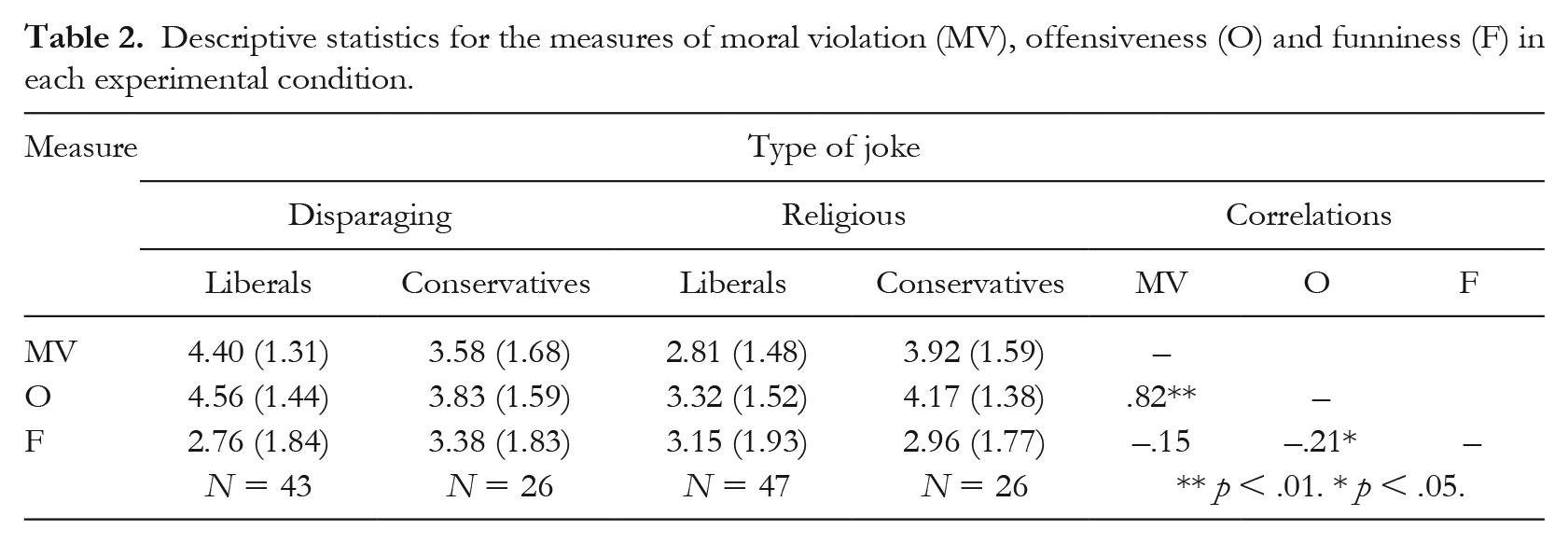
Table 2 presents descriptive statistics for the moral violation, offensiveness and funniness measures in each experimental condition. As can be seen in Table 2 there was a strong positive correlation between moral violation and offensiveness of the jokes across conditions, r = .82, p < .001. However, moral violation was not significantly correlated with funniness ratings of the jokes, r = −.15, p = .08, suggesting that the violation of personal moral standards more strongly predicts how offensive versus how funny participants found the jokes.
Descriptive statistics for the measures of moral violation (MV), offensiveness (O) and funniness (F) in each experimental condition.
Overview of Hypothesis Tests
According to our hypotheses, liberals should judge the disparaging jokes as a greater moral violation and thus more offensive and less funny than conservatives; conservatives should judge the religious jokes as a greater moral violation and thus more offensive and less funny. We tested our hypotheses by subjecting the offensiveness and funniness ratings to separated moderated mediation analyses using the same bootstrapping macro for SPSS described in Experiment 1. We specified political identity (coded as −1 liberal, 1 conservative) as the predictor “X”, the standardized moral violation scores as the mediator “M” and the type of joke (coded as −1 disparaging, 1 religious) as the moderator “W” (see Figure 3).
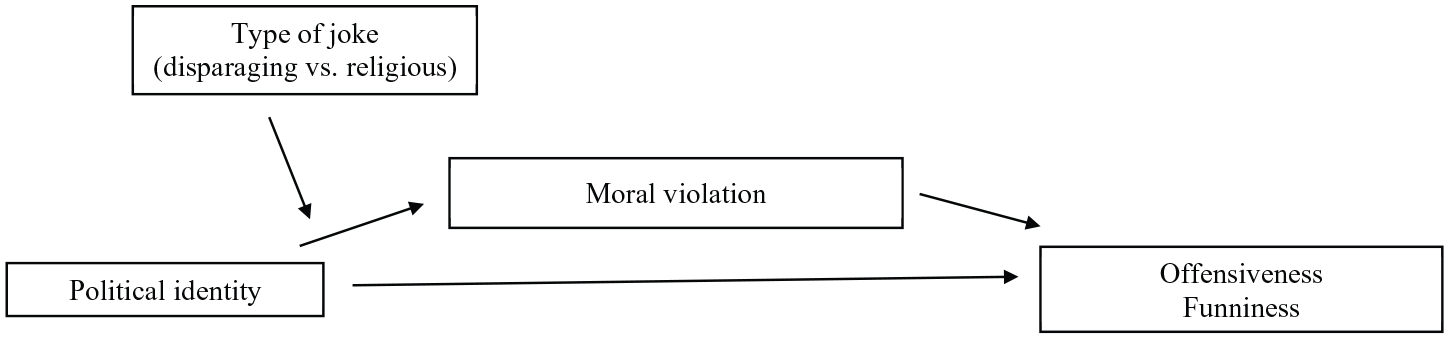
Moderated mediation model for offensiveness and funniness.
Offensiveness Ratings
Analyses on the offensiveness ratings first revealed a significant political identity × type of joke interaction effect on the mediator variable, moral violation, b = 0.483, SE = 0.13, t = 3.74, p < .001, CI95 = [0.23, 0.74]. The means for this interaction effect are presented in Table 2. Simple effects tests revealed that liberals rated the disparaging jokes as a greater moral violation (M = 4.40, SD = 1.31) than did conservatives (M = 3.58, SD = 1.68), b = −0.56, SE = 0.18, t = −3.07, p < .01, CI95 =[−0.92, –0.20], whereas conservatives rated the religious jokes as a greater moral violation (M = 3.92, SD = 1.55) than did liberals (M = 2.81, SD = 1.48), b = 0.41, SE = 0.18, t = 2.25, p = .03, CI95 = [0.04, 0.77].
Second, the predicted moderated mediation effect on the offensiveness ratings was significant, index of moderated mediation = 0.77, SE = 0.22, CI95 = [0.35, 1.21]. Tests of indirect effects for each experimental condition revealed that liberals rated the disparaging jokes as more offensive (M = 4.56, SD = 1.44) than did conservatives (M = 3.83, SD = 1.59) in part because they perceived them as a greater moral violation, b = −0.44, SE = 0.15, CI95 =[−0.75, –0.16]. Similarly, conservatives rated the religious jokes as more offensive (M = 4.17, SD = 1.38) than did liberals (M = 3.32, SD = 1.52) in part because they perceived them as a greater moral violation, b = 0.33, SE = 0.15, CI95 = [0.03, 0.64].
Funniness Ratings
The analyses on the funniness ratings failed to support our hypotheses. The predicted moderated mediation effect was not significant, index of moderated mediation = −0.14, SE = 0.12, CI95 =[−0.40, 0.05]. It does not appear that liberals and conservatives evaluated the disparaging and religious jokes as differentially funny in part because they differentially violated personal moral standards. Furthermore, direct effects tests indicated that the political identity × experimental condition interaction effect on the funniness ratings apart from perceived moral violation was not significant, b = −0.13, SE = 0.17, t = −0.77, p < .44, CI95 = [−0.47, 0.21].
Discussion
The results of Experiment 2 expand upon the findings of Experiment 1 showing that a personal moral violation mediates the relationship between political identity and evaluations of humor targeting individualizing and binding moral foundations. In Experiment 2, however, the moral foundation violated by the jokes did not moderate the effect of political identity on funniness ratings; we found the predicted effects only on offensiveness ratings. This might reflect a general difference in the degree to which offensiveness and funniness are affected by humor content relative to other variables as well as specific differences in the humor material we used in Experiment 2 versus Experiment 1.
A number of structural variables associated with humor material, independent of its content, influence perceptions of funniness including its: degree of incongruity (Shultz and Horibe, 1974), resolution potential (Hildebrand & Smith, 2014), degree of surprise (Jääskeläinen et al., 2016), elaboration potential (Wyer & Collins, 1992), and comprehension difficulty (Wyer & Collins, 1992). The funniness of orally presented humor material is also affected by contextual variables related to how a speaker communicates such as timing (Vilk & Fitter, 2020), use of exaggeration, (Magnotta & Strohl, 2011), voice characteristics (Brugman & Burgers, 2020), prosody (Magnotta & Strohl, 2011) and persona (Schwarz, 2010).
Offensiveness, by contrast, represents a negative reaction specifically to the content of humor material (Carretero-Dios et al., 2009; Ruch & Hehl, 1998). Thus, while the content of the jokes in the different conditions of Experiment 2 could have resulted in different judgments of offensiveness, its effect on evaluations of funniness could have been obscured by other structural or contextual variables.
Furthermore, in Experiment 1 we presented humorous memes; in Experiment 2 a person presented jokes verbally on a video. It is possible that these differences could have contributed to the different findings between the two experiments. First, compared to the video in Experiment 2, the presentation of memes in Experiment 1 could have been accompanied by fewer structural or contextual variables that could dilute the effect of humor content on evaluations of funniness. Second, for the religion-disparaging meme of Experiment 1, both the picture and the caption contributed to its irreverent content, perhaps making it particularly impactful and thus having a greater relative impact on evaluations of funniness.
General Discussion
Research has begun to show that our perceptions of disparagement humor reflect our moral worldviews (Koszałkowska & Wróbel, 2019; Kruschke & Vollmer, 2014). People judge disparagement humor more negatively insofar as it violates valued moral foundations. Further, research guided by MFT (e.g., Graham et al., 2009) reveals that liberals and conservatives build their moral worldviews on different foundation concerns. Liberals place greater relative emphasis on the individualizing foundations and less on the binding foundations than conservatives. The present research contributes to and integrates these lines of research by examining the relationship between political identity and perceptions of disparagement humor that triggers different moral concerns.
Using different procedures, humor material, and ways of conceptualizing political identity, Experiments 1 and 2 provide convergent evidence for the idea that liberals and conservatives differentially appreciate humor that violates the individualizing and binding moral foundations described in MFT (e.g., Graham et al., 2009). Experiment 2 also presented evidence that violations of personal moral standards mediate these effects. Collectively, then, the findings of our experiments reveal that liberals evaluate humor violating the individualizing foundations more negatively than do conservatives because they see it as a greater personal moral violation. Similarly, conservatives judge humor violating the binding foundations more negatively compared to liberals because they see it as a greater personal moral violation.
In addition, Experiment 1 revealed that political identity predicts how strongly one endorses cavalier humor beliefs, which in turn, mediates the relationship between political identity and evaluations of humor material in general. Conservatives appear to more strongly endorse cavalier humor beliefs compared to liberals; thus, they seem to have a greater propensity to appreciate humor of all types compared to liberals.
The findings of the present research have both practical implications for thinking about disparagement humor as a political topic, as well as implications for theory and future empirical investigations of disparagement humor. Practically, our research newly identifies humor as another topic that liberals and conservatives evaluate based on different moral foundations, giving it the potential to be a battleground issue for the advancement of particular moral values. For instance, controversy over the acceptability of the meme of Jesus holding a beer and a cigarette could reflect a more general, latent conflict over the importance society should place on Sanctity/purity concerns, values, and motives.
Implications for Theory and Future Research
By demonstrating how political identity influences humor appreciation, the present research advances theory on humor appreciation and derives novel hypotheses to be explored in future empirical research. Historically, attempts to explain appreciation of disparagement humor were founded on the meta-theory or broad perspective on humor called superiority theory. The superiority theory tradition originated in the writings of ancient Greek philosophers, Aristotle and Plato. However, its origins are commonly credited to British philosopher, Thomas Hobbes, who articulated its central proposition: amusement and laughter result from feelings of self-esteem enhancement we experience when comparing oneself to someone not doing as well (Hobbes, 1651/1996).
Following Hobbes’ original formulation, modern superiority theories assert that disparagement humor serves self-enhancement motives. That is, people use and appreciate disparagement humor as it makes them feel better about themselves through a “downward social comparison” (Wills, 1981) with the humor target (e.g., La Fave, 1972; La Fave et al., 1996; Zillmann & Cantor, 1996). Research guided by social identity (Tajfel & Turner, 1986) explains the self-enhancement functions of disparagement humor related to intergroup relationships. People enjoy outgroup disparagement humor because it positively elevates the ingroup above the outgroup.
The present research expands the consideration of the critical explanatory mechanisms underlying appreciation of disparagement humor beyond enhancement of one’s personal or social identity to include fundamental views of morality and broader views about the acceptability of disparagement humor. Our findings suggest that people find disparagement humor more offensive and less funny insofar as it violates valued moral principles. Furthermore, our findings establish that, because political identity is differentially associated with moral principles and concerns, it represents an important predictor of one’s affective reactions to different types of disparagement humor.
Our studies suggest new directions for research examining the social implications and consequences of disparagement humor. It is possible that disparagement humor that violates the individualizing versus binding moral foundations has different social consequences for liberals and conservatives. For instance, because liberals view humor that violates the binding moral foundations as more benign than conservatives do, they might be more susceptible to “prejudice releasing” effects of such humor (Ford & Olah, 2021). That is, disparagement humor targeting the binding moral foundations might make liberals more apt to discriminate against groups/individuals representing the binding foundations, while humor targeting the individualizing foundations might make conservatives more likely to discriminate against groups/individuals representing the individualizing foundations.
Limitations
Although our findings make important contributions, they have limitations that should be addressed in future research. First, in the present studies, we manipulated the degree to which memes or jokes violated the individualizing versus the binding foundations upon which liberals and conservatives have been shown to build their personal moralities according to MFT (Graham et al., 2009). We also treated the degree to which those jokes violated personal moral standards as a mediator. We did not, however, ask participants to identify the degree to which memes or jokes violated the individualizing and binding foundations derived from (MFT). Thus, we did not directly test whether the degree of perceived violation of individualizing versus binding foundations predicts one’s response to a joke. Rather, we demonstrated that jokes violating the individualizing versus binding foundations differentially feel “wrong” to liberals and conservatives.
Second, the dependent measures and experimental manipulations took place in an imaginary social environment. Third, and related to the second limitation, our research did not examine the potential moderating role of social context. It is possible that the social context (e.g., a comedy club versus the workplace) attenuates or accentuates the relationship between political identity and perceptions of different types of disparagement humor (Gray & Ford, 2013). Thus, future research could address people’s reactions to different types of disparagement humor in real social interactions and examine perceptions of disparagement humor encountered in different social settings.
Conclusion
According to MFT (e.g., Graham et al., 2009) the tendency for liberals and conservatives to construct their moral worldviews on different foundational concerns and motives represents a fundamental source of conflict and controversy between them. As illustrated by the Australian pub’s media post described at the beginning of this article, the conflict can present itself in public displays of humor. Our research thus identifies political identity as a critical variable affecting how people respond to different types of disparagement humor. Because of the pervasiveness of disparagement humor on social media and its potential to foster conflict across political identities, our research addresses a topic of critical social relevance and theoretical importance for social psychology.
Footnotes
Acknowledgements
The authors wish to express their appreciation to Ryan M. Olah for his work in editing the videos used in Experiment 2.
Author Note
Andrew R. Olah is now affiliated with The Junkin Group, LLC, Philadelphia, PA, USA and Catalina Arguello is now affiliated with Universidad Internacional de la Rioja (UNIR).
Funding
The authors received no financial support for the research, authorship, and/or publication of this article.
