




Abstract
Whistleblowing is the action by which members of an organization report misconduct that occurs within their group to other persons inside or outside the organization. In the present research, we examined perception of whistleblowers in terms of global impressions, emotions, and behavioural intentions. Study 1 reveals negative reactions to whistleblowers, while Study 2 shows positive reactions to whistleblowers. To reconcile these findings, Study 3 varies the self-relevance of the context and reveals that whistleblowers are derogated when the context is highly self-relevant (as in Study 1) and positively evaluated when it is not (as in Study 2). Across the studies, we also show that emotions and the subjective importance of loyalty and fairness influence the evaluation of whistleblowers. Our findings help unveiling the conditions in which whistleblowers are alternatively regarded as heroes or traitors, depending on the perceivers’ point of view.
Whistleblowing is the action by which members of an organization report misconduct that occurs within their group to other persons inside or outside the organization (Dungan et al., 2014; Near & Miceli, 1985). Research has acquired relevant knowledge about the factors associated with employee’s choice to blow the whistle or their willingness to report wrongdoing, ranging from formal organizational regulations to individual characteristics of the employees (for reviews, see Chen, 2019; Mesmer-Magnus & Visesvaran, 2005). Far less attention, however, has been devoted to a key aspect that could intervene in the individual choice to report, that is, how coworkers perceive the persons who decide to blow the whistle. To fill this gap, the current research aimed at examining the perception of individuals who report group misconduct compared to individuals who choose to stay silent.
Responses to Whistleblowing
Whistleblowing is a controversial phenomenon. If, on the one hand, its social value is often applauded by public opinion, on the other hand, negative reports of whistleblowers also abound. One emblematic case is that of Joe Darby, the American soldier who reported torture by American soldiers against Iraqi prisoners in 2004. Although Darby was honored in 2005 with the prestigious J. F. Kennedy Profile in Courage Award, he was the target of severe harassment from his colleagues in the army (Dawn, 2007). This is consistent with organizational research showing that the choice for whistleblowers to speak out may result in severe backlash in their own workplace (Bjørkel & Matthiesen, 2011; Miceli & Near, 1989).
Retaliation for whistleblowing in the workplace can be formal, such as blatant or direct actions that paralyze or downsize whistleblowers’ careers (Near & Miceli, 2016), or more indirect, such as avoiding and isolating them (Dasgupta & Kesharwani, 2010; Gundlach et al., 2008). To improve the understanding of the costs incurred by whistleblowers, here we examined how whistleblowers are perceived by their peers, the emotions they elicit, and how they can become target of retaliatory behavioural intentions in indirect and direct forms.
Loyalty and Fairness in Judgements of Whistleblowers
The decision to blow the whistle does not take place in a social vacuum. Organizational research has shown that whistleblowing occurs most often in supportive workplaces, that is, workplaces where employees see the opportunity to report wrongdoing to their managers and colleagues without fear of reprisals (Bjørkel & Matthiesen, 2011). Given the role of organizational support in whistleblowing, it is important to investigate what might drive these supportive attitudes.
The anecdotal evidence of ambivalent reactions towards whistleblowers—alternatively perceived as heroes or as traitors (Hersh, 2001)—illustrates how the decision to blow the whistle can be extremely complex. As Dungan et al. (2015, 2019) have argued, the whistleblowing choice involves a trade-off between two different but equally moral judgements, that is, judgments regarding loyalty and judgements about fairness. Whistleblowing can be perceived as a fair action by calling attention to unfair advantages and improper procedures, but on the other hand, it can be meant as an act of betrayal, as it involves exposing wrongdoings by group members, which can negatively affect the group’s reputation and sometimes even run counter to the group’s material interests. Accordingly, research has shown that people describe past decisions to report unethical behaviour as motivated by fairness, while they describe decisions not to report unethical behaviour as driven by group loyalty (Waytz et al., 2013, Study 3).
If the trade-off between loyalty and fairness is key in the decision to blow the whistle, it is possible to hypothesize that it is relevant also in the perception of the person who blows the whistle when exposed to the ingroup’s misconduct. Research on this topic is scant, but relevant insights to predicting potential peers’ reaction towards whistleblowers come from studies on ingroup-directed criticism (Elder et al., 2005; Hornsey, 2005). Hornsey et al. (2005), for example, have shown that ingroup members who criticized their group to an outgroup audience on dimensions such as narrow-mindedness or poor strategic skills elicited more negative feelings, were derogated more strongly on personality traits, and were seen to be doing more damage to the group compared to the ingroup members who kept their criticisms in-house. To the best of our knowledge, research on group criticism has not considered what occurs when the ingroup is publicly reproached for moral issues such as unethical and dishonest behaviours.
Another line of research that could provide insights into how whistleblowers are perceived is that on moral rebels. Insofar as they are “individuals who take a principled stand against the status quo, who refuse to comply to remain silent or simply go along when doing so would require them to compromise their values,” moral rebels are comparable to whistleblowers (Monin et al., 2008, p. 76–77). Importantly, Monin et al.’s research (2008) has demonstrated that appreciation of moral rebels depends on the psychological closeness and self-relevance of the situation: in their study, participants who merely observed a confederate refusing to perform a decision task because of its racist undertones, viewed him as more moral than the compliant confederate. In contrast, participants who were assigned to complete the racist task (as opposed to merely observing it) disliked the rebel more than the compliant confederate.
The Present Research
In three experiments involving undergraduate students as participants, we examined reactions towards whistleblowers in terms of perceptions, emotions, and retaliatory behavioural intentions. We examined responses to targets who either reported or did not report wrongdoings of other ingroup members.
Given the controversial nature of the phenomenon of whistleblowing, as well as previous research evidence, competitive hypotheses can be raised about responses to whistleblowers. By revealing unethical conduct, whistleblowers might be viewed as moral rebels and inspire admiration for their moral courage and strength (Sekerka et al., 2009). If the perception of whistleblowers as heroes prevails, we anticipate that participants would perceive them more positively than nonwhistleblowers; if so, whistleblowers should elicit more positive overall impressions, moral emotions, and behavioural intentions than nonwhistleblowers.
Alternatively, by calling out ethical misconduct, whistleblowers might be perceived as troublemakers and trigger moral defensiveness (Monin, 2007). If so, participants would evaluate whistleblowers more negatively than nonwhistleblowers. To test these alternative hypotheses, in Study 1, undergraduate students evaluated a student who either reported or did not report academic dishonesty that benefitted the ingroup. In Study 2, participants imagined they worked in an organization and evaluated an employee who reported or did not report financial wrongdoing by coworkers. Study 3 was designed to address the inconsistent results of Studies 1 and 2 by varying the self-relevance of the context to undergraduate participants (i.e., test cheating vs. financial wrongdoing) and testing the extent to which this affected the prioritization of loyalty over fairness.
Across the three studies, we focused on moral emotions due to their importance in understanding people’s behavioural compliance (or lack thereof) with their moral standards (Tangney et al., 2007). Moral emotions arise in response to violations (or observance) of internalized moral rules and serve as a motivator for morally coherent behaviour (Haidt, 2003). Additionally, they have been proposed to be a response to group-identity-related motivations, in that, when group identities are salient, individuals experience and express emotions in response to group-related cues (Brady et al., 2020). Thus, we further tested whether moral emotions may be a key mediating variable eliciting the hypothesized patterns described before.
Study 1
A large body of literature has investigated academic cheating and dishonesty (Anderman & Murdock, 2007; Chudzicka-Czupała et al., 2016). Although the study of academic whistleblowing has received scant attention, existing insights suggest that possible retaliation associated to reporting wrongdoing in the academic context is similar to that observed in the workplace (Radulovic & Uys, 2019; but see Jones et al., 2014). The present study examined how university students perceived a whistleblower of academic misconduct, a context that is highly relevant to them. We were interested in examining whether social perception—in terms of global impression and emotions elicited by a target—would change according to the choice to report (vs. not to report) the ingroup misconduct. We were also interested in examining whether the target’s action would be perceived as differently fair and loyal, and whether the target would be the recipient of different behavioural intentions according to the choice to report (vs. not to report). Moreover, we tested whether moral emotions would be a key mediator in shaping the relationship between the decision to report the misconduct and the behavioural intentions towards the target.
Since research has found that men tend to report wrongdoing in organizations more frequently than women (Miceli & Near, 1988; Near & Miceli, 1996), in part because they suffer less retaliation (but see Cassematis & Wortley, 2013), we additionally explored the effect of target’s gender on all the dependent variables, but had no specific hypotheses regarding this factor.
Method
Design and participants
We adopted a 2 (target’s decision: report vs. not to report wrongdoing) x 2 (target’s gender: male vs. female) between-participant experimental design. Prior to data collection, the required sample size was calculated using G*Power Version 3.1.9.2 (Faul et al., 2007). Considering the main effect of target’s decision, we estimated that a sample size of at least 128 participants was required to observe a medium effect size (f = .25) in a F-test with an alpha = .05 and power = .80. We advertised the study on campus and 131 Italian undergraduates (48.4% male; Mage = 21.40, SDage = 3.10; five age and gender unspecified) took part in the study. Following recommendations by Schoemann et al. (2017), we ran a post hoc power analysis to ascertain whether our sample was sufficient to detect the mediational hypothesized effects. Based on the final sample, correlations among key variables, and their standard deviations, we found that, in each case, power was above the threshold of .80 (1.00 for the model with indirect retaliation as dependent variable, and .99 for the model with direct retaliation as dependent variable). In line with the ethical standards of the 1964 Declaration of Helsinki, before taking part in the experiment, participants were informed about relevant aspects of the study (e.g., methods, institutional affiliations of the researcher), the anonymity of their responses, their right to refuse to participate in the study and to withdraw consent to participate at any time during the study without reprisal. They then confirmed that they understood the instructions, and those who agreed to participate proceeded to fill out the questionnaire.
Procedure and materials
Data collection was conducted using the online software SurveyMonkey. Participants were randomly assigned to one of the four experimental conditions.
Experimental manipulation
Participants were instructed to read a scenario carefully and to imagine being part of a small WhatsApp group composed of colleagues who were supporting each other in the preparation of their exams. According to the scenario, 3 days before the examination, one of the members of the WhatsApp group revealed that he was able to find a copy of the exam, and thus shared the exam with the group, asking them to keep this information secret. Another student in the group, Paola/o, then sent a message to the chat group that s/he did not approve of this behaviour and thus had decided to report (vs. not to report) the wrongdoing to the coordinator of the course.
Manipulation check
Participants indicated whether Paolo/a decided to report or not to report the academic wrongdoing, or whether they did not remember this information. All participants correctly recalled the information presented in the scenario, so we considered the manipulation successful.
Dependent measures
Moral emotions towards the target
Participants indicated to what extent Paolo the young man (vs. Paola the young woman) who disapproved the cheating behaviour described in the scenario, made them feel nine moral emotions (admiration, respect, sympathy, trust, disgust, disapproval, anger, outrage, annoyance; adapted from Ashburn-Nardo, 2017 and Cuddy et al., 2007) on a 5-point scale (1 = not at all, 5 = very much so). After reversing the negative moral emotions, a final index was created by averaging participants’ answers (Cronbach’s α = .91).
Global impression of the target
On a 5-point scale (1 = not at all, 5 = very much so), we asked participants to indicate how much Paolo/a was trustworthy, honest, sincere, moral, competent, intelligent, capable, friendly, kind, and likeable (Leach et al., 2007). We averaged them for further analyses (Cronbach’s α = .88).
Perceived fairness and loyalty of the target’s action
Four items were adapted from Waytz et al. (2013, Study 1) to assess the target’s behaviour; two items to assess the perceived fairness of Paolo/a’s action (“Paolo/a acted unfairly” and “Paolo/a did what was right”); r(126) = .26, p = .003, and two to assess loyalty (“Paolo/a was loyal to the group” and “Paolo/a betrayed the group”); r(126) = .68, p < .001, on a 7-point scale (1 = strongly disagree, 7 = strongly agree). Before calculating the correlation between items, “Paolo/a acted unfairly” and “Paola/a betrayed the group” were reverse-scored.
Retaliation against the target
Indirect retaliation was measured with nine items adapted from Brambilla et al. (2013; e.g., “I would avoid Paolo/a,” “I would have nothing to do with Paolo/a”) on a 7-point scale (1 = not at all, 7 = very much so; Cronbach’s α = .92). Direct retaliation was measured through a tablet allocation task (Loughnan et al., 2010). We asked participants to imagine that scientists had invented a temporary-pain-inducing pill and to indicate how many pills they would give the target to induce pain (0 pills = no pain, 5 pills = substantial amount of pain).
After completing the questionnaire, participants were thanked and debriefed.
Results
For all the dependent variables, except for the perceived fairness and loyalty of the target’s action, we conducted 2 (target’s decision: report vs. not to report wrongdoing) x 2 (target’s gender: male vs. female) between-participant analyses of variance (ANOVA). Fairness and loyalty were examined with a repeated-measures ANOVA, with the moral dimension (perceived fairness and loyalty of the target’s action) as a within-participant variable, and target’s decision and target’s gender as between-participant variables. Table 1 reports the descriptive statistics and intercorrelations for all the variables in the study, and Table 2 displays means and standard deviations by target’s decision and gender.
Correlations among key variables: Study 1.
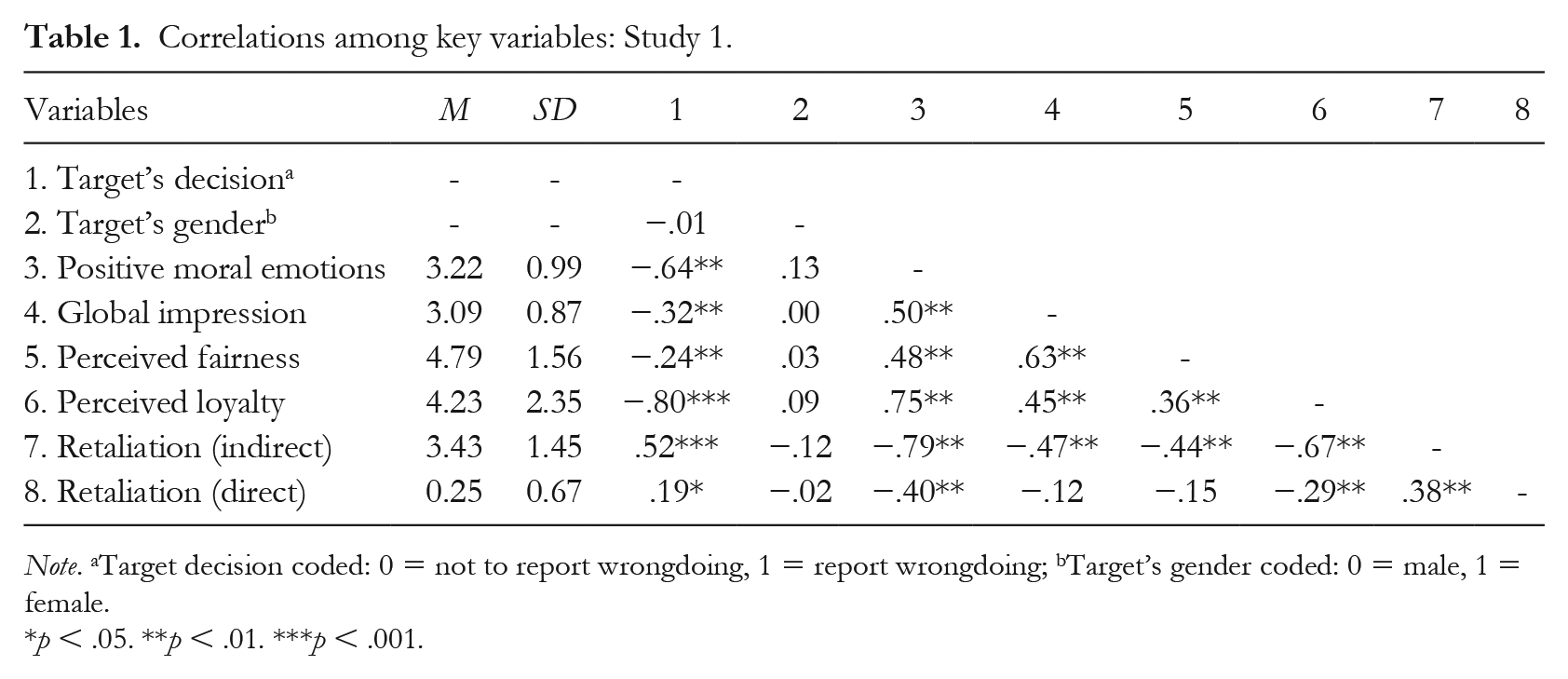
Note. aTarget decision coded: 0 = not to report wrongdoing, 1 = report wrongdoing; bTarget’s gender coded: 0 = male, 1 = female.
p < .05. **p < .01. ***p < .001.
Means and standard deviations distinguished by target decision and gender: Study 1.
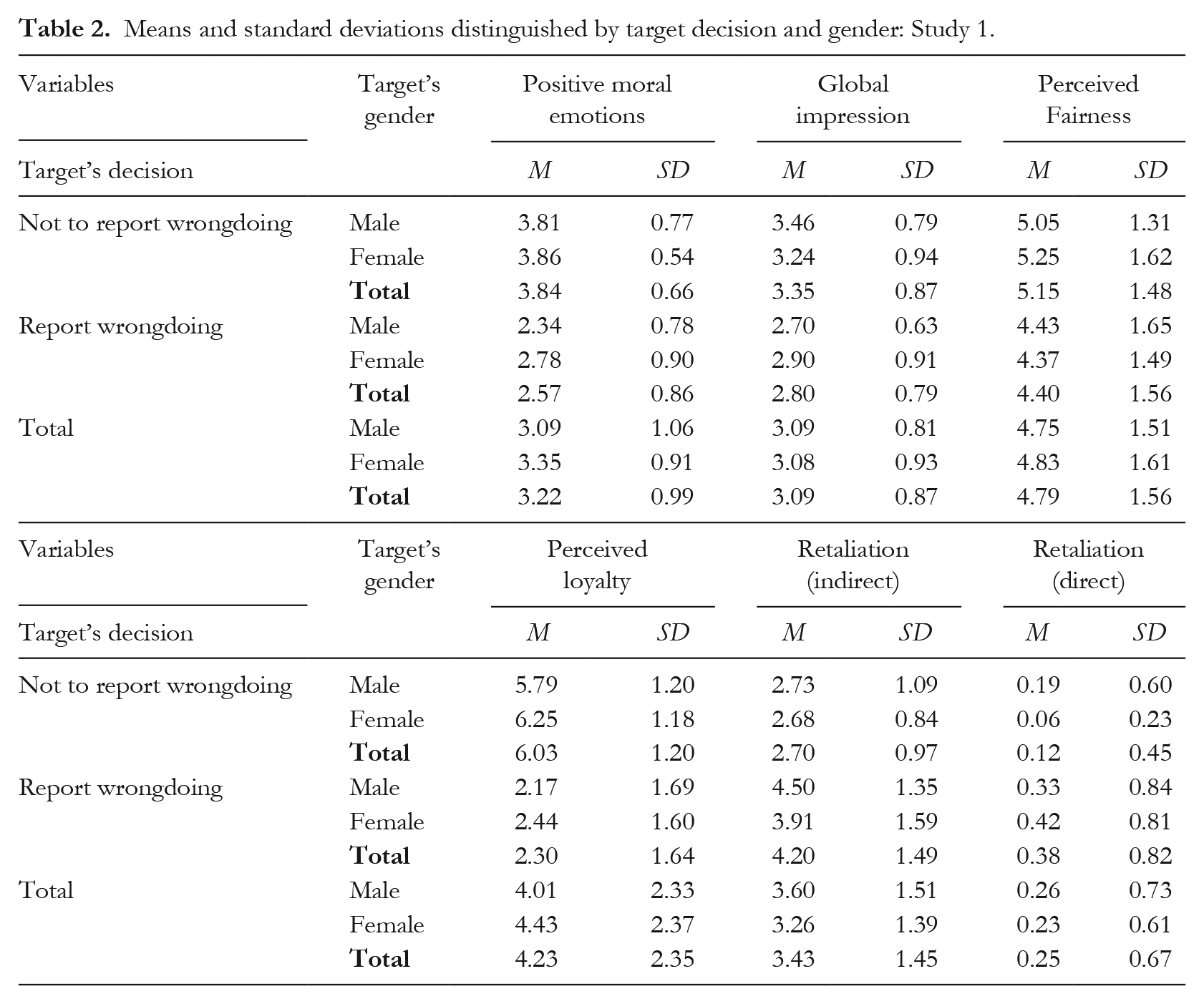
Moral emotions towards the target
A main effect of the target’s decision emerged, F(1, 122) = 88.63, p < .001, ηp2 = .42. The decision to not to report the wrongdoing elicited more positive moral emotions towards the target than the decision to report the wrongdoing. The main effect of the target’s gender, F(1, 122) = 3.12, p = .080, ηp2 = .03, and the interaction between target’s gender and whistleblowing decision did not emerge as significant, F(1, 122) = 1.81, p = .181, ηp2 = .02.
Global impression of the target
Participants perceived the target who decided to report (vs. not to report) the academic wrongdoing less positively, F(1, 122) = 13.94, p < .001, ηp2 = .10. Neither the main effect of target’s gender, F(1, 122) = 0.002, p = .962, ηp2 < .001, nor the interaction between target’s gender and target’s decision emerged as significant, F(1, 122) = 2.01, p = .159, ηp2 = .02.
Perceived fairness and loyalty of the target’s action
A main effect of target’s decision emerged. The decision to not to report (vs. report) the wrongdoing was perceived as generally more moral (Mnot to report = 5.59, SDnot to report = 1.12; Mreport = 3.35, SDreport = 1.24), F(1, 122) = 112.20, p < .001, ηp2 = .48. A main effect of the moral dimension emerged, F(1, 122) = 15.08, p < .001, ηp2 = .11, showing that the target was perceived as more fair than loyal. Most importantly, the analysis revealed a significant interaction between target’s decision and moral dimension, F(1, 122) = 88.05, p < .001, ηp2 = .42. The target was judged as more fair than loyal in the report condition (p < .001). Instead, participants judged the target as more loyal than fair in the not to report condition (p < .001).
Retaliation against the target
A main effect of target’s decision emerged both for indirect, F(1, 122) = 45.84, p < .001, ηp2 = .27, and direct retaliation against the target, F(1, 122) = 4.53, p = .035, ηp2 = .04. Participants expressed stronger indirect and direct retaliation intents against the target who decided to report (vs. not to report) the wrongdoing. No significant effects of target’s gender and of the interaction between gender and target’s decision emerged for either indirect or direct retaliation (ps > .146).
Mediational model
We carried out two different multiple mediation analyses using PROCESS macro (Model 4) for SPSS, with 1,000 bootstrapping resamples (Hayes, 2013). The target’s decision (0 = not to report the wrongdoing, 1 = report the wrongdoing) was entered as predictor, positive moral emotions as mediator, and indirect or direct retaliation as dependent variables. We standardized all measures before testing the mediational models. In both cases, the overall model was significant. Indirect retaliation: R2 = .63, F(2, 123) = 104.96, p < .001; direct retaliation: R2 = .17, F(2, 123) = 12.36, p < .001. The path linking the target’s decision to positive moral emotions emerged as significant, b = −1.28, SE = 0.14, t = −9.30, p < .001, 95% CI [−1.55, −1.01]. With regard to the model with indirect retaliation as outcome, results showed that positive moral emotions significantly affected retaliation, b = −0.79, SE = 0.07, t = −11.00, p < .001, 95% CI [−0.93, −0.64], and that the indirect effect of decision on indirect retaliation through positive moral emotions was significant, b = 1.00, SE = 0.14, 95% CI [0.76, 1.34]. In regard to the model with direct retaliation as outcome, similar results emerged. Positive moral emotions towards the target significantly reduced retaliation, b = −0.47, SE = 0.11, t = −4.39, p < .001, 95% CI [−0.68, −0.26], and the indirect effect of decision on direct retaliation was significant, b = 0.60, SE = 0.20, 95% CI [0.28, 1.07].
Discussion
The findings from Study 1 consistently showed that the decision of an ingroup member to report (vs. not to report) wrongdoing, negatively affected how participants perceived the target in terms of moral emotions, global impression, and behavioural intentions. Interestingly, the target who decided to remain silent not only was perceived as more loyal but also as fairer than the target who blew the whistle. Moreover, our mediational models proved significant, showing that the decision to blow the whistle elicited less positive moral emotions towards the target, which in turn increased indirect and direct retaliation intent. The variance explained by the model was higher for indirect than for direct retaliation.
It is important to note that, in this study, the wrongdoing was beneficial to the ingroup, so it is possible that this drove negative responses to the whistleblower. We therefore conducted a second study where we varied who benefitted from the wrongdoing (the ingroup or the wider community). To test the generalizability of our findings, we also changed the context of the wrongdoing to one less self-relevant to our undergraduate participants, that is, a work environment.
Finally, since gender of the target did not have significant effects in Study 1, and it is not central to our argument, we chose not to test it anymore in the interest of clarity of the subsequent research studies’ design.
Study 2
Study 2 aimed to examine social perception of an ingroup member who chose to report (vs. not to report) wrongdoing in a workplace context. As in Study 1, we were interested in examining whether the target’s choice to report (vs. not to report) would affect the emotions elicited, global impression, and behavioural intentions towards the target. Further, we wanted to examine whether the decision to report the wrongdoing would affect behavioural intentions towards the target through the moral emotions elicited by them.
In addition, we aimed to complement Study 1 by varying whether or not the wrongdoing benefitted the wrongdoer and his ingroup or the wider community, and by exploring whether the results of Study 1 generalize to both contexts. We also aimed to explore whether the relative status of the whistleblower (equal or lower than that of the participant perceiver) influenced how he was perceived. Research has shown that individuals who hold leadership positions in an organization are expected to stop dishonest conduct and are less frequently the target of retaliation when they do report it than employees without leadership responsibilities (Curtis & Taylor, 2009; Kaplan & Whitecotton, 2001). It is therefore possible that whistleblowers with higher status are judged with more leniency than whistleblowers with lower status.
Method
Design and participants
We adopted a 2 (target’s decision: report vs. not to report wrongdoing) x 2 (benefit of the wrongdoing: for the ingroup vs. for the community) x 2 (target’s status: equal vs. higher than the participants’) between-participant experimental design.
Based on the sample size estimation and the power obtained for mediation analysis from Study 1, we decided to enroll at least the same number of participants. We advertised the study on campus and enrolled all students who made themselves available, reaching a total sample size of 174 undergraduates at an Italian university (50.3% male; Mage = 21.19, SDage = 2.75). The same ethical considerations and measures as in Study 1 were applied.
Procedure and materials
Data collection was conducted using the online software SurveyMonkey. Male and female participants were randomly assigned to one of the eight experimental conditions. All measures were identical to those used in Study 1.
Experimental manipulation
Participants were instructed to carefully read a scenario and to image they worked with 10 other colleagues in a public office that provided identity cards for citizens (hereafter ID cards). To manipulate who benefitted from the wrongdoing, in one condition (benefit for the ingroup), they read that over the last year, with a group of colleagues, they had been making some extra money on the side by subtracting certain amounts of cash from citizens’ taxes by declaring a lower number of ID cards. In the other experimental condition (benefit for the community), participants read that over the last year, the regional department had decided to close their office and move it to a new town, forcing citizens to travel to get an ID card. To benefit the entire community, the participant and their colleagues decided to register that they had processed a higher number of ID cards per day than was actually the case.
To manipulate the target’s status, Paolo, the whistleblower, was either described as the office executive or as a colleague of the participant. The target’s decision was that Paolo either decided to report or not to report the wrongdoing to the mayor. As in Study 1, this manipulation was checked by asking participants to indicate whether Paolo decided to report or not to report the wrongdoing, or whether they did not remember such information. All participants correctly recalled this information. After completing the questionnaire, participants were thanked and debriefed.
Results
For all dependent variables, we followed the same analytic strategies as in Study 1. Table 3 reports the descriptive statistics and intercorrelations for all measured variables, and Table 4 reports means and standard deviations by target’s decision.
Correlations among key variables: Study 2.

Note. aTarget’s decision coded: 0 = not to report, 1 = report wrongdoing; bBenefit of the wrongdoing: 0 = ingroup benefit, 1 = community benefit; cTarget’s status coded: 0 = equal, 1 = higher.
p < .05. **p < .01. ***p < .001.
Means and standard deviations distinguished by target status, decision, and benefit of the wrongdoing: Study 2.

Note. aTarget’s status coded: 0 = equal, 1 = high; btarget’s decision coded: 0 = not to report, 1 = report wrongdoing; cbenefit of the wrongdoing: 0 = ingroup benefit, 1 = community benefit.
Moral emotions towards the target
A significant main effects of target’s decision, F(1, 164) = 6.14, p = .014, ηp2 = .04, and of who benefitted from the wrongdoing, F(1, 164) = 10.33, p = .002, ηp2 = .06, emerged. Participants declared more positive moral emotions when the target decided to report than to not to report the wrongdoing. Results showed that positive moral emotions elicited by the target were higher when the wrongdoing resulted in a benefit for the community rather than for the ingroup. Instead, the main effect of target’s status, F(1, 164) = 0.933, p = .335, ηp2 = .006, as well as that of the interactions between the independent variables did not reach significance (Fs < 1.91, ps > .169).
Global impression of the target
A main effect of target’s decision emerged, F(1, 164) = 6.36, p = .013, ηp2 = .04. In particular, when the target decided to report the wrongdoing was perceived more positively than when he decided not to report the wrongdoing. Moreover, results showed a main effect of the benefit of the wrongdoing, F(1, 164) = 16.71, p < .001, ηp2 = .09. Participants perceived the target more positively when the wrongdoing resulted in a benefit for the community rather than for the ingroup. Neither the main effect of target’s status, F(1, 164) = 0.07, p = .787, ηp2 = .00, nor that of the interactions between the other variables considered were significant (Fs < 0.29, ps > .590).
Perceived fairness and loyalty of the target’s action
Results showed a main effect of the benefit of the wrongdoing, with the benefit for the community (M = 4.78, SD = 1.16) perceived as more moral than the benefit for the ingroup (M = 4.34, SD = 1.17), F(1, 164) = 4.97, p = .027, ηp2 = .03. The main effects of target’s decision, F(1, 164) = 0.45, p = .503, ηp2 = .00, and target’s status, F(1, 164) = 0.132, p = .717, ηp2 = .00, did not emerge as significant. The ANOVA also revealed a significant interaction effect between target’s decision and moral dimension, F(1, 164) = 125.14, p < .001, ηp2 = .43. The target was judged as more fair than loyal in the report condition (p < .001). Instead, participants judged the target as more loyal than fair in the not-to-report condition. No other two- or three-way interactions between the variables considered in the ANOVA emerged as significant (Fs < 1.84, ps > .177).
Retaliation against the target
Participants expressed stronger intention of indirect retaliation when the wrongdoing benefitted only the ingroup rather than the entire community, F(1, 164) = 5.48, p = .020, ηp2 = .03. The main effect of target’s decision, F(1, 164) = 0.00, p = .962, ηp2 = .00, was not significant. The target’s status, F(1, 164) = 0.01, p = .912, ηp2 = .00, and the two- and three-way interactions between variables did not emerge as significant (Fs < 1.19, ps > .276). The ANOVA we conducted on direct retaliation showed neither significant main effects—target’s decision: F(1, 164) = 0.84, p = .361, ηp2 = .01; benefit of the wrongdoing: F(1, 164) = 0.00, p = .989, ηp2 = .00; target’s status: F(1, 164) = 2.66, p = .105, ηp2 = .02—nor significant two- or three-way interactions between the variables considered (Fs < 1.11, ps > .294).
Mediational models
We tested a mediational model using PROCESS macro (Model 4) for SPSS. The analyses were conducted following Preacher and Hayes’s recommendations (2008), calculating a bias-corrected 95% CI for the indirect effect using a bootstrapping technique with 1,000 resamples (Hayes, 2013). Again, the target’s decision (0 = not to report wrongdoing, 1 = report wrongdoing) was entered as predictor, positive emotions were included as mediator, and indirect retaliation or direct retaliation as dependent variables. As in Study 1, we standardized all measures before testing the moderated mediational models.
With regard to indirect retaliation, the overall model was significant, R2 = .35, F(2, 169) = 45.01, p < .001. The paths linking the target’s decision to positive moral emotions, b = 0.35, SE = 0.15, t = 2.29, p = .024, 95% CI [0.05, 0.64], emerged as significant, and so did the relationship between this latter variable and indirect retaliation, b = −0.60, SE = 0.06, t = −9.49, p < .001, 95% CI [−0.72, −0.47]. Furthermore, the indirect effect of decision on indirect retaliation through positive moral emotions was significant, b = −0.21, SE = 0.09, 95% CI [−0.38, −0.04]. Regarding direct retaliation, the overall model was significant, R2 = .07, F(2, 169) = 6.67, p = .002. The same patterns of the previous model between target’s decision and positive moral emotions emerged. Moreover, positive moral emotions significantly affected direct retaliation, b = −0.27, SE = 0.07, 95% CI [−0.41, −0.12]. In regard to the indirect effect of decision on direct retaliation through positive moral emotions, results showed it was significant, b = −0.09, SE = 0.05, 95% CI [−0.23, −0.02].
Discussion
While Study 1 showed participants reported negative reactions to a whistleblower, Study 2 showed positive responses to them. That is, in Study 2, university students generally judged an employee who blew the whistle on their colleagues’ wrongdoing more positively than when he did not blow the whistle. This was not modified by who benefitted from the wrongdoing, or by the status of the whistleblower. That said, who benefitted from the wrongdoing had main effects on all measures, showing that whatever the target chose to do, they were more leniently judged when the wrongdoing benefitted the wider community. The main effect of the target’s decision was again mediated by positive emotional reactions to the target. As in Study 1, the variance explained by the model was higher for indirect retaliation than for direct retaliation.
Why might the results of Studies 1 and 2 differ? We advance that the main conceptual difference between these two studies is that the group and the context were more relevant to the perceivers (our participants) in Study 1 than in Study 2. This raises the possibility that responses to whistleblowers might depend on whether perceivers stand in relation to the group where the wrongdoing and whistleblowing happens. If so, participants should be more likely to negatively evaluate a whistleblower in a highly self-relevant context (e.g., academic cheating) than in a context of low self-relevance (e.g., financial wrongdoing). Consistent with this idea, examining so-called moral rebels, Monin et al. (2008) showed that their appreciation depends on the psychological closeness and self-relevance of the situation. Furthermore, a correlational study conducted by Rullo et al. (2018) confirmed that the judgment of a social target who reveals an uncomfortable truth varies according to the self-relevance of the situation to the respondents.
To test whether or not self-relevance affects the evaluation of whistleblowers, we conducted a third study where we varied the extent to which the group was relevant to the participants.
Study 3
In Study 3, in line with Studies 1 and 2, all participants were university students. To vary the self-relevance of the context, in one scenario participants read about academic cheating (high self-relevance, as in Study 1) and in the other scenario participants read about financial cheating (low self-relevance, as in Study 2). Based on the results of Studies 1 and 2, we predicted that when the self-relevance of the wrongdoing is high, a less positive attitude would emerge towards the whistleblower in terms of global impression, moral emotions, and behavioural intentions (i.e., direct and indirect retaliation). To further explore self-relevance, we also varied whether the whistleblower was an ingroup or an outgroup member. Generally, we expected a less favourable evaluation of the ingroup (vs. outgroup) whistleblower in terms of global perception, positive moral emotions, and behavioural intentions. We further expected that the whistleblower belonging to the ingroup (vs. outgroup) would elicit more negative behavioural intentions through the reduced moral emotions elicited by them, especially when the self-relevance of the wrongdoing was high.
Method
Design and participants
We adopted a 2 (self-relevance of the group wrongdoing: high vs. low) x 2 (membership of the whistleblower: ingroup vs. outgroup) experimental design with the first factor varied within participants and the second between participants. In this study, all targets were whistleblowers. Sample size was determined before data collection. Specifically, an a priori power analysis was conducted for sample size estimation (using G*Power Version 3.1; Faul et al., 2007). The projected sample size needed to detect a medium effect size (f = .25) with 80% power was N = 98 for a mixed ANOVA. We advertised the study on campus and enrolled all available participants, reaching a total sample size of 122 (66% female; Mage = 22.93, SDage = 4.92). The same ethical considerations and measures as in Study 1 were applied.
Procedure and materials
Data collection was conducted using the online software Qualtrics. Participants provided informed consent and were randomly assigned to one of the two experimental conditions (ingroup vs. outgroup). All participants were presented with the two scenarios, and their order was counterbalanced.
Experimental manipulation
Participants were instructed to carefully read the scenarios, to imagine themselves being part of those specific situations. The first scenario participants read was the highly self-relevant one. In the ingroup condition, the scenario was identical to that used for the whistleblower conditions in Study 1. Thus, participants read that, before a university examination, one of the members of the chat group revealed that a copy of the exam was found, and the target decided to report the wrongdoing to the coordinator of the course. In the outgroup condition, the first scenario was identical but, instead of an academic context, it concerned a working one. More precisely, the scenario presented a group of employees who cheated in order to pass an examination within their organization to obtain a monetary bonus. Analogously to the ingroup condition, the target decided to report the wrongdoing to the company manager. That is, in both the ingroup and outgroup conditions, the first scenario participants read referred to a test-cheating situation, but this was either done by students (ingroup) or by employees (outgroup).
All participants then read a second scenario that was less self-relevant. In the ingroup condition, the participant was asked to imagine being a waiter in a pub. A group of coworkers had decided to organize a sale of alcoholic drinks outside the bar, unbeknown to the manager, to earn additional money that would be shared among the waiters working at the pub. One of the pub waiters decided to report the wrongdoing to the pub manager. In the outgroup condition, the scenario described the same situation but referring to a pub different from that where the participant imagined being employed.
Manipulation check
We asked participants to indicate to what degree they identified with the group described in the scenario on seven items drawn from Cameron’s Identification Scale (Cameron, 2004; e.g., “Being part of this group would be an important reflection of who I am”; 1 = not at all, 7 = very much; Cronbach’s α = .77).
All measures were the same as in the two previous studies, except for global impression and indirect retaliation. As for global impression, we used a single item after each scenario and asked participants to report their general impression of the whistleblower (i.e., “What is your global impression of this individual?”) along a 7-point scale (1 = extremely negative, 7 = extremely positive; see De Bruin & van Lange, 1999). As for indirect retaliation, we added two further items to the measure used in the previous two studies (i.e., “I would exclude the whistleblower from the group” and “I would probably argue with the whistleblower”). After completing the questionnaire, participants were thanked and debriefed.
Results
Manipulation check
In line with our objectives, participants in the ingroup condition (M = 3.91, SD = 1.01) identified more with the group than participants in the outgroup condition (M = 3.49, SD = 1.21), F(1, 101) = 4.95, p = .030, ηp2 = .05. Next, a series of 2 (self-relevance of the wrongdoing: high vs. low) x 2 (membership of whistleblower: ingroup vs. outgroup) MANOVAs with the first factor varied within participants and the second between participants were computed on social perceptions of the whistleblower. Table 5 reports the descriptive statistics and intercorrelations for the variables in this study.
Correlations among key variables: Study 3.
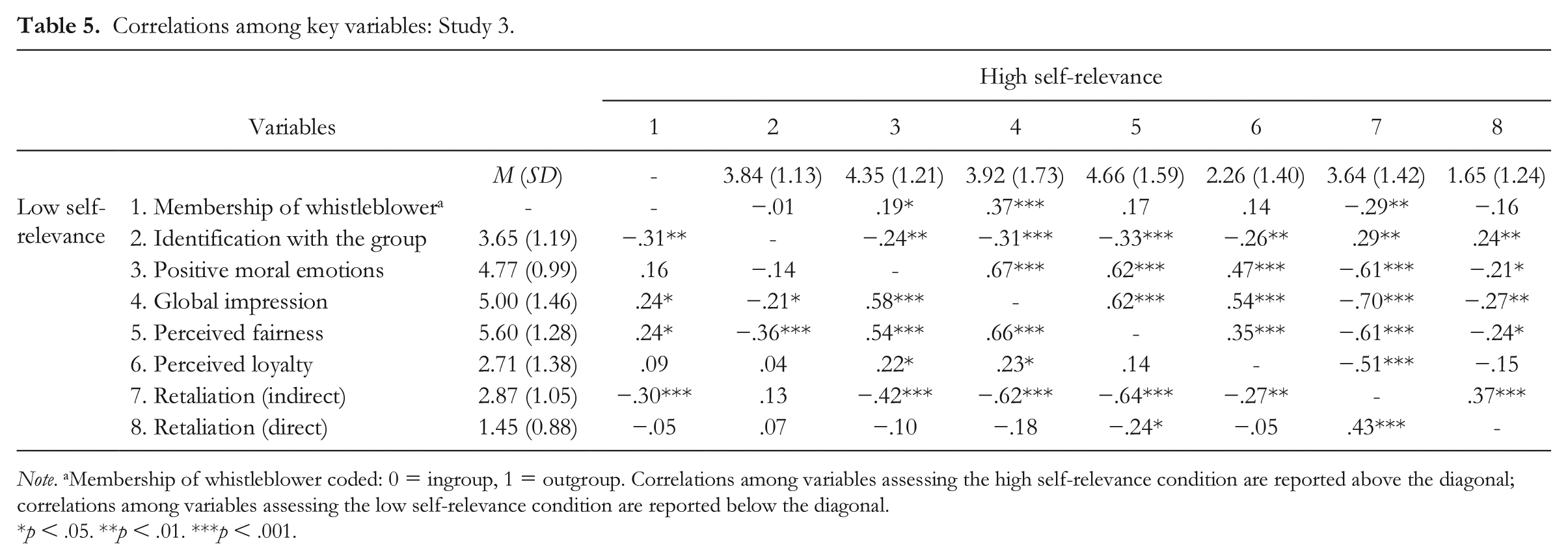
Note. aMembership of whistleblower coded: 0 = ingroup, 1 = outgroup. Correlations among variables assessing the high self-relevance condition are reported above the diagonal; correlations among variables assessing the low self-relevance condition are reported below the diagonal.
p < .05. **p < .01. ***p < .001.
Moral emotions towards the target
A main effect of self-relevance emerged, F(1, 101) = 20.79, p < .001, ηp2 = .17. As predicted, participants reported more positive emotions towards the whistleblower in the lowly self-relevant condition (M = 4.77, SD = 0.97) than in the highly self-relevant condition (M = 4.31, SD = 1.18). The ANOVA also yielded a main effect of target group membership, F(1, 101) = 5.98, p = .02, ηp2 = .06. As hypothesized, the emotions were more positive towards the outgroup (M = 4.77, SD = 1.00) than the ingroup whistleblower (M = 4.32, SD = 1.10). The interaction between self-relevance and target group membership was not significant, F(1, 101) = 0.16, p = .69.
Global impression of the target
The analysis revealed a main effect of self-relevance, F(1, 101) = 44.92, p < .001, ηp2 = .31. As predicted, participants reported a more positive impression of the whistleblower in the lowly self-relevant condition (M = 5.02, SD = 1.46) than in the highly self-relevant condition (M = 3.81, SD = 1.70). The ANOVA also yielded a main effect of target membership, F(1, 101) = 20.14, p < .001, ηp2 = .17. The impression of the whistleblower was more negative when he was an ingroup member (M = 3.89, SD = 1.61) than an outgroup member (M = 4.94, SD = 1.37). The interaction between self-relevance and membership was not significant, F(1, 101) = 1.63, p = .20.
Perceived fairness and loyalty of the target’s action
We computed a 2 (self-relevance of the wrongdoing: high vs. low) x 2 (whistleblower’s membership: ingroup vs. outgroup) x 2 (moral dimension: fairness vs. loyalty) MANOVA with the whistleblower’s membership varied between participants and the other two factors varied within participants. The analysis yielded a main effect of self-relevance, F(1, 100) = 57.33, p < .001, ηp2 = .36. Independently from the dimension, participants perceived the whistleblower as more moral in the lowly self-relevant condition (M = 4.18, SD = 1.33) than in the highly self-relevant condition (M = 3.36, SD = 1.46). The MANOVA also showed a main effect of target membership, F(1, 100) = 7.27, p = .008, ηp2 = .07. In line with prior findings, the outgroup whistleblower (M = 4.02, SD = 1.30) was perceived as more moral than the ingroup one (M = 3.53, SD = 1.44). Furthermore, a main effect of moral dimension arose, F(1, 100) = 315.84, p < .001, ηp2 = .76. Independently of self-relevance and whistleblower group membership, the whistleblowers’s action was perceived as more fair (M = 5.11, SD = 1.43) than loyal (M = 2.43, SD = 1.36). Moreover, the analysis revealed a significant interaction effect between self-relevance and moral dimension, F(1, 100) = 10.14, p = .002, ηp2 = .09. Although the whistleblower’s action was judged as more fair than loyal both in the highly self-relevant (Mfair = 4.57, SDfair = 1.58; Mloyal = 2.16, SDloyal = 1.34; p < .001) and in the lowly self-relevant condition (Mfair = 5.66, SDfair = 1.27; Mloyal = 2.70, SDloyal = 1.38; p < .001), the interaction was due to a greater difference between the two dimensions in the lowly self-relevant condition. No other significant effect arose (Fs < 1.01, ps > .32).
Retaliation against the target
A main effect of self-relevance of the wrongdoing emerged, F(1, 100) = 53.79, p < .001, ηp2 = .35. Participants reported more negative intentions towards the whistleblower in the highly self-relevant (M = 3.72, SD = 1.39) than in the lowly self-relevant condition (M = 2.88, SD = 1.04). The ANOVA also yielded a main effect of whistleblower membership, F(1, 100) = 16.52, p < .001, ηp2 = .14. Intentions were more negative towards the whistleblower when he belonged to the ingroup (M = 3.54, SD = 1.20) than to the outgroup (M = 2.95, SD = 1.02). The interaction between self-relevance of the wrongdoing and whistleblower group membership was not significant, F(1, 100) = 0.40, p = .530. On blatant retaliation, the analysis showed only a main effect of self-relevance of the wrongdoing, F(1, 100) = 8.05, p = .006, ηp2 = .08. Participants were more eager to administer the pain pill to the whistleblower in the high self-relevance of the wrongdoing (M = 1.73, SD = 1.29) than in the low self-relevance of the wrongdoing condition (M = 1.43, SD = 0.85). The other results were not significant (Fs < 1.76, ps > .19).
Mediational models
We conducted four different mediational models, two for each level of self-relevance of the wrongdoing (i.e., high vs. low) and two for each behavioural intention (i.e., indirect and direct retaliation) using the SPSS macro PROCESS (Model 4). The analyses were conducted following Preacher and Hayes’s recommendations (2008), calculating a bias-corrected 95% CI for the indirect effect using a bootstrapping technique with 1,000 resamples (Hayes, 2013). The whistleblower’s membership (0 = ingroup, 1 = outgroup) was entered as predictor, positive emotions were included as mediator, and indirect retaliation or direct retaliation as dependent variables. In line with previous studies, we standardized all measures before testing the moderated mediational models.
When self-relevance of the wrongdoing was high, the models were both significant. The path linking whistleblower’s membership to positive moral emotions, b = 0.39, SE = 0.18, t = 2.10, p = .038, 95% CI [0.02, 0.75], emerged as significant. The relationships between positive moral emotions and indirect, b = −0.57, SE = 0.07, t = −7.71, p < .001, 95% CI [−0.72, −0.43], and direct retaliation, b = −0.19, SE = 0.09, t = −1.99, p = .049, 95% CI [−0.37, −0.00], were both significant. The indirect effect of whistleblower’s membership on indirect retaliation through moral emotions was significant, b = 0.31, SE = 0.16, 95% CI [0.02, 0.67]. In contrast, the indirect effect of whistleblower’s membership on direct retaliation through moral emotions was not significant, b = −0.09, SE = 0.08, 95% CI [−0.33, 0.01].
Regarding the models referring to the low self-relevance of the wrongdoing, the path linking whistleblower’s membership to positive moral emotions was not significant, b = 0.32, SE = 0.19, t = 1.69, p = .094, 95% CI [−0.06, −0.70]. Thus, the relationship between whistleblower’s membership and behavioural intentions was not mediated by positive moral emotions when self-relevance was low.
Discussion
The findings of Study 3 confirmed our predictions and showed, in a within-participant research design, that self-relevance affected reactions to whistleblowers. Specifically, when the self-relevance of the wrongdoing was high (vs. low), whistleblowers were perceived less positively, elicited less positive moral emotions, and more behavioural intentions both for indirect and for direct retaliation. Moreover, ingroup whistleblowers received less favourable evaluations in terms of global perception, moral emotions, and indirect (but not direct) intentions to retaliate than outgroup whistleblowers. Finally, mediational analyses revealed that only when self-relevance of the wrongdoing was high, the relationship between whistleblower’s membership and behavioural intentions was mediated by positive moral emotions. In particular, our models revealed that when self-relevance was high, a whistleblower belonging to the outgroup (vs. ingroup) elicited more positive moral emotions, which in turn lowered participants’ willingness to engage in both indirect and direct retaliation.
General Discussion
Whistleblowing, as disclosure by organization members of illegal or immoral practices, has a crucial relevance in organizational functioning (Lindblom, 2007). Up to now, research has extensively examined factors predicting whistleblowing intentions but has left largely unexplored the other side of the coin, that is, how whistleblowers are perceived. In order to fill this gap, in the present research and across three studies, we focused on the social perception, emotions, and behavioural intentions towards whistleblowers. In Study 1, we focused on a highly self-relevant context of wrongdoing (and the relative reporting of misconduct) for our undergraduate participants, that is, the academic context. We found that the decision of an ingroup member to report (vs. not to report) the group’s wrongdoing, negatively affected the social perception of the target in terms of elicited moral emotions, global impression, and behavioural intentions. Moreover, we found that the decision to blow the whistle elicited less positive moral emotions towards the target, which in turn increased indirect and direct retaliation intent against them. In Study 2, we chose a public office working environment, that is, a less self-relevant context, quite far from the daily experience of our undergraduate participants. Differently from Study 1, the findings of Study 2 showed that reactions towards a person who decided to report ingroup wrongdoing were more favorable than reactions towards a person who decided to remain silent. From the mediational models we tested, it emerged that decision to blow the whistle increased positive emotions towards the target, which in turn decreased retaliation intent only in its indirect but not in its direct form. We conducted a third study in order to test whether self-relevance affected evaluations of whistleblowers. The findings of Study 3 confirmed our predictions and showed that when self-relevance of the group committing the wrongdoing was higher, a less positive attitude towards the whistleblower emerged in terms of global perception, positive moral emotions, and behavioural intentions (both for indirect and for direct retaliation). Moreover, a less favourable evaluation emerged in terms of global perception, positive moral emotions, and indirect (but not direct) retaliation intentions towards the ingroup versus the outgroup whistleblower. In sum, whistleblowers are more negatively evaluated when the context is self-relevant and when they are ingroup members.
The findings from the present research are relevant because they help to understand why the same person who chooses to blow the whistle can be alternatively regarded as a hero or a traitor depending on the context and the perceivers’ point of view. In line with evidence from contiguous research on moral rebels (Monin et al., 2008) and ingroup criticism (Elder et al., 2005; Hornsey, 2005), our research consistently showed that reactions towards whistleblowers change in relation to the self-relevance of the group committing the wrongdoing and being reported. Nonetheless, because all experiments involved undergraduate students, their generalizability must be further established with more diverse samples and in different cultural contexts, given that cultural factors might affect group processes (Gelfand et al., 2007). We also acknowledge that our studies were powered to detect main effects rather than interactive or mediation patterns. Even though the post hoc power analyses suggested that our mediational findings are robust, future studies with samples powered to detect these effects are called to confirm the generalizability of our conclusions. Additionally, future research is needed in order to simultaneously examine whether and how social perception of a target changes in response to the group’s self-relevance, group membership, and target decision to blow the whistle.
Our research highlights the social nature of whistleblowing and the relevance of group processes to understand responses to whistleblowing; as such, it responds to the call of scholars such as Kaplan (2015) for more research on group processes in the whistleblowing phenomenon. Practical indications stem from our findings about how to actively and concretely foster the reporting of illegal/immoral behaviours in corruption prevention training aimed to promote whistleblowing in organizations. Indeed, we know that reflecting upon abstract cases of whistleblowing that are far from participants’ experiences elicits positive responses towards whistleblowers. Rather than reflecting on abstract and general cases of whistleblowing, it is crucial to work on concrete and specific cases that are close to the working experiences of participants in order to make the group processes and issue of self-relevance illustrated in this research more visible.
Groups are of fundamental importance in defining individual identity (Tajfel & Turner, 1979); therefore, it becomes central to understand their role in decision-making processes related to group dilemmas or ethical issues. It is essential to consider groups—formal and informal—as moral anchors: They have norms and standards of behaviour that are shared by members of the group and that guide and constrain social behaviour even without the force of law (Ellemers, 2017). In this way, compliance with group norms guarantees inclusion in the group, makes group members feel good about their group membership, and it is a way to express loyalty and commitment towards other members (Cialdini & Trost, 1998). Morality is crucial in group functioning, and group members comply with moral group norms because they anticipate receiving ingroup respect (Pagliaro et al., 2011). If compliance with group norms is perceived as a sign of loyalty to the group, then deviance and dissent are often seen as a sign of disloyalty and disengagement (Jetten & Hornsey, 2014). Although we did not specifically focus on perceived norms in our studies, it is worth noting that cheating is normative and usual among students, but not among employees (Makridis & Englander, 2021). Future studies should examine more in depth the role of social norms of fairness versus justice of a specific group in the perception of whistleblowers.
Denouncing wrongdoings in the workplace—such as bullying, sexual harassment, gender/ethnic discrimination, bribery, environmental crimes, etc.—can have a crucial impact in the specific contexts and society as a whole: In the short run, reporting wrongdoing guarantees the optimal functioning of the organization where the misconduct occurred; in the long run, as far as it prevents corruption dynamics, it can contribute to an improvement of the society as a whole.
