



Abstract
This work examines lay beliefs about the societal implications of different forms of ingroup identity. While secure ingroup identity reflects a genuine attachment to one’s ingroup members, defensive forms of identity are aimed at satisfying individual enhancement motives through highlighting belongingness to an exceptional group. The latter can be exemplified by collective narcissism, a belief in ingroup greatness and entitlement to privileged treatment, which has been linked to undesirable intra- and intergroup outcomes. In three experiments (total N = 473), conducted in the context of national identities, we investigated how people perceive the manifestations of collective narcissism, contrasted with secure ingroup identity and low identity. Across all studies, participants expected the highest outgroup hostility and poorest intragroup relations from those high in collective narcissism. However, perceivers who were themselves high in collective narcissism were less likely to expect these undesirable manifestations, thus revealing a biased perception of similar others.
Trump’s nationalism is also a patriotic appeal for national unity and pride. . . . It is not a thoughtless glorification of all things American, but the recognition of American ideals, and a belief in seeking the best for the country as a whole.
The USA Today’s columnist’s statement, in defense of former U.S. President Donald Trump calling himself a nationalist, suggests that some people perceive strong national identity, even in its defensive form such as nationalism, as beneficial to the ingroup. The events of January 6, 2021, when Trump’s supporters attacked the Capitol, cast doubt on this view, highlighting the dangers of underestimating the dark side of a strong yet defensive ingroup identity. Past work has shown that defensive ingroup identity manifests in numerous undesirable ingroup and outgroup outcomes (for a review, see Cichocka, 2016; Cichocka & Cislak, 2020). However, we know less about lay people’s ability to recognize the potential negative effects of defensive ingroup identity. It is also unclear whether people expect different outcomes from defensive and nondefensive forms of ingroup identity, and to what extent one’s own defensive identity might modify perceptions of these effects.
According to research on lay perceptions, just as people endorse intuitive theories about individuals, they do so in reference to social groups too (see e.g., Lickel et al., 2001; Yzerbyt et al., 2004). Here, we investigate perceptions of different forms of ingroup identity in a national context. We compare lay perceptions of people who are high in national narcissism—a belief that one’s nation is exceptional but underappreciated, typical of Trump’s nationalistic views (Cichocka & Cislak, 2020)—with perceptions of people with a more secure identity (i.e., a confidently held positive ingroup evaluation; e.g., Cichocka, 2016; Golec de Zavala, Cichocka, & Bilewicz, 2013), and with perceptions of people who can be seen as weakly identified with their nation. We expect that perceptions of these three targets will vary according to perceivers’ form of national identity. Specifically, we expect that perceivers’ own national narcissism might contribute to downplaying the potential negative effects of national narcissism.
Collective Narcissism as a Defensive Form of Ingroup Identity
Research conducted in the tradition of social identity theory suggests that a strong ingroup identity can provide benefits. For instance, it is positively related to group performance, citizenship behaviors, involvement on behalf of the group community (Abrams et al., 1998; Bilewicz & Wojcik, 2010; Efraty & Wolfe, 1988; Harris et al., 2011; van Knippenberg & van Schie, 2000), and support for actions beneficial to ingroup members (Miller & Ali, 2014).
These benefits might, however, not be universal. Researchers distinguished between defensive and secure forms of ingroup identity that, in turn, may be differently associated with intergroup relationships and ingroup outcomes (Adorno et al., 1950; Amiot & Aubin, 2013; Cichocka, 2016; Golec de Zavala, Cichocka, & Bilewicz, 2013; Huddy & Del Ponte, 2019; Kosterman & Feshbach, 1989; Roccas et al., 2006; Schatz et al., 1999). In the national domain, past work differentiated between nationalism and patriotism (Kosterman & Feshbach, 1989), blind and constructive patriotism (Schatz et al., 1999), and national glorification and national attachment (Roccas et al., 2008). Beyond the national context, one approach focused on differences between narcissistic and nonnarcissistic forms of group identity (Cichocka, 2016; Golec de Zavala et al., 2009; Golec de Zavala, Cichocka, & Bilewicz, 2013).
Psychological defensiveness involves avoiding information that may cause discomfort to the self (Baumeister et al., 1996; Kernis, 2003; Kernis & Sun, 1994). For instance, individual narcissism (e.g., Emmons, 1987; Morf & Rhodewalt, 2001) features feelings of self-importance, superiority, and entitlement to special treatment (Campbell & Foster, 2007; Campbell et al., 2002; Horvath & Morf, 2009; Krizan & Herlache, 2018). Those high in narcissism avoid external information or thoughts that could distort their grandiose self-image (e.g., Marchlewska & Cichocka, 2017). Opinions disconfirming their convictions easily threaten them (Baumeister et al., 1996; Horvath & Morf, 2009; Kernis et al., 1989). They are sensitive to criticism (Morf & Rhodewalt, 1993), and react to such threats with hostility (Bushman & Baumeister, 1998). Crucially, those high in narcissism are aware of their narcissistic traits and behaviors (Carlson et al., 2011) but view them favorably (e.g., Hart et al., 2017), and show greater tolerance for others’ narcissistic traits and behaviors (Hart & Adams, 2014).
Collective narcissism is defensive to the extent that it is contingent on external validation, and is related to unsatisfied psychological needs and threat sensitivity (Cichocka, 2016; Cichocka et al., 2018). Those high in collective narcissism react aggressively to ingroup criticism (Golec de Zavala, Cichocka, & Iskra-Golec, 2013), and distance themselves from any accusations and historical accounts that would undermine their image of a strong group that never commits any wrongdoing (Bilewicz, 2016; Klar & Bilewicz, 2017; Marchlewska et al., 2020). At the same time, they emphasize ingroup members’ heroic deeds (Bilewicz et al., 2018), overestimate the ingroup’s contribution to their country or world history (Putnam et al., 2018; Zaromb et al., 2018), and perceive actions benefitting ingroup (vs. outgroup) interests as more moral (Bocian et al., 2021).
In contrast, secure ingroup identity can be defined as ingroup identity free from the defensive, narcissistic component (Golec de Zavala, Cichocka, & Bilewicz, 2013), and it is an expression of satisfaction with group belongingness. It is confidently held as it is consistent with one’s values, stems from satisfied (rather than frustrated) personal needs such as high personal control (Cichocka et al., 2018), and enables achieving personally significant goals (Eker et al., 2023). Those high in secure identity are willing to invest in a group, not expecting recognition from others (Cichocka, 2016). Secure sense of identity can be captured with regard to various types of social groups (e.g., nation, ethnicity, race, gender, or organization) by covarying out collective narcissism from measures of ingroup identification, especially those focused on ties, membership satisfaction, and/or importance of the group to the individual (Cameron, 2004; Leach et al., 2008; Marchlewska et al., 2020).
Inter- and Intragroup Manifestations of Narcissistic Versus Secure Ingroup Identity
Past work has shown that the benefits of ingroup identity depend on its form (Cichocka, 2016; Cichocka & Cislak, 2020). Collective narcissism is associated with stronger prejudice toward other nationalities (Bertin et al., 2022; Cai & Gries, 2013; Golec de Zavala et al., 2009; Gries et al., 2015; Lyons et al., 2010) and ethnic minorities (Cichocka et al., 2017; Golec de Zavala & Cichocka, 2012; Golec de Zavala, Cichocka, & Bilewicz, 2013; Hadarics et al., 2020), and hostility in response to threats (e.g., Golec de Zavala, Cichocka, & Iskra-Golec, 2013). It is also related to intergroup conspiracy beliefs (Biddlestone et al., 2020; Cichocka et al., 2016), lower willingness to forgive others for their past wrongdoings (Golec de Zavala et al., 2009; Hamer et al., 2018), and decreased solidarity with other groups in crisis (Górska et al., 2020).
Importantly, research revealed negative manifestations of collective narcissism concerning ingroup relations. In line with classic theorizing (Adorno, 1963; Fromm, 1973), contemporary studies show that collective narcissism is underlain by the need to regain self-worth, a sense of autonomy, or personal control (Cichocka et al., 2018; Golec de Zavala et al., 2020; Marchlewska, Górska, et al., 2022). This demonstrates the compensatory nature of collective narcissism, which manifests in prioritizing individual goals above the welfare of other ingroup members. While past work showed that leaving the ingroup to join a higher status group was more likely among low-identifiers (Ellemers et al., 1997), recent work shows that leaving the group (in this case, leaving one’s own country for personal financial profit) is also more likely among those high in collective narcissism (Marchlewska et al., 2020). Moreover, collective narcissism is associated with prioritizing personal goals over ingroup goals, exploiting ingroup members (Cichocka et al., 2022), and supporting actions against members of one’s nation, for example, wiretapping citizens (Biddlestone et al., 2022; Molenda et al., 2023). Furthermore, the group image concerns associated with collective narcissism may translate into support for policies that endanger the national environment or citizens’ health. For example, collective narcissism is associated with antivaccination attitudes, which may eventually put the entire group at risk (Cislak, Marchlewska, et al., 2021), increased readiness to sacrifice ingroup members’ health to defend the ingroup’s image (Gronfeldt, Cislak, Sternisko, et al., 2023), and lowered readiness to offer humanitarian aid (Mashuri et al., 2022). In the same vein, collective narcissism was positively related to support for anticonservation actions, such as cutting down a UNESCO-listed national park or subsidizing the coal industry (Cislak et al., 2018), and preference for greenwashing over genuine proenvironmental actions (Cislak, Cichocka, et al., 2021).
Importantly, research in the environmental domain differentiated between collective narcissism and political orientation. Collective narcissism is positively related to right-wing political orientation (Cichocka et al., 2017). However, while political conservatism is related to general opposition to environmentalism (Gromet et al., 2013; Hornsey et al., 2018; McCright, 2010), collective narcissism is related to readiness to exploit environmental narratives to reinforce the group image (Cislak, Cichocka, et al., 2021), but not to support for genuine proenvironmental action (Cislak, Cichocka, et al., 2021; Cislak et al., 2023). This line of work provided theoretical insights regarding the unique explanatory role of collective narcissism: its focus on external recognition and group enhancement.
Considering collective narcissism also helps clarify the nature of secure ingroup identity. As we outlined above, controlling for collective narcissism allows us to observe the positive effects of secure ingroup identity on attitudes toward outgroups (Golec de Zavala, Cichocka, & Bilewicz, 2013): increased empathy and solidarity with disadvantaged groups (Górska et al., 2020); lower perception of outgroup threats and, thus, a lower likelihood of endorsing conspiracy theories (Cichocka et al., 2016); and less experience of insult (Golec de Zavala et al., 2016). Instead of focusing on external approval, those with high secure identity seem more focused on caring for ingroup members (Cichocka, 2016; Golec de Zavala, Cichocka, & Bilewicz, 2013; Marchlewska et al., 2020, Marchlewska, Cichocka, et al., 2022). In the intragroup context, secure ingroup identity is negatively related to readiness to exploit ingroup members (Cichocka, 2016; Cichocka et al., 2022) or conspire against them (Biddlestone et al., 2022), while being positively related to national loyalty (Marchlewska et al., 2020). Less is known, however, to what extent lay people, largely unaware of scientific findings on forms of ingroup identity and relying on their own lay beliefs, are able to differentiate forms of identity and anticipate their potential manifestations for inter-and intragroup relations.
Lay Perceptions of Group Identity Manifestations
The process of social perception relies largely on lay beliefs about the world (e.g., Brewer et al., 1984; Neisser, 1976). Numerous studies have focused on how lay theories affect social cognition, emotions, motivation, and behavior (e.g., Dweck et al., 1995; Epstein, 1989; Heider, 1958; Kelly, 1955; Rhodewalt, 1994; Sternberg, 1985), including perception and behavior towards groups (see e.g., Chiu et al., 2000; Hong et al., 2001; Karafantis & Levy, 2004; Levy et al., 2001; Plaks et al., 2004). While people are often unable to verbalize them, such theories operate implicitly and affect the interpretation of incoming information from the social world (Levy et al., 1999). As Plaks et al. (2004) found, because people implicitly hold a lay theory of group types, they draw conclusions about the nature of social relations within specific group types based on an abstract description of group features.
Lay theories may thus shape inferences regarding social relationships, behavioral readiness, and choices. These may be shaped by the social perceivers’ own identity. The motivated cognition tradition suggests that cognitive biases serve to maintain one’s attitudes or protect self-worth (Clark et al., 2008; Dunning & Cohen, 1992; Eagly et al., 2000; Kunda, 1990). Plaks et al. (2009) argue that people implicitly engage in compensation mechanisms to reduce the impact of information that could undermine their current system of meaning. Following this reasoning, we suggest that people’s perceptions of different forms of national identity will depend on their lay beliefs attributed to national identity, alongside their individual tendency to protect their attitudes.
Thus, we examine whether collective narcissism moderates people’s perceptions of ingroup identity manifestations. We consider two possibilities. On the one hand, those high in collective narcissism might accept outgroup hostility or poor ingroup relations as a price for achieving their goals. On the other hand, in line with the idea that collective narcissism is a group-based ego-enhancement strategy (Cichocka & Cislak, 2020), one could expect those high in collective narcissism to protect their beliefs, attitudes, or behaviors by enhancing the image of those similar to themselves (in this case, those high in collective narcissism). If those high in collective narcissism allowed doubts about their beliefs concerning the group, they would have to face a hint of negativity in their self-image. Thus, similarly to those high in individual narcissism, who tend to view their narcissistic traits and behaviors as necessary and desirable (e.g., Hart et al., 2017), we expect those high in collective narcissism to perceive behaviors typically associated with narcissistic identities in a favorable light.
Overview
In three experiments, we examine lay perceptions of different forms of national identity. We investigate whether ingroup members expect different intra- and intergroup manifestations of national identity and national narcissism (ingroup identity and collective narcissism applied to the national context). In all experiments, we manipulate the description of a national ingroup member (secure high-identifier vs. narcissistic high-identifier vs. low-identifier) and measure perceptions of outgroup hostility, ingroup loyalty, and relations between ingroup members. We also examine the potential moderating effect of perceivers’ national narcissism (Study 1), additionally controlling for perceivers’ national identification (Study 2). In all studies, we test the effects controlling for age, gender, and political orientation (more details in the supplemental online material [SOM]). We report all measures, manipulations, and exclusions.
Pilot Study
We checked whether lay people (i.e., people unfamiliar with scientific descriptions of national identities) have different expectations of narcissistic identifiers as opposed to secure identifiers or low-identifiers. To this end, we manipulated the description of an anonymous ingroup member. The descriptions presented the person as strongly narcissistically identified with their nation, strongly nonnarcissistically identified, or as weakly identified. Here, for brevity, we refer to those three descriptions as featuring secure high-identifiers, narcissistic high-identifiers, and low-identifiers. 1
We expected participants to attribute higher outgroup hostility to narcissistic high-identifiers, compared to secure high-identifiers or low-identifiers; and the lowest loyalty to low-identifiers, compared to the two other groups. Also, we expected participants to attribute better ingroup relations to secure high-identifiers than to narcissistic high-identifiers or low-identifiers.
Method
Participants
We used a rule of thumb and aimed to include at least 50 participants per cell (Simmons et al., 2013). We recruited 160 Polish participants: 2 96 women (coded as 1) and 64 men (coded as 0), aged between 19 and 71 (M = 31.13, years SD = 10.99). We invited community members to participate in the study in public places such as railway stations or shopping centers, which resulted in good-quality data; no exclusions were made. A sensitivity analysis conducted with G*Power (Faul et al., 2017) suggested that this sample size provided 80% power to detect a medium effect f = .25 (f2 = .06).
Procedure and design
First, we randomly assigned participants to one of three descriptions (see Appendix). We provided them with a description of a person presented as “X” (without names or gender) and asked them to spend a few moments imagining this person. In order to assure they actually spent time doing this, we asked them to write down three adjectives that adequately described this person. Then, we asked participants to imagine that people similar to the one described in the materials constituted a majority in the participants’ own country; and to respond to items concerning relations with outgroups, ingroup loyalty, and relations between ingroup members. Finally, we measured demographics and political orientation.
Measures
Unless otherwise noted, participants provided answers on 7-point scales (1 = definitely not, 7 = definitely yes). We coded all variables so that higher scores reflected less desirable outcomes.
Perception of outgroup hostility was measured with seven items (e.g., “People of non-Polish nationality could fear aggressive behavior from some part of Poles (verbal or in extreme situations, physical attacks),” “Other countries would be accused by Poland of conspiring against Poland”; α = .87, M = 3.25, SD = 1.40).
Perception of ingroup disloyalty was measured with three items (e.g., “Some Poles would be more willing to leave the country,” “Poles would be more loyal to their country” [reverse-coded]; α = .83, M = 3.81, SD = 1.68).
Perception of poor relations between ingroup members was measured with four items (e.g., “Permission to follow and eavesdrop on Polish citizens would increase in Poland,” “Relations between people in Poland would be better” (reverse-coded); α = .72, M = 3.35, SD = 1.45).
Political orientation was a single-item measure answered on a 7-point scale (1 = definitely left wing, 7 = definitely right wing; M = 3.99, SD = 1.34).
Results
Zero-order correlations
Perception of poor ingroup relations significantly positively correlated with perception of outgroup hostility, r(157) = .73, p < .001, 95% CI [0.65, 0.80], and perception of ingroup disloyalty, r(157) = .39, p < .001, 95% CI [0.25, 0.51]. The latter two were not correlated, r(157) = −.02, p = .772, 95% CI [−0.18, 0.13]. Political orientation was not related to perception of outgroup hostility, r(157) = −.13, p = .115, 95% CI [−0.28, 0.03]; ingroup disloyalty, r(157) = −.15, p = .063, 95% CI [−0.30, 0.01]; and poor ingroup relations, r(157) = −.16, p = .055, 95% CI [−0.31, 0.003].
Perception of outgroup hostility
An ANOVA with Bonferroni correction for multiple comparisons showed that participants expected a significantly higher level of outgroup hostility from narcissistic high-identifiers compared to secure high-identifiers, d = 2.44, p < .001, and to low-identifiers, d = 2.08, p < .001, with no significant differences between the latter two, d = 0.23, p = .791 (see Table 1). 3
Differences in means of focal variables across conditions: Pilot study.

Note. Different superscripts within a row represent differences between means significant at p < .050 (with Bonferroni correction for multiple comparisons for perception of outgroup hostility and ingroup disloyalty, and Tamhane correction for ingroup relations).
Perception of ingroup loyalty
An ANOVA with Bonferroni correction showed that participants expected greater disloyalty from low-identifiers compared to narcissistic, d = 1.69, p < .001, and secure high-identifiers, d = 2.40, p < .001. Also, participants expected greater disloyalty from narcissistic than from secure high-identifiers, d = 0.53, p = .034 (see Table 1).
Perception of relations between ingroup members
An ANOVA with Tamhane’s correction for multiple comparisons, applied due to significant result of Levene’s test, F(2, 157) = 5.25, p = .006, showed that participants expected significantly poorer ingroup relations from narcissistic high-identifiers, d = 1.72, p < .001, and low-identifiers, d = 0.94, p < .001, compared to secure high-identifiers. Also, participants expected poorer ingroup relations from those high in national narcissism than from low-identifiers, d = 0.67, p = .002 (see Table 1).
Discussion
Based on our construct-informed descriptions, participants expected the greatest outgroup hostility from narcissistic high-identifiers, the lowest loyalty from low-identifiers, and the best ingroup relations from secure high-identifiers. Thus, our manipulation can be considered effective. Also, lay participants expected lower loyalty from narcissistic than from secure high-identifiers, which is in line with past empirical research showing that loyalty is in fact negatively associated with collective narcissism and positively associated with secure ingroup identity (Marchlewska et al., 2020). Participants also expected poorer ingroup relations from narcissistic high-identifiers than from low-identifiers, which is in line with recent work on national narcissism and instrumental treatment of ingroup members (Cichocka, 2016; Cichocka et al., 2022).
Study 1
The pilot study delivered evidence that lay perceivers understand the problematic manifestations of national narcissism. In the main studies, we aimed to verify whether those scoring high on national narcissism recognize these undesirable manifestations. We expect that they will downplay the negative consequences of national narcissism.
Method
Participants
Given that in the pilot study we observed large effect sizes, and we planned to additionally include interaction effects, we relied on a similar target sample size. We recruited 156 Polish participants: 96 women (coded as 1), 56 men (coded as 0), and four participants who declined to report their gender; aged between 18 and 81 (M = 36.60, years SD = 18.33). Because we used two dummy codes in our moderation effects analysis, we adjusted power to .90 in the sensitivity analysis. Using G*Power analysis for linear multiple regression, with one tested predictor and five predictors overall, we determined that we should be able to detect an R2 increase of .07 for each interaction effect, which corresponds to a small to medium effect size.
Procedure and design
As in the pilot study, we recruited community members in public places (face-to-face). We first measured participants’ national narcissism, then followed the same procedure as in the pilot study.
Measures
National narcissism was measured with the nine-item Collective Narcissism Scale (Golec de Zavala et al., 2009), applied in relation to the national group. Participants indicated to what extent they agreed with the statements (e.g., “It really makes me angry when others criticize Poles,” “If Poles had a major say in the world, the world would be a much better place”) on 7-point scales (1 = definitely not, 7 = definitely yes; α = .83, M = 3.74, SD = 1.15).
Perception of outgroup hostility (α = .87, M = 3.38, SD = 1.52), ingroup disloyalty (α = .68, M = 3.76, SD = 1.52), poor relations between ingroup members (α = .71, M = 3.44, SD = 1.48), and political orientation (M = 3.97, SD = 1.18) were all measured as in the pilot study.
Results
Zero-order correlations
First, we examined correlations between continuous variables. Perceived outgroup hostility, ingroup disloyalty, and ingroup poor relations were significantly positively correlated. 4 None of these variables was related to national narcissism or political orientation. The latter two were, however, positively correlated (see Table 2).
Correlations between continuous variables with 95% confidence intervals: Study 1.

p < .010. ***p < .001.
Analytical strategy for testing moderation
Similarly to the pilot study, we first conducted ANOVAs with Bonferroni correction for multiple comparisons. We then examined the moderation effects using General Analyses for Linear Models, a module of Jamovi (Version 1.1.9; Galucci, 2019). We tested separate models for each of the dependent variables, introducing national narcissism as a moderator and condition as a factor. Using the group of narcissistic high-identifiers as a reference category, we recoded the condition into two dummy variables: we contrasted narcissistic high-identifiers with (a) secure high-identifiers and (b) low-identifiers. To investigate the differences in the strength of the relationship between national narcissism and each of the dependent variables across conditions, we estimated two interaction terms representing the moderating effect of national narcissism on each dummy variable. In other words, we estimated the models that included two dummy variables (representing the conditions), national narcissism (a moderator), and two interaction terms corresponding to 5 degrees of freedom.
The regression coefficient for national narcissism can be interpreted as reflecting the relationship between national narcissism and the dependent variable in the narcissistic high-identifier condition. Similarly, regression coefficients for the interaction terms can be interpreted as representing the difference between the strength of the relationship of national narcissism and the dependent variable in the secure high-identifier condition and in the narcissistic high-identifier condition, and between the strength of the relationship of national narcissism and the dependent variable in the low-identifier and the narcissistic high-identifier conditions.
Perception of outgroup hostility
An ANOVA showed significant differences between the conditions: participants expected higher outgroup hostility from narcissistic high-identifiers than from secure high-identifiers, d = 2.01, p < .001, and low-identifiers, d = 2.10, p < .001. Again, there was no difference in perception of secure high-identifiers and low-identifiers, d = 0.01, p > .999 (see Table 3).
Differences in means of focal variables across conditions: Study 1.

Note. Different superscripts within a row represent differences between means significant at p < .050 (with Bonferroni correction for multiple comparisons).
The model with the interactions was significant and explained perception of outgroup hostility significantly better than a model without the interactions, 5 F(5, 150) = 34.83, p < .001; R2 = .54, ΔR2 = .05 (see Figure 1). The effect of national narcissism on outgroup hostility attributed to the narcissistic high-identifiers (reference target) was negative: the higher national narcissism, the lower outgroup hostility attributed to narcissistic high-identifiers, B = −0.42, 95% CI [−0.73, −0.11], p = .008. Both interaction terms of national narcissism and dummy variables were significant. The difference in strength of the relationship of national narcissism and perceived outgroup hostility between low-identifiers and narcissistic high-identifiers was significant, B = 0.80, 95% CI [0.40, 1.19], p < .001. Simple slope analysis showed that the effect of national narcissism on perceived outgroup hostility for the low identifying target was significant and positive: the higher participants’ national narcissism, the higher outgroup hostility attributed to low-identifiers, B = 0.38, 95% CI [0.13, 0.62], p = .003. Similarly, the difference in strength of the relationship of national narcissism and perceived outgroup hostility between secure and narcissistic high-identifiers was significant, B = 0.55, 95% CI [0.16, 0.94], p = .006. In this case, simple slope analysis showed that the effect of national narcissism on perceived outgroup hostility for the target secure high-identifiers was not significant: the level of outgroup hostility attributed to secure high-identifiers was unrelated to participants’ national narcissism, B = 0.13, 95% CI [−0.10, 0.36], p = .267. 6

Effect of national narcissism on outgroup hostility attributed to narcissistic high-identifiers in comparison to secure high-identifiers and low-identifiers (with 95% CIs): Study 1.
Perception of ingroup disloyalty
ANOVA results showed similar differences across conditions as in the pilot study (see Table 3). Participants expected a higher level of ingroup disloyalty from low-identifiers compared to narcissistic, d = 1.16, p < .001, and secure high-identifiers, d = 1.74, p < .001. They also expected greater disloyalty from narcissistic than from secure high-identifiers, d = 0.73, p = .001.
The model with the interactions was significant and explained perception of ingroup disloyalty significantly better than a model without the interactions, F(5, 150) = 28.23, p < .001; R2 = .49, ΔR2 = .12 (see Figure 2). The effect of national narcissism on ingroup disloyalty attributed to narcissistic high-identifiers was negative: the higher participants’ national narcissism, the lower ingroup disloyalty attributed to narcissistic high-identifiers, B = −0.71, 95% CI [−1.04, −0.38], p < .001. The difference in strength of the relationship of national narcissism and perceived ingroup disloyalty between low-identifiers and narcissistic high-identifiers was significant, B = 1.23, 95% CI [0.81, 1.64], p < .001. Simple slope analysis showed that the effect of national narcissism on perceived ingroup disloyalty for the target low-identifiers was significant and positive: the higher participants’ national narcissism, the higher ingroup disloyalty attributed to low-identifiers, B = 0.51, 95% CI [0.25, 0.77], p < .001. The difference in strength of the relationship of national narcissism and perceived ingroup disloyalty between narcissistic and secure high-identifiers was also significant, B = 0.61, 95% CI [0.20, 1.02], p = .004. Simple slope analysis showed that the effect of national narcissism on perceived ingroup disloyalty for the target secure high-identifiers was not significant: the level of ingroup disloyalty attributed to secure high-identifiers was not related to participants’ national narcissism, B = −0.11, 95% CI [−0.35, 0.14], p = .394.

Effect of national narcissism on ingroup disloyalty attributed to narcissistic high-identifiers in comparison to secure high-identifiers and low-identifiers (with 95% CIs): Study 1.
Perception of relations between ingroup members
As in the pilot study, compared to secure high-identifiers, participants expected significantly poorer ingroup relations from narcissistic high-identifiers, d = 1.74, p < .001, and low-identifiers, d = 0.86, p < .001. They also expected poorer ingroup relations from narcissistic high-identifiers than from low-identifiers, d = 0.79, p < .001 (see Table 3).
The model with the interaction was significant and explained perception of poor ingroup relations significantly better than a model without the interaction, F(5, 150) = 23.60, p < .001; R2 = .44, ΔR2 = .11 (see Figure 3). The effect of national narcissism on poor ingroup relations attributed to narcissistic identifiers was negative: the higher participants’ national narcissism, the less narcissistic high-identifiers were attributed poor ingroup relations, B = −0.68, 95% CI [−1.02, −0.35], p < .001. The difference in strength of the relationship of national narcissism and perceived poor ingroup relations between low-identifiers and narcissistic high-identifiers was significant, B = 1.19, 95% CI [0.77, 1.62], p < .001. Simple slope analysis showed that the effect of national narcissism on perceived poor ingroup relations for the target low-identifiers was significant and positive: the higher participants’ national narcissism, the poorer ingroup relations attributed to low-identifiers, B = 0.51, 95% CI [0.25, 0.77], p < .001. The difference in strength of the relationship of national narcissism and perceived poor ingroup relations between narcissistic and secure high-identifiers was also significant, B = 0.77, 95% CI [0.35, 1.19], p < .001. Simple slope analysis revealed that the effect of national narcissism on perceived ingroup relations for the target secure high-identifiers was not significant: the level of poor relations attributed to secure high-identifiers was not related to participants’ national narcissism, B = 0.09, 95% CI [−0.16, 0.34], p = .493.

Effect of national narcissism on poor ingroup relations attributed to narcissistic high-identifiers in comparison to secure high-identifiers and low-identifiers (with 95% CIs): Study 1.
Discussion
In Study 1, we replicated the pattern observed in the pilot study: participants expected the highest outgroup hostility and the poorest ingroup relations from national narcissists, while they expected the highest group disloyalty from low-identifiers. Perceivers’ national narcissism, however, moderated these expectations. The higher participants’ national narcissism, the less likely they were to attribute outgroup hostility and ingroup disloyalty to other national narcissists. Also, the higher participants’ national narcissism, the more they expected good ingroup relations from other national narcissists. Those high in national narcissism also attributed stronger outgroup hostility, greater ingroup disloyalty, and the poorest ingroup relations to low-identifiers. Interestingly, these effects were observed even though the material made clear differences in the descriptions of the manifestations of the three types of identity. Thus, Study 1 suggests that those high in national narcissism revealed a positive bias towards other national narcissists, suggesting that they might ignore or underestimate the threats associated with their form of national identity.
Study 2
In Study 2, we aimed to replicate Study 1, additionally controlling for perceivers’ own national identity.
Method
Participants
Following the same power considerations as in Study 1, we recruited 157 Polish participants: 83 women (coded as 1) and 74 men (coded as 0), aged between 18 and 70 (M = 33.12, years, SD = 14.27).
Procedure and design
We collected the data face-to-face according to the same scenario. First, we measured national narcissism and national identification (counterbalanced). We then followed the same procedure as in the previous studies.
Measures
National narcissism (α = .89, M = 3.83, SD = 1.33), perception of outgroup hostility (α = .88, M = 3.47, SD = 1.50), ingroup disloyalty (α = .83, M = 3.61, SD = 1.68), poor relations between ingroup members (α = .73, M = 3.35, SD = 1.45), and political orientation (M = 3.72, SD = 1.53) were all measured as in previous studies.
National identification was measured with the 12-item Social Identification Scale (Cameron, 2004); participants responded to items (e.g. “I have a lot in common with other Poles,” “I feel strong ties to other Polish people,” “In general, I’m glad to be Polish”) on 7-point scales (1 = definitely not, 7 = definitely yes; α = .91, M = 4.84, SD = 1.21).
Results
Zero-order correlations
National narcissism was significantly positively correlated with national identification (see Table 4). Unlike in Study 1, both national narcissism and national identification were significantly negatively correlated with perception of ingroup disloyalty and perception of ingroup poor relations. The latter two were also positively related to each other and unrelated to outgroup hostility. Political orientation was positively correlated with national narcissism and national identification, and negatively correlated with perception of ingroup disloyalty. 7
Correlations between continuous variables with 95% confidence intervals: Study 2.

p < .050. **p < .010. ***p < .001.
Perception of outgroup hostility
An ANOVA with Tamhane’s correction for multiple comparisons, due to significant result of Levene’s test, F(2, 153) = 4.71, p = .010, showed that participants expected a significantly higher level of outgroup hostility from narcissistic than from secure high-identifiers, d = 1.81, p < .001, and low-identifiers, d = 1.53, p < .001; with no significant difference between the latter two, d = 0.22, p > .999 (see Table 5).
Differences in means of focal variables across conditions: Study 2.

Note. Different superscripts within a row represent differences between means significant at p < .050 (with Tamhane correction for multiple comparisons).
The model with the interactions was significant and explained perception of outgroup hostility significantly better than a model without the interactions, F(6, 149) = 32.86, p < .001; R2 = .57, ΔR2 = .15 (see Figure 4). The effect of national narcissism on outgroup hostility attributed to the narcissistic high-identifiers was negative: the higher participants’ national narcissism, the lower outgroup hostility attributed to narcissistic high-identifiers, B = −0.50, 95% CI [−0.74, −0.27], p < .001. The difference in strength of the relationship of national narcissism and perceived outgroup hostility between low-identifiers and narcissistic high-identifiers was significant, B = 1.05, 95% CI [0.75, 1.35], p < .001. As in Study 1, simple slope analysis showed that the effect of national narcissism on perceived outgroup hostility for the target low-identifiers was significant and positive: the higher participants’ national narcissism, the higher outgroup hostility attributed to low-identifiers, B = 0.55, 95% CI [0.29, 0.80], p < .001. The difference in strength of the relationship of national narcissism and perceived outgroup hostility between narcissistic and secure high-identifiers was also significant, B = 0.76, 95% CI [0.47, 1.05], p < .001. In contrast to Study 1, simple slope analysis revealed that the effect of national narcissism on perceived outgroup hostility for the target secure high-identifiers was significant and positive: the higher participants’ national narcissism, the higher outgroup hostility attributed to secure high-identifiers, B = 0.26, 95% CI [0.01, 0.51], p = .038.

Effect of national narcissism on outgroup hostility attributed to narcissistic high-identifiers in comparison to secure high-identifiers and low-identifiers after controlling for national identification (with 95% CIs): Study 2.
Perception of ingroup disloyalty
An ANOVA with Tamhane’s correction for multiple comparisons, due to significant result of Levene’s test, F(2, 153) = 4.88, p = .009, showed that participants expected greater disloyalty from low-identifiers in comparison to both narcissistic, d = 1.01, p < .001, and secure high-identifiers, d = 1.62, p < .001. They also expected greater disloyalty from narcissistic than from secure high-identifiers; the effect was marginally nonsignificant, d = 0.46, p = .060 8 (see Table 5).
The model with the interactions was significant and explained perception of ingroup disloyalty significantly better than a model without the interactions, F(6, 149) = 16.92, p < .001; R2 = .41, ΔR2 = .02 (see Figure 5). After controlling for national identification, the effect of national narcissism on ingroup disloyalty attributed to the target of narcissistic high-identifiers was negative. As in Study 1, the higher participants’ national narcissism, the lower ingroup disloyalty attributed to narcissistic high-identifiers, B = −0.53, 95% CI [−0.84, −0.22], p < .001. We found a significant difference in strength of the relationship of national narcissism and perceived ingroup disloyalty between low-identifiers and narcissistic high-identifiers, B = 0.45, 95% CI [0.05, 0.84], p = .028. However, simple slope analysis revealed that the effect of national narcissism on perceived ingroup disloyalty for the target low-identifiers was not significant: the level of disloyalty attributed to low-identifiers was not related to participants’ national narcissism, B = −0.08, 95% CI [−0.41, 0.25], p = .638. We found no significant difference in strength of the relationship of national narcissism and perceived ingroup disloyalty between secure and narcissistic high-identifiers, B = 0.20, 95% CI [−0.19, 0.58], p = .309.

Effect of national narcissism on ingroup disloyalty attributed to narcissistic high-identifiers in comparison to secure high-identifiers and low-identifiers, after controlling for national identification (with 95% CIs): Study 2.
Perception of relations between ingroup members
An ANOVA with Tamhane’s correction for multiple comparisons, result of Levene’s test was significant, F(2, 153) = 6.41, p = .002, revealed that participants expected significantly poorer relations from narcissistic high-identifiers, d = 1.44, p < .001, and low-identifiers, d = 0.74, p = .001, compared to secure high-identifiers. They also expected poorer relations from narcissistic high-identifiers than from low-identifiers, d = 0.85, p < .001 (see Table 5).
The model with the interaction was significant and explained perception of ingroup relations significantly better than the model without the interaction, F(6, 149) = 20.69, p < .001; R2 = .45, ΔR2 = .13 (see Figure 6). After controlling for national identification, the effect of national narcissism on poor ingroup relations attributed to narcissistic identifiers was negative. As in Study 1, the higher participants’ national narcissism, the less narcissistic high-identifiers were attributed poor ingroup relations, B = −0.52, 95% CI [−0.78, −0.27], p < .001. The difference in strength of the relationship of national narcissism and perceived poor ingroup relations between low-identifiers and narcissistic high-identifiers was significant, B = 0.99, 95% CI [0.66, 1.32], p < .001. As in Study 1, simple slope analysis showed that the effect of national narcissism on perceived poor ingroup relations for the target low-identifiers was significant and positive: the higher participants’ national narcissism, the poorer ingroup relations attributed to low-identifiers, B = 0.47, 95% CI [0.20, 0.75], p < .001. The difference in strength of the relationship of national narcissism and perceived poor ingroup relations between secure and narcissistic high-identifiers was also significant, B = 0.62, 95% CI [0.31, 0.94], p < .001. As in Study 1, simple slope analysis showed that the effect of national narcissism on perceived ingroup relations for the target secure high-identifiers was not significant, B = 0.10, 95% CI [−0.17, 0.37], p = .453.
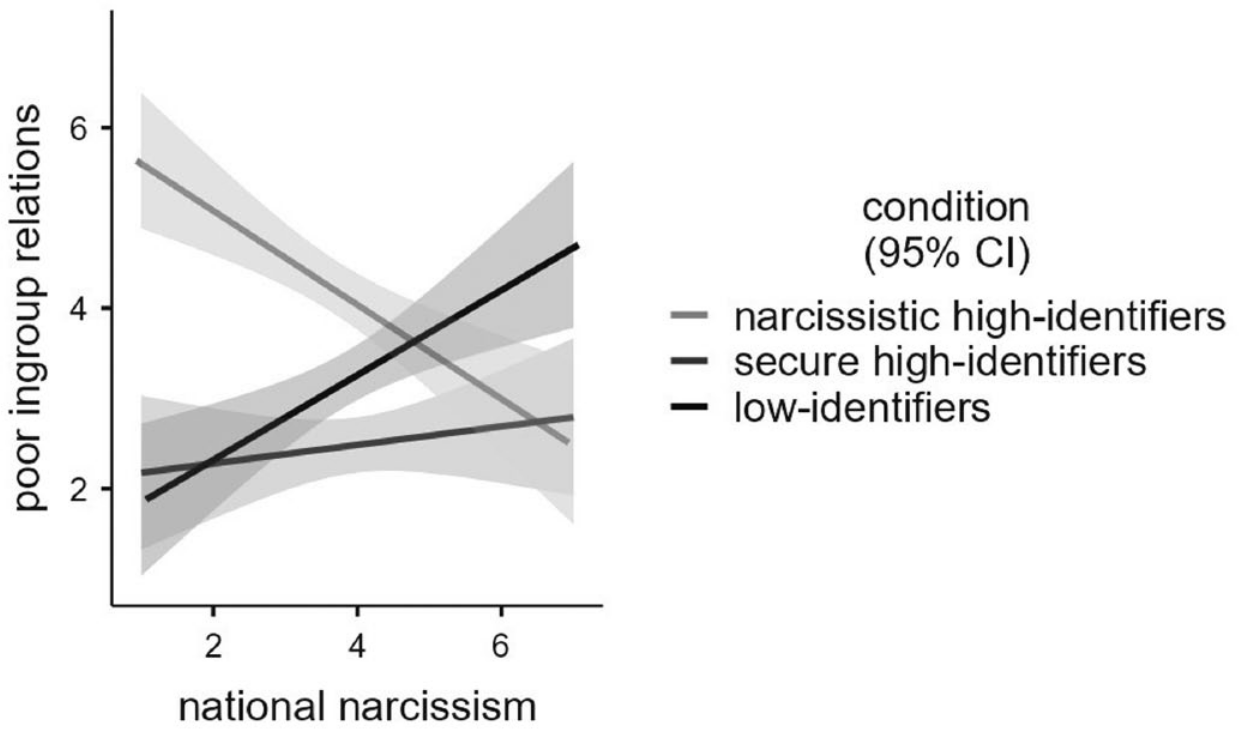
Effect of national narcissism on poor ingroup relations attributed to narcissistic high-identifiers in comparison to secure high-identifiers and low-identifiers, after controlling for national identification (with 95% CIs): Study 2.
Discussion
The results of Study 2 replicated and extended the findings of the previous studies. Participants expected the highest outgroup hostility and the poorest ingroup relations from narcissistic high-identifiers, while they expected the highest ingroup disloyalty from low-identifiers. Importantly, even after controlling for perceiver’s national identification, perceiver’s national narcissism moderated these expectations: those high in national narcissism expected significantly lower outgroup hostility and ingroup disloyalty, and significantly better ingroup relations from national narcissists than those low in national narcissism did. Also, Study 2 replicated a pattern we observed in Study 1: those high in national narcissism attributed stronger outgroup hostility and the poorest ingroup relations to low-identifiers. Yet, contrary to Study 1, those high (vs. low) in national narcissism did not attribute higher disloyalty to the group of low-identifiers. Additionally, those high in national narcissism attributed stronger outgroup hostility also to the group of secure high-identifiers. This suggests a general tendency to assign responsibility for potential negative outcomes to those not revealing national narcissism.
General Discussion
Across three experiments, we observed a consistent pattern: participants expected the highest outgroup hostility and the poorest ingroup relations from narcissistic high-identifiers, and the highest ingroup disloyalty from low-identifiers (and the lowest disloyalty from secure high-identifiers). The effect sizes of these outcomes were large, suggesting that lay beliefs regarding the inter- and intragroup consequences of collective identity might be strong and widespread. Namely, participants revealed stable expectations of how harmful for inter- and intragroup relations might be to maintain a strong but narcissistic national identity. Similarly, participants perceived strong links between not claiming a strong national identity and being disloyal to individuals who represent the same nationality. Low identification may, after all, imply greater readiness to choose a mobility strategy when the ingroup’s status is no longer satisfactory (Ellemers et al., 1997).
Importantly, in Studies 1 and 2, we found that perceivers’ national narcissism moderated these expectations: those high (vs. low) in national narcissism were more likely to expect better intragroup relations, greater loyalty, and lower outgroup hostility from groups composed of fellow national narcissists. Also, they expected the highest disloyalty from groups dominated by low-identifiers.
Past work showed that collective narcissism in general, and national narcissism in particular, is positively associated with outgroup hostility (e.g., Bertin et al., 2022; Golec de Zavala, Cichocka, & Iskra-Golec, 2013; Lyons et al., 2010), ingroup disloyalty (Marchlewska et al., 2020), and harming of ingroup members (Biddlestone et al., 2022; Cichocka et al., 2022; Gronfeldt, Cislak, Marinthe, & Cichocka, 2023; Gronfeldt, Cislak, Sternisko, et al., 2023; Marchlewska et al., 2020). Those high in national narcissism seem to downplay these risks and reveal a positivity bias toward compatriots narcissistically identified with their nation. If those high in collective narcissism recognized narcissistic identifiers as somewhat similar to them, then, this pattern may indicate a defensive need to enhance the narcissistic ingroup’s image. This is in line with research on individual defensiveness showing that individual narcissism predicts a preference for narcissistic friends (Jonason & Schmitt, 2012), perception of narcissistic traits as personal strengths (Carlson, 2013), and a favorable view of narcissism (e.g., Hart et al., 2018). Our results, however, also suggest a potential difference between individual and collective narcissism. While those high in individual narcissism perceive agentic traits as more valued by others, they seem to be aware that those traits may be socially destructive (Carlson, 2013). Yet, in our study, those high in collective narcissism seemed to downplay the risks associated with their form of ingroup identity. In a nutshell, national narcissism seems to involve a motivated perception of their own “breed” within the nation.
This tendency seems to correspond with a negative perception of those who do not exhibit national narcissism themselves, especially low-identifiers. On the one hand, those high in collective narcissism may hold prejudice against those who are not identified with any particular group. On the other hand, low-identifiers may evoke hostile reactions if they are perceived as cosmopolitans. As stated by former British Prime Minister Theresa May, “If you believe you are a citizen of the world, you are a citizen of nowhere” (Ahmed, 2018). Such tendencies were evident in statements of Trump and his supporters, who attacked cosmopolitans for allegedly being enemies of the American nation (Buruma, 2017). In a similar vein, Josh Hawley, a conservative U.S. senator accused cosmopolitans of disloyalty for being primarily identified with the community of human beings instead of promoting “specifically American identity” (Gorman & Seguin, 2019). Thus, national narcissism may involve derogating or scapegoating members of the same group who are seen as cosmopolitans.
Implications, Limitations, and Future Directions
The present results contribute to the psychological literature on the consequences of narcissistic identity by elucidating how collective narcissism may shape lay perceptions of group identity. In our studies, we aimed at emphasizing the differences between the forms of identity, and used descriptions representing idealized types. In real life, such beliefs and attitudes may be more ambiguous and not always easy to recognize at first sight. Despite the fact that we used such vividly different descriptions, we still managed to observe the moderating effects of perceivers’ own levels of collective narcissism.
Although we measured perceivers’ collective narcissism and ingroup identification, we did not verify the degree to which perceivers actually identified themselves with a given target. We assume that just as narcissists recognize their narcissistic traits and behaviors (e.g., Hart & Adams, 2014; Hart et al., 2017), those high in collective narcissism identify with other collective narcissists. However, it is possible that those high in collective narcissism not only tend to minimize potentially destructive manifestations of this form of national identity, but they may also view themselves as secure rather than defensive identifiers. Further research should explore more directly how they view their own ingroup sentiments.
This finding may also provide some insight regarding the process underlying the previously observed link between country-level collective narcissism and globalization (Cichocka et al., 2023): countries characterized by higher national narcissism are less globalized. Those high in national narcissism perceive low-identifiers (possibly cosmopolitans) as disloyal, but diminish the risk of hostility toward outgroups revealed by those similar to them, thereby creating a sociopolitical climate against globalization (or integration; Cisłak et al., 2020; Marchlewska et al., 2018). In contrast, cosmopolitanism might, in the long run, produce the opposite effect (Barbalet, 2014); thus, future studies could also verify the role of perceivers’ level of cosmopolitanism in shaping perceptions of group manifestations of various forms of national attachment.
Future studies would do well to explore the different ways weak national identity can manifest. While some of those who deny that strong nationality is a significant group criterion and perceive themselves as citizens of the world might identify with all humanity (McFarland et al., 2019), others might identify as cosmopolitans and consider those who similarly reject nationality as their ingroup members. These different identities might also have different implications for perceptions of inter- and intragroup outcomes of different forms of identity.
In a similar vein, future studies could explore the perceived desirability of strengthening or weakening of various forms of national identity, thereby probing expectations regarding socialization and diplomatic efforts depending on the strength (and form) of one’s own national identity. Also, the functional purpose of ingroup perceptual bias could be further investigated. On the one hand, national narcissism can be considered a group-based ego-enhancement strategy (Cichocka & Cislak, 2020), and those high in national narcissism as sensitive to threats and prone to hostility (Golec de Zavala et al., 2009). Thus, they may also trust their ingroup members less (see e.g., Biddlestone et al., 2022), despite the perceptual positivity bias we observed here. On the other hand, they may reveal similar lowered sensitivity to anti- or prosocial behaviors of others (for similar findings regarding individual narcissism, see Chen et al., 2022), especially those similar to themselves. Future work could directly address these possibilities.
Our research might help explain the previously observed link between collective narcissism and support for populist policies and politicians, such as voting for Trump in 2016 (Federico & de Zavala, 2018; Marchlewska et al., 2018), supporting Brexit (Cisłak et al., 2020; Golec de Zavala et al., 2017), and supporting populist parties such as Law and Justice in Poland (Marchlewska et al., 2018) and Fidesz in Hungary (Forgas & Lantos, 2019). Future studies should investigate the degree to which those who support populist parties and politicians downplay the risks associated with their vision of the nation.
Additionally, we conducted the current studies within a single national (Polish) context. Previous research demonstrated the prevalence of collective narcissism across nationalities: in sports teams (Larkin & Fink, 2019), business organizations (Cichocka, 2016; Cichocka & Cislak, 2020), or political parties (Bocian et al., 2021). Future studies would do well to replicate the “narcissistic tolerance” towards narcissistic traits (see e.g., Carlson, 2013; Hart et al., 2018) in other types of groups, thus aiming at increasing external validity. In addition, future research could explore the links between aspects of collective narcissism, such as dominance/arrogance, (Montoya et al., 2020) and ingroup enhancement, and thus with the biased perception of ingroup identity effects.
Finally, it would be worth investigating the differences between secure and narcissistic high-identifiers’ metaidentification, that is, comparing their beliefs about how their identity is perceived by outgroups (other nations) or other ingroup identifiers (subgroups of the national group), and whether such metaperceptions are associated with negativity toward those groups. As past work showed that expecting an outgroup’s negative perception was associated with hostility toward that outgroup (Vorauer et al., 1998, 2000; see also Kteily & Bruneau, 2017; Kteily et al., 2016), future efforts should be turned to minimizing national narcissists’ perceptual biases.
Concluding Remarks
Our findings contribute to the literature on ingroup identity and lay perceptions of groups by investigating lay beliefs about collective narcissism; specifically, we investigated whether people are aware of its potential negative manifestations. Indeed, in three experiments, we found that people expect national narcissism to bring about more negative inter- and intragroup outcomes than high level of national identification or even disidentification would. However, we also showed that collective narcissism biases the perception of others narcissistically identified with their nation, downplaying the negative manifestations of national narcissism. This suggests that perceivers’ own predisposition to defensive versus nondefensive group identity plays a meaningful role in the process of group perceptions.
Our work also sheds light on why some people may not notice the possible negative effects of narcissistic identity rhetoric. Those who may be blind to the risks of national narcissism are those who themselves narcissistically identify with their nation, and perhaps also support parties and leaders that aim to mobilize such identity.
Supplemental Material
sj-docx-1-gpi-10.1177_13684302231208398 – Supplemental material for Missing a beam in thine own eye: Motivated perceptions of collective narcissism
Supplemental material, sj-docx-1-gpi-10.1177_13684302231208398 for Missing a beam in thine own eye: Motivated perceptions of collective narcissism by Justyna Baba, Aleksandra Cichocka and Aleksandra Cislak in Group Processes & Intergroup Relations
Footnotes
Appendix
We created the description of a narcissistically identified person on the basis of the definition of collective narcissism and items of the Collective Narcissism Scale (Golec de Zavala et al., 2009), highlighting national exceptionalism and the need for external validation. The description of a strongly, but not narcissistically, identified person reflected the definitions, measures, and results of research on ingroup identity (Cameron, 2004; Leach et al., 2008), highlighting commitment to other group members and acceptance of group criticism. The description of a weakly identified person highlighted low national attachment and was created on the basis of criteria of ingroup self-categorization (Turner et al., 1987). The descriptions read as follows:
Data Availability Statement

Funding
The author(s) disclosed receipt of the following financial support for the research, authorship, and/or publication of this article: This work was supported by the National Science Center Grant (Grant No. 2018/29/B/HS6/02826).
Supplemental Material
Supplemental material for this article is available online.
Notes
References
Supplementary Material
Please find the following supplemental material available below.
For Open Access articles published under a Creative Commons License, all supplemental material carries the same license as the article it is associated with.
For non-Open Access articles published, all supplemental material carries a non-exclusive license, and permission requests for re-use of supplemental material or any part of supplemental material shall be sent directly to the copyright owner as specified in the copyright notice associated with the article.
