



Abstract
Political bubbles may foster the moralization of attitudes on polarized issues—that is, create a subjective connection between individuals’ attitudes (e.g., pro-refugee) and their core values. However, little is known about the underlying mechanisms—which could be rooted in the dynamic social interactions occurring within those bubbles. We examined those mechanisms by using a unique methodology focusing on small group conversations (N = 142; n = 46 groups) about controversial outgroup statements (concerning refugees). Multilevel analyses distinguished individual-level from group-level processes. Supporting pre-registered hypotheses, results show that moral emotions exerted a contextual effect on moralization: individuals in groups with stronger emotional responses moralized the issue more strongly, independent of their own emotional responses. Moreover, group-level moral emotions mediated the association between group-level perceived attitude strength and individual moralization. In contrast, pre-discussion attitude strength did not show comparable contextual effects. These findings suggest that moralization can be shaped by emergent emotional norms during group discussions.
Keywords
Introduction
In polarized contexts, people tend to surround themselves with others who share similar perspectives and opinion, creating political bubbles. This may be problematic, as political conversations within such bubbles could intensify political disagreements (Hobolt et al., 2024) and push those disagreements into the domain of moral conflict (i.e., conflict about what is fundamentally right and wrong, moral and immoral; D’Amore et al., 2024). Indeed, psychologically, political bubbles may fuel the moralization of attitudes on polarized issues—that is, the process through which individuals connect their attitudes on specific topics (e.g., immigration policy) with their core moral beliefs and convictions (e.g., equality; Skitka et al., 2021). For example, in a longitudinal study during the highly polarized 2020 US election period, Americans were repeatedly confronted with controversial political messages about polarizing issues from those with whom they disagree. In this context, individuals who perceived stronger support for their preferred presidential candidate within their social network (i.e., those who perceived themselves to be embedded in stronger political bubbles) showed stronger moralization of their attitudes on polarized issues (D’Amore et al., 2024). Yet, little is known about how robust this effect is, and what the underlying mechanisms are. What happens within political bubbles that might explain individuals’ heightened tendency to moralize?
This question remains largely unanswered, as no research to date has studied the role of social interactions and group-level mechanisms in the development of individual moralization. We argue that a better understanding of the social influence processes underlying moralization requires examining the role of social interactions—specifically, interactions about controversial outgroup statements—within networks that constitute political bubbles (e.g., Druckman et al., 2018), thereby elucidating the (group-level) factors that may drive individual moralization.
Within the context of the moralization literature, the current study adopts a unique methodology focusing on small group conversations among like-minded individuals discussing controversial outgroup statements. This approach enables us to examine whether and how dynamic interactions within stronger (compared to weaker) political bubbles strengthen individual moralization tendencies. It allows for testing hypotheses about the connection between political bubbles and attitude moralization at both the group and individual level, including contextual effects on individual moralization (Pettigrew, 2018).
Conceptually, “contextual effects” refer to the effect of group-level characteristics—such as the average attitudes or emotions of group members—on individual-level outcomes (e.g., individual attitude moralization). These cross-level effects are conceptually and analytically distinct from group-level effects, which involve associations between those variables at the group level alone. By disentangling between-group from within-group effects, contextual effects uniquely reveal whether individuals’ responses (e.g., attitude moralization) are shaped not only by their personal experiences (e.g., individual moral emotions) but also by those of the social climate surrounding them. For example, Christ et al. (2014) demonstrated that while individual experiences of intergroup contact predicted reduced prejudice, the average experience of intergroup contact by other people in one’s region had an additional effect in reducing individuals’ prejudice (i.e., a contextual effect). These contextual effects often reflect emergent norms as a function of social interaction that guide individual interpretation and behavior. In the study of moralization, highlighting such contextual effects adds value beyond individual- and group-level analysis alone, underscoring how interactions within social environments may powerfully shape individual moralization.
If observed, such contextual effects would suggest that the impact of controversial political messages via social media may be more significant than previously assumed (D’Amore et al., 2024), especially in contexts with networks that constitute political bubbles (Brady et al., 2020; Druckman et al., 2018). Through dynamic interaction, the normative responses emerging within a network may amplify moralization tendencies of members who would otherwise react less strongly to political outgroup messages. This research may thus shed light on the dynamic social environment as a powerful catalyst for individual moralization.
Attitude Moralization within Political Bubbles
Attitude moralization has important implications for the regulation of relationships and group dynamics (e.g., Aramovich et al., 2011; Skitka & Morgan, 2014). Shared moral beliefs and convictions bind like-minded people together into tight groups or bubbles (Ellemers et al., 2019; Haidt, 2012), motivate collective action ranging from normative to violent approaches (Mooijman et al., 2018; Pauls et al., 2022; Skitka et al., 2016; van Zomeren et al., 2012), hinder the resolution of political conflict (Skitka et al., 2021), and intensify “us-versus-them” polarization (Finkel et al., 2020; Kovacheff et al., 2018). Indeed, without a sense of shared moral values and principles for appropriate behavior and relationship regulation (Rai & Fiske, 2011), people do not know whom to trust (Teymoori et al., 2017) and their social embeddedness is threatened (van Zomeren, 2016; van Zomeren et al., 2024). Despite this widespread understanding of the social functions and consequences of moralized attitudes, the dynamic mechanisms driving moralization within such bubbles remain poorly understood.
To better understand this, we build on recent theorizing suggesting that moralization can emerge as part of a broader, highly emotional, value-protective response to potentially harmful actions by political opponents (D’Amore et al., 2022, 2024). Supporting the Theory of Dyadic Morality (Schein & Gray, 2018), experimental work demonstrated that perceived dyadic (intentional) harm in potentially harmful outgroup actions, along with negative moral emotions such as anger and disgust, can be key drivers in the psychological process of attitude moralization (D’Amore et al., 2022). More specifically, in this intergroup context, D’Amore et al. (2022, 2024) used the term dyadic harm to capture the perception of an outgroup causing intentional harm to a relevant ingroup (i.e., a cognitive template of a perpetrator and victim that is applied to an intergroup context). For example, when supporters of a Dutch tradition involving blackface were exposed to an opinion-based outgroup (i.e., opponents of this tradition) who expressed their willingness to use violence (as contrasted with constructive conversations) against ingroup members to achieve their goal, this triggered increased moralization of their attitudes in support of the tradition (D’Amore et al., 2022).
Perceiving outgroup statements as involving the intention to harm innocent victims means perceiving an intentional moral violation (Schein & Gray, 2018) or taboo tradeoff (Tetlock et al., 2000), which could subjectively transform the outgroup into a dangerous opponent that poses a threat to core values in society (e.g., fairness; D’Amore et al., 2022). As such, perceiving intentional harm in outgroup statements triggers strong moral-emotional responses (Schein & Gray, 2018) that push individual attitudes into the moral domain to protect those values from such outgroup threat (i.e., a value-protective response; D’Amore et al., 2022, 2024; van Zomeren et al., 2024). A value-protective perspective on moralization therefore suggests that outgroup actions can trigger strong moral emotions (e.g., “moral shock”; Skitka et al., 2018) and moralization when those actions are perceived as involving intentional harm. In line with this recent work, we therefore conceptualize attitude moralization as part of a broader value-protective response to outgroup actions, which includes perceptions of intentional harm and negative moral emotions.
By extension, this suggests that conversations within political bubbles may strengthen moralization tendencies when they result in stronger moral-emotional responses (by individuals and/or their groupmates) to such outgroup actions. Indeed, longitudinal research during the US presidential elections demonstrated that individuals who perceived their discussion network as increasingly supportive of their preferred political candidate (i.e., increasing political bubble strength) experienced heightened emotional responses to outgroup actions and they perceived stronger intentional harm in those actions, which subsequently predicted greater attitude moralization over time (D’Amore et al., 2024). This occurred amidst repeated exposure to potentially harmful news messages featuring issue-relevant actions by the opposing candidate (e.g., Joe Biden calling Trump a “climate arsonist”). While that study highlights the potential role of interactions within one’s social network in this process, and thus potential exposure to others’ value-protective responses, it could not directly evaluate these possibilities due to its exclusive reliance on self-reported perceptions of network members’ political attitudes.
In line with this value-protection perspective on moralization, we reason that conversations within political bubbles could increase moralization tendencies when those conversations result in the strengthening of such negative cognitive and emotional responses to potentially harmful outgroup actions. Being situated in an intragroup conversation in which people are confronted with a controversial statement from an issue-based outgroup, the term “political bubble” refers to the extent to which conversation partners belong to the issue-based ingroup (i.e., in terms of issue-specific attitudes; D’Amore et al., 2024). For instance, in a group of people who tend to be strongly pro-refugee (i.e., strong bubble), discussions about a controversial anti-refugee statement by a politician are expected to intensify individual group members’ value-protective responses compared to discussions within groups in which such pro-refugee tendencies are less pronounced (i.e., weaker bubble). This is not unlikely, considering that intragroup discussions can strengthen negative evaluations of outgroup behavior. For example, social interactions within groups resembling political bubbles were found to strengthen (partisan) group bias, motivated reasoning, and negative emotions towards outgroups (Levendusky et al., 2016; Lupton et al., 2015).
More direct support comes from controlled experimental research combining media exposure with group interactions, suggesting that discussions within political bubbles can amplify the (polarizing and moralizing) effects of exposure to political messages via partisan media. Specifically, while individual exposure to political messages via partisan media alone predicted the strengthening of partisan attitudes, this effect was substantially stronger among people who subsequently discussed this message within homogeneous political groups (e.g., all political Democrats; Druckman et al., 2018). In fact, this study demonstrated that even engaging in politically homogeneous group discussions without exposure to messages via partisan media predicted stronger increases in partisan attitudes than did exposure to political messages via partisan media alone, whereas engagement in politically heterogeneous discussions reduced the effects of such exposure. Thus, while individuals’ own exposure to messages via partisan media typically shapes their political beliefs in isolation, the composition of one’s discussion group (e.g., average support for a party or policy position) may be more powerful in shaping individuals’ political beliefs when engaging in social interaction.
Why Does Moralization Occur within the Bubble?
Against this backdrop, we expect that, via social interaction, the average attitudinal strength within a discussion group (i.e., political bubble strength) predicts the strength of group members’ value-protective responses to a controversial outgroup action. More specifically, we expect that group-level attitude strength (in support of refugees) predicts increased perceptions of intentional harm in, and emotional responses to, the outgroup action (H1a), as well as increased attitude moralization (H1b). But what is it, then, that happens during interactions that can explain how this works within such political bubbles?
Emergent Group Norms and Contextual Effects
We expect that during social interactions among ingroup members, a negative group norm about the outgroup emerges and is reinforced over the course of interaction, which drives the effect of discussions within stronger (versus weaker) political bubbles on individual moralization tendencies. Indeed, in line with Social Identity Theory (SIT) and group polarization research, intragroup conversations typically shape and reinforce the shared reality and norms of the ingroup (e.g., Koudenburg et al., 2019; Postmes et al., 2005; Smith et al., 2024). Consequently, intragroup discussions can strengthen the effect of exposure to a negative outgroup stereotype on outgroup discrimination via the formation and reinforcement of a discriminatory ingroup norm (Smith & Postmes, 2009). In other words, intragroup interactions can give rise to the emergence of strong outgroup-condemning norms that reach (far) beyond the aggregation of group members’ personal responses in the absence of such interaction (Koudenburg et al., 2019).
Considering this notion of emergence, Klein and Kozlowski (2000, p. 55) noted that “A phenomenon is emergent when it originates in the cognition, affect, behaviors, or other characteristics of individuals, is amplified by their interactions, and manifests as a higher-level phenomenon.” As applied to our current study, we expect that the discussion group’s attitude strength gives rise to the emergence of a negative normative response to the outgroup action, which is then amplified through dynamic interaction. This is presumed to occur through the repeated reinforcement of strong value-protective responses to the outgroup action when strong attitudes are more (versus less) commonplace in the discussion group. Thus, via dynamic interaction, strong initial attitudes within a discussion group give rise to the emergence of even stronger moral-emotional responses and norms of outgroup condemnation (e.g., Brady et al., 2017) relative to what would be predicted from the average strength of group members’ attitudes without such interaction. In more technical terms, this reasoning would be supported when finding a contextual effect of group-level attitude strength (Christ et al., 2014; Pettigrew, 2018): the stronger the average pro-refugee attitude within the discussion group (i.e., the political bubble strength), the stronger group members’ value-protective responses to outgroup actions are expected to be (H1a), and the stronger their attitude moralization is expected to be (H1b), over and above the effect of individual-level attitude strength on those outcomes (see Figure 1 for a visual representation).
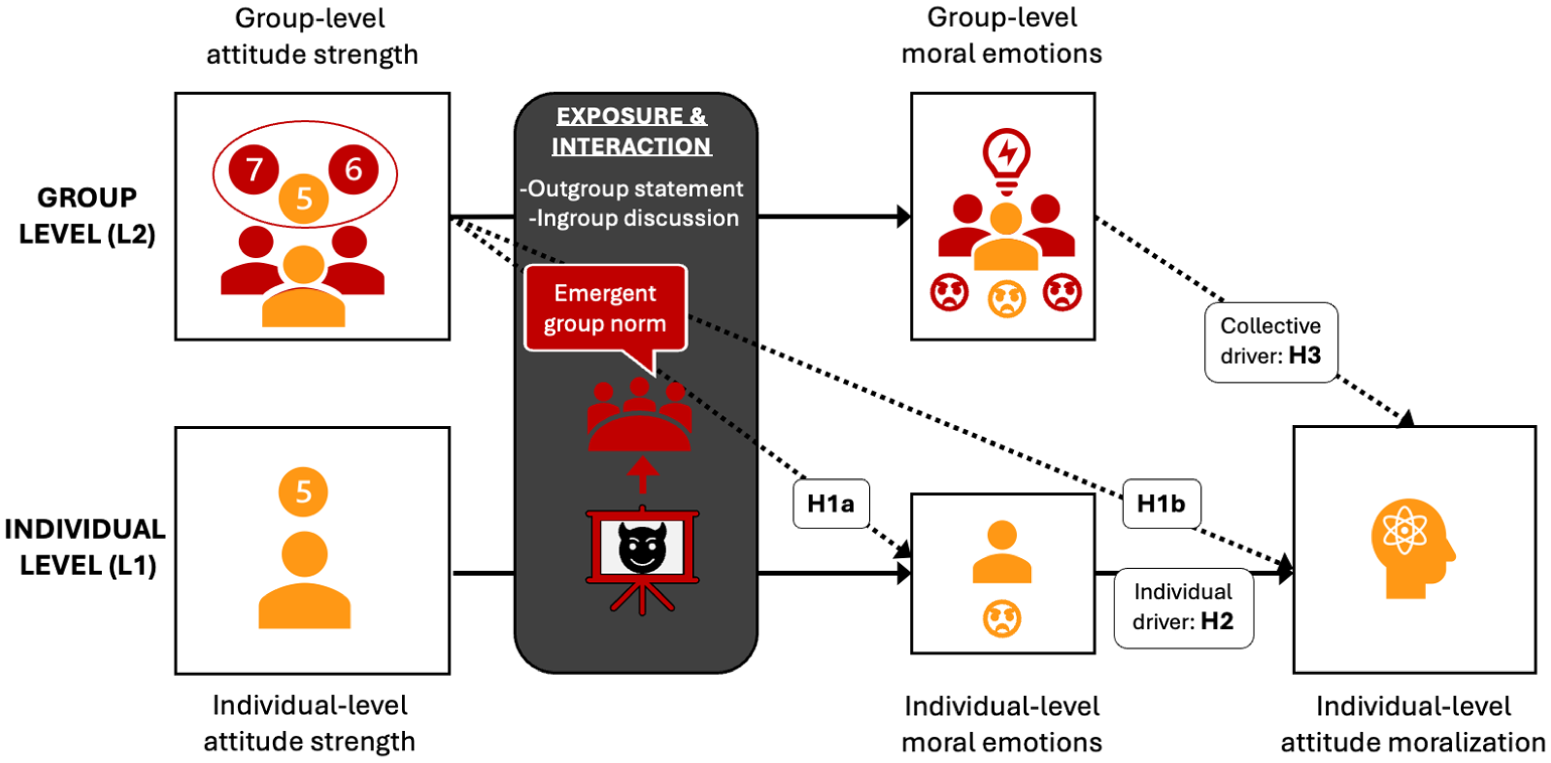
Illustration of the theoretical model, core concepts, and pre-registered hypotheses.
What Drives Moralization within the Bubble?
While this emergent group norm hypothesis helps to explain when and why conversations about outgroup actions within stronger (versus weaker) political bubbles are likely to strengthen value-protective responses, it does not yet answer the question of what drives the moralization outcome psychologically. As visualized in Figure 1 (after the exposure and interaction box), we consider two different yet potentially complementary driving mechanisms: an individual moralization driver (H2) and a collective moralization driver (H3).
Individual Moralization Driver (H2)
Arguably the most intuitive way through which emergent norms (as a function of the group-level attitude strength) may strengthen individual moralization is indirectly, namely via the strengthening of individuals’ own moral-emotional responses to the outgroup statement. Indeed, considering that the individual experience of strong moral emotions in response to relevant triggers has been consistently identified as a critical psychological driver of individual moralization (Brandt et al., 2015; D’Amore et al., 2022, 2024; Pauls et al., 2022; Wisneski & Skitka, 2017), it is reasonable to expect that the strength of an individual’s moral emotional responses is what eventually predicts their attitude moralization. If this is the case, then the strength of an individual’s subjective emotional response to the outgroup action remains the core driver of moralization: group normative responses influence individual moralization indirectly, namely via strengthening (or weakening) individuals’ own emotional responses to the outgroup action in alignment with the group’s normative response. Consequently, those increases in individual-level moral emotions drive (mediate) the effect of group-level attitude on individual moralization (H2).
Collective Moralization Driver (H3)
At the same time, increases in individual moralization may also be driven by the average moral emotions experienced by people within the discussion group—in addition to what is predicted by individuals’ own emotions. Even if individual emotions appear to be a driver of individual moralization (as formulated in H2), then it is still possible that the average emotions within a group (i.e., group-level emotions) have an additive effect on individual moralization (H3, Figure 1). For example, this may occur in contexts where the group-based self is salient (e.g., when faced with the political outgroup). Indeed, being in a group in which members express strong perceptions of dyadic harm, and experience strong moral emotions, likely signals that a moral line has been crossed (Schein & Gray, 2018), and that (ingroup) values are at stake (Tetlock et al., 2000). Through dynamic interaction in groups with strong emotional responses, this normative belief is reinforced and strengthened. As such, through interaction, the average emotions experienced within a group may strengthen individual moralization over and above individual emotions, because, for example, the responses of other group members induce a sense of value-threat that further pushes individual attitudes into the moral domain. Thus, the group-level emotions emerging within the group may function as a collective driving mechanism of individual moralization over and above the effect of individual-level emotions (H3, Figure 1).
The Current Research Aims
This research aims to extend research on the effect of perceived political bubble strength on attitude moralization (D’Amore et al., 2024) in three ways. First, we test the link between group composition and attitude moralization in response to outgroup actions via dynamic intragroup interaction as the mechanism of moralization. To do so, we collected data among high school pupils, who generally endorsed progressive attitudes about the issue of refugees (i.e., issue-based ingroup) but differed in the strength of those attitudes (and hence offered group-level variation in political bubble strength). Focusing on the refugee debate as the topic for moralization, we selected a social media message from a political actor known for his anti-refugee rhetoric (i.e., issue-based outgroup statement) as the discussion topic to examine the link between political bubbles and moralization.
Second, moving beyond mere individual-level perceptions of network members’ attitudes (D’Amore et al., 2024), we test whether the group influence within small discussion groups is essentially rooted in the actual and perceived group-level composition of attitudes over and above the effect of such individual-level indicators within groups. This disentangling of individual- and group-level processes is critical for the current aims, as it enables the examination of the causal role of social interactions within political bubbles. Specifically, we already know that at the individual level, attitude strength as well as perceived political bubble strength within one’s discussion network predict the strength of individuals’ value-protective responses to trigger events (e.g., D’Amore et al., 2022, 2024). Statistically, therefore, it is a given that this same relationship exists at the level of the group: even prior to the start of the group discussion, groups comprised of individuals with stronger attitudes (actual and perceived) on average should report stronger emotions and moralization than groups comprised of individuals with weaker attitudes on average. Yet, by incorporating dynamic interactions within our study design and testing for contextual effects, we can evaluate whether interactions lead to the emergence of higher-level norms that amplified the effect of the group-level (actual and perceived) attitude strength on individual moralization. That is, we specifically test whether the effect of attitude strength between groups on emotions and moralization is stronger than the effect of individual-level attitude strength within groups, which would indicate that the social context has its own, additive, effect on individual outcomes beyond individual predictors (e.g., see Christ et al., 2014). According to the first hypotheses, the group-level attitude strength predicts individuals’ moral emotions (H1a) and moralization (H1b) over and above the individual-level attitude strength (i.e., contextual effects). Additionally, a secondary question is whether the same model applies when tapping into the shared perceptions of where the group stands. As formulated in the pre-registered analysis plan, we therefore conduct the same analyses as described above with perceived attitude strength as the predictor (in line with D’Amore et al., 2024).
Third, this unique methodology and statistical approach enable us to examine whether previously identified drivers of moralization may also develop into emergent group-level drivers via interaction—such that their average experience could strengthen group members’ moralization tendencies over and above group members’ individual experience of those drivers. As visualized in Figure 1, the second and third hypotheses test whether responses of moral emotions and perceived intentional harm, via group interactions, represent purely individual-level moralization drivers (H2) or also collective moralization drivers (H3).
Method
All the details of this research, including the hypotheses, measurements, data collection, and statistical analysis plan were pre-registered online (https://aspredicted.org/jybt-98j7.pdf). The anonymized research data and the R-script containing the analyses are available online (https://osf.io/rw97x/overview?view_only=8f92dbd7ea2f4414869e7ad5a9ac2400). This research was approved by the Ethics Committee of the University of Groningen.
Participants
To make sure that the members of the discussion group represent relevant others (such as network members; D’Amore et al., 2024), we collected data among high school peers. Specifically, the participant sample consists of same-level high school pupils from various schools in the Netherlands (the pre-school for university-level education), participating during six one-day workshops organized by the local university in April 2022. The data collection took place during an interactive lecture on social psychology provided by the first author of this research. We expected that the total sample size would be 150, with six lectures and approximately 25 participants in each.
The initial participant sample consisted of 146 Dutch pupils (in 46 discussion groups of three to four members). Four participants were excluded from the analysis. 1 We also excluded their groups because dyads do not provide a sufficient basis for assessing group-level constructs or within-group agreement (Bliese, 1998; Du & Wang, 2016). The remaining sample consisted of 134 participants (age range: 15–17) embedded in 42 discussion groups. We did not collect any background information to minimize risks of personal identification of the mostly under-aged pupils (in line with the recommendations of the Ethics Committee).
Procedure
This research was conducted in three parts: (1) pre-survey, (2) exposure to outgroup statement combined with group discussion, (3) post-survey. After providing informed consent, participants completed a short pre-discussion survey, indicating their attitude on the issue and the extent to which this attitude reflected a moral conviction. Participants were then randomly allocated to groups of 3–4 pupils (total N = 46 groups). Each group received the same stimulus material (Twitter message) in which an outgroup politician expressed a controversial statement about the topic of refugees in the Netherlands. Participants were asked to discuss this tweet with their groupmates for about ten minutes, and were provided with a couple of questions to inspire the group conversation in line with the concept of dyadic harm (e.g., “What do you think the consequences of this tweet could be for other people?” and “What do you think the intentions of [politician] were behind this tweet?”). Then, they were asked to report the conclusion of their conversation in one or two sentences. In the third part, participants completed a short survey about the group conversation, including perceived group attitude strength, and they reported on their moral emotions and perceived harm in response to the tweet. Participants then reported on their own attitude and moral conviction again (post-measure), followed by their perception of moral polarization. Finally, they were fully debriefed through an interactive lecture outlining the aims and expected outcomes of the study.
Media Exposure: Potentially Harmful Outgroup Statement
The tweet that was used as the potentially harmful outgroup statement was carefully selected to fit the participant population, based on three criteria. First, the tweet’s source should represent an opinion-based outgroup member for the participant population in general. This was successful, given that only two participants reported an anti-refugee leaning attitude. Second, the tweet was selected to highlight one concrete political issue that was subject to polarization within the broader Dutch population, for example as indicated by the degree to which opposing positions were taken across political parties within this context. Third, the content of the tweet constituted a potential cue to dyadic harm, such that it should have reasonable potential to be perceived as an act that intentionally caused harm to others (at least within the participant population).
The tweet was posted by the long-standing leader (i.e., Geert Wilders) of a large and arguably extreme right-wing populist party (PVV) from the Netherlands, in the context of the Russian invasion of Ukraine and the sudden rise of Ukrainian refugees requesting shelter. During this time, there was strong solidarity with Ukraine in European countries. In terms of its content, the tweet tapped into the topic of refugee sheltering and stated that “fake” non-Western refugees should make place for “real” Ukrainian refugees in the Netherlands. An English translation of the stimulus tweet is as follows: “The Netherlands is full, there is no space for anyone else to come. But our heart is bleeding, the Ukrainian women + children are REAL refugees. Therefore, we need to create short-term and limited space by throwing asylum-profiteers and fake refugees such as those from safe countries and Syrians out of our country. YES to limited, short-term shelter for Ukrainian refugees, NO to fake refugees from Africa and Arabia.” For a screenshot of the original tweet used in the study, see Supplement 1.
Measures
Table 1 provides an overview of the conceptual and operational details of the group-level variables, including the type of construct and justification (in line with Nijstad et al., 2025). For group-level constructs, we differentiate between formative and reflective group constructs. Reflective group constructs are often conceived of as emergent states (e.g., collective emotions)—properties that arise through interaction among members, and that manifest in shared cognitions, emotions, or motivations of the team as an entity. Reflective constructs therefore assume agreement among group members. This is different from a formative group construct, which assumes that individual-level scores are independent (e.g., individual attitude strength, pre-discussion). In this case, no agreement among group members is assumed, and it is simply the combination of individual-level scores that defines the group-level construct (e.g., group-level attitude strength; Nijstad et al., 2025).
Conceptualization and Operationalization of Group-Level Variables.
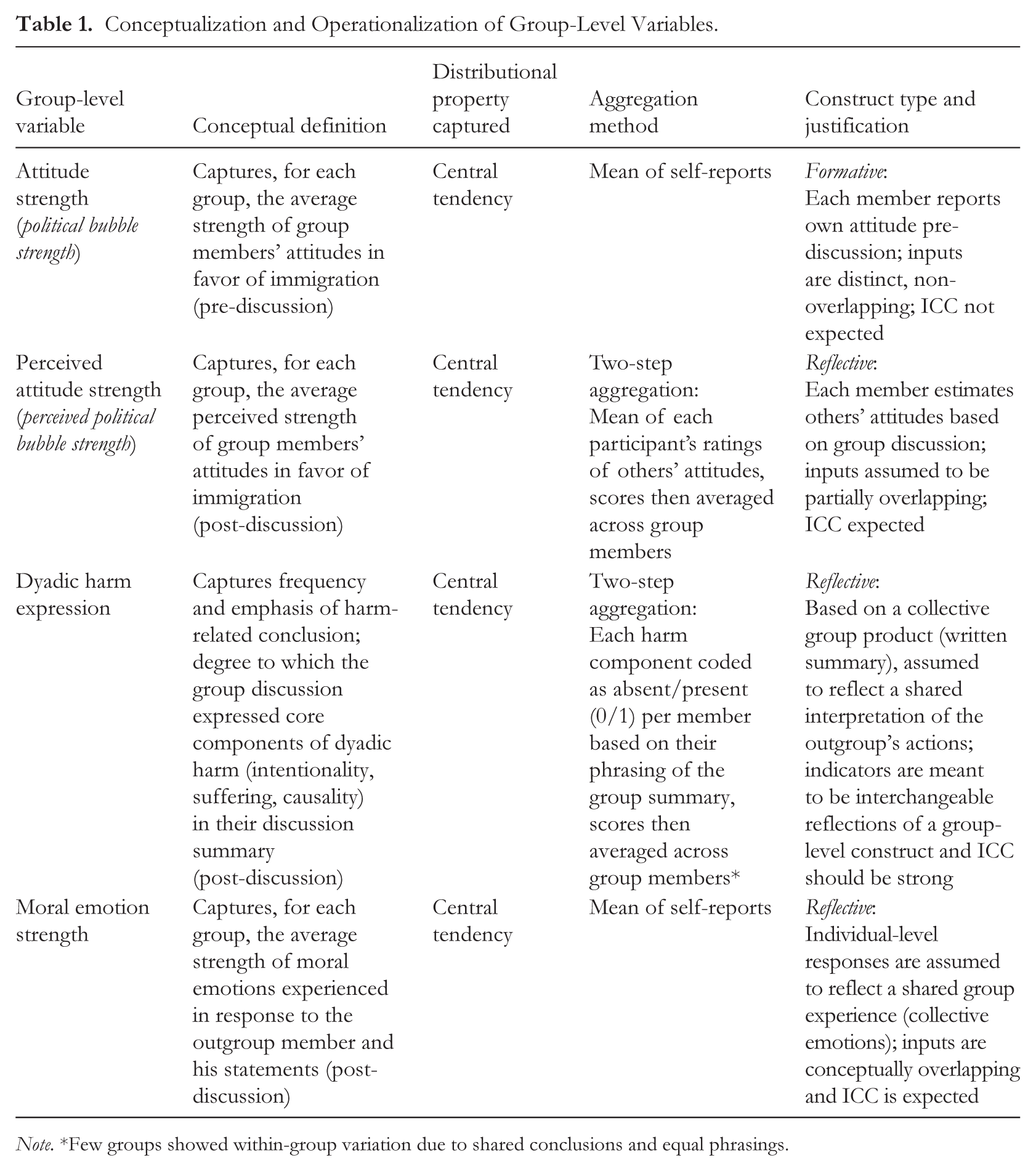
Note. *Few groups showed within-group variation due to shared conclusions and equal phrasings.
Group Composition
Attitude Strength
Following previous research (e.g., D’Amore et al., 2024), group-level attitude strength was operationalized based on group members’ average attitudes towards refugees. This attitude was measured prior to group discussion with a single item, namely: “The Netherlands should be welcoming refugees independent of their origin” (on a 7-point scale; 1 = completely disagree, 4 = neither disagree nor agree, 7 = completely agree). While all groups (and all but two individuals 2 ) on average agreed with the statement, they varied in the strength with which they endorsed this statement. Therefore, based on the measure of attitude, we calculated the actual attitude at two levels. Individual-level attitude strength is simply the strength of an individual’s attitude on the topic. Group-level attitude strength is operationalized as the average attitude strength of all members within a group (a formative construct; Nijstad et al., 2025; Table 1).
Perceived Attitude Strength
For the measurement of the perceived attitude strength, participants were asked after their group discussion (and after providing their written group conclusion on that discussion) to estimate the attitudes that each of their groupmates had on the topic, using the single attitude item reported above with reference to each group member (D’Amore et al., 2024). The individual-level variable, individual-level perceived attitude strength, was operationalized as the average score of a subject’s estimated attitudes across their groupmates, such that higher scores represent stronger perceived group attitude. Group-level perceived attitude strength was operationalized based on the average perceived attitude strength of all members within a group (a reflective construct; Table 1).
Value-Protective Responses
For all measurements reported below, participants indicated their agreement with the statements on a 5-point scale (from 1 = not at all to 5 = very much).
Dyadic Harm
We found that the existing scale for perceived dyadic harm by D’Amore et al. (2022, 2024), was low in reliability (α = .41; see Supplement 2 for a detailed evaluation). Therefore, this measure of perceived dyadic harm was not used as a variable in the planned analyses. 3 Instead, we conducted an exploratory analysis by using conversational dyadic harm expression scores as indicators of group-level dyadic harm responses to the outgroup action. Specifically, we estimated conversational content based on the qualitative group summaries written at the conclusion of the discussions, and coded them in line with the three components of dyadic harm (i.e., actor intentionality, 4 victim suffering, 5 and dyadic causality). Each dyadic harm component was coded as either 0 = absent or 1 = present for each individual group member, and then averaged within groups to reflect the group-level dyadic harm expression (group-level descriptives: N = 42 groups, M = 0.26, SD = 0.29, range = [0, 1]). Note that we use this strictly as a group-level construct, because many groups had zero within-group variation (i.e., in these cases, all group members wrote exactly the same conclusion sentences, which impairs the validity of this measure as an individual-level construct for our research).
Moral Emotions
Participants reported the strength of three moral emotions (anger, contempt, disgust; D’Amore et al., 2022) in response to the politician and their statements in the tweet (i.e., “To what extent did you feel [emotion] towards the politician and his statements?”). Individual (level) moral emotions was operationalized as a composite score of the three moral emotions (α = .76). Group (level) moral emotions was operationalized as the average of members’ moral emotions within each group (a reflective construct; Nijstad et al., 2025; Table 1).
Attitude Moralization
Participants indicated, on a validated four-item measure (Skitka & Morgan, 2014; translated to Dutch) the extent to which they held their attitude about the issue as a moral conviction (e.g., “To what extent is your position on this issue a reflection of your core moral beliefs and convictions?”; a(pre-score) = .67; a(post-score) = .75; r(repeated measures) = .78). Attitude moralization was operationalized as the within-subject increase in moral conviction (post-score controlling for pre-score). 6
Results
Descriptive Data
Table 2 presents the descriptive statistics for the core variables at both the individual and the group levels. As expected for variables conceptualized as reflective group constructs, in our case perceived attitude strength, moral emotions, and dyadic harm expression, correlations within groups were greater than .71, indicating strong agreement (rwg > .71; LeBreton & Senter, 2008; Nijstad et al., 2025). Moreover, the ICC1 values for moral emotions and dyadic harm expression reflected large effect sizes (Woehr et al., 2015). The ICC values for perceived attitude strength were not significantly different from 0. This is likely due to the fact that each participant estimated the attitude strength of their fellow group members (but not their own), meaning that the set of rated referents differed across individuals. Indeed, when including individuals’ own post-attitude strength in the measurement of perceived attitude strength, this strengthened its ICC values substantially and made them significantly different from 0 (ICC1 = .32*, ICC2 = .59*). 7 Across the board, these findings suggest that the group discussions produced meaningful within-group agreement on the relevant variables. This implies that the aggregation of those variables at the group level is justified and results in reliable group-level variables for multilevel modeling.
Descriptive Statistics of the Key Variables.

Note. Most variables were scored on a 5-point scale (higher scores reflect stronger endorsement), except for the attitude strength measures (7-point scales) and group dyadic harm expression (ranging from 0–1).
The ICC1 reflects the proportion of the total variance in a variable that can be explained by systematic differences between groups (*significantly different from 0; at a = .05).
rwg: correlation within groups.
Mean-level attitude moralization was significantly different from 0 (p = .002).
Pre-registered Statistical Analysis Plan
All statistical analyses were conducted as described in the detailed statistical analysis plan that was pre-registered online (https://aspredicted.org/jybt-98j7.pdf). 8
In each model testing individual attitude moralization as the outcome, we used individual post-discussion moral conviction scores as the outcome and controlled for individual pre-discussion moral conviction scores (in line with previous research, e.g., D’Amore et al., 2022, 2024).
Hypothesis 1 is tested by testing for the contextual effects of attitude strength on individual negative moral emotions (H1a) and attitude moralization (H1b). We followed Raudenbush and Bryk’s (2002) procedure for estimating the contextual effect in a multilevel linear model. Specifically, by using specific centering methods in two different models, we estimated three conceptually different effects: between-group, within-group (i.e., individual), and contextual effects. The effect of interest, the contextual effect, is established by a formal test of the difference between the between-group coefficient and the within-group coefficient (Raudenbush & Bryk, 2002; see also Christ et al., 2014). This difference is the incremental effect of being in a group with higher (vs. lower) average values of the predictor (e.g., attitude strength), beyond the individual’s own attitude strength . If the between-group and within-group slopes are equal, there is no contextual effect (i.e., group-level predictors add no predictive power to individual outcomes). If they differ, such that the between-group effect is significantly greater than the within-group effect, it shows that the social context (i.e., group aggregate) has its own, additive, effect on individual outcomes (i.e., a contextual effect).
We tested for those effects in two steps. In a first step, we used within-group (i.e., group-mean) centering of the predictor variable to obtain the within-group (level 1) effect and, in the same model, we used the group-mean score as the predictor to obtain the between-group (level 2) effect. In a second step, we formally tested the contextual effect by using a different centering method for the level 1 variable. Specifically, this was done by replacing the within-group centered level 1 variable with the grand-mean centered level 1 variable (while keeping the group average variable at level 2 in the model): In this model, the contextual effect is now indicated by the coefficient of the level 2 predictor variable (Raudenbush & Bryk, 2002). Stated differently, a formal test of the difference between the between- and within-group slopes is statistically achieved by a test of the group-level predictor when controlling for the individual-level predictor (using grand-mean centering, instead of within-group centering).
Mediation effects were tested on both levels. H2 states that the group-level effect of attitude strength on individual-level moralization is mediated by individual-level moral emotions (i.e., individual mediation effect). Therefore, as pre-registered, we extended the above models by including moral emotions as a mediator at the individual level only to test H2. Finally, H3 states that the group-level effect of attitude strength on individual-level moralization is mediated by group-level moral emotions, over and above individual-level emotions (i.e., contextual mediation effect). Again, as pre-registered, we included moral emotions at both the individual and group level as mediators in the same model to test for contextual effects of moral emotions (H3) following the same procedure (and centering methods) for estimating contextual effects as described above. For both hypotheses testing mediation effects, we conducted bootstrapped tests of average causal mediation effects from the multilevel model using the Mediation package in R (Tingley et al., 2014).
Finally, our secondary question is whether the same model applies when using the perception of groupmates’ attitude strength as a predictor. As formulated in the pre-registered analysis plan, we therefore conducted the same analyses as described above with perceived attitude strength as the predictor (in line with the conceptualization by D’Amore et al., 2024).
Hypothesis Testing
Prior to testing our formal hypotheses, we tested whether, in the first place, group discussions about a controversial outgroup statement within political bubbles strengthened individual attitude moralization (relative to the pre-measure). In support of this, Table 2 shows that, on average, a significant within-subject increase in individual attitude moralization was found (paired t-test; Mdifference = 0.12, t(133) = 3.20, p = .002).
Additionally, we explored the association between the actual- and perceived attitude strength at the group level (r(between-groups) = .38). This small-to-medium-sized association (Cohen, 1992) suggests that it is indeed sensible to test actual and perceived indicators of attitude strength as two distinct predictors. 9 The results of the analyses with perceived attitude strength are presented in a separate section (see Secondary Analyses).
Contextual Effects of Attitude Strength on Emotions (H1a) and Moralization (H1b)
In the first set of analyses, we tested group-level attitude strength as a predictor of group members’ value-protective responses to outgroup actions, over and above the effect of individual-level attitude strength (Table 3). We found no evidence for a contextual effect of group attitude strength on moral emotions (b = 0.13, p = .573, 95% CI [−0.32, 0.58]) nor on attitude moralization (b = 0.13, p = .218, 95% CI [−0.07, 0.33]). Stated differently, contrary to H1a and H1b, group-level attitude strength did not predict individual emotions or moralization over and above what was predicted by individual-level attitude strength.
Effects of Attitude Strength (IV) on Moral Emotions (Mediator) and Moralization (DV).
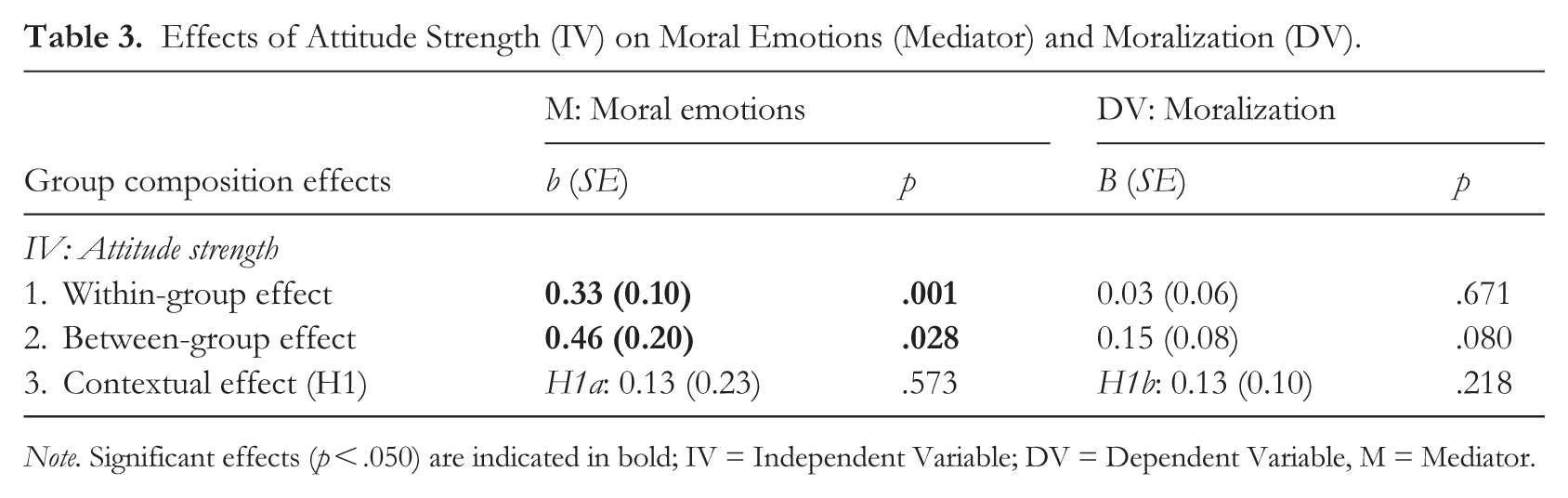
Note. Significant effects (p < .050) are indicated in bold; IV = Independent Variable; DV = Dependent Variable, M = Mediator.
What should also be noted from Table 3 is that attitude strength positively predicted moral emotions at both levels. The within-group effect suggests that individuals who endorsed stronger attitudes compared to their groupmates experienced stronger moral emotions compared to their groupmates. The between-group effect suggests that groups with stronger average attitudes compared to other groups experienced stronger moral emotions compared to other groups. This sets the stage for testing both pre-registered mediation models, as discussed below.
Drivers of Moralization: Individual- (H2) and Contextual Effects of Moral Emotions (H3)
Hypothesis 2 states that the effects of the group attitude strength on individual moralization are explained by individual increases in moral emotions. Contrary to H2, there was no significant effect of the individual’s own negative moral emotions on individual attitude moralization (b = 0.07, p = .113, 95% CI [−0.02, 0.16]), precluding the possibility of this individual-level variable to serve as a mediator.
Hypothesis 3 states that the effect of the group attitude strength on individual attitude moralization is driven by group-level increases in moral emotions—over and above the effect of the individual’s own moral emotions (i.e., contextual effect). We first tested the between-group effect of moral emotions on attitude moralization, which was positive and significant (b = 0.15, p = .013, 95% CI [0.04, 0.27]). Moreover, the contextual effect of moral emotions on attitude moralization was also positive and significant (b = 0.17, p = .046, 95% CI [0.01, 0.33]). Thus, over and beyond individuals’ own level of moral emotions, individuals embedded in discussion groups characterized by higher average moral emotions showed higher moralization. This also means that it is statistically sensible to test the effect of group-level moral emotions as a contextual mediator in the relationship between group-level attitude strength and individual moralization.
Contextual Mediation Analyses (H3)
In line with H3, the bootstrapped mediation analysis tests indicated a positive contextual mediation effect of group-level moral emotions on individual moralization with group-level attitude strength as the predictor (indirect effect = 0.10, bootstrapped 95% CI [0.01, 0.20]; Figure 2). This suggests that groups characterized by stronger attitudes developed stronger negative moral emotions, which in turn strengthened individual moralization beyond what would be expected based on individuals’ own emotions alone.
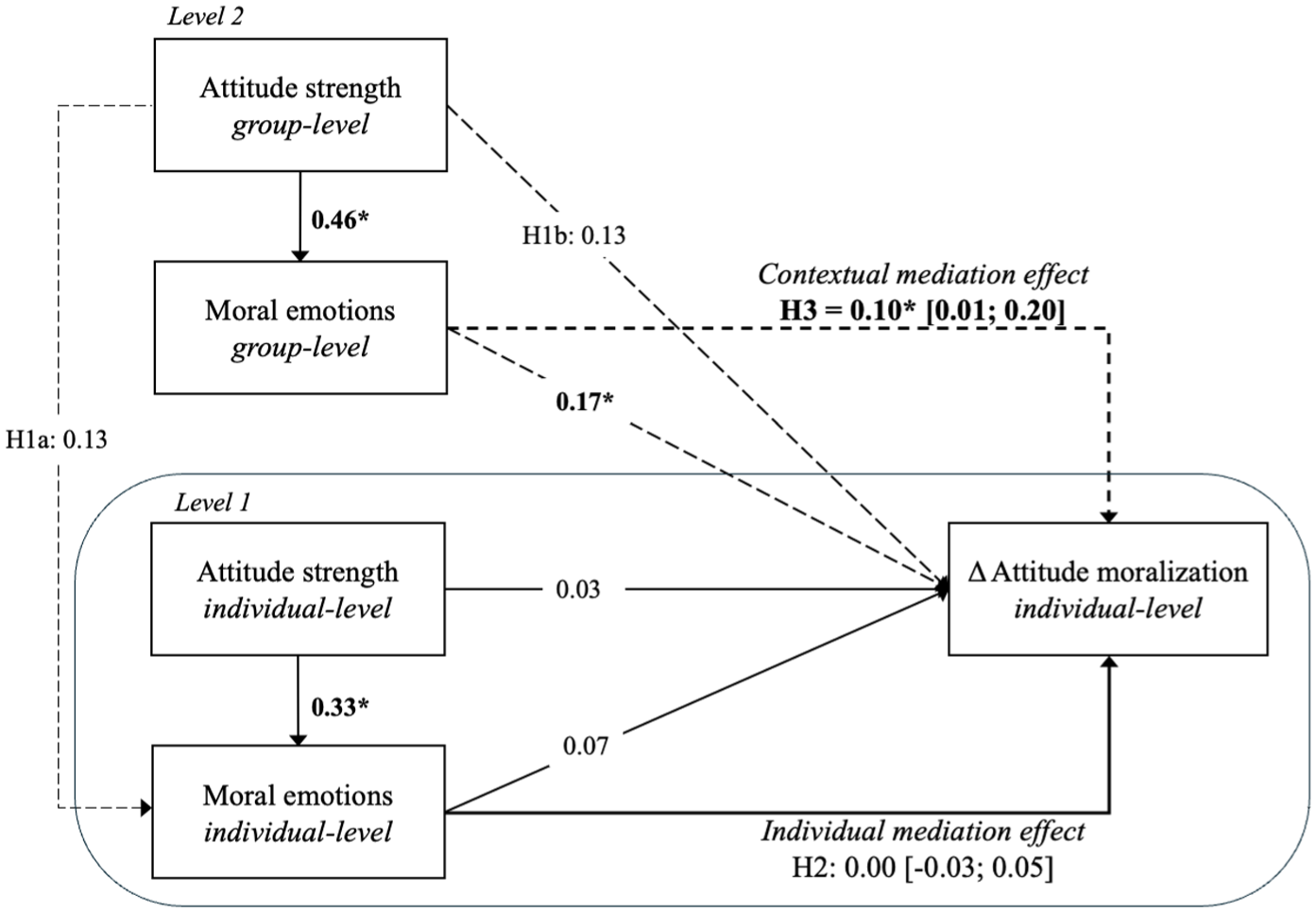
Multi-level mediation model: Group-level attitude strength (IV) predicting individual-level attitude moralization (DV) via group-level moral emotions (Mediator).
Secondary Analyses: Perceived Attitude Strength as the Predictor
A secondary set of analyses moved beyond the private strength of group members’ attitudes, to the shared perceptions of where the group stands. In line with our pre-registered analysis plan, we conducted the same analyses to test the model (including contextual effects) with perceived attitude strength as the predictor. Although the analyses reported below are not formal tests of our hypotheses, we conduct the same analyses and therefore mention the relevant hypotheses in the text below to make clear which part of the statistical model is tested.
Contextual Effects of Perceived Attitude Strength on Emotions and Moralization
In line with H1a, the contextual effect of perceived group attitude on individual moral emotions was positive and significant (b = 0.69, p = .005, 95% CI [0.23, 1.15]; Table 4). Stated differently, the between-group effect of perceived attitude strength on individual moral emotions was significantly greater than the effect of individual perceived attitude strength on individual moral emotions within groups, indicating the existence of a contextual effect. Similarly, in line with H1b, the contextual effect of perceived group attitude on individual attitude moralization was positive and significant (b = 0.25, p = .032, 95% CI [0.03, 0.47]). This means that the perceived attitude strength at the group level predicted increased moral emotions, and attitude moralization, over and above the effect of the individual’s own perception.
Effects of Perceived Attitude Strength (IV) on Moral Emotions (M) and Moralization (DV).
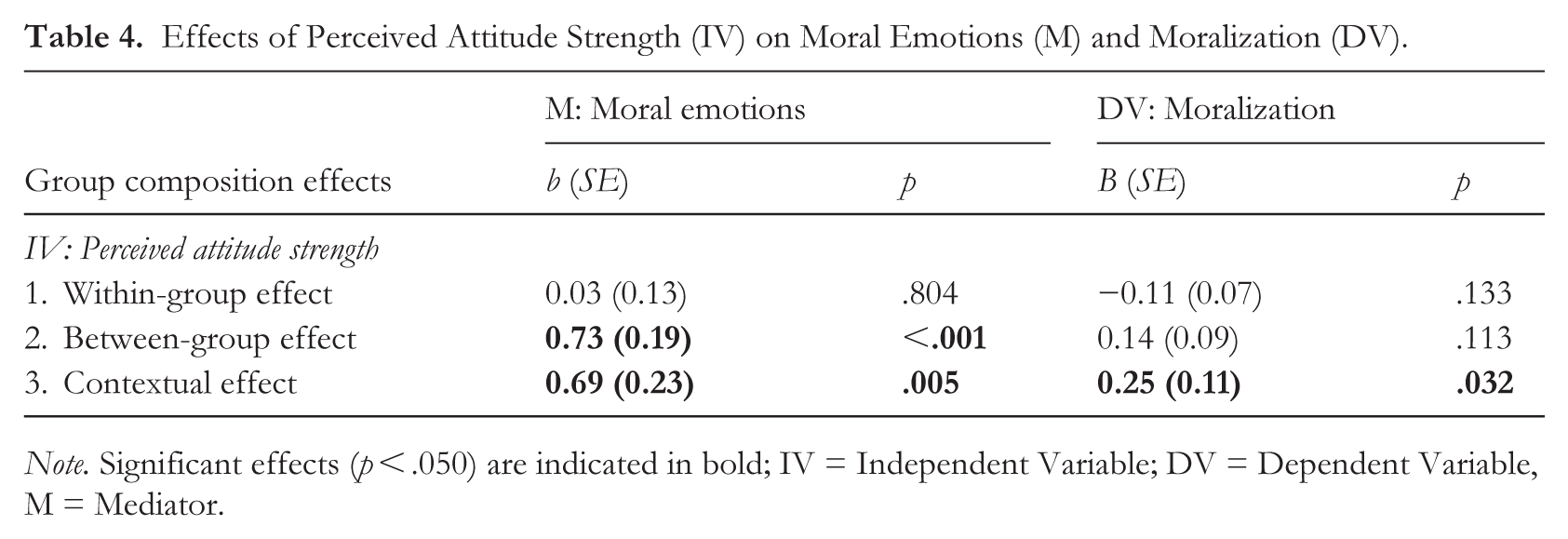
Note. Significant effects (p < .050) are indicated in bold; IV = Independent Variable; DV = Dependent Variable, M = Mediator.
Contextual Mediation Analyses
In line with H3, the bootstrapped mediation analysis tests indicated a positive contextual mediation effect of group-level moral emotions on individual moralization with perceived attitude strength as the predictor (indirect effect = 0.16, bootstrapped 95% CI [0.05, 0.28]; Figure 3). 10 This suggests groups characterized by the development of stronger perceived attitudes also developed stronger moral emotions, which in turn predicted stronger individual moralization beyond what would be expected based on individuals’ own emotions alone.

Secondary multi-level mediation model: Group-level perceived attitude strength (IV) predicting individual-level attitude moralization (DV) via group-level moral emotions (Mediator).
Exploratory Analysis: Group Dyadic Harm Expression
We explored the role of group conversational expressions of dyadic harm for individual attitude moralization in three steps. First, we explored whether the group composition was related to differences in the strength of group dyadic harm expression. As expected, multilevel regression analyses showed that the strength of group-level dyadic harm expression was positively associated with both group-level attitude strength (b = 0.05, p < .001) and group-level perceived attitude strength (b = 0.05, p < .001). This suggests that groups with stronger than average attitudes (and groups with stronger than average perceived attitudes) in support of refugees were more likely to express perceived dyadic harm in their response toward the outgroup action.
Second, we explored the predictive power of such group dyadic harm expressions for the psychological development of moralization via increased moral emotions. 11 In line with theoretical expectations, individual attitude moralization was stronger in groups where dyadic harm expressions were more prominent (b = 0.30, p = .027). Moreover, the strength of group-level dyadic harm expressions also predicted the strength of group-level moral emotions (b = 1.13, p < .001). Finally, the bootstrapped mediation analysis indicated that the contextual mediation effect of group-level moral emotions in the relationship between group-level dyadic harm expression and individual-level attitude moralization was also significant (indirect effect = 0.05, bootstrapped 95% CI [0.01, 0.10]; Figure 4). This implies that the expression of perceived dyadic harm during the group conversation may foster individual attitude moralization via the strengthening of moral emotional experiences within the group at large.
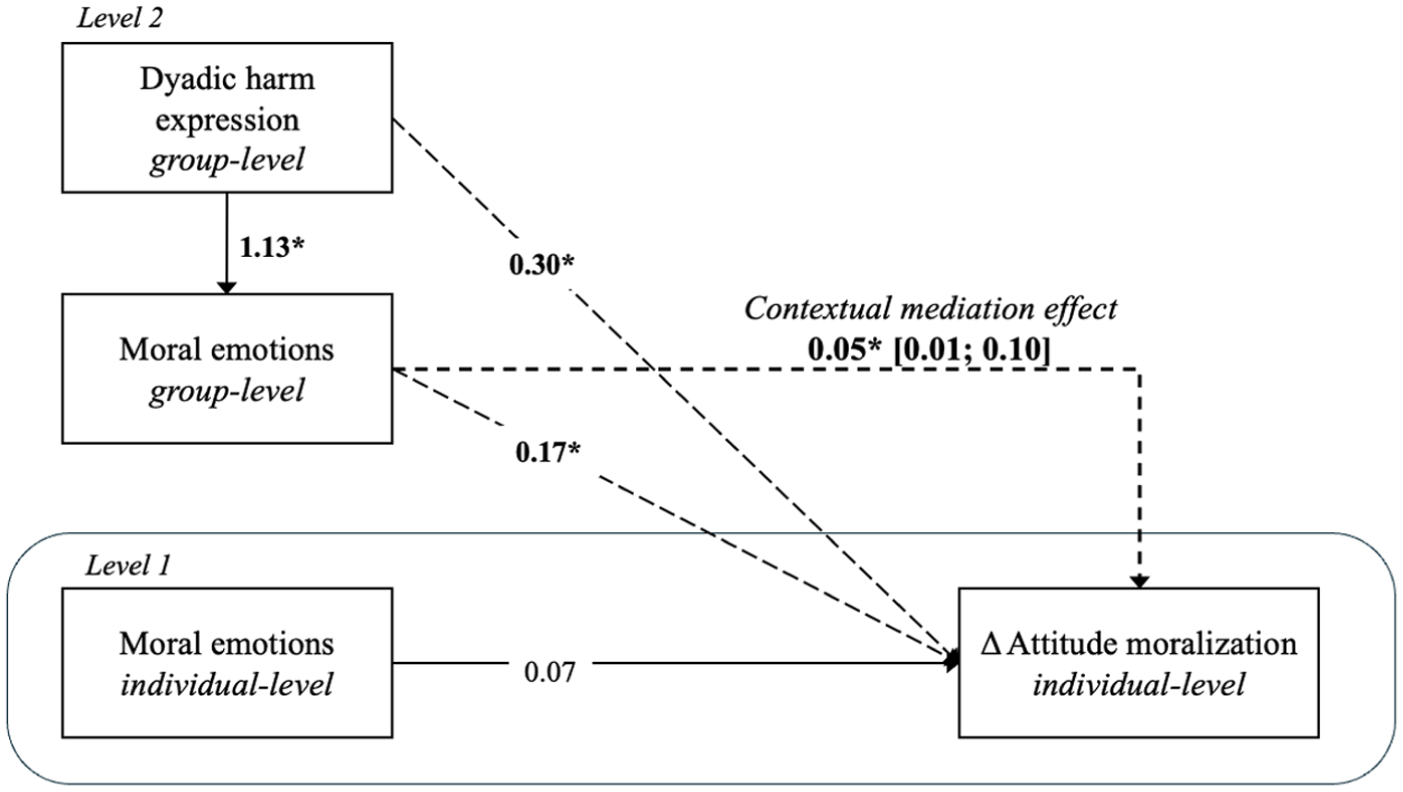
Exploratory findings: Group-level dyadic harm expression (IV) predicting individual-level attitude moralization (DV) via group-level moral emotions (Mediator).
Discussion
When and how do conversations within political bubbles shape individual moralization tendencies? Moving beyond the individual, the present research examined real-life social interactions within groups to identify the dynamic social and psychological processes involved in the development of individual attitude moralization within such political bubbles. We focused on conversations about a controversial outgroup tweet (in the context of refugees) within small groups of relevant others, to better understand the driving mechanisms at both the (a) individual level and (b) group level simultaneously. This enabled us to examine whether and how discussing such a controversial outgroup action within more (vs. less) attitudinally strong ingroups strengthens individual group members’ value-protective responses to those actions, including attitude moralization.
Research Findings
Overall, we found that, on average, group discussions about an issue-specific outgroup action resulted in the strengthening of individuals’ (post-discussion) moral conviction in support of refugees (i.e., moralization occurred). This enabled us to test our specific hypotheses about the expected predictors (H1) and mediators (H2–H3) of this attitude moralization outcome at both the individual and group level.
There are several key findings that we discuss below. Most importantly, although attitude strength at the group level did not directly predict individual emotions (rejecting H1a) or individual moralization (rejecting H1b), the findings suggested support for an indirect effect via group-level moral emotions (supporting H3). Specifically, moral emotions functioned as a group-level mechanism linking collective attitude strength to individual moralization. Groups characterized by stronger attitudes (in favor of refugees) developed stronger collective moral emotions, which in turn predicted stronger moralization among group members. Importantly, this indirect effect operated at the contextual level, underscoring that it is the shared emotional environment—rather than individual emotional intensity—that helps translate collective attitudes into moralized judgments. In fact, contrary to H2, individual moral emotions did not predict individual moralization. Together, these findings support theoretical accounts that emphasize the socially embedded and normative nature of moralization processes in the context of small group conversations.
Furthermore, secondary analyses suggested that the perceived attitude strength at the group level predicted individual moralization both directly, and indirectly via group-level moral emotions. Importantly, as perceived attitude strength could only be measured after the group discussion took place, no causal inferences should be made here (as discussed below).
Finally, exploratory analyses indicated that the degree to which the group conversation involved expressions of dyadic harm about the outgroup action was another predictor of increased moralization tendencies, once again via the emergence of stronger moral emotions at the group level. Below, we discuss the core findings of this research in more detail and reflect on the theoretical and practical implications.
Why does Moralization Occur within the Bubble?
A central contribution of the present findings lies in distinguishing between the role of individual attitudes prior to the political discussion and the role of perceived group normative attitudes in the emergence of moralization during the discussion. Although individuals’ attitude strength was associated with their own moral-emotional responses, aggregated attitude strength did not exert contextual effects on moral emotions or moralization. This suggests that attitude strength functioned primarily as an individual-level input into individual moral-emotional responses, rather than as an emergent group-level property that shapes moral-emotional norms during interaction. In contrast, perceived attitude strength within the discussion group (measured after the discussion) showed robust contextual effects on moral emotions and moralization, beyond individual-level predictors. This dissociation suggests that, in group discussion contexts, moralization is less closely related to the private strength of group members’ attitudes and more to shared perceptions of where the group stands (during the discussion).
These findings suggest that perceptions of strong group norms (in terms of attitudes) signal what is emotionally appropriate and morally relevant within the interaction, thereby amplifying moral emotions and facilitating the moralization of individual attitudes. Importantly, moral emotions functioned as a group-level mechanism linking perceived group attitudes to individual moralization, highlighting the role of emergent emotional climates in linking perceived attitudinal norms with the moralization of attitudes.
What Drives Attitude Moralization within Political Bubbles?
In line with this normative perspective, the link between group-level attitude strength and individual moralization was mediated by the emergence of stronger group-level emotions. That is, through interaction within groups where the (perceived) group attitude was stronger on average, stronger than average (group-level) emotional responses emerged, which in turn predicted individual group members’ attitude moralization over and above (the effect of) their own emotional response (i.e., contextual effect; Hypothesis 3). These findings clearly point at a normative explanation in which the group-level perceived attitude strength, through actual interactions about outgroup actions, strengthened moralization tendencies via the emergence of stronger moral-emotional norms within those groups. Theoretical and societal implications of those key findings are discussed below.
Theoretical Implications
Collective (Group-Level) Emotions as Normative Drivers of Moralization
One important implication of the current research is that it questions the assumed necessity for individuals to subjectively experience strong moral emotions for their own attitude moralization to strengthen. The moral psychology literature points to individuals’ emotional responses to trigger stimuli as the driving mechanism for moralization of attitudes (e.g., Skitka et al., 2021) or behaviors (e.g., Haidt, 2012; Rozin et al., 1999). More recently, and in line with the current conceptualization, a slightly different perspective on the role of emotions emerged by considering group-based emotions at the individual level. Specifically, rather than being integral to the topic of moralization (e.g., disgust towards abortion practices; Wisneski & Skitka, 2017), individual emotions felt towards a specific outgroup action (e.g., anger towards the behavior of political opponents) can also serve as a moralization trigger, namely when the outgroup action is directly associated with the topic of moralization (D’Amore et al., 2022, 2024; Pauls et al., 2022). In the current study, however, individual moral emotions in response to the outgroup action did not play a role in the psychological moralization process. In contrast, the present research found that the average (i.e., group-level) emotional response of the discussion group strengthened individual moralization independent of the individual emotional response (i.e., for predicting individual moralization, only the group average emotion was relevant, and it did not matter whether individual emotions were equal to, stronger, or weaker than the group average emotions).
While this finding may be surprising from the perspective of moral psychology, group psychology offers conceptual ideas that help to understand why this may occur. In line with social identity theorizing, salient intergroup contexts can induce a psychological shift from the individual to the group identity, which prompts people to behave in line with salient ingroup norms (e.g., Mackie et al., 2000; Tajfel & Turner, 1986). This suggests that collective emotions may influence moralization because they function as ingroup norms, shaping individual moralization in contexts where the group-based self is salient (e.g., when faced with the political outgroup). One possibility is that the moral emotions expressed by ingroup members signal that ingroup values are at stake, which may facilitate the moralization of other ingroup members’ attitudes to protect those values. In sum, our research findings regarding the mediating role of group-level moral emotions suggest that in the context of ingroup discussions about an outgroup statement, attitude moralization may be driven more by collective than individual emotions. This is a unique insight that could shed new light on when and where moralization is likely to occur.
More generally, our findings add a complementary perspective to previous research highlighting the social independence of moral convictions (for a review, see Skitka et al., 2021). Prior studies have shown that once attitudes become moralized, they tend to resist social influence—even when group norms or authorities advocate for a different stance (e.g., Aramovich et al., 2011). In contrast, our study focuses on a different phase of the moralization process: how group-level responses to outgroup messages can facilitate the moralization of attitudes that were previously not, or to a lesser extent, held with moral conviction. These two findings are not contradictory but may instead reflect different phases of moralized beliefs. Our findings suggest that while moral convictions may become deeply internalized and independent over time, their emergence can be socially shaped, for example through emotionally charged group discussions.
Societal Implications
A key societal implication of this research is that interactions within political bubbles could play an important role in the moralization of attitudes within polarized contexts. Previous research has already suggested that when exposed to potentially harmful outgroup actions, such as on social media, this can trigger attitude moralization (D’Amore et al., 2022, 2024). The current research extends this by suggesting that actual interactions about such outgroup actions within political bubbles amplify individual moralization tendencies. This is expected to be relevant to many real-life situations, given that people become increasingly motivated to engage with and share messages to the extent that those messages contain such moral-emotional content, especially within political bubbles (Brady et al., 2020). Therefore, the downstream effects of potentially harmful political messages on social media may be more pronounced in societal contexts in which attitudinally strong and similar-minded networks are more commonplace.
Limitations and Future Directions
This research offered many important insights, yet one specific part of the model could not be tested. Specifically, due to the low scale reliability of the measurement scale, this research could not be used to evaluate the role of perceived dyadic harm in the link between political bubbles and attitude moralization. On the one hand, this was unexpected as previous research using this exact measurement showed good scale reliability (i.e., originally developed in D’Amore et al., 2022, and further studied in D’Amore et al., 2024). On the other hand, one important reason for weak scale reliability to occur is precisely through encouraging elaborate discussion on the separate components of perceived dyadic harm (Schein & Gray, 2018), which fits with the results of our exploratory analyses (Supplement 2). To resolve this issue, future research may use more general instructions, which do not tap into the notion of dyadic harm, to guide the group conversation.
We measured moral conviction twice (pre- and post-discussion), bolstering our conclusion that the discussion caused the change. Regarding the mediation models focusing on moral emotions, however, one limitation is that it is difficult to draw strong causal conclusions based on the perceived attitude strength variable. Specifically, while attitude strength was measured prior to the discussion, perceived attitude strength was measured after the discussion took place. Therefore, it is not possible to conclude that perceived attitude strength preceded moral emotions, and hence some caution is needed when drawing conclusions about the causality of this relationship. Theoretically, we consider it likely that there was a dynamic interplay between the strength of the moral emotions experienced and discussed in the group and the strength of the perceived attitudes among group members, which mutually influenced one another over the course of interaction. Future research may address this by using a longitudinal design with repeated measures of each of the variables (potentially even incorporating multiple discussion rounds), enabling the disentangling of the specific causal relationships between those variables more accurately.
Another important open question is whether engagement in group discussions with heterogeneous (as opposed to homogeneous) views may buffer the effects of relevant moralization triggers. For example, people embedded in networks that included a variety of views may evaluate attitude-relevant information more carefully, modifying their attitudes in response to strong but not weak arguments (Levitan & Visser, 2008). Given that the present study was designed to ensure largely homogeneous opinions within the groups (similar to D’Amore et al., 2024), the potential effects of heterogeneous ingroup discussions could not be examined. While we expect that moralization is stronger in homogeneous compared with heterogeneous ingroup conditions, it is an open question as to what exactly may occur in the heterogeneous condition. For example, heterogeneous ingroup discussions may be a buffer for moralization (i.e., reducing the effect of the trigger event on moralization), or it may even trigger de-moralization (i.e., resulting in decreased moral conviction strength). This is an important direction for future research.
Another fruitful direction for follow-up research is to consider the inclusion of a control condition for exposure to the outgroup message. Indeed, an interesting open question is whether exposure to the trigger event is required for the group interaction to amplify moralization tendencies in line with our findings. Research on the phenomenon of the “two-step flow,” for example, suggests that the effect of homogeneous group interactions on attitude polarization is largely independent of whether it involved exposure to a trigger cue (Druckman et al., 2018). However, in the context of attitude moralization, exposure to a relevant trigger event may serve a more important purpose, as it may be needed to infuse the group discussion with moral meaning (which is not needed for attitude polarization to occur). Future research is needed to better understand whether exposure to trigger events is needed for group interactions to amplify attitude moralization.
Conclusion
Do political bubbles foster attitude moralization via the conversations that people within such bubbles have about a controversial outgroup message? Our interactive study among high school students suggested that this is likely to be the case. Overall, we found that interactions within groups of students who generally endorsed supportive attitudes towards refugees (i.e., they were in a political bubble) resulted in increased attitude moralization. Importantly, this unique methodology enabled us not only to test the causal role of interactions, but also to disentangle relevant individual- and group-level variables to closely examine the social and psychological mechanisms underlying the link between political bubbles and moralization. We found that the group-level effect of both perceived attitude strength and moral emotions on individual moralization was stronger than the individual-level effects of these variables within groups, providing clear evidence of contextual effects. Stated differently, when interactions among group members led to perceptions of strong group attitudes, stronger normative (i.e., group-level) emotional responses to the outgroup statement emerged, which were associated with stronger individual moralization over and beyond individuals’ own perceptions and emotional responses. This research thereby sheds new light on the normative mechanisms that underlie the link between political bubbles and attitude moralization. Taken together, these new insights suggest that the downstream consequences of controversial political messages posted on social media may be more pronounced than previously assumed, particularly in contexts characterized by strong political bubbles.
Supplemental Material
sj-docx-1-gpi-10.1177_13684302261440348 – Supplemental material for The Social Roots of Moralization: Group-Level Emotions and Attitudes Drive Individual Moralization Via Social Interaction
Supplemental material, sj-docx-1-gpi-10.1177_13684302261440348 for The Social Roots of Moralization: Group-Level Emotions and Attitudes Drive Individual Moralization Via Social Interaction by Chantal D’Amore, Namkje Koudenburg and Martijn van Zomeren in Group Processes & Intergroup Relations
Footnotes
Ethical Considerations
The Ethical Committee of the Faculty of Behavioral and Social Sciences at the University of Groningen approved our study (approval: PSY-2122-S-0284) on April 4, 2022.
Consent to Participate
All participants provided written informed consent for participation and publication prior to participating in the study.
Funding
The authors received no financial support for the research, authorship, and/or publication of this article.
Declaration of Conflicting Interests
The authors declared no potential conflicts of interest with respect to the research, authorship, and/or publication of this article.
Data Availability Statement
The details of this research, including the hypotheses, measurements, data collection, and statistical analysis plan were pre-registered online (https://aspredicted.org/jybt-98j7.pdf). The anonymized research data and the R-script containing the analyses are available online ( ).
).
Supplemental Material
Supplemental material for this article is available online.
Notes
References
Supplementary Material
Please find the following supplemental material available below.
For Open Access articles published under a Creative Commons License, all supplemental material carries the same license as the article it is associated with.
For non-Open Access articles published, all supplemental material carries a non-exclusive license, and permission requests for re-use of supplemental material or any part of supplemental material shall be sent directly to the copyright owner as specified in the copyright notice associated with the article.
