




Abstract
Research into the sociology of intellectual life reveals numerous appeals to the public conscience of intellectuals. The way in which concepts such as ‘the public intellectual’ or ‘intellectual life’ are discussed, however, conceals a long history of biased thinking about thinking as an elite endeavour with prohibitive requirements for entry. This article argues that this tendency prioritizes the intellectual realm over the public sphere, and betrays any claims to public relevance unless a broader definition of what counts as intellectual life is introduced. By calling for a shift from the notion of public intellectuals to Jane Jacobs’ (1961) idea of the ‘public character’, a publicly situated and affect-laden conception of intellectual life is articulated with the aim of redefining intellectual life as an ordinary, collective pursuit, rather than the prerogative of a few extraordinary individuals, as well as restoring the role of the senses in theoretical discussions on the life of the mind. The theoretical scope of this article therefore is to cast the net wider in the search for meanings of what public intellectual life is, can or may be in a larger context than ‘intellectualist’ discussions currently allow.
Keywords
This article sets out to discuss, critique and repair the idea of public intellectuals as it currently informs the relevant literature in social theory. By arguing against and beyond the existing theoretical body of work on public intellectuals, an alternative conception of intellectual life is offered in the article’s final section. The main argument here espoused puts forward the view that the current interpretive framework, with which social theorists approach intellectual life, reads like a rule book of exclusions which treats the life of the mind as an elite endeavour with prohibitive requirements for entry. For all its virtues and good intentions, such an understanding of intellectual life as beholden to a specific type of activity (thinking), an extraordinary kind of person (the intellectual), and a particular habitat (the world of letters), reflects a strikingly limited conception of what intellectual life is, may, or can be, a restricted sense of where intellectual life can be found, or made, and a puzzlingly stereotyped shortlist of potential candidates for the role.
Any attempt at neatly defining the “public intellectual” eventually stumbles upon the realization that both the meaning of the term, as well as the individual and the process it describes, belong to a ‘complex group of words’ (Williams, 1983: 148) with no universal purchase, despite its widespread appeal as a ‘resource of hope’ (Williams, 1989) or an antidote to impending cultural or political crises. Despite the ‘undecidability’ (Derrida, 1992: 24–6) which surrounds the notion of the public intellectual, the job specification usually describes the ideal candidate as someone who lives ‘for rather than off ideas’ (Coser, 1965: viii; Eyerman, 1994: 13), remains dissatisfied ‘with things as they are’ (Coser, 1965: viii), and strives to engage with ‘the global issues of truth, judgement and taste of the time’ (Bauman, 1987: 2), in a bid to ‘create, distribute, and apply culture’ (Lipset, 1960: 311). This depiction of the public intellectual as a person of ideas who divides her time between culture and politics, inspiring though it may sound, also creates a ‘social type’ (Lasch, 1966) that is often idealized, romanticized and heroicized as a ‘rhapsodist of the eternal’ (Foucault, 1984: 71) or even elevated to the status of a being ‘above all other beings’ due to her ‘intelligence and knowledge’ (Voragine, 1969: 291), 1 reminding us of Weber’s and Nietzsche’s messianic pronouncements on the charismatic authority (Weber, 1948: 245–52) of the Übermensch (Nietzsche, 1961; 1968).
Arguing against such received wisdom on the meaning or the role of the public intellectual, the remainder of this article will focus on a critical reading of some leitmotifs that have saturated the existing literature on intellectuals, and the article will also formulate an alternative conception of: (1) who the intellectual can be; (2) what intellectual life consists of; and (3) where such an activity can take place with a view to making the notion and the activity of public intellectual life more egalitarian, more inclusive, and more public, echoing Simmel’s (1910: 390) aspiration to achieve not the ‘perfect society’ but the ‘perfect society’. To help the reader navigate her way through these issues, the article is divided into two main parts, each of which is composed of two and three sections respectively. The first part of the article provides an outline of the main issues, themes and debates that surround social theories of intellectuals, while the second argues against the existing theoretical tradition by articulating a different view of how public intellectual life can be observed and practised, not just ‘from below’ but also between different cultural spaces.
Overview of dominant motifs in the theoretical study of intellectuals
This section provides a historiography, periodization and dominant representations of the intellectuals’ identity, function and role as witnessed in the relevant literature, and is composed of two sections. The first section (see Figure 1) looks at recurrent themes in the study of intellectuals, periods where the presence (or alleged absence) of ‘the intellectual’ has been most acutely noted, and popular candidates for the role of ‘the intellectual’. The second section (see Figure 2) looks at who is an intellectual (identity), what intellectuals do (role), where the intellectuals are (place), when intellectuals act (time), where intellectuals stand (position), how intellectuals speak (mode), and what intellectuals say (content). 2

Recurrent themes in the study of intellectuals.
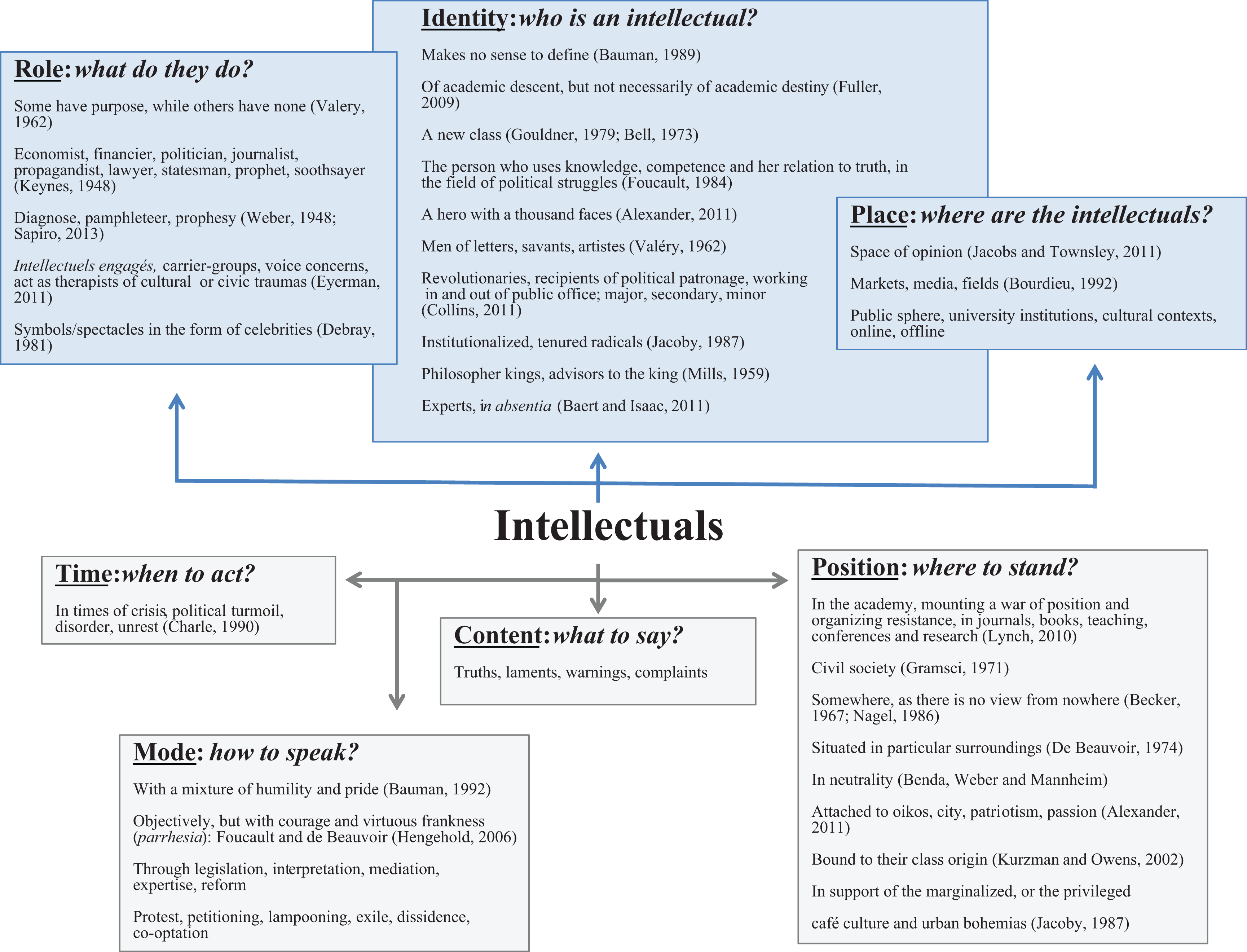
Modes of being an intellectual.
Themes
The existing theoretical work on intellectuals often reads like a recital of lamentations, jeremiads and dramatic tales that describe the fall, betrayal, disappearance, decline and absence of intellectuals (Benda, 1928; Aron, 1957; Molnar, 1961; Jacoby, 1987; Lilla, 2001; Posner, 2001; Furedi, 2004; Collini, 2006; Sowell, 2010), sometimes even treating them as an ‘endangered species’ (Etzioni, 2006). This melancholic vocabulary of loss is accentuated further by a danse macabre of autopsies and deaths (Jennings, 2002a) only to be resurrected by clarion calls to ‘speak truth to power’; a commonplace in the literature on intellectuals originated by Benda (1928) but popularized by Jacoby (1987) and Said (1994). One last common refrain in the theoretical discourse on intellectuals belongs to Foucault’s (1984: 67–75) distinction between the ‘specific’ and the ‘universal’ intellectual, the former understood as working within circumscribed domains of culture and politics, while the latter represents a spokesperson of all-encompassing human concerns. 3
As Foucault (1977: 207) put it, the specific intellectual can be understood as she who speaks ‘in the name of those who were forbidden to speak the truth’, while the universal intellectual ‘spoke the truth to those who had yet to see it’, not neglecting, however, that ‘[i]n the most recent upheaval, the intellectual discovered that the masses no longer need him to gain knowledge they know perfectly well, without illusion; they know far better than he and they are certainly capable of expressing themselves’. 4
Periods, trends, developments
Following Baert and Isaac’s (2011) historical overview of perspectives on intellectuals, the early twentieth century appears divided into two main trends in the theoretical study of intellectuals. The first of these trends defended the principles of objectivity, detachment and free-floating intellectual activity, represented by Julien Benda, Alfred Weber and Karl Mannheim, who coined the term freischwebende Intelligenz to refer to the independent, non-aligned and unanchored intellectual. The second trend reversed such priorities by emphasizing class struggle and political change, as epitomized in the works of Marx and Gramsci, who denounced intellectuals, who acted as ‘waverers’ (Jacoby, 1987: 63), and urged intellectuals to aspire instead to the role of the ‘constructor’, ‘organizer’ and ‘permanent persuader’ (Gramsci, 1971: 10).
The mid-twentieth century witnessed a relativist turn, influenced by the work of Kuhn (1962), until the emergence of the ‘new class’ thesis, mostly associated with Bell (1979) and Gouldner (1979), whose work predicted ‘the coming’ of an arguably more technocratic, post-industrial cohort of knowledge workers. In the late twentieth century, this ‘new class thesis’ lost much of its appeal, giving rise to more empirical inquiries on knowledge. This shift was chiefly represented by Bourdieu (1988) and Lamont (1987) in the 1980s, and was succeeded in the 1990s by arguments about the fall of the legislative power of intellectuals in the writings of Bauman (1987), and Nisbet (1997). Such arguments signalled a critical response to changes in the way universities were managed, and the way knowledge was produced, disseminated and ‘used’. Amid such a background of institutional transformation, fully-fledged theories on intellectuals appeared in the work of Collins (1998), and Camic and Gross (2001), which established the ferment, out of which contemporary writings on public sociology emerged in the writings of Agger (2000) and Burawoy (2005), which have dominated most of the twenty-first-century literature on engaged sociology, and public involvement via intellectual activity.
Protagonists
Much like the conceptualization and the periodization of the study of intellectuals, the recruitment of potential candidates for the role of ‘the intellectual’ is as varied as it is selective, thereby lacking a blueprint upon which to base our choice for the most suitable candidate. There is, however, some relative consistency to be found in the idolization of certain characters who are routinely identified with the performance of the intellectual’s role (Zola, Sartre), as much as there is a conspicuous absence of women, black intellectuals, subalterns, and deviant ‘others’ (Matza, 1969; hooks, 1982; Mitchell, 1984; Lerner, 1986; Jennings, 2002b; Spivak, 2010; Warmington, 2014). 5 The ‘Dreyfusards’ 6 monopolize that role (Said, 1994; Rose, 2010; Collins, 2011), considered as they are to be the archetype of courageous public participation against all the odds, or at least against a backdrop of hesitation, silence and prejudice.
The Dreyfusards spoke up in support of young Jewish artillery captain, Alfred Dreyfus, who was unfairly accused of charges of espionage and treason in 1894. He was subsequently fully exonerated in 1906, largely due to the intervention of politicians, and high-profile intellectuals such as Georges and Albert Clemenceau, Jean Jaurès, Henri Poincaré, Anatole France, and Émile Zola, 7 who exposed not only a flagrant miscarriage of justice, but also condemned the outpouring of anti-Semitic sentiment during the reign of the French Third Republic. 8 Zola’s passionate letter in support of Dreyfus, written for the left-wing paper L’Aurore, and known under the title ‘J’Accuse’, is seen as the highlight in the Western history of intellectuals. 9
Zola himself was celebrated as the archetypal intellectual until French existentialist philosopher, and revolutionary thinker Jean-Paul Sartre donned the mantle of ‘the intellectual’ during another period of turmoil in French politics. This time it was the rift between collaborationists of the Vichy regime of Philippe Pétain during France’s occupation by Nazi Germany in the Second World War, such as Céline and Brasillach, and anti-collaborationists such as de Beauvoir, Gide, Fanon, and, of course, Sartre himself. Aptly described as the ‘the war of intellectuals’ by Sapiro (1999), the period of ‘L’Occupation allemande’ can be likened to a veritable cauldron of intellectual activity, during which the figure of Sartre, perhaps unfairly overshadowing Simone de Beauvoir, looms large, especially after the end of the war where formal and informal tribunals were set up to question the involvement of collaborationists, who were called to testify on their wartime activity.
Divided as this process was into épuration legale, in the form of legal purges, and épuration sauvage, which was marked by unofficial ad hoc purges, debates on the use of violence, and the justification of retribution as a form of justice, 10 became intense and were largely headed by Sartre whose radical stance towards the matter dominated much of the scene, tempting Sapiro (1999) to name the period the ‘era of Sartre’. Departing from nearly two centuries of animosities on French soil, but remaining within the country’s physical borders, Pierre Bourdieu and Michel Foucault rightly appear as successors to Sartre’s glory in Alexander’s (2011) casting of intellectual protagonists. He also includes figures as diverse in time and opinion as Socrates, Marx, Trotsky, Bentham, J.S. Mill, the Fabians, Subcomandante Marcos, Osama Bin Laden, Ayn Rand, Michael Oakeshott and Milton Friedman.
Who is an intellectual? The intellectuals’ identity
Starting with the attempt to define who an intellectual is, may or can be, Bauman (1987: 2, 8) advises against such meaningless speculations, suggesting instead that defining what and who an intellectual is, and perhaps who and what she is not, is in fact a self-definition that ‘makes no sense’, echoing perhaps Alexander’s (2011: 200) depiction of the intellectual as a ‘hero with a thousand faces’. 11 Fuller (2009: 165), on the other hand, appears more willing, albeit equally vague, in his definition of the intellectual as ‘someone who is clearly of academic descent but not necessarily of academic destiny’. This definition provides some space for seeing intellectuals as a new class of specialized knowledge workers as prophesized by Gouldner (1979), Bell (1979), and Weber (1992: 124) in his memorable rant against ‘specialist[s] without spirit and sensualist[s] with no heart’.
Foucault (1980) offers a broader scope for the definition of the intellectual, maintaining that she can be anyone who uses her skills, talents and resources for the advancement of political struggles, while Valéry (1962: 84) sought to describe intellectuals in the elitist image of men of letters (belle-lettristes), who have knowledge (savants), and ‘purpose’ as avant-garde artists (artistes). Collins (2011: 438), on the other hand, suggests that revolutionaries, recipients of political patronage, and people who may work in and out of public office ought to be included, while he divides intellectuals into three categories: ‘major’, ‘secondary’ and ‘minor’. Jacoby (1987) places intellectuals in ‘institutionalized’ settings, considering them to be ‘tenured radicals’, while Baert and Isaac (2011: 200) describe them as simultaneously respected, and denounced as experts although they are often conspicuously absent, while Mills (1959: 179–81) urges intellectuals to transcend their traditional role as either ‘philosopher kings’ or ‘advisors to the king’ and calls for an orientation of intellectuals’ work towards both ‘kings’ and ‘publics’.
What do they do? The intellectuals’ role
If the identity of intellectuals is something that is made to fit the scholar’s purposes, and match her gaze, it seems important to note what roles the intellectuals are charged to perform in the existing literature. These are aptly summarized by Keynes’ (1948: 1109) famous remark that intellectuals often have ‘to perform at one and the same time the tasks appropriate to the economist, to the financier, to the politician, to the journalist, to the propagandist, to the lawyer, to the statesman – even, I think, to the prophet and to the soothsayer’. 12 Keynes nicely sums up similar pleas that urge the intellectuals to diagnose, pamphleteer, and prophesy (Weber, 1948; Sapiro, 2003). Last but not least, intellectuals are also conceived in the form of a nom de guerre 13 for politically concerned intellectuals (intellectuels engagés), as carrier-groups (Eyerman, 2011), who make claims and voice concerns for others, extending their role as therapists of cultural or civic traumas, and as symbols or a spectacle even in the form of celebrity-intellectuals (Debray, 1981). 14
Where are the intellectuals? The intellectuals’ place and time
Understanding the intellectuals as figures that are ‘made’, and charged with multiple individual and socio-cultural roles to perform, leads to identifying them as a ‘space of opinion’ (Jacobs and Townsley, 2011), located firmly in the public sphere. Seen in this light, intellectuals address, occupy, and open themselves up to particular markets, media, ‘fields’ (Bourdieu, 1992), institutions, contexts and, since the advent of the Internet, modes: online or offline. This hybrid position of the intellectual in-between spaces is extended to time too, calling into question the conditions that persuade or dissuade the intellectuals’ intervention, involvement, and co-operation while also calling into question whether such interventions are exclusive to crises (Charle, 1990), political turmoil, disorder and unrest.
Where to stand: The intellectuals’ position
Locating the intellectuals’ position can be likened to entertaining doubts, similar to those expressed by Paul Valéry (1962: 84) about the intellectuals’ purpose, given that ‘we find in the intellectual population these two categories: intellectuals who serve some purpose and intellectuals who serve none’. Despite what Bauman (1992: 77) sees as a ‘mixture of sham humility and unmistakable pride’, tracing the intellectuals’ stance remains an important issue and a relatively unresolved controversy in the current literature. There are those who argue for mounting a ‘war of position’ and ‘organising resistance’ in ‘journals, books, teaching, conferences and research for critical intellectuals’ in the academy (Lynch, 2010: 575) or in civil society at large (Gramsci, 1971), believing that there can be no ‘view from nowhere’ (Becker, 1967; Rich, 1985; Nagel, 1986), nor can there be a ‘being’ devoid of ‘situation’ and ‘surroundings’ (de Beauvoir, 1974: 275–6). But there are also those like Benda, Alfred Weber and Mannheim who prefer a position of disinterest, with no backing script or other ‘attachments of a particularistic sort – friendship, oikos, city, patriotism, passion’ (Alexander, 2011: 196).
Such disparity of views on locating the intellectual, despite its artificial dualism between neutrality, and situatedness, is important especially if it is linked to questions of power hierarchy, and social order; as intellectuals are not simply located somewhere arbitrarily in the broad social grid but they are also ‘made’ there. Understanding intellectuals as ‘bound to their class origin’ (Kurzman and Owens, 2002: 64), for instance, justifies in part the suggestion that intellectuals are made in specific conditions (social class) as well as circumstances (crises, wars, situations of political disconnect), both of which are embedded in and involve relations of power. Alternative loci for intellectuals, transcending strict class or status divides, oscillate between notions of marginality and privilege or find them dissolved in enclaves of avant-gardism in the form of the ‘café culture’ of ‘urban bohemias’ (Jacoby, 1987), archetypical examples of which are to be found in the Parisian Quartier Latin or in New York’s Greenwich Village.
How to speak and what to say: The intellectuals’ mode and content
Having seen where the intellectuals are ‘made’, it is now important to examine how intellectuals are thought to make their public interventions, and what they may have to say. Alluding to Oswell’s (2009: 12) apt observation that ‘democracy is figured out through the modalities of speaking and listening’, a brief look at the social theory literature on how the intellectuals might speak, or what Bhabha (1994) calls ‘enunciatory modalities’, finds them articulating their message in the following three main ways: (1) objectively but with courage, and virtuous frankness (parrhesia 15 ); (2) through legislation, interpretation, mediation, expertise and reform; or (3) by means of protest, petitioning, lampooning, exile, dissidence, and co-optation. These being the three main modes identified in relation to how the intellectual might speak, the content of that speech (what to say), appears in the form of ‘the truth’, but this is also punctuated by loud cheers for the intellectual’s role, and profile as a valuable agent provocateur of, as well as in, public life at large.
Admirable though such depictions of the intellectual may be, they insist too much on equating intellectual life with an ideal type of a person who thinks, speak, and acts in a certain way which fuses the life of the mind with the life in the world, forgetting perhaps that such a neat portrait conceals as much as it reveals. To set up such a hypothetical construct of the intellectual as a person that is made up of salient features that differentiate her from the rest of the world, is to also implicitly define intellectual life as little more than a collection of personal attributes, rather than a widely available public function to be performed by all, provided that they wish to do so. Such depictions of intellectuals as exceptional figures, laudable though they may be, also create intellectual habits that narrow our search for different meanings or definitions of what intellectual life is, who the intellectuals may or can be, what they do, and where they can be seen doing it.
To make matters worse, the fusion of intellect and action that current definitions of the intellectual readily assume is exactly what existing definitions actually deny, fixated as they are on an archetypal image of the intellectual as a figure whose identity, role, place, mode, and manner of speaking are by definition at a certain social distance from the public sphere she is called upon to address. By conflating the mind with the brain, the intellect with reason, the ostentatious with the substantive, and the Republic of Letters with the public sphere, we betray our good intentions or noble ambitions through our obdurate refusal to define intellectual life in a way that does not merely affirm ‘our’ sense of what it is, but also admits, invites and involves ideas, people and practices that may not look, act, or speak like ‘us’ but can perhaps perform the roles that we have exclusively reserved for thinkers-as-intellectuals better than they do. Drawing on a sense of disillusionment with this tradition of thinking about and searching for intellectuals, the following section of this article attempts to disown that burdened inheritance by replacing hoary cobwebs with new connections in the hope that a novel conception on intellectual life will pave the way for a different relationship between contemplative life (vita contemplativa) and public participation (vita activa). 16
Notes towards an alternative conception of intellectual life
The preceding overview of common tropes in the sociological study of intellectuals raises a number of intriguing questions about the essential mental attributes, cultural disposition, and political imperatives that intellectuals must aspire to in order to perform their role, as well as justify their identity and place in the public realm. Yet, much of such scholarship on the intellectuals’ raison d’être suffers from the limits of its own thinking, as it draws its definitions and protagonists from a conceptual net that is not cast wide enough to include figures who do not inhabit the world of letters, but may have plenty to offer intellectually, culturally and politically as ‘thinker-tinkers’ (Ellison, 1965: 10), or ‘public character[s]’ (Jacobs, 1961: 68). Building on the idea of the ‘public character’ as a plausible contender of the ‘public intellectual’, what is proposed here is a broader, more inclusive, and more egalitarian view of: (1) who the intellectual can be; (2) what intellectual life consists of; (3) where intellectual life might take place; and (4) who can be involved in such an activity. The rest of this article is therefore organized around these questions, preceded by a brief critique of the existing scholarship on the subject.
A short critique of the existing scholarship on intellectual life
Reflecting Coser’s (1965: vii) assertion that ‘definitions, far from being neutral, have consequences’ by ‘weaving’ delicate ‘webs of inclusion and exclusion’ (Nichols, 1978: 10–11), the existing literature on intellectuals views intellectual life from the narrow prism of definitions that resemble what Seidman (1998: 93) describes as ‘strategies to maintain intellectual and social hierarchy by fixing boundaries’. The problem with such long-standing conceptual and discursive tropes, however, is that they harden into canons which create ‘many exclusions and silences’ and leave ‘certain figures, problems, conceptual approaches and argumentative strategies ignored, suppressed and marginalised’ (Seidman, 1998: 93). The main casualty of such thinking habits is the reluctance to view intellectual life as something other than a primarily cerebral function that is chiefly represented by men of letters who engage ‘the public’ mostly from ‘the study’ rather than ‘the street’ (Nichols, 1978: 13), despite persistent calls for a more ‘organic’ (Gramsci, 1971), ‘communicative’ (Habermas, 1984), or ‘embedded’ (Baert, 2015) relationship between intellectuals and their audience.
Against such one-dimensional perspectives of what ‘makes’ the intellectual and intellectual life more broadly, the view here espoused looks for the intellectual within us all by interpreting intellectual life as a process which is not the exclusive domain of a few, but a common attribute of the many, which engages not just the brain but the whole human mind. This involves recognizing the role of the sensual alongside the verbal, and urges an understanding of intellectual life primarily as a matter of public participation, rather than intellectual pedigree. By calling for a broader view of intellectual life, it is argued that there are types of intellectuals who are not recognized as such, and that there are forms of intellectual expression and creativity that are not afforded serious, scholarly attention due to deep-seated intellectual and cultural biases of who can be an intellectual, what constitutes intellectual life, and where such activity might take place.
Who can the intellectual be?
Challenging commonplaces that depict intellectuals as an army of swashbuckling heroes who are guided by the romantic determination to ‘speak truth to power’, the view adopted here defines the intellectual as a figure and an endeavour that are inclusive and egalitarian, welcoming contributions from a variety of people rather than a specific sociocultural type. In doing so, the realm of the intellect is envisaged as an ordinary activity, rather than an exceptional event or the prerogative of certain professionals. Taking a cue from Maslow (1968), Rogers (1954), Gordon (1972), and Roe (1963), the life of the mind is hereby seen as a ‘rendez-vous’ activity that can be arrived at via multiple routes, and practised by a variety of people from many different walks of life, including members of ‘DiY’ (McKay, 1998), ‘profane’ (Willis, 1978), or ‘déclassé’ subcultures (Gelder, 2005: 3) in the spirit of the ‘histories from below’, described by Hobsbawm (1998), Thompson (1975), and Rudé (1964).
Such a position owes a considerable debt to Foucault’s (1984: 70) broad definition of the intellectual as ‘the person who utilises his knowledge, his competence, and his relation to truth in the field of political struggles’, and resonates with Gramsci’s conviction that intellectuals do not have to be ‘an autonomous and independent social group’, given that every social group, coming into existence on the original terrain of an essential function in the world of economic production, creates together with itself, organically one or more strata of intellectuals which give it homogeneity and an awareness of its own function not only in the economic but also in the social and political fields. (1971: 5)
The alternative view defended here departs from such positions and the intellectual tradition that informs them, by resisting their tendency to exclusively define intellectuals as literati, arguing instead for the inclusion of hitherto ignored ‘outsiders’ (Becker, 1973) in debates of who the intellectual is or can be. This involves introducing a rich medley of unheard voices to theoretical debates on intellectuals, not only as an attempt to rescue excluded social groups ‘from the enormous condescension of posterity’ (Thompson, 1966: 12), but in a bid to bring forth an ‘insurrection of subjugated knowledges’ (Foucault, 2003: 7) in the sociological study of intellectual life. By defining intellectuals primarily as thinkers and writers, we fail to properly recognize who they are defined against, be it “the common people”, ‘dropouts from the social ladder’ (Salgado, 1972: 13), or anyone who does not fit conventional depictions of the intellectual as a person of consequence. Such thinking habits treat intellectuals as a species apart, rising above ordinary citizens who ostensibly lack the ability, capacity, skills, and wherewithal to think, act, or debate as intellectuals, without sufficiently questioning whether intellectuals themselves ‘devote at least part of their skills to the political and cultural emancipation of humanity’ (Wald, 1987: 324).
By widening our search for, as well as broadening our definition of who the intellectual can be, we can therefore recruit West African griots (singer-storytellers), West Indian calypsonians, dancehall artists, sound system operators, DJs, and rasta revolutionaries, (Campbell, 1987; Gilroy, 1987; Hebdige, 1987; Jones, 1988; Chevannes, 1994; Cooper, 1993; 2004; Hall, 2003; Henry, 2006; Stanley-Niaah, 2010; Henriques, 2011) as potential candidates for the role, not to mention rappers (Baker Jr, 1993; Barron, 2013; Bramwell, 2015), jazz musicians (McKay, 2005), dancers (Becker, 1973), artists, photographers (Becker, 1974; 2008; Dewey, 1994), as well as community organizers, craftsmen (Sennett, 2009; 2012), or even perhaps programmers as politicians of the online commons (Berry, 2008), urban planners (Jacobs, 1961), flâneurs (Benjamin, 1983; De Certeau, 1984; Wolff, 1985; Buck-Morss, 1986), pedagogues (Freire, 1996) or inventors and industrial scientists (Galison, 2008). This perfunctory cast-list of absent presences in the existing literature on intellectuals reveals a genealogy of exclusions and exposes deep-seated prejudices in the way intellectuals are defined, conceived of, and portrayed.
Such omissions point to ample opportunities for contending with, and including hitherto unfamiliar types, forms, and modes of intellectual life in our scholarship on the subject. Any such shift in thinking habits, however, requires us to embrace non-normative, marginal and often ‘deviant’ cultural practices as worthy and valid, acknowledging that the ‘same strains which help to produce deviant behaviour also help to produce the behaviour we most applaud’ (Cohen, 1959: 473–4). Examples of such culturally deviant groups can also include hobos, dreamers, bootleggers and vagabonds who are ‘similar in character and disposition to persons who, in another social context might be praiseworthy’ (Matza, 1969: 72) but are almost exclusively seen ‘through the disapproving eyes of respectable citizens’ (Salgado, 1972: 13), and are therefore denied membership to the ‘organic’ (Gramsci, 1971) and ‘embedded’ (Baert, 2015) ideal types of the current literature, despite the transgressive potential of such groups’ activities.
What does intellectual life consist of?
In the process of breaking established patterns of thinking that define intellectuals in the one-dimensional manner described above, another bias is discovered which reinforces exclusively intellectualist views of what intellectual life consists of, defining it strictly as an activity and product of the head alone, thereby assuming the irrelevance of the senses in the thinking process or as thinking organs of the body politic. Despite persistent attempts by neuroscientists (Gregory, 1987; Humphrey, 1992; Carter, 2002), historians (Roeder Jr., 1994; Smith, 2007; 2008), philosophers (Ryle, 1968), and sociologists (Simmel, 1921; Vannini, Waskul and Gottschalk, 2014; Back, 2007; Oswell, 2009; Rhys-Taylor, 2013), who would dismiss such statements as profoundly senseless, the existing literature on intellectuals fails to adequately account for the role of the senses as ‘gates and windows of knowledge’ (Drummond, in Humphrey, 1992: 30). The problem with such a position is that it erroneously treats ‘the intellect’ as ‘distinct in essence from the senses’ (Maritain, 1976: 107), thereby conflating the life of the mind with the life of the head and reducing thinking to its dianoetic function, despite overwhelming evidence of the impossibility of neatly separating the workings of such a ‘lateralized’ network of organs as the mind (Carter, 2002: 54).
Given that the mind is more than the brain, and that our capacity to think and understand involves the co-ordination of complex behavioural and neuropsychological processes that take place across multiple networks of sensation, intellectual and nervous activity, to misunderstand what counts as ‘intellect’ is also to misidentify who can count as an intellectual. In doing so, we do not just superimpose the brain on the whole mind or the intellect on the senses, but also limit our conception of intellectual life to its cerebral function alone, thereby divorcing it from a more visceral understanding of the social world, according to which there is ‘nothing to be found in the intellect which does not come from the senses’ (Maritain, 1976: 107). The shortcomings of such an intellectualist approach are evident in its reluctance to re-cognize thinking as an embodied practice (O’Neil, 1972; 2004; Scheper-Hughes and Lock, 1987; Csordas, 1994; Shilling, 2003; Henriques, 2011), treating it instead as an abstraction which involves little more than rational discourse at the expense of other forms of ‘communicative action’ (Habermas, 1984) or types of public expression and political intervention, examples of which can be found in popular music (Kotarba and Vannini, 2009; Bramwell, 2015), graffiti writing (Ferrell, 1996), skateboarding (Borden, 2001), performance art and fashion (Gruen, 1966).
Where does intellectual life take place?
The ‘place’ where intellectual life happens may originate in the mind’s neural hinterland, but its socio-cultural and political home is the public sphere, which is routinely viewed as a platform where intellectuals can communicate their thoughts via a variety of print and other digital media. This view of the public sphere as a spectator sport, however, bears the hallmarks of, and is constrained by, the limits of the existing intellectualist tradition which regards public intervention as a one-directional activity which springs from the intellectual’s mind and is subsequently disseminated in the public sphere. In a twenty-first-century context, however, the notion of the public intellectual as an omniscient sage who dispenses the wisdom of the ages to a helpless and hapless public is problematic at the outset, as it ignores that forms of intellectual life can exist in various shapes and forms as well as circulate across multiple ‘scapes’ and flows, which upset the image of the public intellectual as someone who speaks to ‘the public’ or against ‘power’ in a one-way process. The very history of knowledge exchange, public deliberation and political interventions from ‘Alexandria to the Internet’ (McNeely and Wolverton, 2008), from the agora to the ‘Republic of Blogs’ (Dunleavy, 2012) or from ‘Dreyfus to the new social media’ (Baert and Booth, 2012), shows much more democratization at play than the insularity of intellectualist exceptionalism permits, especially in an era of global informational flows.
Departing from a view of intellectual life as something that predominantly happens in the ivory tower, between the nodes of the Internet, or within the margins of the printed page, an alternative conception of it as a ‘street ballet’ (Jacobs, 1961), which unfolds in and around the city is argued for, reinterpreting intellectual life not as an abstraction, but as an embodied, public-oriented endeavour, which is performed in ‘actually existing’ democratic public spaces (Fraser, 1999), and is represented by the inescapably public figure of what Jane Jacobs (1961) termed ‘the public character’. The notion of the ‘public character’ is employed here in an attempt to translate Jacobs’ ideas on urban life to debates about intellectual life with the aim of declaring the existing notion of the public intellectual anachronistic, parochial and irrelevant, thereby replacing it with a truly publicly situated alternative. The ‘public character’, Jacobs’ (1961: 68) explains, can be ‘anyone who is in frequent contact with a wide circle of people and who is sufficiently interested to make himself a public character’. S/he ‘need have no special talents or wisdom to fulfil his function – although he often does. He just needs to be present, and there need to be enough of his counterparts. His main qualification is that he is public, that he talks to lots of different people.’ What such a definition allows, is an emphasis on action, public participation and direct experience with no requirement to be an intellectual in order to have a voice, role and say in the public realm.
Taking up Fridjonsdottir’s (1987: 113) challenge to ‘re-evaluate the meaning and the importance of the category of the traditional intellectual itself as well as analyse its changing conditions’, a rhetorical and discursive shift from the public intellectual to the public character splinters the intellectualist veneer from the possibility of public involvement, reveals the prevailing biases of public intellectualism, and articulates a more inclusive, egalitarian and public-oriented view of what intellectual life can be as a practice of ‘vernacular cosmopolitanism’ (Bhabha, 2000). Interpreting intellectual life as a form of vernacular cosmopolitanism has considerable merits, as it allows us to translate between various forms of intellectual creativity, and renegotiate existing intellectual traditions in order to locate intellectual life in the real, physical, public spaces where it actually unfolds. To achieve this, however, intellectual life has to be recognized as an activity which spills over beyond the conventional boundaries that the existing literature confines it to, involving the body, the senses, the urban environment, and a host of public characters that we have hitherto been neglectful of and inarticulate about.
Footnotes
Declaration of conflicting interests
The author declared no potential conflicts of interest with respect to the research, authorship, and/or publication of this article.
Funding
The author received no financial support for the research, authorship, and/or publication of this article.
Notes
References
Supplementary Material
Please find the following supplemental material available below.
For Open Access articles published under a Creative Commons License, all supplemental material carries the same license as the article it is associated with.
For non-Open Access articles published, all supplemental material carries a non-exclusive license, and permission requests for re-use of supplemental material or any part of supplemental material shall be sent directly to the copyright owner as specified in the copyright notice associated with the article.
