




Abstract
Despite its undisputed importance, fear is yet to become a distinct research area for social theory. However, without a clear conceptualization of fear, the explanation of significant phenomena, such as the risk-related anxiety or the conflict of the global and the local, remains incomplete. This article aims at reintroducing fear at the fundamental level of social integration. First, the social contract theories of Hobbes and Rousseau are reinterpreted in order to identify a negative (based on fear) and a positive (based on hope) motivational basis of self-limiting one’s freedom of pursuing individual goals. These motivations for cooperation are the prerequisite of any society, as their absence results in disintegration. While social contract theories analyse them in detail, social theories forget about this level and focus on the mechanisms of action coordination. From the perspective of the two types of motivation for cooperation, two modalities of integration mechanisms identified by classical (Weber, Durkheim, Habermas) and late modern (Beck, Castells) social theories are elaborated. Based on such a model, the contemporary expansion of fear is explained as a consequence of the upset balance of the two modalities, leading to the predominance of negative integration.
Although fear is considered to be a universal emotion, its prevalence is affected by many social factors. Most theories of late modernity argue that the integration mechanisms capable of reliably handling social contingencies are dissolving, thus fear and anxiety are becoming decisive experiences in contemporary societies (e.g. Bauman, 2000). These diagnoses are supported by large-scale surveys reporting an increasing level of perceived threats (e.g. Collins, 2018), media analysis detecting the increased coverage of fearful events (e.g. Glassner, 1999) and qualitative research describing the naturalizing of fear in various constellations (e.g. Brower, 2011). Even if these analyses conclude that fear plays a fundamental role in our societies, none of them succeeds in explaining which particular integration mechanisms are responsible for its emergence. While most theories tend to rely on over-generalizing structural changes without paying attention to the phenomenological details (Wilkinson, 1999; 2001), empirical analyses either neglect or fail to elaborate a comprehensive social theoretical framework (Tudor, 2003). This gap is the starting point of the following article: an attempt is made to reintroduce the emergence of fear at a fundamental level of social integration.
While fear is an essential, constitutive factor of the human condition, social theories relate to it in a controversial way. 1 As a ‘primary emotion’, fear is considered to be cross-culturally universal, making it primarily belong to the territory of the psy-sciences (Kemper, 1987). 2 On the other hand, fear plays a constitutive role in sociability: basic concepts, such as norms, power or solidarity, can hardly be described without referring to the fear of sanctions, subordination or external danger (Moon, 2013; Vannelli, 2015). Most social theories react to such ambiguity by neglecting fear, while latently building on it. Therefore, fear is seldom the focus of theoretical analysis, instead it is considered to be a self-evident component of social phenomena. However, such an attitude prevents sociology from convincingly explaining the increase of fear in contemporary societies. In order to falsify or prove such a hypothesis, the general and historical aspects of fear need to be differentiated, thus the increase in fear can be explained through the latter. This requires the elaboration of a concept of fear, which is social not only because of its object (i.e. the fear of the other), but also because of its origins (i.e. the fear caused by the way society functions). Such analysis requires a social phenomenological approach capable of operating both on the level of structural components and the experiences of the actors. Fear is not considered to be a substantive element of the lifeworld, but a formal, underlying dimension of it, being constructed intersubjectively. 3 Such an approach enables the linking of the probability of fear to certain types of integration mechanisms, thus analysing, to what extent and how late modernity became an epoch of extreme fear.
For this purpose, the reinterpretation of those theoretical sources is required, which are free from the above-mentioned blind spot. In the first section an attempt is made to re-examine two classical social contract theories, which discuss fundamental questions that later became irrelevant for social theories. While social contract theories are preoccupied with the question of why one should give up one’s unconditional freedom in the process of joining society, the latter focuses on how social integration is possible. In this sense, social contract theories start their investigation at the fundamental level of the motivational basis of cooperation, whereas social theories consider sociability to be self-evident. Relying on the ideas of Hobbes and Rousseau, the ideal-types of negative and positive motivation for cooperation are described, grounding two different modalities of social integration: one based on the fear of something, the other based on the hope of something. In this sense, social contract theories enable the reintroduction of fear on the fundamental level of theorizing: it becomes a definitive dimension of the lifeworld in those constellations, where integration is based mostly on the negative motivation for cooperation. 4
These conceptual tools revived from early modern social philosophy are applied in the second and third sections for the purpose of exploring latent aspects of social theories. On the one hand, the positive and negative modalities of the classical modern integration mechanisms introduced by Weber (the legal-bureaucratic legitimacy), Durkheim (the division of labour) and Habermas (the communicative lifeworld and systems) are elaborated. On the other hand, the modalities of late modern technics of adaptation appearing in the theory of Castells (networks) and Beck (reflexivity) are reinterpreted. 5 Such an overview provides an opportunity to describe the balance of negative and positive modalities of social integration in each epoch. According to the diagnosis of the period of classical modernity, positive and negative motivations played an equally important role in organizing social interactions. However, based on the descriptions of late modernity, it can be argued that the negative modalities have recently become predominant. This change not only affects the newest mechanisms of integration, but also the ones inherited from previous times.
After reintroducing fear on a fundamental level of social integration and explaining late modernity as an upset of the balance of negative and positive motivation for cooperation, an attempt is made to link specific patterns of fear (identified by empirical research) and patterns of negative integration (identified theoretically). In the final section, those mechanisms are introduced, which are responsible for translating the abstract negative motivation for cooperation into actual patterns of fear. By reintroducing fear as a phenomenological texture of late modernity and revealing its specific expressions related to various mechanisms of integration, its overall emergence can be explained in a comprehensive way. Fear does not expand in general, instead its diverse patterns appear in constellations coordinated by various mechanisms of negative integration.
Social contract and the motivation for cooperation
Social contract theories born at the dawn of modernity express a liminal condition, characterized by turbulent transformations and uncertainties. As the religious worldview and the related feudal structures lost their unchallenged validity, the question of freedom became once again central in epistemology, ethics and social philosophy. Without naturalized hierarchies based on religious dogma, clarification was required as to why actors should limit their – originally unlimited – freedom of pursuing individual goals. Social contract theories start their investigation with the intention of answering this question: what are those universally accessible reasons, which are capable of motivating actors not sharing any sort of mutual belief system to cooperate? This question is prior to the one about the potential forms of society, as only the clarification of the motivational basis of cooperation enables the elaboration of a typology of society. As the theologically grounded, quasi-natural, external reasons to limit one’s freedom lost their relevance, normative regulation could only be based on the autonomous, voluntary decision of the actors. In this sense, classic contract theories inevitably operated on a phenomenological level: they argued that the constitution of society cannot depend on natural or transcendent forces, only on the actors’ self-limitation. 6
While each social contract theory provides alternative answers to these questions, it was Hobbes and Rousseau, who elaborated two fundamentally different motivational bases of self-limitation. Their contrasting ideas originate from the differences of their anthropological and historical assumptions. Hobbes relies on a concept of human existence purified of any metaphysical preconceptions: humans are considered to be sensing and processing automatons, not determined by any inherent, essential goal or value. In such a constellation actors are motivated primarily by their desires and fears. Among these, the fear of death is particularly important, as it is fundamental to any reasonable actor. If avoiding death is the single most elementary interest, then everyone is motivated to increase their power, which is the only way to find relative security. These basic premises outline a dynamic, yet chaotic, hypothetical ‘state of nature’ (the war of all against all), where everyone has unlimited freedom, but nobody is secure. As the elementary interest of avoiding death is in contradiction with the state of nature (the risk of becoming a victim is high), reasonable actors are motivated to overcome such a constellation. In order to do this, they have to give up their unconditional freedom and transfer it to a single authority (the Leviathan) responsible for protecting everyone by monopolizing power. In this sense, the social contract is a collective agreement about self-limiting freedom and centralizing power, motivated by the elementary fear of the unconditionally free other. The state that is being born in such an agreement is not justified by any transcendental-metaphysical value, only by the individual’s self-evident interest in survival. Hobbes’ Leviathan has unlimited power as long as it is capable of fulfilling its fundamental role of maintaining order by monopolizing power, but collapses at the moment it fails this task (Hobbes, 1997 [1651]: 82).
While Hobbes considers the hypothetical state of nature to be the most frightening possibility for any reasonable actor, Rousseau argues that the actual historical societies do not provide a more promising prospect either. The history of society is a history of various forms of inequalities and injustices, which is only partly compensated for by cultural development and order. As the existing social orders have always resulted in suffering and the limitation of the freedom of the majority, the task of grounding a post-metaphysical society cannot be done only by referring to the threat of war of all against all. Showing the emancipatory potential of overcoming the historically tenacious injustice is an equally important task. Only by introducing the promise of an alternative power structure, which enables actual freedom, can actors who are in hopelessly subordinated positions be motivated to give up the freedom of following their own personal interest. According to Rousseau, the stake of the social contract is not only to provide order instead of the chaos of the natural state, but also to create a better order in the place of the unequal status quo – an order where actual freedom may rise, instead of its limited or illusory version. Such a transformation is based on the collective giving up of the freedom to realize individual interest in exchange for the ruling of general will. As a consequence of this self-limitation, the injustice of various privileges gives way to the justice of equality, which is ensured by the generally applied, universal law (Rousseau, 2002 [1762]: 164).
Hobbes and Rousseau describe two opposing basic reasons, which are capable of motivating actors to limit their own freedom of pursuing personal goals. In a certain sense, they elaborated two phenomenological trajectories for modern societies. For Hobbes, it is the fear of the unconditionally free others, which urges individuals to give up their own freedom along with everyone else to a monopolist of power. For Rousseau, it is the hope of the realization of latent potentials of freedom, which inspires the individual to replace the pursuit of personal interest with subordination to the general will. In this sense, the former refers to a negative motivation for cooperation (the fear of the deadly threat of the other), the latter describes a positive motivation for cooperation (the hope of realizing the missing potentials of freedom). Based on these explanations of why any reasonable actor is interested in the self-limitation of their individual freedom, Hobbes and Rousseau elaborated contrasting typologies of social order, which can be reinterpreted as two phenomenological modalities of social integration.
Social contracts include a promise concerning the predictability of social relations: for Hobbes, it includes the relative safety from the ultimately dangerous others, for Rousseau, it is a constellation enabling actors to realize otherwise impossible potentials. These latent promises function as the phenomenological basis of social existence in a sense, that they outline the actors’ horizon of expectations. 7 As actions based on certain expectations become general, interactive patterns are emerging around them, functioning as framework for future social action. 8 In this sense, the phenomenological modalities of social contracts are not only giving sense to social phenomena, but also are institutionalizing certain mechanisms of integration. This conceptual connection enables us to move from contract to integration and analyse how mechanisms of action coordination can be differentiated according to their negative and positive modality.
While the social theoretical tradition focuses on the typology of the social order in the form of integration mechanisms, it has more or less forgotten about the motivational level analysing the fundamental reasons of cooperation. This change of emphasis resulted in the blind spot of social theories: they no longer started their investigation with the phenomenological question (why are actors motivated to choose social existence instead of dissociation?), but with the technical-functional one (which mechanisms are capable of maintaining social order?). In this sense, social contract theories provide an opportunity to expand the horizon of social theories by recalling a forgotten level of theorizing. In the case of every mechanism of action coordination, the question about their negative and positive modalities may be raised: how do they operate in those cases, where actors rely on them only because they are afraid of an alternative constellation, and in those cases, where they are considered to result in a constellation more promising than the status quo? Besides broadening the horizon of social theories by describing two modalities of each integration mechanism, from the perspective of motivation for cooperation also a forgotten level of social dynamics becomes accessible. In the case of every historical constellation, the question of the proportion of negative and positive modalities may be raised: are they in balance, or is one of them predominant? In the following two sections some classical and late modern social theories are reinterpreted from this perspective.
Classical modernity: the fragile balance of negative and positive integration
Classical modernity is a retrospective term originating from the comparison with a new era characterized by the dissolution of those integration mechanisms, which originally removed the pre-modern ones. As theological knowledge was succeeded by science, use value was replaced by exchange value and the representative public sphere was transformed into the bourgeois sphere, not only uncertainties and worries emerged, but also a sense of new order and security was born. Accordingly, despite its deconstructing impact, classical modernity also created its own ‘tradition’, which was based on formal knowledge instead of substantive dogmas, and maintained by experts instead of guardians (Giddens, 1994). The gradual dissolution of this tradition indicates the dawn of a new era, characterized not only by new mechanisms of action coordination, but also by the reconfiguration of the balance of their negative and positive modalities. In the following section, Durkheim’s and Weber’s theories are evoked in order to describe the classical constellation, while Habermas’ theory helps to explain its paradoxes.
Durkheim understands modernization as functional differentiation: while archaic societies constituted of similar actors are integrated mechanically through collective consciousness, modern societies are constituted mainly of specialized actors who are integrated organically through the division of labour. It is important to note, however, that modern societies cannot rely solely on the contractual integration mechanisms of organic solidarity: compliance with contracts depends on moral obligation, which can be based only on the level of collective consciousness. While modernization enables a new form of solidarity based on mutual dependence, the fulfilment of individual potentials and an overall increased productivity, it also creates new difficulties originating from the challenges of organizing and regulating a functionally differentiated society (Durkheim, 1997 [1893]). Such social pathologies include injustice (inequalities are not the result of the difference of effort) and anomic division of labour (anomalies of the job market). Furthermore, as these pathological ‘social facts’ are interiorized, beside social dysfunction, they also result in personal suffering, which could lead in the most extreme cases to suicide (Durkheim, 1951 [1897]).
Weber understands modernization as instrumental rationalization in various spheres of life. Formal, calculative rationality is expressed not only in economy (capitalism) and politics (bureaucracy), it also affects the everyday life (optimized daily routines) and culture (science, modern music). On the one hand, this leads to unparalleled efficiency of social integration, which is secured by legal-bureaucratic domination (Weber, 1978: 954). Such an ideal-type of domination is not based on the recognition of traditions, charisma or religiously grounded values. Instead it is based on the collective subordination to the set of universally applied laws, thus it expresses a rational and just way of organizing social interactions. On the other hand, the disenchantment of the world also leads to the loss of those general values, which could make instrumental action meaningful. Such a loss of meaning expresses the paradox of rationalization: while the particular tasks are resolved more and more efficiently, the actual meaning of action becomes less and less accessible (Weber, 1946).
From their different epistemological and methodological starting points, both Durkheim and Weber identify key integration mechanisms of modern societies and elaborate the emancipatory and pathological potentials originating from their expansion. Accordingly, in order to properly characterize the classical modern constellation, first, the positive (motivated by hope) and negative modalities (motivated by fear) of these integration mechanisms need to be mapped out. While the positive motivation for cooperation is expressed by the new potentials enabled by modernization, the negative one is related to the pre-modern practices that require to be transcended. Second, the equilibrium of positive and negative motivations for cooperation needs to be analysed. By describing the dynamics and interactions of modern and pre-modern mechanisms, the diagnoses of these periods inform us of this question.
According to Durkheim, the labour market is responsible for coordinating functionally differentiated social activities. The positive motivational basis for joining the system of the division of labour is none other than the hope of being able to profit from others’ expertise in exchange for one’s own. Due to the collective specialization, everyone has better chances of satisfying their needs, which results in the overall increase of the quality of life. In this sense, the division of labour expresses not only a private interest, but also a professional vocation and an organic solidarity based on the general will. On the structural level, this constellation is characterized by the fair distribution of goods, enabling actors to realize their personal goals by fulfilling their functional roles. As the functional division of labour replaces the segmental distribution of labour, its negative motivational basis is characterized by the threats originating from the latter. Order in archaic societies is maintained by repressive law, which avenges any deviations from the ritually maintained collective consciousness. From this perspective, the acceptance of an order based on restitutive law could be motivated by the fear of such a rigid mechanic solidarity based on restricting the individual. Unlike in case of the positive motivation for cooperation, in this case, contributing to the division of labour does not imply a vocation or an identification with an organic general will – instead it is based on the desire to escape the tyranny of a repressive order. The institutionalization of such a modality results in a system of unequal, but not completely arbitrary and unpredictable redistribution, which prevents actors from fully realizing their personal desires by contributing to collective production, but at least grants them the potential of gradual accumulation.
According to Weber, the legal-bureaucratic legitimacy is responsible for maintaining order in a rational manner. The positive motivational basis for subsuming one’s will to such domination is based on the hope of realizing the rationality potential of social relationships. The capitalist-industrial mode of production, the bureaucratic organization of the state and the contractual interpersonal relations all serve the purpose of efficiency and accountability. As legal-bureaucratic legitimacy ensures the most effective technical domination of nature and the most universal normative regulation, it actually serves the private interest of every rational actor. The consequent model of integration is an inclusive rule of law, enabling the principles of justice to prevail. Such domination is the alternative to traditional, charismatic and hierocratic ones, which means that its negative motivational basis is related to fears of these forms. As these ideal-types of social relationships are characterized by limited versions of instrumental rationality, 9 it may be argued that the recognition of legal-bureaucratic domination is negatively motivated by the fear of such narrow perspectives. In this case, subordination to universal legal frames is based on the fear of the purposelessness of traditions, the overwhelming nature of the charismatic and the dogmatism of hierocratic domination. However, such negative legal-bureaucratic domination is not capable of providing a horizon, it is chosen as a compromise: not because of its efficiency, but because – even despite its pathologies – it is less threatening than the irrational, uncontrollable alternatives. Institutionalizing such a modality leads to an exclusive, potentially discriminative rule of law, which, however, includes the claim of rationality.
After introducing the positive and negative modalities of organic solidarity and legal-bureaucratic domination, the balance of the two can be clarified based on the diagnoses of times. First, both Durhkeim and Weber argue that modernization is a fait accompli. The predominance of organic solidarity or legal-bureaucratic domination is not only widely accepted for their potential, but also exists as an independent framework undeniable for the actors – these characteristics strengthen the positive motivation for cooperation. Second, both of them identify social dysfunctions and pathologies affecting the individual. The cost of anomie, injustice or loss of meaning is measured by the personal suffering they cause – these tendencies weaken the positive motivation for cooperation. Third, both of them argue that modern mechanisms of integration are not exclusive. Consequently, the threats of mechanical solidarity or domination based on limited rationality remain real – these processes are responsible for the existence of negative motivation for cooperation. Based on these diagnoses, it may argued that classical modernity is characterized by a delicate balance of positive and negative motivations for cooperation, which constitute the phenomenological structure of the era: the former is enforced by the results, but shadowed by the new challenges, while the latter is strengthened by the coexistence of old mechanisms. Accordingly, such a balance depends on the maintenance of the achievements, the treatment of the pathologies and the embeddedness of old practices.
Even if such a fragile balance was the general experience at the beginning of the twentieth century, the constellation has changed since then. Habermas is a perfect example of how these changes were interpreted by post-war social theory: not only does he further develop the ideas of Durkheim and Weber, but he also identifies new, irreversible dangers of modernization, which affect the balance of negative and positive motivations for cooperation. Habermas understands modernization as a rationalization of both the actors’ perspectives and the institutionalized mechanisms. The former is expressed by the increasing transparency of the lifeworld, which originates from the lack of distortion of speech acts enabling mutual understanding. The latter is described as the functional differentiation of systems based on symbolically generalized communicative mediums (such as money or law). The communicative lifeworld and systems outline a dual model of society, where two spheres integrated by different mechanisms complement each other. However, their relation is not symmetric, as systems are dependent on the sufficient rationalization of the lifeworld (i.e. the capability to process disembedded, generalized mediums). Social pathologies may emerge on both levels. In the case of the lifeworld, the distortions of communicative action threaten with loss of meaning, anomie and psychopathologies (Habermas, 1987: 143). In the case of the systems, the functional inefficiency threatens with adaptive failures potentially leading to a legitimation crisis (Habermas, 1975). As well as these dangers affecting only one sphere of integration, those paradoxes of rationalization are even more serious, which threaten the whole project of modernization: as functionally differentiating systems expand due to their efficiency, mediatized communication effaces speech acts. This threatens with the dissolution of the same rationality potential inherent in the lifeworld, which enables the emergence and rationalization of systems. In this sense, instrumental rationalization becomes a self-destructive ‘colonizing’ force (Habermas, 1987: 196).
By elaborating an improved theory of integration, Habermas provides an opportunity to analyse the modalities of the communicative lifeworld and the system. The positive motivation for the former originates from the potential of undistorted communication, including both moral recognition and rationality. Only if the better argument determines the outcome of an interaction, then not only experiences of autonomy are born, but also the accessible best answers are found. Such a model of integration secures communicative action, leading to mutual understanding. The negative motivation for communicative action can be explained by referring to the alternative mechanism of interpersonal integration, that is the natural attitude of the lifeworld. As it is unquestionable, such a dogmatic horizon is maintained by explicit or latent power relations, provoking endless confrontations. As the negative motivation for communicative action is based on the fear of such hopeless confrontations, it does not result in moral autonomy or a devotion to rationality, only the competence of avoiding conflict through communication. On the structural level, such modality is characterized by a repressed hermeneutics of suspicion, which is at least capable of preventing violence. The positive motivational basis of system integration is based on its adaptive potential. As systems enable a differentiated way of observing the environment and avoiding the potential threats, trust in them is born. The institutionalization of such practice results in the expansion of entrusted social systems. The negative motivation for mediatized communication can be explained by referring to the contingencies of linguistic communication. As the lifeworld becomes fragmented, reaching mutual understanding becomes more and more difficult. Ultimately this leads to the inability to produce meaning, establish norms and construct identity. If systems are based on the fear of insufficient forms of communication, then they are not actually trusted, only chosen in despair. Despite such system integration being characterized by the lack of identification with the norms of efficiency, thus threatening to be dysfunctional, it is still capable of maintaining a basic predictability of interactions.
Based on Habermas’ theory, it seems that the fragile balance of positive and negative motivations for cooperation detected by Durkheim and Weber is eroding. On the one hand, he argues that the communicative rationalization of the lifeworld and the instrumental rationalization of the systems are undeniable but non-exclusive tendencies of modernization, despite their pathologies. On the other hand, he also argues that such a delicate balance is about to change: because of the conflict between the communicative and instrumental aspect of rationalization that is the colonization of lifeworld, the achievements are becoming unsustainable, the pathologies are becoming untreatable and the chance of regression to old practices increases. All in all, as a result of this paradox of modernization, the weight of negative motivation grows. In the next section, the theories of late modernity will serve as the basis to analyse the extent of such a transformation.
Late modernity: the birth of negative integration
The ongoing discourse on late modernity explores various aspects of the dissolving integration mechanisms based on instrumental rationality and functional differentiation. In a certain sense, these transformations realize the destructive potential introduced by the thesis of colonization. While Habermas never provided a substantive analysis of the empirical consequences of colonization, they may be reconstructed based on the theories of Beck and Castells. The emergence of unmanageable risks and networks of global informational capitalism equally express the self-destructive potential of instrumental rationalization. As these changes progress, not only the achievements of modernization are weakened, but also old and new pathologies disperse, along with regressive integration patterns. Accordingly, the transformations analysed by Beck and Castells not only highlight how the colonization of the lifeworld actually proceeds, but also help to understand the reconfiguration of the balance of negative and positive motivations for cooperation.
Beck draws the line between simple and reflexive modernity, by differentiating between the logic of capitalist-industrial production and risk management. It is not risks per se, which are new to late modernity, rather their configuration and nature. In industrial societies, risks originating from human activity emerged (e.g. pollution, economic crises), along with attempts to handle them by experts capable of measuring and countering them (e.g. public health care, social security). However, in the second half of the twentieth century, this formula changed: new risks originating from human activity appeared (e.g. nuclear energy, gene technology), which were no longer manageable by the existing procedures based on expert knowledge and insurance. Such a transformation affects every level of social integration: previously expert issues were part of political debates; as national attempts at risk management became inadequate, the need for global counter-measures arose; the lines between classes or status groups are blurred; ideologies based on such distinctions lose their relevance; patterns of individual life become unpredictable. Beside the dissolution of classical modern mechanisms of integration, new opportunities also emerge, as the weakening of social constraints enables the improvement of individual reflexivity. This competence becomes the key to the prosperity of late modern actors being left on their own to manage risks (Beck, 1992: 136). Due to its adaptive potential, reflexivity ensures the relative success of those who can rely on it – in this sense, it is capable of coordinating particular lifeworlds and local interactions. However, it does not provide a universally accessible mechanism capable of macro coordination – in this sense, it does not create a new paradigm of social integration.
According to Castells, the new era of modernity starts with the replacement of the industrial mode of development (based on efficient energy generation) by an informational one (based on the efficient processing of information). Such a transformation was enabled by the parallel processes of the computing and information technological revolution and the deregulation of international financial markets. As a result of the combination of these changes, a global version of capitalism emerged, which produced surplus value by processing economic information in real time, on a global scale. While in classical modernity, nation states were capable of regulating their markets and decreasing the negative externalities, in late modernity, the deregulated global market is uncontrollable, thus it enforces the adaptation of individual and organizational actors as well. The most important competence is flexibility: as global demand and supply vary unpredictably, their fluctuation needs to be followed in real time, which can be ensured by network structures enabling rapid expansion (in times of boom) and downsizing (in times of bust). Besides being the key to success in the informational global market, networks also introduce several new challenges: individual and local times are adjusted to the virtual rhythm of global networks; collective representations and identities are subordinated to meanings distributed in cultural networks; nation states lose their agency (Castells, 2010). Overall, the network as the basis of sociability is similar to the reflexivity described by Beck: it provides an opportunity for the adaptation to the new constellation characterized by dissolving structures, but it does not open up a new horizon of integration.
After sketching out two basic types of the diagnoses of late modernity, a substantive analysis of the paradoxical tendencies of modernization (described by Habermas as colonization) can be elaborated. When it comes to naming the causes of the rupture in classical modernity, Beck refers to the newly emerging irreversible risks, while Castells refers to the emergence of global network capitalism based on an informational mode of development. Despite their differences, at the core of both phenomena, the traces of uncontrolled instrumental rationalization are found: the new risks are born as a consequence of new technologies aiming exclusively at optimizing productivity, while the global market is enabled by more effective information processing capabilities and deregulation motivated by the sole aim of profitability. In both cases, it is the uncontrolled instrumental rationalization, which results in self-destructive tendencies: it equally threatens both the local lifeworlds and the natural environment of human existence.
Furthermore, irreversible risks and global markets are similar, as both of them bring to life new techniques, which are only partly capable of handling the challenges of late modernity. Reflexivity and networking provide opportunities for adapting to the increased uncertainties and to the need for flexibility. However, these techniques are not capable of establishing a new paradigm of integration. On the one hand, they are fundamentally exclusive: reflexivity and networks help only those who have the necessary competence to operate them, but ignore everyone else (e.g. the ‘black holes’ of global networks). On the other hand, they are inevitably temporary: reflexivity and networks can provide a compromising solution for a particular problem, but not a general one. As both of them were born out of the need for adaptation to an unpredictable constellation, they are reactive instead of decisive. In this sense, the casual, particular successes of reflexivity and networking cannot be transformed into general practices: because nothing ensures their success in the rapidly changing future, they remain contingent.
Theories of late modernity inform us not only about the substantive consequences of system colonization, but also of the rearrangement of the negative and positive motivations for cooperation. They describe a constellation, where the integration mechanisms based on rationality and functional differentiation dissolve and no replacements capable of providing a stable and general structure are available. 10 In this sense, late modernity is characterized by difficulties of integration and loss of hope in emancipation as well. However, that does not necessarily mean the elimination or weakening of social ties in general, rather it expresses a reconfiguration of the modality of cooperation. Instead of relying on both hope of new possibilities and fear of threats, late modern social relations are based predominantly on the latter, resulting in a lifeworld characterized by the experience of hiatus. 11 Such a constellation can be defined as negative integration in the sense that the way action coordination mechanisms work maintains a dominantly fearful lifeworld. On the one hand, negative integration affects the weakened, but yet to be eliminated classical modern mechanisms: their positive motivation for cooperation is decreasing, while the negative becomes predominant. On the other hand, it affects the new techniques as they are exclusively based on negative motivation for cooperation.
As in the case of classical modern integration mechanisms, where the inadequate pre-modern ones served as a negative reference point, in the case of reflexivity and networking, it is the fear of the distorting, colonizing classical modern integration, which serves as the primary source of negative motivation for cooperation. In the case of reflexivity, this means that the source of fear is the application of hazardous social technologies, which may be effective for their own purposes, but completely ignore the well-being of those who are affected by their negative externalities. If reflexivity is based on such motivation, then it is fuelled by suspicion, not by confidence as it does not include the promise of control over one’s life, only a chance for temporary harm reduction. On a structural level, this constellation is characterized by reflections ultimately incapable of protecting the individual from hazards, instead only locally and temporarily averting them. In the case of networks, negative motivation for cooperation is related to the destructive potential of the global markets. They may create previously unseen opportunities for profit accumulation, but at the same time undermine everyday lifeworlds. If connecting to a network is motivated by the fear of such extreme reification, then it serves the purpose of escaping: instead of handling the negative externalities of global markets on a general level, it seeks individual relief from its burdens. On a structural level, these networks are not aiming to control the global processes or profit from them, only trying to establish fragile spaces of familiarity.
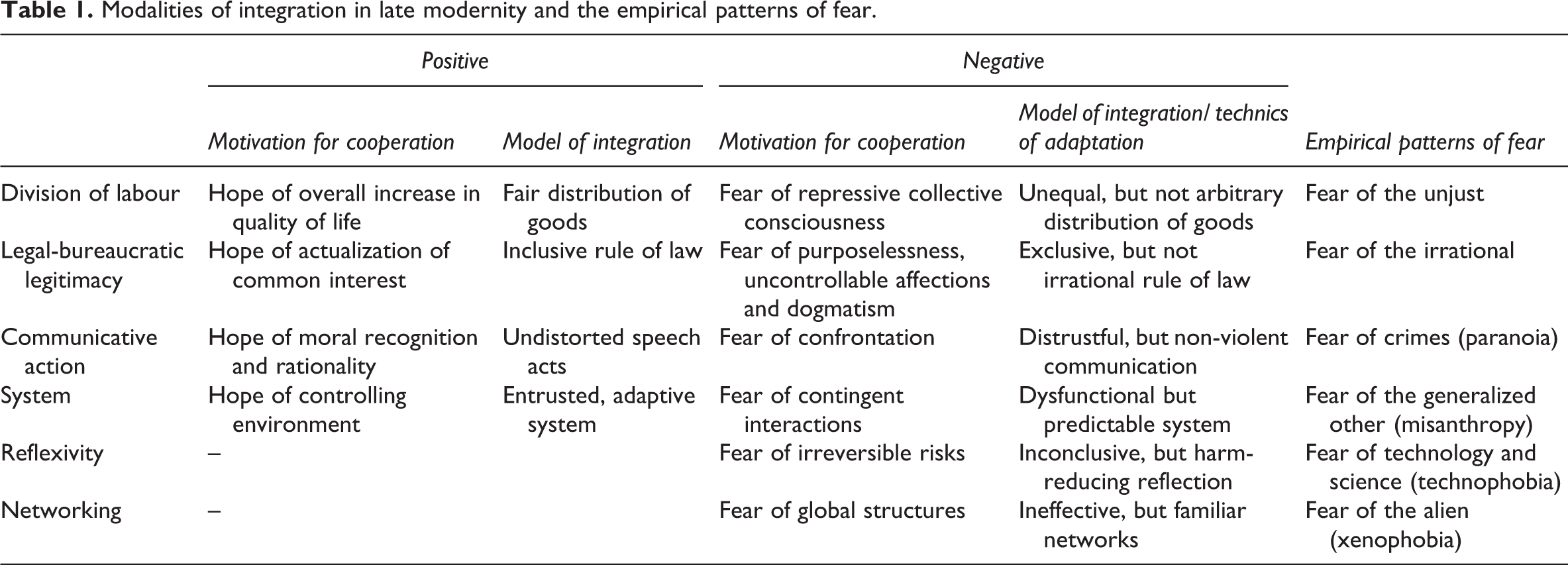
After describing the specificities of late modern motivation for cooperation of each integration mechanisms (Table 1), an attempt is made to summarize some theoretical conclusions. Overall, late modernity is characterized by the coexistence of mechanisms of integration maintained solely by fears of pre-modern dangers and techniques of adaptation based on fears of the negative consequences of these very same emptied mechanisms. In this sense, the dynamics of late modernity depend on the equilibrium of these various fears. If the fears belonging to the former group become predominant, then pre-modern mechanisms of integration are kept at bay, while modern ones are maintained with the ambivalent support of late modern techniques. If the fears belonging to the latter group become predominant, then the dissolution of modern mechanisms of integration is the result, which also implies the potential return of pre-modern patterns (as the forces keeping them away disappear).
Modalities of integration in late modernity and the empirical patterns of fear.
In this sense, two fundamentally different ideal-typical scenarios of late modernity can be outlined. The first is characterized by the coexistence of the emptied forms of integration based on rationality and techniques of adaptation to disintegration – that is, the normalization of negative integration. The second is defined by the expansion of techniques of adaptation completely replacing discredited mechanisms of integration and the latent re-emerging patterns of pre-modernity – that is, the regressive culmination of negative integration. Like any ideal-types, these scenarios should not be considered as general descriptions of the empirical tendencies, instead should be considered tools of understanding particular constellations. In the final section, empirical analyses of the contemporary ‘culture of fear’ are reinterpreted in order to elaborate on some of the actual consequences of negative integration.
Negative integration and the contemporary patterns of fear
If fear is on the rise not because the world has become a more dangerous place or because society is disintegrating (Elchardus et al., 2008), then the contemporary expansion of fear can be explained as due to a new susceptibility originating from structural transformation. Fear does not increase in general, only in those constellations, where the experiences of negative integration imply it. Empirical research on the social construction of fear helps to refine these theoretical conclusions: the substantive analyses of the culture of fear are linked to the various patterns of negative motivation for cooperation. Such a synthesis provides a comprehensive understanding of how the susceptibility originating from the transformation of integration is exploited by the mechanisms that are responsible for producing and spreading fear.
The first analyses of the social construction of fear were centred around moral panic (Cohen, 1972; Young, 1971). This phenomenon was understood as an extraordinary outburst of fear, generated by the media. These studies described a classical modern way of constructing fear: the frightening phenomena were considered to be exceptional deviances, requiring an immediate political response. However, the constellation slowly changed, as the exceptionality of moral panics was replaced by the ordinariness of news about threats, catastrophes, tragedies and dangers covered daily by the media. The popularity of frequent and dramatized media representations of dreadful events can be partly explained by their ability to attract attention, thus if the public are busy focusing on extraordinary threats beyond their responsibility, they are relieved of the duty of dealing with their own pragmatic and existential problems (Glassner, 1999). The general demand for fearful reports directing the attention away from personal issues is further intensified as late modern subject faces an extremely wide horizon of possibilities (Bude, 2017).
Such fundamental tendencies are further aggravated, as the construction of fear becomes detached from personal experiences. As scientific discourses identify more and more imperceptible threats, the actors’ relation to the world transforms. The perception of the environment, of ourselves and the others is based more and more on the semantics of danger implying the pragmatic and moral duty of vigilance. On the one hand, this results in a sense of general distrust, that is fear of the other in general. It concerns not only the members of the outgroup, but the members of the ingroup as well, who are considered to be irresponsible bystanders, potentially dangerous perpetrators or latent abusers. As danger becomes the framework of relating to the other, an alienated, misanthropic perspective is normalized (Furedi, 2006), which reduces the potential forms of interaction to mere harm reduction or potentially violent pre-emptive measures (Collins, 2008). On the other hand, generalized fears also concern the products of technology considered to be potentially damaging to health. Any basic goods that are industrially processed, such as food, now becomes the subject of continuous suspicion, which could result in technophobia (Fabiansson and Fabiansson, 2016; Ferrari, 2009).
As well as scientific discourses of environmental and social dangers, the semantics of fear may also be born out of pure strategic interests. Discourses of crime function as a means of ‘governmentality’ in the Foucauldian sense. By identifying social problems as crimes, the logic of surveillance and punishment is set in motion. Through the discourse of crime, more and more areas of everyday life (such as the family or school) become the subject of governance, resulting in preventive measures limiting the freedom of the actors. As a consequence, not only the willingness to give up democratic institutions in exchange for security grows, but also a paranoid attitude emerges (Simon, 2007). By pointing to internal (e.g. criminals) and external (e.g. terrorists) enemies, the semantics of war fulfil the purpose of pacifying class conflict as the frustrations of the deprived classes are translated into hatred against deviants or foreigners. As well as the media representations, the actual countermeasures including quarantines (e.g. prisons, refugee camps, the ghetto) and violence (e.g. torture, the death penalty) also contribute to the reproduction of fear (Skoll, 2010). Stereotypes such as the ‘flow of immigrants’ fuel xenophobic fears, which result not only in hostility towards foreigners, but also in the undermining of solidarity in general. By inducing recognition struggles for worthy victimhood, instead of advocating collective interest, they legitimize the weakening of welfare institutions (Linke and Smith, 2009). The cornerstones of the increase in xenophobic fears are the collective traumas caused by the acts of terror. The intensive media coverage of these acts leads to a chain of events, including not only the aggravation of fear, but also the advocacy of securitizing political answers (e.g. increased surveillance), which contributes to a further escalation of fear (Altheide, 2006).
Obviously, the above overview of empirical analyses of the social construction of fear is far from complete. However, it covers the most significant topics appearing in the public sphere and the connections between individuals and various institutional actors. This provides an opportunity to expand the previous theoretical conclusions: in order to understand more precisely how the negative modality of the various integration mechanism work, an attempt is made to link them to empirical patterns of fear (see Table 1). No empirical signs of the existence of fear appear, which emerges as a consequence of the negative modality of the legal-bureaucratic legitimacy or division of labour. Neither fear of injustice, nor of irrationality seem to be widespread in late modernity. Unlike them, fears originating from the negative modality of communicative action and systems are manifest in the form of paranoid fear of crime and the misanthropic fear of the other. Communication is initiated solely because the fear of confrontation refers to the totalization of a binary distinction dividing the people into the groups of aggressors and victims. This lifeworld is strengthened by media coverage and social policies centred around crime, implying the other is suspicious and the self as a potential victim. Systems relying solely on refraining from uncertain and contingent linguistic interactions express a distrust in the competence of others and a disbelief in the possibility of consensus. This phenomenological pattern leads to the turning away from those others considered to be inefficient. Such a perception resonates with the media discourses on universal corruption, resulting in a misanthropic experience of negative system integration.
Experiences originating from the negative modality of reflexivity and networks may be linked to technophobic attitudes towards artificial products and xenophobic hostility towards anything alien. Reflexivity limited to harm reduction leads to a one-sidedly worrying perception of science and technology. As a discredited image is generated in the intermeshing expert and esoteric public discourses, such ambiguity is further increased, expressing how the negative modality of reflection might manifest itself in actual patterns of fear. Networks solely constituted as reactions to the constraints of economic and cultural globalization lead to a biased understanding of anything external. The alien is viewed as oppressive or simply threatening, while the potential of learning from the other remains in a blind spot. Media coverage of the mostly dangerous (e.g. terror) or displeasing (e.g. cultural differences) impacts of the other generate xenophobic worries, which are capable of filling the abstract experience of negative modalities of networks with substantive images.
Even if these empirical patterns of fear are just a few among many other potential manifestations of the negative motivation for cooperation, they help us visualize how the phenomenology of negative integration can be used to explain the contemporary expansion of fear. Actual patterns of fear need to be understood from the perspective of the transforming modality of integration mechanisms, as they express the fundamental social dynamics creating susceptibility to fear. Also, through a detailed conceptualization of these mechanisms, the empirical sociology of fear may find useful guidelines. It may be argued that the expansion of fear is not a general cultural transformation caused by the dissolution of social ties or the bias of the press, which is a common misconception of many empirical researchers (Tudor, 2003: 245). Instead, its various substantive forms expand in constellations constituted of different integration mechanisms, but simultaneously characterized by the predominance of the negative motivation for cooperation. In this sense, if fear is on the rise, that is because more and more actors are socialized in constellations characterized by negative integration. By continuously reminding the actors of their own limitations (risks) and providing only halfway measures (networks), these spheres of action prevent identification and the comfort of an evident lifeworld – instead, they only enable the individual to inhabit an inherently ambivalent, inhospitable world.
Finally, one last question needs to be answered concerning the diagnosis of our times. Based on the empirical overview, it may be argued that the most widespread patterns of fear are those which can be linked to the negative modalities of communicative action, system, reflexivity and network, while the negative modalities of legal-bureaucratic legitimacy and division of labour seem to lose their importance. This means that some of the most important fears of the distortions of pre-modernity (i.e. the dangers of authoritarianism and irrationality) are losing their relevance, while fears of the classical modern mechanisms of integration become predominant. Thus, the current constellation is characterized by the further dissolution of the partially already discredited classical modern mechanisms and the susceptibility to the resurgence of pre-modern patterns. In sum, contemporary societies are between what has been called a normalizing and regressive ideal-type of negative integration, but certainly now is closer to the latter than the former.
Footnotes
Declaration of conflicting interests
The author declared no potential conflicts of interest with respect to the research, authorship, and/or publication of this article.
Ethical statement
The paper entitled ‘Towards a social theory of fear – a phenomenology of negative integration’ is (a) my original work and has not been published in whole or in part elsewhere and, (b) is not simultaneously being considered for publication elsewhere.
Funding
The author disclosed receipt of the following financial supportfor the research, authorship, and/or publication of this article: The research was supported by the National Research, Development and Innovation Office (Agreement Number: FK 129138).
