



Abstract
It is widely acknowledged that perceptions of the future play an important role in shaping social outcomes. Imaginaries of how the future might unfold influence expectations, help coordinate social interactions and, consequently, impact the allocation of resources. While alternative and formative visions of society, creating collective expectations of the future, played an important role in social development over the past two centuries, many observers today note a widespread decline in future-oriented thinking, especially in countries of the global north—what some describe as a “loss of the future.” This article explores why inclusive social visions are so much less salient today compared to earlier times. In contrast to those who argue that stories of the future must simply be told more convincingly, this article highlights the fading of important social capacities for sustaining integrative collective visions.
Introduction
Perceptions of the future play a central role in shaping social outcomes. Expectations about how the future might unfold influence decisions, coordinate social interactions and guide the allocation of resources. This insight has gained increasing attention across the social sciences (Beckert & Suckert, 2021; Suckert, 2022). 1 Expectations about the future do not only concern concrete events in the near term. They also take the form of broader collective imaginaries, shared visions of how society might develop, and what kinds of social order are desirable.
Historically, modern societies have been organized around such imaginaries of the future. Competing visions of progress—most prominently liberal and socialist—provided normative yardsticks for evaluating present conditions, offered orientation for political action, and helped coordinate collective efforts toward long-term goals (Habermas, 1986; Herrmann-Pillath, 2024; Jameson, 2004). Although such visions differed in their understanding of freedom, equality, and the role of markets or the state, they shared an important characteristic: they depicted social development as a positive-sum trajectory from which society as a whole could ultimately benefit. Such collective imaginaries stabilized social and political orders by generating what has been described as promissory legitimacy: the belief that an envisioned future state of the world is desirable and can plausibly be achieved by the measures taken (Beckert, 2020). Formative visions of society support confidence that current grievances will be alleviated in the future (Hirschman & Rothschild, 1973; White, 2024). Thus, “the expectation of large, if unrealistic, benefits obviously serves to facilitate certain social decisions” (Hirschman, 1977, p. 131).
Today, however, many observers diagnose a profound transformation in how the future is imagined. Instead of competing visions of collective progress, contemporary societies in the Global North appear increasingly characterized by doubt, uncertainty, and dystopian imaginaries of the future. 2 Surveys indicate widespread pessimism regarding the environment, growing doubts about democracy's capacity to address current crises, and the expectation among a majority of young people that they will be economically worse off than their parents (Mulgan, 2022, p. 13f; Sendroiu, 2023). 3 While dystopian scenarios and technological salvation narratives proliferate, integrative visions capable of mobilizing broad social support appear strikingly marginalized. Commentators speak of a “loss of the future” (Mulgan, 2022) or an “imaginary crisis,” pointing to a condition in which support for broader collective visions appears difficult to mobilize (Fisher, 2009; Zielonka, 2023). 4
How can this change be explained? A common response is to argue that societies lack compelling narratives about the future, and that the solution lies in articulating more persuasive, emotionally engaging, or optimistic visions (Hajer & Oomen, 2025; Hopkins, 2019). This article challenges that view. It argues that the contemporary “loss of the future” is not primarily reflecting a failure of imagination, but a transformation in the social conditions under which societies can relate to the future as a project.
To capture this condition, the article introduces the concept of futural anomie: a situation in which societies lose the institutional, social, and epistemic capacities required to sustain widely shared visions of collective progress. Under the conditions of futural anomie, imaginaries of the future do not disappear. Rather, they become fragmented and lose their ability to coordinate expectations and generate promissory legitimacy. By linking the decline of integrative future imaginaries to transformations in social organization, the article contributes to sociological debates on temporality, political legitimacy, and the role of collective imagination.
The argument proceeds in four steps. First, I briefly examine the historical role of collective future imaginaries and the conditions under which they acquired their organizing force. Second, I introduce a life-cycle model that depicts how the promissory legitimacy of such imaginaries tends to erode over time as their promises fail to materialize. Third, I identify six structural transformations that undermine the emergence of new integrative imaginaries today: pervasive insecurity, the decline of associational relationships, the rise of technocratic governance, the individualization of social aspirations alongside the erosion of public goods, demographic aging, and the fragmentation of the public sphere. These developments jointly weaken the motivational, organizational, political, material, and epistemic conditions necessary for sustaining images of societal futures. Finally, I analyze the kinds of future imaginaries that emerge under these conditions, what I call anomic futures, and consider their implications for contemporary politics.
The Integrative Force of Imagined Futures
The emergence of secular counterfactual images of a “better” future is closely associated with cultural shifts in the temporal order of modern societies and the newly presumed role of human actors in shaping social relations. To understand their current exhaustion, we must first identify the conditions under which integrative future imaginaries historically acquired their organizing force.
Following Koselleck (2004), in the period of early modernity, European societies moved from a cyclical understanding of time, where the future was largely seen as a repetition of what was known from the past, to a linear understanding of time, where the future appears to actors as open and formable. 5 This implies that for actors, the “horizon of experience” and the “horizon of expectations” became separated; it became conceivable to imagine the future as being radically different from what past experiences would tell and to see such change not as the work of divine forces, but as the outcome of human action. Because experience could not be the sole guide anymore, a cultural space was opened for the emergence of new markers for the orientation of action. Alternative visions of how social order could look filled this space. 6
From the Enlightenment onward, such imaginaries became a powerful political and economic force. Often embedded in philosophies of history, the idea of progress offered a general orientation toward a future that promised inclusive social advancement (Bronk, 1998; Delanty, 2024; Wagner, 2015). In concrete terms, the idea of progress became formulated most powerfully in the political programs of liberalism and socialism. 7 Despite their differences, both liberal and socialist imaginaries shared a crucial structural feature: they projected the future as an inclusive, positive-sum trajectory that would ultimately benefit all members of society. 8
These integrative aspirations, however, do not imply that they were shared by everyone: Conservatives were deeply suspicious of liberal and socialist ideas of progress (Hirschman, 1991). Liberals saw socialist ideals as destroying individual freedom (Hayek, 1944), and socialists saw the expansion of market freedom proposed by liberals as producing class relations that repressed the economic advancement of the majority of the population (Marx, [1867] 1977). 9 Despite such contestation, which is to be expected, given the respective distributional and ideological implications, the imaginaries each propelled an idea of progress in which all members of society were included. This created a powerful force supporting the coordination of the efforts of actors across social and geographic domains. By projecting a future in which current grievances would be alleviated, they motivated actors to commit to long-term projects under conditions of uncertainty.
The Contestation of Promissory Legitimacy
Promissory legitimacy, however, is not stable. First of all, it depends on the belief that present commitments will be redeemed through future improvement. This belief is inherently fragile. It requires actors to make commitments in the present, while the realization of promised outcomes lies in an indeterminate future. Promissory legitimacy thus depends on a leap of faith that current commitments and sacrifices will indeed be rewarded later on. Several mechanisms have been identified that help sustain such commitments. Albert Hirschman (1967) describes how actors embark on ambitious projects without fully anticipating the challenges involved, a process he termed the “hiding hand.” Overconfidence can generate commitment and mobilization. Similarly, the “tunnel effect” (Hirschman & Rothschild, 1973) explains how actors maintain support for collective projects when they observe others advancing, as long as they are expecting that their own advancement will follow. In addition, appeals to philosophies of history can reinforce belief by presenting desired outcomes as historically inevitable (Soer, 2024). These mechanisms, often supported by charismatic leadership, help stabilize expectations in the absence of immediate confirmation.
Over the long run, however, promissory legitimacy cannot be sustained without experiential confirmation from positive outcomes (see Figure 1). Imaginaries lose credibility when the expectations they generate are persistently contradicted by experience. This occurs both through “intended but unrealized effects” (Hirschman, 1977, p. 131), when promised improvements fail to materialize, and through “unintended effects,” when the negative consequences of social change are perceived as outweighing anticipated benefits. 10 As promises fail to materialize or are accompanied by undesirable effects, their capacity to sustain belief in a shared future weakens. This can be observed historically: The promissory legitimacy of liberalism became challenged in the nineteenth century when equal rights went hand in hand with intolerable social inequality. The societal crisis emerging from this gave a pathway to the dominance of two other imaginaries: Fascism as a regressive and exclusionary ideology and socialist or social democratic futures (Polanyi, [1944] 1957). In countries that turned communist after World War II, the credibility of the promises of socialism was brought into doubt when economic performance could not keep up with capitalist economies, when power was concentrated in a privileged party elite, and when suppression was exercised not just on the small group of capitalists, but on large parts of the population. 11 In Western countries, the social democratic vision of combining market freedom with state planning to correct social inequalities within a democratic political order gained the upper hand, but likewise lost its evocative appeal when growth rates declined, inflation soared, and individual freedom was seen as being threatened by an ever-enlarging administrative state (Bell, 1978; Habermas, 1975; Murray, 1984; Offe, 1984).
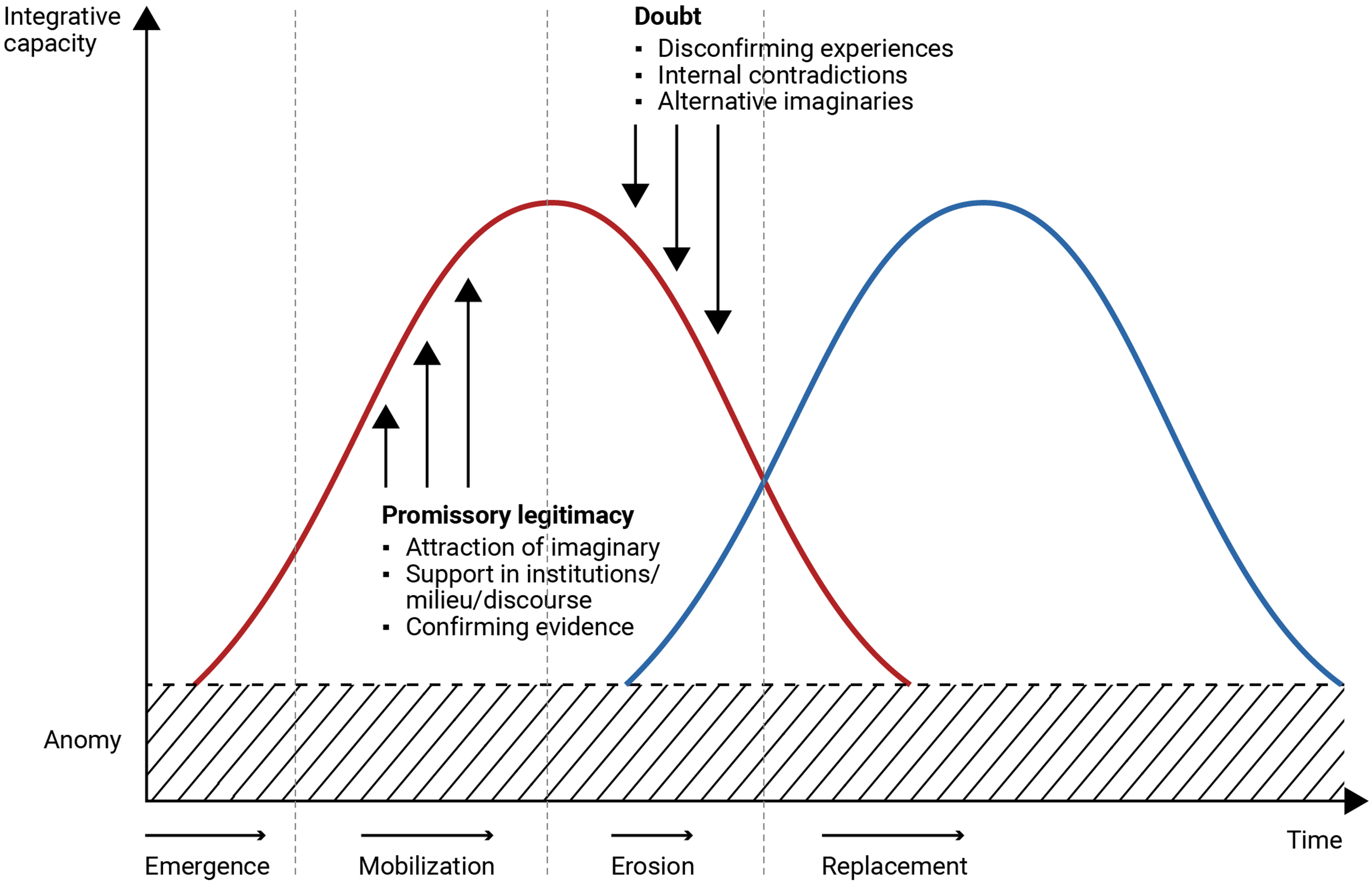
A life-cycle model of future imaginaries.
Liberalism, socialism, and later social democracy each experienced such cycles of mobilization and disillusionment (Bell, 1978; Fourcade-Gourinchas & Babb, 2002; Habermas, 1975; Hall, 1993; Streeck, 2014). The recent erosion of neoliberalism's promissory legitimacy (Beckert, 2020) can also be understood along these lines. Significant parts of the population in developed economies have experienced little or no upward social mobility for decades, and within-country inequality has increased sharply (Milanović, 2016). Reforms justified in terms of collective advancement through market liberalization have exposed many citizens to socioeconomic insecurity and disruption (Hochschild, 2016, 2024) without bringing them the promised benefits. These developments are compounded by the ecological crisis, which calls into question the very idea of progress as improvement. 12
Historically, the erosion of one dominant imaginary was typically followed by the emergence of another imaginary capable of restoring promissory legitimacy. Integrative imaginaries thus followed a recurrent dynamic of mobilization and erosion, in which hope was repeatedly reattached to new institutional and ideological configurations (see Figure 1). 13
What distinguishes the present conjuncture is that this regenerative mechanism appears to have stalled. The current exhaustion of imaginaries has not been followed by the emergence of new, socially inclusive visions capable of commanding broad support. New emancipatory visions of diversity or ideas of a Green New Deal failed as integrative imaginaries. 14 As several commentators observe, the belief in the possibility of a socially inclusive, economically advancing, and environmentally intact future has faded per se (Fisher, 2009; Jameson, 2005; Unger, 2024). 15 Contemporary societies thus seem to exhibit a more fundamental breakdown in their capacity to sustain integrative imaginaries. What has been developing is a condition in which societies seem to have lost the institutional and social capacities required to sustain credible and widely shared visions of collective progress. I describe this as futural anomie.
Changing Social Contexts
A widespread response to the declining authority of inclusive future imaginaries is the call for producing new collective visions that could once again capture the public imagination and give direction to politics (Hajer & Oomen, 2025; Mulgan, 2022). A related argument emphasizes the need to communicate such imaginaries more effectively: stories should be more compelling, emotionally engaging, and optimistic in order to generate confidence (Hopkins, 2019). In contrast to such assertions, I argue that the challenge is not simply a lack of persuasive narratives, but the erosion of the social conditions under which such narratives can generate and sustain belief. Six such changes stand out.
Pervasive Insecurity
The first development is the multiplication and intensification of systemic crises, which has produced a widespread and deeply internalized sense of insecurity (Tooze, 2022). Rising social precariousness and inequality, accelerating climate disruption, technological upheavals, geopolitical instability, and perceived cultural threats have converged into what Ulrich Beck (1992) famously described as a “risk society.” Individuals and institutions are increasingly preoccupied with managing risks that are difficult to predict or control. While earlier periods were also marked by crises, what distinguishes the present conjuncture is the generalization of insecurity as a dominant mode of relating to the future. As a consequence, the future is increasingly not seen as a space of possibility, but of threat and uncertainty (Hartog, 2015).
This shift has important consequences for the capacity to sustain collective imaginaries. Integrative visions of the future depend on actors’ willingness to make present commitments based on expectations of long-term improvement. Such commitments require a minimum degree of confidence that the future is both open and transformable through collective action. Pervasive insecurity undermines this confidence. When the future is perceived primarily as a source of risk, actors adopt defensive orientations, prioritizing short-term stabilization over long-term transformation. As Pierre Bourdieu (1977, [1972] 1977) observed, precarious living conditions reduce the capacity to project oneself into the future and to engage in long-term planning. Actors become preoccupied with coping strategies aimed at managing immediate pressures, rather than participating in projects oriented toward collective advancement. The narrowing of temporal perspectives weakens the motivational basis for engaging in political projects whose benefits lie in an uncertain future.
At the same time, insecurity contributes to the privatization of future orientations. Faced with systemic risks that appear beyond collective control, individuals increasingly retreat into the sphere of the family or individual life projects. As Appadurai (2017) notes, experiences of marginalization and being “left behind” foster defensive and exclusionary orientations, displacing broader societal aspirations. Similarly, Bauman's (2000) notion of “liquid modernity” captures how the erosion of stable social frameworks like the nation-state, welfare-state protections, or long-term work relations undermines confidence in long-term planning and collective coordination. It emerges a public discourse that “departs from progressive, evolutionary accounts and instead offers a dystopian account of regression” (Savage, 2021, p. 16). The future is framed as a terrain of threats to be managed or avoided.
Crucially, however, insecurity alone cannot explain the current absence of integrative future imaginaries. Historical evidence shows that transformative visions have often emerged under conditions of crisis and hardship (Tarrow, 2011). In principle, periods of instability can generate new forms of collective imagination and mobilization. But why does contemporary insecurity not lead to the emergence of new integrative imaginaries? To answer this question, one needs to focus on the social infrastructures that historically enabled such imaginaries to form and diffuse.
Changing Structural Contexts
Collective visions of the future are produced and stabilized through political practices embedded in institutional rules, cultural beliefs, and social structures (Altstaedt, 2024). In recent decades, these enabling conditions have undergone profound transformations, a development that can be grouped into five interrelated changes: (1) the decline of associative social relationships, (2) the growing dominance of technocratic and managerial approaches to politics, (3) ongoing individualization accompanied by the erosion of public goods, (4) demographic aging, and (5) the progressive decay of the public sphere.
(1) Associative relationships play an essential role in the emergence and stabilization of integrative future imaginaries. Historically, social environments in which shared interpretations of the world and its possible futures are continuously produced, challenged, and reinforced, were provided by dense networks of associations, including political parties, trade unions, religious communities, and civic organizations (Eley, 2002; Hobsbawm, 1994; Mann, 2012; White, 2024, p. 55). These organizations constituted a social infrastructure that enabled collective imaginaries to move from abstract ideas to socially embedded pathways.
Associational structures perform at least three interrelated functions in this process. First, they provide cognitive orientation. Within organizational contexts, interpretations of social reality and projections of desirable futures are debated and diffused. Leadership structures and internal communication channels help stabilize shared frames of reference, allowing dispersed actors to align their expectations and understand their situation in common terms (Polletta, 2002; Snow & Benford, 1988). Second, associations generate emotional commitment. Collective practices such as meetings, strikes, demonstrations, and party conventions foster what Durkheim ([1912] 1965) described as collective effervescence. 16 Experiences of copresence strengthen affective attachments to shared goals and reinforce belief in the plausibility of envisioned futures, even in the absence of immediate success. In this way, organizations transform abstract projections into emotionally compelling commitments (Fantasia, 1988; Goodwin et al., 2001). 17 Third, associational structures create political capacity. By embedding individuals in networks of obligations and expectations, they help solve collective action problems through the creation of “supportive contexts” (Offe, 1989, p. 741), which sustain cooperation over time. This is in addition to institutional rules. Legal protections, welfare arrangements, and democratic procedures lend credibility to collective expectations by stabilizing the conditions under which future-oriented commitments can be realized (White, 2024). Institutions thus anchor imaginaries in durable structures that extend beyond immediate interaction.
Contemporary societies experienced a profound erosion of hitherto established associational infrastructures. Membership in political parties, trade unions, religious communities, and civic organizations has declined significantly (Putnam, 2000). As a result, individuals are increasingly disembedded from the social contexts that historically enabled the formation and stabilization of shared future orientations.
This erosion has direct consequences for the viability of integrative imaginaries. In fragmented social environments, beliefs about the future may emerge rapidly, often amplified through digital communication, but they tend to remain unstable and short-lived. Contemporary mobilizations, often organized through digital platforms, can generate episodic bursts of participation but rarely develop into enduring structures capable of carrying forward a coherent vision of societal transformation (Amenta & Polletta, 2019). Without durable organizational embedding, such imaginaries lack the political capacity necessary to sustain long-term collective projects. Following Dewey ([1927] 1957), a public capable of deliberate political action emerges only when individuals are linked through stable associations that enable communication and sustained engagement. Where such linkages are absent, individuals remain isolated and unable to transform diffuse concerns into collective will.
The decline of associative relationships thus undermines a central condition for promissory legitimacy: the social embedding of belief. Without the organizational and relational infrastructures that stabilize expectations, integrative future imaginaries struggle to emerge, and even more so to persist. This suggests that the crisis of the future is not primarily a crisis of imagination, but a crisis of social organization.
(2) A second major transformation undermining the emergence of integrative future imaginaries is the rise of technocratic governance. Since the mid-twentieth century, political decision-making has increasingly been framed as a matter of expertise, calculation, and efficient management rather than collective will-formation (Innes, 2023; White, 2024). In the emerging context, politics has been understood as an expert affair, reliant on probabilistic reasoning and technocratic “future-making” tools. This shift was already evident in postwar social planning efforts (Streeck, 2015), later adopted by conservative think tanks through instruments like scenario planning (Andersson, 2018; Soer, 2024), and further institutionalized through the technocratic rationalities of neoliberal governance and New Public Management (LeGalès & Scott, 2008).
This transformation entails a fundamental shift in how the future is understood. Rather than being conceived as an open field of political possibilities, the future is treated as an object of prediction and constraint. Technocracy replaces open political debate with “single-exit solutions” (Latsis, 1972), closing off the deliberation of alternative paths and rendering collective political imagination redundant. As Appadurai (2013, p. vii) has argued, this marks a shift from “the future as a realm of possibilities” to “the future as a realm of probabilities.” In consequence, the political space for vibrant debates between competing ethical goals and sociopolitical visions suffocates.
This epistemic shift has direct political consequences. When political choices are presented as matters of technical necessity, the space for contestation over alternative futures is narrowed. Policy debates become oriented toward optimizing given constraints rather than questioning underlying goals or imagining different trajectories. The technocratic credo that “there is no alternative” (TINA) transforms political disagreement into a problem of incorrect understanding rather than legitimate divergence over collective aims. As a result, the future becomes depoliticized.
This dynamic is also reinforced by the institutional expansion of judicial authority. Decisions that were previously subject to political contestation are increasingly delegated to regulatory agencies and courts (Hirschl, 2004; Manow, 2020). Political debate becomes hollowed out when unelected experts or courts make key decisions, leading to a widespread sense of powerlessness among those excluded from shaping the future. The capacity to imagine alternative social orders is weakened, not because imagination disappears, but because alternative visions lose plausibility within a framework that defines them prima facie as unrealistic or infeasible.
The consequences extend beyond the narrowing of political debate. Technocratic governance also undermines the affective and motivational dimensions of collective imaginaries. As mentioned before, integrative visions of the future rely not only on plausibility and reason but also on the emotional investment generated through participation in collective projects. When politics is reduced to technical administration, it loses its capacity to mobilize such engagement. What Hannah Arendt (1958) termed the “fact of natality,” that is, the generative potential of political action, is replaced by adaptive responses to projected constraints. This deprives societies of what she considered central to democracy.
Paradoxically, the expansion of technocratic governance contributes to its own destabilization. By presenting political outcomes as inevitable, it generates a sense of exclusion and powerlessness. This is a fertile ground for resentment toward elites and institutions perceived as exercising power without accountability. As Offe (1989, p. 765) observed, institutional legitimacy rests not only on procedural stability but also on the public's trust that the future remains open to collective deliberation and agency.
Thus, technocratic governance generates a context in which populism emerges as a reactive force that seeks to reassert the existence of alternatives and reopen political space (Manow, 2020). Populist movements derive their appeal from the promise to restore the voice of those who feel dominated by expert- or court-led governance. Their resonance is anchored in the promise of a reactivation of “the political” as a domain of contestation and possibility. This promises to once more open up the future, but is often anchored in exclusionary or regressive imaginaries that do not restore integrative visions of collective progress.
In sum, the rise of technocratic governance transforms both the epistemic and political status of the future. By framing it as a domain of necessity rather than possibility, it undermines the conditions under which integrative future imaginaries can emerge, gain credibility, and mobilize collective action. Under technocratic conditions, the problem is not primarily that alternatives cannot be imagined, but that actors cease to perceive alternatives as politically viable.
(3) A third development undermining the emergence of integrative future imaginaries is the intertwined process of individualization and the erosion of collective material capacities. Integrative imaginaries presuppose that individuals perceive their futures as interconnected and that the realization of collective goals is supported by shared institutional and material resources. Both conditions have been significantly weakened in recent decades.
At the cultural level, processes of individualization have transformed how futures are imagined. As documented by the World Values Survey, there has been a broad shift from collectivist orientations toward values centered on individual self-expression and personal fulfillment (Inglehart & Welzel, 2005). Under these conditions, the future is increasingly conceived not as a shared societal project but as a domain of individual life-planning, focusing on careers, consumption, self-optimization, and the protection of private wealth (Davies, 2020; Han, 2022; White, 2024, p. 130). When individuals no longer perceive their destinies as interdependent, the motivational basis for integrative collective visions is weakened. This implies that integrative future imaginaries find it increasingly difficult to achieve promissory legitimacy; societies lack orientation toward collective welfare.
Relatedly, the individualization of the future is also a consequence of what might be described as the commodification of utopia. Visions of alternative futures, when they emerge, are frequently absorbed into market logics and reconfigured as opportunities for individual profit (Boltanski & Chiapello, 2005). The trajectory of the digital economy provides a telling example. In its early days, the internet, and later social media, were widely perceived as technologies capable of broadening democratic participation, while the nascent platform economy appeared to provide the tools for collective resource sharing. As Schor and Vallas (2021, p. 371) note, the sharing economy was “launched with a utopian discourse promising economic, social, and environmental benefits.” Yet these utopias were quickly subsumed under capitalist imperatives to the benefit of a few dominant firms, thereby losing their integrative potential.
At the same time, the material foundations for collective futures have eroded (Davies, 2020, p. 18; Slater, 2024, p. 41). The state increasingly withdrew from investing in public infrastructures, be it in education, housing, health care, or transportation, and thus removed crucial material conditions for enacting collective progress. Public infrastructures themselves embody promises of the future because of the opportunities they make possible and because of the collective future aspirations they symbolize, something that can easily be seen for instance in infrastructures of transportation or education (Appel et al., 2018). With the hollowing out of these shared resources, the political imagination shrinks: in a world where wealth is increasingly private, societies lack the material conditions to enact large-scale projects of social advancement based on the shared wealth of public goods.
A striking example of this logic is the privatization of space exploration. During the Cold War, the future imaginary associated with NASA's space program was framed as a “giant leap for mankind,” a vision of human advancement on behalf of an imagined global community. In contrast, today's privately led space ventures present space not as a frontier for humanity, but as a luxury escape route for the wealthy elite with significant profit opportunities. Companies market space tourism and off-world colonization, which are not public missions but services for those rich enough to contemplate the idea of fleeing the Earth's coming ecological and social catastrophes. This symbolic shift from public exploration to private entertainment, enrichment, and exit encapsulates the broader transformation of future imaginaries. 18
This dynamic is further intensified by rising levels of public and private debt (Streeck, 2014). In 2023, global public debt amounted to about 94% of the world's annual economic output, leaving most states unable to pursue ambitious reforms without risking sanctions from global financial markets (International Monetary Fund, 2024). Large-scale projects such as the transition to sustainable energy systems, the expansion of education and healthcare, or comprehensive urban housing programs could all form a material infrastructure supporting integrative, future-oriented visions. In fact they are halted by the fiscal constraints of highly indebted states. With considerable variation across countries, private households likewise bear heavy debt burdens (Crouch, 2011). When people's prospects are curtailed by financial obligations already incurred, their outlook narrows: instead of imagining the future as an open and malleable space, states and citizens rely on short-term coping strategies to manage immediate pressures.
Taken together, these developments lead to a privatization of the future where futures are imagined in terms of private advancement, “against the backdrop of public destruction” (Davies, 2020, p. 20). This fragmentation undermines the plausibility of integrative imaginaries, which depend on the belief that social progress can be collectively achieved and broadly shared. A society that organizes its resources privately can only imagine its future privately.
(4) A fourth structural transformation concerns demographic aging. Modern societies have historically been sustained by an implicit orientation toward future generations. Political institutions, welfare arrangements, educational systems, and public infrastructures were justified not only by their present utility but also by the expectation that they would improve the lives of those who came after us. This orientation presupposes a demographic structure in which younger generations constitute a substantial share of the population and exercise power through voting and public visibility.
Today, however, many societies are experiencing historically unprecedented demographic change. Fertility rates have fallen far below replacement levels, while life expectancy continues to increase (André et al., 2024). As a result, the age structure of society is shifting decisively toward older cohorts (Willetts, 2010). This transformation has profound political and cultural consequences. Welfare states increasingly devote a growing share of their resources to pensions, and long-term care for the elderly, while investments in education, housing, childcare, sustainability, and other future-oriented public goods come under pressure.
This demographic shift may also affect how societies imagine the future. Aging societies increasingly orient themselves toward the protection of accumulated achievements rather than the creation of new futures. Demographic aging can alter the symbolic balance between future and present. When fewer children are born and the social and political visibility of younger generations declines, the future risks and opportunities become less salient as a collective concern. Political conflicts increasingly revolve around the distribution of existing resources rather than the creation of new possibilities (Vanhuysse & Goerres, 2012). The demographic transition thus undermines a key condition for integrative future imaginaries: the presence of a socially and politically salient future generation who would be powerful agents and on whose behalf collective projects can be imagined and justified.
(5) The last transformation undermining the emergence of integrative future imaginaries concerns the fragmentation of the public sphere and the erosion of shared epistemic frameworks. Integrative imaginaries require spaces of communication in which alternative visions of the future can be articulated and collectively evaluated. Such spaces enable processes of mutual learning and coordination through which dispersed perspectives can be aligned into broadly shared orientations.
Historically, these conditions were partially provided by mass-mediated public spheres structured by print and broadcast media. While always contested and imperfect, these environments offered relatively stable frames of reference and common standards of relevance, making it possible for different social groups to engage with competing visions of the future within a shared communicative arena (Habermas, 2023). These environments were indispensable to the Deweyan ideal of public inquiry: they enabled citizens to compare interpretations, scrutinize evidence, and revise preferences in light of common problems. Collective visions need an agreed space within which different visions of the future could be debated under common epistemic and social ground rules.
This epistemic infrastructure has been profoundly transformed with the rise of digital communication technologies and platform-based media. Algorithmically curated information environments create more chaotic communicative spaces. As a result, the public sphere no longer functions as a site of collective orientation, but as a constellation of partially disconnected discursive arenas with no ground rules. The communicative dynamics of digital platforms favor the amplification of emotionally charged and polarizing content. As Bronk and Jacoby (2020, p. 23) note, an “arms race of rhetorical hyperbole” drives attention in these environments. The result is fragmentation and also the intensification of exclusionary imaginaries, which are not part of a shared deliberative space.
This fragmentation has direct consequences for the formation of future imaginaries. Without shared frames of reference, it becomes increasingly difficult to establish common problem definitions, let alone agree on desirable trajectories of social development. Competing visions of the future evolve in parallel, often mutually unintelligible, communicative environments. This stands in stark contrast to narrower communicative arenas where contestation and difference are more closely curated.
Thus, the fragmentation of the public sphere does not eliminate future imaginaries. On the contrary, it facilitates the proliferation of diverse and often highly mobilizing visions. However, these imaginaries remain socially segmented and lack the capacity to generate a broad-based consensus or coordinated collective action. They mobilize within groups but fail to integrate across them.
In this sense, the crisis of the future is a crisis of social contexts for coordination. The erosion of a shared epistemic space prevents the alignment of expectations and the formation of collectively binding visions of the future. Without such alignment, imaginaries cannot become widely shared and collectively actionable. Where there is no shared space of communication, there can be no shared future.
Taken together, these transformations point to a profound reconfiguration of the social foundations on which integrative future imaginaries rely. Pervasive insecurity narrows temporal horizons and weakens actors’ willingness to commit to long-term collective projects. The erosion of associational structures undermines the social embedding through which shared expectations are stabilized and translated into political capacity. The rise of technocratic governance constrains the political space in which alternative futures can be legitimately articulated, recasting the future as a domain of administrative necessity rather than possibility. Demographic aging concentrates power in forces that protect established structures. At the same time, processes of individualization and the erosion of public goods dissolve the cultural and material conditions that sustain a sense of shared destiny, while the fragmentation of the public sphere disrupts the epistemic coordination required to align perspectives across social groups.
These developments are not independent but mutually reinforcing. Together, they weaken the motivational, organizational, political, material, and epistemic conditions necessary for the emergence and persistence of integrative imaginaries. The result is a fundamental transformation in the capacity of societies to produce collectively orienting expectations.
Anomic Futures
The diminishing social capacities for forming integrative futures are, in many ways, an outcome of societies embracing the promises of the neoliberal imaginary. Among the consequences of neoliberalism are not only manifest features such as increasing social inequality, precarity, global dependencies, and an accelerating ecological crisis, but also the erosion of the social fabric from which alternative integrative imaginaries could emerge.
Still, the structural transformations described do not lead to the simple disappearance of future imaginaries. Rather, they give rise to a distinct class of imaginaries shaped by the very conditions that undermine integrative visions. These can be described as anomic futures: imaginaries that emerge in a context where shared norms, institutional trust, and collective capacities have eroded, and which therefore lack the ability to coordinate expectations across society. Such anomic futures mobilize actors, yet they fail to produce broadly shared orientations or collectively binding projects. Instead of integrating diverse social groups around a common horizon, they reflect and reinforce the divisions, uncertainties, and institutional weaknesses of contemporary societies.
Two ideal-typical forms of anomic futures can be distinguished. The first takes the form of dystopian or collapse-oriented imaginaries. These visions portray the future as a space of inevitable breakdown, whether through ecological catastrophe, technological disruption, or social disintegration (Brozović, 2023). Such dystopian imaginaries imply the loss of the future as a malleable space. In their most extreme forms, these imaginaries even contemplate the extinction of the human species and thus provide a radical expression of existential risk (P. Torres, 2016).
Such imaginaries express a future that must be endured rather than constructed. In some cases, these dystopian projections retain a residual political function, when they are intended as “wake-up calls,” motivating collective action to avert catastrophe before it's “too late” (Davidson, 2025). Apocalyptic imaginaries that are envisioned as warnings can remain politically productive. 19
Yet, the images of collapse are often not warnings to protect existing institutions. In many narratives, actual downfall is embraced and reframed as a necessary precondition for renewal: the destruction of the old world becomes the necessary condition for rebirth and the emergence of a purified new order. The logic of purgation implies that constraints of the present must be violently removed to unlock the future. This then justifies radical institutional rupture. However, these imaginaries are often underspecified: while they promise radical transformation, the “new social forms” remain vague with regard to their concrete institutional grounding and the contradictions they entail. Research on populism and on apocalyptic imaginaries shows that this openness allows for social mobilization, as different actors can project their hopes and fears onto an undefined horizon (Laclau, 2005).
Such cathartic futures often frame the destruction of liberal democratic institutions as a path toward restoring an idealized (often homogeneous) social order. In this vision, collapse becomes a gateway to an idealized past with less complex social structures that are culturally homogeneous and founded on exclusion. “Retrotopias” (Bauman, 2017) promise stable communities, strong borders and hierarchies, clear moral orders, and clear-cut identities. The collective future is imagined not as a project with potentially positive outcomes for (almost) everybody, but as a zero-sum or even negative-sum trajectory where ascensions are believed to be possible only at the cost of others’ exclusion or disappearance—be it migrants, religious minorities, or oil companies. In addition, the dystopian imaginaries of breakdown motivate highly individualized reactions of preparedness (Garrett, 2021; Parkkinen, 2021; Rushkoff, 2022). The “prepper movement” shows how futures are imagined as individual survival within a world that has been devastated: actors prepare for collapse by securing personal autonomy, especially by stockpiling resources, acquiring survival skills, and retreating from dependency on public institutions.
The second type of anomic futures centers on technological salvation and escape. In these imaginaries, transformative change is not achieved through collective political action but delegated to technological innovation. Climate change, for example, is framed as solvable through geoengineering rather than social transformation, while longtermist perspectives project futures in which advanced technologies like artificial intelligence, life extension, or space colonization, secure humanity's survival (MacAskill, 2022; Parfit, 1984). 20 These visions displace political agency by treating technological development as the primary driver of progress and by legitimizing present inequalities in the name of future advances.
A particularly striking feature of these imaginaries is their tendency toward privatization. Technological futures are often imagined as accessible only to a select group, whether in the form of space colonization, life-extension technologies, or insulated infrastructures for the wealthy. As a result, the future becomes a differentiated space of individual opportunity rather than a shared horizon of collective advancement.
Despite their differences, both dystopian and techno-utopian imaginaries reflect the broader conditions that were identified: the breakdown of shared symbolic and institutional frameworks through which collective futures can be meaningfully imagined and pursued. They either abandon the idea of collective agency (e.g., collapse imaginaries) or displace it onto nonpolitical mechanisms (e.g., technological salvation).
The diverse imaginaries evolving under current conditions can be brought together under the notion of futural anomie. These are futures born out of the breakdown of collective meaning-making and thus become the temporal expression of social anomie. Where classical utopias once articulated shared horizons of progress and inclusion, anomic futures emerge from a void of moral and institutional orientation. They oscillate between collapse, salvation, despair, and transcendence. Whether dystopian or techno-utopian, these imaginaries reflect a society in which the normative and temporal coordinates that once sustained collective purpose have disintegrated. In this sense, futural anomie is both a symptom and a mirror of contemporary social conditions.
Conclusion
The contemporary assertion of a loss of the future can be understood as a temporal transformation of the classical sociological problem of anomie. For Durkheim ([1893] 1984, [1897] 1997), anomie referred to a breakdown of the moral regulation that would orient individuals toward collectively shared norms. In contemporary societies, this erosion extends into the temporal dimension: what erodes is the shared imagination of the future as an open field of collective possibility. The result is a condition that can be described as futural anomie. Individuals lack stable expectations about social continuity or progress that would support social integration.
The erosion of integrative future imaginaries reflects structural transformations that undermine the social foundations on which such imaginaries depend. Pervasive insecurity narrows temporal horizons, the decline of associational life weakens the social embedding of shared expectations, technocratic governance constrains the space of political possibility, processes of individualization and the erosion of public goods dissolve the material and cultural basis of collective futures, demographic aging undermines the interest in dedicating resources to developing integrative futures, and the fragmentation of the public sphere disrupts the epistemic conditions for their coordination. Taken together, these developments erode the conditions under which promissory legitimacy can be sustained.
Consequently, the future appears foreclosed, generating disorientation and withdrawal. This happens against the backdrop of future-orientation being an essential characteristic of modern societies (Hartog, 2015; Koselleck, 2004) and democratic rule (White, 2024). Future-orientation has made possible the dynamics of social change, where risks are taken with the confidence of reaching an improved state of affairs and where societies can loosen their moral bonds on individuals, because social integration is reached through the action-orienting impulses of imaginaries depicting a better future. If these imaginaries falter, societies are in danger of also losing much of the freedom that has been gained over the past 200 years.
A society that imagines its future only as technological inevitability or as impending collapse loses direction and enters an anomic state. As Fred Polak warned, “the rise and fall of images of the future precedes or accompanies the rise and fall of cultures. (...) Once the image begins to decay and lose its vitality, the culture does not long survive” (Polak, 1973, p. 19). Jürgen Habermas (1986, p. 16) likewise cautioned that when utopian energies dry up, “a desert of banality and helplessness spreads.” These mid-century insights resonate powerfully with contemporary diagnoses of a loss of the future (Mulgan, 2022), capturing a condition in which both normative and temporal coordinates of collective life have subsided. Societies became incapable of generating the collective action required for integrative social transformation.
The implications of this are both analytical and political. Analytically, it suggests that future-oriented expectations must be understood not merely as cultural or cognitive phenomena, but as deeply embedded in social structures and institutional arrangements. The capacity to imagine and sustain shared futures is itself a social achievement. Politically, the argument challenges the widespread assumption that the crisis of the future can be addressed by articulating more compelling narratives. Without the reconstruction of the social infrastructures that enable collective orientation and action, such narratives are unlikely to gain traction.
At the same time, the diagnosis of futural anomie should not be read as a claim of inevitability. The future remains inherently open, and the very uncertainty that characterizes it also creates the possibility for change. However, this openness is not sufficient in itself. What is at stake, therefore, is not simply the recovery of utopian thinking, but the reconstruction of the social foundations that make shared futures conceivable and actionable: the institutions, infrastructures, and forms of association through which societies imagine and shape their collective trajectories. As John Dewey ([1927] 1957, p. 110ff) insisted, democracy is a mode of collective inquiry, an inquiry where people imagine themselves realistically as part of a common world they help to shape.
Footnotes
Acknowledgments
For helpful comments on previous versions of this article, I would like to thank Sören Altstaedt, Richard Bronk, Christoph Deutschmann, Wolfgang Vortkamp, and the anonymous reviewers.

Funding
The author received no financial support for the research, authorship, and/or publication of this article.
Declaration of Conflicting Interests
The author declared no potential conflicts of interest with respect to the research, authorship, and/or publication of this article.