




Abstract
Regulatory networks are increasingly important actors in multi-level systems of human rights governance. Yet we know little about the role that domestic networks play as intermediaries or about the strategies they use to integrate sub-national human rights institutions to ensure compliance at the local level. We draw on the theoretical literature on orchestration to conceptualise network governance and propose a new intermediary for the human rights governance, the multi-level network, which operates inside one country. We apply this theoretical model to the case of a multi-level network operating at the domestic level in the United Kingdom – Northern Ireland Human Rights Commission, Equality and Human Rights Commission, and Scottish Human Rights Commission. We discuss how the three commissions use the tools of managerial stewardship to facilitate intra-network collaboration and how they engage in hierarchical stewardship to gain access to international networks and take on a leadership role globally and regionally.
Regulatory networks are increasingly active in global and regional arenas, especially within specialised sectors with significant technical elements, such as finance, environment, or human rights (Abbott et al., 2017; Djelic and Quack, 2010; Havinga and Verbruggen, 2017; Jordana, 2017; Kahler, 2009). The expert knowledge that members of networks hold is an invaluable resource for national policy-makers. Organised in communities and networks centred on shared technical interests and common areas of practice, networks can play a role at all stages of policy innovation. They can provide fresh solutions and causal explanations for policy choices and support governments to identify their preferences and interests and influence the form and content of the policy outcome. Regulatory networks are also a valuable source of information and mediation between international regulators and national governments. For instance, the European Union (EU) relies on ‘networked agencies’ made up of national bodies to implement EU rules consistently and provide expert feedback (Blauberger and Rittberger, 2015; Levi-Faur, 2011).
The human rights regime is no exception. Globally, the United Nations (UN) remains the primary international regulator and the principal international organisation for legitimising human rights norms and the implementation of human rights. However, the global UN-centred regime has transformed to accommodate a dense network of state and non-state actors that operate through increasingly complex relationships at the bilateral, multilateral, regional, and trans-governmental level (De Burca et al., 2013; Pegram, 2015). In the human rights field, networks have played a key role in the diffusion of human rights norms across borders, shaping these norms and supporting the efforts to monitor their implementation (Finnemore, 1993; Lake and Wong, 2009; Linos and Pegram, 2016a, 2016b, 2017). The Global Alliance for National Human Rights Institutions (GANHRI) provides a perfect example, as it is a trans-governmental network made up of national human rights institutions (NHRIs), national regulatory bodies mandated with the promotion and protection of human rights at the national level (GANHRI, 2018). GANHRI acts as a go-between the international regulator, the UN Office of the High Commissioner for Human Rights (OHCHR), and national governments (Pegram, 2015), providing a multi-level system of support and monitoring of countries’ human rights performance.
While existing research has given ample evidence about the importance of network-based governance for NHRIs at the global level, we have far less understanding of the ways in which sub-national counterparts of NHRIs – sub-national human rights institutions (SNHRIs) – make use of existing network structures and create new ones to adapt better to their environments. SNHRIs are independent regulatory bodies with a sub-national mandate and have as their main mission the implementation of human rights norms (Wolman, 2013, 2015, 2017) at the local level. Although their institutional remit has a different scope and focus, centred on addressing needs at the local level, SNHRIs are often functionally similar to NHRIs (Wolman, 2015).
Researchers have contributed important insights about the inadequacy of existing global network systems of NHRIs for granting access to SNHRIs or for addressing the needs of their sub-national institutional counterparts. They have proposed alternative structures that ombudsmen and local human rights regulators in federal states could create to address more appropriately their own needs (Saunders and Bang, 2007; Wolman, 2013). While these studies have significantly improved our understanding how SNHRIs engage with global and regional networks, we still have much to learn about how SNHRIs manage this governance gap and find innovative domestic solutions to address it.
Our contribution to this research agenda is twofold. First, we draw on the theoretical literature on orchestration to conceptualise the governance of SNHRIs and situate it in relation to international, national, and local regulators. We do so by introducing a third category of intermediary in the human rights governance system, the multi-level network, which develops and operates inside one country and includes both national and local actors. Second, we apply this theoretical model to the case of a particular kind of complex human rights network, a multi-level network made up of two SNHRIs and one NHRI, working collaboratively at the domestic level in the United Kingdom – Northern Ireland Human Rights Commission (NIHRC), Equality and Human Rights Commission (EHRC), and Scottish Human Rights Commission (SHRC).
Conceptually, recent International Relations scholarship has captured networked governance arrangements using the concept of orchestration, which can be defined as a model in which an international governmental organisation (IGO) enlists and supports intermediary actors to address target actors in pursuit of IGO governance goals (Abbott et al., 2015, 2017; Abbott and Snidal, 2009) Distinct from hierarchy, delegation, and collaboration, orchestration occurs when (1) an IGO, as the orchestrator, seeks to influence the behaviour of the target (state) via intermediaries; and (2) the orchestrator lacks authoritative control over the intermediaries, which, in turn, lack the ability to compel the compliance of the target. Within this framework, networks are seen as a particular type of intermediary that integrates expert knowledge in institutionalised yet dynamic network structures and formalise their communication with both international regulators and national governments. Scholars have provided valuable insights into what orchestration means for global human rights governance. They have focused on the important role that NHRIs play as intermediaries between, on one hand, the UN human rights treaty bodies and the OHCHR as the principal UN-based international regulators and, on the other hand, national governments as their main targets (Pegram, 2015, 2017).
This study seeks to contribute to the debate on orchestration for human rights governance by probing further the relationship between networks as intermediaries and governments as targets. More specifically, we seek to understand orchestration in complex network-like systems of national and sub-national governance for human rights. We draw on the literatures on orchestration, regulatory stewardship, and the role of networks to situate conceptually the unique position that sub-national networks of human rights institutions occupy as intermediaries. We expand the model of orchestration to include domestic networks of multi-level intermediaries, which include SNHRIs, and to accommodate a complex web of relationships with multiple other intermediaries, regulators, and targets.
We argue that SNHRIs are more likely to have an impact on targets when they work collaboratively with other intermediaries in multi-level networks. As part of networks, SNHRIs can engage in two different types of governance at the same time. First, inside their domestic network, they can engage in collaborative intermediation. These networks create domestic systems of expert knowledge exchange and information sharing, which facilitate learning, mutual support, and institutional innovation inside the network. Although not always devoid of competition for financial resources, institutional actors in a domestic network seek to develop targeted solutions that address important domestic and local human rights challenges. They do so through managerial stewardship (Pegram, 2017) and by encouraging a form of collaborative governance that is not threatening to the sovereignty of the targets.
Furthermore, in their relationships with regional and global intermediaries, SNHRIs can engage in more hierarchical forms of regulatory governance, in which they can take on a leadership role (Pegram, 2017). They may seek to gain access to other intermediaries like trans-governmental networks otherwise set up for national institutions, such as GANHRI, and legitimise their status and increase their influence internationally and domestically. They can also play central roles at the regional level, driving the creation of institutional networks that accommodate NHRIs and SNHRIs in their region.
We illustrate our argument with an application of the theoretical model to the domestic network of three human rights institutions in the United Kingdom. The network is made up of two SNHRIs – the SHRC and the North Ireland Human Rights Commission – and one country-wide NHRI, the EHRC. A small number of studies have investigated the establishment of NHRIs in the United Kingdom, providing a historical view of the context at the time of their creation (Harvey and Spencer, 2012; Spencer, 2008; Spencer and Bynoe, 1998). In contrast to most SNHRIs around the world, which play a much more marginal role in regional or global human rights governance, sometimes to the point of full exclusion, the three UK-based commissions have enjoyed access to NHRI networks. They have even taken on leadership roles in regional and global networks designed for human rights institutions with national remits.
We base our analysis on qualitative evidence collected through 18 expert interviews during November 2016–April 2017 and the analysis of institutional documents (see Supplementary Appendix). We show how the network of three UK-based institutions operate as intermediaries, engaging in two types of network-level governance for human rights. Despite differences in mandate, they engage in largely nonhierarchical managerial stewardship inside their domestic network, promoting cross-institutional learning, capacity building, and more effective tools of responding to national and local human rights challenges. The rule framework in which they operate domestically is defined by a multi-level governance system incorporating a central government and legislature in Westminster and two devolved governments and legislatures in Scotland and Northern Ireland. This rule framework sets the stage for a cooperative approach to institutional collaboration within the network.
Internationally, they engage primarily in hierarchical stewardship. The two SNHRIs have gained unprecedented visibility regionally and globally. They have advanced their interests both via independent influence and by drawing on their roles inside the domestic network. Benefitting from the lack of a clearly defined rule framework for access of SNHRIs, the Scottish and Northern Ireland commissions gained access to GANHRI, being granted one vote and one voice as an institutional network representing the United Kingdom. Since their establishment, they have exercised unprecedented influence at the global level. They have been granted A-status and prominent role in GANHRI and have held leadership roles in the European Network of National Human Rights Institutions (ENNHRI) and the Commonwealth Forum of National Human Rights Institutions.
Networks as regulatory intermediaries for human rights
Recent theoretical work has advanced our understanding of regulation as a complex multi-actor process. Typically conceived of as a two-party relationship between an international regulator, who is a rule-maker with authority and capability to regulate, and a local target, whose behaviour makes them the rule-taker (Abbott et al., 2015, 2017; Abbott and Snidal, 2009), regulation models have expanded to accommodate third parties (see Figure 1). Diverse actors, such as civil society groups, networks of trans-governmental agencies, for-profit certification companies, governmental bodies, or international organisations, can act as regulatory intermediaries and stand at the centre of a multi-actor model of regulatory governance (Abbott et al., 2017). The study of intermediaries is essential to understanding regulatory governance (Black, 2003, 2008; Kostka, 2016; Levi-Faur, 2011; Scott, 2004). This expanded model grants intermediaries a lot of flexibility in terms of their function and main responsibilities as go-between regulators and targets as, at least in principle, any actor can act as regulatory intermediary and, depending on context, can perform this function formally or informally and with both positive and negative outcomes (Abbott et al., 2017).

The RIT model.
In this multi-level governance architecture, networks can play important intermediary roles. They remain independent from global regulators and have strong legitimacy among the members of the local regulatory network. Through their actions, they can facilitate the implementation of goals by targets and, through their operational capacities, can provide expertise within the network and beyond. Arguably, their strongest feature is their ability to provide collaborative intermediation. They are nonhierarchical in nature and, although some members may take on leadership roles, they are generally flexible enough to support multiple forms of collaboration among members. Their activities often facilitate policy convergence and institutional similarities among their members (see, for instance, Bach and Newman, 2010; Fernández-i-Marín and Jordana, 2015) and provide mutual support to implement better rules provided by policy-makers. They share best practices on the drafting and implementation of laws, procedures and rules and can organise regular meetings and capacity-building activities for members (Berg and Horrall, 2008).
In addition to the risk of capture faced by intermediaries, especially in environments where they are faced with relative resistance (Abbott et al., 2017; Pegram, 2017), networks can face a set of specific difficulties. To sustain their activities over time and mitigate the danger of decline, networks need to overcome free-rider problems as well as to maintain a high level of trust and repeated contact among members (Miles and Snow, 1992; Saz-Carranza and Ospina, 2011). Given that they do not organise themselves on the basis of international treaties or similar agreements among participants (Raustiala, 2002; Slaughter and Hale, 2011), they rely on volunteer member contributions and generally have weak governance structures.
Networks play a central role in the global structure of human rights governance. As recent research has shown, the OHCHR in Geneva and the UN Country Teams are orchestrators that have sought to exercise a margin of independent action beyond the bounds of state agreement (Pegram, 2015, 2017). In pursuing its governance goals, the OHCHR is often faced with great challenges due to the lack of sufficient material resources (Boyle, 2004), resistance by some member states, and attempts at micromanagement by its political body, the Human Rights Council (Lagon and Kaminski, 2014). To achieve their goals of increasing states’ compliance with international human rights law and of maintaining a degree of influence in domestic performance, these two orchestrators work indirectly through intermediaries such as non-governmental organisations (NGOs), like Amnesty International (Martens, 2004), and through networks of NHRIs.
Existing networks of NHRIs represent a notable and innovative effort at orchestration in the field of human rights. Unlike the more informal forms of working with IGOs and other intermediaries, the OHCHR has made use of both material and ideational channels of influence to promote the creation and rapid dissemination of NHRIs (Pegram, 2015). Through direct consultation with NHRIs at a workshop organised by the UN Centre for Human Rights (CHR), the UN elaborated a set of normative standards for the design of NHRIs in 1991, entitled the Paris Principles. Endorsed by the CHR and the General Assembly in 1993 (UN General Assembly, 1993), this non-binding agreement has had a direct impact on the rapid adoption of NHRIs globally and on the promotion of more independent designs for NHRIs (Linos and Pegram, 2016a).
States can seek accreditation and become members of GANHRI on the basis of voluntary processes of application and demonstrated compliance with the Paris Principles. The accreditation process grants NHRIs three possible grades, with A-status certifying full compliance with the Paris Principles. ‘A-status’ grants them participation rights before various UN bodies, including the Human Rights Council, a stronger voice inside the OHCHR, and full rights of participation in decision-making processes in GANHRI. States with NHRIs that are only partly in compliance with Paris Principles gain B-status and observer status with GANHRI. States with institutions that are not at all compliant gain C-status and have no rights within the global or the regional networks of human rights institutions. As of 2018, C-status is no longer granted, and states whose NHRIs are found not to be in compliance with the Paris Principles hold no accreditation status. GANHRI also has four regional counterpart networks: ENNHRI, the Asia Pacific Forum of National Human Rights Institution, the Network of National Institutions for the Promotion and Protection of Human Rights in the Americas, and the Network of African National Human Rights Institutions. They coordinate learning across member NHRIs in their respective regions and offer assistance and technical advice to weaker national institutions in preparation for the accreditation process.
Despite the success that the OHCHR has had with coordinating the global spread of NHRIs, there is evidence that it has not been able to appropriately address the needs of SNHRIs and has often been unwilling to integrate them in GANHRI. Ombudsman-type bodies have only the option to participate in the network coordinated by the International Ombudsman Institution, while commissions and other non-ombudsman types often have no options at all. Thus, they do not partake in the information-sharing, cooperation, or standard-setting benefits of networking (Wolman, 2015).
As Figure 2 shows, in the RIT arrangement that best explains the position of SNHRIs in the current human rights governance system, most sub-national commissions exist often outside the regional and global networks. Applying the insights of network analysis (Hafner-Burton, 2009) to the interpretation of the diagram, the power of sub-national institutions is small, as their centrality is very limited and their only direct tie with other network actors is with the local or national governments in their countries. All else being equal, more limited power could result in reduced convergence with international standards, lesser international cooperation (Slaughter, 2004: 24) and, as intermediaries, a very high risk of capture (Pegram, 2017). Ultimately, sub-national institutions run the risk of having limited capacity to carry out their mandates to produce change in human rights performance at the local level.
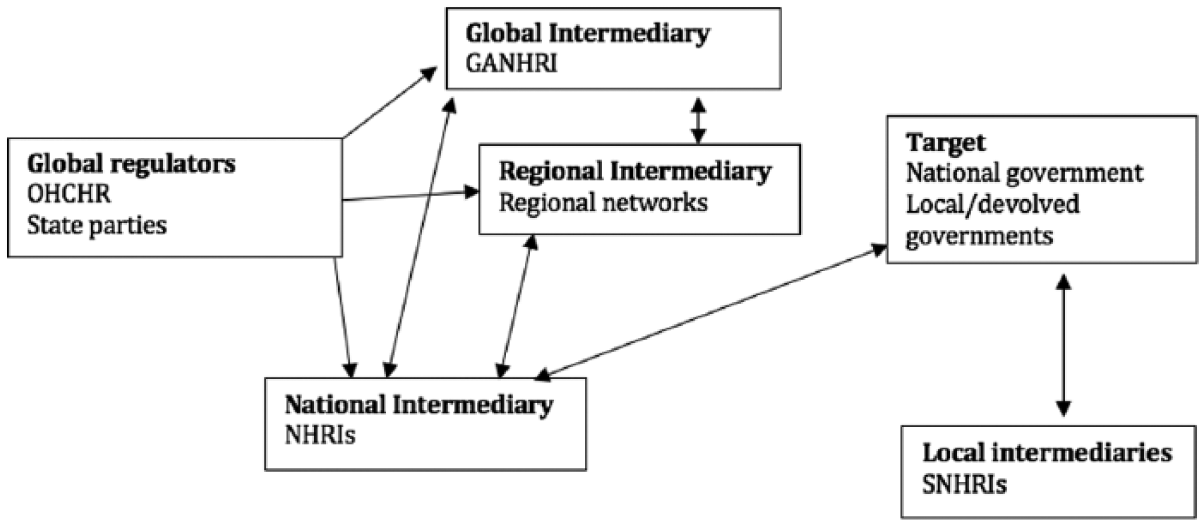
RIT arrangement for human rights governance including SNHRIs.
GANHRI and the regional networks have dealt with applications from SNHRIs in a haphazard and inconsistent manner (Wolman, 2015). At first, the OHCHR granted them C-status and thus non-voting status, as was the case with the Hong Kong Equal Opportunities Commission in 2000 and the Oficina del Procurador del Ciudadano del Estado Libre Asociado de Puerto Rico, and this assessment was primarily linked to their sub-national mandates and not directly to their more limited independence or effectiveness. These two bodies have maintained C-status. Since then, the Sub-Committee for Accreditation declined the applications of the Office of the Bermuda Ombudsman in 2011–2012 and of the Mexico City of Human Rights Commission and the City of Buenos Aires Human Rights Commission, as they are not national bodies in UN member nation states (Wolman, 2015). At the same time, the Palestinian Independent Commission for Citizens’ Rights received A-status (with reservations) in 2005 and A-status (without reservations) in 2009, despite Palestine not being a UN member at the time and holding non-member observer status at the UN General Assembly.
The NIHRC was granted B-status in 2001 and was upgraded to A-status upon reaccreditation in 2006. A few years later, the British EHRC, which is mandated to address English issues and limited Scottish matters but does not cover Northern Ireland, was given A-status. In addition, the SHRC was given A-status in 2010. In terms of acceptance in global and regional NHRI fora, however, the accreditation status makes the three UK-based commissions the most successful multi-level network of human rights bodies.
Why have these sub-national institutions been more successful at regulatory intermediation than others? How has this success come about?
Intermediary stewardship and SNHRIs
To address these questions, we examine the power that SNHRIs can have in the global architecture of human rights governance by forming multi-level networks with multiple intermediaries such as fellow SNHRIs and, whenever available, also NHRIs. In doing so, they foster managerial stewardship inside the network, facilitating learning and capacity building. Inside a network, they can align shared interests and increase impact on local and national targets by drawing on a larger pool of expertise and best practice. As part of a multi-level network, SNHRIs may be able to define more effective strategies to mitigate capture from a wider range of actors when they are part of a network. Given the right domestic and international conditions, as a network, they may also be facilitating access to regional and global networks, where they could to take on leadership roles and, when required, engage in hierarchical stewardship.
To elaborate on the mechanisms that SNHRIs can employ in a network setting, we turn to the concept of stewardship that has recently been applied to regulatory intermediation for human rights governance. Regulatory stewardship can be defined as ‘the assignment of mutual-monitoring and support responsibilities among intermediaries themselves, with the goal of safeguarding against capture and enhancing performance’ (Pegram, 2017: 230). Occurring in regulatory systems with multiple intermediaries, stewardship seeks to explicate concerns about the performance of intermediaries and their influence on regulatory interactions. Essentially a nonlinear area of intermediation, stewardship appears an intrinsic quality of networks of intermediaries. Weaker by design and more heavily dependent on voluntary participation, networks of human rights institution are expected to rely more heavily on stewardship than individual actors, to safeguard against capture by regulators and other intermediaries.
Stewards use both hierarchical and managerial techniques to monitor and support other intermediaries. Pegram (2017) identifies two categories of explanations in compliance scholarship that help us understand the behaviour of stewards. First, managerial explanations argue for non-coercive strategies to support targets that genuinely want to comply but found that they cannot (Chayes and Chayes, 1993; Pegram, 2017). We propose that managerial stewardship is a quality intrinsic in institutional networks, as they facilitate nonhierarchical exchange of information, the provision of technical assistance, fostering dialogue, and capacity building. Second, instrumental accounts explicate compliance problems endemic in regulatory contexts with strong distributive and value conflicts, above all resistance by the target to the implementation (Posner, 2010). We expect that members of institutional networks will engage in harder hierarchical techniques to steer behaviour when intermediaries operate in contested regulatory terrain where they may find themselves more vulnerable to underperformance and capture.
Following Pegram (2017), we will probe these two logics of intermediary action in the case of the three UK-based commissions. We will examine a number of factors that the literature identifies as central to effective regulatory stewardship in systems of human rights governance: the nature of the task environment, the rule framework and their enabling quality, and the practical approaches adopted by stewards. In addition, the access that the international regulator has to local and national intermediaries is particularly important for understanding the nature and behaviour of a multi-level network as an intermediary in a complex system of governance with multiple other intermediaries, orchestrators, and targets.
The multi-level network of UK-based NHRIs is unique on the global stage of human rights governance and thus a ‘most likely case’ of successful multi-level networked intermediation. A close examination of the types of intermediation and capture management in which the multi-level network engages offers us valuable insights into the tools of stewardship that multi-level networks employ in practice. An investigation of the British case will allow us to explore conclusions of broader relevance for other SNHRIs and for regional and global regulators, as they may seek to engage with them and, ultimately, find new and important avenues for making an impact on national and local targets.
Stewardship in the UK-based network of human rights institutions
A multi-level network: The main actors
The UK-based human rights network is made up of two human rights commissions with sub-national mandates in Northern Ireland and Scotland, and the EHRC with a mandate that covers England and Scotland but does not include Northern Ireland. In 1999, the Labour Government decisive steps to integrate regional human rights law in UK law, facilitate the implementation of the European Convention of Human Rights domestically, and make it easier for British citizens to contest human rights violations directly through national law. The same efforts of legislative harmonisation also led to the establishment of the first NHRI on British territory, the NIHRC. Section 68 of the Northern Ireland Act 1998 established a semi-autonomous institution charged with the promotion and protection of human rights in a post-conflict zone. This decision indicated a commitment on the part of the UK government to long-standing peace, cooperative diplomatic relations with the Republic of Ireland with respect to Northern Ireland, and the implementation of international human rights law with the goal to ensure sustainable peace (Northern Ireland Act, 1998).
The UK-wide EHRC started its activity in 2007 and was the result of the merger of three existing equality commissions: the Commission for Racial Equality, the Disability Rights Commission, and the Equal Opportunities Commission. Staff members at these three equality commissions had no prior expertise in human rights. The newly formed Commission had a mixed equality and human rights mandate. In order to define its new priorities of activity, the Commissioners reached out to human rights organisations around the country and conducted consultations on the types of human rights–focused issues that could be the object of the Commission’s future activities. Despite a large budget and a large number of staff at the start of its activity, as a result of merging the three equality commissions, the EHRC would not have a clearly defined human rights agenda for several years after its inception. As a former General Counsel for the Commission stated, in the early days the EHRC was ‘an equality body with a human rights framework’, but it has managed to strengthen its capacity in the area of human rights promotion and protection in the one decade of existence (Interview, 8 November 2016).
Unlike its Northern Irish equivalent body, which has sole powers over the protection and promotion of human rights in Northern Ireland, the SHRC shares a human rights mandate in Scotland with the EHRC based in Glasgow. SHRC’s remit focuses on issues within the devolved powers of the Scottish Parliament and Executive: the promotion of economic, social, and cultural rights in Scotland, as well as social care, public health (for instance, disability, dementia, and mental health) policing, the rights of people in detention and historic child abuse. From its inception in 2006 until it became operational in 2008, the Commissioners and other Commission staff carried out extensive consultations with the public across Scotland and identified great support in the population for the creation of a human rights commission in Scotland (Interview, 17 November 2016). In almost one decade of activity, the Commission has collaborated with other EHRC s in the United Kingdom. It has also carried out government advisory work, policy-focused research, and promotional activities in the issue areas in which the Scottish Government exercises its devolved powers.
A multi-level network as intermediary
As Figure 3 shows, the RIT model applied to the UK case of human rights governance includes a complex architecture of actors and ties. In addition to the OHCHR, the EU is a second regulator/orchestrator, imposing rules on member states to align their legal and institutional systems with European human rights law. The target contains both the central government and two devolved governments in Scotland and Northern Ireland. Finally, the model contains a multi-level network of human rights commissions, which have a large number of ties with other intermediaries in the model.
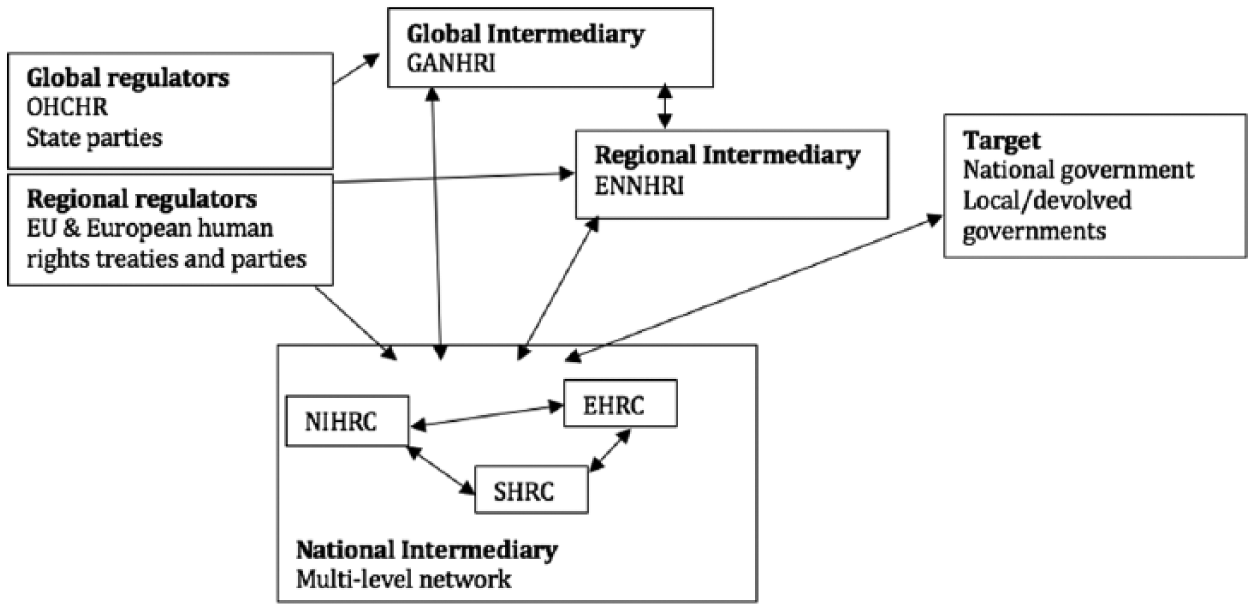
Stewardship for SNHRI networks in the United Kingdom.
The multi-level network of human rights institutions in the United Kingdom has operated in a regulatory setting in which the level of government support for human rights compliance over time has not been high and sometimes been very low. At certain moments in recent history, the public rhetoric advanced by the Conservative Party has shown a party position hostile to the existing national human rights governance in the United Kingdom, enshrined in the Human Rights Act. One such moment was at the Conservative Party conference a few weeks prior to the Scottish independence referendum in 2014, when then Prime Minister David Cameron spoke and called for the repeal of the Human Rights Act with the intention to create a British Bill of Rights (Conservative Party, 2015). That prompted warnings from Scotland’s First Minister, Nicola Sturgeon, that it was ‘inconceivable’ that the Scottish Parliament would consent to attempts to amend the Act, given that the principles enshrined in it are at the very centre of the devolution settlement (MacNab, 2015). The contested issue of a bill of rights for Northern Ireland is also a case in point. Under the terms of the Belfast (Good Friday) Agreement of 1998, the NIHRC was tasked with conducting a consultation on a bill of rights. Despite overall lack of support for such a measure in Westminster, the NIHRC delivered advice to the Secretary of State for Northern Ireland on 10 December 2008. Vigorous debates regarding the form of such an instrument have not led to the adoption of a bill.
The specific support for NHRIs has fluctuated over the years, often responding to political priorities at the time. When they were established, none of the three human rights commissions enjoyed full support from central or devolved governments, although they did receive a lot of support from civil society organisations (Interviews, 4 November 2016; 8 November 2016; 18 November 2016; 6 December 2016; 18 December 2016; 13 December 2016; 13 December 2016b). Government support was largely motivated by external pressures, such as the pressures to align national law with European human rights law and, in the case of Northern Ireland, the conditions tied to reaching a peace agreement.
Members of a number of NGOs had begun lobbying the Labour Party as early as 1993, asking for an independent body for the promotion and protection of human rights. A taskforce composed of civil servants, academics, and representatives of the existing equality commission and leading NGOs carried out deliberations from 1999 to 2001, which lead to the human rights playing a more central role in the vision for the new body (Crowther and O’Cinneide, 2013; Spencer, 2008). The NGO representatives on the Human Rights Taskforce overseeing implementation of the Human Rights Act found that NGOs could not meet the high demand from public bodies for training and Whitehall could not provide the guidance needed (Spencer, 2008). Initially, the government was not open to the idea of creating an NHRI and recommended instead that Parliament establish the Joint Committee on Human Rights that could launch an inquiry into the need to establish a unified body for the promotion and protection of rights. The Joint Committee began its activity in 2001, six months after the Human Rights Act had come into force, and received a significant body of evidence that a culture of respect for human rights within public services was missing and that the Human Rights Act alone was not sufficient for implementation of human rights law in the United Kingdom. Around the same time, the British Institute of Human Rights published a report entitled Something for Everyone, which spelled out the unmet need for rights protection (Watson, 2002), and argued for the need to establish a sole body overseeing human rights. In March 2003, the Joint Committee on Human Rights reported that the case for a human rights body was ‘compelling’. It was not until 2007 that the EHRC began its activity as an institution with a broader mandate that also included human rights.
In Northern Ireland, experts selected from among human rights lawyers and academics as well as civil society representatives of communities that experienced human rights violations during the troubles participated actively in shaping the NIHRC at its start. They continued to influence the Commission’s activity after its inception as well, by taking on leadership roles as commissioners specialising in particular types of rights violations (Interview, 25 April 2017). The Northern Ireland human rights commissioners were also influential in advising governments and human rights experts in England and Scotland when the two other NHRIs were established (Interviews, 15 November 2016; 6 December 2016; 8 December 2016; 13 December 2016a; 13 December 2016b; 25 April 2017). In Scotland, the Parliament created the Commission with advice from human rights experts and appointed a small number of them as commissioners. In the early years of institutional existence, these human rights experts defined the scope of activity of the SHRC and convinced the Scottish executive and the Parliament of a need for an independent commission to address more adequately the rights of people living in Scotland (Interviews, 6 December 2016; 13 December 2016a; 13 December 2016b).
Domestically, the central factor determining the task environment of the three commissions has been the pressure to harmonise national human rights law with European law. The British government formalised its commitment to the implementation of human rights through the Human Rights Act of 1998, in response to the calls for aligning domestic law with Council of Europe Law. The Act incorporates the rights set out in the European Convention on Human Rights into domestic British law. The UK system of rights protection has a separate and distinct ‘devolution dimension’, which imposes some constraints on the freedom of the central government to control human rights implementation alone. The devolved legislatures and executives in Northern Ireland and Scotland are also individually required to comply with the European Convention by virtue of specific provisions set out in the devolution statutes. 1 While their authority is comparatively more restricted, the Scottish and Northern Irish legislatures can also take measures to give further effect to the UK’s international human rights obligations when acting within the scope of their powers, including but not confined to those that arise under the European Convention.
Interviews indicate that, after their establishment, central government support for three commissions has varied over time but has generally been in decline since the election in 2010 and the austerity measures taken by the David Cameron government in the aftermath of the financial crisis (Interviews, 15 November 2016; 7 December 2016; 15 December 2016; 14 December 2016b; 25 April 2017). As public bodies, the three Commissions have also been the object of different waves of budget cuts, which saw their institutional financial resources reduced considerably. The NIHRC saw a first budget reduction of 25% from 2010 until 2013, when it lost two of its four management posts in 2011, and subsequent 11%–15% cut in 2015–2016 (Northern Ireland Assembly, 2014). Although not easy to assess at the time of the research interviews, some of the interview partners anticipated that the lack of a devolved government in Northern Ireland after the election in 2017 would have a negative impact on the resources and effectiveness of the Northern Ireland Commission (Interview, 25 April 2017). The Scottish Commission appears to be the one commission faring more smoothly the extensive budget cuts, as the otherwise relatively small Commission had been able to maintain most of its staff members (Interviews, 6 December 2016; 13 December 2016a; 13 December 2016b; 14 December 2016b).
The EHRC began its activity with a large budget that combined the individual budgets of the different equality commissions that took part in the merger. Subsequent budget cuts, including a recent one in 2017, have seen its staff and capacity reduced considerably. For example, in 2016, GANHRI expressed concern at the ways in which budget cuts equivalent to 70% of its 2010 budget would threaten the effectiveness and independence of the British Commission (Doward, 2016). In addition, there has been a lack of consensus on appropriate boundaries between government and the commissions, which has limited the independence of the EHRC (Harvey and Spencer, 2012). Unlike the Scottish Commission, which is accountable to Scottish Parliament, the EHRC is not accountable to Parliament but rather to government, and hence a Minister has to answer to Parliament for the Commission’s performance. Despite the provisions for institutional autonomy in the 2006 Equality Act, the direct subordination of the commission to government allows government to hold the commissioners accountable on their actions and sometimes micro-manage, interfering in a manner that the commissions may find intrusive (Harvey and Spencer, 2012).
Multi-level managerial stewardship
The domestic network operates within a complex rule framework defining the terms of operation for each commission and the overlap of responsibilities among them. The rule framework also specifies the terms of the interactions within the network and with two other international intermediaries, GANHRI and ENNHRI. These rules are specified in founding documents and the institutional mandates for each commission, in addition to two memoranda of understanding endorsed by the commission heads that detail the terms of the cooperation within the network. Two framework agreements spell out the terms of the collaboration within the network, seeking to regulate and facilitate the working relationship among the EHRC, the NIHRC, and the SHRC. They define the main purpose of the network in terms of managerial stewardship based on ‘[…] close practical collaboration, exchange of information and, as far as possible, agreement of common positions and avoidance of conflict’ (EHRC, 2010: 1).
According to the Memorandum signed by the three commissions, each institution retains an autonomous position inside the network, defined by individual mandates, and in relation to the other two commissions (EHRC, 2010). The Memorandum encourages regular formal and informal contact between equivalent staff in the three commissions in areas of policy work, legal services, and international cooperation. Whenever activities overlap, each commission is expected to alert others and give appropriate consideration to their opinions. The EHRC is the national intermediary, as the only NHRI with country-wide mandate. The EHRC retains its powers across the whole of Great Britain when it comes to equality issues, while NIHRC has sole authority over human rights promotion and protection in Northern Ireland. Under the Equality Act (2006), the EHRC has the authority to undertake human rights action in relation to devolved matters that are within the legislative competence of the Scottish Parliament. Since the Scottish Commission began its activity, the Equality Commission will not pursue any human rights activity unless it has obtained the consent of its Scottish counterpart.
Interviews with staff members at all three commissions offer insights into the application of these rules in everyday institutional practice. They indicate that, overall, the three institutions follow a cooperative working model among themselves. The multi-level network is driven by managerial stewardship, based on cross-institutional learning, regular meetings to share information and knowledge, and consult on specific policy issues as well as shared project-based work. A current legal advisor at the SHRC gives the example of the interest that the NIHRC has shown in learning about the experience of drafting and implementing Scotland’s National Action Plan for Human Rights (Interview, 17 November 2016). Whenever appropriate, the three commissions will establish joint arrangements to share work on policy areas and programmes for which they share responsibility: ‘We hold regular meetings and also collaborate, especially with the EHRC, as we have shared projects’ (Interview, 13 December 2016b).
Formal annual meetings facilitate regular communication among Commissioners and senior staff (Interviews, 4 November 2016; 8 November 2016; 17 November 2016; 6 December 2016; 25 April 2017). Over the years, the leadership in each commission has played a significant role in determining the intensity of the collaboration between institutions (Interviews, 8 December 2016; 6 December 2016; 21 November 2016; 13 December 2016a; 13 December 2016b; 15 December 2016; 25 April 2017). In other words, the formal ties within the network have been strengthened, or weakened, by the informal ties established by each of the commissioners. A vulnerability of the network when not managed well, the reliance on informal relationships has proven to be of help when commissions sought to work collaboratively and also when individual commissions have sought to exercise their influence internationally.
Hierarchical stewardship and access to international networks
What renders the UK-based SNHRIs unique around the world is the access they have gained to regional and global institutional networks of intermediaries set up specifically for institutions with a national mandate, despite having two SNHRIs as network members. Their special status is the result of two main determining factors.
To gain access to international NHRI networks, the Northern Ireland and Scottish Commissions benefitted from the lack of clearly defined rules at GANHRI regarding the access of SNHRIs to the accreditation system. GANHRI conditioned the continued acceptance of the UK-based commissions on their status as a domestic institutional network and on the endorsement of the central government. Nonetheless, each of the three institutions was assessed independently from the other two during the accreditation process, granting them A-status. Their participation in GANHRI is tied to their operation as a multi-level country network – the three UK-based bodies share a single vote, one speaking right, and one voice at GANHRI. In 2008, this result was justified in section 6.6 of the General Observations, stating that ‘In very exceptional circumstances’ multiple national institutions could seek accreditation, on the condition that they had the written consent of the state government and a written agreement regarding rights and duties as a GANHRI member detailing also arrangements for participation in the international human rights system (ICC, 2013).
In addition, the two SNHRIs, SHRC and NIHRC, have employed hierarchical stewardship tools, showing entrepreneurship and taking on leadership roles regionally and in global fora. In 2015, the Northern Ireland Commission was elected chair of the Commonwealth Forum of NHRIs. It has also been an active member of ENNHRI over the years, participating alongside the EHRC and the Scottish Commission in the organisation of a number of Working Groups that meet regularly to address issues of relevance for human rights policy in Europe, such as the rights of persons with disabilities, asylum and migration, or European legal structures. These groups provide a platform for mutual learning among different members, as well as capacity building and advising, and the facilitation of a regional response from NHRIs on specific thematic areas (ENNHRI, 2014).
The Scottish Commission has been particularly active internationally, engaging with regional and international intermediaries. Alan Miller, the Chair of the Scottish Commission (2008–2016), held elected positions of Secretary of the International Coordinating Committee of NHRIs (currently GANHRI) from 2013 to 2016, Chair of the European Group of NHRIs (currently ENNHRI) from 2011 to 2016 and was later re-elected to the same post in 2013 (GANHRI Special Envoys, 2018). In June 2009, the Scottish Commission hosted the first joint meeting of the three UK-based commissions together with the Irish Human Rights Commission (SHRC, 2009). In October 2010, the Commission organised the 10th International Conference of NHRIs at the Scottish Parliament, which brought together representatives from over 80 countries (Scottish Parliament, 2009). The conference concluded with the agreement of the Edinburgh Declaration, calling for more national and international monitoring of businesses’ compliance with human rights laws and more efforts to promote corporate responsibility (Scottish Parliament, 2009). In addition, the Scottish Commission makes submissions to the Treaty bodies of the UN framework regarding relevant human law, policy, and practice in Scotland and in June 2009, it was appointed a member of the UK’s independent mechanism responsible for promoting, monitoring, and protecting the implementation of the Convention on the Rights of Persons with Disabilities (SHRC, 2009).
Conclusion
The RIT model illuminates the diversity and structure of reliance on intermediaries throughout the human rights governance system. In general, intermediaries can bring operational capacity, expertise, independence, and legitimacy to regulatory governance. For human rights, they are particularly significant for the regulators’ efforts to reduce the compliance gap between states’ commitments to human rights treaties and their implementation of human rights law. Research to date has examined national and international regulatory intermediaries for human rights, such as NHRIs and the global peer-network they form, GANHRI, and discussed the key roles they play in advising, supporting governments, and monitoring governments in their efforts to implement human rights law in their countries.
In this study, we focus on a new type of intermediary – the multi-level domestic network of human rights institutions – and discuss its potential to be a channel for regulating the behaviour of state targets with multi-level domestic governance systems. By incorporating human rights institutions with local human rights mandates, multi-level networks are able to facilitate and oversee the local implementation of human rights. Although more vulnerable to capture and reliant on trust relations and the strength of their informal ties, when successful, multi-level networks can represent an important step in the formalised efforts to orchestrate informal action through parties.
We build on existing work on orchestration and stewardship for human rights regulatory governance (Abbott et al., 2015, 2017; Abbott and Snidal, 2009; Pegram, 2015, 2017). We have situated multi-level networks in the RIT model of human rights governance and illustrated the discussion with an analysis of a unique multi-level network of human rights institutions based in the United Kingdom. The existence of an institutional network, made up of two SNHRIs based in Scotland and Northern Ireland and the one country-wide NHRI, the EHRC, has been an innovative domestic solution to human rights governance in a state with two devolved governments. Despite being SNHRIs with limited local mandates, the Scottish and Northern Ireland Commissions have successfully gained access to regional and global intermediary networks that normally accept only human rights institutions with national remits. The UK-based multi-level network has been so uniquely successful due to its members’ ability to engage in both managerial stewardship inside the domestic network and in hierarchical stewardship in their relationships with other regional and global networks of intermediaries.
The multi-level network built on its ability to engage in participatory governance inside the network, by integrating three different institutions with different scope of mandate into one multi-level network. The three institutions created a rule framework for the network itself, which specified the specific roles and remits of each institution, and also clarified the rules of their cooperation and open communication. As a network, they have made use of their shared management policy of mutual support and collaborative work, facilitated by the national governance model based on devolution. To facilitate their unitary voice and single vote at the UN, the three commissions have also set up an informal system of agreement on the policy issues each would like to address when representing the United Kingdom globally.
Furthermore, the multi-level network had unprecedented access to global and regional networks, GANHRI and ENNHRI, which SNHRIs normally cannot enter. They benefitted from a lack of clearly defined rules regarding the access that SNHRIs could have to the accreditation system coordinated by OHCHR. In addition, they took on leadership roles in these two networks, gaining visibility and sustained support for their membership. By being members of a country-wide institutional network and employing instruments of hierarchical stewardship, the two SNHRIs raised their international profile and gained an information access advantage over other SNHRIs around the world. Individual A-level accreditation status for all three commissions has facilitated their access to international and regional fora and has made it possible for them to hold positions of leadership in GANHRI and ENNHRI.
This analysis has sought to offer insights into dynamics that can account for the successful performance of SNHRIs and the UK-based multi-level network. Our findings are relevant beyond the studies of human rights governance in the United Kingdom, especially in the context of orchestration in which employing multiple intermediaries may further enhance the rule-maker’s capacity. The analysis has broadened the spectrum of regulatory intermediation of human rights, by examining concrete ways in which regional and global networks can benefit from opening up their membership to multi-level networks of SNHRIs. Finally, our findings have significance for the wider international relations (IR) scholarship, by highlighting the role of networks in systems of multi-level governance. The increased complexity of global governance systems in the 21st century has created space for a growing number of regulators and targets and has embraced local actors as key to effective regulatory processes. This growing complexity has led to greater challenges of communication, coordination, and effectiveness in regulatory systems. We believe that multi-level networks offer some valuable and creative answers to these challenges. When functioning well, multi-level networks can make possible the coordination of efforts among actors operating at the local and domestic levels. Moreover, they can offer more stable structures of orchestration between national regulators and local actors. Importantly, as our case study shows, they can facilitate more direct interactions between international organisations and local actors in a collaborative manner that is not threatening to national regulators.
