



Abstract
Gramscian International Political Economy scholarship has predominantly focused on studying capital’s power to subsume labour under different hegemonic projects. Various autonomist Marxists have recently sought to ‘voice labour’ by proposing a disruption-oriented International Political Economy. However, this article argues that such an approach mirrors domination-oriented International Political Economy approaches by overemphasising labour’s disruptive potentiality and by paying little attention to the historical limitations that labour faces in its own empowerment. To escape from the unilateralism of these two mutually exclusive perspectives, Gramsci’s ‘Methodology of the Subaltern’ is reviewed in order to propose a Gramscian or strategic International Political Economy of Labour. Hence, this article shows that it is possible for International Political Economy scholars to study uneven capitalist development as the result of the agency of (dis)organised labour and thereby to better account for the emancipatory potentiality of working-class strategies in specific contexts.
Keywords
Introduction
Critical and neo-Gramscian International Political Economy (IPE) approaches have given labour a secondary role in the transformation of early 21st century capitalism. For example, Transnational Capitalist Class (TCC) formation has been explained as being intrinsically related to both the expansion of capitalism in space, that is, the globalisation process, and the overwhelming power of the state in implementing capital’s neoliberal hegemonic project across Western and developing countries (Bieler and Morton, 2003; Cafruny and Ryner, 2007; Robinson, 2004) and after the 2008 financial crisis (Bieler and Morton, 2014; Bruff, 2014; Ryner and Cafruny, 2017). This historical process has been uneven and has resulted in the formation of different TCC fractions that have vested interests in, for example, their location in the expanded ‘circuit of capital’ (Van der Pijl, 1998), as a result of their function in producing capitalist hegemony (Sklair and Struna, 2013), or in their capacity to incorporate new geographies and labour markets into the overall accumulation process (Shields, 2012; Yurchenko, 2012; for a review see Harris, 2014; Jessop and Sum, 2017; Overbeek, 2000). In Europe, this was possible due to the entrenchment of both industrial and financial interests in European structures of governance and, because of the inability of social-democratic governments and European trade unions to pose an effective challenge to TCC’s hegemonic strategies (Becker et al., 2015; Ryner and Cafruny, 2017; Van der Pijl et al., 2011).
In contrast to these ‘top-down’ approaches of class formation, this article argues that a more complex and dynamic theory of working-class formation is both necessary and possible. In particular, it argues that Gramsci’s methodology of the subaltern can be a useful starting point for the development of a Labour-oriented IPE that can strategically account for the limits and possibilities of working-class struggles. Recently, various autonomist Marxists have sought to counterbalance ‘top-down’ accounts by proposing a ‘disruption-oriented’ IPE (Bailey et al., 2017; Huke et al., 2015). However, in solely focusing on the subversive agency of the working class, they have missed the fact that (alienated) labour is crucial in the reproduction of capitalism and in its governance institutions (Las Heras, 2018a, 2018c). Thus, a theory that is capable of addressing both the limits and potentialities of working-class struggles in different contexts is very much needed. Only through such a theory can we understand and account for both the relative success and failure of specific working-class strategies. The aim of this article is thus threefold: (1) to outline the drawbacks of one-sided theories in critical and neo-Gramscian IPE, (2) to provide a sympathetic critique of recent ‘disruption-oriented’ IPE approaches and (3) to outline an analytical framework that may serve as a foundation for a Gramscian or strategic IPE of Labour (IPEL).
To do so, I will first review succinctly the critique of autonomist Marxists and IPEL scholars regarding ‘top-down’ approaches to class formation and capitalist development. I will then go on to review recent contributions defending a ‘disruption-oriented’ IPE which emphasise workers’ obstinate, disruptive and creative role in challenging capital’s domination. In order to escape from the one-sidedness that simplifies labour’s power, I will review Gramsci’s ‘methodology of the subaltern’. This perspective will be presented as a ‘vantage point’ to understand uneven capitalist development from the holistic perspective of the working class. The aim is to produce an IPE of Labour that gives credence to workers’ contradictory role in the reproduction and transformation of capitalism. Finally, I will discuss Gramsci’s framework alongside more recent IPE and industrial relations contributions to formulate a strategic theory of working-class formation, namely a strategic IPEL. Three main strategic dimensions of working-class power will be outlined: economic, political and ideological. These are derived from a Gramscian approach to the ‘integral economy’, and are subdivided into various forms of tactical agency or immediate working-class power that may become more useful to determine specific forms of class struggle. The pursuit of class strategies and production of class power are both relative and complex. Context is therefore important in any attempt to account accurately for the structural position and the emancipatory potentiality of overlapping and often contradictory processes of working-class formation. Rather than a definite-ideal closed box, the strategic framework that will be outlined below must be understood as an open process. At an ontological plane, new forms of class action transform existing structures of domination and, vice versa, the endurance or emergence of power structures necessarily shape and contextualise strategic agency. At an epistemological plane, such an analytical framework enables us to make a determinate reading of workers’ relative alienated position and to outline the limits that (subversive) workers must transcend. These limits include the very theory itself because it provides an incomplete and partialised meaning within a historically determined system of power relations.
Moving away from domination-focused IPE
A problematic feature that most neo-Gramscian approaches to capitalist and working-class formation share is that they only theorise and explain class formation, capitalist development and class hegemony from the perspective of capital. A good illustration of this problem is that the last two books on the state-of-the-art of critical IPE (Cafruny et al., 2016; Shields et al., 2011) make no reference to the crucial role that the working class and its multiple organisations, such as trade unions or social movements, play in shaping contemporary capitalism. Nevertheless, the critique of various Marxist and Gramscian approaches for neglecting labour is nothing new: it has been previously advanced by autonomous Marxists (Cleaver, 2000 [1979], 2017; Huke et al., 2015), labour historians (Hobsbawm, 1984; Thompson, 2016 [1963]), IPEL scholars (Harrod and O’Brien, 2002; Selwyn, 2014) and labour geographers (Herod, 2006; McGrath-Champ et al., 2010). 1 Their critique deals with the limitations of top-down approaches when explaining class formation and can be summarised in the following interdependent arguments:
Explaining the development of global capitalism and class formation solely as a result of capital’s agency ignores the production of a substantiated historiography of the subjectivity of the working class that completes any systemic analysis.
The lack of historiography produces a gap in the collective consciousness around the concrete struggles and dilemmas that (organised) workers experience in different (formal or informal) economic sectors, geographies or institutional environments, as well as in the form in which (organised) labour has a particular imprint on the production of different economic, political and ideological structures.
The gaps in the collective consciousness of the crucial role that labour plays in the uneven development of capitalism undermines the production of new categories and theories that may allow working-class militants and academics to better understand and explain the possibilities and limitations of different projects of class emancipation as well as the contradictions that the working-class encounters when contesting or legitimising capitalist domination.
The lack of theories and categories to account for the contradictions that the working class experiences cripples the production of renewed working-class strategies that can transform the balance of class forces to the benefit of labour.
Or, as Harry Cleaver (2000 [1979]: 57) explained with enormous strategic clarity:
If one’s attention is focused uniquely on the enemy’s activities on the battlefield, the battle will assuredly be lost. In the class war, as in conventional military encounters, one must begin with the close study of one’s own forces, that is, the structure of working-class power. Without an understanding of one’s own power, the ebb and flow of the battle lines can appear as an endless process driven only be the enemy’s unilateral self-activity.
There are two important points to be grasped from Cleaver’s ‘political reading’ of Capital. First, critical studies on class formation have to incorporate the political subjectivity of the working class in order to better understand the ‘ebbs and flows’ of the battle, namely the concrete form in which uneven capitalist development occurs from the perspective of the immanent subversive class. Gramscian accounts of class formation have explained how the bourgeoisie produces hegemony, yet ‘it serves little purpose to study the structures of capitalist domination unless they are recognised as strategies that capital must struggle to impose’ (Cleaver, 2000 [1979]: 57, emphasis added). In this sense, IPE scholarship necessarily stands ‘within the actual on-going growth [or absence] of working class struggles’ (Cleaver, 2000 [1979]: 57). Thus, not accounting for labour’s (in)action silences at least half of the story (Huke et al., 2015: 732).
Second, and most important, voicing labour is strategically desirable for IPE scholarship because explanations that establish causation presume or defend what it is contingent or necessary in a historical setting, and the particular reasons why social problems unfold in the way they do (Las Heras, 2018b). How we determine the context of our historical analysis has important implications in the production of a collective consciousness that may inform concrete forms of collective action and pathways to follow. As Ollman (2003: 99–111) discusses, there are important implications in the choice of a starting point in historical inquiry: understanding how Marx made use of the ‘force of abstraction’ helps us to grasp that ‘the vantage point that is adopted organises not only the immediate contradiction but establishes a perspective in which other parts of the system acquire their order and importance’ (Ollman, 2003: 108; also Bhaskar, 1998; Bieler and Morton, 2001; Las Heras, 2018b). In reflecting on how critical Critical IPE has been in studying the effectiveness of class struggles over the past decades (Huke et al., 2015), it is necessary to move away from a theory of everlasting capitalist domination. Therefore, actively engaging with IPE from labour’s perspective – a strategic IPEL – becomes a ‘vantage point’ to study uneven capitalist development and the immanent processes that enable its transcendence. Or, to put it differently, if strategic action is ‘the art of creating power’ (Freedman, 2015: xvii), capitalism and class formation from the perspective of labour is a strategic manoeuvre to understand how the working class realises its own interests (incompletely), and the limits and contradictions it finds in the process of class emancipation (also McNally, 2015: 140–141; Ollman, 1987: 67–70). Conversely, if we solely focus on how capital produces class hegemony, for example, by studying how ‘comprehensive concepts of control’ underpin neoliberal and austerity policies, or how labour is fragmented because of its location in multi-scalar global labour markets, it is futile to account for how the working class engages with such processes and becomes the main actor of its own history because, no matter what it does, capital always wins.
Autonomist contributions to IPE: Disruption-oriented IPE
Recently, various IPE scholars have attempted to develop a ‘bottom-up’ disruption-oriented IPE in contrast to a ‘top-down’ IPE (see Bailey et al., 2017, 2018; Bailey and Shibata, 2014; Huke et al., 2015). According to Huke et al. (2015: 731), this approach, which draws on autonomist Marxism, 2 highlights ‘action, contestation and disruption by labour’ to address ‘the inherent instability of attempts to contain resistance and insubordination, and the disruptive effect such always-already practices have upon would-be relations of domination’. Thus, their framework is ‘based on the assumption that contemporary structures of domination, and especially (but not exclusively) the classed, gendered and racialised structures of inequality that constitute contemporary capitalism, are each inherently unstable as a result of their contested nature’ (Bailey et al., 2018: 11).
In so doing, these authors have sought to produce an ‘alternative narrative’ to ‘top-down’ accounts of European integration and authoritarian neoliberalism in which the ‘autonomy, self-activity and self-organisation’ of workers has been overlooked (Bailey et al., 2017: 4, 20–21). More specifically, and as summarised in Table 1, disruption-oriented IPE has a number of central concerns:
how workers express their capacity ‘to act creatively, and for that creativity to be central to the construction and reproduction of society’ since ‘the creative worker can never be (fully) contained, constrained or controlled’;
how ‘mechanisms and institutions of containment, integration and co-optation’ are ‘inherently secondary, porous and incomplete’, in their ‘disrupted attempt to secure domination and exploitation’ that always meets worker confrontation;
how social forces manifest ‘beyond’ the state’, since there is always ‘a constitutive excess that exists beyond (and thereby acts to disrupt) the state’. The capitalist state is then conceptualised as ‘a regime of control, but one which is unable to contain the fluidity that constitutes everyday life’;
similarly, and in contrast to, for example, top-down Gramscian approaches to civil society that fundamentally explain this as a site for the production and reproduction of ‘hegemony’, civil society is conceived as ‘incomplete’, and therefore we must look ‘beyond’, to the ‘imperceptible politics, escapes and struggles ‘from below’ that are exercised in ‘everyday practices’ and more complex ‘subjectivities’;
in the study of capitalist economies class struggle is put at the centre, and labour must be conceived as an ‘independent variable’, a ‘creative force that develops obstinate practices with regard to the needs of capital accumulation’. Subsequently, ‘capitalist dynamics are understood to be driven (primarily) by acts of labour, with capital forced to respond to those activities’ (Huke et al., 2015: 731–734).
Analytically, these authors have outlined various ideal-types of disruptive-subjectivity, allowing them to ‘think “with theory” […] as a means through which to consider the ways in which disruptive subjectivities have developed during both the period of neoliberal capitalism and more specifically during the course of the post-2008 crisis era’, thus evoking different questions that produce different forms of thought (Bailey et al., 2017: 28). In order to restrain themselves from idealist exercises, they argue that such ideal-types are not:
discrete, fixed or mutually exclusive. Rather, [that] disruptive subjects can and do display these characteristics in combination with each other, and the inability to achieve their demands through a particular type of agency may often bring them to a different strategic choice, leading to new forms of disruptive subjectivity in new socio-economic contexts. (Bailey et al., 2017: 28)
Overall, disruptive-oriented IPE can be understood as an attempt to respond to the following two research questions: how are daily-life relations of domination contradictorily constituted so that they enable obstinate workers to permanently resist and subvert them? And, in turn, how do these various forms of worker subjectivity generate ‘passageways towards new forms of radical emancipatory action, collective self-organisation and an autonomous reorganisation of social reproduction?’ (Bailey et al., 2018: 26). In relation to the European integration process, Bailey et al. (2017: 4) state clearly that their aim is to address ‘what problems have workers created for European capitalism over the past thirty years?’ In asking these research questions, ‘disruption-oriented approaches illuminate the impossibility and therefore the incompleteness of those attempts to stabilise domination, alongside the potential (and actuality of) escape routes as they manifest themselves in (and disrupt) contemporary capitalism’ (Bailey et al., 2017: 27).
Comparing Domination-IPE, Disruption-IPE and Gramscian or Strategic IPE of Labour. The first two columns correspond to Huke et al. (2015: 727).
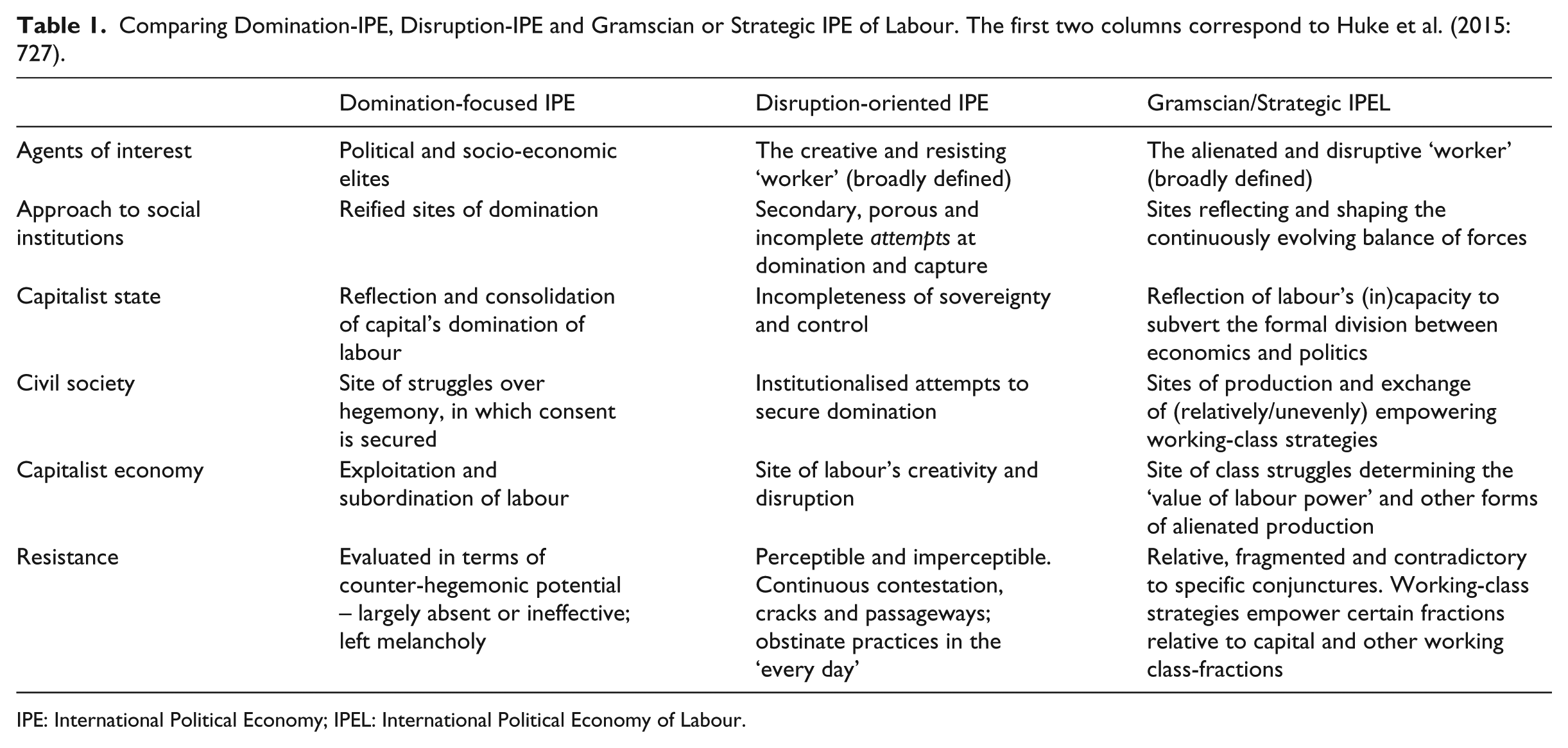
IPE: International Political Economy; IPEL: International Political Economy of Labour.
Notwithstanding the importance of voicing the daily-life subversive capacity of the worker, the propositions advanced hitherto are, nevertheless, distant from providing a convincing framework in place of ‘top-down’ IPE approaches. In overemphasising the autonomy of workers (Bailey et al., 2017: 20–23, 2018: 14–18; Bailey and Shibata, 2014: 241–244; Huke et al., 2015: 731–734), these authors have analytically obviated the limitations and contradictions that working-class struggles embody – namely that working-class empowerment does not occur in absolute terms but in relative terms to different fractions of capital and the working class – and thus, they have tended to over-emphasise the challenges that grass-root contemporary struggles have posed to the ruling class.
Problematically, the implications of acknowledging workers’ relative autonomy – that is, their inescapably structural embeddedness that enables different forms of transformative action (Bailey et al., 2018: 26) – have not been incorporated into their framework and, therefore, an analytical split between the mutually determining dominating and disruptive forms of action remains (Kicillof and Starosta, 2007). These authors have tried to get out of the impasse by arguing that domination- and disruption-focused IPE must be ‘combined’ to produce an encompassing analysis, but without explaining how it should be done. Nor have they explored the methodological problems that may emerge from such an endeavour (see Bailey et al., 2017: 26–27; Cleaver, 2000 [1979]: 58, 2017: 122–124; Holloway, 2012; Huke et al., 2015: 730–732). The impossibility of simply combining two mutually exclusive perspectives will become more evident after revising Gramsci’s approach to bourgeoisie hegemony from the position of the subaltern. A disruptive-oriented IPE (see the five propositions outlined above and in Table 1) does not theoretically address the fact that:
the worker is at one and the same time an (relatively) alienated and (relatively) transformative subject who produces and reproduces different class relations;
social institutions are, broadly defined, primary sites or ‘strategic-fields’ that reflect and shape, that is, co-determine, an always-changing balance of class forces;
the capitalist state is a reflection of labour’s incapacity to thoroughly subvert the formal division between economics and politics, the private and the public spheres that control the capitalist world;
civil society is the historically determinate realm in which old and new class strategies (hegemonic/counter-hegemonic) are produced in order to empower relatively certain groups over others;
workers’ agency at the (re)production site is crucial when contesting and legitimising (1) the ‘value of labour-power’ and (2) other forms of alienated subjectivity inherent to capitalist development, for example, gender or race;
resistance or disruption is always relative and fragmented to specific spatio-temporal frameworks; thus, class strategies and class structures exist in a fragmented manner since they can never secure the immediate interests of all capitalists and of all workers.
The flaw in recognising and incorporating these fundamental pillars underlies the importance of overcoming any theoretical ‘one-sideness’ that prioritises agency over structures or vice versa. Strategically, by only paying attention to workers’ subversive capabilities, a disruptive-oriented IPE ends up producing over-optimistic narratives (e.g. Bailey et al., 2017: 8) that underplay the obvious: that no matter how imperfect and limited, the European integration process has been hitherto an effective hegemonic project in (unevenly) taming European working classes (Becker et al., 2015; Ryner and Cafruny, 2017). Prefigurative actions should be then understood and explained in relation to specific structure-conjunctures and, while being far from subverting every power relation (Gramsci, 1971: 330–333), they should be conceived as being effective in only transforming some or creating new ones within.
A more realistic but no less progressive formula, compared with solely acting ‘beyond’ existing class structures, might be the Poulantzasian argument of fighting inside and outside the capitalist state (Jessop, 1990: 227–229; Poulantzas, 2014 [1978]: 259–265). Such a strategy acknowledges the possibility of articulating struggles that simultaneously create new democratic and participatory institutions/relations while transforming already-existing ones, so that the latter can be overcome or ‘withered away’ by progressively (not linearly) generalising the former (Poulantzas, 2014 [1978]: 261–262). In order to build such a path, we must nevertheless recognise and embrace the fact that one cannot completely escape from a reality that is constraining and enabling at the same time, and thus there is a need for a hybrid theory that both outlines the limits and forces us to think prefiguratively. In addressing the contradictions of existing capitalist structures and forms of contestation, this theory would allow us to synthesise new forms of class and revolutionary action for their transformation and dismissal.
Gramsci’s methodology of the subaltern and IPE
In contrast to disruption-oriented IPE, Gramsci’s ‘methodology of the subaltern’ can be taken as a different point of departure which still embraces a political and strategic analysis of capitalism from the perspective of labour. 3 In the eyes of Thomas (2009), Gramsci’s Prison Notebooks sought to present capitalist development and the capitalist state as a result of the dialectic between the proletarian antithetical project and bourgeois hegemony. More specifically, Gramsci ‘does not begin [his analysis] by asserting the concept of proletarian in its sheer, indeterminate immediacy’, presupposing a ‘collective worker’ that understands passively its objective position in the division of labour; but it is rather from the very ‘analysis of bourgeois hegemony’ that Gramsci develops an ‘exact appreciation of the nature of the actual and effective bourgeois hegemony against which [workers] must struggle’ (Thomas, 2009: 233).
For Gramsci, ‘politics’ (in lowercase) is theorised as the human activity par excellence in the production of discourses that provide an intellectual/ideological basis for historically concrete forms of power and social domination (Gramsci, 1971: 334–341). Such an approach takes us to a ‘fundamentally contingent, fundamentally open-ended’ understanding of politics in which subaltern groups have the capacity to subvert any particular balance of forces to their favour because: (1) there is ‘no law of history which can predict what must be the outcome of a political struggle’, (2) ‘politics depends on the [complex] relations of forces at any particular [historical] moment’ and (3) ‘there is no unitary subject in history’ with predetermined interests but, instead, social subjects/groups which become conscious of their needs through contingent forms of political praxis (Bieler and Morton, 2001: 20–22; Hall, 2002: 231–232). 4
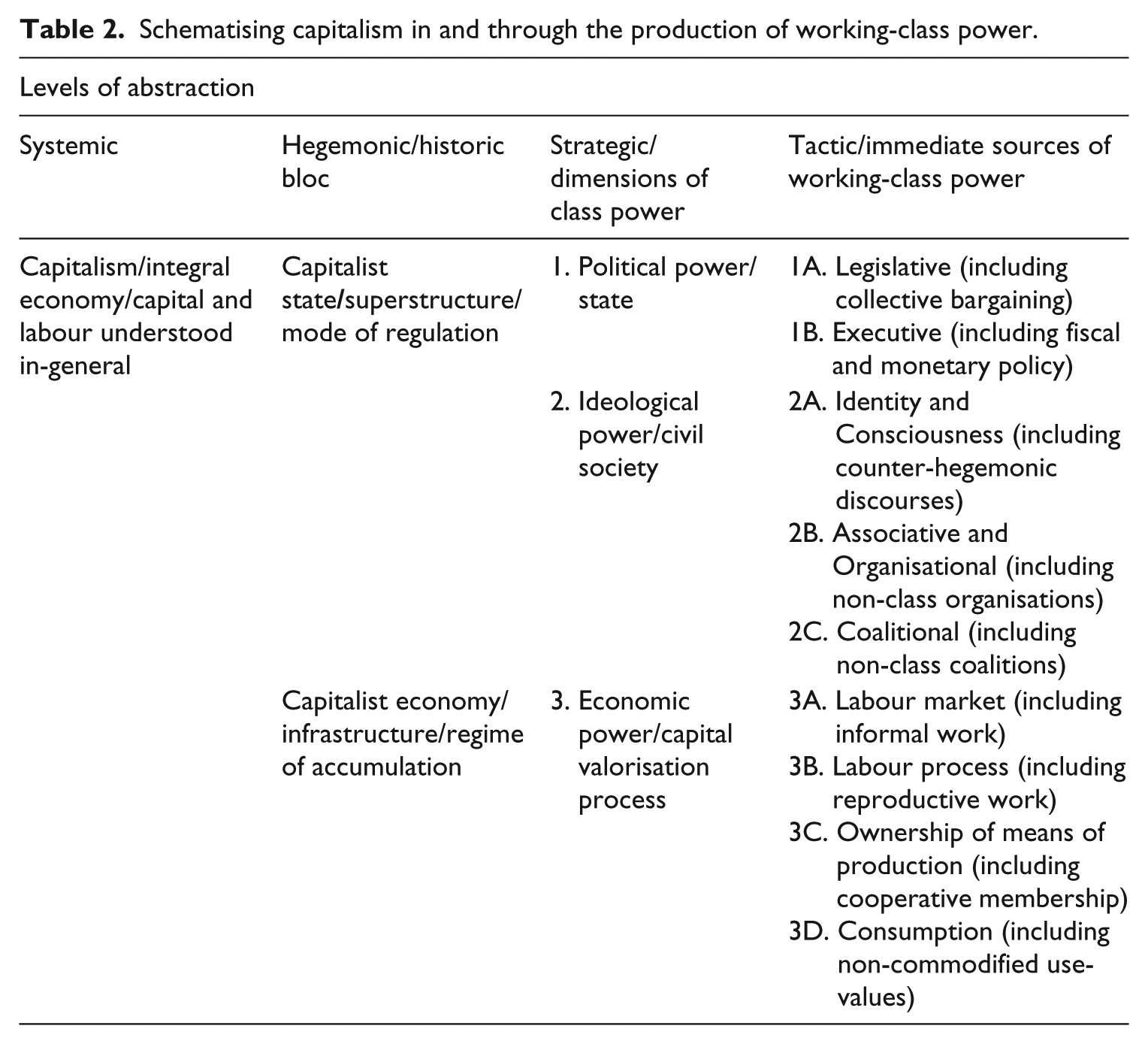
Conversely, ‘Politics’ (in uppercase) is not independent from the economic or civil society spheres of class struggle, but a distinct, albeit interdependent, moment in the contested (re)production of bourgeois hegemony. For Gramscians, bourgeois domination implies a changing and always contested formal division between: (1) the Economic sphere, that is, the private citizen that engages through contractual relations into the transformation of nature for the (re)production of the capitalist mode of production, (2) the Ideological sphere, that is, when civil society organisations and organic intellectuals produce hegemonic and subversive discourses that provide meaning and logic to the ‘ebbs and flows’ of class struggle in the other dimensions and, (3) the Political sphere, that is, the capitalist state which encapsulates the political capacity to establish legal boundaries for the (re)production of the two previous forms and intervenes with its state-apparatuses through fiscal, monetary, educational and other policy-making (Gramsci, 1971: 257–265; also Gallas, 2016a: 26–69; Jessop, 1990: 145–166; Jessop and Sum, 2006: 348–373; Poulantzas 2014 [1978]: 123–160; see also Table 2). Therefore, for Gramscian interpretations of politics (in lowercase), entrenched relations of power have resulted in the formation of particular ‘historic blocs’, that is, in historically specific ‘complex, contradictory and discordant’ political and ideological relations that are the ‘reflection of the ensemble of all the social relations of production’ (Bieler and Morton, 2003: 475–476; Gramsci, 1971: 366). By gaining awareness, the working class provides a distinctive and inverted response to bourgeois discourse and frames class relations in historically objective terms, that is, as relations of oppression among formally independent but materially interdependent subjects (Bieler and Morton, 2001: 22–23; Gill, 1993: 36–37). In subsequent moments of ‘catharsis’, the working class subjectively produces its own objective understanding, and structures of domination cease ‘to be an external force which crushes man [sic], assimilates him to itself and makes him passive; and [become] transformed into means of freedom, instrument to create new ‘ethico-political’ form[s]’ (Bieler and Morton, 2001: 19; Gramsci, 1971: 366–367; Thomas, 2009: 295).
Schematising capitalism in and through the production of working-class power.
Gramsci’s ‘methodology of the subaltern’ is rich in its understanding of the complexity of class relations with respect to (1) other forms of domination and (2) its multi-scalar spatial nature. First, and similar to autonomist propositions that define the working class ‘broadly’, including unpaid (productive and reproductive) labour, unemployed workers, racialised labour markets and other forms of cultural and demographic marginalisation (Cleaver, 2000 [1979]: 16–17), Gramsci (1978) also acknowledges the complex ontology of the subaltern worker – as in the Southern Question – and the interdependence of multiple forms of social oppression when securing bourgeois hegemony. Class relations are constituted by relations of ‘gender, race, culture, and religion that function in different modalities in specific historical contexts, [thus] constructing categories of identity provide the basis for excluding particular groups from participating, [and form] the basis for relations of inequality and exclusion which produce the subaltern as the marginalised “Other”‘ (Green, 2011: 395–396). However, not all relations of subordination have the same historical force or ‘decisive nucleus of economic activity’ (Bruff, 2005: 272–276); and it is of material necessity for the subaltern class(es) to surface unnoticed relations of domination to give meaning to their (more or less) subversive and (more or less) inclusive forms of struggle (Galastri, 2018; Gramsci, 1971: 243–245, 333–367; Jubas, 2010).
Second, the spatial dimension is also present in Gramsci’s work. Gramsci is aware of the spatial dimension shaping the concrete political, economic and cultural forms through which class hegemony is disputed and challenged (Thomas, 2009: 214–217). Similar to ‘top-down’ IPE approaches to TCC formation, Gramsci theorised both working class and state formation as a process of shaping and being shaped by the space in which social classes and the capitalist state exert their ideological and coercive powers. For Jessop (2005: 429), ‘Gramsci did not believe that space exists in itself, independently of the specific social relations that construct it, reproduce it and occur within it’. Quite the opposite, ‘as a profoundly relational and practical thinker’, he never reified/isolated any spatial scale/territory as a bounded site of class struggle (Jessop, 2005: 429). Subsequently, the ‘methodology of the subaltern’ can become a constituent component of IPEL scholarship. It is sensitive to multi-scalar expressions of working-class formation and struggle, allowing us to be sensitive to and differentiate sub-national, national and transnational forms of working-class formation (e.g. Bieler, 2006, 2011; Las Heras, 2018a), or the uneven territorialisation of the capitalist state that also embodies certain labour demands in order to secure an unstable rule (Bieler and Morton, 2014; Bieler et al., 2015; Las Heras, 2018c; Tsolakis, 2010), but without reifying any spatial-scale over others.
Accordingly, we can use the ‘methodology of the subaltern’ to study the historical development of class forces from the multiple and often discontinuous moments of ‘catharsis’. We can study the historical process of workers reaching ‘integral autonomy’ through the production of uneven and contradictory stages of ‘relative autonomy’ (Gramsci, 1971: 52; Jubas, 2010: 229; Galastri, 2018: 46–47). Integral autonomy can be understood when a subaltern class consolidates its immanent class project, namely when it transcends its constitutive historical relations of social alienation. In contrast, relative autonomy can be understood as the empowerment of workers with respect to their prior positioning – that is, in relation to (1) the capitalist class and (2) other working-class fractions that also become constituted through such a process of relative empowerment – but without transcending (completely) overarching relations of subordination (also Gramsci, 1971: 157). A historical example that Gramsci draws on is the fight for ‘industrial legality’ by Italian workers during the early 20th century. While it allowed unions to organise and bargain for better conditions, reducing provisionally the rate of exploitation (Lebowitz, 2003: 110–112), it was definitely far from being an ‘ultimate and definitive victory’ because the legality was ‘conditional on the trust the entrepreneur [had] in the solvency of the union, and its ability to ensure that the working masses respect their contractual obligations’ (Gramsci, 1977: 387). Simultaneously, the better salaries and working conditions of the industrial core were secured by the more political, economic and ideologically subordinate position that southern Italian workers had in the national division of labour and the Italian state (Gramsci, 1978). In this sense, non-revolutionary class struggles were inherently contradictory as they both challenged and legitimised bourgeois ruling. However, ‘Gramsci did not advocate that trade unions abandon collective bargaining, or the winning of economic concessions. Rather, he saw such activities as part of a strategy for social transformation, but not the exclusive strategy’ (Annunziato, 2011: 123, original emphasis; also Gramsci, 1971: 234–236, 1977: 386–387). Working-class victories that fall short of dismissing capitalism, and which still emerge from the subversive subjectivity of the individual and collective labourer that seeks to empower herself under certain specific conditions, are nothing but a better, yet unstable, social compromise (Gramsci, 1971: 158–165, 180–185, 235–236; Panitch, 1981: 30–34; Upchurch et al., 2009: 10–16). Or, as Hyman (1989: 114–116) put it, working-class struggles ‘consist in overturning past victories’, and any ‘persuasive theory must sensitively map the complex dialectic of institutionalisation, re-institutionalisation and counter-institutionalisation of working class struggles’ (also Gramsci, 1977: 387).
The strategic logic that the ‘methodology of the subaltern’ embraces rules out the one-sidedness of disruption-oriented IPE class formation in which the working class makes its own history ‘independently’ regarding the concrete forms of oppression that it seeks to dismiss. In their (relatively flawed) attempts to subvert capitalist domination, the working classes, their discourses and their organisations embody the various contradictions which they are not capable of freeing themselves from. The very struggles that empower certain strategies inhibit other forms of ‘subaltern praxis’ which could potentially be more effective in subverting the status quo. Therefore, the ‘methodology of the subaltern’ allows us to escape from the one-sidedness of disruptive-oriented approaches to IPE, and build a complex and strategic reading of working-class formation to ‘understand the process, development, and lineage of the subaltern; how they came into existence, how some survived at the margins, and how others succeeded in their ascent from a subordinate social position to a dominant one’ (Green, 2002: 8).
Furthermore, the ‘methodology of the subaltern’ allows us to trace the uneven, complex and contradictory processes of class formation, in which ‘subalternity exists in degrees or levels of development’, and in which ‘some groups maintain higher levels of political consciousness and organisation than others, and some groups exercise more autonomy and initiative than others’ (Green, 2002: 9–10). 5 As a subaltern class, the working class always finds it difficult to produce a historiography of its own and account for the ‘fragmented and episodic elements of subaltern development’ (Gramsci, 1971: 55; Green, 2002: 12–14; Morton, 2007: 173–176). In the process of ‘self-empowerment’ – in and through spreading specific class discourses/strategies, formalising its material basis in various class organisations and social movements, and transforming the judicial and governmental foundations of the capitalist state – not all working-class practices and critiques become dominant. The struggles between working-class ‘organic intellectuals’ and how these become the intellectual templates for guiding different social groups will be crucial in determining both the specific form in which working-class power unfolds (unevenly), and how these help to reproduce or challenge ‘common sense’ (Gramsci, 1971: 334–335). Thus, as autonomist Marxists accurately point out, it is important to produce a historiography of labour that provides an ‘integral history’ of the ‘ebbs and flows’ of capitalism from the perspective of labour and the multiple and overlapping forms in which it is mediated.
To wrap up the argument, the ‘methodology of the subaltern’ can be perceived as being driven by the following two research questions: what are the contradictions (i.e. the limitations and possibilities) that working-class organisations face when moving forward and beyond? And how are these contradictions carved on the prevailing structures and institutions that (re)produce and challenge bourgeois domination? Or, if we prefer to merge them both under a coherent research question that may inform Gramscian approaches to a IPE of Labour: how do the multiple and complex structures of class domination reflect the balance of class forces that labour must transform in order to gain more relative and integral autonomy?
Towards a Gramscian or strategic IPEL
The war historian Lawrence Freedman (2015: xi) argues that ‘strategy comes into play where there is actual or potential conflict, when interests collide and forms of resolution are required’. Strategy presupposes social actors to have confronted interests, to live in tension, which in our case refers to workers living in continuous struggle until they can free themselves from an alienated form of social mediation that considers and regulates human activity as ‘abstract labour’ (Cleaver, 2017: 89–93: for a detailed discussion see Postone, 2003 [1993]). Strategic logic is nevertheless ‘governed by the starting point and not the end point’ because the ‘inherent unpredictability of human affairs’ forces social actors to continuously update and redefine their interests and objectives (Freedman, 2015: xi). Or, as Gramsci (1971: 34–35) puts it in his own terms, a critical and strategic reading of history:
understands movement and change, which appreciates the sum of effort and sacrifice which the present has cost the past and which the future is costing the present, and which conceives the contemporary world as a synthesis of the past, of all past generations, which projects itself into the future.
Thus, it is crucial when engaging critically with social structures to always maintain and re-examine the ‘balance between ends, ways, and means; about identifying objectives; and about the resources and methods available for meeting such objectives’ that different actors have (Freedman, 2015: xi). The dynamic of strategic action is ‘one of bargaining and persuasion as well as threats and pressure, psychological as well as physical effects, and words as well as deeds. [Strategy] is about getting more out of a situation than the starting balance of power would suggest’ or, in other words, strategic action is ‘the art of creating power’ (Freedman, 2015: xii).
Transposing such logic to a Gramscian approach to an IPE of Labour means that, on one hand, pursuing working-class strategies is linked to knowing and wielding one’s class power effectively and, on the other hand, building class power is inherently linked to pursuing effective and plausible class strategies that transform the original environment. Moreover, class emancipation is a complex process which is simultaneously overdetermined by other (apparently external) systemic processes and forms of socialisation (Vergesellschaftungsmodus) like gender or race (Jessop, 2008: 226; McNally, 2015). Therefore, to avoid making unsubstantiated predictions and attribute absolute rather than relative interests to workers, or by determining working-class fractions and their actions in ‘bounded’ or ‘autonomous’ forms of struggle, a strategic approach to an IPEL suggests to us that we can either (1) depart from giving emphasis to historically specific power relations, that is, class structures that enable and constrain particular working-class strategies, or (2) instead, that we can adopt an agential perspective that takes new class strategies as moments of transformation, in order to later determine the materiality of class structures (see Jessop, 2008: 31–44; Las Heras, 2018b: 177–178). Such openness to the study of historically determined relations of (class) power underpins a strategic form of analysis. It helps us to both analyse the actual transformation of past and present structures of class power as a result of workers’ strategic action and also to understand the potential transformation of class structures when pursuing different class strategies. It is only by redefining and updating its objective interests via class struggle that the working class builds its own project of social emancipation (Ollman, 1987: 67–68; Thompson, 2016 [1963]: 9–11). Acknowledging the open possibilities for workers’ action is crucial because it is up to the history of labour – if possible with the help of partisan scholarship – to discover new forms of class organisation and, most importantly, to prove which strategies serve workers’ interests best (Gramsci, 1971: 150–151, 330–341).
In order to effectively trace class structures that emerge from the (disruptive) subjectivity of the working class from a systemic perspective, a Gramscian or strategic IPEL can well make use of the recent literature on working-class power and ‘union power resources’ that has been produced by labour IPE (Gallas, 2016b; Selwyn, 2012, 2014; Silver, 2003b) and Industrial Relations (IR) scholars (Gumbrell-McCormick and Hyman, 2013; Lévesque and Murray, 2010). 6 Notwithstanding the important similarities between working class power and trade union power, as both are objectified expressions of the working class’s ‘relative autonomy’ in its struggle vis-a-vis capital (Gallas, 2016b; Gramsci, 1977), an IPEL should begin from its analysis of the historical category of working-class power and not from trade union power for two obvious reasons. First, the category of working-class power already incorporates the notion of trade union power, and extends to other multiple forms of class action and organisation like, for example, individual workers, informal networks of workers, political parties, state institutions or social movements. Therefore, the former is more inclusive and general than the latter. Second, and as important as the previous point, the category of working-class power incorporates the structural tensions underlying capitalist development and explicitly addresses the contingent nature of class institutions emerging within it, and the precariousness of any strategy in consolidating its dominant status, namely that union and class strategies will always be flawed if they fall short of overcoming capital-labour relations.
An ‘integral’ approach to capitalist development is invaluable because it explicitly brings to the fore the interdependence of market exchange, state-materiality/state-power and ideological struggles in civil society (Gramsci, 1971: 257–267; see section above). Understanding these three analytically distinct but ontologically internally constituted dimensions through the ‘methodology of the subaltern’ will allow us to locate (1) labour’s agency in its production of class power and transformation of capitalism and (2) the particular forms in which working-class fractions (i.e. differentiated forms of agency) emerge from the uneven production of class power. Or, in other words, articulating the various forms of working-class power under a counter-hegemonic perspective paves the way for a Gramscian or strategic IPEL that studies the transformation of class structures in and through the (in)action of the working class.
Gramscian literature has broadly defined three main working-class strategic dimensions, which can be subdivided into more immediate sources of class power/class tactics, under the rubrics of:
Political power as the position/function and representation that workers have within the juridical-legal and executive system which belongs to the ‘political society’ or the ‘capitalist state’.
Ideological power as the position/function that workers hold in the production, organisation and projection of a set of class strategies/discourses that guide not only workers but other subaltern classes in civil society.
Economic power as the position/function that workers hold within the capitalist relations of social (re)production. 7
In common with other Gramscian ‘top-down’ theorisations of the ‘integral economy’ (see Gramsci, 1971: 157–165; Jessop and Sum, 2006), these three class power dimensions correspond to an analytical distinction between the economic, political and discursive processes which, in their continuous and differentiated transformation, give concrete form to capitalist development. In this sense, these three strategic dimensions locate and give an overarching meaning to working-class formation, while, at a more concrete level of abstraction, the various forms of tactical agency can be understood as immediate forms in and through which class relations unfold. Thus, class strategies and tactics establish a ‘vantage point’ (Ollman, 2003: 99–109) for the study of labour’s history because we can grasp how class structures are produced because of labour. The relative (in)coherence of these various forms of class power may result in the constitution of particular and always provisional ‘historic blocs’ or ‘spatio-temporal-fixes’ with their own tensions (Jessop, 2006; Jessop and Sum, 2017). However, rather than tracing the production of ‘historic blocs’ in and through capital’s provisional success, a strategic IPEL encourages us to explain them according to the contradictions that such a particular balance of class forces poses to labour in moving forward.
It is crucial to note that when attributing power and associated interests/needs, that is, when moving between and within levels of abstraction, one must not presume their ontological autonomy: in other words, they may exist independently from other forms of class power (Ollman, 2003: 36–50). Instead, class struggles and the institutions governing capitalism are always ‘relatively autonomous’. The apparently natural separation between the market and state apparatuses covers underlying tensions between the private and public spheres as, for example, in determining the value of labour-power the juridical and executive powers of the state are necessary, since they prescribe certain labour rights/obligations and secure citizen rights, including private property (see also Bruff, 2011; Wood, 2016 [1995]: 20–23). Therefore, the analytical separation of these various dimensions and immediate forms of class power must be understood as a necessarily strategic methodological step in order to reproduce concrete forms of class struggle in thought. The ultimate objective is, however, to subvert and transcend the very conditions that give meaning to such forms of social mediation.
As a corollary, explaining working-class formation must always be understood in relational terms (Ollman, 1987; Thompson, 2016 [1963]) and the magnitude of workers’ empowerment can be argued to be conditioned by the level of abstraction in which we are operating, including the spatial dimension (Jessop et al., 2008). For example, the empowerment of a set of workers via their conscious engagement with one or several of the above-mentioned strategic dimensions and tactics will always be to the detriment of the capitalist class and/or other working-class factions towards whom they have generated a more advantageous position (e.g. Bieler, 2006; Las Heras, 2018c).
It is therefore important to define specific contexts when determining (1) the emancipatory scope of certain class strategies and tactics, (2) how these result in the formation of new and contingent class structures and (3) how the more or less fragmented working class gains awareness of its own interests when going through different moments of ‘catharsis’. Summing up, and similar to Gramscian theories of TCC and state formation (Bieler and Morton, 2003; Van der Pijl, 1998), working-class factions only appear in action: in the uneven transformation of working-class power that results from groups of workers pursuing particular strategies and tactics that transform the balance of power, via class struggle, in their favour. The relative coherence and success of more or less encompassing class strategies is nothing but a historical question. The above presented schema aims to establish some foundations so that, by moving through different levels of abstraction, we can effectively periodise, compare and challenge capitalist development from the strategic perspective of labour.
Conclusion: Class power – the source and barrier for labour’s emancipation
This article has departed from a critique of ‘top-down’ approaches to IPE that miss the necessary role that (dis)organised labour has in transforming capitalism. Such a critique argues that if we produce a theoretically informed historiography of labour, we will be in a better position to account for the concrete form in which capitalist institutions, including the state, are shaped and transformed by labour’s (in)action. I then moved on to analyse recent disruptive-oriented IPE contributions that put workers’ disruptive and autonomous subjectivity at the centre of their analysis (Bailey et al., 2017; Huke et al., 2015). I argued that these scholars have tended to pay very little theoretical attention to the contradictory role that workers and working-class organisations have played in their continuous challenging and legitimisation of their environment.
In contrast, I presented Gramsci’s ‘methodology of the subaltern’ as an effective way to move beyond simplistic interpretations of working-class formation. Fundamentally, in the development of their own subjective consciousness, workers produce differentiated discourses, organisations and structures of power that both represent and objectify a challenge to bourgeois domination while, at the same time, also reproduce new forms of capitalist hegemony owing to their inability to effectively remove underlying structures of domination. A Gramscian analytical framework proves more complex and coherent than disruptive-oriented approaches because the latter only study the moments of ‘catharsis’ without complementing them with other reasons why they appear scattered in space and time, and also why prevailing expressions of ‘catharsis’ cannot move beyond and overthrow bourgeois hegemony. Thus, it has been argued that the ‘methodology of the subaltern’ locates the researcher at a ‘vantage point’ in order to study the uneven ‘process, development, and lineage’ of the subaltern, and ‘understand how the conditions and relations of the past influence the present and future development of the subaltern’s lived experience’ (Green, 2002: 8).
Finally, the article has articulated Gramsci’s methodology in and through recent contributions to IPE and industrial relations scholarship in order to both overcome some limits of disruptive-oriented IPE approaches, and provide a strategic IPE of Labour that may prove useful in the study of working-class formation. More specifically, this article has outlined some theoretical and analytical foundations for producing a relational and contextual theory of working-class formation in which working-class factions emerge, shape their environment and disappear by pursuing different class strategies and tactics. In contrast to disruption-oriented IPE approaches, I have attempted to argue that it is only by critically theorising the subjectivity of the working class, by looking at what it does and does not do, at what it can and cannot do, at what it can and cannot conceive, that we will better grasp its historical position as a potentially revolutionary class, and the limits and potentialities it must consider when struggling for its emancipation. In this sense, the article tries to prepare the ground for a richer debate in which we do not miss the fact that what may seem a progressive strategy for some may not be for others, since class structures are both the burden and the source for workers’ emancipation. The revolutionary and progressive purpose is to build new and more encompassing practices among apparently fragmented but equally subjugated workers concerning the abstract laws of capital accumulation.
