




Abstract
When and why do voters change their evaluation of party leaders? Voters’ evaluations of party leaders are an increasingly important determinant of electoral behaviour. Which factors influence these evaluations of party leaders? Do voters evaluate party leaders who hold the office of prime minister differently from other party leaders, and do electoral campaigns and issues change these evaluations? I use a multilevel growth model with panel data from the United Kingdom to analyse effects over time. I find that campaigns play a significant role and that voters’ stance on Brexit has a considerable time-varying effect. In addition, voters use economic performance as a valence signal for party leaders holding the office of prime minister and therefore hold them accountable for bad economic performance, especially during election campaigns. These findings show that the personalization of politics may endanger the democratic function of elections to a lesser extent than is commonly feared.
Introduction
Why do voters change their evaluation of party leaders? The electoral impact of voters’ evaluations of party leaders in parliamentary elections has been extensively covered (Aarts et al., 2011; Bittner, 2011, 2018b; Costa and Ferreira da Silva, 2015; Ferreira da Silva, 2018; Garzia, 2014, 2017; Lobo and Curtice, 2014; Mughan, 2015) and the influence of party leaders in elections may further increase as established democracies tend to become more and more personalised (Kriesi, 2012; Poguntke and Webb, 2005; Rahat and Kenig, 2018; Rahat and Sheafer, 2007; Wattenberg, 1991). Although it has also been argued that party leaders have always had an electoral impact (Bittner, 2018a). Scholars argue that such a personalisation of parliamentary democracies may endanger democracy. Voters may no longer hold parties accountable for their behaviour in office, but rather rely on their feelings towards party leaders (Curtice and Hunjan, 2011; Huber, 2014). These concerns would be less pressing if voters’ changes in these feelings are caused by political issues and if party leaders in government positions are held to account. In this study, I address these concerns by analysing voters’ evaluations of party leaders over time. Until now, electoral studies have mainly focused on the between-person effect of party identification (PID) (King, 2002; Oscarsson and Holmberg, 2011) to explain differences in voters’ feelings towards party leaders. These studies argue that voters who identify with a party are also more likely to evaluate the leader of that party more positively. In contrast, the within-person effect of changes in PID on the evaluation of party leaders has received less attention. In addition, many electoral studies have focused on the evaluation of party leaders at the time of parliamentary elections and only provide a cross-sectional view on the evaluation of party leaders by the electorate. A longitudinal analysis will foster our understanding of how voters form their evaluation of party leaders.
In addition, this study also explains campaign dynamics in the recent 2017 British General Election. Mellon et al. (2018) have shown that the 2017 General Election campaign was characterised by considerable changes in voters’ perception of the two party leaders, Theresa May and Jermey Corbyn. A longitudinal analysis will be able to explain these dynamics. In electoral campaigns, parties seek to present their party leaders in the best way possible (Milazzo and Hammond, 2017). Do these campaigns persuade voters to change their evaluation of party leaders? In this study, I analyse the effect of several factors on voters’ evaluations of party leaders: the effect of campaigns as well as the within- and between-person effects of voters’ PID, and their stance on Brexit. I furthermore analyse if voters use economic performance as a valence signal for party leaders who hold the office of prime minister and in consequence hold them directly accountable.
The findings show that the attachment of voters to parties and voters’ stance on Brexit have a significant impact on their evaluation of party leaders. The effect of Brexit furthermore increases over time as the issue itself becomes more salient. The two party leaders who held the office of prime minister (Theresa May and David Cameron) are held accountable for economic performance. In contrast, the effect of voters’ economic perception is negligible for other party leaders.
The rest of the article is structured as follows: First, I discuss potential causes of voters’ evaluations towards party leaders. Second, a descriptive analysis on how voters’ evaluations of the party leaders under study developed over time is provided. Following this analysis, relevant events are identified and the specification of each party leader’s multilevel growth model is discussed. Third, I review my findings, their robustness and how further studies may depart from the presented evidence.
Causes of party leaders evaluations
What causes voters to evaluate some party leaders more positively than others? In this section, I discuss why party leaders matter to voters and subsequently identify potential causes behind voters’ evaluation of them.
A frequent argument levelled against the electoral impact of party leaders is the hypothesis that voter’s evaluation of party leaders heavily depends on their feelings towards the party as a whole (Oscarsson and Holmberg, 2011). The dominance of parties in parliamentary systems has lead to the argument that party leaders should only influence voting behaviour in very specific electoral circumstances (King, 2002). In contrast, party attachments of voters are perceived as relevant because they serve as heuristic for vote choices and evaluation of other political objects like candidates (Campbell et al., 1966; Clarke et al., 2004; Downs, 1957). For example a candidate’s party affiliation already provides voters with information on policies the candidate is likely to support. However, an increasing number of electoral studies show that party leaders influence voting behaviour in parliamentary elections independently from political parties (Bittner, 2011, 2018a; Garzia, 2017; Lobo and Curtice, 2014; Mughan, 2015). I argue that party leaders matter to voters, because they serve as additional heuristics in the decision-making processes of voters (Clarke et al., 2004). Knowledge about party leaders is widespread and they are highly visible during electoral campaigns; therefore, party leaders can serve as very low cost election-specific information short-cut for voters. The further European political systems become dealigned (Berglund et al., 2005; Dalton and Flanagan, 2017; Dalton and Wattenberg, 2000; Sarlvik and Crewe, 1983), the more likely party leaders will replace PID as key heuristic, since fewer voters form stable PIDs.
In addition, voters will also hold the view that the party’s performance in government depends on the capability of the party leader, since party leaders vie for top executive positions like the position of prime minister (Clarke et al., 2004, 2011). Curtice and Lisi (2014) further support the argument that party leaders matter due to their later position in the executive by showing that party leaders who are more likely to become prime minister have a larger effect on voters’ decision. The importance voters attach to party leaders may have further increased in recent decades due to the internationalisation of politics and increasing autonomy of prime ministers (Poguntke and Webb, 2005). Consequently, voters should view party leaders who exhibit valence attributes like competence and integrity positively, because these party leaders are more likely to perform well in government (Campbell et al., 2019; Clarke et al., 2009, 2011; Green and Hobolt, 2008; Miller et al., 1986; Stokes, 1963; Stone and Simas, 2010). Bittner (2011, 2018b) shows that voters evaluate party leaders along two dimensions that include valence attributes: competence (intelligence, leadership) and character (trustworthiness, integrity).
In short, party leaders function as a short-term heuristic for voters’ decision on who will perform well in government after the election. It follows, that voters may change their perception of party leaders through changes in other heuristics like their PID, when voters or party leaders change their position on a salient issue and through signals of party leader valence. Similar to PID, party leader evaluations present a running-tally of leader’s past actions and performance. Hypotheses on each of these factors are formulated in the following paragraphs.
Although voters will use party leaders as additional heuristic to PID, their evaluation of party leaders might be influenced by an existing identification with the party leader’s party. Following the socio-psychological conception of PID voters who identify with a party will tend to also evaluate the respective party leader positively (Campbell et al., 1966; Oscarsson and Holmberg, 2011). However, a revisionist conception of PID as evaluative running tally of party actions which could be influenced by actions of party leaders (Fiorina, 1981; Popkin et al., 1976) and further studies (Garzia, 2011, 2012, 2013; Garzia and De Angelis, 2016; Page and Jones, 1979; Rapoport, 1997; Whiteley et al., 2016) strongly question the stability of PID as unmoved mover of party leader evaluations.
In contrast, Johnston (2006) provides evidence for rather stable PIDs and analysing voters’ open-ended explanations for their PID. Mayer (2019) finds that a majority of party adherents hold their attachment to a party due to ideological reasons. While only a minority of voters give evaluative reasons or explain their PID with historic party leaders (Mayer, 2019). Ideology- or class-based PIDs are not completely at odds with the revisionist conception, because in theory voters could have formed their identification during socialisation in early life (Clarke et al., 1998; Fiorina, 1981) and update them afterwards.
In summary, the present evidence on the relationship between voters’ PID and their evaluation of party leaders supports a running-tally conception and, in turn, a dynamic relationship. 1 Including PIDs could overestimate their effect on party leader evaluations. However, omitting PIDs as a key heuristic may lead to biased results when analysing other causes of party leader evaluations. In addition, parties overwhelmingly exist for longer periods than politicians lead those parties. PIDs will capture crucial information on past party performance and performance associated with the party brand in general that may influence what voters expect of the party leader. Therefore, I formulate the following hypothesis:
H1. Voters who identify with a party evaluate a party leader of said party more positively.
In addition to PID, voters may also change their evaluation of party leaders depending on salient position issues on which, in contrast to valence issues, voters’ preferences differ (Clarke et al., 2004; Stokes, 1963). King (2002) has argued that party leaders may be particularly relevant to voters if the stance of a party leader on issues differs from the stance of the respective party. Consequently, voters who agree with party leaders on a position issue (for example Brexit) should evaluate the party leader more positively than voters who disagree on the issue (Downs, 1957; Stokes, 1963):
H2. Voters who hold the same issue position as a party leader evaluate the party leader more positively.
Voters may then change their evaluation of party leaders if they themselves or the party leaders change their position on an issue. Furthermore, the effect of issue position congruence on party leader evaluation will depend on the salience of the issue. If a positional issue becomes more salient (Budge and Farlie, 1983: 21ff), position congruences between voters and party leaders should have larger effects. Similar to parties, party leaders should also be able to emphasis or de-emphasis certain positional issues to try and make them more or less salient (Hart, 2016). For the present study, the United Kingdom’s referendum on leaving the European Union (EU) provides a highly visible position issue to test H2 over time and in situations in which party leader positions differ from other positions in their party and for which time-varying effects can be easily tested.
Finally, voters will not only consider party leader’s issue stances or party affiliation, but also evaluate their capability to perform successfully in government (Clarke et al., 2004) and deliver on position and valence issues. Therefore, voters may change their evaluation of party leaders when their perception of the leader’s capability change. I argue that good economic performance may serve as a valence signal (Campbell et al., 2019) to voters that the party leaders posses attributes like competence and leadership strength that foster performance capability. The economy is a clear valence issue (Clarke et al., 2004; 2011; Stokes, 1963; Whiteley, 1984), delivering on this issue will matter for party leaders who are responsible for the economy, since rational voters should update their evaluation of the party leader to reflect future expectations of performance in office (Downs, 1957; Fiorina, 1981). However, while economic performance can serve as valence signal for party leaders who hold the office of prime minister and can broadly influence government decisions (Blondel and Müller-Rommel, 1993), economic performance does not signal valence attributes of party leaders who are not head of government. Consequently, my hypotheses on the valence signal of economic performance entails a mechanism of accountability that focuses on the prime minister:
H3. Party leaders who hold the office of prime minister are evaluated more positively if voters perceive the state of the economy to be good.
It may still be possible for opposition party leaders to gain a comparative advantage over the prime minister when evaluations of the prime minister decrease under bad economic conditions, while opposition leader remain unaffected, but economic performance will not serve as direct signal for their valence attributes. Any effects of voters’ economic perception on other party leaders should therefore be negligible or minor.
While voters are likely to constantly evaluate the state of the economy and hold a party leader in the position of prime minister accountable, this effect may be especially pronounced during electoral campaigns. During electoral campaigns economic issues usually become more salient (Hart, 2016; Johnston et al., 2014). Consequently, voters will rely more heavily on past economic performance to infer candidate valence. Electoral campaigns may therefore moderate the effect of voters’ perception of the economy:
H4. The effect of voters’ perception of the economy on the evaluation of party leaders is larger during election campaigns.
Economic perceptions may also follow a grievance behaviour, meaning that a negative development of the economy has greater weight for voters than a positive economic development. Previous studies (Dassonneville and Lewis-Beck, 2014; Nannestad and Paldam, 1997; Soroka, 2006) have provided evidence for the existence of such an asymmetric effect on the individual- and aggregate-level. Yet, other empirical studies fail to support such a grievance hypothesis (Lewis-Beck and Stegmaier, 2013). Nevertheless, one can expect that voters might interpret negative economic performance as the clearest signal of a leader’s lack in governing ability:
H5. Negative perceptions of the state of the economy have a greater impact on the evaluation of leaders who hold the office of prime minister than neutral or positive perceptions.
Finally, the importance of major political events should not be neglected. The decision to call a snap election may influence voters’ expectations of a government’s future performance (Smith, 2004) or could affect voters’ perception of the prime minister’s capabilities. Election campaigns seek to highlight candidates valence attributes and may influence the evaluation of party leaders by voters in general. I will therefore include election campaigns, as well as resignations into my analysis; the descriptive analysis in the next section discusses the necessity to include such events to model the change in voters’ evaluations over time. In addition, voters’ socio-economic characteristics – age, gender and educational attainment – may also influence their evaluation of party leaders.
The reviewed causes of party leader evaluations may not be exhaustive. For example voters’ perception of party leader charisma could plausibly affect their evaluation of party leaders capabilities, but such a factor is difficult to observe. It is therefore likely that a good portion of unexplained variance will remain. Nevertheless, voters’ PID, salient issues and perceptions of the economy are likely to be major causes.
Research design and model specification
I use panel data from the British Election Study (Fieldhouse et al., 2017) to study voters’ evaluations of party leaders over time. 2 Britain provides a favourable setting since over the 4 years under study, two parliamentary elections and a referendum on the withdrawal of Britain from the EU took place, which allows this study to observe the influence of campaigning and of a highly visible issue on voters’ evaluations over time. The analysis is limited to the party leaders of the major national parties Labour, Conservatives and Liberal Democrats, leading to a total of six party leaders over the period of the study.
Since increases in salience over time and differences in effects during and between times of electoral campaigns are of substantial interest, multilevel growth models, as described by Singer and Willett (2003), are employed for each party leader. These models estimate the latent trajectory of leader evaluations over time with the underlying trajectories of individual voters (i). In this longitudinal approach, voters are allowed to vary in their initial evaluation of leaders and in their slopes in change over time (j); therefore, the multilevel growth model estimates an underlying development of leader evaluation across all time points of every single voter. By comparison, a traditional fixed effects (FE) panel approach would estimate voters’ leader evaluation at a given time point dependent on their level at the previous time point across all voters (Bollen and Curran, 2006: 3). The multilevel growth model has several benefits over FE: First, the model allows to include the exact elapsed time between respondents’ answers, instead of using differences between waves that are homogeneous across respondents and irrespective of the date at which respondents’ attitudes are actually measured. Second, the models allow for a flexible modification of linear change that can include political events which could change respondents’ evaluation of party leaders immediately or events that change the fortunes of party leaders (alter the direction of change) over time. Such a longitudinal model requires at least three points of observation (waves). The requirement is exceeded for all party leaders under study. 3
However, such a random effects (RE) model makes stronger exogeneity assumptions than FE models, which may not be met when one considers the multi-faceted causes of leader evaluations and the various effects of partisanship. Therefore, I use the within-between formulation proposed by Bafumi and Gelman (2006), as well as Bell and Jones (2015), to fit a within-between random effects (REWB) model that makes exogeneity assumptions on within-person effects that are equal to a FE model. The REWB formulation includes a time-invariant person mean (


where
as well as the covariance
This REWB approach also incorporates the Hausmann test for differences in between- and within-effects (Bell et al., 2019: 7). Results in Figure 2 show that a Hausmann test will advise against an RE and in favour of a FE or REWB approach, because within- and between-effects differ. While REWB solves the exogeneity issue, the distinct benefits and drawbacks of FE, RE and REWB are a matter of ongoing research (Dieleman and Templin, 2014; Kaufman, 2013; Schempf and Kaufman, 2012). Given the substantive interests of this article in salience increases over time and varying effects at the time of elections and between elections, I choose the REWB approach for a direct modelling of time while still incorporating the benefits of FE.
Are such longitudinal models necessary? Before I discuss my data in greater detail, I give a descriptive assessment on how much leader evaluations actually changed over the course of this study. Previous studies have shown the possibility of considerable movement of party leader perceptions over the time (Clarke et al., 2011; Mellon et al., 2018).
Figure 1 shows how the evaluation of British party leaders changed over the course of the 4 years under analysis: Voters’ evaluations of party leaders change considerably over time. The evaluations of May, Corbyn and Clegg show the greatest volatility. For the period under study, May reaches the highest aggregated evaluation of all party leaders. Followed by Corbyn whose evaluation becomes more favourable during the 2017 general election campaign. Voters also developed more positive feelings towards May after she was elected prime minister, while voters’ evaluations of Corbyn become more negative until the 2017 general election campaign. I scrutinise randomly selected samples of respondents’ evaluation over time and confirm that some voters change their evaluation by several points over the time of the study. 4 In contrast, some voters do not alter their evaluation throughout the panel study. Reviewing patterns of individual voters reveal that most strong changes in party leader evaluation, and especially changes in slope, seem to be associated with electoral campaigns which tend to focus on the competing party leaders. Figure 1 leads me to conclude that the evaluation of party leaders changes over time, which makes a growth model appropriate. 5 More information on the portion of within-person change and between-person differences is provided later in this section and in the Supplementary Tables S1 & S2 in the online repository.
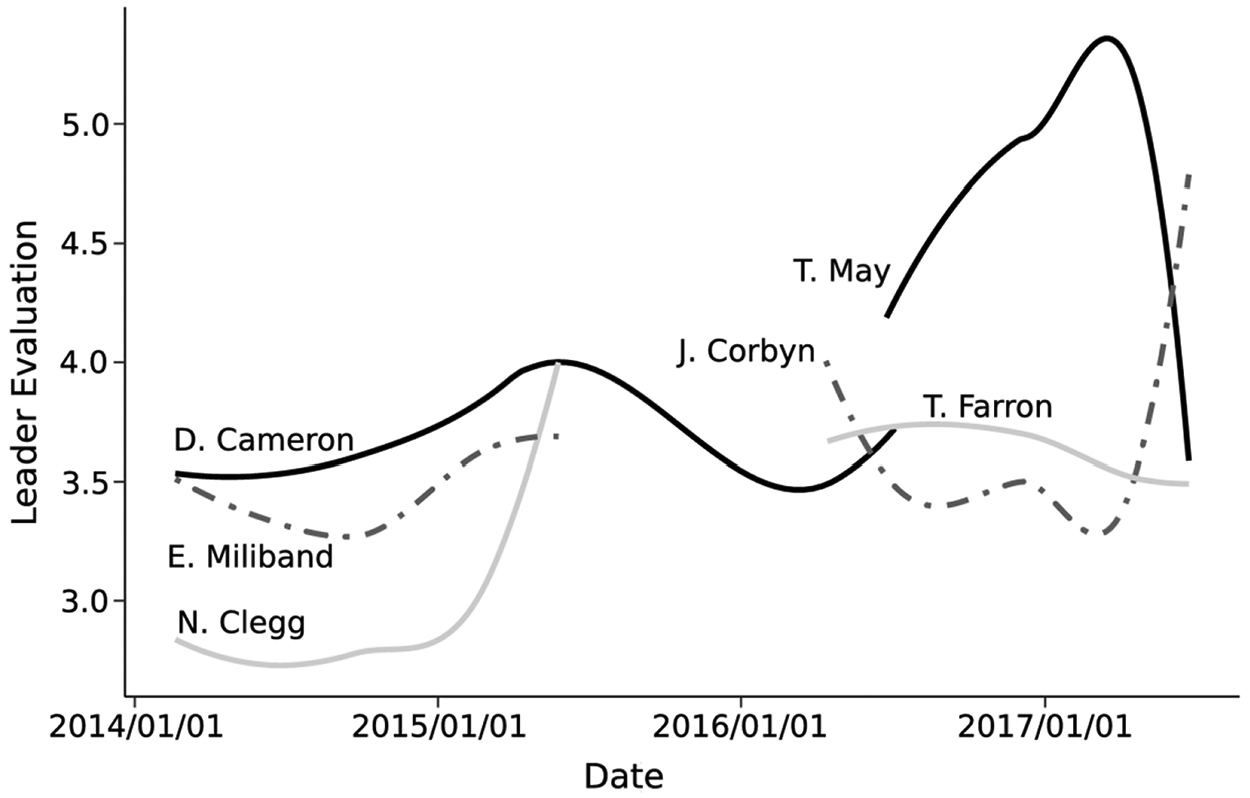
Voters’ evaluations of British party leaders, locally weighted scatter-plot smoothing (0 strongly dislike, 10 strongly like). Data: BES (Fieldhouse et al., 2017).
I use voters’ evaluations of party leaders assessed on an 11-point thermometer scale (0 strongly dislike, 10 strongly like) as dependent variable in the aforementioned growth models. Thermometer scales have been used frequently in studies of party leaders (Bittner, 2018b; Garzia, 2017) and as measure of voters’ expectation of their performance in government (Clarke et al., 2004). Clarke et al. (2011) show that these thermometer scales are closely tracked by competence evaluations. As control variables, the age of respondents at the time of entry to the panel, their gender and education level (0 no qualifications, 5 Postgraduate) are included. The valence signal of economic performance is measured with respondents’ retrospective general economic perception (1 very dissatisfied, 5 very satisfied). 6 I also include a variable that measures if respondents identified with a party leader’s party 7 and how strong they identify with the party (1 not very strong, 3 very strong).
I furthermore control for a dichotomous time-varying variable that captures how respondents would vote in a referendum to exit the EU, and how they actually voted at the referendum, to track the influence of Brexit as a highly visible issue. On this issue, the party leaders under study significantly differ in their position. While Cameron campaigned for Britain to remain in the EU, May became prime minister to deliver on the result of the referendum and leave the EU’s single market (hard Brexit). In contrast Farron, and his party wanted to remain in the single market (soft Brexit), and sought a second referendum on Britain’s final deal with the EU (Hobolt, 2018). Corbyn’s position on Brexit matches the ambiguous (Hobolt, 2018) position of Labour during the 2017 general election. While Corbyn stated before the 2016 referendum that Labour wanted to remain in the EU, his previous eurosceptic positions signalled some uncertainty. In addition, members of his party criticised him for lack of engagement in the referendum. He also did not share the remain platform with Tony Blair and Ed Miliband during the referendum. Even after the recent general election, Corbyn’s ambiguity on Brexit has been mentioned in political commentaries (Malik, 2018; Menon, 2018). Although Corbyn’s position on Brexit is not as clear as the position of other party leaders, he at least offered some sort of ‘softer’ alternative which should appeal to remainers. A softer Brexit should be positionally closer to voters who want to remain in the EU, and should be preferred over a harder Brexit.
Finally, time as a central variable that measures the real time between the start of the panel and the date respondents’ interviews is included. The variables is a ratio on which the value one represents the passing of 6 months. 8 I fit unconditional means models to quantify the amount of interpersonal differences in the evaluation of party leaders and find that between 61% and 84% of the variation could be explained by such differences. Unconditional growth models with linear change over time show that 3%–21% of variation in voters’ evaluations of party leaders could be explained by linear change. 9 This would only be a meaningful amount of change for some leaders. However, the graphical analysis of voters’ evaluations of party leaders over time in Figure 1 has shown that the changes in evaluations are not strictly linear. Upon further inspection of individual-level variation over time, I conclude that the change in voters’ evaluations of party leaders can be approximated in a linear form if the models allow for changes in slope and elevation determined by political events. One included event is Cameron’s resignation as prime minister as a possible elevation in voters’ growth curves. In addition, two variables which identify the time period of election campaigns are included. First is a dichotomous measure that spans the 2 months before a general election and the month immediately after the general election. Second is a variable that measures the elapsed time from 2 months before the election. I also consider that the importance of Brexit as an issue has gained salience over time and therefore interact it with measures of time. All variables which measure time in addition to the general time variable allow for a change in voters’ trajectories of change. Finally, a possible change in slope for voters’ evaluations of Cameron after he announced the results of his negotiations with the EU and that a referendum would be held in the following year is included.
Findings
In this section, I present and debate the findings of my statistical models. Main results are displayed graphically and detailed regression results are provided in the Online Appendix (Tables A1–A7).
Figure 2 shows the effect of voters’ PID, their stance on Brexit and the retrospective perception of the economy on the evaluation of the party leaders under study. I find that between-person effects are considerably larger than the within-person effects, which are not biased by unobserved heterogeneity. PID shows the largest effect on the evaluation of party leaders. Those voters whose identification with their party weakens also evaluate the party leader less favourably. The respective effect sizes of within- and between-person effects are quite similar for all party leaders. In comparison with voters’ PID, their stance on Brexit and their perception of the economy have smaller effects on party leader evaluation. All effects work in the hypothesised directions. Voters who support Brexit hold a higher evaluation of May, while their evaluation of other party leaders decreases. It is notable that the difference from between- to within-person effect of Brexit is the smallest for Cameron and that the direction of the effect changes direction. In the between-person effect remainers evaluate Cameron less favourably, while the within-person effect shows the opposite. The within-person effect of voters’ economic perception works in the hypothesised direction as well. Voters who perceive the economy to be in a better state also evaluate both party leaders who hold the office of prime minister more positively. There is no effect of economic perceptions on the evaluation of Corbyn and Miliband, while I find a minor effect of economic perceptions for Clegg and Farron. The effects for the Lib Dem leaders work in opposite directions, but coincide with differences in government incumbency. The effect of economic perception on the evaluation of Clegg who held the office of deputy prime minister is positive, while the effect on the evaluation of Farron as part of the opposition is negative.

Within- and between-person effect of voters’ PID, stance on Brexit and economic perception on the evaluation of party leaders (95% confidence intervals, approximation with Wald statistics). Other covariates not shown.
The presented findings support H1, H2 and H3. In addition, I also find that the effect of voters’ economic perception and stance on Brexit are not constant over time. Time variation in economic perception and Brexit effects are shown in Figures 3 and 4.
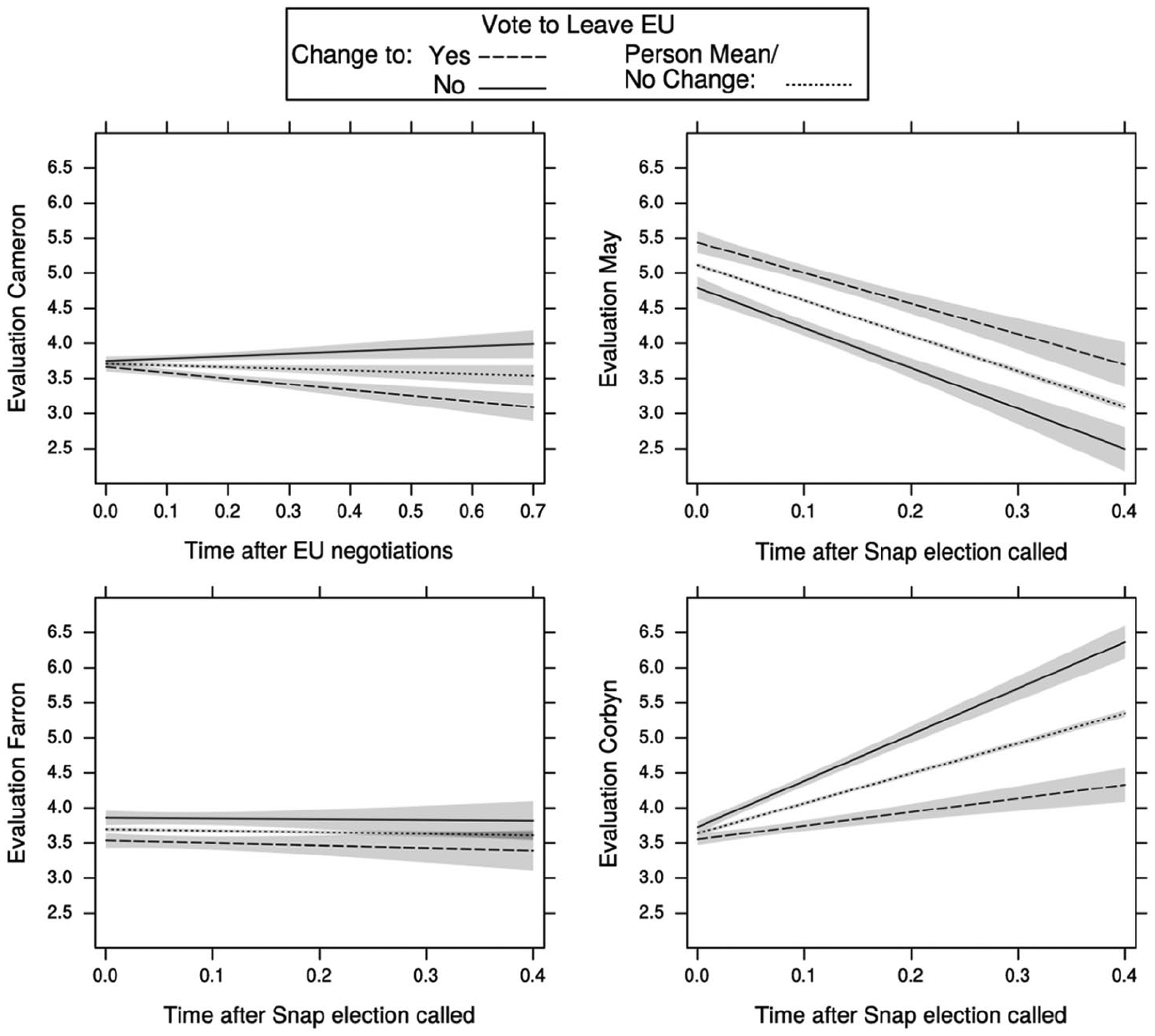
Interaction effect plots (predicted values) of respondents’ stance on Brexit and time on the evaluation of party leaders (95% confidence intervals). The figure displays values for respondents who held a clear leave- or remain-position over time in order to facilitate graphical clarity. A figure which included values for respondents whose stance on Brexit was mixed is provided in Supplementary Figure S4.
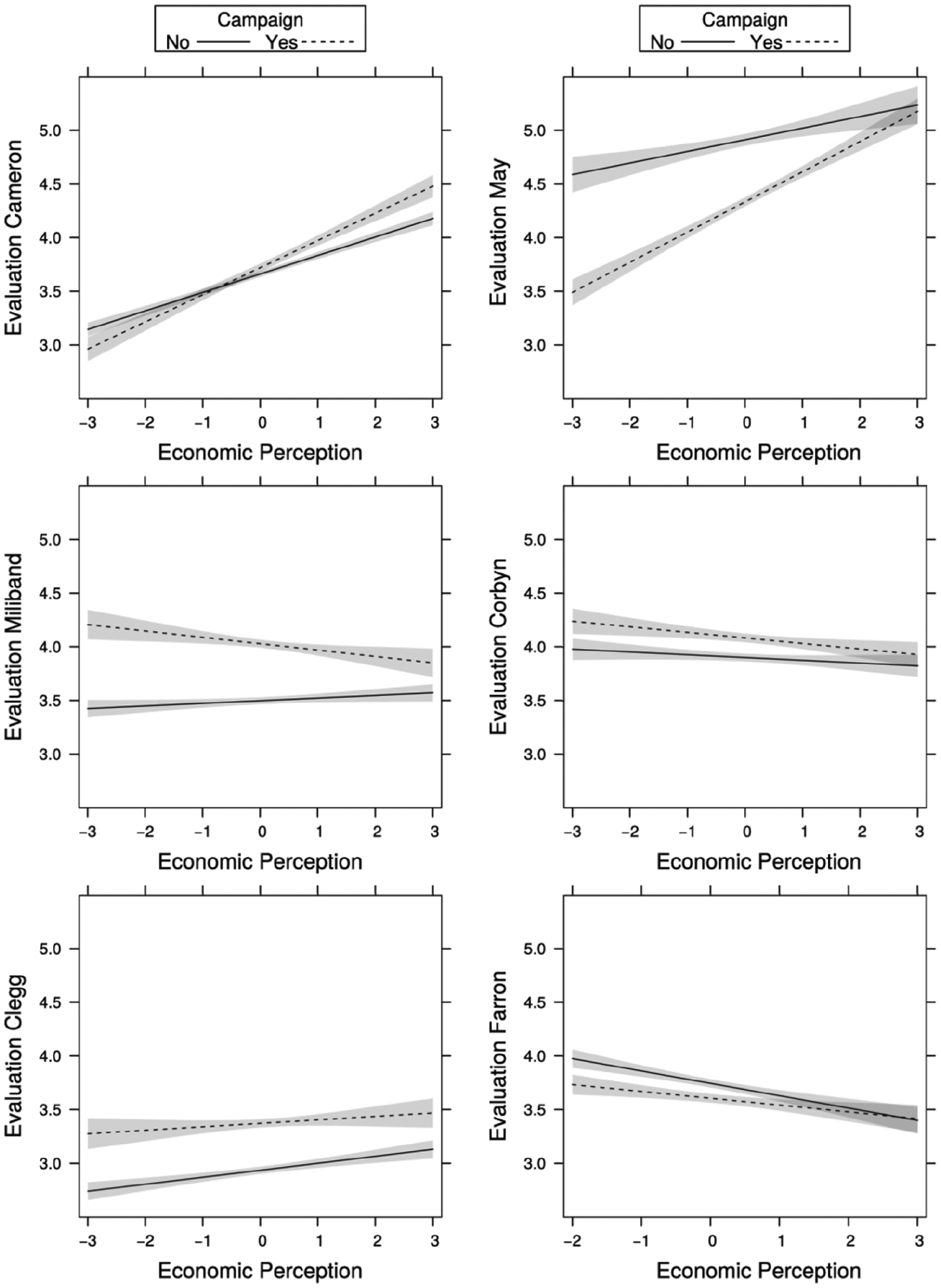
Interaction effect plots (predicted values) of respondents’ retrospective perception of the UK’s economy during and out of election campaigns on the evaluation of party leaders (95% confidence intervals).
I have theorised that the salience of Brexit as an issue is likely to have increased over time. Interactions of the within effect of voters’ stance on Brexit with time measuring variables test this hypothesis. These interactions are omitted in the models for Miliband and Clegg since it is unlikely that the salience of Brexit significantly increased before the general election in 2015.
Figure 3 shows the interaction between respondents’ stance on Brexit with elapsed time on the evaluation of party leaders. The first upper-left plot shows that respondents’ stance on Brexit had no significant influence on their evaluation of Cameron before his negotiations with the EU finished. After these negotiations, as the referendum drew closer, Cameron’s stance on Brexit became more influential for voters’ evaluation of him. Over time, respondents who shared Cameron’s stance and who answered that they would not vote for Britain to leave the EU viewed him increasingly positively compared with voters who wanted to leave the EU. The other plots show the interaction between voters’ stance on Brexit and elapsed time after May had called a snap election in 2017. The referendum on Brexit had already taken place, negotiations between the UK and the EU had started and May sought to fortify her party’s majority in parliament. At this point in time, Brexit already was a salient issue, as is visible in its significant effect on voters’ feelings towards May and Farron. However, in contrast to Cameron, there is no significant interaction between Brexit and time for May and Farron.
In comparison, the effect of Brexit on voters’ feelings towards Corbyn is negligible before May called a snap election. After the announcement of the snap election, however, the effect of voters’ Brexit stance on the evaluation of Corbyn shows a pattern similar to that of Cameron. Over time, voters who wanted to remain in the EU held more and more positive feelings towards Corbyn compared with voters who wanted to leave. This development further supports the conclusion that campaign dynamics may lead voters to re-evaluate party leaders who increasingly engage with a salient position issue.
Voters’ stance on Brexit is not the only effect that might vary over time. I have hypothesised that the effect of voters’ perception of the economy may be larger around elections. Figure 4 tests this hypothesis and shows the interaction between economic perception and a dichotomous campaign measure. The bottom axis of the plots depicts respondents’ retrospective economic perception from ‘worse’ to ‘better’ while the plot lines show the effect during and between electoral campaigns. These results re-emphasise that economic perception matters for party leaders who hold the office of prime minister, but not for other party leaders. The results also show that the effect of voters’ economic perception on the evaluation of May and Cameron is larger around the two general elections. This change in effect is most pronounced for May where it is three times larger. In case of other party leaders, the effects stay similar between and around elections. The effect of economic perception becomes significant during elections in case of Miliband and the effect size decreases in case of Farron. There are no significant changes in the effect for Clegg or Corbyn. These findings support the hypotheses that the valence signal of economic performance becomes stronger during parliamentary elections (H4).
Finally, Figure 5 shows the result of two piecewise regressions (full results are presented in Table A7 in the Online Appendix) that test H5: Whether negative economic perceptions have a larger effect on the evaluation of leaders in the position of prime minister than neutral or positive perceptions of the economy (grievance effect). That neutral and positive perceptions matter less than negative perceptions is tested by the covariate D Non-Negative Economic Perceptions which measures the unit change in economic perceptions for non-negative values, and therefore measures the change in slope for non-negative perceptions. The results provide mixed support for H5. On the one hand negative perceptions of the economy have a larger within-person effect on the evaluation of May (0.09 points), but on the other hand the opposite holds true for the evaluation of Cameron. Non-negative economic perceptions have a larger within-person effect on voters’ evaluation of Cameron (0.07 points). The between-person change in slope is negative for both prime ministers but does not exclude zero in case of Cameron. Negative economic perceptions have a particular strong between-person effect on the evaluation of May, which is about twice as large as the effect of non-negative evaluations.
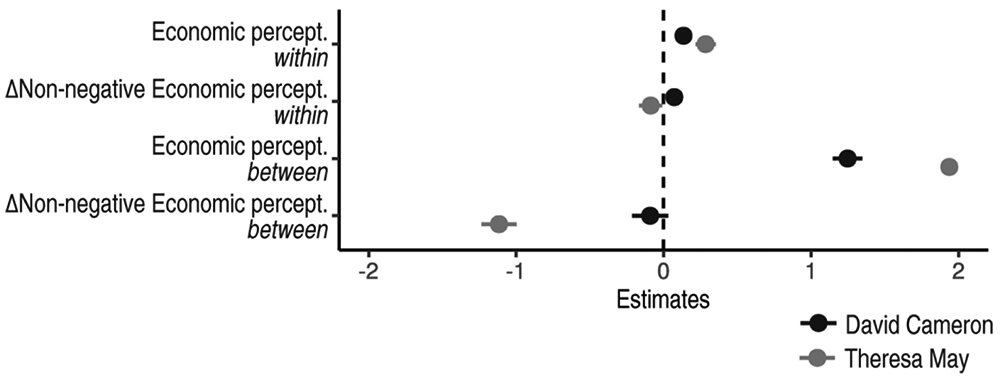
Within- and between-person effect of economic perception on the evaluation of party leaders and change in slope of non-negative economic perceptions (95% confidence intervals, approximation with Wald statistics). Other covariates not shown.
In conclusion, stances on Brexit, PID and economic perception do matter for voters’ evaluation of party leaders. The same holds true for election campaigns. Not only does the effect of Brexit and the effect of economic perception vary over time. I also find considerable effects of elapsed campaign time on the evaluation of May, Corbyn and Clegg. These time-effects likely point towards changes in voters’ evaluation of party leaders that are not explained by voters’ changes in economic perception, PID and position on Brexit, as the mere passing of time should not significantly affect voters’ feelings towards party leaders. It may therefore be worthwhile to explore additional salient issues. Electoral campaigns may also provide voters with more frequent information on the valence attributes of party leaders.
Overall, the empirical findings match the hypothesised relationships. Established factors of electoral behaviour, like issues, economic perception and PID are able to explain why voters change their evaluations of party leaders. Electoral campaigns and time moderate some of these effects.
Robustness checks
To test the robustness of the presented findings models for H1–H4 are re-estimated with two alternative specifications. These models are shown in Tables A1 to A6 in the Online Appendix. In a first step, an additional model tests whether differences in the effect of economic perception during election campaigns are caused by differences in political attention. Voters’ may simply pay more attention to signals of party leader valence attributes during election campaigns. Changes in the effect of economic perception may therefore be driven by changes in voters’ general attention and not because the economy becomes a more salient issue. Furthermore, increases in political attention, which is measured on a scale from 0 (no attention) to 10 (a great deal of attention), could be masked by the dichotomous campaign period measure.
I find that the overall level of political attention does not vary over time and is therefore not masked by the campaign period measure (see Figure A2 in the Online Appendix). However, to further ensure that the interactions between economic perception and campaigns are not driven by certain voters who change their political attention, Tables A1–A6 also control for a possible interaction between political attention and economic perception. These additional models do not show any significant interaction between political attention and the effect of economic perception and do not negate the interaction of interest.
In a second robustness check, voters’ PID is replaced with their thermometer evaluation of the party leader’s party (0 strongly dislike, 10 strongly like). This measure captures a wider range of voters’ perception of political parties than PIDs. On the downside, the causal relationship between voters’ thermometer evaluation of parties and party leaders is less clear than for PID. Although Figure S1 indicates that thermometer evaluations of parties are more stable than leader evaluations. The inclusion of party thermometers reduces the effects of economic perception and stances on Brexit, but the presented findings remain robust. Voters’ thermometer feelings also considerably reduce the difference in between- and within-person effects. This suggests that PIDs may indeed not sufficiently describe voters’ assessment of the political parties.
These tests show that the presented findings remain robust to alternative specification and additional explanatory variables. Nevertheless, the results are limited by covering party leaders from one country only. Empirical findings on economic factors in voting behaviour have been shown to be consistent across electoral systems (Dassonneville and Lewis-Beck, 2017); therefore, the presented relation between economic perception on the evaluation of party leaders is likely to be stable across countries. However, since the institutional setting and power of prime ministers differs between countries, the valence signal of economic perception for party leaders who hold the office of prime minister could still systematically differ between countries. With these limitations in mind, I draw my conclusion and discuss how future studies may depart from the presented findings.
Conclusion
When and why do voters change their evaluation of party leaders? In this article, I provided answers to both of those questions. First, voters change their evaluation of party leaders at any point in time, but most strong changes and changes in trajectory are associated with parliamentary election campaigns. Second, I find a large effects on voters’ evaluations of party leaders in established factors of electoral behaviour: perceptions of the economy as valence signal, PIDs and Brexit as a salient position issue. Parliamentary elections may have become more personalised over the past decades. Yet, the presented findings suggest that voters’ evaluation towards party leaders do not simply reflect a ‘beauty contest’ (Curtice and Hunjan, 2011). Insofar the personalization of elections may endanger the democratic function of elections to a lesser extent than is commonly feared.
With regard to electoral campaigns the results suggest that campaigns may be crucial for party leaders to change the electorate’s perception of them. Additional studies should explore the role of electoral campaigns further. Hart (2016) has shown that candidates can deactivate the salience of economic issues by means of campaign strategy. It may also be possible for party leaders to deactivate the presented effect of voters’ economic perception. This could be a strategic interest of party leaders in the position of prime minister under bad economic performance. Furthermore, comparisons between a larger number of prime ministers may resolve the mixed findings on economic grievances. It might be the case that voters’ evaluations of a newly appointed prime minister like Theresa May are more strongly affected by negative economic perceptions than voters’ evaluations of a leader with an established track record as head of the executive like David Cameron.
The fact that voters punish or reward party leaders who hold the office of prime minister for the state of the economy is a welcome finding. Yet, the other party leaders under study do not seem to be able to benefit directly from voters’ dissatisfaction with the economy and can only benefit indirectly if the prime minister’s evaluations decrease under a bad economy. This asymmetry in behaviour can lead to situations in which prime ministers or their opponents hold comparative advantages. While the state of the economy provides no direct valence signal for leaders other than the prime minister, future research may focus on the direct avenues through which other party leaders can signal their personal governing capability to voters.
Furthermore, the presented findings support the conclusion of Mellon et al. (2018), who find that the 2017 general election was dominated by voters’ attitudes towards Brexit, as the issue also explains changes in voters’ assessment of Theresa May and Jeremy Corbyn.
In this study, I have extended established findings on party leaders by performing a longitudinal analysis of voters’ evaluations of them. Party leader evaluations by voters vary considerably over time. A cross-sectional view on party leader evaluations may overestimate their stability and underestimate the impact of electoral campaigns on these evaluations. Overall, voters seem to include rational considerations in their evaluation of party leaders and apply personal accountability for the economy to prime ministers.
Supplemental Material
BPI886220_online_appendix – Supplemental material for The effect of voters’ economic perception, Brexit and campaigns on the evaluation of party leaders over time
Supplemental material, BPI886220_online_appendix for The effect of voters’ economic perception, Brexit and campaigns on the evaluation of party leaders over time by Jan Berz in The British Journal of Politics and International Relations
Footnotes
Acknowledgements
I am indebted to Helene Pedersen, Frederico Ferreira da Silva, Gideon Rahat and other workshop participants of the ‘Political Personalization and Personalized Politics’ panel at the ECPR Joint Sessions in Cyprus for their insightful comments on an earlier version of this paper. I would also like to thank the editor and the anonymous reviewers for their time and valuable comments, as well as Ceri Fowler, Jack Bailey and Ferdinand Müller-Rommel for encouraging feedback and critical remarks.
Funding
The author(s) received no financial support for the research, authorship, and/or publication of this article.

Supplementary information
Additional supplementary information may be found with the online version of this article.
Notes
References
Supplementary Material
Please find the following supplemental material available below.
For Open Access articles published under a Creative Commons License, all supplemental material carries the same license as the article it is associated with.
For non-Open Access articles published, all supplemental material carries a non-exclusive license, and permission requests for re-use of supplemental material or any part of supplemental material shall be sent directly to the copyright owner as specified in the copyright notice associated with the article.
