




Abstract
Addressing climate change requires international effort from both governments and the public. Climate change concern is a crucial variable influencing public support for measures to address climate change. Combining country-level data with data from the Pew Research Center Spring 2015 Global Attitudes Survey, we test whether perceived threats from climate change influence climate change concern. We distinguish between personal threat and planetary threat and we find that both threats have substantive effects on climate change concern, with personal threat exerting a greater influence on climate change concern than planetary threat. The effects of both types of threats are also moderated by Gross Domestic Product per capita, such that threats have stronger effects on climate change concern in high-income countries than in low-income countries. Our findings contribute to the existing literature and open up new debates concerning the role of threats in climate change concern and have implications for climate change communication.
Keywords
Introduction
Climate change is one of the most pressing international issues, which requires intense efforts from governments to tackle it. In addition to the implementation of government policies, the public has to make lifestyle changes to mitigate and adapt to climate change. Both of these changes require that the public sees climate change as a serious issue and makes it a priority for action (Konisky et al., 2016). In fact, many studies show that climate change concern influences support for climate policies as well as individual willingness to make lifestyle changes to address climate change (Leiserowitz, 2005).
Various studies have looked at the factors shaping public concern with climate change at individual and national levels (e.g. Kvaløy et al., 2012; Sandvik, 2008). In this article, we combine country-level data with data from the Pew Research Center Spring 2015 Global Attitudes Survey, which includes public opinion data from a wide range of countries to test whether perceived threats from climate change influence climate change concern. Some researchers have argued that highlighting the threats climate change poses may be helpful to bring climate change to the political agenda (Von Lucke et al., 2014). However, the effects of perceived threats from climate change on climate change concern have not been examined so far using cross-national data. Our study also distinguishes between two levels at which threats are perceived (cf. Stevens and Vaughan-Williams, 2016): personal threat to one’s self and immediate environment and planetary threat against the planet and humans as a result of climate change. We find that both types of threat have substantive effects on climate change concern, and that the effect of personal threat is stronger than the effect of planetary threat. We also find that the effect of planetary and personal threats on climate change concern is higher in high-income countries compared to low-income countries.
Our findings make several contributions to the literature. First, we show that perceived threats from climate change have positive effects on climate change concern. Second, some researchers pointed out that climate change is perceived usually as a threat to distant people and places than to one’s self here and now (Schultz et al., 2014; Tvinnereim et al., 2020). Our findings demonstrate that when climate change is perceived as a threat to the self and the immediate family, it has stronger effects on climate change concern. Therefore, if most people continue to perceive climate change as primarily threatening the planet and the humans, the effect of threat on concern could be relatively limited. Third, the finding that the effects of perceived threats from climate change are stronger in high-income countries has implications for climate change communication. Researchers discuss whether highlighting the various threats climate change poses is an effective way to communicate climate change (see Hulme, 2008; Risbey, 2008; Spence and Pidgeon, 2010). Our findings indicate that this may indeed be a strategy to increase climate change concern particularly in high-income countries.
Climate change concern and the role of threats
Climate change concern has a robust influence on support for climate-related policies (Leiserowitz, 2006: 45; Maibach et al., 2011). Both survey and experimental evidence show that climate change concern is associated with higher levels of support for national policies to address climate change such as increasing taxes on industries that contribute to climate change (Hart, 2011; Mayer et al., 2017) as well as individual willingness to engage in environment-friendly behaviours that reduce greenhouse gas emissions such as using less air conditioning in the summer or turning down the thermostat in the winter (Hart, 2011; also see Smith and Mayer, 2018).
Climate change concern is influenced by a variety of psychological, social, and background factors (Slovic, 2000). However, to date, the effect of threat on climate change concern have not been analysed using large-scale cross-national data. We also distinguish between different types of threats that individuals perceive from climate change at different levels (Stevens & Vaughan-Williams, 2016). In discussing threat perceptions and their effects on attitudes, the political psychology literature often distinguishes between different types or levels of threats. For example, personal and national or collective threats are treated as distinct but related concepts (Davis and Silver, 2004; Hetherington and Suhay, 2011; Huddy et al., 2002; Joslyn and Haider-Markel, 2007; Stevens and Vaughan-Williams, 2016). Personal threats are threats to one’s own physical well-being and are often more affectively arousing and generally elicit more fear and anxiety than perceived threats to the nation or the collective (Davis and Silver, 2004; Huddy et al., 2002). Some show that perceived threat to one’s self is a stronger determinant of attitudes towards more restrictive government policies than perceived threats to the collective. For example, Arian and Gordon (1993) find that personal threat is more emotionally arousing than perceived threats to the collective while Hetherington and Suhay (2011) show that those who perceive threats to their physical well-being due to terror tend to be more supportive of anti-democratic policies that restrict individual liberties (Hetherington and Suhay, 2011). While Huddy et al. (2002) show that the effect of national threat on the economic consequences of terrorism is stronger than the effect of personal threat, they also find that personal threats are more relevant for explaining willingness to change behaviour to mitigate threat.
Others find threats at the national or collective level to have stronger effects on attitudes than personal threats. For example, Feldman (2003) and Stenner (2005) find national threats to order and security to increase prejudice, intolerance, and support for tough law and order policies. Still, some suggest that the national-personal threat distinction may be limited in terms of its effects, especially concerning issues where ‘the global’ is of growing influence relative to the national (Stevens and Vaughan-Williams, 2016: 154). For example, issues such as globalisation or global warming could arouse threats at different levels (Stevens and Vaughan-Williams, 2016: 154–155). Global warming or climate change could be conceived as a threat to the planet as well as a threat to the physical well-being of the individual. In the discussion of climate change threats, then, we distinguish between personal threat from climate change, which is threat to oneself and one’s family and planetary threat, which is the perception that climate change threatens the world, including other species, the state of ecosystems and the planet (Diez et al., 2016).
Public opinion research on climate change attitudes also distinguishes between personal and global threats. For example, Helm et al. (2018) discuss the effects of personal and biospheric threats on adaptation to climate change. Perceived threats are defined as threats to one’s self or their family, while biospheric threats are perceived threats to other species or the state of ecosystems and the planet as a result of environmental degradation. The authors find that biospheric threat is positively associated with perceived ecological stress (i.e. how personally stressful individuals find environmental problems) and with ecological coping (psychological methods to cope with anxiety related to environmental issues) while the personal threats were unrelated to these variables. As threats have powerful effects on attitudes, they should also explain and predict concern with climate change. We, therefore, test to what extent two types of threats are related to climate change concern and whether the effects of these threats are conditional on national-level wealth of a country.
Other influences on climate change concern
Drawing on the relevant literature, we consider several influences on climate change concern. We start with country-level factors. Many studies have considered the relationship between a country’s economic development and public attitudes towards climate change and have come up with conflicting findings (Diekmann and Franzen, 1999; Dunlap and Mertig, 1997; Franzen, 2003; Franzen and Myers, 2010; Franzen and Vogl, 2013; Gelissen, 2007; Knight, 2016; Kvaløy et al., 2012; Sandvik, 2008). For example, Kvaløy et al. (2012) found negative but insignificant correlations between gross domestic product (GDP) per capita and concern for climate change while Franzen and Myers (2010) showed that people from wealthy countries are more concerned with climate change (Diekmann and Franzen, 1999; Franzen, 2003; Franzen and Myers, 2010; Franzen and Vogl, 2013). Conversely, Dunlap and Mertig (1997) argued that environmental concern is higher in poorer nations, which was later confirmed by Gelissen (2007) and Sandvik (2008). It is important to note that these findings are based on data from different sources collected from different countries at different time points, which may explain some of the conflicting results. Furthermore, the survey items measuring climate change concern differ, making it hard to compare the findings. Drawing on the literature on adaptive capacity, we expect individuals living in wealthy countries to be less concerned with climate change (Lo and Chow, 2015: 338). Adaptive capacity is the ability of individuals or communities to adapt to the impact of a given environmental hazard. According to Safi et al. (2012: 1042), adaptive capacity ‘reflects the resources available to the system under investigation (community, individuals, etc.) and the accessibility to these resources either for protection from risks or for survival and coping when risks happen’. As Nordås and Gleditsch (2007: 629) argue, ‘[t]he relative vulnerability of different regions to climatic change is largely determined by their access to resources, information, and technology, and by the stability and effectiveness of their institutions’. Since poorer countries tend to have less adaptive capacity to mitigate or adapt to climate change, we expect national wealth to be negatively associated with climate change concern.
Exposure to the adverse effects of climate change may increase climate change concern (Spence et al., 2011). Extreme weather events such as droughts, flooding, or above or below average temperatures may increase the sense of risk associated with climate change and lead to higher levels of concern. In fact, there is growing evidence of the effect of personal experiences on climate change attitudes. For example, Palutikof et al. (2004), Borick and Rabe (2010), Zaval et al. (2014), Egan and Mullin (2012), and Konisky et al. (2016) have found that changes in weather patterns and experience of extreme weather activity increase climate change concern and decrease climate change scepticism. Spence et al. (2011) showed that experience of flooding is associated with higher levels of concern over climate change as well as greater willingness to save energy to mitigate climate change. While we lack data about whether each individual was personally affected from extreme events or climate change-related disasters, we expect events occurring in an individual’s country to influence climate change concern regardless of personal exposure. Research shows that individuals do not need to be personally affected by disasters for their opinions to be influenced by them. News reports or even movies covering climate change events can change climate-related opinions. For example, using data from two nationally representative surveys, Leiserowitz (2004) found that those who watched the movie The Day After Tomorrow had higher global warming risk perceptions than those who did not. Experiencing climate change-related disasters in one’s country may have similar effects on climate change concern. Even if individuals are not exposed to such disasters personally, they are often exposed to news stories that also contain images of such disasters.
Finally, the literature shows the influence of cultural values on public attitudes towards climate change (Inglehart, 1995; Kvaløy et al., 2012; Leiserowitz, 2006). One of the critical cultural values that influence pro-environmental attitudes is postmaterialism. Inglehart (1995, 1997) argues that advanced industrialised countries experienced a fundamental value shift during 1970s such that the affluence and material security provided by prosperity led these countries’ citizens to shift their concern from economic struggle and survival (i.e. materialist concerns) to postmaterialist goals, such as political and individual freedom, identity concerns, and environmental issues (Inglehart and Welzel, 2005). However, the findings concerning the relationship between country-level postmaterialism and environmental and climate change concern are often contradictory. For example, while Kvaløy et al. (2012) found a positive correlation between postmaterialist values and concern for climate change, Franzen and Myers (2010) and Franzen and Vogl (2013) reported that environmental concern was not associated with the proportion of postmaterialists to materialists in a country. Nevertheless, we expect postmaterialism to be positively associated with climate change concern based on Inglehart’s theory concerning value priorities in postmaterialist nations.
We also consider the effects of individual-level variables. First, studies consistently find that women are more environmentally concerned than men (Franzen and Myers, 2010; Zelezny et al., 2000). This may be because women are generally socialised into being compassionate, caring, and empathetic (McCright et al., 2016) or because women tend to be more risk averse than men (Egan and Mullin, 2017). Women are more afraid of victimisation and tend to overestimate risks to themselves and society as a whole (Huddy et al., 2002) including climate-change induced risks and events (Safi et al., 2012). We therefore expect men to be less concerned with climate change than women. Second, some expect younger people to be more concerned about new politics issues, such as the environment, gender, freedom, and autonomy (Dalton, 2006; Inglehart, 1995). However, evidence concerning the effect of age on climate change concern is far from conclusive. Although some studies found greater climate change concern among the young (Egan and Mullin, 2017; McCright et al. 2016), others found a negative relationship between age and climate change concern (Lewis et al., 2019; Smith et al., 2017; Tjernström and Tietenberg, 2008), and yet, some others have found an insignificant relationship (Gray et al., 2019). Yet, some argued that the relationship between age and climate change concern is curvilinear, such that the greatest concern is observed among those aged between 30 years and 60 years (Kvaløy et al., 2012). Given these inconclusive findings, we do not have concrete expectations about the relationship between age and climate change concern.
Furthermore, based on existing research, we hypothesise that level of education is positively related to climate change concern (Franzen and Myers, 2010; Kvaløy et al., 2012; Lee et al., 2015). Education provides cognitive resources that facilitate the understanding of the scientific underpinnings of climate change and gives the citizens the capacity to participate in political action (Kvaløy et al., 2012: 12; Marquart-Pyatt, 2008). Education is also associated with an appreciation of the environment and understanding of the ways that it benefits the society (Smith et al., 2017). Educated individuals have better access to information relevant to climate change, including early warning signals (Striessnig et al., 2013: 15). For similar reasons, we also expect social media use to be positively related to climate change concern (Lee et al., 2015). The media is a highly significant factor in the public’s understanding and perceptions of climate change issues (Wahlberg and Sjoberg, 2000; Weingart and Pansegrau, 2003). While we expect social media usage to be positively associated with climate change concern, in the data, we are unable to discern what type of social media news survey participants consume and how often they consume such content.
Personal economic security is generally associated with greater concern with climate change (Scruggs and Benegal, 2012). Higher levels of personal security brought about by high levels of income allows individuals to consider non-material concerns such as environmental issues, personal freedoms, and freedom of expression (Smith et al., 2017). To the contrary, those with lower levels of income focus more on immediate economic necessities and concerns. We therefore expect income to be positively related to climate change concern.
We also consider the effect of postmaterialist values at the individual level. As with country-level postmaterialism, we also expect individual-level postmaterialism to have a positive effect on climate change concern. Those living in rural areas, particularly farmers, may be more vulnerable or exposed to the effects of climate change (Tschakert, 2007). Poor infrastructure may also contribute to higher levels of insecurity due to extreme climactic events in rural areas. Finally, we consider the role of individual religiosity. The literature provides conflicting findings of its effect on attitudes towards climate change. While some report negative relationships between religiosity and environmental concern (Eckberg and Blocker, 1989; Guth et al., 1995; Wood and Vedlitz, 2007), we do not necessarily expect religiosity to influence climate change concern. Religiosity is often associated with values prioritising security (Saroglou et al., 2004). This may increase climate change concern because security-seeking individuals are generally more worried about challenges that pose great uncertainties to themselves or to their society. However, religious individuals also tend to be politically conservative (Malka et al., 2011), which is often associated with lower levels of climate change concern (McCright et al., 2016). Therefore, religiosity may not have consistent effects on climate change concern. In fact, some analyses found opposing considerations associated with religiosity to cancel each other out, leading to null effects of religiosity on attitudes (Arikan and Ben-Nun Bloom 2019; Malka et al., 2011).
Data and variables
Data source
The individual-level data come from the Pew Research Center Spring 2015 Global Attitudes Survey. The surveys were conducted between March and May 2015 through telephone or face-to-face interviews. The major advantage of this dataset is that it is one of the most recent public opinion surveys that include a variety of questions concerning global climate change while covering a diverse sample of countries. These countries are highly varied in socioeconomic development, democracy, geography, culture, environmental degradation, and environmental policies. Supplementary Appendix Table AI shows the countries included along with summary statistics of key country-level variables. While the World Values Surveys also include a large set of countries, their most recent wave (2010–2014) does not include questions about environmental or climate change-related attitudes. The International Social Survey Programme (ISSP) has a survey on environmental attitudes dating back to 2010, while the most recent European Social Surveys (ESS) have a broad set of questions concerning environmental attitudes and attitudes towards climate change. However, they both cover a less diverse set of countries. Studies that primarily cover the developing world may produce country and culture-specific results that prevent findings being generalised across diverse contexts (Lee et al., 2015). Therefore, to make our results more generalisable across contexts we decided to use the Pew survey as our main data source.
Dependent variable
To measure our dependent variable, climate change concern, we used a survey item that asks respondents to what extent they are concerned with global climate change. 1 We coded the response categories such that respondents who stated that they were ‘very concerned’ or ‘somewhat concerned’ received a score of 1, while those who stated that they were ‘not too concerned’ or ‘not at all concerned’ received a score of 0.
Threat perceptions
We used two questions that asked respondents whether they perceive global climate change as harming the world and themselves personally (cf. Thaker et al., 2017). 2 To measure planetary threat, we used a question that asks respondents whether they believe global climate change is harming people around the world now, will harm people in the next few years, will not harm people for many years, or will never harm people. Respondents who chose either of the first two options were given a score of 1 as these individuals perceive climate change as an immediate or very near-future threat. The other respondents were given a score of 0. To measure personal threat, we used a question that asks respondents to what extent they believe global climate change will harm them personally at some point in their lifetime. We recoded responses into two categories such that those who are very concerned or somewhat concerned about being harmed by climate change received a score of 1, while those who say that they are not too much concerned or not at all concerned received a score of 0.
Individual-level control variables
These variables include gender (coded 1 if respondent is male, 0 otherwise), age (age of respondent), age-squared, income (ranges from 0 to 1, where 0 represents the lowest category of income in country of residence of respondent, and 1 for the highest category of income, with other categories taking integer values between 0 and 1), level of education (years of education), urban residence (1 for urban or semi-urban locality, 0 otherwise), and importance of God in respondent’s life (coded between 0 and 1, where 1 indicates highest level of importance, and 0 denotes no religious attendance or very infrequent attendance, with other frequencies taking values in between). Social media use is a dichotomous variable where 1 indicates that the respondent is a social media user (Facebook, Twitter, or other social media site specific to country).
We used three questions to construct an additive index of individual postmaterialist orientation. These questions ask respondents whether they believe media organisations should be able to publish news about (1) large political protests in the country, (2) economic issues that might destabilise the country’s economy, and (3) sensitive issues related to national security, or whether they think that the government should be able to prevent media organisations from publishing these issues under some circumstances. Higher index scores represent stronger agreement with statements in favour of media freedom on these issues. The original postmaterialism measure developed by Inglehart (1990, 1997) asked respondents to choose from a list of policy priorities that represent the tension between materialistic concerns (such as maintaining order and fighting rising prices) and individual freedoms (giving people more say in political decisions and maintaining freedom of speech). While the Pew survey did not include questions with these wordings, the set of questions about media freedom also require respondents to make a choice between stability and order at the expense of freedom of expression. Respondents who tend to favour government suppression of media when political and economic stability and national security are at stake must be giving more importance to materialistic concerns at the expense of individual freedom.
Country-level variables
Purchasing power parity adjusted GDP per capita for 2015 is taken from the World Bank. We used the logged version of this variable in the multivariate analyses. Data for postmaterialist value orientations at the national level are taken from the World Values Surveys. We took the mean level of postmaterialism index for each country that was available in the most recent two waves of the surveys (Wave 5 and Wave 6). If data on Wave 6 was present for a country, we coded that value. If data for Wave 6 did not exist for a country but was available for Wave 5, then this value was coded. To investigate the effects of environmental disasters on attitudes towards climate security, we used the EM-DAT database to gather data on the number of people requiring immediate assistance during a period of emergency (including basic survival needs such as food, water, shelter, sanitation, and immediate medical assistance) following climatological, hydrological, or meteorological disasters (see Kvaløy et al., 2012). As the number of people affected by a climate change-related natural disaster should be considered relative to a country’s population, we divided the number affected by the country’s population such that the final values reflect the number affected per 1000 people in a country. Since surveys were conducted in spring 2015, disasters that occurred after data collection but were still recorded as 2015 data could have biased our results. We therefore used data for disasters that occurred in 2014.
Descriptive statistics and correlations between variables are presented in Supplementary Appendix Table AII and AIII. Before running the models, we also calculated the variance inflation factors (VIFs) for the independent variables specified in the model to check whether multicollinearity is a potential problem (Supplementary Appendix Table AIV). The mean VIF value was 1.37 and the VIF values for variables ranged from 1.03 to 2.40, which is much below the threshold values considered to indicate serious multicollinearity (generally VIF > 10; see Kennedy, 1992).
Results
We used multilevel (mixed effects) modelling to account for the hierarchical structure of the data by allowing the intercept to vary between countries (Gelman and Hill, 2007). Since the dependent variable was binary, we used multilevel logit modelling for the analysis. STATA 15 was used to run all the models. We specified cluster-robust VCE estimators to obtain Huber/White/sandwich estimators for the estimated coefficients (Wooldridge, 2013). Some data at the individual level (postmaterialist orientations) and some country-level variables such as EM-DAT data, are not available for all countries in the Pew survey. As a result, the final number of countries included in our analyses is 24.
Table 1 presents the results from the multilevel model testing for the effects of planetary and personal threats along with other control variables. Coefficients from logit models cannot be interpreted directly. Therefore, we also present the marginal effects of each variable in the third column. The marginal effects refer to the change in probability when the predictor variable increases by one unit when all other variables are held at their means.
Individual and country level predictors of climate change concern: random-intercept models.

GDP: gross domestic product.
Entries are unstandardised coefficients, cluster-robust standard errors, and change in probability with a unit increase in the independent variable when other predictors are held at their means. Bold entries indicate p < .05 (two-tailed).
We first discuss the effects of individual-level variables. Since all our individual level variables with the exception of age and years of education are coded to vary between 0 and 1, the marginal effect shows the change in probability when moving from the minimum to the maximum value of the predictor variable. As expected, both planetary and personal threats are substantive and significant predictors of climate change concern. The change in probability for planetary threat is calculated as 0.081, which means that the change in probability when moving from not perceiving climate change as a threat to the planet to perceiving it as a threat increases by 8.1 percentage points. The effect of personal threat on climate change concern is also positive and much more substantive than the effect of planetary threat. The change in probability when moving from not perceiving climate change as a personal threat to perceiving it as a threat is about 21%, almost three times the effect of planetary threat. The difference between the coefficients of personal and planetary threat is statistically significant as well (p < .000). 3 This suggests that perceived threat to one’s self is associated with greater level of concern with climate change compared to perceived threat to the planet, ecosystems, and humans around the world and is in line with the argument that psychological distance of climate change leads to lower levels of climate change concern (Spence et al., 2012).
The findings also reveal that gender is a statistically significant predictor of climate change concern. All else being equal, being male is associated with reduced concern with climate change as expected and in line with previous studies (cf. Franzen and Vogl, 2013; Franzen and Myers, 2010; Kvaløy et al., 2012). Being a male reduces the probability of being concerned with climate change by about 2.4 percentage points. Contrary to the hypothesis that younger people care more about new politics issues such as climate change (Dalton, 2006), we find age to have positive and statistically significant effect on climate change concern. The predicted marginal effect of one unit increase in age is 0.0006. This means that, all else being equal, the expected change in predicted probability between an 18-year-old respondent and 48-year-old respondent is about 2%.
Our results also show that both income and years of education are significant predictors of climate change concern. The change in predicted probability when moving from the lowest to the highest level of income is 1.5 percentage points, which is in line with the expectation that economically more secure individuals express greater concern with environmental and climate change-related issues. The effect of education is also in line with our expectations and the findings of previous studies (Franzen and Myers, 2010; Franzen and Vogl, 2013; Kvaløy et al., 2012). All else being equal, 1-year increase in education leads to an increase in the predicted probability of being concerned with climate change by about 0.2 percentage points. This finding is also in line with the expectation that education increases the cognitive skills and knowledge about the world around the individual, which in turn increases concern for climate change (Tjernström and Tietenberg, 2008).
The importance of religion, urban residence, and social media use did not emerge as significant predictors of climate change concern. While social media and other online sources have become an increasingly common source of information on climate change (Schäfer, 2012: 534), it seems like this is not necessarily associated with increased concern with climate change at the individual level. One reason for this might be that our measure did not necessarily capture the frequency of social media use or the type of content respondents access through the social media. Individuals may use social media for various reasons, including but not limited to news consumption. Even if social media sources include news stories, information, or discussions concerning climate change, it is possible that not all this content is equally accessed by all individuals. The framing of climate change in different sources or the overall tone or sentiment of the news and discussions could also differ (Cody et al., 2015; Günay et al., 2018) and may thus be the reason for the null findings.
Finally, individual-level postmaterialist orientations emerge as positive and statistically significant predictors of climate change concern. Moving from the lowest to the highest value of postmaterialism increases the probability of being concerned with climate change by about 1.5 percentage points. Thus, value priorities that emphasise non-material concerns are associated with higher levels of climate change concern, as we predicted.
We next discuss the effects of country-level variables. First, confirming our prediction based on the adaptive capacity argument and in line with the findings of Lo and Chow (2015), we found that GDP per capita has a statistically significant negative effect on concern with climate change. The marginal effect of logged GDP per capita is calculated to be −0.025. This means that the predicted probability when moving from the poorest to the richest country in our sample (log GDP per capita 7.373 for the poorest and 10.872 for the richest) decreases by 8.7 percentage points, when all other variables are held at their means.
Next, we did not find country-level postmaterialism to be associated with heightened concern with climate change, as shown by the statistically insignificant coefficient in the model presented in Table 1. Finally, while the coefficient of the number per 1000 in the population is positive, it did not reach statistical significance. Thus, vulnerability to climate change-related natural disasters does not seem to influence concern with climate change. This finding is contrary to our expectations, but in line with Kvaløy et al. (2012: 17), who found that people living in countries that are more prone to natural disasters are less concerned with climate change. These authors suggest that people in disaster-prone countries may have other perhaps more acute problems, while information systems may be less developed. These dynamics may weaken the link between natural disasters and assessments of the effects of climate change, which may explain why our analysis did not yield a statistically meaningful relationship between disaster exposure and climate change concern. Such a finding is also in line with recent research by Mayer et al. (2017) who found that exposure to environmental and climate risks (such as local CO2 emissions or being a coastal county) even at the local level do not necessarily increase climate change concern. These authors argue that the representation of the risks through media frames or political elites rather than actual exposure may be more critical in raising climate change concern. Such frames and messages are also important for individuals to make the causal link between the disasters and climate change, which is necessary for the experience of natural disasters to increase climate change concern (Weber, 2010).
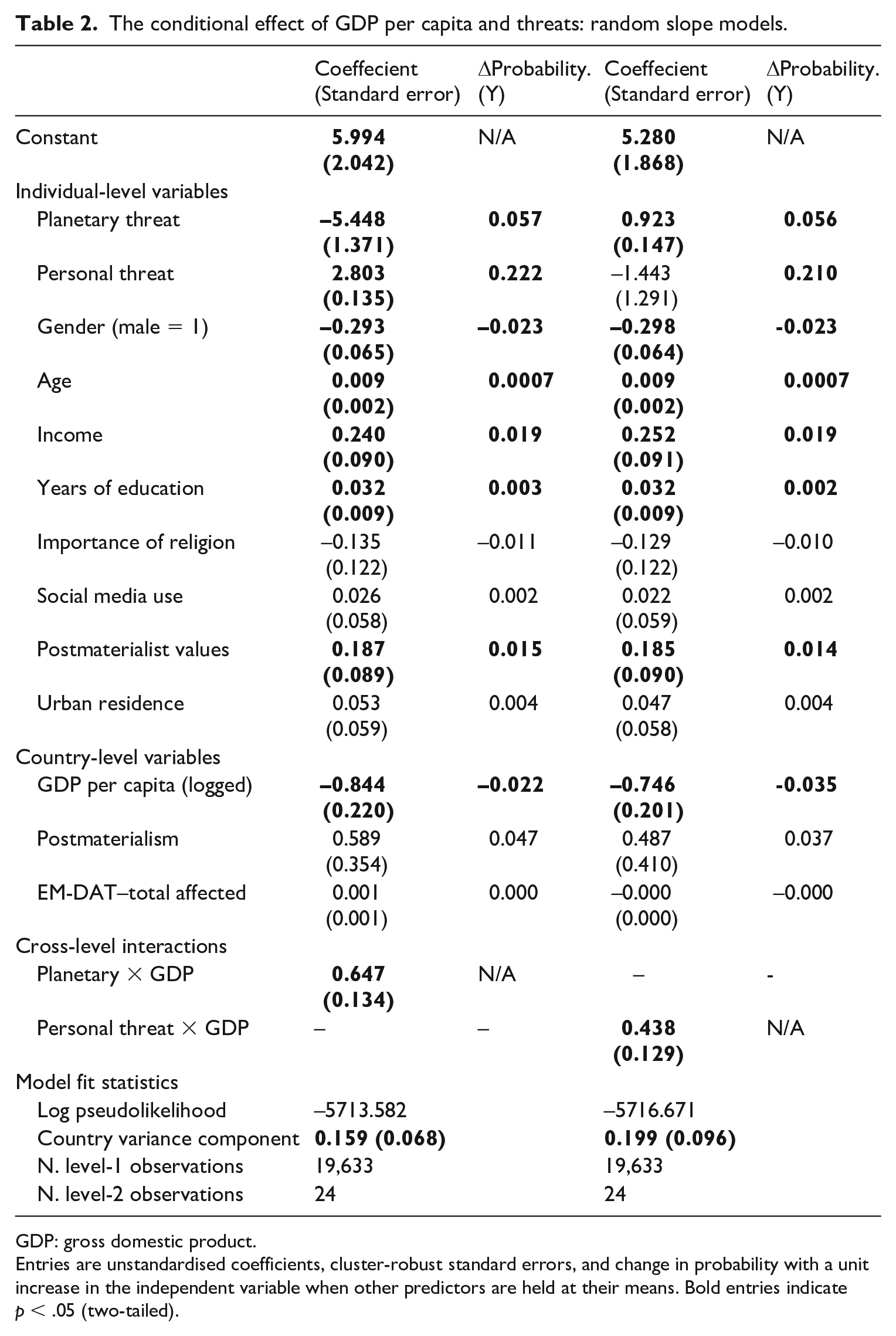
Next, we present the results from random slope models that consider the interactive effects of planetary and personal threats and GDP per capita. Results are presented in Table 2. As can be seen from the table, cross-level interactions between planetary and personal threats and GDP per capita are positive and statistically significant indicating that the effect of both types of threats on climate change concern is conditional on national wealth. While we present the marginal effects of each variable in the table, for variables in the interaction terms, the marginal effects refer to the change in predicted probability for one unit increase in the variable of interest on average rather than the conditional effects. This is why we computed the conditional marginal effects and 95% confidence intervals for both threat variables and plotted them in Figure 1.
The conditional effect of GDP per capita and threats: random slope models.
GDP: gross domestic product.
Entries are unstandardised coefficients, cluster-robust standard errors, and change in probability with a unit increase in the independent variable when other predictors are held at their means. Bold entries indicate p < .05 (two-tailed).
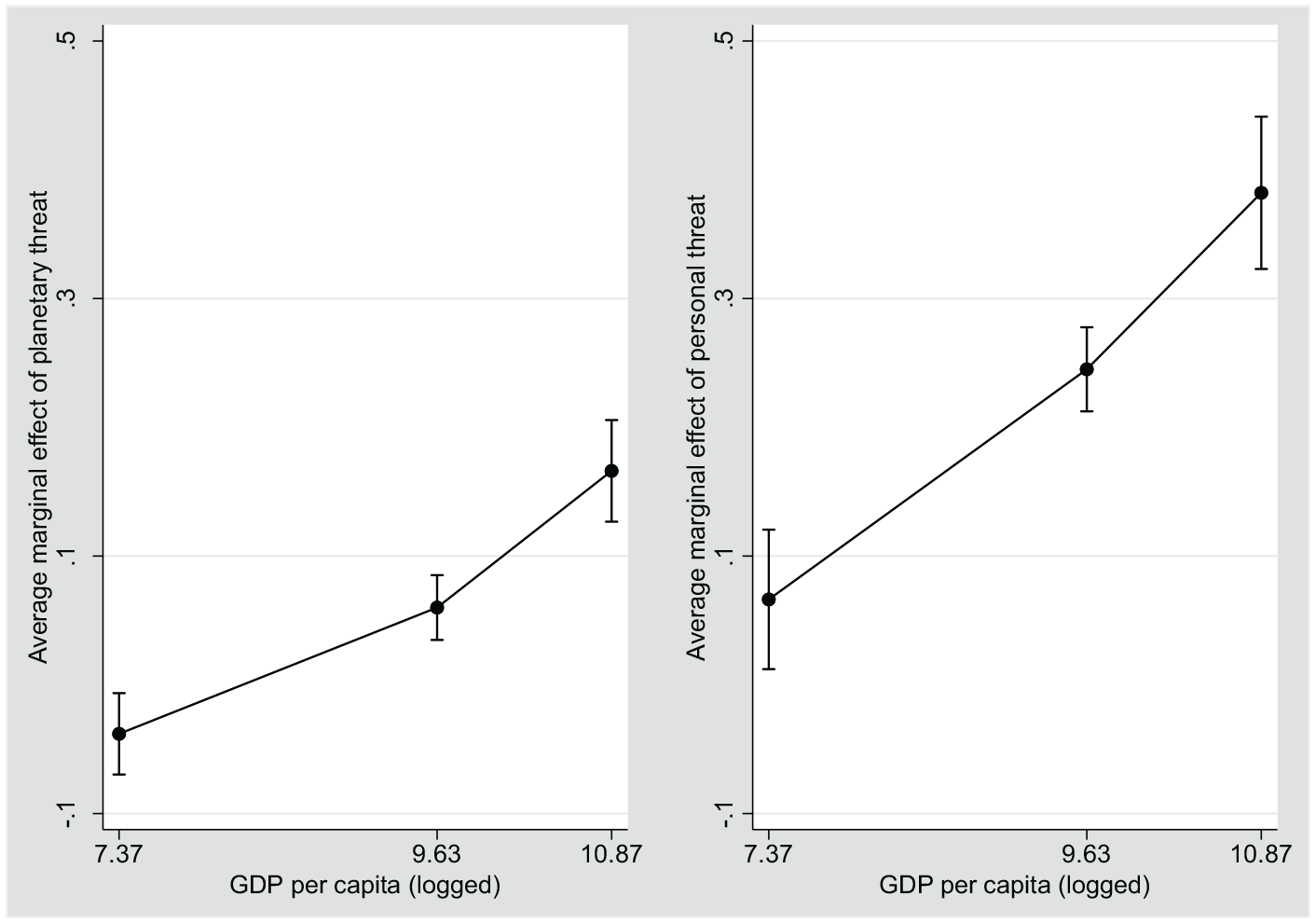
The effect of planetary and personal threats on climate change concern, conditional on logged GDP per capita (with 95% confidence intervals).
The left-hand side of Figure 1 plots the predicted marginal effect of planetary threat on climate change concern for minimum, mean, and maximum values of logged GDP per capita. As can be seen from the figure, at the lowest levels of logged GDP per capita, the marginal effect of planetary threat on climate change concern is negative. However, as GDP per capita increases, the effect of planetary threat becomes positive and statistically significant. At the highest value of GDP per capita, one unit increase in planetary threat (i.e. moving from no threat to perceiving climate change as threat to the planet) is associated with about 16% increase in predicted probability.
The right-hand side of Figure 1 shows that the marginal effect of personal threat on climate change concern is statistically indistinguishable from zero at the lowest levels of logged GDP per capita. Similar to planetary threat, the marginal effect of personal threat increases as logged GDP per capita increases. All else being constant, at the highest GDP per capita, moving from the lowest to the highest value of personal threat is associated with 39% increase in predicted probability for climate change concern. These findings indicate that the effect of planetary and personal threats on climate change concern is much stronger in high-income countries that have high levels of adaptive capacity. It is possible that in such countries, threat perceptions may be influential in convincing individuals that their country may not be able to cope with the impacts of climate change, and thus further contribute to climate change concern.
Discussion and conclusions
The role of perceived threats on climate change concern has been relatively understudied in the literature. This article fills this gap by distinguishing between climate change-related threats perceived at different levels and testing for their effects on climate change concern. We do this by combining cross-national survey data from the Pew Global Attitudes project with country-level data on national wealth, postmaterialism and exposure to climate change-related natural disasters, which enhances the generalisability of our findings.
Our finding that both personal and planetary threats exert robust and substantive effects on climate change concern is an important contribution to the literature. Various studies have looked at the effect of different demographic variables or the role of values and worldviews at the individual-level or the effect of disaster-proneness at the national or local level on climate change concern. However, the role of perceived threats from climate change has not been tested with large-scale cross-national survey data. Furthermore, our finding that the effect of personal threat on climate change concern is stronger than the effect of planetary threat also adds to the discussions about what type of threats is crucial in raising concern about climate change.
Our findings confirm some of the findings in the existing literature on adaptive capacity and add to it. In line with some of the previous findings we find that GDP per capita is negatively correlated with climate change concern. Sandvik (2008) describes this as ‘the uncomfortable truth’, that people living in wealthy countries do not want to face the reality of their responsibility for climate deterioration. However, we also find that personal threats have a stronger effect on climate change concern in countries with higher levels of GDP per capita. The media, political parties, non-governmental organisations, or climate change activists usually underline the threats associated with climate change when drawing attention to the issue (Hulme, 2008; O’Neil and Nicholson-Cole, 2009). Our findings further suggest that such communication strategies could be influential in raising concern especially when potential threats to individuals and their immediate families are emphasised, and especially in high-income country contexts. Future research could further test these implications by conducting experimental studies at different country contexts.
Our study also contributes to the political psychology literature. The effect of perceived personal or collective threats on various attitudes such as preference for tough law and order policies, attitudes towards immigration policies and border controls, or defence policy have been extensively studied (Stevens and Vaughan-Williams, 2016). However, there is relatively little research concerning the effect of different types of threats on public opinion on climate change. The effects of personal and planetary threats from climate change on other relevant attitudes such as support for different types of adaptation and mitigation policies could be further explored in future studies. Likewise, whereas existing research revealed an association between public awareness of climate change and government-determined unconditional emissions reduction targets set by that country (Drummond et al., 2018), future research could analyse how perceived threats and concern with climate change factor into government’s calculations in setting these targets.
Supplemental Material
SUPPLEMENTARY_APPENDIX – Supplemental material for Public attitudes towards climate change: A cross-country analysis
Supplemental material, SUPPLEMENTARY_APPENDIX for Public attitudes towards climate change: A cross-country analysis by Gizem Arıkan and Defne Günay in The British Journal of Politics and International Relations
Footnotes
Funding
The author(s) disclosed receipt of the following financial support for the research, authorship, and/or publication of this article: This work was supported within the scope of the scientific research project which was accepted by the Project Evaluation Commission of Yasar University under the project number and title of ‘BAP053: Public Attitudes toward Climate Change’.

Supplementary information
Additional supplementary information may be found with the online version of this article.
Content Supplementary Appendix. Public Attitudes Towards Climate Security: A Cross-Country Analysis. Table AI. Countries Included and Summary Statistics of Country-Level Variables. Table AII. Descriptive Statistics. Table AIII. Correlations Between Individual-Level and Country-Level Variables. Table AIV. Variance Inflation Factors (VIFs) for the Independent Variables Specified in the Model.
Notes
References
Supplementary Material
Please find the following supplemental material available below.
For Open Access articles published under a Creative Commons License, all supplemental material carries the same license as the article it is associated with.
For non-Open Access articles published, all supplemental material carries a non-exclusive license, and permission requests for re-use of supplemental material or any part of supplemental material shall be sent directly to the copyright owner as specified in the copyright notice associated with the article.
