




Abstract
This article focuses on discourses on populism, presenting a case study on the United Kingdom. Analysing all references to populism in the British Parliament from 1970 to 2018, this article provides a framework to think about rhetoric and populism, a method to investigate political attitudes, and insights about the debate on populism in the United Kingdom. Results show that from the 1970s to the 1990s politicians interpret populism in demagogical terms and most often refer to the category of the political role of ‘the people’. More recently, negative references and personal attacks increase, and politicians refer to different categories. Moreover, the analysis shows how British politicians employ epideictic and forensic rhetorical strategies more often when debating about populism, whereas deliberative strategies rarely emerge. Finally, the investigation over the 2015–2018 period shows that government membership, a distant election, and a right-wing party membership increase the likelihood of rhetorical positive interpretations of populism.
Keywords
Introduction
Scholars have worked on a variety of topics linked to populism, from the definition of the concept (Müller, 2017) to the measurement of populist attitudes (Pauwels, 2011) and from populism during elections (Bernhard and Kriesi, 2011) to the efficacy of populist narratives (Bos et al., 2020). Despite such attention, some territories remain unchartered and some questions open. This article focuses on the rhetorical analysis of political language, investigating how politicians employ the term populism in their debates. How do politicians define populist attitudes? Why do politicians rhetorically employ the term in different ways? Do politicians refer to the theoretical categories of populism established by scholars in the academic debate?
The first contribution of this article is to enlarge the scope of research on populism. While previous studies have mostly focused on the strategies and language of populist parties, this analysis considers all actors in the parliamentary arena. Moreover, the article introduces rhetorical political analysis to the debate on populism, shifting the attention on rhetorical uses of the term, and not on previously defined categories. As Baker (2019) has recently argued, ‘The noisy dispute over the meaning of populism is more than just an academic squabble – it’s a crucial argument about what we expect from democracy’. The second contribution is that the article sketches a new framework to connect theories of populism with political attitudes and rhetorical strategies in the parliamentary arena. Third, the article offers a methodological contribution, coding all references to populism in parliamentary debates in the United Kingdom from 1970 to 2018. Quantitative and qualitative elements provide a picture of the rhetorical use of the populist lemma, as the former highlights general trends, whereas the latter investigates political strategies thoroughly.
Results show that British politicians produce mixed interpretations of populism from the 1970s to the 1990s. However, more recently, negativity dominates references to the phenomenon, personal attacks that employ the term increase, and politicians provide new interpretations of populism, especially following the recent ‘populist hype’ (Glynos and Mondon, 2016). Moreover, the investigation of the post-2015 period highlights how government–opposition membership, the position of a party over the left–right spectrum, and the distance from the next general elections influence the likelihood of observing negative or positive references to populism in politicians’ speeches. Finally, the article provides rich descriptive details about the adjectives associated with populism, the theoretical categories of populism to which politicians refer, and the different rhetorical strategies that politicians employ.
Populism and rhetoric
Previous studies have provided extensive literature reviews on populism (Gidron and Bonikowski, 2013; Rooduijn, 2019), showing the depth and diversity of this research agenda. As anticipated, after an overload of research focusing on populist discourses, there is a necessity to study discourses about populism. As De Cleen et al. (2018) argued, ‘We must also turn our attention towards how the term is used, by whom and why, and with what performative effects’. Thus, here the focus moves from populism as a concept to populism as a rhetorical signifier. Rhetoric is indeed a fundamental aspect of democratic politics and, in particular, of debates in the parliamentary arena. Democratic politics involves the contestation of ideas, beliefs, and meanings, and rhetorical analysis focuses on the arguments employed to discuss about such ‘bones of contention’ (Finlayson, 2007; Walter, 2017).
Political Science literature on rhetoric has addressed various phenomena, from politicians’ references to relevant political events (Atkins, 2016), to appeals to authoritative figures (Casiraghi and Testini, 2020), and to different psychoanalytical approaches to political communication (Martin, 2016). As Finlayson (2007) argues, political rhetoric can have (1) epideictic functions, when the speaker acclaims or blames something or someone; (2) forensic objectives, when the speaker discusses the just or unjust character of specific acts in the past; and (3) deliberative aims, when the speaker encourages to or deters from following a specific action.
However, few scholars have systematically addressed the connection between populism and rhetoric, namely, how political actors employ the term populism in their discourses. Van Kessel (2014) highlights the rhetorical ambiguity of populism, a concept that can serve various political strategies, whereas Elmgren (2018) addresses the political appropriation of the concept of populism, analysing how the Finnish Rural Party created a positive interpretation. Moreover, Herkman (2017) shows how the media and politicians in Nordic countries refer to the various rhetorical manifestations of populism, and Bale et al. (2011) compare the British media’s employment of the term populism with scholarly usages.
Following these approaches to populism as a signifier, this article provides a framework to establish a link between the characteristics of populism as a political phenomenon and the potential ways in which politicians could employ the term. Regarding the characteristics of populism, many works have addressed the diverse manifestations of the phenomenon, producing broad and specific categorizations. Two schools of thought have mostly characterised the debate: Mudde (2004) defines populism as a thin ideology centred on the antagonism between people and elites, whereas Laclau (2005: 63–68) underlines the discursive nature of populism, as populist actors all adopt a comparable rhetoric. Scholars have elaborated on these approaches or have highlighted other cleavages. For instance, populism may entail positive or negative sentiments, implying attention to people’s needs or demagogy (Canovan, 1981: 109; Moffitt, 2016: 129–131), or it can be construed as a valence issue or not (Curini, 2018: 161). In addition, populism may assume different geopolitical forms, from the populist European far-right to left-wing populist governments in Latin America (Stavrakakis, 2017).
Concerning populism’s more specific features, Berlin (1968) provides a list of populism’s main ingredients: a communitarian idea, an anti-political approach, a willingness to provide people with political relevance, and an emphasis on the transformation of society. Recently, scholars have enriched Berlin’s menu, with Moffitt and Tormey (2014) talking about ‘bad manners’ as a feature of populist politicians, Groppo (2009: 76) highlighting populism as anti-status discourse, and Weyland (2001) elaborating on the personalization of politics. Finally, Mudde (2007: 16–17) underlines the link between nationalism and populism, whereas others note populism’s exploitation of socio-political crises, economic breakdowns, and security threats (Arditi, 2007: 54–63; De Cleen and Stavrakakis, 2017). Scholars have also largely focused on the recent powerful emergence of populist parties and attitudes, investigating the socio-political reasons that led to this rise (Moffitt, 2016), various national manifestations of populist attitudes (Bossetta, 2017), and discursive reactions of non-populist parties (Stavrakakis and Katsambekis, 2019). Indeed, hardly any other recent political phenomenon has such a complex characterization.
Navigating this ocean of features, one could argue that populism, in rhetorical terms, is what politicians say it is. For sure, they may have an idea of various ideal types of populism to orientate their rhetorical strategies, but the borders of this area are blurred. Leftist politicians may highlight the link between populism and nationalism to attack the far-right, whereas populist politicians might argue that their supposed populist attitudes constitute a positive approach to citizens’ needs. However, in order to conduct a rigorous analysis and to distinguish populism from related concepts and ideologies, some clearer definitions are necessary. Following a recent and growing scholarly consensus, this article adopts a minimal definition of populism:
a formal political and discursive logic [. . .] which constructs and represents society as ultimately divided between two groups, ‘the people’ and ‘the elite’, and which argues that politics should be an expression of the will of the people. (Katsambekis, 2017; Stavrakakis et al., 2017: 423)
In this way, the following analysis will show whether British politicians’ definitions of populism are accurate or not. In particular, Glynos and Mondon (2016) have shown how academics, the media, and politicians often follow a ‘populist hype’, a tendency to present the rise of the populist far-right in ‘simplistic and homogenized terms’, exaggerating their political success and interpreting it as an apocalyptical threat to democracy. Thus, shedding light on these minimal characteristics of populism and on the concepts that revolve around this core in the debates of British Members of Parliament (MPs), the article contributes to mitigate the detrimental effects of the conceptual confusion on populism, in particular on the often misused populist label for far-right parties (Albertazzi and McDonnell, 2008: 4; Mudde, 2007: 26).
Furthermore, different rhetorical strategies can be identified: first, politicians may leverage on the negative connotation of populism to attack a colleague or might instead highlight a positive feature of populism to praise a policy (epideictic). Second, politicians could point to the populist essence of an action in the past, for instance, the Government’s attitude towards crime over the long-term, to underline the unjust or just character of such postures (forensic). Finally, politicians may refer to some supposed characteristics of populism, such as nationalism, to exhort to or deter from a specific political strategy (deliberative). The open question is which rhetorical strategies and approaches should be more common among different political groups and parties. The evaluation of the typologies and features of populism, on the one hand, and the political and rhetorical strategies of different political forces, on the other, generate a set of hypotheses and expectations regarding British politics.
The United Kingdom represents an engaging pilot study, as a populist frame has characterised major political issues, such as the relations with the European Union (EU) or the debate on crime. Second, no politicians from (explicit) populist parties have ever seated in the Parliament, with the exception of two UK Independence Party (UKIP) politicians. In this way, the analysis focuses on the rhetorical attitudes towards populism of mainly non-populist parties. Moreover, following the recent ‘populist accusation’ thrown against the Conservative Party and the emergence of the UKIP, the discussion allows testing whether political postures significantly change in the recent ‘populist era’.
The first part of the analysis will provide a descriptive picture of the evolution of rhetorical uses of the populist lemma over the long-term. References to populism should be more frequent and negative over time, following the prominence and the unfavourable characterization the topic has acquired (Canovan, 1981: 150). Second, politicians should refer more often to the people’s political role as an essential characteristic of populism, as this feature is prominent in every definition of the phenomenon (Müller, 2017). However, from the 2010s onwards, new categories should contest the dominance of the reference to ‘the people’. Seeing the variety and complexity of political phenomena linked with populist attitudes, politicians nowadays possess a large set of characteristics to leverage on. In particular, politicians should highlight more often the nationalist and exploitative features of populism following the recent ‘populist hype’, namely, the identification of populism with far-right movements (Eatwell and Goodwin, 2018: 53–56; Gidron and Bonikowski, 2013; March, 2017).
Finally, this investigation over the long-term allows assessing which rhetorical strategies politicians employ more often when debating about populism. Although the Parliament is the quintessential deliberative forum, deliberative strategies should not be common. Different from appeals to authority or to historical examples, references to populism possess less rhetorical potential to help politicians show the advantages or harms deriving from a certain action (Atkins, 2016; Casiraghi and Testini, 2020). Conversely, since populism so often entails negative connotations, epideictic and forensic references should abound. MPs should have alluring incentives to rhetorically employ the unfavourable meaning of populism to challenge their colleagues and their policies, as well as their attitudes over the long-term.
The second section of the discussion focuses on the 2015–2018 period to empirically test two hypotheses. The first hypothesis claims that the more common unfavourable characterization of populism should lead the opposition to produce more negative and valence references, interpreted as tools to attack the government. This expectation descends from two interlinked considerations: first, the opposition always has powerful incentives to blame the government, and a hot topic as populism can easily serve this purpose (Curini et al., 2020). However, a potential emphasis from the government on responsibility could also affect this expectation, as the government could accuse the opposition to follow populism instead of having a serious debate. Second, the Conservatives have controlled the British Government for the entire period, and what opponents have defined their populist turn should provide Labour and Liberal Democrats’ oppositions with occasions to challenge the Conservatives on this matter (Baldini et al., 2020). In particular, the oppositions should produce more negative and valence references, targeting what they should interpret as the right-wing and nationalist populism of the Conservative Government (March, 2017). In this context, topics that have a clear identification with populism should influence the intensity and nature of references. For instance, the Brexit vote should generate many negative references that mention populism’s nationalist, demagogic, and right-wing nature (Watts and Bale, 2019). On the contrary, the expectation is for parties accused of being populist to avoid debates on populism and resist accusations or to highlight its positive features (Elmgren, 2018). Thus, the Conservative Party may adopt similar strategies.
The second hypothesis states that negative and valence references should increase when a general election is approaching, as the incentives to exploit the negative features of populism to attack competitors should become more powerful (Bernhard and Kriesi, 2011). This hypothesis descends from general considerations about election times, usually more antagonistic (Nunnari and Zàpal, 2017), and from the evolution of British elections, which have recently become highly confrontational (Vaccari et al., 2020). Furthermore, the last three general elections (May 2015, June 2017, and December 2019) have been centred on topics tightly linked with populism, in particular the relation with the EU and Brexit (Baldini et al., 2020):
H1. The oppositions, in particular Labour and Liberal Democrats, produce more negative and valence references to populism.
H2. Negative and valence references increase as general elections approach.
Data and method
Scholars working on political communication and rhetoric have analysed different types of texts, from parliamentary debates (Proksch and Slapin, 2012) to social media posts (Barbera et al., 2015), and have employed different methods, from qualitative content analysis (Atkins, 2016) to quantitative text-analysis (Curini et al., 2020). In this context, scholars have shown the importance of investigating parliamentary debates to understand phenomena as coalition partners’ policy communication (Martin and Vanberg, 2008), intra-party politics (Proksch and Slapin, 2012), or government–opposition polarisation (Curini et al., 2020). Indeed, legislative speeches are an omnipresent characteristic of political life and provide valuable insights about different approaches to political communication and to politics in general. Thus, studies on political rhetoric in parliamentary debates are particularly useful to understand how politicians relate to and address crucial political phenomena, as populism in this case. Finally, parliamentary debates constitute the most adequate locus for the investigation of politicians’ interpretations of populism, as speeches given in other fora, as social media or campaign addresses, are usually shorter and more distorted by the expectations of the public and the exigencies of political campaigns.
Here, I code all references to the keywords ‘populism’ and ‘populist’ in the parliamentary debates in the United Kingdom from 1970 to 2018. Different from previous works of rhetorical politics that focus solely on political leaders and on short time frames (Atkins and Finlayson, 2013, 2016), I employ a long-term historical analysis to trace the historical roots and evolution of the rhetorical uses of populism (Jäger, 2017). Another methodological innovation this analysis brings to rhetorical politics is the quantification and the empirical analysis of references in the speeches, an approach rarely adopted in this field. Second, the article targets single decision-makers and then aggregates the picture at the party level, and third, it employs qualitative content analysis, fundamental to fathom every detail of the discussions on populism, nuances that a quantitative text-analysis could not properly grasp (Wiesner et al., 2017).
Regarding research on populism, I follow the suggestions of Rooduijn (2019), trying to employ innovative approaches about discourses on populism and the relation of populism with related concepts. First, as anticipated, the focus on discourses on populism and on non-populist politicians constitutes a novel approach. Second, the analysis of all concepts and adjectives revolving around the use of the populist lemma sheds light on the conceptual relation between populism and related concepts, such as nationalism or Euroscepticism. Finally, as populism research has remained rather detached from adjacent fields, the integration of rhetorical political analysis, together with a systematic approach to text-analysis, could generate what Rooduijn (2019) calls a ‘fruitful fertilisation’ across literatures.
In particular, I have extrapolated every paragraph that contains one of the keywords from the British Hansard Parliamentary Archive, 1 and I have started the coding remaining initially blind to the name of the MP giving the speech and to his or her party affiliation. I manually coded every paragraph for the year and the topic of the debate, listing the general subject the politician is discussing while mentioning the keyword, for instance, an economic policy or a referendum. Moreover, for every observation, I specified the positive, neutral, or negative nature of the reference; whether populism is interpreted as a valence issue or not; and the distance of the observation from the following general election. Positive references highlight, for instance, populism’s attention to citizens’ needs, negative references may underline the racist posture of populist parties, and neutral references do not express a clear judgement. Then, valence references attack a specific actor, as a foreign leader or the British media, who is accused of being populist, whereas non-valence references define populism as a general characteristic of a political system.
I also coded the adjective associated with the keyword, for example, ‘cheap populism’ or ‘the racist populist attitude’. Then, I listed the targets of the speech, namely to which actor the accusation of populism is thrown against, such as the Labour opposition or a British newspaper, and I coded the theoretical category of populism the reference mentions more explicitly. As stated, these categories constitute a complex system of different and overlapping definitions, and it is not possible to produce an exhaustive list. Moreover, there are no reasons to believe that politicians should consistently locate their mentions of populism within one of these categories. Recognising this limit, my coding employs a deductive approach that starts from the most established categories, as reference to the people or anti-elitist discourse, although remaining inductively open to the emergence of new categories. Finally, I have coded the name of the politician, the government–opposition membership, the MPs’ party affiliation, and its position along the left–right spectrum, employing the Manifesto Project Rile Index. 2 Appendix 1 provides a list of all variables with their characteristics and a complete codebook.
The first part of the discussion includes descriptive statistics that provide a picture of trends and discontinuities about the meaning of populism, offering insights about the main expectations. Here, space is also devoted to a thorough qualitative analysis of the different rhetorical tools politicians employ. Conversely, the second part offers empirical tests to verify the two hypotheses. As the meaning and interpretation of populism change dramatically in such a long period, the use of empirical tests over all references could have generated insurmountable methodological problems. Empirical tests are thus limited to the sole 2015–2018 period, in order to have a homogeneous unit of analysis. As in late 2014 two UKIP politicians, explicitly described as populist, enter the UK Parliament, the analysis starts from 2015. For sure, also in this recent period, interpretations of populism can greatly differ, but politicians at least share some common understandings of populism and debate over well-known and homogeneous issues.
A long-term picture of populism
The keyword ‘populist’ appears in 1155 paragraphs and ‘populism’ in 449. Negative references represent 87.16%, whereas 9.10% of references are neutral and 3.74% positive. Opposition’s members produce more mentions, 59.64%, compared to their colleagues in government, 40.36%. Finally, Labour and Conservatives show similar frequencies of mentions, 38.59% and 31.67%, respectively, whereas the Liberal Democrats follow with 17.46%.
Figure 1 shows that the frequency of references increases over time, whereas Figure 2 displays how mentions become more negative over the years, highlighting, in the margins graph, the likelihood of having a positive, neutral, or negative reference. Regarding political parties, all actors consistently employ the keywords with a negative tone, as negative references are frequent for the Liberal Democrats (89.64%), Labour (86.91%), and the Conservatives (85.83%). Moreover, politicians employ the keyword as a valence issue with a similar intensity, from the Liberal Democrats (68.93%) to Labour (68.01%) and the Conservatives (62.80%). As anticipated, the figures collect a vast array of interpretations across different periods, still providing important insights. Specifically, populism becomes a more debated issue, and its characterization becomes more negative as time goes by. In addition, Table 1 offers a picture of the most frequent values for all other variables, showing how the reference to the category ‘the people’ is by far the most common.
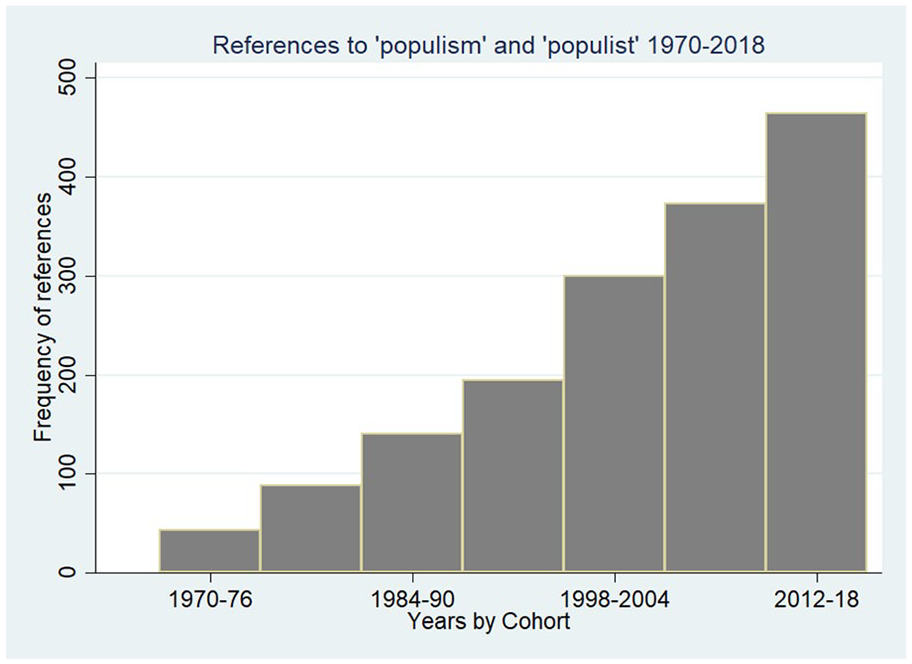
Frequency of references over 7-year cohorts.

On the left, positive (+1), neutral (0), and negative (−1) references, with regression line and 95% confidence interval, 1970–2018. Observations’ value has been randomised around the +1, 0, and −1 lines. On the right, the likelihood, for every year, of a negative (light grey), neutral (medium grey), and positive (black) reference.
Most frequent values per variable.
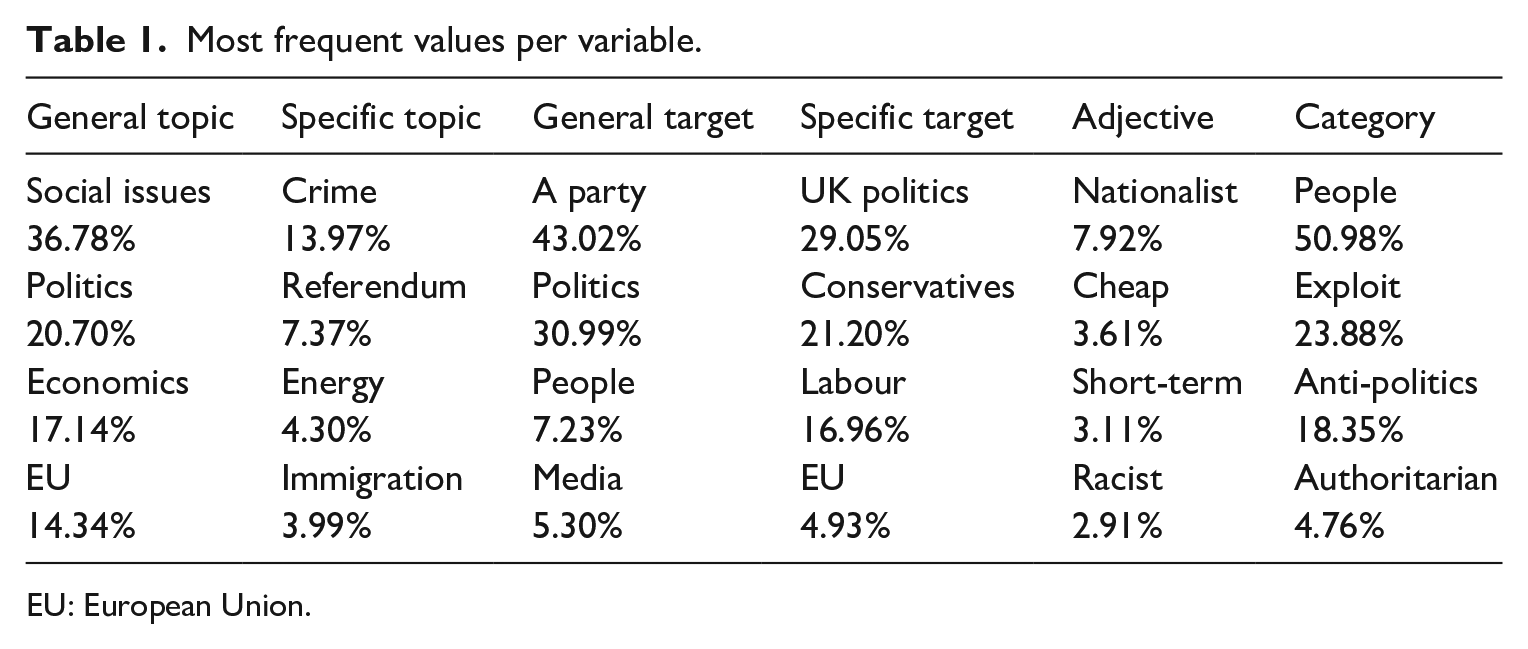
EU: European Union.
Table 2 focuses instead on the changing nature of the meaning of populism over time, listing the most frequent adjectives associated with the keywords and the most common categories to which politicians refer to in three different periods, 1970–1990, 1991–2010, and 2011–2018. During the first period, politicians negatively construe populism in the classic demagogical sense (easy, simple, irresponsible), although they also sometimes mention the nationalist and authoritarian character of populist regimes, especially in Latin America, thus highlighting a critique against mainly left-wing populist regimes. This is worth noting as over the next decades attacks against left-wing populists will almost disappear. Unsurprisingly, the most cited category is that of ‘the people’, implying that politicians do interpret populism with accurate lenses of the minimal definition provided above. In the following 20 years, there are still traces of the demagogical (cheap, short-term) and nationalist interpretation. However, politicians start to point out more often the right-wing and illiberal character of populist attitudes, also highlighting the role of right-wing and populist media in boosting anti-political postures (tabloid, pressures, headline). In addition, the categories remain reasonably similar to those of the previous period.
The meaning of populism over time.
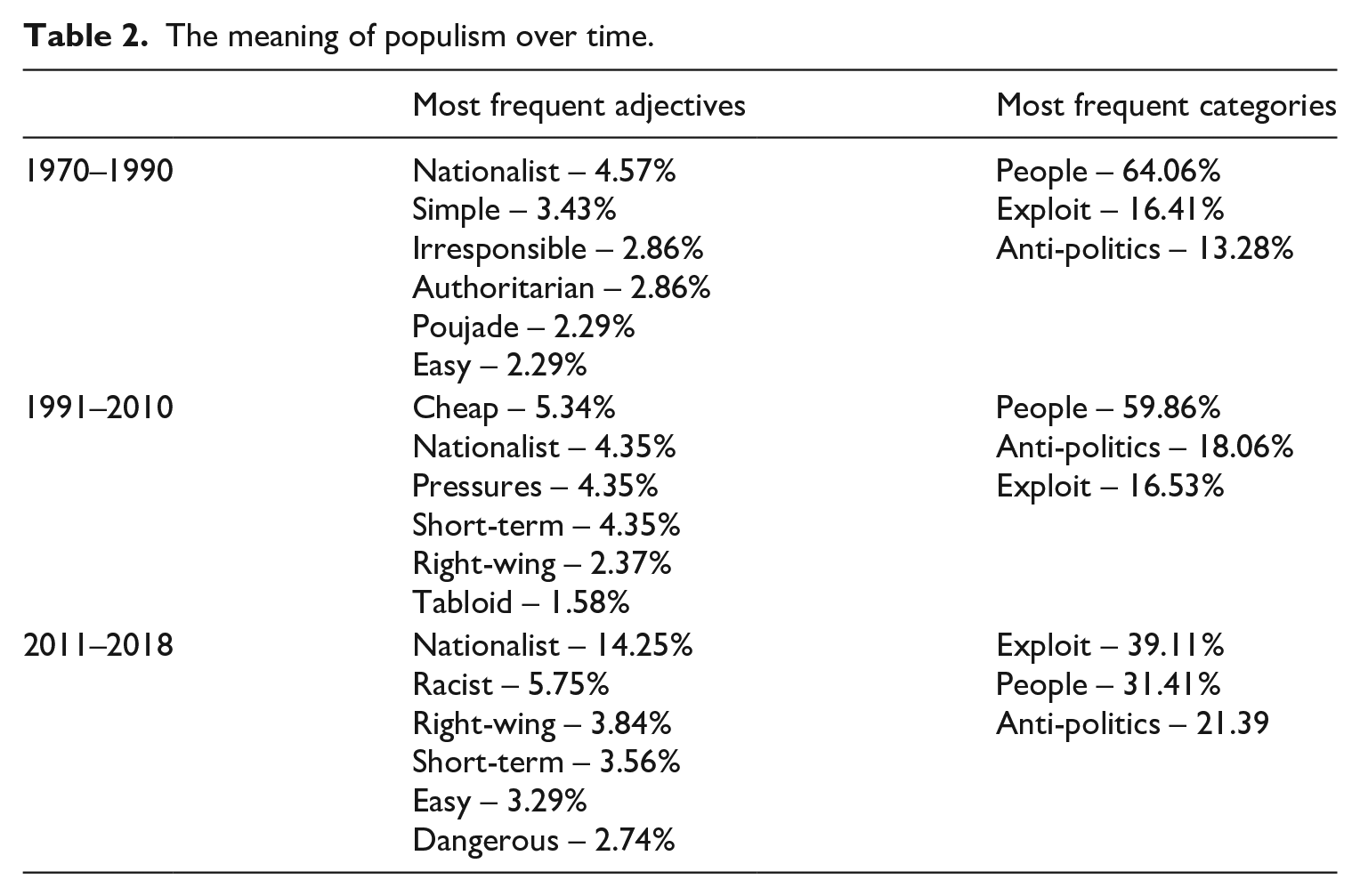
During the most recent period, although classic interpretations persist (easy, short-term), politicians come up with new types of populism. In particular, they considerably more often mention the nationalist, right-wing, and racist nature of populist parties in the United Kingdom and all over Europe, clearly following that ‘populist hype’ drives speakers to homogeneously and simplistically apply the populist lemma to a vast array of right-wing parties. Furthermore, their references to populism express more preoccupation for the socio-political dangers that right-wing populist attitudes entail, indeed another key characteristic of the ‘hype’. Such different meanings also emerge from the changes in the frequency of the categories: ‘the people’ category remains popular, but references to populists’ tendencies to exploit crises drastically increase compared to previous periods.
These results, and the quotations that will follow, show that until 2010 British MPs mostly interpret populism accurately, as a logic centred on the political role of the people and their antagonism towards the elite, at least following the minimal definition provided above. Conversely and recently, discourses about populism change significantly, and politicians enlarge the scope of the populist lemma, in particular targeting right-wing parties. In this context, politicians evidently employ the stigma attached to populism to support their accusation against the supposedly nationalist, racist, and right-wing policies of the Conservatives, the UKIP, and other European right-wing parties. Following the ‘hype’, British politicians, especially from the left, generate a conceptual confusion between populism and other concepts, often also presenting the rise of the so-called populist far-right in apocalyptic terms.
The debate on crime 1970–2018
In order to more closely follow the evolution of populism over time and to highlight various rhetorical strategies, the discussion now focuses on the debate about crime, the specific issue that attracts the largest number of references. Across five decades, the discussion on crime presents very similar dynamics, as two main trends surface from the debates. First, MPs produce recurrent accusations that return in most debates: for instance, Labour often accuses the Conservatives of being demagogically tough on crime to legitimate the prejudices and the bloodiest instincts of the population. On the contrary, politicians also produce specific critiques linked to particular issues. For example, during debates about the supposed link between immigration and crime, the Conservatives argue that Labour often upholds an idealised image of a non-conflictual British society. In any case, both parties consistently employ the populist stigma, especially when they sit in the opposition benches.
In 1984, discussing about prison terms, Coley (Lab) provides a textbook case for a reference from the opposition, arguing that Conservatives solely want to enforce tougher sentences: ‘I believe that the hon. Gentleman is pursuing a populist trend, which is to get tough and do something about all these dreadful things’. 3 Mellor (Con) promptly answers, stating that ‘the public should know what credibility to attach to recent populist observations from the Leader of the Opposition suggesting that law and order policy would be safe in the hands of the Labour party’. 4 Both politicians here employ an epideictic rhetorical strategy: Coley uses populism to blame the political attitudes and the policies of the Conservatives, whereas Mellor accuses the opposition, disqualifying their supposedly cheap populist observations.
During a similar debate in 1997, McIntosh (Lab) clarifies a common Labour’s argument about the Conservatives’ take on crime: ‘We regret the concentration on sentencing, the most populist part of being tough on crime, which is the Government’s stock response to all those questions’. 5 The function of this quotation is clearly forensic, as McIntosh highlights the unjust character of the Conservative Party’s attitude towards crime over the long-term. However, when Labour wins the election in 1997, it soon becomes the target of similar accusations. In 1999, Lord McNally (LD) claims that Labour falsifies data to meet citizens’ requests for more officers. In a classic epideictic fashion, he blames a specific act supposedly committed by the Home Secretary: ‘If fiddling the figures over police numbers shows the populism of the Home Secretary’s twilight zone, freedom of information shows his illiberalism’. 6 In 2003, during a debate about immigration, Davis (Con) contests Labour’s self-assigned tile of champion of an open society, employing a forensic rhetorical strategy: ‘we have a Government [. . .] addicted to posturing: posturing on asylum, grand gestures and meaningless initiatives on crime [. . .] example of an addiction to cheap populism’. 7
Recently, the debate follows similar trends. In 2011, Lord Beecham (Lab) notes that the Conservative Government’s proposal for the local election of police commissioners is populist. With epideictic rhetorical aims, he argues that ‘the Bill, studded with populist gesture politics, is redolent of the prejudices of the Secretary of State’. 8 In 2015, discussing about online crime, Lord Stevenson (Lab) denounces Government’s populism, arguing that the Conservatives only follow people’s perceptions and fear about online crime. 9
The discussion on crime shows that parties rhetorically employ the keywords in a similar way. The meaning politicians attach to populism seems to be consistent over the years, as similar interpretations systematically return. In particular, concerning mentions of populism’s call to the people, politicians accuse their colleagues of being demagogic about people’s positions on crime. Conversely, regarding the category of the exploitation of crises and fears, attacks point to the populist exploitation of citizens’ fears. Different from what will happen during the debate on Brexit, leftist MPs do not clearly characterise the position of the Conservatives on crime as authoritarian or right-wing nationalism. Here, the main area of contestation about populist attitudes seems to follow the minimal definition of populism, since politicians accuse their colleagues of rhetorically creating a division between the elite and the people’s positions on crime to argue that the Parliament should more closely follow people’s perceptions and attitudes on crime-related policies. Finally, epideictic and forensic rhetorical strategies dominate the debates: as expected, the peculiar character of populism and its relation with crime drive politicians to employ the populist stigma to attack their colleagues on specific policies or on general attitudes over the long-term.
The populist era 2015–2018
Results over the 2015–2018 period show significant differences compared to previous decades (1970–2014). Negative and valence references increase in frequency (from 85.57% to 95.43% and from 64.09% to 74.56%, respectively), highlighting a more confrontational debate, and references from the opposition also rise (from 58.13% to 66.55%), likely reflecting the oppositions’ answer to what they perceive as the populist turn of the Conservative Government. As seen, also the categories politicians mention and the adjectives they employ to characterise populism significantly change.
The models in Table 3 test H1 and H2, whereas Table 4 presents descriptive results for negative and valence references from the three main parties. In particular, models 1 (multinomial logit) and 3 (logit) show that opposition membership does not significantly affect the probability of having a negative or a valence reference, controlling for the year of speeches and the position of the parties on the left–right spectrum. However, being a member of the government significantly increases the likelihood of producing a positive reference. Models 2 (multinomial logit) and 4 (logit) show that approaching general elections do not influence the probability of observing negative and valence references, although they significantly decrease the likelihood of positive references. Finally, model 4 highlights a significant impact of the left–right spectrum, as valence references are more likely moving towards the left. Evidently, the effect of the opposition membership, a variable excluded from model 4, in a way comes back through the political spectrum, as leftist politicians are members of the opposition.
Empirical models.
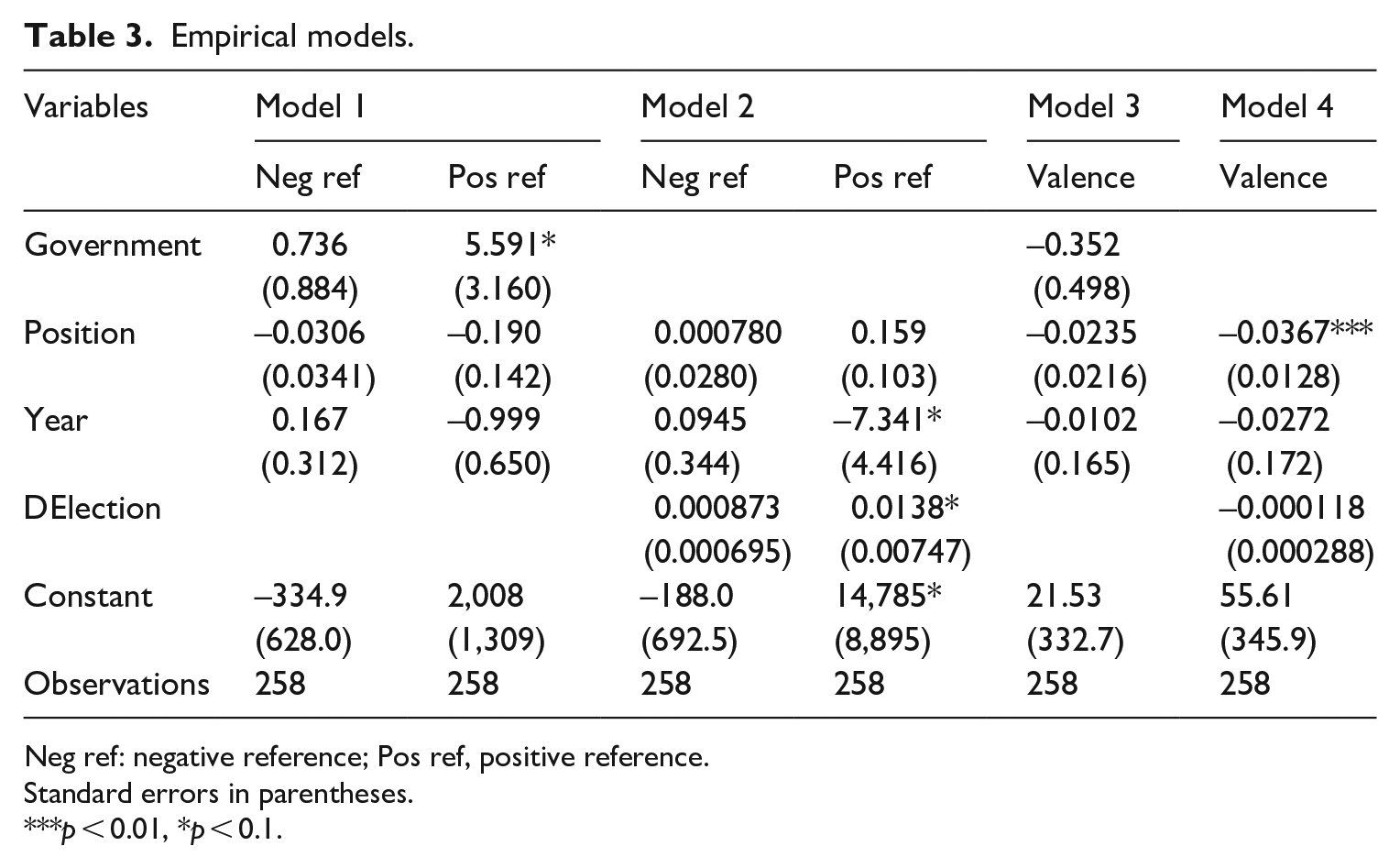
Neg ref: negative reference; Pos ref, positive reference.
Standard errors in parentheses.
p < 0.01, *p < 0.1.
Political parties after 2015.
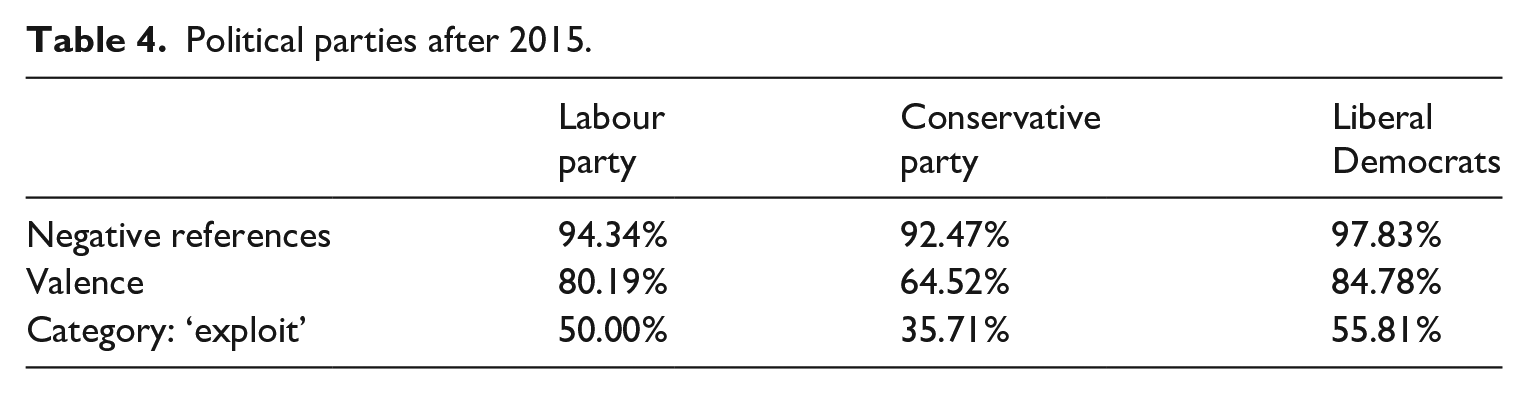
Although Table 4 shows considerable differences across parties, as Labour and Liberal Democrats considerably surpass the Conservatives in terms of valence mentions and references to the category of exploitation, empirical results only partially confirm H1 and H2. Negative and valence interpretation of populism remains widespread across the government–opposition divide and the political spectrum. Nevertheless, the Government’s Conservative members tend to refer more often to some positive characteristics of populism, a trend that decreases when a general election is approaching. Figure 3 shows in detail the impact of various variables on the likelihood of having positive, neutral, negative, and valence references. As anticipated, opposition members consistently interpret populism negatively, whereas government members show more variation. When elections approach, there is a sustained increase in the probability of negative references and an equivalent decrease in that of positive references. The likelihood of valence references rises moving towards the left of the political spectrum, whereas the distance from a general election does not have a considerable effect on the same probability.

The impact of government–opposition membership (top-left) and the distance from the next general election (top-right) on the likelihood of negative (light grey), neutral (medium grey), and positive (black) references. The impact of the left–right spectrum (bottom-left) and the distance from the next general election (bottom-right) on the likelihood of valence references.
These results, and the quotations that will follow, show how the recent ‘populist era’ enflames the debate, leading leftist parties to employ the populist stigma to attack their colleagues. On the contrary, Conservatives maintain a negative attitude towards populism, although a tendency towards leveraging on its positive characteristics emerges.
One popular accusation from the opposition is that the Government appeases populist movements in the political arena and in the civil society. During a 2015 debate about a potential UK withdrawal from the EU Court of Human Rights, Lord Cashman (Lab) criticises the Government: ‘The Government’s intentions are to appease their right wing and the leader writers of the tabloids and the right-wing press. [. . .] We will have lost power to so-called populism: to the mob’. 10 Next, Lord Wills (Lab) leads the attack: ‘The Government seek to satisfy those populist demands by also withdrawing from the European Convention’. 11 These two quotations perform an epideictic function, as Labour Lords openly contest the Government. The rhetorical strategy is not deliberative, meaning that the negative appeal to populism does not have the aim to discourage the Government from an action, in this case withdrawing from the EU Court, but instead are configured as a direct attack.
However, what mostly drives accusations against the Conservatives is the debate about the EU Referendum and Brexit. In 2016, Lord Collins (Lab), in a forensic fashion, underlines the negative consequences of the Referendum in scientific and political terms: ‘What is good for UK science is staying in the European Union. [. . .] The rise of populism, drawing from the well of economic and social discontent, carries disturbing echoes of the 1930s’.
12
Similarly, Lord Giddens (Lab) directly attacks Boris Johnson:
Those who want to close the borders and retrieve lost sovereignty. [. . .] The descent of the leave campaign into empty populism, epitomised by Boris Johnson’s absurd remark that [. . .] he wanted to have his cake and eat it.
13
Again, populism is not rhetorically employed to show the harms deriving from a certain policy, but to produce a verbal assault against a political competitor, as also shown in the following quotations.
Labour politicians also express their concern for the growing nationalist populist attitude of the Conservatives and the UKIP. Debating on the implications of the Referendum in 2016, Lavery (Lab) highlights such preoccupation: ‘the actions of a Government increasingly dominated by right-wing populism’. 14 Liberal Democrats follow through, with Lord Paddick (LD) arguing that populism and nationalism inflamed by the right have led to an ‘increase in hate crimes’ 15 and Lord Bruce (LD) claiming that ‘malicious populism and nationalism’ threaten the liberal order. 16 In 2018, debates about the Brexit Deal proceed with similar tones. Lord Bassam (Lab) argues that ‘The ill-fated campaign was a piece of naked populism aimed at appeasing UKIP-leaning voters’ 17 and Sheerman (Lab) notes that PM May is ‘a captive of this unpleasant, nationalist, populist group in the Conservative party’. 18 These quotations show that these accusations are framed through a more general attack against thicker ideologies, in particular nationalism and its right-wing and racist manifestations. Indeed, Labour MPs and Liberal Democrats seem not to criticise populism as a problematic ideology per se, but instead target the employment of populist rhetoric and political style to support nationalism. It is thus clear how the oppositions employ the lenses of the ‘populist hype’ to characterise the populist turn of the Conservative Party, the emergence of the UKIP, and the rise of right-wing movement across Europe.
On the other side of the Parliament, Conservatives also rhetorically employ the stigma of populism, as negative and valence references abound, though never on nationalism and Brexit. Moreover, they react to accusations, refusing to accept the populist stigma. For instance, in 2018 Lord Cavendish (Con) contests the attitudes of the Labour Party: ‘There is the group [. . .] wants to ignore the referendum result, and sabotage the Brexit process. [. . .] He characterises those who voted for Brexit as “populist” and undergoing a “nationalist spasm worthy of Donald Trump”’. 19 Overturning the accusation, Cavendish refuses the association between populism and nationalist attitudes, highlighting instead the minimal definition of populism, where significant attention and political power are provided to the British people, whose will expressed in the Referendum cannot be ignored.
In addition, as results have shown, Conservatives sometimes highlight the positive characteristics of populist postures. For example, in 2015 Lord Moynihan (Con) discusses the Consumer Rights Bill, arguing that ‘Lords want a populist measure that is also the right one for consumers in their manifestos’. 20 In 2017, Doyle-Price (Con), while debating on the political communication strategy of the Parliament, points out how the Government should send more ‘populist messages to raise awareness among the whole general public’. 21 Here, both Conservative members provide a positive connotation of populism, highlighting in a deliberative fashion the positive impact that populist policies and messages could have. Thus, they do not directly challenge the mainstream negative interpretation of populist in epideictic or forensic terms; instead, they underline the potential positive instrumental impact of adopting a populist attitude towards the needs of British citizens.
Conclusion
The meaning of populism, in the interpretations of politicians, considerably changes over time. Whereas the classic demagogical interpretation centred on the elite–people opposition and on the political role of the people almost trumps any other understandings of populism from 1970 to 2010, recently politicians more often highlight the nationalist and right-wing character of populism, pointing out the socio-political dangers that populist attitudes entail. Also, the theoretical categories that politicians mention evolve over the years: ‘the people’ category dominates the debates from 1970, while since 2010 new categories, and in particular populism’s exploitation of crises, challenge this primacy. Politicians, especially on the left of the political spectrum, follow the ‘populist hype’, tending to more and more closely associate populism with nationalist and right-wing political positions.
After 2015, the discussion inflames, with a sustained increase in negative and valence references. In particular, Labour and Liberal Democrats attack the UKIP and Conservatives’ populism, highlighting the nationalist, far-right, and exploitative of fears character of such attitudes. On the contrary, Conservatives react, rejecting the accusations and continuing to interpret populism with a negative tone. Nevertheless, Conservatives sometimes underline positive features of populism, highlighting a trend that could be more intense in the future under the leadership of Boris Johnson. Indeed, empirical models have shown how positive references are more common among (1) government’s members, (2) on the right of the political spectrum, and (3) when a general election is distant.
Finally, regarding the rhetorical uses of populism, the analysis has shown how epideictic and forensic strategies are far more common, despite the quintessential deliberative nature of the parliamentary forum. Politicians mostly employ the term to directly attack their colleagues and their political attitudes. Nevertheless, the recent powerful emergence and electoral success of populism all over Europe seems to drive some Conservative politicians to underline, in a deliberative fashion, the potential political advantages of populist postures.
These results provide engaging implications. Politicians tend to identify populism’s call to ‘the people’ as the most important and essential characteristic of the political phenomenon. However, the emergence of a populist party, here the UKIP and to some extent the ‘new’ Conservative Party, and the relevance of political issues defined in populist terms, here essentially Brexit, do drastically change the picture. Debates become more confrontational, and non-populist parties employ powerful rhetorical weapons to attack their supposedly populist colleagues. In particular and following the ‘hype’, they more often leverage on the nationalist, racist, and right-wing character of populism to attack supposed populist actors and attitudes. Thus, the minimal definition of populism stated above not only provides a path to systematically analyse discourses on populism but also allows showing how British politicians’ interpretations of populism often lack rigour and consistency. Although the ‘hype’ provides alluring incentive to leftist politicians to support their attacks against the right, the use of the populist lemma to characterise right-wing parties not only offers an inaccurate definition of populism but may also contribute, as Glynos and Mondon (2016) argue, to euphemise radical right nationalist and racist attitudes, simplistically described as populist.
On the contrary, following previous research (e.g. Elmgren, 2018), populist parties may answer to such accusation with two strategies. Either they recognise and acknowledge their populism, providing a positive characterization of this attitude, or alternatively, they reject the accusation, maintaining a negative approach towards populism and possibly revolting the attack against the political force that has initially produced it. In the British political context, Conservatives flirt with both strategies, though less often with the latter.
This article has shed new light on the evolution of populism as a rhetorical political phenomenon, providing a new focus for research. Moreover, it has offered an original dataset, opening the path to future projects that may analyse debates in other countries. Finally, the theoretical framework and the methodology presented here may be useful to address rhetorical manifestations of concepts and categories other than populism.
Footnotes
Appendix 1
Category (the theoretical categories of populism).
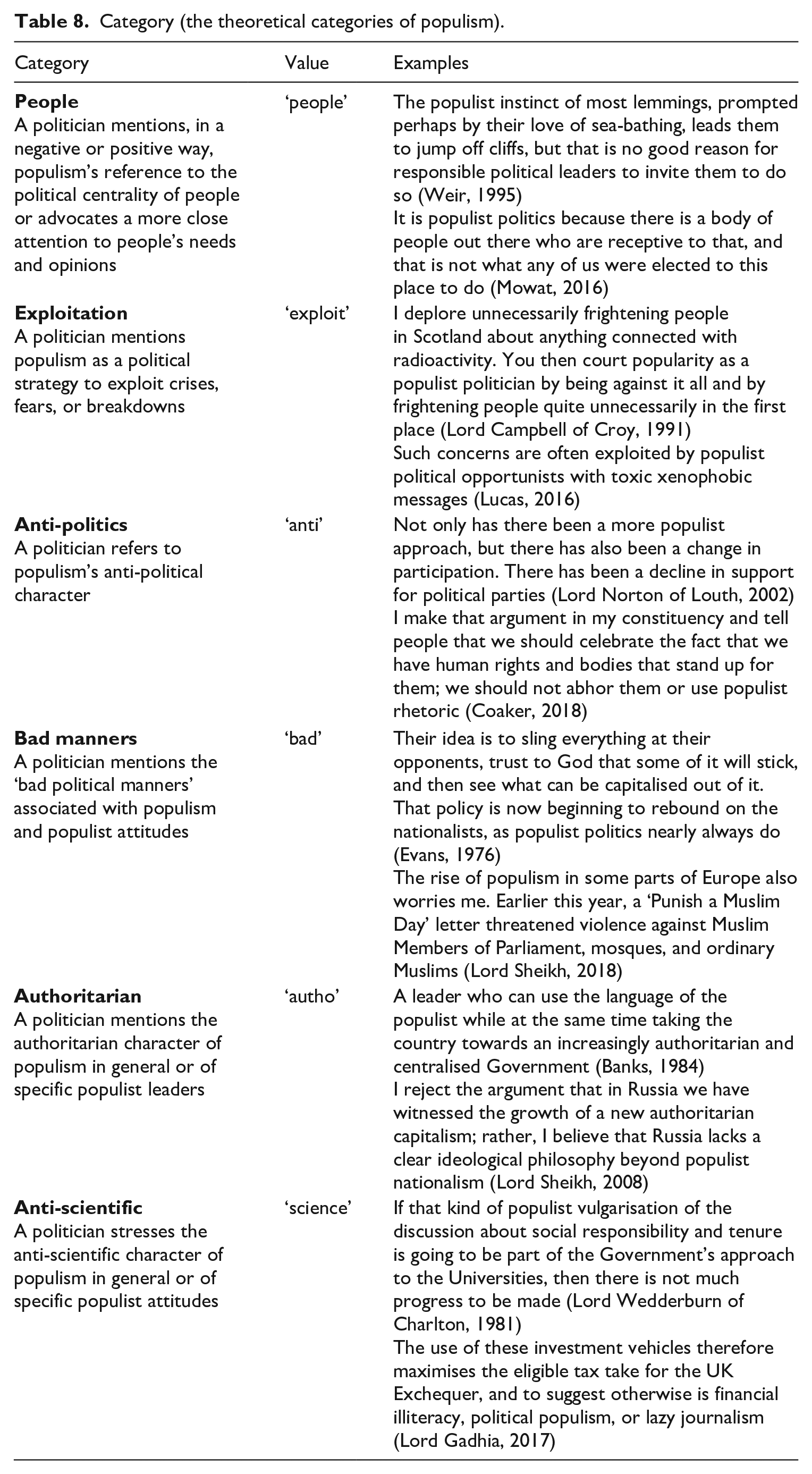
| Category | Value | Examples |
|---|---|---|
A politician mentions, in a negative or positive way, populism’s reference to the political centrality of people or advocates a more close attention to people’s needs and opinions |
‘people’ | The populist instinct of most lemmings, prompted perhaps by their love of sea-bathing, leads them to jump off cliffs, but that is no good reason for responsible political leaders to invite them to do so (Weir, 1995) It is populist politics because there is a body of people out there who are receptive to that, and that is not what any of us were elected to this place to do (Mowat, 2016) |
A politician mentions populism as a political strategy to exploit crises, fears, or breakdowns |
‘exploit’ | I deplore unnecessarily frightening people in Scotland about anything connected with radioactivity. You then court popularity as a populist politician by being against it all and by frightening people quite unnecessarily in the first place (Lord Campbell of Croy, 1991) Such concerns are often exploited by populist political opportunists with toxic xenophobic messages (Lucas, 2016) |
A politician refers to populism’s anti-political character |
‘anti’ | Not only has there been a more populist approach, but there has also been a change in participation. There has been a decline in support for political parties (Lord Norton of Louth, 2002) I make that argument in my constituency and tell people that we should celebrate the fact that we have human rights and bodies that stand up for them; we should not abhor them or use populist rhetoric (Coaker, 2018) |
A politician mentions the ‘bad political manners’ associated with populism and populist attitudes |
‘bad’ | Their idea is to sling everything at their opponents, trust to God that some of it will stick, and then see what can be capitalised out of it. That policy is now beginning to rebound on the nationalists, as populist politics nearly always do (Evans, 1976) The rise of populism in some parts of Europe also worries me. Earlier this year, a ‘Punish a Muslim Day’ letter threatened violence against Muslim Members of Parliament, mosques, and ordinary Muslims (Lord Sheikh, 2018) |
A politician mentions the authoritarian character of populism in general or of specific populist leaders |
‘autho’ | A leader who can use the language of the populist while at the same time taking the country towards an increasingly authoritarian and centralised Government (Banks, 1984) I reject the argument that in Russia we have witnessed the growth of a new authoritarian capitalism; rather, I believe that Russia lacks a clear ideological philosophy beyond populist nationalism (Lord Sheikh, 2008) |
A politician stresses the anti-scientific character of populism in general or of specific populist attitudes |
‘science’ | If that kind of populist vulgarisation of the discussion about social responsibility and tenure is going to be part of the Government’s approach to the Universities, then there is not much progress to be made (Lord Wedderburn of Charlton, 1981) The use of these investment vehicles therefore maximises the eligible tax take for the UK Exchequer, and to suggest otherwise is financial illiteracy, political populism, or lazy journalism (Lord Gadhia, 2017) |
Acknowledgements
The author thanks the anonymous reviewers, Professor Luigi Curini, Dr Andrea Ceron, Dr Andrea Pedrazzani, Dr Valerio Vignoli, and all participants of the Panel ‘Populism and Nationalism: Overlaps and Interplays’ at the 2019 SISP Conference (Italy) for their valuable comments and support.
Declaration of conflicting interests
The author(s) declared no potential conflicts of interest with respect to the research, authorship, and/or publication of this article.
Funding
The author(s) received no financial support for the research, authorship, and/or publication of this article.
