



Abstract
Parliamentary candidates face choices about the extent to which they personalise their election campaigns. They must strike a balance between promoting their party’s message and their own personal appeal, and they must decide how much effort to invest in developing personalised campaign activities. These decisions determine the nature of the campaigns that candidates run, and therefore, voters’ experience during elections. In this article, we use individual-level survey data from the British Representation Study to explore the extent to which candidates personalise their election campaigns in terms of messaging focus and activities. We find that candidates who live in the area they seek to represent, and those who are more positive about their electoral chances, run more personalised campaigns, in terms of focus and activities. Incumbents’ campaigns, meanwhile, are more personalised in their focus only, while candidates who have held national party office tend to use a greater range of personalised campaign activities.
Introduction
Contemporary British politics is often characterised by voter discontent and disillusionment with politicians (Allen and Birch, 2015; Jennings et al., 2017; Lee and Young, 2013). Against this backdrop, the role of campaigns is increasingly important in fostering engagement with democratic politics. After all, evidence shows that effective campaigns can encourage citizens to turn out (e.g. Aldrich et al., 2016; Fieldhouse et al., 2013; Foos and de Rooij, 2017), influence their vote choice (e.g. Druckman, 2004; Fisher et al., 2011a; Goodwin et al., 2018), and can affect their perception of parties, as well as party leaders (Aaldering et al., 2018). In short, campaigns matter.
It is also increasingly evident that personalised election campaigns are effective at engaging voters. 1 The personal traits that candidates possess – and the traits that candidates choose to emphasise to voters – represent a growing area of political science research (Stiers, 2019). The identity and attributes of individual politicians are now a common feature of the information that voters are exposed to and seek during campaigns (Dalton et al., 2000; Deacon and Harmer, 2014; Milazzo and Hammond, 2017). Candidates’ personal characteristics are increasingly important in influencing for whom voters cast their ballot (Arzheimer and Evans, 2012; Campbell and Cowley, 2014; Renwick and Pilet, 2016). These include aspects of candidates’ personal and political profile such as gender (Dittmar, 2019), race and ethnicity (Fisher et al., 2011b; Norris et al., 1992), occupational background (Campbell and Cowley, 2014; Coffe and Theiss-Morse, 2016), personality (Laustsen, 2017), and even perceived attractiveness (King and Leigh, 2009; Lutz, 2010; Milazzo and Mattes, 2016). Voters also pay particular attention to candidates’ localness (e.g. Campbell and Cowley, 2014; Middleton, 2018; Von Schoultz and Papageoriou, 2019).
But what factors explain the extent to which candidates in Britain personalise their campaigns?
Carey and Shugart (1995) argue that the first-past-the-post electoral system used for elections to the UK House of Commons – where parties retain control over access to the ballot and there is no need for candidates to compete against members of their own party to gain their seat – offers less encouragement for candidates to emphasise their personal attributes. In the absence of intra-party competition, candidates should enjoy greater electoral benefits from emphasising the party label, rather than their own personal reputation. At the same time, there is evidence that single member districts, which are generally smaller in terms of population size and geography, provide incentives for geographical or locally focused campaigning (Sudulich and Trumm, 2019). 2 On this basis, a candidate may gain an electoral payoff from emphasising her own attributes, rather than relying exclusively on her party’s national profile. Given the conflicting pressures provided by the electoral context, we would expect to observe a great degree of variation in candidate behaviour. Such heterogeneity in behaviour is consistent with previous research showing that the policy platforms of British candidates frequently differ from those of their party (Buttice and Milazzo, 2011), even when it comes to the most salient issues of the day (Trumm et al., 2020). Moreover, recent analysis of campaign leaflets also suggests that there is considerable variation in the extent to which they emphasise the personal background and characteristics of individual candidates (Milazzo and Townsley, 2020).
This paper builds on this growing body of literature on individual-level campaign behaviour in Britain. Using data from the 2017 British Representation Study, we explore the extent to which candidates choose to run personalised campaigns and what factors explain variation in the level of campaign personalisation across candidates. We focus on two key aspects of campaign personalisation: (1) the extent to which candidates focus their campaign messages on themselves rather than their party, and (2) the extent to which candidates utilise personal campaign activities. In terms of the explanatory factors, we rely on two key areas. First, we capture candidates’ personal and political profile, which includes gender, incumbency, their experience within the party, and self-perceived electoral chances. Second, we look at the nature of their relationship with their principals – their party and constituency. Specifically, we analyse the role of ideological distance between a candidate and her party, and the impact of residing in the constituency one is contesting.
Our results show that candidates in Britain, on average, run campaigns that are broadly balanced between emphasising themselves and their party. That said, we find that candidates who live in the area they seek to represent run more personalised campaigns, in terms of focus and activities, as do candidates who are more positive about their electoral chances. In addition, we find evidence that incumbents’ campaigns tend to be more personalised, though they are no more likely to use personalised activities. Meanwhile, candidates who have held national-level party office tend to use a broader range of personalised campaign activities than candidates without such experience. Our study contributes to the open debate in the literature over the factors that influence the tone and nature of political campaigning, particularly in Britain, where candidates often face mixed incentives to personalise. We also add to the literature on elite-level political behaviour by presenting empirical evidence on the relative role factors such as gender, incumbency, political experience, ideology, and localness have on candidate behaviour.
This article is organised as follows. In the next section, we survey the existing literature on campaign personalisation and candidate behaviour that we touch upon to guide our investigation. We then provide an overview of the data used, the operationalisation of our variables, and the empirical strategy. This is followed by the presentation of the findings. Finally, the paper concludes with a brief discussion of the implications that emerge from the empirical evidence.
Theory and expectations
Political parties traditionally play an important role in British politics (Butler and Stokes, 1974; Cox, 1987). Nevertheless, while the first-past-the-post electoral system used in Britain for elections to the House of Commons allows parties to act as gatekeepers to political office, thereby weakening candidates’ incentive to differentiate themselves from their own party (Carey and Shugart, 1995), it nonetheless creates some incentives for candidates to engage in local, more personalised campaigns. Candidates’ names appear on the ballot and the use of single member districts means that a successful candidate will serve as the sole elected representative for a defined geographical area. By stressing her personal attributes and ties to the community, a candidate can emphasise her ability to provide her constituents with high quality, local representation. In this way, the electoral system provides incentives for campaign activities that allow the candidate to raise her personal profile. Comparative research that explores the role of electoral system on campaign behaviour supports this view. Sudulich and Trumm (2019) show that candidates contesting elections in single member districts tend to campaign harder and use a broader range of campaign tools that are designed to raise both their own profile and that of their party.
In addition to the effects of the electoral system, the changing nature of political competition in Britain is such that we might expect to see more evidence of personalisation in more recent elections. While party identities remain important, British voters are increasingly volatile and willing to switch parties from one election to another (Fieldhouse et al., 2019). The decline of party loyalty among voters has opened the door for more candidate-specific factors to weigh upon their decision-making when considering how to cast their ballots (Dalton and Wattenberg, 2002; Mondak, 1993). From the perspective of the voter, the personal traits and attributes of a particular candidate can provide heuristics that serve as ‘shortcuts’ to simplify the processing of political information (Mondak, 1993). For example, survey experiments show that voters tend to reward personal traits such as localness (Campbell and Cowley, 2014).
Not only do voters rely upon and value particular personal characteristics in their candidates, but candidates themselves are also increasingly independent actors in the British political arena. Members of Parliament (MPs) are, for instance, increasingly willing to break with party loyalties (Cowley, 2005; Cowley and Stuart, 2012; Slapin et al., 2018). Recent years have witnessed, for example, large-scale defections, the rise – as well as decline – of subsequent parties such as Change UK, as well as the removal of the party whip from many Conservative MPs in 2019 for rebelling against the government. In addition, candidates may wish to distance themselves from their party in light of unpopular approval ratings for their leader. It is, therefore, unsurprising that Milazzo and Townsley (2020) found around 40% of election leaflets distributed by candidates in the run up to the 2015 and 2017 elections talked about personal characteristics and traits. A simultaneous dynamic that is interesting to note, however, is that of the increasingly top-down, centralised nature of campaign organisation in Britain. Campaigns are increasingly run from parties’ national headquarters, with key decisions such as leader visits, resources, targeting, and crucially, messaging, becoming increasingly centralised (Denver et al., 2003; Johnston et al., 2012). The shift towards personalised politics that is occurring in tandem with the centralisation of campaign decisions highlights the cross-pressures that candidates face in their own campaigning behaviour. In sum, parties may continue to dominate British electoral politics, but the personalisation of politics appears to be an increasingly salient feature of contemporary Britain.
Our study contributes to the discussion on the extent to which we would expect candidates standing for election in Britain to personalise their campaigns. We shed further light on the circumstances under which candidates run more personalised election campaigns. We posit that the extent to which a candidate personalises her campaign is influenced by her personal and political profile, and her relationship with her party and constituency.
Personal and political profile
Recent studies have highlighted the importance of candidates’ personal profile in shaping their political behaviour. Research has shown that gender, in particular, affects various aspects of elite-level political behaviour, including legislative behaviour (Hargrave and Langengen, 2020; Swers, 2002; Wangnerud, 2009), policy-formation (Lloren and Rosset, 2017), and, increasingly, campaigning (Burrell, 2014; Dittmar, 2019; Fox, 2018). While research suggests that candidates’ gender matters less to voters when it comes to deciding who to vote for (Campbell and Heath, 2017; Schwarz and Coppock, 2020), gender stereotypes can influence how candidates are perceived (Dittmar, 2019) and campaigns are fought largely on ‘male-stereotypical territory’ (Katz, 2016; Schneider, 2007). For example, voters tend to see women as more empathetic and men as more assertive (Alexander and Andersen, 1993; King and Matland, 2003). Therefore, we would expect the differing landscape faced by candidates based on their gender to result in differences in the extent to which male and female candidates choose to run personalised campaigns. Indeed, there is some evidence that male and female candidates do in fact campaign somewhat differently as US-based studies show that men are more inclined to emphasise personal traits in their social media messaging and reference their family during the campaign (Meeks, 2016; Stalsburg and Kleinberg, 2015). We expect to find the same pattern in Britain.
H1: Men run more personalised campaigns than women.
We also expect candidates’ political profile to influence their campaign decisions. Incumbents carry an advantage of having better name recognition than challengers among voters. This is particularly so in Britain where MPs carry out a significant amount of constituency casework which, in turn, raises their profile (McKay, 2018). Indeed, Rosenblatt (2006) estimates that British MPs spend approximately 50% of their time in their constituency addressing casework, a feature of an MP’s role that is particularly valued by voters (Heitshusen et al., 2005; Vivyan and Wagner, 2015, 2016). Challengers, meanwhile, have less name recognition to call upon at election time. Given the importance of personal traits for voters, it is, therefore, imperative for challengers to make up for this disadvantage over the course of the electoral campaign. In other words, they need to talk more about themselves than incumbents to benefit from their personal vote winning attributes on election day. This is also reflected in existing empirical literature. Milazzo and Townsley (2020) show incumbents are less likely to discuss their personal traits or local connections in campaign leaflets than challengers. 3 Taken together, we expect challengers to run more personalised campaigns in order to develop greater name recognition.
H2: Challengers run more personalised campaigns than incumbents.
In addition, it is increasingly common for candidates to have held national-level positions within their party prior, or in addition, to being a candidate (Allen and Cairney, 2017). A more party-based background is likely to influence candidates’ mind-set and propensity to ‘toe the party line’ as they are more socialised within the party structure. Therefore, we expect candidates who have held a national-level position in their party to be more inclined to run a party-focused, as opposed to a personalised, election campaign.
H3: Candidates who have served in national-level party organisation run less personalised campaigns.
Finally, it is likely that candidates’ self-perceived electoral prospects, before starting their electoral campaigns, influence their campaign choices. On the one hand, candidates who consider themselves to be in contention of winning the seat have an incentive to emphasise their personal traits in their campaign messages, given that personal characteristics are increasingly important in shaping for whom voters cast their ballot (Arzheimer and Evans, 2012; Campbell and Cowley, 2014; Renwick and Pilet, 2016). Making the most of one’s personal vote winning attributes, in addition to one’s party label, could potentially be the difference between getting elected or not. On the other hand, ‘paper candidates’ who do not expect to win a seat, are more likely to take a longer-term view and opt for a party-focused campaign strategy to build a profile within their party and, in turn, enhance the likelihood of being chosen as its candidate in a more winnable constituency at subsequent elections.
H4: Candidates who feel that they have a stronger chance of winning run more personalised campaigns.
Relationship with principals
The nature of a candidate’s relationship with key principals such as her party and constituency should also affect her campaign choices. Regarding the former, the extent to which candidates feel ideologically distant from their party is likely to matter. While it is of course reasonable to expect that candidates are aligned with their party’s broad ideological leaning as well as election manifesto, even if they do not agree with their party’s every policy position, there is nonetheless substantial evidence to suggest that considerable ideological/policy heterogeneity exists within parties (Buttice and Milazzo, 2011; Lloren and Rosset, 2017; Trumm et al., 2020). This may be particularly true in 2017, when Labour leader Jeremy Corbyn was widely perceived to be to the left of his fellow Labour MPs, exposing ideological divides within the party. Some Labour candidates to the right of Corbyn, therefore, may have felt themselves more ideologically distant from the party in 2017. It is reasonable to expect such divergence also influences the emphasis that a candidate places on herself, as opposed to her party. We expect that candidates who are more ideologically distant from their party disagree with a larger proportion of the party’s policies and, in turn, place greater emphasis on their own traits and profile within their election communication.
H5: Candidates who are more ideologically distant from their parties run more personalised campaigns.
In terms of candidates’ relationship with their (potential) voters, it is physical proximity that is likely to matter. Evidence consistently shows that one of the most powerful vote-winning traits candidates can possess is localness and personal ties to the constituency they seek to represent (e.g. Campbell and Cowley, 2014; Middleton, 2018; Von Schoultz and Papageoriou, 2019). It is, therefore, reasonable to expect that candidates who are in fact local draw a lot of attention to it in their campaign communication. Candidates are, after all, seeking votes. If a candidate lives in the constituency in which she stands for election, we expect her to emphasise this and, consequently, run a more personalised campaign.
H6: Candidates who reside in the constituency they are contesting run more personalised campaigns.
Data and methods
The theoretical expectations are evaluated using data from the 2017 British Representation Study. 4 It is a survey of parliamentary candidates who stood at the ‘snap’ 2017 general election, covering all major political parties. The final sample used in the analyses includes 978 candidates (35% response rate) and is broadly representative of the full population of candidates on key characteristics of partisanship and nation (Appendix A). The sample includes candidates from the Conservatives, Greens, Labour, Liberal Democrats, Plaid Cymru, Scottish National Party, and UK Independence Party.
There are key advantages in using 2017 British Representation Study data to study campaign personalisation. First, it is one of the most comprehensive recent surveys of politicians. It includes questions on candidates’ personal and political background, their relationship with their party and constituents, and covers all major political parties in Britain. This allows for a complex evaluation of the extent to which candidates choose to run personalised campaigns as well as what factors explain variation in their comparative likelihood of doing so. Second, the British Representation Study includes both winning and losing candidates. Although successful candidates are more important in terms of understanding policymaking, the interaction that voters have with politicians in the run up to polling day include both the former and the latter. Finally, the reliance on survey data should allow us to capture candidates’ sincere, unbiased accounts of their campaign activity, as their answers are anonymous.
The survey data from the 2017 British Representation Study are self-reported and, therefore, a degree of caution should be applied. For instance, unsuccessful candidates may face incentives to say that they ran more party-centred campaigns than they did to exonerate themselves personally of blame for defeat, while winning candidates may feel the need to exaggerate the personalised nature of their campaigns. Nevertheless, candidates are assured of anonymity in their survey responses. This means that candidates – both successful and unsuccessful – do not have to give consideration to their personal reputation in the eyes of their party, members, or voters when responding to the survey.
Dependent variables
We utilise two separate measurements to capture campaign personalisation. First, we use campaign focus to describe the extent to which candidates focused their campaign messages on themselves versus their party. It is operationalised as a 0–10 scale, where 0 means ‘to attract as much attention as possible to my party’ and 10 means ‘to attract as much attention as possible to me as the candidate’. This is a common way for capturing what candidates talk about in their campaigns and the kind of campaign messages they convey to voters through their campaign effort (e.g. Sudulich and Trumm, 2019; Zittel and Gschwend, 2008).
Our second dependent variable focuses on how candidates campaign and the extent to which they utilise personalised campaign activities in the run up to the polling day. It describes how many personalised activities, from the following options, each candidate used as part of her campaign: (a) canvassing, (b) personal posters, (c) personal newspaper adverts, and (d) personal website. These options not only maximise the number of cases for analysis but also account for the different types of personalised campaign effort, including localised door-to-door direct contact with voters as well as both traditional and new media forms of campaign advertisements. This measure ranges from 0 to 4, with higher values corresponding to greater use of personalised campaign activities.
Explanatory variables and controls
In line with the theoretical expectations, we incorporate two categories of factors in our efforts to explain why some candidates choose to run more personalised campaigns – in terms of focus and activities – than others.
First, we account for three elements of candidates’ personal and political profile. Gender is operationalised as a dichotomous variable with male candidates coded 0 and female candidates 1. We expect a negative relationship between gender and campaign personalisation for reasons highlighted above. Incumbency is a straightforward indicator that distinguishes between candidates who had served as MPs in the previous 2015–2017 Parliament (coded 1) and those who had not (coded 0). It is reasonable to expect that challengers are less known among their voters than incumbents and, as such, have greater incentive to personalise their appeal in their election campaign. Party office captures whether candidates have held, or are holding, national-level party office (coded 1) or not (coded 0). The socialisation effect of holding such office is likely to incentivise the former to undertake less personalisation, and more party-centric, campaigns. Finally, chance of winning captures the impact of the electoral context by capturing candidates’ self-perceived electoral prospect prior to the start of campaigning. It ranges from 1 ‘very unlikely to get elected’ to 5 ‘very likely to get elected’. 5
Second, we capture candidates’ relationship with key principals – party and constituents – through two indicators. It likely that the further away a candidate’s own ideological views and positions are from those of her party, the more likely she is to run a campaign with a personalised focus and put in extra effort through greater use of their own, personalised campaign activities. We measure ideological distance as the absolute difference between the left-right position of the candidate and that of her party (as perceived by the candidate). 6 It ranges from 0 ‘no difference’ to 1 ‘small difference’ to 2 ‘large difference’. In addition, we account for the candidate’s relationship with her constituents. Locality distinguishes between candidates who live in the constituency in which they are standing for election (coded 1) from those who do not (coded 0) on the premise that the former are likely to be aware of the potential vote-winning nature of their localness, as well as be more invested and knowledgeable of constituency matters and, in turn, more confident in running highly personalised campaigns. 7
Finally, the analysis controls for partisanship, nation, and candidates’ chance of winning. Candidates face a dilemma in how they set up their electoral campaigns. They can choose to prioritise their own individual appeal and policy positions, or they can design their campaigns around their parties’ national-level leaders and policy proposals. It is highly plausible that candidates from different parties may opt for different approaches. For example, candidates from parties who are doing well in pre-election opinion polls and whose leaders are well thought of by the electorate are likely to embed the image and messages of their party more prominently in their campaign than candidates whose parties have less optimistic electoral expectations. Party distinguishes between candidates of the Conservative Party (coded 1), the Labour Party (coded 2), the Liberal Democrats (coded 3), the Green Party (coded 4), UKIP (coded 5), and the Plaid Cymru and the Scottish National Party (coded 6). 8 In addition, we control for nation, distinguishing between candidates who ran for election in England (coded 1), Scotland (coded 2), and Wales (coded 3).
Empirical strategy
Given the different data structures of our dependent variables, different estimation techniques are used to analyse variation in the two aspects of campaign personalisation. We use the ordinary least squares method to analyse campaign focus and ordered probit to examine campaign activities. Both models are run with robust standard errors.
How personalised are British electoral campaigns?
We start by looking at the overall picture with regards to campaign personalisation in Britain. At the national level, the 2017 general election in many ways encapsulated important themes around personalisation and decisions on whether to emphasise candidate or party. The Conservatives, going into the election with a commanding polling advantage on leadership, focused its campaign messages largely on the then Prime Minister Theresa May with the ‘strong and stable’ (leadership) mantra. Locally, campaigns regularly drew voters’ attention to ‘Theresa May’s candidate’ rather than the ‘Conservative candidate’ and focused their attacks against the Labour Party on Jeremy Corbyn personally (Walsh, 2017). The narrative that emerged from the Labour side, however, was different. Jeremy Corbyn was widely perceived before the campaign as lagging behind his Conservative opponent, Theresa May. The frequent headlines, therefore, were about local candidates, with focus on party leadership often relatively limited. Leanne Wood, the then leader of Plaid Cymru, even suggested that Welsh Labour airbrushed the national party leadership out of its campaign in Wales (BBC, 2017). By simply looking at the general themes associated with the two main parties, it appears that we should see differences in the extent to which candidates from different parties ran personalised campaigns. Table 1 presents the mean scores for candidates’ campaign focus and campaign activities by party.
Campaign personalisation in Britain.
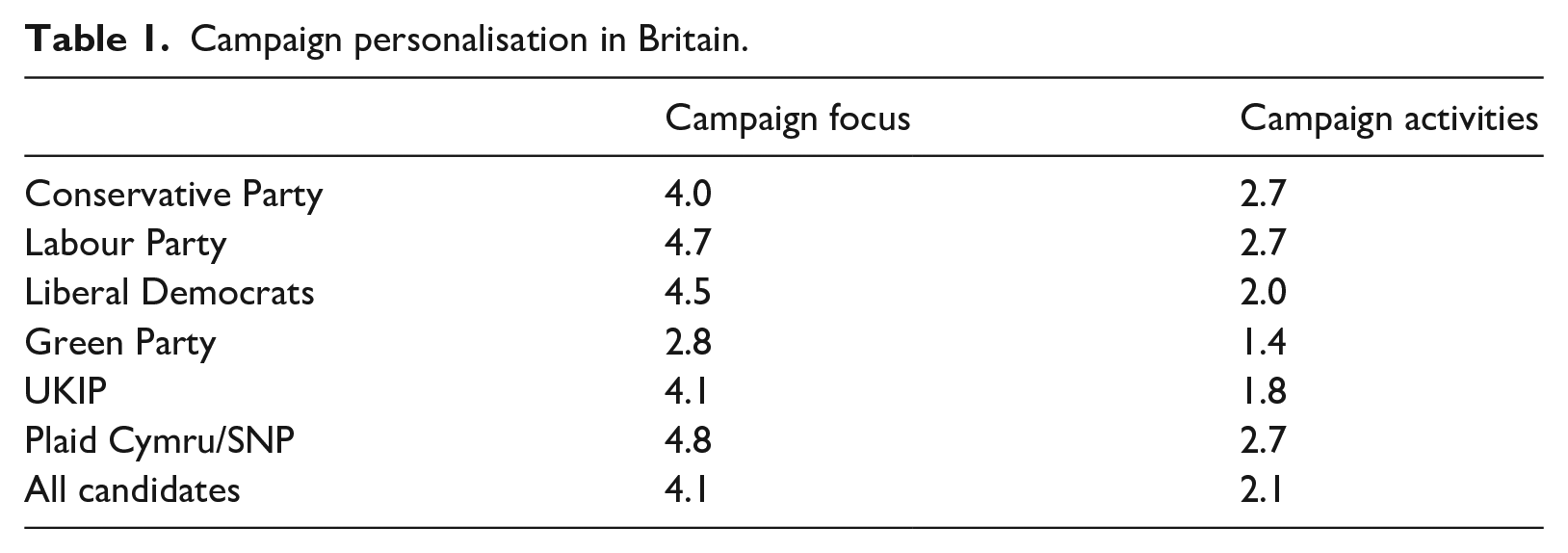
Note first that candidates’ electoral campaigns, at least at the aggregate level, were balanced in nature. The mean campaign focus across all candidates is 4.1, indicating that candidates put a broadly equal emphasis on themselves and their party in their campaign messages. Party-centred messages were only marginally more prominent than candidate-centred messages when looking at candidates in general. This relatively balanced messaging is unsurprising given that, while party labels still represent a key difference between candidates competing for votes, there is also a growing body of evidence that candidates’ personal characteristics can be very useful vote winning attributes.
The same pattern appears when focusing on the range of personalised campaign activities used. Candidates, on average, use approximately two of the following four personalised activities in their campaign: (a) canvassing, (b) personal posters, (c) personal newspaper adverts, and (d) personal website. This lends further support to the idea that individual-level campaigns in Britain are relatively balanced in their nature. Candidates do acknowledge the benefits of personalised campaign activities and assign some role for them in their campaigns but tend not to make use of all such tools at their disposal.
Breaking the aggregate patterns down by party reveals some, albeit limited, degree of heterogeneity in campaign personalisation. The narrative that emerges around campaign focus is one of consistency. It is only the Green Party candidates who stand out as being particularly likely to run party-centred campaigns with a mean score of 2.8, with the corresponding scores for all other parties remaining between 4.0 and 4.8. 9 While there is variation in the campaign focus of candidates running under the labels of the other parties, with Conservative Party candidates tending to carry out slightly less personalised campaigns than their Labour Party counterparts for example (4.0 versus 4.7), the differences in the mean campaign focus of candidates of these parties do not reach conventional levels of statistical significance. The differences in campaign focus along party lines are relatively limited.
The partisan differences in campaign personalisation are more pronounced when looking at the range of personalised campaign tools used. Generally speaking, candidates representing larger parties stand out as utilising a greater range of such campaign activities. The mean number of personalised campaign tools employed is highest for candidates of the Conservative Party, the Labour Party, and the national parties of Plaid Cymru and the Scottish National Party (2.7 for all). 10 Interestingly, it is candidates of the Green Party who once again stand out as conducting the least personalised campaigns, using, on average, only 1.4 of the personalised campaign tools. 11 This heterogeneity in the range of personalised campaign tools used likely reflects the disparity between parties in terms of resources they can make available for their candidates to develop a diverse, personalised campaign presence. 12 Taken together, these first-cut descriptive insights suggest that, while partisanship has some influence on the extent to which candidates conduct personalised campaigns, other factors are also likely to be relevant to our understanding of why some candidates carry out more (or less) personalised campaigns than others.
Explaining variation in campaign personalisation
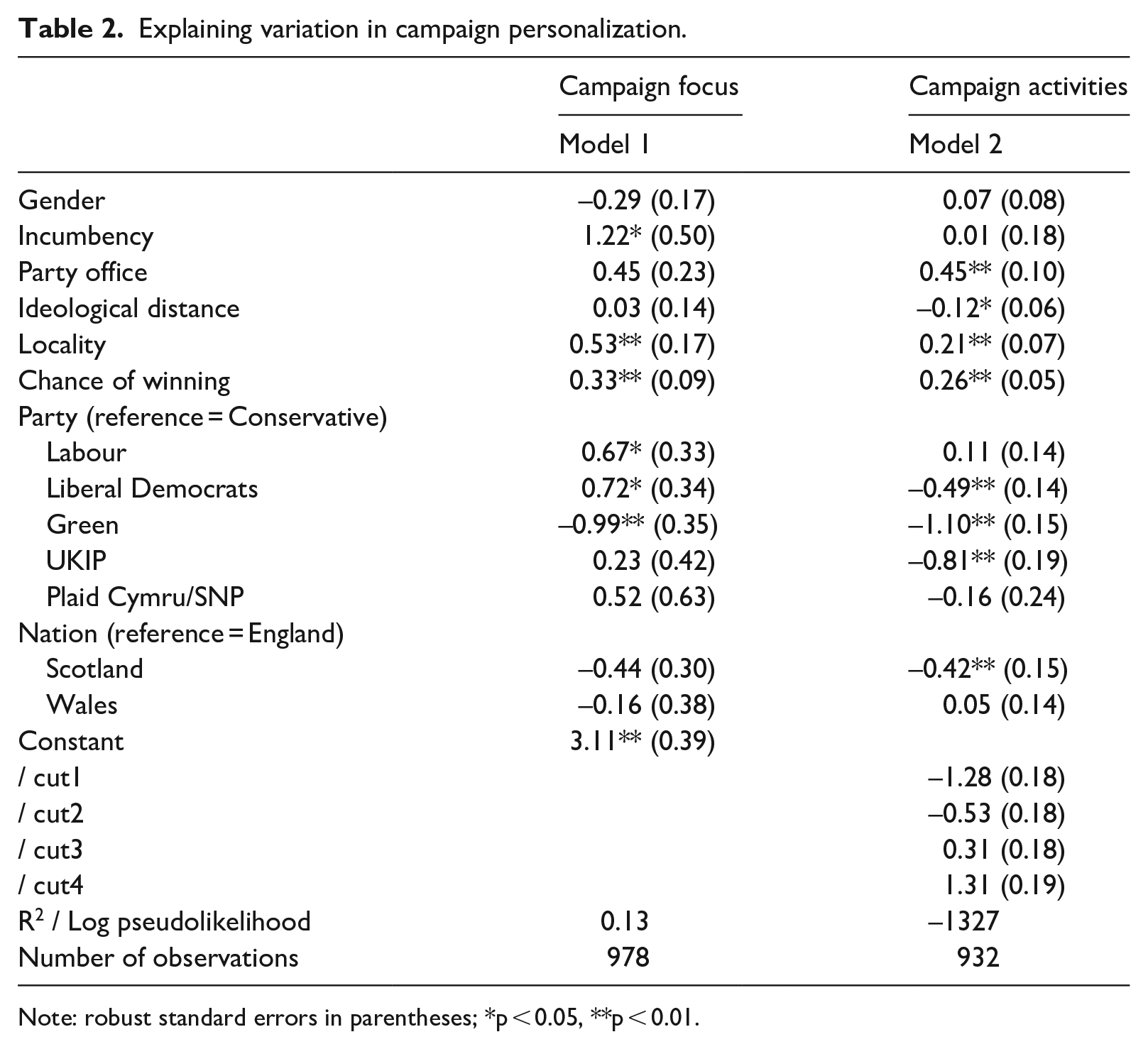
We now move on to testing what factors account for the extent to which candidates personalise their campaigns by modelling variation in campaign focus and campaign activities. The results are presented in Table 2.
Explaining variation in campaign personalization.
Note: robust standard errors in parentheses; *p < 0.05, **p < 0.01.
Note first that locality and chance of winning stand out in shaping campaign personalisation; both in terms of candidates’ campaign focus and the range of personalised campaign activities used. The positive and statistically significant coefficients of 0.53 and 0.21 for locality show that candidates who reside in the constituency they seek to represent put forward more candidate-centred campaign messages, as well as utilise a broader range of personalised campaign tools than candidates who do not live in the constituency. The positive and statistically significant coefficients of 0.33 and 0.26 for chance of winning indicate that candidates who are more positive about their electoral prospects prior to campaigning also tend to put forward more personalised campaign efforts in terms of campaign focus and campaign activities. These patterns are in line with our theoretical expectations.
In terms of the relationship between a candidate’s political profile and campaign personalisation, we find that incumbency and party office contribute to the latter. Interestingly, while the positive and statistically significant coefficient of 1.22 for incumbency in Model 1 suggests that incumbents tend to put more focus on themselves, versus their party, in their campaign messages than challengers, the positive coefficient for incumbency does not reach conventional levels of statistical significance in Model 2. 13 It appears that incumbents put forward more personalised campaigns messages than challengers, but they do not use additional personalised campaign tools as part of their campaign. The evidence regarding party office shows a contrasting trend. Candidates who have held national-level party office use more personalised campaign tools than those who have not as shown by the positive and significant coefficient of 0.45 in Model 2, but do not use significantly more candidate-centred messaging than the latter as the respective coefficient fails to reach conventional levels of statistical significance in Model 1.
Finally, we find ideological distance to have a negative impact on the number of personalised campaign tools used, but no evidence that gender has a significant effect on the extent to which candidates run personalised campaigns. The party effects largely mirror the descriptive patterns shown earlier. The Green Party candidates stand out as having particularly party-centred campaign focus, while it is the candidates of the smaller parties that tend to use a smaller range of personalised campaign tools.
To illustrate the real world meaning of the findings and provide an intuitive comparison of the effect sizes, we present predicted values for campaign focus (Figure 1) and predicted probabilities of using no and all personalised campaign activities (Figure 2). 14 For each effect, the characteristic in question is allowed to vary, while others are held constant.
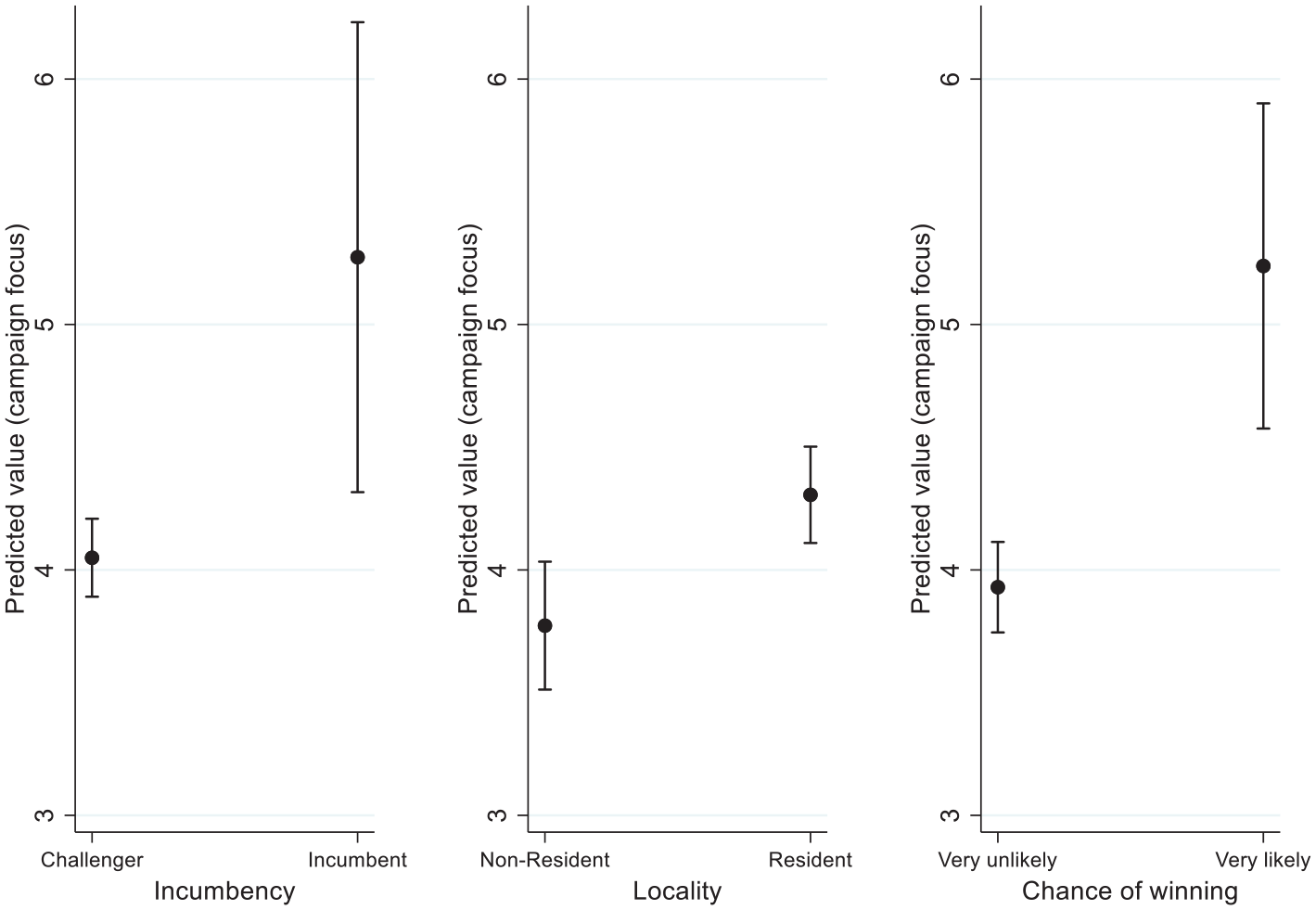
Predicted values for campaign focus.
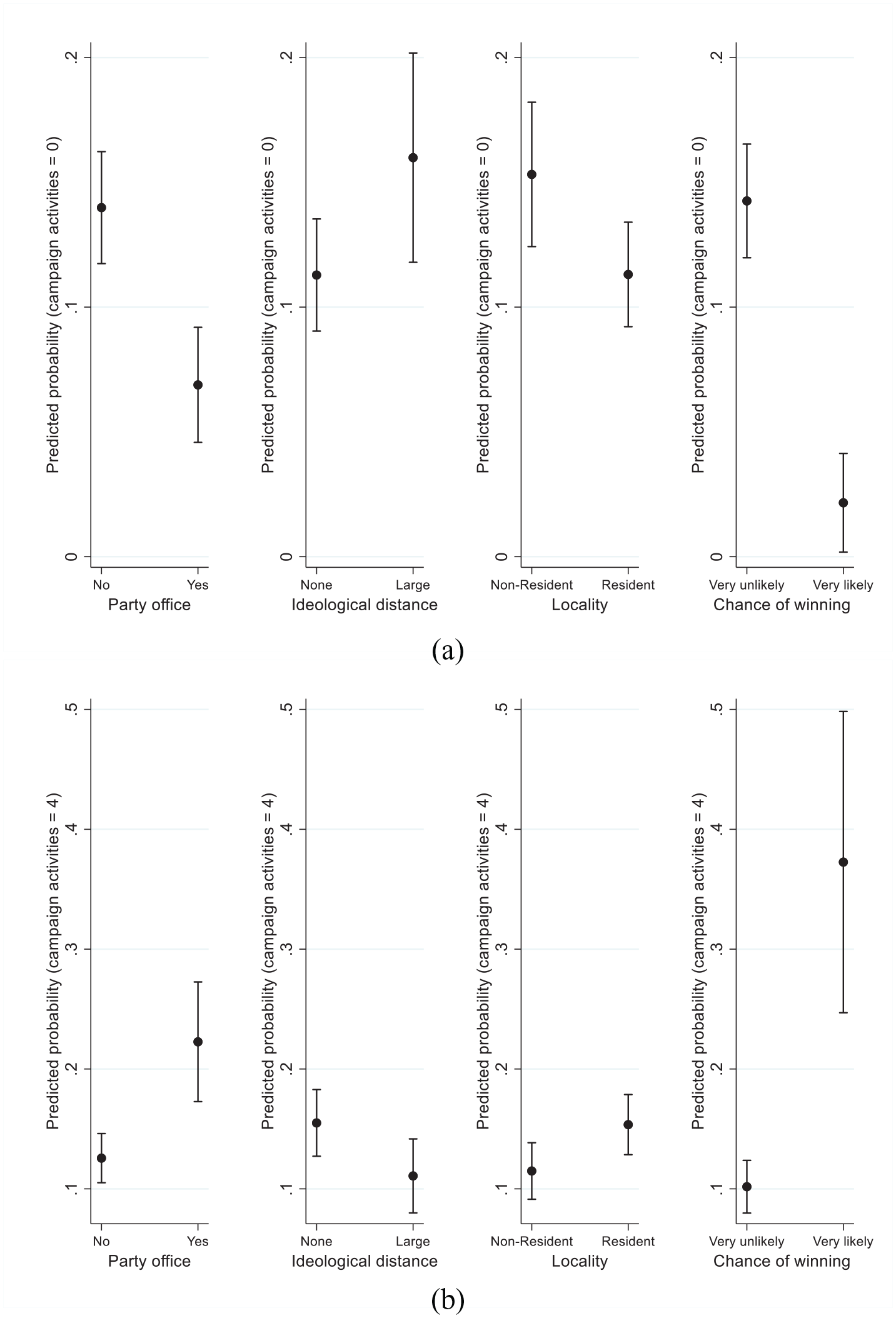
Predicted probabilities for campaign activities. (a) Predicted probabilities of using no personalised campaign tools. (b) Predicted probabilities of using all personalised campaign tools.
Starting with campaign focus, it is incumbency and chance of winning that stand out as having the largest effects on the extent to which candidates choose to focus their campaign messages on themselves, as opposed to their party. As expected, incumbents tend to run more candidate-centric campaigns than challengers (5.3 versus 4.0), and candidates who expect to win run more personalised campaigns than those who do not consider it a realistic possibility (5.2 versus 3.9). Interestingly, it appears that the ‘standard’ election campaigns of incumbents and candidates who are confident in their electoral prospects are slightly more candidate-focused than party-focused, while the ‘standard’ campaigns by challengers and those who are pessimistic about their electoral prospects are the opposite, slightly more party-focused than candidate-focused. In terms of locality, the effect size is somewhat smaller as the predicted value of campaign focus is 0.5 points higher for candidates who reside in the constituency that they seek to represent than it is for those who do not (4.3 versus 3.8). Taken together, it appears that it is political profile and experience, rather than personal profile or relationship with their principals, that are more influential in shaping the extent to which they use candidate-centred, versus party-centred, campaign messaging.
Turning to campaign activities, it is the effect sizes associated with political profile that are once again most influential in shaping the level of campaign personalisation, although the exact explanatory variables that stand out differ slightly. The largest effect sizes are linked to chance of winning and party office. With regards to the former, candidates’ likelihood of not using any of the four personalised campaign tools is 12.1 points higher for candidates who are most pessimistic about their electoral prospects than those who are most optimistic about these (14.3% versus 2.2%), while the former are 27.1 points less likely to utilise all four personalised campaign tools than the latter (10.2% versus 37.3%). The effects associated with party office are slightly smaller, but still significant. The predicted probability of candidates who have held national-level party office to not have used any of the four personalised campaign activities is 7.1 points lower than that for candidates who have not held national-level party office (6.9% versus 14.0%), while the pattern is reverse when focusing on how likely candidates are to make use of all four personalised campaign activities. Candidates who have held national-level party office are 9.6 points more likely to do so candidates who have not held national-level party office (22.2% versus 12.6%). The effects associated with locality and ideological distance are even smaller, and there is overlap in the 95% confidence intervals around the predicted probabilities at the lowest and highest values of these explanatory variables. This lends further support to the notion that it is candidates’ personal profile and experience that stand out in shaping first and foremost the extent to which they engage in personalised campaigning.
Conclusion
Voters often rely on candidates’ personal attributes during election campaigns when choosing who to cast their ballot for. Attributes like candidates’ localness (e.g. Campbell and Cowley, 2014; Middleton, 2018; Von Schoultz and Papageoriou, 2019), occupational background (Campbell and Cowley, 2014; Coffe and Theiss-Morse, 2016), perceived attractiveness (King and Leigh, 2009; Lutz, 2010; Milazzo and Mattes, 2016), race and ethnicity (Fisher et al., 2011b; Norris et al., 1992), and personality (Laustsen, 2017), among other factors, have all been shown to influence voters. The evidence from the supply side, however, is somewhat scarcer as we know less about which candidates tend to run more personalised campaigns. Using data from the 2017 British Representation Study, this paper addresses this gap by examining both the extent of and variation in campaign personalisation in Britain.
We present two main findings, both of which have important implications for our understanding of campaign styles in Britain. First, despite the perception that British elections are becoming increasingly personalised, we find that candidates in fact tend to run broadly balanced campaigns. On average, candidates make use of some, but by no means all, personalised campaign activities and assign roughly equal emphasis to their party and their personal candidacy in their campaign messages. This highlights an interesting discrepancy between the supply and demand side of the election equation. While voters may value certain personal attributes and traits, it is clear that candidates do not believe that they can be elected solely on their own personal profile – that is, they must strike a balance between raising their own profile as well as that of their party. Voters in Britain remain exposed to both personal appeals from candidates and more traditional party cues. The balance between these two, and how voters respond to each, remains a topic of interest in terms of understanding voters’ experience of elections.
Second, we find evidence that key aspects of candidates’ personal and political profile, as well as their relationship with their own constituency, influence the extent to which they personalise their campaigns. Candidates who expect to win and live in the constituency they seek to represent stand out as being both more likely to focus on their own personal profile in their campaign communication as well as using a broader range of personalised campaign activities. This has important implications for our understanding of elite behaviour and electoral campaigns. For example, they suggest that, to a large extent, candidates behave rationally as vote-seeking actors. Candidates living locally acknowledge the electoral advantage this presents and respond accordingly by focusing their campaigns on themselves. Similarly, candidates who have realistic chances of winning the seat respond to the incentive created by single member districts to draw attention to their personal attributes and how these might enhance their ability to represent the local area, in contrast to candidates who do not expect to get elected and can be less strategic in their efforts to maximise their vote share. Simply put, the findings demonstrate that candidates recognise their electoral strengths and personalise their campaigns when it matters most. Meanwhile, other variables provide additional nuance about the form of campaign personalisation they influence. Incumbents, for instance, who have higher name recognition and have developed (to varying extents) a ‘personal vote’ in their constituencies (Middleton, 2018), are more likely to run personalised campaigns in terms of the focus of their campaign messages, but do not utilise additional personalised campaign tools to promote these messages.
Finally, we contribute to research on the dilemma faced by candidates standing for election in first-past-the-post systems in terms of the extent to which they are expected to personalise their campaigns. Candidates standing for office in this electoral context face mixed incentives. On the one hand, the role of parties in controlling access to the ballot and the lack of intra-party competition creates a system wherein candidates should primarily emphasise their party’s appeal to voters. However, the use of single member districts, alongside voters’ general interest in candidates’ personal traits, provide incentives for candidates to emphasise their own personal appeal to the electorate. Our findings suggest that these two competing incentives effectively ‘cancel themselves out’, with candidates in Britain tending to run balanced campaigns that are not overly personalised nor party centred.
Footnotes
Appendix A. 2017 British Representation Study
2017 British Representation Study includes 978 candidates who were included in the analyses of campaign personalisation. We used the Duncan index of dissimilarity to show that this sample is broadly representative of the full population of candidates who stood at the 2017 general election in terms of partisanship and nation. The index ranges from 0 to 1, with higher values indicating greater discrepancy between the sample and the population (Duncan and Duncan 1955).
Table A1 presents the comparison between the sample of 978 candidates used in the analyses and the full population. The comparison of partisanship yields a value of 0.18 and the comparison of nation yields a value of 0.01. The sample is not perfect as one would expect, with the Conservative Party candidates being somewhat underrepresented and candidates who ran under the Liberal Democrats and the Green Party banners being overrepresented, but it is still broadly representative of the population of candidates on these two key characteristics.
Appendix B. Robustness check
Appendix C. Post-estimation
Funding
The author(s) disclosed receipt of the following financial support for the research, authorship, and/or publication of this article: This research was supported by the ESRC grant ES/R003785/1
